Chapter 4 Financial Decisions and Planning Copyright 2007
- Slides: 30
Chapter 4 Financial Decisions and Planning Copyright 2007 Thomson South-Western
Meeting Needs and Wants • Basic needs are items for survival. They include: food, clothing, shelter, and medical care. • Other needs are not basic to survival, but they are needed to have a comfortable lifestyle. They include: more than one pair of shoes, education, or furniture to make life more comfortable. 4 -1 Resources and Choices Slide 2
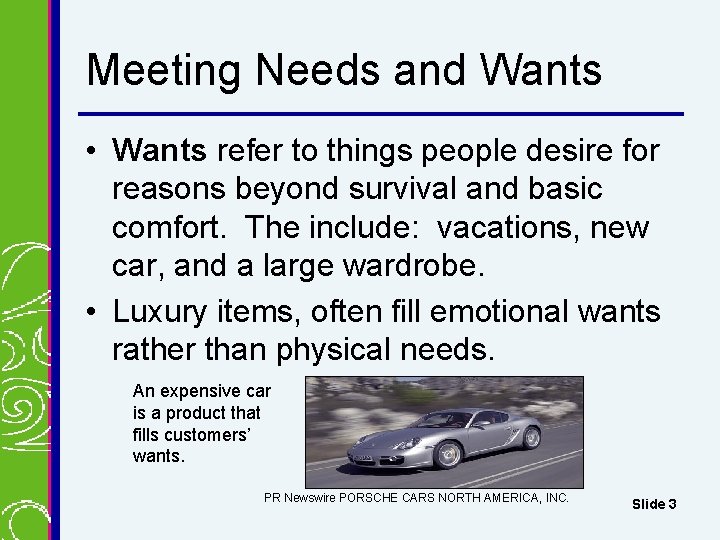
Meeting Needs and Wants • Wants refer to things people desire for reasons beyond survival and basic comfort. The include: vacations, new car, and a large wardrobe. • Luxury items, often fill emotional wants rather than physical needs. An expensive car is a product that fills customers’ wants. PR Newswire PORSCHE CARS NORTH AMERICA, INC. Slide 3
Financial Resources • Money or other assets used to acquire goods and services • Tend to be limited, while needs and wants tend to be unlimited • Most people do not have enough resources to meet all their needs and wants 4 -1 Resources and Choices Slide 4
Financial Resources • People must decide how to use their scarce resources • Discretionary income is the amount of money a person has to spend after needs are met Slide 5
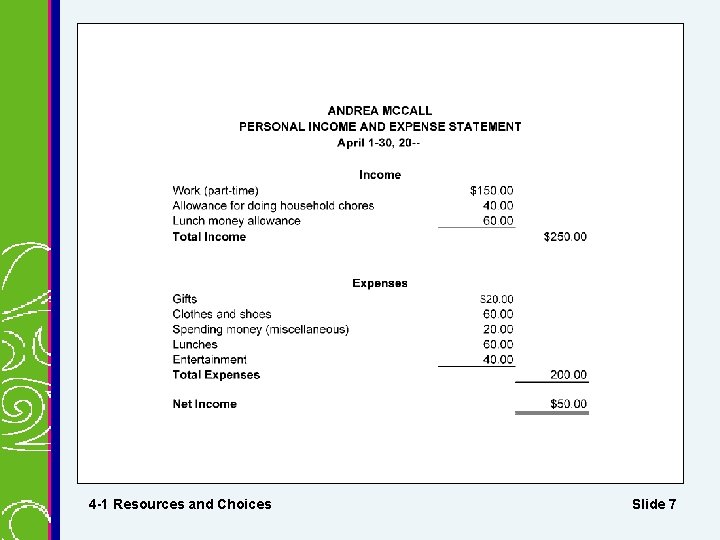
Financial Information Terminology • The flow of money you receive from working, investments, or other sources is income. • Expenses are items for which you must spend money. • Income > Expenses = Net Income • Expenses > Income = Net Loss Slide 6
Personal Income and Expense Statement 4 -1 Resources and Choices Slide 7
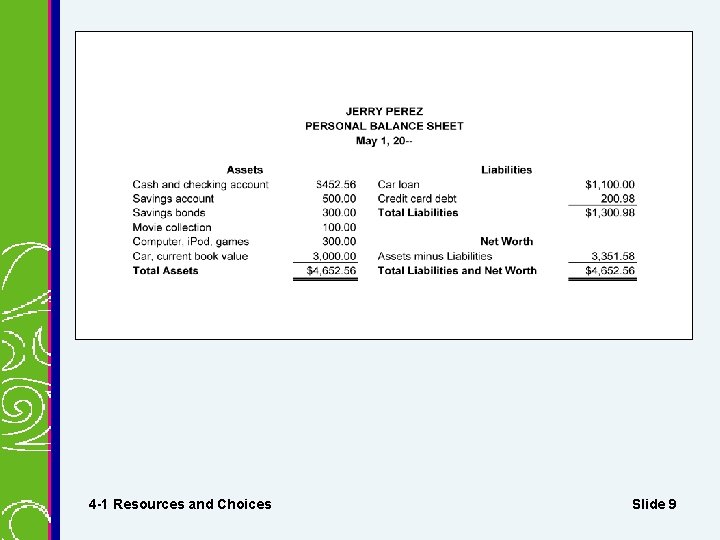
Financial Information Terminology • Money and items of value that you own are assets. • Any debt that you must repay is a liability. • Assets – Liabilities = Net Worth Slide 8
Personal Balance Sheet 4 -1 Resources and Choices Slide 9
Making Financial Choices • Buying decisions play an important part in managing your money • A trade-off involves giving up a particular benefit or item to get another that you think is more desirable • Opportunity cost is the benefit or item you give up (do not buy). 4 -1 Resources and Choices Slide 10
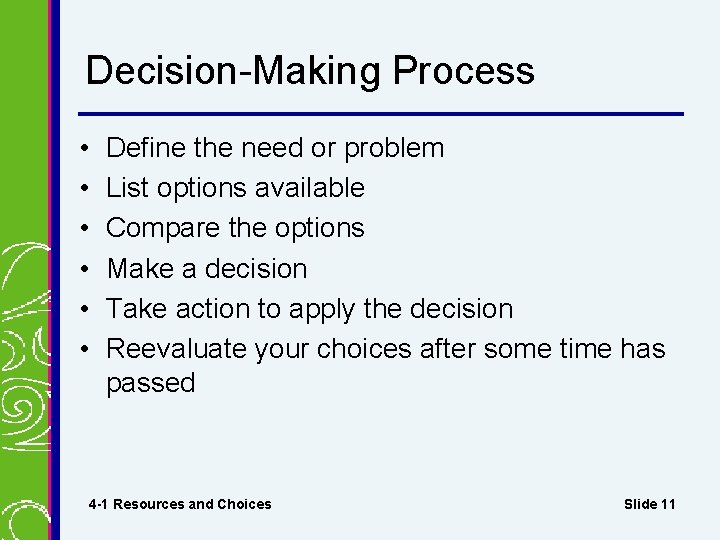
Decision-Making Process • • • Define the need or problem List options available Compare the options Make a decision Take action to apply the decision Reevaluate your choices after some time has passed 4 -1 Resources and Choices Slide 11
Making Good Financial Choices • • Choice you make today will affect your finances tomorrow. Consider the opportunity cost of each item or service you purchase. Make the right choice for you. When in doubt about whether to buy a particular item or service, do not make the purchase. If you are not sure of a choice, keep asking questions or doing research until you know enough to make a good decision. Do not make snap decisions about financial matters. Buyer’s remorse occurs when you make a purchase and then later regret it. Spend less than your income each month. Set aside money for unexpected expenses. Be realistic when deciding which wants you can fill. Learn to enjoy items you have rather than always wanting more items. Take enough time to read all financial agreements. Learn from mistakes you made. Slide 12
Check-In #1 1. How do financial resources limit a person’s spending choices? 2. What are assets? What are Liabilities? 3. How is a person’s net worth calculated? 4. What is the trade-off? What is the opportunity cost? 5. Briefly list 6 steps to follow when making a financial decision. Slide 13
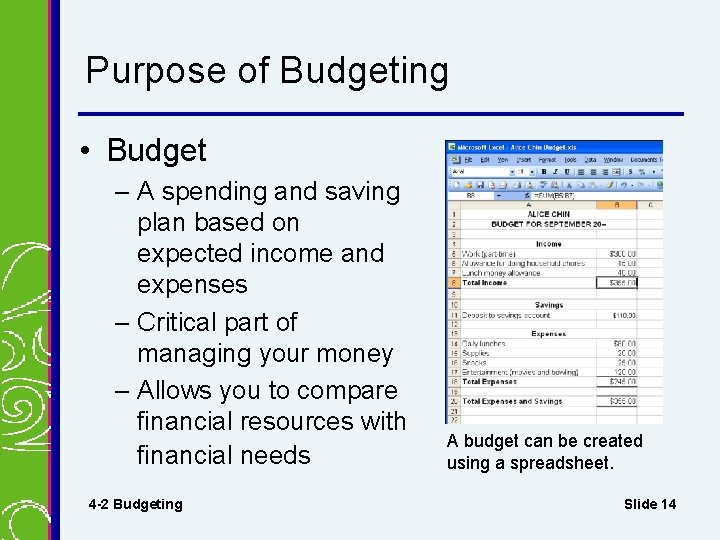
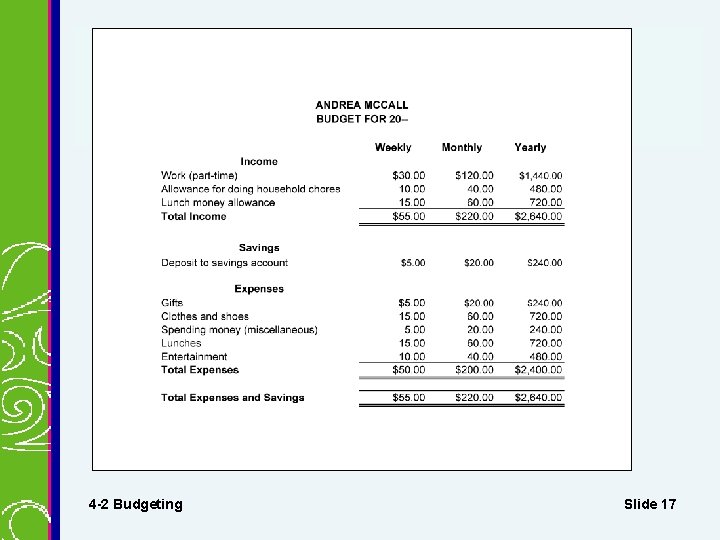
Purpose of Budgeting • Budget – A spending and saving plan based on expected income and expenses – Critical part of managing your money – Allows you to compare financial resources with financial needs 4 -2 Budgeting A budget can be created using a spreadsheet. Slide 14
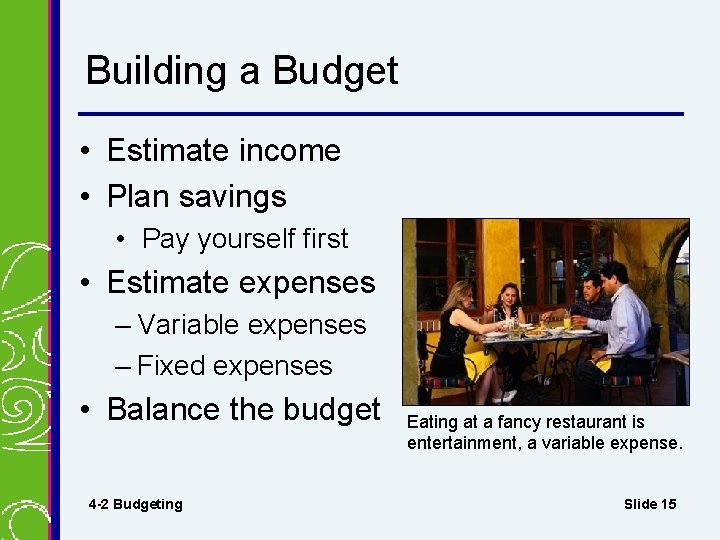
Building a Budget • Estimate income • Plan savings • Pay yourself first • Estimate expenses – Variable expenses – Fixed expenses • Balance the budget 4 -2 Budgeting Eating at a fancy restaurant is entertainment, a variable expense. Slide 15
Pay Yourself First • Put money into savings before you consider other expenses. • If you plan what you want to spend first, you may have no money left for savings. • Put money away in savings to build up money for the future. Slide 16
Personal Budget 4 -2 Budgeting Slide 17
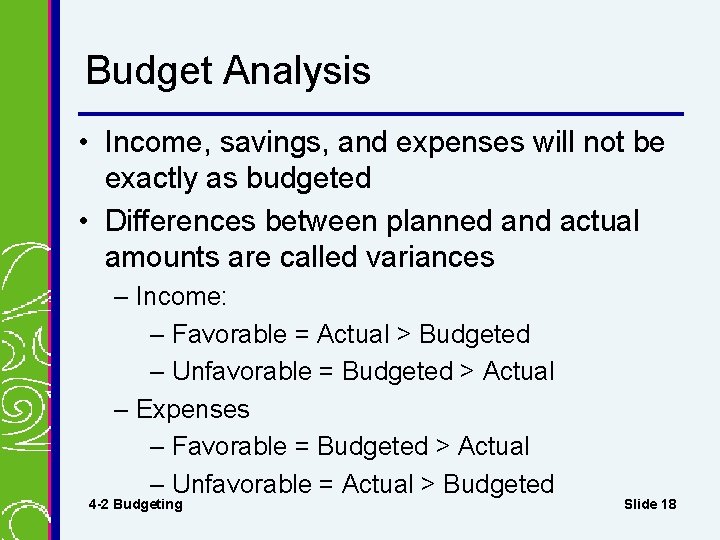
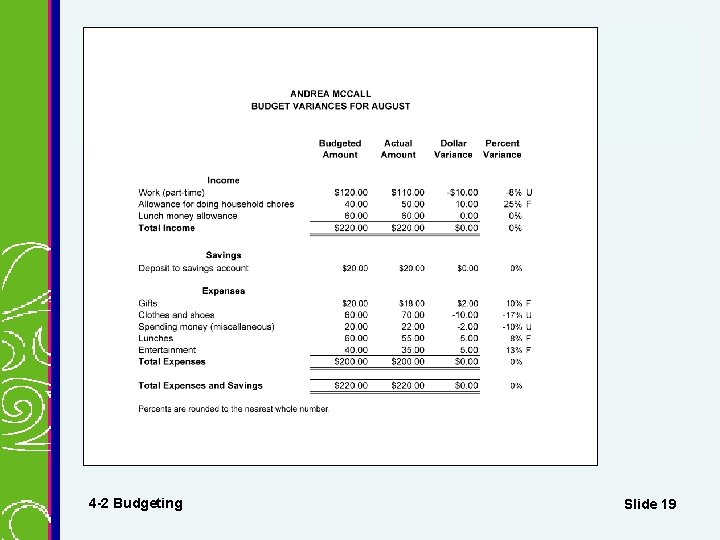
Budget Analysis • Income, savings, and expenses will not be exactly as budgeted • Differences between planned and actual amounts are called variances – Income: – Favorable = Actual > Budgeted – Unfavorable = Budgeted > Actual – Expenses – Favorable = Budgeted > Actual – Unfavorable = Actual > Budgeted 4 -2 Budgeting Slide 18
Budget Variances Report 4 -2 Budgeting Slide 19
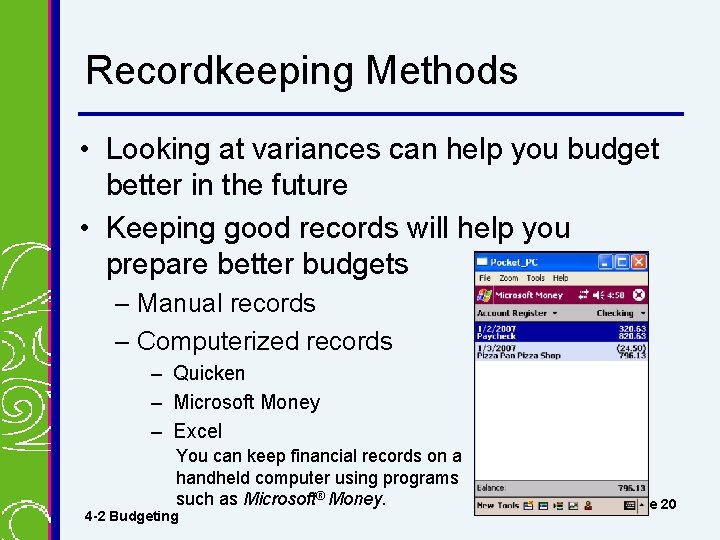
Recordkeeping Methods • Looking at variances can help you budget better in the future • Keeping good records will help you prepare better budgets – Manual records – Computerized records – Quicken – Microsoft Money – Excel You can keep financial records on a handheld computer using programs such as Microsoft® Money. 4 -2 Budgeting Slide 20
Check-In #2 1. What is the purpose of a budget? 2. How are variable expenses different from fixed expenses? 3. Why is it important that a budget be balanced? If your budget does not balance, what can you do to bring it into balance? 4. What is an unfavorable variance? 5. Describe ways to keep financial records manually. Slide 21
Financial Planning • A financial plan contains – Personal goals – Financial goals – Steps to take for achieving goals – A timeline for achieving goals 4 -3 Personal Financial Planning Slide 22
Financial Planning Process • Personal Goals are things you want to achieve (take a vacation). • Financial Goals are how you will pay for your personal goals. – Short-term (1 week to 2 years) – Intermediate (2 to 5 years) – Long-term (more than 5 years) Slide 23
Financial Planning Process • Gather information • Personal income and expense • statements • • Personal balance sheet • • Personal budget • • Current bank account • statements • • Investment account statements • Financial contracts • Other documents related to your finances 4 -3 Personal Financial Planning Checkbooks Insurance policies Current paycheck stub Tax returns Will Trusts Slide 24
Financial Planning Process • Analyze information – Review income and expenses – Review your balance sheet – Consider changing goals or spending habits • Set goals – Personal goals – Financial goals 4 -3 Personal Financial Planning Slide 25
Financial Planning Process • Develop a timeline – Consider how soon you want to achieve each goal – Consider steps you must take to achieve each goal • Implement and evaluate the plan – Work toward achieving goals – Review and adjust the plan at least once a year 4 -3 Personal Financial Planning Slide 26
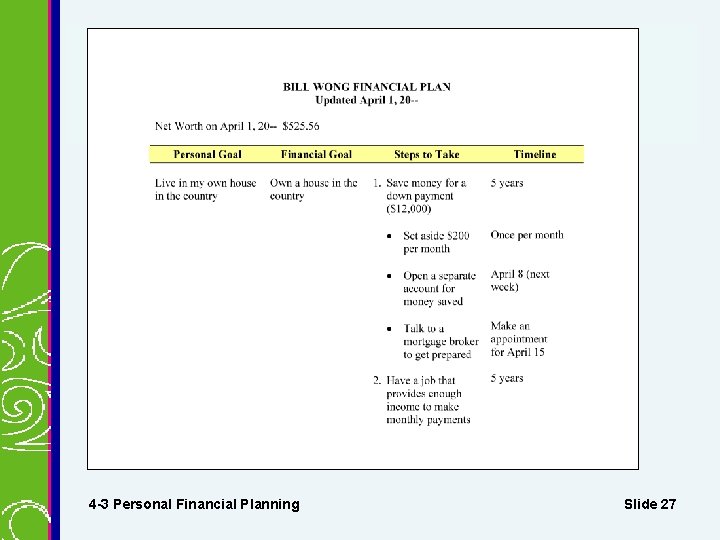
One Goal in a Financial Plan 4 -3 Personal Financial Planning Slide 27
Focus on. . . Phishing • Is a type of Internet scam – You are asked by e-mail to provide personal information such as a bank account number – Your data may be used to commit identity theft or other crimes • To protect yourself, do not send personal data in reply to e-mails that appear to be from a bank or business 4 -3 Personal Financial Planning Slide 28
Ethics Financial Planners and Commission Earnings • A financial planner – Provides financial advice to individuals – May also buy and sell products on commission • Financial planners are unethical if they buy or sell products just to earn a commission • Choose a financial planner you can trust to deal fairly 4 -3 Personal Financial Planning Slide 29
Check-In #3 1. What is the purpose of a financial plan? 2. List the 5 steps in creating a financial plan. 3. What types of information or documents are needed to create a financial plan? 4. How are short-term goals different from long-term goals? 5. Why might you choose a financial planner who does not work on commission rather than one who does? Slide 30