
CHAPTER 16 SLIDE 1 CHAPTER 16 Money Management

- Slides: 21
CHAPTER 16 SLIDE 1 CHAPTER 16 Money Management and Financial Planning 16 -1 Personal Financial Statements 16 -2 Budgeting Techniques 16 -3 Taxes in Your Life 16 -4 Your Financial Future © 2012 Cengage Learning. All Rights Reserved. Principles of Business, 8 e
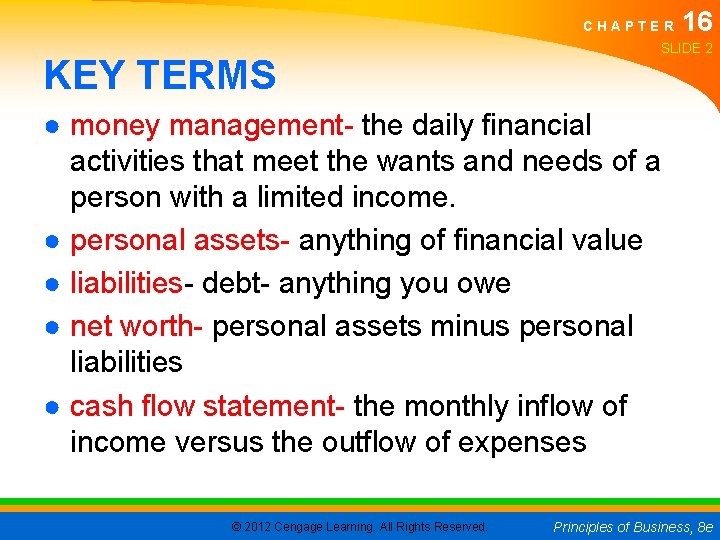
CHAPTER KEY TERMS 16 SLIDE 2 ● money management- the daily financial activities that meet the wants and needs of a person with a limited income. ● personal assets- anything of financial value ● liabilities- debt- anything you owe ● net worth- personal assets minus personal liabilities ● cash flow statement- the monthly inflow of income versus the outflow of expenses © 2012 Cengage Learning. All Rights Reserved. Principles of Business, 8 e
SUCCESSFUL MONEY MANAGERS CHAPTER 16 SLIDE 3 ● Set goals ● Make wise decisions ● Buy wisely ● Live within their income © 2012 Cengage Learning. All Rights Reserved. Principles of Business, 8 e
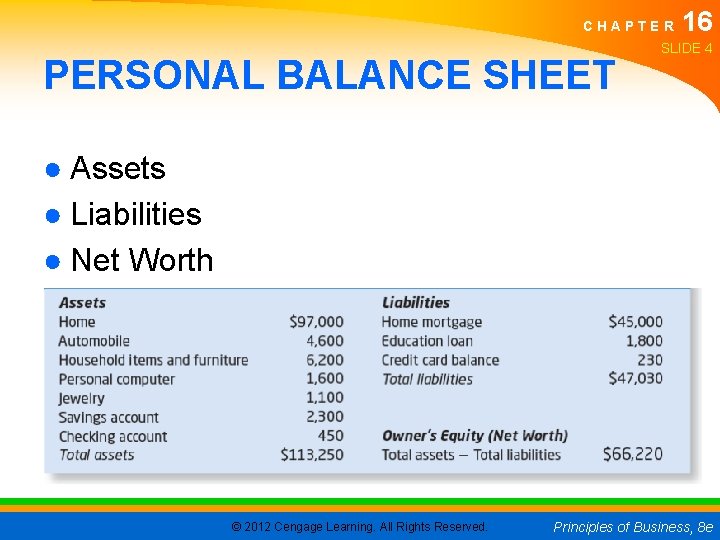
CHAPTER PERSONAL BALANCE SHEET 16 SLIDE 4 ● Assets ● Liabilities ● Net Worth © 2012 Cengage Learning. All Rights Reserved. Principles of Business, 8 e
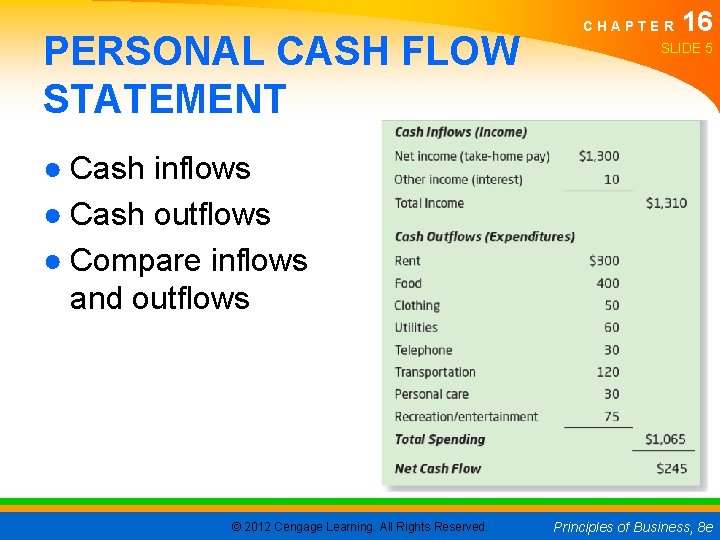
PERSONAL CASH FLOW STATEMENT CHAPTER 16 SLIDE 5 ● Cash inflows ● Cash outflows ● Compare inflows and outflows © 2012 Cengage Learning. All Rights Reserved. Principles of Business, 8 e
16 -2 Budgeting Techniques Goal 1 Identify purposes of a budget. Goal 2 Describe steps for preparing a budget. Goal 3 Describe characteristics of successful budgeting. © 2012 Cengage Learning. All Rights Reserved. SLIDE 6
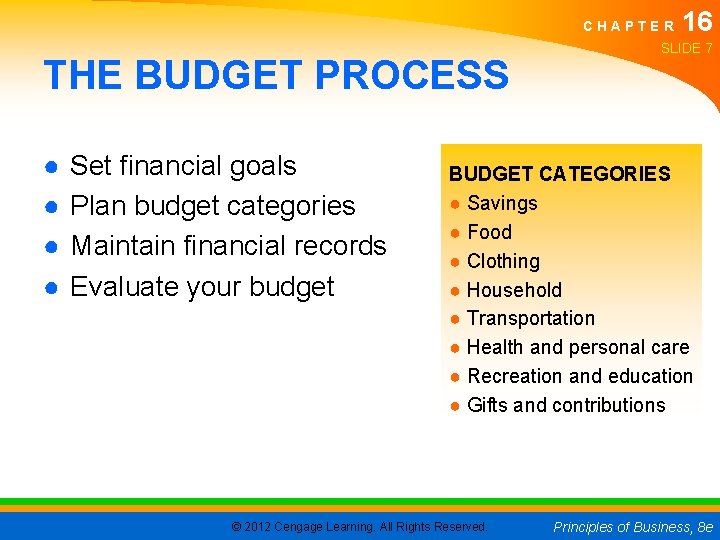
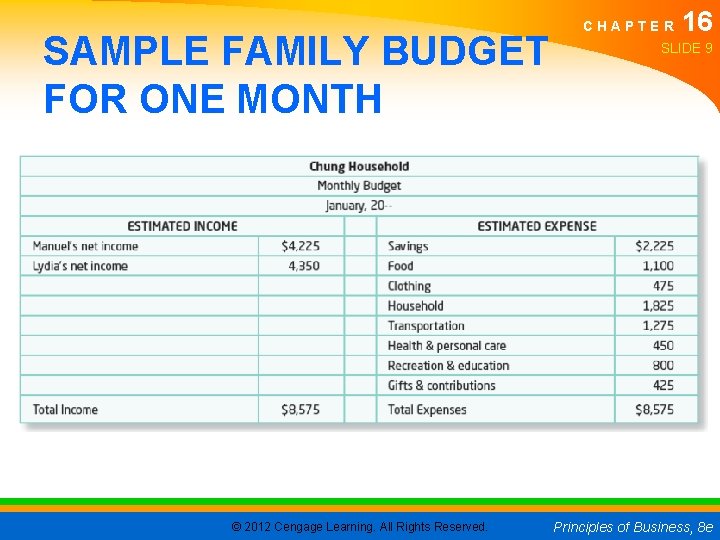
CHAPTER THE BUDGET PROCESS ● ● Set financial goals Plan budget categories Maintain financial records Evaluate your budget 16 SLIDE 7 BUDGET CATEGORIES ● Savings ● Food ● Clothing ● Household ● Transportation ● Health and personal care ● Recreation and education ● Gifts and contributions © 2012 Cengage Learning. All Rights Reserved. Principles of Business, 8 e
CHAPTER KEY TERMS 16 SLIDE 8 ● fixed expenses- monthly expenses that do not change from month to month (example- rent or house payment) ● variable expenses- monthly expenses that change from month to month (example- electricity bill, grocery bills) ● allowance- the amount of money you plan to use for a certain budget category ● budget variance- the changes from month to month of income or expenses © 2012 Cengage Learning. All Rights Reserved. Principles of Business, 8 e
SAMPLE FAMILY BUDGET FOR ONE MONTH © 2012 Cengage Learning. All Rights Reserved. CHAPTER 16 SLIDE 9 Principles of Business, 8 e
16 -3 Taxes in Your Life Goal 1 Identify the types of taxes paid by consumers. Goal 2 Describe the steps when filing a federal income tax return. Goal 3 Explain tax-assistance sources. Goal 4 Identify common tax-planning strategies. © 2012 Cengage Learning. All Rights Reserved. SLIDE 10
CHAPTER 16 SLIDE 11 TAXES ● Taxes- a charge imposed by a government to finance public services 4 AREAS OF TAXATION ● Taxes on purchases ● Taxes on property ● Taxes on wealth ● Taxes on earnings © 2012 Cengage Learning. All Rights Reserved. Principles of Business, 8 e
PREPARING THE FEDERAL INCOME TAX RETURN Step 1: Step 2: Step 3: Step 4: Step 5: Step 6: Step 7: CHAPTER 16 SLIDE 12 Determine gross income Calculate adjusted gross income Subtract deductions Determine exemptions Compute taxable income Taxes owed Make tax payments or ask for a refund or credit © 2012 Cengage Learning. All Rights Reserved. Principles of Business, 8 e
CHAPTER 16 SLIDE 13 Income & Deductions ● Earned Income- Wages from a job ● Investment Income- Income from investments such as stocks, bond, and mutual funds. ● Tax Deductions- Items you can write off from your taxes (example- child care) © 2012 Cengage Learning. All Rights Reserved. Principles of Business, 8 e
16 -4 Your Financial Future Goal 1 Describe the financial planning process. Goal 2 Explain actions for implementing a financial plan. Goal 3 Identify actions for reviewing a financial plan. © 2012 Cengage Learning. All Rights Reserved. SLIDE 14
CHAPTER KEY TERMS 16 SLIDE 15 ● financial plan- a report that summarizes your current financial condition while preparing for future expenses. ● individual retirement account (IRA)- an account set up for retirement that has tax benefits (tax deferred or tax free earnings) © 2012 Cengage Learning. All Rights Reserved. Principles of Business, 8 e
DEVOLPING A FINANCIAL PLAN CHAPTER 16 SLIDE 16 ● A financial plan is a report that ● Summarizes your current financial condition ● Acknowledges your financial needs ● Sets a direction for your future financial activities ● Financial planning includes ● Evaluating one’s financial position ● Setting financial goals ● Guiding activities and resources toward reaching those goals © 2012 Cengage Learning. All Rights Reserved. Principles of Business, 8 e
FINANCIAL PLANNING PROCESS CHAPTER 16 SLIDE 17 1. Analyze your current financial condition 2. Develop financial goals that are responsive to your vision 3. Create your financial plan 4. Implement the plan 5. Revise your financial plan © 2012 Cengage Learning. All Rights Reserved. Principles of Business, 8 e
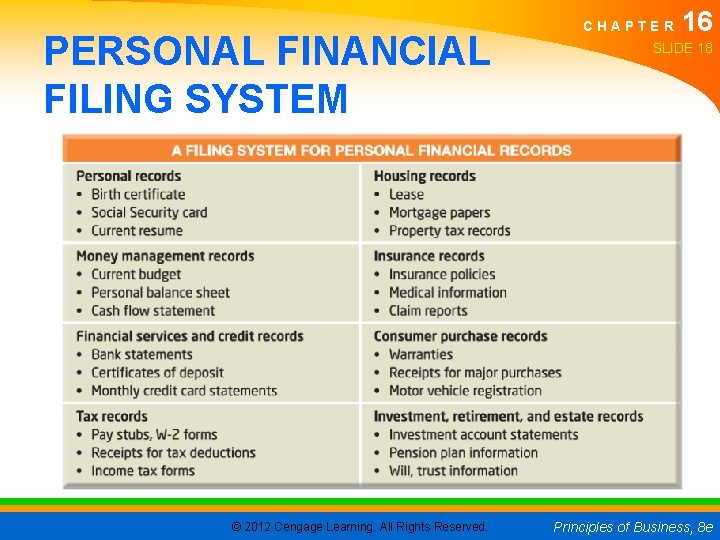
PERSONAL FINANCIAL FILING SYSTEM © 2012 Cengage Learning. All Rights Reserved. CHAPTER 16 SLIDE 18 Principles of Business, 8 e
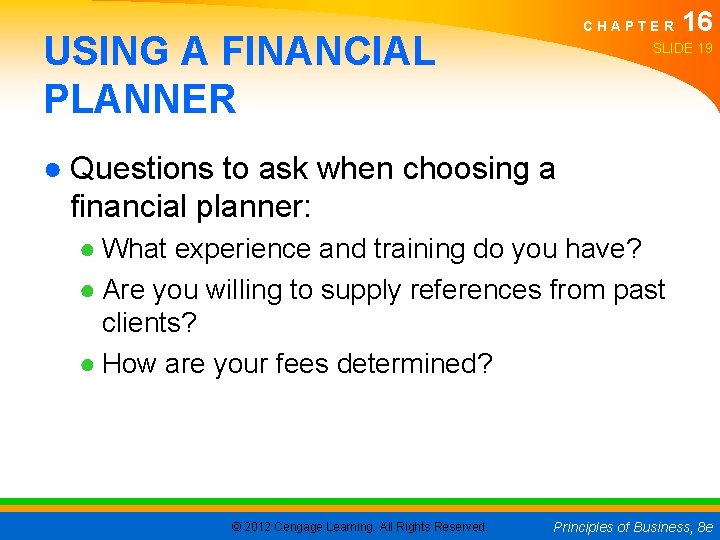
CHAPTER USING A FINANCIAL PLANNER 16 SLIDE 19 ● Questions to ask when choosing a financial planner: ● What experience and training do you have? ● Are you willing to supply references from past clients? ● How are your fees determined? © 2012 Cengage Learning. All Rights Reserved. Principles of Business, 8 e
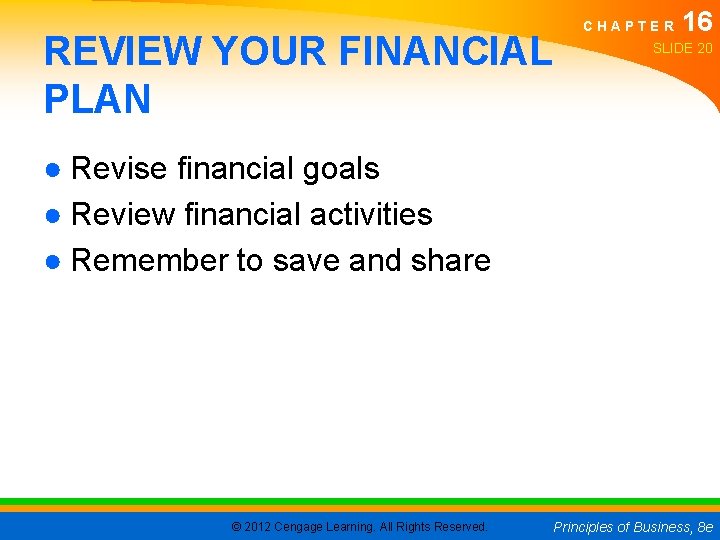
REVIEW YOUR FINANCIAL PLAN CHAPTER 16 SLIDE 20 ● Revise financial goals ● Review financial activities ● Remember to save and share © 2012 Cengage Learning. All Rights Reserved. Principles of Business, 8 e
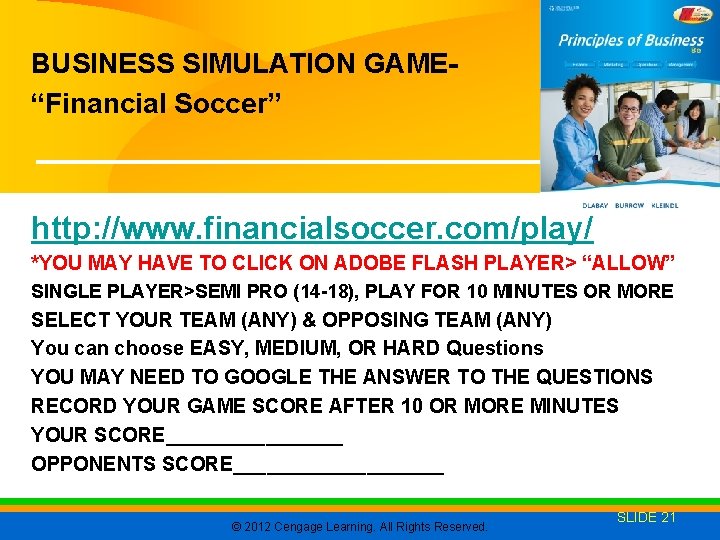
BUSINESS SIMULATION GAME“Financial Soccer” http: //www. financialsoccer. com/play/ *YOU MAY HAVE TO CLICK ON ADOBE FLASH PLAYER> “ALLOW” SINGLE PLAYER>SEMI PRO (14 -18), PLAY FOR 10 MINUTES OR MORE SELECT YOUR TEAM (ANY) & OPPOSING TEAM (ANY) You can choose EASY, MEDIUM, OR HARD Questions YOU MAY NEED TO GOOGLE THE ANSWER TO THE QUESTIONS RECORD YOUR GAME SCORE AFTER 10 OR MORE MINUTES YOUR SCORE________ OPPONENTS SCORE__________ © 2012 Cengage Learning. All Rights Reserved. SLIDE 21