CSCE 430830 Computer Architecture Pipeline Hazards Lecturer Prof


- Slides: 94
CSCE 430/830 Computer Architecture Pipeline: Hazards Lecturer: Prof. Hong Jiang Courtesy of Prof. Yifeng Zhu, U. of Maine Fall, 2006 CSCE 430/830 Portions of these slides are derived from: Dave Patterson © UCB Pipeline Hazards
Pipelining Outline • Introduction – Defining Pipelining – Pipelining Instructions • Hazards – Structural hazards – Data Hazards – Control Hazards • Performance • Controller implementation CSCE 430/830 Pipeline Hazards
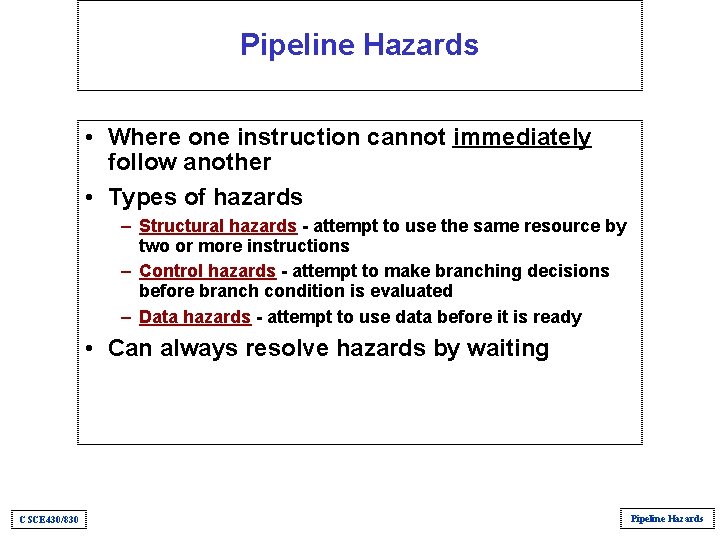
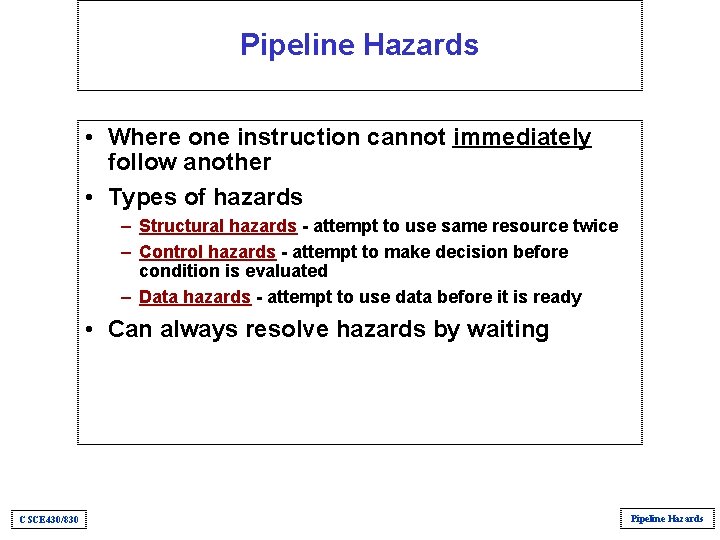
Pipeline Hazards • Where one instruction cannot immediately follow another • Types of hazards – Structural hazards - attempt to use the same resource by two or more instructions – Control hazards - attempt to make branching decisions before branch condition is evaluated – Data hazards - attempt to use data before it is ready • Can always resolve hazards by waiting CSCE 430/830 Pipeline Hazards
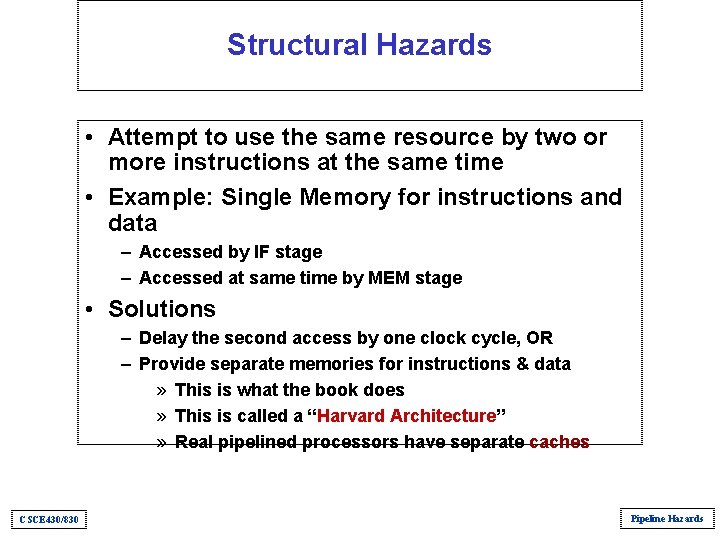
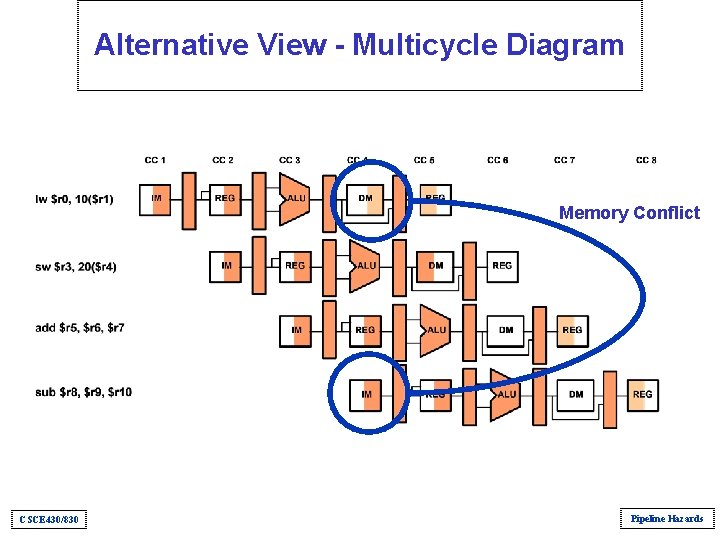
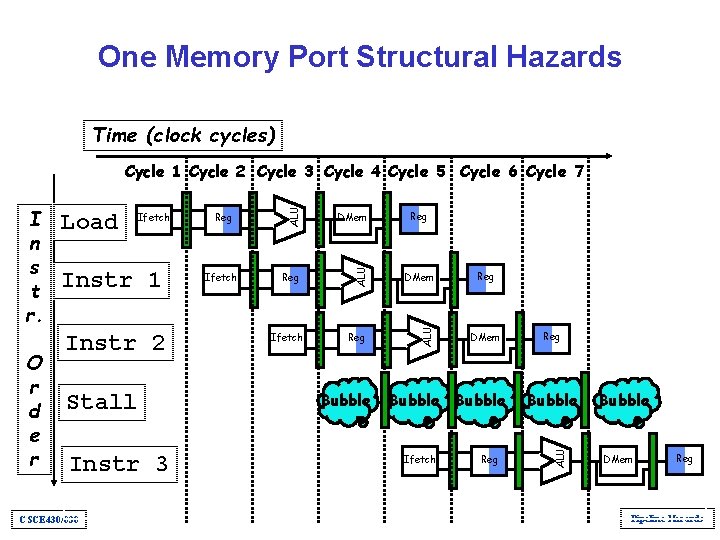
Structural Hazards • Attempt to use the same resource by two or more instructions at the same time • Example: Single Memory for instructions and data – Accessed by IF stage – Accessed at same time by MEM stage • Solutions – Delay the second access by one clock cycle, OR – Provide separate memories for instructions & data » This is what the book does » This is called a “Harvard Architecture” » Real pipelined processors have separate caches CSCE 430/830 Pipeline Hazards
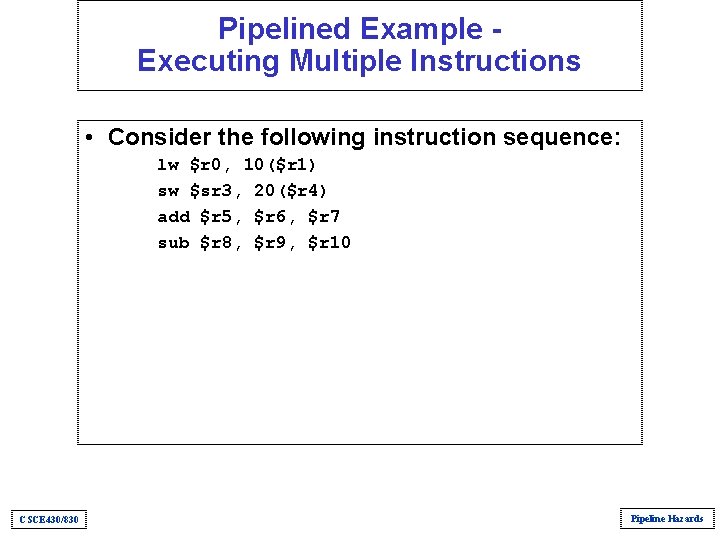
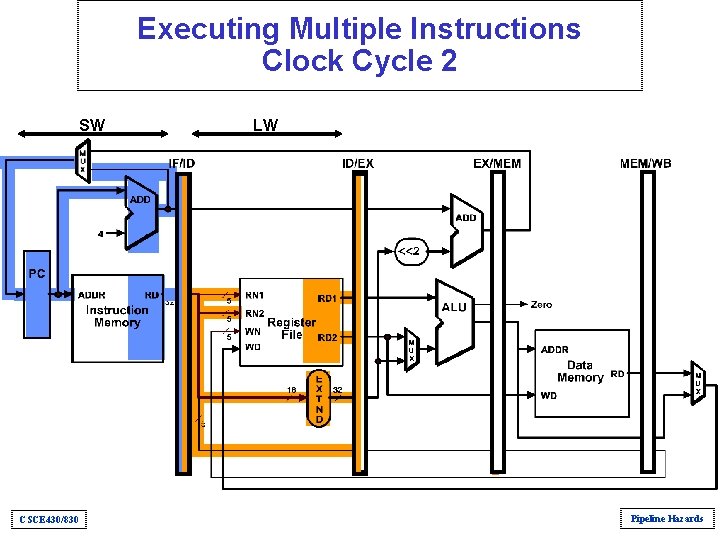
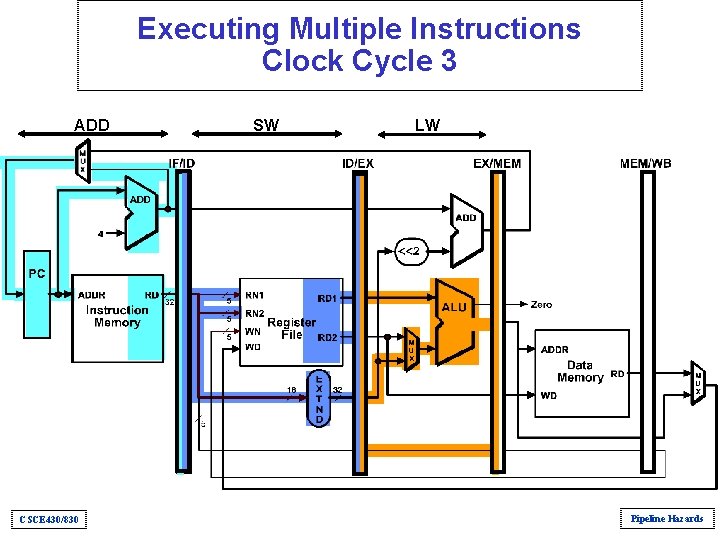
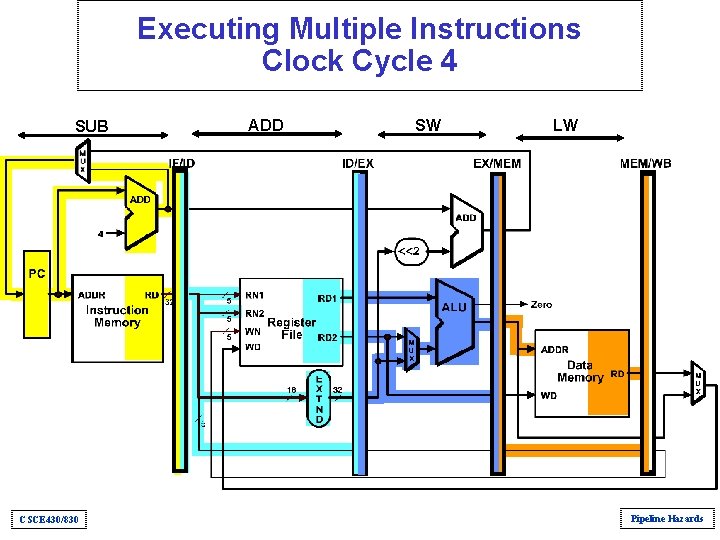
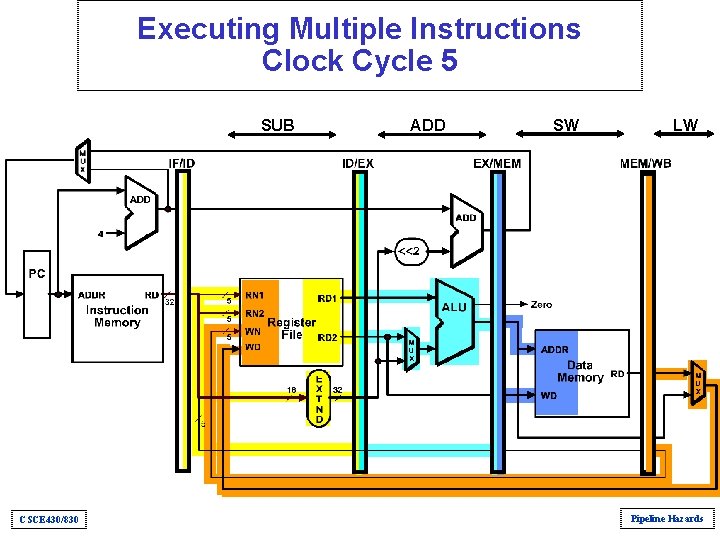
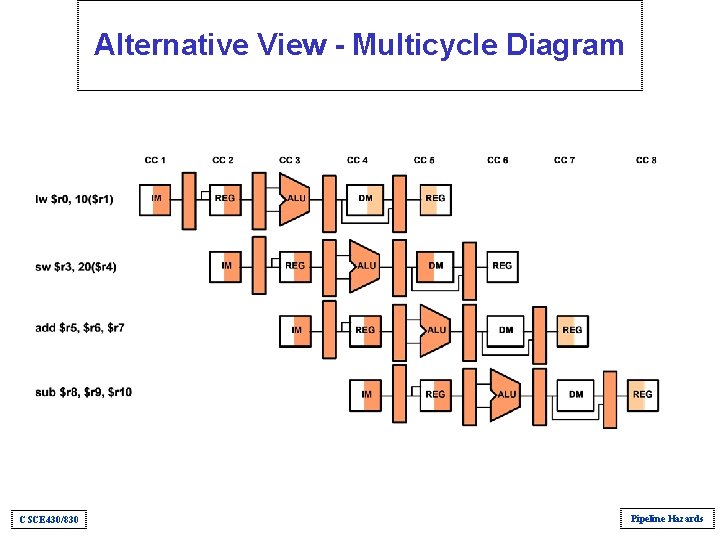
Pipelined Example Executing Multiple Instructions • Consider the following instruction sequence: lw $r 0, 10($r 1) sw $sr 3, 20($r 4) add $r 5, $r 6, $r 7 sub $r 8, $r 9, $r 10 CSCE 430/830 Pipeline Hazards
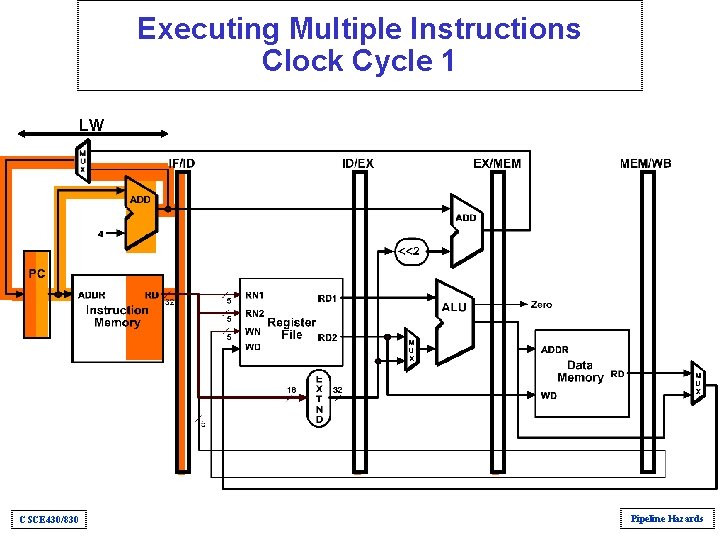
Executing Multiple Instructions Clock Cycle 1 LW CSCE 430/830 Pipeline Hazards
Executing Multiple Instructions Clock Cycle 2 SW CSCE 430/830 LW Pipeline Hazards
Executing Multiple Instructions Clock Cycle 3 ADD CSCE 430/830 SW LW Pipeline Hazards
Executing Multiple Instructions Clock Cycle 4 SUB CSCE 430/830 ADD SW LW Pipeline Hazards
Executing Multiple Instructions Clock Cycle 5 SUB CSCE 430/830 ADD SW LW Pipeline Hazards
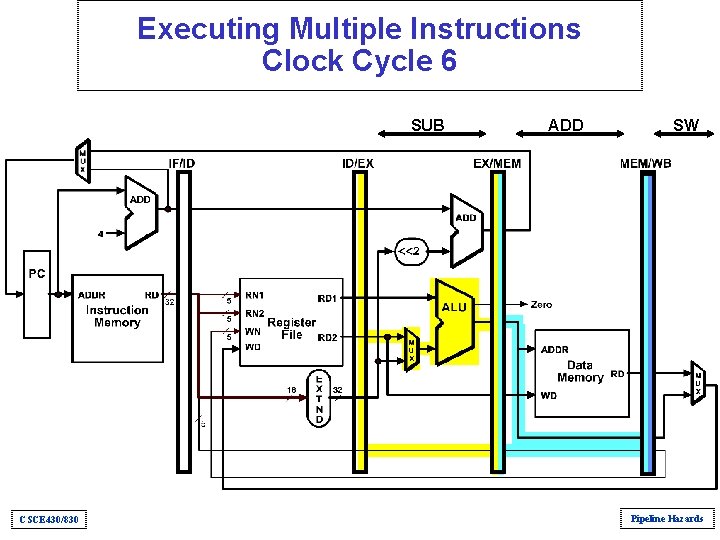
Executing Multiple Instructions Clock Cycle 6 SUB CSCE 430/830 ADD SW Pipeline Hazards
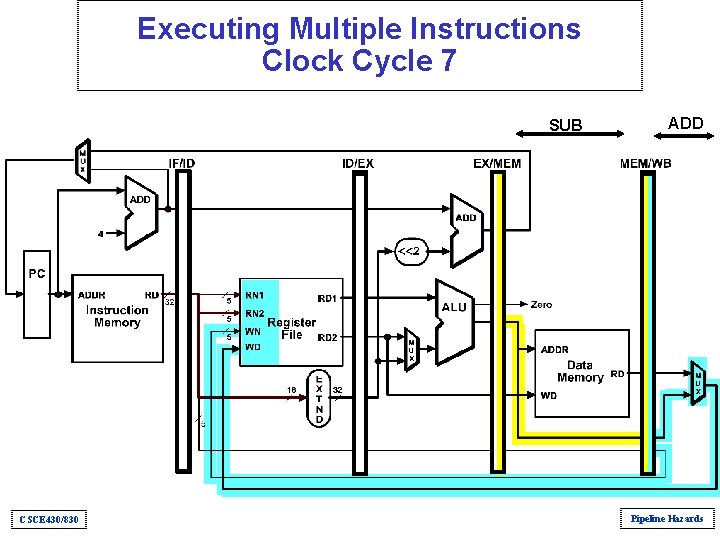
Executing Multiple Instructions Clock Cycle 7 SUB CSCE 430/830 ADD Pipeline Hazards
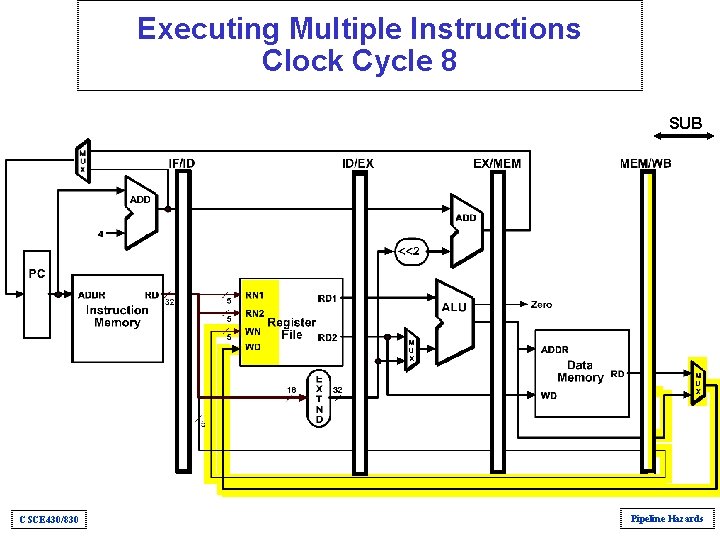
Executing Multiple Instructions Clock Cycle 8 SUB CSCE 430/830 Pipeline Hazards
Alternative View - Multicycle Diagram CSCE 430/830 Pipeline Hazards
Alternative View - Multicycle Diagram Memory Conflict CSCE 430/830 Pipeline Hazards
One Memory Port Structural Hazards Time (clock cycles) Instr 1 Instr 2 Stall Instr 3 CSCE 430/830 Reg Ifetch DMem Reg ALU Ifetch Bubble Reg DMem Bubble Ifetch Reg Bubble ALU O r d e r Load ALU I n s t r. ALU Cycle 1 Cycle 2 Cycle 3 Cycle 4 Cycle 5 Cycle 6 Cycle 7 Bubble DMem Reg Pipeline Hazards
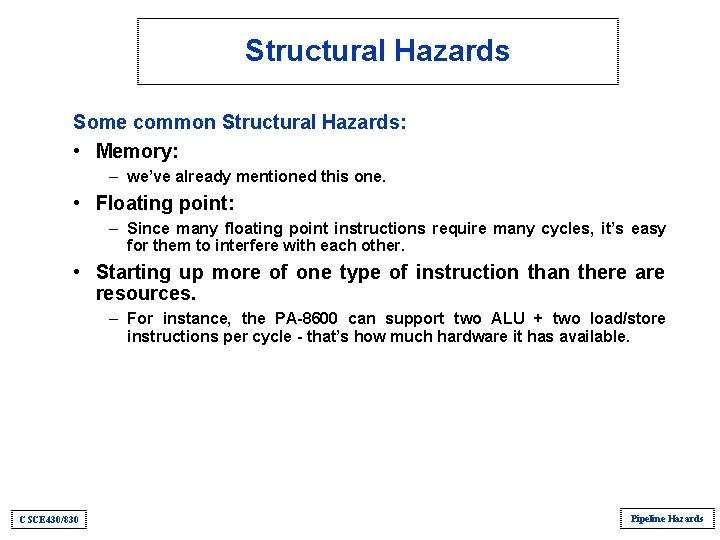
Structural Hazards Some common Structural Hazards: • Memory: – we’ve already mentioned this one. • Floating point: – Since many floating point instructions require many cycles, it’s easy for them to interfere with each other. • Starting up more of one type of instruction than there are resources. – For instance, the PA-8600 can support two ALU + two load/store instructions per cycle - that’s how much hardware it has available. CSCE 430/830 Pipeline Hazards
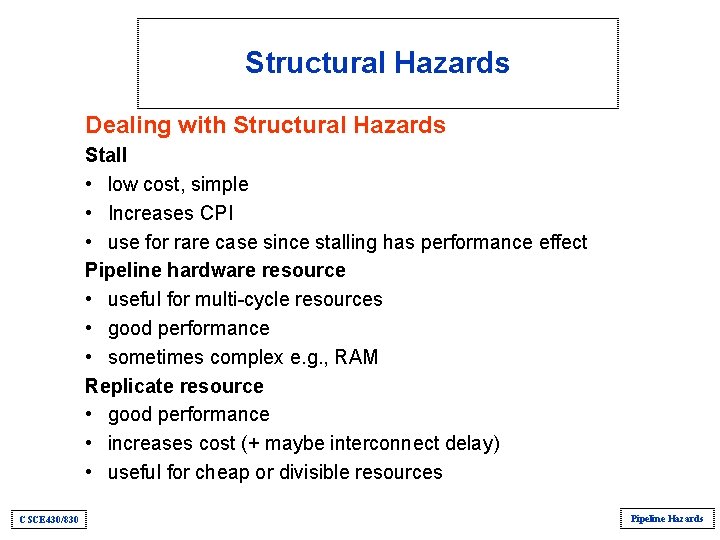
Structural Hazards Dealing with Structural Hazards Stall • low cost, simple • Increases CPI • use for rare case since stalling has performance effect Pipeline hardware resource • useful for multi cycle resources • good performance • sometimes complex e. g. , RAM Replicate resource • good performance • increases cost (+ maybe interconnect delay) • useful for cheap or divisible resources CSCE 430/830 Pipeline Hazards
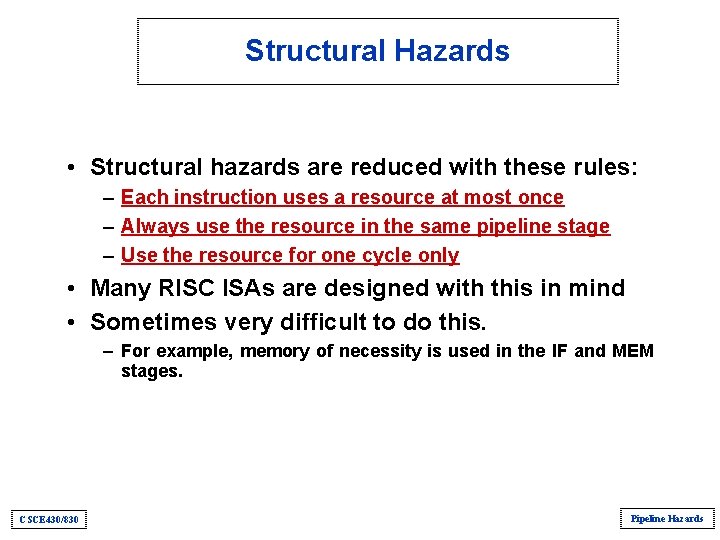
Structural Hazards • Structural hazards are reduced with these rules: – Each instruction uses a resource at most once – Always use the resource in the same pipeline stage – Use the resource for one cycle only • Many RISC ISAs are designed with this in mind • Sometimes very difficult to do this. – For example, memory of necessity is used in the IF and MEM stages. CSCE 430/830 Pipeline Hazards
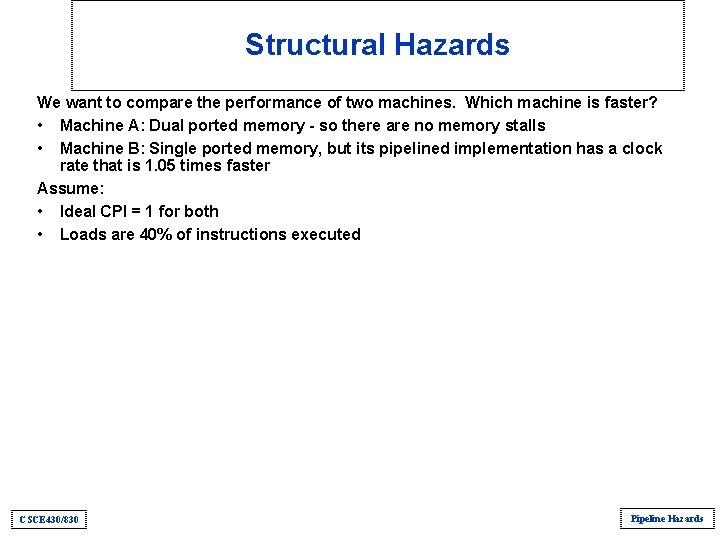
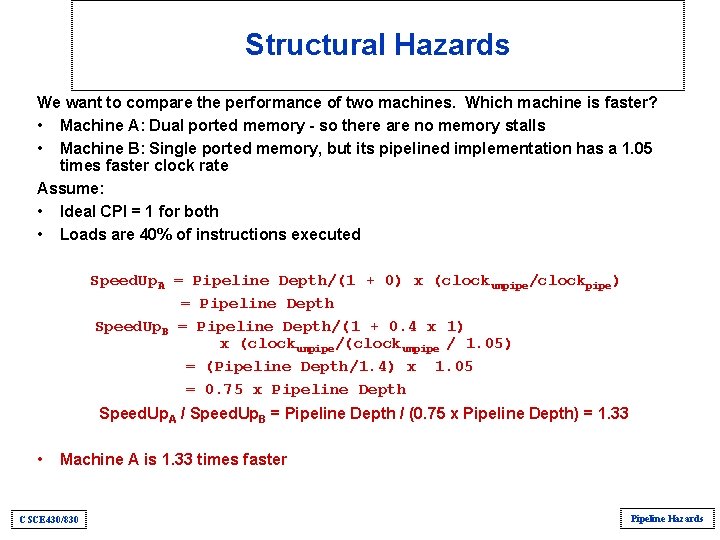
Structural Hazards We want to compare the performance of two machines. Which machine is faster? • Machine A: Dual ported memory - so there are no memory stalls • Machine B: Single ported memory, but its pipelined implementation has a clock rate that is 1. 05 times faster Assume: • Ideal CPI = 1 for both • Loads are 40% of instructions executed CSCE 430/830 Pipeline Hazards
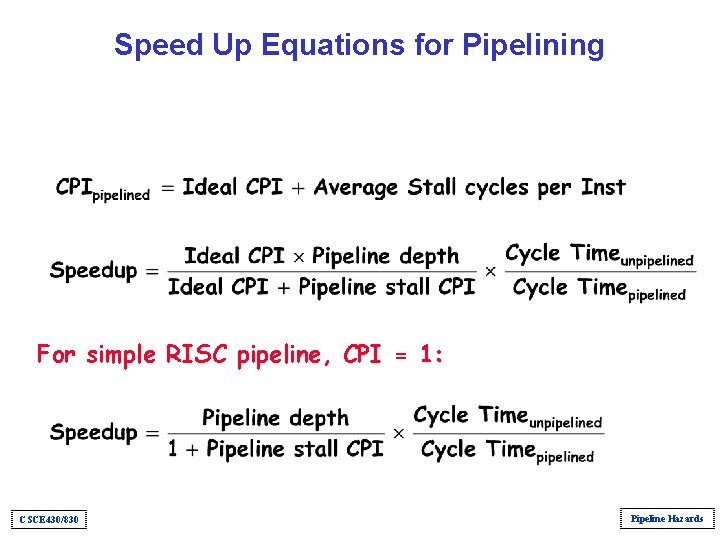
Speed Up Equations for Pipelining For simple RISC pipeline, CPI = 1: CSCE 430/830 Pipeline Hazards
Structural Hazards We want to compare the performance of two machines. Which machine is faster? • Machine A: Dual ported memory - so there are no memory stalls • Machine B: Single ported memory, but its pipelined implementation has a 1. 05 times faster clock rate Assume: • Ideal CPI = 1 for both • Loads are 40% of instructions executed Speed. Up. A = Pipeline Depth/(1 + 0) x (clockunpipe/clockpipe) = Pipeline Depth Speed. Up. B = Pipeline Depth/(1 + 0. 4 x 1) x (clockunpipe/(clockunpipe / 1. 05) = (Pipeline Depth/1. 4) x 1. 05 = 0. 75 x Pipeline Depth Speed. Up. A / Speed. Up. B = Pipeline Depth / (0. 75 x Pipeline Depth) = 1. 33 • Machine A is 1. 33 times faster CSCE 430/830 Pipeline Hazards
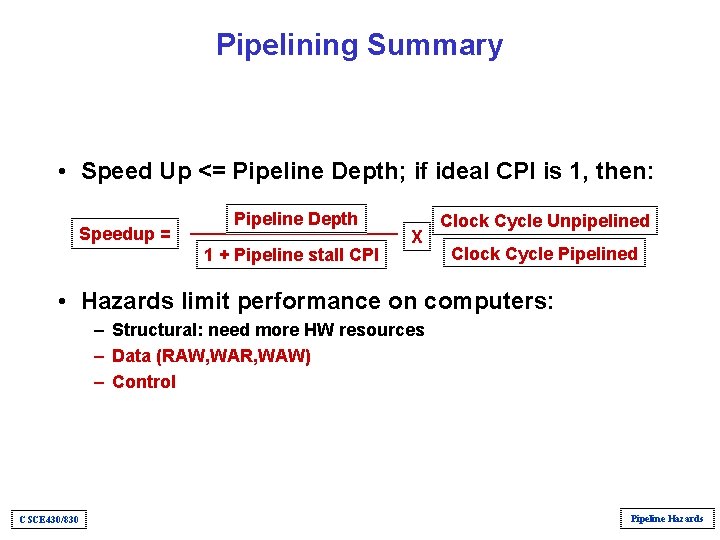
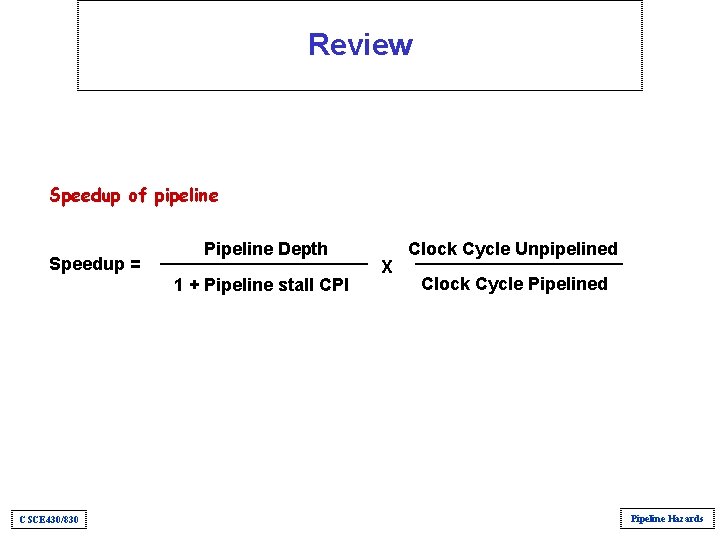
Pipelining Summary • Speed Up <= Pipeline Depth; if ideal CPI is 1, then: Speedup = Pipeline Depth 1 + Pipeline stall CPI X Clock Cycle Unpipelined Clock Cycle Pipelined • Hazards limit performance on computers: – Structural: need more HW resources – Data (RAW, WAR, WAW) – Control CSCE 430/830 Pipeline Hazards
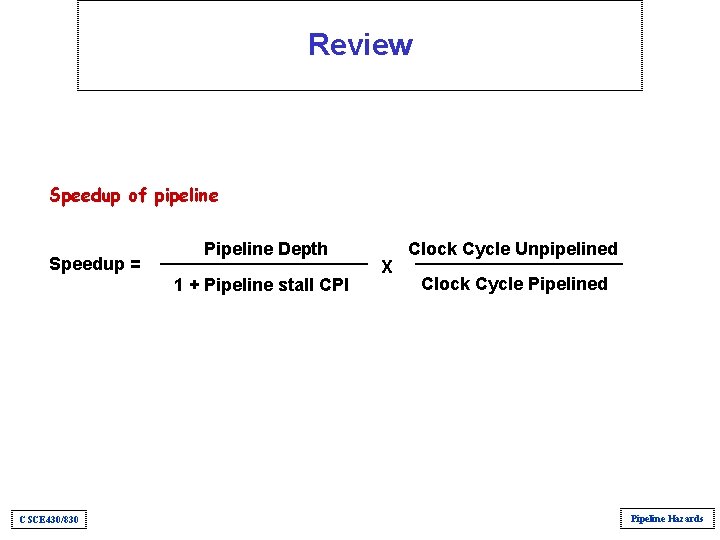
Review Speedup of pipeline Speedup = Pipeline Depth 1 + Pipeline stall CPI CSCE 430/830 X Clock Cycle Unpipelined Clock Cycle Pipelined Pipeline Hazards
Pipelining Outline • Introduction – Defining Pipelining – Pipelining Instructions • Hazards – Structural hazards – Data Hazards – Control Hazards • Performance • Controller implementation CSCE 430/830 Pipeline Hazards
Pipeline Hazards • Where one instruction cannot immediately follow another • Types of hazards – Structural hazards - attempt to use same resource twice – Control hazards - attempt to make decision before condition is evaluated – Data hazards - attempt to use data before it is ready • Can always resolve hazards by waiting CSCE 430/830 Pipeline Hazards
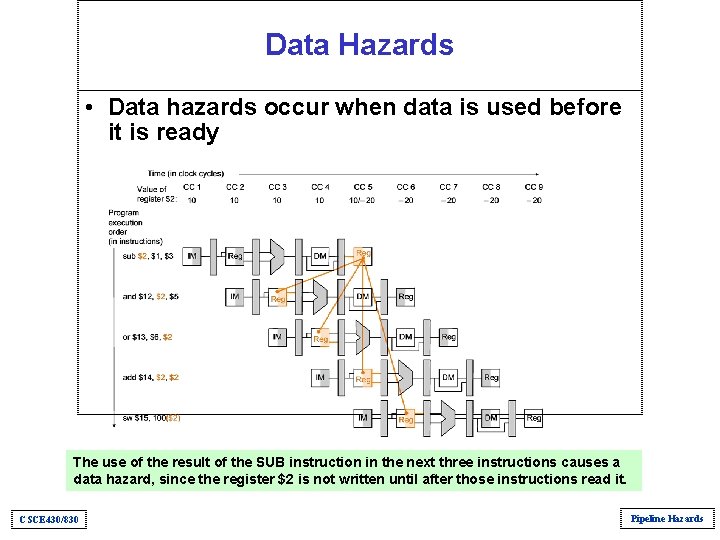
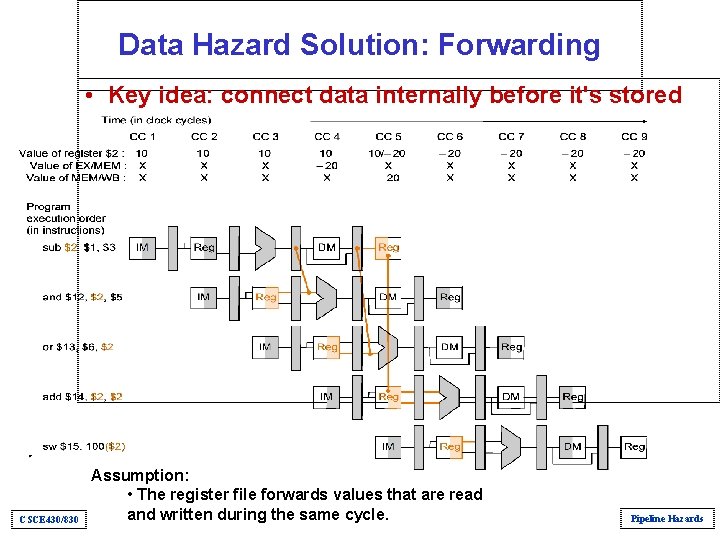
Data Hazards • Data hazards occur when data is used before it is ready The use of the result of the SUB instruction in the next three instructions causes a data hazard, since the register $2 is not written until after those instructions read it. CSCE 430/830 Pipeline Hazards
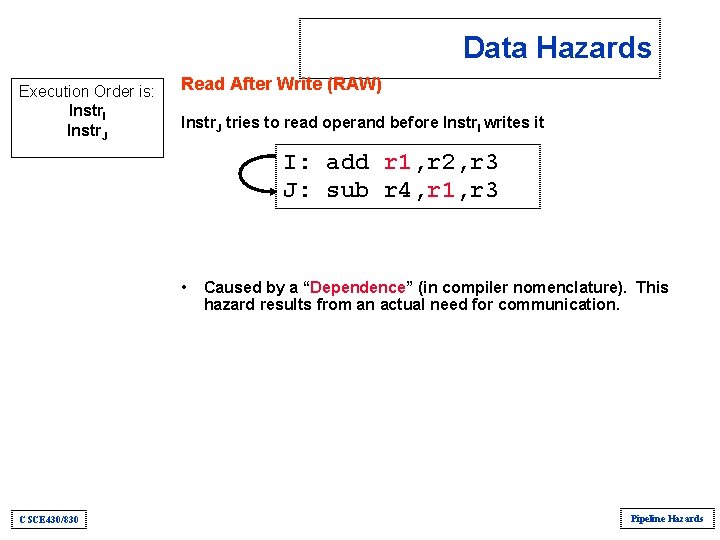
Data Hazards Execution Order is: Instr. I Instr. J Read After Write (RAW) Instr. J tries to read operand before Instr. I writes it I: add r 1, r 2, r 3 J: sub r 4, r 1, r 3 • CSCE 430/830 Caused by a “Dependence” (in compiler nomenclature). This hazard results from an actual need for communication. Pipeline Hazards
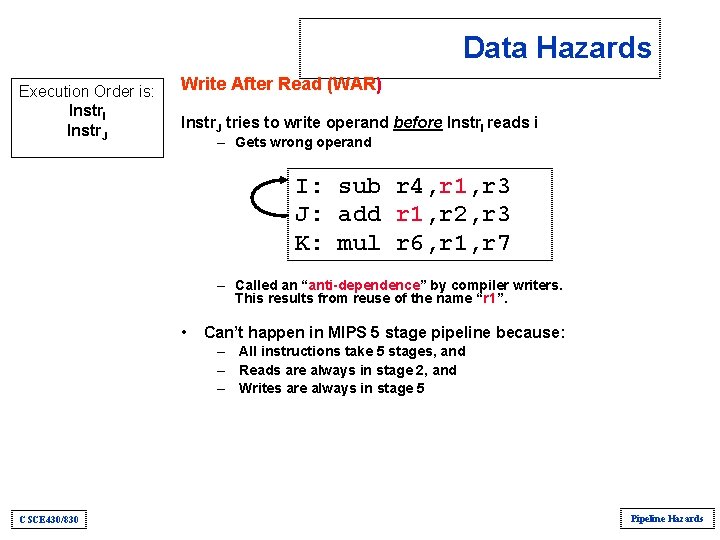
Data Hazards Execution Order is: Instr. I Instr. J Write After Read (WAR) Instr. J tries to write operand before Instr. I reads i – Gets wrong operand I: sub r 4, r 1, r 3 J: add r 1, r 2, r 3 K: mul r 6, r 1, r 7 – Called an “anti-dependence” by compiler writers. This results from reuse of the name “r 1”. • Can’t happen in MIPS 5 stage pipeline because: – All instructions take 5 stages, and – Reads are always in stage 2, and – Writes are always in stage 5 CSCE 430/830 Pipeline Hazards
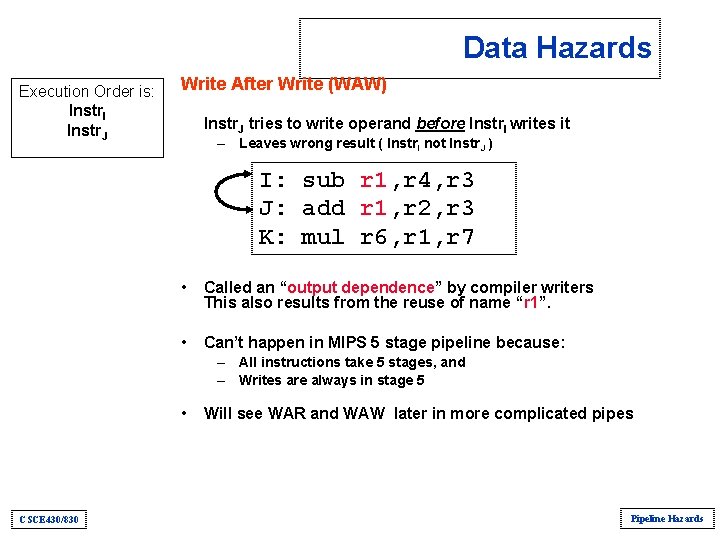
Data Hazards Execution Order is: Instr. I Instr. J Write After Write (WAW) Instr. J tries to write operand before Instr. I writes it – Leaves wrong result ( Instr. I not Instr. J ) I: sub r 1, r 4, r 3 J: add r 1, r 2, r 3 K: mul r 6, r 1, r 7 • Called an “output dependence” by compiler writers This also results from the reuse of name “r 1”. • Can’t happen in MIPS 5 stage pipeline because: – All instructions take 5 stages, and – Writes are always in stage 5 • CSCE 430/830 Will see WAR and WAW later in more complicated pipes Pipeline Hazards
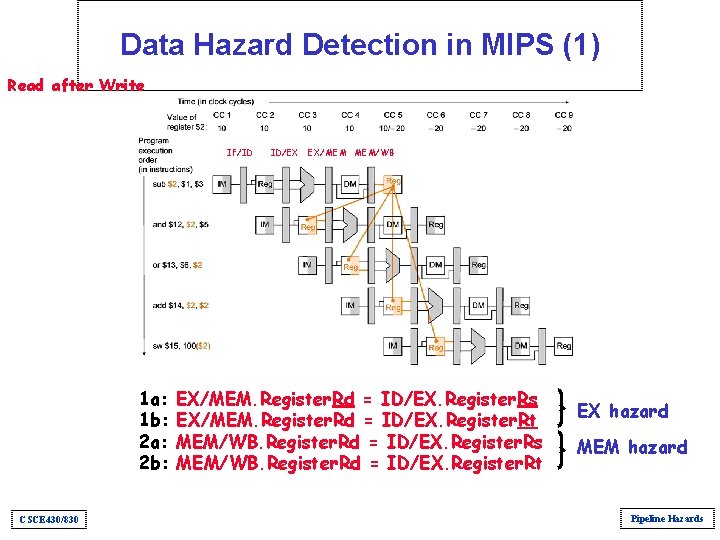
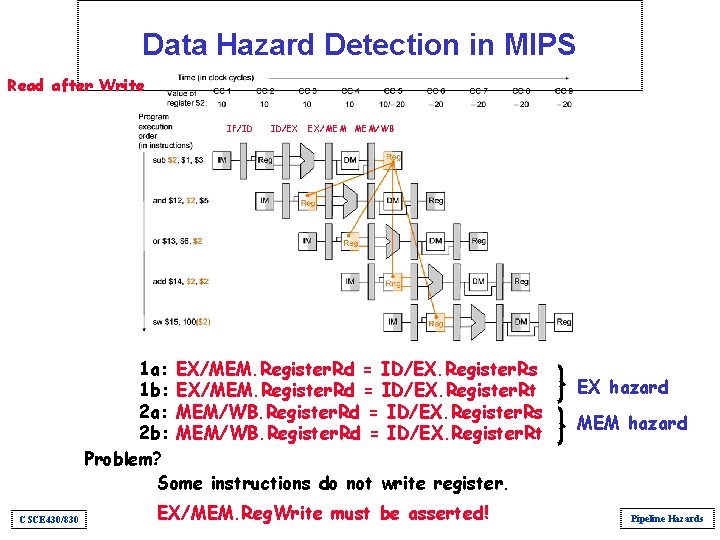
Data Hazard Detection in MIPS (1) Read after Write IF/ID 1 a: 1 b: 2 a: 2 b: CSCE 430/830 ID/EX EX/MEM MEM/WB EX/MEM. Register. Rd = ID/EX. Register. Rs EX/MEM. Register. Rd = ID/EX. Register. Rt MEM/WB. Register. Rd = ID/EX. Register. Rs MEM/WB. Register. Rd = ID/EX. Register. Rt EX hazard MEM hazard Pipeline Hazards
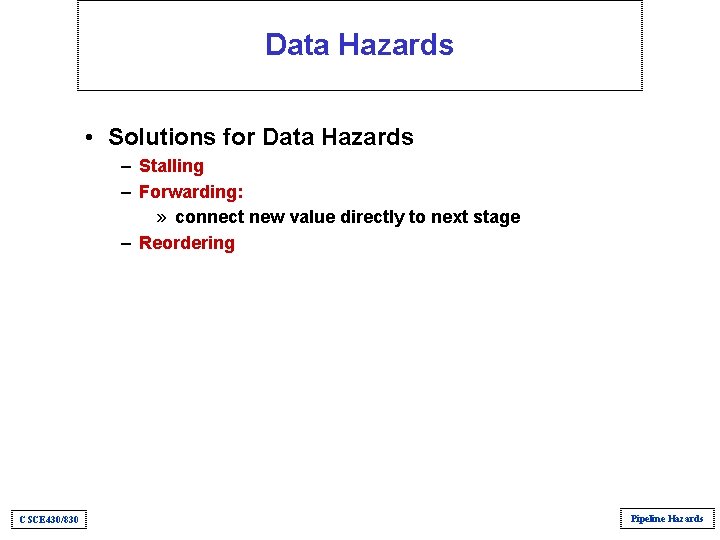
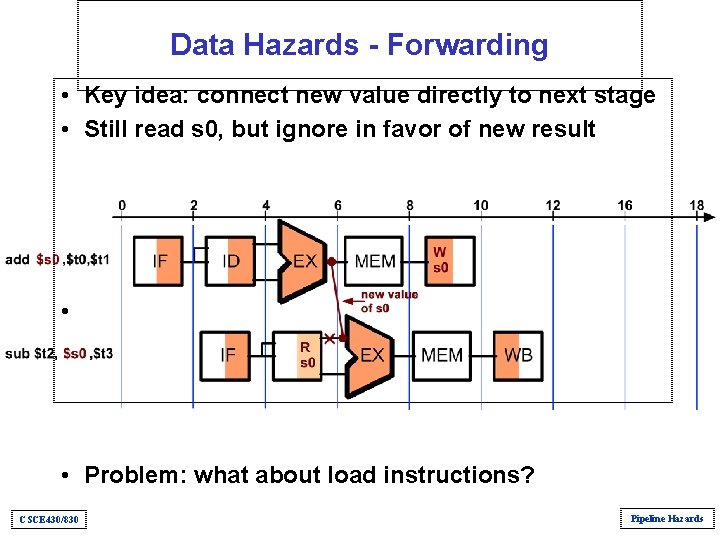
Data Hazards • Solutions for Data Hazards – Stalling – Forwarding: » connect new value directly to next stage – Reordering CSCE 430/830 Pipeline Hazards
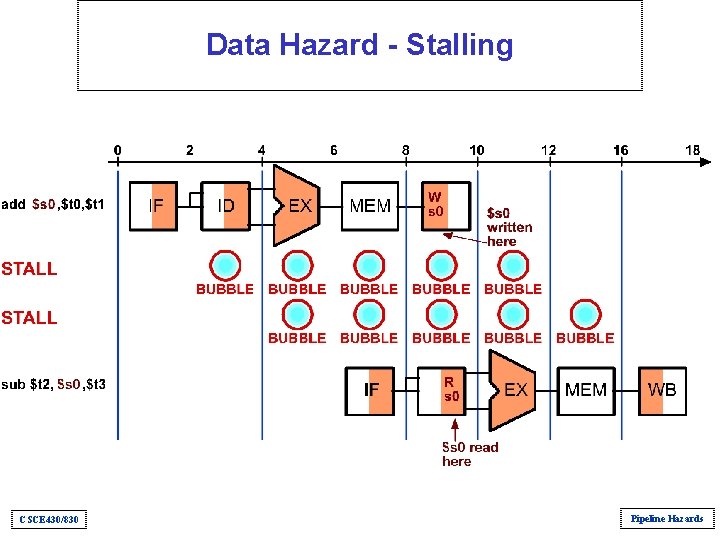
Data Hazard - Stalling CSCE 430/830 Pipeline Hazards
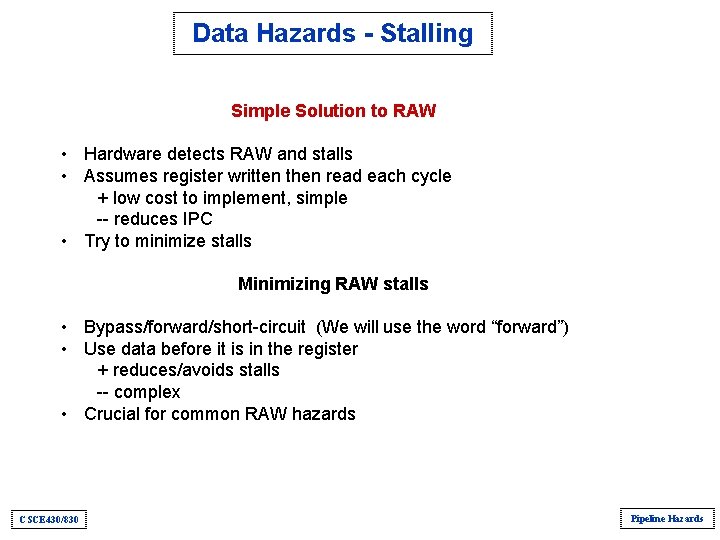
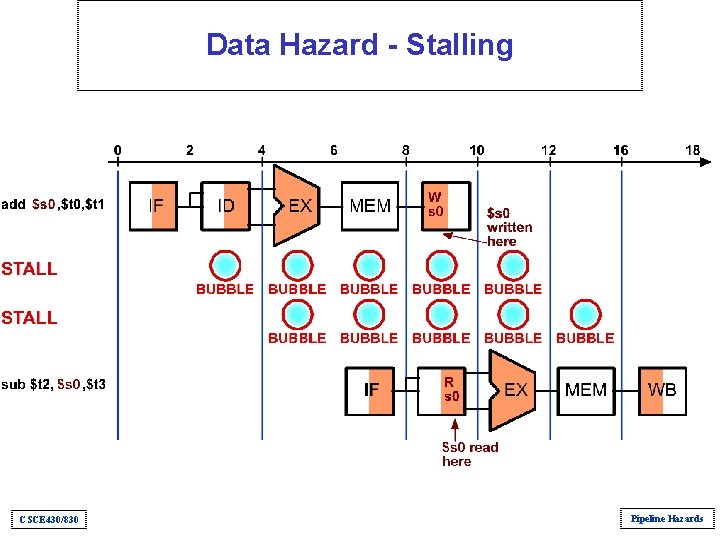
Data Hazards - Stalling Simple Solution to RAW • Hardware detects RAW and stalls • Assumes register written then read each cycle + low cost to implement, simple reduces IPC • Try to minimize stalls Minimizing RAW stalls • Bypass/forward/short circuit (We will use the word “forward”) • Use data before it is in the register + reduces/avoids stalls complex • Crucial for common RAW hazards CSCE 430/830 Pipeline Hazards
Data Hazards - Forwarding • Key idea: connect new value directly to next stage • Still read s 0, but ignore in favor of new result • • Problem: what about load instructions? CSCE 430/830 Pipeline Hazards
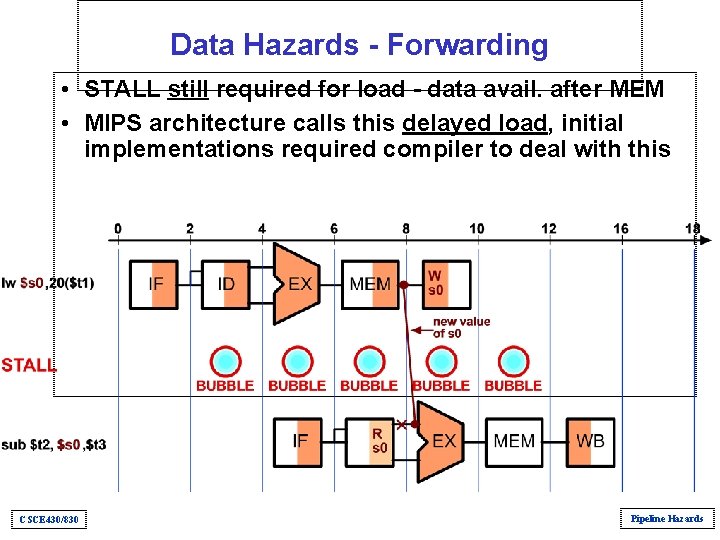
Data Hazards - Forwarding • STALL still required for load - data avail. after MEM • MIPS architecture calls this delayed load, initial implementations required compiler to deal with this CSCE 430/830 Pipeline Hazards
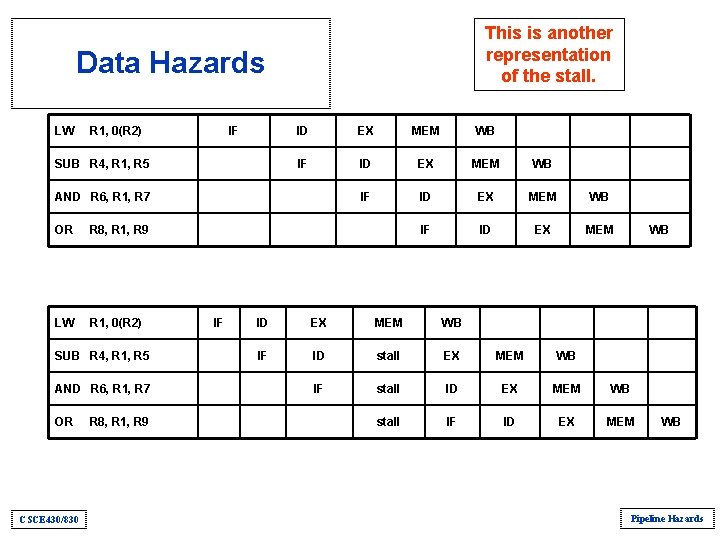
This is another representation of the stall. Data Hazards LW R 1, 0(R 2) IF SUB R 4, R 1, R 5 ID EX MEM WB IF ID EX MEM AND R 6, R 1, R 7 OR R 8, R 1, R 9 LW R 1, 0(R 2) SUB R 4, R 1, R 5 AND R 6, R 1, R 7 OR CSCE 430/830 R 8, R 1, R 9 IF WB ID EX MEM WB IF ID stall EX MEM WB IF stall ID EX MEM WB stall IF ID EX MEM WB Pipeline Hazards
Forwarding Key idea: connect data internally before it's stored IF/ID ID/EX EX/MEM MEM/WB How would you design the forwarding? CSCE 430/830 Pipeline Hazards
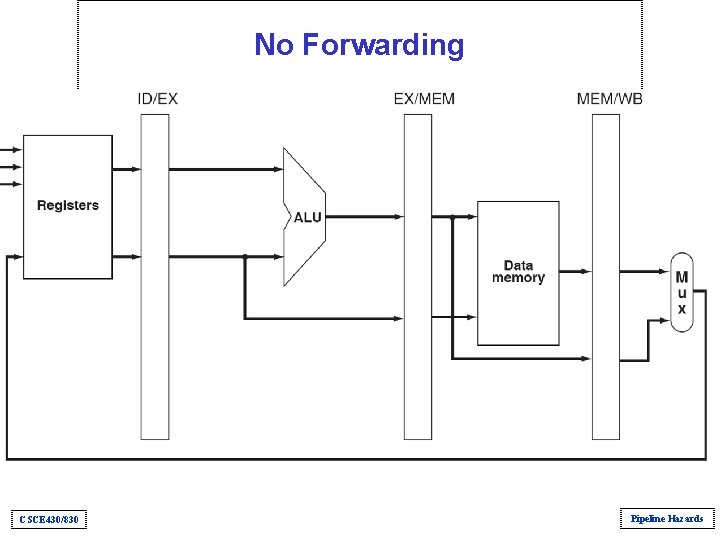
No Forwarding CSCE 430/830 Pipeline Hazards
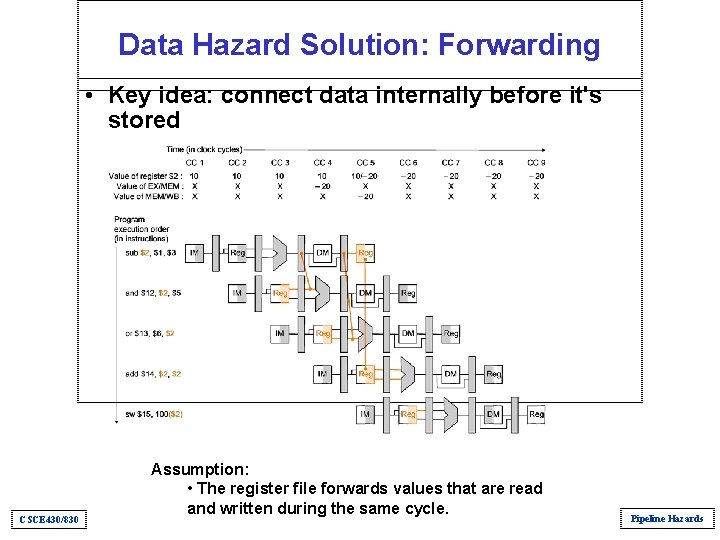
Data Hazard Solution: Forwarding • Key idea: connect data internally before it's stored CSCE 430/830 Assumption: • The register file forwards values that are read and written during the same cycle. Pipeline Hazards
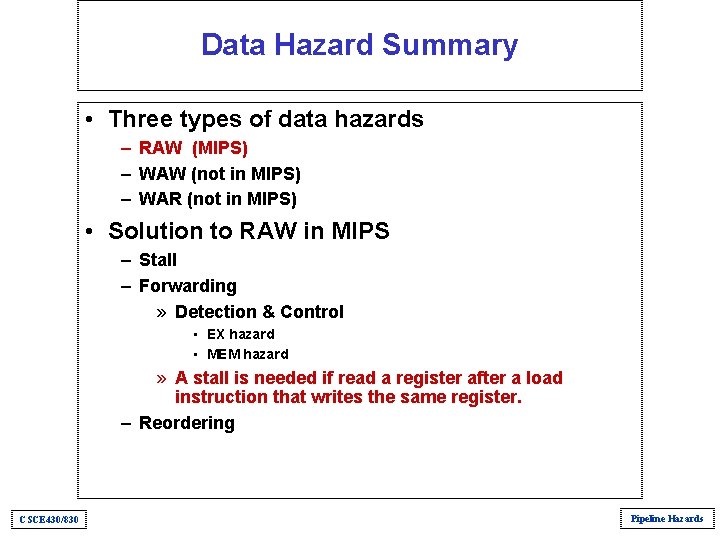
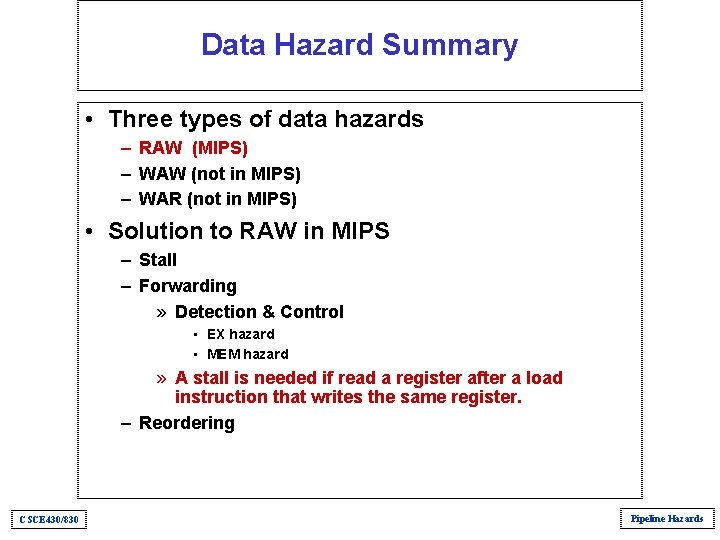
Data Hazard Summary • Three types of data hazards – RAW (MIPS) – WAW (not in MIPS) – WAR (not in MIPS) • Solution to RAW in MIPS – Stall – Forwarding » Detection & Control • EX hazard • MEM hazard » A stall is needed if read a register after a load instruction that writes the same register. – Reordering CSCE 430/830 Pipeline Hazards
Review Speedup of pipeline Speedup = Pipeline Depth 1 + Pipeline stall CPI CSCE 430/830 X Clock Cycle Unpipelined Clock Cycle Pipelined Pipeline Hazards
Pipelining Outline • Introduction – Defining Pipelining – Pipelining Instructions • Hazards – Structural hazards – Data Hazards – Control Hazards • Performance • Controller implementation CSCE 430/830 Pipeline Hazards
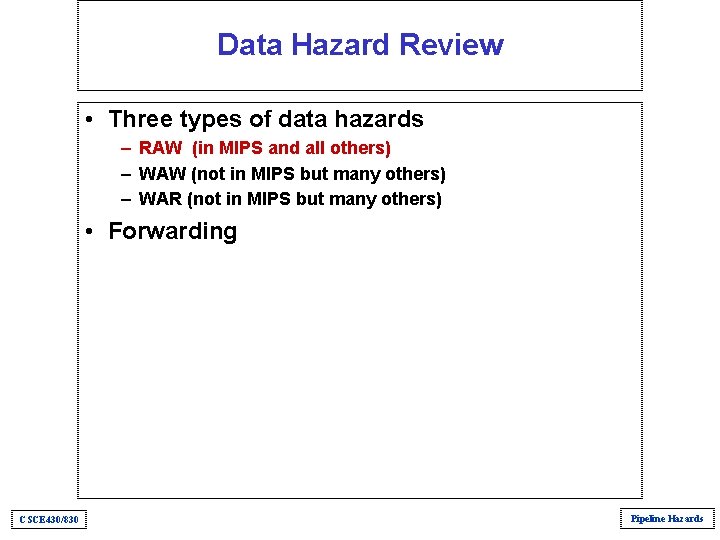
Data Hazard Review • Three types of data hazards – RAW (in MIPS and all others) – WAW (not in MIPS but many others) – WAR (not in MIPS but many others) • Forwarding CSCE 430/830 Pipeline Hazards
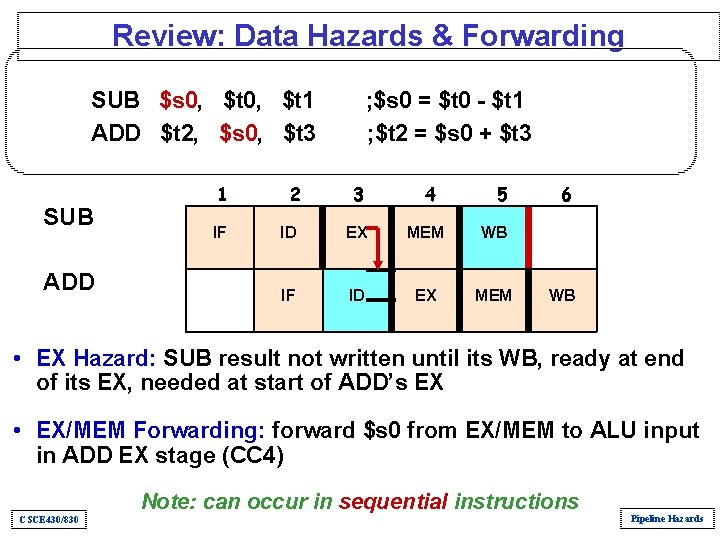
Review: Data Hazards & Forwarding SUB $s 0, $t 1 ADD $t 2, $s 0, $t 3 SUB ADD 1 IF 2 ; $s 0 = $t 0 - $t 1 ; $t 2 = $s 0 + $t 3 3 4 5 ID EX MEM WB IF ID EX MEM 6 WB • EX Hazard: SUB result not written until its WB, ready at end of its EX, needed at start of ADD’s EX • EX/MEM Forwarding: forward $s 0 from EX/MEM to ALU input in ADD EX stage (CC 4) Note: can occur in sequential instructions CSCE 430/830 Pipeline Hazards
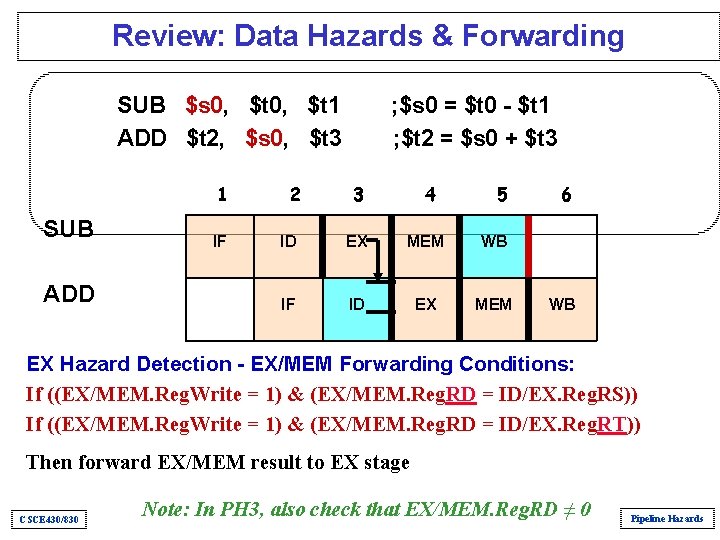
Review: Data Hazards & Forwarding SUB $s 0, $t 1 ADD $t 2, $s 0, $t 3 1 SUB ADD IF 2 ; $s 0 = $t 0 - $t 1 ; $t 2 = $s 0 + $t 3 3 4 5 ID EX MEM WB IF ID EX MEM 6 WB EX Hazard Detection - EX/MEM Forwarding Conditions: If ((EX/MEM. Reg. Write = 1) & (EX/MEM. Reg. RD = ID/EX. Reg. RS)) If ((EX/MEM. Reg. Write = 1) & (EX/MEM. Reg. RD = ID/EX. Reg. RT)) Then forward EX/MEM result to EX stage CSCE 430/830 Note: In PH 3, also check that EX/MEM. Reg. RD ≠ 0 Pipeline Hazards
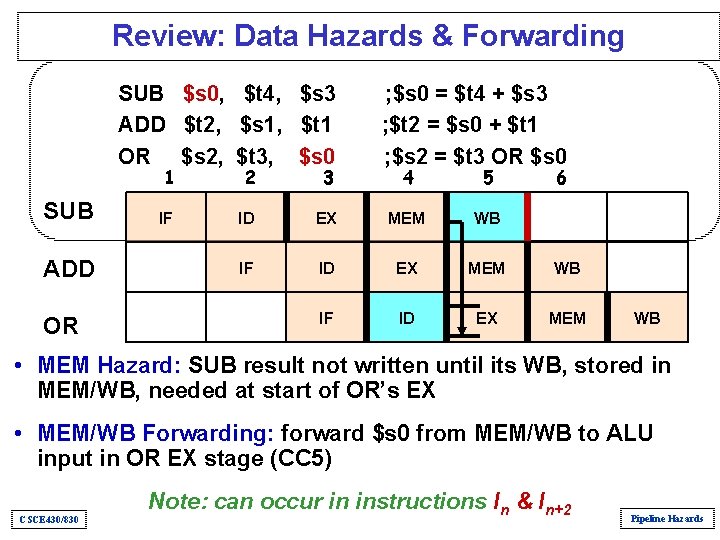
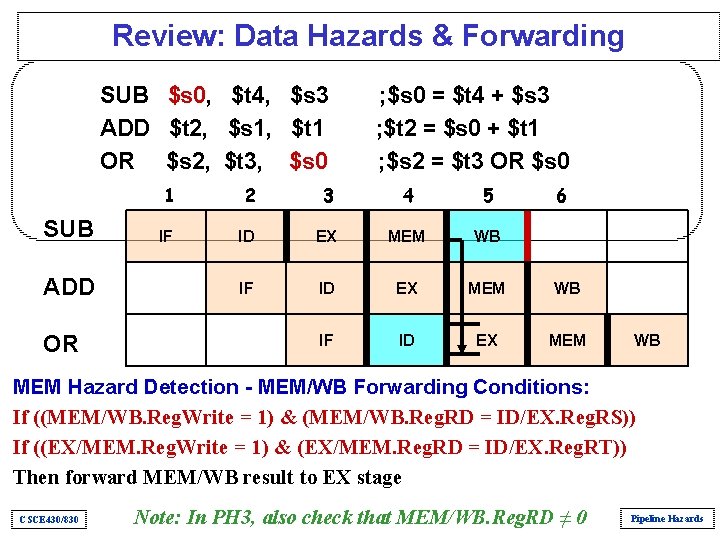
Review: Data Hazards & Forwarding SUB $s 0, $t 4, $s 3 ADD $t 2, $s 1, $t 1 OR $s 2, $t 3, $s 0 SUB ADD OR 1 2 3 IF ID IF ; $s 0 = $t 4 + $s 3 ; $t 2 = $s 0 + $t 1 ; $s 2 = $t 3 OR $s 0 4 5 6 EX MEM WB ID EX MEM WB IF ID EX MEM WB • MEM Hazard: SUB result not written until its WB, stored in MEM/WB, needed at start of OR’s EX • MEM/WB Forwarding: forward $s 0 from MEM/WB to ALU input in OR EX stage (CC 5) CSCE 430/830 Note: can occur in instructions In & In+2 Pipeline Hazards
Review: Data Hazards & Forwarding SUB $s 0, $t 4, $s 3 ADD $t 2, $s 1, $t 1 OR $s 2, $t 3, $s 0 SUB ADD OR ; $s 0 = $t 4 + $s 3 ; $t 2 = $s 0 + $t 1 ; $s 2 = $t 3 OR $s 0 1 2 3 4 5 6 IF ID EX MEM WB MEM Hazard Detection - MEM/WB Forwarding Conditions: If ((MEM/WB. Reg. Write = 1) & (MEM/WB. Reg. RD = ID/EX. Reg. RS)) If ((EX/MEM. Reg. Write = 1) & (EX/MEM. Reg. RD = ID/EX. Reg. RT)) Then forward MEM/WB result to EX stage CSCE 430/830 Note: In PH 3, also check that MEM/WB. Reg. RD ≠ 0 Pipeline Hazards
Data Hazard Detection in MIPS Read after Write IF/ID ID/EX EX/MEM MEM/WB 1 a: EX/MEM. Register. Rd = ID/EX. Register. Rs 1 b: EX/MEM. Register. Rd = ID/EX. Register. Rt 2 a: MEM/WB. Register. Rd = ID/EX. Register. Rs 2 b: MEM/WB. Register. Rd = ID/EX. Register. Rt Problem? Some instructions do not write register. CSCE 430/830 EX/MEM. Reg. Write must be asserted! EX hazard MEM hazard Pipeline Hazards
Data Hazards • Solutions for Data Hazards – Stalling – Forwarding: » connect new value directly to next stage – Reordering CSCE 430/830 Pipeline Hazards
Data Hazard - Stalling CSCE 430/830 Pipeline Hazards
Data Hazard Solution: Forwarding • Key idea: connect data internally before it's stored CSCE 430/830 Assumption: • The register file forwards values that are read and written during the same cycle. Pipeline Hazards
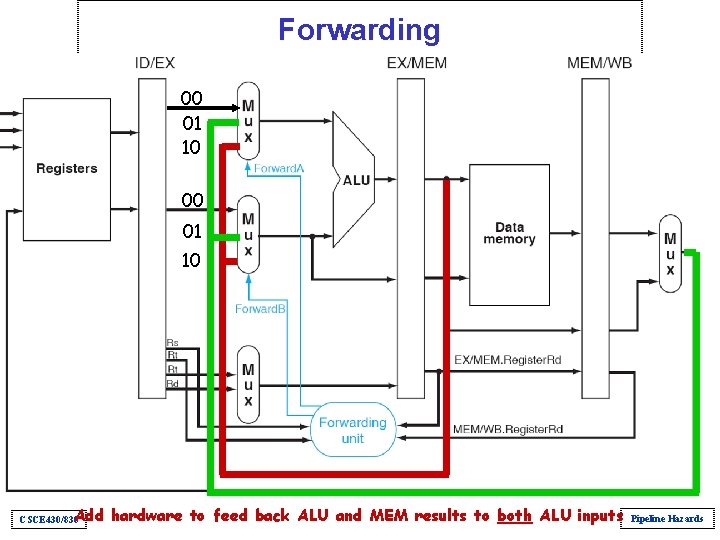
Forwarding 00 01 10 Add hardware to feed back ALU and MEM results to both ALU inputs CSCE 430/830 Pipeline Hazards
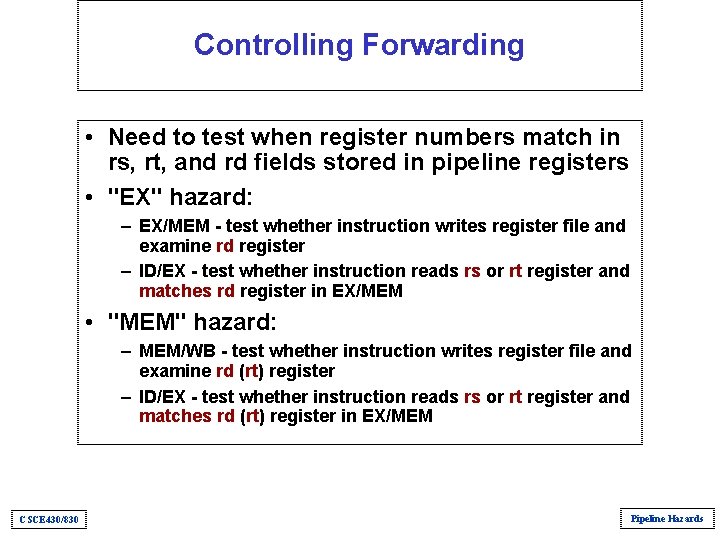
Controlling Forwarding • Need to test when register numbers match in rs, rt, and rd fields stored in pipeline registers • "EX" hazard: – EX/MEM - test whether instruction writes register file and examine rd register – ID/EX - test whether instruction reads rs or rt register and matches rd register in EX/MEM • "MEM" hazard: – MEM/WB - test whether instruction writes register file and examine rd (rt) register – ID/EX - test whether instruction reads rs or rt register and matches rd (rt) register in EX/MEM CSCE 430/830 Pipeline Hazards
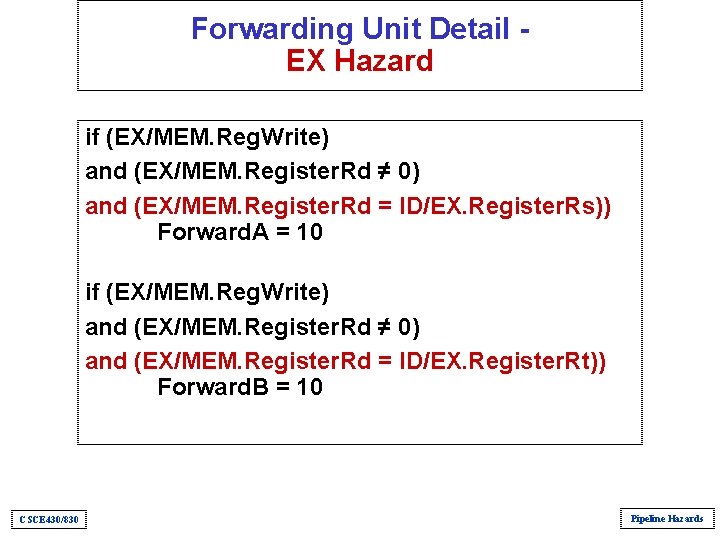
Forwarding Unit Detail EX Hazard if (EX/MEM. Reg. Write) and (EX/MEM. Register. Rd ≠ 0) and (EX/MEM. Register. Rd = ID/EX. Register. Rs)) Forward. A = 10 if (EX/MEM. Reg. Write) and (EX/MEM. Register. Rd ≠ 0) and (EX/MEM. Register. Rd = ID/EX. Register. Rt)) Forward. B = 10 CSCE 430/830 Pipeline Hazards
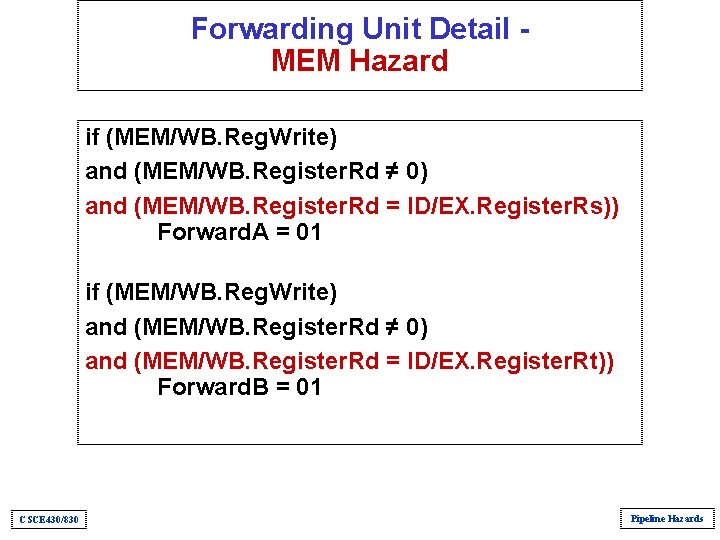
Forwarding Unit Detail MEM Hazard if (MEM/WB. Reg. Write) and (MEM/WB. Register. Rd ≠ 0) and (MEM/WB. Register. Rd = ID/EX. Register. Rs)) Forward. A = 01 if (MEM/WB. Reg. Write) and (MEM/WB. Register. Rd ≠ 0) and (MEM/WB. Register. Rd = ID/EX. Register. Rt)) Forward. B = 01 CSCE 430/830 Pipeline Hazards
Data Hazards and Stalls • So far, we’ve only addressed “potential” data hazards, where the forwarding unit was able to detect and resolve them without affecting the performance of the pipeline. • There also “unavoidable” data hazards, which the forwarding unit cannot resolve, and whose resolution does affect pipeline performance. • We thus add a (unavoidable) hazard detection unit, which detects them and introduces stalls to resolve them. CSCE 430/830 Pipeline Hazards
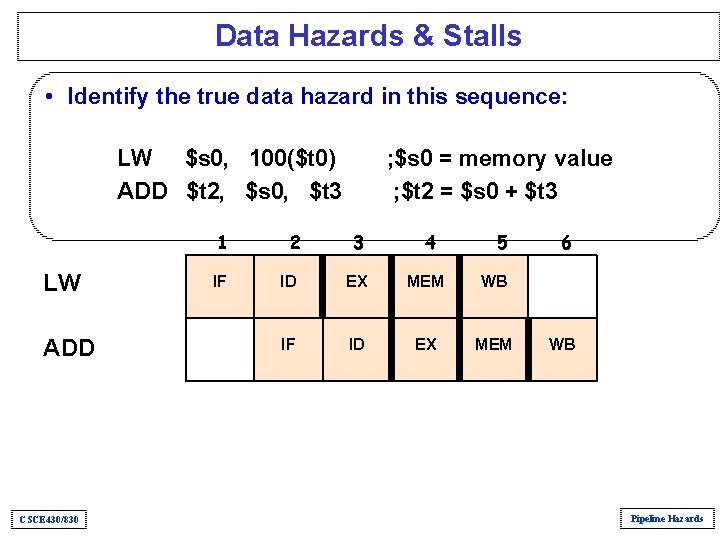
Data Hazards & Stalls • Identify the true data hazard in this sequence: LW $s 0, 100($t 0) ADD $t 2, $s 0, $t 3 1 LW ADD CSCE 430/830 IF 2 ; $s 0 = memory value ; $t 2 = $s 0 + $t 3 3 4 5 ID EX MEM WB IF ID EX MEM 6 WB Pipeline Hazards
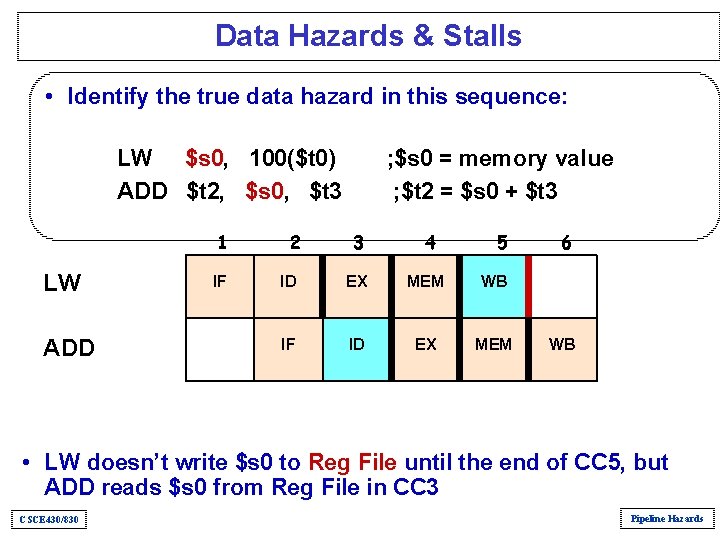
Data Hazards & Stalls • Identify the true data hazard in this sequence: LW $s 0, 100($t 0) ADD $t 2, $s 0, $t 3 1 LW ADD IF 2 ; $s 0 = memory value ; $t 2 = $s 0 + $t 3 3 4 5 ID EX MEM WB IF ID EX MEM 6 WB • LW doesn’t write $s 0 to Reg File until the end of CC 5, but ADD reads $s 0 from Reg File in CC 3 CSCE 430/830 Pipeline Hazards
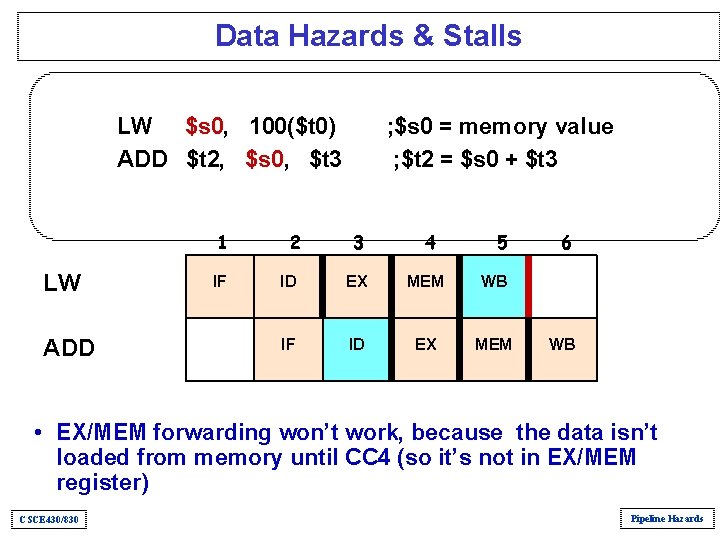
Data Hazards & Stalls LW $s 0, 100($t 0) ADD $t 2, $s 0, $t 3 1 LW ADD IF 2 ; $s 0 = memory value ; $t 2 = $s 0 + $t 3 3 4 5 ID EX MEM WB IF ID EX MEM 6 WB • EX/MEM forwarding won’t work, because the data isn’t loaded from memory until CC 4 (so it’s not in EX/MEM register) CSCE 430/830 Pipeline Hazards
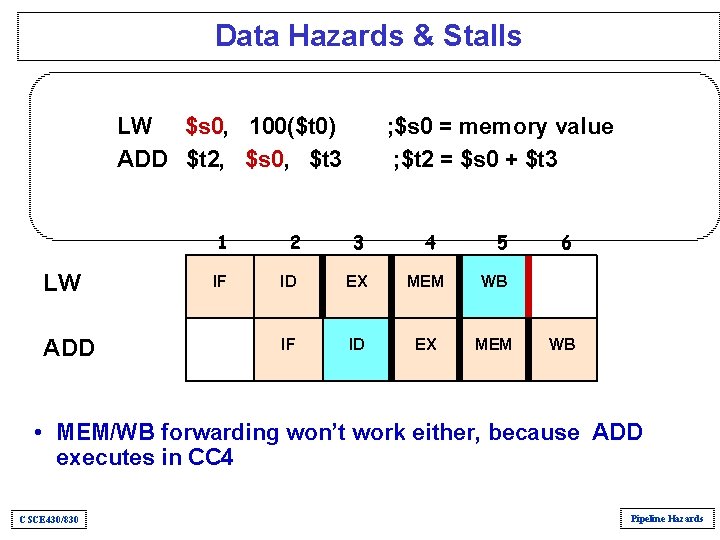
Data Hazards & Stalls LW $s 0, 100($t 0) ADD $t 2, $s 0, $t 3 1 LW ADD IF 2 ; $s 0 = memory value ; $t 2 = $s 0 + $t 3 3 4 5 ID EX MEM WB IF ID EX MEM 6 WB • MEM/WB forwarding won’t work either, because ADD executes in CC 4 CSCE 430/830 Pipeline Hazards
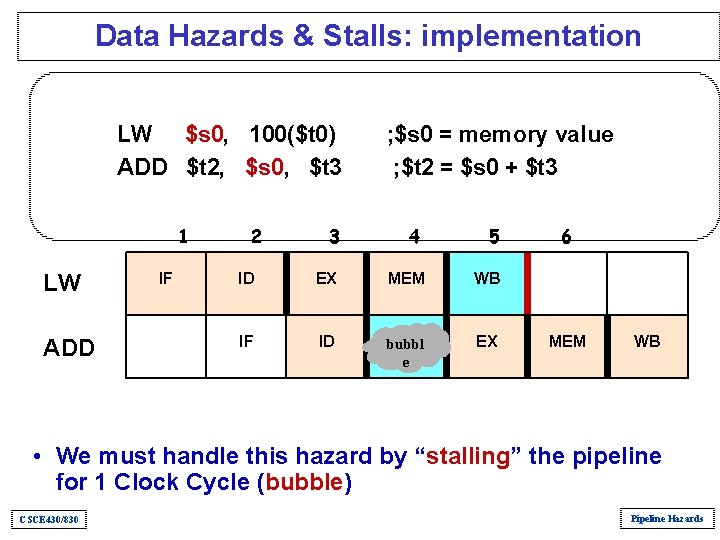
Data Hazards & Stalls: implementation LW $s 0, 100($t 0) ADD $t 2, $s 0, $t 3 1 LW ADD IF 2 3 ; $s 0 = memory value ; $t 2 = $s 0 + $t 3 4 5 ID EX MEM WB IF ID ID bubbl e EX 6 MEM WB • We must handle this hazard by “stalling” the pipeline for 1 Clock Cycle (bubble) CSCE 430/830 Pipeline Hazards
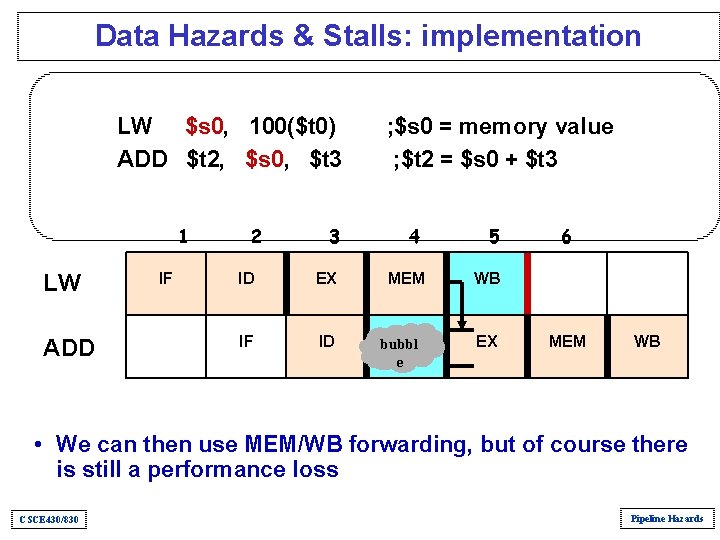
Data Hazards & Stalls: implementation LW $s 0, 100($t 0) ADD $t 2, $s 0, $t 3 1 LW ADD IF 2 3 ID EX IF ID ; $s 0 = memory value ; $t 2 = $s 0 + $t 3 4 MEM ID bubbl e 5 6 WB EX MEM WB • We can then use MEM/WB forwarding, but of course there is still a performance loss CSCE 430/830 Pipeline Hazards
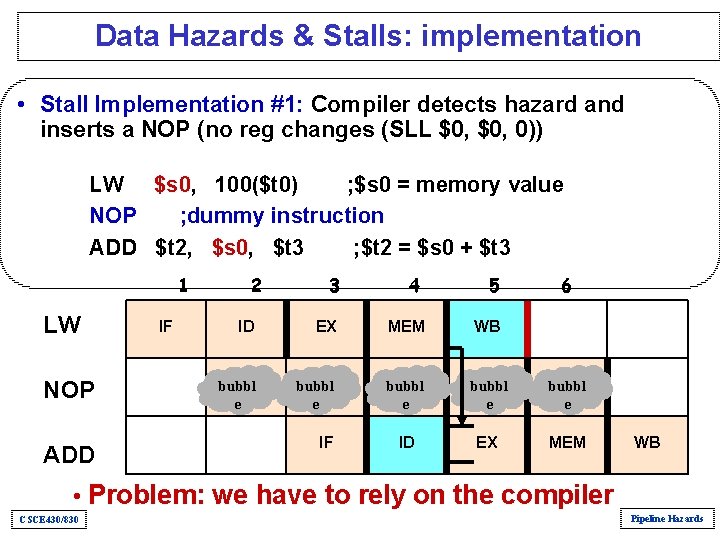
Data Hazards & Stalls: implementation • Stall Implementation #1: Compiler detects hazard and inserts a NOP (no reg changes (SLL $0, 0)) LW $s 0, 100($t 0) ; $s 0 = memory value NOP ; dummy instruction ADD $t 2, $s 0, $t 3 ; $t 2 = $s 0 + $t 3 1 LW NOP ADD IF 2 3 4 5 6 ID EX MEM WB IF bubbl e ID bubbl e EX bubbl e MEM bubbl e WB bubbl e ID EX MEM IF WB • Problem: we have to rely on the compiler CSCE 430/830 Pipeline Hazards
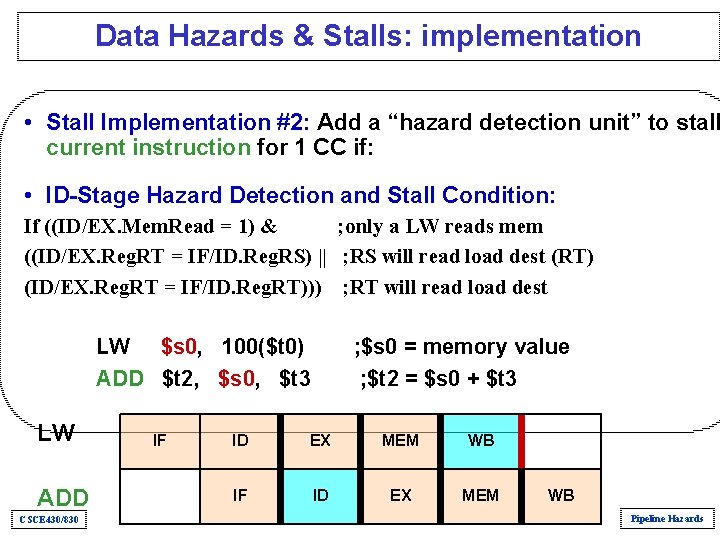
Data Hazards & Stalls: implementation • Stall Implementation #2: Add a “hazard detection unit” to stall current instruction for 1 CC if: • ID-Stage Hazard Detection and Stall Condition: If ((ID/EX. Mem. Read = 1) & ; only a LW reads mem ((ID/EX. Reg. RT = IF/ID. Reg. RS) || ; RS will read load dest (RT) (ID/EX. Reg. RT = IF/ID. Reg. RT))) ; RT will read load dest LW $s 0, 100($t 0) ADD $t 2, $s 0, $t 3 LW ADD CSCE 430/830 IF ; $s 0 = memory value ; $t 2 = $s 0 + $t 3 ID EX MEM WB IF ID EX MEM WB Pipeline Hazards
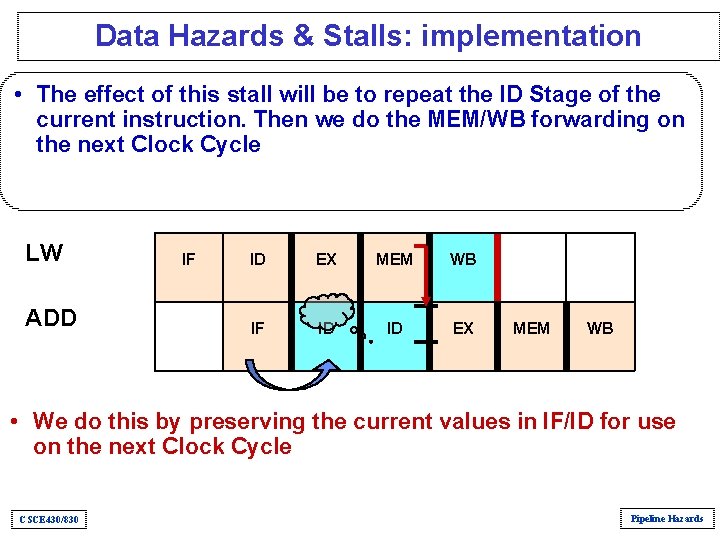
Data Hazards & Stalls: implementation • The effect of this stall will be to repeat the ID Stage of the current instruction. Then we do the MEM/WB forwarding on the next Clock Cycle LW ADD IF ID EX MEM WB IF ID ID EX MEM WB • We do this by preserving the current values in IF/ID for use on the next Clock Cycle CSCE 430/830 Pipeline Hazards
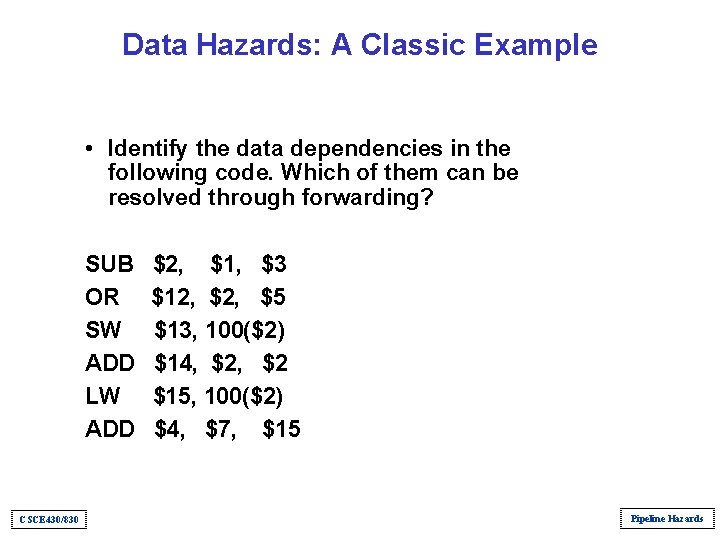
Data Hazards: A Classic Example • Identify the data dependencies in the following code. Which of them can be resolved through forwarding? SUB OR SW ADD LW ADD CSCE 430/830 $2, $1, $3 $12, $5 $13, 100($2) $14, $2 $15, 100($2) $4, $7, $15 Pipeline Hazards
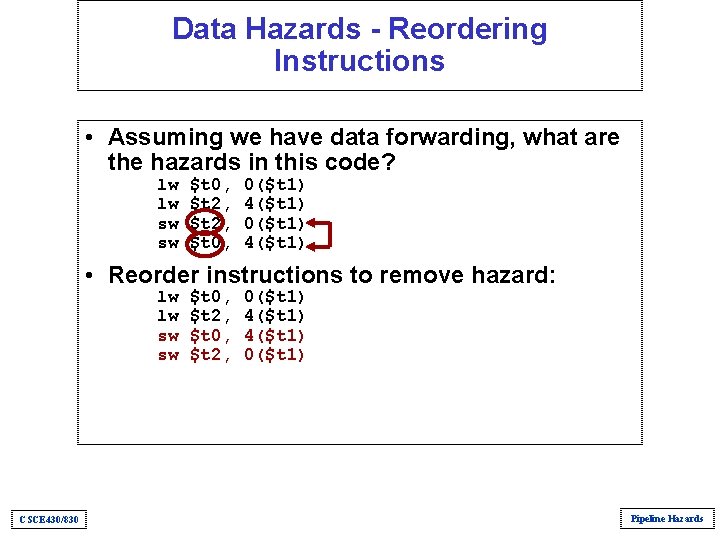
Data Hazards - Reordering Instructions • Assuming we have data forwarding, what are the hazards in this code? lw lw sw sw $t 0, $t 2, $t 0, 0($t 1) 4($t 1) • Reorder instructions to remove hazard: lw lw sw sw CSCE 430/830 $t 0, $t 2, 0($t 1) 4($t 1) 0($t 1) Pipeline Hazards
Data Hazard Summary • Three types of data hazards – RAW (MIPS) – WAW (not in MIPS) – WAR (not in MIPS) • Solution to RAW in MIPS – Stall – Forwarding » Detection & Control • EX hazard • MEM hazard » A stall is needed if read a register after a load instruction that writes the same register. – Reordering CSCE 430/830 Pipeline Hazards
Pipelining Outline Next class • Introduction – Defining Pipelining – Pipelining Instructions • Hazards – Structural hazards – Data Hazards – Control Hazards • Performance • Controller implementation CSCE 430/830 Pipeline Hazards
Pipeline Hazards • Where one instruction cannot immediately follow another • Types of hazards – Structural hazards - attempt to use same resource twice – Control hazards - attempt to make decision before condition is evaluated – Data hazards - attempt to use data before it is ready • Can always resolve hazards by waiting CSCE 430/830 Pipeline Hazards
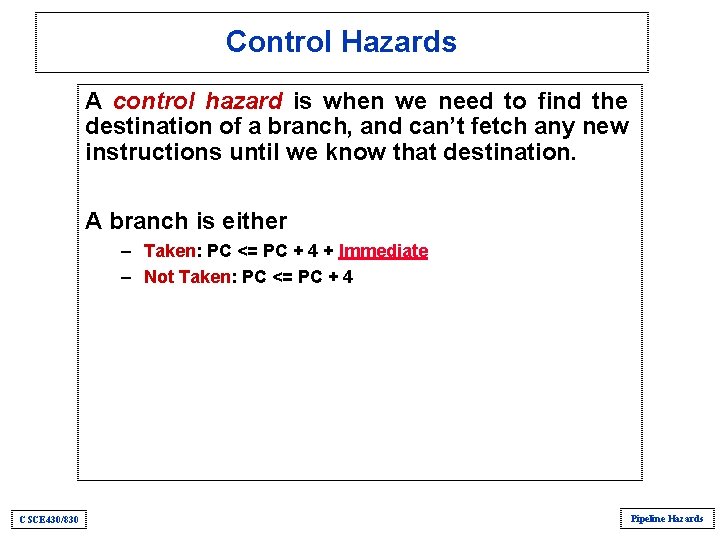
Control Hazards A control hazard is when we need to find the destination of a branch, and can’t fetch any new instructions until we know that destination. A branch is either – Taken: PC <= PC + 4 + Immediate – Not Taken: PC <= PC + 4 CSCE 430/830 Pipeline Hazards
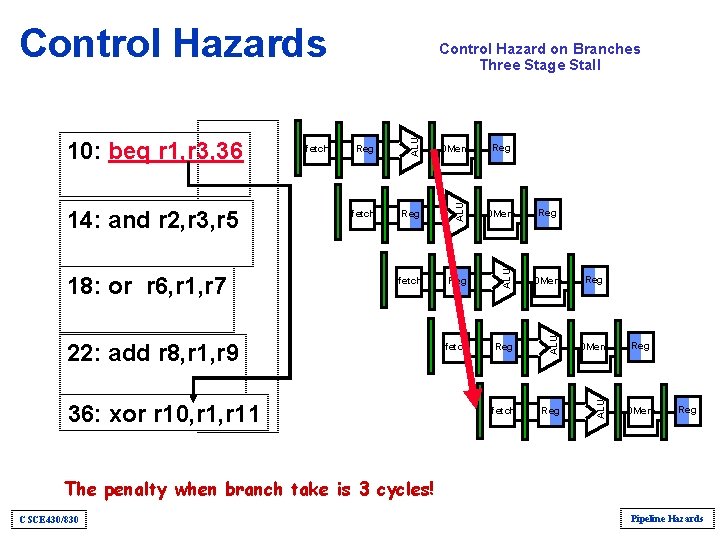
Control Hazards Ifetch Reg ALU Ifetch Reg 22: add r 8, r 1, r 9 36: xor r 10, r 11 DMem Reg DMem ALU 18: or r 6, r 1, r 7 Reg ALU 14: and r 2, r 3, r 5 Ifetch ALU 10: beq r 1, r 3, 36 Control Hazard on Branches Three Stage Stall Reg DMem Reg The penalty when branch take is 3 cycles! CSCE 430/830 Pipeline Hazards
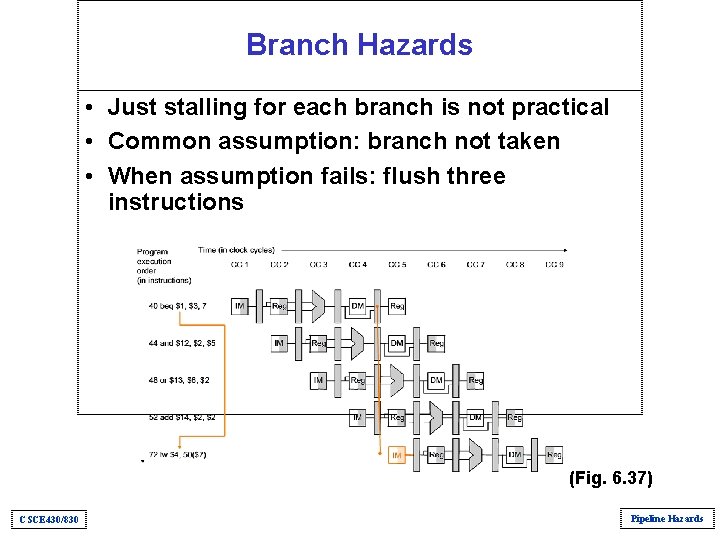
Branch Hazards • Just stalling for each branch is not practical • Common assumption: branch not taken • When assumption fails: flush three instructions (Fig. 6. 37) CSCE 430/830 Pipeline Hazards
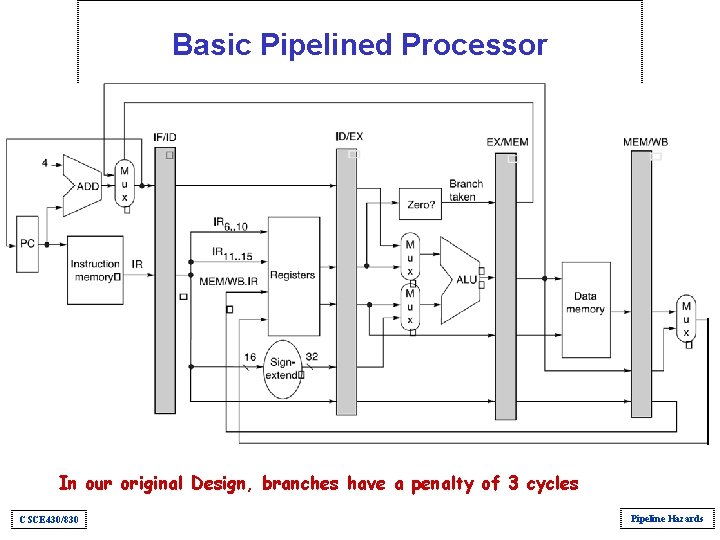
Basic Pipelined Processor In our original Design, branches have a penalty of 3 cycles CSCE 430/830 Pipeline Hazards
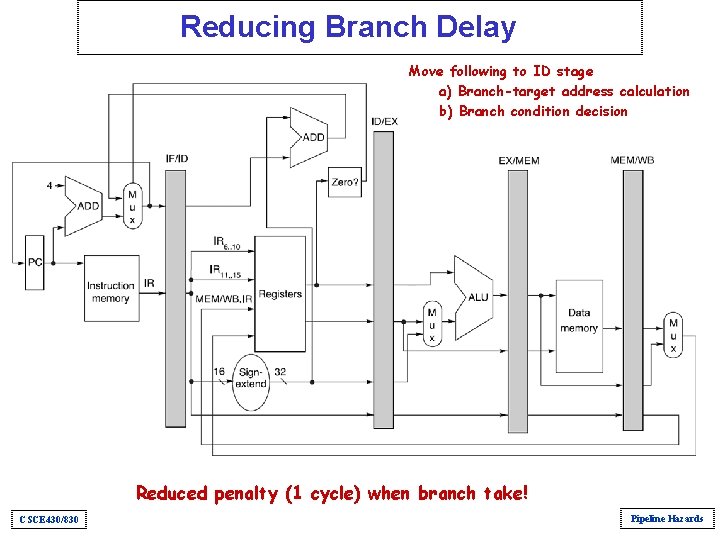
Reducing Branch Delay Move following to ID stage a) Branch-target address calculation b) Branch condition decision Reduced penalty (1 cycle) when branch take! CSCE 430/830 Pipeline Hazards
Reducing Branch Delay • Key idea: move branch logic to ID stage of pipeline – New adder calculates branch target (PC + 4 + extend(IMM)) – New hardware tests rs == rt after register read • Reduced penalty (1 cycle) when branch take CSCE 430/830 Pipeline Hazards
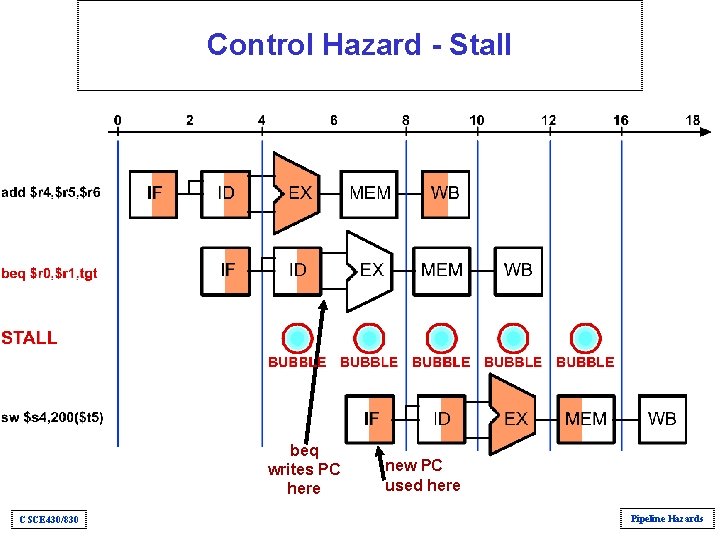
Control Hazard Solutions • Stall – stop loading instructions until result is available • Predict – assume an outcome and continue fetching (undo if prediction is wrong) – lose cycles only on mis-prediction • Delayed branch – specify in architecture that the instruction immediately following branch is always executed CSCE 430/830 Pipeline Hazards
Branch Behavior in Programs • Based on SPEC benchmarks on DLX – Branches occur with a frequency of 14% to 16% in integer programs and 3% to 12% in floating point programs. – About 75% of the branches are forward branches – 60% of forward branches are taken – 80% of backward branches are taken – 67% of all branches are taken • Why are branches (especially backward branches) more likely to be taken than not taken? CSCE 430/830 Pipeline Hazards
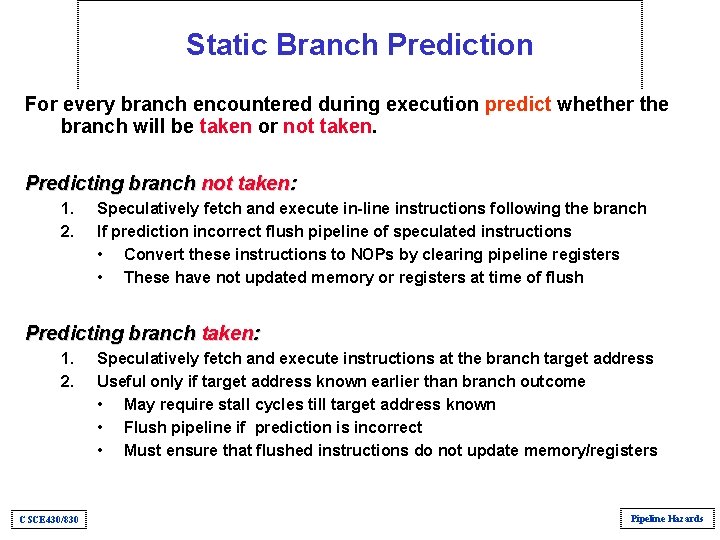
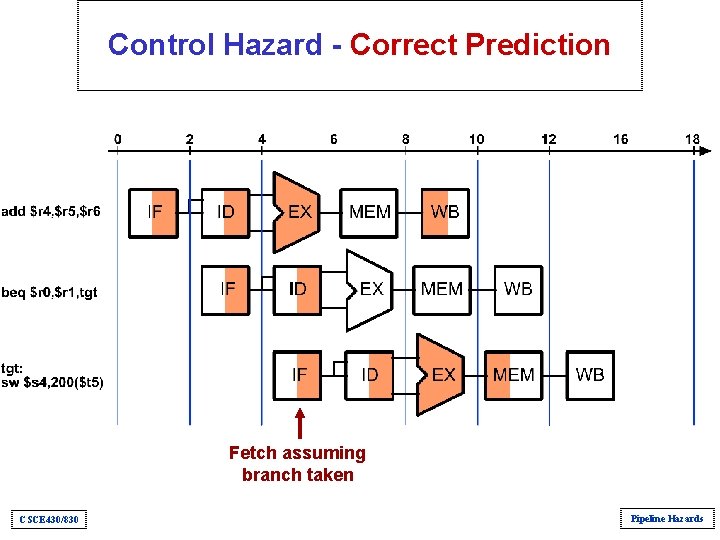
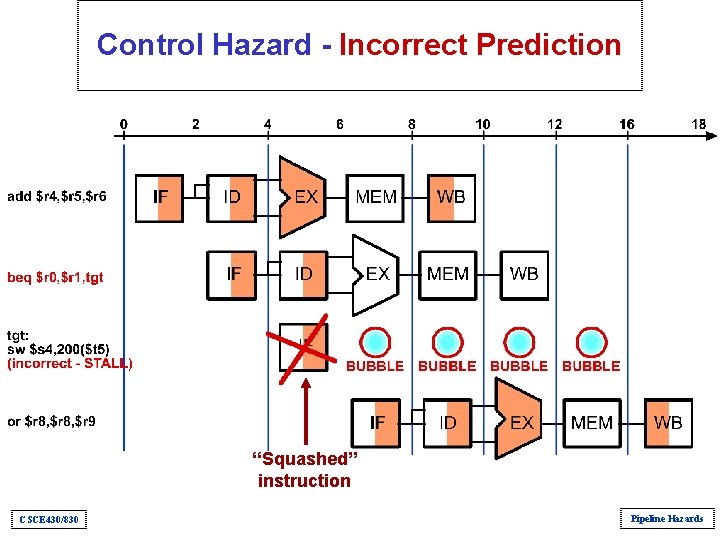
Static Branch Prediction For every branch encountered during execution predict whether the branch will be taken or not taken. Predicting branch not taken: 1. 2. Speculatively fetch and execute in-line instructions following the branch If prediction incorrect flush pipeline of speculated instructions • Convert these instructions to NOPs by clearing pipeline registers • These have not updated memory or registers at time of flush Predicting branch taken: 1. 2. CSCE 430/830 Speculatively fetch and execute instructions at the branch target address Useful only if target address known earlier than branch outcome • May require stall cycles till target address known • Flush pipeline if prediction is incorrect • Must ensure that flushed instructions do not update memory/registers Pipeline Hazards
Control Hazard - Stall beq writes PC here CSCE 430/830 new PC used here Pipeline Hazards
Control Hazard - Correct Prediction Fetch assuming branch taken CSCE 430/830 Pipeline Hazards
Control Hazard - Incorrect Prediction “Squashed” instruction CSCE 430/830 Pipeline Hazards
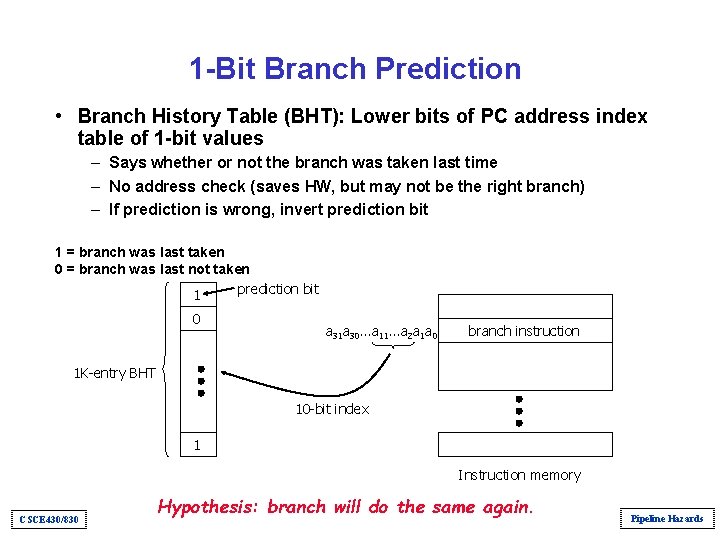
1 -Bit Branch Prediction • Branch History Table (BHT): Lower bits of PC address index table of 1 -bit values – Says whether or not the branch was taken last time – No address check (saves HW, but may not be the right branch) – If prediction is wrong, invert prediction bit 1 = branch was last taken 0 = branch was last not taken prediction bit 1 0 a 31 a 30…a 11…a 2 a 1 a 0 branch instruction 1 K-entry BHT 10 -bit index 1 Instruction memory CSCE 430/830 Hypothesis: branch will do the same again. Pipeline Hazards
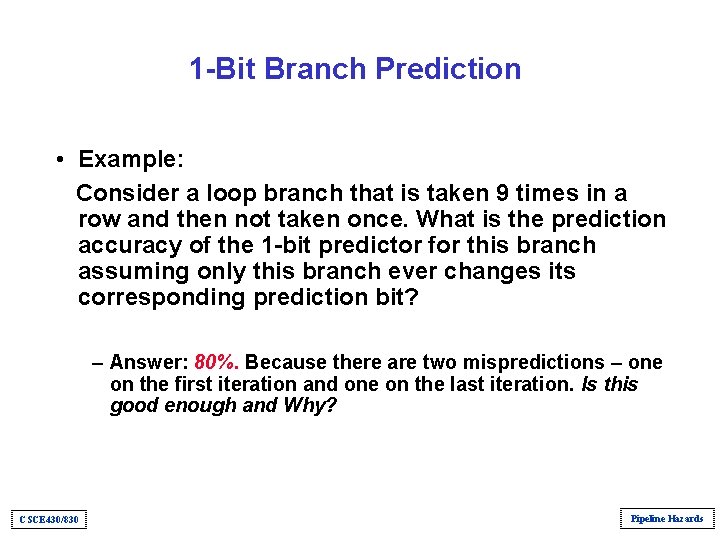
1 -Bit Branch Prediction • Example: Consider a loop branch that is taken 9 times in a row and then not taken once. What is the prediction accuracy of the 1 -bit predictor for this branch assuming only this branch ever changes its corresponding prediction bit? – Answer: 80%. Because there are two mispredictions – one on the first iteration and one on the last iteration. Is this good enough and Why? CSCE 430/830 Pipeline Hazards
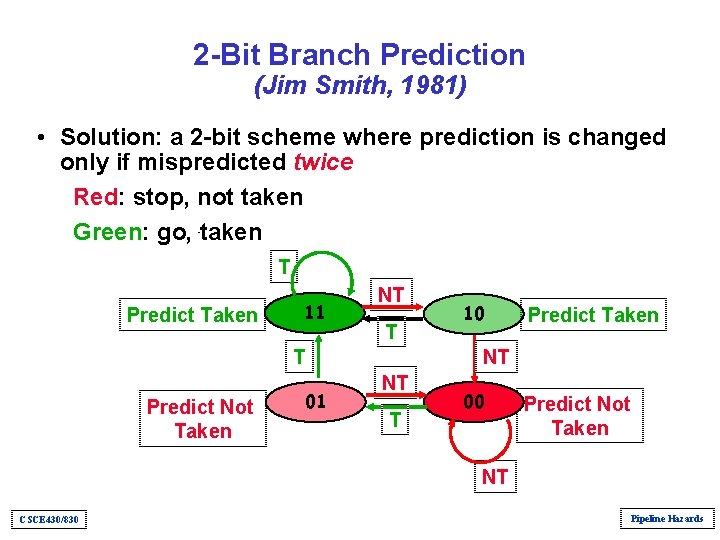
2 -Bit Branch Prediction (Jim Smith, 1981) • Solution: a 2 -bit scheme where prediction is changed only if mispredicted twice Red: stop, not taken Green: go, taken T Predict Taken 11 NT T T Predict Not Taken 01 10 Predict Taken NT NT T 00 Predict Not Taken NT CSCE 430/830 Pipeline Hazards
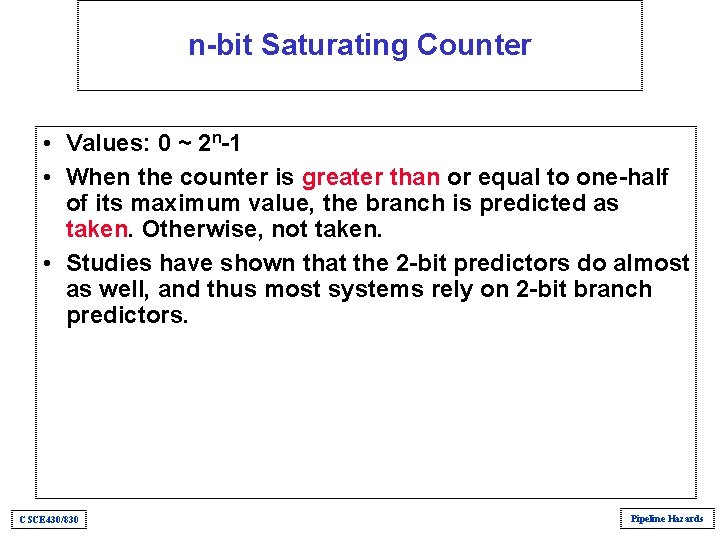
n-bit Saturating Counter • Values: 0 ~ 2 n-1 • When the counter is greater than or equal to one-half of its maximum value, the branch is predicted as taken. Otherwise, not taken. • Studies have shown that the 2 -bit predictors do almost as well, and thus most systems rely on 2 -bit branch predictors. CSCE 430/830 Pipeline Hazards
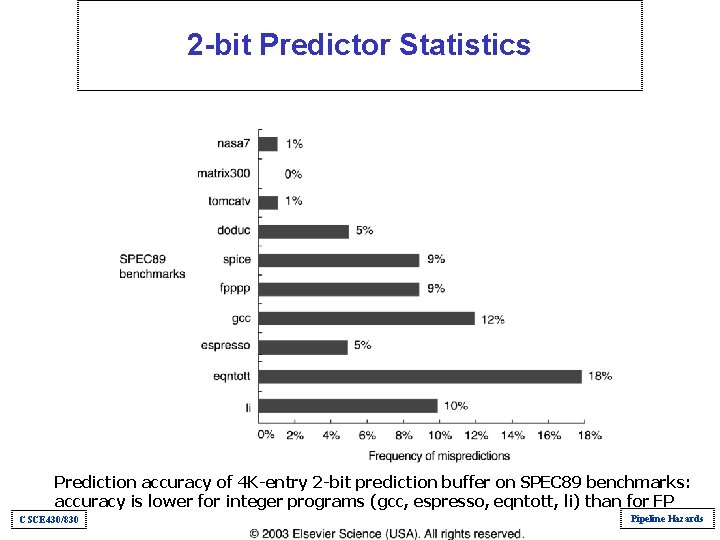
2 -bit Predictor Statistics Prediction accuracy of 4 K-entry 2 -bit prediction buffer on SPEC 89 benchmarks: accuracy is lower for integer programs (gcc, espresso, eqntott, li) than for FP CSCE 430/830 Pipeline Hazards
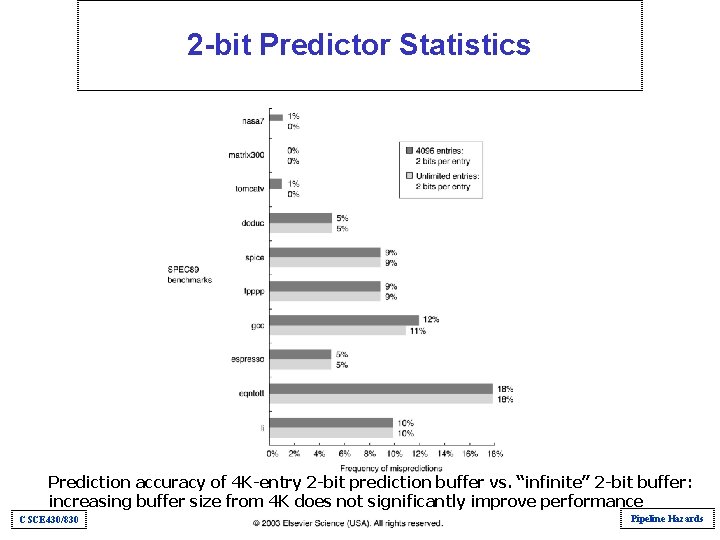
2 -bit Predictor Statistics Prediction accuracy of 4 K-entry 2 -bit prediction buffer vs. “infinite” 2 -bit buffer: increasing buffer size from 4 K does not significantly improve performance CSCE 430/830 Pipeline Hazards
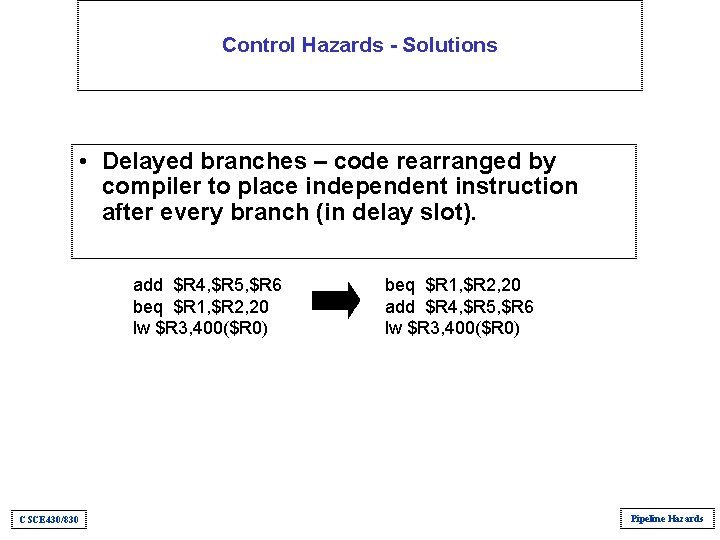
Control Hazards - Solutions • Delayed branches – code rearranged by compiler to place independent instruction after every branch (in delay slot). add $R 4, $R 5, $R 6 beq $R 1, $R 2, 20 lw $R 3, 400($R 0) CSCE 430/830 beq $R 1, $R 2, 20 add $R 4, $R 5, $R 6 lw $R 3, 400($R 0) Pipeline Hazards
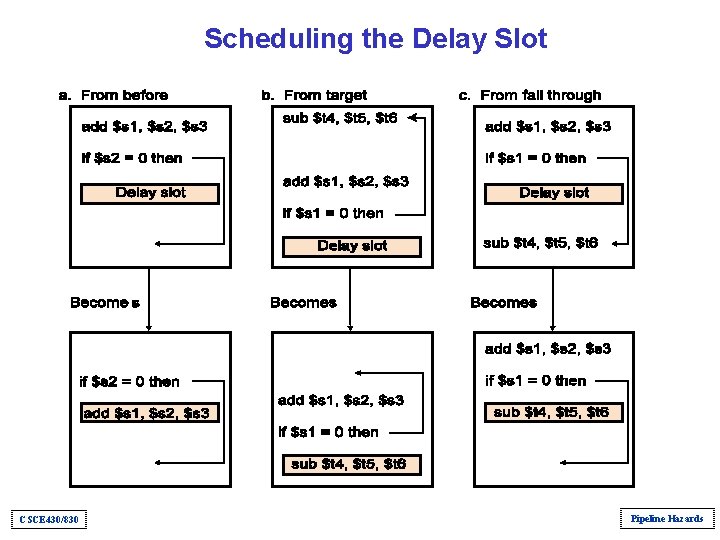
Scheduling the Delay Slot CSCE 430/830 Pipeline Hazards
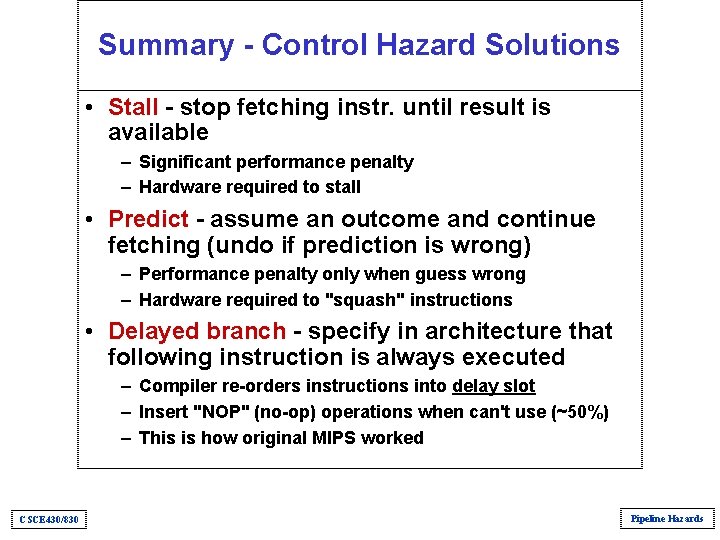
Summary - Control Hazard Solutions • Stall - stop fetching instr. until result is available – Significant performance penalty – Hardware required to stall • Predict - assume an outcome and continue fetching (undo if prediction is wrong) – Performance penalty only when guess wrong – Hardware required to "squash" instructions • Delayed branch - specify in architecture that following instruction is always executed – Compiler re-orders instructions into delay slot – Insert "NOP" (no-op) operations when can't use (~50%) – This is how original MIPS worked CSCE 430/830 Pipeline Hazards
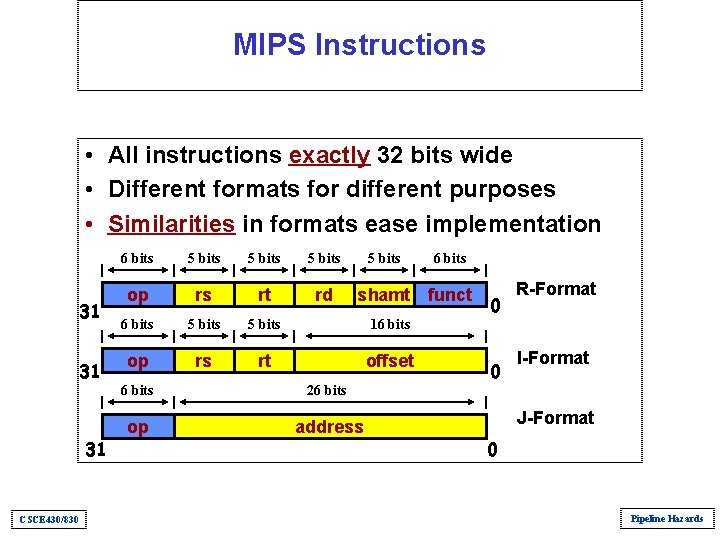
MIPS Instructions • All instructions exactly 32 bits wide • Different formats for different purposes • Similarities in formats ease implementation 31 31 31 CSCE 430/830 6 bits 5 bits op rs rt rd 6 bits 5 bits 16 bits op rs rt offset 6 bits shamt funct 6 bits 26 bits op address 0 0 R-Format I-Format J-Format 0 Pipeline Hazards
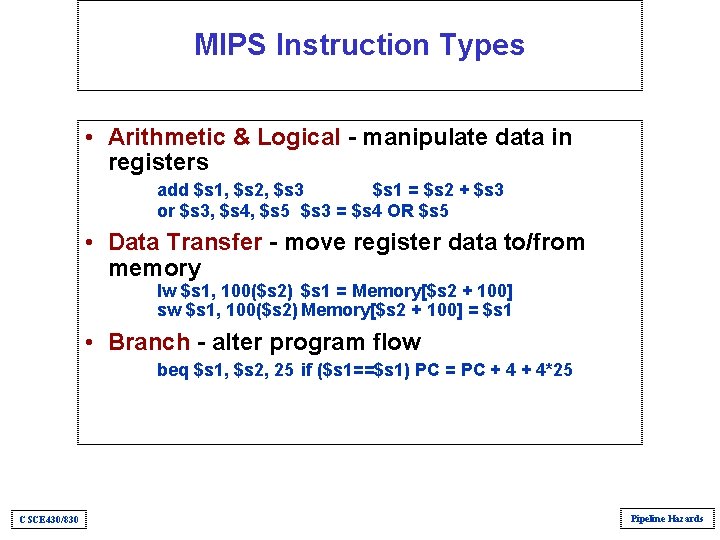
MIPS Instruction Types • Arithmetic & Logical - manipulate data in registers add $s 1, $s 2, $s 3 $s 1 = $s 2 + $s 3 or $s 3, $s 4, $s 5 $s 3 = $s 4 OR $s 5 • Data Transfer - move register data to/from memory lw $s 1, 100($s 2) $s 1 = Memory[$s 2 + 100] sw $s 1, 100($s 2) Memory[$s 2 + 100] = $s 1 • Branch - alter program flow beq $s 1, $s 2, 25 if ($s 1==$s 1) PC = PC + 4*25 CSCE 430/830 Pipeline Hazards