Constructive Computer Architecture Data Hazards in Pipelined Processors
- Slides: 20
Constructive Computer Architecture: Data Hazards in Pipelined Processors Arvind Computer Science & Artificial Intelligence Lab. Massachusetts Institute of Technology Delivered by Andy Wright October 15, 2014 http: //csg. csail. mit. edu/6. 175 L 13 -1
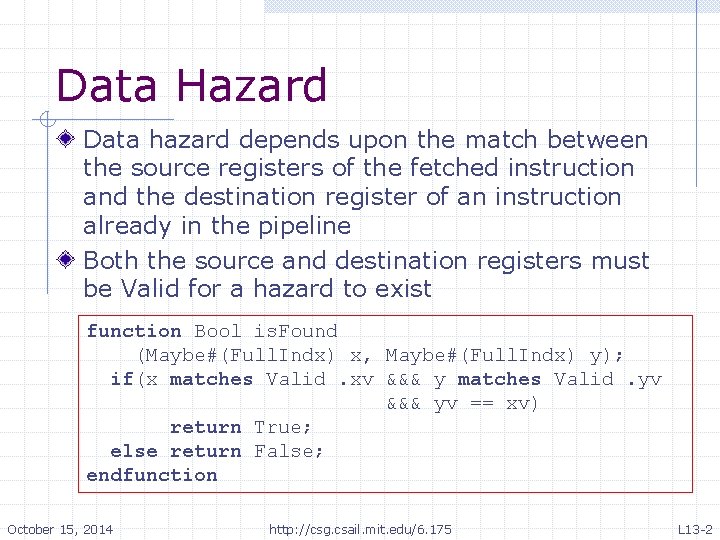
Data Hazard Data hazard depends upon the match between the source registers of the fetched instruction and the destination register of an instruction already in the pipeline Both the source and destination registers must be Valid for a hazard to exist function Bool is. Found (Maybe#(Full. Indx) x, Maybe#(Full. Indx) y); if(x matches Valid. xv &&& y matches Valid. yv &&& yv == xv) return True; else return False; endfunction October 15, 2014 http: //csg. csail. mit. edu/6. 175 L 13 -2
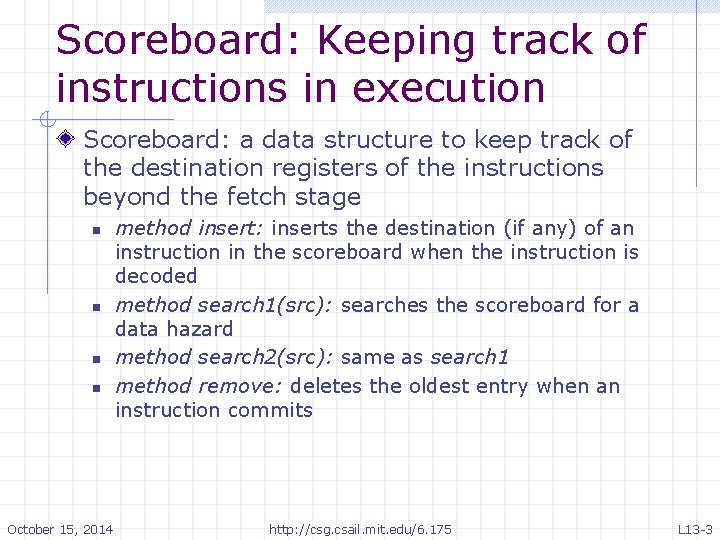
Scoreboard: Keeping track of instructions in execution Scoreboard: a data structure to keep track of the destination registers of the instructions beyond the fetch stage n n October 15, 2014 method insert: inserts the destination (if any) of an instruction in the scoreboard when the instruction is decoded method search 1(src): searches the scoreboard for a data hazard method search 2(src): same as search 1 method remove: deletes the oldest entry when an instruction commits http: //csg. csail. mit. edu/6. 175 L 13 -3
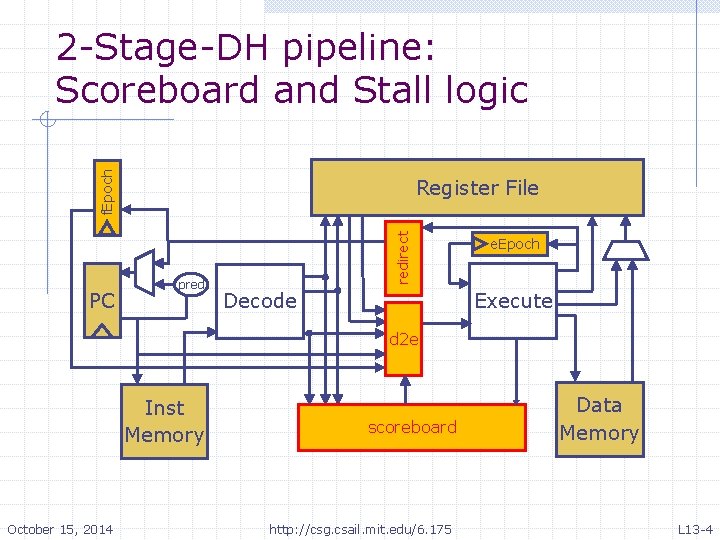
f. Epoch 2 -Stage-DH pipeline: Scoreboard and Stall logic PC pred redirect Register File e. Epoch Execute Decode d 2 e Inst Memory October 15, 2014 scoreboard http: //csg. csail. mit. edu/6. 175 Data Memory L 13 -4
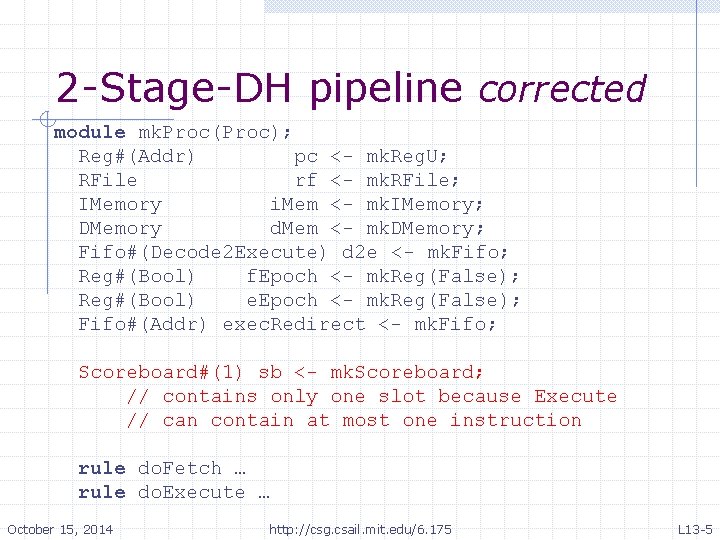
2 -Stage-DH pipeline corrected module mk. Proc(Proc); Reg#(Addr) pc <- mk. Reg. U; RFile rf <- mk. RFile; IMemory i. Mem <- mk. IMemory; DMemory d. Mem <- mk. DMemory; Fifo#(Decode 2 Execute) d 2 e <- mk. Fifo; Reg#(Bool) f. Epoch <- mk. Reg(False); Reg#(Bool) e. Epoch <- mk. Reg(False); Fifo#(Addr) exec. Redirect <- mk. Fifo; Scoreboard#(1) sb <- mk. Scoreboard; // contains only one slot because Execute // can contain at most one instruction rule do. Fetch … rule do. Execute … October 15, 2014 http: //csg. csail. mit. edu/6. 175 L 13 -5
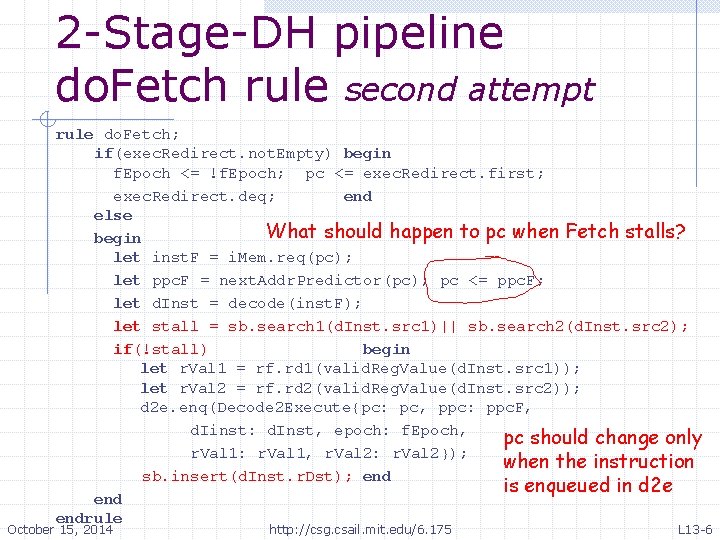
2 -Stage-DH pipeline do. Fetch rule second attempt rule do. Fetch; if(exec. Redirect. not. Empty) begin f. Epoch <= !f. Epoch; pc <= exec. Redirect. first; exec. Redirect. deq; end else What should happen to pc when Fetch stalls? begin let inst. F = i. Mem. req(pc); let ppc. F = next. Addr. Predictor(pc); pc <= ppc. F; let d. Inst = decode(inst. F); let stall = sb. search 1(d. Inst. src 1)|| sb. search 2(d. Inst. src 2); if(!stall) begin let r. Val 1 = rf. rd 1(valid. Reg. Value(d. Inst. src 1)); let r. Val 2 = rf. rd 2(valid. Reg. Value(d. Inst. src 2)); d 2 e. enq(Decode 2 Execute{pc: pc, ppc: ppc. F, d. Iinst: d. Inst, epoch: f. Epoch, pc should change only r. Val 1: r. Val 1, r. Val 2: r. Val 2}); when the instruction sb. insert(d. Inst. r. Dst); end is enqueued in d 2 e endrule October 15, 2014 http: //csg. csail. mit. edu/6. 175 L 13 -6
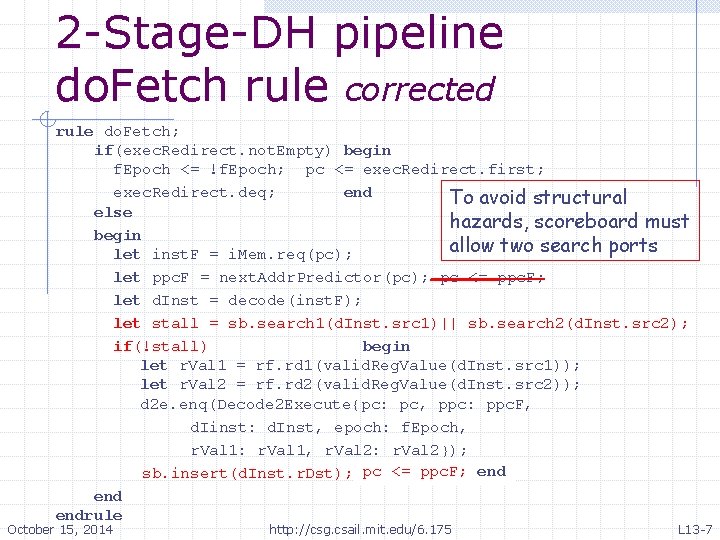
2 -Stage-DH pipeline do. Fetch rule corrected rule do. Fetch; if(exec. Redirect. not. Empty) begin f. Epoch <= !f. Epoch; pc <= exec. Redirect. first; exec. Redirect. deq; end To avoid structural else hazards, scoreboard must begin allow two search ports let inst. F = i. Mem. req(pc); let ppc. F = next. Addr. Predictor(pc); pc <= ppc. F; let d. Inst = decode(inst. F); let stall = sb. search 1(d. Inst. src 1)|| sb. search 2(d. Inst. src 2); if(!stall) begin let r. Val 1 = rf. rd 1(valid. Reg. Value(d. Inst. src 1)); let r. Val 2 = rf. rd 2(valid. Reg. Value(d. Inst. src 2)); d 2 e. enq(Decode 2 Execute{pc: pc, ppc: ppc. F, d. Iinst: d. Inst, epoch: f. Epoch, r. Val 1: r. Val 1, r. Val 2: r. Val 2}); pc <= ppc. F; end sb. insert(d. Inst. r. Dst); end endrule October 15, 2014 http: //csg. csail. mit. edu/6. 175 L 13 -7
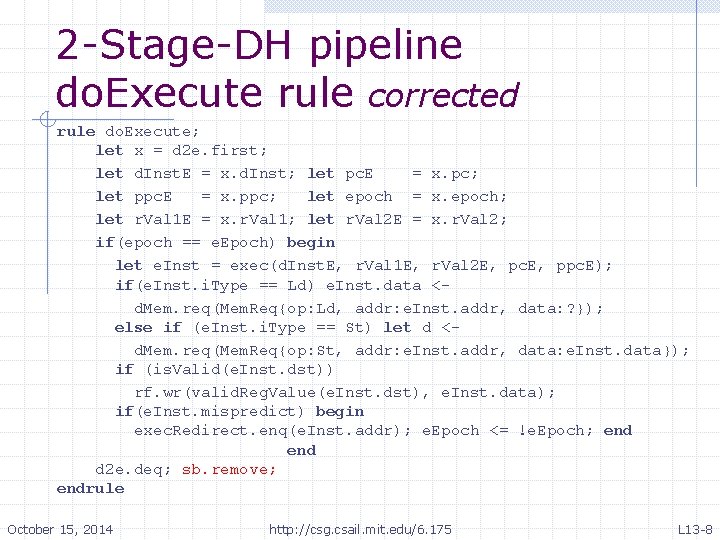
2 -Stage-DH pipeline do. Execute rule corrected rule do. Execute; let x = d 2 e. first; let d. Inst. E = x. d. Inst; let pc. E = x. pc; let ppc. E = x. ppc; let epoch = x. epoch; let r. Val 1 E = x. r. Val 1; let r. Val 2 E = x. r. Val 2; if(epoch == e. Epoch) begin let e. Inst = exec(d. Inst. E, r. Val 1 E, r. Val 2 E, pc. E, ppc. E); if(e. Inst. i. Type == Ld) e. Inst. data < d. Mem. req(Mem. Req{op: Ld, addr: e. Inst. addr, data: ? }); else if (e. Inst. i. Type == St) let d <- d. Mem. req(Mem. Req{op: St, addr: e. Inst. addr, data: e. Inst. data}); if (is. Valid(e. Inst. dst)) rf. wr(valid. Reg. Value(e. Inst. dst), e. Inst. data); if(e. Inst. mispredict) begin exec. Redirect. enq(e. Inst. addr); e. Epoch <= !e. Epoch; end end d 2 e. deq; sb. remove; endrule October 15, 2014 http: //csg. csail. mit. edu/6. 175 L 13 -8
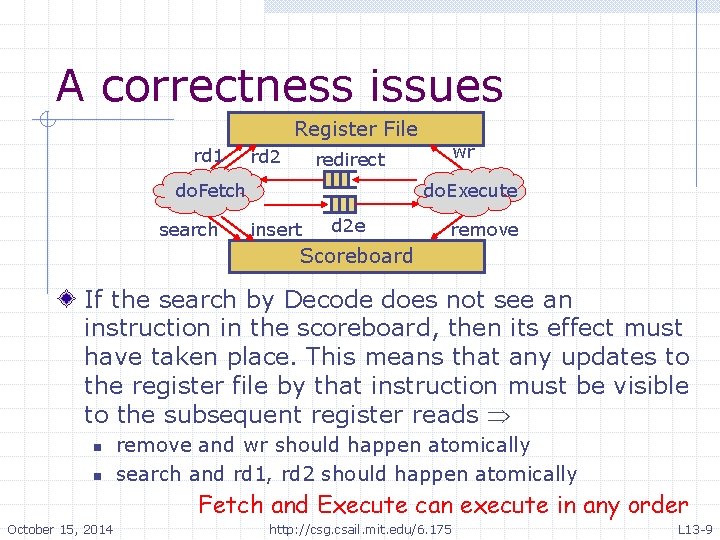
A correctness issues Register File rd 1 rd 2 do. Fetch search wr redirect do. Execute insert d 2 e remove Scoreboard If the search by Decode does not see an instruction in the scoreboard, then its effect must have taken place. This means that any updates to the register file by that instruction must be visible to the subsequent register reads n n remove and wr should happen atomically search and rd 1, rd 2 should happen atomically Fetch and Execute can execute in any order October 15, 2014 http: //csg. csail. mit. edu/6. 175 L 13 -9
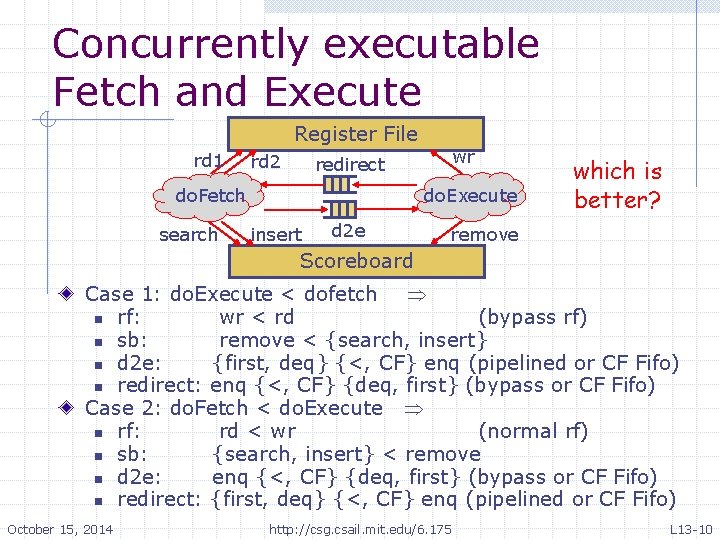
Concurrently executable Fetch and Execute Register File rd 1 rd 2 do. Fetch search wr redirect do. Execute insert d 2 e which is better? remove Scoreboard Case 1: do. Execute < dofetch n rf: wr < rd (bypass rf) n sb: remove < {search, insert} n d 2 e: {first, deq} {<, CF} enq (pipelined or CF Fifo) n redirect: enq {<, CF} {deq, first} (bypass or CF Fifo) Case 2: do. Fetch < do. Execute n rf: rd < wr (normal rf) n sb: {search, insert} < remove n d 2 e: enq {<, CF} {deq, first} (bypass or CF Fifo) n redirect: {first, deq} {<, CF} enq (pipelined or CF Fifo) October 15, 2014 http: //csg. csail. mit. edu/6. 175 L 13 -10
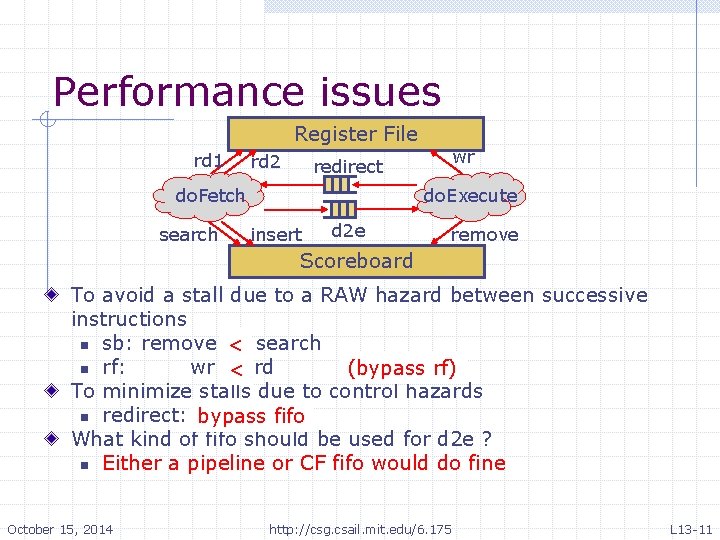
Performance issues Register File rd 1 rd 2 do. Fetch search wr redirect do. Execute insert d 2 e remove Scoreboard To avoid a stall due to a RAW hazard between successive instructions n sb: remove < ? search n rf: wr ? (bypass rf) < rd To minimize stalls due to control hazards n redirect: bypass ? fifo What kind of fifo should be used for d 2 e ? n Either a pipeline or CF fifo would do fine October 15, 2014 http: //csg. csail. mit. edu/6. 175 L 13 -11
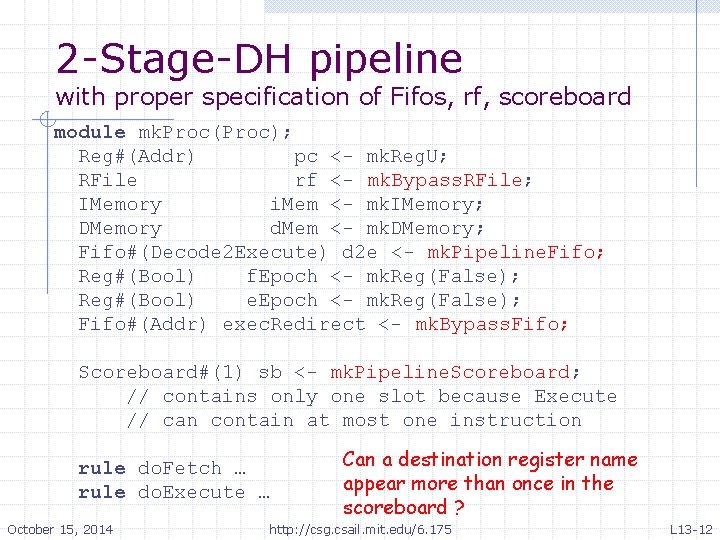
2 -Stage-DH pipeline with proper specification of Fifos, rf, scoreboard module mk. Proc(Proc); Reg#(Addr) pc <- mk. Reg. U; RFile rf <- mk. Bypass. RFile; IMemory i. Mem <- mk. IMemory; DMemory d. Mem <- mk. DMemory; Fifo#(Decode 2 Execute) d 2 e <- mk. Pipeline. Fifo; Reg#(Bool) f. Epoch <- mk. Reg(False); Reg#(Bool) e. Epoch <- mk. Reg(False); Fifo#(Addr) exec. Redirect <- mk. Bypass. Fifo; Scoreboard#(1) sb <- mk. Pipeline. Scoreboard; // contains only one slot because Execute // can contain at most one instruction rule do. Fetch … rule do. Execute … October 15, 2014 Can a destination register name appear more than once in the scoreboard ? http: //csg. csail. mit. edu/6. 175 L 13 -12
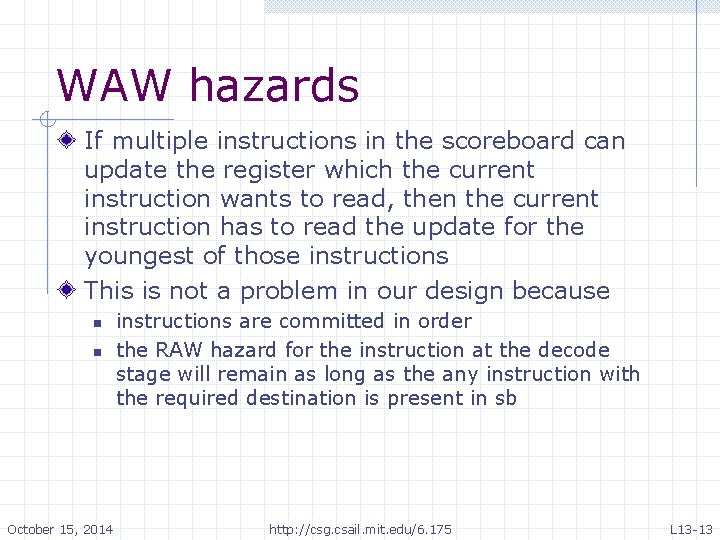
WAW hazards If multiple instructions in the scoreboard can update the register which the current instruction wants to read, then the current instruction has to read the update for the youngest of those instructions This is not a problem in our design because n n October 15, 2014 instructions are committed in order the RAW hazard for the instruction at the decode stage will remain as long as the any instruction with the required destination is present in sb http: //csg. csail. mit. edu/6. 175 L 13 -13
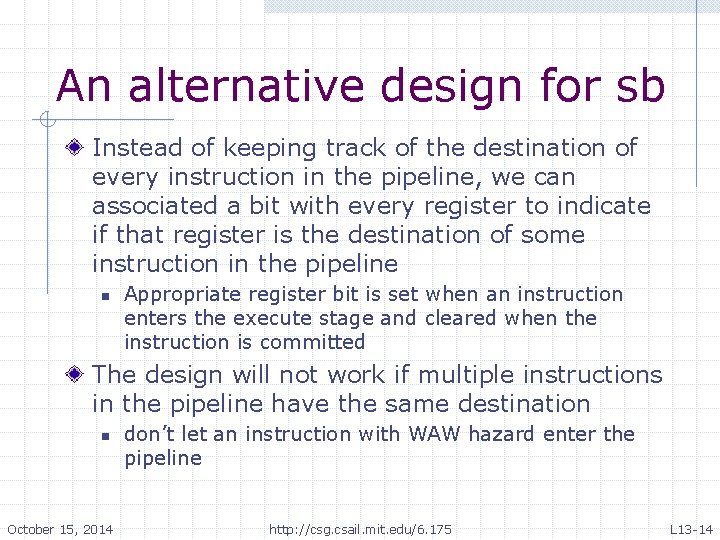
An alternative design for sb Instead of keeping track of the destination of every instruction in the pipeline, we can associated a bit with every register to indicate if that register is the destination of some instruction in the pipeline n Appropriate register bit is set when an instruction enters the execute stage and cleared when the instruction is committed The design will not work if multiple instructions in the pipeline have the same destination n October 15, 2014 don’t let an instruction with WAW hazard enter the pipeline http: //csg. csail. mit. edu/6. 175 L 13 -14
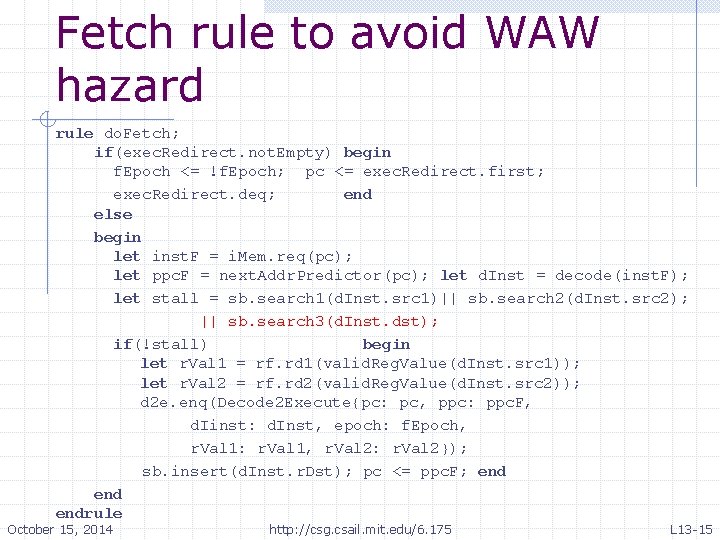
Fetch rule to avoid WAW hazard rule do. Fetch; if(exec. Redirect. not. Empty) begin f. Epoch <= !f. Epoch; pc <= exec. Redirect. first; exec. Redirect. deq; end else begin let inst. F = i. Mem. req(pc); let ppc. F = next. Addr. Predictor(pc); let d. Inst = decode(inst. F); let stall = sb. search 1(d. Inst. src 1)|| sb. search 2(d. Inst. src 2); || sb. search 3(d. Inst. dst); if(!stall) begin let r. Val 1 = rf. rd 1(valid. Reg. Value(d. Inst. src 1)); let r. Val 2 = rf. rd 2(valid. Reg. Value(d. Inst. src 2)); d 2 e. enq(Decode 2 Execute{pc: pc, ppc: ppc. F, d. Iinst: d. Inst, epoch: f. Epoch, r. Val 1: r. Val 1, r. Val 2: r. Val 2}); sb. insert(d. Inst. r. Dst); pc <= ppc. F; end endrule October 15, 2014 http: //csg. csail. mit. edu/6. 175 L 13 -15
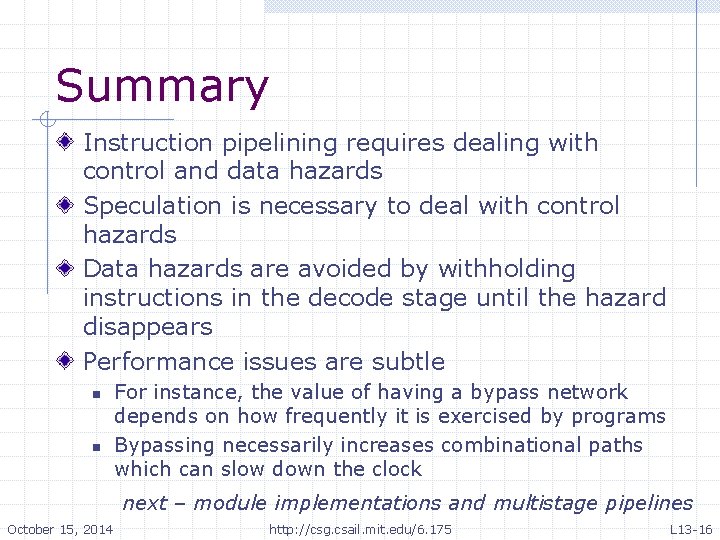
Summary Instruction pipelining requires dealing with control and data hazards Speculation is necessary to deal with control hazards Data hazards are avoided by withholding instructions in the decode stage until the hazard disappears Performance issues are subtle n n For instance, the value of having a bypass network depends on how frequently it is exercised by programs Bypassing necessarily increases combinational paths which can slow down the clock next – module implementations and multistage pipelines October 15, 2014 http: //csg. csail. mit. edu/6. 175 L 13 -16
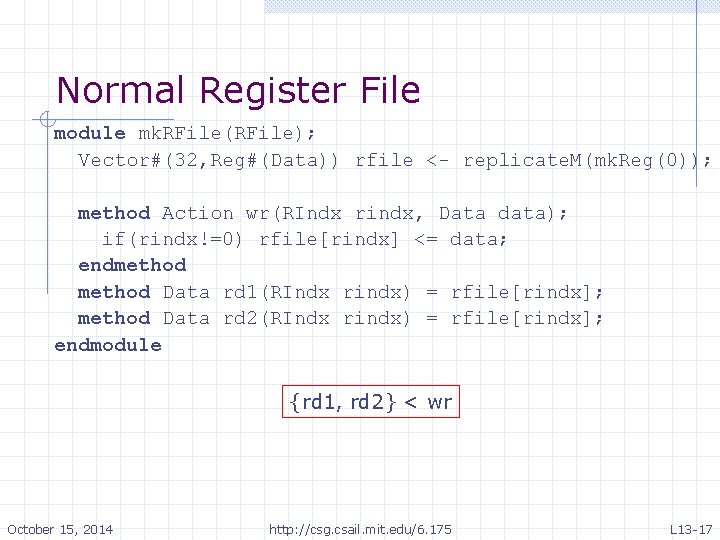
Normal Register File module mk. RFile(RFile); Vector#(32, Reg#(Data)) rfile <- replicate. M(mk. Reg(0)); method Action wr(RIndx rindx, Data data); if(rindx!=0) rfile[rindx] <= data; endmethod Data rd 1(RIndx rindx) = rfile[rindx]; method Data rd 2(RIndx rindx) = rfile[rindx]; endmodule {rd 1, rd 2} < wr October 15, 2014 http: //csg. csail. mit. edu/6. 175 L 13 -17
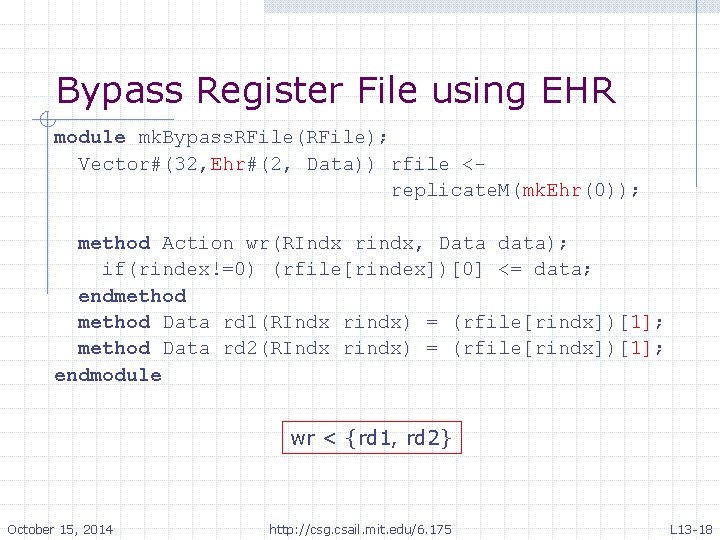
Bypass Register File using EHR module mk. Bypass. RFile(RFile); Vector#(32, Ehr#(2, Data)) rfile < replicate. M(mk. Ehr(0)); method Action wr(RIndx rindx, Data data); if(rindex!=0) (rfile[rindex])[0] <= data; endmethod Data rd 1(RIndx rindx) = (rfile[rindx])[1]; method Data rd 2(RIndx rindx) = (rfile[rindx])[1]; endmodule wr < {rd 1, rd 2} October 15, 2014 http: //csg. csail. mit. edu/6. 175 L 13 -18
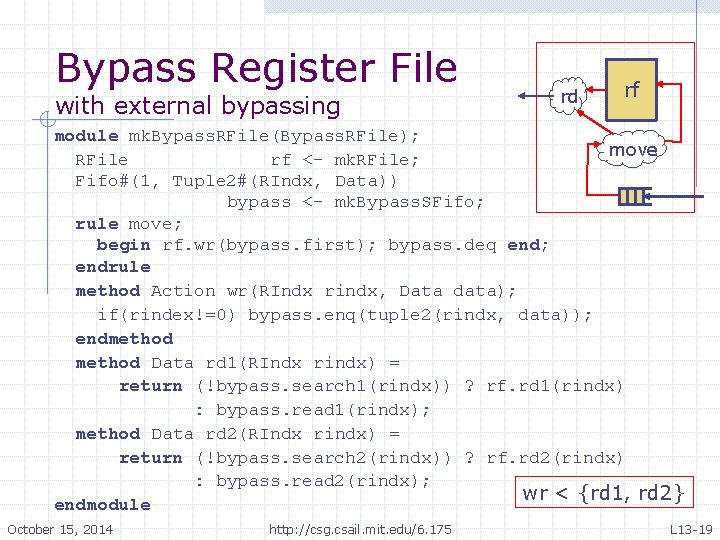
Bypass Register File with external bypassing rd rf module mk. Bypass. RFile(Bypass. RFile); move RFile rf <- mk. RFile; Fifo#(1, Tuple 2#(RIndx, Data)) bypass <- mk. Bypass. SFifo; rule move; begin rf. wr(bypass. first); bypass. deq end; endrule method Action wr(RIndx rindx, Data data); if(rindex!=0) bypass. enq(tuple 2(rindx, data)); endmethod Data rd 1(RIndx rindx) = return (!bypass. search 1(rindx)) ? rf. rd 1(rindx) : bypass. read 1(rindx); method Data rd 2(RIndx rindx) = return (!bypass. search 2(rindx)) ? rf. rd 2(rindx) : bypass. read 2(rindx); wr < {rd 1, rd 2} endmodule October 15, 2014 http: //csg. csail. mit. edu/6. 175 L 13 -19
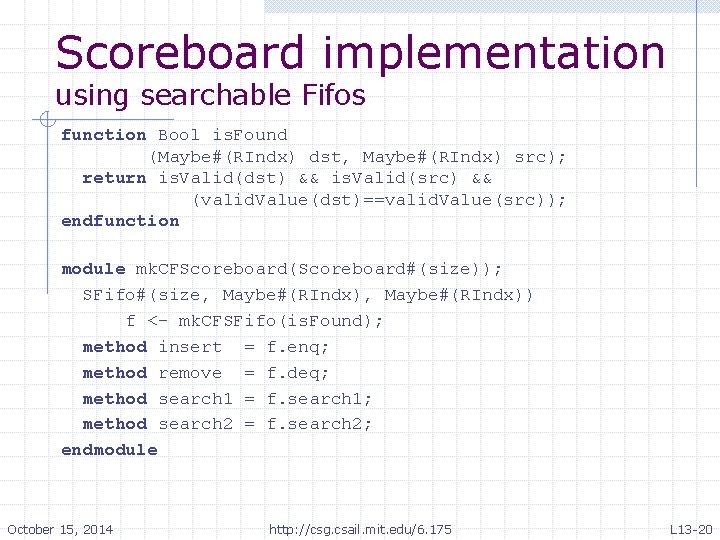
Scoreboard implementation using searchable Fifos function Bool is. Found (Maybe#(RIndx) dst, Maybe#(RIndx) src); return is. Valid(dst) && is. Valid(src) && (valid. Value(dst)==valid. Value(src)); endfunction module mk. CFScoreboard(Scoreboard#(size)); SFifo#(size, Maybe#(RIndx)) f <- mk. CFSFifo(is. Found); method insert = f. enq; method remove = f. deq; method search 1 = f. search 1; method search 2 = f. search 2; endmodule October 15, 2014 http: //csg. csail. mit. edu/6. 175 L 13 -20