
CSCE 430830 Computer Architecture Instructionlevel parallelism Tomasulo Lecturer
- Slides: 79
CSCE 430/830 Computer Architecture Instruction-level parallelism: Tomasulo Lecturer: Prof. Hong Jiang Courtesy of Yifeng Zhu (U. Maine) Fall, 2006 CSCE 430/830 Portions of these slides are derived from: Dave Patterson © UCB ILP: Tomasulo
Another Dynamic Algorithm: Tomasulo’s Algorithm • For IBM 360/91 (before caches!) • Goal: High Performance without special compilers • Small number of floating point registers (4 in 360) prevented interesting compiler scheduling of operations – This led Tomasulo to try to figure out how to get more effective registers — renaming in hardware! • Why Study 1966 Computer? • The descendants of this have flourished! – Alpha 21264, HP 8000, MIPS 10000, Pentium III, Power. PC 604, … CSCE 430/830 ILP: Tomasulo
Tomasulo’s Algorithm • Tracks when operands for instructions are available. – Minimizes RAW hazards. – Introduces register renaming to minimize WAW and WAR hazards. • Supports the overlapped execution of multiple iterations of a loop. CSCE 430/830 ILP: Tomasulo
Avoiding Hazards • RAW – Execute an instruction only when its operands are available. • WAW and WAR – Register renaming CSCE 430/830 ILP: Tomasulo
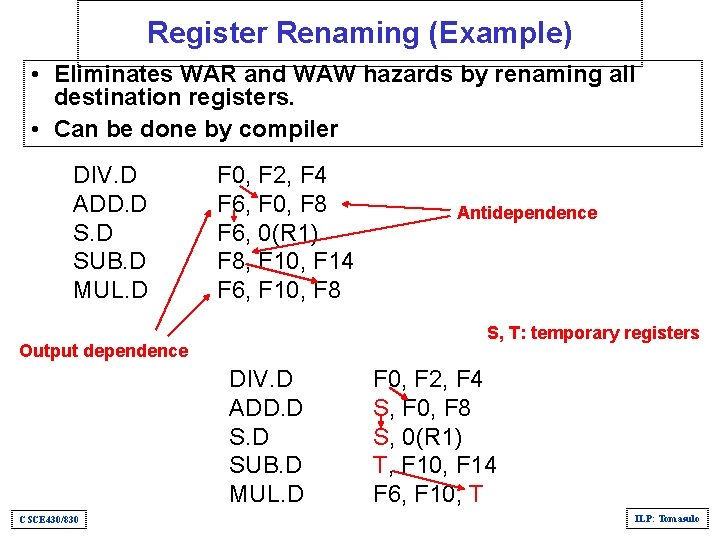
Register Renaming (Example) • Eliminates WAR and WAW hazards by renaming all destination registers. • Can be done by compiler DIV. D ADD. D SUB. D MUL. D F 0, F 2, F 4 F 6, F 0, F 8 F 6, 0(R 1) F 8, F 10, F 14 F 6, F 10, F 8 S, T: temporary registers Output dependence DIV. D ADD. D SUB. D MUL. D CSCE 430/830 Antidependence F 0, F 2, F 4 S, F 0, F 8 S, 0(R 1) T, F 10, F 14 F 6, F 10, T ILP: Tomasulo
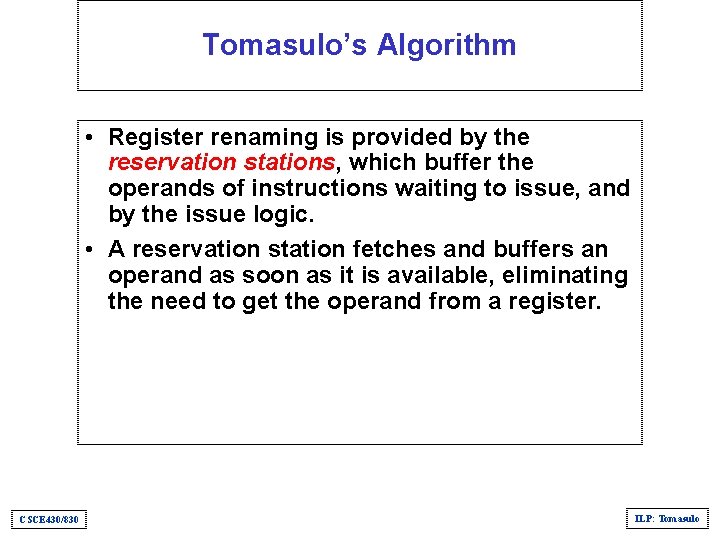
Tomasulo’s Algorithm • Register renaming is provided by the reservation stations, which buffer the operands of instructions waiting to issue, and by the issue logic. • A reservation station fetches and buffers an operand as soon as it is available, eliminating the need to get the operand from a register. CSCE 430/830 ILP: Tomasulo
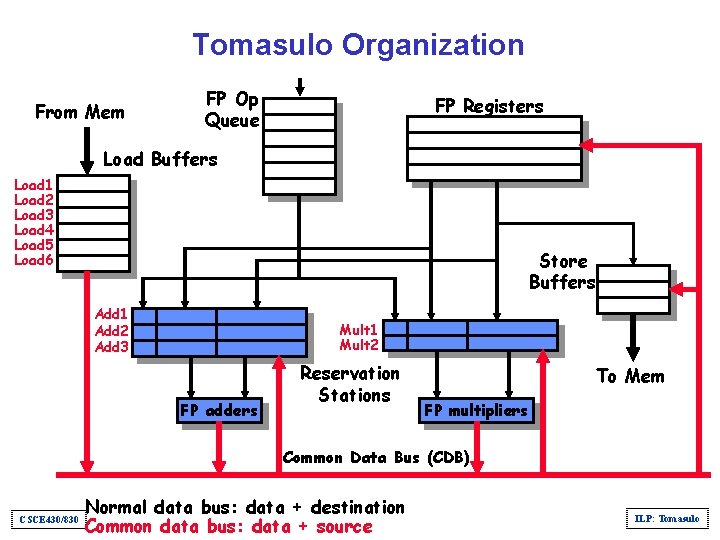
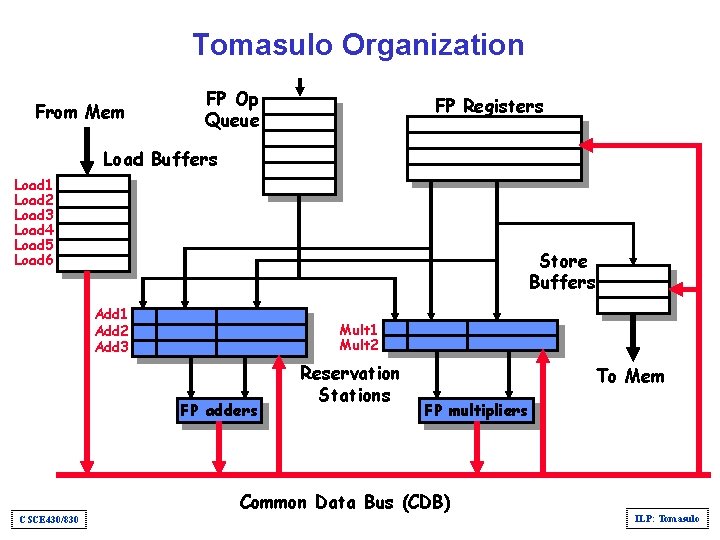
Tomasulo Organization From Mem FP Op Queue FP Registers Load Buffers Load 1 Load 2 Load 3 Load 4 Load 5 Load 6 Store Buffers Add 1 Add 2 Add 3 Mult 1 Mult 2 FP adders Reservation Stations To Mem FP multipliers Common Data Bus (CDB) CSCE 430/830 Normal data bus: data + destination Common data bus: data + source ILP: Tomasulo
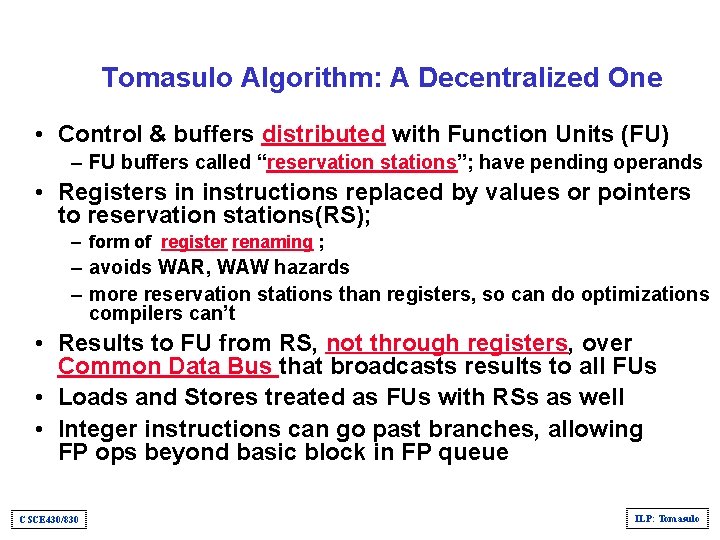
Tomasulo Algorithm: A Decentralized One • Control & buffers distributed with Function Units (FU) – FU buffers called “reservation stations”; have pending operands • Registers in instructions replaced by values or pointers to reservation stations(RS); – form of register renaming ; – avoids WAR, WAW hazards – more reservation stations than registers, so can do optimizations compilers can’t • Results to FU from RS, not through registers, over Common Data Bus that broadcasts results to all FUs • Loads and Stores treated as FUs with RSs as well • Integer instructions can go past branches, allowing FP ops beyond basic block in FP queue CSCE 430/830 ILP: Tomasulo
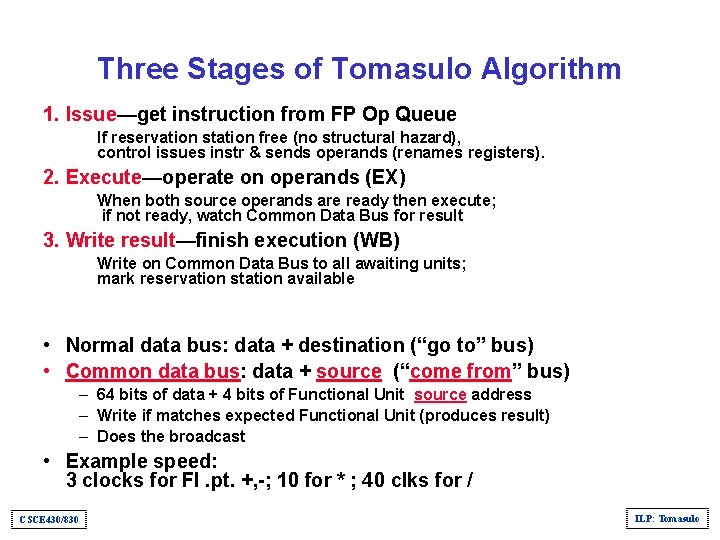
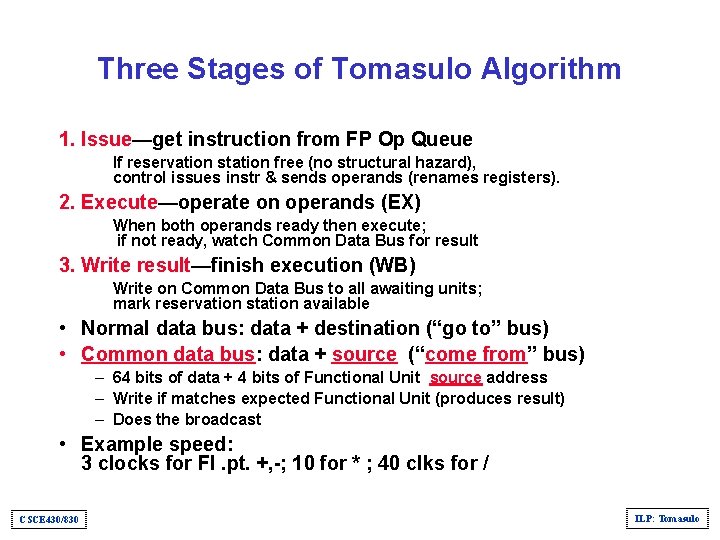
Three Stages of Tomasulo Algorithm 1. Issue—get instruction from FP Op Queue If reservation station free (no structural hazard), control issues instr & sends operands (renames registers). 2. Execute—operate on operands (EX) When both source operands are ready then execute; if not ready, watch Common Data Bus for result 3. Write result—finish execution (WB) Write on Common Data Bus to all awaiting units; mark reservation station available • Normal data bus: data + destination (“go to” bus) • Common data bus: data + source (“come from” bus) – 64 bits of data + 4 bits of Functional Unit source address – Write if matches expected Functional Unit (produces result) – Does the broadcast • Example speed: 3 clocks for Fl. pt. +, -; 10 for * ; 40 clks for / CSCE 430/830 ILP: Tomasulo
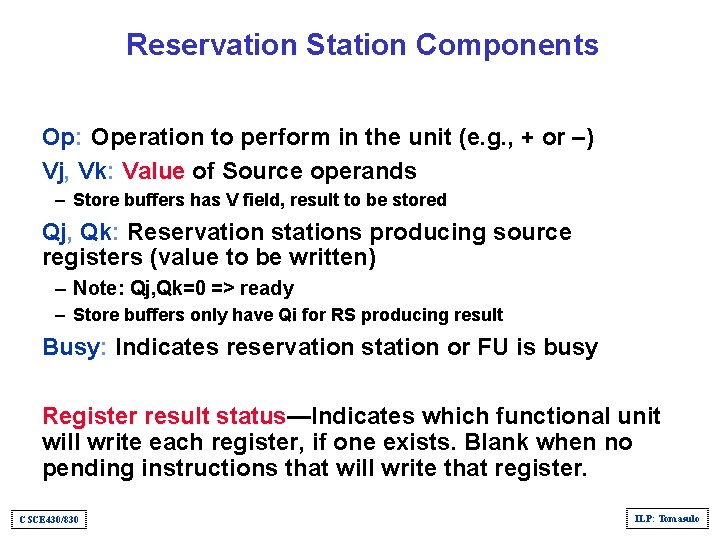
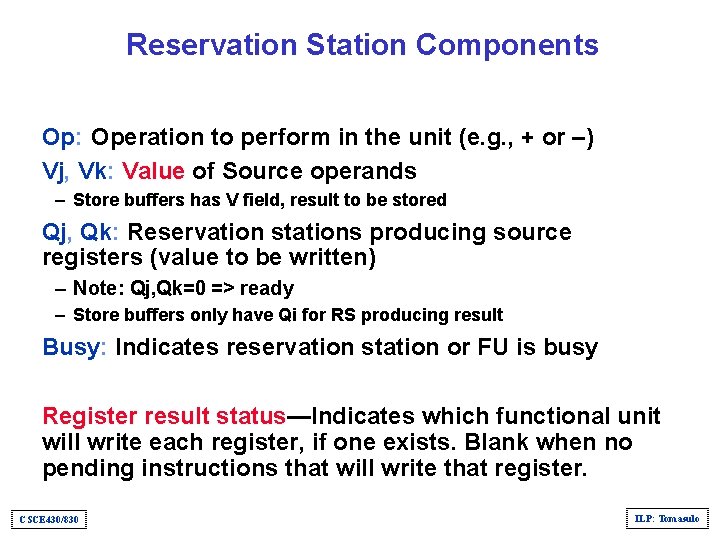
Reservation Station Components Op: Operation to perform in the unit (e. g. , + or –) Vj, Vk: Value of Source operands – Store buffers has V field, result to be stored Qj, Qk: Reservation stations producing source registers (value to be written) – Note: Qj, Qk=0 => ready – Store buffers only have Qi for RS producing result Busy: Indicates reservation station or FU is busy Register result status—Indicates which functional unit will write each register, if one exists. Blank when no pending instructions that will write that register. CSCE 430/830 ILP: Tomasulo
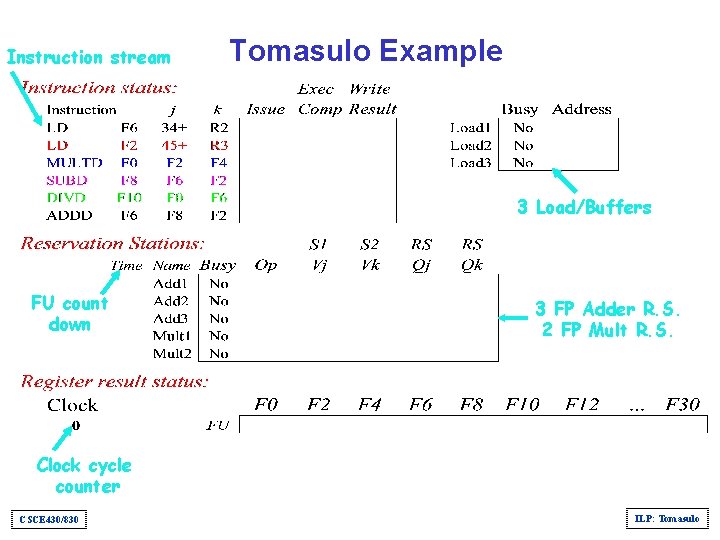
Instruction stream Tomasulo Example 3 Load/Buffers FU count down 3 FP Adder R. S. 2 FP Mult R. S. Clock cycle counter CSCE 430/830 ILP: Tomasulo
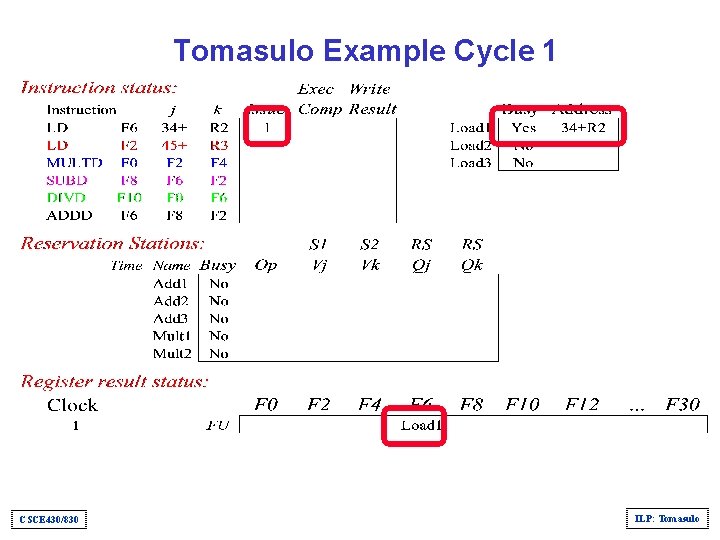
Tomasulo Example Cycle 1 CSCE 430/830 ILP: Tomasulo
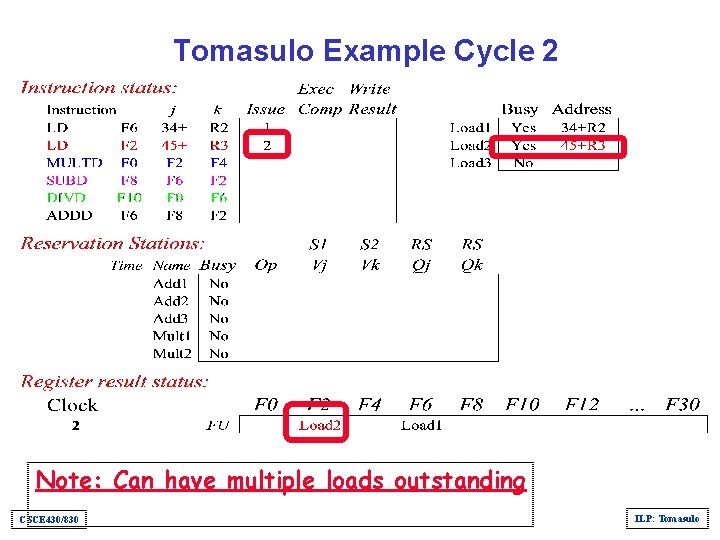
Tomasulo Example Cycle 2 Note: Can have multiple loads outstanding CSCE 430/830 ILP: Tomasulo
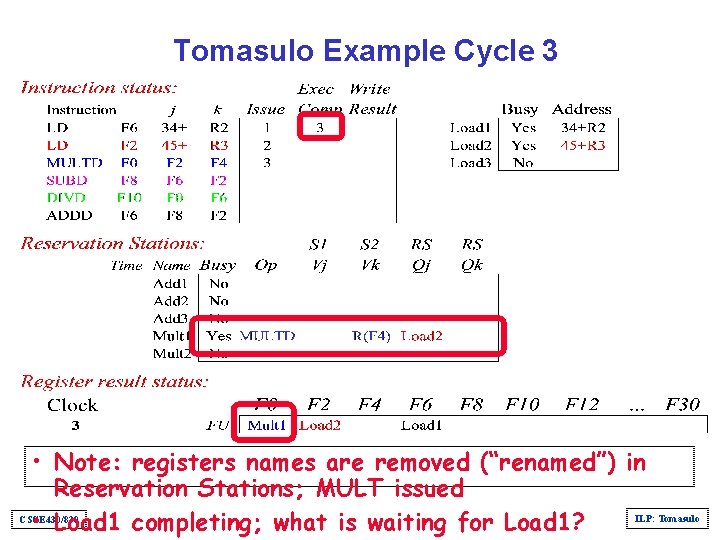
Tomasulo Example Cycle 3 • Note: registers names are removed (“renamed”) in Reservation Stations; MULT issued ILP: Tomasulo CSCE 430/830 • Load 1 completing; what is waiting for Load 1?
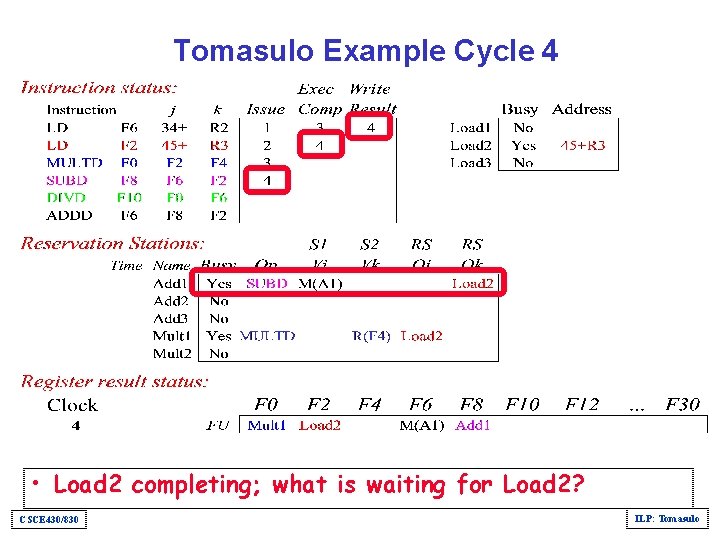
Tomasulo Example Cycle 4 • Load 2 completing; what is waiting for Load 2? CSCE 430/830 ILP: Tomasulo
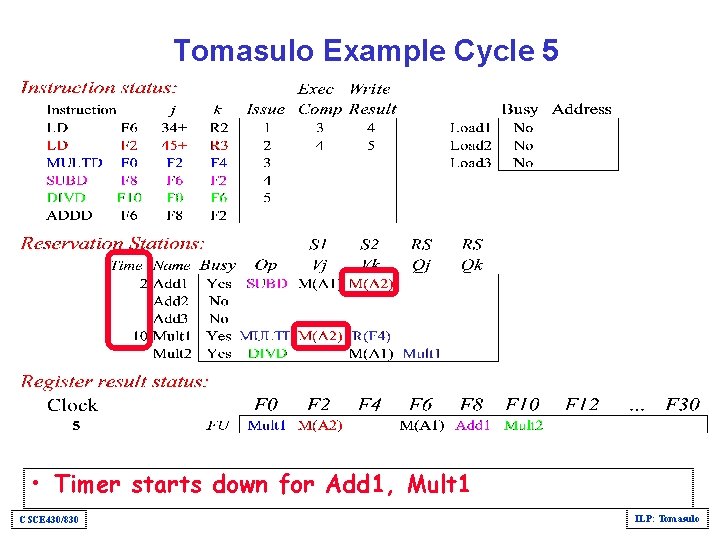
Tomasulo Example Cycle 5 • Timer starts down for Add 1, Mult 1 CSCE 430/830 ILP: Tomasulo
Tomasulo Example Cycle 6 • Issue ADDD here despite name dependency on F 6? CSCE 430/830 ILP: Tomasulo
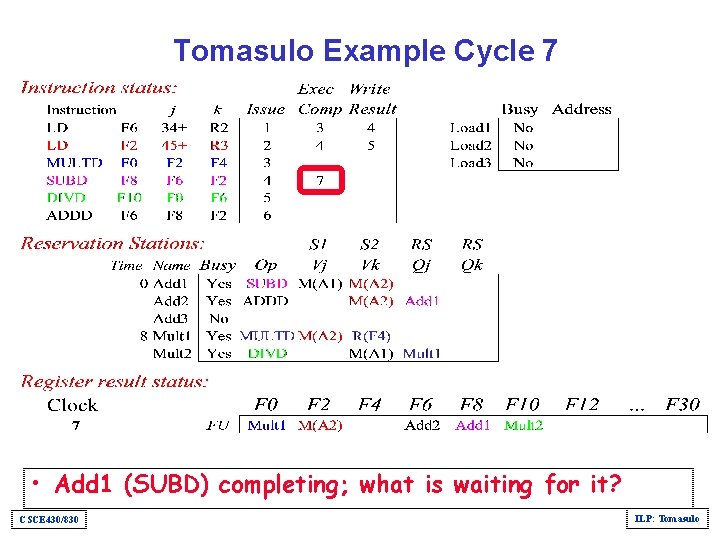
Tomasulo Example Cycle 7 • Add 1 (SUBD) completing; what is waiting for it? CSCE 430/830 ILP: Tomasulo
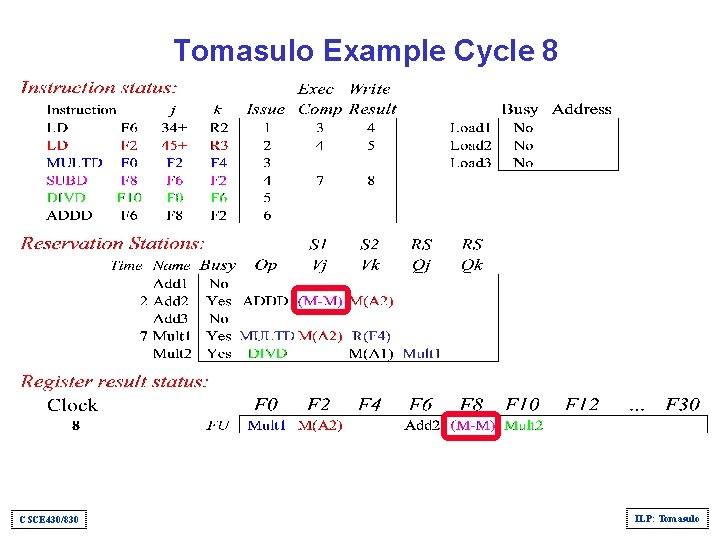
Tomasulo Example Cycle 8 CSCE 430/830 ILP: Tomasulo
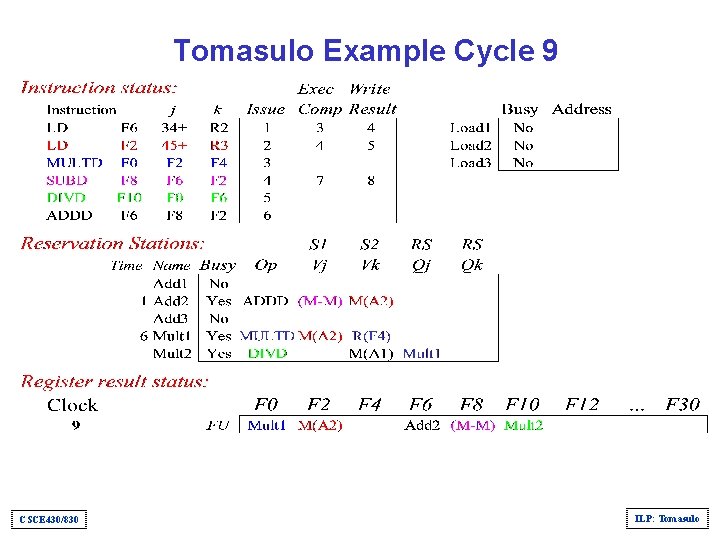
Tomasulo Example Cycle 9 CSCE 430/830 ILP: Tomasulo
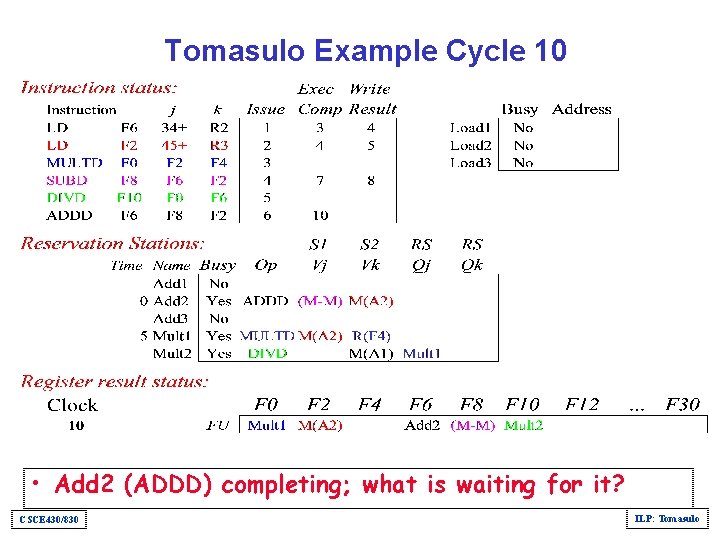
Tomasulo Example Cycle 10 • Add 2 (ADDD) completing; what is waiting for it? CSCE 430/830 ILP: Tomasulo
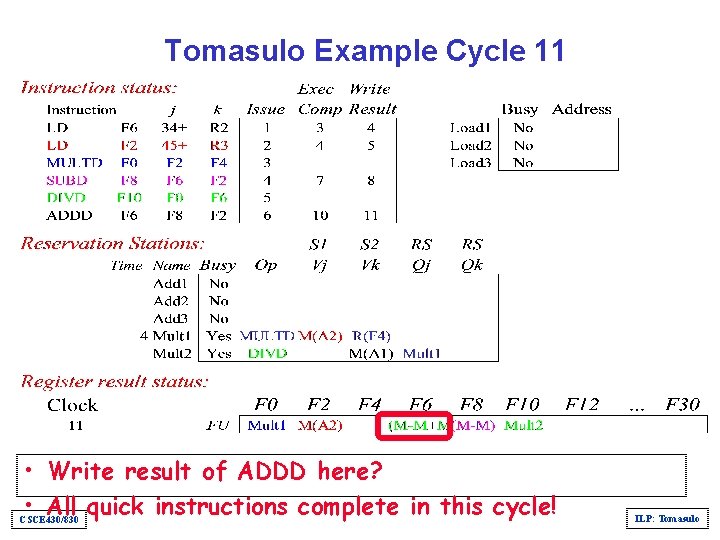
Tomasulo Example Cycle 11 • Write result of ADDD here? • All quick instructions complete in this cycle! CSCE 430/830 ILP: Tomasulo
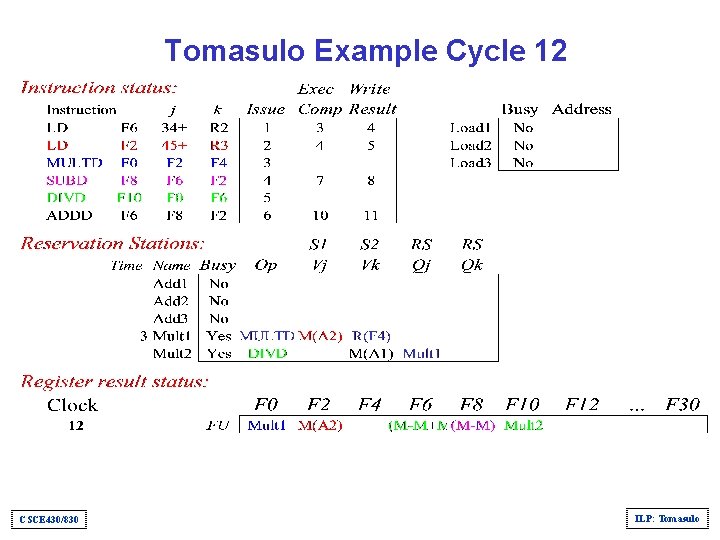
Tomasulo Example Cycle 12 CSCE 430/830 ILP: Tomasulo
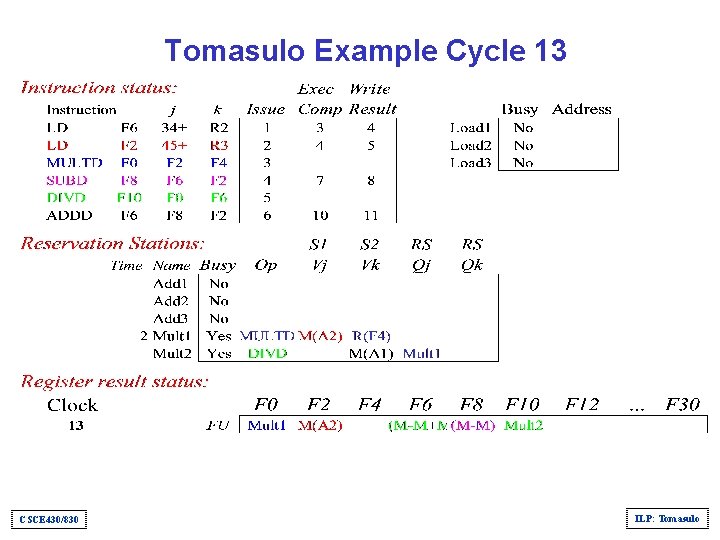
Tomasulo Example Cycle 13 CSCE 430/830 ILP: Tomasulo
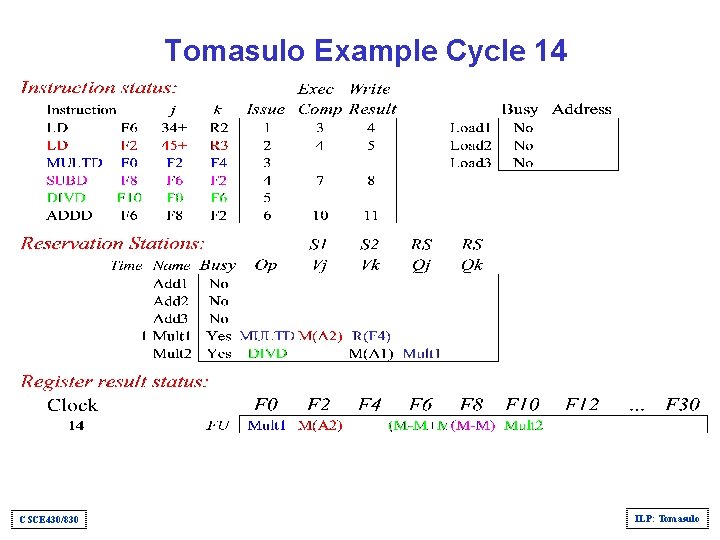
Tomasulo Example Cycle 14 CSCE 430/830 ILP: Tomasulo
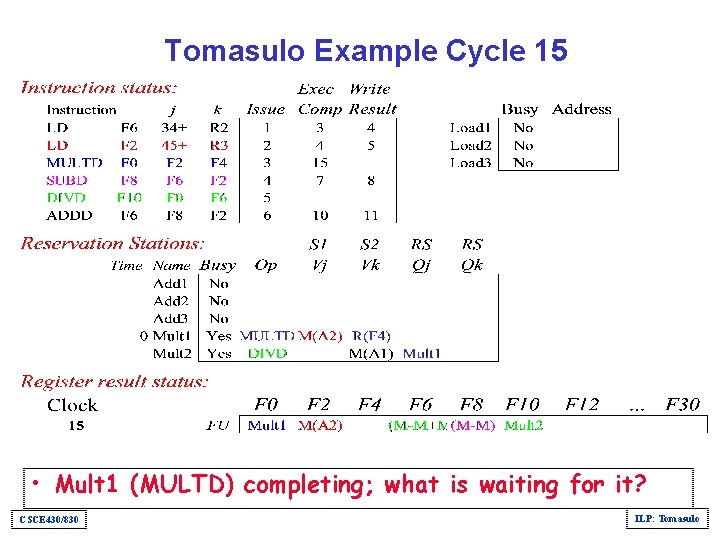
Tomasulo Example Cycle 15 • Mult 1 (MULTD) completing; what is waiting for it? CSCE 430/830 ILP: Tomasulo
Tomasulo Example Cycle 16 • Just waiting for Mult 2 (DIVD) to complete CSCE 430/830 ILP: Tomasulo
Faster than light computation (skip a couple of cycles) CSCE 430/830 ILP: Tomasulo
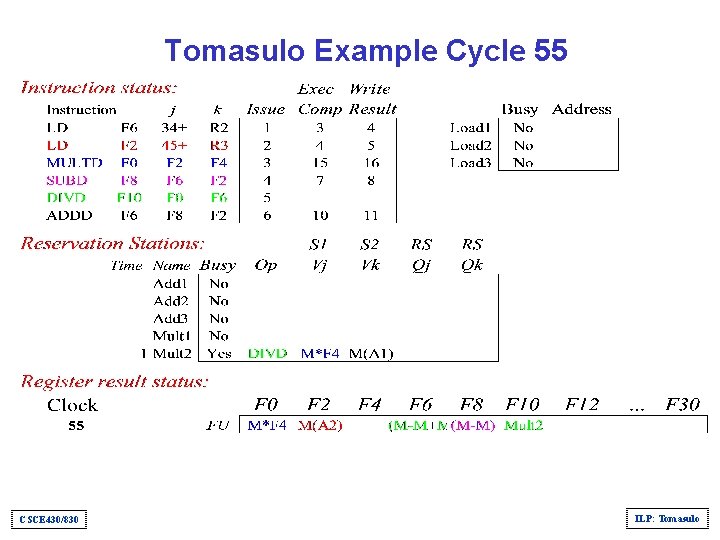
Tomasulo Example Cycle 55 CSCE 430/830 ILP: Tomasulo
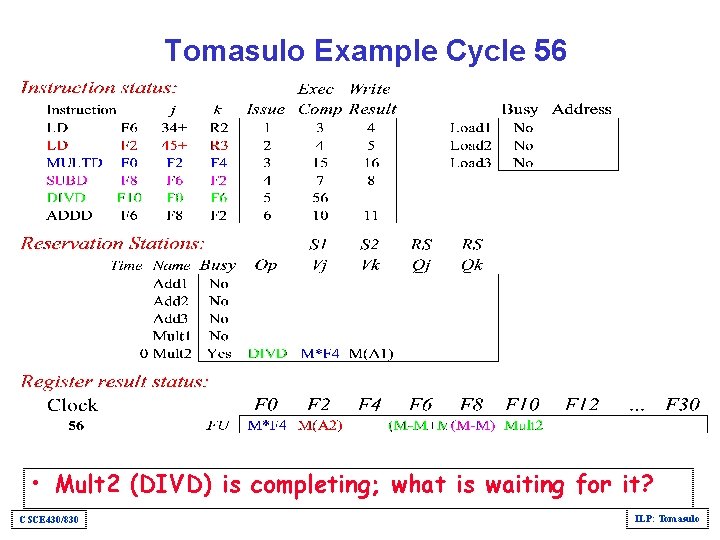
Tomasulo Example Cycle 56 • Mult 2 (DIVD) is completing; what is waiting for it? CSCE 430/830 ILP: Tomasulo
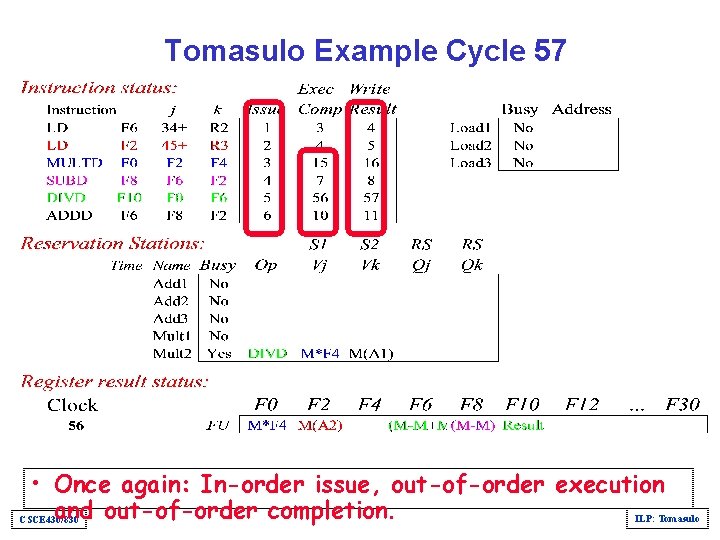
Tomasulo Example Cycle 57 • Once again: In-order issue, out-of-order execution and out-of-order completion. ILP: Tomasulo CSCE 430/830
Tomasulo Drawbacks • Complexity – delays of 360/91, MIPS 10000, Alpha 21264, IBM PPC 620 in CA: AQA 2/e, but not in silicon! • Many associative stores (CDB) at high speed • Performance limited by Common Data Bus – Each CDB must go to multiple functional units high capacitance, high wiring density – Number of functional units that can complete per cycle limited to one! » Multiple CDBs more FU logic for parallel assoc stores • Non-precise interrupts! – We will address this later CSCE 430/830 ILP: Tomasulo
Avoiding Hazards • RAW – Execute an instruction only when its operands are available. • WAW and WAR – Register renaming CSCE 430/830 ILP: Tomasulo
Tomasulo Organization From Mem FP Op Queue FP Registers Load Buffers Load 1 Load 2 Load 3 Load 4 Load 5 Load 6 Store Buffers Add 1 Add 2 Add 3 Mult 1 Mult 2 FP adders Reservation Stations To Mem FP multipliers Common Data Bus (CDB) CSCE 430/830 ILP: Tomasulo
Three Stages of Tomasulo Algorithm 1. Issue—get instruction from FP Op Queue If reservation station free (no structural hazard), control issues instr & sends operands (renames registers). 2. Execute—operate on operands (EX) When both operands ready then execute; if not ready, watch Common Data Bus for result 3. Write result—finish execution (WB) Write on Common Data Bus to all awaiting units; mark reservation station available • Normal data bus: data + destination (“go to” bus) • Common data bus: data + source (“come from” bus) – 64 bits of data + 4 bits of Functional Unit source address – Write if matches expected Functional Unit (produces result) – Does the broadcast • Example speed: 3 clocks for Fl. pt. +, -; 10 for * ; 40 clks for / CSCE 430/830 ILP: Tomasulo
Reservation Station Components Op: Operation to perform in the unit (e. g. , + or –) Vj, Vk: Value of Source operands – Store buffers has V field, result to be stored Qj, Qk: Reservation stations producing source registers (value to be written) – Note: Qj, Qk=0 => ready – Store buffers only have Qi for RS producing result Busy: Indicates reservation station or FU is busy Register result status—Indicates which functional unit will write each register, if one exists. Blank when no pending instructions that will write that register. CSCE 430/830 ILP: Tomasulo
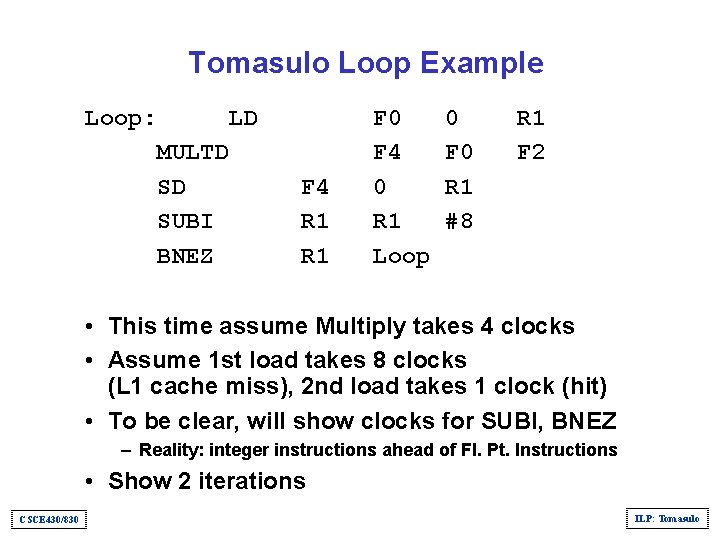
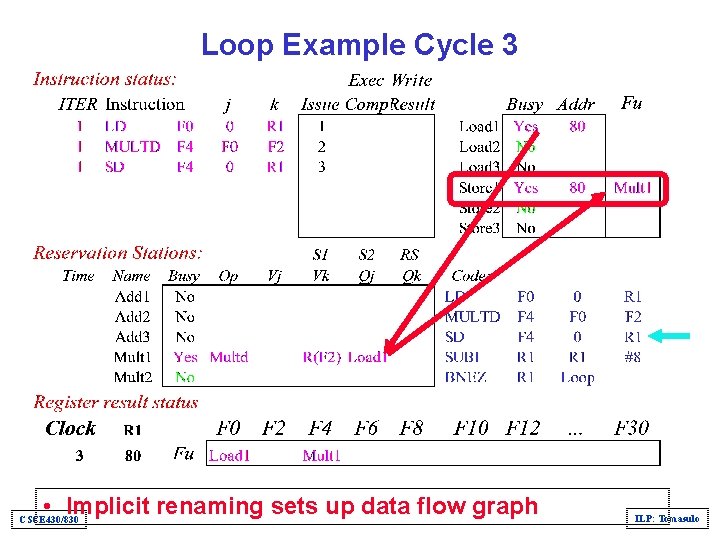
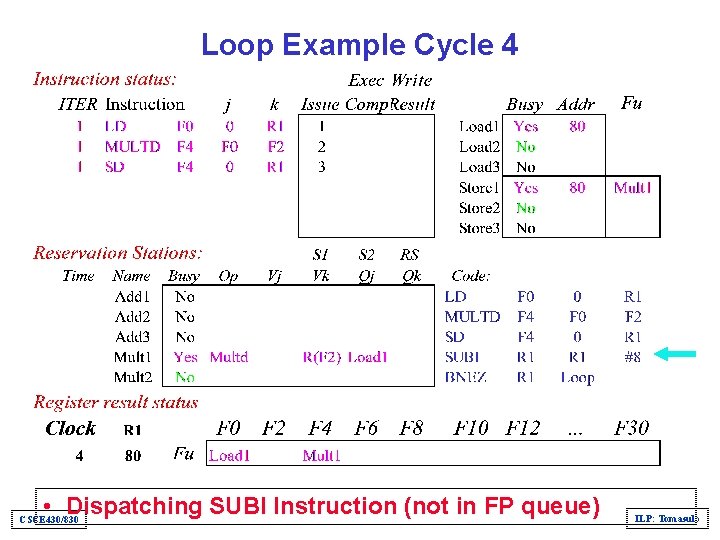
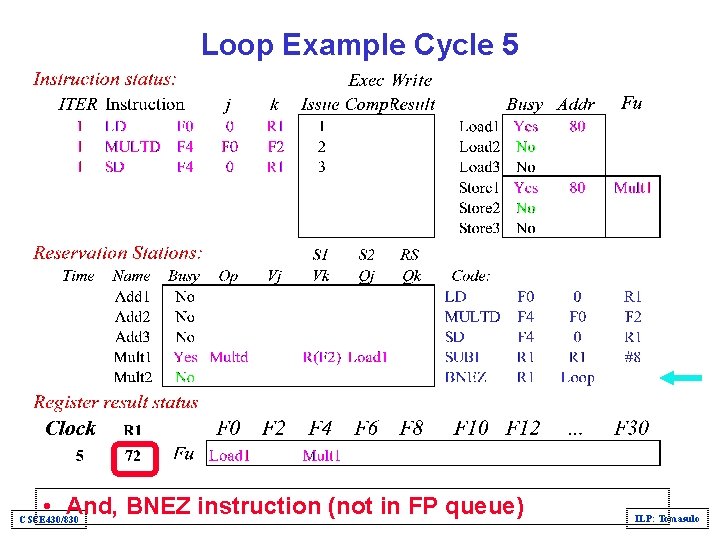
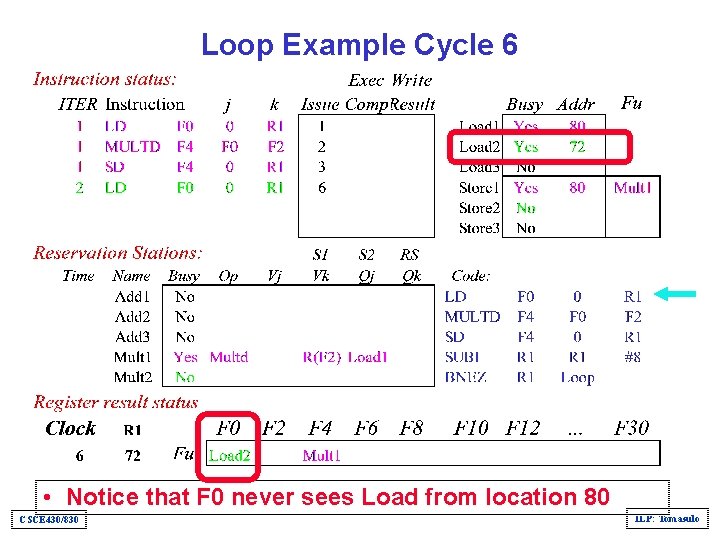
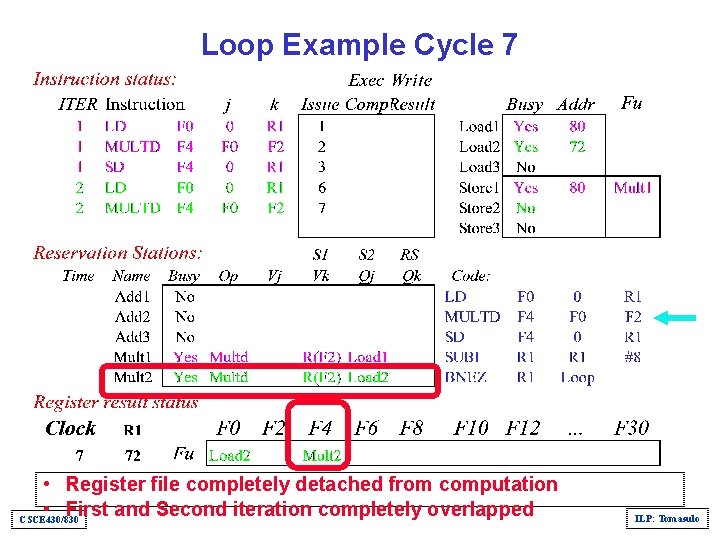
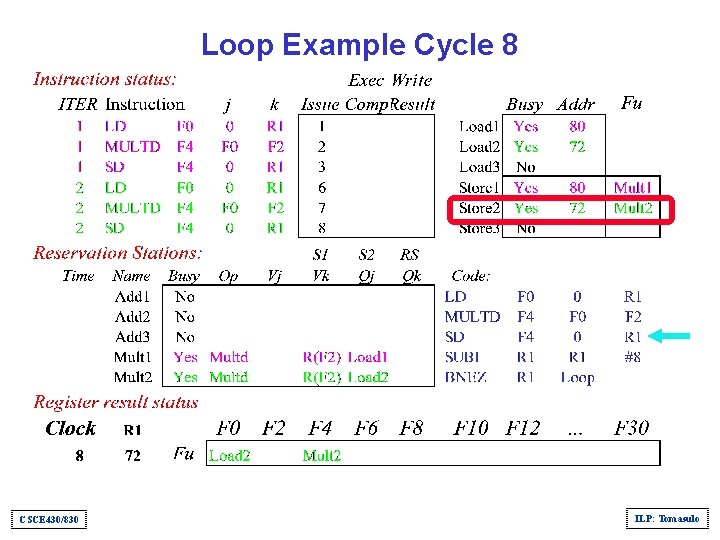
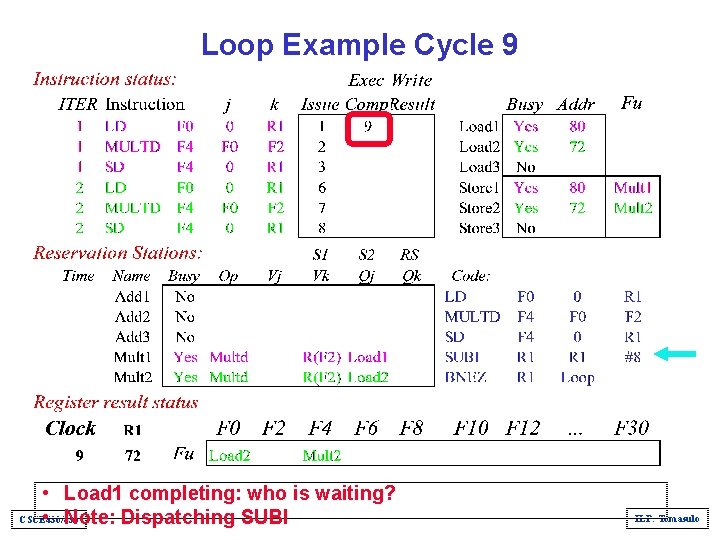
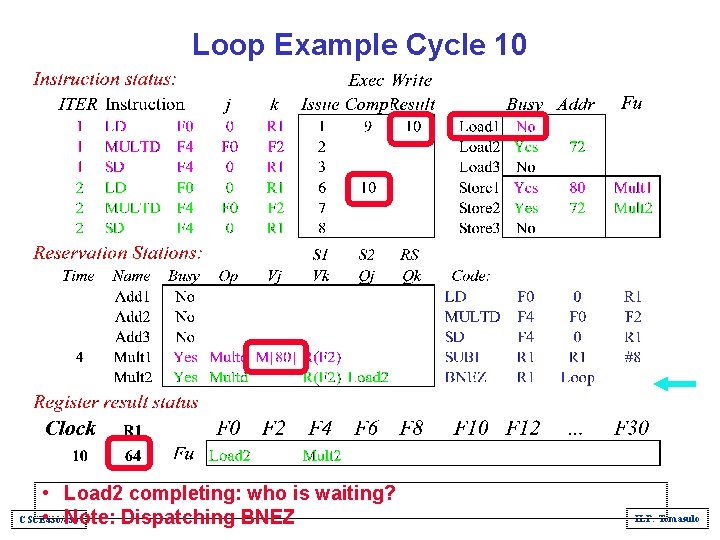
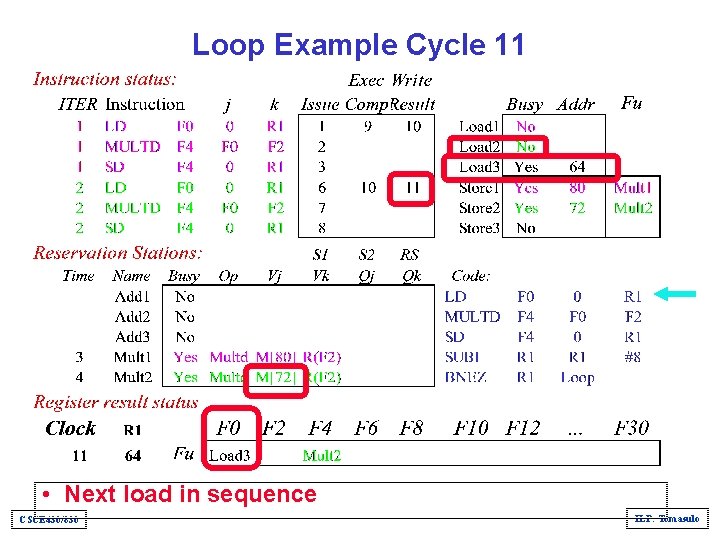
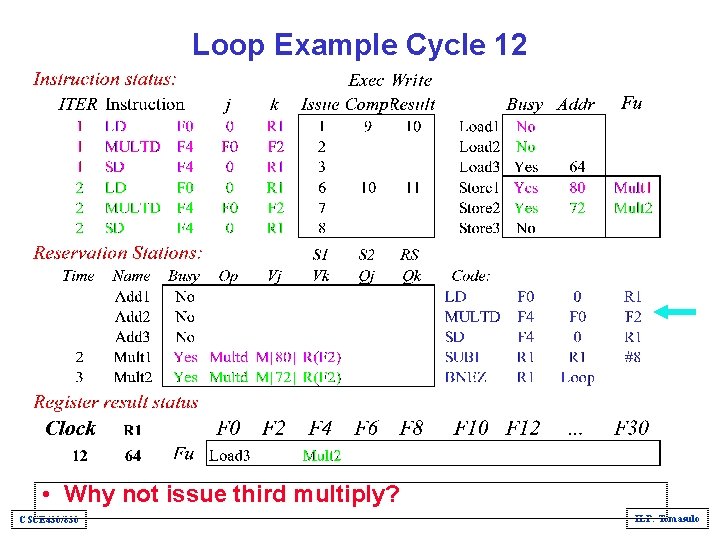
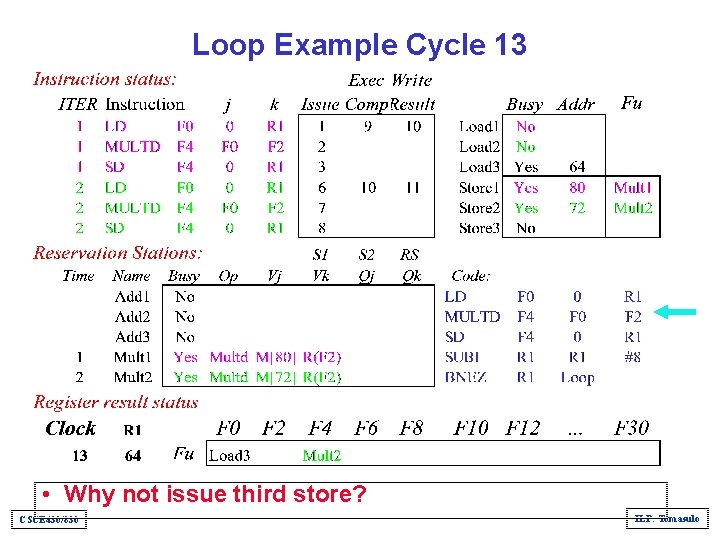
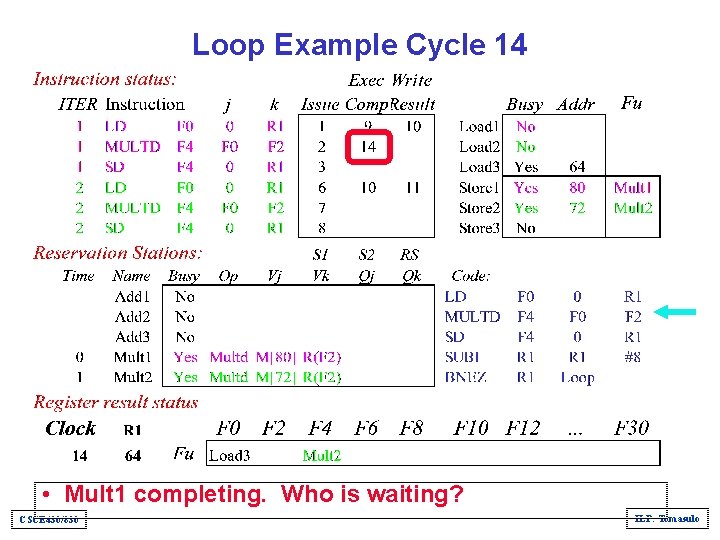
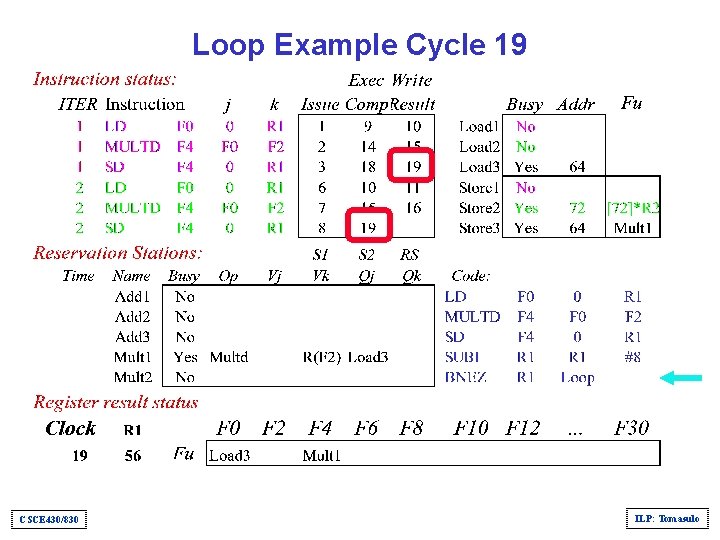
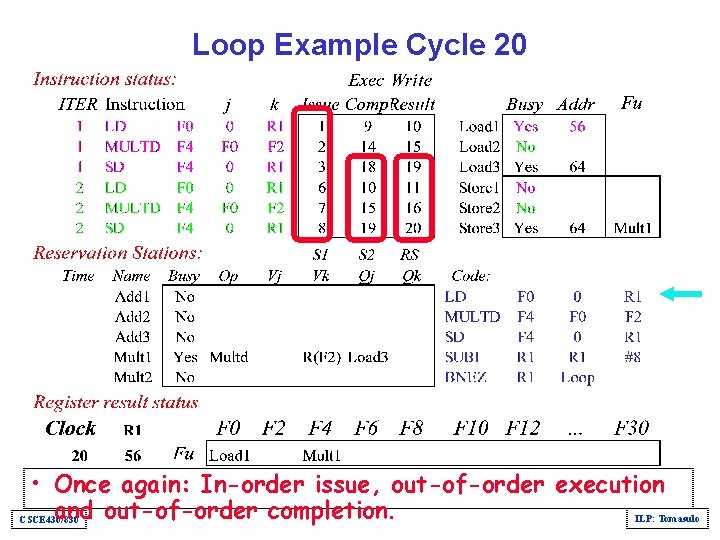
Tomasulo Loop Example Loop: LD MULTD SD SUBI BNEZ F 4 R 1 F 0 F 4 0 R 1 Loop 0 F 0 R 1 #8 R 1 F 2 • This time assume Multiply takes 4 clocks • Assume 1 st load takes 8 clocks (L 1 cache miss), 2 nd load takes 1 clock (hit) • To be clear, will show clocks for SUBI, BNEZ – Reality: integer instructions ahead of Fl. Pt. Instructions • Show 2 iterations CSCE 430/830 ILP: Tomasulo
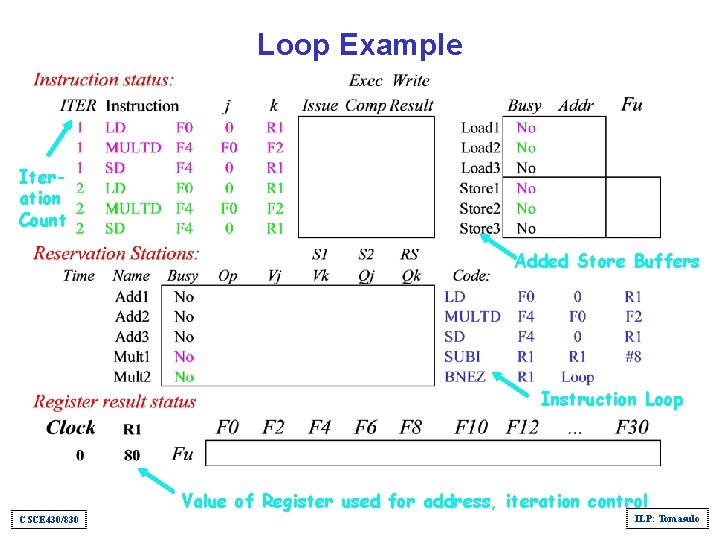
Loop Example Iteration Count Added Store Buffers Instruction Loop Value of Register used for address, iteration control CSCE 430/830 ILP: Tomasulo
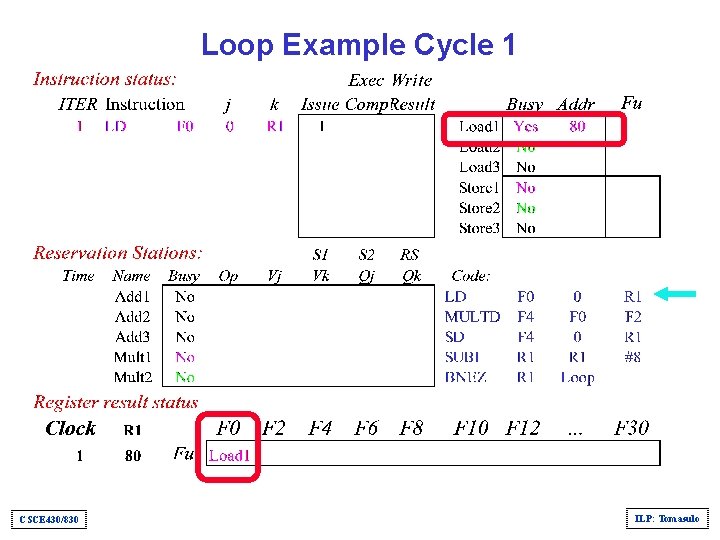
Loop Example Cycle 1 CSCE 430/830 ILP: Tomasulo
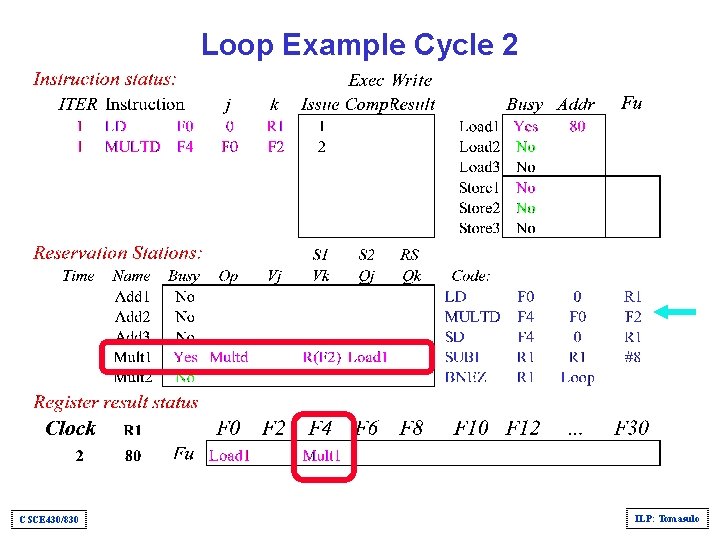
Loop Example Cycle 2 CSCE 430/830 ILP: Tomasulo
Loop Example Cycle 3 • Implicit renaming sets up data flow graph CSCE 430/830 ILP: Tomasulo
Loop Example Cycle 4 • Dispatching SUBI Instruction (not in FP queue) CSCE 430/830 ILP: Tomasulo
Loop Example Cycle 5 • And, BNEZ instruction (not in FP queue) CSCE 430/830 ILP: Tomasulo
Loop Example Cycle 6 • Notice that F 0 never sees Load from location 80 CSCE 430/830 ILP: Tomasulo
Loop Example Cycle 7 • Register file completely detached from computation • First and Second iteration completely overlapped CSCE 430/830 ILP: Tomasulo
Loop Example Cycle 8 CSCE 430/830 ILP: Tomasulo
Loop Example Cycle 9 • Load 1 completing: who is waiting? CSCE 430/830 • Note: Dispatching SUBI ILP: Tomasulo
Loop Example Cycle 10 • Load 2 completing: who is waiting? CSCE 430/830 • Note: Dispatching BNEZ ILP: Tomasulo
Loop Example Cycle 11 • Next load in sequence CSCE 430/830 ILP: Tomasulo
Loop Example Cycle 12 • Why not issue third multiply? CSCE 430/830 ILP: Tomasulo
Loop Example Cycle 13 • Why not issue third store? CSCE 430/830 ILP: Tomasulo
Loop Example Cycle 14 • Mult 1 completing. Who is waiting? CSCE 430/830 ILP: Tomasulo
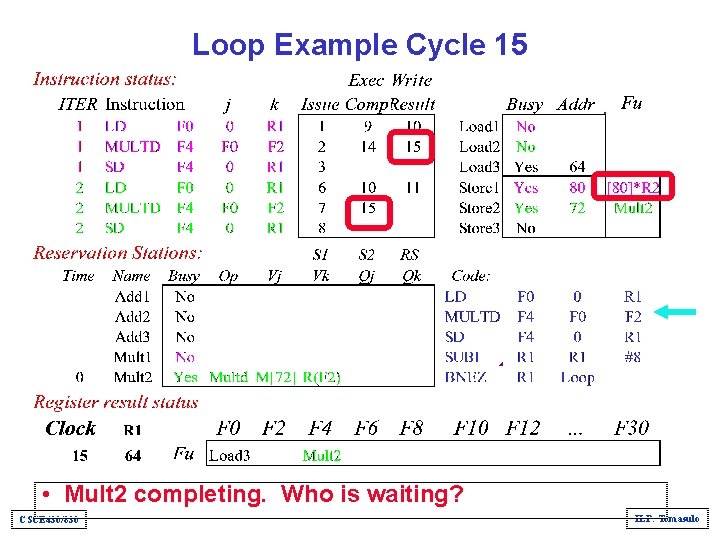
Loop Example Cycle 15 • Mult 2 completing. Who is waiting? CSCE 430/830 ILP: Tomasulo
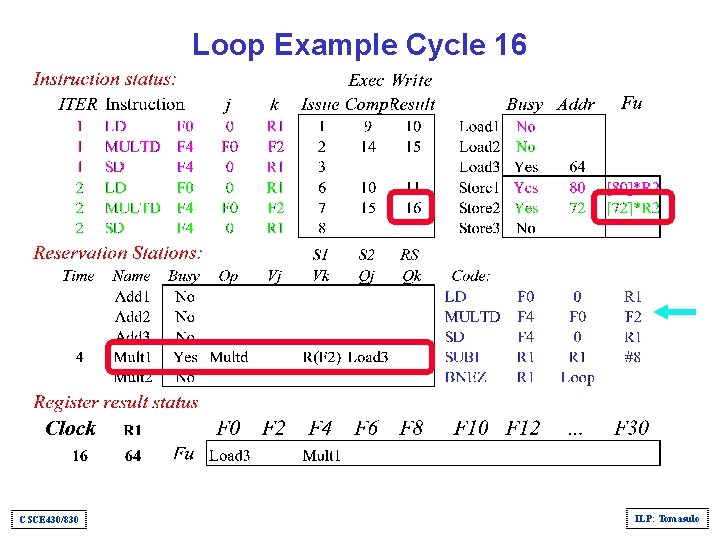
Loop Example Cycle 16 CSCE 430/830 ILP: Tomasulo
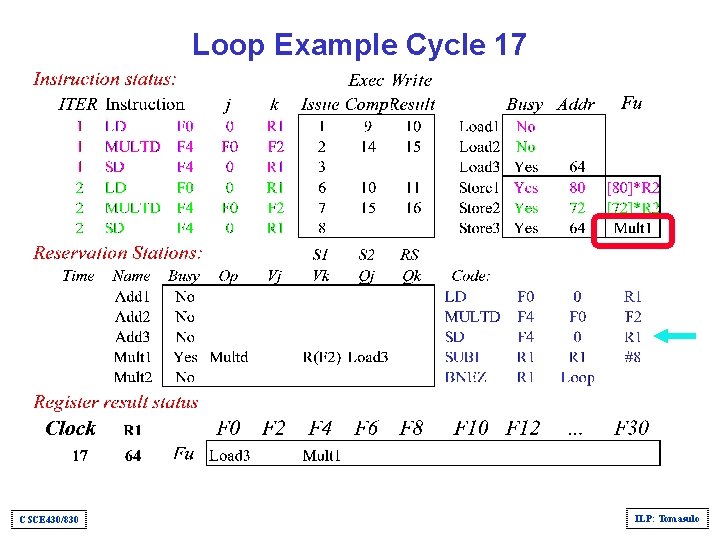
Loop Example Cycle 17 CSCE 430/830 ILP: Tomasulo
Loop Example Cycle 18 CSCE 430/830 ILP: Tomasulo
Loop Example Cycle 19 CSCE 430/830 ILP: Tomasulo
Loop Example Cycle 20 • Once again: In-order issue, out-of-order execution and out-of-order completion. ILP: Tomasulo CSCE 430/830
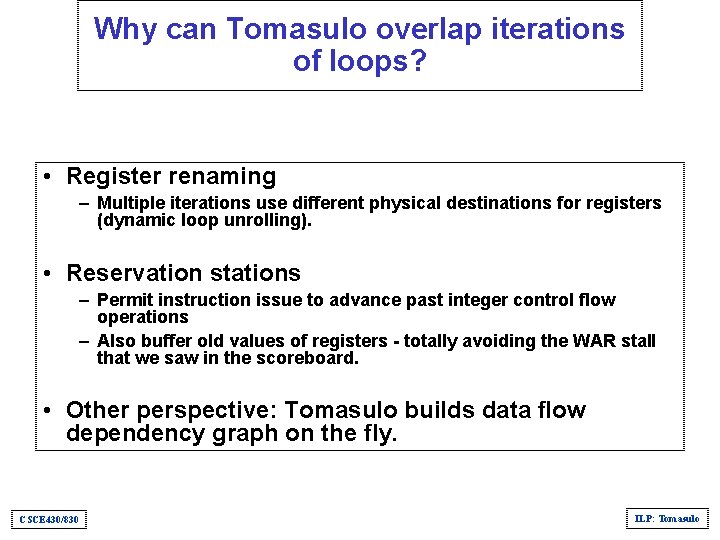
Why can Tomasulo overlap iterations of loops? • Register renaming – Multiple iterations use different physical destinations for registers (dynamic loop unrolling). • Reservation stations – Permit instruction issue to advance past integer control flow operations – Also buffer old values of registers - totally avoiding the WAR stall that we saw in the scoreboard. • Other perspective: Tomasulo builds data flow dependency graph on the fly. CSCE 430/830 ILP: Tomasulo
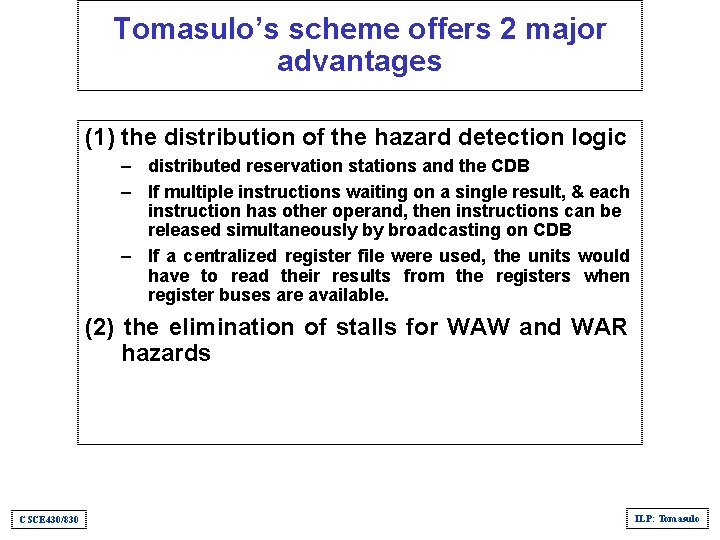
Tomasulo’s scheme offers 2 major advantages (1) the distribution of the hazard detection logic – distributed reservation stations and the CDB – If multiple instructions waiting on a single result, & each instruction has other operand, then instructions can be released simultaneously by broadcasting on CDB – If a centralized register file were used, the units would have to read their results from the registers when register buses are available. (2) the elimination of stalls for WAW and WAR hazards CSCE 430/830 ILP: Tomasulo
Summary • Reservations stations: implicit register renaming to larger set of registers + buffering source operands – Prevents registers from being bottleneck – Avoids WAR, WAW hazards of Scoreboard – Allows loop unrolling in HW • Not limited to basic blocks (integer units gets ahead, beyond branches) • Today, helps cache misses as well – Don’t stall for L 1 Data cache miss (insufficient ILP for L 2 miss? ) • Lasting Contributions – Dynamic scheduling – Register renaming – Load/store disambiguation • 360/91 descendants are Pentium III; Power. PC 604; MIPS R 10000; HP-PA 8000; Alpha 21264 CSCE 430/830 ILP: Tomasulo
What about Precise Interrupts? • State of machine looks as if no instruction beyond faulting instructions has issued • Tomasulo had: In-order issue, out-of-order execution, and out -of-order completion • Need to “fix” the out-of-order completion aspect so that we can find precise breakpoint in instruction stream. CSCE 430/830 ILP: Tomasulo
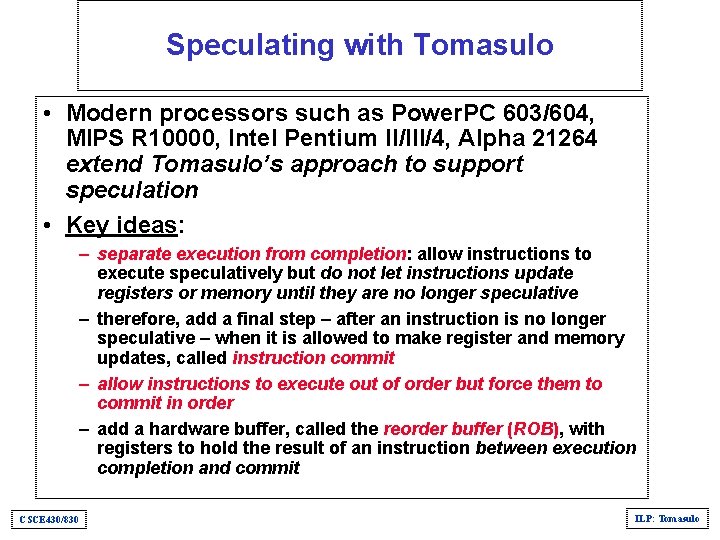
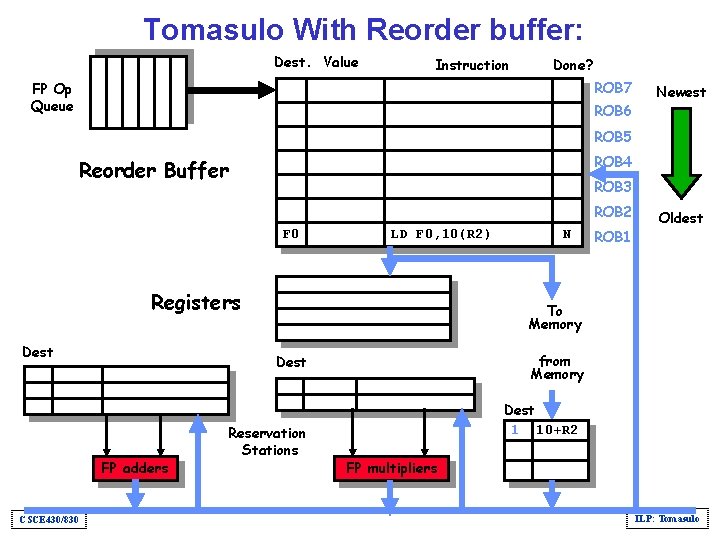
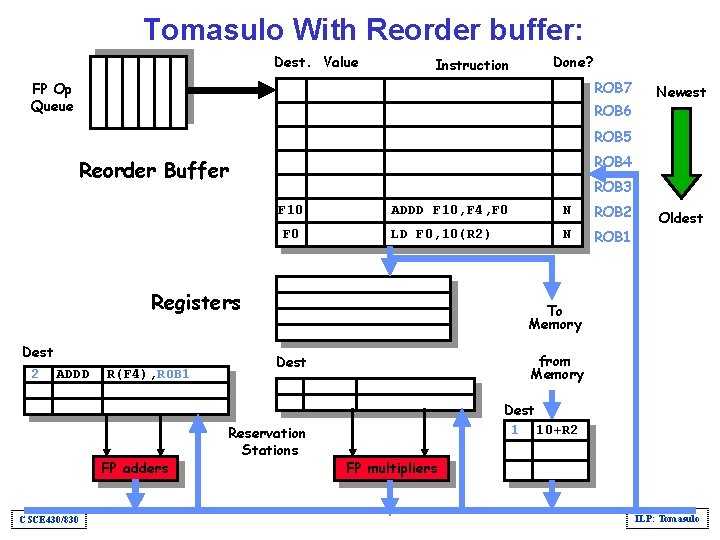
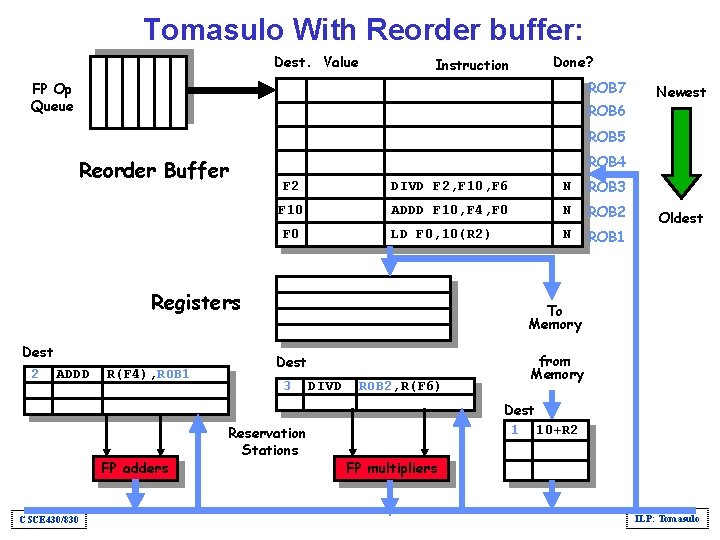
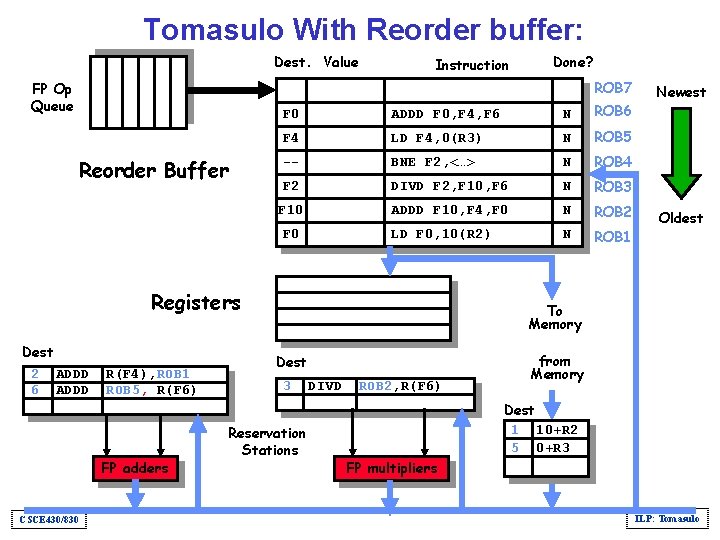
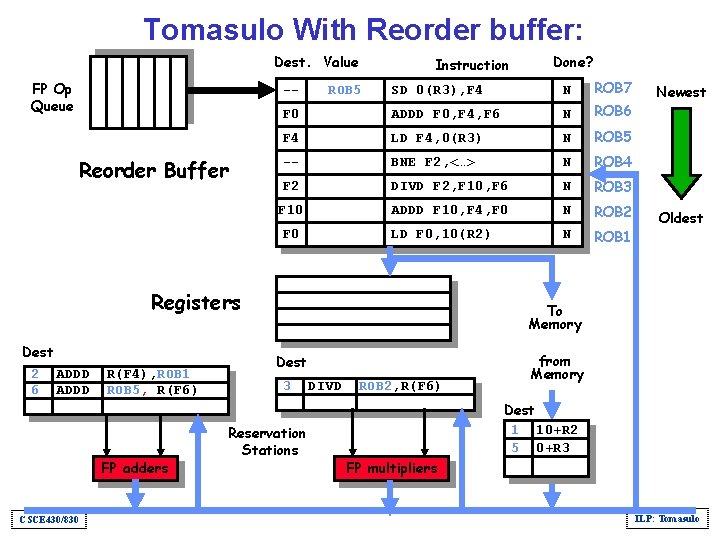
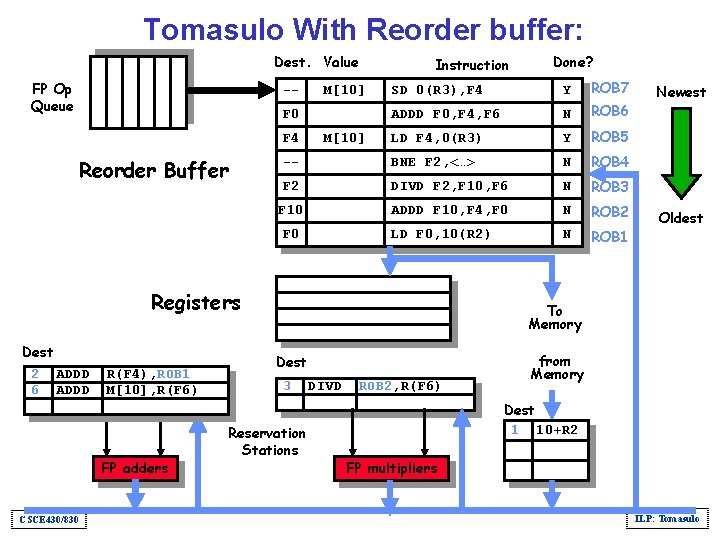
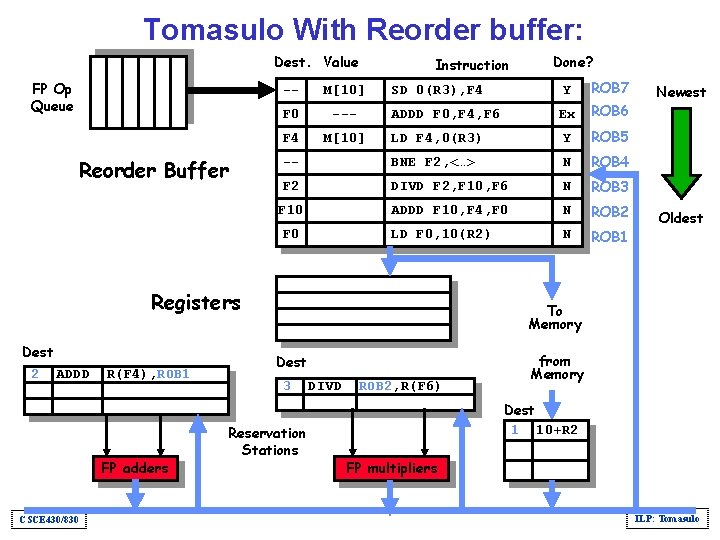
Speculating with Tomasulo • Modern processors such as Power. PC 603/604, MIPS R 10000, Intel Pentium II/III/4, Alpha 21264 extend Tomasulo’s approach to support speculation • Key ideas: – separate execution from completion: allow instructions to execute speculatively but do not let instructions update registers or memory until they are no longer speculative – therefore, add a final step – after an instruction is no longer speculative – when it is allowed to make register and memory updates, called instruction commit – allow instructions to execute out of order but force them to commit in order – add a hardware buffer, called the reorder buffer (ROB), with registers to hold the result of an instruction between execution completion and commit CSCE 430/830 ILP: Tomasulo
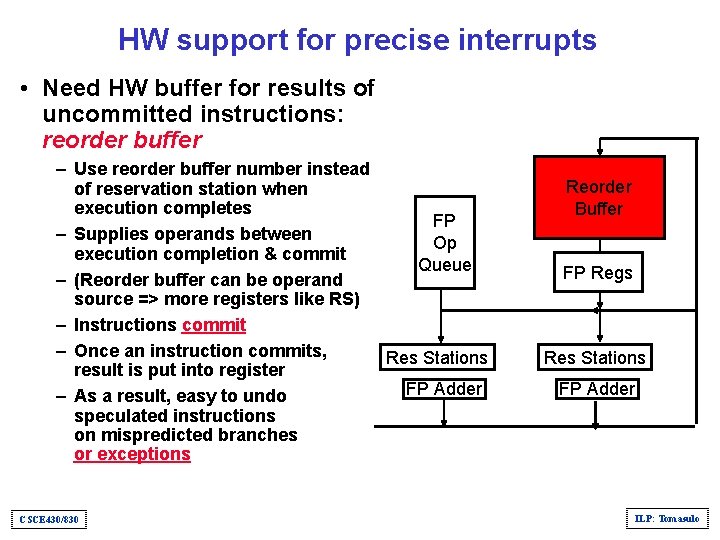
HW support for precise interrupts • Need HW buffer for results of uncommitted instructions: reorder buffer – Use reorder buffer number instead of reservation station when execution completes FP – Supplies operands between Op execution completion & commit Queue – (Reorder buffer can be operand source => more registers like RS) – Instructions commit – Once an instruction commits, Res Stations result is put into register FP Adder – As a result, easy to undo speculated instructions on mispredicted branches or exceptions CSCE 430/830 Reorder Buffer FP Regs Res Stations FP Adder ILP: Tomasulo
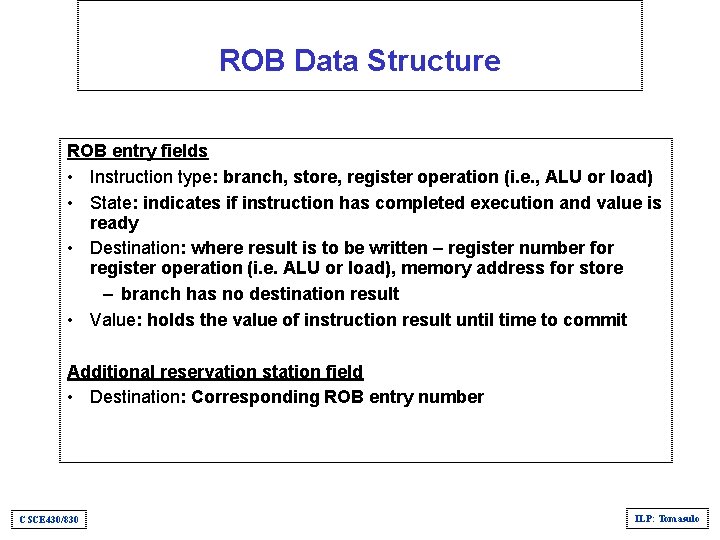
ROB Data Structure ROB entry fields • Instruction type: branch, store, register operation (i. e. , ALU or load) • State: indicates if instruction has completed execution and value is ready • Destination: where result is to be written – register number for register operation (i. e. ALU or load), memory address for store – branch has no destination result • Value: holds the value of instruction result until time to commit Additional reservation station field • Destination: Corresponding ROB entry number CSCE 430/830 ILP: Tomasulo
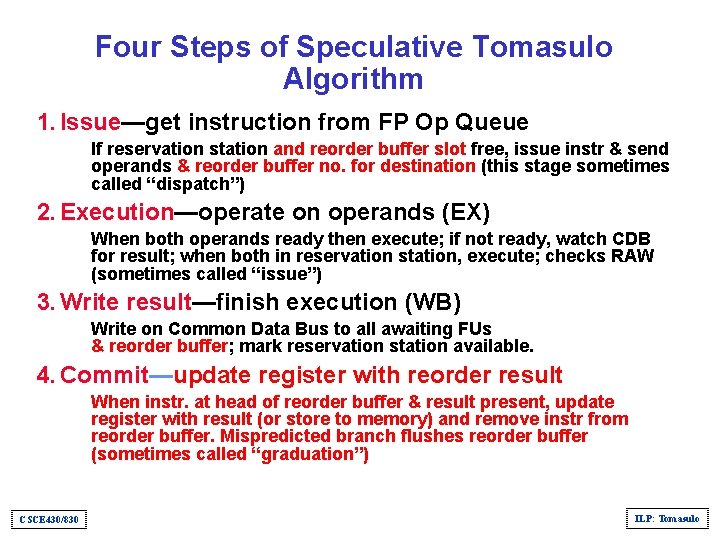
Four Steps of Speculative Tomasulo Algorithm 1. Issue—get instruction from FP Op Queue If reservation station and reorder buffer slot free, issue instr & send operands & reorder buffer no. for destination (this stage sometimes called “dispatch”) 2. Execution—operate on operands (EX) When both operands ready then execute; if not ready, watch CDB for result; when both in reservation station, execute; checks RAW (sometimes called “issue”) 3. Write result—finish execution (WB) Write on Common Data Bus to all awaiting FUs & reorder buffer; mark reservation station available. 4. Commit—update register with reorder result When instr. at head of reorder buffer & result present, update register with result (or store to memory) and remove instr from reorder buffer. Mispredicted branch flushes reorder buffer (sometimes called “graduation”) CSCE 430/830 ILP: Tomasulo
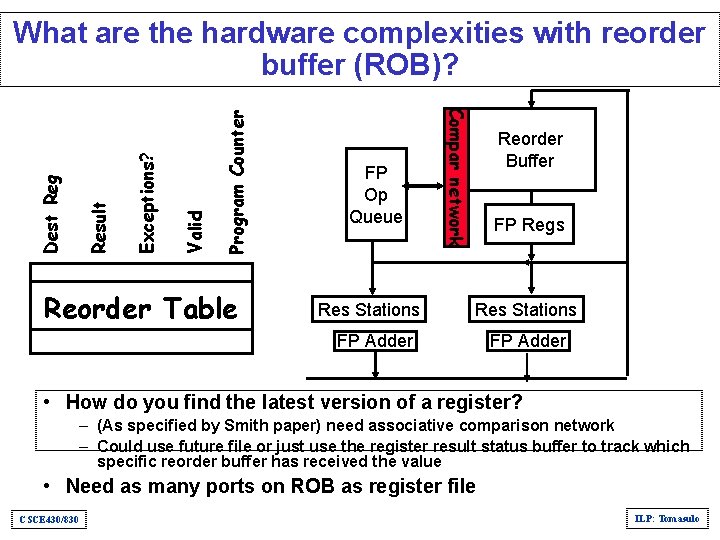
Program Counter Valid Exceptions? Result Reorder Table FP Op Queue Res Stations Compar network Dest Reg What are the hardware complexities with reorder buffer (ROB)? Reorder Buffer FP Regs Res Stations FP Adder • How do you find the latest version of a register? – (As specified by Smith paper) need associative comparison network – Could use future file or just use the register result status buffer to track which specific reorder buffer has received the value • Need as many ports on ROB as register file CSCE 430/830 ILP: Tomasulo
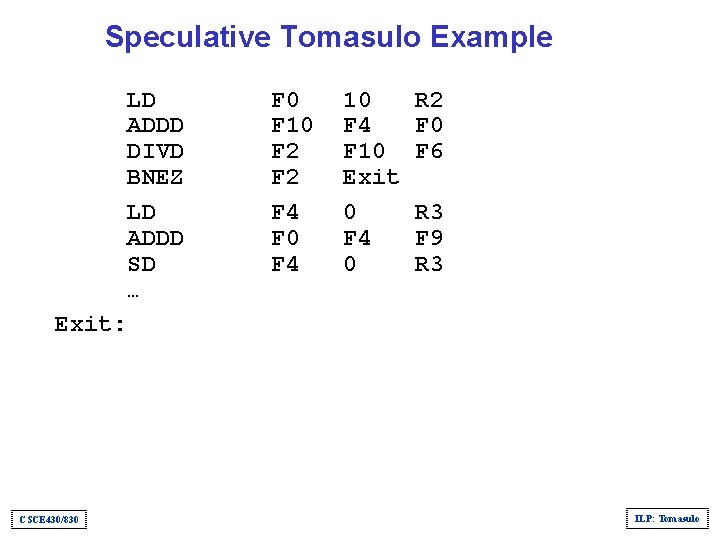
Speculative Tomasulo Example LD ADDD DIVD BNEZ LD ADDD SD … F 0 F 10 F 2 F 4 F 0 F 4 10 F 4 F 10 Exit 0 F 4 0 R 2 F 0 F 6 R 3 F 9 R 3 Exit: CSCE 430/830 ILP: Tomasulo
Tomasulo With Reorder buffer: Dest. Value Instruction Done? ROB 7 FP Op Queue ROB 6 Newest ROB 5 ROB 4 Reorder Buffer ROB 3 ROB 2 F 0 LD F 0, 10(R 2) Registers Dest CSCE 430/830 ROB 1 To Memory from Memory Dest FP adders N Oldest Reservation Stations Dest 1 10+R 2 FP multipliers ILP: Tomasulo
Tomasulo With Reorder buffer: Dest. Value Instruction Done? ROB 7 FP Op Queue ROB 6 Newest ROB 5 ROB 4 Reorder Buffer ROB 3 F 10 F 0 ADDD F 10, F 4, F 0 N ROB 2 LD F 0, 10(R 2) N ROB 1 Registers Dest 2 ADDD R(F 4), ROB 1 FP adders CSCE 430/830 Oldest To Memory from Memory Dest Reservation Stations Dest 1 10+R 2 FP multipliers ILP: Tomasulo
Tomasulo With Reorder buffer: Dest. Value Instruction Done? ROB 7 FP Op Queue ROB 6 Newest ROB 5 Reorder Buffer ROB 4 F 2 DIVD F 2, F 10, F 6 N ROB 3 F 10 ADDD F 10, F 4, F 0 N ROB 2 LD F 0, 10(R 2) N ROB 1 F 0 Registers Dest 2 ADDD R(F 4), ROB 1 FP adders CSCE 430/830 Oldest To Memory Dest 3 Reservation Stations DIVD ROB 2, R(F 6) from Memory Dest 1 10+R 2 FP multipliers ILP: Tomasulo
• Skip some cycles CSCE 430/830 ILP: Tomasulo
Tomasulo With Reorder buffer: Dest. Value Instruction ROB 7 FP Op Queue Reorder Buffer F 0 ADDD F 0, F 4, F 6 N ROB 6 F 4 LD F 4, 0(R 3) N ROB 5 -- BNE F 2, <…> N ROB 4 F 2 DIVD F 2, F 10, F 6 N ROB 3 F 10 ADDD F 10, F 4, F 0 N ROB 2 LD F 0, 10(R 2) N ROB 1 F 0 Registers Dest 2 6 ADDD R(F 4), ROB 1 ROB 5, R(F 6) FP adders CSCE 430/830 Done? Newest Oldest To Memory Dest 3 Reservation Stations DIVD ROB 2, R(F 6) from Memory Dest 1 10+R 2 5 0+R 3 FP multipliers ILP: Tomasulo
Tomasulo With Reorder buffer: Dest. Value FP Op Queue N ROB 7 F 0 ADDD F 0, F 4, F 6 N ROB 6 F 4 LD F 4, 0(R 3) N ROB 5 -- BNE F 2, <…> N ROB 4 F 2 DIVD F 2, F 10, F 6 N ROB 3 F 10 ADDD F 10, F 4, F 0 N ROB 2 LD F 0, 10(R 2) N ROB 1 ROB 5 F 0 Registers Dest 2 6 ADDD R(F 4), ROB 1 ROB 5, R(F 6) FP adders CSCE 430/830 Done? SD 0(R 3), F 4 -- Reorder Buffer Instruction Newest Oldest To Memory Dest 3 Reservation Stations DIVD ROB 2, R(F 6) from Memory Dest 1 10+R 2 5 0+R 3 FP multipliers ILP: Tomasulo
Tomasulo With Reorder buffer: Dest. Value FP Op Queue Y ROB 7 ADDD F 0, F 4, F 6 N ROB 6 LD F 4, 0(R 3) Y ROB 5 -- BNE F 2, <…> N ROB 4 F 2 DIVD F 2, F 10, F 6 N ROB 3 F 10 ADDD F 10, F 4, F 0 N ROB 2 LD F 0, 10(R 2) N ROB 1 M[10] F 0 F 4 M[10] F 0 Registers Dest 2 6 ADDD R(F 4), ROB 1 M[10], R(F 6) FP adders CSCE 430/830 Done? SD 0(R 3), F 4 -- Reorder Buffer Instruction Newest Oldest To Memory Dest 3 Reservation Stations DIVD ROB 2, R(F 6) from Memory Dest 1 10+R 2 FP multipliers ILP: Tomasulo
Tomasulo With Reorder buffer: Dest. Value FP Op Queue Reorder Buffer Instruction Y ROB 7 Ex ROB 6 LD F 4, 0(R 3) Y ROB 5 -- BNE F 2, <…> N ROB 4 F 2 DIVD F 2, F 10, F 6 N ROB 3 F 10 ADDD F 10, F 4, F 0 N ROB 2 LD F 0, 10(R 2) N ROB 1 -- M[10] F 0 --- F 4 M[10] F 0 SD 0(R 3), F 4 ADDD F 0, F 4, F 6 Registers Dest 2 ADDD R(F 4), ROB 1 FP adders CSCE 430/830 Done? Newest Oldest To Memory Dest 3 Reservation Stations DIVD ROB 2, R(F 6) from Memory Dest 1 10+R 2 FP multipliers ILP: Tomasulo
Notes • If a branch is mispredicted, recovery is done by flushing the ROB of all entries that appear after the mispredicted branch – entries before the branch are allowed to continue – restart the fetch at the correct branch successor • When an instruction commits or is flushed from the ROB then the corresponding slots become available for subsequent instructions CSCE 430/830 ILP: Tomasulo
Tomasulo Algorithm vs. Scoreboard • Control & buffers distributed with Function Units (FU) vs. centralized in scoreboard; – FU buffers called “reservation stations”; have pending operands • Registers in instructions replaced by values or pointers to reservation stations(RS); called register renaming ; – avoids WAR, WAW hazards – More reservation stations than registers, so can do optimizations compilers can’t • Results to FU from RS, not through registers, over Common Data Bus that broadcasts results to all FUs • Load and Stores treated as FUs with RSs as well • Integer instructions can go past branches, allowing FP ops beyond basic block in FP queue CSCE 430/830 ILP: Tomasulo
Summary • Reservations stations: implicit register renaming to larger set of registers + buffering source operands – Prevents registers as bottleneck – Avoids WAR, WAW hazards of Scoreboard – Allows loop unrolling in HW • Not limited to basic blocks (integer units gets ahead, beyond branches) • Today, helps cache misses as well – Don’t stall for L 1 Data cache miss (insufficient ILP for L 2 miss? ) • Lasting Contributions – Dynamic scheduling – Register renaming – Load/store disambiguation • 360/91 descendants are Pentium III; Power. PC 604; MIPS R 10000; HP-PA 8000; Alpha 21264 CSCE 430/830 ILP: Tomasulo