
CSCE 411 Design and Analysis of Algorithms Andreas

- Slides: 45
CSCE 411 Design and Analysis of Algorithms Andreas Klappenecker
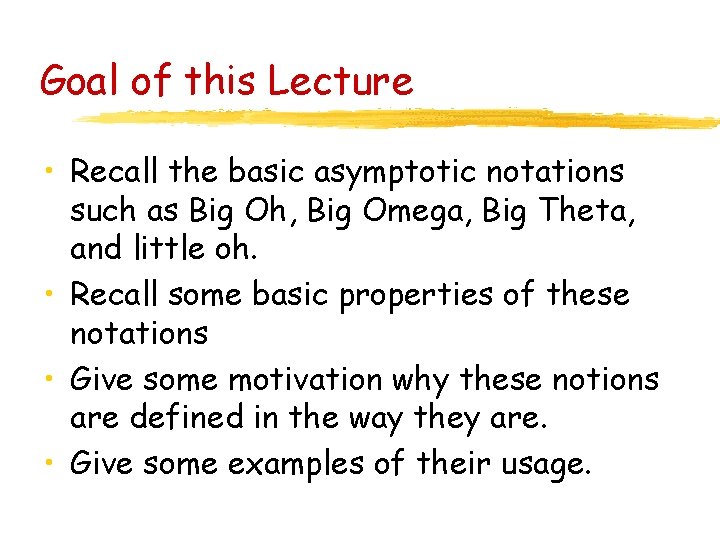
Goal of this Lecture • Recall the basic asymptotic notations such as Big Oh, Big Omega, Big Theta, and little oh. • Recall some basic properties of these notations • Give some motivation why these notions are defined in the way they are. • Give some examples of their usage.
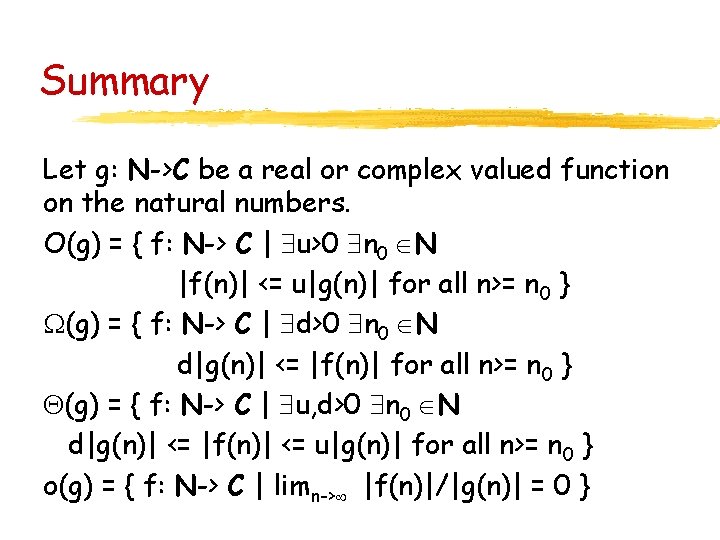
Summary Let g: N->C be a real or complex valued function on the natural numbers. O(g) = { f: N-> C | u>0 n 0 N |f(n)| <= u|g(n)| for all n>= n 0 } (g) = { f: N-> C | d>0 n 0 N d|g(n)| <= |f(n)| for all n>= n 0 } (g) = { f: N-> C | u, d>0 n 0 N d|g(n)| <= |f(n)| <= u|g(n)| for all n>= n 0 } o(g) = { f: N-> C | limn-> |f(n)|/|g(n)| = 0 }
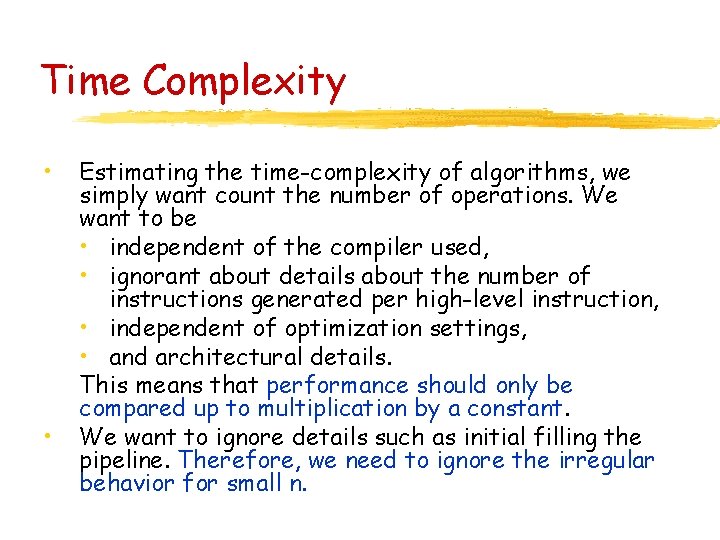
Time Complexity • • Estimating the time-complexity of algorithms, we simply want count the number of operations. We want to be • independent of the compiler used, • ignorant about details about the number of instructions generated per high-level instruction, • independent of optimization settings, • and architectural details. This means that performance should only be compared up to multiplication by a constant. We want to ignore details such as initial filling the pipeline. Therefore, we need to ignore the irregular behavior for small n.
Big Oh
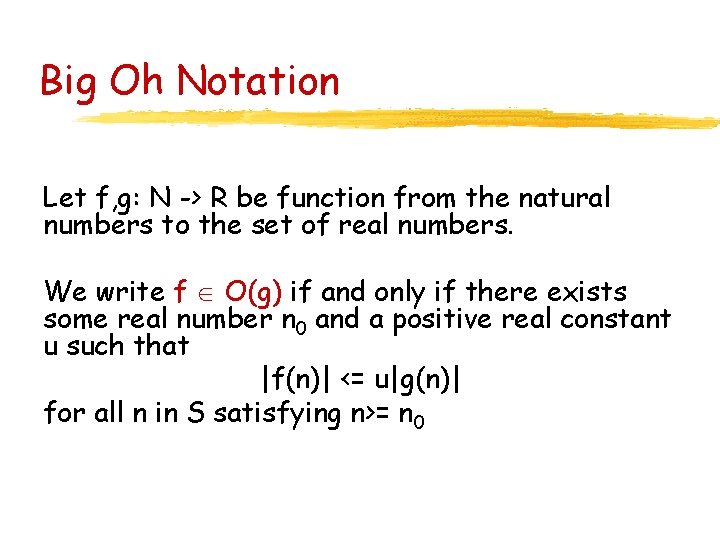
Big Oh Notation Let f, g: N -> R be function from the natural numbers to the set of real numbers. We write f O(g) if and only if there exists some real number n 0 and a positive real constant u such that |f(n)| <= u|g(n)| for all n in S satisfying n>= n 0
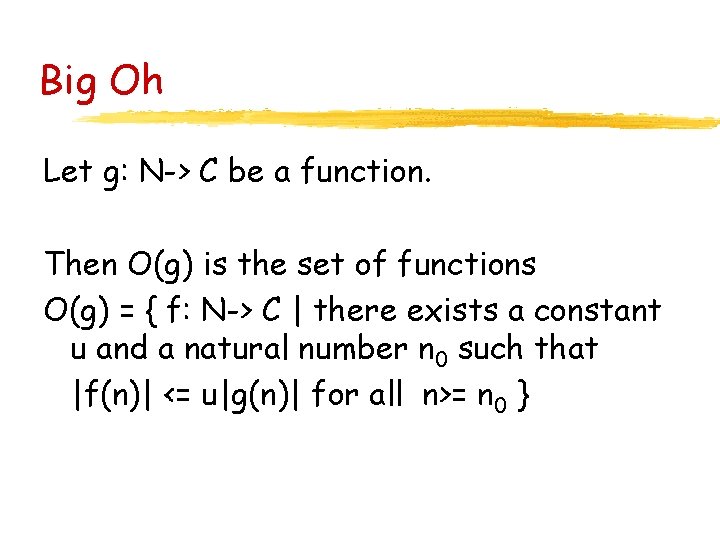
Big Oh Let g: N-> C be a function. Then O(g) is the set of functions O(g) = { f: N-> C | there exists a constant u and a natural number n 0 such that |f(n)| <= u|g(n)| for all n>= n 0 }
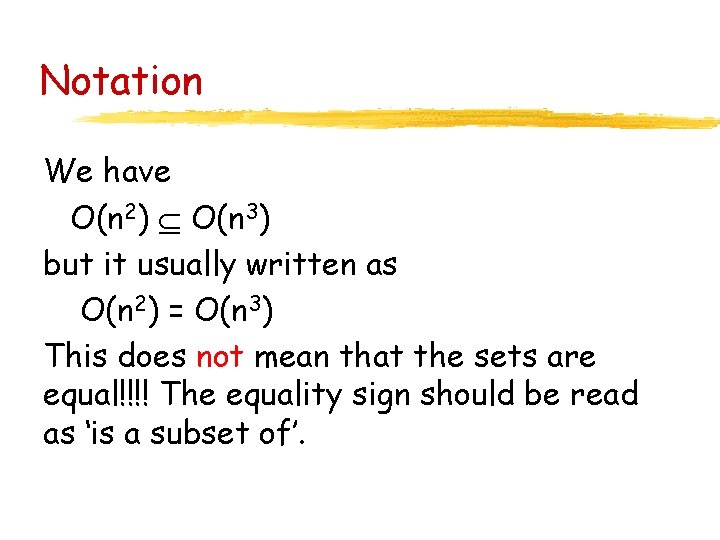
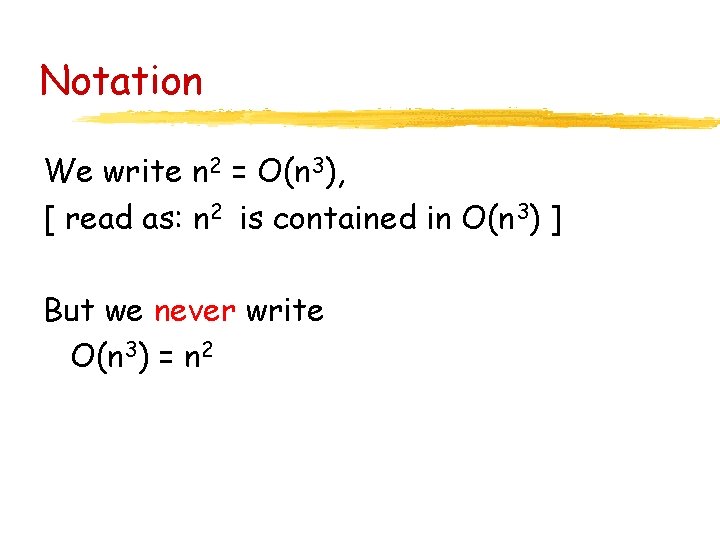
Notation We have O(n 2) O(n 3) but it usually written as O(n 2) = O(n 3) This does not mean that the sets are equal!!!! The equality sign should be read as ‘is a subset of’.
Notation We write n 2 = O(n 3), [ read as: n 2 is contained in O(n 3) ] But we never write O(n 3) = n 2
Example O(n 2)
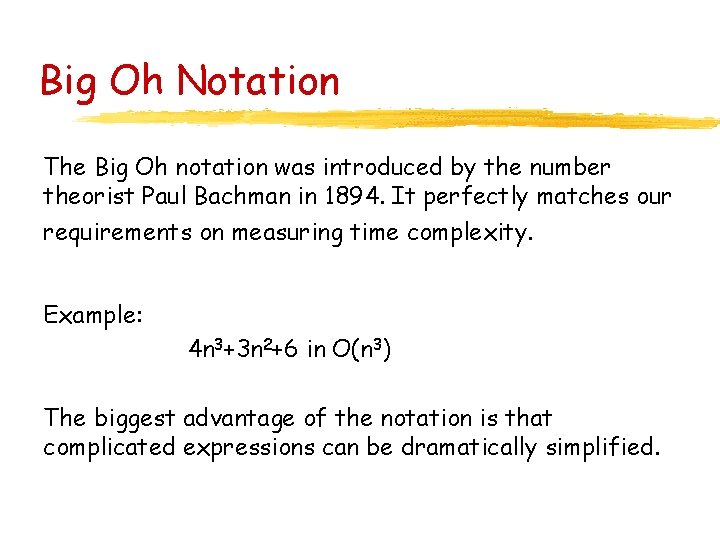
Big Oh Notation The Big Oh notation was introduced by the number theorist Paul Bachman in 1894. It perfectly matches our requirements on measuring time complexity. Example: 4 n 3+3 n 2+6 in O(n 3) The biggest advantage of the notation is that complicated expressions can be dramatically simplified.
Quiz Does O(1) contain only the constant functions?
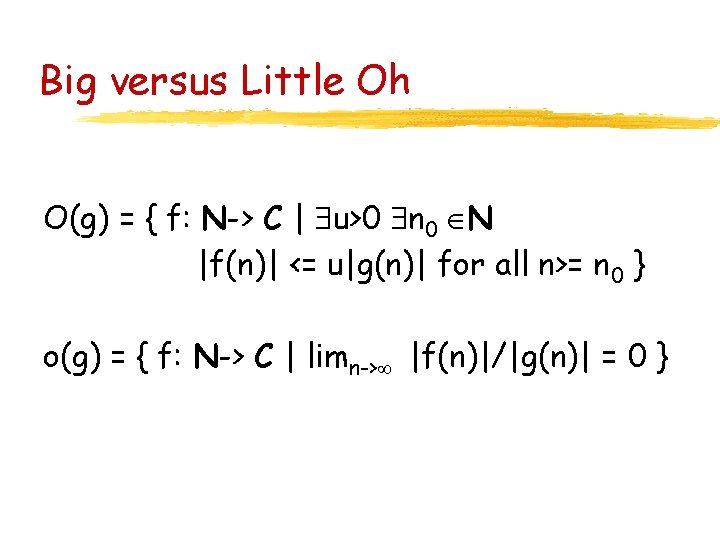
Big versus Little Oh O(g) = { f: N-> C | u>0 n 0 N |f(n)| <= u|g(n)| for all n>= n 0 } o(g) = { f: N-> C | limn-> |f(n)|/|g(n)| = 0 }
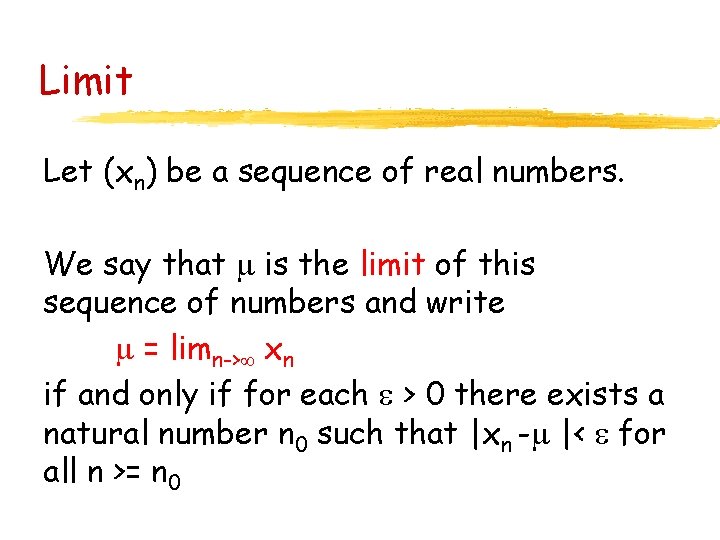
Limit Let (xn) be a sequence of real numbers. We say that is the limit of this sequence of numbers and write = limn-> xn if and only if for each > 0 there exists a natural number n 0 such that |xn - |< for all n >= n 0
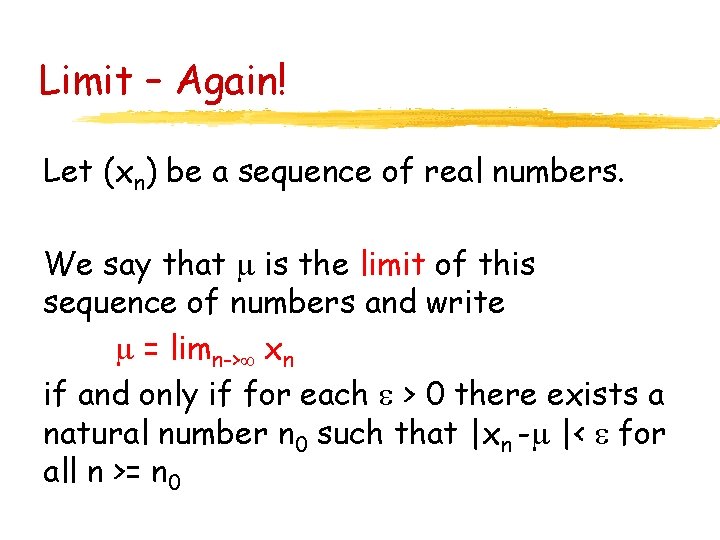
Limit – Again! Let (xn) be a sequence of real numbers. We say that is the limit of this sequence of numbers and write = limn-> xn if and only if for each > 0 there exists a natural number n 0 such that |xn - |< for all n >= n 0
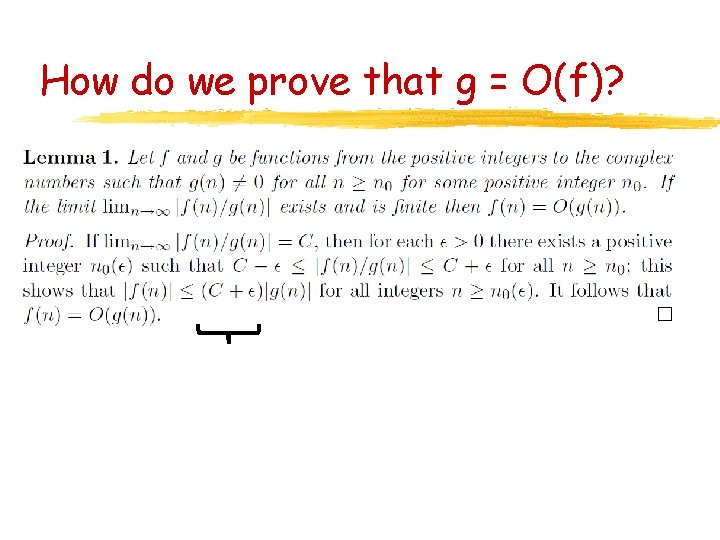
How do we prove that g = O(f)?
Quiz It follows that o(f) is a subset of O(f). Why?
Quiz What does f = o(1) mean? Hint: o(g) = { f: N-> C | limn-> |f(n)|/|g(n)| = 0 }
Quiz Some computer scientists consider little oh notations too sloppy. For example, 1/n+1/n 2 is o(1) but they might prefer 1/n+1/n 2 = O(1/n). Why is that?
Limits? There are no Limits! The limit of a sequence might not exist. For example, if f(n) = 1+(-1)n then limn-> f(n) does not exist.
Least Upper Bound (Supremum) The supremum b of a set of real numbers S is the defined as the smallest real number b such that b>=x for all s in S. We write s = sup S. • sup {1, 2, 3} = 3, • sup {x : x 2 <2} = sqrt(2), • sup {(-1)^n – 1/n : n>=0 } = 1.
The Limit Superior The limit superior of a sequence (xn) of real numbers is defined as lim supn -> xn = limn -> ( sup { xm : m>=n}) [Note that the limit superior always exists in the extended real line (which includes ), as sup { xm : m>=n}) is a monotonically decreasing function of n and is bounded below by any element of the sequence. ]
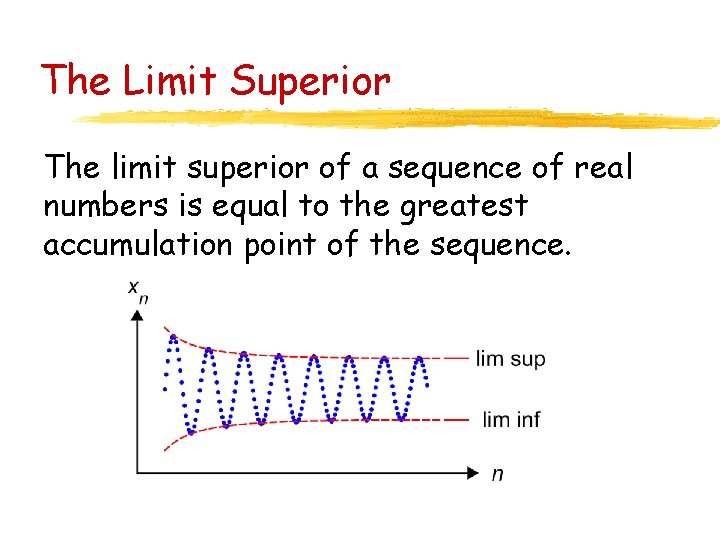
The Limit Superior The limit superior of a sequence of real numbers is equal to the greatest accumulation point of the sequence.
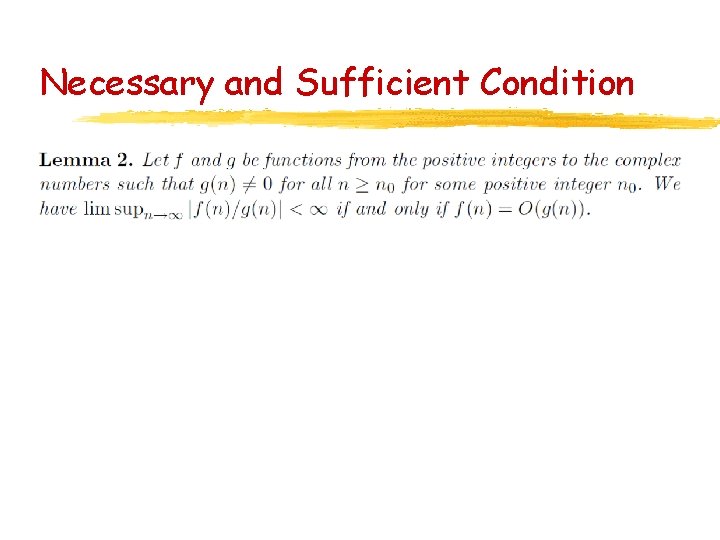
Necessary and Sufficient Condition
Big Omega
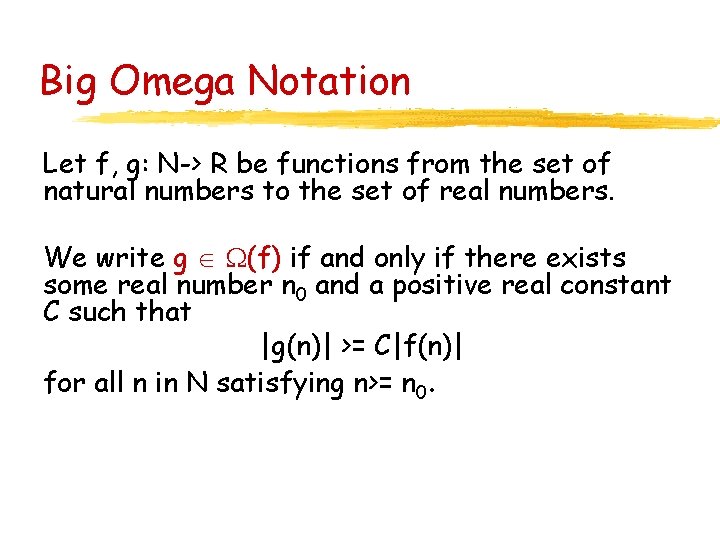
Big Omega Notation Let f, g: N-> R be functions from the set of natural numbers to the set of real numbers. We write g (f) if and only if there exists some real number n 0 and a positive real constant C such that |g(n)| >= C|f(n)| for all n in N satisfying n>= n 0.
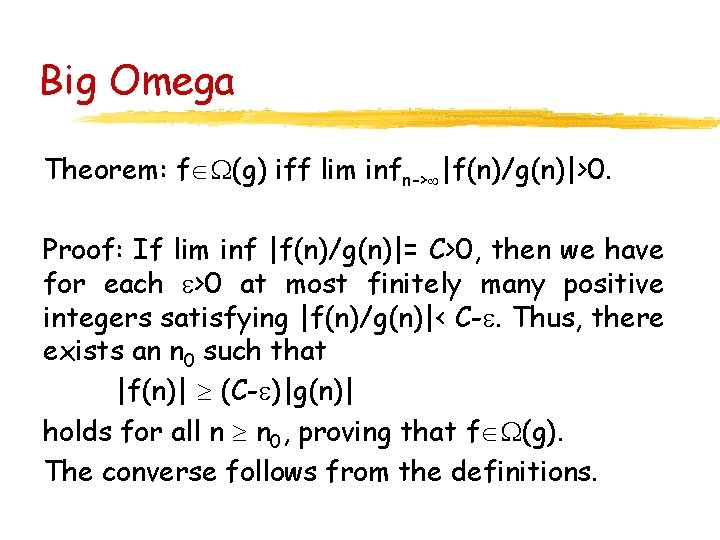
Big Omega Theorem: f (g) iff lim infn-> |f(n)/g(n)|>0. Proof: If lim inf |f(n)/g(n)|= C>0, then we have for each >0 at most finitely many positive integers satisfying |f(n)/g(n)|< C-. Thus, there exists an n 0 such that |f(n)| (C- )|g(n)| holds for all n n 0, proving that f (g). The converse follows from the definitions.
Big Theta
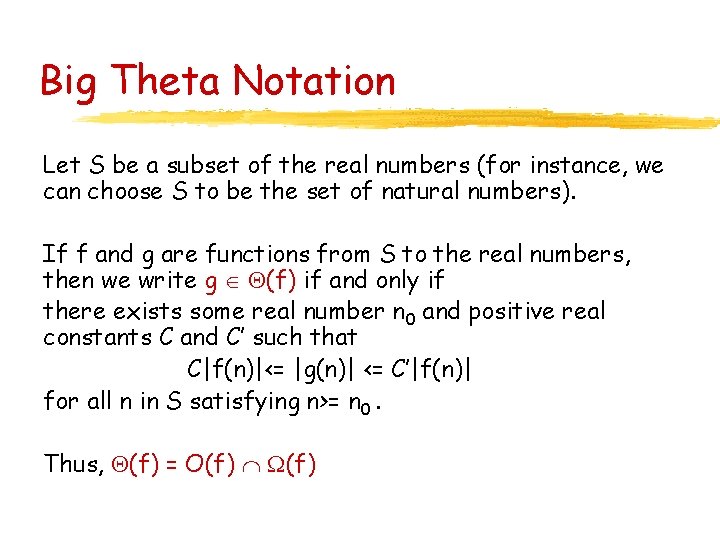
Big Theta Notation Let S be a subset of the real numbers (for instance, we can choose S to be the set of natural numbers). If f and g are functions from S to the real numbers, then we write g (f) if and only if there exists some real number n 0 and positive real constants C and C’ such that C|f(n)|<= |g(n)| <= C’|f(n)| for all n in S satisfying n>= n 0. Thus, (f) = O(f)
Examples
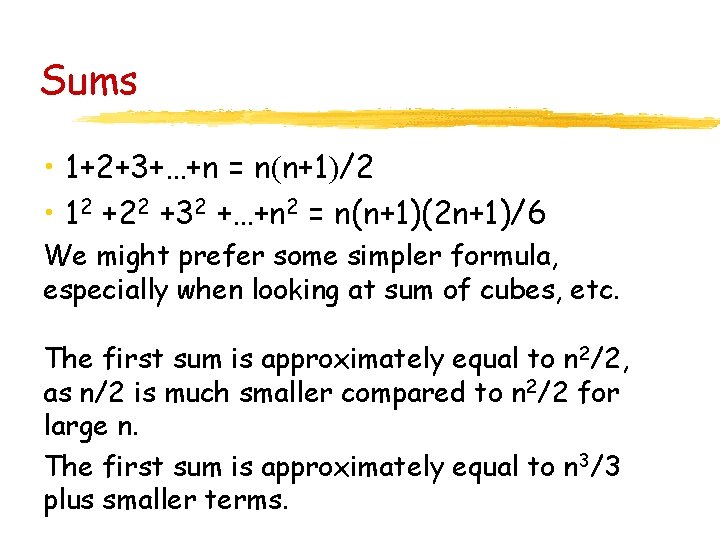
Sums • 1+2+3+…+n = n n+1 /2 • 12 +22 +32 +…+n 2 = n(n+1)(2 n+1)/6 We might prefer some simpler formula, especially when looking at sum of cubes, etc. The first sum is approximately equal to n 2/2, as n/2 is much smaller compared to n 2/2 for large n. The first sum is approximately equal to n 3/3 plus smaller terms.
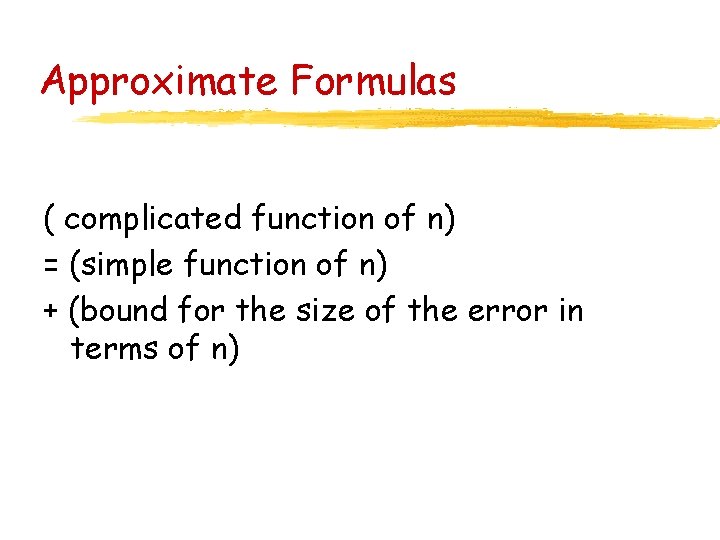
Approximate Formulas ( complicated function of n) = (simple function of n) + (bound for the size of the error in terms of n)
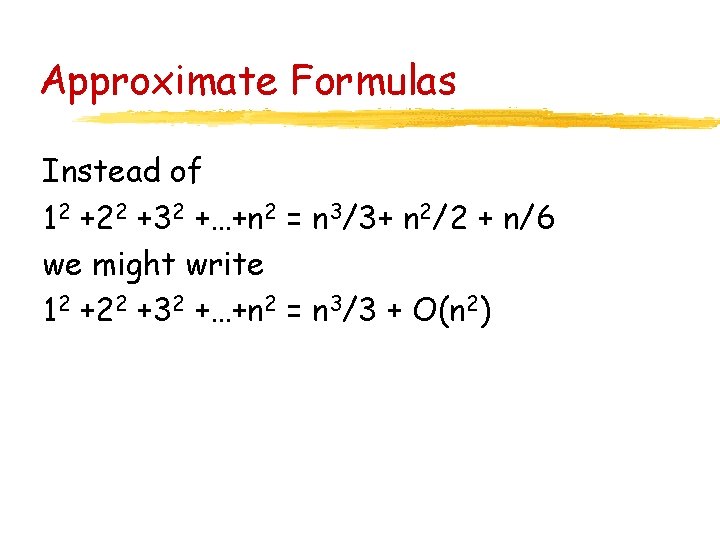
Approximate Formulas Instead of 12 +22 +32 +…+n 2 = n 3/3+ n 2/2 + n/6 we might write 12 +22 +32 +…+n 2 = n 3/3 + O(n 2)
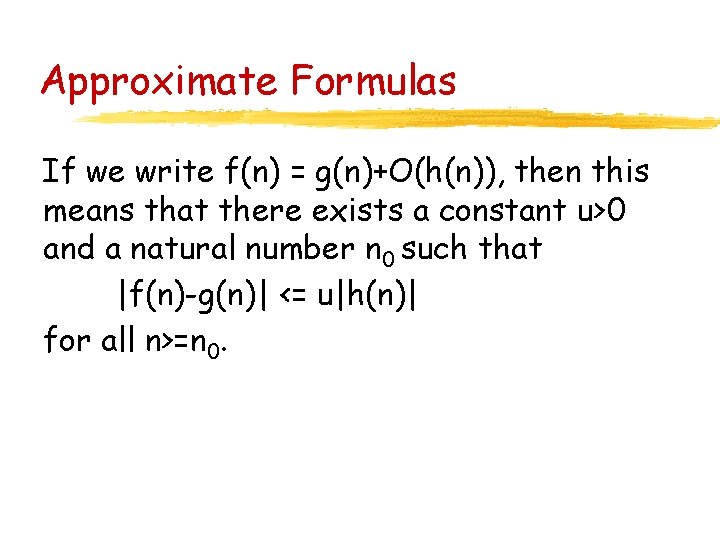
Approximate Formulas If we write f(n) = g(n)+O(h(n)), then this means that there exists a constant u>0 and a natural number n 0 such that |f(n)-g(n)| <= u|h(n)| for all n>=n 0.
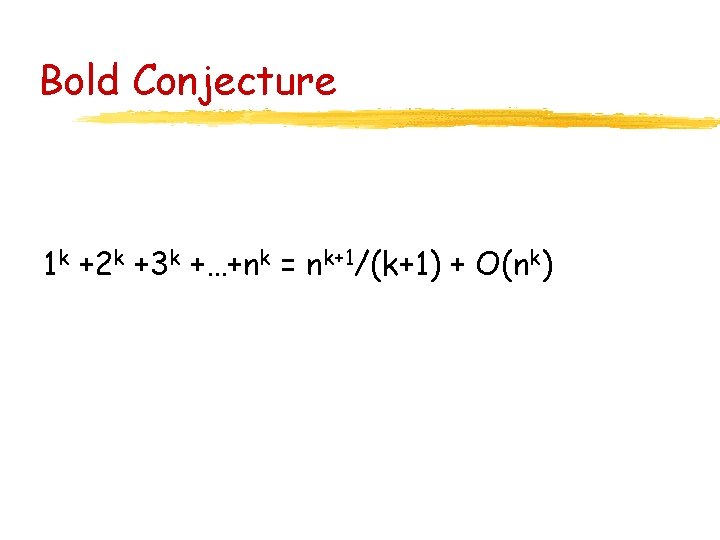
Bold Conjecture 1 k +2 k +3 k +…+nk = nk+1/(k+1) + O(nk)
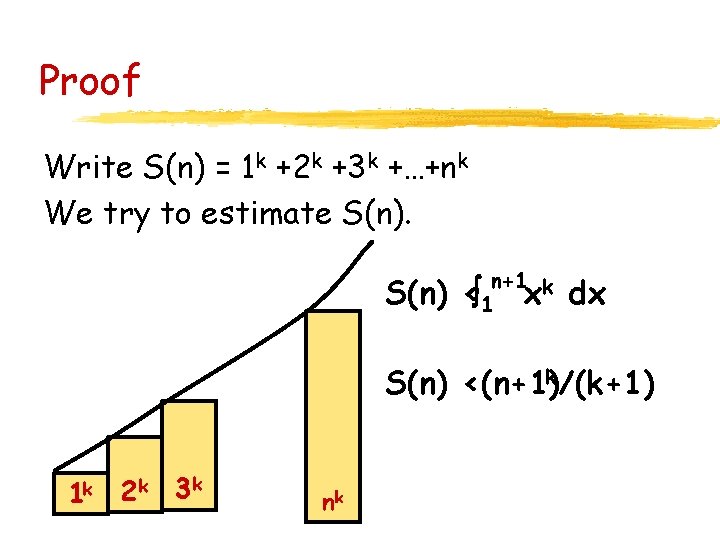
Proof Write S(n) = 1 k +2 k +3 k +…+nk We try to estimate S(n) n+1 k < 1 x dx S(n) <(n+1)k/(k+1) 1 k 2 k 3 k nk
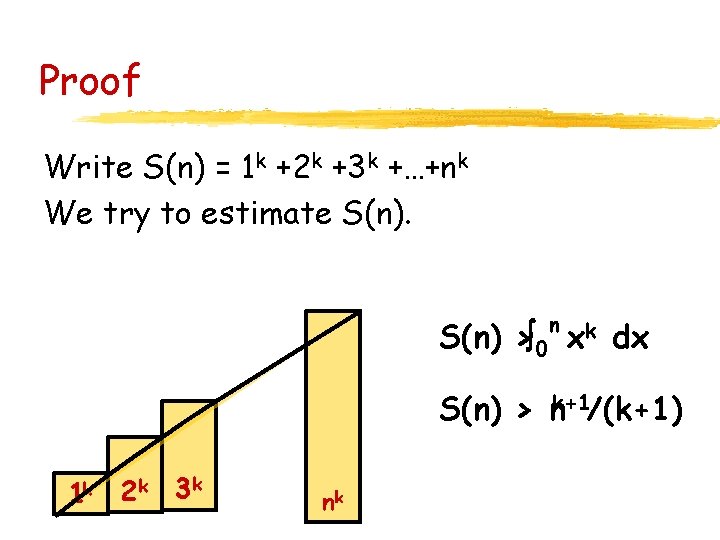
Proof Write S(n) = 1 k +2 k +3 k +…+nk We try to estimate S(n). n S(n) > 0 xk dx S(n) > nk+1/(k+1) 1 k 2 k 3 k nk
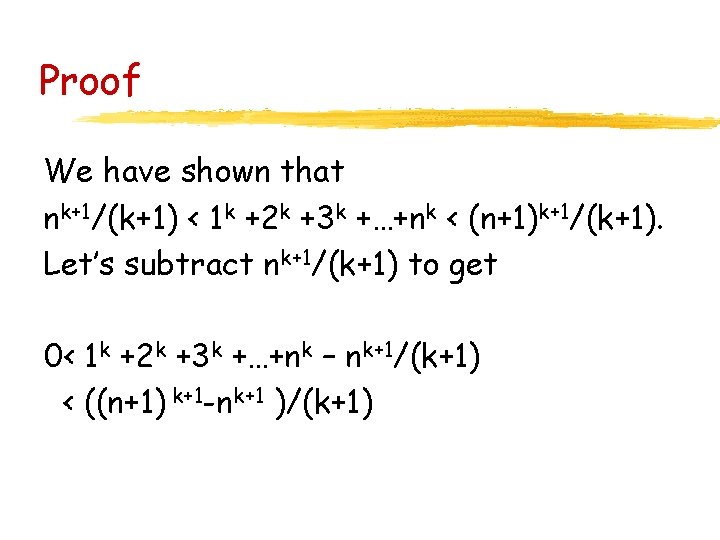
Proof We have shown that nk+1/(k+1) < 1 k +2 k +3 k +…+nk < (n+1)k+1/(k+1). Let’s subtract nk+1/(k+1) to get 0< 1 k +2 k +3 k +…+nk – nk+1/(k+1) < ((n+1) k+1 -nk+1 )/(k+1)
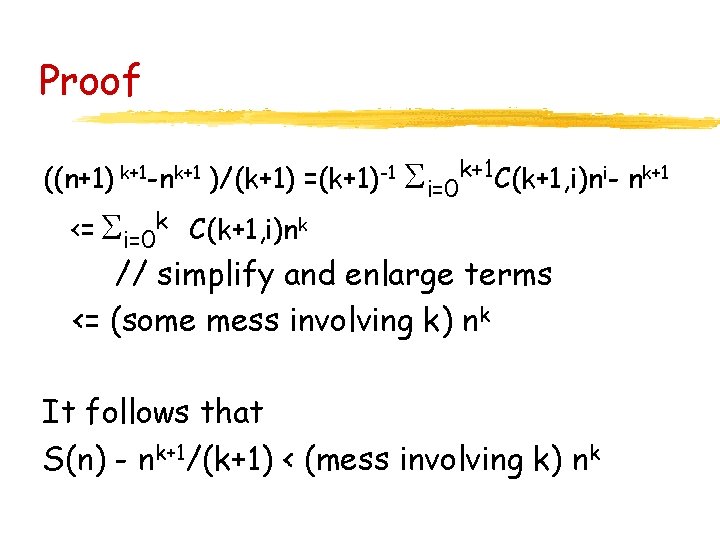
Proof ((n+1) k+1 -nk+1 )/(k+1) =(k+1)-1 i=0 k+1 C(k+1, i)ni- nk+1 <= i=0 k C(k+1, i)nk // simplify and enlarge terms <= (some mess involving k) nk It follows that S(n) - nk+1/(k+1) < (mess involving k) nk
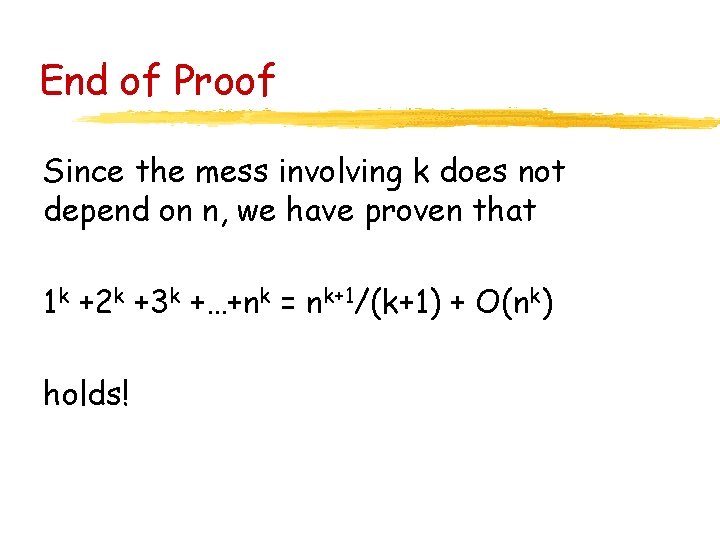
End of Proof Since the mess involving k does not depend on n, we have proven that 1 k +2 k +3 k +…+nk = nk+1/(k+1) + O(nk) holds!
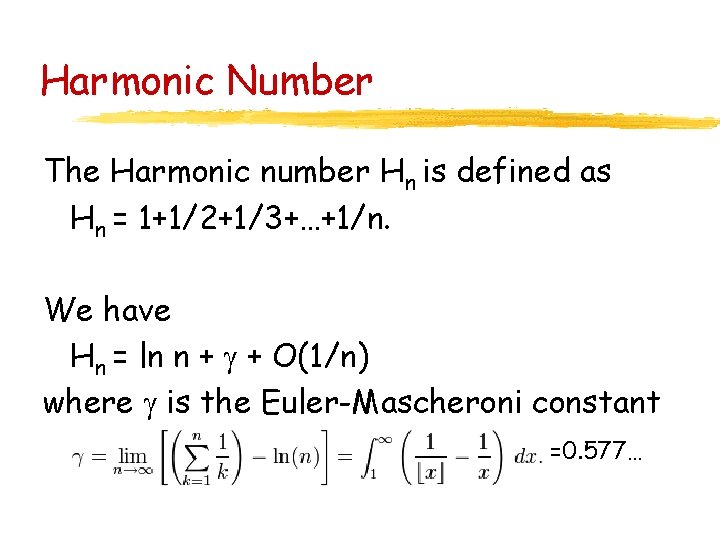
Harmonic Number The Harmonic number Hn is defined as Hn = 1+1/2+1/3+…+1/n. We have Hn = ln n + + O(1/n) where is the Euler-Mascheroni constant =0. 577…
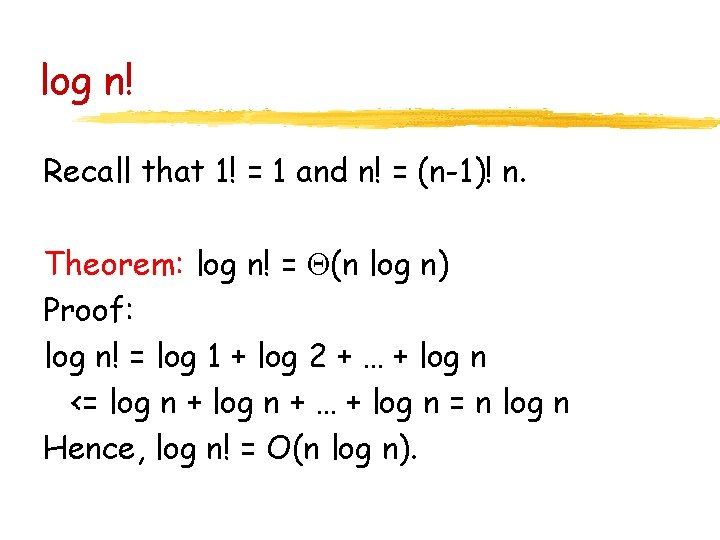
log n! Recall that 1! = 1 and n! = (n-1)! n. Theorem: log n! = (n log n) Proof: log n! = log 1 + log 2 + … + log n <= log n + … + log n = n log n Hence, log n! = O(n log n).
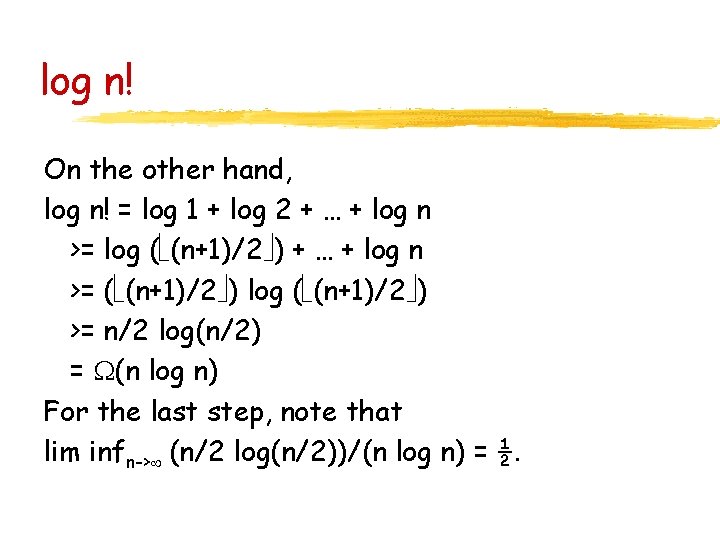
log n! On the other hand, log n! = log 1 + log 2 + … + log n >= log ( (n+1)/2 ) + … + log n >= ( (n+1)/2 ) log ( (n+1)/2 ) >= n/2 log(n/2) = (n log n) For the last step, note that lim infn-> (n/2 log(n/2))/(n log n) = ½.
Reading Assignment • Read Chapter 1 -3 in [CLRS] • Chapter 1 introduces the notion of an algorithm • Chapter 2 analyzes some sorting algorithms • Chapter 3 introduces Big Oh notation