CSCE 411 Design and Analysis of Algorithms Set


- Slides: 56
CSCE 411 Design and Analysis of Algorithms Set 2: Brute Force & Exhaustive Search Prof. Jennifer Welch Fall 2014 CSCE 411, Fall 2014: Set 2 1
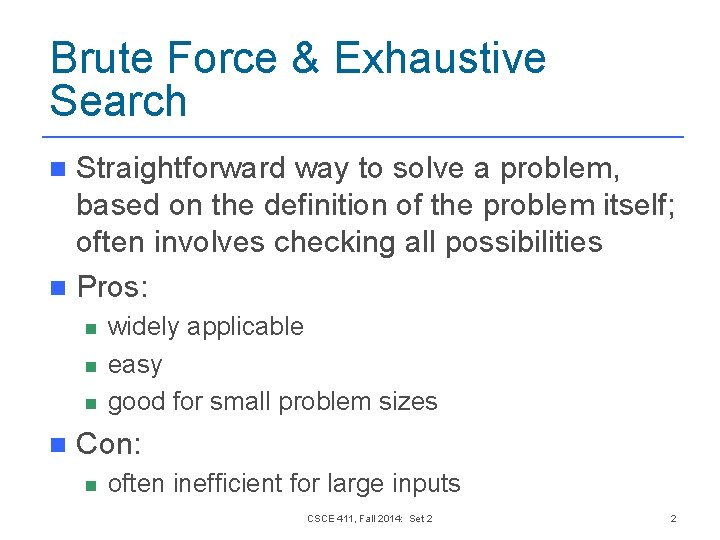
Brute Force & Exhaustive Search Straightforward way to solve a problem, based on the definition of the problem itself; often involves checking all possibilities n Pros: n n n widely applicable easy good for small problem sizes Con: n often inefficient for large inputs CSCE 411, Fall 2014: Set 2 2
Brute Force Sorting n Selection sort n n Bubble sort n n n scan array to find smallest element scan array to find second smallest element etc. scan array, swapping out-of-order neighbors continue until no swaps are needed Both take Θ(n 2) time in the worst case. CSCE 411, Fall 2014: Set 2 3
Brute Force Searching n Sequential search: n n go through the entire list of n items to find the desired item Takes Θ(n) time in the worst case CSCE 411, Fall 2014: Set 2 4
Brute Force Searching in a Graph n n (Review graph terminology and basic algorithms) Breadth-first search: n n Depth-first search: n n go level by level in the graph go as deep as you can, then backtrack Both take Θ(V+E) time, where |V| is the number of vertices and |E| is the number of edges CSCE 411, Fall 2014: Set 2 5
Brute Force for Combinatorial Problems n Traveling Salesman Problem (TSP): n n n given a set of n cities and distances between all pairs of cities, determine order for traveling to every city exactly once and returning home with minimum total distance Solution: Compute distance for all “tours” and choose the shortest. Takes Θ(n!) time (terrible!) CSCE 411, Fall 2014: Set 2 6
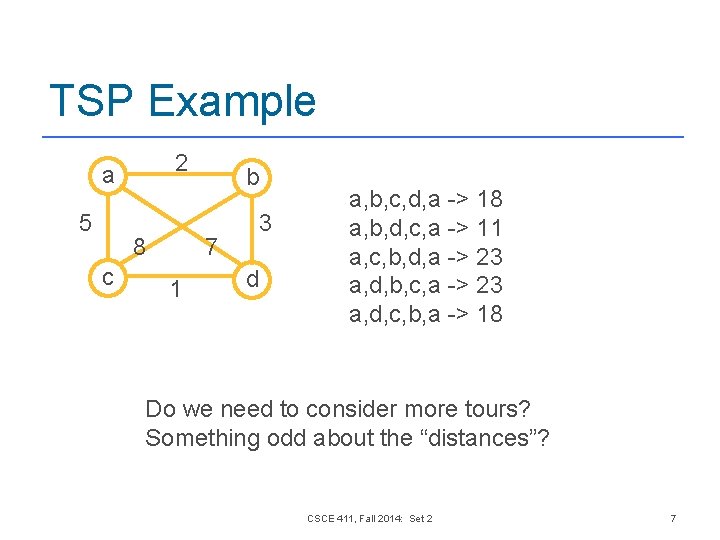
TSP Example 2 a 5 8 c b 7 1 3 d a, b, c, d, a -> 18 a, b, d, c, a -> 11 a, c, b, d, a -> 23 a, d, b, c, a -> 23 a, d, c, b, a -> 18 Do we need to consider more tours? Something odd about the “distances”? CSCE 411, Fall 2014: Set 2 7
TSP Applications transportation and logistics (school buses, meals on wheels, airplane schedules, etc. ) n drilling printed circuit boards n analyzing crystal structure n overhauling gas turbine engines n clustering data n tsp. gatech. edu/apps/index. html iris. gmu. edu/~khoffman/papers/trav_salesman. html CSCE 411, Fall 2014: Set 2 8
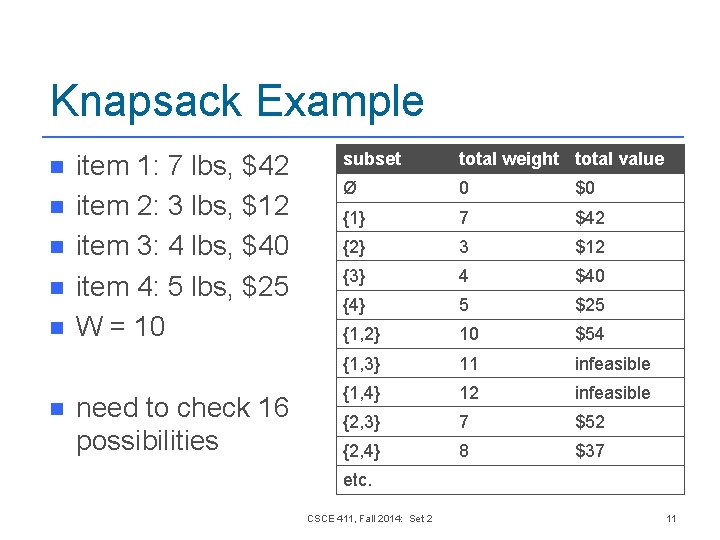
Brute Force for Combinatorial Problems n Knapsack Problem: n n n n There are n different items in a store Item i weighs wi pounds and is worth $vi A thief breaks in He can carry up to W pounds in his knapsack What should he take to maximize his haul? Solution: Consider every possible subset of items, calculate total value and total weight and discard if more than W; then choose remaining subset with maximum total value. Takes Ω(2 n) time CSCE 411, Fall 2014: Set 2 9
Knapsack Applications Least wasteful way to use raw materials n selecting capital investments and financial portfolios n generating keys for the Merkle-Hellman cryptosystem n Knapsack Problems, H. Kellerer, U. Pferschy, D. Pisinger, Springer, 2004. CSCE 411, Fall 2014: Set 2 10
Knapsack Example n n n item 1: 7 lbs, $42 item 2: 3 lbs, $12 item 3: 4 lbs, $40 item 4: 5 lbs, $25 W = 10 need to check 16 possibilities subset total weight total value Ø 0 $0 {1} 7 $42 {2} 3 $12 {3} 4 $40 {4} 5 $25 {1, 2} 10 $54 {1, 3} 11 infeasible {1, 4} 12 infeasible {2, 3} 7 $52 {2, 4} 8 $37 etc. CSCE 411, Fall 2014: Set 2 11
Brute Force For Closest Pair n Closest-Pair Problem: n n Given n points in d-dimensional space, find the two that are closest Applications: n n n airplanes close to colliding which post offices should be closed which DNA sequences are most similar CSCE 411, Fall 2014: Set 2 12
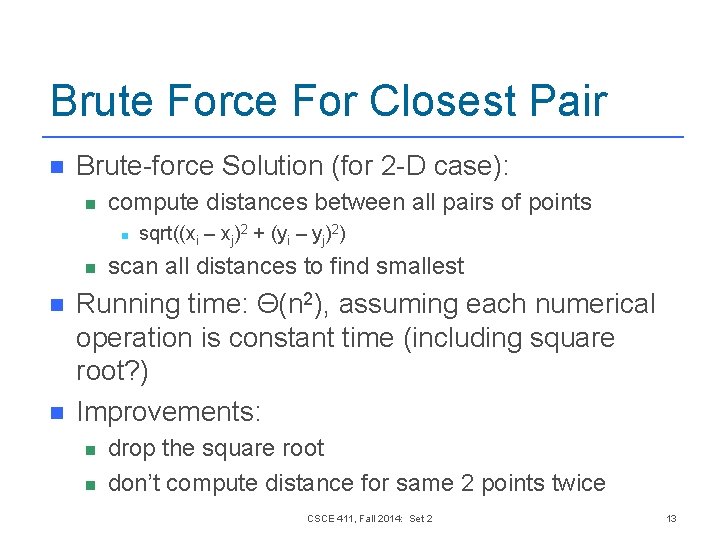
Brute Force For Closest Pair n Brute-force Solution (for 2 -D case): n compute distances between all pairs of points n n sqrt((xi – xj)2 + (yi – yj)2) scan all distances to find smallest Running time: Θ(n 2), assuming each numerical operation is constant time (including square root? ) Improvements: n n drop the square root don’t compute distance for same 2 points twice CSCE 411, Fall 2014: Set 2 13
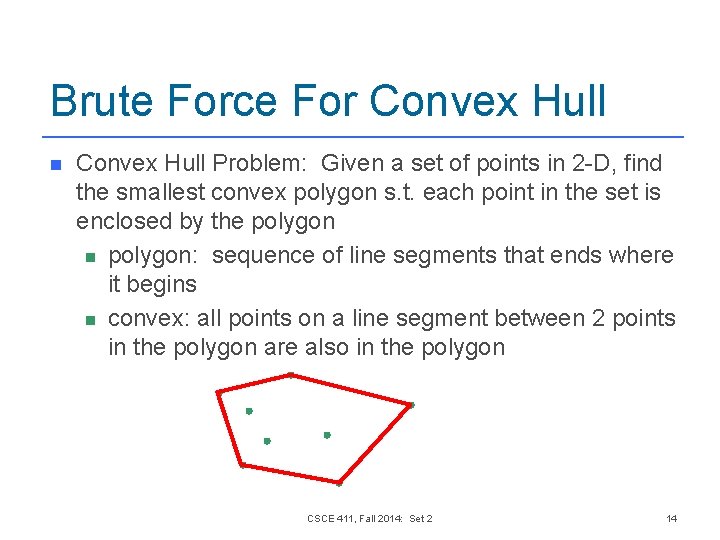
Brute Force For Convex Hull n Convex Hull Problem: Given a set of points in 2 -D, find the smallest convex polygon s. t. each point in the set is enclosed by the polygon n polygon: sequence of line segments that ends where it begins n convex: all points on a line segment between 2 points in the polygon are also in the polygon CSCE 411, Fall 2014: Set 2 14
Convex Hull Applications In computer graphics or robot planning, a simple way to check that two (possibly complicated) objects are not colliding is to compute their convex hulls and then check if the hulls intersect n Estimate size of geographic range of a species, based on observations (geocat. kew. org/about) n CSCE 411, Fall 2014: Set 2 15
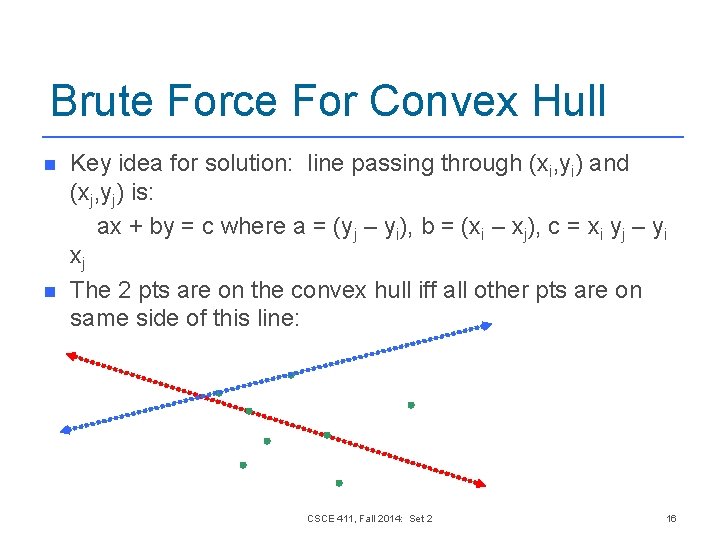
Brute Force For Convex Hull n n Key idea for solution: line passing through (xi, yi) and (xj, yj) is: ax + by = c where a = (yj – yi), b = (xi – xj), c = xi yj – yi xj The 2 pts are on the convex hull iff all other pts are on same side of this line: CSCE 411, Fall 2014: Set 2 16
Brute Force For Convex Hull n For each (distinct) pair of points in the set, compute a, b, and c to define the line ax + by = c. n For each other point, plug its x and y coordinates into the expression ax + by – c. n If, for all the other points (x, y), ax + by – c has the same sign (all positive or all negative), then this pair of points is part of the convex hull. n Takes Θ(n 3) time. CSCE 411, Fall 2014: Set 2 17
Brute Force for Two Numeric Problems n n Problem: Compute an n Solution: Multiply a by itself n-1 times n Takes Θ(n) time, assuming each multiplication takes constant time. Problem: multiply two n x n matrices A and B to create product matrix C n Solution: Follow the definition, which says the (i, j) entry of C is Σ aik*bkj , k = 1 to n n Takes Θ(n 3) time, assuming each basic operation takes constant time CSCE 411, Fall 2014: Set 2 18
Brute Force/Exhaustive Search Summary n n n sorting: selection sort, bubble sort searching: sequential search graphs: BFS, DFS combinatorial problems: check all possibilities for TSP and knapsack geometric: check all possibilities for closest pair and for convex hull numerical: follow definition to compute an or matrix multiplication CSCE 411, Fall 2014: Set 2 19
Applications of DFS n Now let’s go more in depth on two applications of depth-first search n n topological sort finding strongly connected components of a graph CSCE 411, Fall 2014: Set 2 20
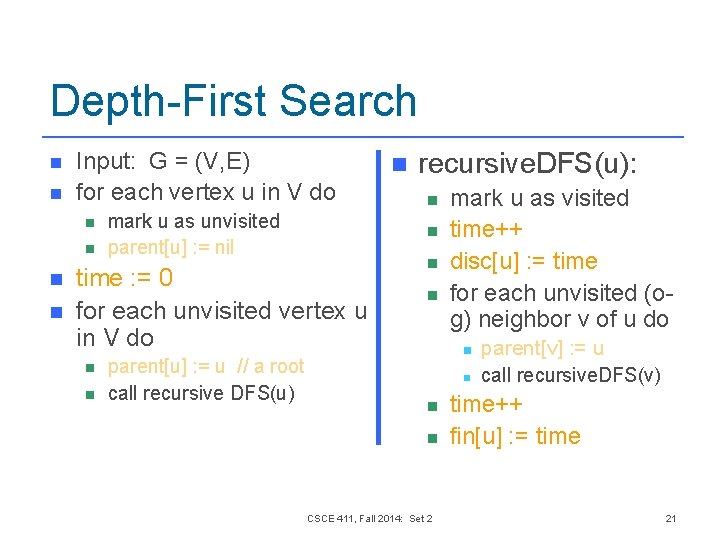
Depth-First Search n n Input: G = (V, E) for each vertex u in V do n n mark u as unvisited parent[u] : = nil n parent[u] : = u // a root call recursive DFS(u) recursive. DFS(u): n n time : = 0 for each unvisited vertex u in V do n n mark u as visited time++ disc[u] : = time for each unvisited (og) neighbor v of u do n n CSCE 411, Fall 2014: Set 2 parent[v] : = u call recursive. DFS(v) time++ fin[u] : = time 21
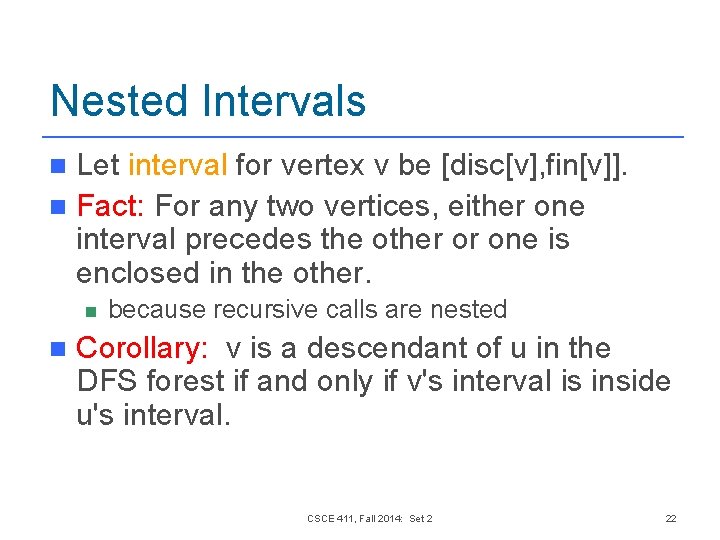
Nested Intervals Let interval for vertex v be [disc[v], fin[v]]. n Fact: For any two vertices, either one interval precedes the other or one is enclosed in the other. n n n because recursive calls are nested Corollary: v is a descendant of u in the DFS forest if and only if v's interval is inside u's interval. CSCE 411, Fall 2014: Set 2 22
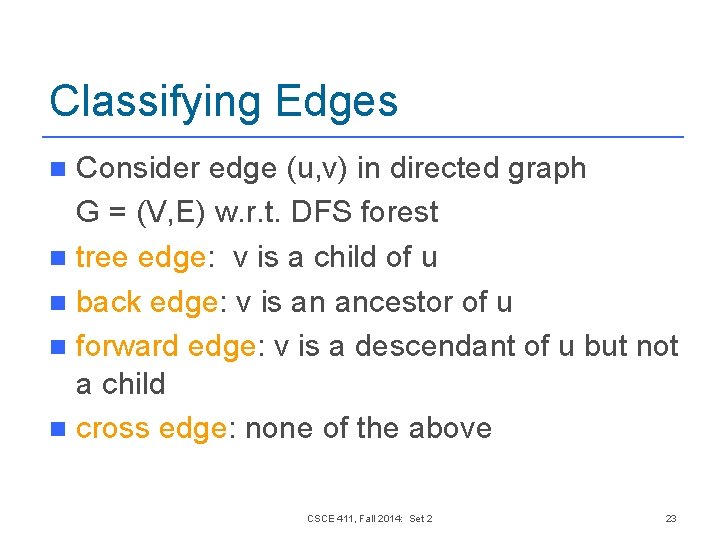
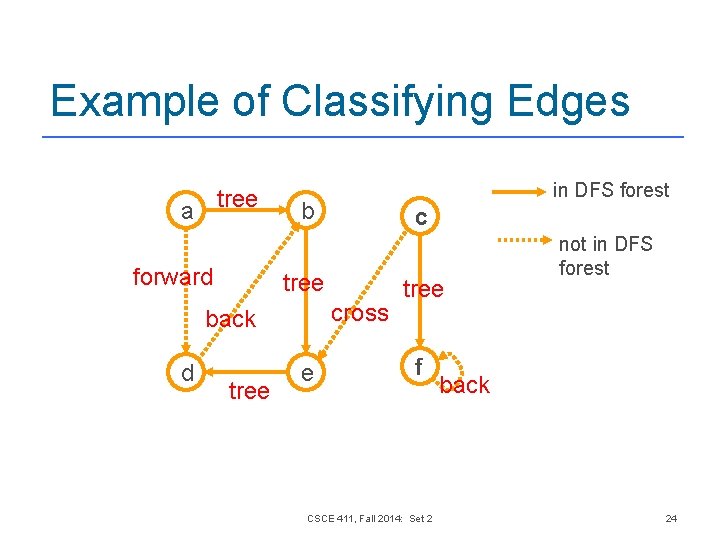
Classifying Edges Consider edge (u, v) in directed graph G = (V, E) w. r. t. DFS forest n tree edge: v is a child of u n back edge: v is an ancestor of u n forward edge: v is a descendant of u but not a child n cross edge: none of the above n CSCE 411, Fall 2014: Set 2 23
Example of Classifying Edges tree a forward b c tree cross back d in DFS forest tree e tree f CSCE 411, Fall 2014: Set 2 not in DFS forest back 24
DFS Application: Topological Sort Given a directed acyclic graph (DAG), find a linear ordering of the vertices such that if (u, v) is an edge, then u precedes v. n DAG indicates precedence among events: n n n events are graph vertices, edge from u to v means event u has precedence over event v Partial order because not all events have to be done in a certain order CSCE 411, Fall 2014: Set 2 25
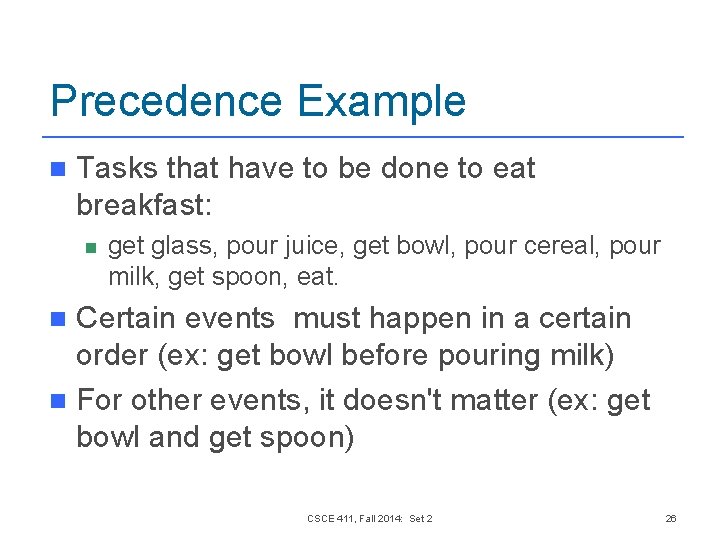
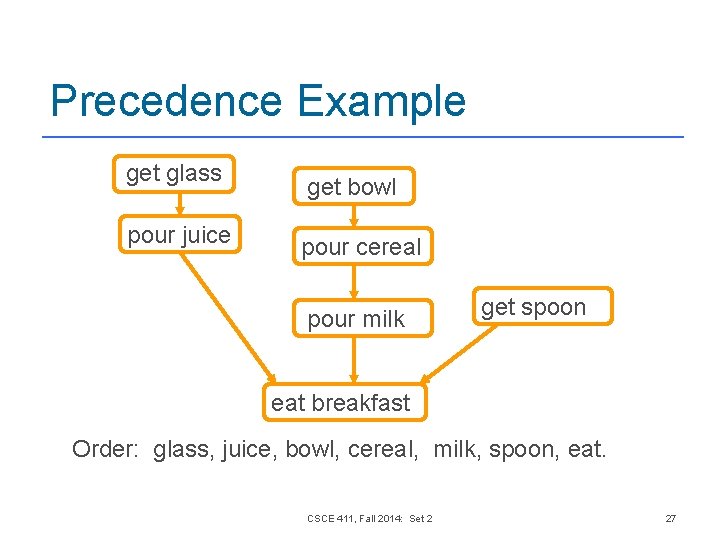
Precedence Example n Tasks that have to be done to eat breakfast: n get glass, pour juice, get bowl, pour cereal, pour milk, get spoon, eat. Certain events must happen in a certain order (ex: get bowl before pouring milk) n For other events, it doesn't matter (ex: get bowl and get spoon) n CSCE 411, Fall 2014: Set 2 26
Precedence Example get glass pour juice get bowl pour cereal pour milk get spoon eat breakfast Order: glass, juice, bowl, cereal, milk, spoon, eat. CSCE 411, Fall 2014: Set 2 27
Why Acyclic? Why must directed graph be acyclic for the topological sort problem? n Otherwise, no way to order events linearly without violating a precedence constraint. n CSCE 411, Fall 2014: Set 2 28
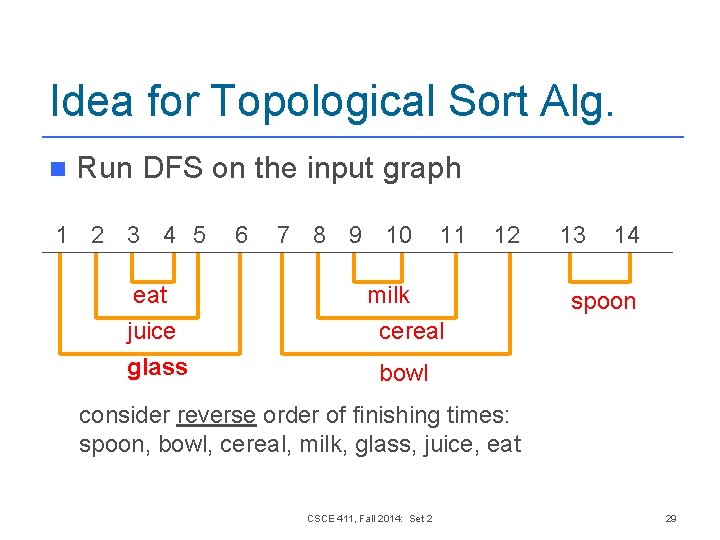
Idea for Topological Sort Alg. n Run DFS on the input graph 1 2 3 4 5 eat juice glass 6 7 8 9 10 11 12 milk cereal 13 14 spoon bowl consider reverse order of finishing times: spoon, bowl, cereal, milk, glass, juice, eat CSCE 411, Fall 2014: Set 2 29
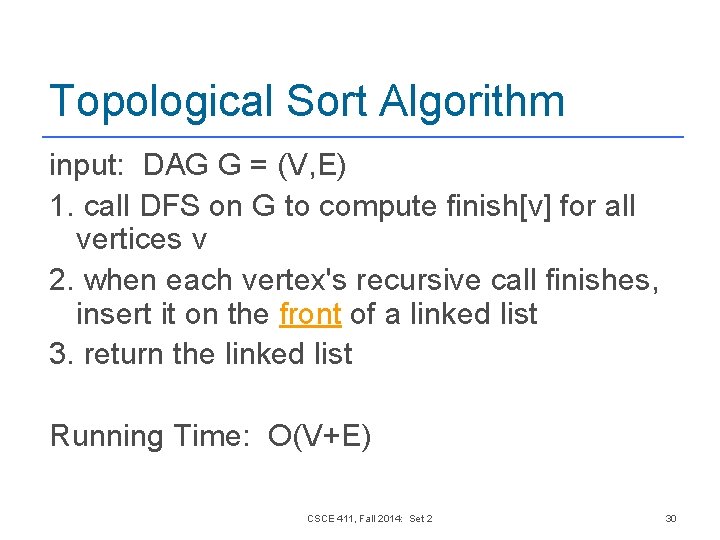
Topological Sort Algorithm input: DAG G = (V, E) 1. call DFS on G to compute finish[v] for all vertices v 2. when each vertex's recursive call finishes, insert it on the front of a linked list 3. return the linked list Running Time: O(V+E) CSCE 411, Fall 2014: Set 2 30
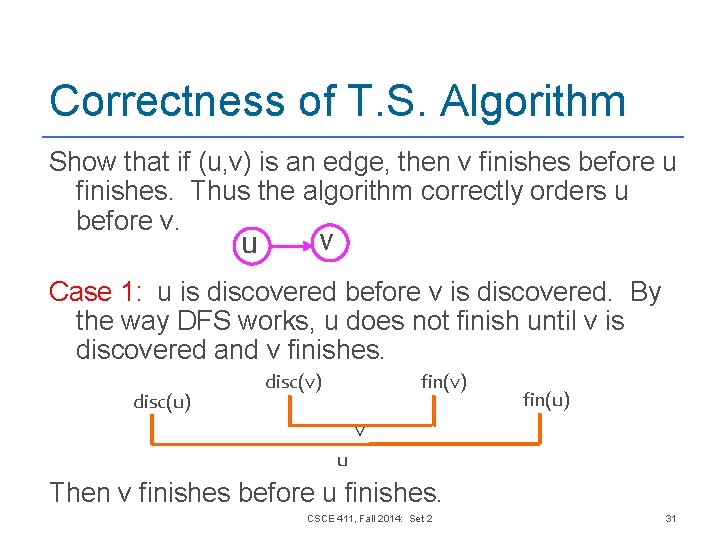
Correctness of T. S. Algorithm Show that if (u, v) is an edge, then v finishes before u finishes. Thus the algorithm correctly orders u before v. u v Case 1: u is discovered before v is discovered. By the way DFS works, u does not finish until v is discovered and v finishes. disc(u) disc(v) fin(u) v u Then v finishes before u finishes. CSCE 411, Fall 2014: Set 2 31
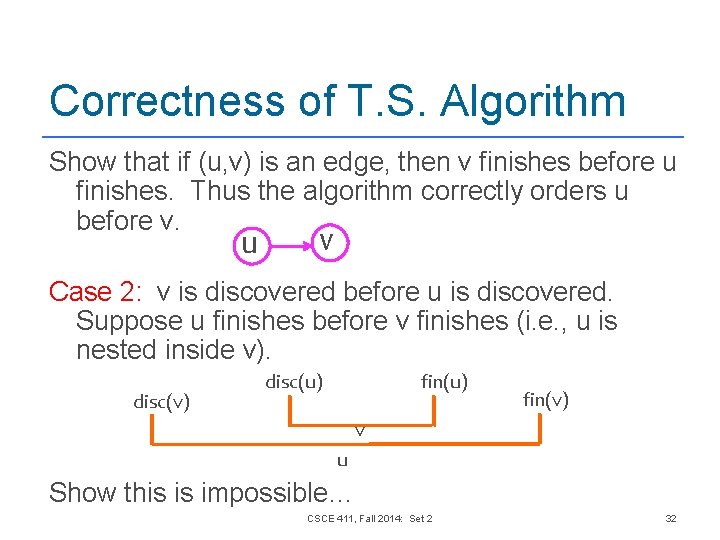
Correctness of T. S. Algorithm Show that if (u, v) is an edge, then v finishes before u finishes. Thus the algorithm correctly orders u before v. u v Case 2: v is discovered before u is discovered. Suppose u finishes before v finishes (i. e. , u is nested inside v). disc(v) disc(u) fin(v) v u Show this is impossible… CSCE 411, Fall 2014: Set 2 32
Correctness of T. S. Algorithm v is discovered but not yet finished when u is discovered. n Then u is a descendant of v. n But that would make (u, v) a back edge and a DAG cannot have a back edge (the back edge would form a cycle). n Thus v finishes before u finishes. n CSCE 411, Fall 2014: Set 2 33
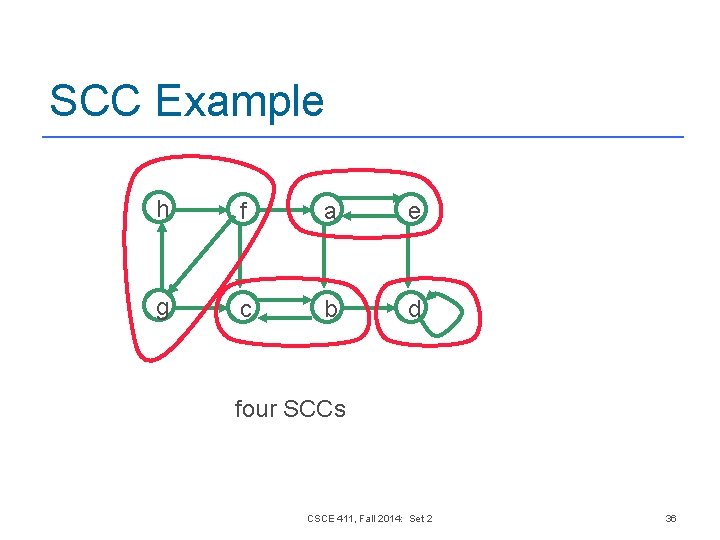
DFS Application: Strongly Connected Components Consider a directed graph. n A strongly connected component (SCC) of the graph is a maximal set of vertices with a (directed) path between every pair of vertices n Problem: Find all the SCCs of the graph. n CSCE 411, Fall 2014: Set 2 34
What Are SCCs Good For? n Packaging software modules: n n n Construct directed graph of which modules call which other modules A SCC is a set of mutually interacting modules Pack together those in the same SCC www. cs. princeton. edu/courses/archive/fall 07/cos 226/lectures. html n Solving the “ 2 -satisfiability problem”, which in turn is used to solve various geometric placement problems (graph labeling, VLSI design), as well as data clustering and scheduling wikipedia CSCE 411, Fall 2014: Set 2 35
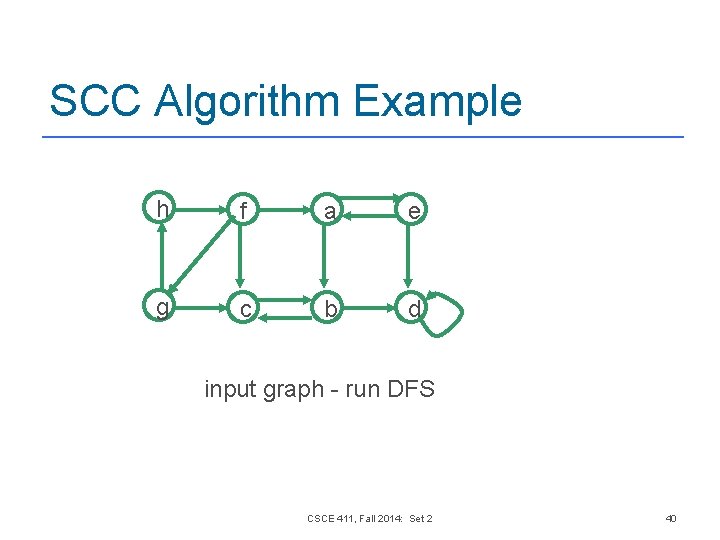
SCC Example h f a e g c b d four SCCs CSCE 411, Fall 2014: Set 2 36
How Can DFS Help? Suppose we run DFS on the directed graph. n All vertices in the same SCC are in the same DFS tree. n But there might be several different SCCs in the same DFS tree. n n Example: start DFS from vertex h in previous graph CSCE 411, Fall 2014: Set 2 37
Main Idea of SCC Algorithm DFS tells us which vertices are reachable from the roots of the individual trees n Also need information in the "other direction": is the root reachable from its descendants? n Run DFS again on the "transpose" graph (reverse the directions of the edges) n CSCE 411, Fall 2014: Set 2 38
SCC Algorithm input: directed graph G = (V, E) 1. call DFS(G) to compute finishing times 2. compute GT // transpose graph 3. call DFS(GT), considering vertices in decreasing order of finishing times 4. each tree from Step 3 is a separate SCC of G CSCE 411, Fall 2014: Set 2 39
SCC Algorithm Example h f a e g c b d input graph - run DFS CSCE 411, Fall 2014: Set 2 40
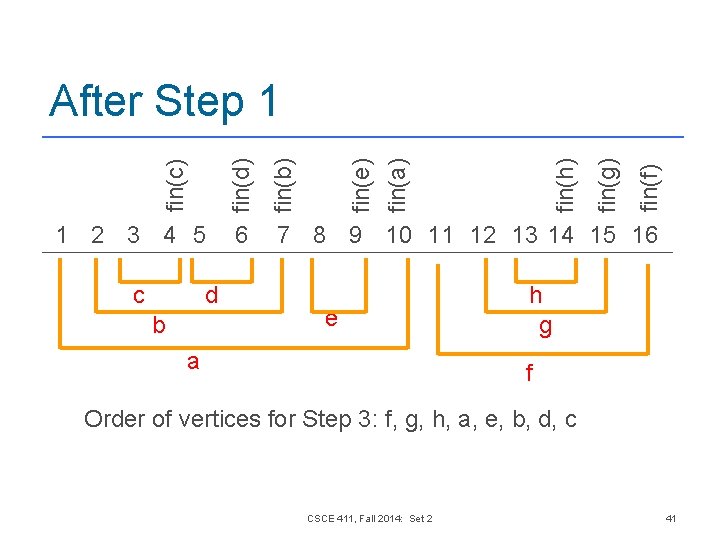
1 2 3 4 5 c d b 6 fin(f) fin(g) fin(h) fin(e) fin(a) fin(b) fin(c) fin(d) After Step 1 7 8 9 10 11 12 13 14 15 16 e a h g f Order of vertices for Step 3: f, g, h, a, e, b, d, c CSCE 411, Fall 2014: Set 2 41
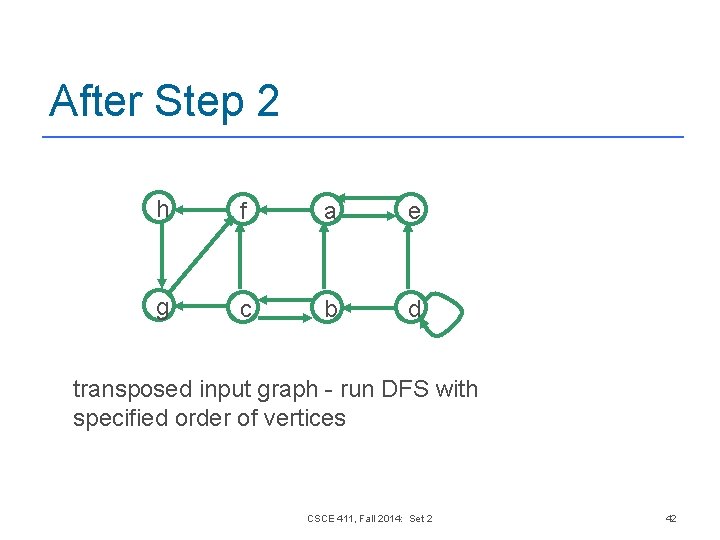
After Step 2 h f a e g c b d transposed input graph - run DFS with specified order of vertices CSCE 411, Fall 2014: Set 2 42
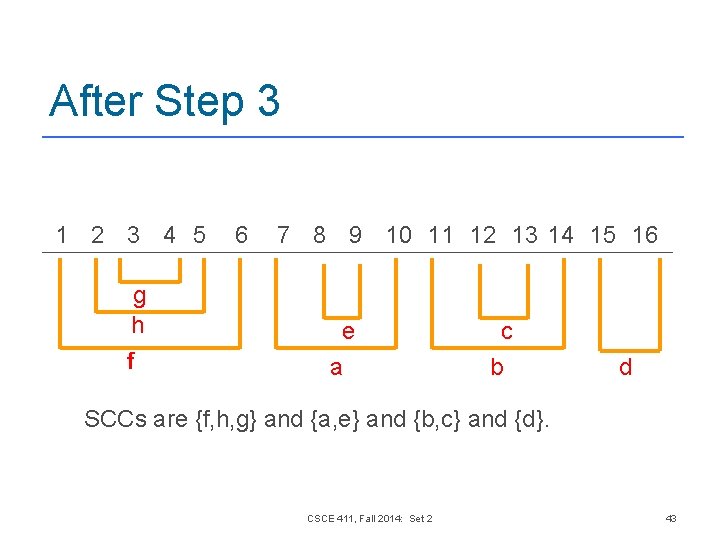
After Step 3 1 2 3 4 5 g h f 6 7 8 9 10 11 12 13 14 15 16 e a c b d SCCs are {f, h, g} and {a, e} and {b, c} and {d}. CSCE 411, Fall 2014: Set 2 43
Running Time of SCC Algorithm Step 1: O(V+E) to run DFS n Step 2: O(V+E) to construct transpose graph, assuming adjacency list rep. n Step 3: O(V+E) to run DFS again n Step 4: O(V) to output result n Total: O(V+E) n CSCE 411, Fall 2014: Set 2 44
Correctness of SCC Algorithm Proof uses concept of component graph, GSCC, of G. n Vertices are the SCCs of G; call them C 1, C 2, …, Ck n Put an edge from Ci to Cj iff G has an edge from a vertex in Ci to a vertex in Cj n CSCE 411, Fall 2014: Set 2 45
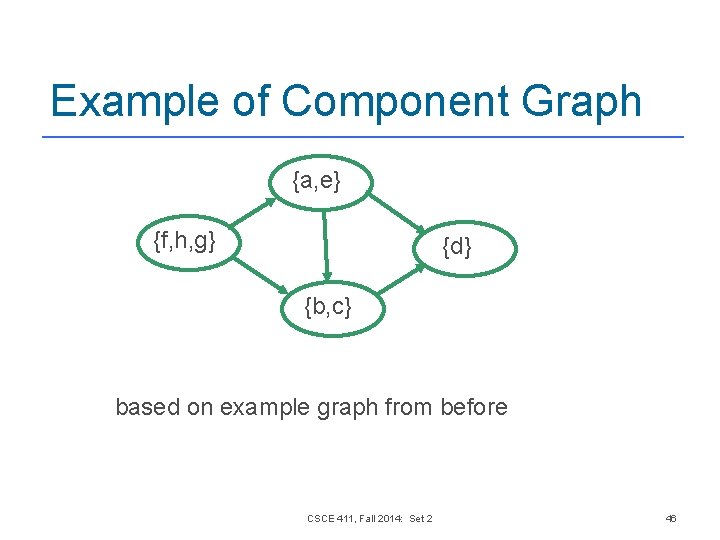
Example of Component Graph {a, e} {f, h, g} {d} {b, c} based on example graph from before CSCE 411, Fall 2014: Set 2 46
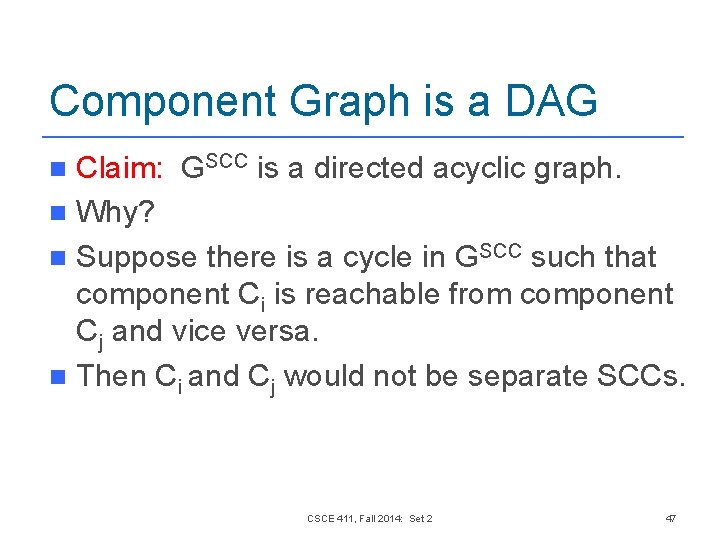
Component Graph is a DAG Claim: GSCC is a directed acyclic graph. n Why? n Suppose there is a cycle in GSCC such that component Ci is reachable from component Cj and vice versa. n Then Ci and Cj would not be separate SCCs. n CSCE 411, Fall 2014: Set 2 47
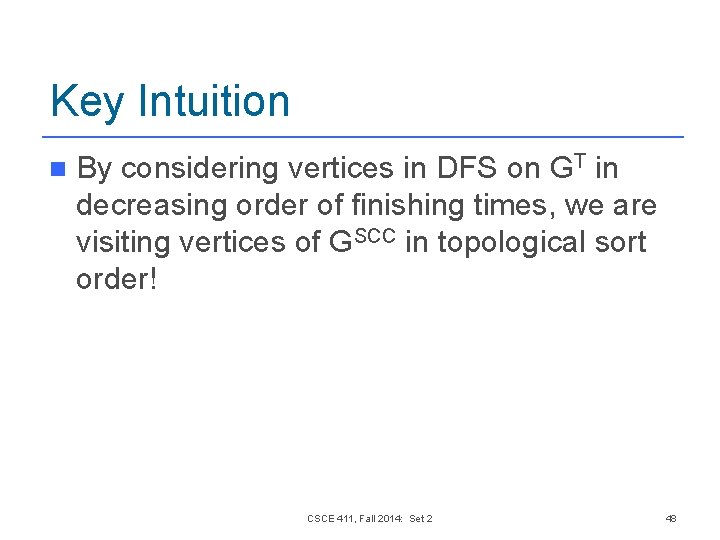
Key Intuition n By considering vertices in DFS on GT in decreasing order of finishing times, we are visiting vertices of GSCC in topological sort order! CSCE 411, Fall 2014: Set 2 48
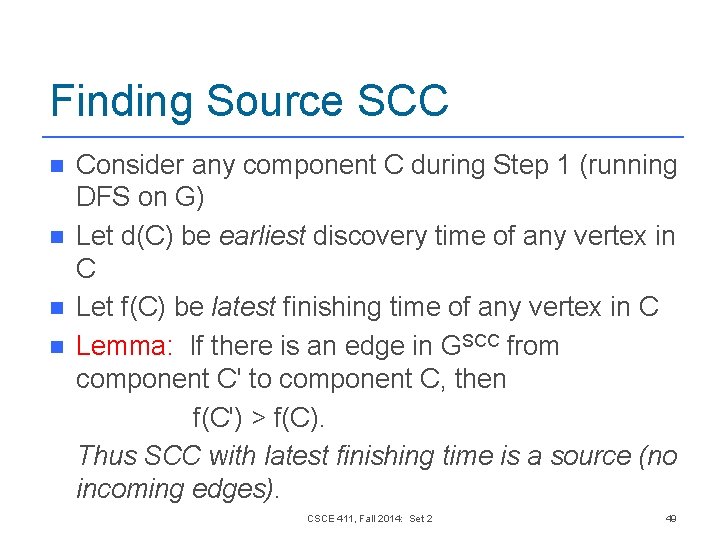
Finding Source SCC n n Consider any component C during Step 1 (running DFS on G) Let d(C) be earliest discovery time of any vertex in C Let f(C) be latest finishing time of any vertex in C Lemma: If there is an edge in GSCC from component C' to component C, then f(C') > f(C). Thus SCC with latest finishing time is a source (no incoming edges). CSCE 411, Fall 2014: Set 2 49
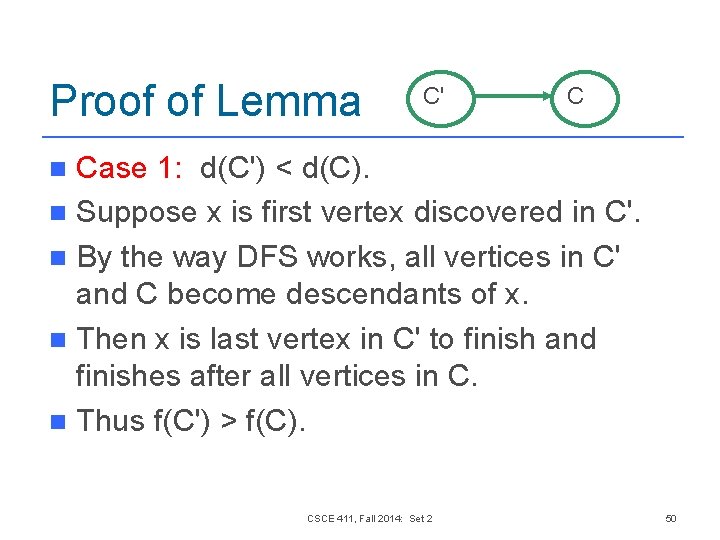
Proof of Lemma C' C Case 1: d(C') < d(C). n Suppose x is first vertex discovered in C'. n By the way DFS works, all vertices in C' and C become descendants of x. n Then x is last vertex in C' to finish and finishes after all vertices in C. n Thus f(C') > f(C). n CSCE 411, Fall 2014: Set 2 50
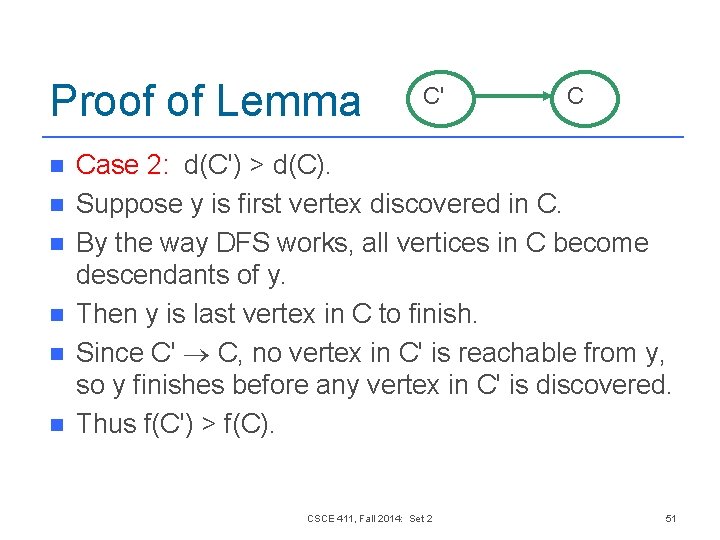
Proof of Lemma n n n C' C Case 2: d(C') > d(C). Suppose y is first vertex discovered in C. By the way DFS works, all vertices in C become descendants of y. Then y is last vertex in C to finish. Since C' C, no vertex in C' is reachable from y, so y finishes before any vertex in C' is discovered. Thus f(C') > f(C). CSCE 411, Fall 2014: Set 2 51
SCC Algorithm is Correct Prove this theorem by induction on number of trees found in Step 3 (running DFS on GT). n Hypothesis is that the first k trees found constitute k SCCs of G. n Basis: k = 0. No work to do ! n CSCE 411, Fall 2014: Set 2 52
SCC Algorithm is Correct Another case (to build intuition, not formally necessary): k = 1. n First node visited in DFS on GT is in an SCC that is a source in GSCC (no incoming edges) n So in GT, this SCC is a sink (no outgoing edges) n So the first tree found during the DFS on GT is a single SCC. n CSCE 411, Fall 2014: Set 2 53
SCC Algorithm is Correct n n Induction: Assume the first k trees constructed in Step 3 (running DFS on GT) correspond to k SCCs; consider the (k+1)st tree. Let u be the root of the (k+1)st tree. u is part of some SCC, call it C. By the inductive hypothesis, C is not one of the k SCCs already found and so all vertices in C are unvisited when u is discovered. n By the way DFS works, all vertices in C become part of u's tree CSCE 411, Fall 2014: Set 2 54
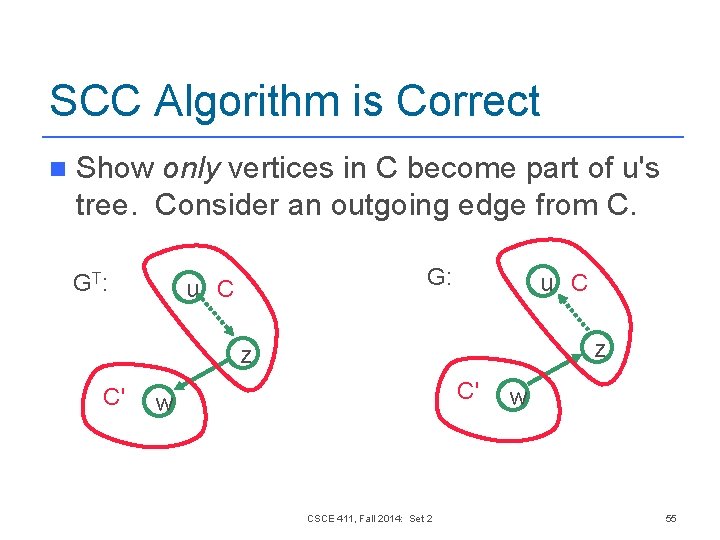
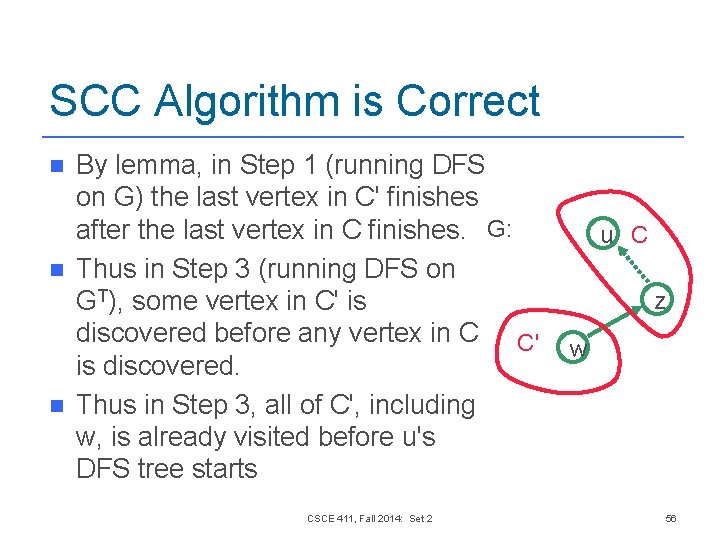
SCC Algorithm is Correct n Show only vertices in C become part of u's tree. Consider an outgoing edge from C. G T: G: u C z z C' C' w CSCE 411, Fall 2014: Set 2 w 55
SCC Algorithm is Correct n n n By lemma, in Step 1 (running DFS on G) the last vertex in C' finishes after the last vertex in C finishes. G: Thus in Step 3 (running DFS on GT), some vertex in C' is discovered before any vertex in C C' is discovered. Thus in Step 3, all of C', including w, is already visited before u's DFS tree starts CSCE 411, Fall 2014: Set 2 u C z w 56