
CMSC 411 Computer Systems Architecture Lecture 1 Computer


- Slides: 22
CMSC 411 Computer Systems Architecture Lecture 1 Computer Architecture at Crossroads Instructor: Anwar Mamat Slides from Alan Sussman, Pete Keleher, Chau-Wen Tseng
Administrivia • Class web page – http: //www. cs. umd. edu/class/spring 2015/cmsc 4 11 -0201/Linked in from CS dept class web pages • Class accounts – CSIC Linux cluster • Recommended textbook – Hennessy & Patterson, Computer Architecture: A Quantitative Approach, 5 th Edition CMSC 411 - 1 2
What can you expect to learn? • What to look for in buying a PC – Can brag to parents and friends! • • • How computer architecture affects programming style How programming style affect computer architecture How processors/disks/memory work How processors exploit instruction/thread parallelism A great deal of jargon CMSC 411 - 1 3
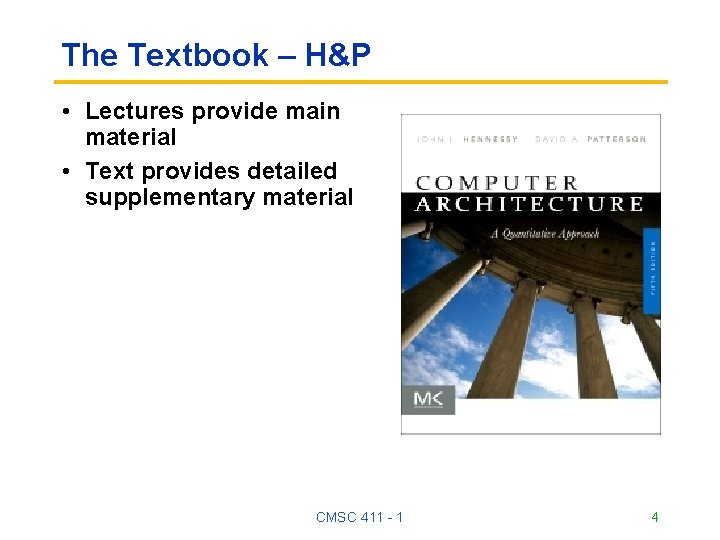
The Textbook – H&P • Lectures provide main material • Text provides detailed supplementary material CMSC 411 - 1 4
Calendar / Course Overview • Tests Quizzes and Homework 15% 2 projects 20% 2 midterms 30% final exam 30% Participation 5% 5
Project Grading • Projects will be graded using the CS submit server • Develop programs on your own machine – Generally results will be identical on dept machines – Your responsibility to ensure programs run correctly on the linuxlab cluster 6
Rules and Reminders • Use lecture notes as your text – Supplement with textbook, Internet – You will be responsible for everything in the notes, even if it is directly covered in class! • Keep ahead of your work – Get help as soon as you need it » Office hours, Piazza (email as a last resort) • Don’t disturb other students in class – Keep cell phones quiet – No laptops in class 7
Academic Integrity • All written work (including projects) must be done on your own – Do not copy code from other students – Do not copy code from the web – We’re using Moss; cheaters will be caught • Work together on high-level project questions – Do not look at/describe another student’s code – If unsure, ask an instructor! • Work together on practice exam questions 8
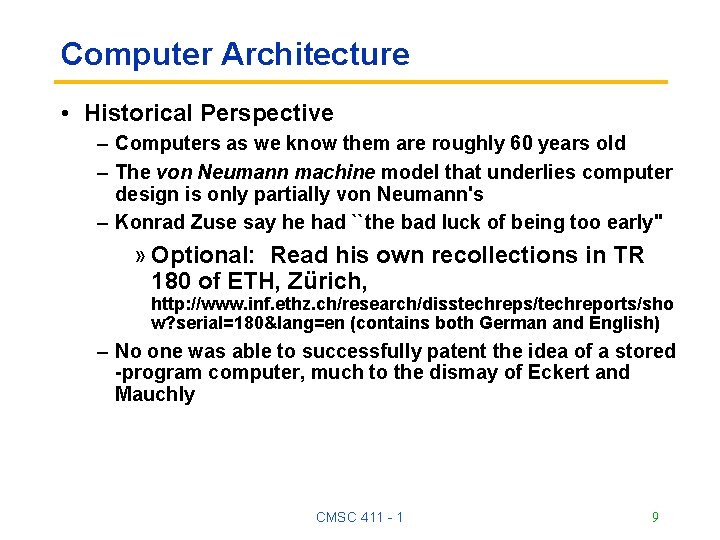
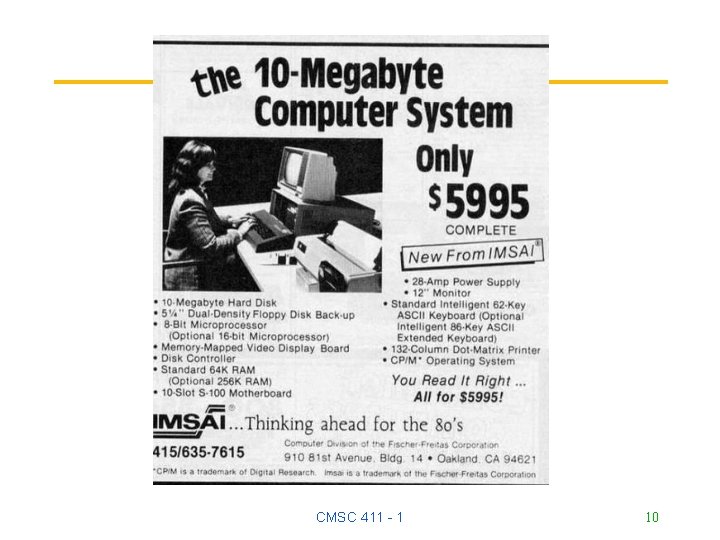
Computer Architecture • Historical Perspective – Computers as we know them are roughly 60 years old – The von Neumann machine model that underlies computer design is only partially von Neumann's – Konrad Zuse say he had ``the bad luck of being too early" » Optional: Read his own recollections in TR 180 of ETH, Zürich, http: //www. inf. ethz. ch/research/disstechreps/techreports/sho w? serial=180&lang=en (contains both German and English) – No one was able to successfully patent the idea of a stored -program computer, much to the dismay of Eckert and Mauchly CMSC 411 - 1 9
CMSC 411 - 1 10
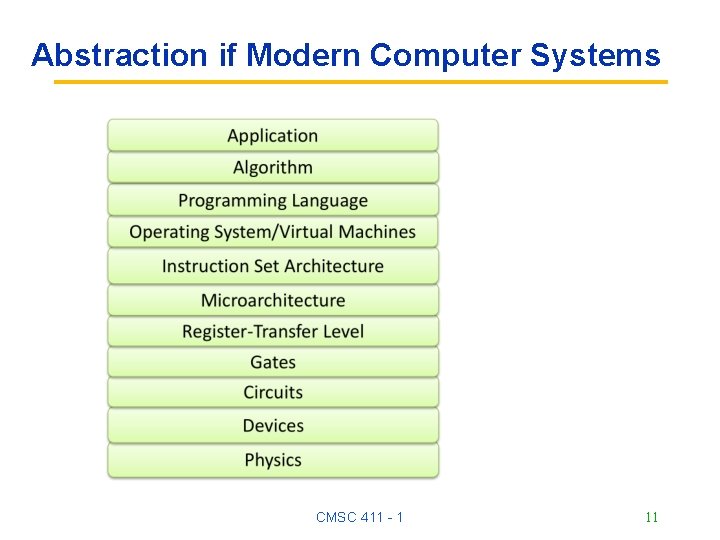
Abstraction if Modern Computer Systems CMSC 411 - 1 11
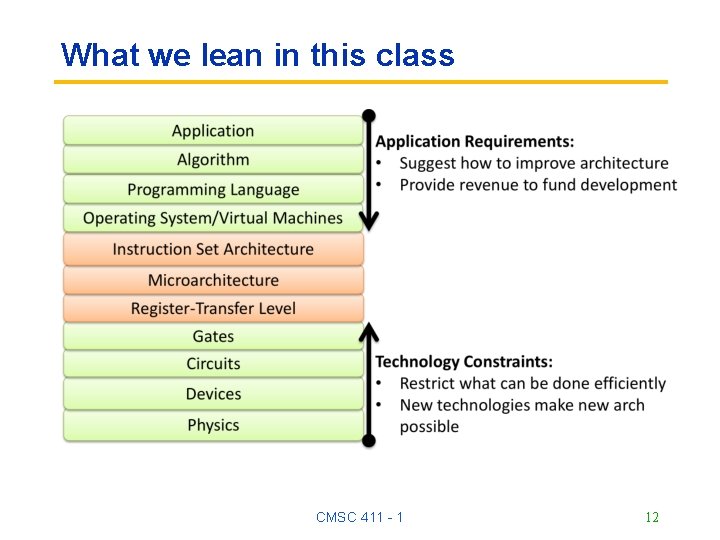
What we lean in this class CMSC 411 - 1 12
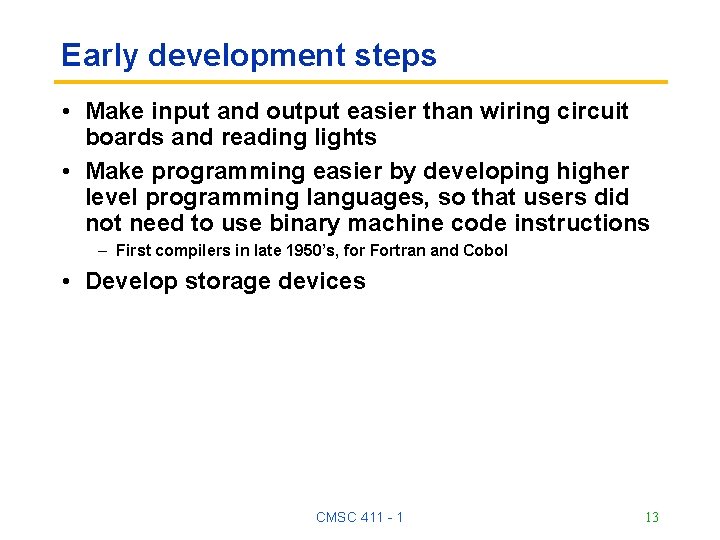
Early development steps • Make input and output easier than wiring circuit boards and reading lights • Make programming easier by developing higher level programming languages, so that users did not need to use binary machine code instructions – First compilers in late 1950’s, for Fortran and Cobol • Develop storage devices CMSC 411 - 1 13
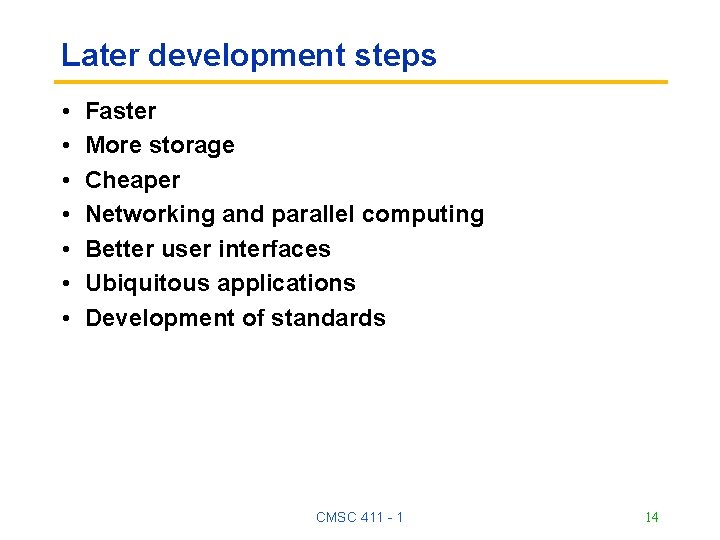
Later development steps • • Faster More storage Cheaper Networking and parallel computing Better user interfaces Ubiquitous applications Development of standards CMSC 411 - 1 14
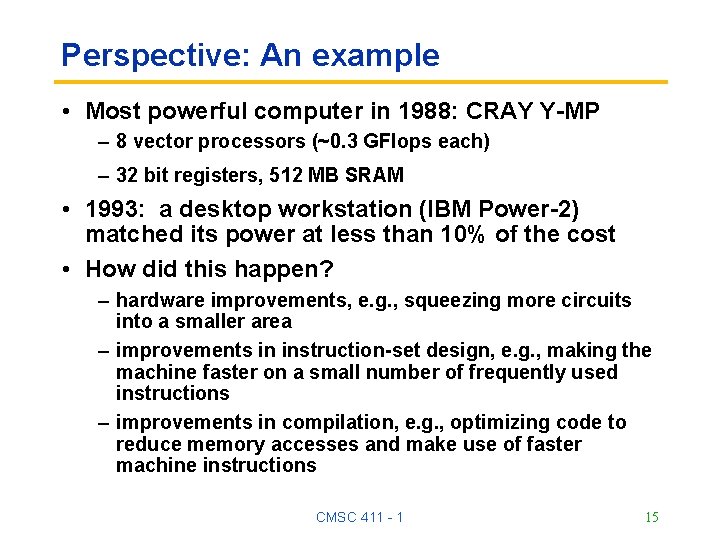
Perspective: An example • Most powerful computer in 1988: CRAY Y-MP – 8 vector processors (~0. 3 GFlops each) – 32 bit registers, 512 MB SRAM • 1993: a desktop workstation (IBM Power-2) matched its power at less than 10% of the cost • How did this happen? – hardware improvements, e. g. , squeezing more circuits into a smaller area – improvements in instruction-set design, e. g. , making the machine faster on a small number of frequently used instructions – improvements in compilation, e. g. , optimizing code to reduce memory accesses and make use of faster machine instructions CMSC 411 - 1 15
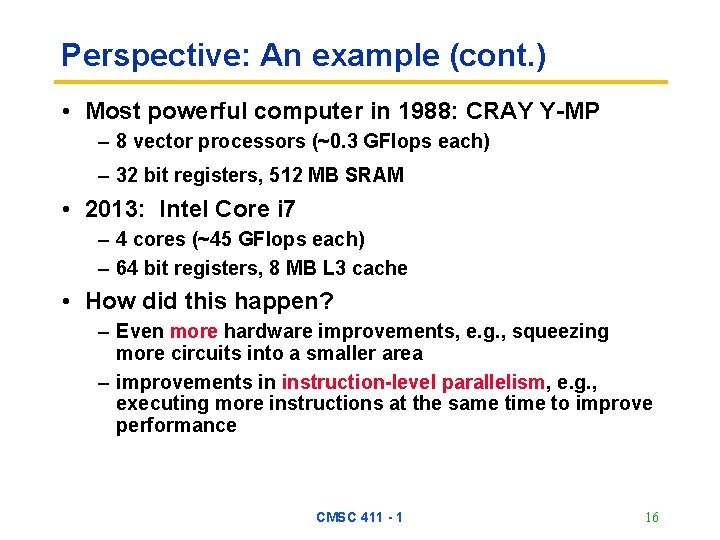
Perspective: An example (cont. ) • Most powerful computer in 1988: CRAY Y-MP – 8 vector processors (~0. 3 GFlops each) – 32 bit registers, 512 MB SRAM • 2013: Intel Core i 7 – 4 cores (~45 GFlops each) – 64 bit registers, 8 MB L 3 cache • How did this happen? – Even more hardware improvements, e. g. , squeezing more circuits into a smaller area – improvements in instruction-level parallelism, e. g. , executing more instructions at the same time to improve performance CMSC 411 - 1 16
COMPUTER ARCHITECTURE AT A CROSSROADS CMSC 411 - 1 17
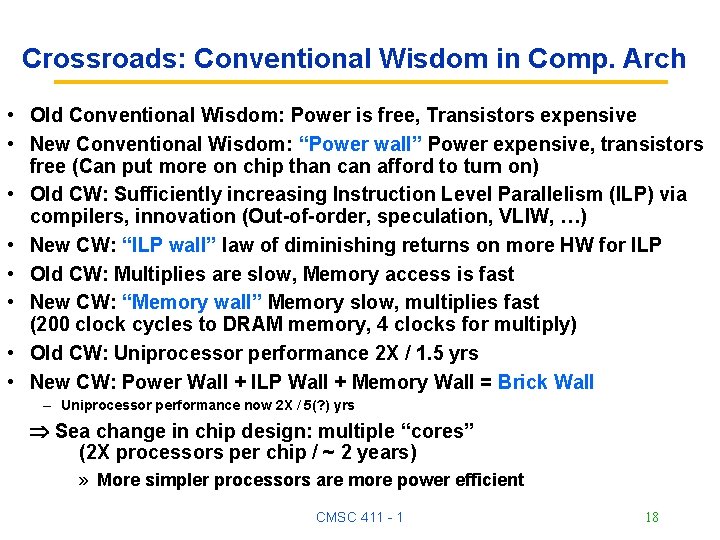
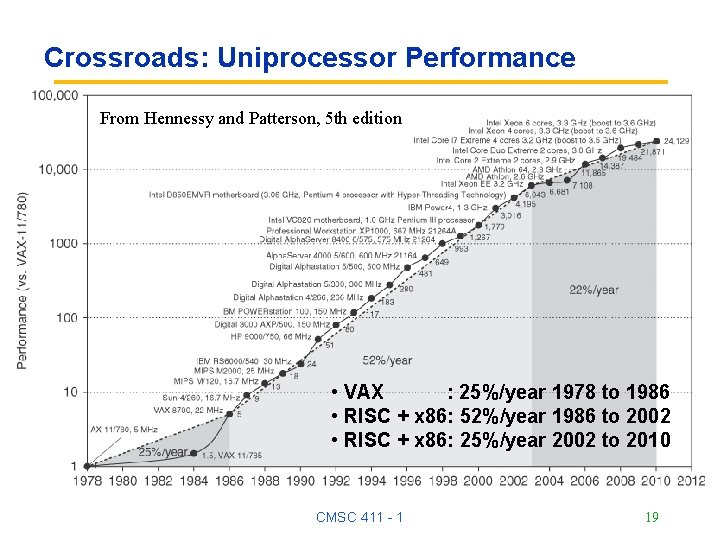
Crossroads: Conventional Wisdom in Comp. Arch • Old Conventional Wisdom: Power is free, Transistors expensive • New Conventional Wisdom: “Power wall” Power expensive, transistors free (Can put more on chip than can afford to turn on) • Old CW: Sufficiently increasing Instruction Level Parallelism (ILP) via compilers, innovation (Out-of-order, speculation, VLIW, …) • New CW: “ILP wall” law of diminishing returns on more HW for ILP • Old CW: Multiplies are slow, Memory access is fast • New CW: “Memory wall” Memory slow, multiplies fast (200 clock cycles to DRAM memory, 4 clocks for multiply) • Old CW: Uniprocessor performance 2 X / 1. 5 yrs • New CW: Power Wall + ILP Wall + Memory Wall = Brick Wall – Uniprocessor performance now 2 X / 5(? ) yrs Sea change in chip design: multiple “cores” (2 X processors per chip / ~ 2 years) » More simpler processors are more power efficient CMSC 411 - 1 18
Crossroads: Uniprocessor Performance From Hennessy and Patterson, 5 th edition • VAX : 25%/year 1978 to 1986 • RISC + x 86: 52%/year 1986 to 2002 • RISC + x 86: 25%/year 2002 to 2010 CMSC 411 - 1 19
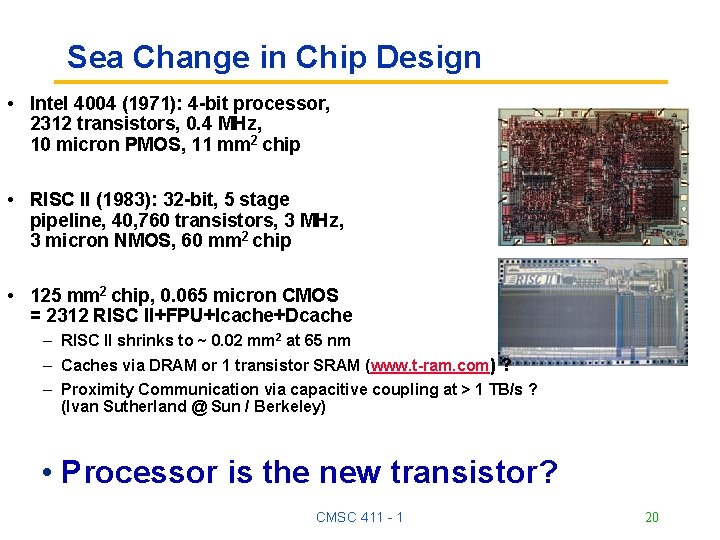
Sea Change in Chip Design • Intel 4004 (1971): 4 -bit processor, 2312 transistors, 0. 4 MHz, 10 micron PMOS, 11 mm 2 chip • RISC II (1983): 32 -bit, 5 stage pipeline, 40, 760 transistors, 3 MHz, 3 micron NMOS, 60 mm 2 chip • 125 mm 2 chip, 0. 065 micron CMOS = 2312 RISC II+FPU+Icache+Dcache – RISC II shrinks to ~ 0. 02 mm 2 at 65 nm – Caches via DRAM or 1 transistor SRAM (www. t-ram. com) ? – Proximity Communication via capacitive coupling at > 1 TB/s ? (Ivan Sutherland @ Sun / Berkeley) • Processor is the new transistor? CMSC 411 - 1 20
Multiprocessors - Déjà vu all over again? • Multiprocessors imminent in 1970 s, ‘ 80 s, ‘ 90 s, … • “… today’s processors … are nearing an impasse as technologies approach the speed of light. . ” David Mitchell, The Transputer: The Time Is Now (1989) • Transputer was premature Custom multiprocessors strove to lead uniprocessors Procrastination rewarded: 2 X seq. perf. / 1. 5 years • “We are dedicating all of our future product development to multicore designs. … This is a sea change in computing” Paul Otellini, President, Intel (2004) • Difference is all microprocessor companies switch to multiprocessors (AMD, Intel, IBM, Sun; all new Apples 2 CPUs) Procrastination penalized: 2 X sequential perf. / 5 yrs Biggest programming challenge: 1 to 2 CPUs CMSC 411 - 1 21
Problems with Sea Change • Algorithms, Programming Languages, Compilers, Operating Systems, Architectures, Libraries, … not ready to supply Thread Level Parallelism or Data Level Parallelism for 1000 CPUs / chip, Architectures not ready for 1000 CPUs / chip • • • Unlike Instruction Level Parallelism, cannot be solved just by computer architects and compiler writers alone, but also cannot be solved without participation of computer architects This 5 th Edition of textbook Computer Architecture: A Quantitative Approach explores shift from Instruction Level Parallelism to Thread Level Parallelism / Data Level Parallelism CMSC 411 - 1 22