
CSCE 313 MP 6 Unix Threads Acknowledgment Yi
- Slides: 10
CSCE 313 MP 6 Unix Threads Acknowledgment: Yi Cui, GSTA, CSCE-313, Prof. Tanzir Ahmed, CSCE-313
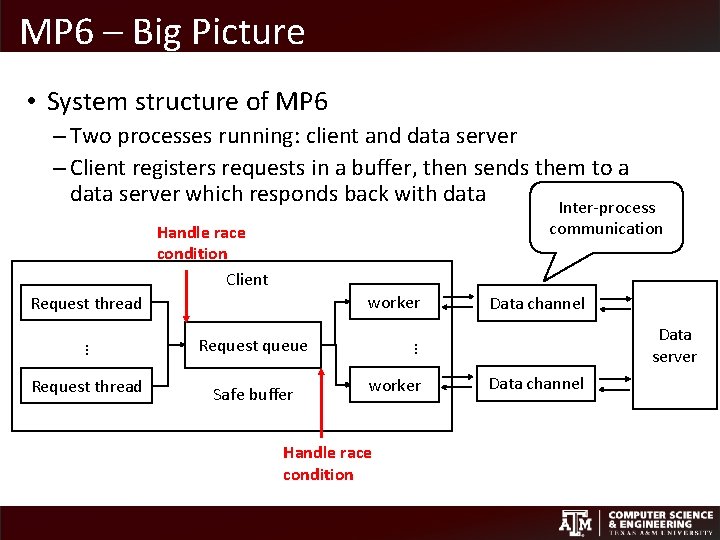
MP 6 – Big Picture • System structure of MP 6 – Two processes running: client and data server – Client registers requests in a buffer, then sends them to a data server which responds back with data Inter-process communication Handle race condition Client worker Request thread Safe buffer Data server … … Request queue Data channel worker Handle race condition Data channel
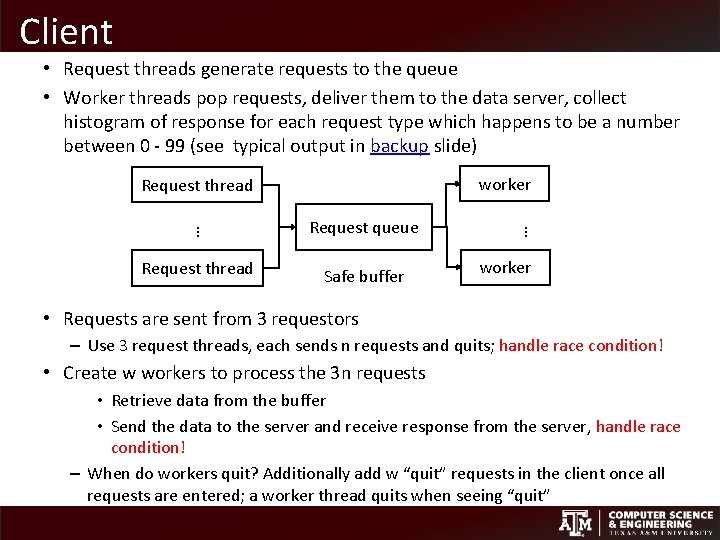
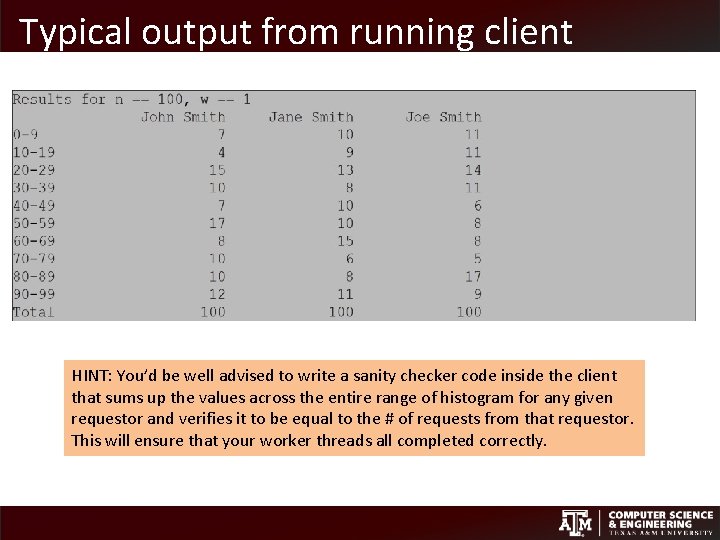
Client • Request threads generate requests to the queue • Worker threads pop requests, deliver them to the data server, collect histogram of response for each request type which happens to be a number between 0 - 99 (see typical output in backup slide) worker Request thread Safe buffer … … Request queue worker • Requests are sent from 3 requestors – Use 3 request threads, each sends n requests and quits; handle race condition! • Create w workers to process the 3 n requests • Retrieve data from the buffer • Send the data to the server and receive response from the server, handle race condition! – When do workers quit? Additionally add w “quit” requests in the client once all requests are entered; a worker thread quits when seeing “quit”
MP 6 – Tangibles of the Assignment • dataserver. cpp, reqchannel. h, and reqchannel. cpp are already done for you • Your task – Implement safe buffer and client functions in accordance with the requirements published in MP 6_handout. pdf available here. – Specifically, Modify Safe. Buffer. h, Safe. Buffer. cpp, and client_MP 6. cpp – In addition, write a report with three key sections: • Describe your implementation • Graph the runtime of your client program (execution time versus the number of worker threads) • Commentary on your client program performance in context of the system you ran it on
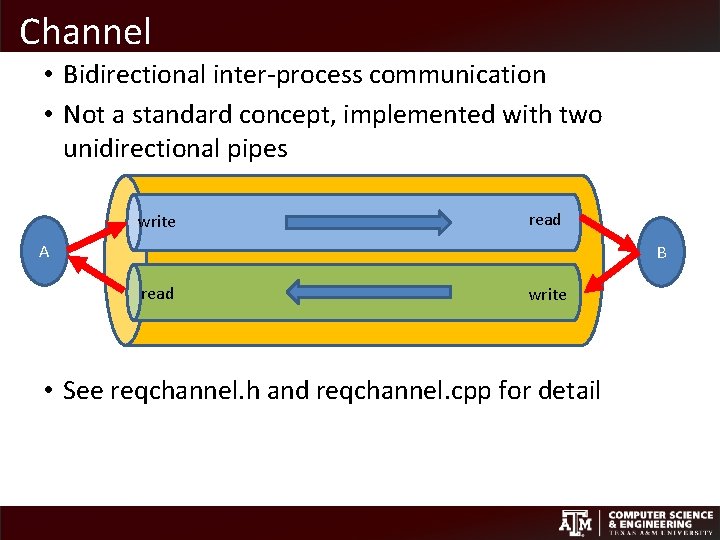
Channel • Bidirectional inter-process communication • Not a standard concept, implemented with two unidirectional pipes write read A B read write • See reqchannel. h and reqchannel. cpp for detail
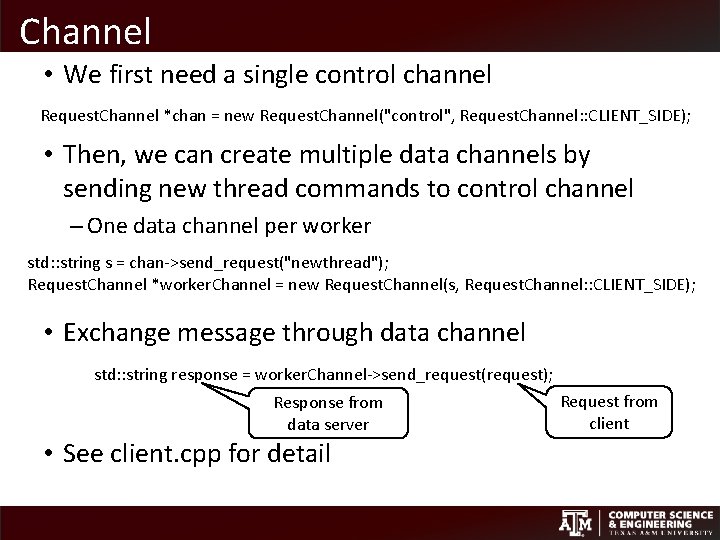
Channel • We first need a single control channel Request. Channel *chan = new Request. Channel("control", Request. Channel: : CLIENT_SIDE); • Then, we can create multiple data channels by sending new thread commands to control channel – One data channel per worker std: : string s = chan->send_request("newthread"); Request. Channel *worker. Channel = new Request. Channel(s, Request. Channel: : CLIENT_SIDE); • Exchange message through data channel std: : string response = worker. Channel->send_request(request); Response from data server • See client. cpp for detail Request from client
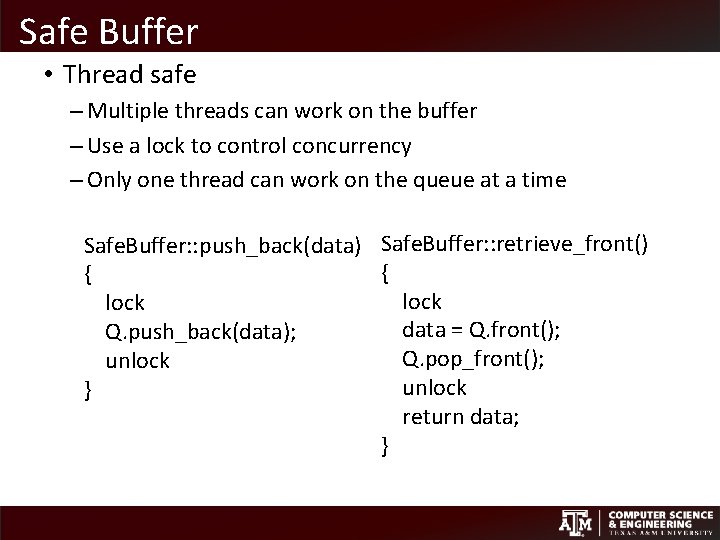
Safe Buffer • Thread safe – Multiple threads can work on the buffer – Use a lock to control concurrency – Only one thread can work on the queue at a time Safe. Buffer: : push_back(data) Safe. Buffer: : retrieve_front() { { lock data = Q. front(); Q. push_back(data); Q. pop_front(); unlock } return data; }
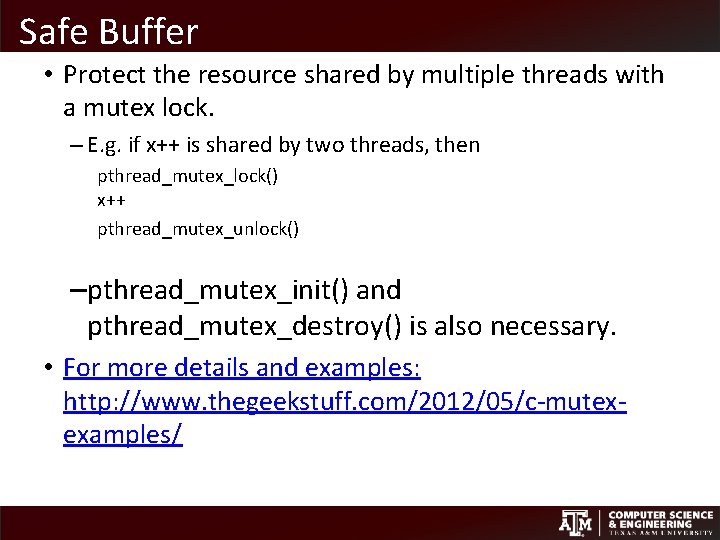
Safe Buffer • Protect the resource shared by multiple threads with a mutex lock. – E. g. if x++ is shared by two threads, then pthread_mutex_lock() x++ pthread_mutex_unlock() –pthread_mutex_init() and pthread_mutex_destroy() is also necessary. • For more details and examples: http: //www. thegeekstuff. com/2012/05/c-mutexexamples/
BACKUP
Typical output from running client HINT: You’d be well advised to write a sanity checker code inside the client that sums up the values across the entire range of histogram for any given requestor and verifies it to be equal to the # of requests from that requestor. This will ensure that your worker threads all completed correctly.