COPYRIGHT THE CARD GAME WORKS USAGES LICENCES AND







- Slides: 56
COPYRIGHT THE CARD GAME: WORKS, USAGES, LICENCES AND EXCEPTIONS by Chris Morrison and Jane Secker https: //copyrightliteracy. org @UKCopyright. Lit
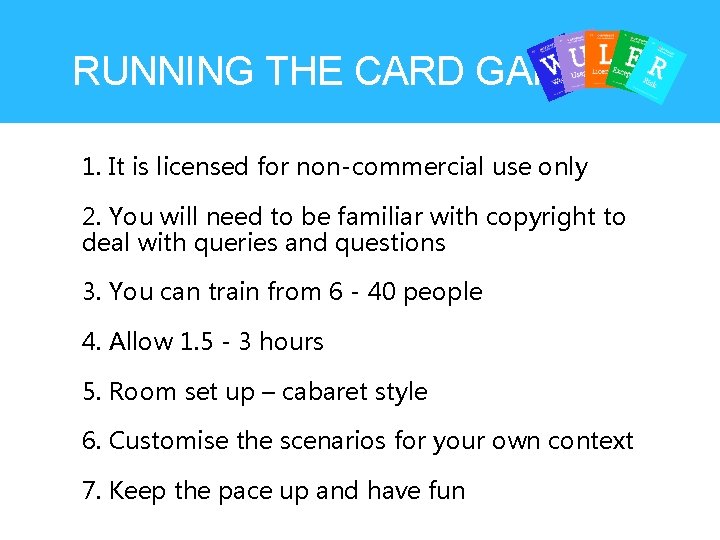
RUNNING THE CARD GAME 1. It is licensed for non-commercial use only 2. You will need to be familiar with copyright to deal with queries and questions 3. You can train from 6 - 40 people 4. Allow 1. 5 - 3 hours 5. Room set up – cabaret style 6. Customise the scenarios for your own context 7. Keep the pace up and have fun
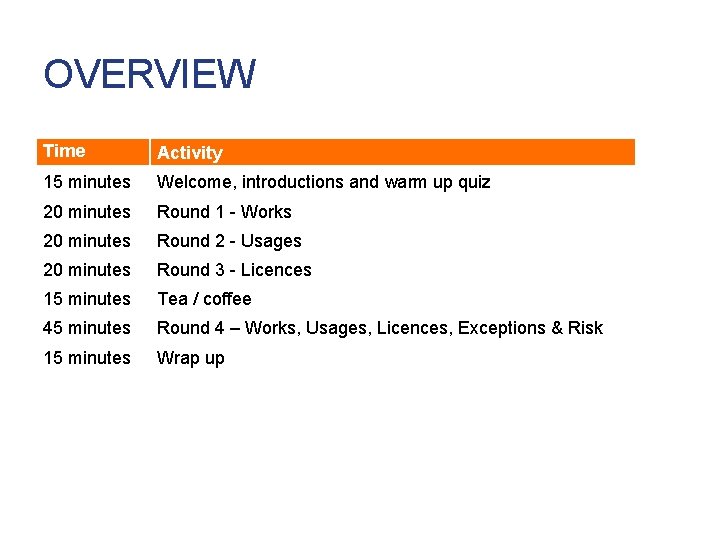
OVERVIEW Time Activity 15 minutes Welcome, introductions and warm up quiz 20 minutes Round 1 - Works 20 minutes Round 2 - Usages 20 minutes Round 3 - Licences 15 minutes Tea / coffee 45 minutes Round 4 – Works, Usages, Licences, Exceptions & Risk 15 minutes Wrap up
INTRODUCTIONS Introduce yourself to your team mates Decide on your team name Give us your team name for the score sheet
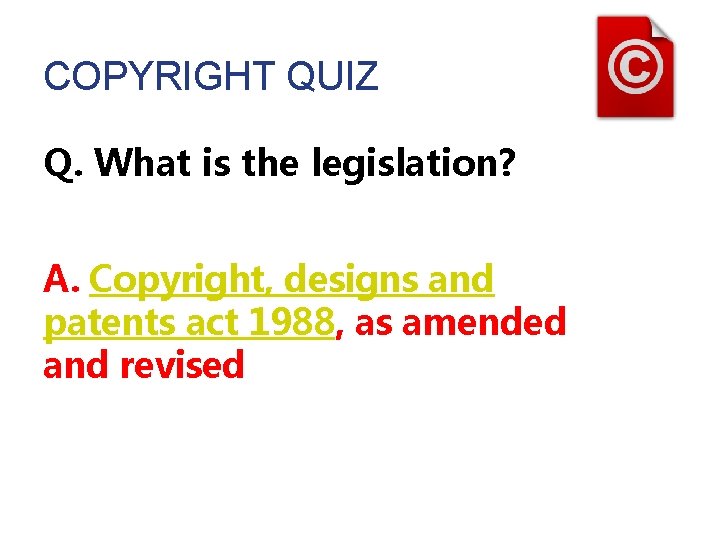
COPYRIGHT QUIZ Q. What is the legislation? A. Copyright, designs and patents act 1988, as amended and revised
COPYRIGHT QUIZ Q. What does copyright provide creators with? A. Copyright gives certain exclusive rights to the owner of a work to incentivise and reward creativity
COPYRIGHT QUIZ Q. Does copyright protect ideas? A. No, copyright does not protect ideas but the way they are expressed.
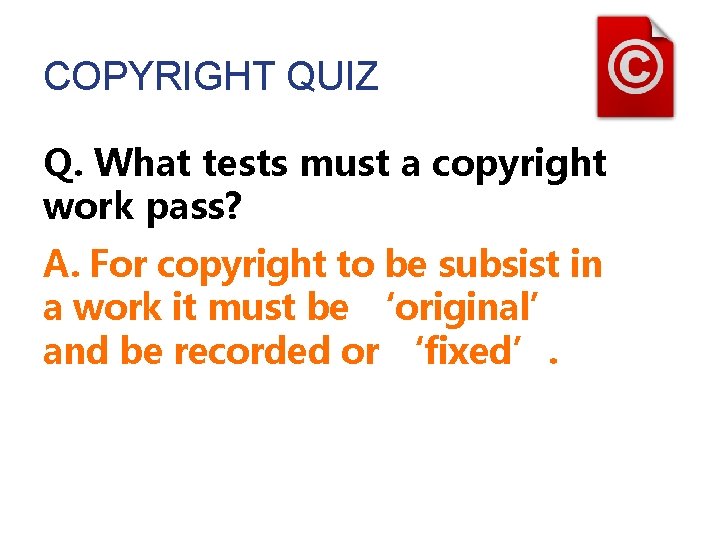
COPYRIGHT QUIZ Q. What tests must a copyright work pass? A. For copyright to be subsist in a work it must be ‘original’ and be recorded or ‘fixed’.
COPYRIGHT QUIZ Q. What sort of content does copyright protect? A. Copyright covers all different types of content (text, images, sound, moving images etc. )
COPYRIGHT QUIZ Q. Do copyright works need to be registered? A. No, copyright protection is automatic as soon as the work is ‘fixed’.
COPYRIGHT QUIZ Q. Do works need a “©” in the UK to be protected? A. No, copyright works don’t need a “©” in the UK to be protected, but it helps indicate that the works is protected.
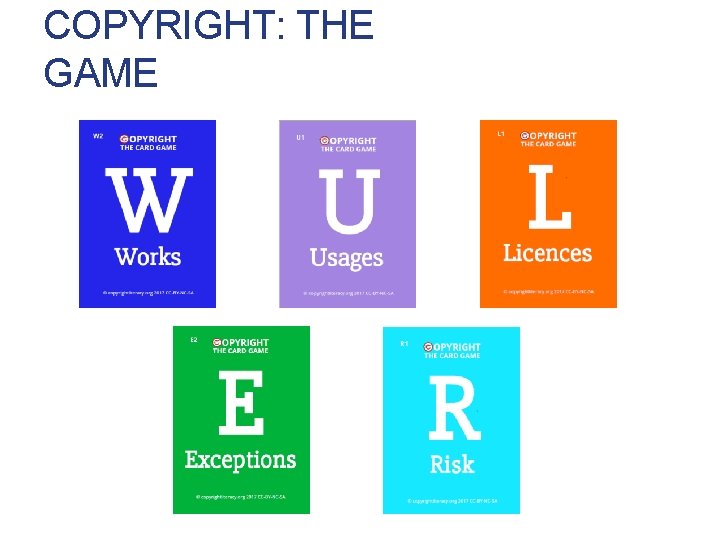
COPYRIGHT: THE GAME
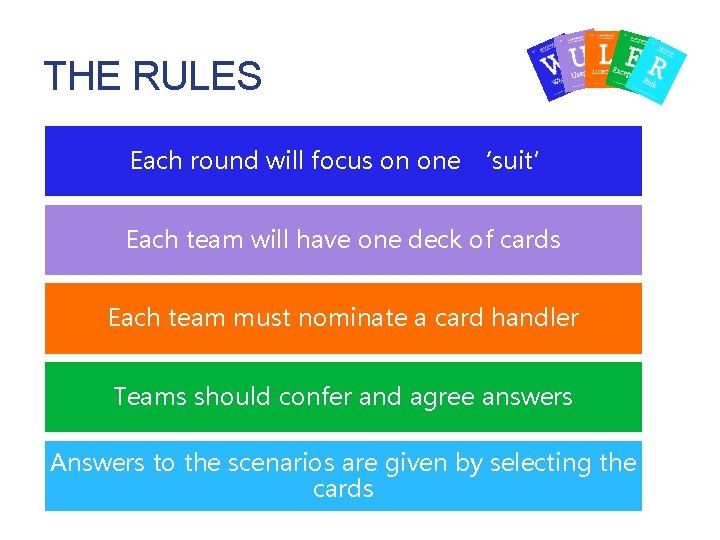
THE RULES Each round will focus on one ‘suit’ Each team will have one deck of cards Each team must nominate a card handler Teams should confer and agree answers Answers to the scenarios are given by selecting the cards
Works
WHY CONSIDER TYPES OF COPYRIGHT WORK? W Works § Different durations § Different layers of rights § Different owners within content § Different licences § Some exceptions work specific
COPYRIGHT WORKS (1) W Works Literary Artistic Musical Dramatic Broadcast Sound Recording Film
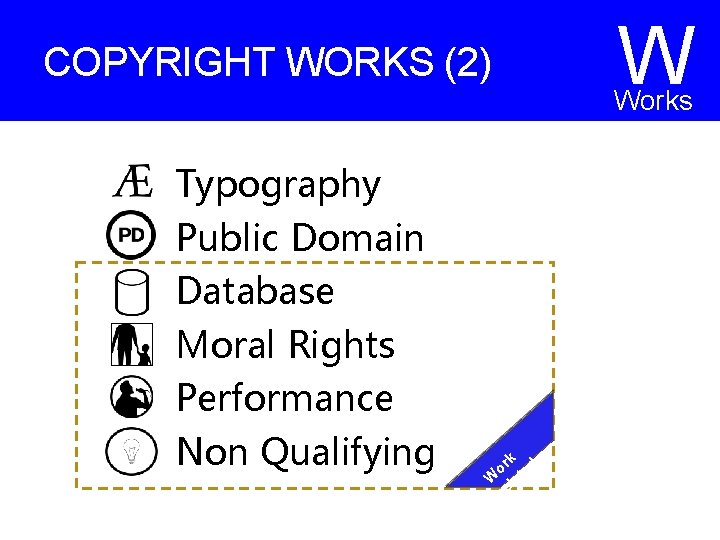
COPYRIGHT WORKS (2) W Works Typography Public Domain Database Moral Rights Performance Non Qualifying k or ted W la re
ROUND 1 W Works Use your “Works” cards to identify what types of works are in the object your team has been given
Usages
WHY CONSIDER TYPES OF COPYRIGHT USAGE? Usage s § They are the CDPA ‘restricted acts’ as defined in law § The ‘restricted acts’ must be ‘mapped’ onto any activity to understand licences and exceptions available U
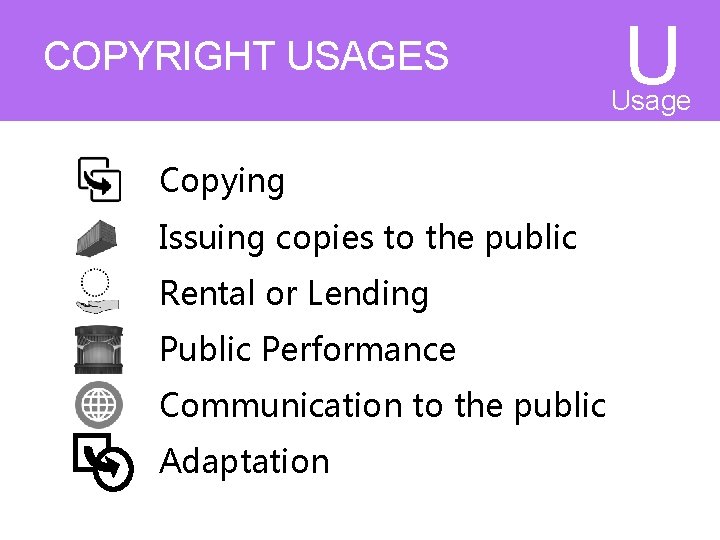
COPYRIGHT USAGES U Usage s Copying Issuing copies to the public Rental or Lending Public Performance Communication to the public Adaptation
ROUND 2 U Usage s Using your “Usage” cards, decide what types of usage apply in the following scenario.
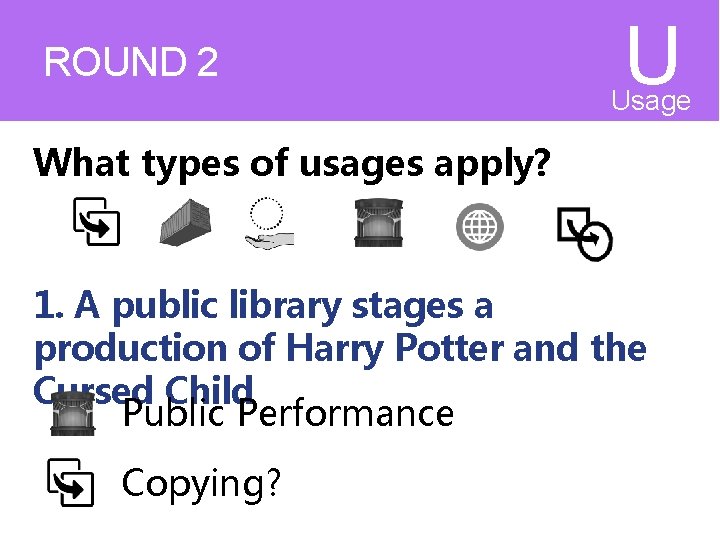
ROUND 2 What types of usages apply? U Usage s 1. A public library stages a production of Harry Potter and the Cursed Child Public Performance Copying?
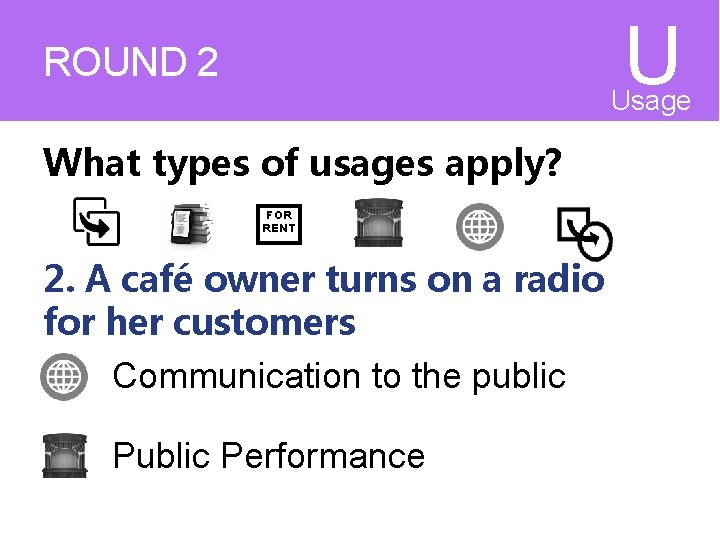
U ROUND 2 What types of usages apply? FOR RENT 2. A café owner turns on a radio for her customers Communication to the public Performance Usage s
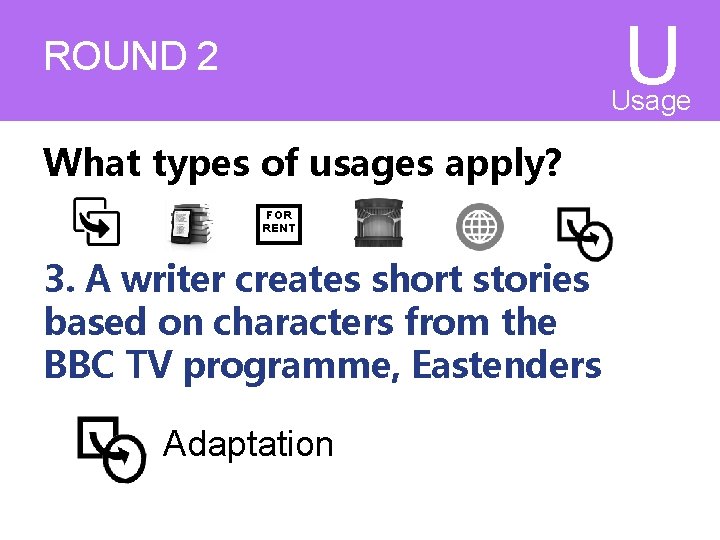
U ROUND 2 What types of usages apply? FOR RENT 3. A writer creates short stories based on characters from the BBC TV programme, Eastenders Adaptation Usage s
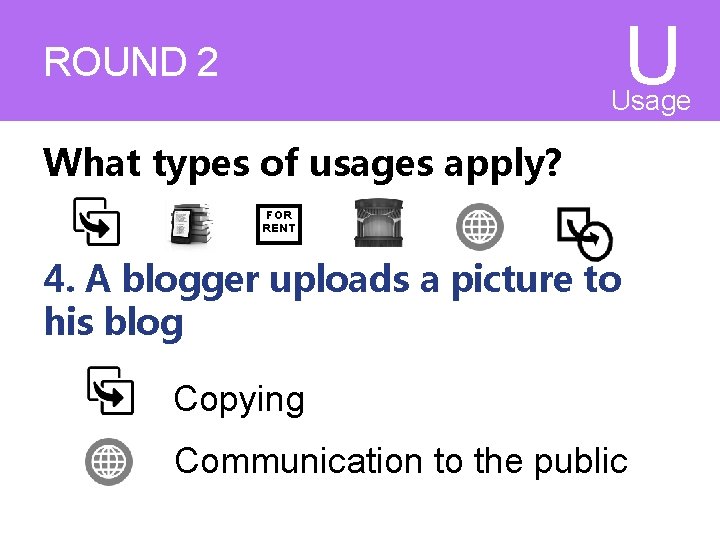
U ROUND 2 What types of usages apply? Usage s FOR RENT 4. A blogger uploads a picture to his blog Copying Communication to the public
Licences
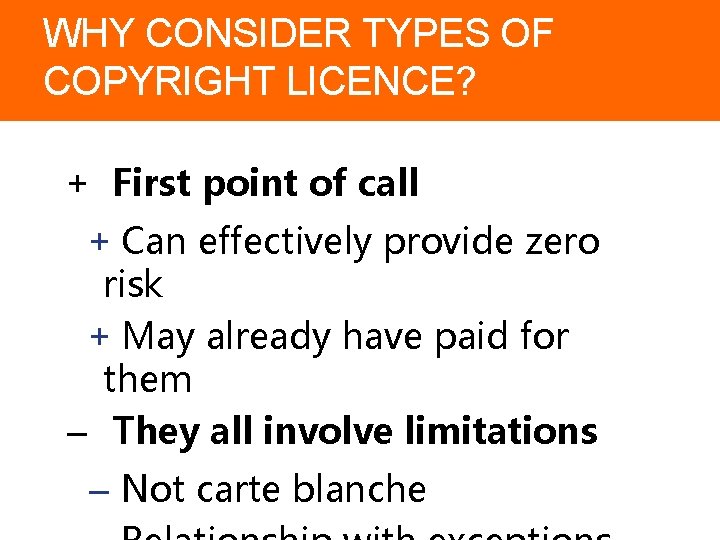
WHY CONSIDER TYPES OF COPYRIGHT LICENCE? + First point of call + Can effectively provide zero risk + May already have paid for them ‒ They all involve limitations ‒ Not carte blanche
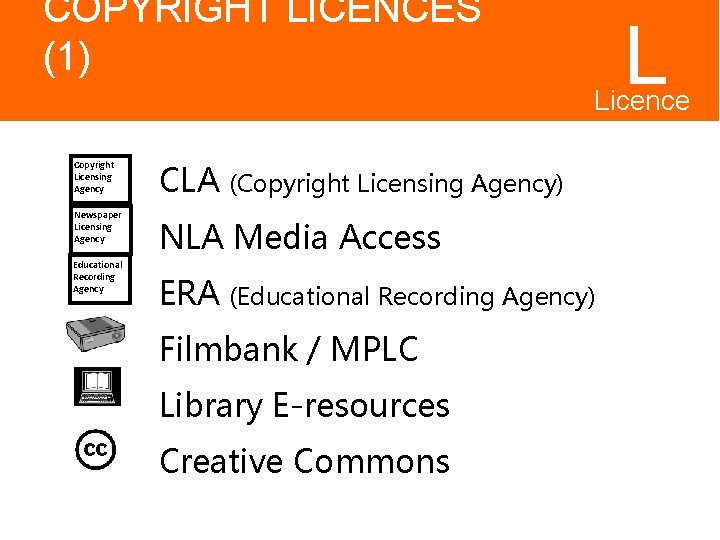
COPYRIGHT LICENCES (1) L Licence s Copyright Licensing Agency Newspaper Licensing Agency Educational Recording Agency CLA (Copyright Licensing Agency) NLA Media Access ERA (Educational Recording Agency) Filmbank / MPLC Library E-resources Creative Commons
COPYRIGHT LICENCES (2) L Licence s ‘Bespoke’ permission Website Terms & Conditions UK Orphan Works Licence You own the copyright You made it as an employee ce n ce ed Li lat re
ROUND 3 L Licence s Using your “Licences” cards, decide what types of licences apply in the following scenarios?
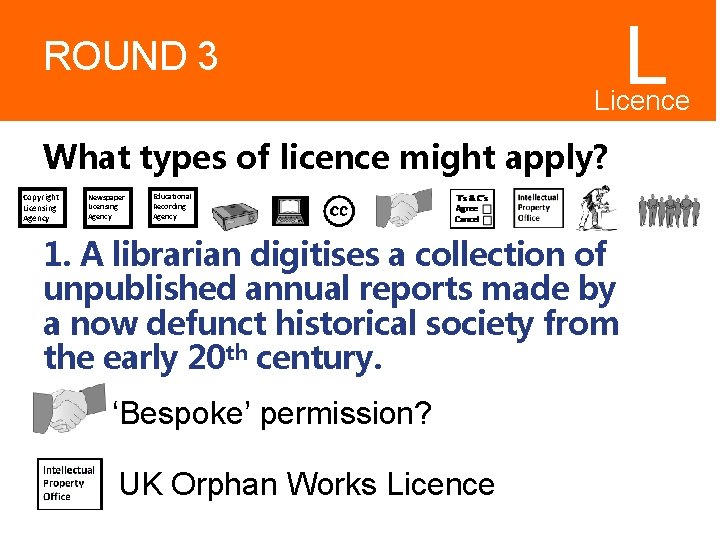
ROUND 3 L Licence s What types of licence might apply? Copyright Licensing Agency Newspaper Licensing Agency Educational Recording Agency 1. A librarian digitises a collection of unpublished annual reports made by a now defunct historical society from the early 20 th century. ‘Bespoke’ permission? UK Orphan Works Licence
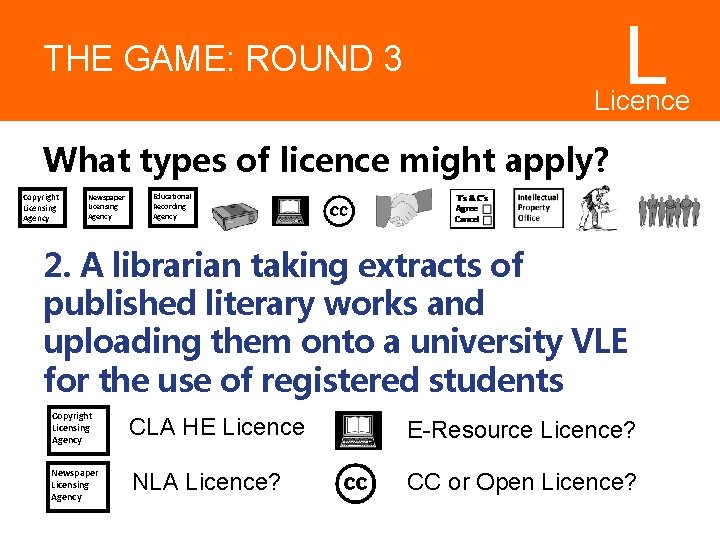
L THE GAME: ROUND 3 Licence s What types of licence might apply? Copyright Licensing Agency Newspaper Licensing Agency Educational Recording Agency 2. A librarian taking extracts of published literary works and uploading them onto a university VLE for the use of registered students Copyright Licensing Agency Newspaper Licensing Agency CLA HE Licence E-Resource Licence? NLA Licence? CC or Open Licence?
Exceptions
DISCLAIMER The following slides are intended to give an overview of the key UK copyright exceptions for those in higher education institutions. They are not comprehensive, nor do they provide full details of the provisions within the relevant legislation (most notably Copyright, Designs and Patents Act 1988). The slides are for information purposes only and do not constitute formal legal advice. If you find anything in the slides which appears to be inaccurate of misleading please contact ukcopyrightlit@gmail. com
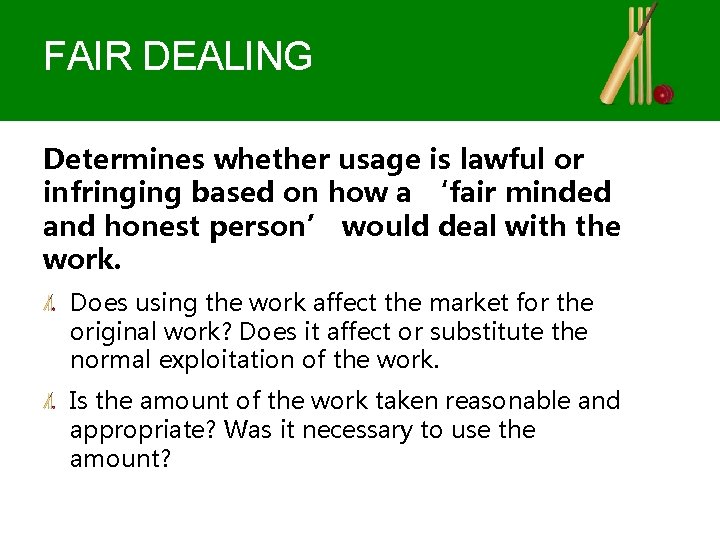
FAIR DEALING Determines whether usage is lawful or infringing based on how a ‘fair minded and honest person’ would deal with the work. Does using the work affect the market for the original work? Does it affect or substitute the normal exploitation of the work. Is the amount of the work taken reasonable and appropriate? Was it necessary to use the amount?
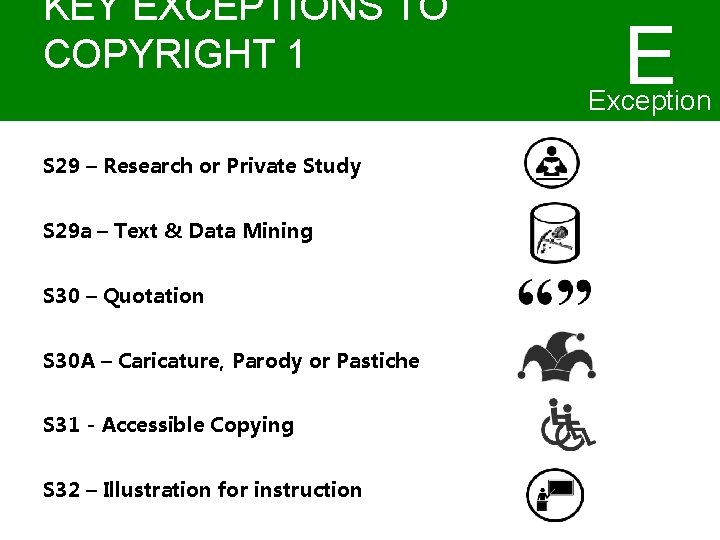
KEY EXCEPTIONS TO COPYRIGHT 1 E Exception s S 29 – Research or Private Study S 29 a – Text & Data Mining S 30 – Quotation S 30 A – Caricature, Parody or Pastiche S 31 - Accessible Copying S 32 – Illustration for instruction
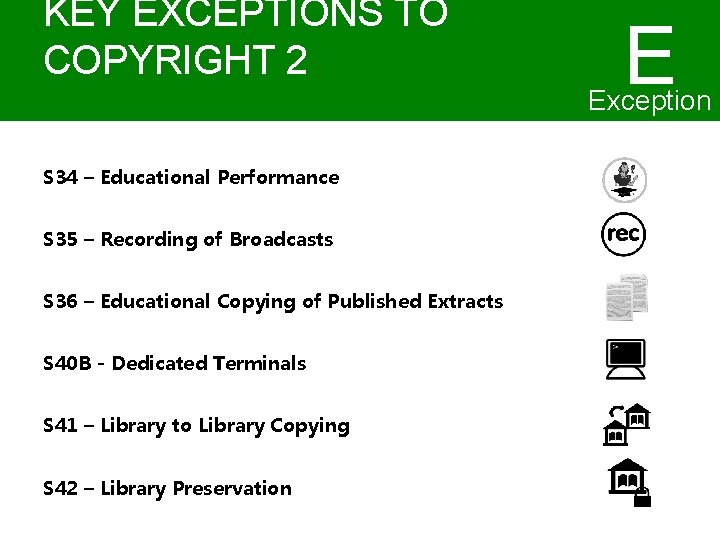
KEY EXCEPTIONS TO COPYRIGHT 2 E Exception s S 34 – Educational Performance S 35 – Recording of Broadcasts S 36 – Educational Copying of Published Extracts S 40 B - Dedicated Terminals S 41 – Library to Library Copying S 42 – Library Preservation
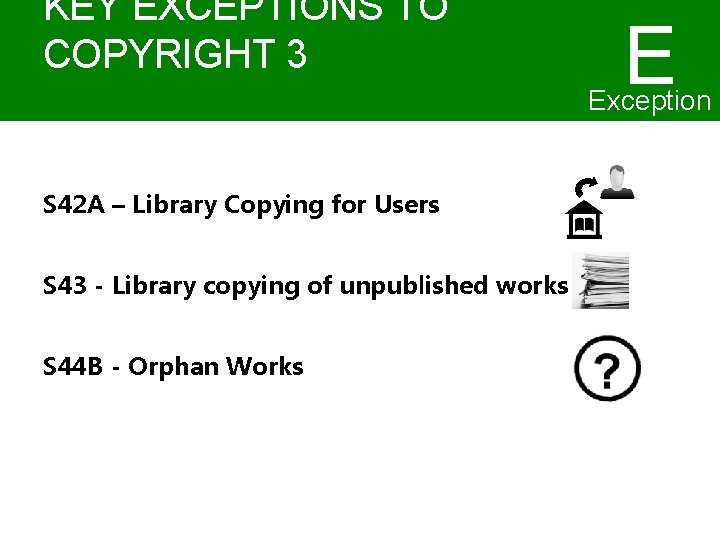
KEY EXCEPTIONS TO COPYRIGHT 3 E Exception s S 42 A – Library Copying for Users S 43 - Library copying of unpublished works S 44 B - Orphan Works
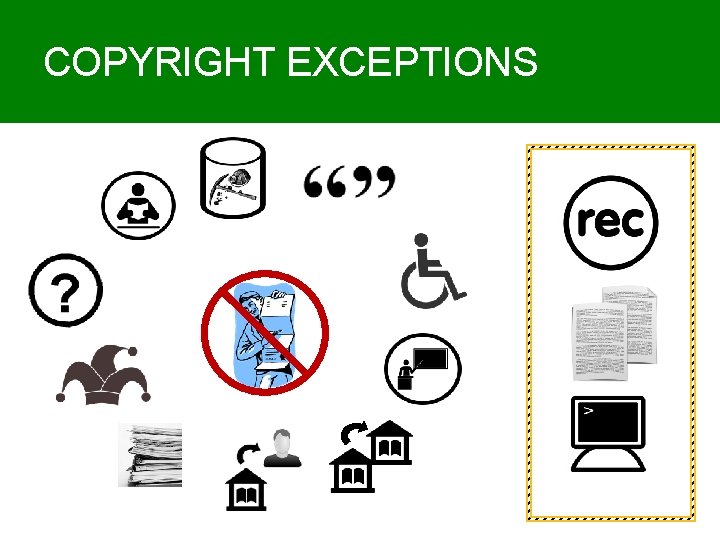
COPYRIGHT EXCEPTIONS
NON-CONTRACTUAL OVERRIDE “To the extent that a term of a contract purports to prevent or restrict the doing of any act which, by virtue of this section, would not infringe copyright, that term is unenforceable. ” Copyright, Designs and Patents Acts 1988
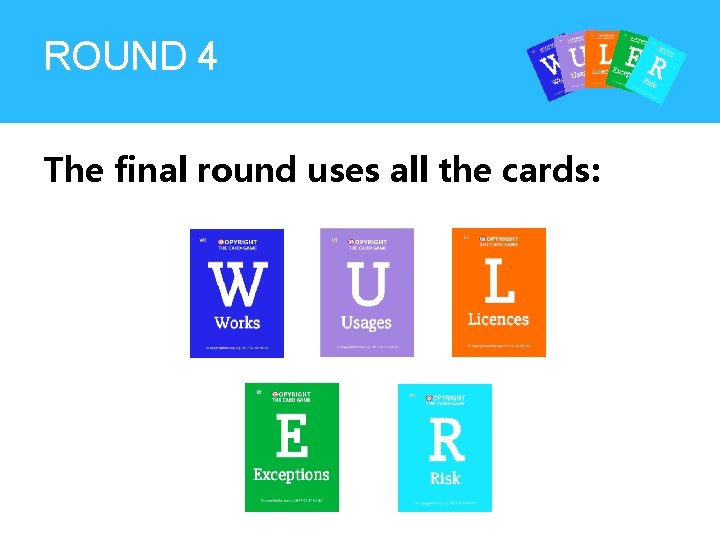
ROUND 4 The final round uses all the cards:
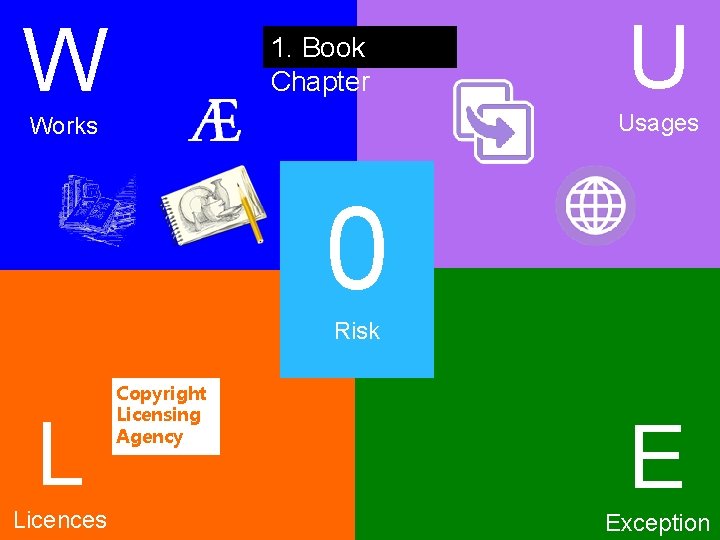
ROUND 4 The Rules: 1. Consider the following scenarios within your teams 2. Play the relevant ‘Works’, ‘Usage’, ‘Licences’ and ‘Exceptions’ cards 3. Choose a level of risk from 0 to 5 and play the corresponding card
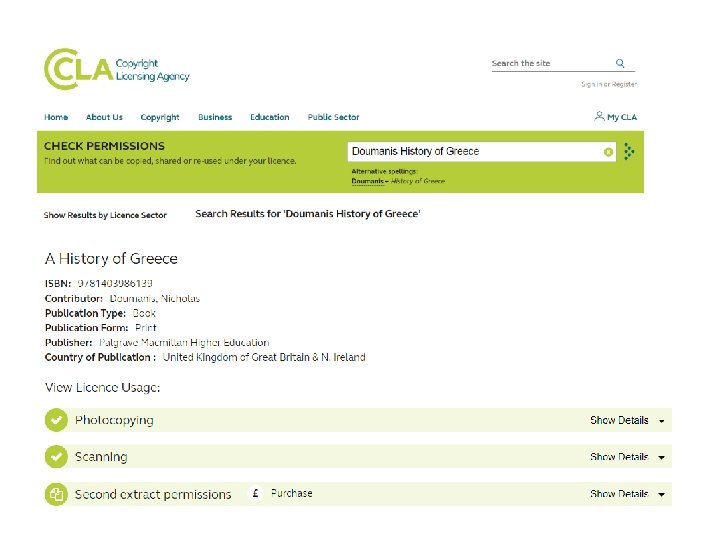
ROUND 4 1. You are a lecturer at a university and you have identified a chapter in the book “A History of Greece” by Nicholas Doumanis (ISBN 9781137013675) that you want to include in your digital course reading pack. The course reading will be available on your institutional virtual learning environment (VLE). Your university library has the item in physical stock, but it is not available as an e-book.
W 1. Book Chapter U Usages Works R 0 Risk L Licences Copyright Licensing Agency E Exception
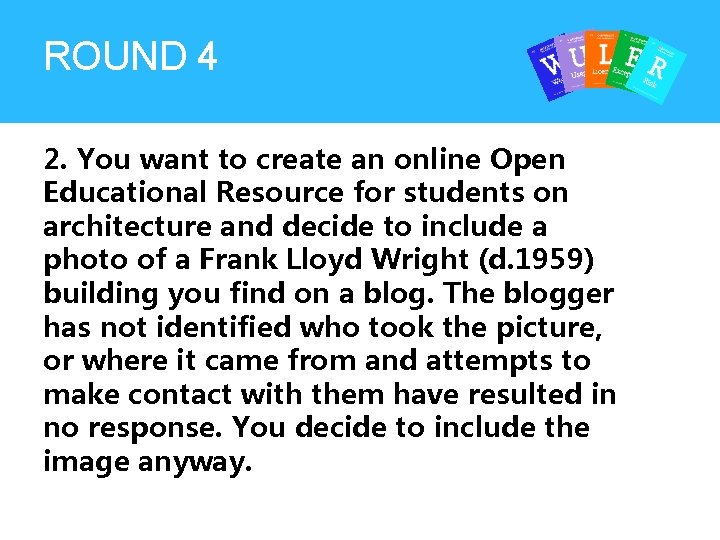
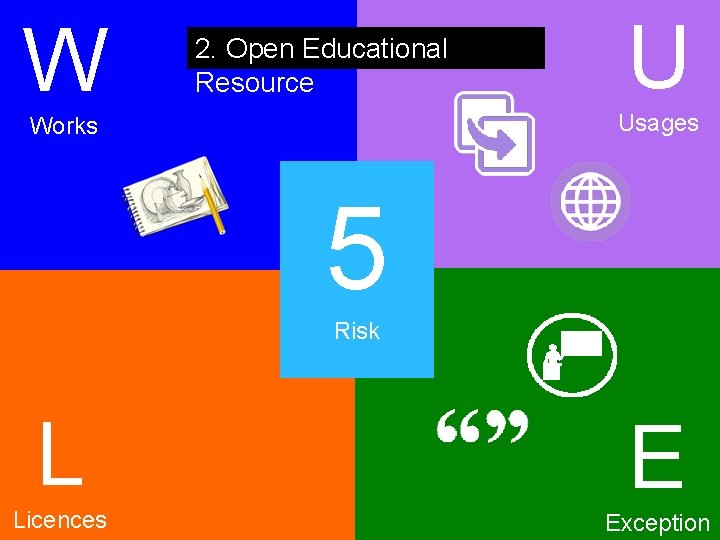
ROUND 4 2. You want to create an online Open Educational Resource for students on architecture and decide to include a photo of a Frank Lloyd Wright (d. 1959) building you find on a blog. The blogger has not identified who took the picture, or where it came from and attempts to make contact with them have resulted in no response. You decide to include the image anyway.
W 2. Open Educational Resource U Usages Works R 5 Risk L E Licences Exception
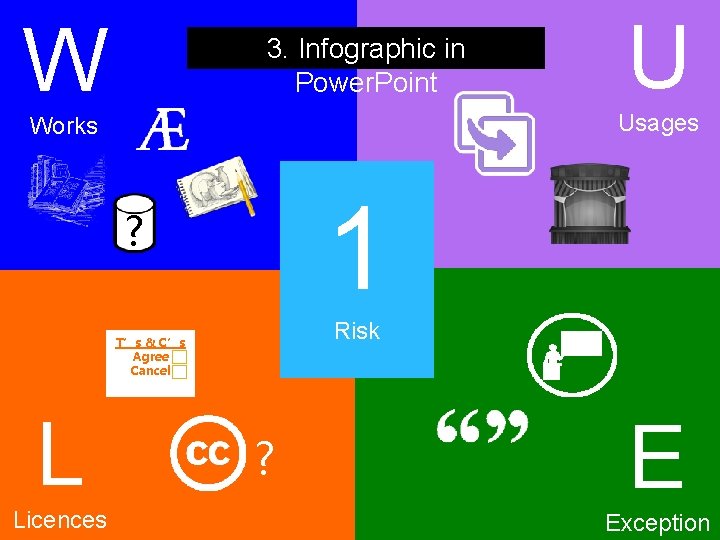
ROUND 4 3. You are a lecturer in a university teaching students economics, exploring the causes of the financial crisis. You find some charts and a useful infographic on the World Bank website. You wish to include these in your Power. Point slides that you will use in the lecture to explore some of the possible causes of the crisis and the impact it had in specific countries.
W 3. Infographic in Power. Point Usages Works R 1 ? Risk T’s & C’s Agree Cancel L Licences U ? E Exception
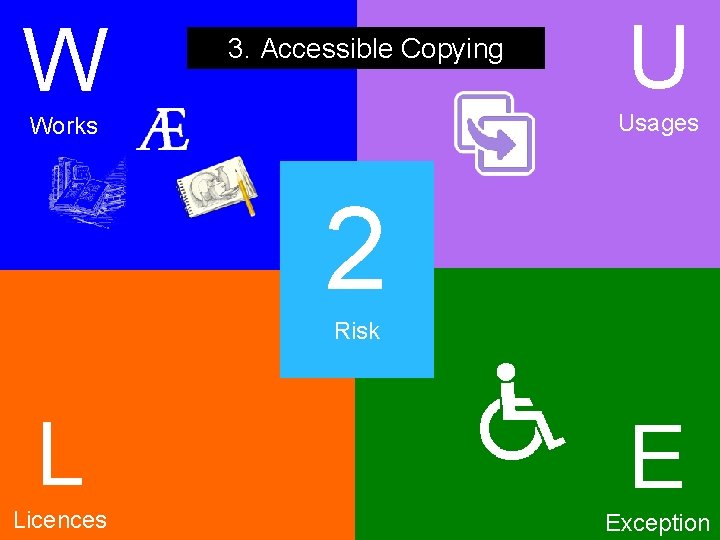
ROUND 4 4. A blind student needs an accessible version of a 40 page pamphlet you hold in your collection. They want a version suitable for use with their screen reader software and have asked their ‘library buddy’ to make a digitised version for them. The pamphlet is not covered by the CLA Licence and is not available in digital form.
W 3. Accessible Copying U Usages Works R 2 Risk L E Licences Exception
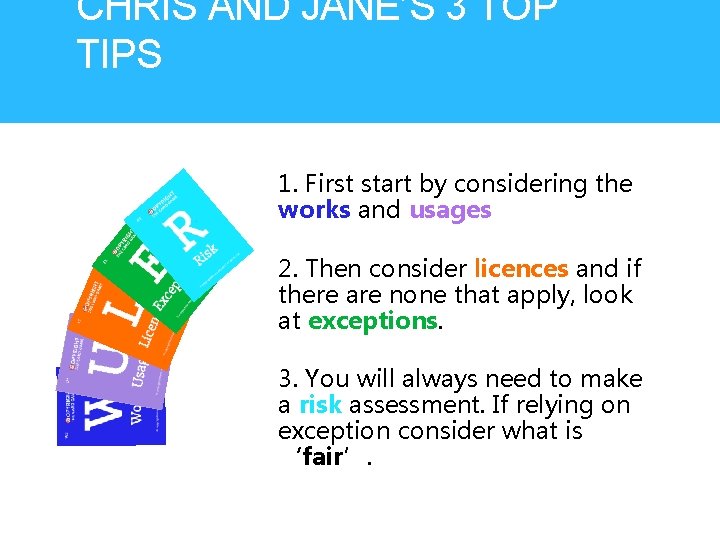
CHRIS AND JANE’S 3 TOP TIPS 1. First start by considering the works and usages 2. Then consider licences and if there are none that apply, look at exceptions. 3. You will always need to make a risk assessment. If relying on exception consider what is ‘fair’.
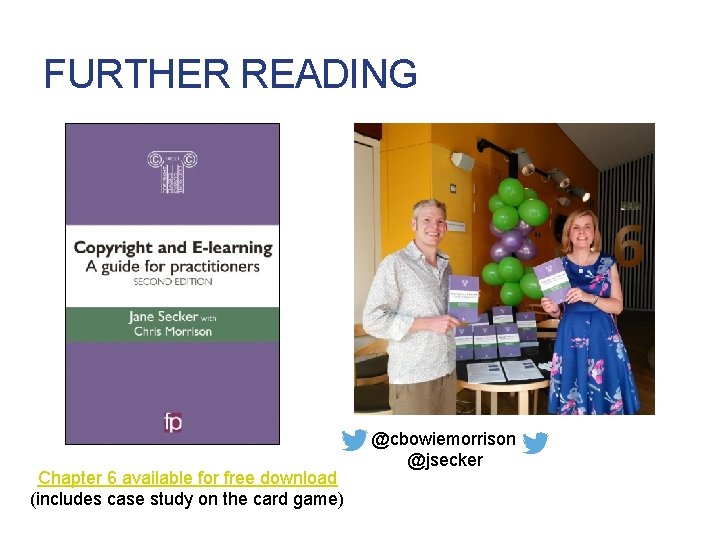
FURTHER READING Chapter 6 available for free download (includes case study on the card game) @cbowiemorrison @jsecker
LINKS Copyrightliteracy. org Copyright, Designs and Patents Act 1988 IPO Copyright Guidance Jisc Copyright Guidance Copyrightuser. org libraries guidance (Morrison & Secker) Association of University Administrators guide to copyright (Morrison & Secker)
CREDITS These slides and accompanying cards are (apart from any images contained within) © Chris Morrison and Jane Secker (@UKCopyright. Lit) 2017 and are available for reuse under a Creative Commons Attribution, Non-Commercial, Share Alike 4. 0 licence. UK Copyright Literacy: http: //copyrightliteracy. org Clip Art icons are from openclipart. org