Chapter 21 European Science and the Foundations of




- Slides: 53
Chapter 21 European Science and the Foundations of Modern Imperialism, 1600– 1820 Copyright © 2017 Cengage Learning. All Rights Reserved.
Learning Objectives (Slide 1 of 5) ▪ ▪ ▪ Recognize the relevance of Joseph Banks’ categorization of plants Identify when and how Europe’s scientific revolution began to have practical applications Describe how Descartes, Bacon, and Newton used inductive reasoning and mathematics to understand the relationship between humanity, nature, and God Copyright © 2017 Cengage Learning. All Rights Reserved.
Learning Objectives (Slide 2 of 5) ▪ ▪ ▪ Discuss how the Carl Linnaeus classification system increased scientific knowledge and the spread of colonial power Explain how the societies of Oceania and Australia experienced encounters with Europeans in this period Outline why the measurement of longitude was crucial to governments of the eighteenth century Copyright © 2017 Cengage Learning. All Rights Reserved.
Learning Objectives (Slide 3 of 5) ▪ ▪ Compare European cartographic endeavors, particularly their efforts to map India, Africa, and the Americas Analyze how Enlightenment thought was derived from the scientific revolution and how it differed from previous European thought systems Copyright © 2017 Cengage Learning. All Rights Reserved.
Learning Objectives (Slide 4 of 5) ▪ ▪ ▪ Outline the ideas of Hobbes, Locke, Montesquieu, and Smith about law, human society, and economic activity Discuss the role of the salon and the French philosophes in promoting Enlightenment ideas Demonstrate how women used Enlightenment ideas to argue for greater equality Copyright © 2017 Cengage Learning. All Rights Reserved.
Learning Objectives (Slide 5 of 5) ▪ Debate whether and how Frederick the Great, Maria Theresa, Joseph II, Catherine the Great, Louis XV, and George I incorporated Enlightenment ideals in their governments Copyright © 2017 Cengage Learning. All Rights Reserved.
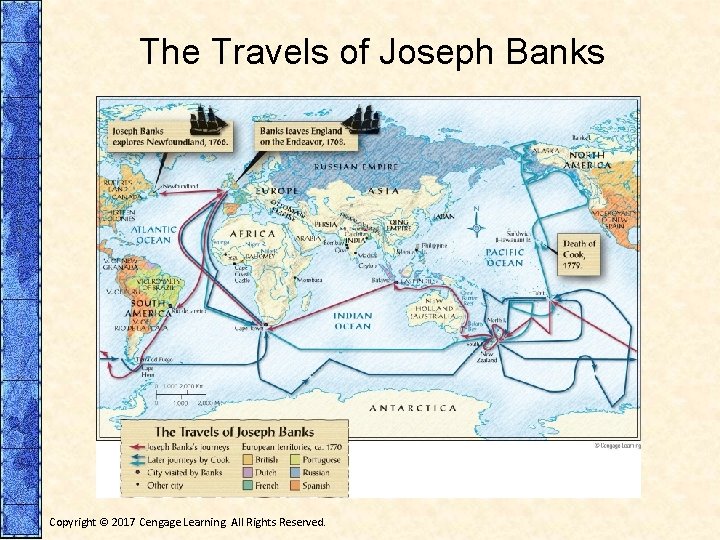
Introduction ▪ Joseph Banks was part of a British expedition across the Pacific Ocean ▪ ▪ A pioneer of ethnography James Cook was a British sea captain whose three voyages to the Pacific Ocean greatly expanded European knowledge of the region ▪ Joseph Banks was on board his first voyage on the Endeavor Copyright © 2017 Cengage Learning. All Rights Reserved.
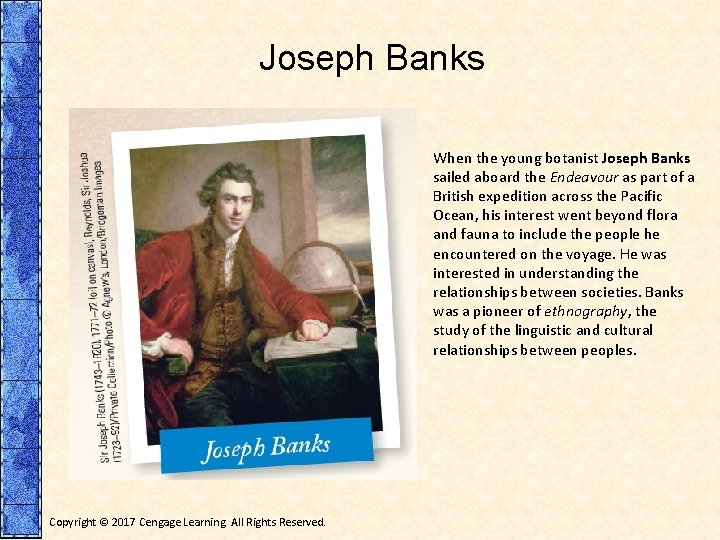
Joseph Banks When the young botanist Joseph Banks sailed aboard the Endeavour as part of a British expedition across the Pacific Ocean, his interest went beyond flora and fauna to include the people he encountered on the voyage. He was interested in understanding the relationships between societies. Banks was a pioneer of ethnography, the study of the linguistic and cultural relationships between peoples. Copyright © 2017 Cengage Learning. All Rights Reserved.
The Travels of Joseph Banks Copyright © 2017 Cengage Learning. All Rights Reserved.
MTSAU Ep 10 14: 45 -29: 15 Scientific Revolution and Captain James Cook
From Scientific Revolution to Practical Science, 1600– 1800 ▪ The development of the scientific method ▪ Seventeenth-century European thought was divided between the “ancients” and the “moderns” ▪ ▪ Ancients emphasized classical authorities such as Aristotle Moderns rejected any deference to classical authorities or Christian theology; they argued in favor of human reason as the key to knowledge Copyright © 2017 Cengage Learning. All Rights Reserved.
The Development of the Scientific Method (Slide 1 of 3) ▪ Traditional view was that humanity was “fallen” from God’s grace because of original sin ▪ ▪ Salvation was only possible through divine mercy. Humans can’t improve their condition without Divine aid. Moderns (Humanists) believed instead that humans were endowed with reason ▪ Human reason could understand creation Copyright © 2017 Cengage Learning. All Rights Reserved.
The Development of the Scientific Method (Slide 2 of 3) ▪ René Descartes believed that systematic doubt was the key to knowledge Based on the human capacity to reason ▪ Mathematics was the key to logical thought Sir Francis Bacon favored inductive approach to science: Start with small controlled observations and work toward larger truths ▪ Believed that doubt produces knowledge ▪ ▪ Copyright © 2017 Cengage Learning. All Rights Reserved.
The Scientific Methods: Crash Course History of Science #14 min 6 -end
The Development of the Scientific Method (Slide 3 of 3) ▪ Isaac Newton discovered a universal law of gravitation ▪ ▪ ▪ Used Bacon’s inductive to experimental science Saw the universe as a self-functioning outcome of God’s creation (Newtons law of physics, First Cause (God) Believed he could use mathematics to explain the world Copyright © 2017 Cengage Learning. All Rights Reserved. Isaac Newton - English Physicist & Formulated the Laws of Gravity |Mini Bio | BIO
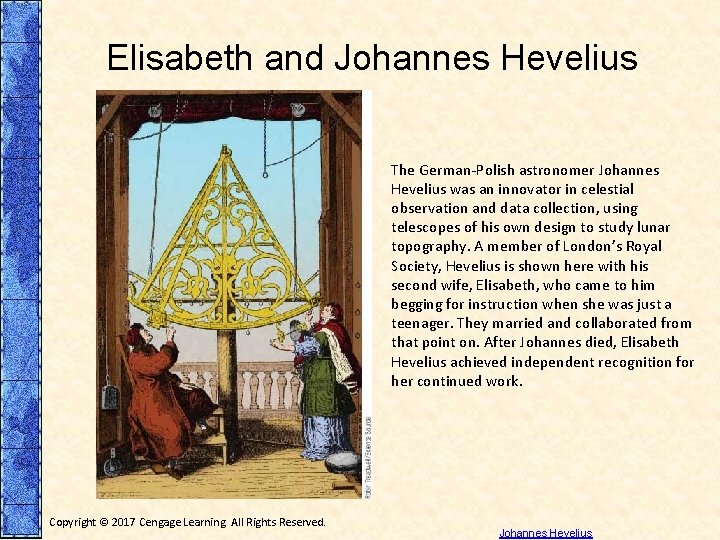
Elisabeth and Johannes Hevelius The German-Polish astronomer Johannes Hevelius was an innovator in celestial observation and data collection, using telescopes of his own design to study lunar topography. A member of London’s Royal Society, Hevelius is shown here with his second wife, Elisabeth, who came to him begging for instruction when she was just a teenager. They married and collaborated from that point on. After Johannes died, Elisabeth Hevelius achieved independent recognition for her continued work. Copyright © 2017 Cengage Learning. All Rights Reserved. Johannes Hevelius
Practical Science: Economic Botany, Agriculture, and Empire (Slide 1 of 5) ▪ Carl Linnaeus was trained in medicine and studied plants for their medicinal properties The work of Carl Linnaeus | Primary Science - Sci. Tube ▪ ▪ Like Newton, he combined experimentation with theory Linnaeus published Systema Naturae in 1735 ▪ ▪ Linnaeus’ system unified all plant names, no matter where in the world they originated Linnaeus used a binomial (“two name”) system of Latin names – genus species Copyright © 2017 Cengage Learning. All Rights Reserved.
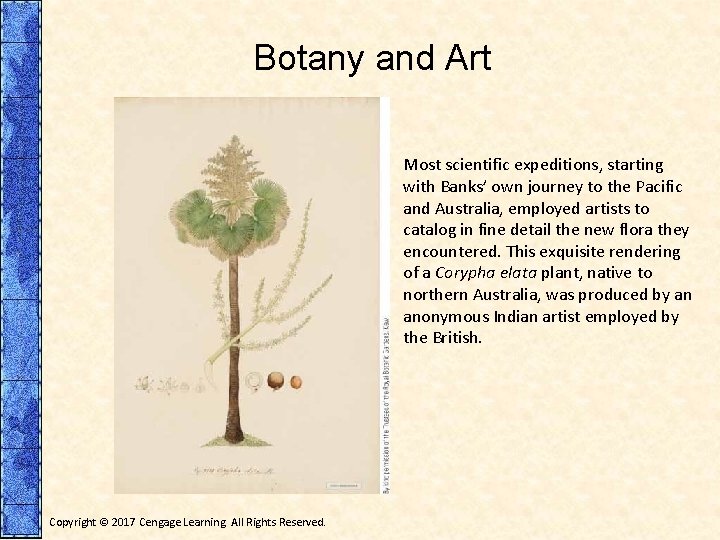
Botany and Art Most scientific expeditions, starting with Banks’ own journey to the Pacific and Australia, employed artists to catalog in fine detail the new flora they encountered. This exquisite rendering of a Corypha elata plant, native to northern Australia, was produced by an anonymous Indian artist employed by the British. Copyright © 2017 Cengage Learning. All Rights Reserved.
Practical Science: Economic Botany, Agriculture, and Empire (Slide 2 of 5) ▪ Joseph Banks was interested in increasing the productivity of the land bringing new land into cultivation ▪ Banks’ estate exemplified measures for improving agricultural productivity ▪ ▪ Drained marshlands to provide more farmland Experimented with rotating crops and selective breeding of farm animals Copyright © 2017 Cengage Learning. All Rights Reserved.
Practical Science: Economic Botany, Agriculture, and Empire (Slide 3 of 5) ▪ The agricultural revolution led to inequality in land ownership ▪ ▪ ▪ Rural gentry, like Banks, consolidated land possession into larger and more efficient farms ▪ Allowed landowners to enclose lands that had previously been open to common use Poorer farmers either worked for the gentry or moved to cities or coal-mining regions for employment You had to either own land or rent it. Copyright © 2017 Cengage Learning. All Rights Reserved.
Practical Science: Economic Botany, Agriculture, and Empire (Slide 4 of 5) ▪ Banks promoted economic botany as a practical application of science ▪ At Kew Gardens, Banks established a global botanical exchange house ▪ ▪ Plants collected from around the world and brought to Kew Benefits of the “economic botany” disseminated in Britain and its colonies Top Ten Attractions at Kew Gardens Copyright © 2017 Cengage Learning. All Rights Reserved.
Practical Science: Economic Botany, Agriculture, and Empire (Slide 5 of 5) ▪ Emphasis on science and improvement justified dominance of the English elite ▪ In the empire, improvement was emphasized even if it displaced native peoples ▪ Agricultural improvements “civilized” native peoples (ex: Aboringal people in Austrailia) Copyright © 2017 Cengage Learning. All Rights Reserved.
Measuring and Mapping: Exploration and Imperialism, 1763– 1820 ▪ Practical science, the Royal Society, and the quest for longitude ▪ Within the Royal Society of England, the most important applications of mathematics and astronomy concerned navigation ▪ ▪ Problem of longitude—how to determine a ship’s position on an east-west axis In 1714, the British Parliament offered a large cash prize to anyone who could solve the longitude problem Copyright © 2017 Cengage Learning. All Rights Reserved.
Practical Science: The Royal Society, and the Quest for Longitude ▪ ▪ ▪ Some astronomers believed that measuring lunar distance was the key Another method was to measure a time at sea compared with the time of departure John Harrison created a chronometer, a clock that kept accurate time ▪ In order for the chronometer to measure longitude, a fixed meridian was set: Greenwich 0: 59 Longitude Trailer Copyright © 2017 Cengage Learning. All Rights Reserved. moonwatcher 1976
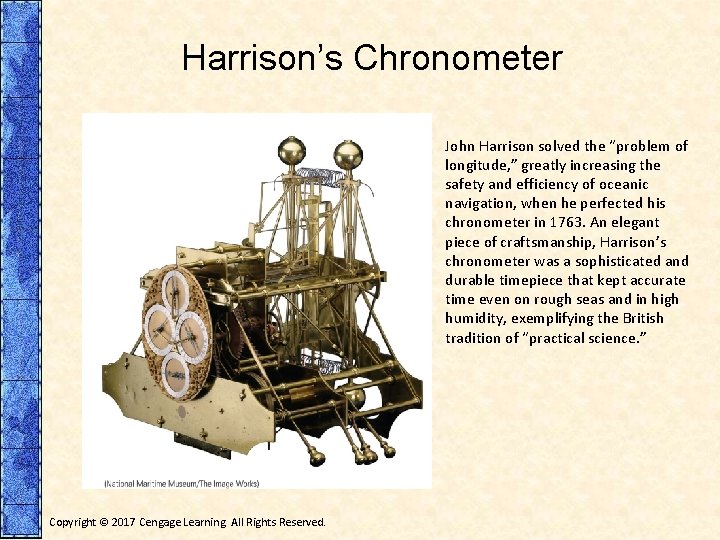
Harrison’s Chronometer John Harrison solved the “problem of longitude, ” greatly increasing the safety and efficiency of oceanic navigation, when he perfected his chronometer in 1763. An elegant piece of craftsmanship, Harrison’s chronometer was a sophisticated and durable timepiece that kept accurate time even on rough seas and in high humidity, exemplifying the British tradition of “practical science. ” Copyright © 2017 Cengage Learning. All Rights Reserved.
Mapping Africa, Central Asia, India, and the Americas (Slide 1 of 3) ▪ Joseph Banks and the Royal Society created the African Association ▪ ▪ African Association was created as a response to French competition European settlements in Africa were limited to coastal areas African Association was focused on mapping the Niger River Mungo Park, a Scottish doctor, was sent to explore West Africa in 1795 Copyright © 2017 Cengage Learning. All Rights Reserved.
Mapping Africa, Central Asia, India, and the Americas (Slide 2 of 3) ▪ Beginning in 1790 s, the British were attempting to map India ▪ Great Trigonometrical Survey sought to establish a baseline meridian of longitude in southern India Copyright © 2017 Cengage Learning. All Rights Reserved.
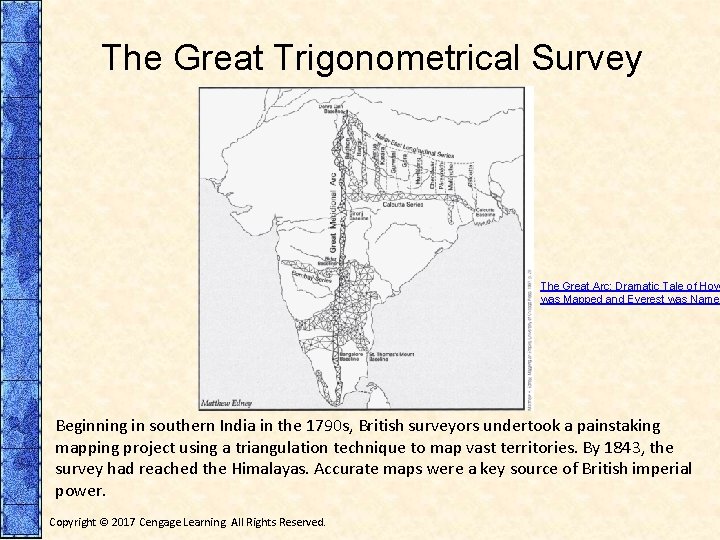
The Great Trigonometrical Survey The Great Arc: Dramatic Tale of How was Mapped and Everest was Named Beginning in southern India in the 1790 s, British surveyors undertook a painstaking mapping project using a triangulation technique to map vast territories. By 1843, the survey had reached the Himalayas. Accurate maps were a key source of British imperial power. Copyright © 2017 Cengage Learning. All Rights Reserved.
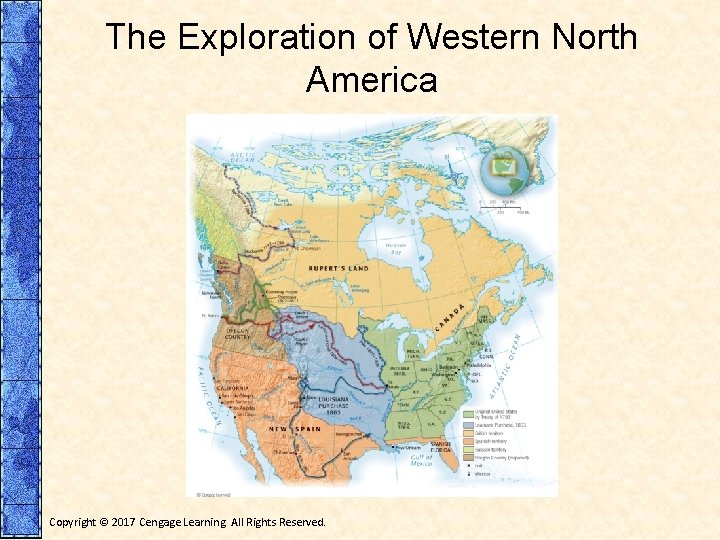
Mapping Africa, Central Asia, India, and the Americas (Slide 3 of 3) ▪ Surveys in the Americas ▪ ▪ Cook’s Pacific voyages and George Vancouver’s expeditions along the western coast of North America Lewis and Clark Expedition attempted to map the West Copyright © 2017 Cengage Learning. All Rights Reserved.
The Exploration of Western North America Copyright © 2017 Cengage Learning. All Rights Reserved.
Oceania and Australia, 1770– 1820 ▪ Captain James Cook undertook three voyages to the Pacific Ocean ▪ ▪ ▪ Consolidated the role of science in the expansion of the British empire Joseph Banks accompanied Cook on his first voyage On his later voyages, Cook added Hawaii to Europe’s geographic knowledge Copyright © 2017 Cengage Learning. All Rights Reserved.
Captain Cook in Polynesia, 1769– 1779 ▪ On the first voyage, Cook and Banks were aided by a Tahitian high priest, Tupaia ▪ Tupaia helped with Polynesian languages cultural practices ▪ ▪ One of the most significant differences between the two cultures was the concept of property Cultural misunderstandings led to the death of Cook in Hawaii Copyright © 2017 Cengage Learning. All Rights Reserved.
The Amazing Life and Strange Death of Captain Cook: Crash Course World History #27
Joseph Banks and the Settlement of Australia ▪ Banks used Botany Bay as a place from which to explore the plant life of Australia ▪ New South Wales was a penal colony, mostly populated with men ▪ ▪ Colony had a difficult start – many of the prisoners were not prepared to survive in the foreign terrain 1805: Merino sheep were introduced to the colony; transformed the colony into an economically successful establishment Explore Port Arthur, previously Australia’s largest penal colony Copyright © 2017 Cengage Learning. All Rights Reserved. The Lost World of Joseph Banks Trailer
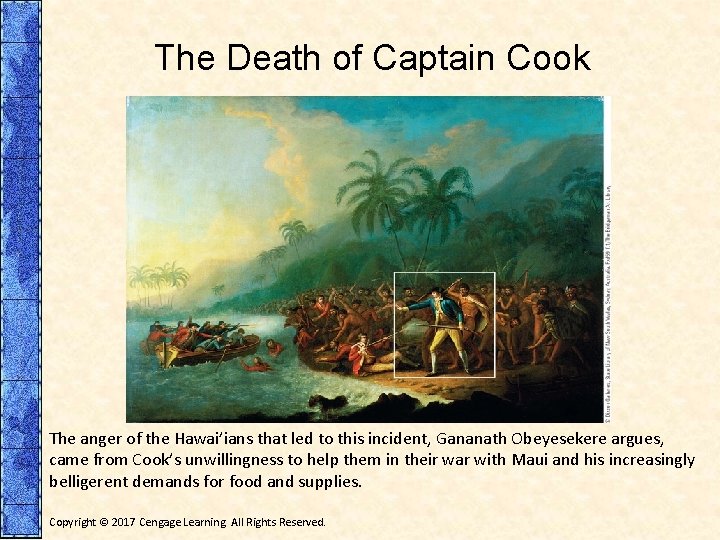
The Death of Captain Cook The anger of the Hawai’ians that led to this incident, Gananath Obeyesekere argues, came from Cook’s unwillingness to help them in their war with Maui and his increasingly belligerent demands for food and supplies. Copyright © 2017 Cengage Learning. All Rights Reserved.
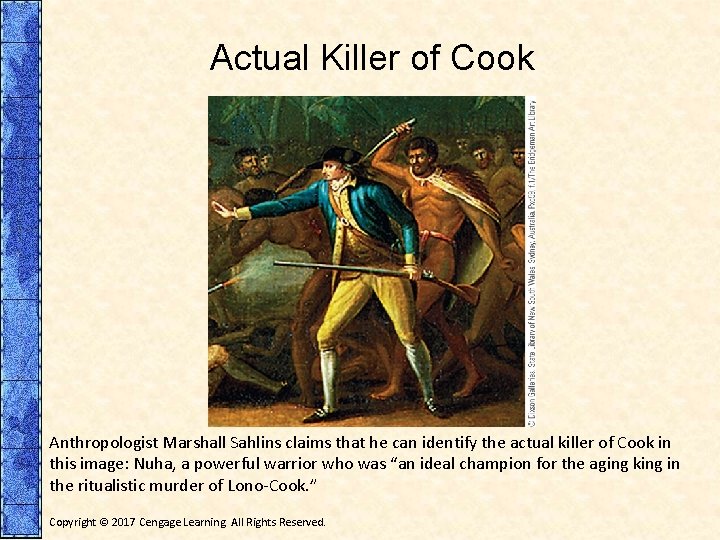
Actual Killer of Cook Anthropologist Marshall Sahlins claims that he can identify the actual killer of Cook in this image: Nuha, a powerful warrior who was “an ideal champion for the aging king in the ritualistic murder of Lono-Cook. ” Copyright © 2017 Cengage Learning. All Rights Reserved.
The European Enlightenment, 1700– 1800 ▪ Enlightenment thinkers argued that reason offered means to understand improve society ▪ New philosophical emphasis on reason impressed Europe’s kings, queens, and aristocracies ▪ Few rulers were willing to risk the traditions that gave them authority Copyright © 2017 Cengage Learning. All Rights Reserved. What Was the Enlightenment? AP Euro Bit by Bit #25
“Enlightened” Ideas: Politics, Economics, and Society (Slide 1 of 9) ▪ Thomas Hobbes applied deductive reasoning to question of how best to sustain political order in society ▪ ▪ Social and political order possible only when individuals relinquish their autonomy to a despotic ruler Hobbes was a pessimist because he had witnessed the anarchy of the English civil war Copyright © 2017 Cengage Learning. All Rights Reserved. POLITICAL THEORY - Thomas Hobbes
“Enlightened” Ideas: Politics, Economics, and Society (Slide 2 of 9) ▪ John Locke followed Bacon’s inductive reasoning approach, starting with experience and observation ▪ Reached more positive conclusions than Hobbes’s about social order ▪ ▪ Locke believed that a stable political order is based on a social contract Individuals give up their autonomy and get protection of their basic rights POLITICAL THEORY - John Locke Copyright © 2017 Cengage Learning. All Rights Reserved.
“Enlightened” Ideas: Politics, Economics, and Society (Slide 3 of 9) ▪ John Locke’s perspective ▪ ▪ Advocated only propertied males should be active in government Shaped by circumstances of late 17 th century ▪ ▪ Played important part in his role as adviser to William and Mary after the Glorious Revolution Real-world applications of Locke’s theories ▪ ▪ Balance of powers between king and parliament English Bill of Rights Copyright © 2017 Cengage Learning. All Rights Reserved.
“Enlightened” Ideas: Politics, Economics, and Society (Slide 4 of 9) ▪ French thinker Montesquieu influenced by observations of the English constitutional system ▪ ▪ ▪ Wrote the Spirit of the Laws in 1748 Believed political systems became more liberal and more free as they advance Believed judicial functions should be protected from executive interference Political Theory: Montesquieu and Rousseau (The Philosophes: Thinkers of the Enlightenment) Copyright © 2017 Cengage Learning. All Rights Reserved.
“Enlightened” Ideas: Politics, Economics, and Society (Slide 5 of 9) ▪ Adam Smith wrote Wealth of Nations (1776), arguing for self-regulating markets ▪ ▪ Believed in laissez-faire: free markets and unregulated economic exchanges Argued economic productivity was based on division of labor ▪ ▪ Opposed slavery because he thought free labor was more efficient Purported free trade would lead to more wealth than monopoly POLITICAL THEORY - Adam Smith Copyright © 2017 Cengage Learning. All Rights Reserved.
“Enlightened” Ideas: Politics, Economics, and Society (Slide 6 of 9) ▪ Intellectual currents of the Western world flowed through Paris ▪ ▪ French word for philosophers—philosophes Francois-Marie Arouet, known as Voltaire, was a satirist ▪ ▪ Novel Candide challenged the corruption and injustice of the world A relativist; promoted tolerance and understanding for others Voltaire Biography Copyright © 2017 Cengage Learning. All Rights Reserved.
“Enlightened” Ideas: Politics, Economics, and Society (Slide 7 of 9) ▪ Philosophes met at salons, organized by women of means and education ▪ Although women patronized the philosophes, few men challenged the traditional limitations placed on women ▪ ▪ Margaret Cavendish and Mary Astell challenged the restrictions placed on women Mary Wollstonecraft wrote Vindication of the Rights of Women (1792) Copyright © 2017 Cengage Learning. All Rights Reserved. Mary Wollstonecraft, Writer and Philosopher | Biography
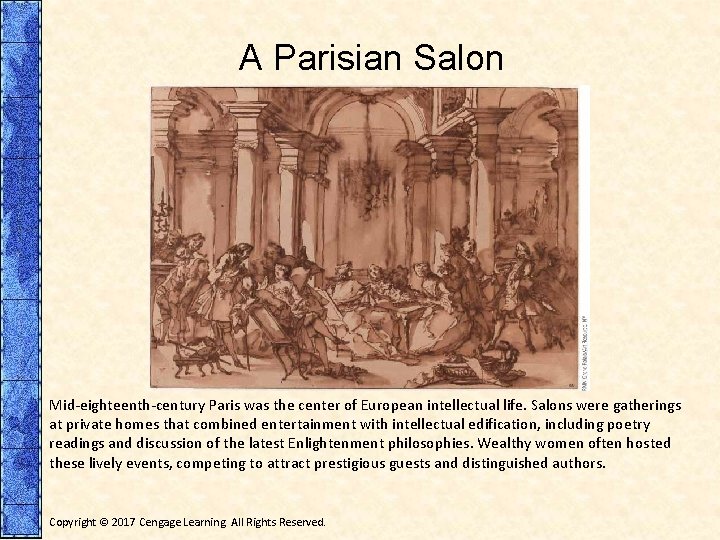
A Parisian Salon Mid-eighteenth-century Paris was the center of European intellectual life. Salons were gatherings at private homes that combined entertainment with intellectual edification, including poetry readings and discussion of the latest Enlightenment philosophies. Wealthy women often hosted these lively events, competing to attract prestigious guests and distinguished authors. Copyright © 2017 Cengage Learning. All Rights Reserved.
“Enlightened” Ideas: Politics, Economics, and Society (Slide 8 of 9) ▪ Enlightenment thought had little impact on lower classes ▪ Enlightenment was most influential on the bourgeoisie ▪ ▪ ▪ Bourgeoisie were economically successful but lacked the political rights of the aristocracy As a class, were more skeptical about religious and civil authority Expanding literacy meant that Enlightenment ideas spread among the bourgeoisie Copyright © 2017 Cengage Learning. All Rights Reserved.
“Enlightened” Ideas: Politics, Economics, and Society (Slide 9 of 9) ▪ Encyclopedia, or Rational Dictionary of the Arts, Sciences and Crafts, was compiled between 1751 and 1776 ▪ ▪ Encyclopedia was a collection of the works of the great Enlightenment thinkers Immanuel Kant said cowardice prevented the spread of Enlightenment ideas PHILOSOPHY: Immanuel Kant Copyright © 2017 Cengage Learning. All Rights Reserved.
Enlightenment and Reform (Slide 1 of 3) ▪ European monarchs argued they required absolute power over their subjects in order to enforce enlightened ideas ▪ ▪ “Enlightened despots” Frederick the Great defined himself as first servant of the state ▪ Trained in music, literature, and philosophy, Frederick transformed Prussia from a military state into one that also patronized the arts Copyright © 2017 Cengage Learning. All Rights Reserved.
Enlightenment and Reform (Slide 2 of 3) ▪ Enlightenment thinking also influenced two powerful women rulers ▪ ▪ Empress Maria Theresa of Austria limited the power of her landlords and called for compulsory public education Catherine the Great of Russia ▪ Enlightenment proved inapplicable to Russia Copyright © 2017 Cengage Learning. All Rights Reserved. Enlightened Absolutism (Frederick the Great, Catherine the Great, Joseph II)
Enlightenment and Reform (Slide 3 of 3) ▪ English constitution continued to evolve ▪ ▪ ▪ 1707: Scottish and English thrones united peacefully to form Great Britain Parliamentary factions developed into organized political parties 1714: King George I became king of England ▪ Accepted the powers of Parliament and hence limitations on his own authority Copyright © 2017 Cengage Learning. All Rights Reserved. King George I (1660 -1727)
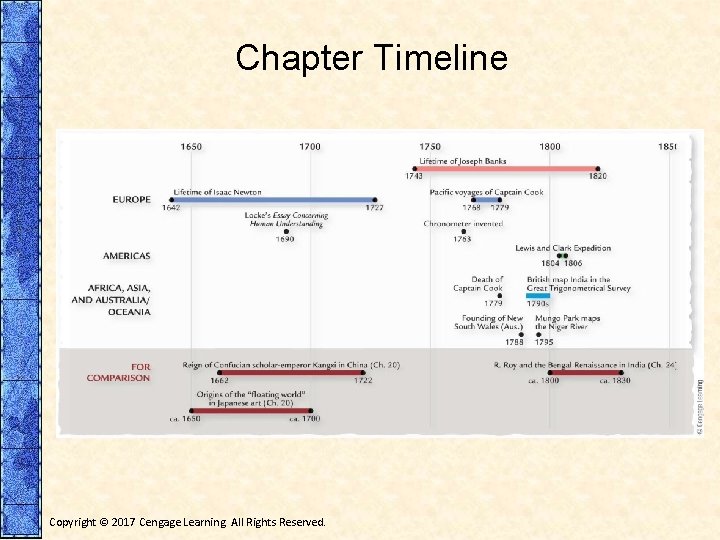
Chapter Timeline EVENT Europe: Lifetime of Isaac Newton For Comparison: Origins of the "floating world" in Japanese art APPROXIMATE DATE(S) (CE) 1, 642 to 1, 727 Circa 1, 650 to Circa 1, 700 For Comparison: Reign of Confucian scholar-emperor Kangxi in China Europe: Locke's Essay Concerning Human Understanding 1, 662 to 1, 722 Europe: Lifetime of Joseph Banks Europe: Chronometer invented Europe: Pacific voyages of Captain Cook Africa, Asia, and Australia/Oceania: Death of Captain Cook 1, 743 to 1, 820 1, 763 1, 768 to 1, 779 Africa, Asia, and Australia/Oceania: Founding of New South Wales (Aus. ) Africa, Asia, and Australia/Oceania: British map India in the Great Trigonometrical Survey Africa, Asia, and Australia/Oceania: Mungo Park maps the Niger River For Comparison: R. Roy and the Bengal Renaissance in India 1, 788 Americas: Lewis and Clark Expedition 1, 804 to 1, 806 Copyright © 2017 Cengage Learning. All Rights Reserved. 1, 690 1, 790 s 1, 795 Circa 1, 800 to Circa 1, 830