Chapter 1 An Introduction to the Science of
- Slides: 43
Chapter 1 An Introduction to the Science of Life Lecture Presentation by Wendy Kuntz, Kapi'olani Community College © 2017 Pearson Education, Inc.
1. 1 Opening Questions: What are the properties of life? Imagine that you are a future explorer and during a space voyage your team identifies a planet that has conditions favorable for life. Your first samples are microscopic, but return some interesting results, including objects with regular shapes. • How would you determine if these objects were alive? • What properties would you require before you were willing to call it life? © 2017 Pearson Education, Inc. Chapter Table of Contents
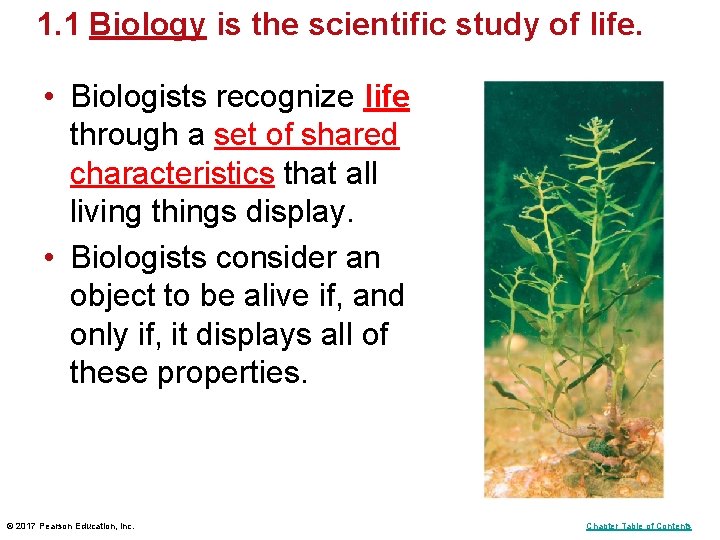
1. 1 Biology is the scientific study of life. • Biologists recognize life through a set of shared characteristics that all living things display. • Biologists consider an object to be alive if, and only if, it displays all of these properties. © 2017 Pearson Education, Inc. Chapter Table of Contents
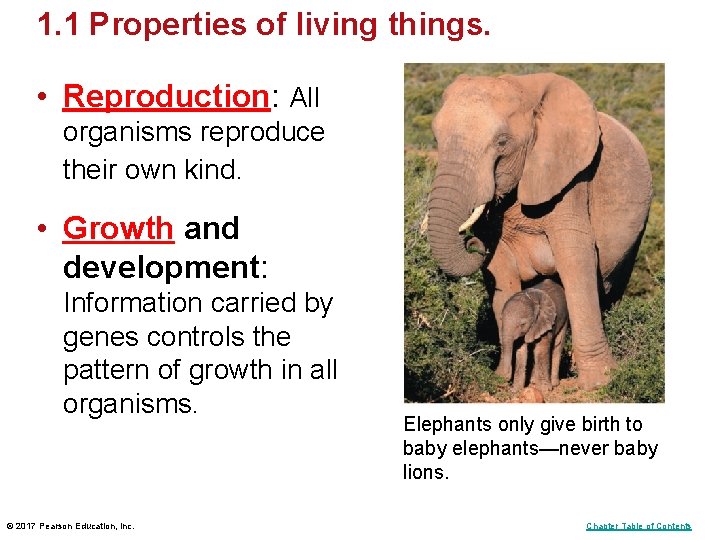
1. 1 Properties of living things. • Reproduction: All organisms reproduce their own kind. • Growth and development: Information carried by genes controls the pattern of growth in all organisms. © 2017 Pearson Education, Inc. Elephants only give birth to baby elephants—never baby lions. Chapter Table of Contents
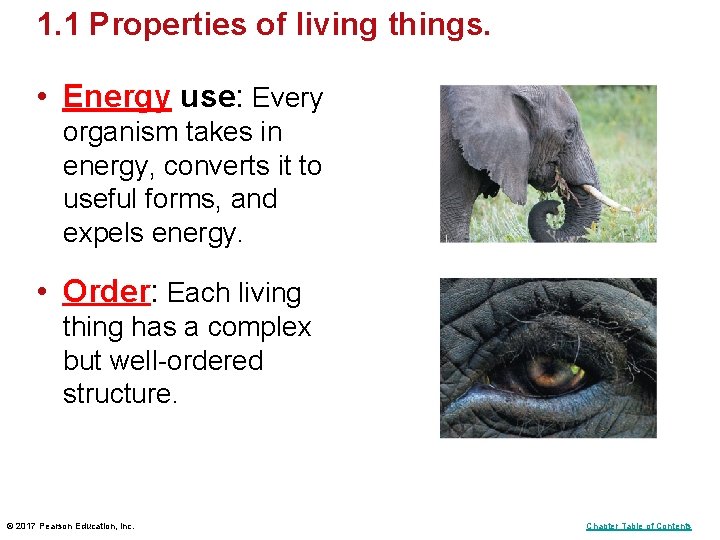
1. 1 Properties of living things. • Energy use: Every organism takes in energy, converts it to useful forms, and expels energy. • Order: Each living thing has a complex but well-ordered structure. © 2017 Pearson Education, Inc. Chapter Table of Contents
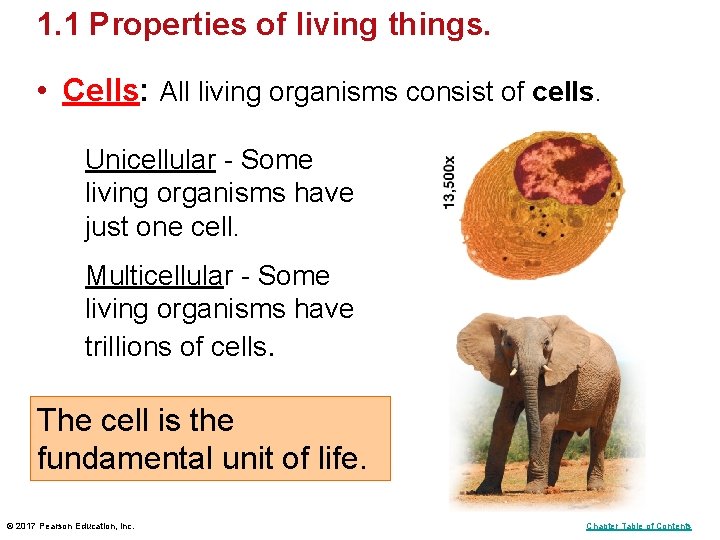
1. 1 Properties of living things. • Cells: All living organisms consist of cells. Unicellular - Some living organisms have just one cell. Multicellular - Some living organisms have trillions of cells. The cell is the fundamental unit of life. © 2017 Pearson Education, Inc. Chapter Table of Contents
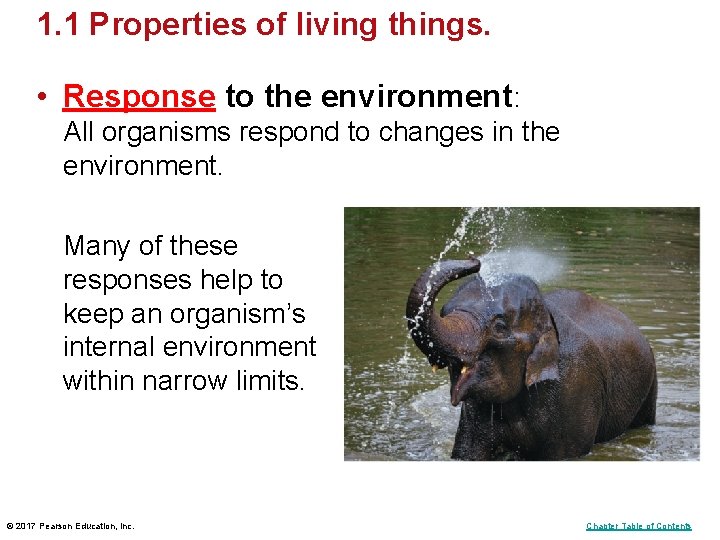
1. 1 Properties of living things. • Response to the environment: All organisms respond to changes in the environment. Many of these responses help to keep an organism’s internal environment within narrow limits. © 2017 Pearson Education, Inc. Chapter Table of Contents
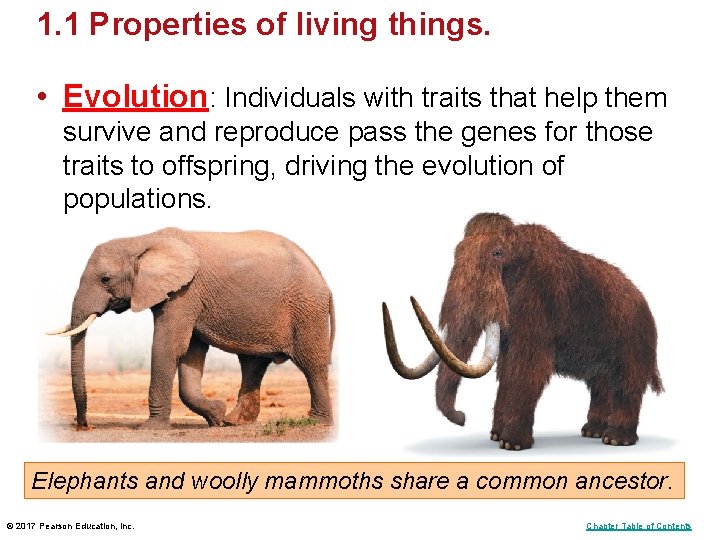
1. 1 Properties of living things. • Evolution: Individuals with traits that help them survive and reproduce pass the genes for those traits to offspring, driving the evolution of populations. Elephants and woolly mammoths share a common ancestor. © 2017 Pearson Education, Inc. Chapter Table of Contents
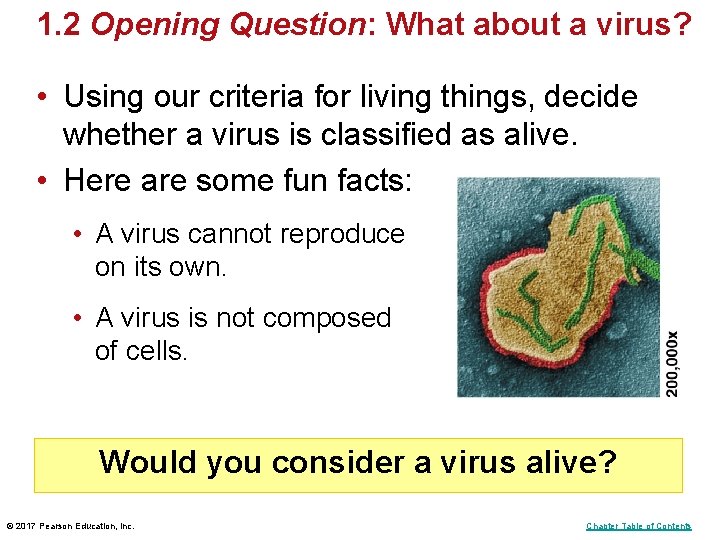
1. 2 Opening Question: What about a virus? • Using our criteria for living things, decide whether a virus is classified as alive. • Here are some fun facts: • A virus cannot reproduce on its own. • A virus is not composed of cells. Would you consider a virus alive? © 2017 Pearson Education, Inc. Chapter Table of Contents
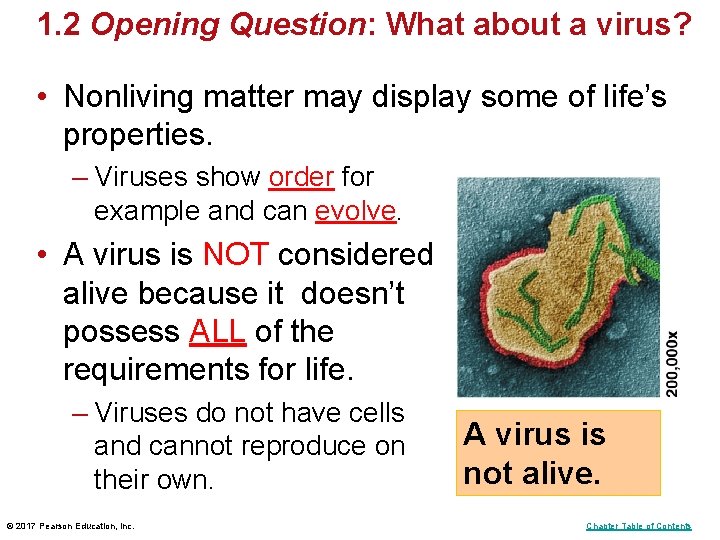
1. 2 Opening Question: What about a virus? • Nonliving matter may display some of life’s properties. – Viruses show order for example and can evolve. • A virus is NOT considered alive because it doesn’t possess ALL of the requirements for life. – Viruses do not have cells and cannot reproduce on their own. © 2017 Pearson Education, Inc. A virus is not alive. Chapter Table of Contents
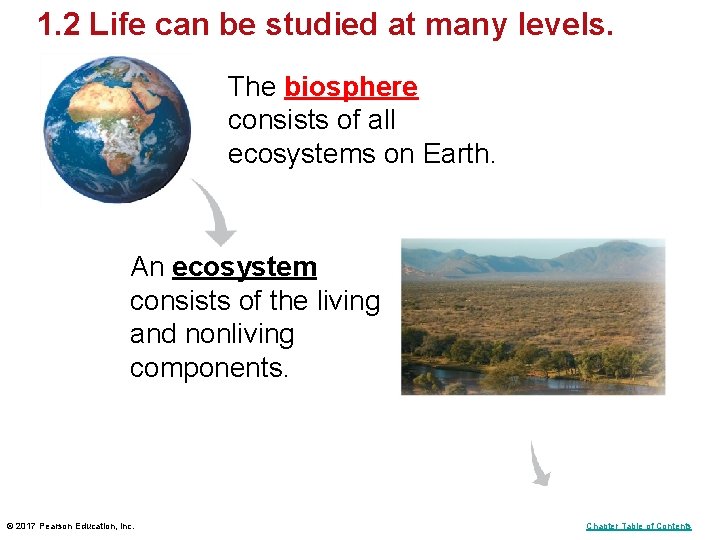
1. 2 Life can be studied at many levels. The biosphere consists of all ecosystems on Earth. An ecosystem consists of the living and nonliving components. © 2017 Pearson Education, Inc. Chapter Table of Contents
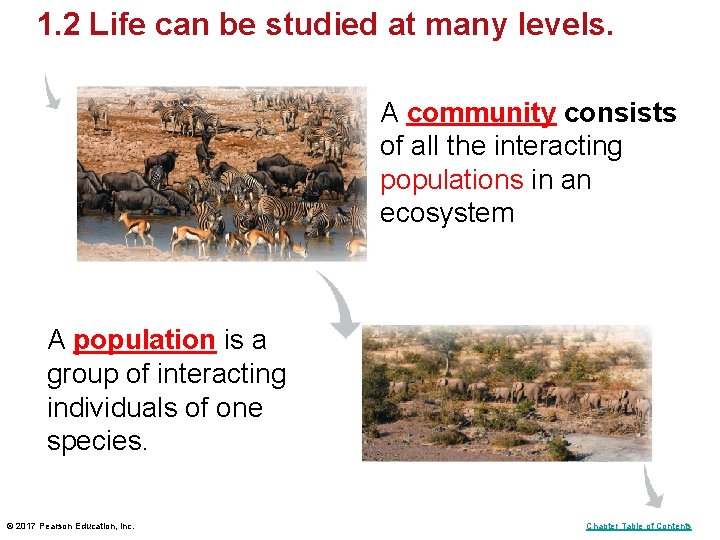
1. 2 Life can be studied at many levels. A community consists of all the interacting populations in an ecosystem A population is a group of interacting individuals of one species. © 2017 Pearson Education, Inc. Chapter Table of Contents
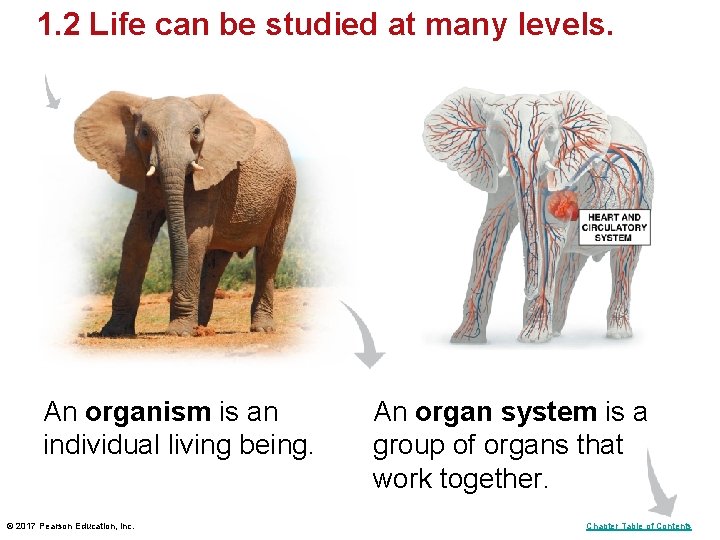
1. 2 Life can be studied at many levels. An organism is an individual living being. © 2017 Pearson Education, Inc. An organ system is a group of organs that work together. Chapter Table of Contents
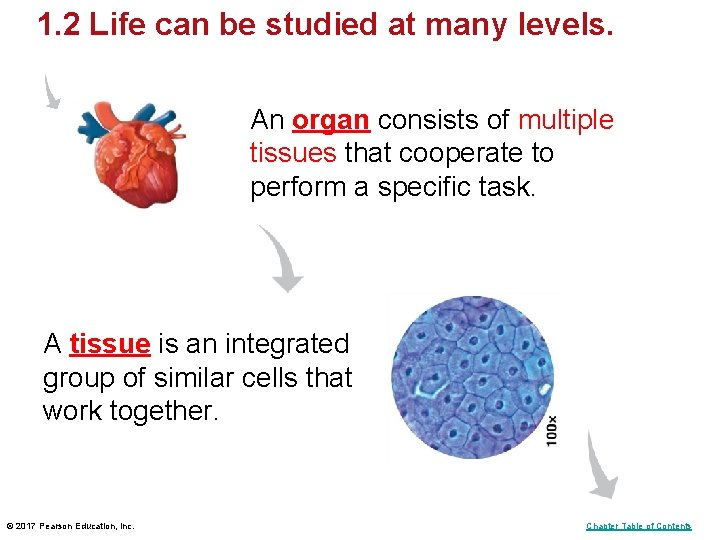
1. 2 Life can be studied at many levels. An organ consists of multiple tissues that cooperate to perform a specific task. A tissue is an integrated group of similar cells that work together. © 2017 Pearson Education, Inc. Chapter Table of Contents
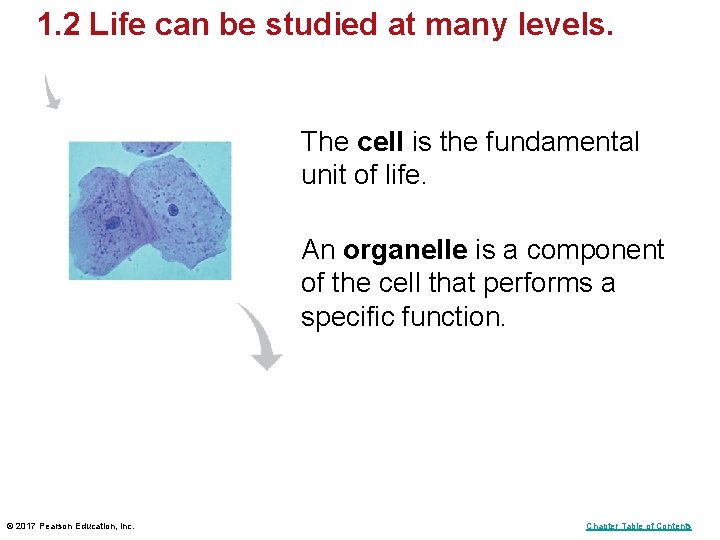
1. 2 Life can be studied at many levels. The cell is the fundamental unit of life. An organelle is a component of the cell that performs a specific function. © 2017 Pearson Education, Inc. Chapter Table of Contents
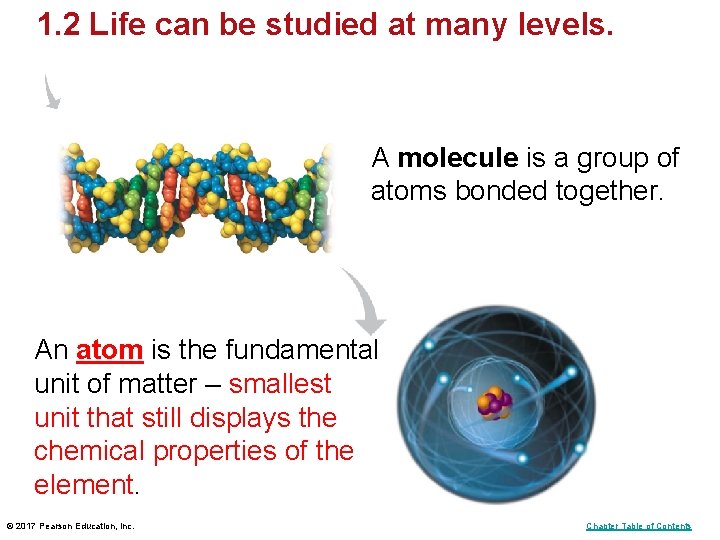
1. 2 Life can be studied at many levels. A molecule is a group of atoms bonded together. An atom is the fundamental unit of matter – smallest unit that still displays the chemical properties of the element. © 2017 Pearson Education, Inc. Chapter Table of Contents
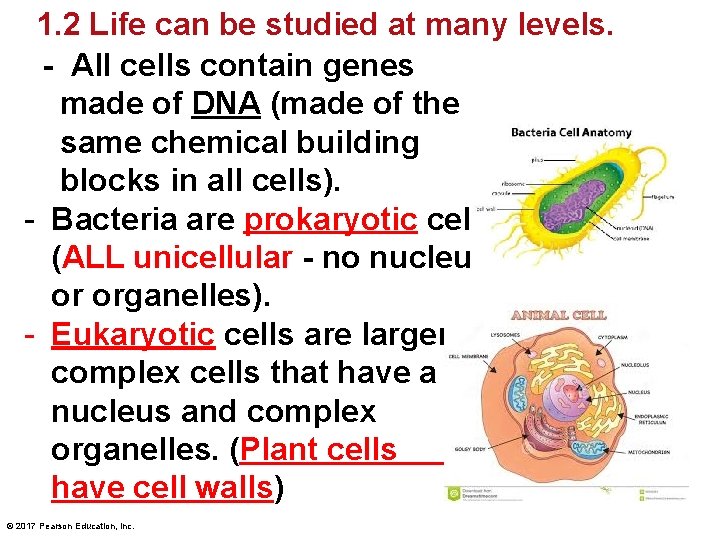
1. 2 Life can be studied at many levels. - All cells contain genes made of DNA (made of the same chemical building blocks in all cells). - Bacteria are prokaryotic cells (ALL unicellular - no nucleus or organelles). - Eukaryotic cells are larger, complex cells that have a nucleus and complex organelles. (Plant cells have cell walls) © 2017 Pearson Education, Inc.
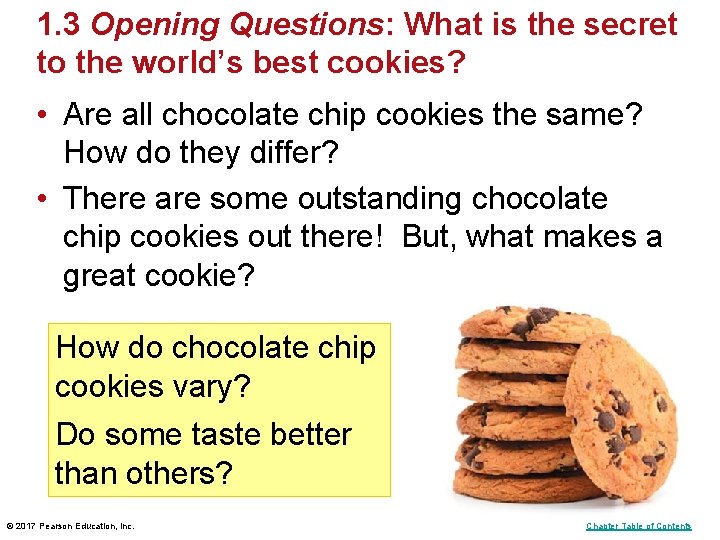
1. 3 Opening Questions: What is the secret to the world’s best cookies? • Are all chocolate chip cookies the same? How do they differ? • There are some outstanding chocolate chip cookies out there! But, what makes a great cookie? How do chocolate chip cookies vary? Do some taste better than others? © 2017 Pearson Education, Inc. Chapter Table of Contents
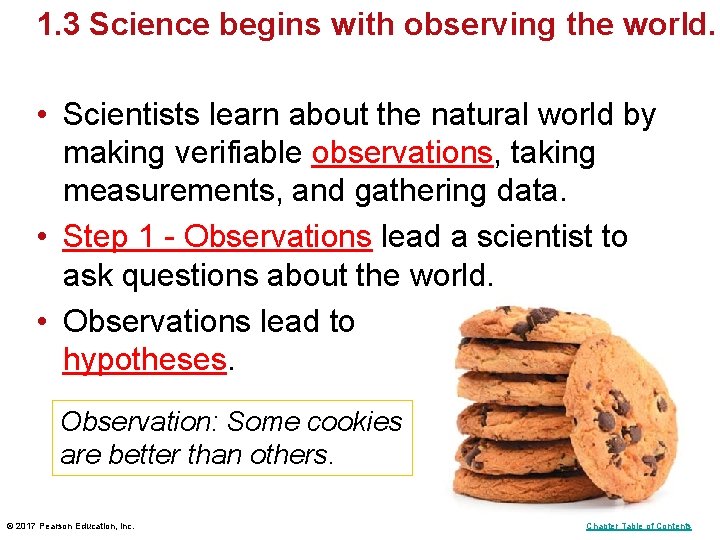
1. 3 Science begins with observing the world. • Scientists learn about the natural world by making verifiable observations, taking measurements, and gathering data. • Step 1 - Observations lead a scientist to ask questions about the world. • Observations lead to hypotheses. Observation: Some cookies are better than others. © 2017 Pearson Education, Inc. Chapter Table of Contents
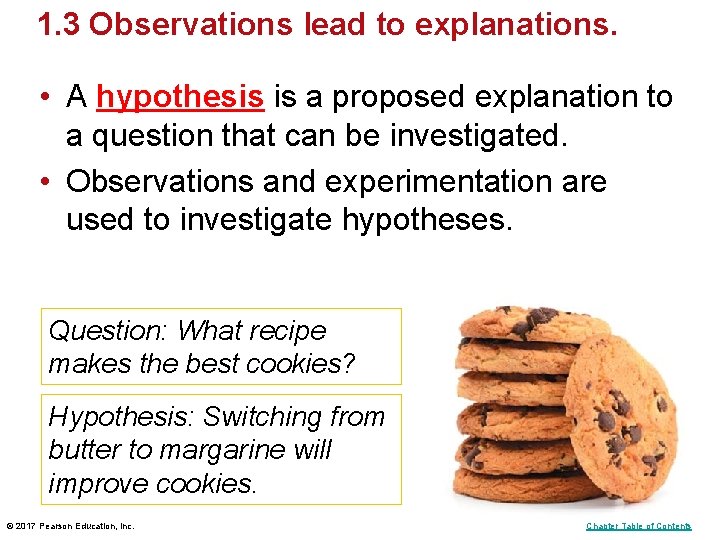
1. 3 Observations lead to explanations. • A hypothesis is a proposed explanation to a question that can be investigated. • Observations and experimentation are used to investigate hypotheses. Question: What recipe makes the best cookies? Hypothesis: Switching from butter to margarine will improve cookies. © 2017 Pearson Education, Inc. Chapter Table of Contents
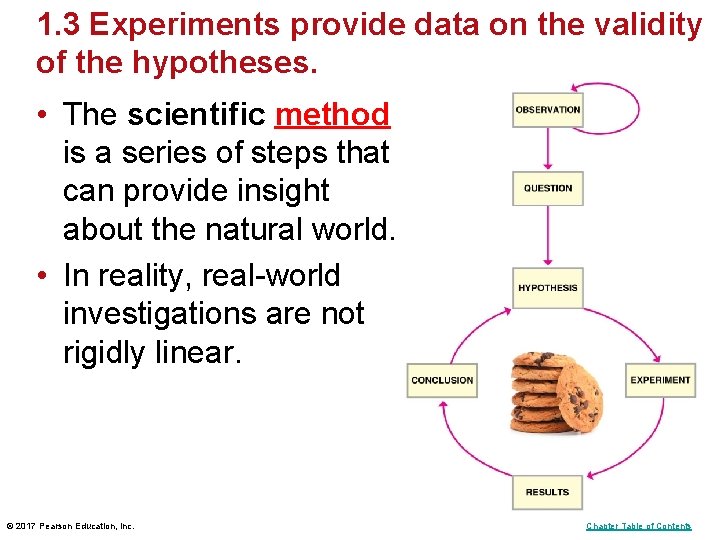
1. 3 Experiments provide data on the validity of the hypotheses. • The scientific method is a series of steps that can provide insight about the natural world. • In reality, real-world investigations are not rigidly linear. © 2017 Pearson Education, Inc. Chapter Table of Contents
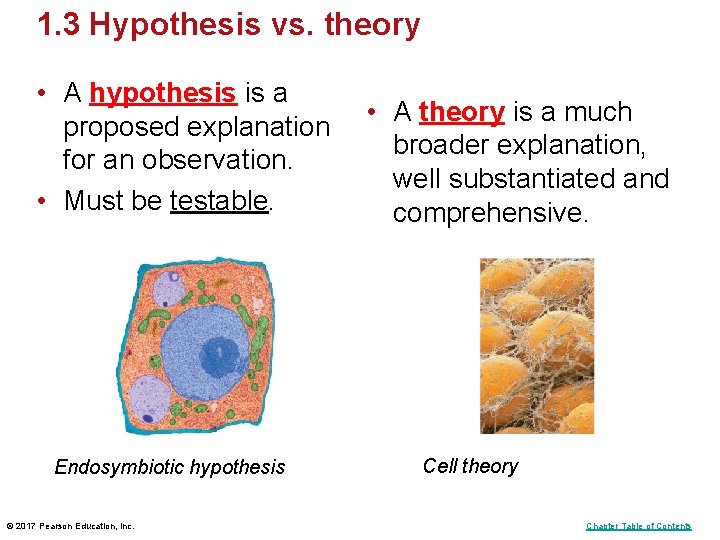
1. 3 Hypothesis vs. theory • A hypothesis is a proposed explanation for an observation. • Must be testable. Endosymbiotic hypothesis © 2017 Pearson Education, Inc. • A theory is a much broader explanation, well substantiated and comprehensive. Cell theory Chapter Table of Contents
1. 4 Opening Questions: How does the term theory differ in science from everyday use? • List at least three ways the term “theory” is used in everyday language. How do those contrast with the use of theory in scientific language? Everyday Language: – Conjecture – Speculation – Opinion Scientific Language: – Well supported – Testable ideas – Objective data Theory has a specific meaning in science. © 2017 Pearson Education, Inc. Chapter Table of Contents
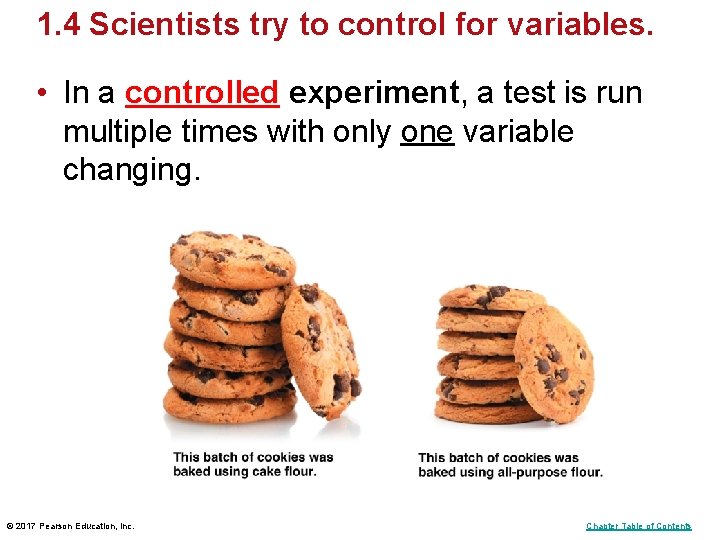
1. 4 Scientists try to control for variables. • In a controlled experiment, a test is run multiple times with only one variable changing. © 2017 Pearson Education, Inc. Chapter Table of Contents
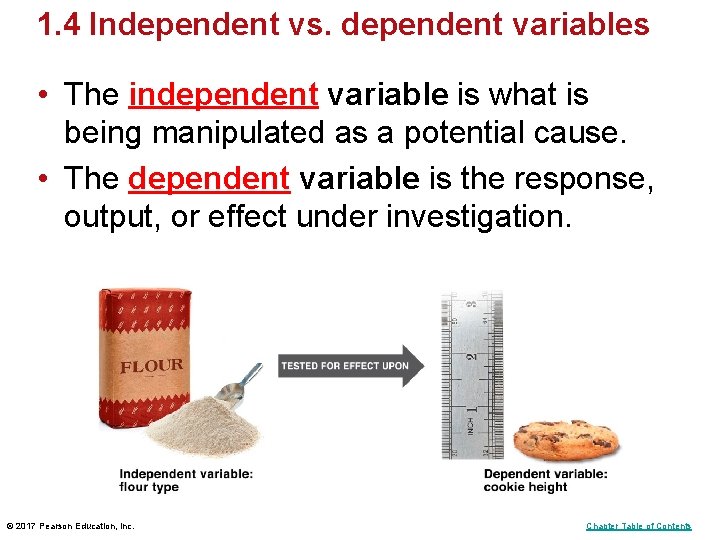
1. 4 Independent vs. dependent variables • The independent variable is what is being manipulated as a potential cause. • The dependent variable is the response, output, or effect under investigation. © 2017 Pearson Education, Inc. Chapter Table of Contents
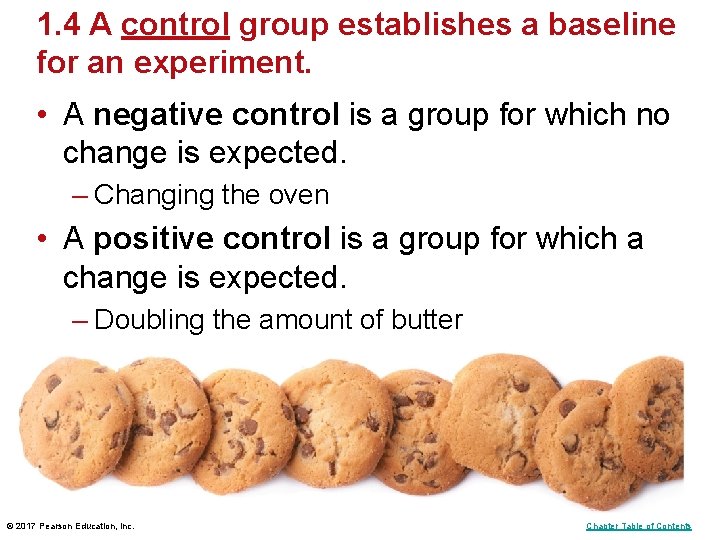
1. 4 A control group establishes a baseline for an experiment. • A negative control is a group for which no change is expected. – Changing the oven • A positive control is a group for which a change is expected. – Doubling the amount of butter © 2017 Pearson Education, Inc. Chapter Table of Contents
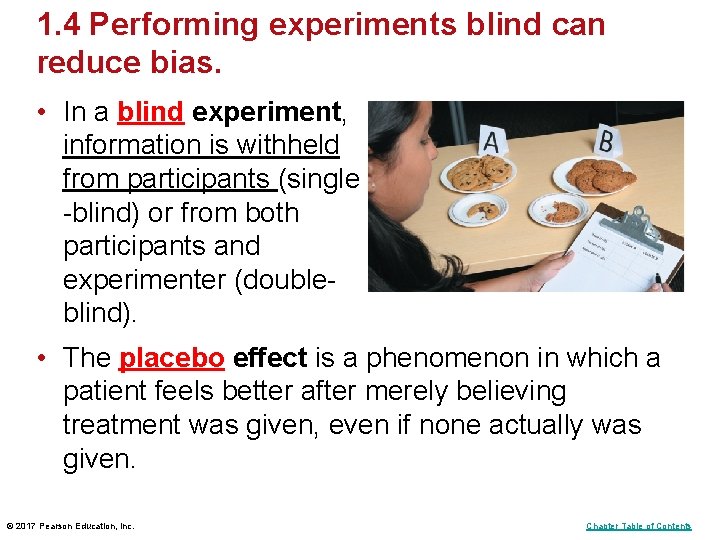
1. 4 Performing experiments blind can reduce bias. • In a blind experiment, information is withheld from participants (single -blind) or from both participants and experimenter (doubleblind). • The placebo effect is a phenomenon in which a patient feels better after merely believing treatment was given, even if none actually was given. © 2017 Pearson Education, Inc. Chapter Table of Contents
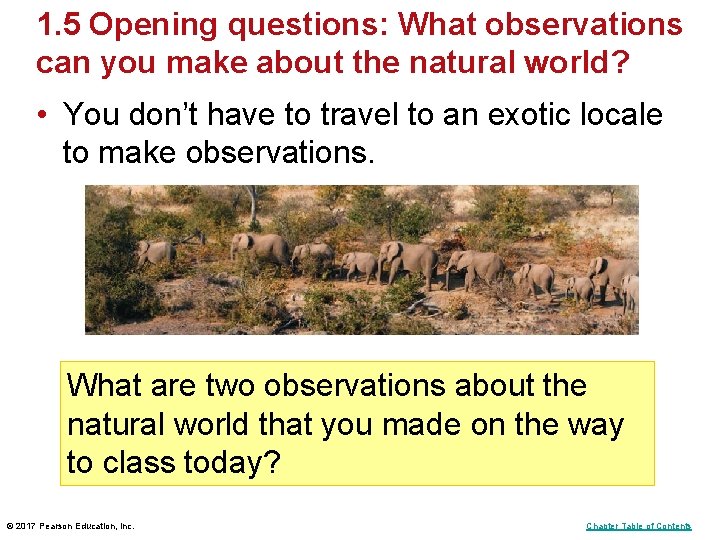
1. 5 Opening questions: What observations can you make about the natural world? • You don’t have to travel to an exotic locale to make observations. What are two observations about the natural world that you made on the way to class today? © 2017 Pearson Education, Inc. Chapter Table of Contents
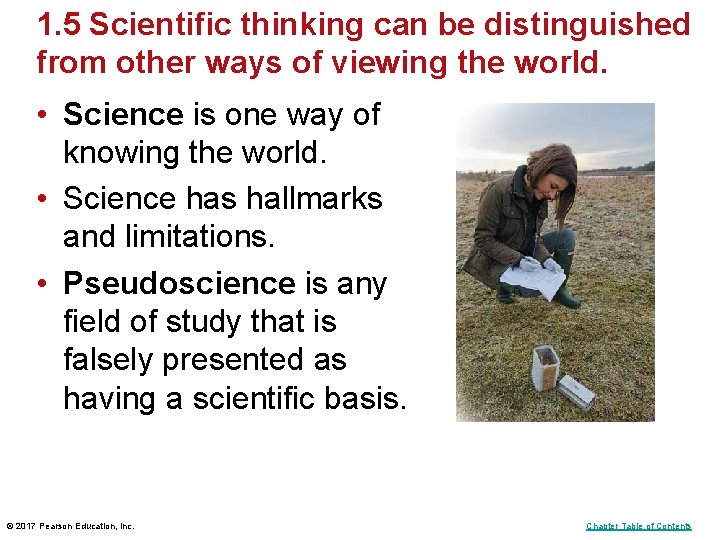
1. 5 Scientific thinking can be distinguished from other ways of viewing the world. • Science is one way of knowing the world. • Science has hallmarks and limitations. • Pseudoscience is any field of study that is falsely presented as having a scientific basis. © 2017 Pearson Education, Inc. Chapter Table of Contents
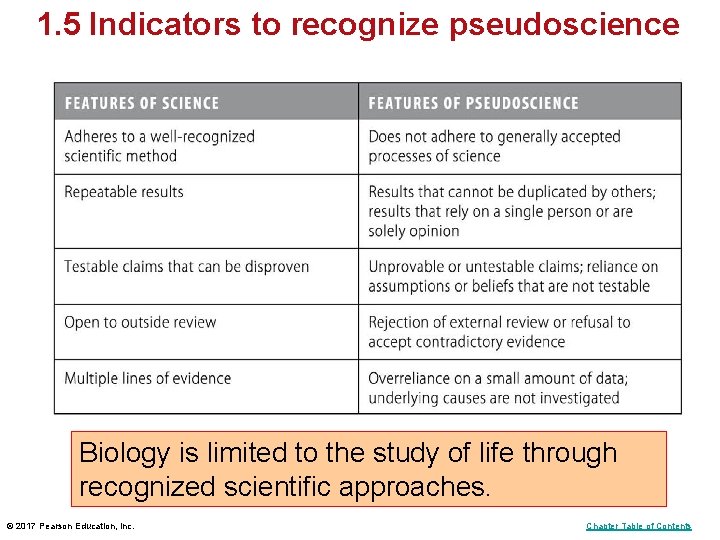
1. 5 Indicators to recognize pseudoscience Biology is limited to the study of life through recognized scientific approaches. © 2017 Pearson Education, Inc. Chapter Table of Contents
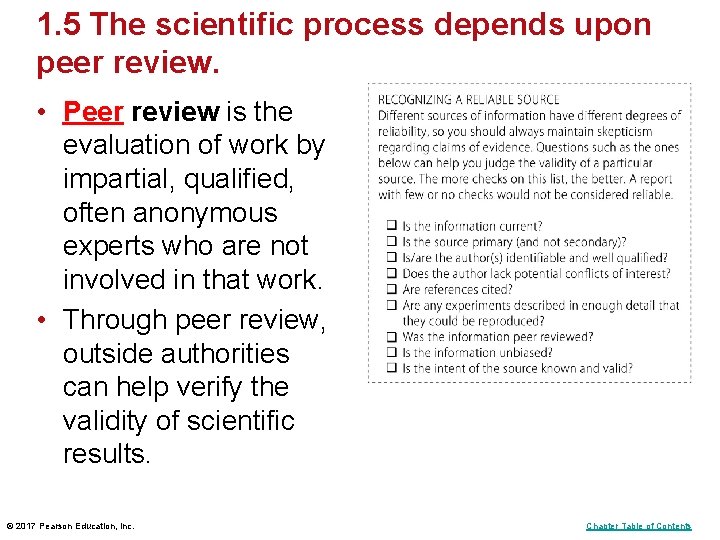
1. 5 The scientific process depends upon peer review. • Peer review is the evaluation of work by impartial, qualified, often anonymous experts who are not involved in that work. • Through peer review, outside authorities can help verify the validity of scientific results. © 2017 Pearson Education, Inc. Chapter Table of Contents
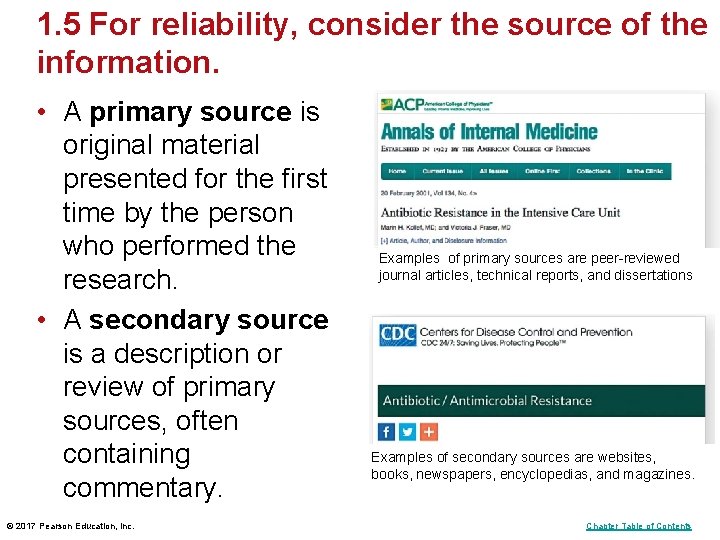
1. 5 For reliability, consider the source of the information. • A primary source is original material presented for the first time by the person who performed the research. • A secondary source is a description or review of primary sources, often containing commentary. © 2017 Pearson Education, Inc. Examples of primary sources are peer-reviewed journal articles, technical reports, and dissertations Examples of secondary sources are websites, books, newspapers, encyclopedias, and magazines. Chapter Table of Contents
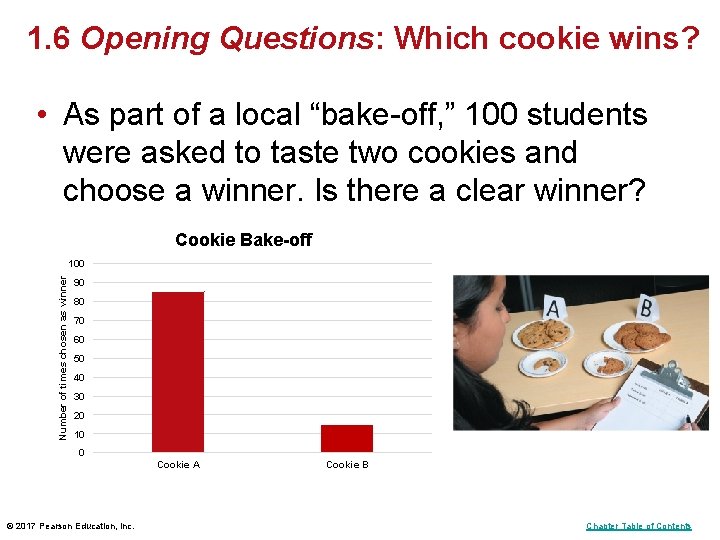
1. 6 Opening Questions: Which cookie wins? • As part of a local “bake-off, ” 100 students were asked to taste two cookies and choose a winner. Is there a clear winner? Cookie Bake-off Number of times chosen as winner 100 90 80 70 60 50 40 30 20 10 0 Cookie A © 2017 Pearson Education, Inc. Cookie B Chapter Table of Contents
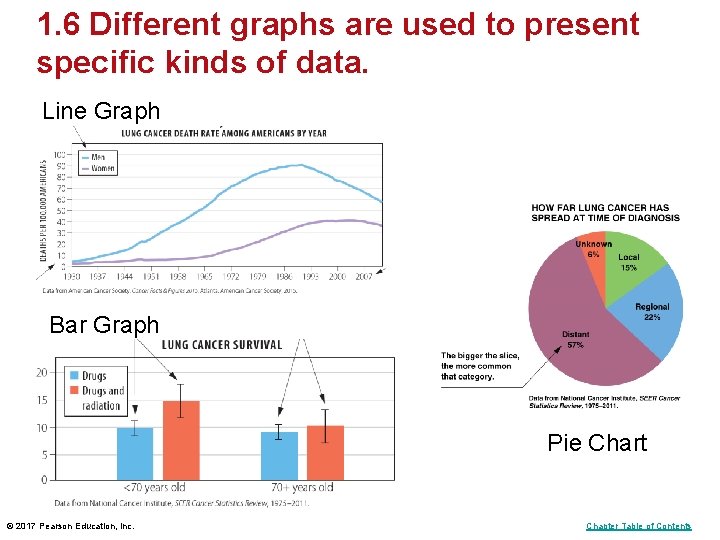
1. 6 Scientists communicate data using tables and graphs. • A scientific table is an • Graphs are a means efficient way to of displaying data present a lot of data in visually, which can a small amount of help to summarize space. and compare information. © 2017 Pearson Education, Inc. Chapter Table of Contents
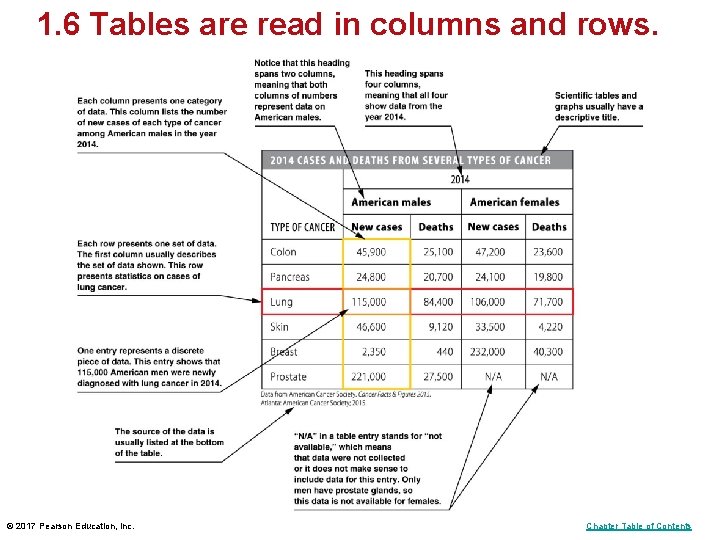
1. 6 Tables are read in columns and rows. © 2017 Pearson Education, Inc. Chapter Table of Contents
1. 6 Different graphs are used to present specific kinds of data. Line Graph Bar Graph Pie Chart © 2017 Pearson Education, Inc. Chapter Table of Contents
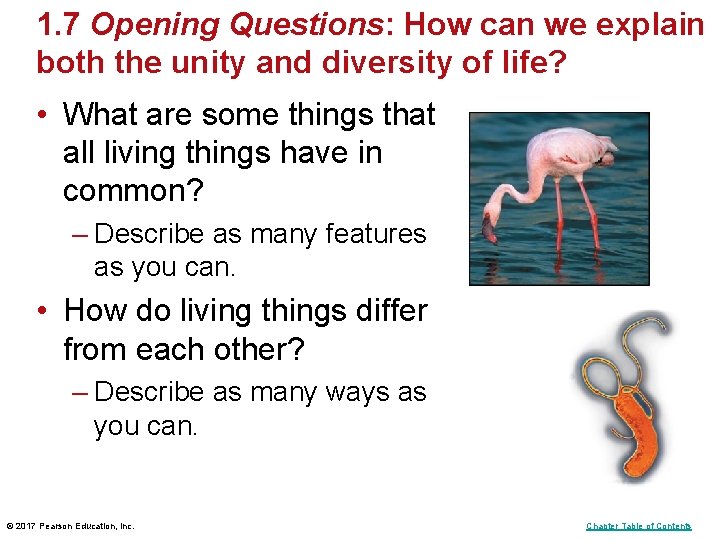
1. 7 Opening Questions: How can we explain both the unity and diversity of life? • What are some things that all living things have in common? – Describe as many features as you can. • How do living things differ from each other? – Describe as many ways as you can. © 2017 Pearson Education, Inc. Chapter Table of Contents
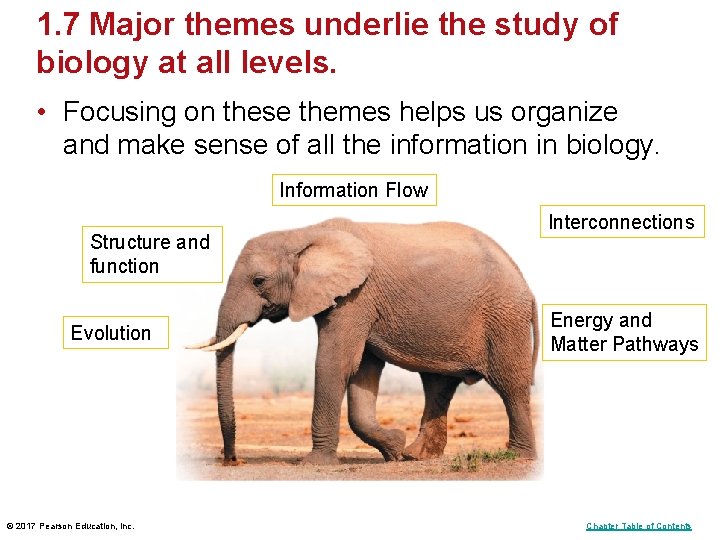
1. 7 Major themes underlie the study of biology at all levels. • Focusing on these themes helps us organize and make sense of all the information in biology. Information Flow Structure and function Evolution © 2017 Pearson Education, Inc. Interconnections Energy and Matter Pathways Chapter Table of Contents
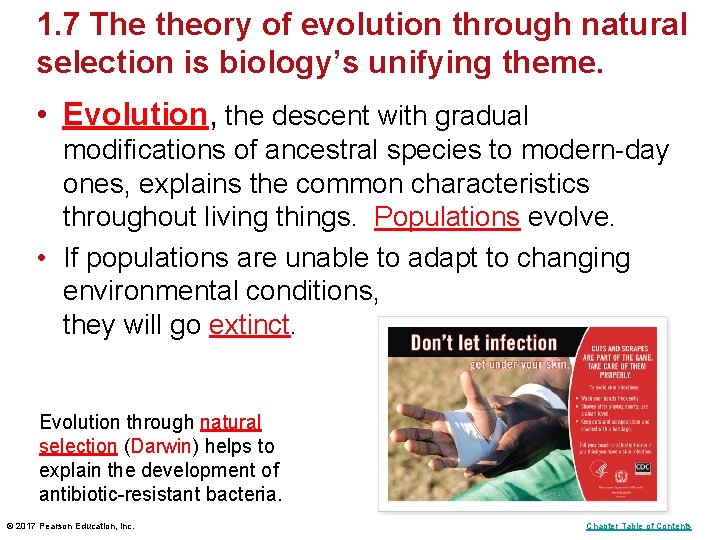
1. 7 The theory of evolution through natural selection is biology’s unifying theme. • Evolution, the descent with gradual modifications of ancestral species to modern-day ones, explains the common characteristics throughout living things. Populations evolve. • If populations are unable to adapt to changing environmental conditions, they will go extinct. Evolution through natural selection (Darwin) helps to explain the development of antibiotic-resistant bacteria. © 2017 Pearson Education, Inc. Chapter Table of Contents
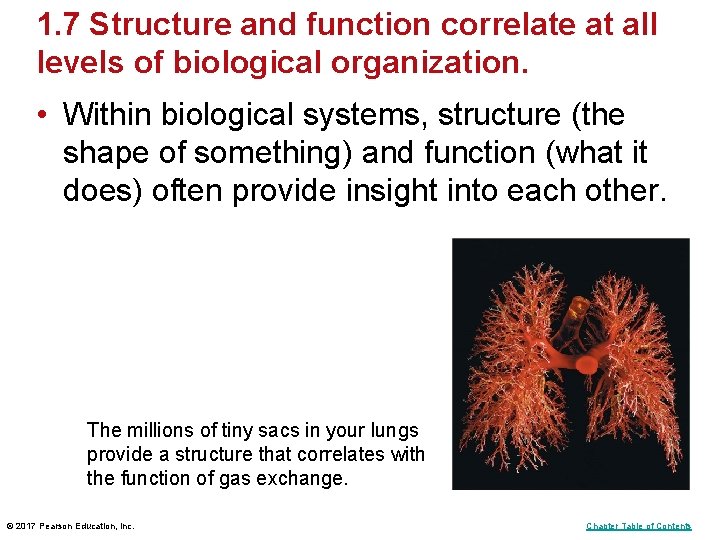
1. 7 Structure and function correlate at all levels of biological organization. • Within biological systems, structure (the shape of something) and function (what it does) often provide insight into each other. The millions of tiny sacs in your lungs provide a structure that correlates with the function of gas exchange. © 2017 Pearson Education, Inc. Chapter Table of Contents
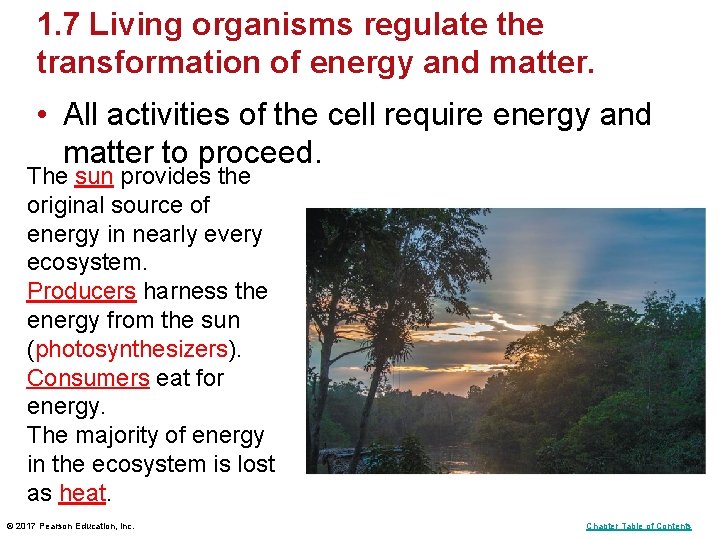
1. 7 Living organisms regulate the transformation of energy and matter. • All activities of the cell require energy and matter to proceed. The sun provides the original source of energy in nearly every ecosystem. Producers harness the energy from the sun (photosynthesizers). Consumers eat for energy. The majority of energy in the ecosystem is lost as heat. © 2017 Pearson Education, Inc. Chapter Table of Contents
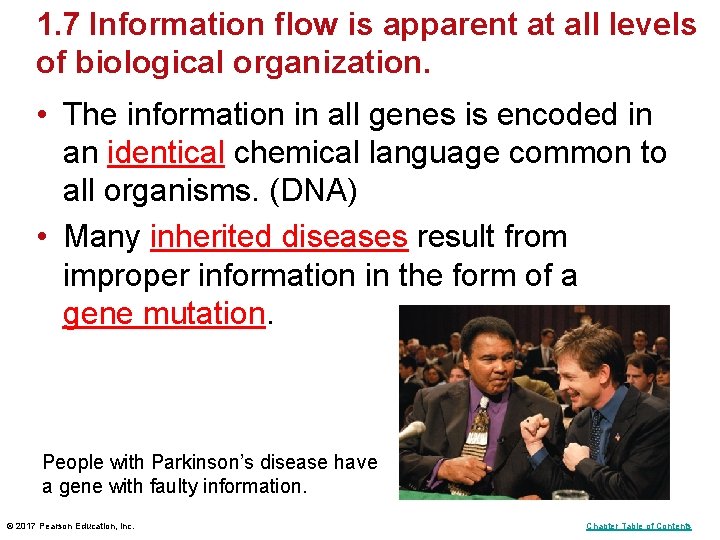
1. 7 Information flow is apparent at all levels of biological organization. • The information in all genes is encoded in an identical chemical language common to all organisms. (DNA) • Many inherited diseases result from improper information in the form of a gene mutation. People with Parkinson’s disease have a gene with faulty information. © 2017 Pearson Education, Inc. Chapter Table of Contents
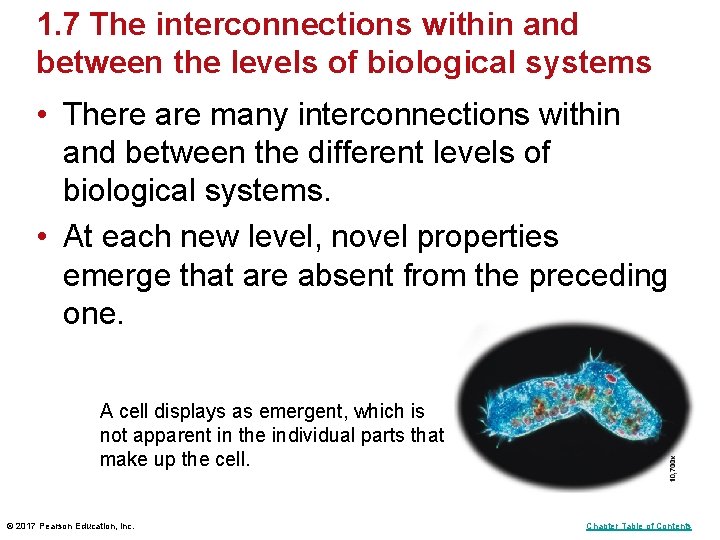
1. 7 The interconnections within and between the levels of biological systems • There are many interconnections within and between the different levels of biological systems. • At each new level, novel properties emerge that are absent from the preceding one. A cell displays as emergent, which is not apparent in the individual parts that make up the cell. © 2017 Pearson Education, Inc. Chapter Table of Contents