Ch 9 Patterns of Inheritance The science of

- Slides: 47
Ch. 9 Patterns of Inheritance
The science of genetics has ancient roots The blending hypothesis, was suggested in the 19 th century by scientists studying plants but later rejected because it did not explain how traits that disappear in one generation can reappear in later generations. © 2012 Pearson Education, Inc.
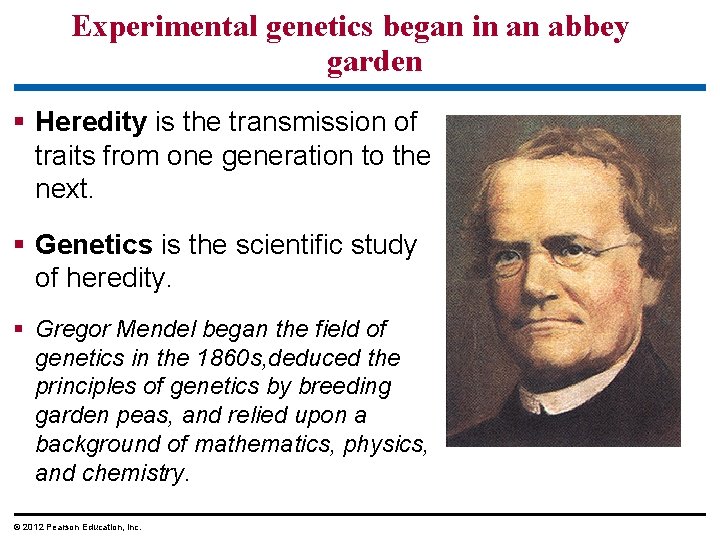
Experimental genetics began in an abbey garden Heredity is the transmission of traits from one generation to the next. Genetics is the scientific study of heredity. Gregor Mendel began the field of genetics in the 1860 s, deduced the principles of genetics by breeding garden peas, and relied upon a background of mathematics, physics, and chemistry. © 2012 Pearson Education, Inc.
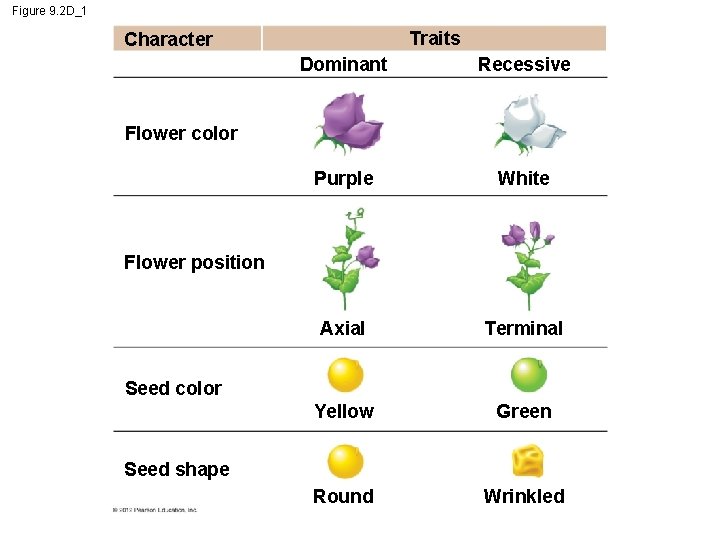
Experimental genetics began in an Abbey Garden In 1866, Mendel correctly argued that parents pass on to their offspring discrete “heritable factors” and stressed that the heritable factors (genes), retain their individuality generation after generation. A heritable feature that varies among individuals, is called a character (flower color) Each variant for a character, is a trait (purple or white flowers) © 2012 Pearson Education, Inc.
Figure 9. 2 D_1 Traits Character Dominant Recessive Purple White Axial Terminal Yellow Green Round Wrinkled Flower color Flower position Seed color Seed shape
Experimental genetics began in an abbey garden True-breeding varieties result when self-fertilization produces offspring all identical to the parent The offspring of two different varieties are hybrids The cross-fertilization is a genetic cross True-breeding parental plants are the P generation. Hybrid offspring of the P generation are the F 1 generation A cross of F 1 plants produces the F 2 generation © 2012 Pearson Education, Inc.
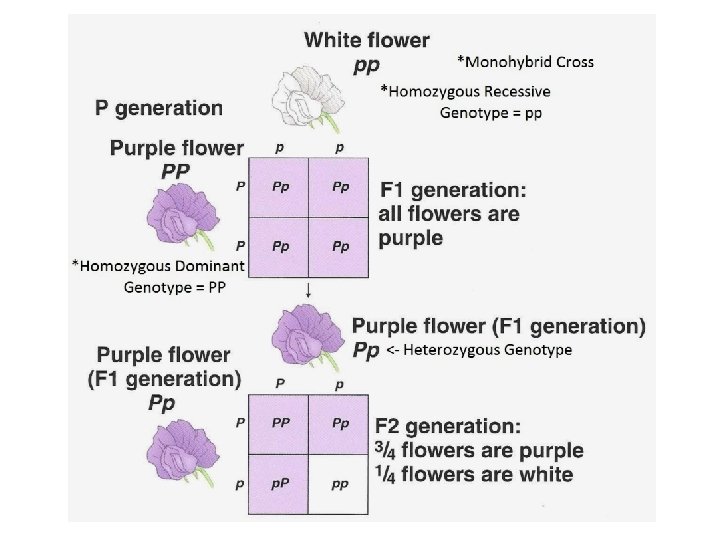
Mendel’s law of segregation describes the inheritance of a single character A monohybrid cross is a cross between two individuals that differ in just one character Mendel performed a monohybrid cross between a plant with purple flowers and a plant with white flowers. – 100% of the F 1 generation had purple flowers – When F 1 plants were crossed to produce the F 2 generation, 75% had purple flowers and 25% had white flowers *Change percentages to ratios by dividing percentages by the smallest percentage* © 2012 Pearson Education, Inc.
The Experiment P generation (true-breeding parents) Purple flowers F 1 generation White flowers 100% have purple flowers Fertilization among F 1 plants (F 1 F 1) F 2 generation 25% of plants 75% of plants have purple flowers have white flowers
Mendel’s law of segregation describes the inheritance of a single character The all-purple F 1 generation did not produce light purple flowers, as predicted by the blending hypothesis Mendel needed to explain why white color seemed to disappear in the F 1 generation and reappear in one quarter of the F 2 offspring © 2012 Pearson Education, Inc.
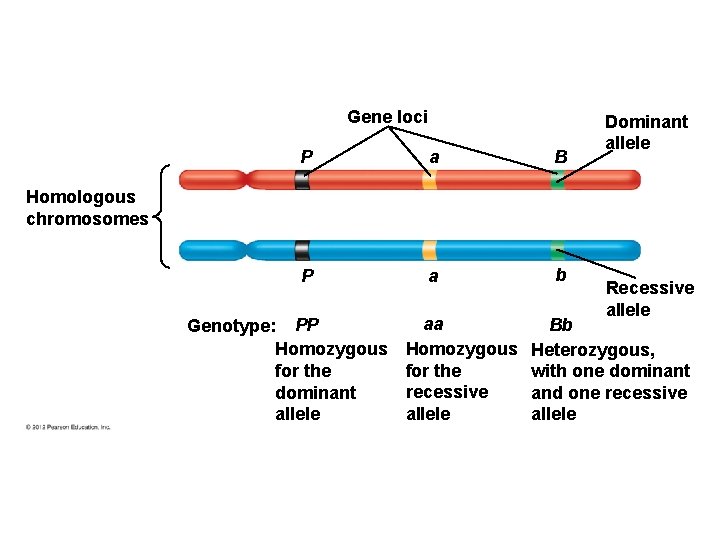
Mendel’s Hypotheses Mendel developed four hypotheses from these crosses 1. Alleles are alternative versions of a gene 2. An organism inherits two alleles (on homologs), one from each parent. The alleles can be the same (homozygous) or different (heterozygous) © 2012 Pearson Education, Inc.
Gene loci P a B P a b Dominant allele Homologous chromosomes Genotype: PP Homozygous for the dominant allele aa Homozygous for the recessive allele Recessive allele Bb Heterozygous, with one dominant and one recessive allele
Mendel’s Hypotheses 3. If the two alleles differ, the one that determines the organism’s appearance is the dominant allele. The recessive allele has no noticeable effect on the organism’s appearance – Phenotype is an organism’s traits – Genotype is an organism’s genetic makeup 4. A sperm or egg carries only one allele for each inherited character because allele pairs separate from each other during gamete formation (meiosis). This is called the law of segregation © 2012 Pearson Education, Inc.
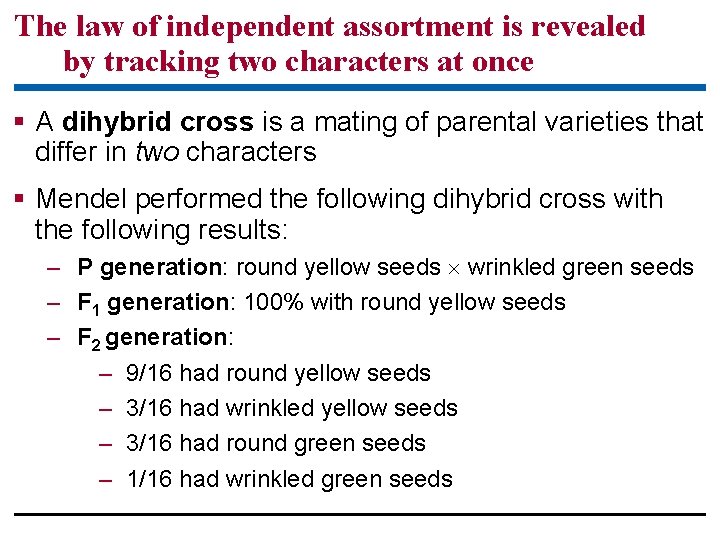
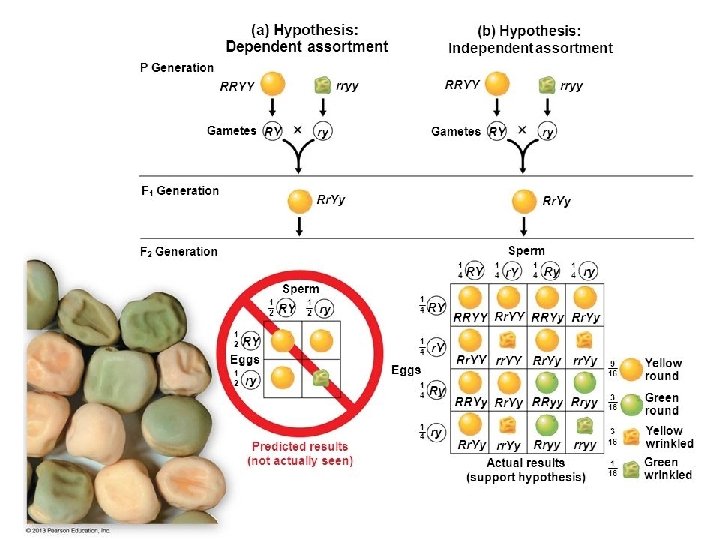
The law of independent assortment is revealed by tracking two characters at once A dihybrid cross is a mating of parental varieties that differ in two characters Mendel performed the following dihybrid cross with the following results: – P generation: round yellow seeds wrinkled green seeds – F 1 generation: 100% with round yellow seeds – F 2 generation: – 9/16 had round yellow seeds – 3/16 had wrinkled yellow seeds – 3/16 had round green seeds – 1/16 had wrinkled green seeds
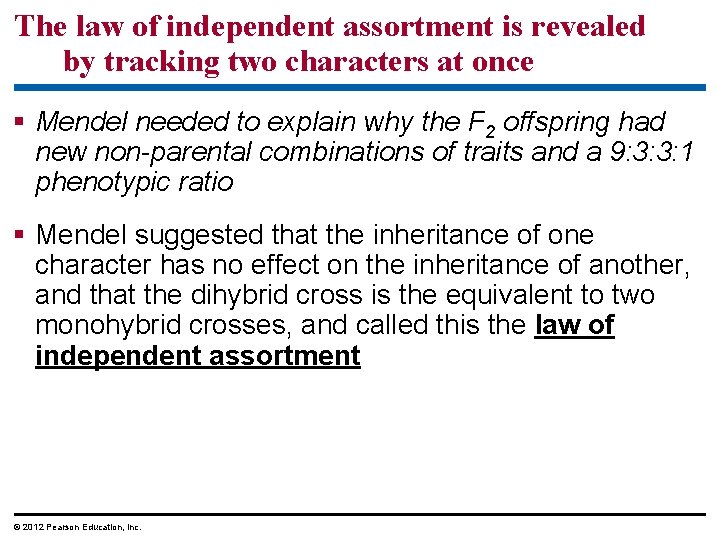
The law of independent assortment is revealed by tracking two characters at once Mendel needed to explain why the F 2 offspring had new non-parental combinations of traits and a 9: 3: 3: 1 phenotypic ratio Mendel suggested that the inheritance of one character has no effect on the inheritance of another, and that the dihybrid cross is the equivalent to two monohybrid crosses, and called this the law of independent assortment © 2012 Pearson Education, Inc.
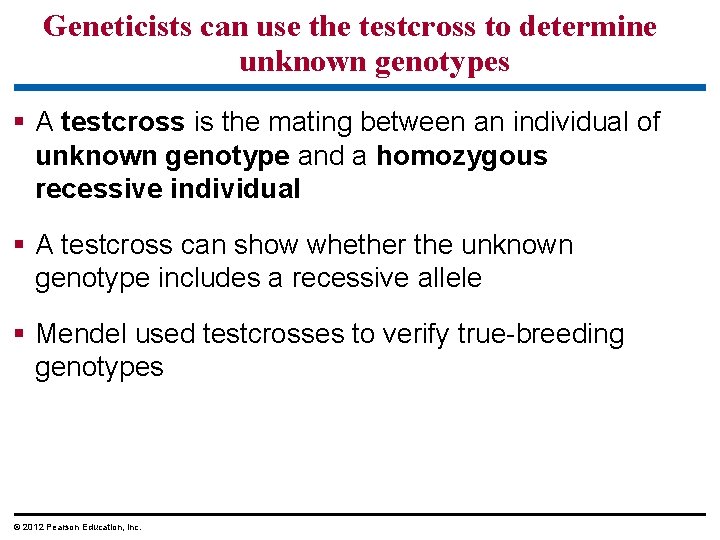
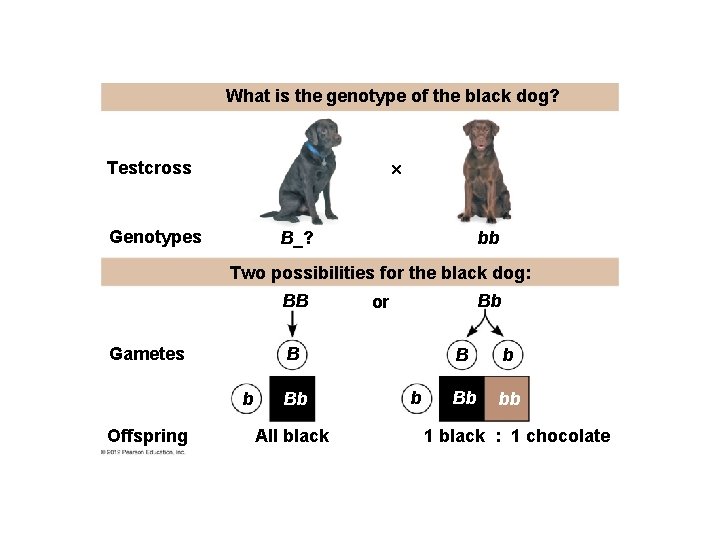
Geneticists can use the testcross to determine unknown genotypes A testcross is the mating between an individual of unknown genotype and a homozygous recessive individual A testcross can show whether the unknown genotype includes a recessive allele Mendel used testcrosses to verify true-breeding genotypes © 2012 Pearson Education, Inc.
What is the genotype of the black dog? Testcross Genotypes B_? bb Two possibilities for the black dog: BB Gametes B b Offspring Bb or Bb All black b Bb bb 1 black : 1 chocolate
Mendel’s laws reflect the rules of probability Using his strong background in mathematics, Mendel knew that the rules of mathematical probability affected the segregation of allele pairs during gamete formation and the re-forming of pairs at fertilization. © 2012 Pearson Education, Inc.
Mendel’s laws reflect the rules of probability The probability of a specific event is the number of ways that event can occur out of the total possible outcomes The probability of two independent events (independent assortment) uses the rule of multiplication. The probability to independent events is the product of the separate probabilities © 2012 Pearson Education, Inc.
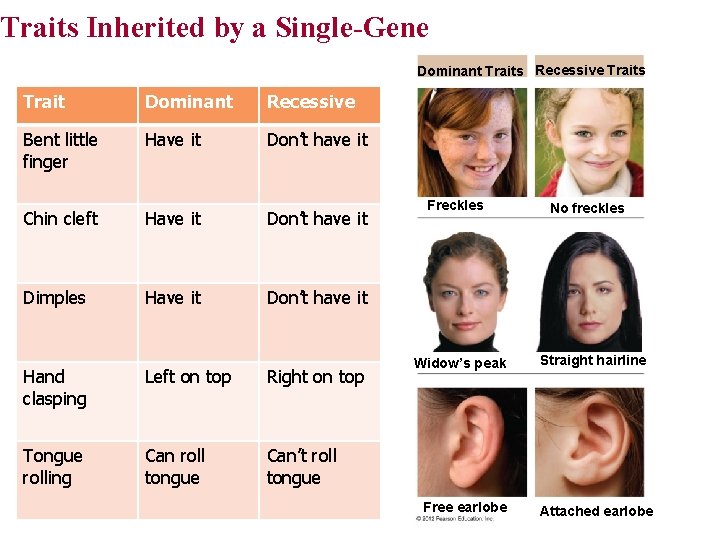
Traits Inherited by a Single-Gene Dominant Traits Recessive Traits Trait Dominant Recessive Bent little finger Have it Don’t have it Chin cleft Have it Don’t have it Dimples Have it Don’t have it Hand clasping Left on top Right on top Tongue rolling Can roll tongue Can’t roll tongue Freckles Widow’s peak Free earlobe No freckles Straight hairline Attached earlobe
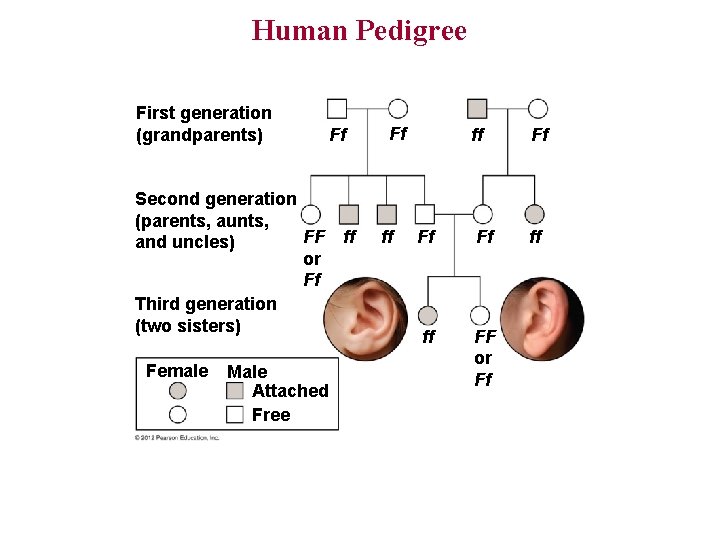
Genetic traits in humans can be tracked through family pedigrees The inheritance of human traits follows Mendel’s laws A pedigree shows the inheritance of a trait in a family through multiple generations, demonstrates dominant or recessive inheritance, and can also be used to deduce genotypes of family members © 2012 Pearson Education, Inc.
Human Pedigree First generation (grandparents) Ff Second generation (parents, aunts, FF and uncles) or Ff Third generation (two sisters) Female Male Attached Free ff Ff ff ff Ff Ff Ff ff ff FF or Ff
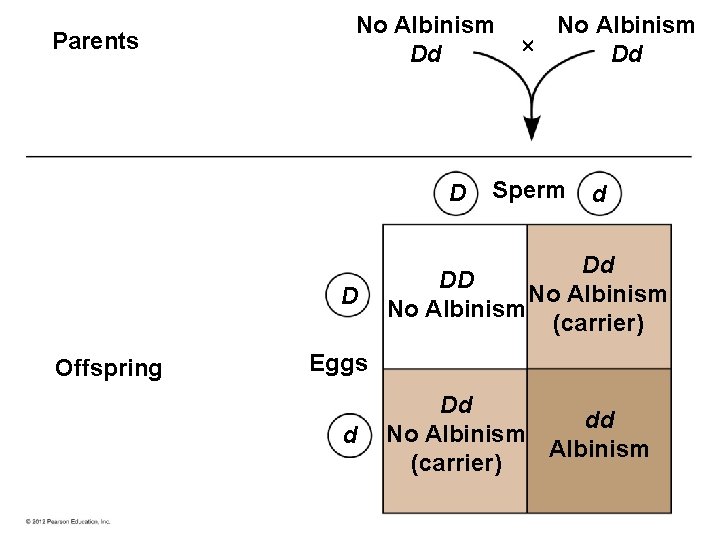
Many inherited disorders in humans are controlled by a single gene Dominant inheritance: one dominant allele is needed to show the dominant phenotype. Dominant lethal alleles are usually eliminated from the population. Recessive inheritance: two recessive alleles are needed to show the recessive phenotype (heterozygous parents are carriers of the recessive allele). © 2012 Pearson Education, Inc.
Parents No Albinism Dd D D Offspring No Albinism Dd Sperm d Dd DD No Albinism (carrier) Eggs d Dd dd No Albinism (carrier)
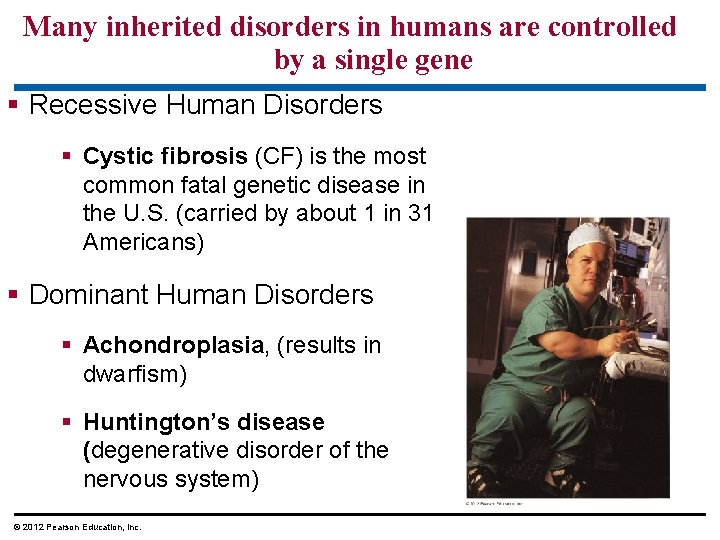
Many inherited disorders in humans are controlled by a single gene Recessive Human Disorders Cystic fibrosis (CF) is the most common fatal genetic disease in the U. S. (carried by about 1 in 31 Americans) Dominant Human Disorders Achondroplasia, (results in dwarfism) Huntington’s disease (degenerative disorder of the nervous system) © 2012 Pearson Education, Inc.
VARIATIONS ON MENDEL’S LAWS © 2012 Pearson Education, Inc.
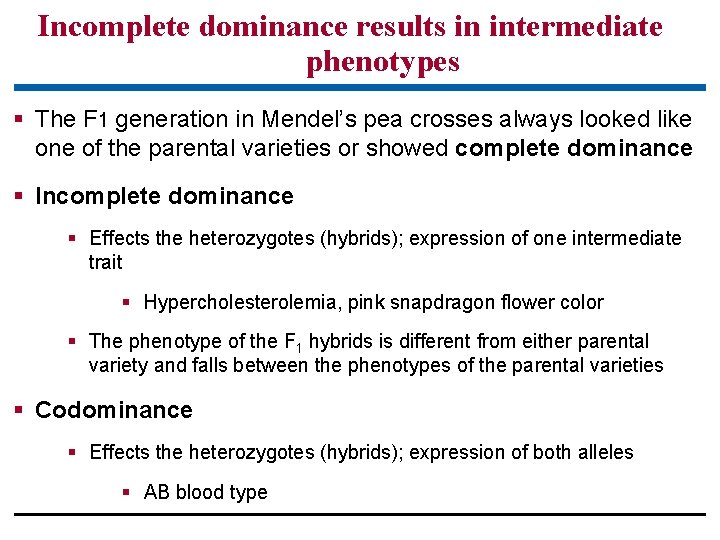
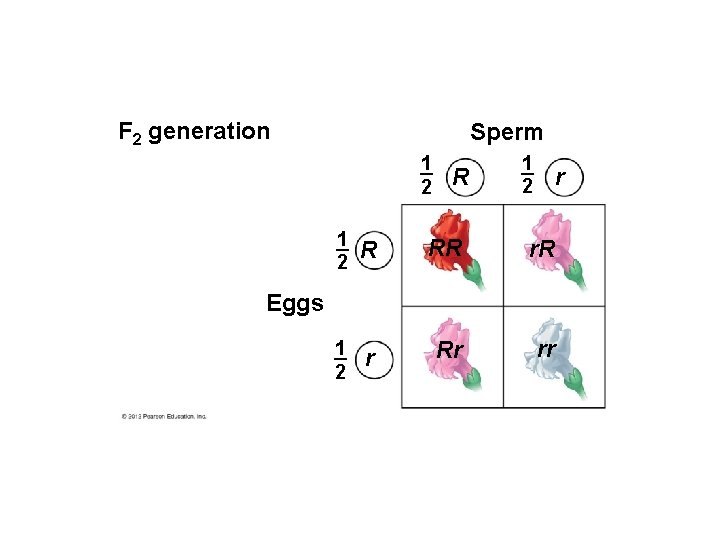
Incomplete dominance results in intermediate phenotypes The F 1 generation in Mendel’s pea crosses always looked like one of the parental varieties or showed complete dominance Incomplete dominance Effects the heterozygotes (hybrids); expression of one intermediate trait Hypercholesterolemia, pink snapdragon flower color The phenotype of the F 1 hybrids is different from either parental variety and falls between the phenotypes of the parental varieties Codominance Effects the heterozygotes (hybrids); expression of both alleles AB blood type
F 2 generation Sperm 1 2 R 1 2 r 1 2 R RR r. R 1 2 r Rr rr Eggs
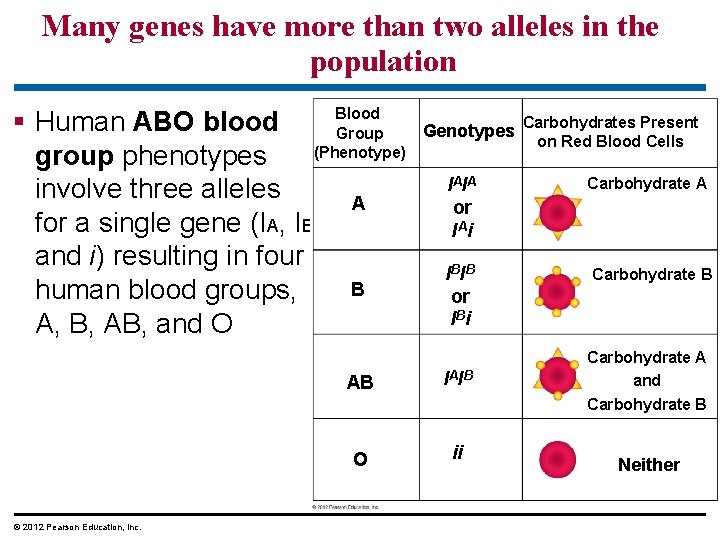
Many genes have more than two alleles in the population Blood Human ABO blood Group (Phenotype) group phenotypes involve three alleles A for a single gene (IA, IB and i) resulting in four B human blood groups, A, B, AB, and O © 2012 Pearson Education, Inc. Genotypes IAIA or IAi IBIB or IBi AB IAIB O ii Carbohydrates Present on Red Blood Cells Carbohydrate A Carbohydrate B Carbohydrate A and Carbohydrate B Neither
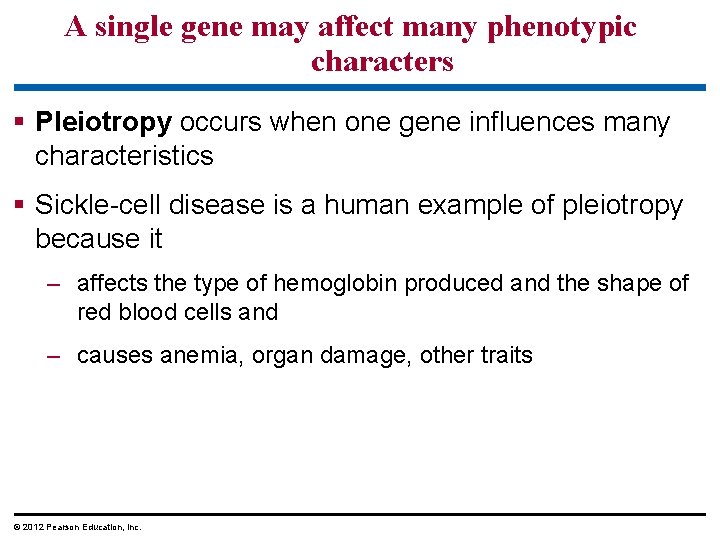
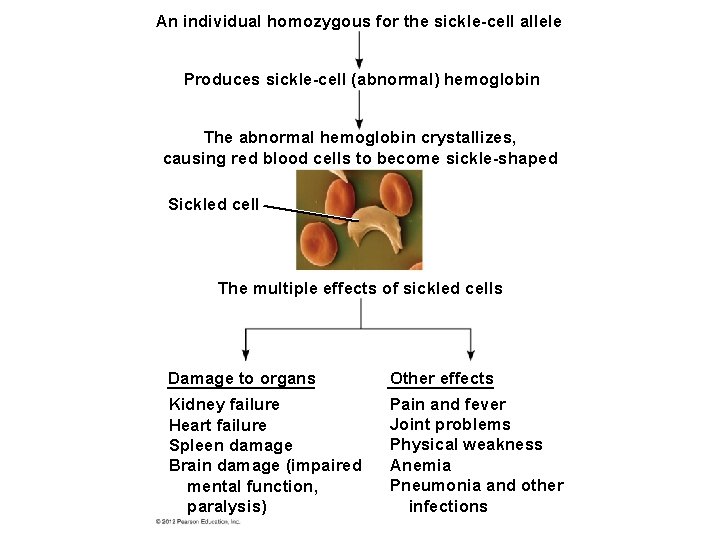
A single gene may affect many phenotypic characters Pleiotropy occurs when one gene influences many characteristics Sickle-cell disease is a human example of pleiotropy because it – affects the type of hemoglobin produced and the shape of red blood cells and – causes anemia, organ damage, other traits © 2012 Pearson Education, Inc.
An individual homozygous for the sickle-cell allele Produces sickle-cell (abnormal) hemoglobin The abnormal hemoglobin crystallizes, causing red blood cells to become sickle-shaped Sickled cell The multiple effects of sickled cells Damage to organs Other effects Kidney failure Heart failure Spleen damage Brain damage (impaired mental function, paralysis) Pain and fever Joint problems Physical weakness Anemia Pneumonia and other infections
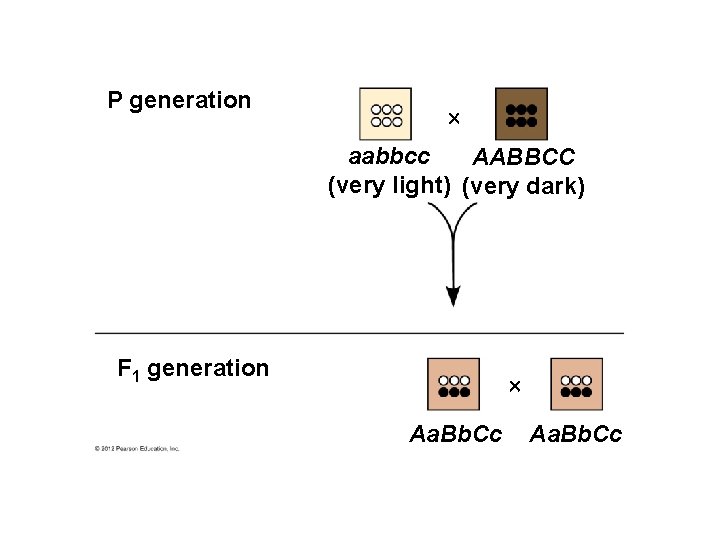
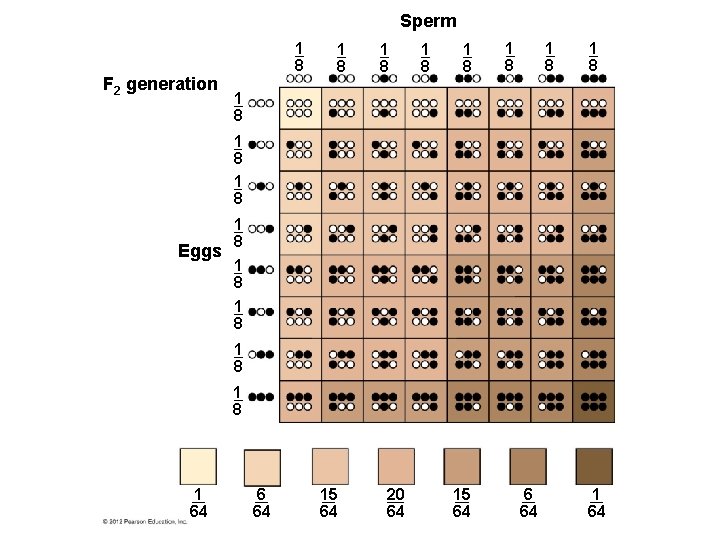
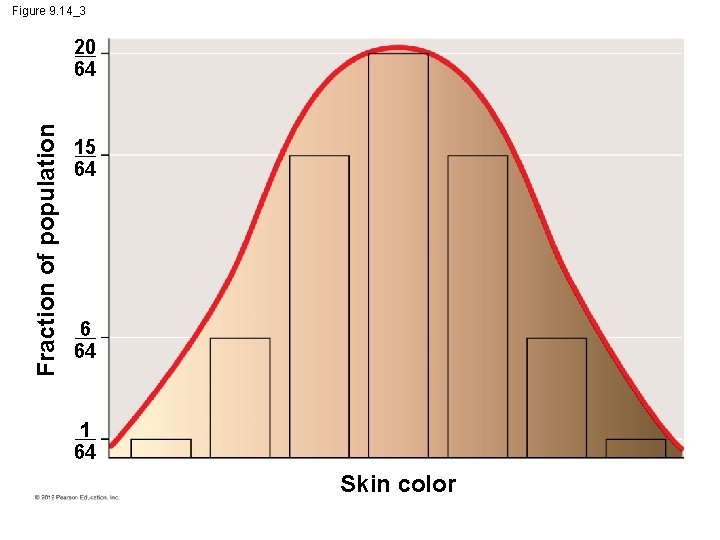
A single character may be influenced by many genes Polygenic inheritance is when a single phenotypic character results from the additive effects of two or more genes. Ex. Human skin color © 2012 Pearson Education, Inc.
P generation aabbcc AABBCC (very light) (very dark) F 1 generation Aa. Bb. Cc
Sperm F 2 generation 1 8 1 8 1 8 Eggs 1 8 1 8 1 8 1 64 6 64 15 64 20 64 15 64 6 64 1 64
Figure 9. 14_3 Fraction of population 20 64 15 64 6 64 1 64 Skin color
THE CHROMOSOMAL BASIS OF INHERITANCE © 2012 Pearson Education, Inc.
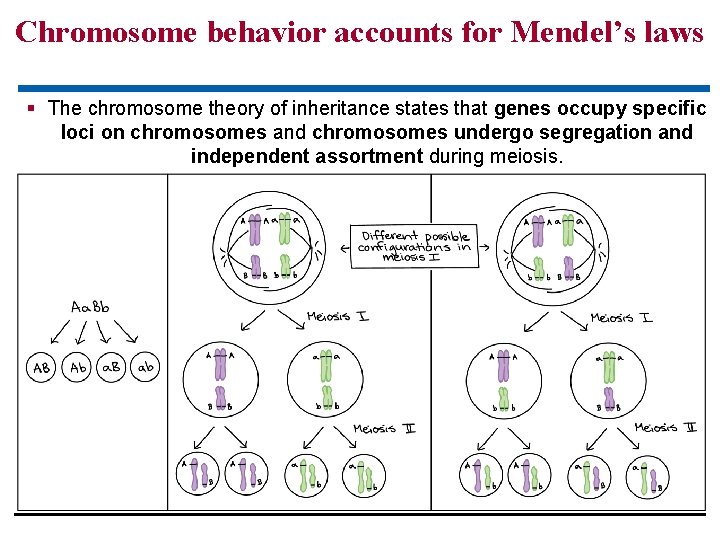
Chromosome behavior accounts for Mendel’s laws The chromosome theory of inheritance states that genes occupy specific loci on chromosomes and chromosomes undergo segregation and independent assortment during meiosis.
Chromosome behavior accounts for Mendel’s laws correlate with chromosome separation in meiosis – The law of segregation depends on separation of homologous chromosomes in anaphase I – The law of independent assortment depends on alternative orientations of chromosomes in metaphase I © 2012 Pearson Education, Inc.
SEX CHROMOSOMES AND SEX-LINKED GENES © 2012 Pearson Education, Inc.
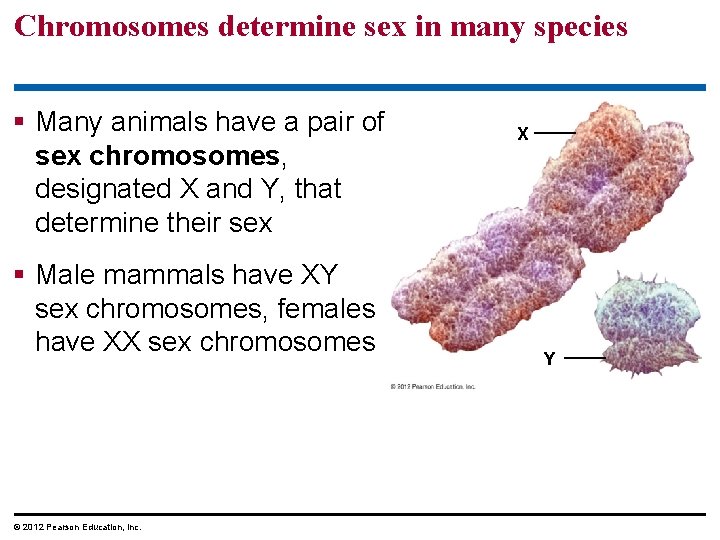
Chromosomes determine sex in many species Many animals have a pair of sex chromosomes, designated X and Y, that determine their sex Male mammals have XY sex chromosomes, females have XX sex chromosomes © 2012 Pearson Education, Inc. X Y
Chromosomes determine sex in many species In some animals, environmental temperature determines the sex – For some species of reptiles, the temperature at which the eggs are incubated during a specific period of development determines whether the embryo will develop into a male or female. © 2012 Pearson Education, Inc.
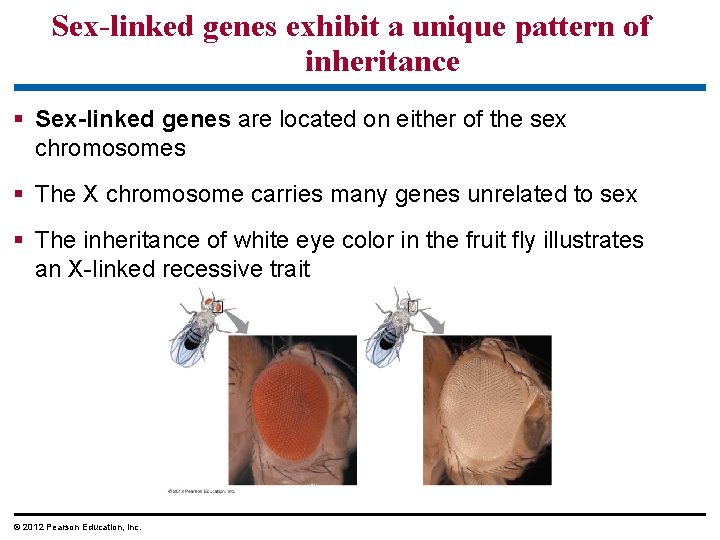
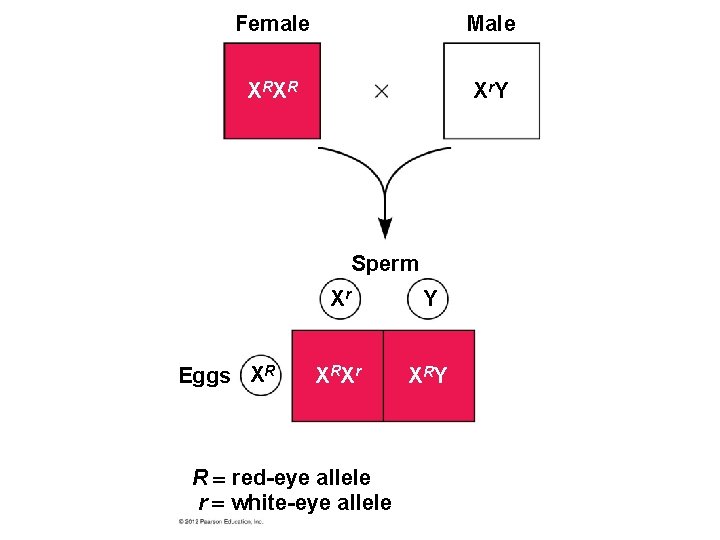
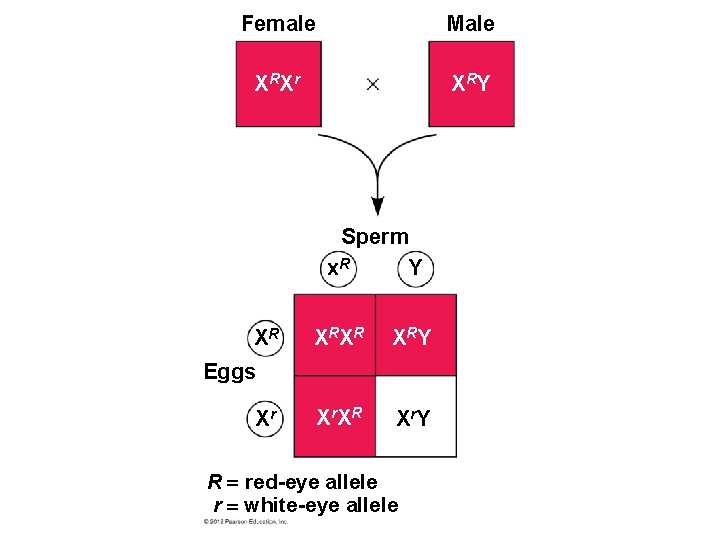
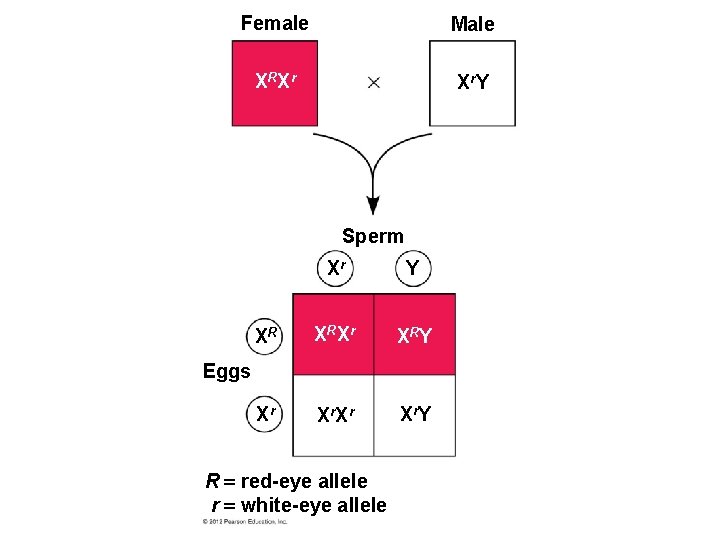
Sex-linked genes exhibit a unique pattern of inheritance Sex-linked genes are located on either of the sex chromosomes The X chromosome carries many genes unrelated to sex The inheritance of white eye color in the fruit fly illustrates an X-linked recessive trait © 2012 Pearson Education, Inc.
Female Male X RX R X r. Y Sperm Eggs XR Xr Y X RX r X RY R red-eye allele r white-eye allele
Female Male X RX r X RY Sperm Y x. R XR X RX R X RY X r. X R X r. Y Eggs Xr R red-eye allele r white-eye allele
Female Male XRXr Xr. Y Sperm Xr Y XR XRXr XRY Xr Xr. Y Eggs R red-eye allele r white-eye allele
Human sex-linked disorders affect mostly males If a sex linked trait is due to a recessive allele, a female will express the phenotype if she is homozygous recessive Any male receiving the recessive allele from his mother will express the trait For this reason, more males than females have sexlinked recessive disorders Sex-linked recessive disorders: Hemophilia, redgreen color blindness, and Duchenne muscular dystrophy © 2012 Pearson Education, Inc.