AKUNTANSI PAJAK PENGHASILAN Akuntansi Keuangan 2 Pertemuan 13















- Slides: 134
AKUNTANSI PAJAK PENGHASILAN Akuntansi Keuangan 2 - Pertemuan 13 Slide OCW Universitas Indonesia Oleh : Dwi Martani Departemen Akuntansi FEUI 1
Agenda 1. Pajak dalam LK 2. Pajak dan Akuntansi 3. Akt. Pajak Penghasilan 4. Contoh dan Ilustrasi Akuntansi Keuangan 2 - Departemen Akuntansi FEUI 2
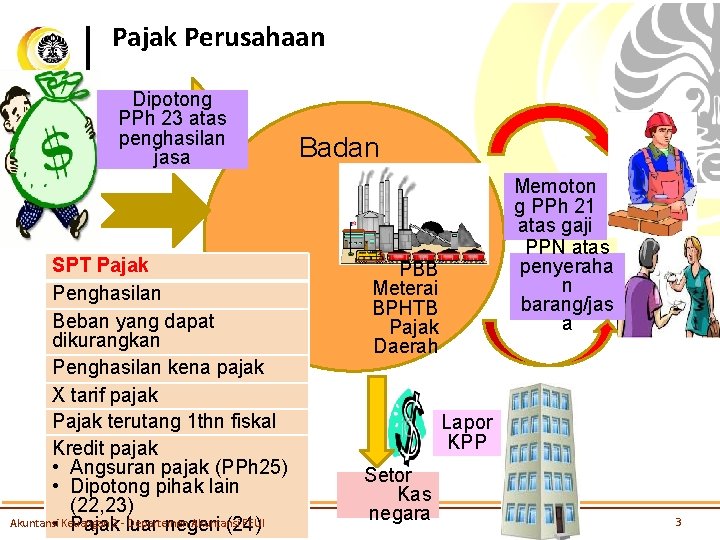
Pajak Perusahaan Dipotong PPh 23 atas penghasilan jasa SPT Pajak Penghasilan Beban yang dapat dikurangkan Penghasilan kena pajak X tarif pajak Pajak terutang 1 thn fiskal Kredit pajak • Angsuran pajak (PPh 25) • Dipotong pihak lain (22, 23) Akuntansi Keuangan 2 - Departemen Akuntansi FEUI • Pajak luar negeri (24) Badan PBB Meterai BPHTB Pajak Daerah Memoton g PPh 21 atas gaji PPN atas penyeraha n barang/jas a Lapor KPP Setor Kas negara 3
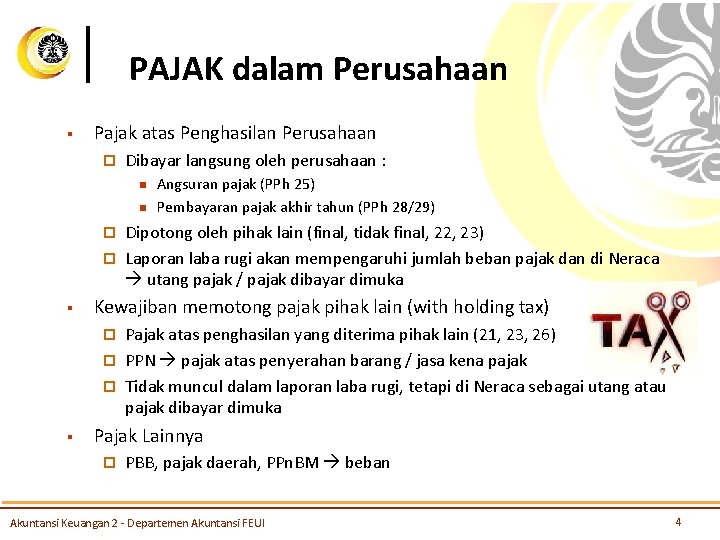
PAJAK dalam Perusahaan § Pajak atas Penghasilan Perusahaan ¨ Dibayar langsung oleh perusahaan : n n Angsuran pajak (PPh 25) Pembayaran pajak akhir tahun (PPh 28/29) Dipotong oleh pihak lain (final, tidak final, 22, 23) ¨ Laporan laba rugi akan mempengaruhi jumlah beban pajak dan di Neraca utang pajak / pajak dibayar dimuka ¨ § Kewajiban memotong pajak pihak lain (with holding tax) Pajak atas penghasilan yang diterima pihak lain (21, 23, 26) ¨ PPN pajak atas penyerahan barang / jasa kena pajak ¨ Tidak muncul dalam laporan laba rugi, tetapi di Neraca sebagai utang atau pajak dibayar dimuka ¨ § Pajak Lainnya ¨ PBB, pajak daerah, PPn. BM beban Akuntansi Keuangan 2 - Departemen Akuntansi FEUI 4
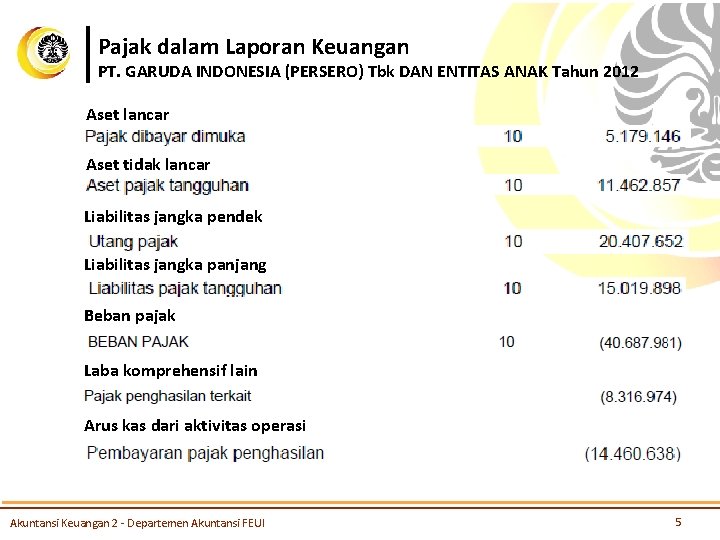
Pajak dalam Laporan Keuangan PT. GARUDA INDONESIA (PERSERO) Tbk DAN ENTITAS ANAK Tahun 2012 Aset lancar Aset tidak lancar Liabilitas jangka pendek Liabilitas jangka panjang Beban pajak Laba komprehensif lain Arus kas dari aktivitas operasi Akuntansi Keuangan 2 - Departemen Akuntansi FEUI 5
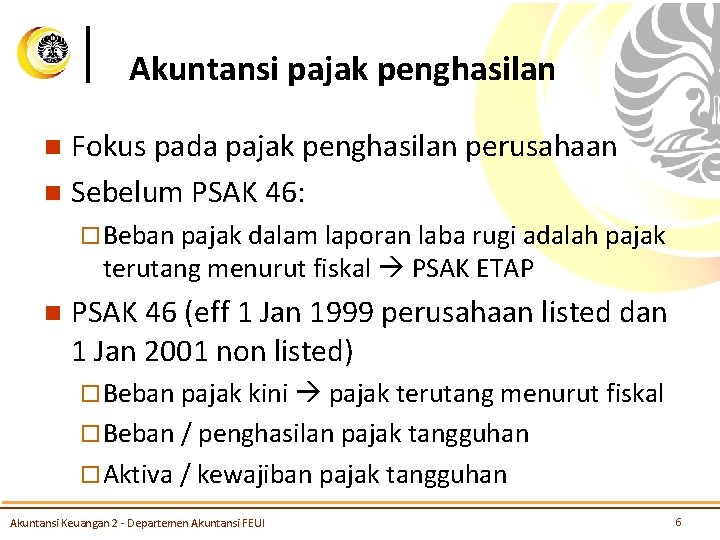
Akuntansi pajak penghasilan Fokus pada pajak penghasilan perusahaan n Sebelum PSAK 46: n ¨ Beban pajak dalam laporan laba rugi adalah pajak terutang menurut fiskal PSAK ETAP n PSAK 46 (eff 1 Jan 1999 perusahaan listed dan 1 Jan 2001 non listed) ¨ Beban pajak kini pajak terutang menurut fiskal ¨ Beban / penghasilan pajak tangguhan ¨ Aktiva / kewajiban pajak tangguhan Akuntansi Keuangan 2 - Departemen Akuntansi FEUI 6
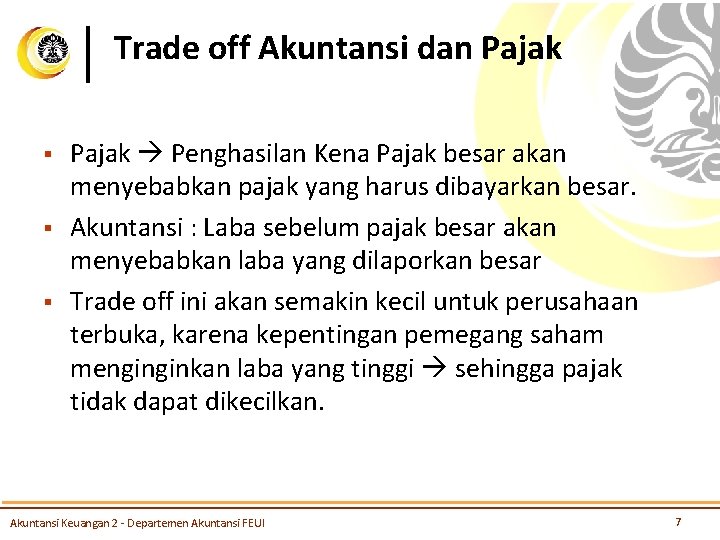
Trade off Akuntansi dan Pajak § § § Pajak Penghasilan Kena Pajak besar akan menyebabkan pajak yang harus dibayarkan besar. Akuntansi : Laba sebelum pajak besar akan menyebabkan laba yang dilaporkan besar Trade off ini akan semakin kecil untuk perusahaan terbuka, karena kepentingan pemegang saham menginginkan laba yang tinggi sehingga pajak tidak dapat dikecilkan. Akuntansi Keuangan 2 - Departemen Akuntansi FEUI 7
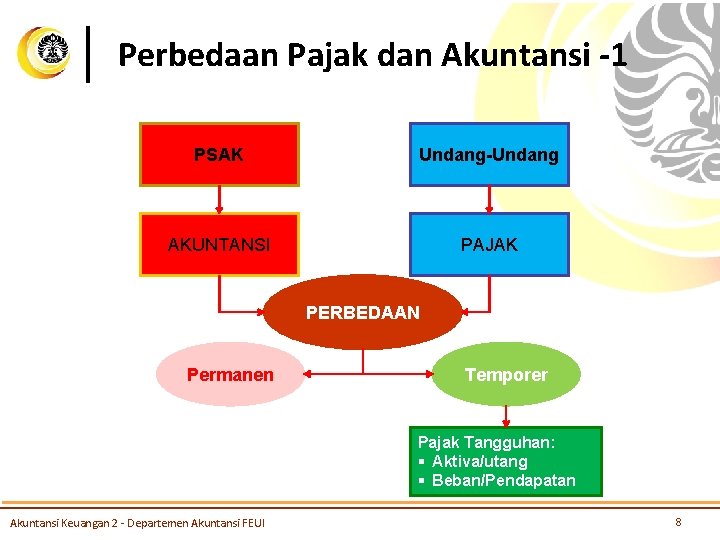
Perbedaan Pajak dan Akuntansi -1 PSAK Undang-Undang AKUNTANSI PAJAK PERBEDAAN Permanen Temporer Pajak Tangguhan: § Aktiva/utang § Beban/Pendapatan Akuntansi Keuangan 2 - Departemen Akuntansi FEUI 8
Perbedaan Pajak dan Akuntansi - 2 § Penghasilan : ¨ Setiap tambahan kemampuan ekonomis yang diterima atau diperoleh Wajib Pajak, baik yang berasal dari Indonesia maupun dari luar Indonesia, yang dapat dipakai untuk konsumsi atau untuk menambah kekayaan Wajib Pajak yang bersangkutan, dengan nama dan dalam bentuk apa pun § Menghitung penghasilan kena pajak - identifikasi § § § Bukan obyek pajak Beban yang boleh dikurangkan Beban yang tidak boleh dikurangkan Pajak final Perbedaan cara pengukuran 9
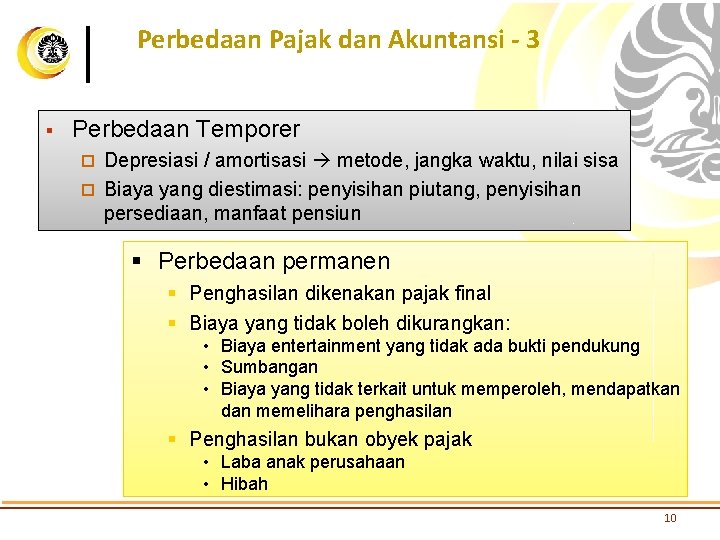
Perbedaan Pajak dan Akuntansi - 3 § Perbedaan Temporer Depresiasi / amortisasi metode, jangka waktu, nilai sisa ¨ Biaya yang diestimasi: penyisihan piutang, penyisihan persediaan, manfaat pensiun ¨ § Perbedaan permanen § Penghasilan dikenakan pajak final § Biaya yang tidak boleh dikurangkan: • Biaya entertainment yang tidak ada bukti pendukung • Sumbangan • Biaya yang tidak terkait untuk memperoleh, mendapatkan dan memelihara penghasilan § Penghasilan bukan obyek pajak • Laba anak perusahaan • Hibah 10
Perbedaan Pajak dan Akuntansi - 4 § Laba sebelum pajak: Pendapatan – Beban operasi = Laba operasi ¨ Laba operasi – pendapatan/beban lain = laba sebelum pajak ¨ Laba sebelum pajak – beban pajak = laba ¨ § Beban pajak Pajak kini penghasilan kena pajak (hasil rekonsiliasi fiskal) dikalikan tarif ¨ Perbedaan temporer / kompensasi kerugian yang dapat dikurangkan/ ditambahkan ¨ Pendapatan komprehensif dengan pajak disajikan tersendiri / per item ¨ § Laba komprehensif: Langsung menambah ekuitas ¨ Pajak dilaporkan per line atau gabungan ¨ 11
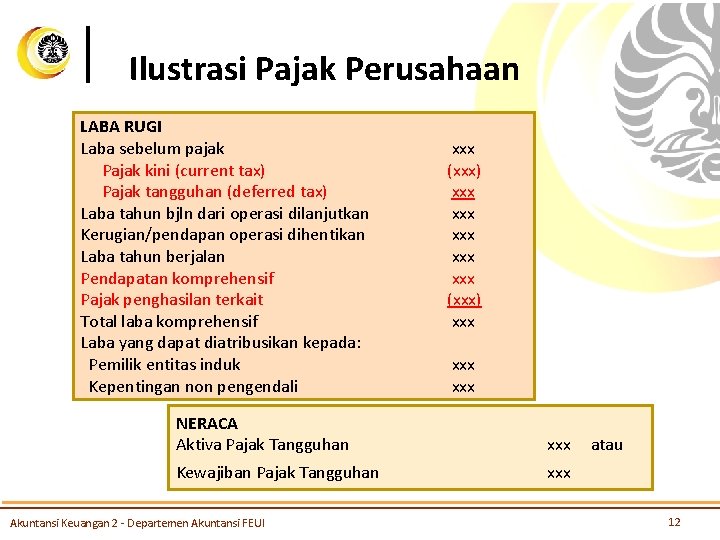
Ilustrasi Pajak Perusahaan LABA RUGI Laba sebelum pajak Pajak kini (current tax) Pajak tangguhan (deferred tax) Laba tahun bjln dari operasi dilanjutkan Kerugian/pendapan operasi dihentikan Laba tahun berjalan Pendapatan komprehensif Pajak penghasilan terkait Total laba komprehensif Laba yang dapat diatribusikan kepada: Pemilik entitas induk Kepentingan non pengendali xxx (xxx) xxx xxx NERACA Aktiva Pajak Tangguhan xxx Kewajiban Pajak Tangguhan xxx Akuntansi Keuangan 2 - Departemen Akuntansi FEUI atau 12
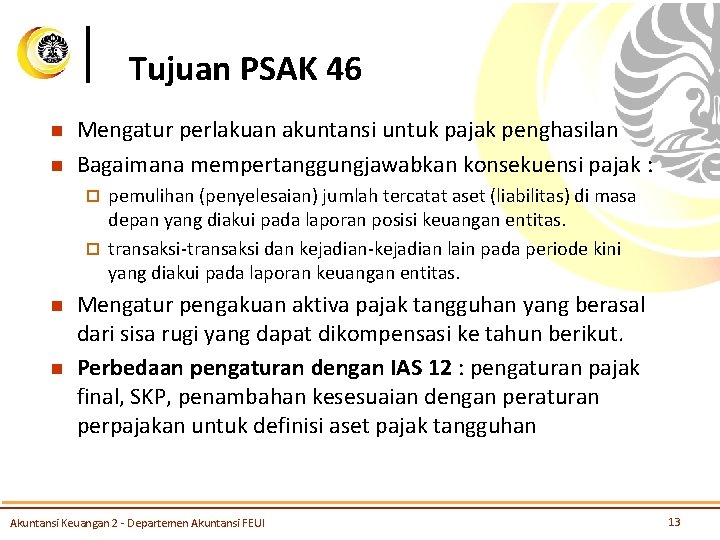
Tujuan PSAK 46 n n Mengatur perlakuan akuntansi untuk pajak penghasilan Bagaimana mempertanggungjawabkan konsekuensi pajak : pemulihan (penyelesaian) jumlah tercatat aset (liabilitas) di masa depan yang diakui pada laporan posisi keuangan entitas. ¨ transaksi-transaksi dan kejadian-kejadian lain pada periode kini yang diakui pada laporan keuangan entitas. ¨ n n Mengatur pengakuan aktiva pajak tangguhan yang berasal dari sisa rugi yang dapat dikompensasi ke tahun berikut. Perbedaan pengaturan dengan IAS 12 : pengaturan pajak final, SKP, penambahan kesesuaian dengan peraturan perpajakan untuk definisi aset pajak tangguhan Akuntansi Keuangan 2 - Departemen Akuntansi FEUI 13
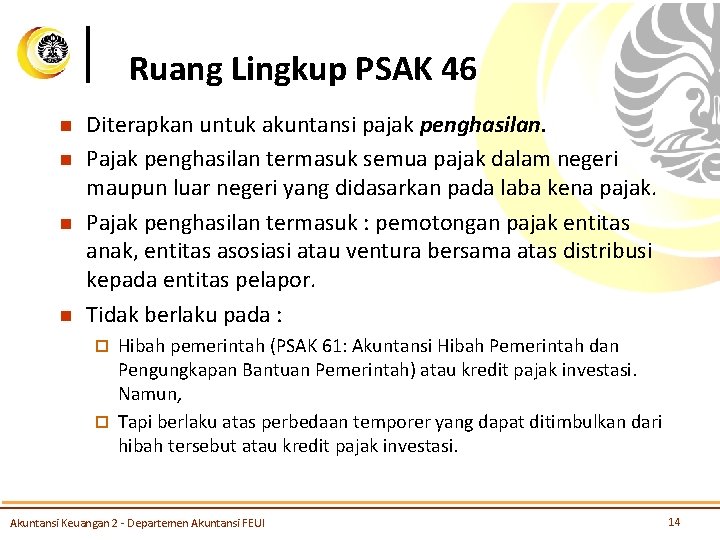
Ruang Lingkup PSAK 46 n n Diterapkan untuk akuntansi pajak penghasilan. Pajak penghasilan termasuk semua pajak dalam negeri maupun luar negeri yang didasarkan pada laba kena pajak. Pajak penghasilan termasuk : pemotongan pajak entitas anak, entitas asosiasi atau ventura bersama atas distribusi kepada entitas pelapor. Tidak berlaku pada : Hibah pemerintah (PSAK 61: Akuntansi Hibah Pemerintah dan Pengungkapan Bantuan Pemerintah) atau kredit pajak investasi. Namun, ¨ Tapi berlaku atas perbedaan temporer yang dapat ditimbulkan dari hibah tersebut atau kredit pajak investasi. ¨ Akuntansi Keuangan 2 - Departemen Akuntansi FEUI 14
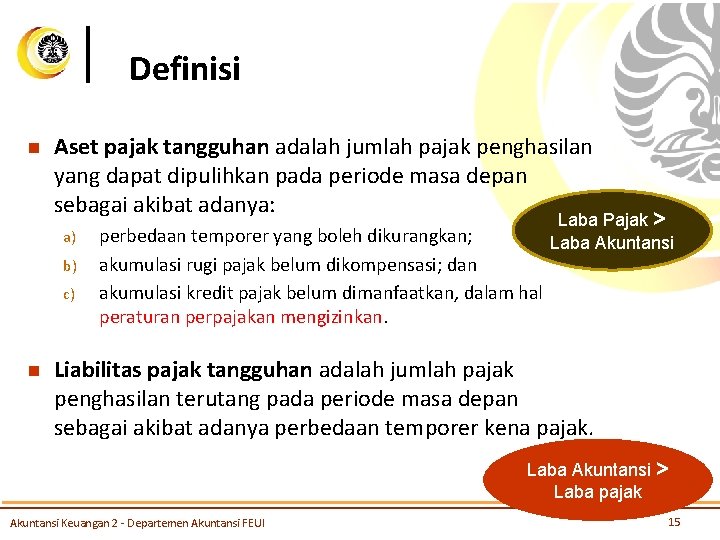
Definisi n Aset pajak tangguhan adalah jumlah pajak penghasilan yang dapat dipulihkan pada periode masa depan sebagai akibat adanya: a) b) c) n perbedaan temporer yang boleh dikurangkan; akumulasi rugi pajak belum dikompensasi; dan akumulasi kredit pajak belum dimanfaatkan, dalam hal peraturan perpajakan mengizinkan. Laba Pajak > Laba Akuntansi Liabilitas pajak tangguhan adalah jumlah pajak penghasilan terutang pada periode masa depan sebagai akibat adanya perbedaan temporer kena pajak. Laba Akuntansi > Laba pajak Akuntansi Keuangan 2 - Departemen Akuntansi FEUI 15
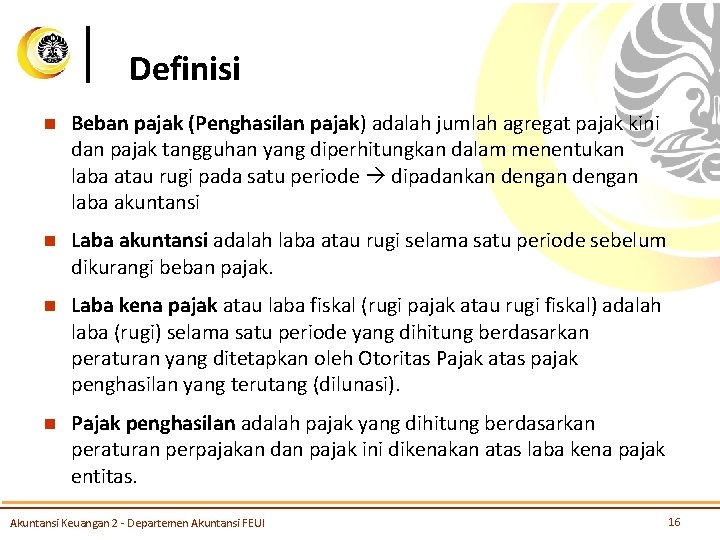
Definisi n Beban pajak (Penghasilan pajak) adalah jumlah agregat pajak kini dan pajak tangguhan yang diperhitungkan dalam menentukan laba atau rugi pada satu periode dipadankan dengan laba akuntansi n Laba akuntansi adalah laba atau rugi selama satu periode sebelum dikurangi beban pajak. n Laba kena pajak atau laba fiskal (rugi pajak atau rugi fiskal) adalah laba (rugi) selama satu periode yang dihitung berdasarkan peraturan yang ditetapkan oleh Otoritas Pajak atas pajak penghasilan yang terutang (dilunasi). n Pajak penghasilan adalah pajak yang dihitung berdasarkan peraturan perpajakan dan pajak ini dikenakan atas laba kena pajak entitas. Akuntansi Keuangan 2 - Departemen Akuntansi FEUI 16
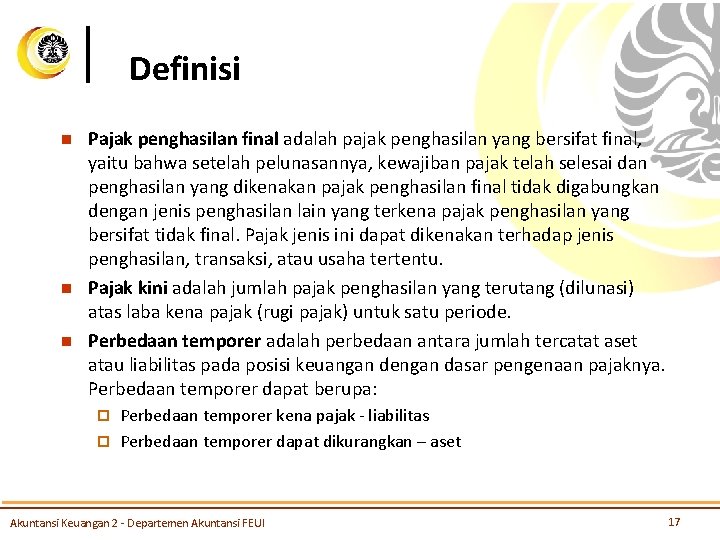
Definisi n n n Pajak penghasilan final adalah pajak penghasilan yang bersifat final, yaitu bahwa setelah pelunasannya, kewajiban pajak telah selesai dan penghasilan yang dikenakan pajak penghasilan final tidak digabungkan dengan jenis penghasilan lain yang terkena pajak penghasilan yang bersifat tidak final. Pajak jenis ini dapat dikenakan terhadap jenis penghasilan, transaksi, atau usaha tertentu. Pajak kini adalah jumlah pajak penghasilan yang terutang (dilunasi) atas laba kena pajak (rugi pajak) untuk satu periode. Perbedaan temporer adalah perbedaan antara jumlah tercatat aset atau liabilitas pada posisi keuangan dengan dasar pengenaan pajaknya. Perbedaan temporer dapat berupa: Perbedaan temporer kena pajak - liabilitas ¨ Perbedaan temporer dapat dikurangkan – aset ¨ Akuntansi Keuangan 2 - Departemen Akuntansi FEUI 17
Pengakuan pajak kini n Jumlah pajak kini, yang belum dibayar harus diakui sebagai liabilitas. n Apabila jumlah pajak yang telah dibayar untuk periode berjalan dan periode sebelumnya melebihi jumlah pajak terutang, maka selisihnya, diakui sebagai aset. n Manfaat yang berkaitan dengan rugi pajak yang dapat ditarik kembali untuk memulihkan pajak kini dari periode sebelumnya harus diakui sebagai aset. Akuntansi Keuangan 2 - Departemen Akuntansi FEUI 18
Pajak Tangguhan n n Pada saat entitas memiliki Laba sebelum pajak > Penghasilan kena pajak ada pengakuan pajak menurut akuntansi sehingga diakui beban pajak tangguhan dan kewajiban pajak tangguhan. Pada saat entitas memiliki Laba sebelum pajak < Penghasilan kena pajak yang dibayarkan lebih besar daripada laba menurut akuntansi sehingga diakui aset pajak tangguhan dan manfaat pajak tangguhan. Perusahaan memiliki kerugian dapat dikompensasikan di masa mendatang manfaat tersebut diakui pada saat kerugian tersebut terjadi Aset pajak tangguhan dan manfaat pajak tangguhan. Aset pajak tangguhan direview untuk memastikan bahwa manfaat di masa mendatang akan diperoleh entitas 19
Pengakuan aset pajak tangguhan dan liabilitas pajak tangguhan n Perbedaan Temporer Kena Pajak - Liabilitas ¨ ¨ n Kombinasi Bisnis Aset Tercatat pada Nilai Wajar Goodwill Pengakuan Awal Aset atau Liabilitas Perbedaan Temporer dapat Dikurangkan - Aset ¨ ¨ Goodwill Pengakuan Awal Aset atau Liabilitas n Rugi Pajak Belum Dikompensasi dan Kredit Pajak Belum Dimanfaatkan Aset n Revaluasi Aset Pajak Tangguhan yang Tidak Diakui n Investasi pada Entitas Anak, Cabang dan Entitas Asosiasi dan Bagian Partisipasi dalam Ventura Bersama Akuntansi Keuangan 2 - Departemen Akuntansi FEUI 20
Perbedaan Temporer Kena Pajak n Semua perbedaan temporer kena pajak diakui sebagai liabilitas pajak tangguhan, kecuali jika timbul perbedaan temporer kena pajak yang berasal dari: pengakuan awal goodwill; atau ¨ pada saat pengakuan awal aset atau liabilitas dari suatu transaksi yang: ¨ n n ¨ bukan transaksi kombinasi bisnis; dan pada saat transaksi, tidak mempengaruhi laba akuntansi dan laba kena pajak (rugi pajak). Perbedaan temporer kena pajak terkait dengan investasi pada entitas anak, cabang dan entitas asosiasi, dan ventura bersama, maka liabilitas pajak tangguhan harus diakui sesuai dengan paragraf 40. Akuntansi Keuangan 2 - Departemen Akuntansi FEUI 21
Perbedaan Temporer n n n Pendapatan bunga termasuk dalam laba akuntansi dalam dasar proporsi waktu tapi mungkin saja pendapatan bunga dihitung dalam laba kena pajak ketika kas diterima. Penyusutan yang digunakan dalam penghitungan pajak berbeda dengan penyusutan dalam akuntansi. Perbedaan temporernya adalah selisih antara jumlah tercatat aset dan DPP Biaya pengembangan dapat dikapitalisasi dalam akuntansi, tetapi untuk penentuan laba kena pajak, biaya pengembangan dikurangkan dalam menentukan laba kena pajak pada periode saat terjadinya. Akuntansi Keuangan 2 - Departemen Akuntansi FEUI 22
Penilaian Kembali Aset Pajak Tangguhan Tidak Diakui n n n Pada setiap akhir periode pelaporan, entitas menilai kembali aset pajak tangguhan. Entitas mengakui aset pajak tangguhan tidak diakui sebelumnya apabila kemungkinan besar laba kena pajak masa depan akan tersedia untuk dipulihkan. Sebagai contoh, perbaikan kondisi perekonomian meningkatkan kemampuan entitas untuk menghasilkan laba kena pajak dalam jumlah yang memadai pada periode masa depan sehingga aset pajak tangguhan yang sebelumnya tidak diakui menjadi memenuhi kriteria pengakuan Akuntansi Keuangan 2 - Departemen Akuntansi FEUI 23
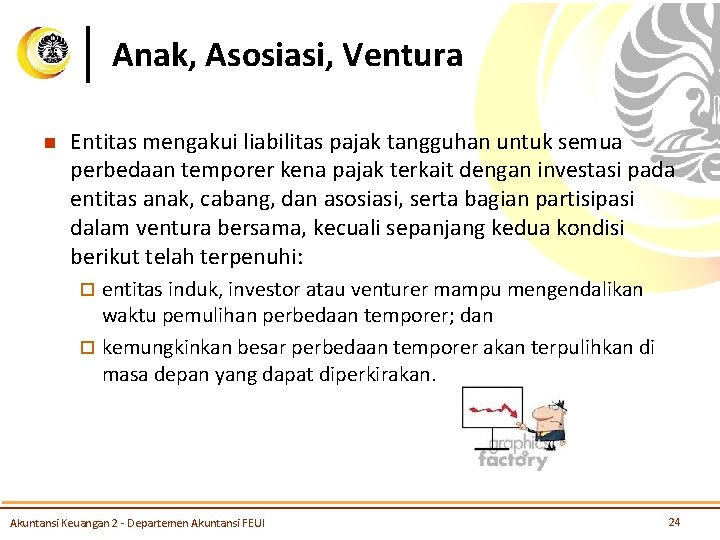
Anak, Asosiasi, Ventura n Entitas mengakui liabilitas pajak tangguhan untuk semua perbedaan temporer kena pajak terkait dengan investasi pada entitas anak, cabang, dan asosiasi, serta bagian partisipasi dalam ventura bersama, kecuali sepanjang kedua kondisi berikut telah terpenuhi: entitas induk, investor atau venturer mampu mengendalikan waktu pemulihan perbedaan temporer; dan ¨ kemungkinkan besar perbedaan temporer akan terpulihkan di masa depan yang dapat diperkirakan. ¨ Akuntansi Keuangan 2 - Departemen Akuntansi FEUI 24
Anak, Asosiasi, Ventura n Entitas harus mengakui aset pajak tangguhan untuk semua perbedaan temporer dapat dikurangkan yang ditimbulkan dari entitas anak, cabang dan entitas asosiasi, serta bagian partisipasi dalam ventura bersama sepanjang dan hanya sepanjang kemungkinan besar terjadi: perbedaan temporer akan terpulihkan pada masa depan yang dapat diperkirakan; dan ¨ laba kena pajak akan tersedia dalam jumlah yang memadai sehingga perbedaan temporer dapat dimanfaatkan. ¨ Akuntansi Keuangan 2 - Departemen Akuntansi FEUI 25
Pengukuran n n Liabilitas (aset) pajak kini untuk periode kini dan periode sebelumnya diukur sebesar jumlah yang diharapkan untuk dibayar (direstitusi) kepada otoritas perpajakan, yang dihitung menggunakan tarif pajak (peraturan pajak) yang telah berlaku atau yang telah secara substantif berlaku pada periode pelaporan. Aset dan liabilitas pajak tangguhan harus diukur dengan menggunakan tarif pajak yang akan berlaku pada saat aset dipulihkan atau liabilitas diselesaikan, yaitu dengan tarif pajak (dan peraturan pajak) yang telah berlaku atau yang telah secara substantif berlaku pada periode pelaporan. Akuntansi Keuangan 2 - Departemen Akuntansi FEUI 26
Pos diakui dalam Laporan Laba Rugi n Pajak kini dan pajak tangguhan diakui sebagai penghasilan atau beban pada laporan laba rugi, kecuali apabila pajak penghasilan yang berasal dari: suatu transaksi atau kejadian yang diakui, pada periode yang sama atau berbeda, di luar laporan laba rugi baik dalam pendapatan komprehensif lain maupun secara langsung dalam ekuitas. Atau ¨ kombinasi bisnis ¨ Akuntansi Keuangan 2 - Departemen Akuntansi FEUI 27
Pos diakui di Luar Laporan Laba Rugi n Pajak kini dan pajak tangguhan diakui di luar laporan laba rugi apabila pajak terkait pada pos-pos tersebut pada periode yang sama atau berbeda, diakui di luar laporan laba rugi. Oleh karena itu, pada periode yang sama atau berbeda, pajak kini dan pajak tangguhan terkait dengan pos-pos yang diakui: dalam pendapatan komprehensif lain, harus diakui pada pendapatan komprehensif lain. ¨ langsung ke ekuitas, harus diakui langsung pada ekuitas. ¨ Akuntansi Keuangan 2 - Departemen Akuntansi FEUI 28
Penyajian n Saling hapus ¨ Entitas melakuan saling hapus atas aset pajak kini dan liabilitas pajak kini jika dan hanya jika, entitas: n n ¨ Memiliki hak secara hukum untuk melakukan saling hapus jumlah yang diakui; dan Berniat untuk menyelesaikan dengan dasar neto, atau merealisasikan aset dan menyelesaikan liabilitas secara bersamaan. Entitas melakukan saling hapus aset pajak tangguhan dan liabilitas pajak tangguhan jika dan hanya jika: n n entitas memiliki hak secara hukum untuk saling hapus aset pajak kini terhadap liabilitas pajak kini; dan aset pajak tangguhan dan liabilitas pajak tangguhan terkait dengan pajak penghasilan yang dikenakan oleh otoritas pajak atas entitas kena pajak yang sama atau entitas kena pajak berbeda yang akan merelaisasikan secara bersama Akuntansi Keuangan 2 - Departemen Akuntansi FEUI 29
Beban Pajak – Laba Rugi Aktivitas Normal n n Beban (penghasilan) pajak terkait dengan laba rugi dari aktifitas normal disajikan tersendiri pada laporan laba rugi komprehensif. Jika entitas menyajikan komponen laba rugi pada laporan laba rugi secara terpisah, maka beban (penghasilan) pajak terkait dengan laba rugi dari aktivitas normal pada laporan keuangan disajikan terpisah. Akuntansi Keuangan 2 - Departemen Akuntansi FEUI 30
Pengungkapan n Komponen utama beban (penghasilan) pajak diungkapkan secara terpisah : ¨ ¨ ¨ ¨ beban (penghasilan) pajak kini; Penyesuaian atas pajak kini yang berasal dari periode sebelumnya; jumlah beban (penghasilan) pajak tangguhan baik yang berasal dari timbulnya perbedaan temporer maupun dari realisasinya; jumlah beban (penghasilan) pajak tangguhan terkait dengan perubahan tarif pajak atau penerapan peraturan perpajakan yang baru; jumlah manfaat yang ditimbulkan dari rugi pajak yang tidak diakui sebelumnya, kredit pajak atau perbedaan temporer periode sebelumnya yang digunakan untuk mengurangi beban pajak kini; jumlah manfaat dari rugi pajak yang tidak diakui sebelumnya, kredit pajak, atau perbedaan temporer periode sebelumnya yang digunakan untuk mengurangi beban pajak tangguhan; Dll. Akuntansi Keuangan 2 - Departemen Akuntansi FEUI 31
Pengungkapan n Hal-hal yang juga diungkapkan secara terpisah: ¨ Agregat pajak kini dan pajak tangguhan berkaitan dengan transaksi-transaksi yang langsung dibebankan atau dikreditkan langsung ke ekuitas; ¨ jumlah pajak penghasilan berkaitan dengan setiap komponen pendapatan komprehensif lain ¨ penjelasan hubungan antara beban (penghasilan) pajak dengan laba n n n rekonsiliasi angka antara beban (penghasilan) pajak dengan hasil perkalian laba akuntansi dan tarif pajak yang berlaku rekonsiliasi angka antara tarif pajak efektif rata-rata dan tarif pajak yang berlaku, penjelasan mengenai perubahan tarif pajak yang berlaku dan perbandingan dengan tarif pajak yang berlaku pada periode akuntansi sebelumnya; jumlah (dan batas waktu penggunaan, jika ada) perbedaan temporer yang boleh dikurangkan, rugi pajak belum dikompensasi dan kredit pajak belum dimanfaatkan yang tidak diakui sebagai aset pajak tangguhan pada laporan keuangan; jumlah agregat perbedaan temporer yang dihubungkan dengan investasi pada entitas anak, cabang dan perusahaan asosiasi dan bagian partisipasi dalam ventura bersama atas liabilitas pajak tangguhan yang belum diakui (lihat paragraf 40); dll Akuntansi Keuangan 2 - Departemen Akuntansi FEUI 32
Pajak Penghasilan Final n n Apabila nilai tercatat aset atau liabilitas yang berhubungan dengan pajak penghasilan final berbeda dari dasar pengenaan pajaknya maka perbedaan tersebut tidak diakui sebagai aset atau liabilitas pajak tangguhan. Atas penghasilan yang telah dikenakan PPh final, beban pajak diakui proporsional dengan jumlah pendapatan menurut akuntansi yang diakui pada periode berjalan. Selisih antara jumlah PPh final yang terutang dengan jumlah yang dibebankan sebagai pajak kini pada perhitungan laba rugi diakui sebagai Pajak Dibayar Dimuka dan Pajak yang Masih Harus Dibayar. Akun Pajak penghasilan final dibayar dimuka harus disajikan terpisah dari pajak penghasilan final yang masih harus dibayar. Akuntansi Keuangan 2 - Departemen Akuntansi FEUI 33
Perlakuan untuk hal –hal khusus n Jumlah tambahan pokok dan denda pajak yang ditetapkan dengan Surat Ketetapan Pajak (SKP) dibebankan sebagai: ¨ n pendapatan atau beban lain-lain pada Laporan Laba Rugi periode berjalan, kecuali apabila diajukan keberatan dan atau banding. Jumlah tambahan pokok pajak dan denda yang ditetapkan dengan SKP ditangguhkan pembebanannya sepanjang memenuhi kriteria pengakuan aset. Apabila terdapat kesalahan maka perlakuan akuntansinya mengacu pada PSAK 25 Akuntansi Keuangan 2 - Departemen Akuntansi FEUI 34
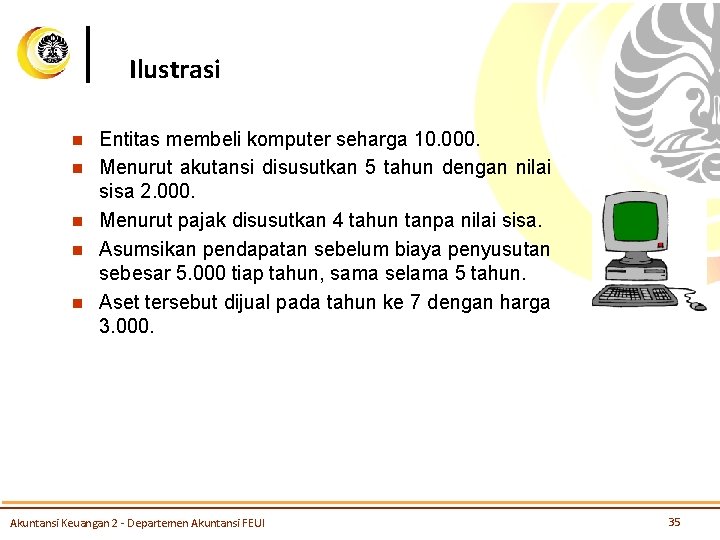
Ilustrasi n n n Entitas membeli komputer seharga 10. 000. Menurut akutansi disusutkan 5 tahun dengan nilai sisa 2. 000. Menurut pajak disusutkan 4 tahun tanpa nilai sisa. Asumsikan pendapatan sebelum biaya penyusutan sebesar 5. 000 tiap tahun, sama selama 5 tahun. Aset tersebut dijual pada tahun ke 7 dengan harga 3. 000. Akuntansi Keuangan 2 - Departemen Akuntansi FEUI 35
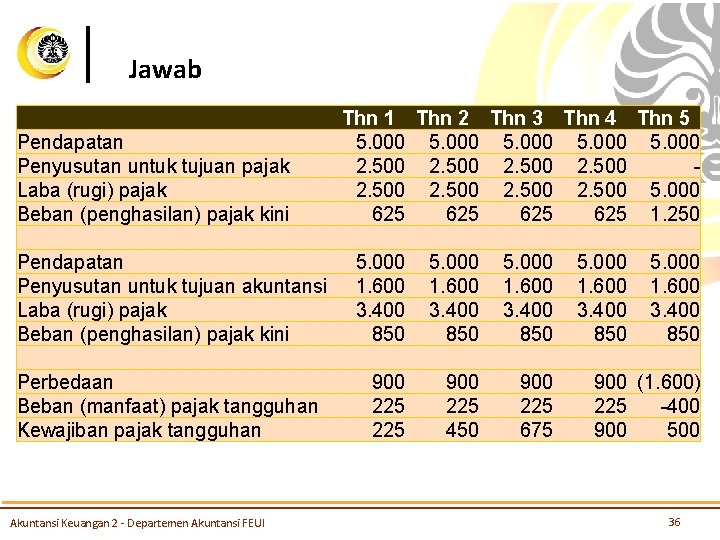
Jawab Thn 1 Thn 2 Thn 3 Thn 4 Thn 5 Pendapatan 5. 000 Penyusutan untuk tujuan pajak 2. 500 - Laba (rugi) pajak 2. 500 5. 000 Beban (penghasilan) pajak kini 625 1. 250 Pendapatan 5. 000 Penyusutan untuk tujuan akuntansi 1. 600 Laba (rugi) pajak 3. 400 Beban (penghasilan) pajak kini 850 850 Perbedaan 900 (1. 600) Beban (manfaat) pajak tangguhan 225 225 -400 Kewajiban pajak tangguhan 225 450 675 900 500 Akuntansi Keuangan 2 - Departemen Akuntansi FEUI 36
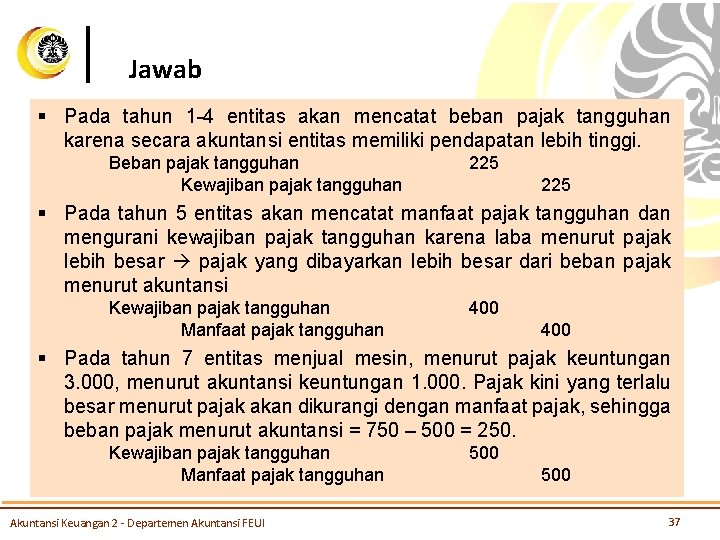
Jawab § Pada tahun 1 -4 entitas akan mencatat beban pajak tangguhan karena secara akuntansi entitas memiliki pendapatan lebih tinggi. Beban pajak tangguhan Kewajiban pajak tangguhan 225 § Pada tahun 5 entitas akan mencatat manfaat pajak tangguhan dan mengurani kewajiban pajak tangguhan karena laba menurut pajak lebih besar pajak yang dibayarkan lebih besar dari beban pajak menurut akuntansi Kewajiban pajak tangguhan Manfaat pajak tangguhan 400 § Pada tahun 7 entitas menjual mesin, menurut pajak keuntungan 3. 000, menurut akuntansi keuntungan 1. 000. Pajak kini yang terlalu besar menurut pajak akan dikurangi dengan manfaat pajak, sehingga beban pajak menurut akuntansi = 750 – 500 = 250. Kewajiban pajak tangguhan Manfaat pajak tangguhan Akuntansi Keuangan 2 - Departemen Akuntansi FEUI 500 37
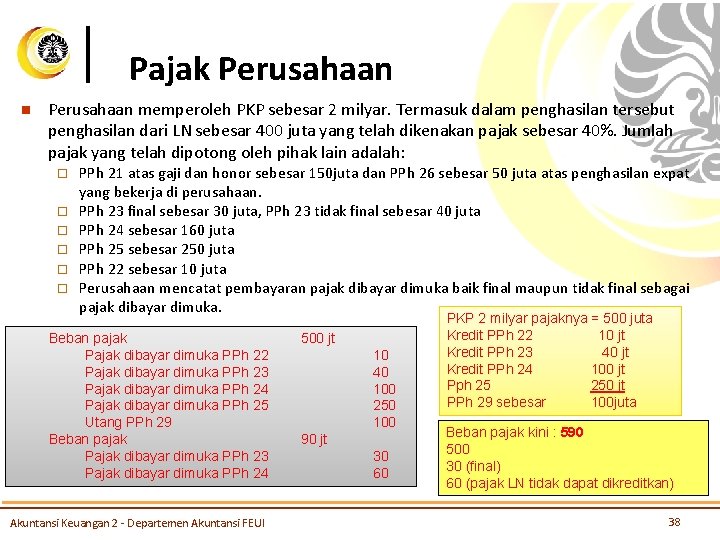
Pajak Perusahaan n Perusahaan memperoleh PKP sebesar 2 milyar. Termasuk dalam penghasilan tersebut penghasilan dari LN sebesar 400 juta yang telah dikenakan pajak sebesar 40%. Jumlah pajak yang telah dipotong oleh pihak lain adalah: ¨ ¨ ¨ PPh 21 atas gaji dan honor sebesar 150 juta dan PPh 26 sebesar 50 juta atas penghasilan expat yang bekerja di perusahaan. PPh 23 final sebesar 30 juta, PPh 23 tidak final sebesar 40 juta PPh 24 sebesar 160 juta PPh 25 sebesar 250 juta PPh 22 sebesar 10 juta Perusahaan mencatat pembayaran pajak dibayar dimuka baik final maupun tidak final sebagai pajak dibayar dimuka. Beban pajak Pajak dibayar dimuka PPh 22 Pajak dibayar dimuka PPh 23 Pajak dibayar dimuka PPh 24 Pajak dibayar dimuka PPh 25 Utang PPh 29 Beban pajak Pajak dibayar dimuka PPh 23 Pajak dibayar dimuka PPh 24 Akuntansi Keuangan 2 - Departemen Akuntansi FEUI 500 jt 10 40 100 250 100 90 jt 30 60 PKP 2 milyar pajaknya = 500 juta Kredit PPh 22 10 jt Kredit PPh 23 40 jt Kredit PPh 24 100 jt Pph 25 250 jt PPh 29 sebesar 100 juta Beban pajak kini : 590 500 30 (final) 60 (pajak LN tidak dapat dikreditkan) 38
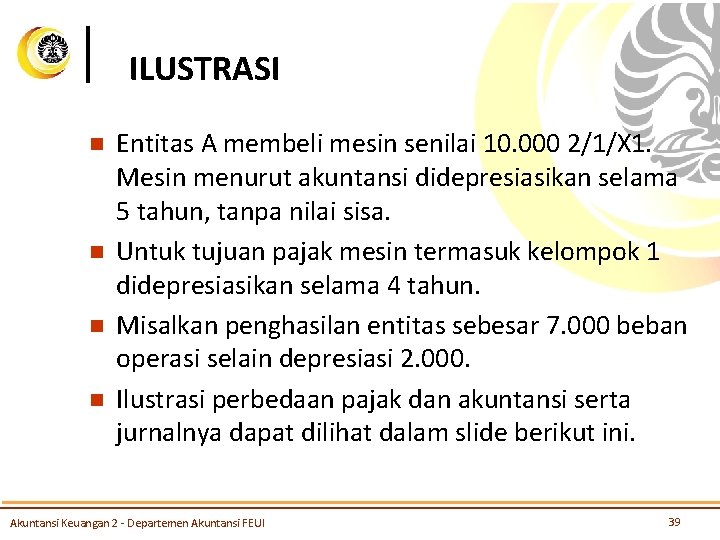
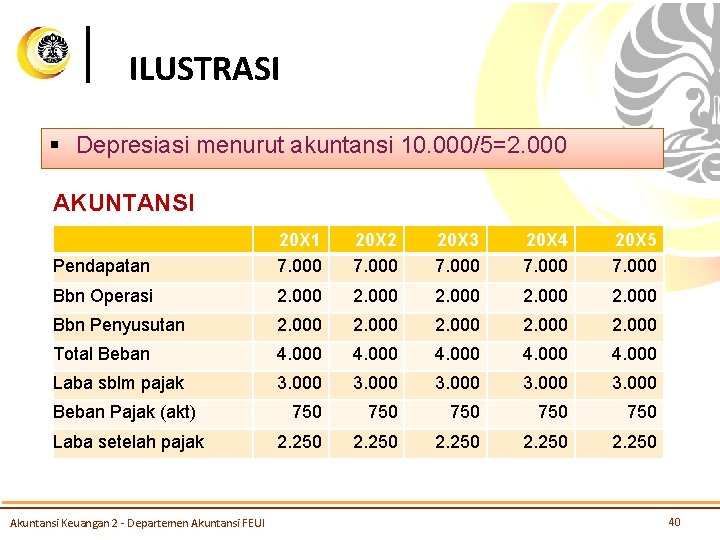
ILUSTRASI n n Entitas A membeli mesin senilai 10. 000 2/1/X 1. Mesin menurut akuntansi didepresiasikan selama 5 tahun, tanpa nilai sisa. Untuk tujuan pajak mesin termasuk kelompok 1 didepresiasikan selama 4 tahun. Misalkan penghasilan entitas sebesar 7. 000 beban operasi selain depresiasi 2. 000. Ilustrasi perbedaan pajak dan akuntansi serta jurnalnya dapat dilihat dalam slide berikut ini. Akuntansi Keuangan 2 - Departemen Akuntansi FEUI 39
ILUSTRASI § Depresiasi menurut akuntansi 10. 000/5=2. 000 AKUNTANSI Pendapatan 20 X 1 7. 000 20 X 2 7. 000 20 X 3 7. 000 20 X 4 7. 000 20 X 5 7. 000 Bbn Operasi 2. 000 Bbn Penyusutan 2. 000 Total Beban 4. 000 Laba sblm pajak 3. 000 750 750 750 2. 250 Beban Pajak (akt) Laba setelah pajak Akuntansi Keuangan 2 - Departemen Akuntansi FEUI 40
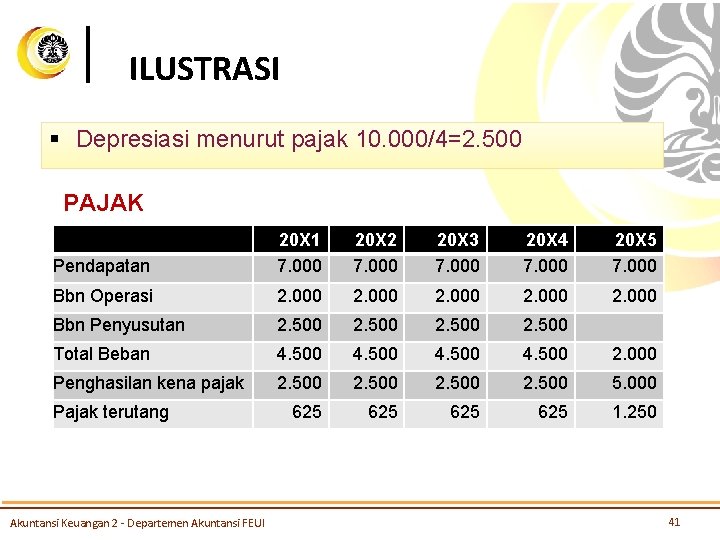
ILUSTRASI § Depresiasi menurut pajak 10. 000/4=2. 500 PAJAK Pendapatan 20 X 1 7. 000 20 X 2 7. 000 20 X 3 7. 000 20 X 4 7. 000 20 X 5 7. 000 Bbn Operasi 2. 000 Bbn Penyusutan 2. 500 Total Beban 4. 500 2. 000 Penghasilan kena pajak 2. 500 5. 000 625 625 1. 250 Pajak terutang Akuntansi Keuangan 2 - Departemen Akuntansi FEUI 41
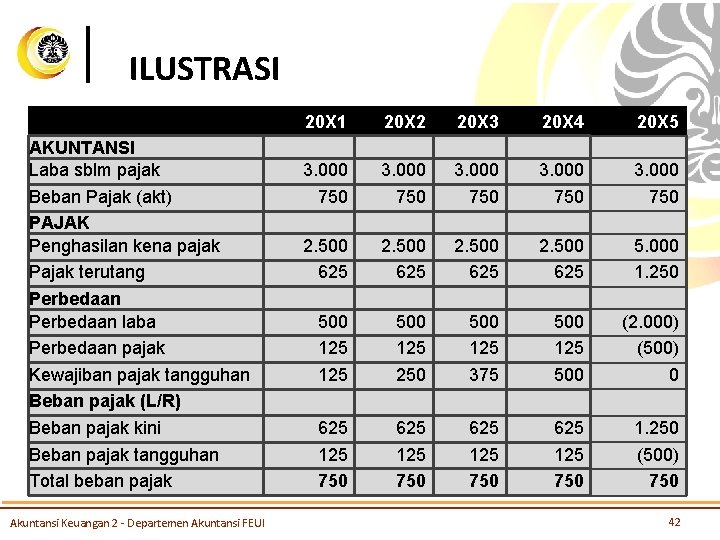
ILUSTRASI AKUNTANSI Laba sblm pajak Beban Pajak (akt) PAJAK Penghasilan kena pajak Pajak terutang Perbedaan laba Perbedaan pajak Kewajiban pajak tangguhan Beban pajak (L/R) Beban pajak kini Beban pajak tangguhan Total beban pajak Akuntansi Keuangan 2 - Departemen Akuntansi FEUI 20 X 1 20 X 2 20 X 3 20 X 4 20 X 5 3. 000 750 2. 500 625 5. 000 1. 250 500 125 250 500 125 375 500 125 500 (2. 000) (500) 0 625 125 750 1. 250 (500) 750 42
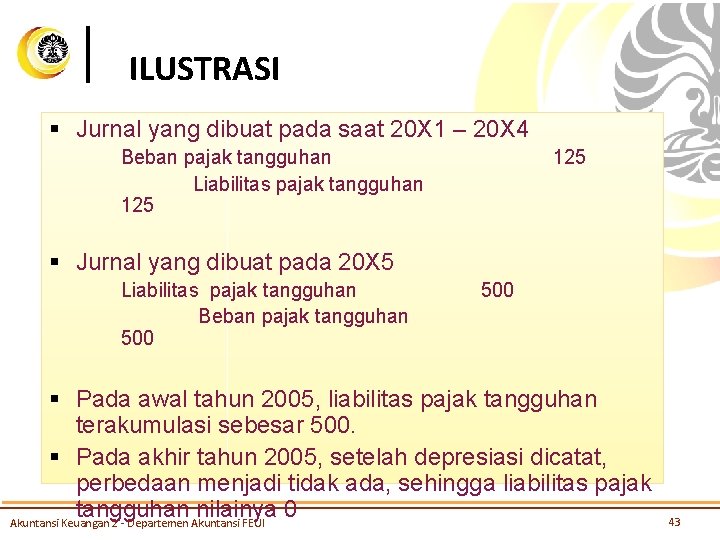
ILUSTRASI § Jurnal yang dibuat pada saat 20 X 1 – 20 X 4 Beban pajak tangguhan Liabilitas pajak tangguhan 125 § Jurnal yang dibuat pada 20 X 5 Liabilitas pajak tangguhan Beban pajak tangguhan 500 § Pada awal tahun 2005, liabilitas pajak tangguhan terakumulasi sebesar 500. § Pada akhir tahun 2005, setelah depresiasi dicatat, perbedaan menjadi tidak ada, sehingga liabilitas pajak tangguhan nilainya 0 Akuntansi Keuangan 2 - Departemen Akuntansi FEUI 43
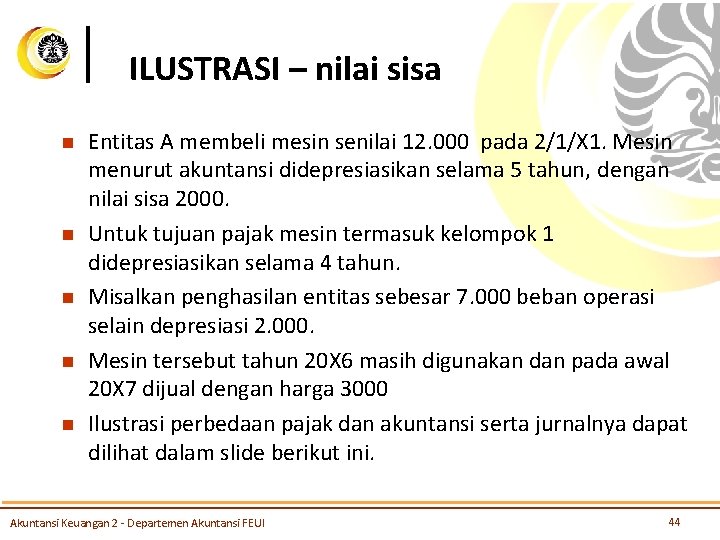
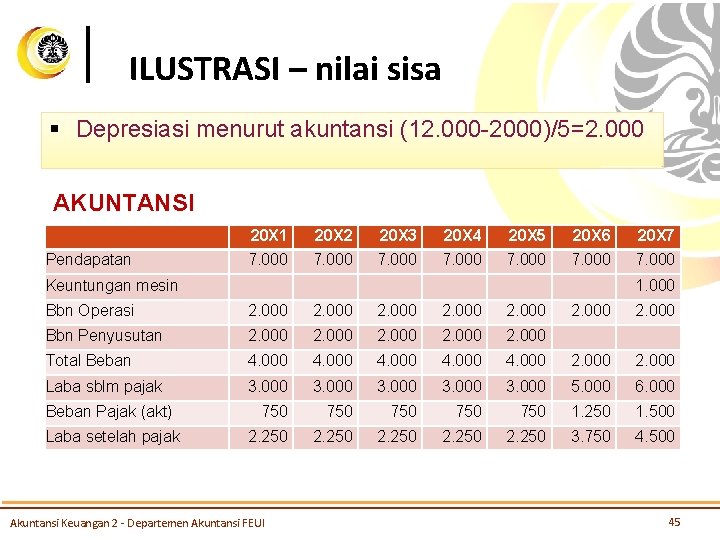
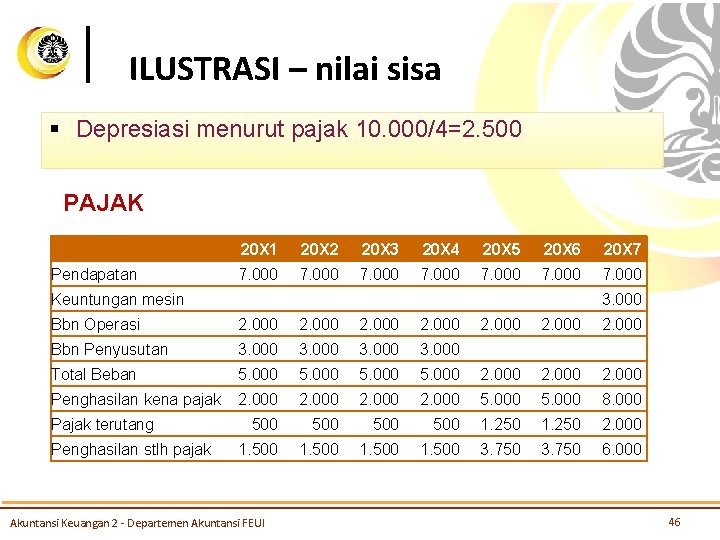
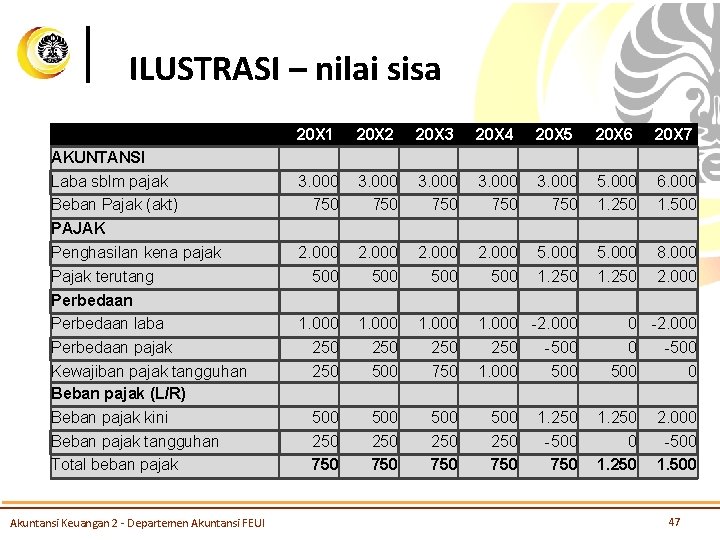
ILUSTRASI – nilai sisa n n n Entitas A membeli mesin senilai 12. 000 pada 2/1/X 1. Mesin menurut akuntansi didepresiasikan selama 5 tahun, dengan nilai sisa 2000. Untuk tujuan pajak mesin termasuk kelompok 1 didepresiasikan selama 4 tahun. Misalkan penghasilan entitas sebesar 7. 000 beban operasi selain depresiasi 2. 000. Mesin tersebut tahun 20 X 6 masih digunakan dan pada awal 20 X 7 dijual dengan harga 3000 Ilustrasi perbedaan pajak dan akuntansi serta jurnalnya dapat dilihat dalam slide berikut ini. Akuntansi Keuangan 2 - Departemen Akuntansi FEUI 44
ILUSTRASI – nilai sisa § Depresiasi menurut akuntansi (12. 000 -2000)/5=2. 000 AKUNTANSI 20 X 1 20 X 2 20 X 3 20 X 4 20 X 5 20 X 6 20 X 7 Pendapatan 7. 000 7. 000 1. 000 Bbn Operasi 2. 000 2. 000 Bbn Penyusutan 2. 000 Total Beban 4. 000 2. 000 Laba sblm pajak 3. 000 5. 000 6. 000 750 750 750 1. 250 1. 500 2. 250 3. 750 4. 500 Keuntungan mesin Beban Pajak (akt) Laba setelah pajak Akuntansi Keuangan 2 - Departemen Akuntansi FEUI 45
ILUSTRASI – nilai sisa § Depresiasi menurut pajak 10. 000/4=2. 500 PAJAK 20 X 1 20 X 2 20 X 3 20 X 4 20 X 5 20 X 6 20 X 7 Pendapatan 7. 000 7. 000 3. 000 Bbn Operasi 2. 000 2. 000 Bbn Penyusutan 3. 000 Total Beban 5. 000 2. 000 Penghasilan kena pajak 2. 000 5. 000 8. 000 500 500 1. 250 2. 000 1. 500 3. 750 6. 000 Keuntungan mesin Pajak terutang Penghasilan stlh pajak Akuntansi Keuangan 2 - Departemen Akuntansi FEUI 46
ILUSTRASI – nilai sisa AKUNTANSI Laba sblm pajak Beban Pajak (akt) PAJAK Penghasilan kena pajak Pajak terutang Perbedaan laba Perbedaan pajak Kewajiban pajak tangguhan Beban pajak (L/R) Beban pajak kini Beban pajak tangguhan Total beban pajak Akuntansi Keuangan 2 - Departemen Akuntansi FEUI 20 X 1 3. 000 750 2. 000 500 1. 000 250 500 250 750 20 X 2 3. 000 750 2. 000 500 1. 000 250 500 250 750 20 X 3 3. 000 750 2. 000 500 1. 000 250 750 500 250 750 20 X 4 20 X 5 3. 000 750 2. 000 500 1. 250 1. 000 -2. 000 250 -500 1. 000 500 1. 250 -500 750 20 X 6 20 X 7 5. 000 6. 000 1. 250 1. 500 5. 000 8. 000 1. 250 2. 000 0 -500 1. 250 1. 500 47
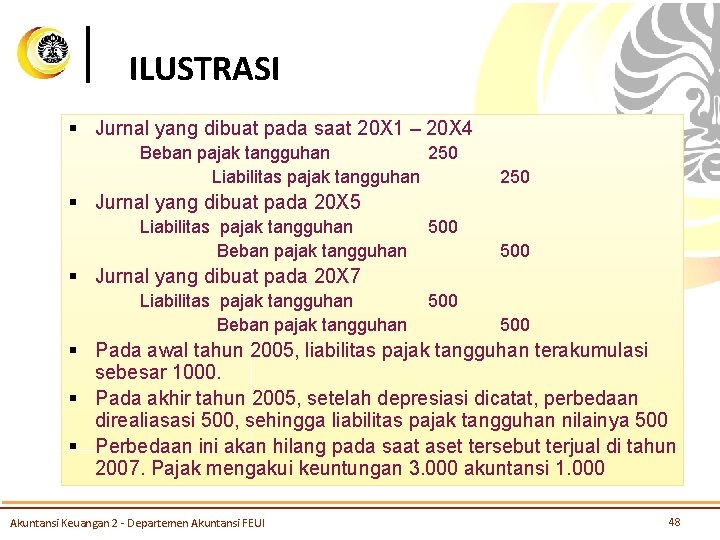
ILUSTRASI § Jurnal yang dibuat pada saat 20 X 1 – 20 X 4 Beban pajak tangguhan 250 Liabilitas pajak tangguhan 250 § Jurnal yang dibuat pada 20 X 5 Liabilitas pajak tangguhan 500 Beban pajak tangguhan 500 § Jurnal yang dibuat pada 20 X 7 Liabilitas pajak tangguhan 500 Beban pajak tangguhan 500 § Pada awal tahun 2005, liabilitas pajak tangguhan terakumulasi sebesar 1000. § Pada akhir tahun 2005, setelah depresiasi dicatat, perbedaan direaliasasi 500, sehingga liabilitas pajak tangguhan nilainya 500 § Perbedaan ini akan hilang pada saat aset tersebut terjual di tahun 2007. Pajak mengakui keuntungan 3. 000 akuntansi 1. 000 Akuntansi Keuangan 2 - Departemen Akuntansi FEUI 48
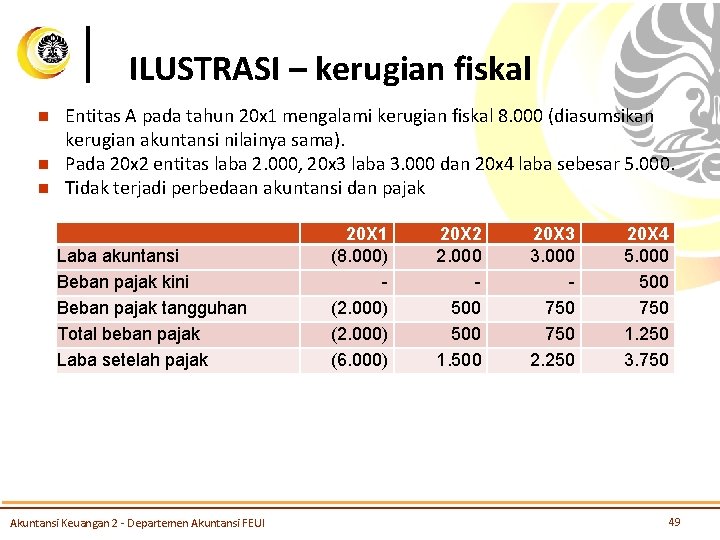
ILUSTRASI – kerugian fiskal n n n Entitas A pada tahun 20 x 1 mengalami kerugian fiskal 8. 000 (diasumsikan kerugian akuntansi nilainya sama). Pada 20 x 2 entitas laba 2. 000, 20 x 3 laba 3. 000 dan 20 x 4 laba sebesar 5. 000. Tidak terjadi perbedaan akuntansi dan pajak Laba akuntansi Beban pajak kini Beban pajak tangguhan Total beban pajak Laba setelah pajak Akuntansi Keuangan 2 - Departemen Akuntansi FEUI 20 X 1 (8. 000) - (2. 000) (6. 000) 20 X 2 2. 000 - 500 1. 500 20 X 3 3. 000 - 750 2. 250 20 X 4 5. 000 500 750 1. 250 3. 750 49
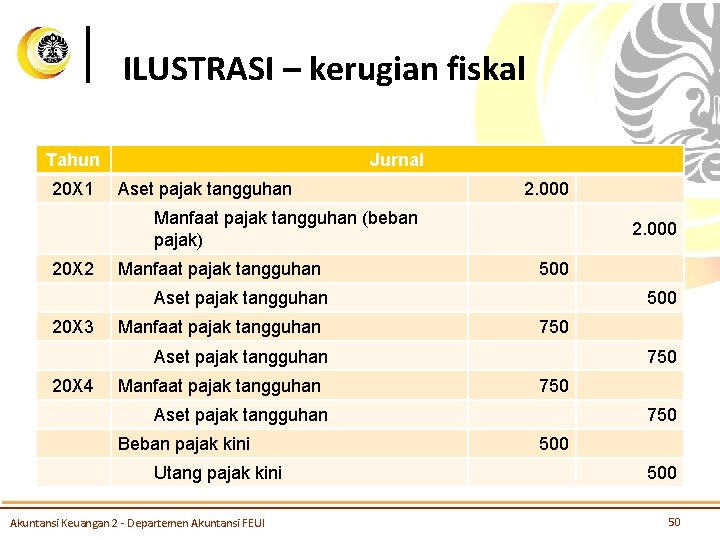
ILUSTRASI – kerugian fiskal Tahun 20 X 1 Jurnal Aset pajak tangguhan 2. 000 Manfaat pajak tangguhan (beban pajak) 20 X 2 Manfaat pajak tangguhan 2. 000 500 Aset pajak tangguhan 20 X 3 Manfaat pajak tangguhan 500 750 Aset pajak tangguhan 20 X 4 Manfaat pajak tangguhan 750 Aset pajak tangguhan Beban pajak kini Utang pajak kini Akuntansi Keuangan 2 - Departemen Akuntansi FEUI 750 500 50
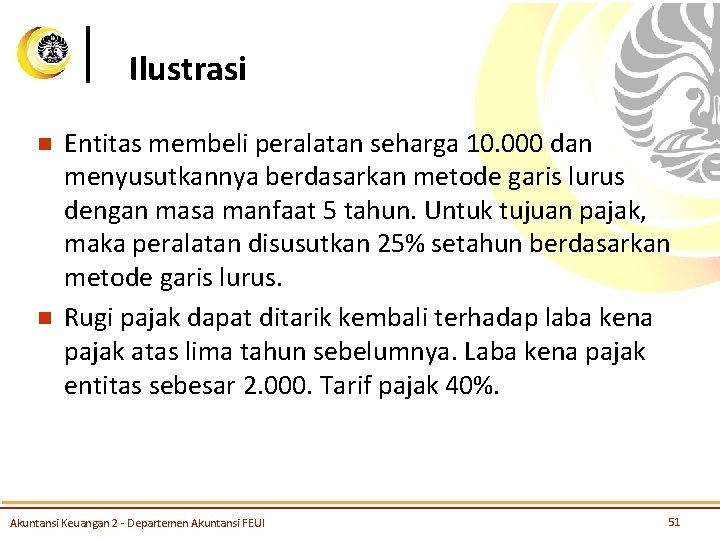
Ilustrasi n n Entitas membeli peralatan seharga 10. 000 dan menyusutkannya berdasarkan metode garis lurus dengan masa manfaat 5 tahun. Untuk tujuan pajak, maka peralatan disusutkan 25% setahun berdasarkan metode garis lurus. Rugi pajak dapat ditarik kembali terhadap laba kena pajak atas lima tahun sebelumnya. Laba kena pajak entitas sebesar 2. 000. Tarif pajak 40%. Akuntansi Keuangan 2 - Departemen Akuntansi FEUI 51
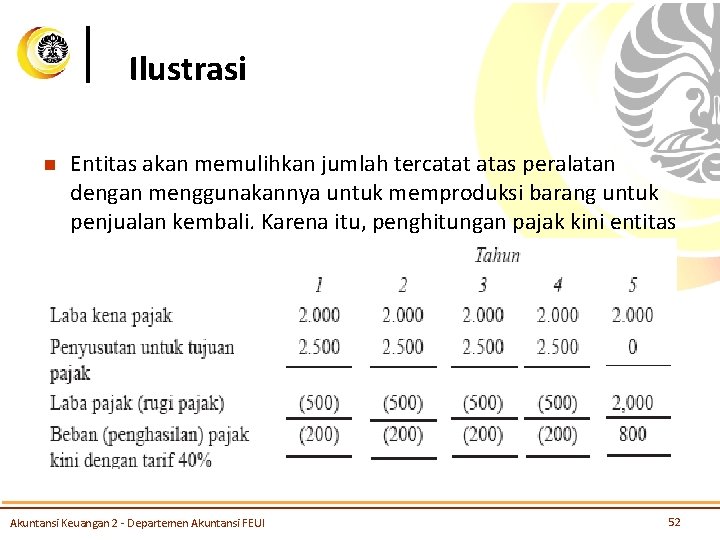
Ilustrasi n Entitas akan memulihkan jumlah tercatat atas peralatan dengan menggunakannya untuk memproduksi barang untuk penjualan kembali. Karena itu, penghitungan pajak kini entitas sebagai berikut: Akuntansi Keuangan 2 - Departemen Akuntansi FEUI 52
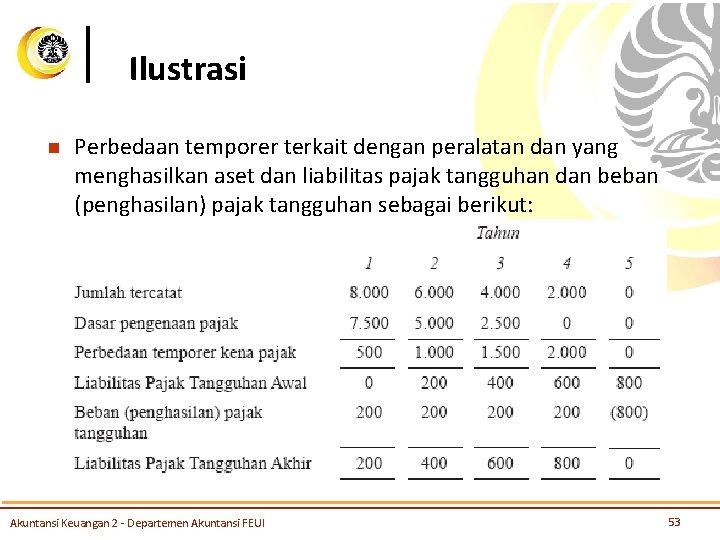
Ilustrasi n Perbedaan temporer terkait dengan peralatan dan yang menghasilkan aset dan liabilitas pajak tangguhan dan beban (penghasilan) pajak tangguhan sebagai berikut: Akuntansi Keuangan 2 - Departemen Akuntansi FEUI 53
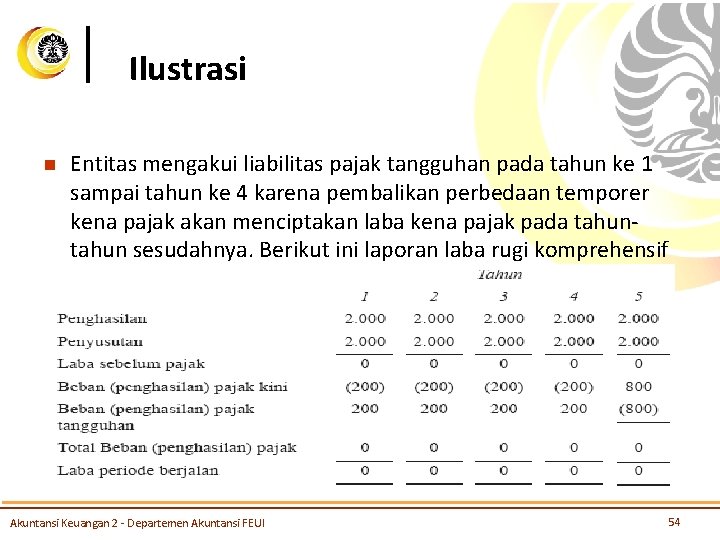
Ilustrasi n Entitas mengakui liabilitas pajak tangguhan pada tahun ke 1 sampai tahun ke 4 karena pembalikan perbedaan temporer kena pajak akan menciptakan laba kena pajak pada tahun sesudahnya. Berikut ini laporan laba rugi komprehensif entitas: Akuntansi Keuangan 2 - Departemen Akuntansi FEUI 54
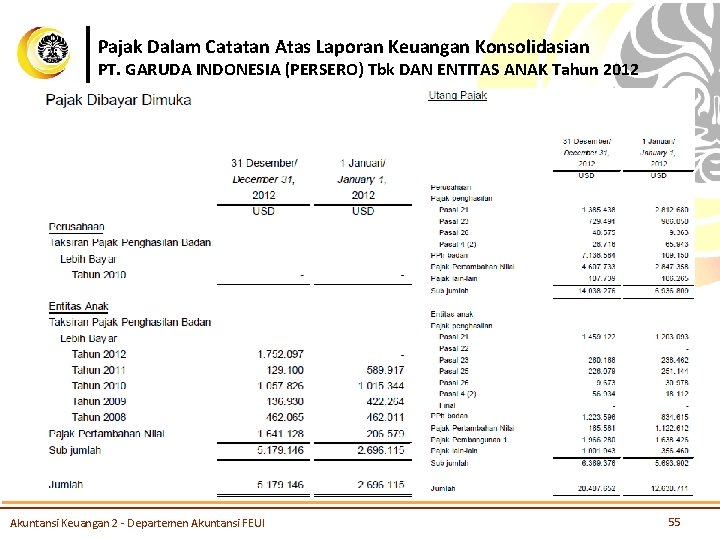
Pajak Dalam Catatan Atas Laporan Keuangan Konsolidasian PT. GARUDA INDONESIA (PERSERO) Tbk DAN ENTITAS ANAK Tahun 2012 Akuntansi Keuangan 2 - Departemen Akuntansi FEUI 55
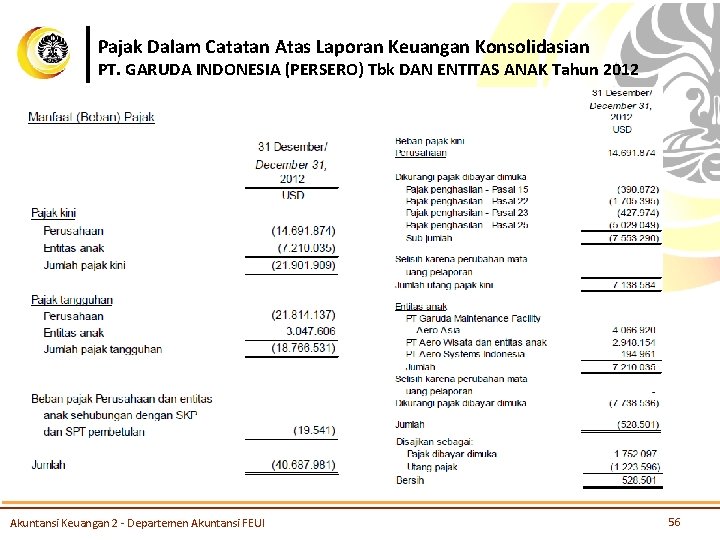
Pajak Dalam Catatan Atas Laporan Keuangan Konsolidasian PT. GARUDA INDONESIA (PERSERO) Tbk DAN ENTITAS ANAK Tahun 2012 Akuntansi Keuangan 2 - Departemen Akuntansi FEUI 56
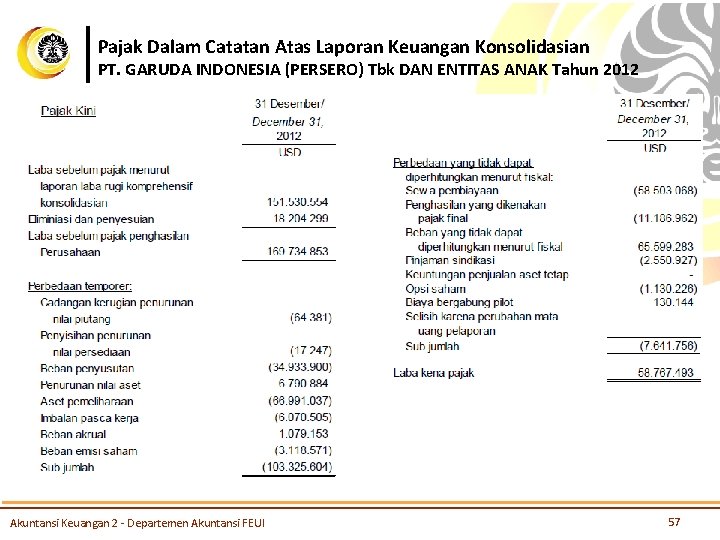
Pajak Dalam Catatan Atas Laporan Keuangan Konsolidasian PT. GARUDA INDONESIA (PERSERO) Tbk DAN ENTITAS ANAK Tahun 2012 Akuntansi Keuangan 2 - Departemen Akuntansi FEUI 57
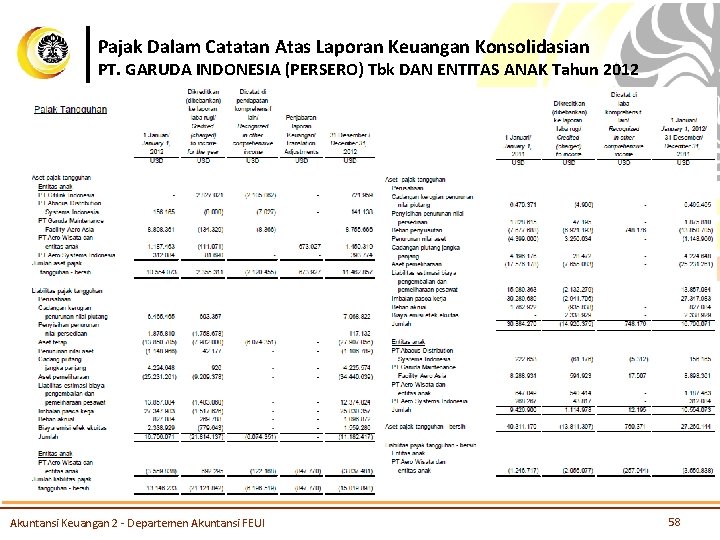
Pajak Dalam Catatan Atas Laporan Keuangan Konsolidasian PT. GARUDA INDONESIA (PERSERO) Tbk DAN ENTITAS ANAK Tahun 2012 Akuntansi Keuangan 2 - Departemen Akuntansi FEUI 58
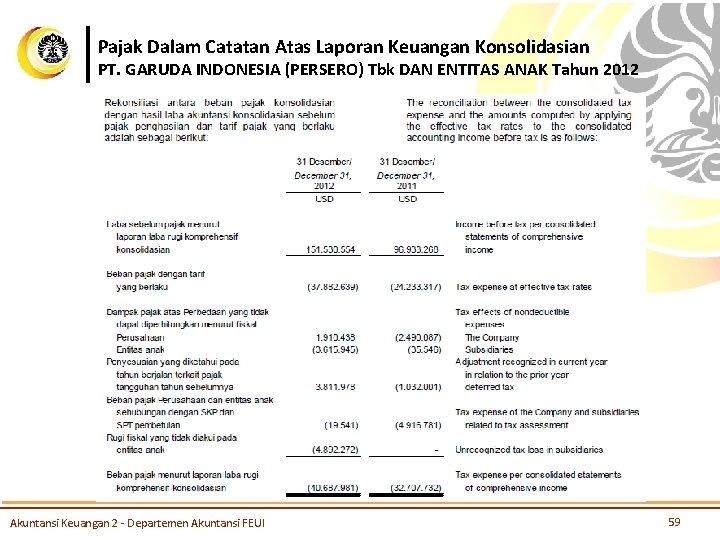
Pajak Dalam Catatan Atas Laporan Keuangan Konsolidasian PT. GARUDA INDONESIA (PERSERO) Tbk DAN ENTITAS ANAK Tahun 2012 Akuntansi Keuangan 2 - Departemen Akuntansi FEUI 59
Volume 2 19 -60
C H A P T E R 19 ACCOUNTING FOR INCOME TAXES Intermediate Accounting IFRS Edition Kieso, Weygandt, and Warfield 19 -61
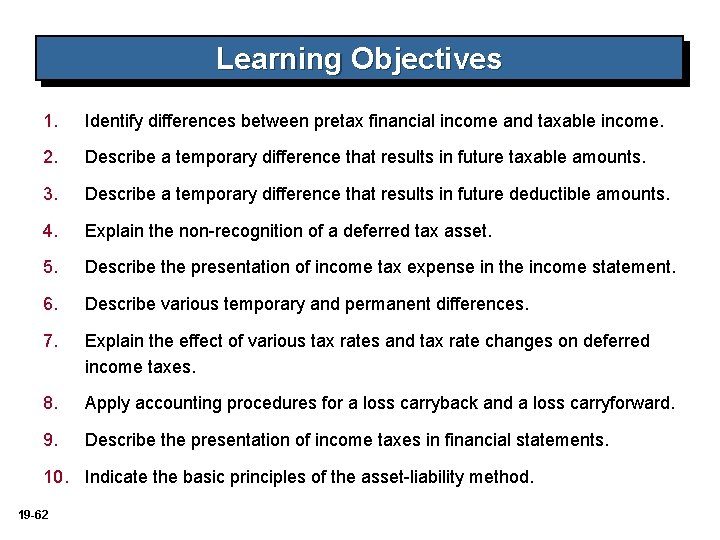
Learning Objectives 1. Identify differences between pretax financial income and taxable income. 2. Describe a temporary difference that results in future taxable amounts. 3. Describe a temporary difference that results in future deductible amounts. 4. Explain the non-recognition of a deferred tax asset. 5. Describe the presentation of income tax expense in the income statement. 6. Describe various temporary and permanent differences. 7. Explain the effect of various tax rates and tax rate changes on deferred income taxes. 8. Apply accounting procedures for a loss carryback and a loss carryforward. 9. Describe the presentation of income taxes in financial statements. 10. Indicate the basic principles of the asset-liability method. 19 -62
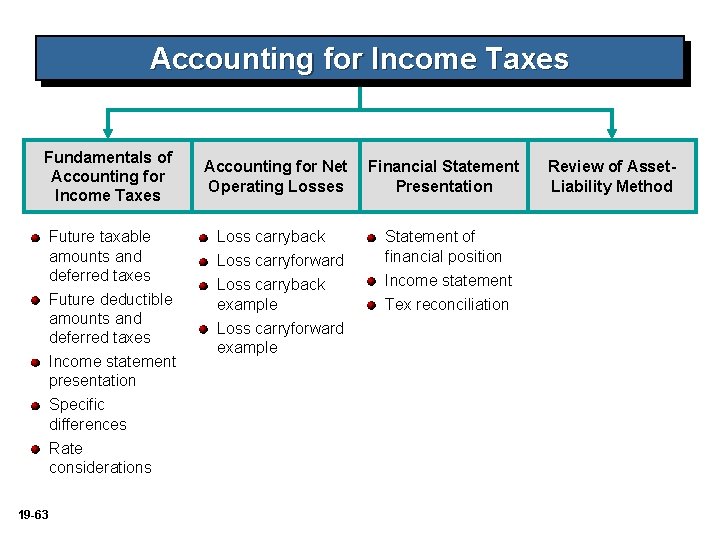
Accounting for Income Taxes Fundamentals of Accounting for Income Taxes Future taxable amounts and deferred taxes Future deductible amounts and deferred taxes Income statement presentation Specific differences Rate considerations 19 -63 Accounting for Net Operating Losses Financial Statement Presentation Loss carryback Loss carryforward Loss carryback example Statement of financial position Loss carryforward example Income statement Tex reconciliation Review of Asset. Liability Method
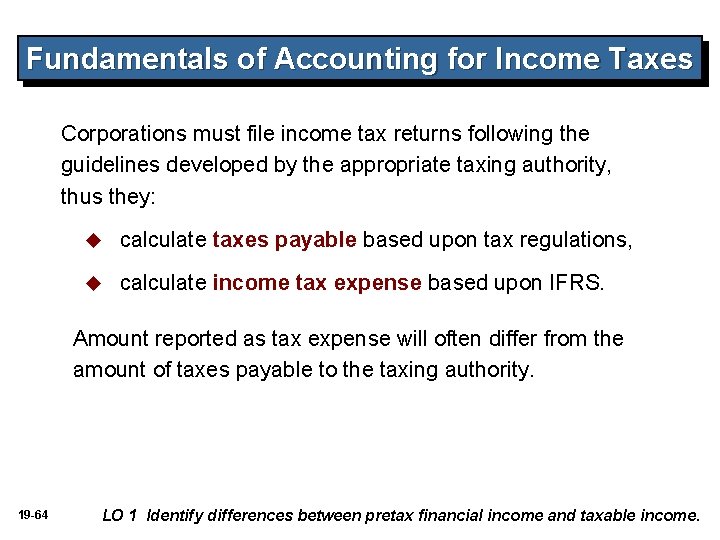
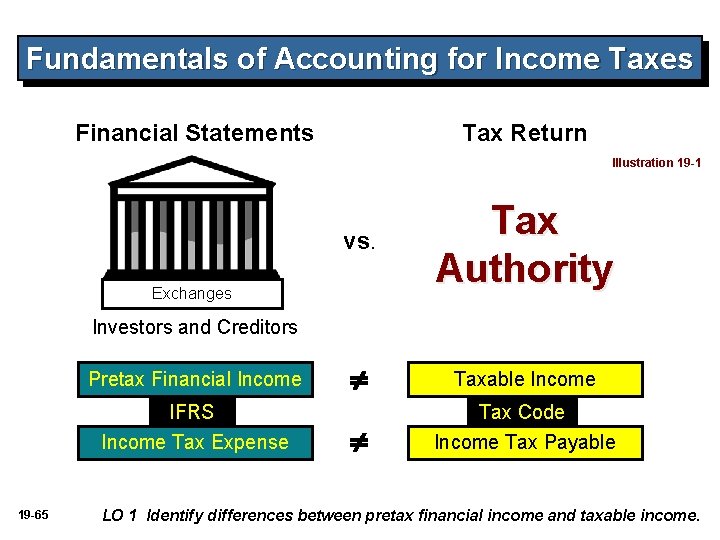
Fundamentals of Accounting for Income Taxes Corporations must file income tax returns following the guidelines developed by the appropriate taxing authority, thus they: u calculate taxes payable based upon tax regulations, u calculate income tax expense based upon IFRS. Amount reported as tax expense will often differ from the amount of taxes payable to the taxing authority. 19 -64 LO 1 Identify differences between pretax financial income and taxable income.
Fundamentals of Accounting for Income Taxes Financial Statements Tax Return Illustration 19 -1 vs. Tax Authority Taxable Income Tax Code Income Tax Payable Exchanges Investors and Creditors Pretax Financial Income IFRS Income Tax Expense 19 -65 LO 1 Identify differences between pretax financial income and taxable income.
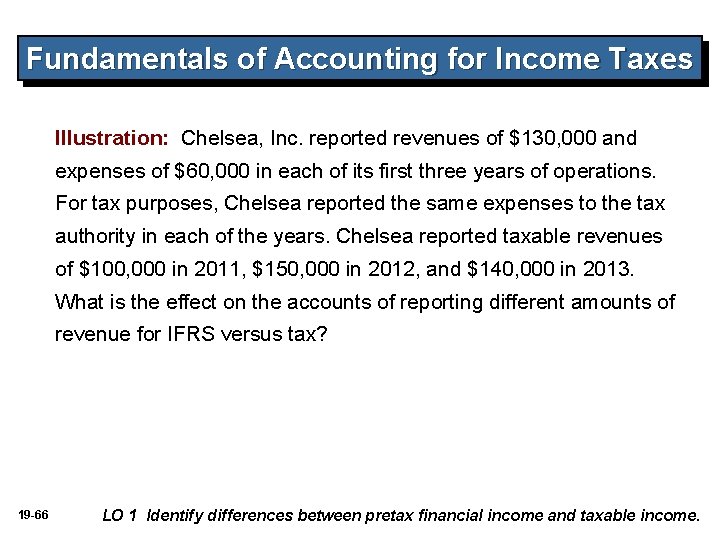
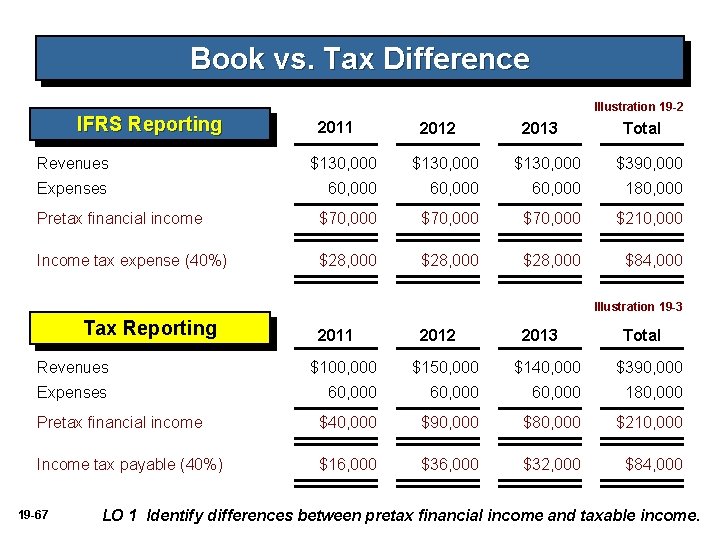
Fundamentals of Accounting for Income Taxes Illustration: Chelsea, Inc. reported revenues of $130, 000 and expenses of $60, 000 in each of its first three years of operations. For tax purposes, Chelsea reported the same expenses to the tax authority in each of the years. Chelsea reported taxable revenues of $100, 000 in 2011, $150, 000 in 2012, and $140, 000 in 2013. What is the effect on the accounts of reporting different amounts of revenue for IFRS versus tax? 19 -66 LO 1 Identify differences between pretax financial income and taxable income.
Book vs. Tax Difference IFRS Reporting Illustration 19 -2 2011 2012 2013 Total Revenues $130, 000 $390, 000 Expenses 60, 000 180, 000 Pretax financial income $70, 000 $210, 000 Income tax expense (40%) $28, 000 $84, 000 Illustration 19 -3 Tax Reporting 2011 2012 2013 Total Revenues $100, 000 $150, 000 $140, 000 $390, 000 Expenses 60, 000 180, 000 Pretax financial income $40, 000 $90, 000 $80, 000 $210, 000 Income tax payable (40%) $16, 000 $32, 000 $84, 000 19 -67 LO 1 Identify differences between pretax financial income and taxable income.
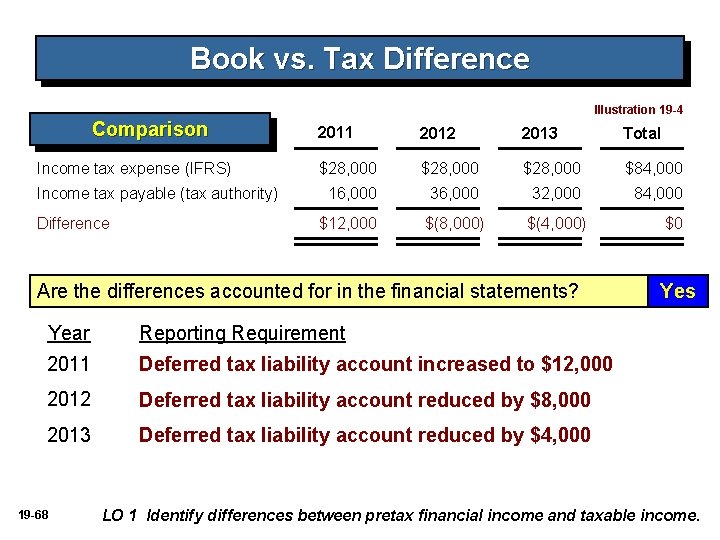
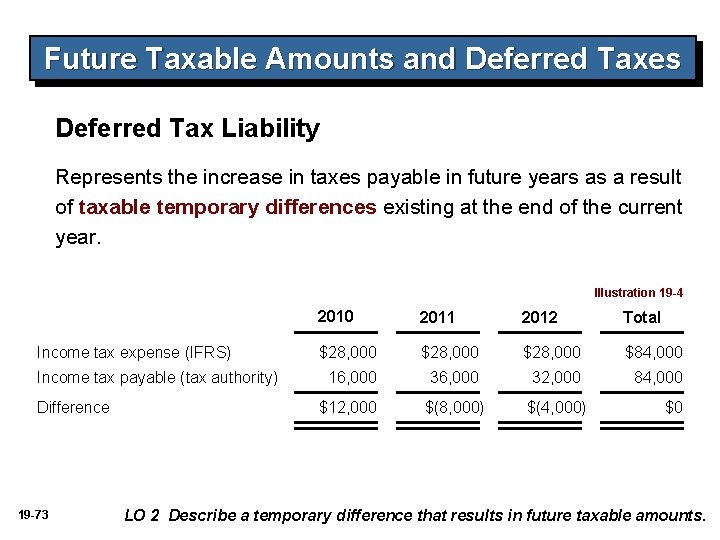
Book vs. Tax Difference Illustration 19 -4 Comparison Income tax expense (IFRS) Income tax payable (tax authority) Difference 2011 2012 2013 Total $28, 000 $84, 000 16, 000 32, 000 84, 000 $12, 000 $(8, 000) $(4, 000) Are the differences accounted for in the financial statements? Year Reporting Requirement 2011 Deferred tax liability account increased to $12, 000 2012 Deferred tax liability account reduced by $8, 000 2013 Deferred tax liability account reduced by $4, 000 19 -68 $0 Yes LO 1 Identify differences between pretax financial income and taxable income.
Financial Reporting Statement of Financial Position Assets: Income Statement 2011 Revenues: Expenses: Liabilities: Deferred taxes Income tax payable Equity: 12, 000 16, 000 Income tax expense 28, 000 Net income (loss) Where does the “deferred tax liability” get reported in the financial statements? 19 -69 LO 1 Identify differences between pretax financial income and taxable income.
Temporary Differences A Temporary Difference is the difference between the tax basis of an asset or liability and its reported (carrying or book) amount in the financial statements that will result in taxable amounts or deductible amounts in future years. Future Taxable Amounts Future Deductible Amounts Deferred Tax Liability represents the increase in taxes payable in future years as a result of taxable temporary differences existing at the end of the current year. Deferred Tax Asset represents the increase in taxes refundable (or saved) in future years as a result of deductible temporary differences existing at the end of the current year. Illustration 19 -22: Examples of Temporary Differences 19 -70 LO 2 Describe a temporary difference that results in future taxable amounts.
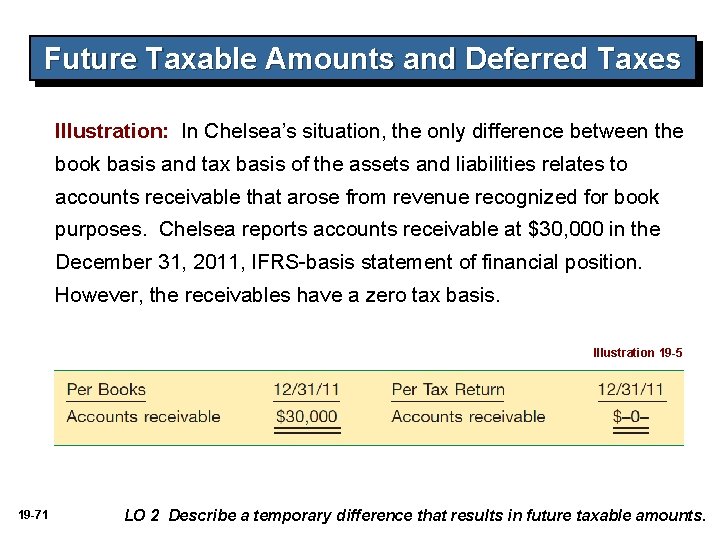
Future Taxable Amounts and Deferred Taxes Illustration: In Chelsea’s situation, the only difference between the book basis and tax basis of the assets and liabilities relates to accounts receivable that arose from revenue recognized for book purposes. Chelsea reports accounts receivable at $30, 000 in the December 31, 2011, IFRS-basis statement of financial position. However, the receivables have a zero tax basis. Illustration 19 -5 19 -71 LO 2 Describe a temporary difference that results in future taxable amounts.
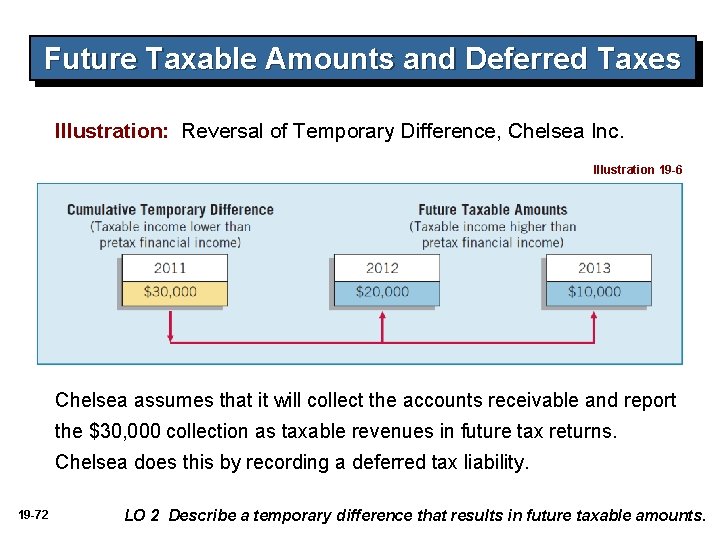
Future Taxable Amounts and Deferred Taxes Illustration: Reversal of Temporary Difference, Chelsea Inc. Illustration 19 -6 Chelsea assumes that it will collect the accounts receivable and report the $30, 000 collection as taxable revenues in future tax returns. Chelsea does this by recording a deferred tax liability. 19 -72 LO 2 Describe a temporary difference that results in future taxable amounts.
Future Taxable Amounts and Deferred Taxes Deferred Tax Liability Represents the increase in taxes payable in future years as a result of taxable temporary differences existing at the end of the current year. Illustration 19 -4 Income tax expense (IFRS) Income tax payable (tax authority) Difference 19 -73 2010 2011 2012 Total $28, 000 $84, 000 16, 000 32, 000 84, 000 $12, 000 $(8, 000) $(4, 000) $0 LO 2 Describe a temporary difference that results in future taxable amounts.
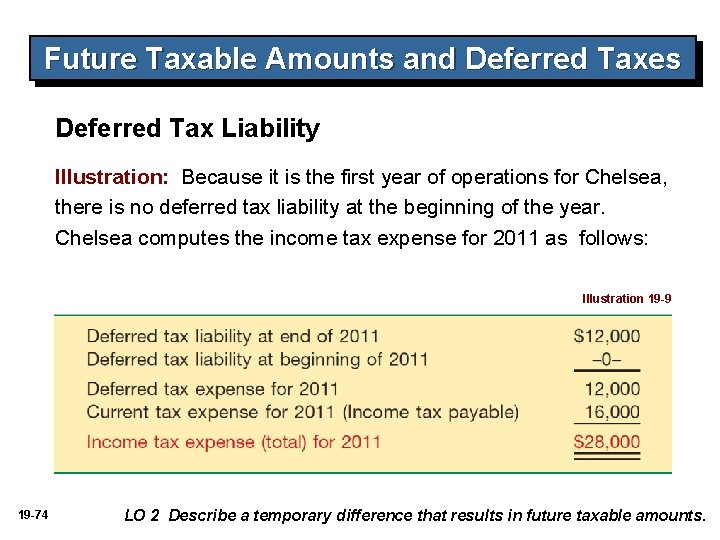
Future Taxable Amounts and Deferred Taxes Deferred Tax Liability Illustration: Because it is the first year of operations for Chelsea, there is no deferred tax liability at the beginning of the year. Chelsea computes the income tax expense for 2011 as follows: Illustration 19 -9 19 -74 LO 2 Describe a temporary difference that results in future taxable amounts.
Future Taxable Amounts and Deferred Taxes Deferred Tax Liability Illustration: Chelsea makes the following entry at the end of 2011 to record income taxes. Income Tax Expense 28, 000 19 -75 Income Tax Payable 16, 000 Deferred Tax Liability 12, 000 LO 2 Describe a temporary difference that results in future taxable amounts.
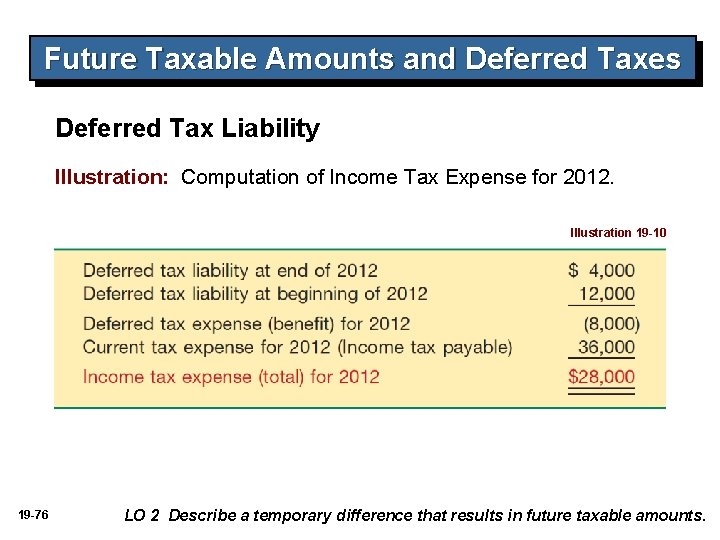
Future Taxable Amounts and Deferred Taxes Deferred Tax Liability Illustration: Computation of Income Tax Expense for 2012. Illustration 19 -10 19 -76 LO 2 Describe a temporary difference that results in future taxable amounts.
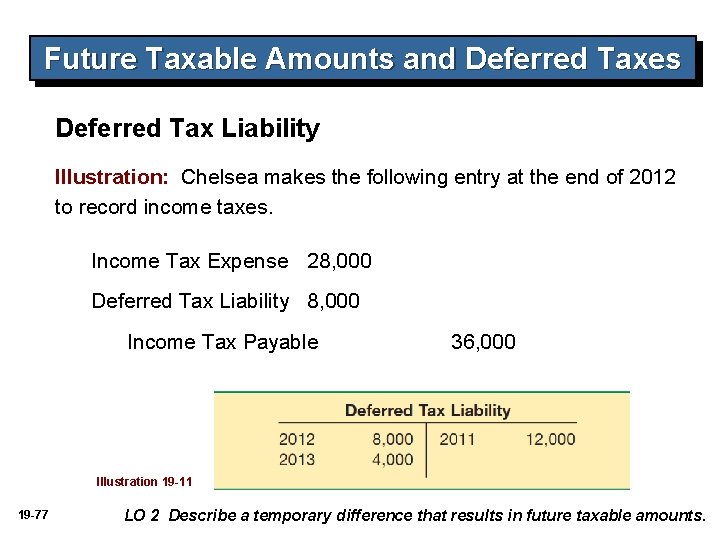
Future Taxable Amounts and Deferred Taxes Deferred Tax Liability Illustration: Chelsea makes the following entry at the end of 2012 to record income taxes. Income Tax Expense 28, 000 Deferred Tax Liability 8, 000 Income Tax Payable 36, 000 Illustration 19 -11 19 -77 LO 2 Describe a temporary difference that results in future taxable amounts.
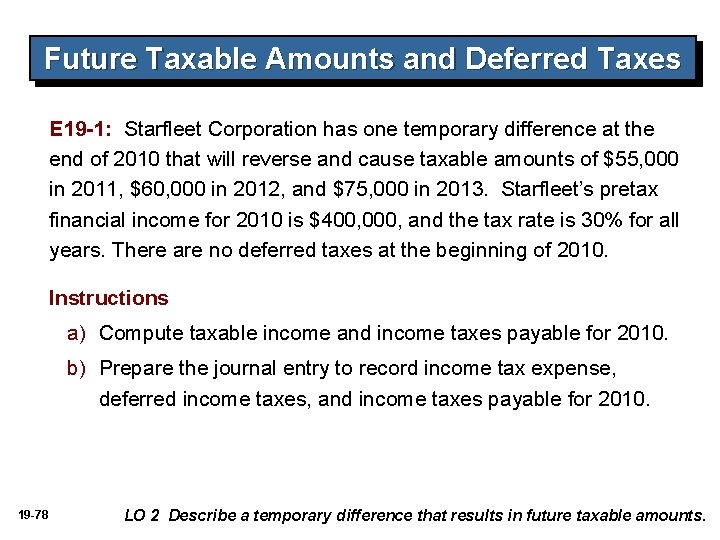
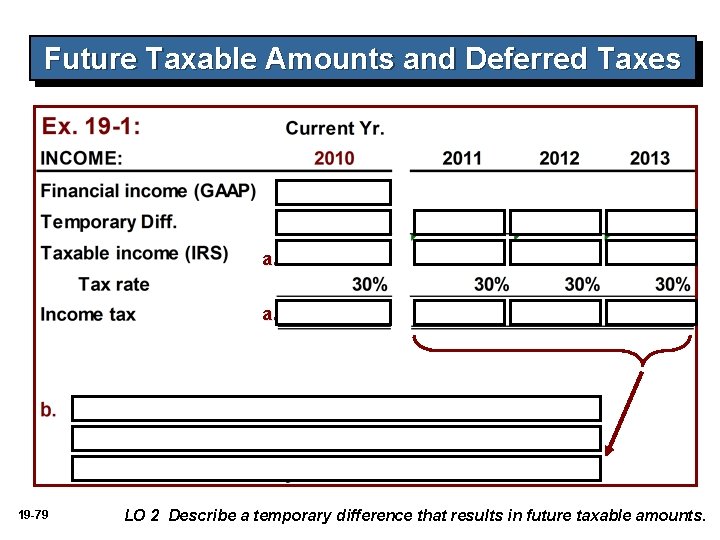
Future Taxable Amounts and Deferred Taxes E 19 -1: Starfleet Corporation has one temporary difference at the end of 2010 that will reverse and cause taxable amounts of $55, 000 in 2011, $60, 000 in 2012, and $75, 000 in 2013. Starfleet’s pretax financial income for 2010 is $400, 000, and the tax rate is 30% for all years. There are no deferred taxes at the beginning of 2010. Instructions a) Compute taxable income and income taxes payable for 2010. b) Prepare the journal entry to record income tax expense, deferred income taxes, and income taxes payable for 2010. 19 -78 LO 2 Describe a temporary difference that results in future taxable amounts.
Future Taxable Amounts and Deferred Taxes a. a. 19 -79 LO 2 Describe a temporary difference that results in future taxable amounts.
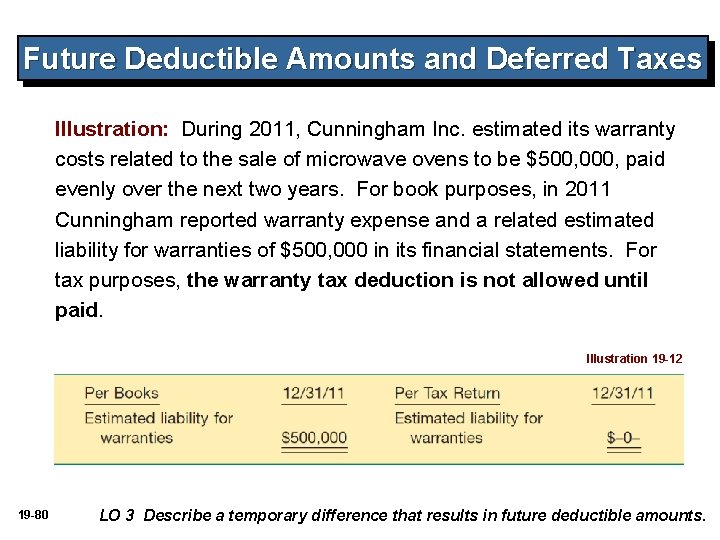
Future Deductible Amounts and Deferred Taxes Illustration: During 2011, Cunningham Inc. estimated its warranty costs related to the sale of microwave ovens to be $500, 000, paid evenly over the next two years. For book purposes, in 2011 Cunningham reported warranty expense and a related estimated liability for warranties of $500, 000 in its financial statements. For tax purposes, the warranty tax deduction is not allowed until paid. Illustration 19 -12 19 -80 LO 3 Describe a temporary difference that results in future deductible amounts.
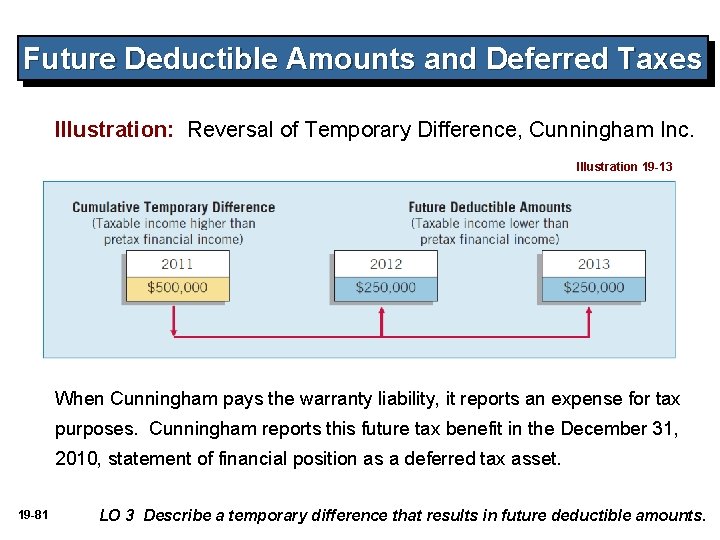
Future Deductible Amounts and Deferred Taxes Illustration: Reversal of Temporary Difference, Cunningham Inc. Illustration 19 -13 When Cunningham pays the warranty liability, it reports an expense for tax purposes. Cunningham reports this future tax benefit in the December 31, 2010, statement of financial position as a deferred tax asset. 19 -81 LO 3 Describe a temporary difference that results in future deductible amounts.
Future Deductible Amounts and Deferred Taxes Deferred Tax Asset Represents the increase in taxes refundable (or saved) in future years as a result of deductible temporary differences existing at the end of the current year. 19 -82 LO 3 Describe a temporary difference that results in future deductible amounts.
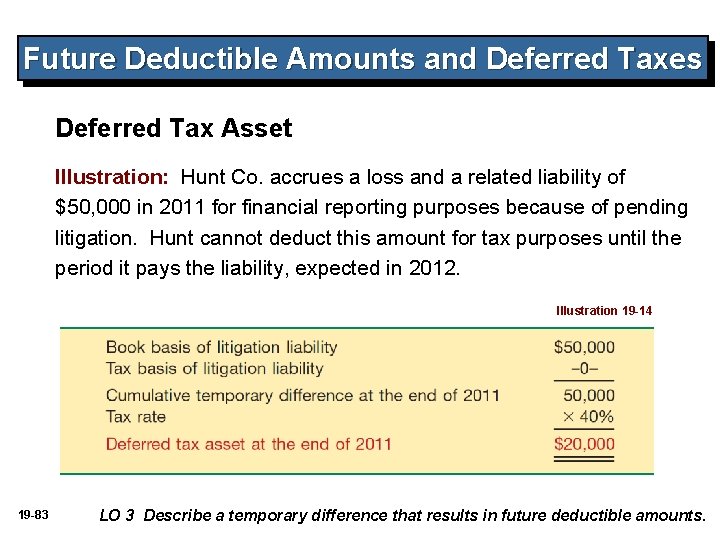
Future Deductible Amounts and Deferred Taxes Deferred Tax Asset Illustration: Hunt Co. accrues a loss and a related liability of $50, 000 in 2011 for financial reporting purposes because of pending litigation. Hunt cannot deduct this amount for tax purposes until the period it pays the liability, expected in 2012. Illustration 19 -14 19 -83 LO 3 Describe a temporary difference that results in future deductible amounts.
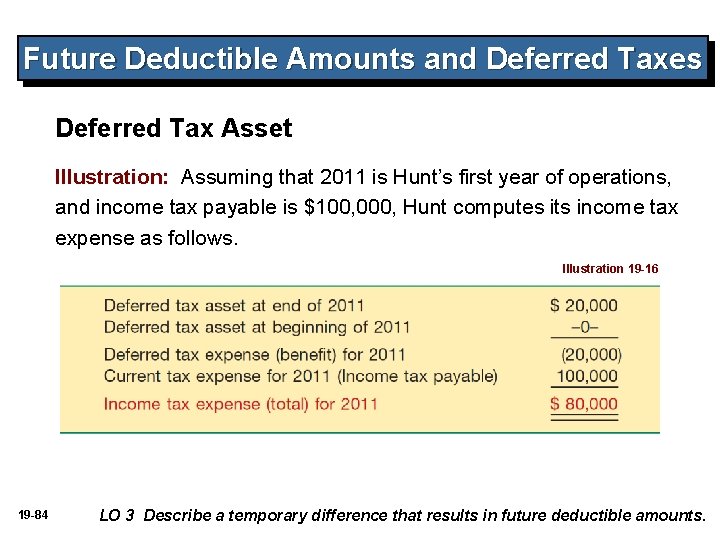
Future Deductible Amounts and Deferred Taxes Deferred Tax Asset Illustration: Assuming that 2011 is Hunt’s first year of operations, and income tax payable is $100, 000, Hunt computes its income tax expense as follows. Illustration 19 -16 19 -84 LO 3 Describe a temporary difference that results in future deductible amounts.
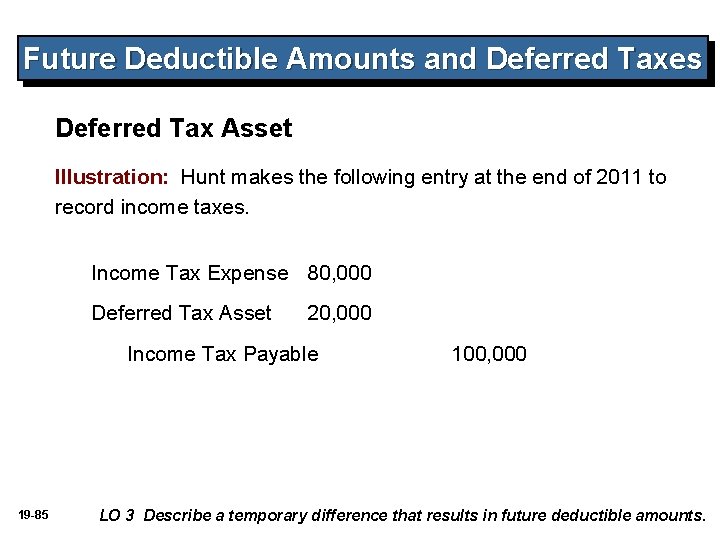
Future Deductible Amounts and Deferred Taxes Deferred Tax Asset Illustration: Hunt makes the following entry at the end of 2011 to record income taxes. Income Tax Expense 80, 000 Deferred Tax Asset 20, 000 Income Tax Payable 19 -85 100, 000 LO 3 Describe a temporary difference that results in future deductible amounts.
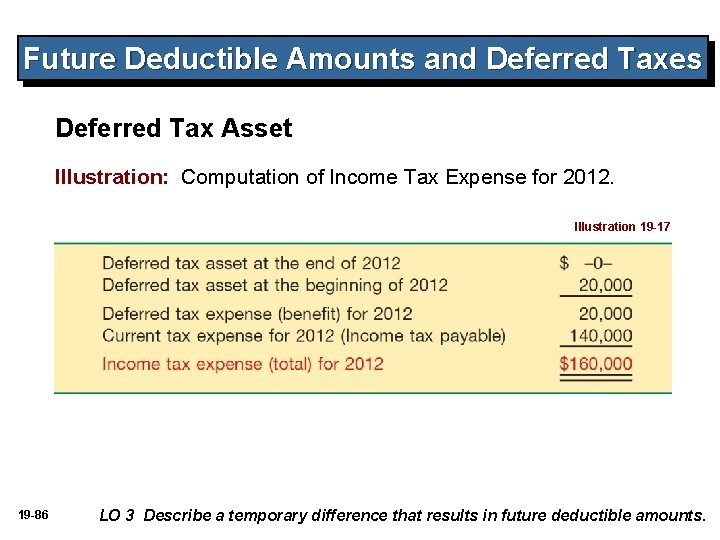
Future Deductible Amounts and Deferred Taxes Deferred Tax Asset Illustration: Computation of Income Tax Expense for 2012. Illustration 19 -17 19 -86 LO 3 Describe a temporary difference that results in future deductible amounts.
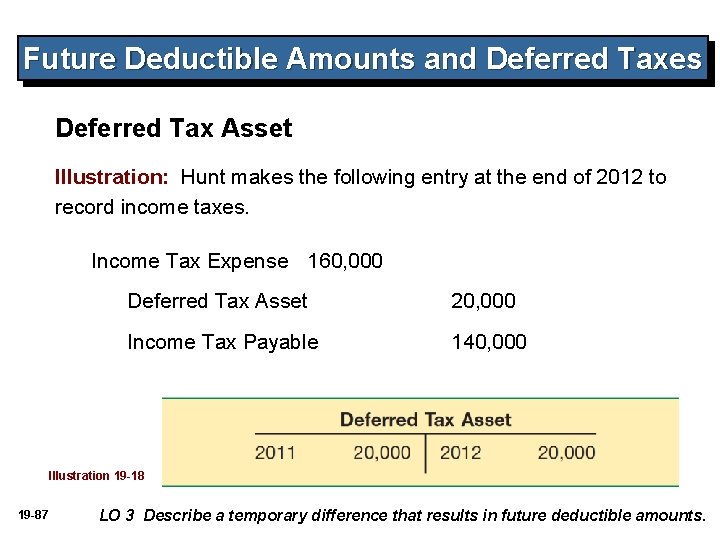
Future Deductible Amounts and Deferred Taxes Deferred Tax Asset Illustration: Hunt makes the following entry at the end of 2012 to record income taxes. Income Tax Expense 160, 000 Deferred Tax Asset 20, 000 Income Tax Payable 140, 000 Illustration 19 -18 19 -87 LO 3 Describe a temporary difference that results in future deductible amounts.
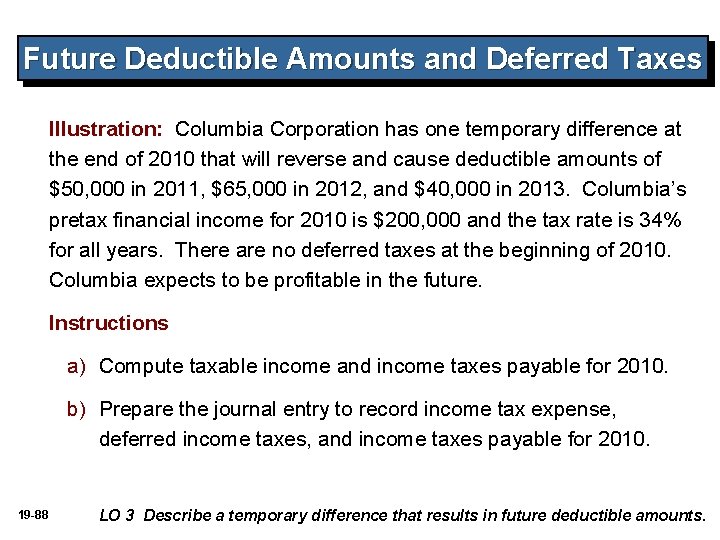
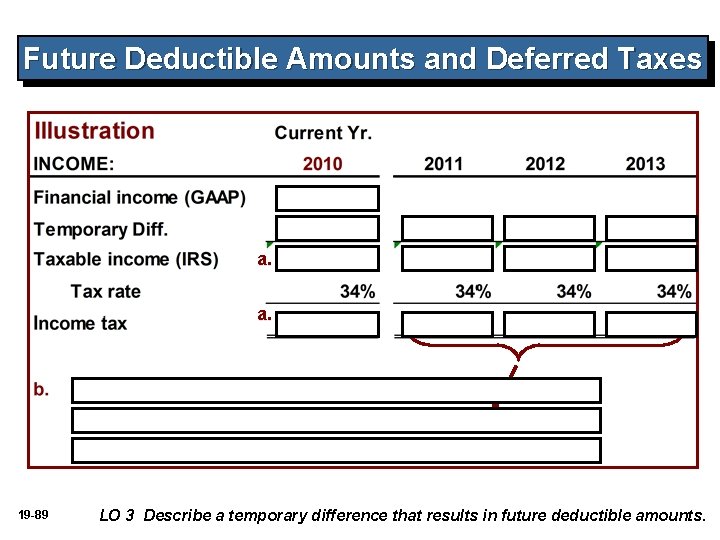
Future Deductible Amounts and Deferred Taxes Illustration: Columbia Corporation has one temporary difference at the end of 2010 that will reverse and cause deductible amounts of $50, 000 in 2011, $65, 000 in 2012, and $40, 000 in 2013. Columbia’s pretax financial income for 2010 is $200, 000 and the tax rate is 34% for all years. There are no deferred taxes at the beginning of 2010. Columbia expects to be profitable in the future. Instructions a) Compute taxable income and income taxes payable for 2010. b) Prepare the journal entry to record income tax expense, deferred income taxes, and income taxes payable for 2010. 19 -88 LO 3 Describe a temporary difference that results in future deductible amounts.
Future Deductible Amounts and Deferred Taxes a. a. 19 -89 LO 3 Describe a temporary difference that results in future deductible amounts.
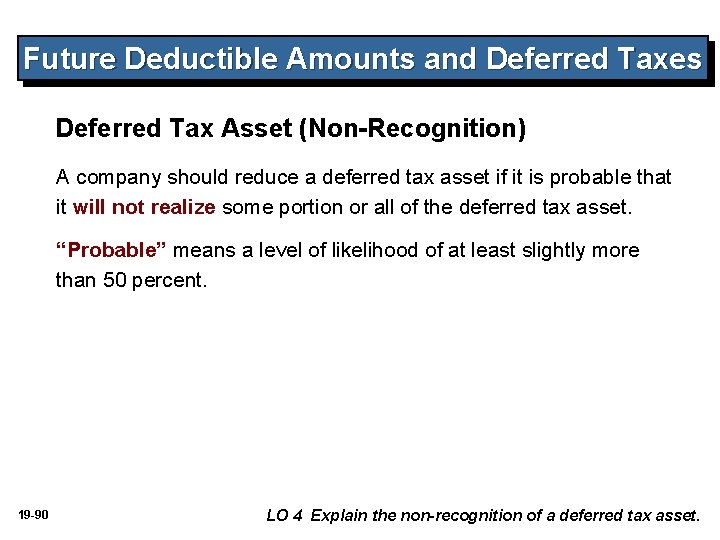
Future Deductible Amounts and Deferred Taxes Deferred Tax Asset (Non-Recognition) A company should reduce a deferred tax asset if it is probable that it will not realize some portion or all of the deferred tax asset. “Probable” means a level of likelihood of at least slightly more than 50 percent. 19 -90 LO 4 Explain the non-recognition of a deferred tax asset.
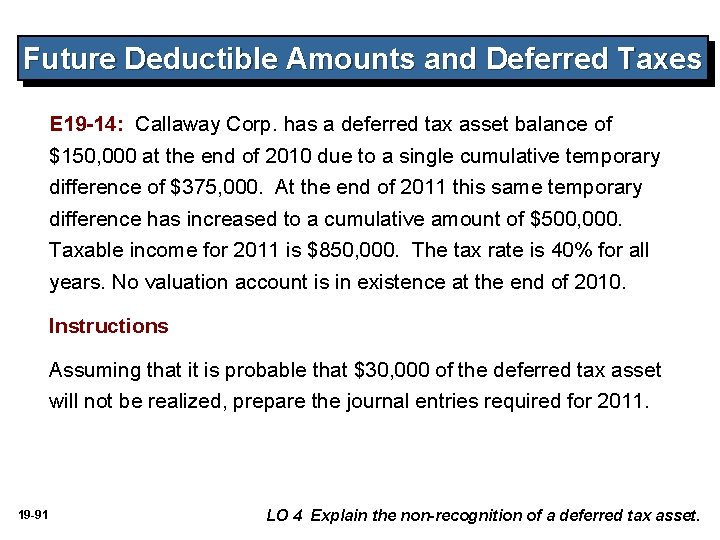
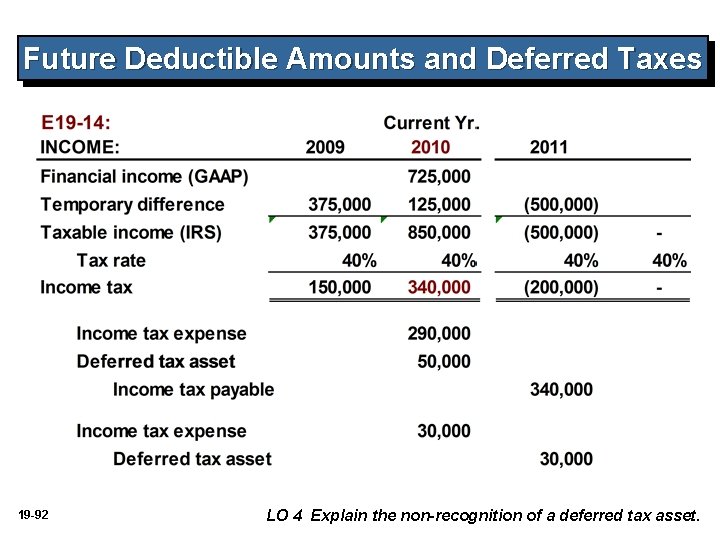
Future Deductible Amounts and Deferred Taxes E 19 -14: Callaway Corp. has a deferred tax asset balance of $150, 000 at the end of 2010 due to a single cumulative temporary difference of $375, 000. At the end of 2011 this same temporary difference has increased to a cumulative amount of $500, 000. Taxable income for 2011 is $850, 000. The tax rate is 40% for all years. No valuation account is in existence at the end of 2010. Instructions Assuming that it is probable that $30, 000 of the deferred tax asset will not be realized, prepare the journal entries required for 2011. 19 -91 LO 4 Explain the non-recognition of a deferred tax asset.
Future Deductible Amounts and Deferred Taxes 19 -92 LO 4 Explain the non-recognition of a deferred tax asset.
Income Statement Presentation Formula to Compute Income Tax Expense Illustration 19 -20 Income tax payable or refundable Change in +- deferred income tax = Income tax expense or benefit In the income statement or in the notes to the financial statements, a company should disclose the significant components of income tax expense attributable to continuing operations. 19 -93 LO 5 Describe the presentation of income tax expense in the income statement.
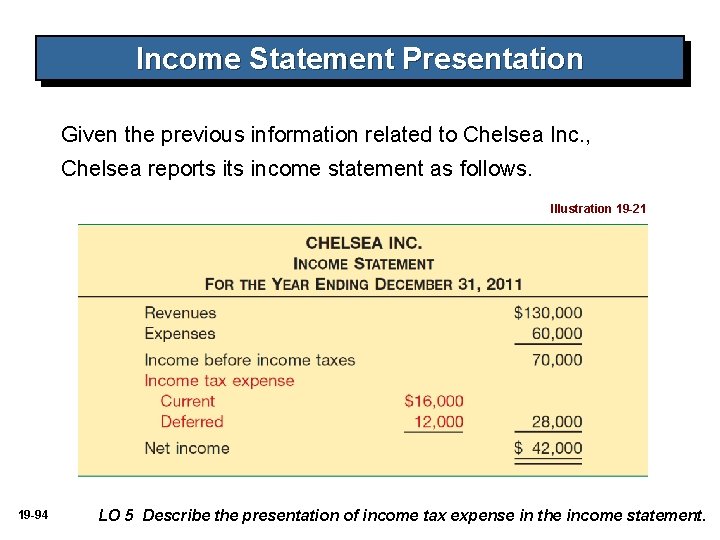
Income Statement Presentation Given the previous information related to Chelsea Inc. , Chelsea reports income statement as follows. Illustration 19 -21 19 -94 LO 5 Describe the presentation of income tax expense in the income statement.
Specific Differences Temporary Differences u Taxable temporary differences - Deferred tax liability u Deductible temporary differences - Deferred tax Asset Text Illustration 19 -22: Examples of Temporary Differences 19 -95 LO 6 Describe various temporary and permanent differences.
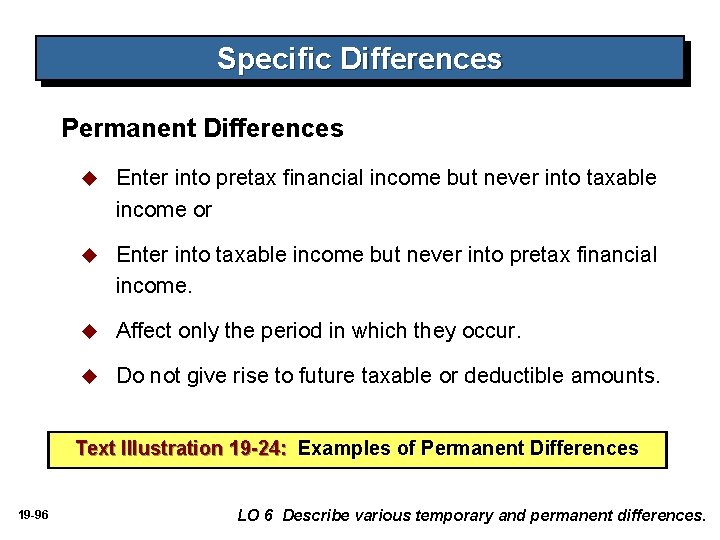
Specific Differences Permanent Differences u Enter into pretax financial income but never into taxable income or u Enter into taxable income but never into pretax financial income. u Affect only the period in which they occur. u Do not give rise to future taxable or deductible amounts. Text Illustration 19 -24: Examples of Permanent Differences 19 -96 LO 6 Describe various temporary and permanent differences.
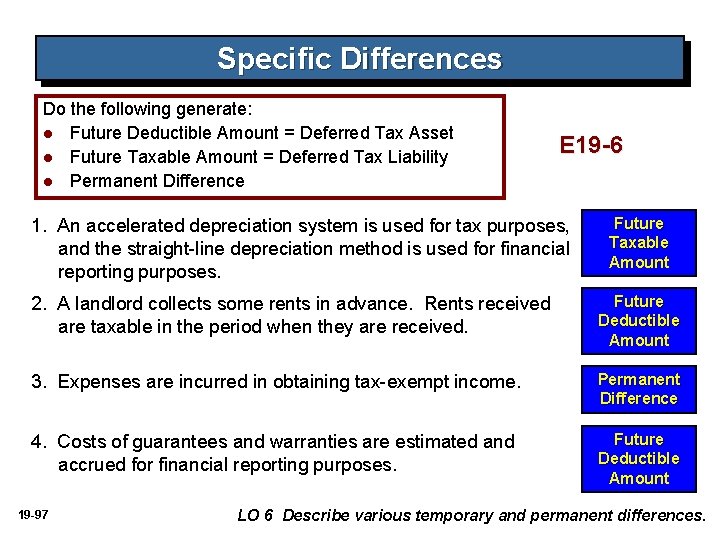
Specific Differences Do the following generate: l Future Deductible Amount = Deferred Tax Asset l Future Taxable Amount = Deferred Tax Liability l Permanent Difference E 19 -6 1. An accelerated depreciation system is used for tax purposes, and the straight-line depreciation method is used for financial reporting purposes. Future Taxable Amount 2. A landlord collects some rents in advance. Rents received are taxable in the period when they are received. Future Deductible Amount 3. Expenses are incurred in obtaining tax-exempt income. Permanent Difference 4. Costs of guarantees and warranties are estimated and accrued for financial reporting purposes. Future Deductible Amount 19 -97 LO 6 Describe various temporary and permanent differences.
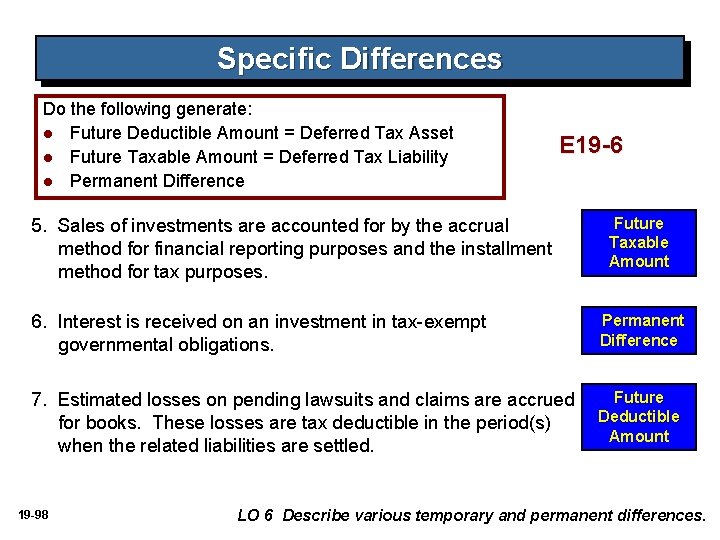
Specific Differences Do the following generate: l Future Deductible Amount = Deferred Tax Asset l Future Taxable Amount = Deferred Tax Liability l Permanent Difference 5. Sales of investments are accounted for by the accrual method for financial reporting purposes and the installment method for tax purposes. 6. Interest is received on an investment in tax-exempt governmental obligations. E 19 -6 Future Taxable Amount Permanent Difference Future 7. Estimated losses on pending lawsuits and claims are accrued Deductible for books. These losses are tax deductible in the period(s) Amount when the related liabilities are settled. 19 -98 LO 6 Describe various temporary and permanent differences.
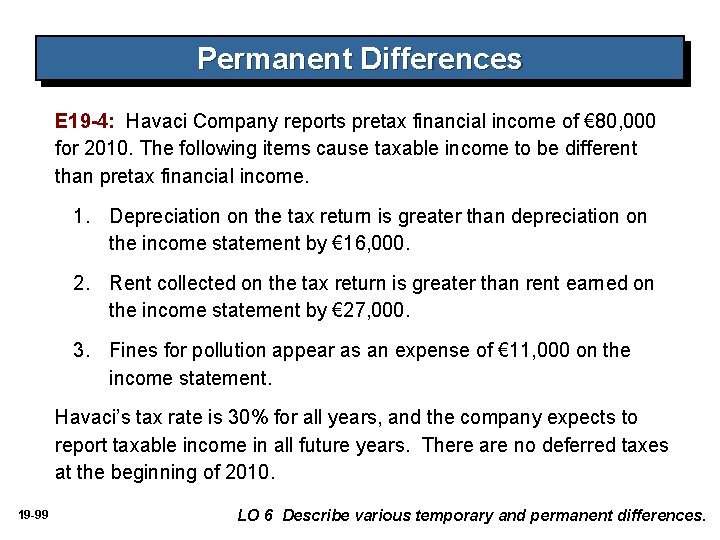
Permanent Differences E 19 -4: Havaci Company reports pretax financial income of € 80, 000 for 2010. The following items cause taxable income to be different than pretax financial income. 1. Depreciation on the tax return is greater than depreciation on the income statement by € 16, 000. 2. Rent collected on the tax return is greater than rent earned on the income statement by € 27, 000. 3. Fines for pollution appear as an expense of € 11, 000 on the income statement. Havaci’s tax rate is 30% for all years, and the company expects to report taxable income in all future years. There are no deferred taxes at the beginning of 2010. 19 -99 LO 6 Describe various temporary and permanent differences.
Permanent Differences 19 -100 LO 6 Describe various temporary and permanent differences.
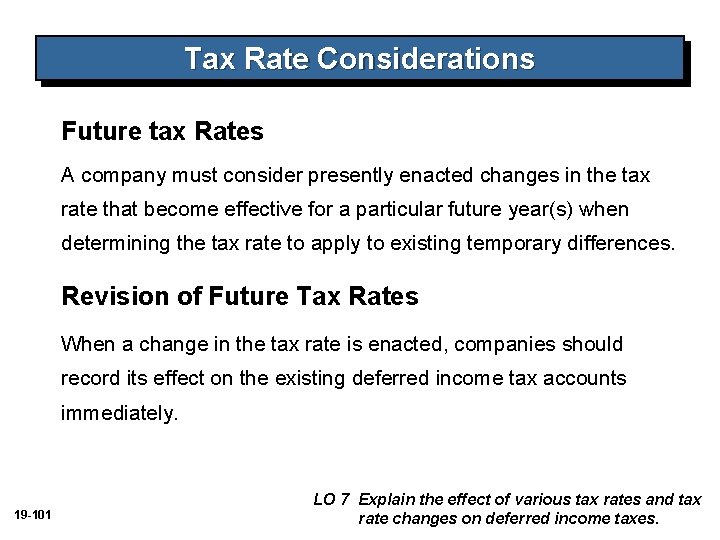
Tax Rate Considerations Future tax Rates A company must consider presently enacted changes in the tax rate that become effective for a particular future year(s) when determining the tax rate to apply to existing temporary differences. Revision of Future Tax Rates When a change in the tax rate is enacted, companies should record its effect on the existing deferred income tax accounts immediately. 19 -101 LO 7 Explain the effect of various tax rates and tax rate changes on deferred income taxes.
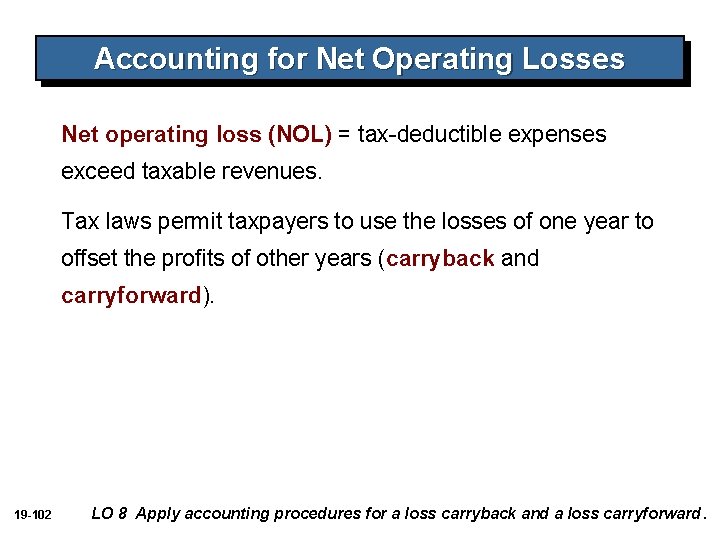
Accounting for Net Operating Losses Net operating loss (NOL) = tax-deductible expenses exceed taxable revenues. Tax laws permit taxpayers to use the losses of one year to offset the profits of other years (carryback and carryforward). 19 -102 LO 8 Apply accounting procedures for a loss carryback and a loss carryforward.
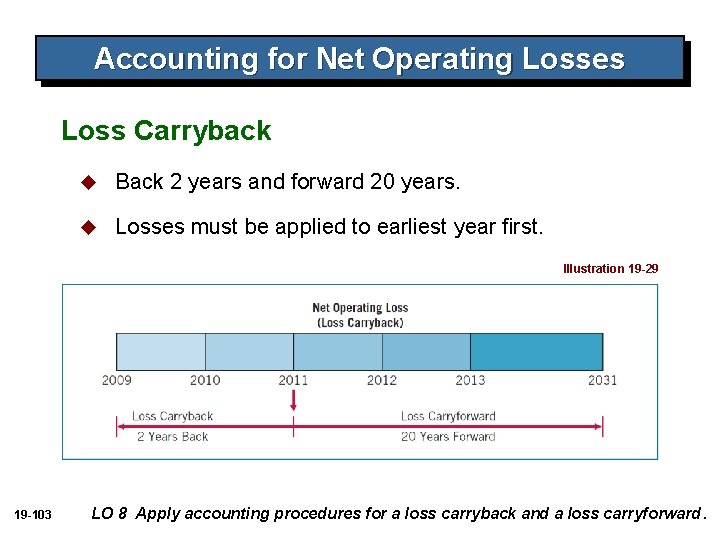
Accounting for Net Operating Losses Loss Carryback u Back 2 years and forward 20 years. u Losses must be applied to earliest year first. Illustration 19 -29 19 -103 LO 8 Apply accounting procedures for a loss carryback and a loss carryforward.
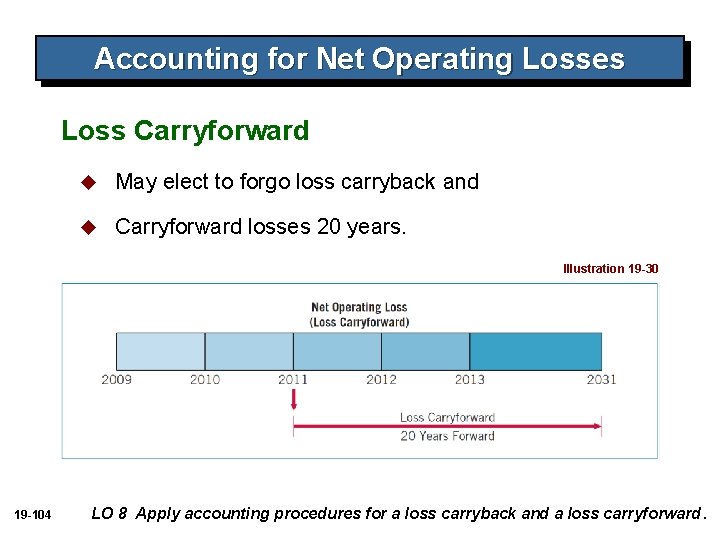
Accounting for Net Operating Losses Loss Carryforward u May elect to forgo loss carryback and u Carryforward losses 20 years. Illustration 19 -30 19 -104 LO 8 Apply accounting procedures for a loss carryback and a loss carryforward.
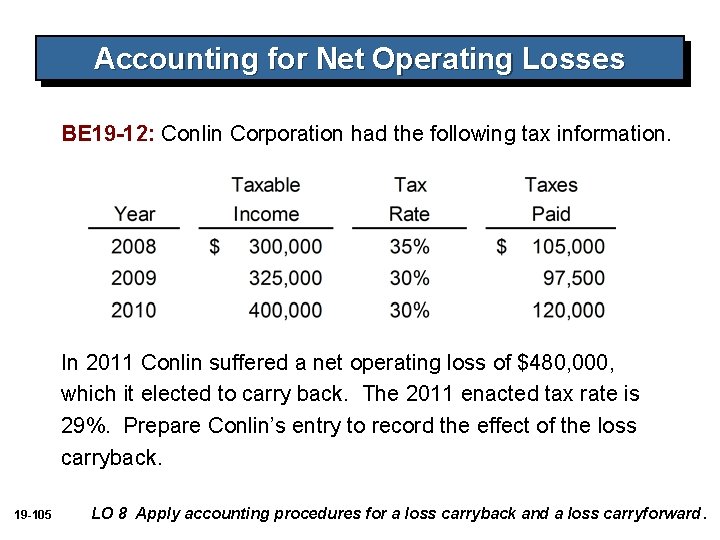
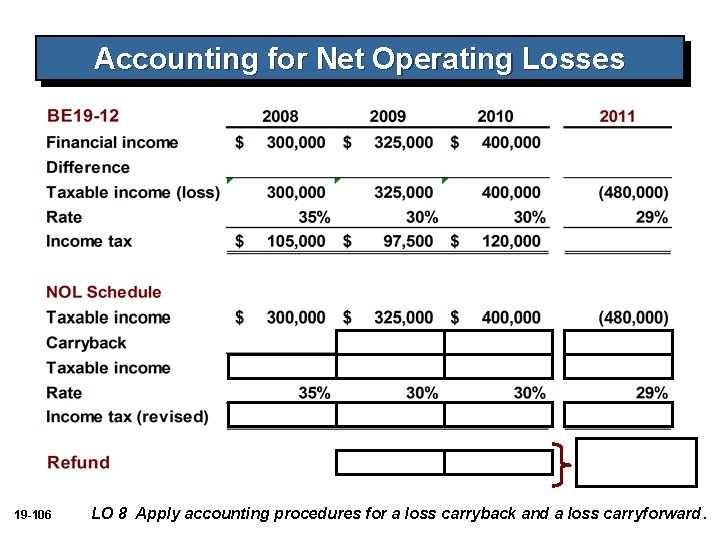
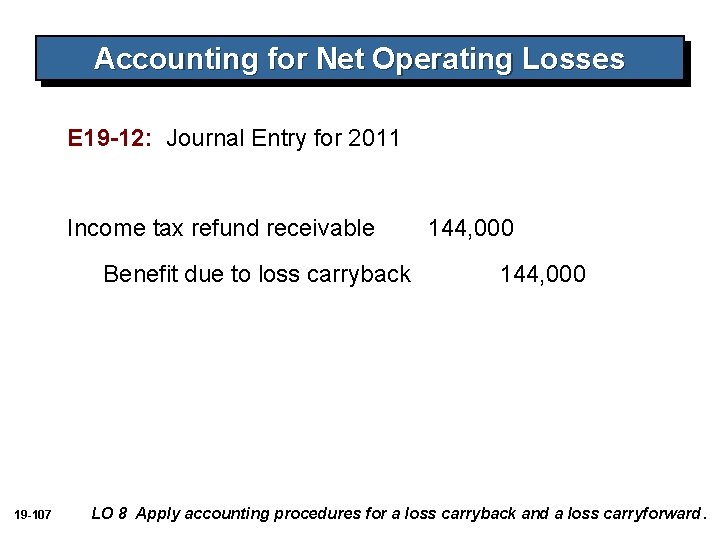
Accounting for Net Operating Losses BE 19 -12: Conlin Corporation had the following tax information. In 2011 Conlin suffered a net operating loss of $480, 000, which it elected to carry back. The 2011 enacted tax rate is 29%. Prepare Conlin’s entry to record the effect of the loss carryback. 19 -105 LO 8 Apply accounting procedures for a loss carryback and a loss carryforward.
Accounting for Net Operating Losses $144, 000 19 -106 LO 8 Apply accounting procedures for a loss carryback and a loss carryforward.
Accounting for Net Operating Losses E 19 -12: Journal Entry for 2011 Income tax refund receivable Benefit due to loss carryback 19 -107 144, 000 LO 8 Apply accounting procedures for a loss carryback and a loss carryforward.
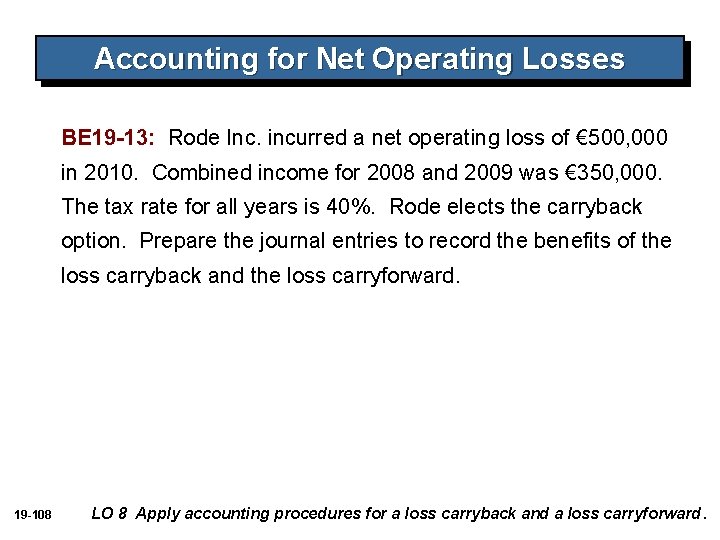
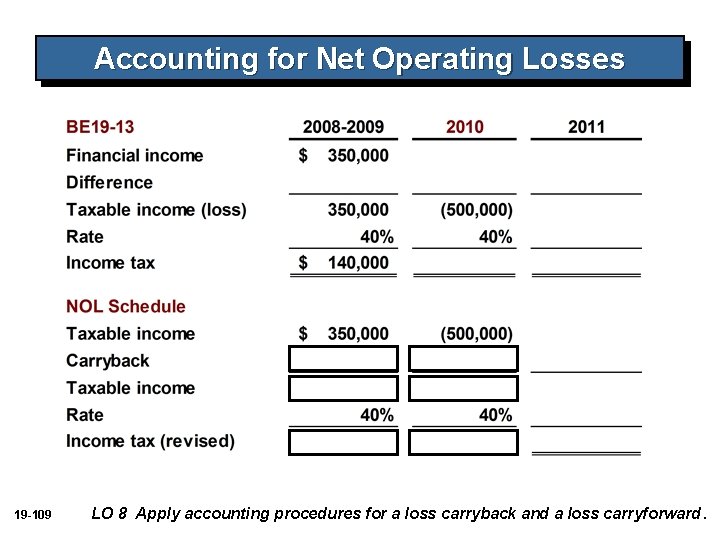
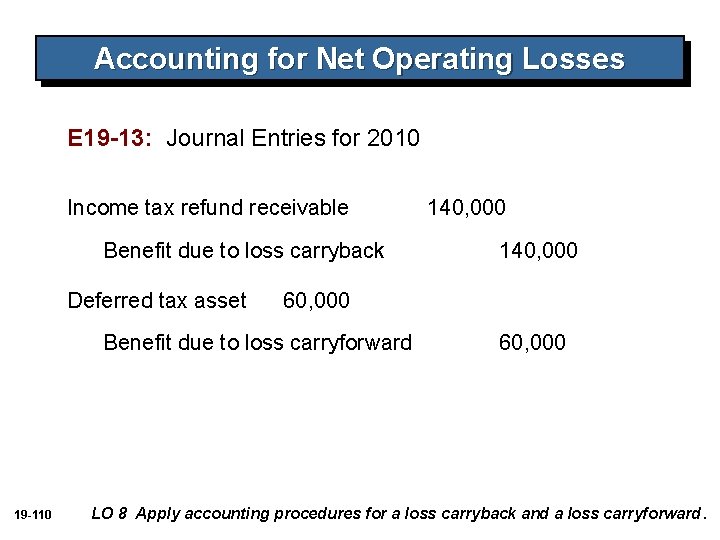
Accounting for Net Operating Losses BE 19 -13: Rode Inc. incurred a net operating loss of € 500, 000 in 2010. Combined income for 2008 and 2009 was € 350, 000. The tax rate for all years is 40%. Rode elects the carryback option. Prepare the journal entries to record the benefits of the loss carryback and the loss carryforward. 19 -108 LO 8 Apply accounting procedures for a loss carryback and a loss carryforward.
Accounting for Net Operating Losses 19 -109 LO 8 Apply accounting procedures for a loss carryback and a loss carryforward.
Accounting for Net Operating Losses E 19 -13: Journal Entries for 2010 Income tax refund receivable Benefit due to loss carryback Deferred tax asset 140, 000 60, 000 Benefit due to loss carryforward 19 -110 140, 000 60, 000 LO 8 Apply accounting procedures for a loss carryback and a loss carryforward.
Accounting for Net Operating Losses BE 19 -14: Use the information for Rode Inc. given in BE 19 -13. Assume that it is more likely than not that the entire net operating loss carryforward will not be realized in future years. Prepare all the journal entries necessary at the end of 2010. 19 -111 LO 8 Apply accounting procedures for a loss carryback and a loss carryforward.
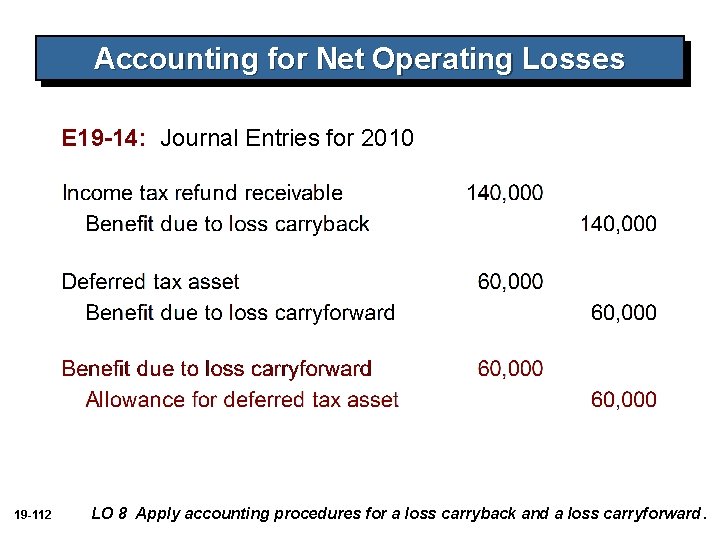
Accounting for Net Operating Losses E 19 -14: Journal Entries for 2010 19 -112 LO 8 Apply accounting procedures for a loss carryback and a loss carryforward.
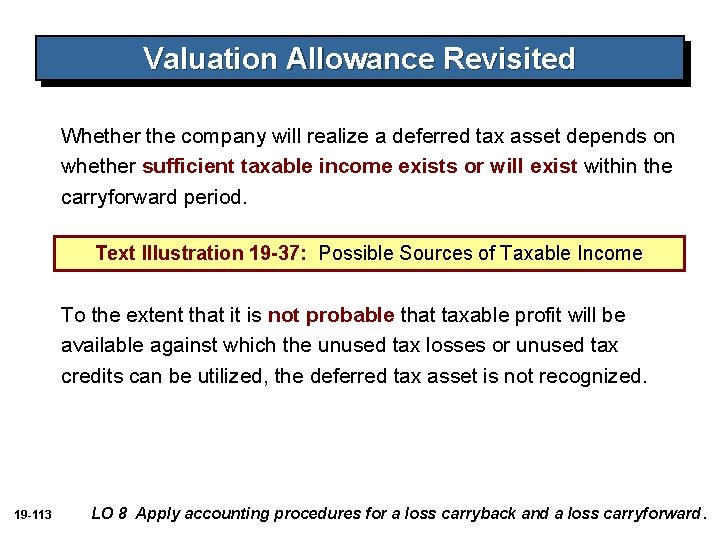
Valuation Allowance Revisited Whether the company will realize a deferred tax asset depends on whether sufficient taxable income exists or will exist within the carryforward period. Text Illustration 19 -37: Possible Sources of Taxable Income To the extent that it is not probable that taxable profit will be available against which the unused tax losses or unused tax credits can be utilized, the deferred tax asset is not recognized. 19 -113 LO 8 Apply accounting procedures for a loss carryback and a loss carryforward.
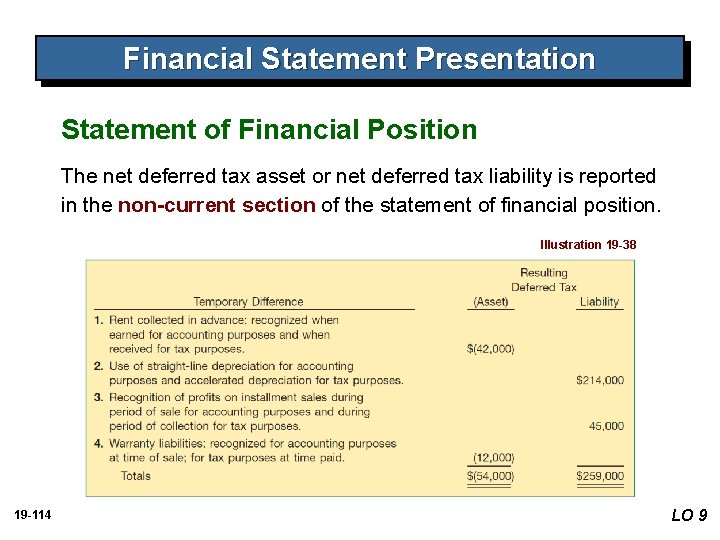
Financial Statement Presentation Statement of Financial Position The net deferred tax asset or net deferred tax liability is reported in the non-current section of the statement of financial position. Illustration 19 -38 19 -114 LO 9
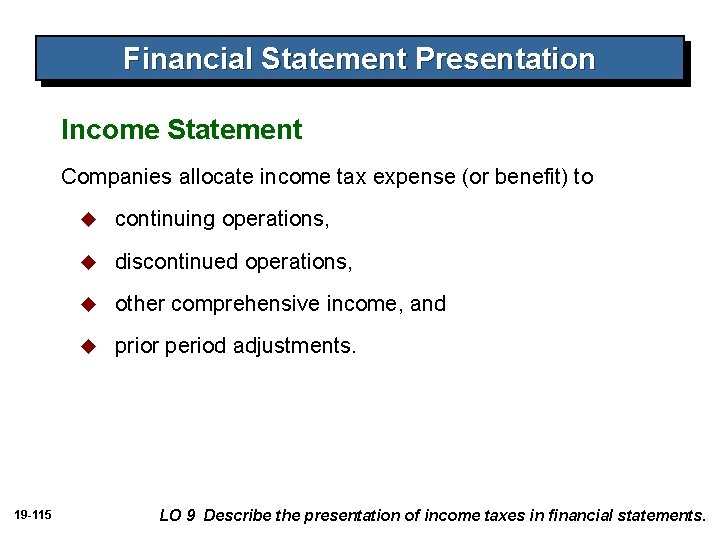
Financial Statement Presentation Income Statement Companies allocate income tax expense (or benefit) to 19 -115 u continuing operations, u discontinued operations, u other comprehensive income, and u prior period adjustments. LO 9 Describe the presentation of income taxes in financial statements.
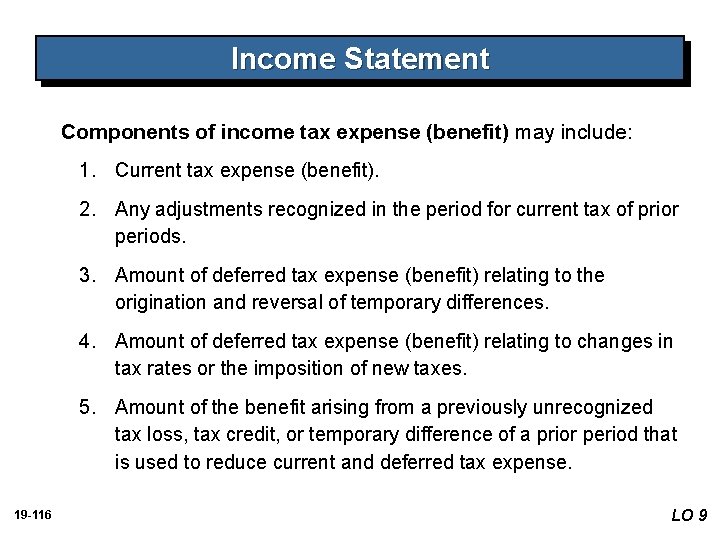
Income Statement Components of income tax expense (benefit) may include: 1. Current tax expense (benefit). 2. Any adjustments recognized in the period for current tax of prior periods. 3. Amount of deferred tax expense (benefit) relating to the origination and reversal of temporary differences. 4. Amount of deferred tax expense (benefit) relating to changes in tax rates or the imposition of new taxes. 5. Amount of the benefit arising from a previously unrecognized tax loss, tax credit, or temporary difference of a prior period that is used to reduce current and deferred tax expense. 19 -116 LO 9
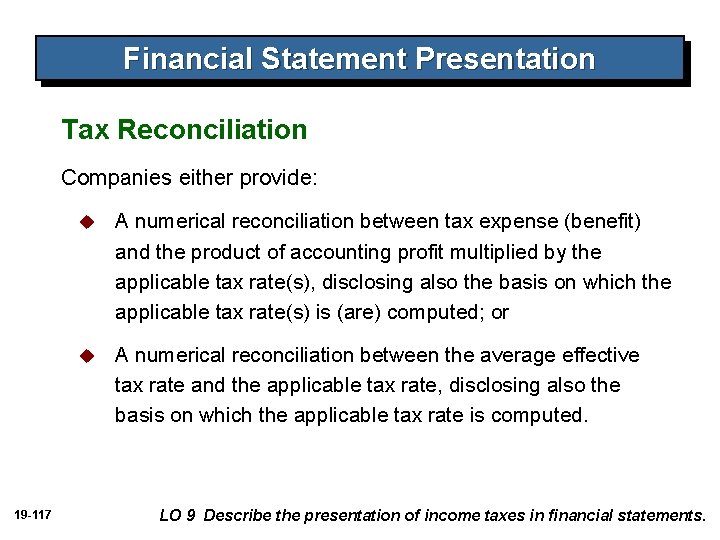
Financial Statement Presentation Tax Reconciliation Companies either provide: 19 -117 u A numerical reconciliation between tax expense (benefit) and the product of accounting profit multiplied by the applicable tax rate(s), disclosing also the basis on which the applicable tax rate(s) is (are) computed; or u A numerical reconciliation between the average effective tax rate and the applicable tax rate, disclosing also the basis on which the applicable tax rate is computed. LO 9 Describe the presentation of income taxes in financial statements.
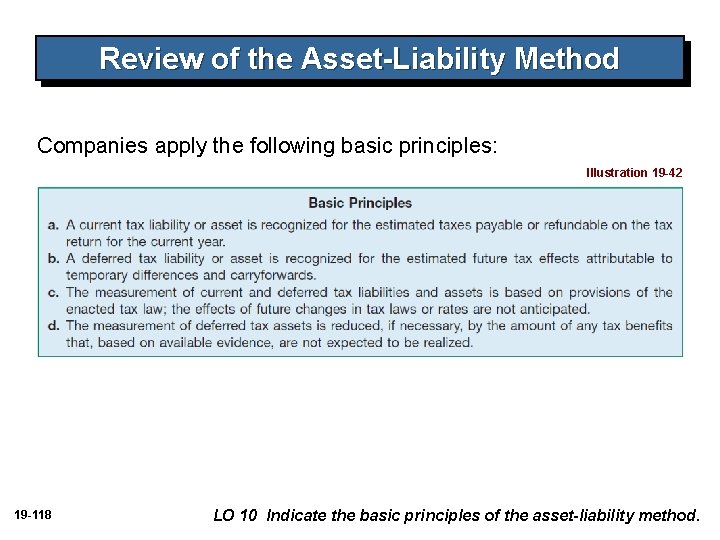
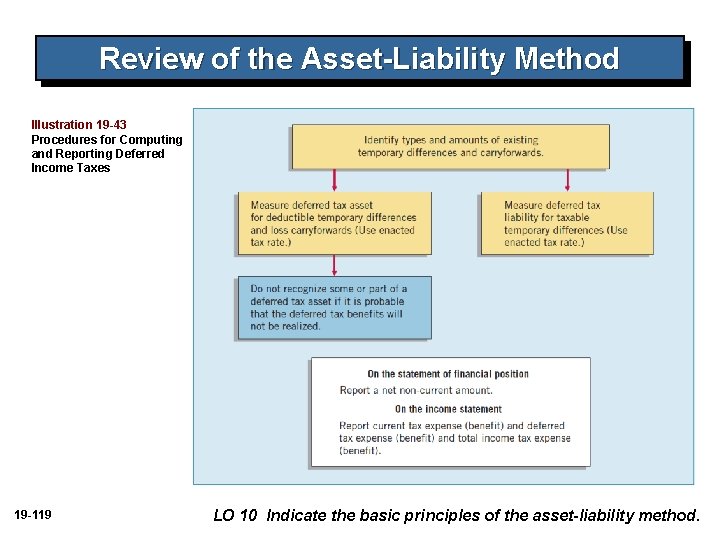
Review of the Asset-Liability Method Companies apply the following basic principles: Illustration 19 -42 19 -118 LO 10 Indicate the basic principles of the asset-liability method.
Review of the Asset-Liability Method Illustration 19 -43 Procedures for Computing and Reporting Deferred Income Taxes 19 -119 LO 10 Indicate the basic principles of the asset-liability method.
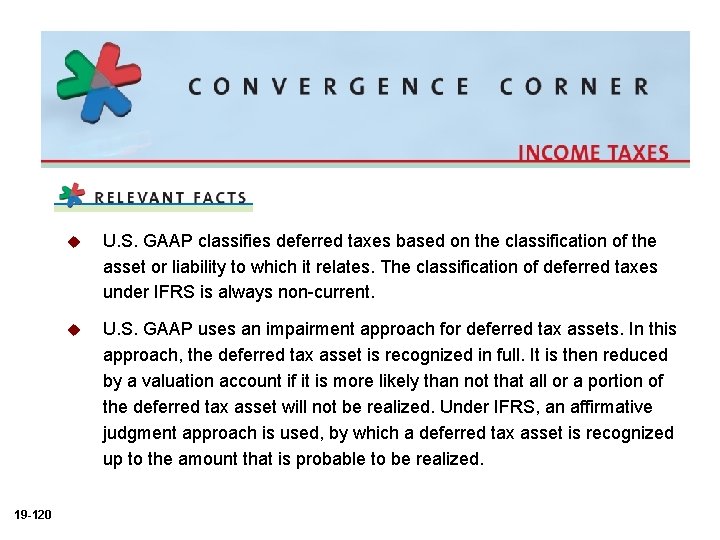
19 -120 u U. S. GAAP classifies deferred taxes based on the classification of the asset or liability to which it relates. The classification of deferred taxes under IFRS is always non-current. u U. S. GAAP uses an impairment approach for deferred tax assets. In this approach, the deferred tax asset is recognized in full. It is then reduced by a valuation account if it is more likely than not that all or a portion of the deferred tax asset will not be realized. Under IFRS, an affirmative judgment approach is used, by which a deferred tax asset is recognized up to the amount that is probable to be realized.
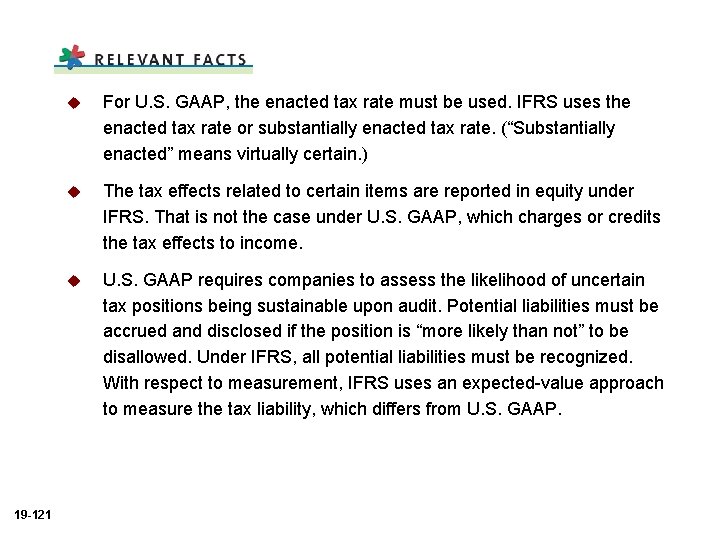
19 -121 u For U. S. GAAP, the enacted tax rate must be used. IFRS uses the enacted tax rate or substantially enacted tax rate. (“Substantially enacted” means virtually certain. ) u The tax effects related to certain items are reported in equity under IFRS. That is not the case under U. S. GAAP, which charges or credits the tax effects to income. u U. S. GAAP requires companies to assess the likelihood of uncertain tax positions being sustainable upon audit. Potential liabilities must be accrued and disclosed if the position is “more likely than not” to be disallowed. Under IFRS, all potential liabilities must be recognized. With respect to measurement, IFRS uses an expected-value approach to measure the tax liability, which differs from U. S. GAAP.
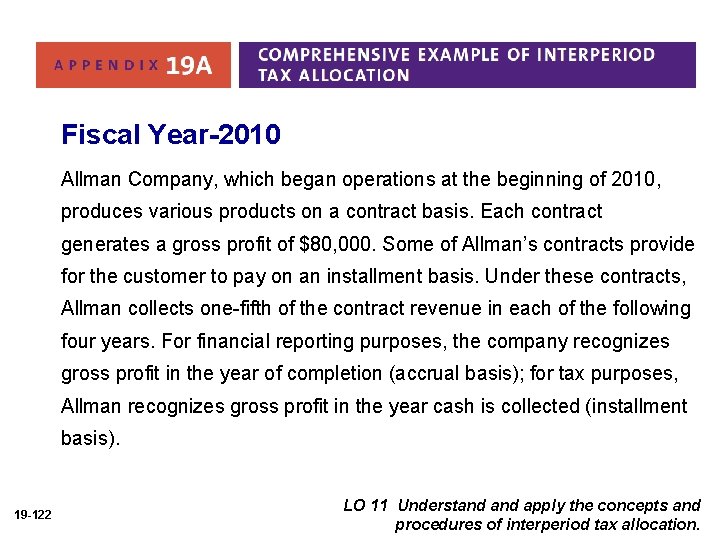
Fiscal Year-2010 Allman Company, which began operations at the beginning of 2010, produces various products on a contract basis. Each contract generates a gross profit of $80, 000. Some of Allman’s contracts provide for the customer to pay on an installment basis. Under these contracts, Allman collects one-fifth of the contract revenue in each of the following four years. For financial reporting purposes, the company recognizes gross profit in the year of completion (accrual basis); for tax purposes, Allman recognizes gross profit in the year cash is collected (installment basis). 19 -122 LO 11 Understand apply the concepts and procedures of interperiod tax allocation.
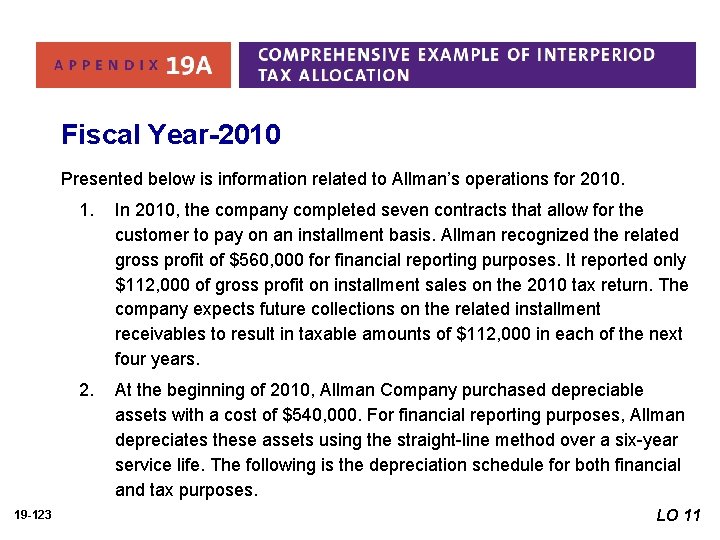
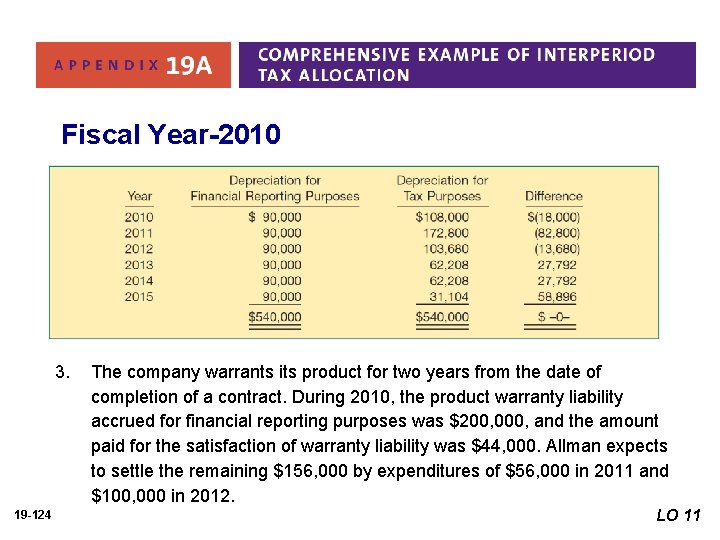
Fiscal Year-2010 Presented below is information related to Allman’s operations for 2010. 19 -123 1. In 2010, the company completed seven contracts that allow for the customer to pay on an installment basis. Allman recognized the related gross profit of $560, 000 for financial reporting purposes. It reported only $112, 000 of gross profit on installment sales on the 2010 tax return. The company expects future collections on the related installment receivables to result in taxable amounts of $112, 000 in each of the next four years. 2. At the beginning of 2010, Allman Company purchased depreciable assets with a cost of $540, 000. For financial reporting purposes, Allman depreciates these assets using the straight-line method over a six-year service life. The following is the depreciation schedule for both financial and tax purposes. LO 11
Fiscal Year-2010 3. 19 -124 The company warrants its product for two years from the date of completion of a contract. During 2010, the product warranty liability accrued for financial reporting purposes was $200, 000, and the amount paid for the satisfaction of warranty liability was $44, 000. Allman expects to settle the remaining $156, 000 by expenditures of $56, 000 in 2011 and $100, 000 in 2012. LO 11
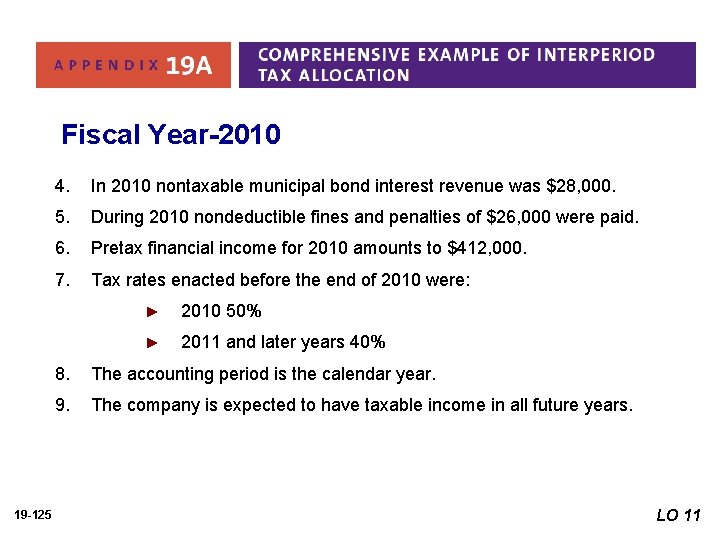
Fiscal Year-2010 19 -125 4. In 2010 nontaxable municipal bond interest revenue was $28, 000. 5. During 2010 nondeductible fines and penalties of $26, 000 were paid. 6. Pretax financial income for 2010 amounts to $412, 000. 7. Tax rates enacted before the end of 2010 were: ► 2010 50% ► 2011 and later years 40% 8. The accounting period is the calendar year. 9. The company is expected to have taxable income in all future years. LO 11
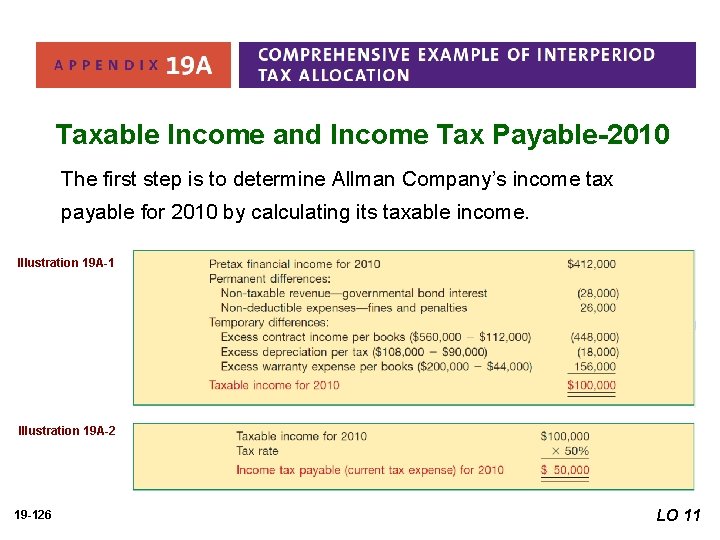
Taxable Income and Income Tax Payable-2010 The first step is to determine Allman Company’s income tax payable for 2010 by calculating its taxable income. Illustration 19 A-1 Illustration 19 A-2 19 -126 LO 11
Deferred Income Taxes – End of 2010 Illustration 19 A-3 Illustration 19 A-4 19 -127 LO 11
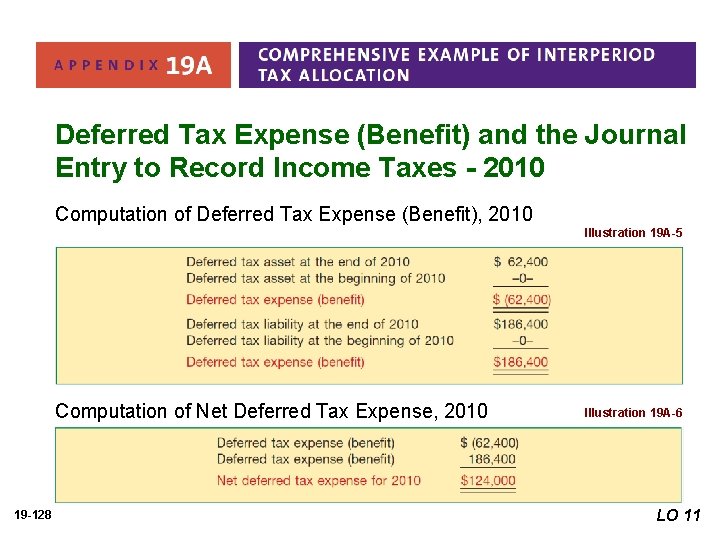
Deferred Tax Expense (Benefit) and the Journal Entry to Record Income Taxes - 2010 Computation of Deferred Tax Expense (Benefit), 2010 Illustration 19 A-5 Computation of Net Deferred Tax Expense, 2010 19 -128 Illustration 19 A-6 LO 11
Deferred Tax Expense (Benefit) and the Journal Entry to Record Income Taxes - 2010 Computation of Total Income Tax Expense, 2010 Illustration 19 A-7 Journal Entry for Income Tax Expense, 2010 Income Tax Expense 174, 000 Deferred Tax Asset 62, 400 Income Tax Payable Deferred Tax Liability 19 -129 50, 000 186, 400 LO 11
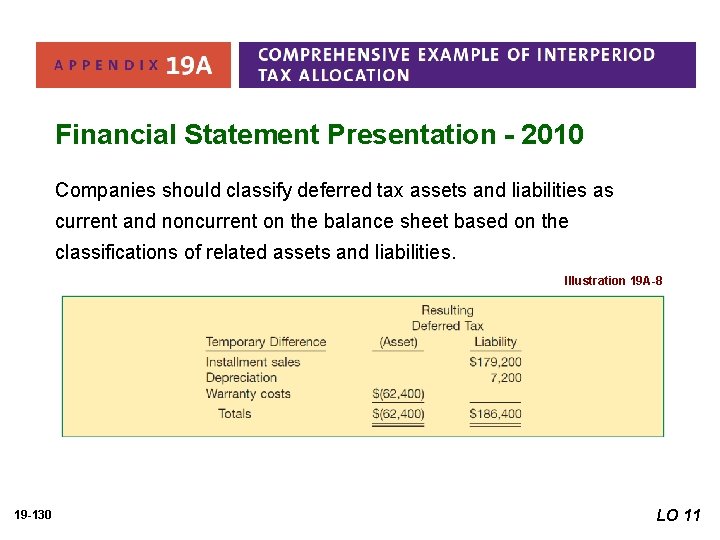
Financial Statement Presentation - 2010 Companies should classify deferred tax assets and liabilities as current and noncurrent on the balance sheet based on the classifications of related assets and liabilities. Illustration 19 A-8 19 -130 LO 11
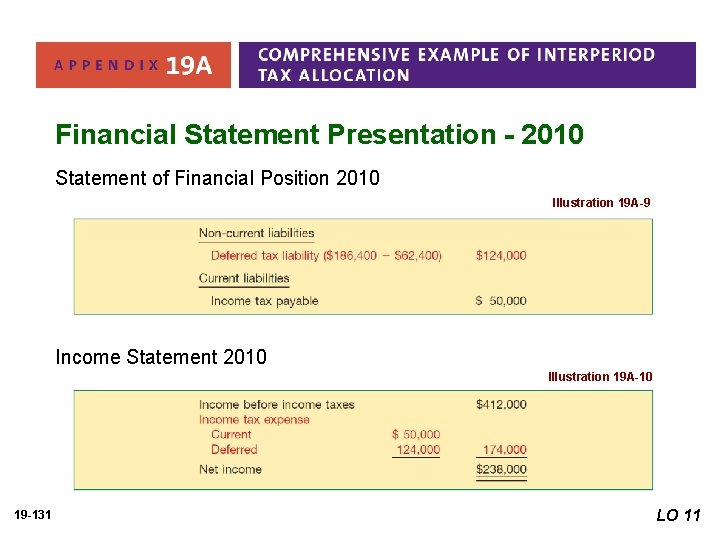
Financial Statement Presentation - 2010 Statement of Financial Position 2010 Illustration 19 A-9 Income Statement 2010 Illustration 19 A-10 19 -131 LO 11
Copyright © 2011 John Wiley & Sons, Inc. All rights reserved. Reproduction or translation of this work beyond that permitted in Section 117 of the 1976 United States Copyright Act without the express written permission of the copyright owner is unlawful. Request for further information should be addressed to the Permissions Department, John Wiley & Sons, Inc. The purchaser may make back-up copies for his/her own use only and not for distribution or resale. The Publisher assumes no responsibility for errors, omissions, or damages, caused by the use of these programs or from the use of the information contained herein. 19 -132
Referensi Utama n Intermediate Accounting Kieso, Weygandt, Walfield, IFRS edition, John Wiley n Standar Akuntansi Keuangan Dewan Standar Akuntansi Keuangan, IAI n International Financial Reporting Standards – Certificate Learning Material The Institute of Chartered Accountants, England Wales Akuntansi Keuangan 2 - Departemen Akuntansi FEUI 133
Dwi Martani Departemen Akuntansi FEUI Slide OCW Universitas Indonesia martani@ui. ac. id Oleh : Dwi Martani atau dwimartani@yahoo. com http: //staff. blog. ui. ac. id/martani/ Departemen Akuntansi FEUI Akuntansi Keuangan 2 - Departemen Akuntansi FEUI 134