The NernstEinstein equation indicates that the ratio D

- Slides: 40
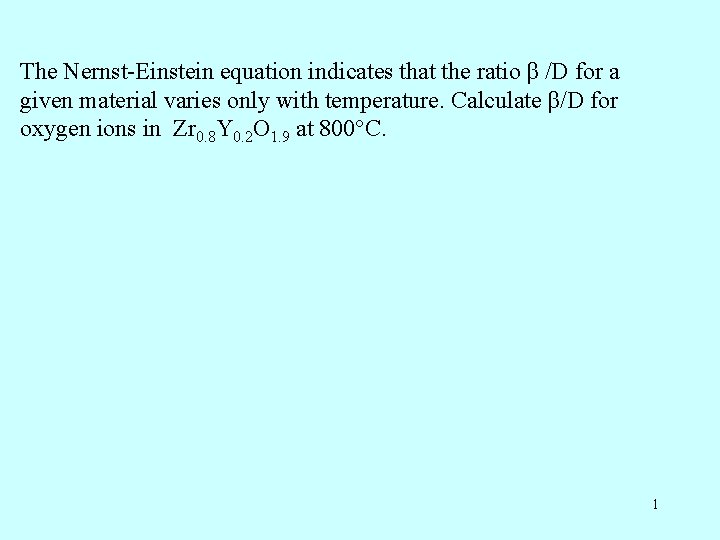
The Nernst-Einstein equation indicates that the ratio β /D for a given material varies only with temperature. Calculate β/D for oxygen ions in Zr 0. 8 Y 0. 2 O 1. 9 at 800°C. 1
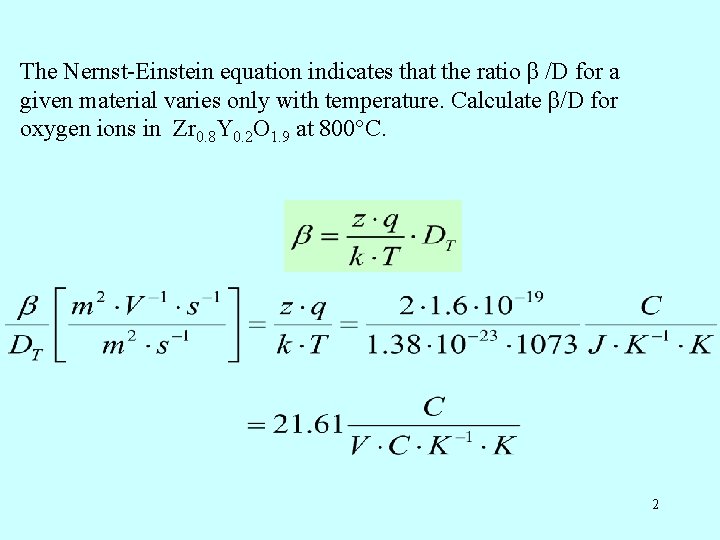
The Nernst-Einstein equation indicates that the ratio β /D for a given material varies only with temperature. Calculate β/D for oxygen ions in Zr 0. 8 Y 0. 2 O 1. 9 at 800°C. 2
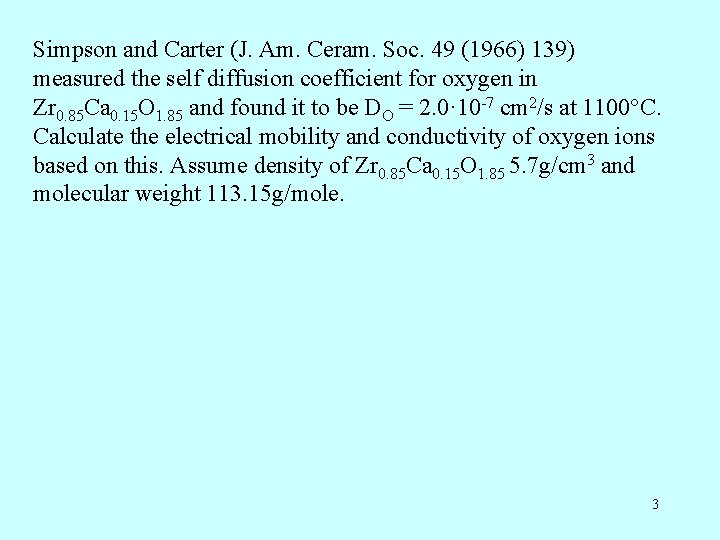
Simpson and Carter (J. Am. Ceram. Soc. 49 (1966) 139) measured the self diffusion coefficient for oxygen in Zr 0. 85 Ca 0. 15 O 1. 85 and found it to be DO = 2. 0· 10 -7 cm 2/s at 1100°C. Calculate the electrical mobility and conductivity of oxygen ions based on this. Assume density of Zr 0. 85 Ca 0. 15 O 1. 85 5. 7 g/cm 3 and molecular weight 113. 15 g/mole. 3
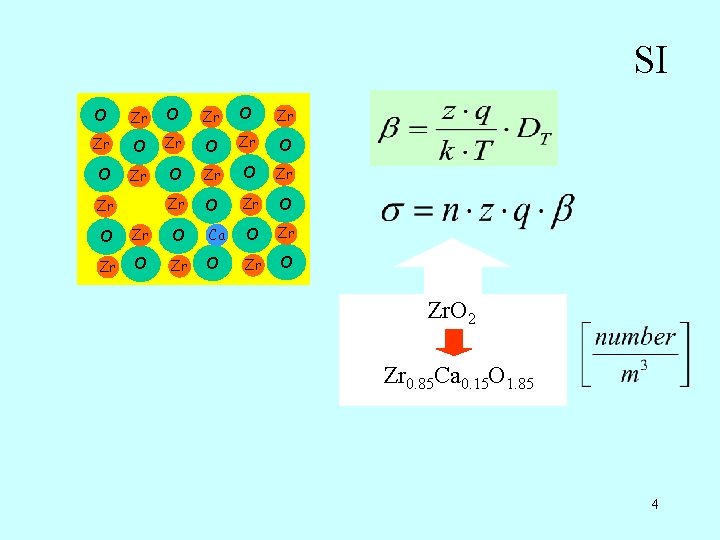
SI O Zr O Zr Zr O Zr O O Zr O Ca O Zr Zr O Zr. O 2 Zr 0. 85 Ca 0. 15 O 1. 85 4
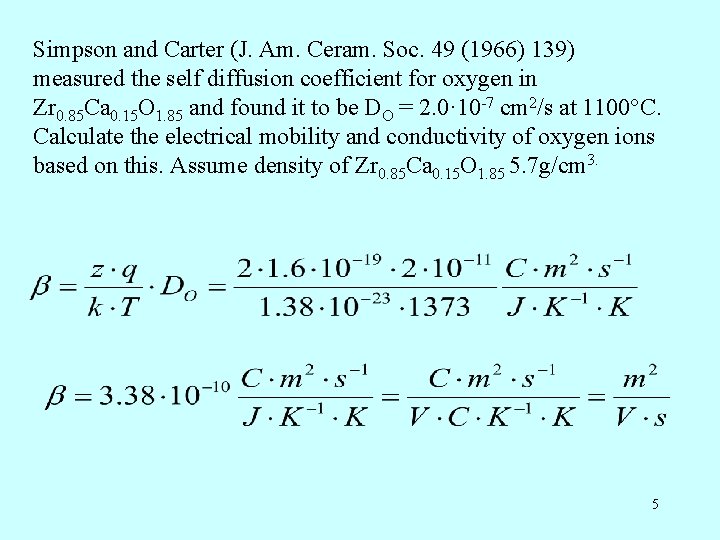
Simpson and Carter (J. Am. Ceram. Soc. 49 (1966) 139) measured the self diffusion coefficient for oxygen in Zr 0. 85 Ca 0. 15 O 1. 85 and found it to be DO = 2. 0· 10 -7 cm 2/s at 1100°C. Calculate the electrical mobility and conductivity of oxygen ions based on this. Assume density of Zr 0. 85 Ca 0. 15 O 1. 85 5. 7 g/cm 3. 5
Electrical conductivity Zahl der Zr 0. 85 Ca 0. 15 O 1. 85 -Einheiten per m 3 6
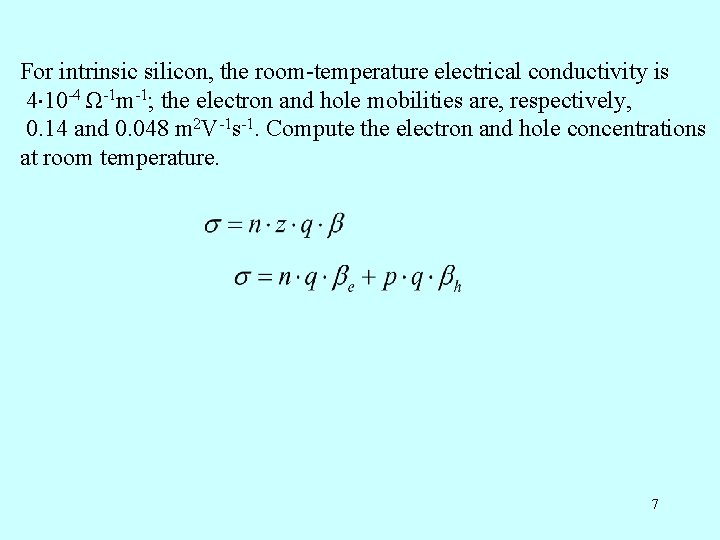
For intrinsic silicon, the room-temperature electrical conductivity is 4 10 -4 Ω-1 m-1; the electron and hole mobilities are, respectively, 0. 14 and 0. 048 m 2 V-1 s-1. Compute the electron and hole concentrations at room temperature. 7
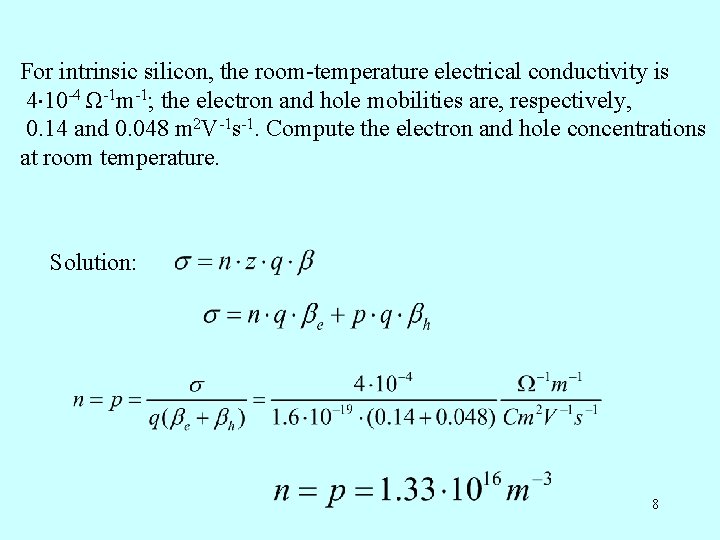
For intrinsic silicon, the room-temperature electrical conductivity is 4 10 -4 Ω-1 m-1; the electron and hole mobilities are, respectively, 0. 14 and 0. 048 m 2 V-1 s-1. Compute the electron and hole concentrations at room temperature. Solution: 8
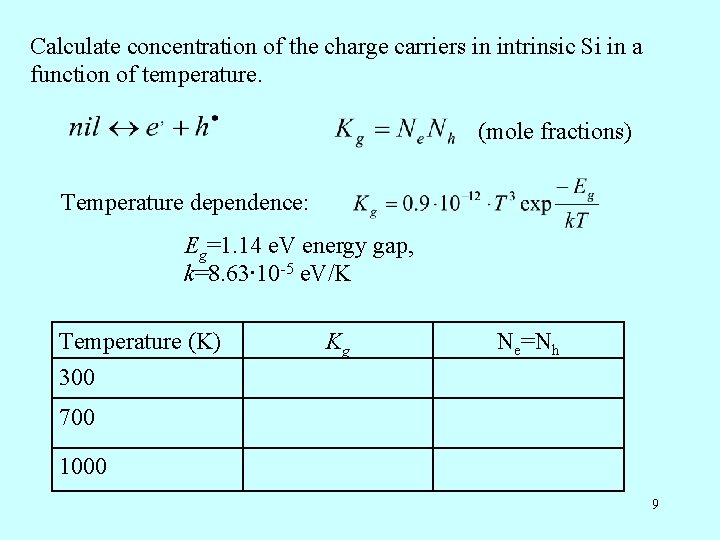
Calculate concentration of the charge carriers in intrinsic Si in a function of temperature. (mole fractions) Temperature dependence: Eg=1. 14 e. V energy gap, k=8. 63∙ 10 -5 e. V/K Temperature (K) 300 Kg Ne=Nh 700 1000 9
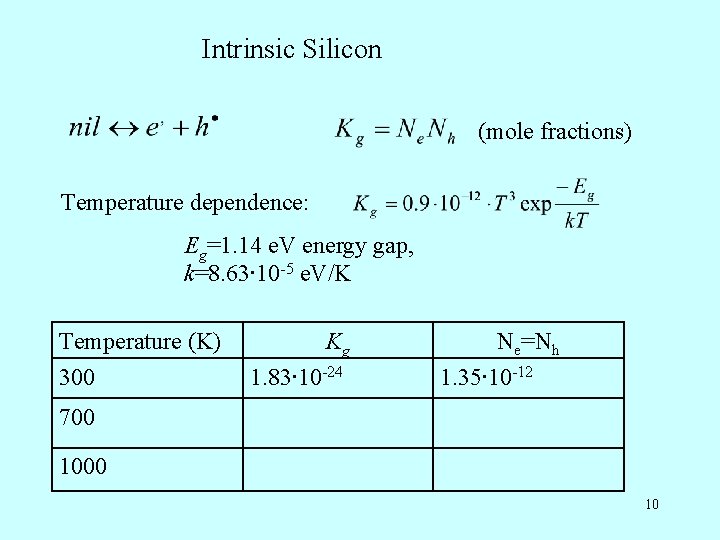
Intrinsic Silicon (mole fractions) Temperature dependence: Eg=1. 14 e. V energy gap, k=8. 63∙ 10 -5 e. V/K Temperature (K) 300 Kg 1. 83∙ 10 -24 Ne=Nh 1. 35∙ 10 -12 700 10
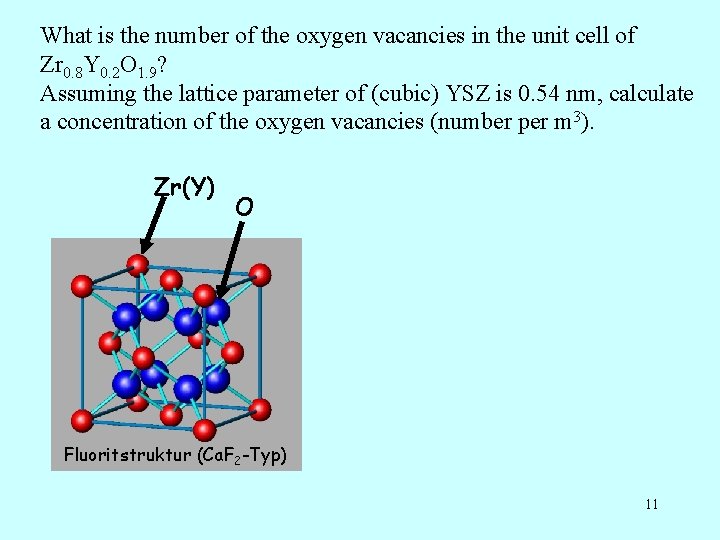
What is the number of the oxygen vacancies in the unit cell of Zr 0. 8 Y 0. 2 O 1. 9? Assuming the lattice parameter of (cubic) YSZ is 0. 54 nm, calculate a concentration of the oxygen vacancies (number per m 3). Zr(Y) O Fluoritstruktur (Ca. F 2 -Typ) 11
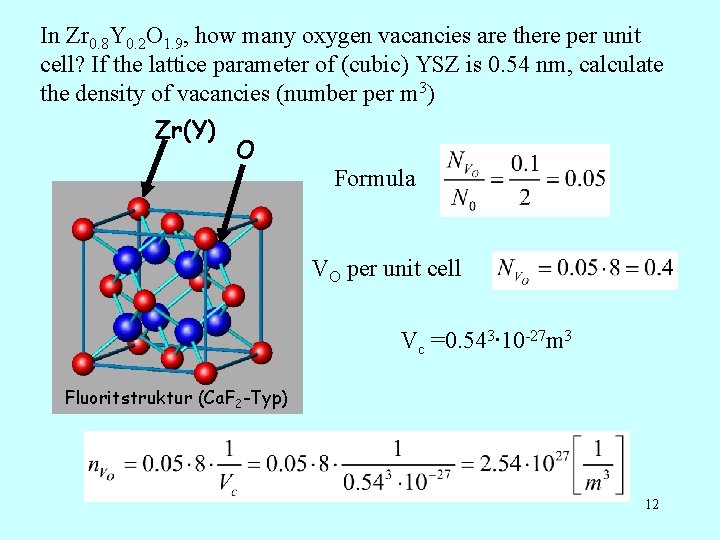
In Zr 0. 8 Y 0. 2 O 1. 9, how many oxygen vacancies are there per unit cell? If the lattice parameter of (cubic) YSZ is 0. 54 nm, calculate the density of vacancies (number per m 3) Zr(Y) O Formula VO per unit cell Vc =0. 543∙ 10 -27 m 3 Fluoritstruktur (Ca. F 2 -Typ) 12
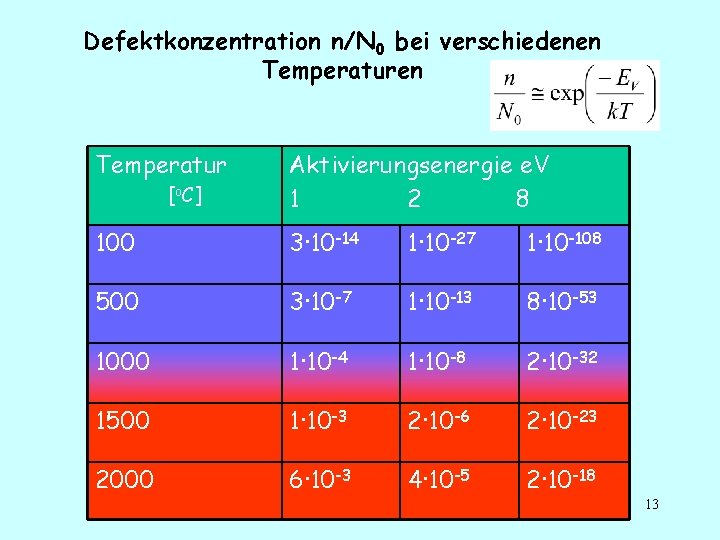
Defektkonzentration n/N 0 bei verschiedenen Temperatur [o. C] Aktivierungsenergie e. V 1 2 8 100 3· 10 -14 1· 10 -27 1· 10 -108 500 3· 10 -7 1· 10 -13 8· 10 -53 1000 1· 10 -4 1· 10 -8 2· 10 -32 1500 1· 10 -3 2· 10 -6 2· 10 -23 2000 6· 10 -3 4· 10 -5 2· 10 -18 13
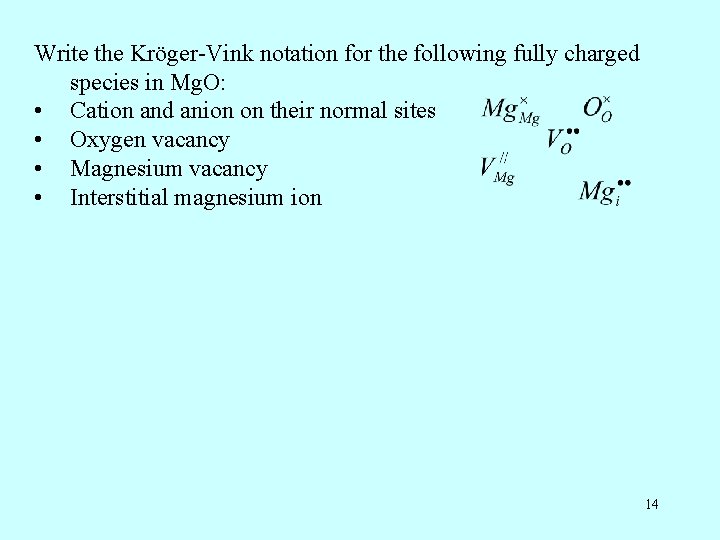
Write the Kröger-Vink notation for the following fully charged species in Mg. O: • Cation and anion on their normal sites • Oxygen vacancy • Magnesium vacancy • Interstitial magnesium ion 14
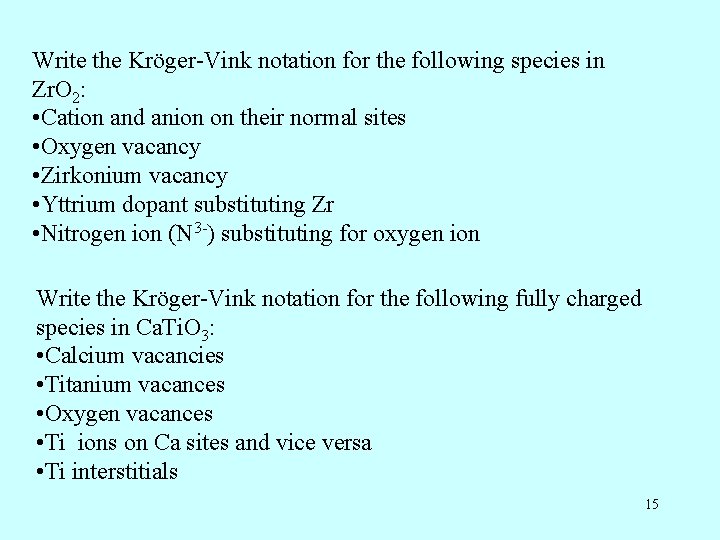
Write the Kröger-Vink notation for the following species in Zr. O 2: • Cation and anion on their normal sites • Oxygen vacancy • Zirkonium vacancy • Yttrium dopant substituting Zr • Nitrogen ion (N 3 -) substituting for oxygen ion Write the Kröger-Vink notation for the following fully charged species in Ca. Ti. O 3: • Calcium vacancies • Titanium vacances • Oxygen vacances • Ti ions on Ca sites and vice versa • Ti interstitials 15
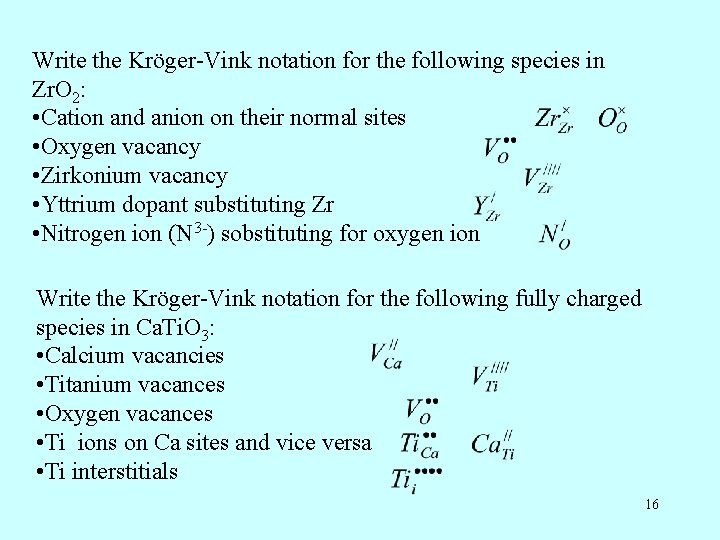
Write the Kröger-Vink notation for the following species in Zr. O 2: • Cation and anion on their normal sites • Oxygen vacancy • Zirkonium vacancy • Yttrium dopant substituting Zr • Nitrogen ion (N 3 -) sobstituting for oxygen ion Write the Kröger-Vink notation for the following fully charged species in Ca. Ti. O 3: • Calcium vacancies • Titanium vacances • Oxygen vacances • Ti ions on Ca sites and vice versa • Ti interstitials 16
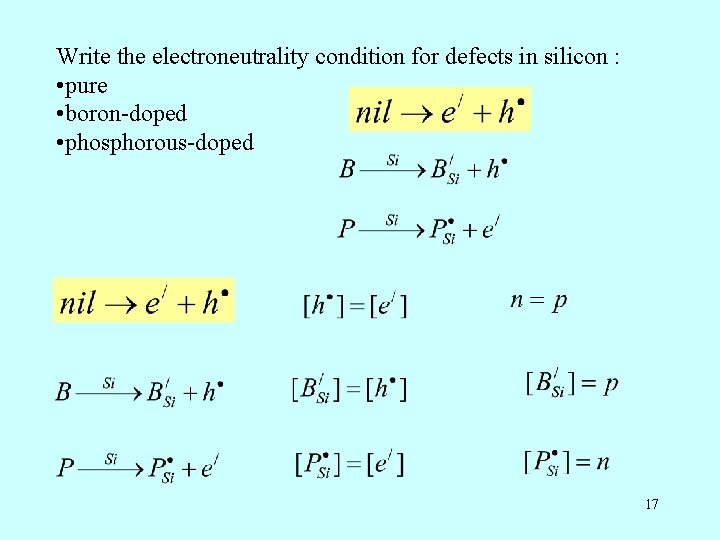
Write the electroneutrality condition for defects in silicon : • pure • boron-doped • phosphorous-doped 17
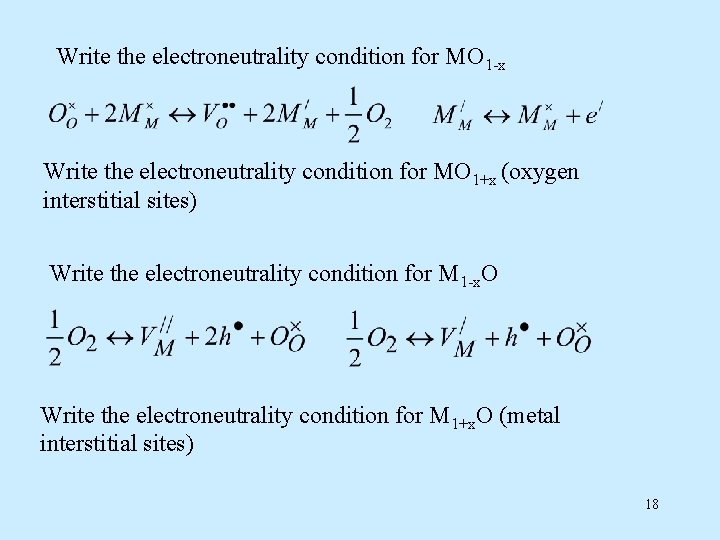
Write the electroneutrality condition for MO 1 -x Write the electroneutrality condition for MO 1+x (oxygen interstitial sites) Write the electroneutrality condition for M 1 -x. O Write the electroneutrality condition for M 1+x. O (metal interstitial sites) 18
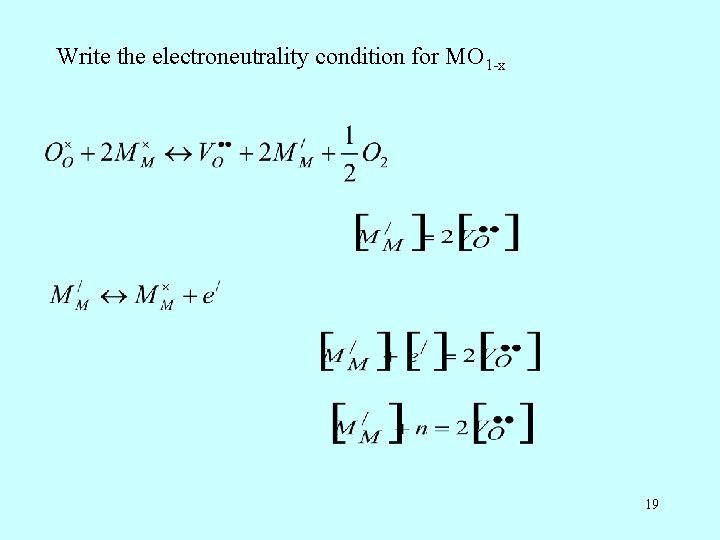
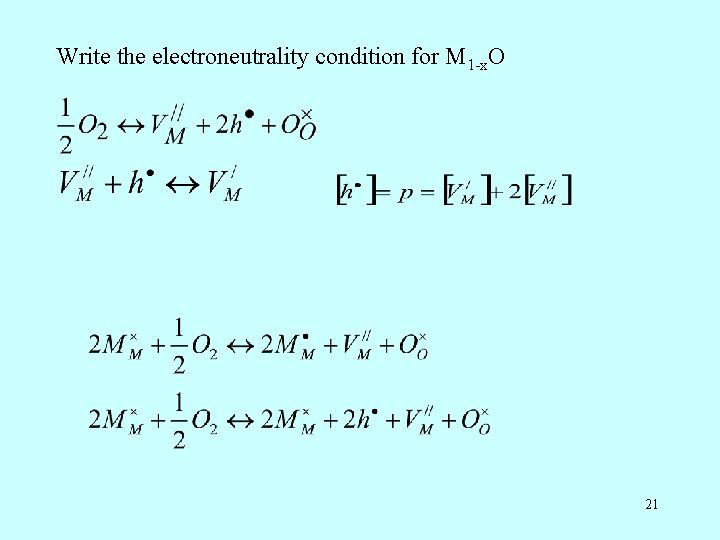
Write the electroneutrality condition for MO 1 -x 19
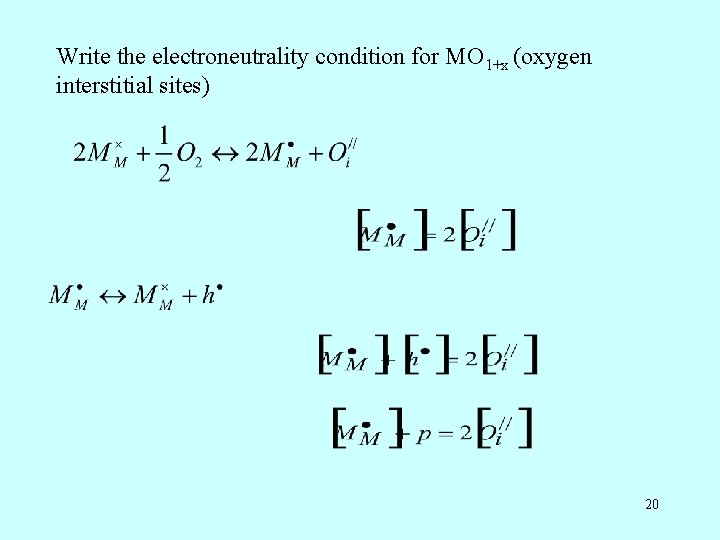
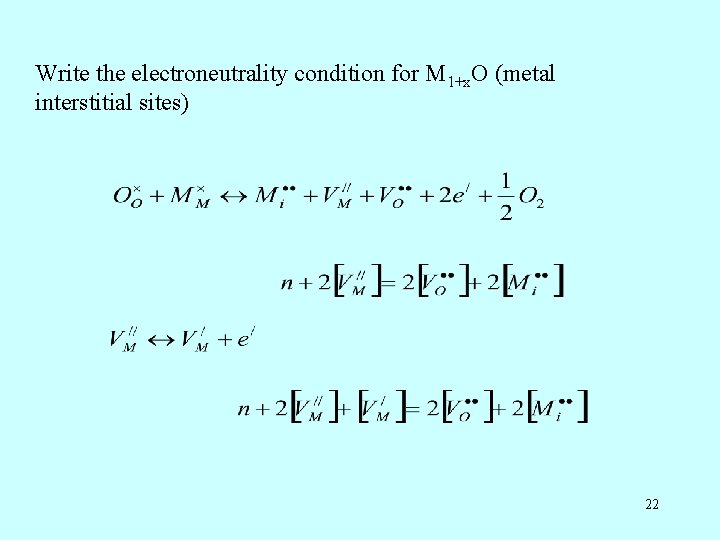
Write the electroneutrality condition for MO 1+x (oxygen interstitial sites) 20
Write the electroneutrality condition for M 1 -x. O 21
Write the electroneutrality condition for M 1+x. O (metal interstitial sites) 22
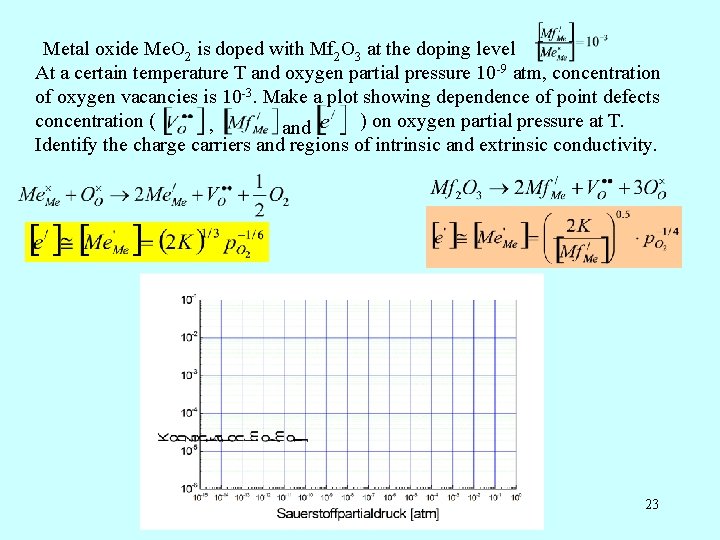
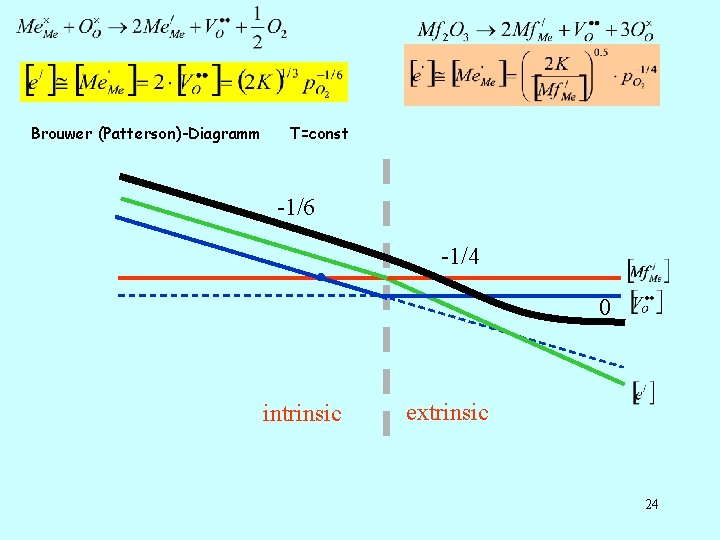
Metal oxide Me. O 2 is doped with Mf 2 O 3 at the doping level At a certain temperature T and oxygen partial pressure 10 -9 atm, concentration of oxygen vacancies is 10 -3. Make a plot showing dependence of point defects concentration ( ) on oxygen partial pressure at T. , and Identify the charge carriers and regions of intrinsic and extrinsic conductivity. 23
Brouwer (Patterson)-Diagramm T=const -1/6 -1/4 0 intrinsic extrinsic 24
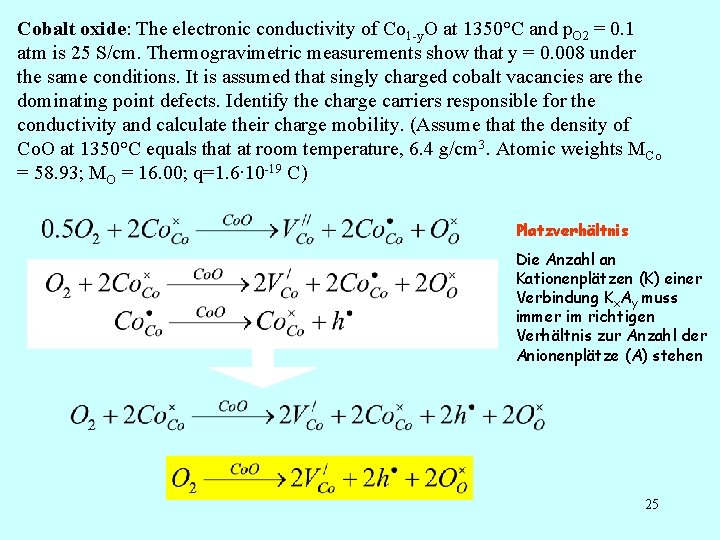
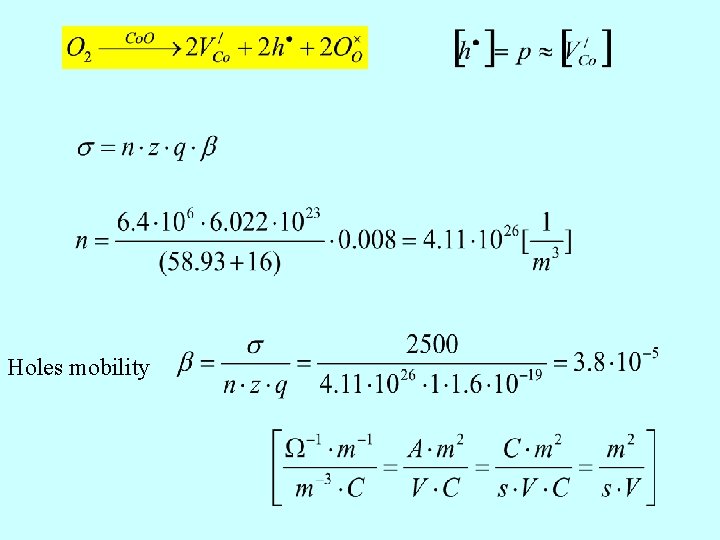
Cobalt oxide: The electronic conductivity of Co 1 -y. O at 1350°C and p. O 2 = 0. 1 atm is 25 S/cm. Thermogravimetric measurements show that y = 0. 008 under the same conditions. It is assumed that singly charged cobalt vacancies are the dominating point defects. Identify the charge carriers responsible for the conductivity and calculate their charge mobility. (Assume that the density of Co. O at 1350°C equals that at room temperature, 6. 4 g/cm 3. Atomic weights MCo = 58. 93; MO = 16. 00; q=1. 6∙ 10 -19 C) Platzverhältnis Die Anzahl an Kationenplätzen (K) einer Verbindung Kx. Ay muss immer im richtigen Verhältnis zur Anzahl der Anionenplätze (A) stehen 25
Holes mobility 26
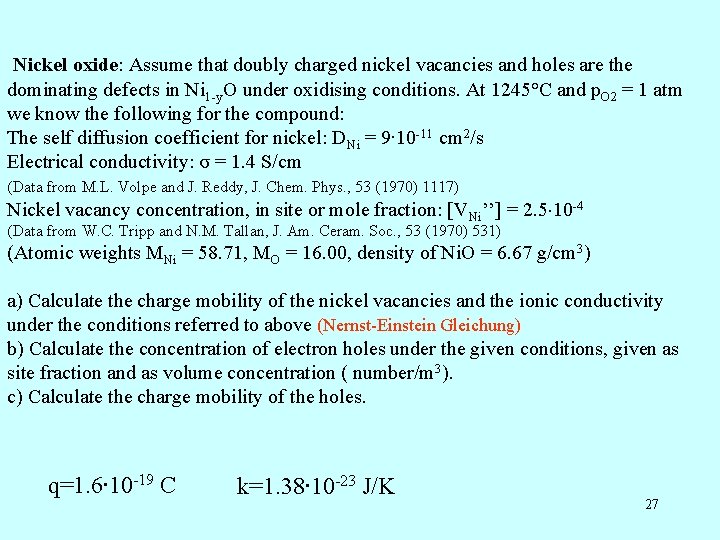
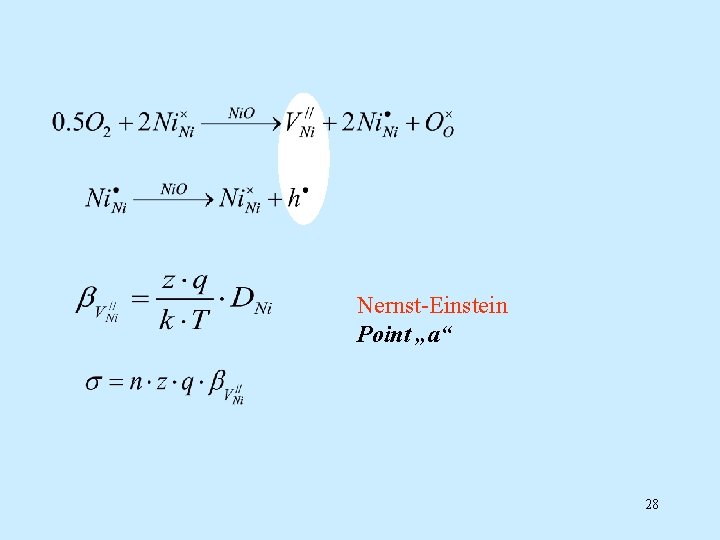
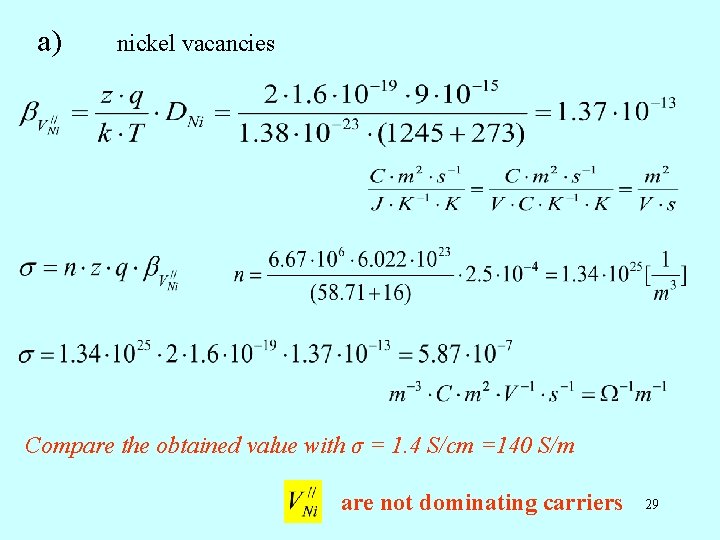
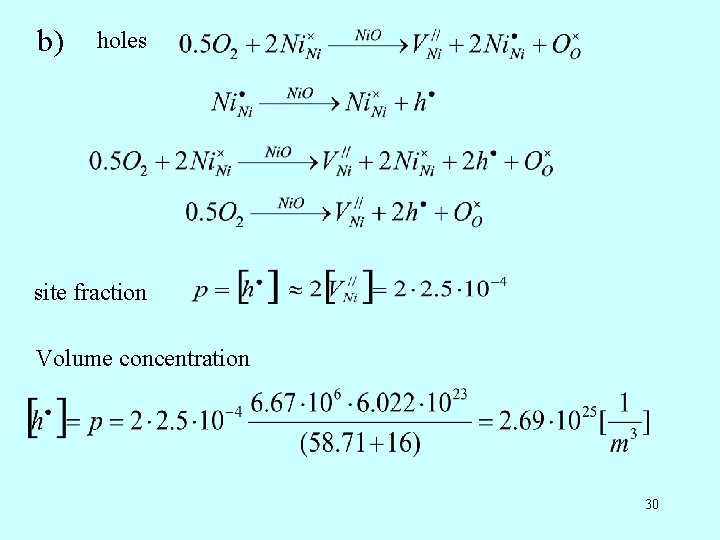
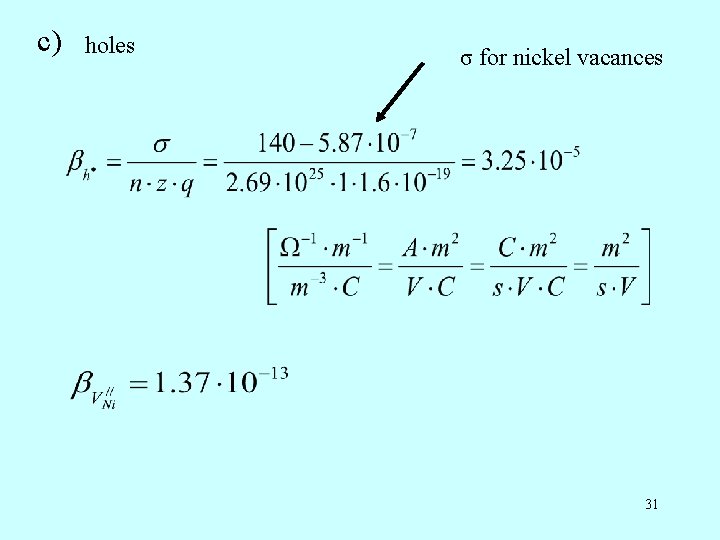
Nickel oxide: Assume that doubly charged nickel vacancies and holes are the dominating defects in Ni 1 -y. O under oxidising conditions. At 1245°C and p. O 2 = 1 atm we know the following for the compound: The self diffusion coefficient for nickel: DNi = 9∙ 10 -11 cm 2/s Electrical conductivity: σ = 1. 4 S/cm (Data from M. L. Volpe and J. Reddy, J. Chem. Phys. , 53 (1970) 1117) Nickel vacancy concentration, in site or mole fraction: [VNi’’] = 2. 5 10 -4 (Data from W. C. Tripp and N. M. Tallan, J. Am. Ceram. Soc. , 53 (1970) 531) (Atomic weights MNi = 58. 71, MO = 16. 00, density of Ni. O = 6. 67 g/cm 3) a) Calculate the charge mobility of the nickel vacancies and the ionic conductivity under the conditions referred to above (Nernst-Einstein Gleichung) b) Calculate the concentration of electron holes under the given conditions, given as site fraction and as volume concentration ( number/m 3). c) Calculate the charge mobility of the holes. q=1. 6∙ 10 -19 C k=1. 38∙ 10 -23 J/K 27
Nernst-Einstein Point „a“ 28
a) nickel vacancies Compare the obtained value with σ = 1. 4 S/cm =140 S/m are not dominating carriers 29
b) holes site fraction Volume concentration 30
c) holes σ for nickel vacances 31
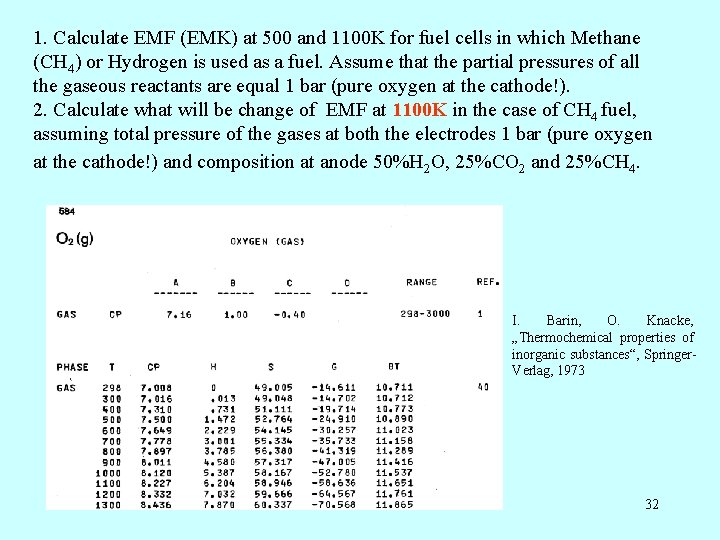
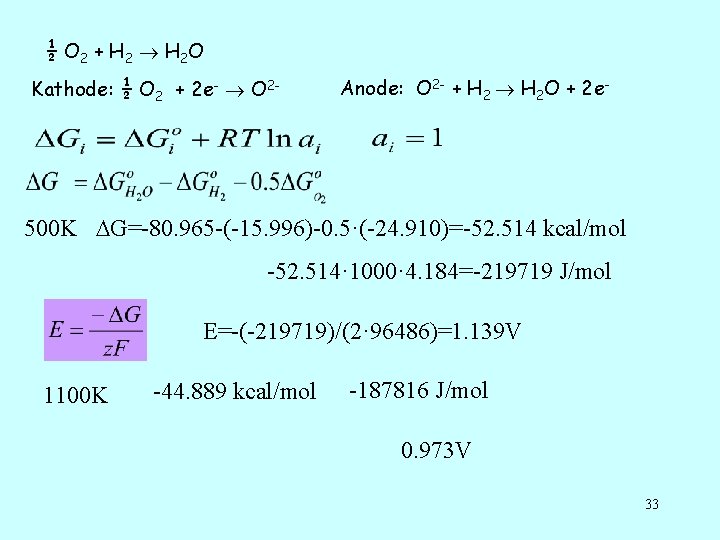
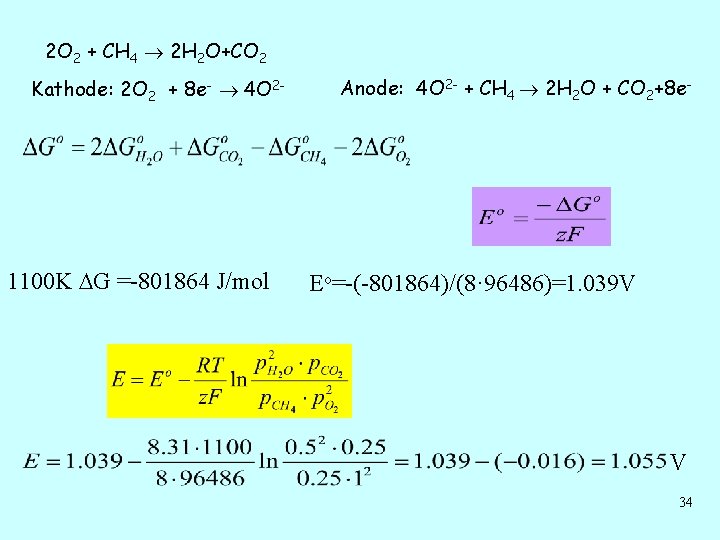
1. Calculate EMF (EMK) at 500 and 1100 K for fuel cells in which Methane (CH 4) or Hydrogen is used as a fuel. Assume that the partial pressures of all the gaseous reactants are equal 1 bar (pure oxygen at the cathode!). 2. Calculate what will be change of EMF at 1100 K in the case of CH 4 fuel, assuming total pressure of the gases at both the electrodes 1 bar (pure oxygen at the cathode!) and composition at anode 50%H 2 O, 25%CO 2 and 25%CH 4. I. Barin, O. Knacke, „Thermochemical properties of inorganic substances“, Springer. Verlag, 1973 32
½ O 2 + H 2 O Kathode: ½ O 2 + 2 e- O 2 - Anode: O 2 - + H 2 O + 2 e- 500 K G=-80. 965 -(-15. 996)-0. 5·(-24. 910)=-52. 514 kcal/mol -52. 514· 1000· 4. 184=-219719 J/mol E=-(-219719)/(2· 96486)=1. 139 V 1100 K -44. 889 kcal/mol -187816 J/mol 0. 973 V 33
2 O 2 + CH 4 2 H 2 O+CO 2 Kathode: 2 O 2 + 8 e- 4 O 2 - 1100 K G =-801864 J/mol Anode: 4 O 2 - + CH 4 2 H 2 O + CO 2+8 e- Eo=-(-801864)/(8· 96486)=1. 039 V V 34
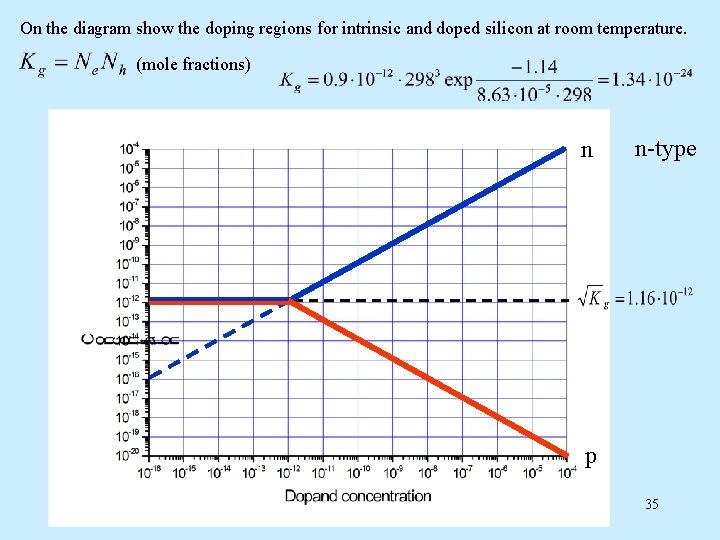
On the diagram show the doping regions for intrinsic and doped silicon at room temperature. (mole fractions) n n-type p 35
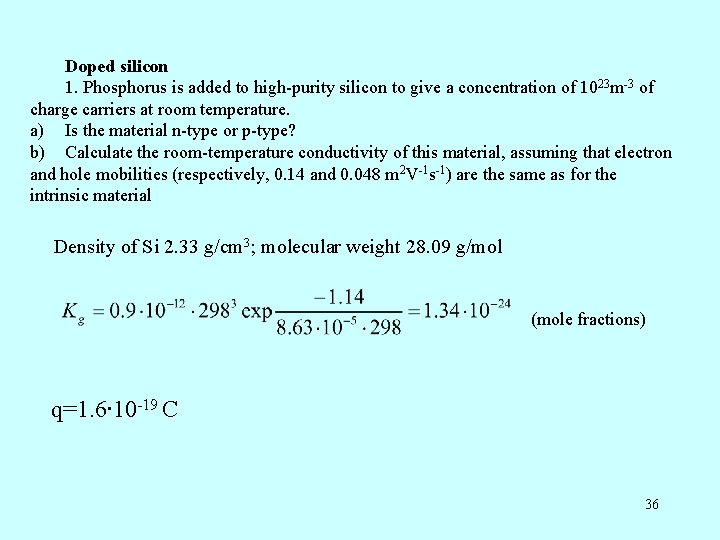
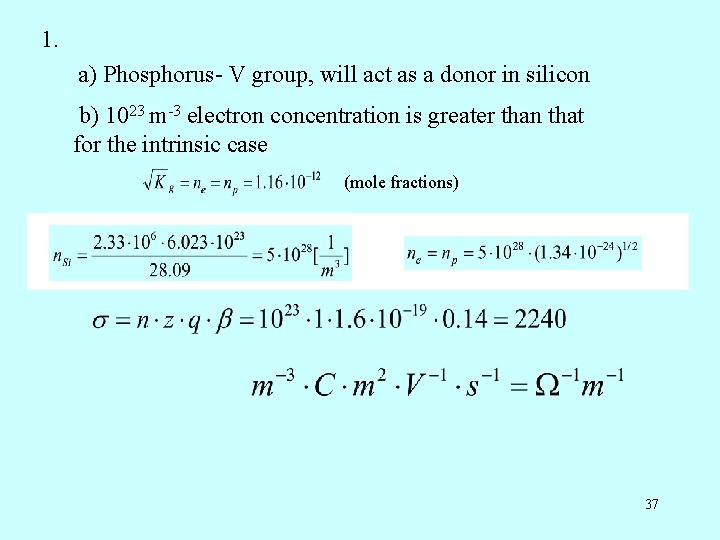
Doped silicon 1. Phosphorus is added to high-purity silicon to give a concentration of 1023 m-3 of charge carriers at room temperature. a) Is the material n-type or p-type? b) Calculate the room-temperature conductivity of this material, assuming that electron and hole mobilities (respectively, 0. 14 and 0. 048 m 2 V-1 s-1) are the same as for the intrinsic material Density of Si 2. 33 g/cm 3; molecular weight 28. 09 g/mol (mole fractions) q=1. 6∙ 10 -19 C 36
1. a) Phosphorus- V group, will act as a donor in silicon b) 1023 m-3 electron concentration is greater than that for the intrinsic case (mole fractions) 37
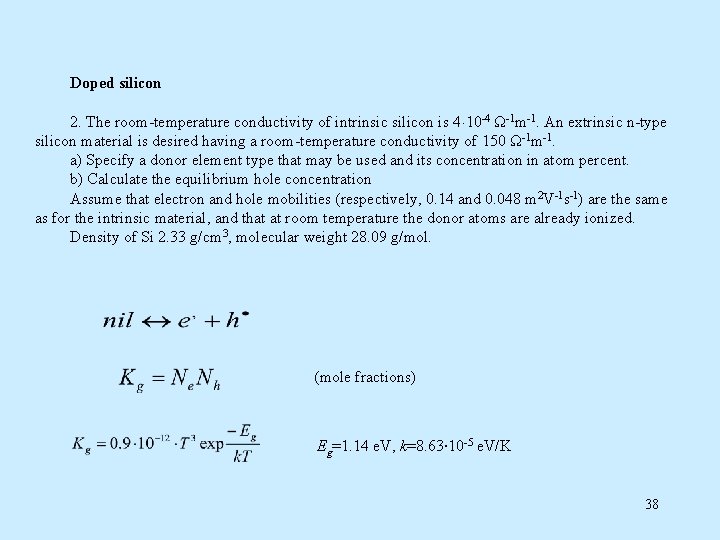
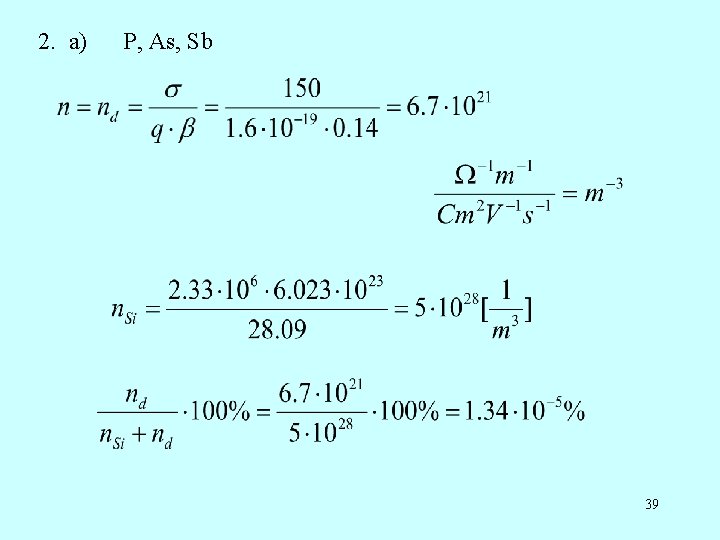
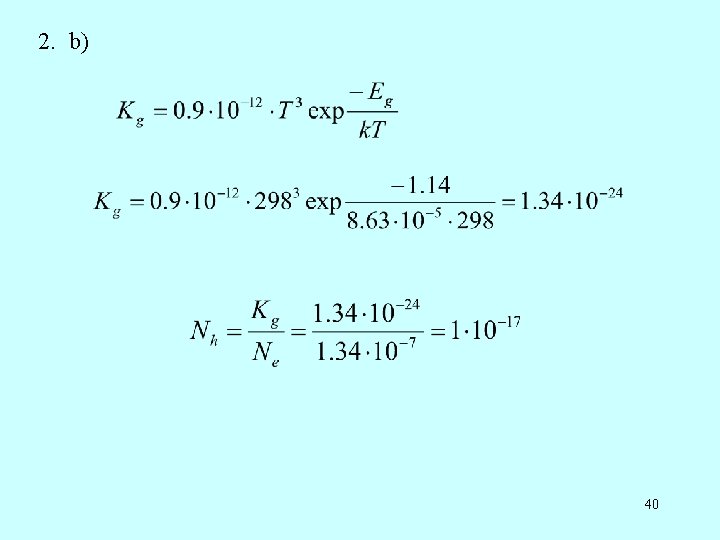
Doped silicon 2. The room-temperature conductivity of intrinsic silicon is 4 10 -4 Ω-1 m-1. An extrinsic n-type silicon material is desired having a room-temperature conductivity of 150 Ω-1 m-1. a) Specify a donor element type that may be used and its concentration in atom percent. b) Calculate the equilibrium hole concentration Assume that electron and hole mobilities (respectively, 0. 14 and 0. 048 m 2 V-1 s-1) are the same as for the intrinsic material, and that at room temperature the donor atoms are already ionized. Density of Si 2. 33 g/cm 3, molecular weight 28. 09 g/mol. (mole fractions) Eg=1. 14 e. V, k=8. 63∙ 10 -5 e. V/K 38
2. a) P, As, Sb 39
2. b) 40