The Final Present Lee JengShiou Computer Network of
- Slides: 41
The Final Present Lee Jeng-Shiou Computer Network of E. E
Outline n n n Throughput Analysis Review for Single-hop Networks Throughout Analysis for Multi-hop Networks Mathematical Analysis of the String Topology Analytical and Simulation Results An Alternative Mathematical Analysis of the String Topology Conclusion
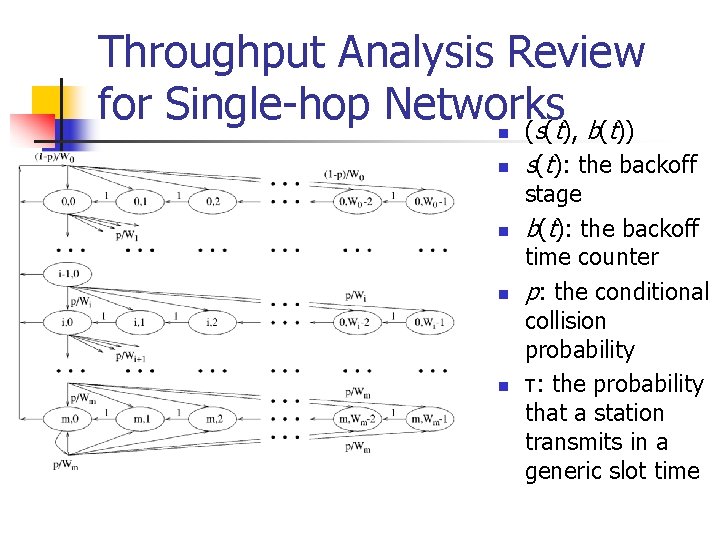
Throughput Analysis Review for Single-hop Networks (s(t), b(t)) n n n s(t): the backoff stage b(t): the backoff time counter p: the conditional collision probability τ: the probability that a station transmits in a generic slot time
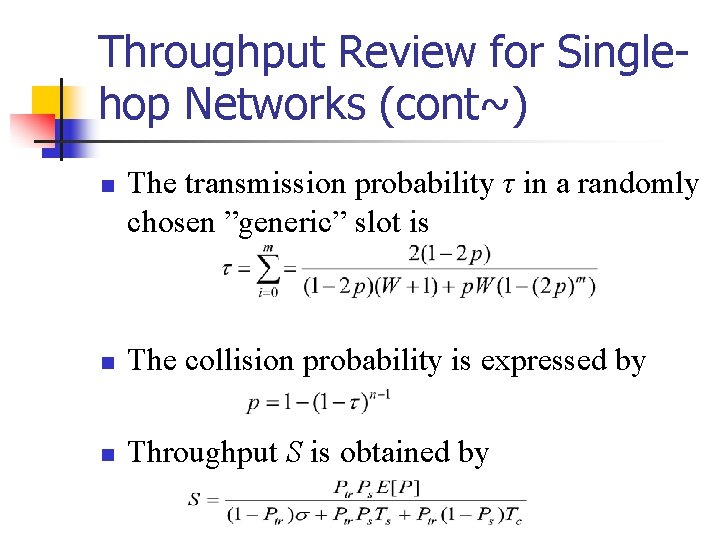
Throughput Review for Singlehop Networks (cont~) n The transmission probability τ in a randomly chosen ”generic” slot is n The collision probability is expressed by n Throughput S is obtained by
Throughout Analysis for Multihop Networks n n n We concentrate on the impact of the hidden node problem. We analyze throughput based on a single station’s point of view. The analysis method is similar to the single-hop case. n n Obtaining the stationary probability τ using a Markov model. Expressing the throughput as function of τ by studying the events that can occur within a generic slot time.
Throughout Analysis for Multihop Networks n Assumption: n n n All packets are destined for neighbor nodes. There is no capture effect. Each station always has packets to transmit.
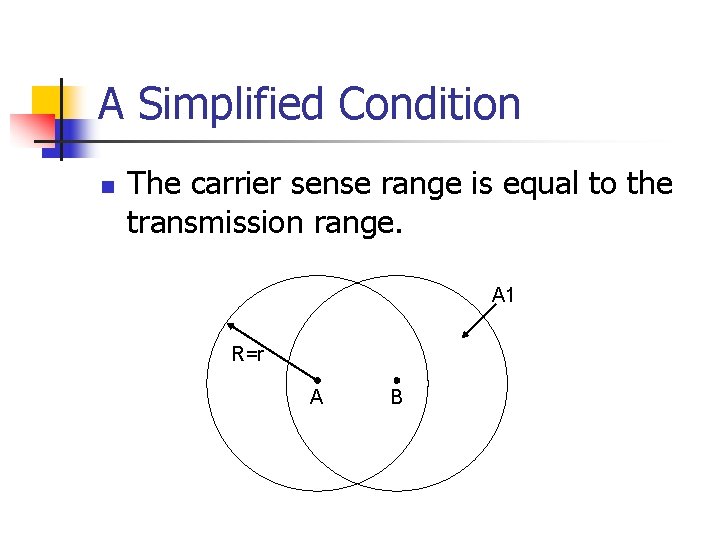
A Simplified Condition n The carrier sense range is equal to the transmission range. A 1 R=r A B
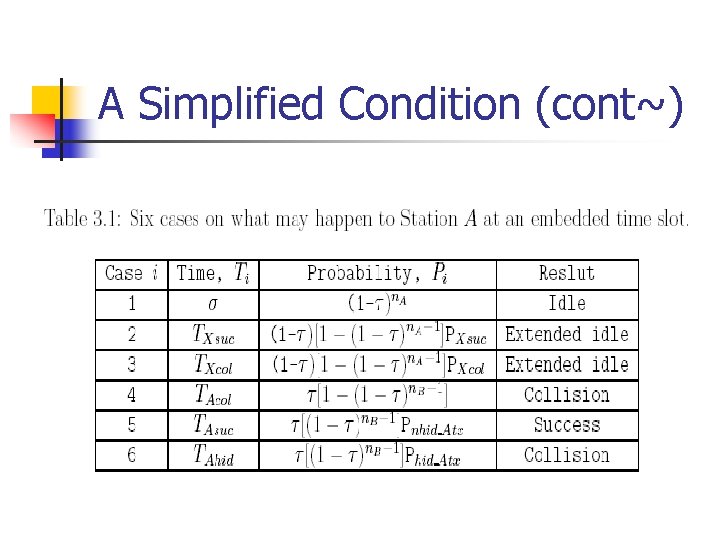
A Simplified Condition (cont~)
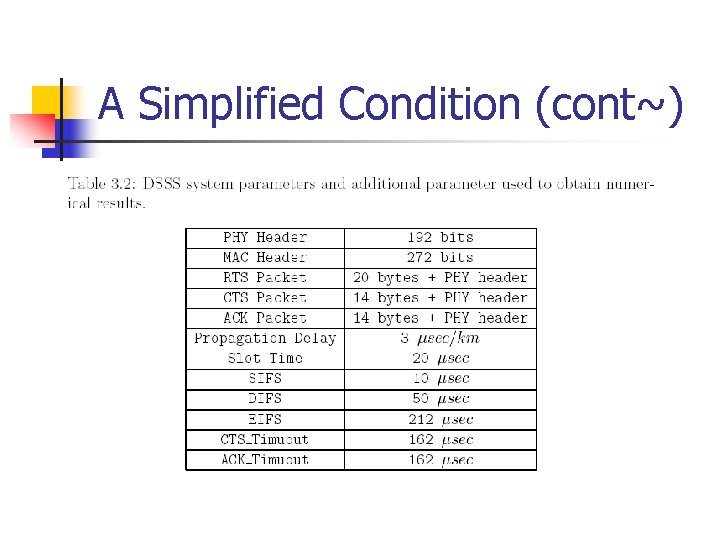
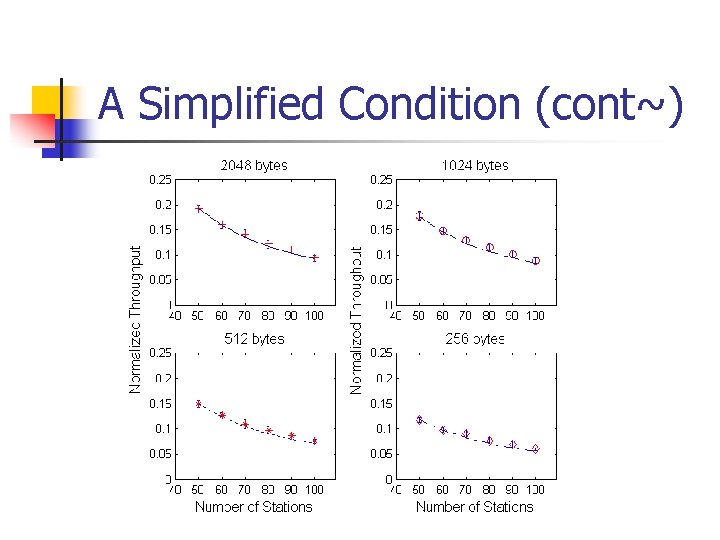
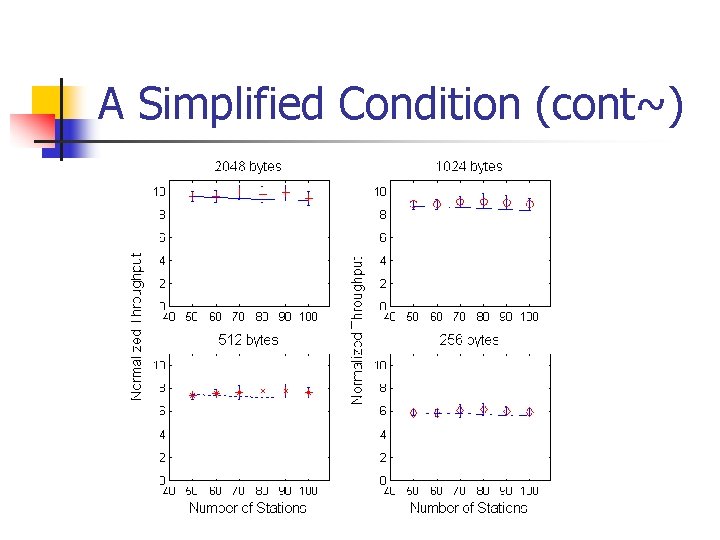
A Simplified Condition (cont~) n n n The simulations have been done by the network simulator - ns 2. Simulation area 1500 x 1500 m 2. We consider five topology scenarios and each scenario includes four traffic patterns. Each node generates packets based on CBR model with packet sizes 256, 512, 1024 and 2048 bytes. They correspond to packet arrival interval of 0. 0013, 0. 0026, 0. 0052 and 0. 01 sec.
A Simplified Condition (cont~)
A Simplified Condition (cont~)
A Simplified Condition (cont~)
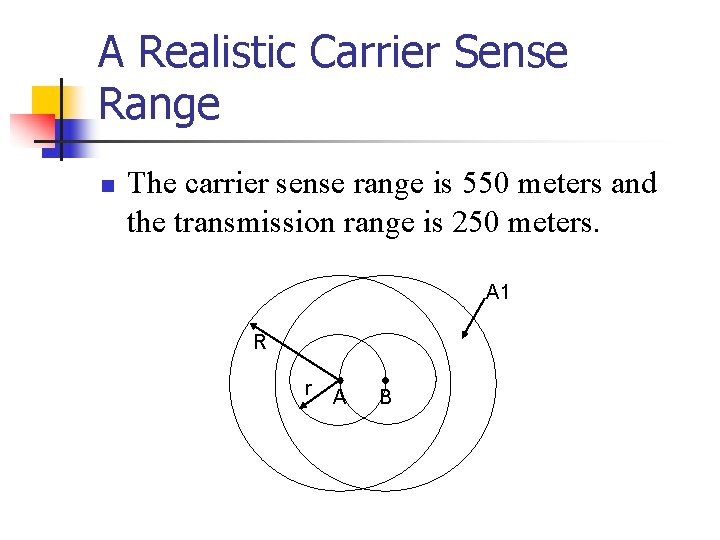
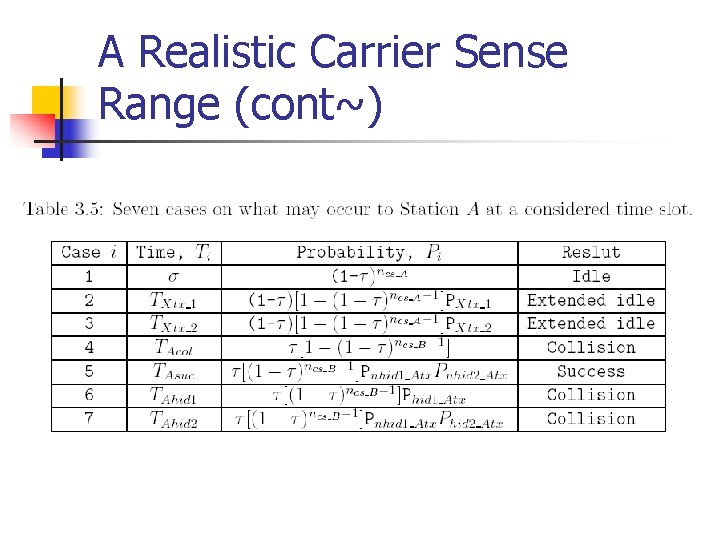
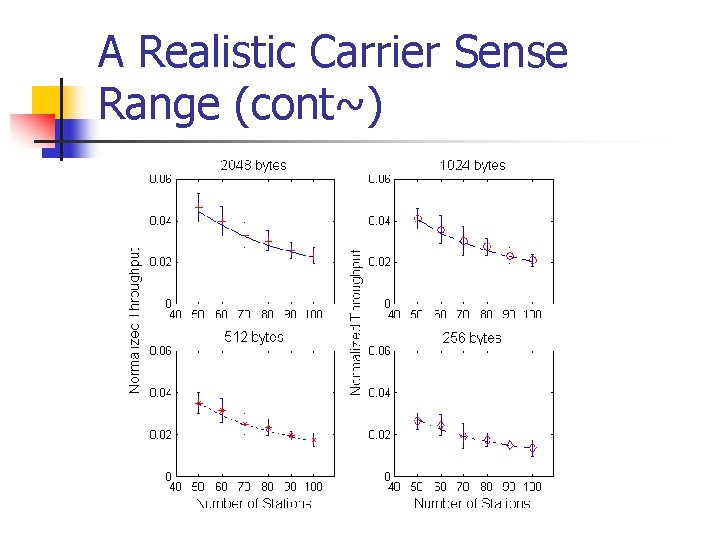
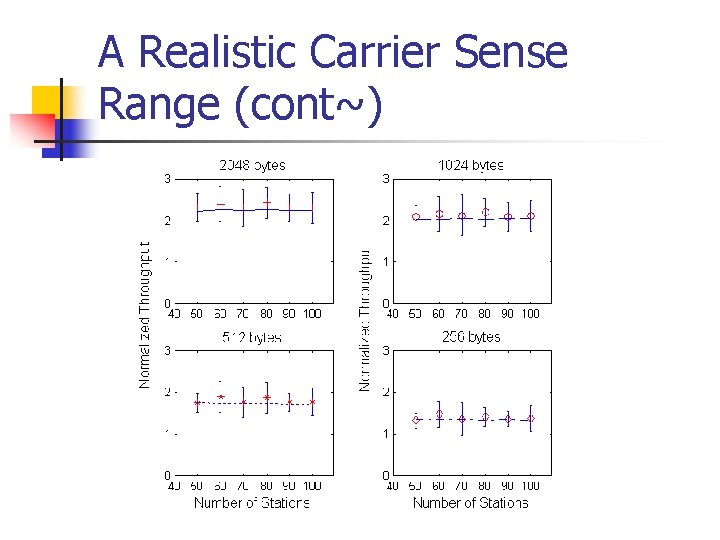
A Realistic Carrier Sense Range n The carrier sense range is 550 meters and the transmission range is 250 meters. A 1 R r A B
A Realistic Carrier Sense Range (cont~)
A Realistic Carrier Sense Range (cont~)
A Realistic Carrier Sense Range (cont~)
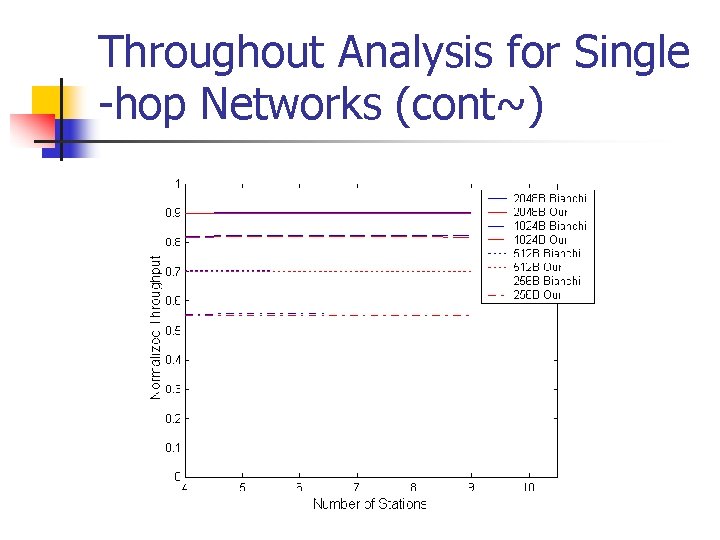
Throughout Analysis for Single -hop Networks (cont~)
Throughout Analysis for Single -hop Networks (cont~)
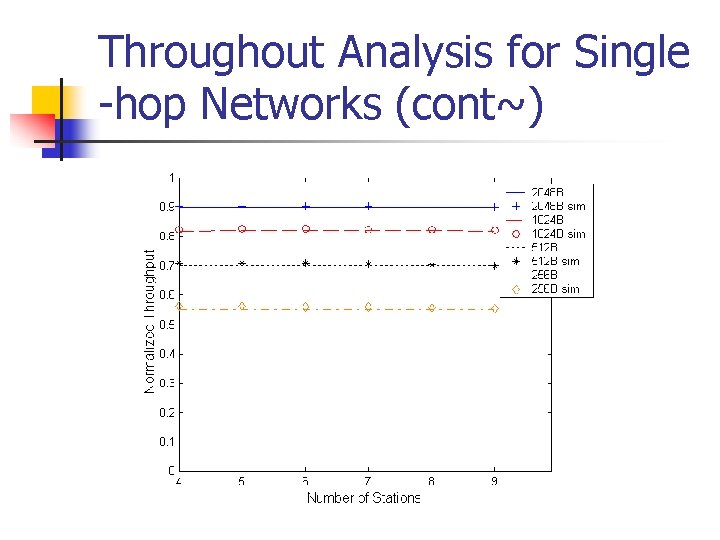
Conclusions n n The throughput performance of the IEEE 802. 11 DCF scheme in multi-hop ad hoc networks is analyzed. It also shows the proposed model is accurate when degenerated into single-hop networks. The throughput of a single station is decreased as the number of stations increases. The total throughout almost stays at a constant value.
Conclusions (cont~) n n n The total network throughput is decreased as much as by 55% when the carrier sense range is equal to 550 meters. The larger packet size results in the higher network throughput. For spatial reuse factor, the results shows that there no clear relationship with the number of stations and packet size.
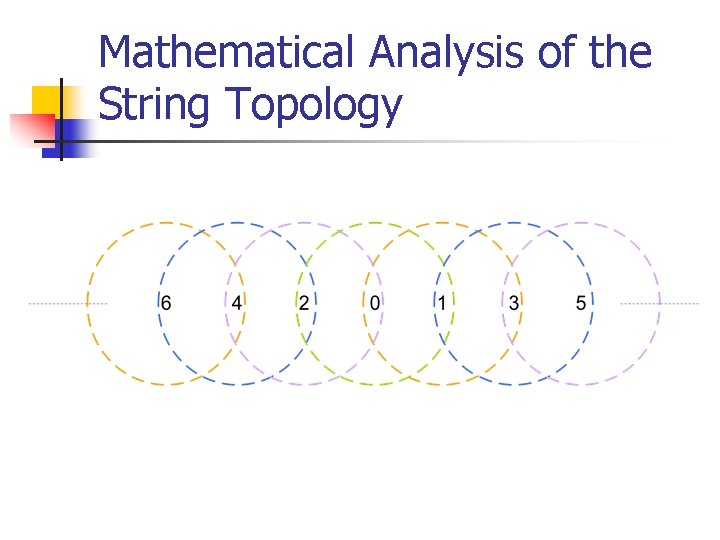
Mathematical Analysis of the String Topology
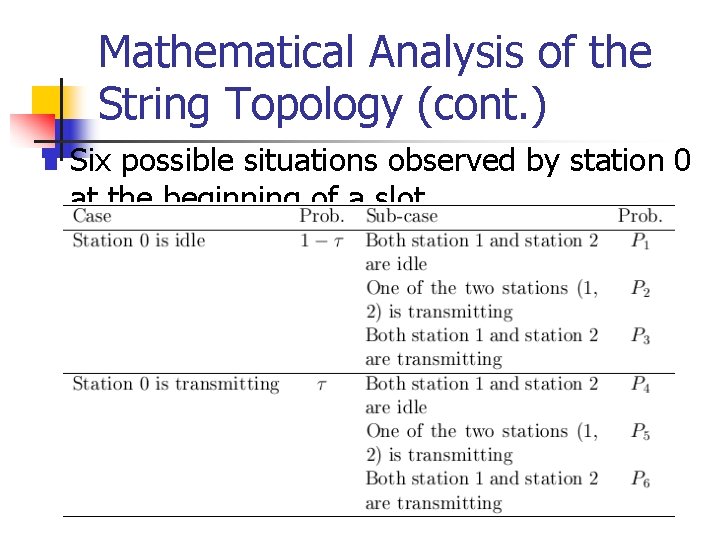
Mathematical Analysis of the String Topology (cont. ) n Six possible situations observed by station 0 at the beginning of a slot.
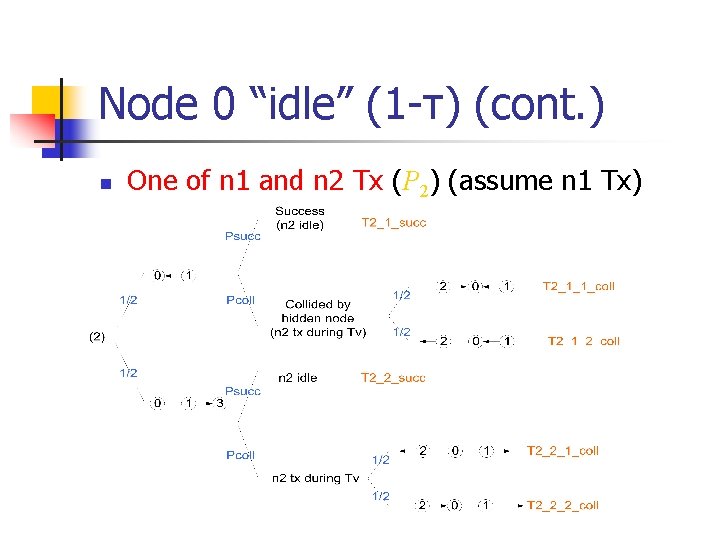
Node 0 “idle” (1 -τ) (cont. ) n One of n 1 and n 2 Tx (P 2) (assume n 1 Tx)
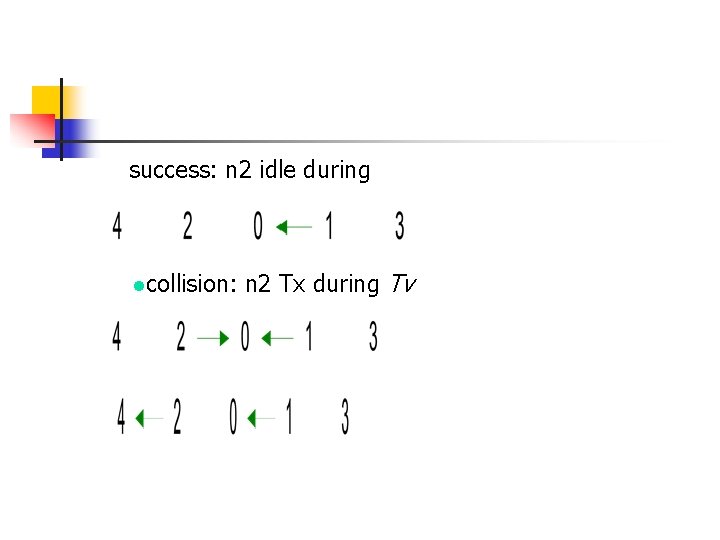
success: n 2 idle during lcollision: n 2 Tx during Tv
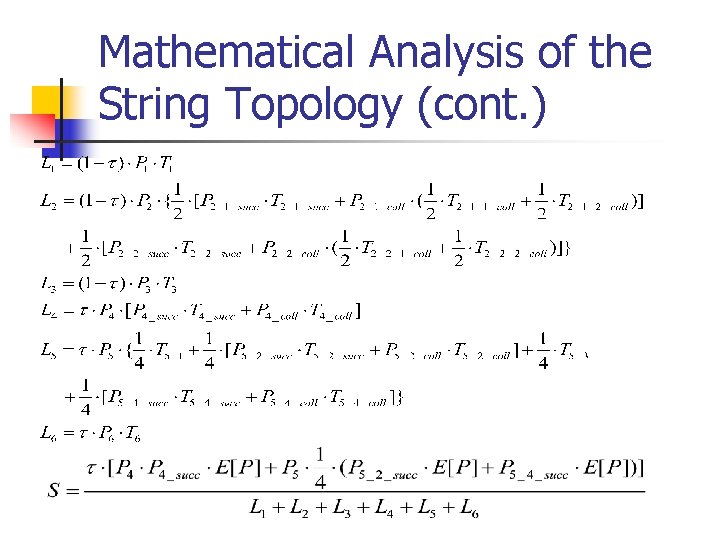
Mathematical Analysis of the String Topology (cont. )
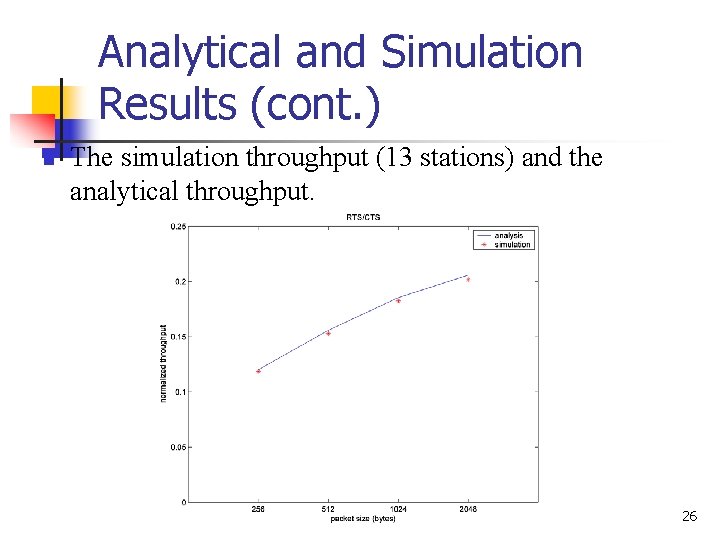
Analytical and Simulation Results (cont. ) n The simulation throughput (13 stations) and the analytical throughput. 26
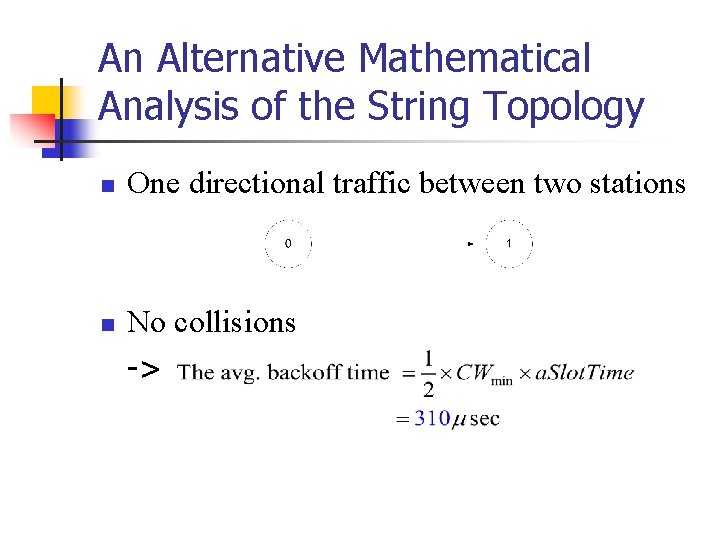
An Alternative Mathematical Analysis of the String Topology n n One directional traffic between two stations No collisions ->
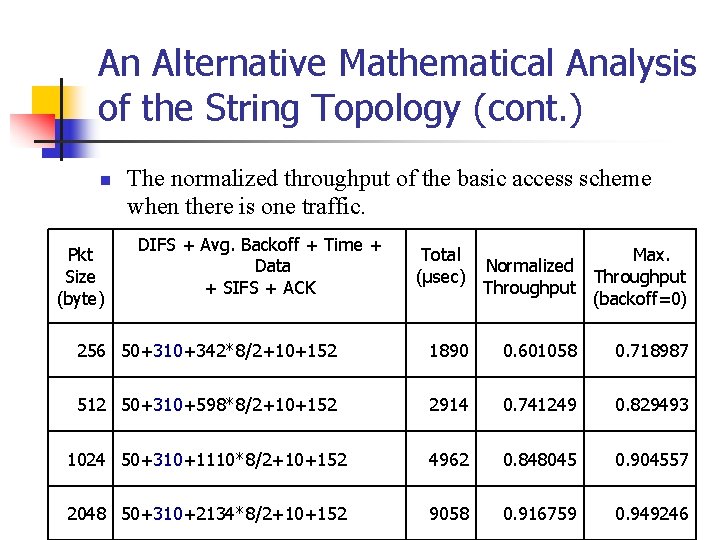
An Alternative Mathematical Analysis of the String Topology (cont. ) n Pkt Size (byte) The normalized throughput of the basic access scheme when there is one traffic. DIFS + Avg. Backoff + Time + Data + SIFS + ACK Max. Total Normalized (μsec) Throughput (backoff=0) 256 50+310+342*8/2+10+152 1890 0. 601058 0. 718987 512 50+310+598*8/2+10+152 2914 0. 741249 0. 829493 1024 50+310+1110*8/2+10+152 4962 0. 848045 0. 904557 2048 50+310+2134*8/2+10+152 9058 0. 916759 0. 949246
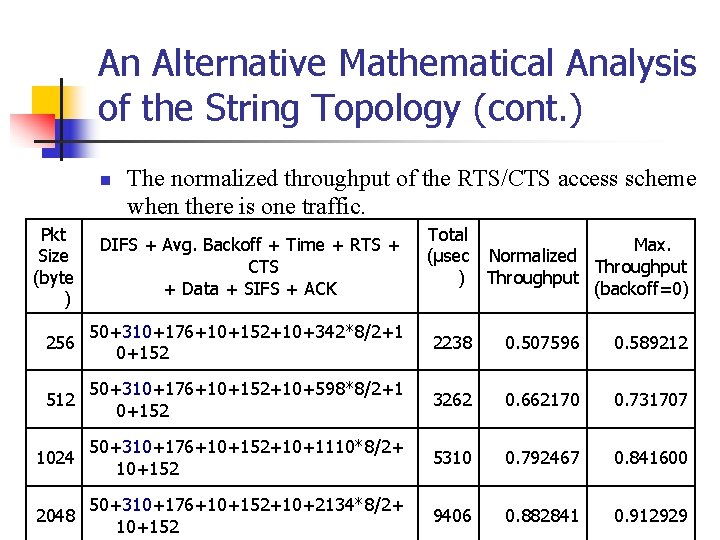
An Alternative Mathematical Analysis of the String Topology (cont. ) n The normalized throughput of the RTS/CTS access scheme when there is one traffic. Pkt Size (byte ) DIFS + Avg. Backoff + Time + RTS + CTS + Data + SIFS + ACK Total Max. (μsec Normalized Throughput ) Throughput (backoff=0) 256 50+310+176+10+152+10+342*8/2+1 0+152 2238 0. 507596 0. 589212 50+310+176+10+152+10+598*8/2+1 0+152 3262 0. 662170 0. 731707 1024 50+310+176+10+152+10+1110*8/2+ 10+152 5310 0. 792467 0. 841600 2048 50+310+176+10+152+10+2134*8/2+ 10+152 9406 0. 882841 0. 912929
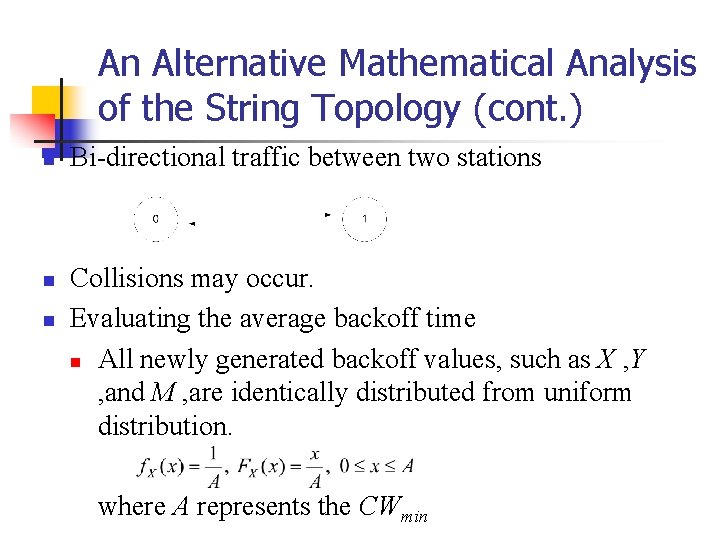
An Alternative Mathematical Analysis of the String Topology (cont. ) n n n Bi-directional traffic between two stations Collisions may occur. Evaluating the average backoff time n All newly generated backoff values, such as X , Y , and M , are identically distributed from uniform distribution. where A represents the CWmin
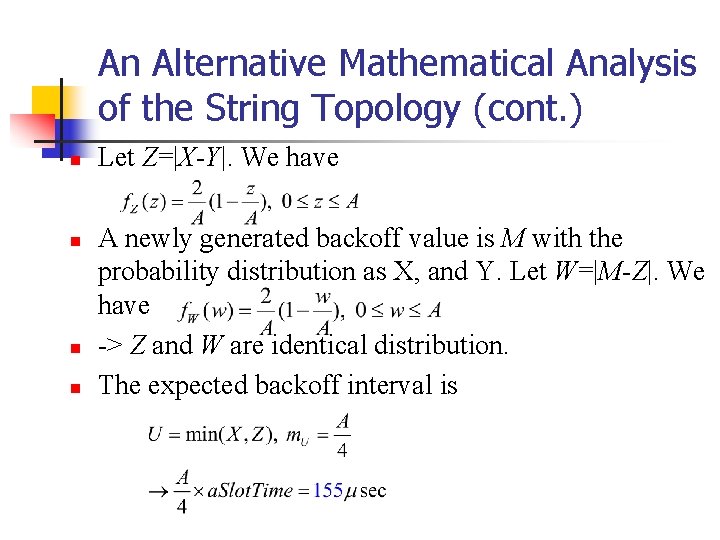
An Alternative Mathematical Analysis of the String Topology (cont. ) n n Let Z=|X-Y|. We have A newly generated backoff value is M with the probability distribution as X, and Y. Let W=|M-Z|. We have -> Z and W are identical distribution. The expected backoff interval is
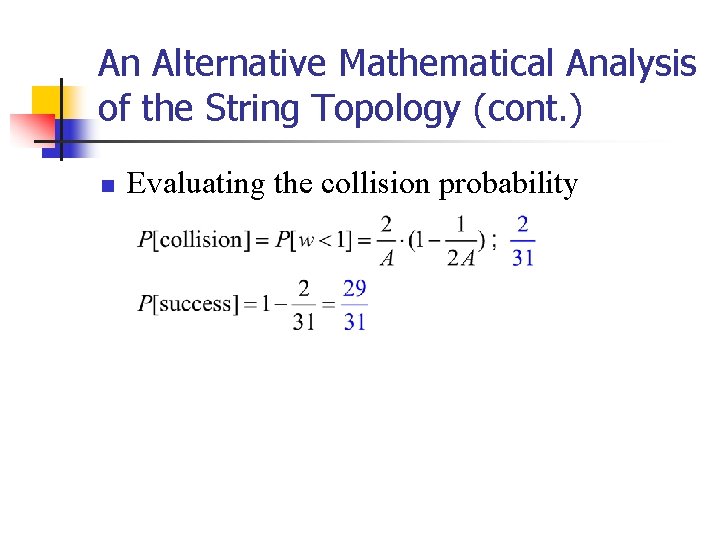
An Alternative Mathematical Analysis of the String Topology (cont. ) n Evaluating the collision probability
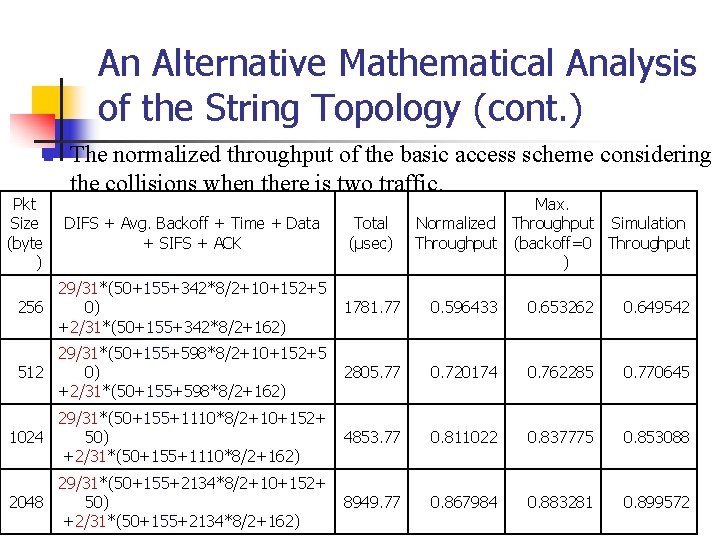
An Alternative Mathematical Analysis of the String Topology (cont. ) n Pkt Size (byte ) The normalized throughput of the basic access scheme considering the collisions when there is two traffic. DIFS + Avg. Backoff + Time + Data + SIFS + ACK Total (μsec) Max. Normalized Throughput Simulation Throughput (backoff=0 Throughput ) 29/31*(50+155+342*8/2+10+152+5 0) 256 +2/31*(50+155+342*8/2+162) 1781. 77 0. 596433 0. 653262 0. 649542 29/31*(50+155+598*8/2+10+152+5 0) 512 +2/31*(50+155+598*8/2+162) 2805. 77 0. 720174 0. 762285 0. 770645 29/31*(50+155+1110*8/2+10+152+ 50) 1024 +2/31*(50+155+1110*8/2+162) 4853. 77 0. 811022 0. 837775 0. 853088 29/31*(50+155+2134*8/2+10+152+ 50) 2048 +2/31*(50+155+2134*8/2+162) 8949. 77 0. 867984 0. 883281 0. 899572
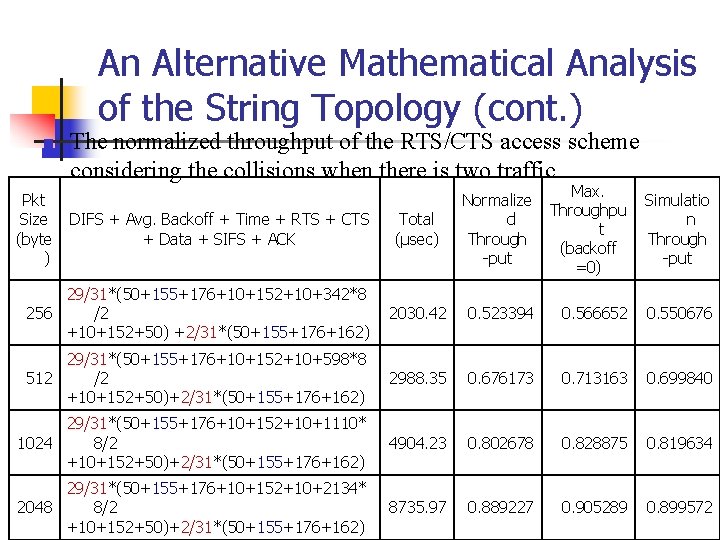
An Alternative Mathematical Analysis of the String Topology (cont. ) n The normalized throughput of the RTS/CTS access scheme considering the collisions when there is two traffic. Total (μsec) Normalize d Through -put Max. Throughpu t (backoff =0) Simulatio n Through -put 29/31*(50+155+176+10+152+10+342*8 /2 256 +10+152+50) +2/31*(50+155+176+162) 2030. 42 0. 523394 0. 566652 0. 550676 29/31*(50+155+176+10+152+10+598*8 /2 512 +10+152+50)+2/31*(50+155+176+162) 2988. 35 0. 676173 0. 713163 0. 699840 29/31*(50+155+176+10+152+10+1110* 8/2 1024 +10+152+50)+2/31*(50+155+176+162) 4904. 23 0. 802678 0. 828875 0. 819634 29/31*(50+155+176+10+152+10+2134* 8/2 2048 +10+152+50)+2/31*(50+155+176+162) 8735. 97 0. 889227 0. 905289 0. 899572 Pkt Size (byte ) DIFS + Avg. Backoff + Time + RTS + CTS + Data + SIFS + ACK
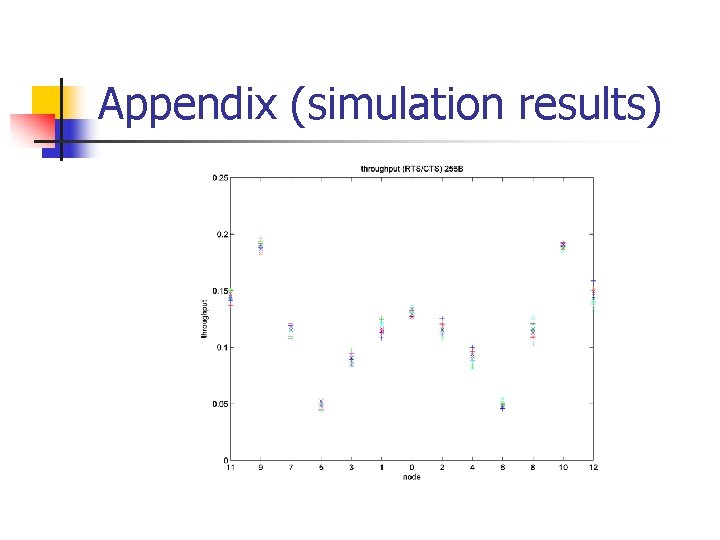
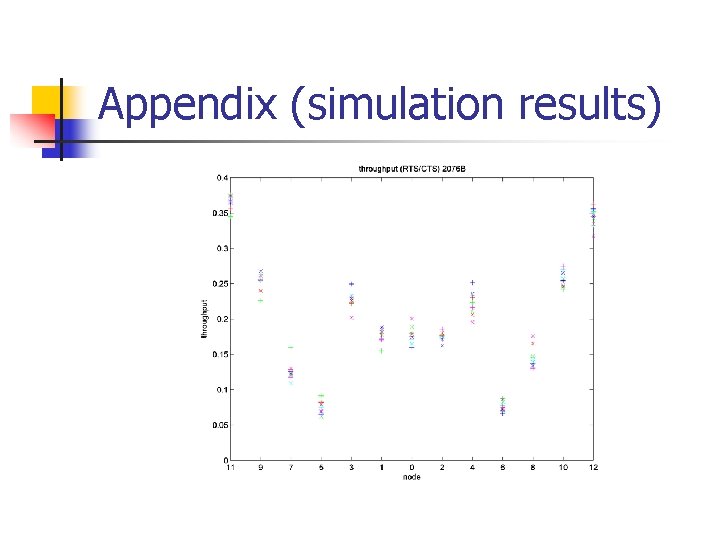
Appendix (simulation results)
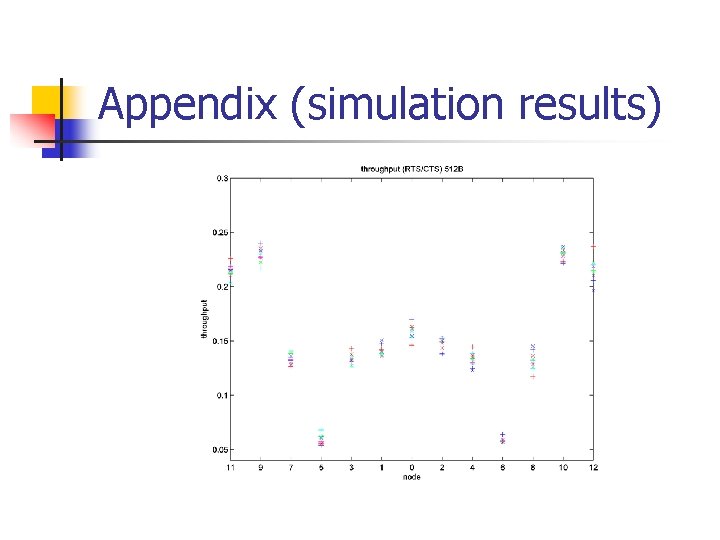
Appendix (simulation results)
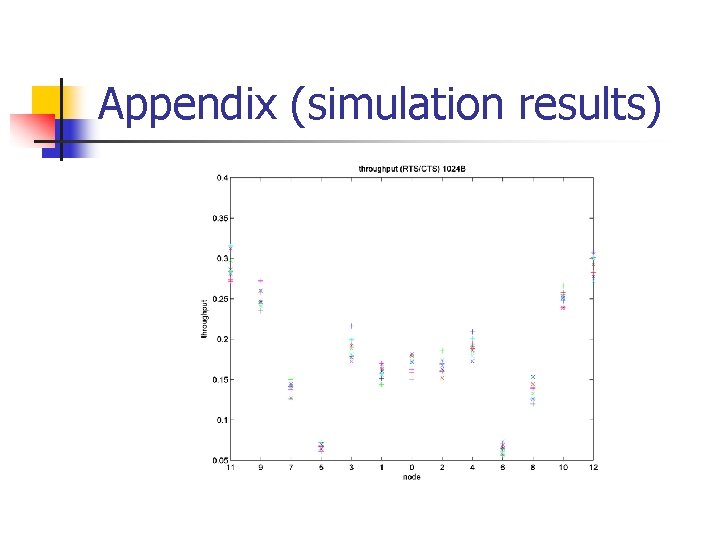
Appendix (simulation results)
Appendix (simulation results)
Conclusions n n n We first analyze the transmission behavior of stations in a string topology in the multi-hop environment. In the presence of the hidden and exposed terminal problems, the mathematical analysis is more complicated compared to the single-hop wireless network. From the analytical and simulation results, we find that a larger packet size can increase the normalized throughput.
Conclusions (cont. ) n n n For future research, we will proceed with the alternative mathematical analysis. We may discuss the behavior under the assumption that the carrier sensing range is much larger than the transmission range, and the capture effect may be included. Besides, we may extend our one-dimension topology to different types of topology.
Conclusion n What we have done n n n We propose a new method to improve IEEE 802. 11 performance and establish a model for analysis. Simulation and comparison What we are going to do n n A general equation (even solution) for our model More simulation