Quantum Algorithms III Shors algorithms for dlog and


- Slides: 49
Quantum Algorithms III Shor’s algorithms for dlog and factoring Martin Roetteler Quantum Architectures and Computation Group Microsoft Research Redmond, WA, U. S. A. CROSSING Winter School on Quantum Security TU Darmstadt January 26 2016
Overview • Part III: Circuits, quantum Fourier transform (20 min) Shor’s algorithms: factoring + dlog (20 min) • Part IV: Hidden subgroups, hidden shifts (30 min) Quantum programming in LIQui|> (10 min) • Q&A (please ask questions during the lecture also!) January 26, 2016 M. Roetteler 2
The power of quantum computing January 26, 2016 M. Roetteler 3
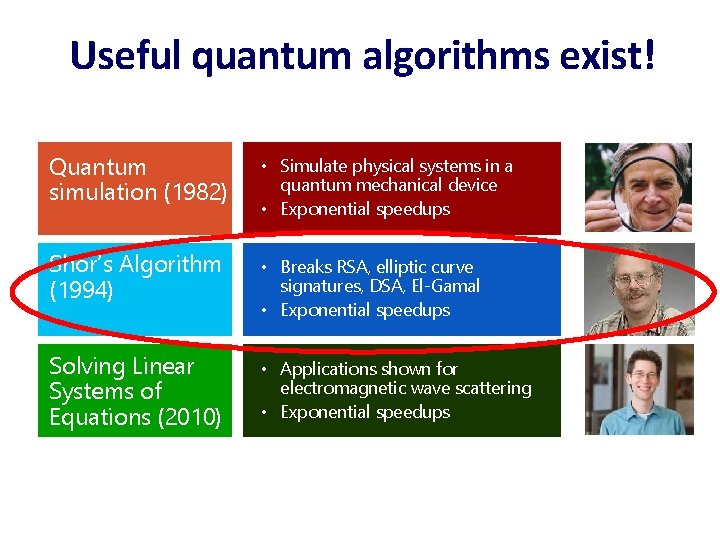
Useful quantum algorithms exist! Quantum simulation (1982) • Simulate physical systems in a quantum mechanical device • Exponential speedups Shor’s Algorithm (1994) • Breaks RSA, elliptic curve signatures, DSA, El-Gamal • Exponential speedups Solving Linear Systems of Equations (2010) • Applications shown for electromagnetic wave scattering • Exponential speedups
Universal quantum gates
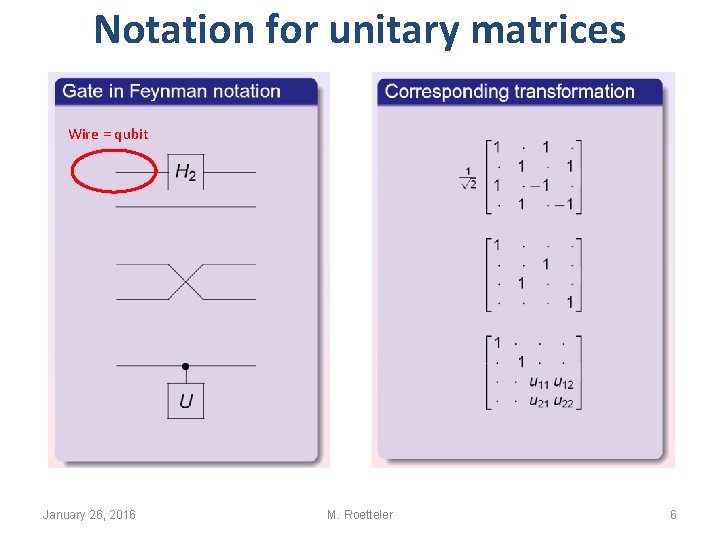
Notation for unitary matrices Wire = qubit January 26, 2016 M. Roetteler 6
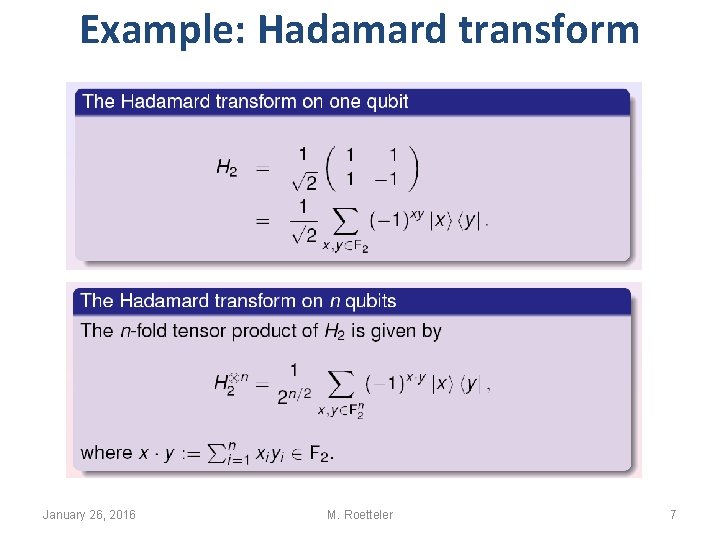
Example: Hadamard transform January 26, 2016 M. Roetteler 7
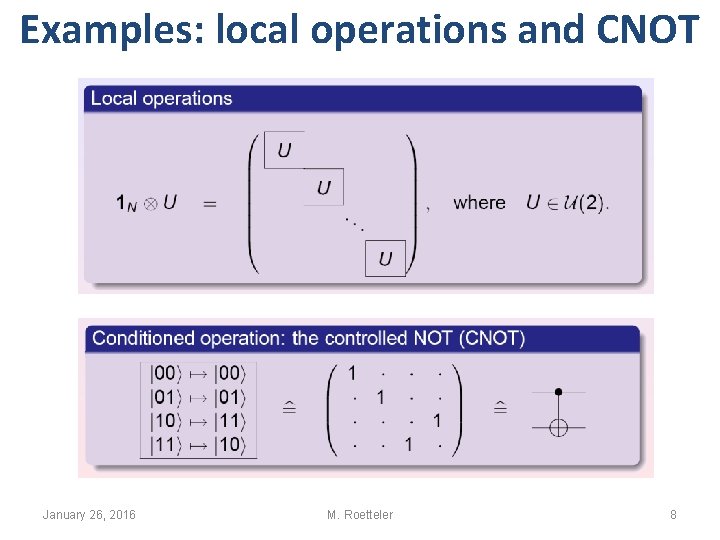
Examples: local operations and CNOT January 26, 2016 M. Roetteler 8
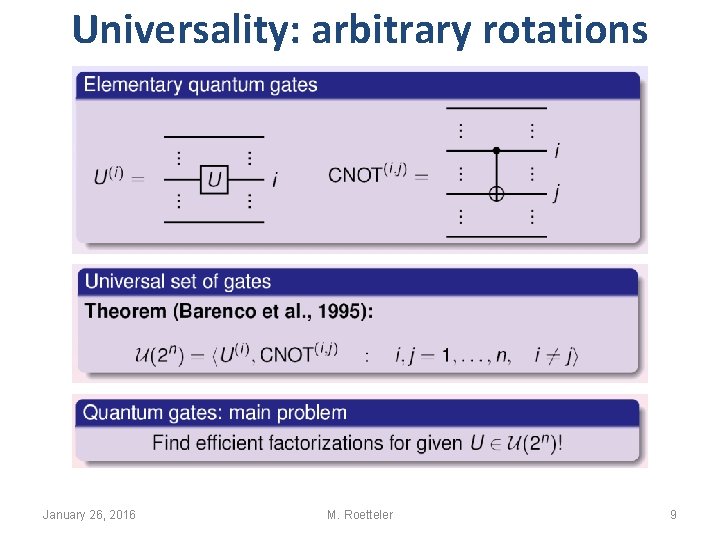
Universality: arbitrary rotations January 26, 2016 M. Roetteler 9
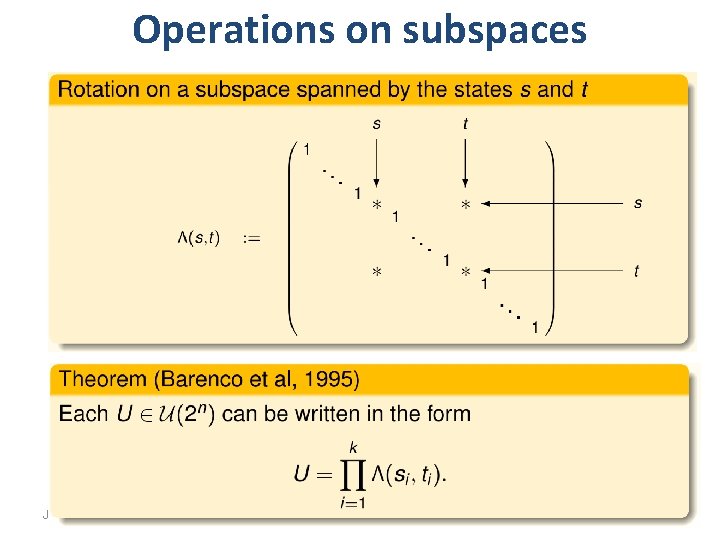
Operations on subspaces January 26, 2016 M. Roetteler 10
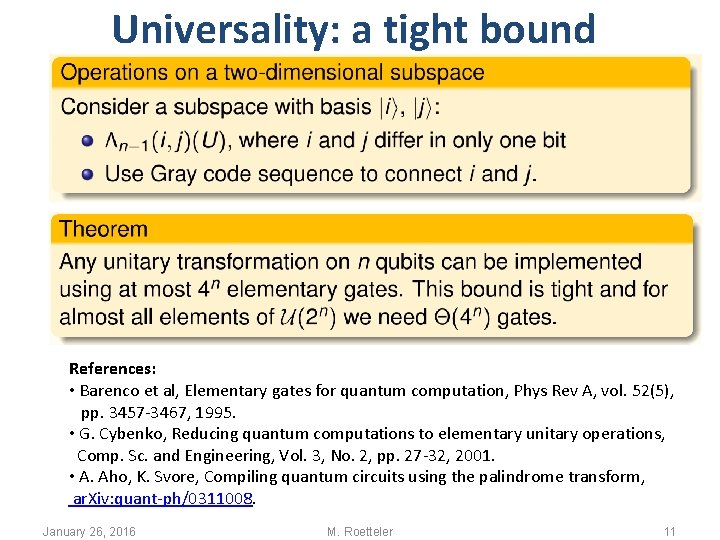
Universality: a tight bound References: • Barenco et al, Elementary gates for quantum computation, Phys Rev A, vol. 52(5), pp. 3457 -3467, 1995. • G. Cybenko, Reducing quantum computations to elementary unitary operations, Comp. Sc. and Engineering, Vol. 3, No. 2, pp. 27 -32, 2001. • A. Aho, K. Svore, Compiling quantum circuits using the palindrome transform, ar. Xiv: quant-ph/0311008. January 26, 2016 M. Roetteler 11
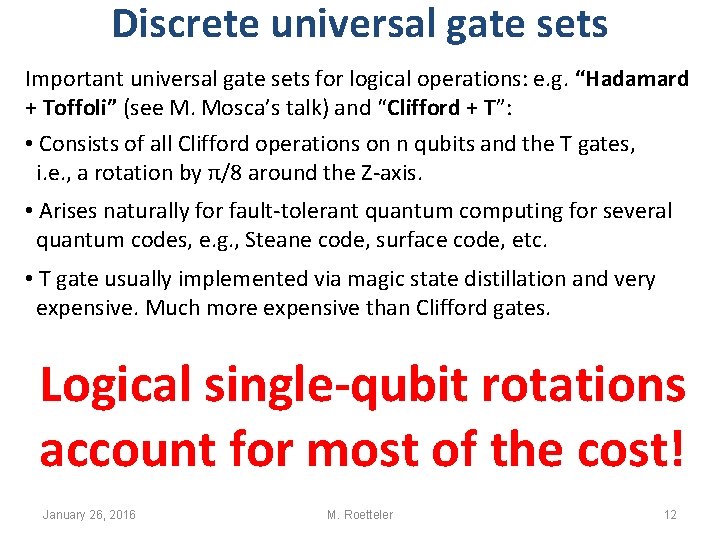
Discrete universal gate sets Important universal gate sets for logical operations: e. g. “Hadamard + Toffoli” (see M. Mosca’s talk) and “Clifford + T”: • Consists of all Clifford operations on n qubits and the T gates, i. e. , a rotation by π/8 around the Z-axis. • Arises naturally for fault-tolerant quantum computing for several quantum codes, e. g. , Steane code, surface code, etc. • T gate usually implemented via magic state distillation and very expensive. Much more expensive than Clifford gates. Logical single-qubit rotations account for most of the cost! January 26, 2016 M. Roetteler 12
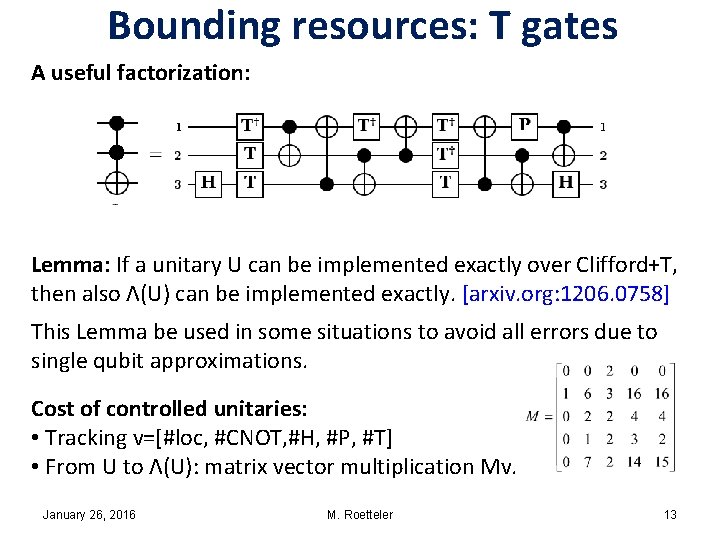
Bounding resources: T gates A useful factorization: Lemma: If a unitary U can be implemented exactly over Clifford+T, then also Λ(U) can be implemented exactly. [arxiv. org: 1206. 0758] This Lemma be used in some situations to avoid all errors due to single qubit approximations. Cost of controlled unitaries: • Tracking v=[#loc, #CNOT, #H, #P, #T] • From U to Λ(U): matrix vector multiplication Mv. January 26, 2016 M. Roetteler 13
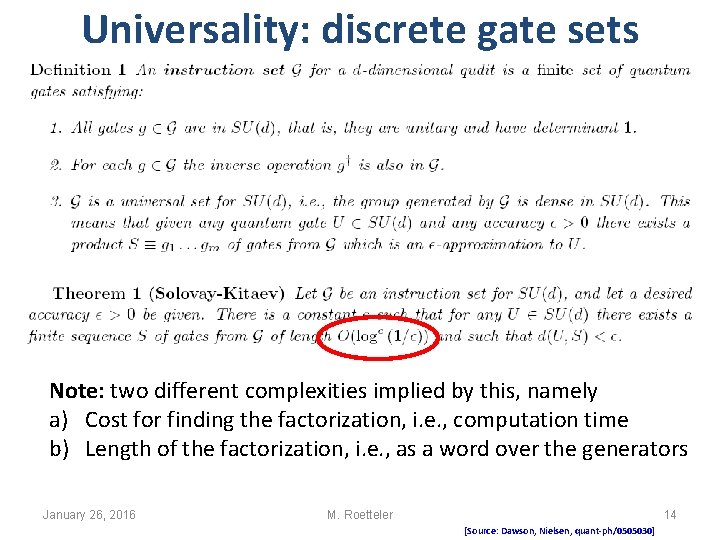
Universality: discrete gate sets Note: two different complexities implied by this, namely a) Cost for finding the factorization, i. e. , computation time b) Length of the factorization, i. e. , as a word over the generators January 26, 2016 M. Roetteler 14 [Source: Dawson, Nielsen, quant-ph/0505030]
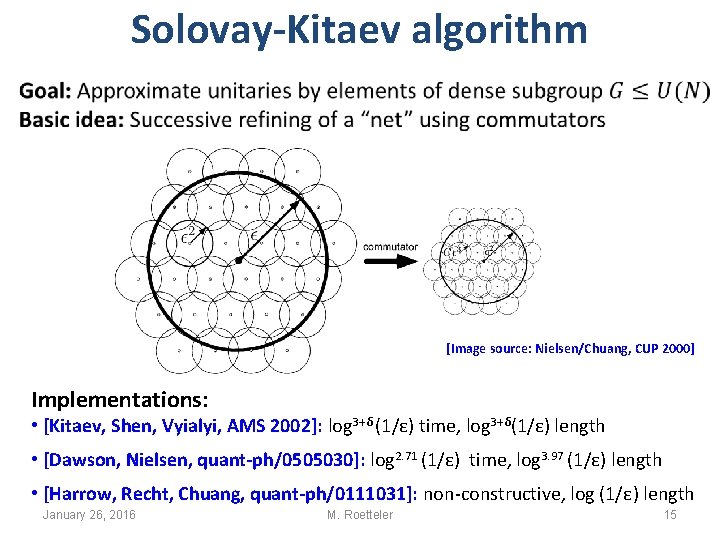
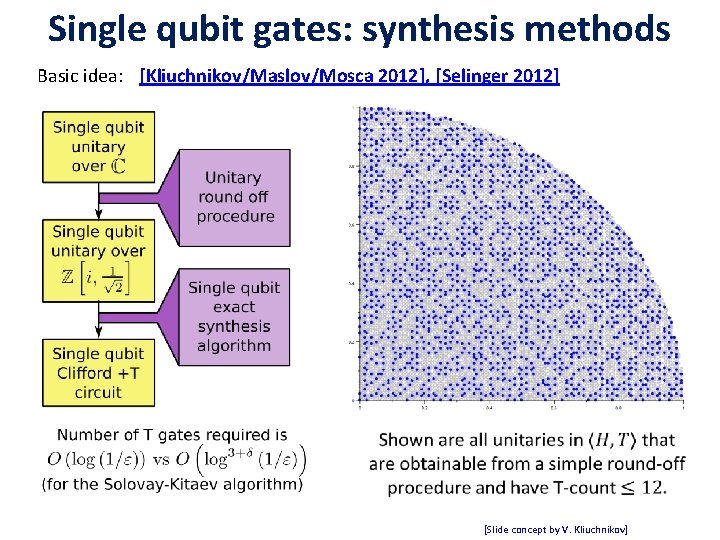
Solovay-Kitaev algorithm [Image source: Nielsen/Chuang, CUP 2000] Implementations: • [Kitaev, Shen, Vyialyi, AMS 2002]: log 3+δ (1/ε) time, log 3+δ(1/ε) length • [Dawson, Nielsen, quant-ph/0505030]: log 2. 71 (1/ε) time, log 3. 97 (1/ε) length • [Harrow, Recht, Chuang, quant-ph/0111031]: non-constructive, log (1/ε) length January 26, 2016 M. Roetteler 15
Single qubit gates: synthesis methods Basic idea: [Kliuchnikov/Maslov/Mosca 2012], [Selinger 2012] [Slide concept by V. Kliuchnikov]
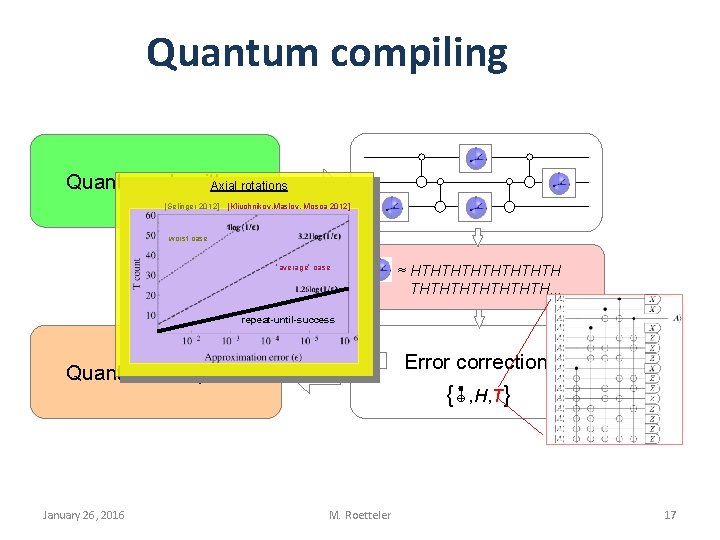
Quantum compiling Quantum algorithm Axial rotations [Selinger 2012] [Kliuchnikov, Maslov, Mosca 2012] worst case “average” case ≈ HTHTHTHTH. . . Quantum computer repeat-until-success Error correction Quantum computer January 26, 2016 { , H, T} M. Roetteler 17
Quantum Fourier transform
# ops = log N
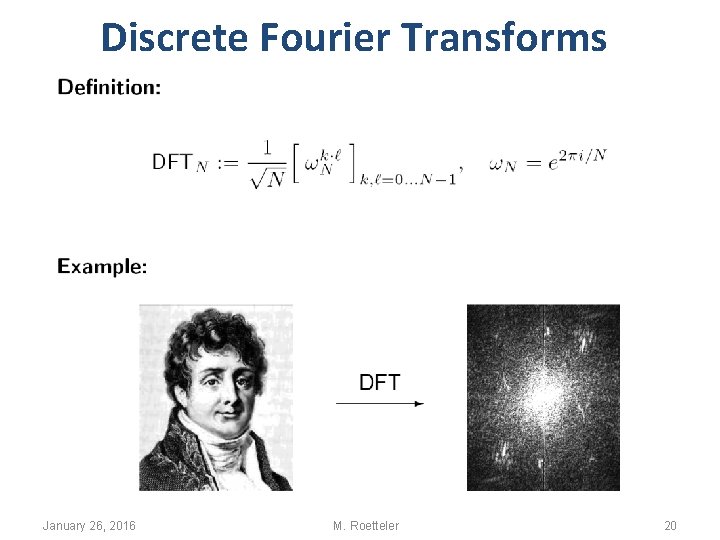
Discrete Fourier Transforms January 26, 2016 M. Roetteler 20
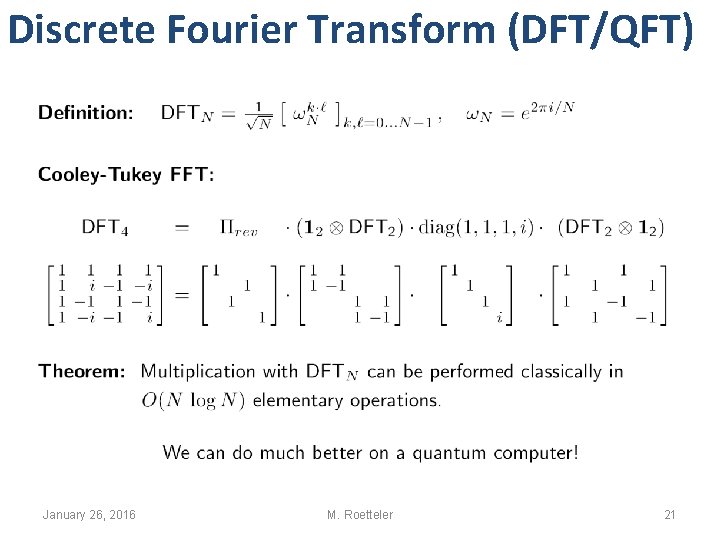
Discrete Fourier Transform (DFT/QFT) January 26, 2016 M. Roetteler 21
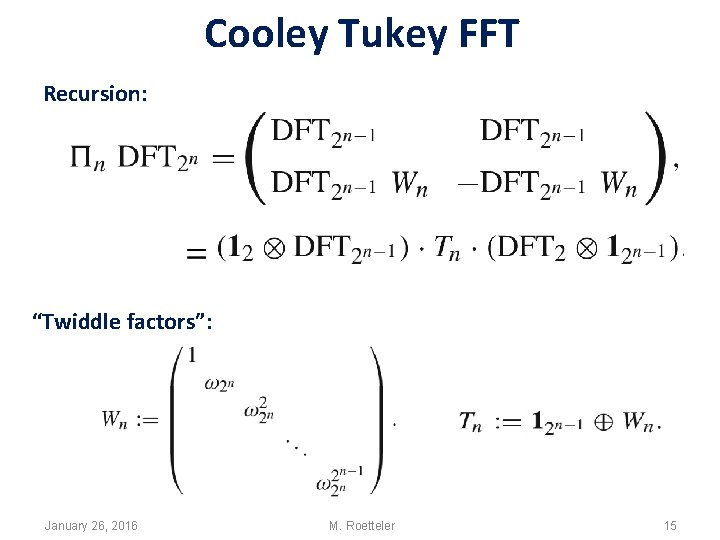
Cooley Tukey FFT Recursion: “Twiddle factors”: January 26, 2016 M. Roetteler 15
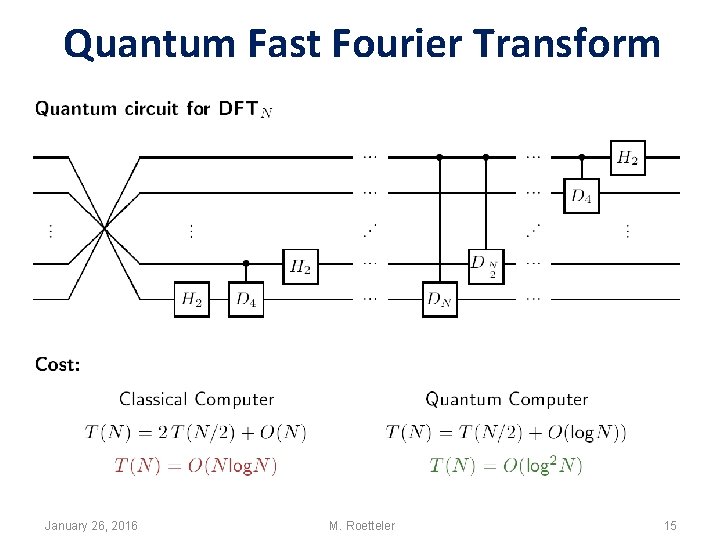
Quantum Fast Fourier Transform January 26, 2016 M. Roetteler 15
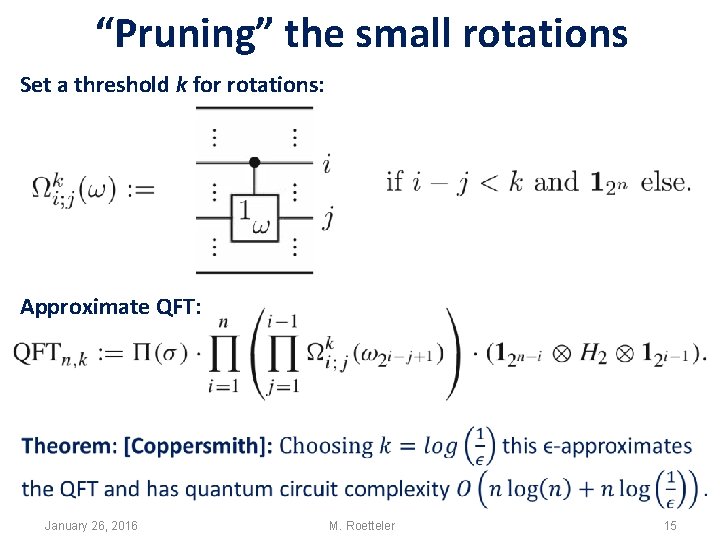
“Pruning” the small rotations Set a threshold k for rotations: Approximate QFT: January 26, 2016 M. Roetteler 15
Shor: factoring
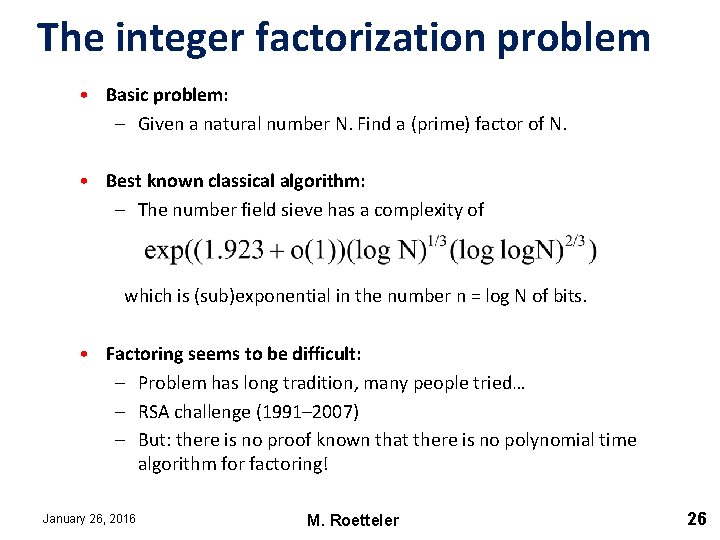
The integer factorization problem • Basic problem: – Given a natural number N. Find a (prime) factor of N. • Best known classical algorithm: – The number field sieve has a complexity of which is (sub)exponential in the number n = log N of bits. • Factoring seems to be difficult: – Problem has long tradition, many people tried… – RSA challenge (1991– 2007) – But: there is no proof known that there is no polynomial time algorithm for factoring! January 26, 2016 M. Roetteler 26
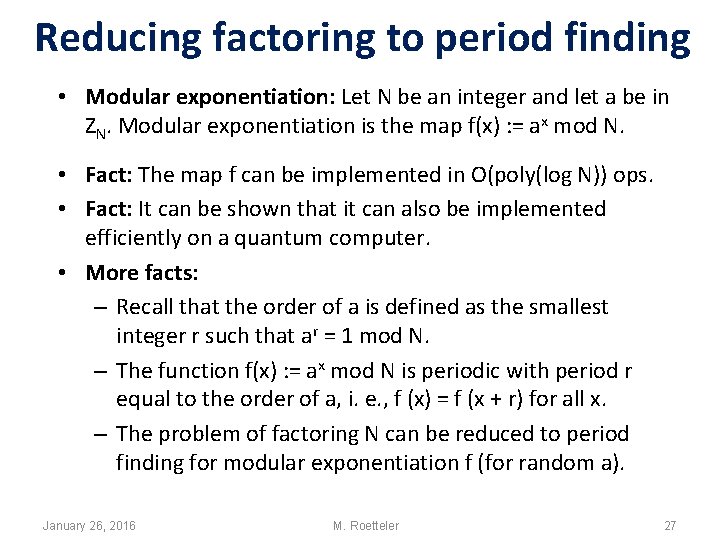
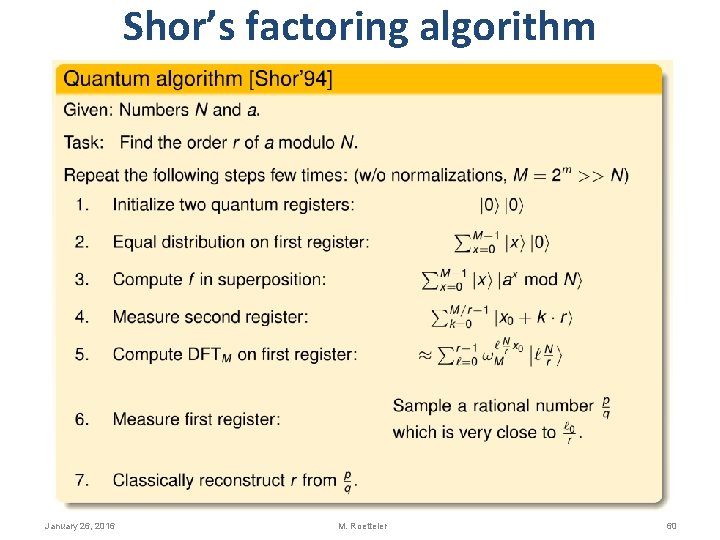
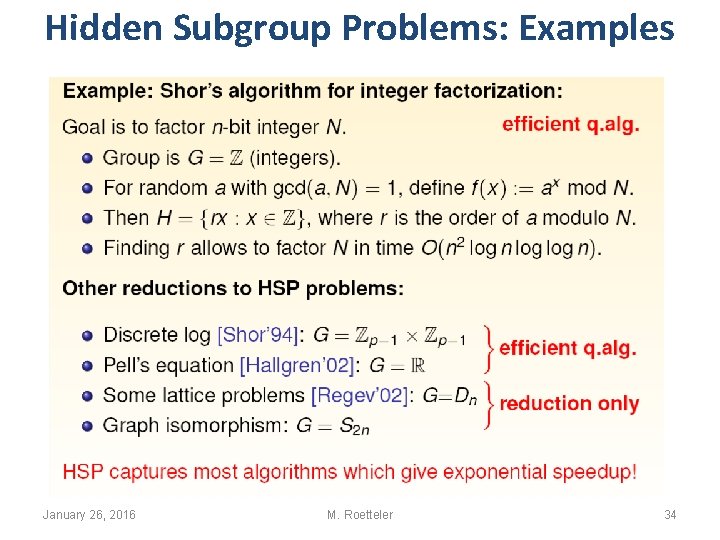
Reducing factoring to period finding • Modular exponentiation: Let N be an integer and let a be in ZN. Modular exponentiation is the map f(x) : = ax mod N. • Fact: The map f can be implemented in O(poly(log N)) ops. • Fact: It can be shown that it can also be implemented efficiently on a quantum computer. • More facts: – Recall that the order of a is defined as the smallest integer r such that ar = 1 mod N. – The function f(x) : = ax mod N is periodic with period r equal to the order of a, i. e. , f (x) = f (x + r) for all x. – The problem of factoring N can be reduced to period finding for modular exponentiation f (for random a). January 26, 2016 M. Roetteler 27
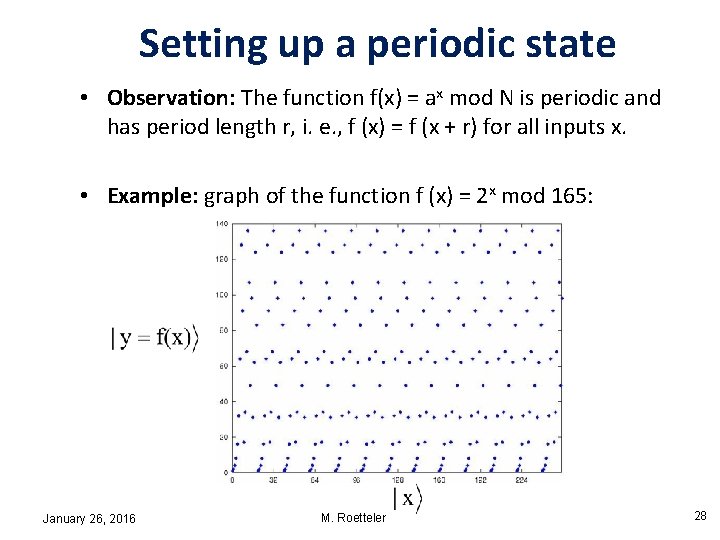
Setting up a periodic state • Observation: The function f(x) = ax mod N is periodic and has period length r, i. e. , f (x) = f (x + r) for all inputs x. • Example: graph of the function f (x) = 2 x mod 165: January 26, 2016 M. Roetteler 28
Shor’s algorithm for period finding January 26, 2016 M. Roetteler 29
Shor’s factoring algorithm January 26, 2016 M. Roetteler 60
Quantum parallelism, Chuck Norris style January 26, 2016 M. Roetteler 31
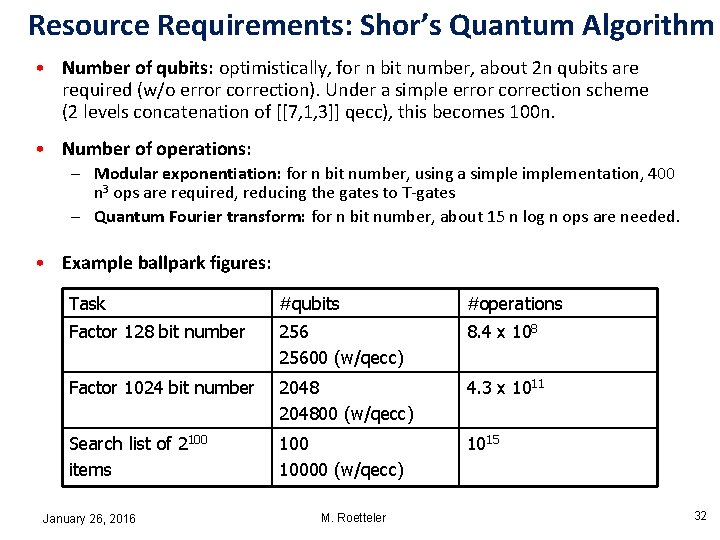
Resource Requirements: Shor’s Quantum Algorithm • Number of qubits: optimistically, for n bit number, about 2 n qubits are required (w/o error correction). Under a simple error correction scheme (2 levels concatenation of [[7, 1, 3]] qecc), this becomes 100 n. • Number of operations: – Modular exponentiation: for n bit number, using a simplementation, 400 n 3 ops are required, reducing the gates to T-gates – Quantum Fourier transform: for n bit number, about 15 n log n ops are needed. • Example ballpark figures: Task #qubits #operations Factor 128 bit number 25600 (w/qecc) 8. 4 x 10⁸ Factor 1024 bit number 204800 (w/qecc) 4. 3 x 10¹¹ Search list of 2100 items 10000 (w/qecc) 1015 January 26, 2016 M. Roetteler 32
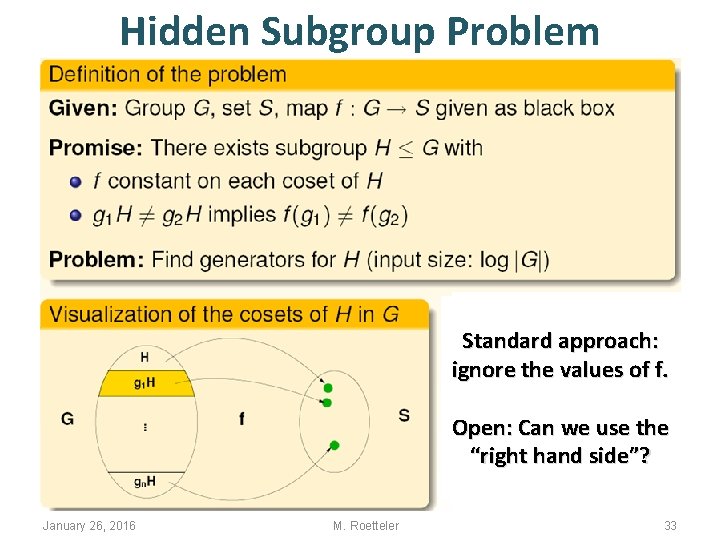
Hidden Subgroup Problem Standard approach: ignore the values of f. Open: Can we use the “right hand side”? January 26, 2016 M. Roetteler 33
Hidden Subgroup Problems: Examples January 26, 2016 M. Roetteler 34
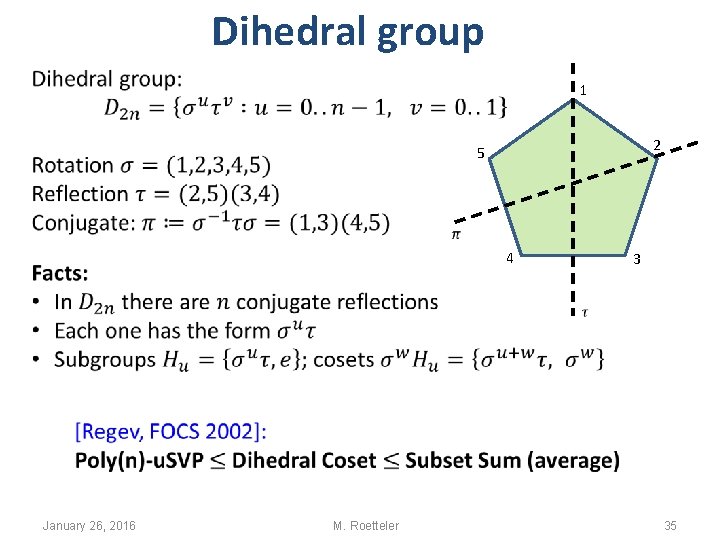
Dihedral group 1 2 5 4 3 January 26, 2016 M. Roetteler 35
Shor: dlog
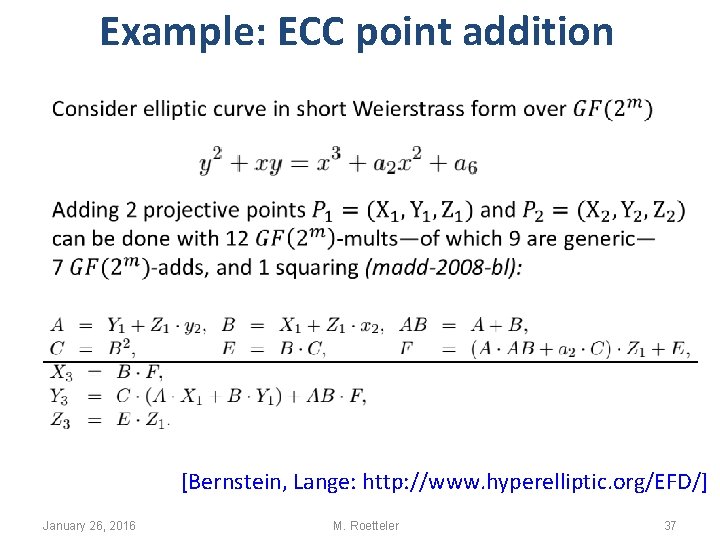
Example: ECC point addition [Bernstein, Lange: http: //www. hyperelliptic. org/EFD/] January 26, 2016 M. Roetteler 37
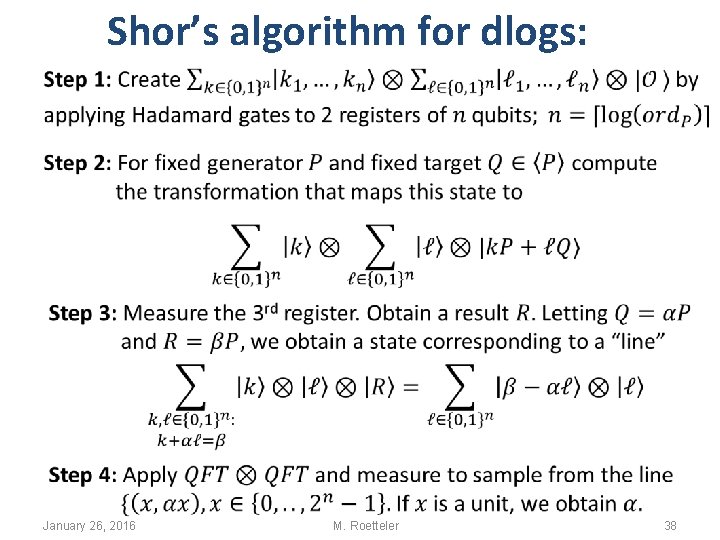
Shor’s algorithm for dlogs: January 26, 2016 M. Roetteler 38
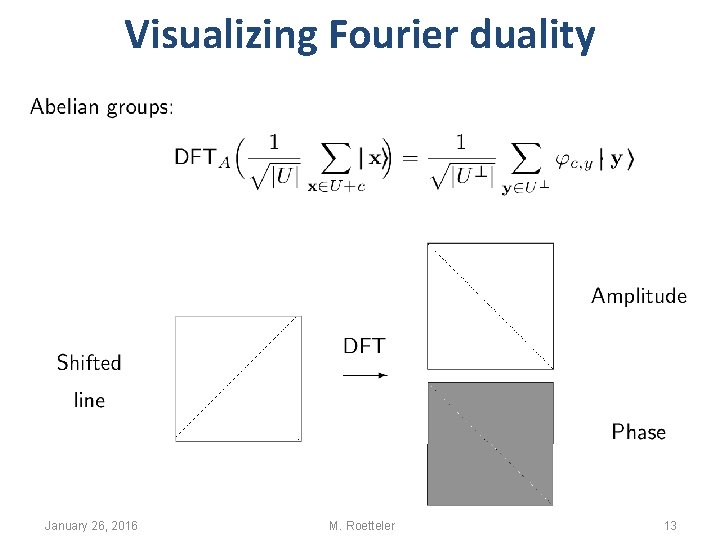
Visualizing Fourier duality January 26, 2016 M. Roetteler 13
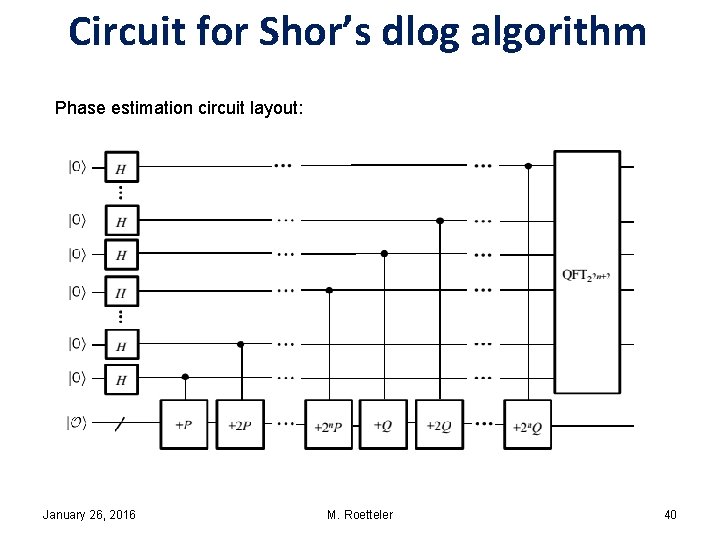
Circuit for Shor’s dlog algorithm Phase estimation circuit layout: January 26, 2016 M. Roetteler 40
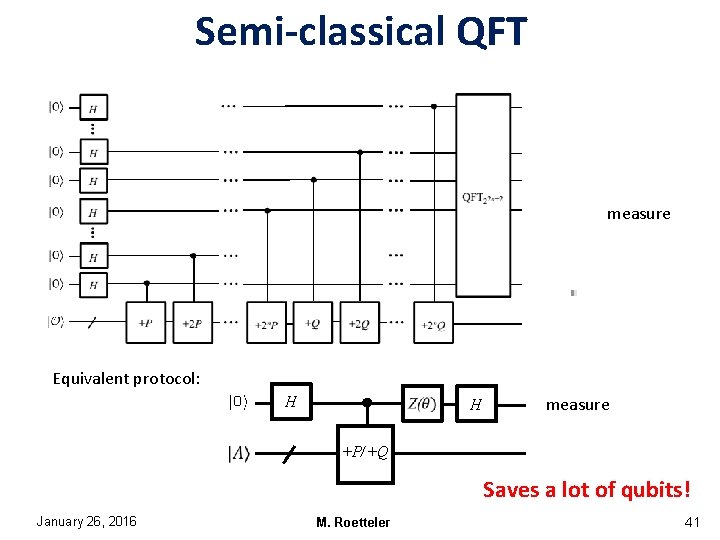
Semi-classical QFT measure Equivalent protocol: H H measure +P/+Q Saves a lot of qubits! January 26, 2016 M. Roetteler 41
Further reading (Part 1) • Textbooks: • M. Nielsen, I. Chuang: “Quantum Computation and quantum information”, Cambridge Univ. Press, 2001 • A. Kitaev, A. Shen, M. Vyalyi: “Classical and quantum computation”, AMS Press, 2002 • Ph. Kaye, M. Mosca, R. Laflamme: “An introduction to quantum computing”, Oxford Univ. Press, 2007 • Quantum gates and circuits (most papers available from arxiv. org) • Elementary gates: ar. Xiv: quant-ph/9503016 • Quantum Fourier transform: ar. Xiv: quant-ph/0201067 • Shor’s algorithm: ar. Xiv: quant-ph/9508027 • Phase estimation: ar. Xiv: quant-ph/9511026 January 26, 2016 M. Roetteler 60
Backup: Quantum arithmetic what is the problem? why is this non-trivial? who cares?
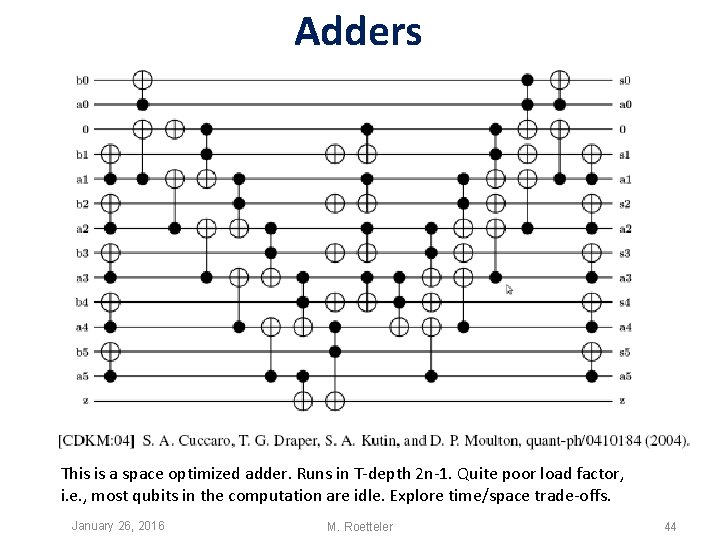
Adders This is a space optimized adder. Runs in T-depth 2 n-1. Quite poor load factor, i. e. , most qubits in the computation are idle. Explore time/space trade-offs. January 26, 2016 M. Roetteler 44
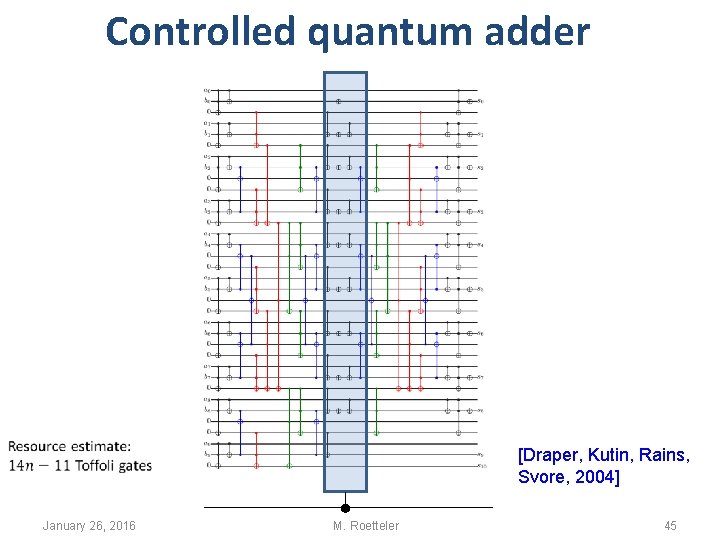
Controlled quantum adder January 26, 2016 [Draper, Kutin, Rains, Svore, 2004] M. Roetteler 45
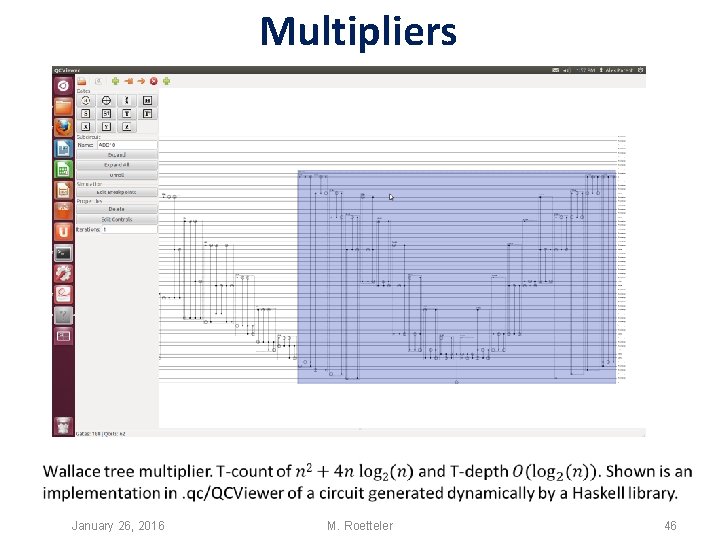
Multipliers January 26, 2016 M. Roetteler 46
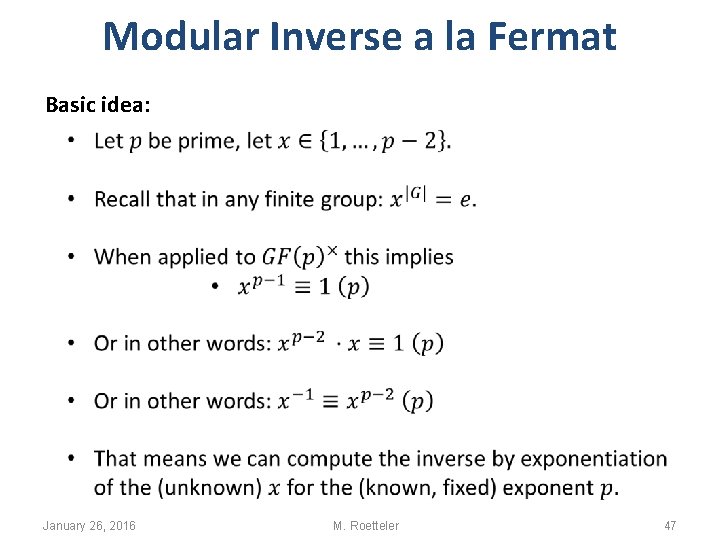
Modular Inverse a la Fermat Basic idea: January 26, 2016 M. Roetteler 47
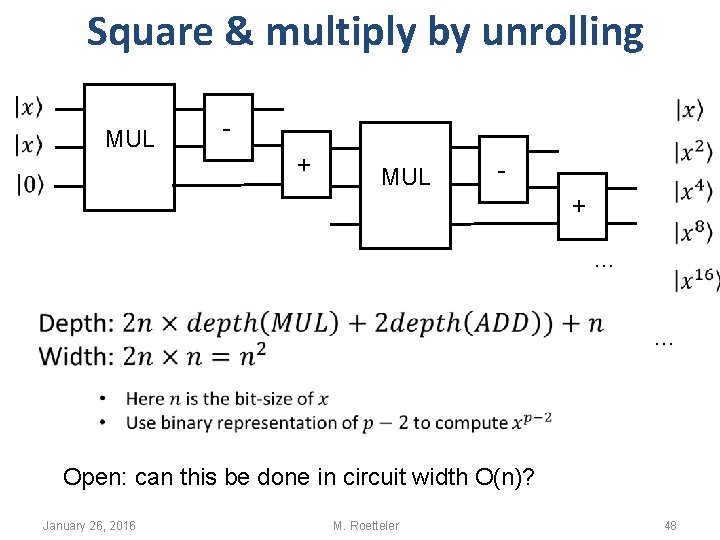
Square & multiply by unrolling MUL A + MUL A - + … … Open: can this be done in circuit width O(n)? January 26, 2016 M. Roetteler 48
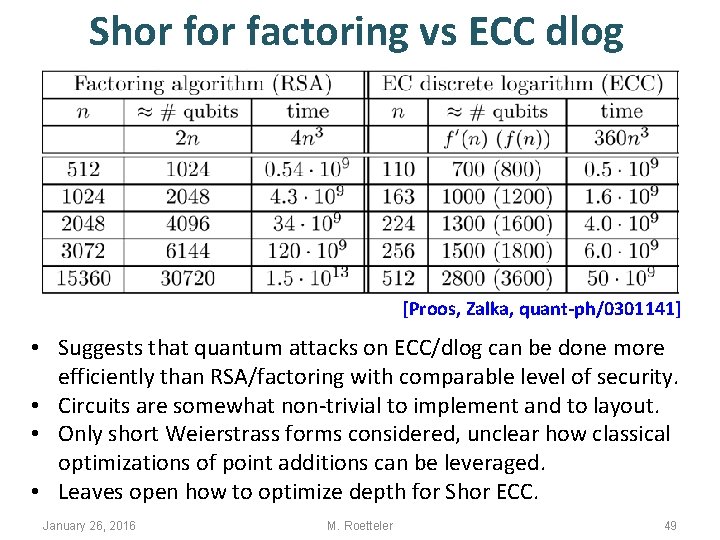
Shor factoring vs ECC dlog [Proos, Zalka, quant-ph/0301141] • Suggests that quantum attacks on ECC/dlog can be done more efficiently than RSA/factoring with comparable level of security. • Circuits are somewhat non-trivial to implement and to layout. • Only short Weierstrass forms considered, unclear how classical optimizations of point additions can be leveraged. • Leaves open how to optimize depth for Shor ECC. January 26, 2016 M. Roetteler 49