On the significance of Sraffas reswitching some longstanding
- Slides: 41
On the significance of Sraffa's reswitching: some long-standing financial puzzles and their joint resolution Keynes Seminar Post Keynesian Study Group Robinson College, Cambridge 15 February 2011 Mike Osborne Sheffield Business School, Sheffield Hallam University 1
On the significance of Sraffa's reswitching: some long-standing financial puzzles and their joint resolution Outline Methodology (multiple interest rates) An alternative route to the results Contemporary relevance (capital budgeting) Meaning (bond market analysis)
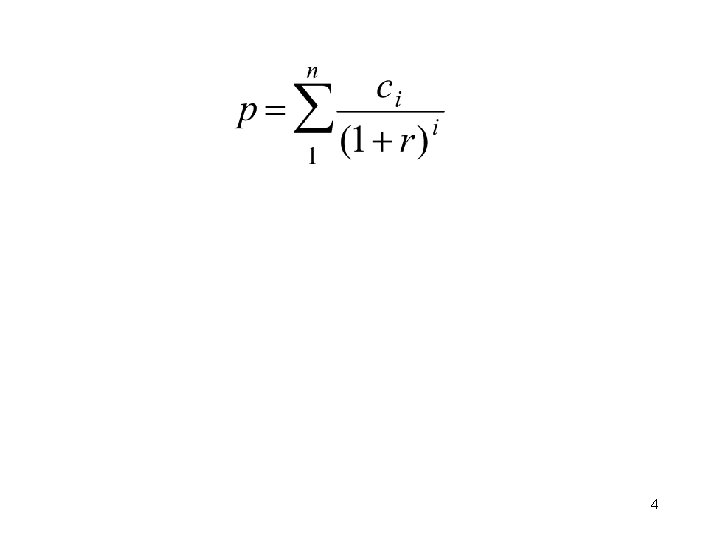
Puzzles 1. The multiple interest rate puzzle: What is the use and meaning of all interest rates in the time value of money equation? 3
4
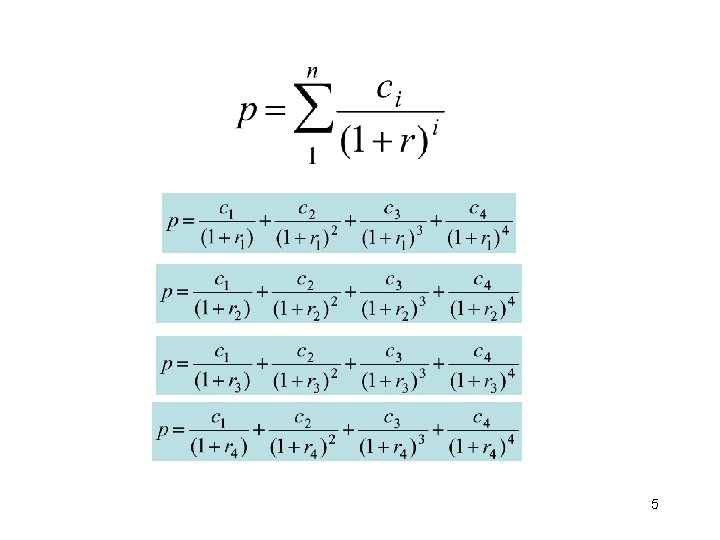
5
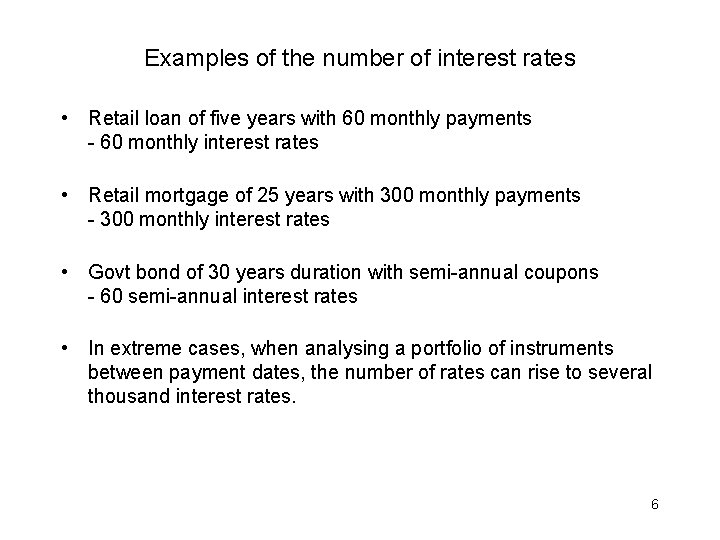
Examples of the number of interest rates • Retail loan of five years with 60 monthly payments - 60 monthly interest rates • Retail mortgage of 25 years with 300 monthly payments - 300 monthly interest rates • Govt bond of 30 years duration with semi-annual coupons - 60 semi-annual interest rates • In extreme cases, when analysing a portfolio of instruments between payment dates, the number of rates can rise to several thousand interest rates. 6
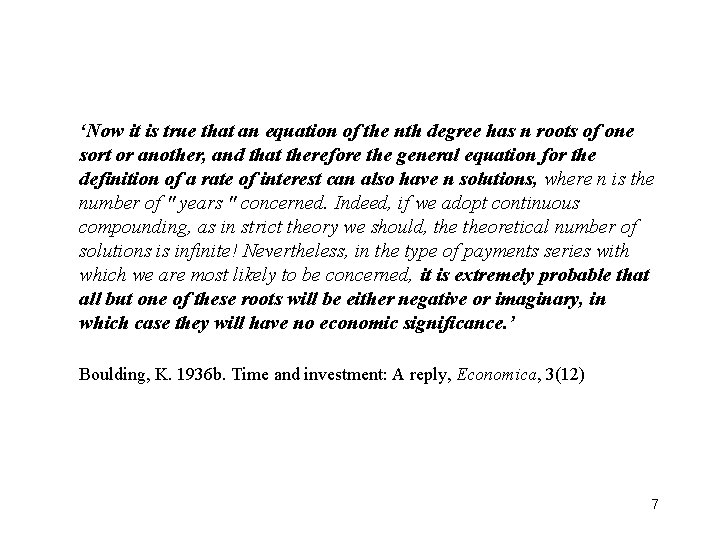
‘Now it is true that an equation of the nth degree has n roots of one sort or another, and that therefore the general equation for the definition of a rate of interest can also have n solutions, where n is the number of " years " concerned. Indeed, if we adopt continuous compounding, as in strict theory we should, theoretical number of solutions is infinite! Nevertheless, in the type of payments series with which we are most likely to be concerned, it is extremely probable that all but one of these roots will be either negative or imaginary, in which case they will have no economic significance. ’ Boulding, K. 1936 b. Time and investment: A reply, Economica, 3(12) 7
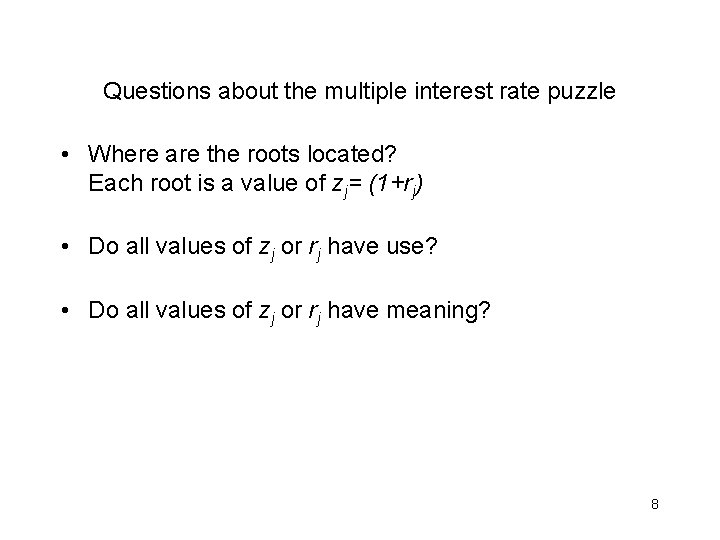
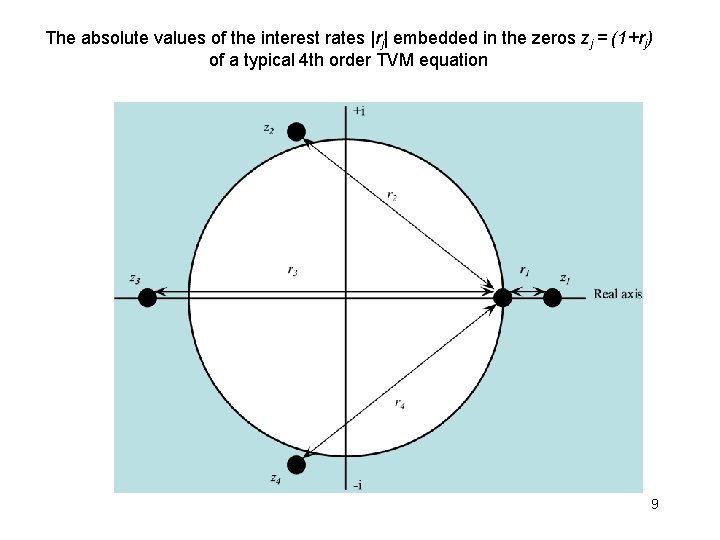
Questions about the multiple interest rate puzzle • Where are the roots located? Each root is a value of zj= (1+rj) • Do all values of zj or rj have use? • Do all values of zj or rj have meaning? 8
The absolute values of the interest rates |rj| embedded in the zeros zj = (1+rj) of a typical 4 th order TVM equation 9
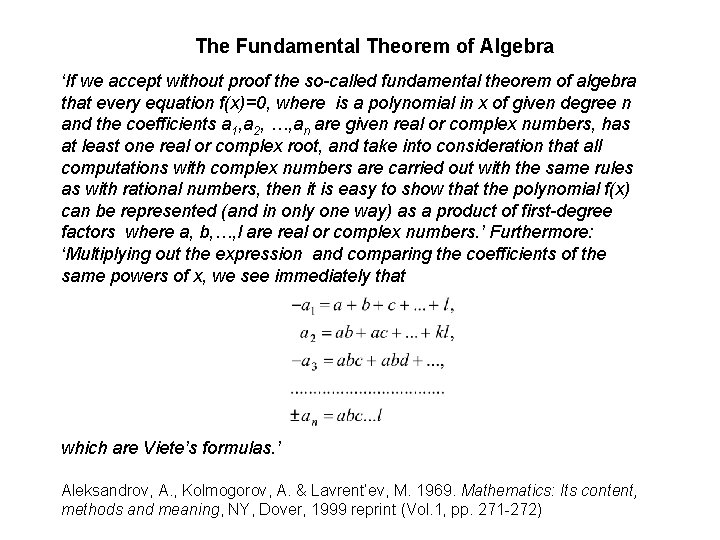
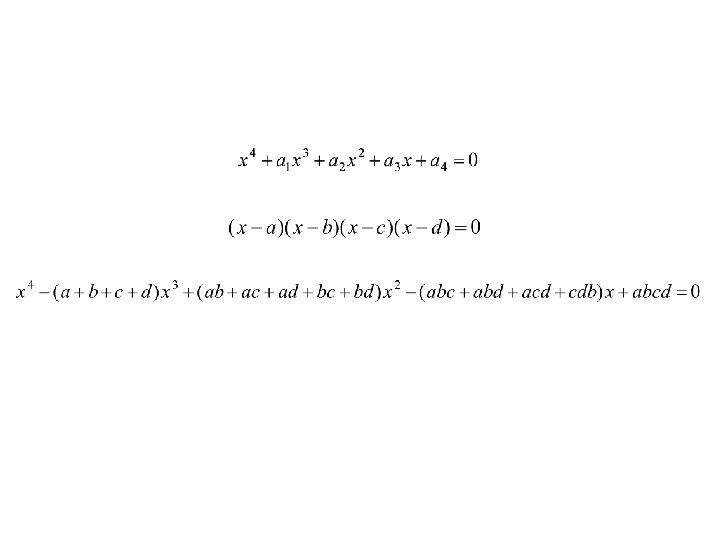
The Fundamental Theorem of Algebra ‘If we accept without proof the so-called fundamental theorem of algebra that every equation f(x)=0, where is a polynomial in x of given degree n and the coefficients a 1, a 2, …, an are given real or complex numbers, has at least one real or complex root, and take into consideration that all computations with complex numbers are carried out with the same rules as with rational numbers, then it is easy to show that the polynomial f(x) can be represented (and in only one way) as a product of first-degree factors where a, b, …, l are real or complex numbers. ’ Furthermore: ‘Multiplying out the expression and comparing the coefficients of the same powers of x, we see immediately that which are Viete’s formulas. ’ Aleksandrov, A. , Kolmogorov, A. & Lavrent’ev, M. 1969. Mathematics: Its content, methods and meaning, NY, Dover, 1999 reprint (Vol. 1, pp. 271 -272)
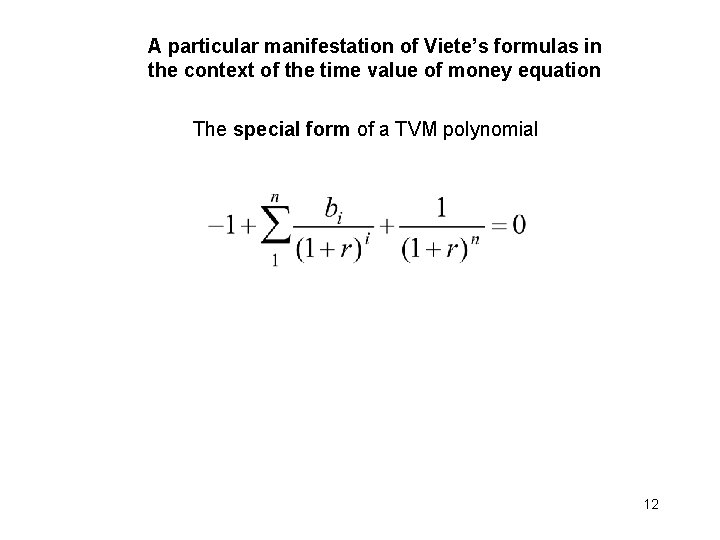
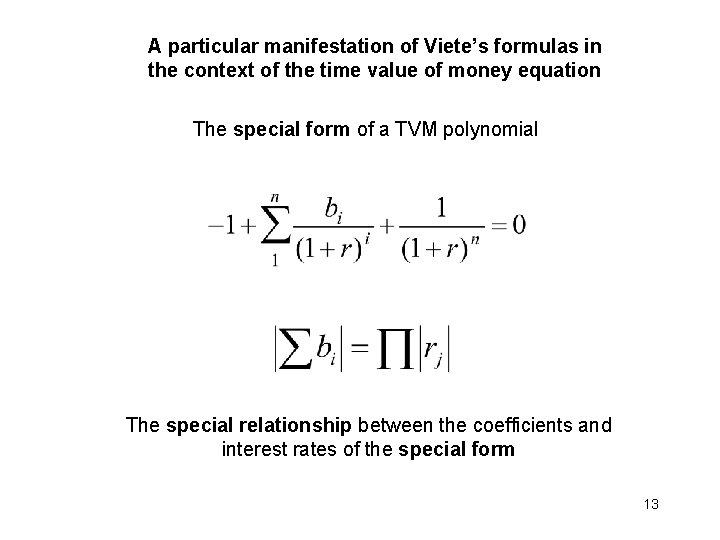
A particular manifestation of Viete’s formulas in the context of the time value of money equation The special form of a TVM polynomial 12
A particular manifestation of Viete’s formulas in the context of the time value of money equation The special form of a TVM polynomial The special relationship between the coefficients and interest rates of the special form 13
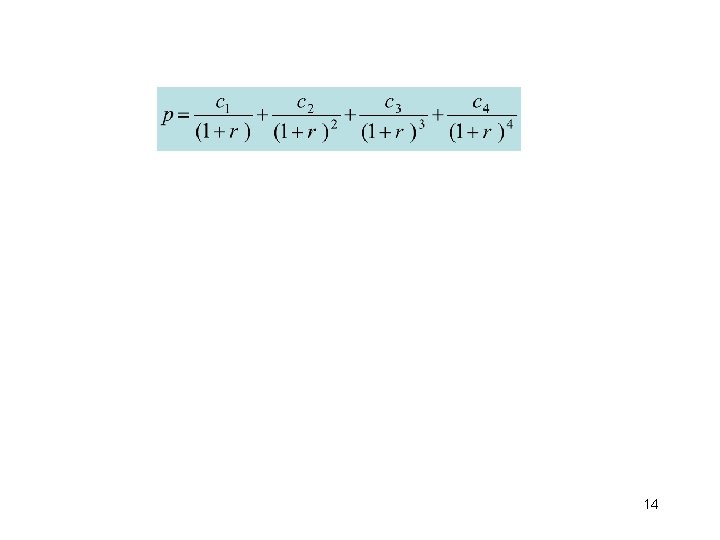
14
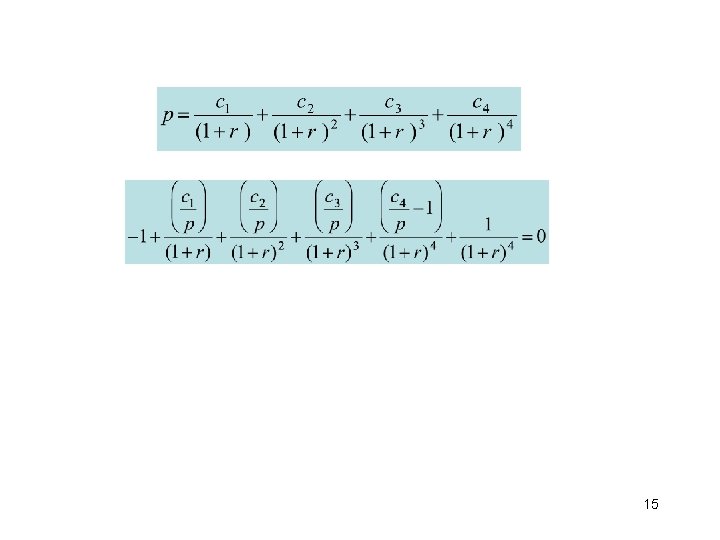
15
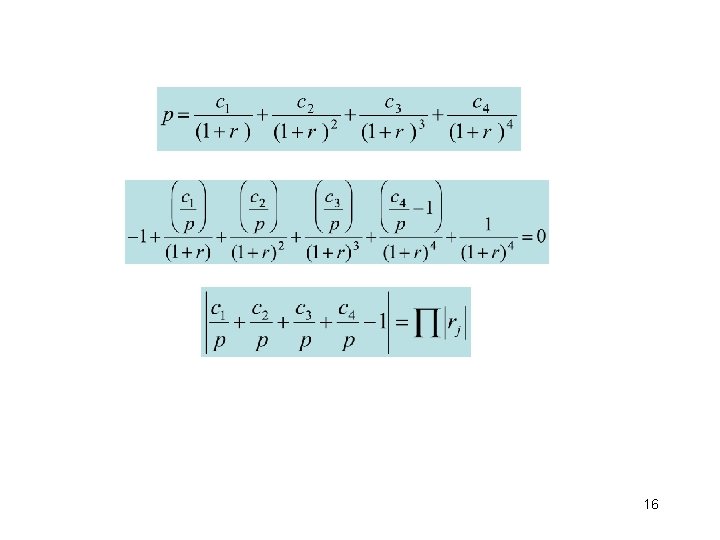
16
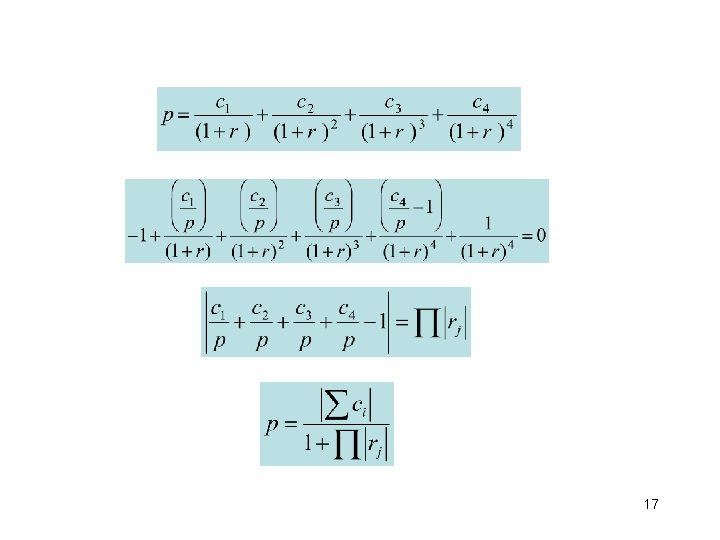
17
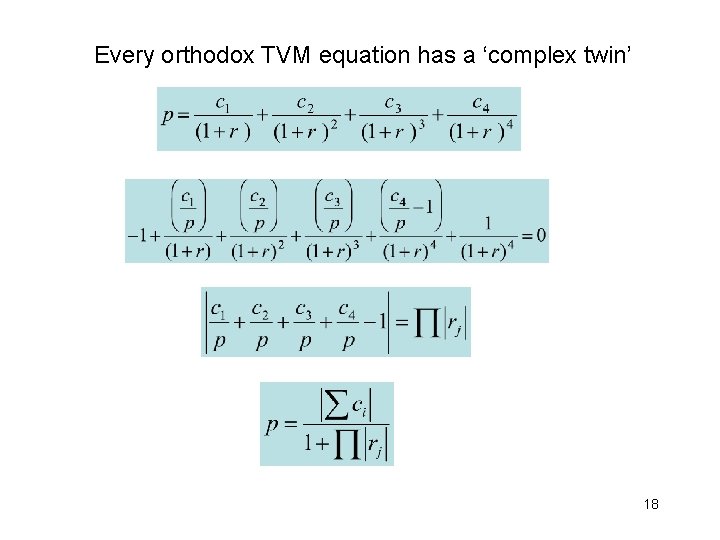
Every orthodox TVM equation has a ‘complex twin’ 18
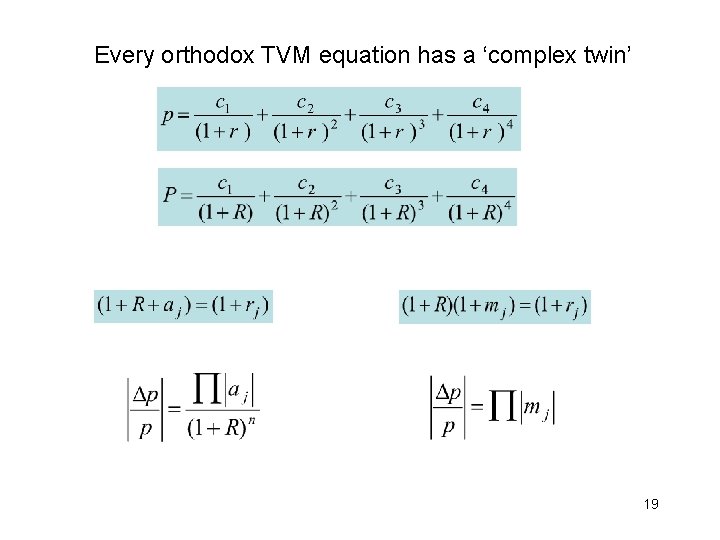
Every orthodox TVM equation has a ‘complex twin’ 19
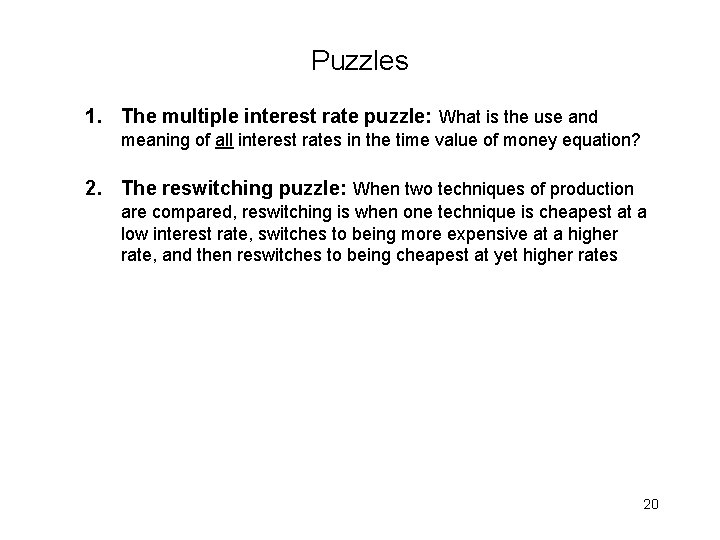
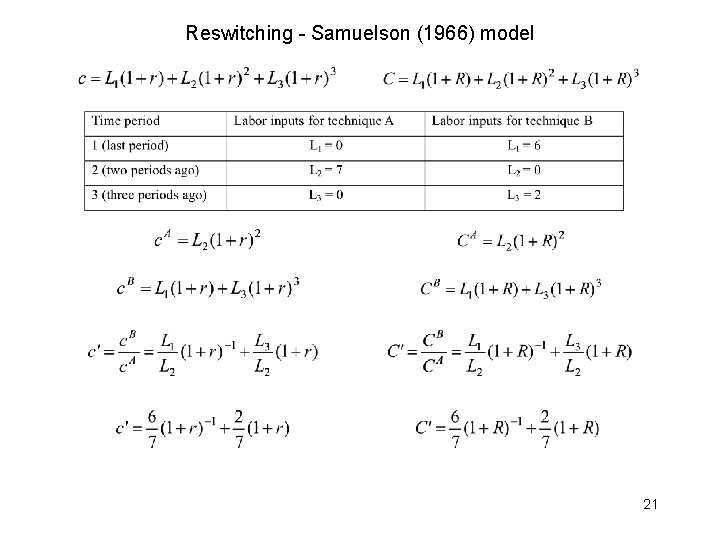
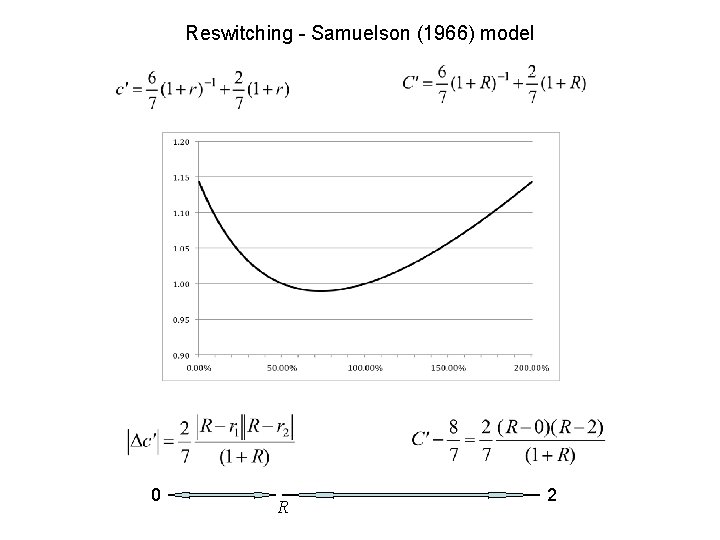
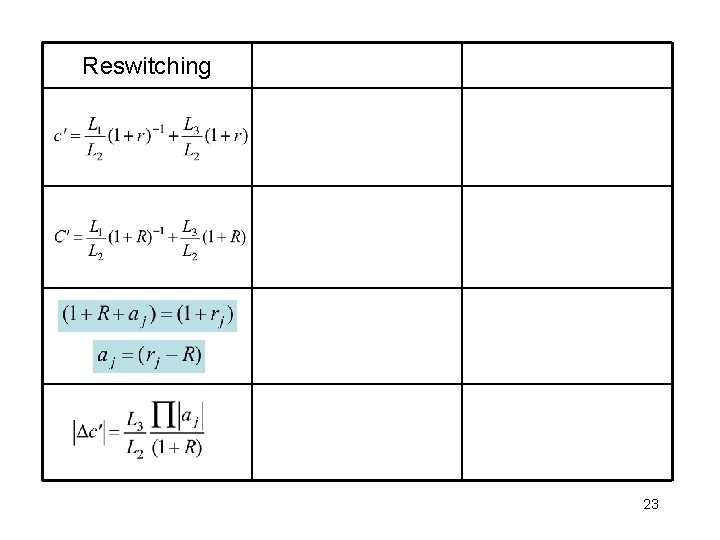
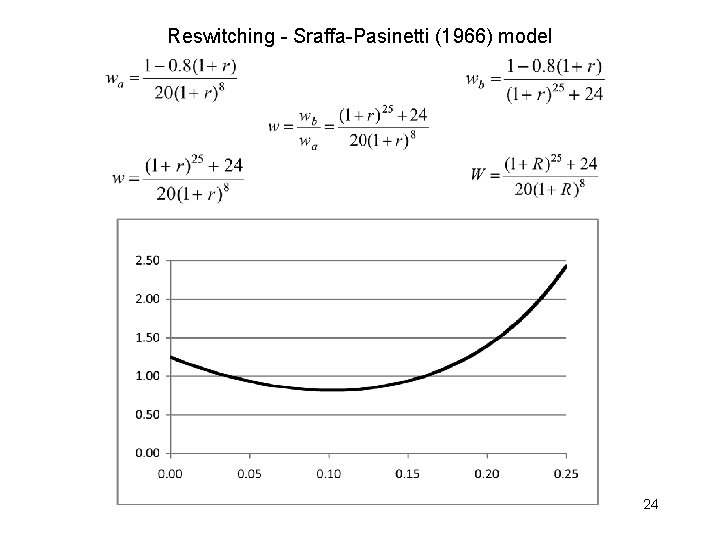
Puzzles 1. The multiple interest rate puzzle: What is the use and meaning of all interest rates in the time value of money equation? 2. The reswitching puzzle: When two techniques of production are compared, reswitching is when one technique is cheapest at a low interest rate, switches to being more expensive at a higher rate, and then reswitches to being cheapest at yet higher rates 20
Reswitching - Samuelson (1966) model 21
Reswitching - Samuelson (1966) model 0 R 2
Reswitching 23
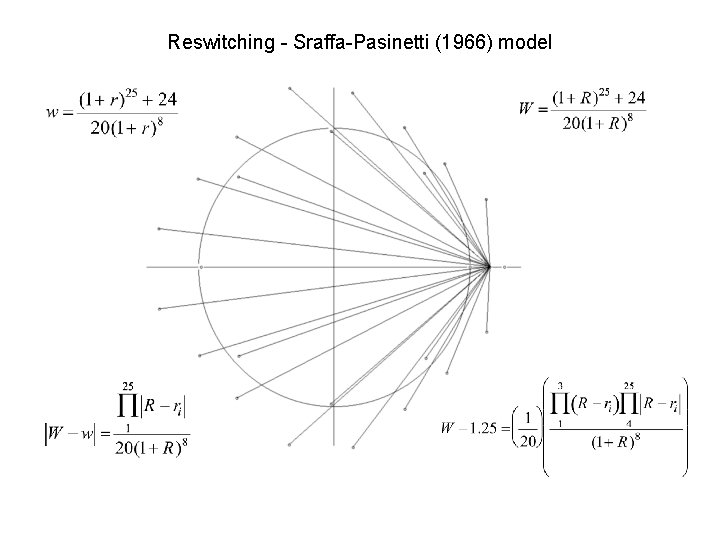
Reswitching - Sraffa-Pasinetti (1966) model 24
Reswitching - Sraffa-Pasinetti (1966) model 25
Puzzles 1. The multiple interest rate puzzle: What is the use and meaning of all interest rates in the time value of money equation? 2. The reswitching puzzle: When two techniques of production are compared, reswitching is when one technique is cheapest at a low interest rate, switches to being more expensive at a higher rate, and then reswitches to being cheapest at yet higher rates 3. The capital budgeting puzzle: NPV versus IRR. Academics recommend NPV while many practitioners use IRR 26
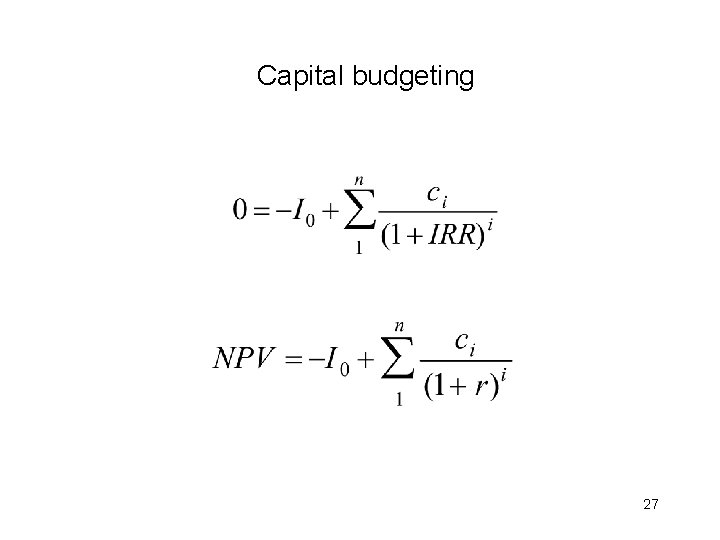
Capital budgeting 27
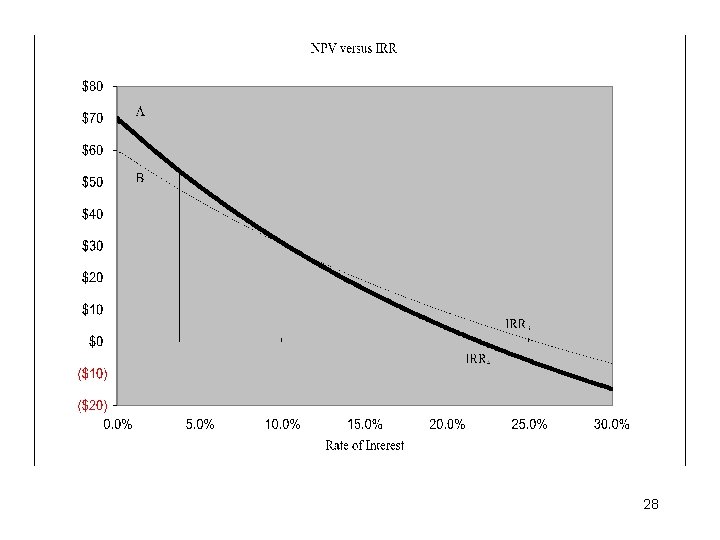
28
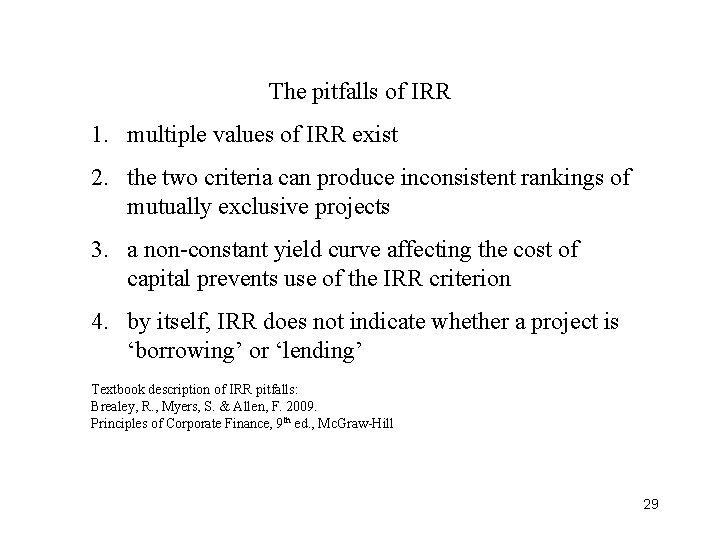
The pitfalls of IRR 1. multiple values of IRR exist 2. the two criteria can produce inconsistent rankings of mutually exclusive projects 3. a non-constant yield curve affecting the cost of capital prevents use of the IRR criterion 4. by itself, IRR does not indicate whether a project is ‘borrowing’ or ‘lending’ Textbook description of IRR pitfalls: Brealey, R. , Myers, S. & Allen, F. 2009. Principles of Corporate Finance, 9 th ed. , Mc. Graw-Hill 29
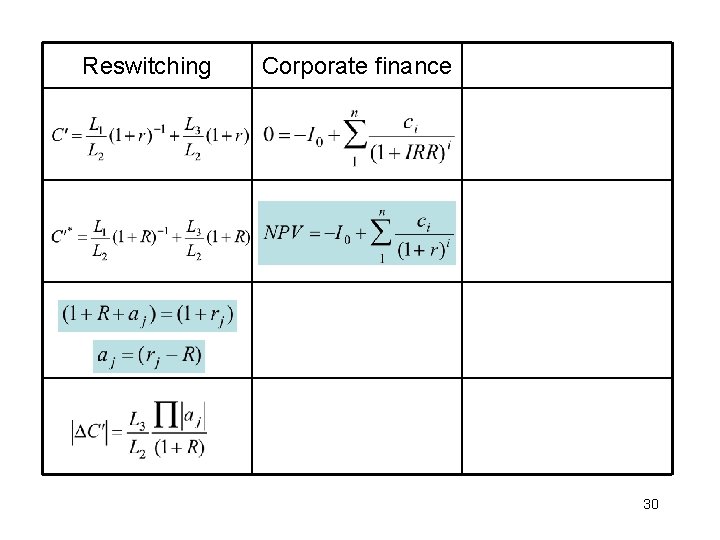
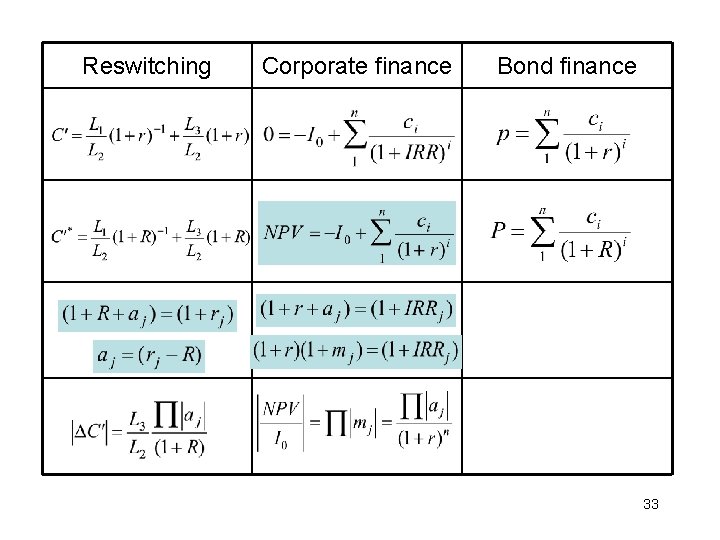
Reswitching Corporate finance 30
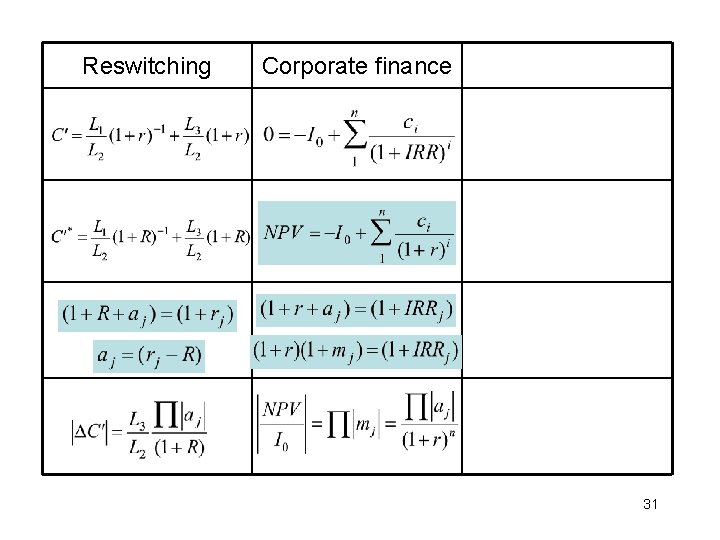
Reswitching Corporate finance 31
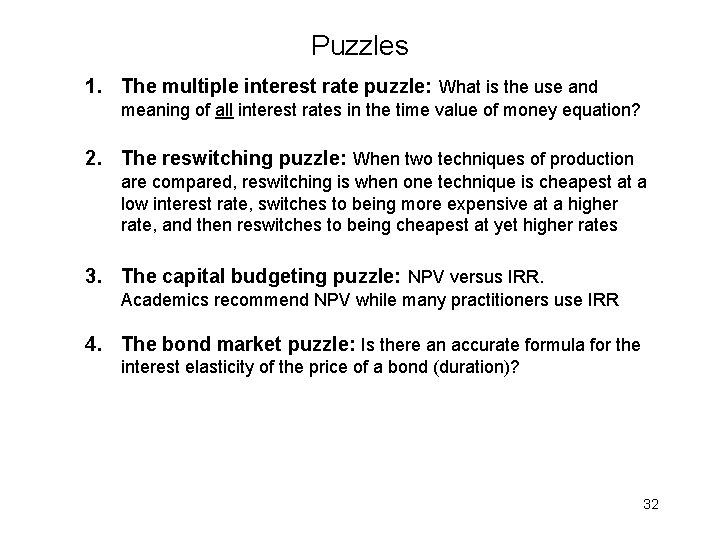
Puzzles 1. The multiple interest rate puzzle: What is the use and meaning of all interest rates in the time value of money equation? 2. The reswitching puzzle: When two techniques of production are compared, reswitching is when one technique is cheapest at a low interest rate, switches to being more expensive at a higher rate, and then reswitches to being cheapest at yet higher rates 3. The capital budgeting puzzle: NPV versus IRR. Academics recommend NPV while many practitioners use IRR 4. The bond market puzzle: Is there an accurate formula for the interest elasticity of the price of a bond (duration)? 32
Reswitching Corporate finance Bond finance 33
34
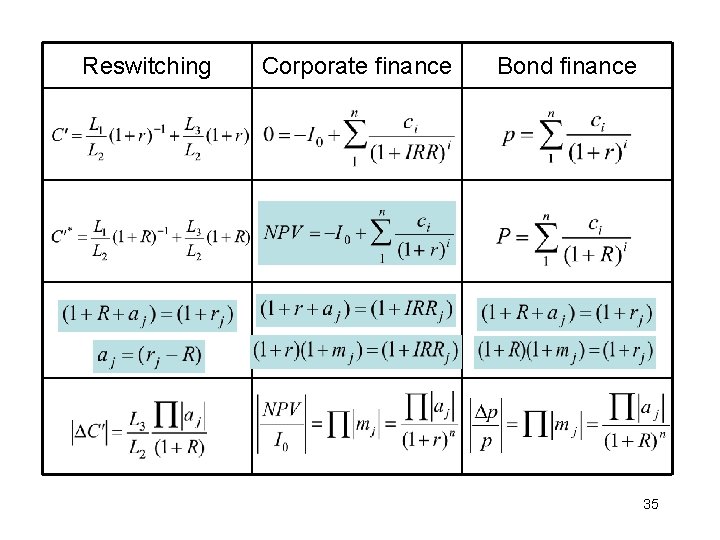
Reswitching Corporate finance Bond finance 35
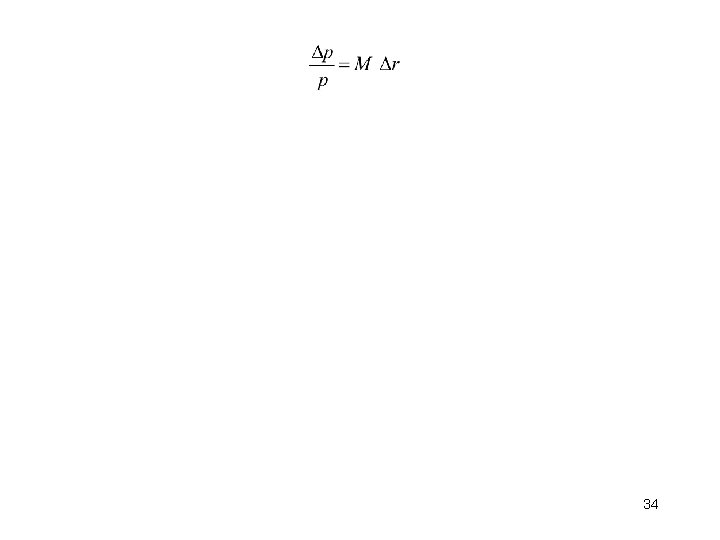
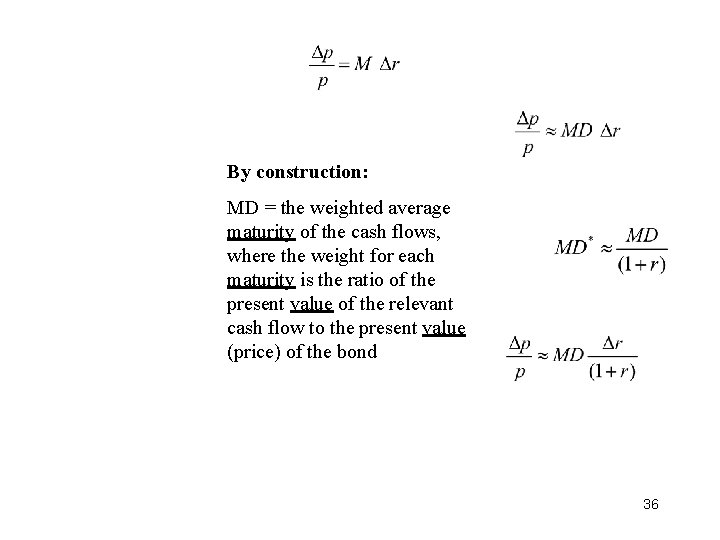
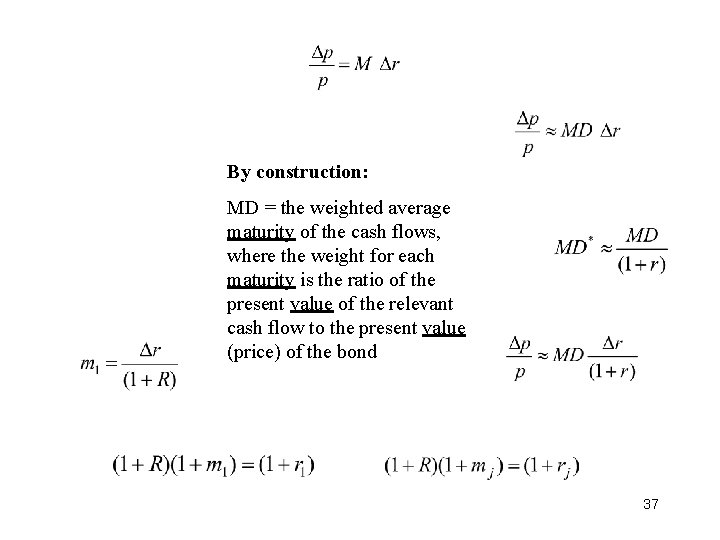
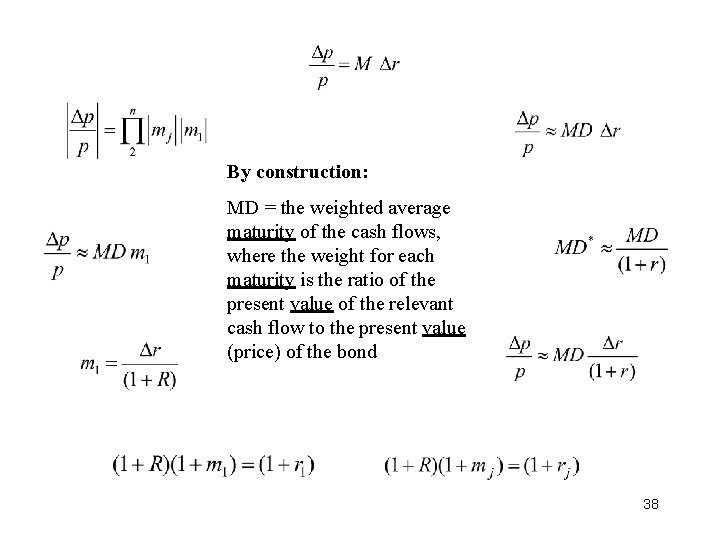
By construction: MD = the weighted average maturity of the cash flows, where the weight for each maturity is the ratio of the present value of the relevant cash flow to the present value (price) of the bond 36
By construction: MD = the weighted average maturity of the cash flows, where the weight for each maturity is the ratio of the present value of the relevant cash flow to the present value (price) of the bond 37
By construction: MD = the weighted average maturity of the cash flows, where the weight for each maturity is the ratio of the present value of the relevant cash flow to the present value (price) of the bond 38
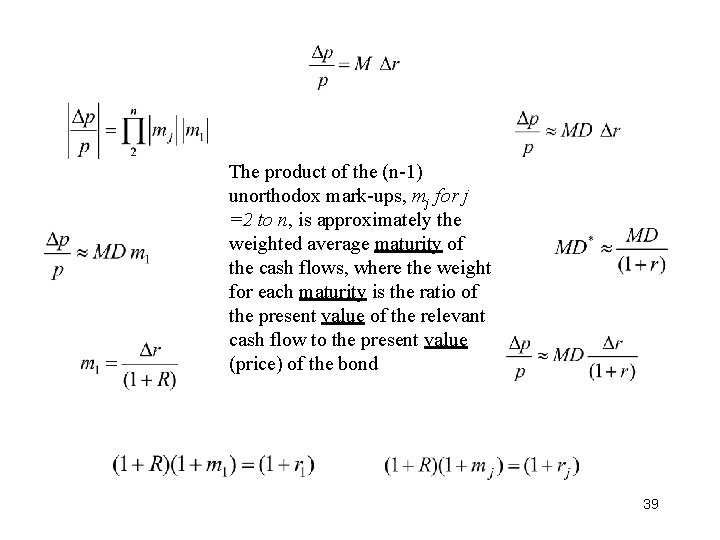
The product of the (n-1) unorthodox mark-ups, mj for j =2 to n, is approximately the weighted average maturity of the cash flows, where the weight for each maturity is the ratio of the present value of the relevant cash flow to the present value (price) of the bond 39
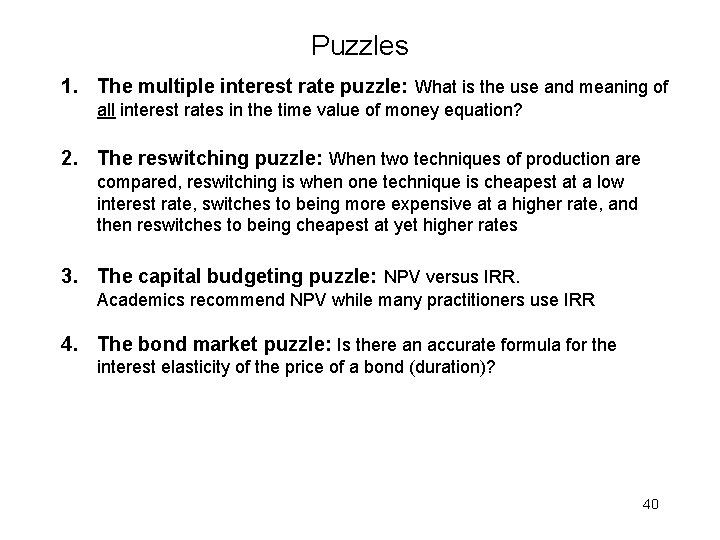
Puzzles 1. The multiple interest rate puzzle: What is the use and meaning of all interest rates in the time value of money equation? 2. The reswitching puzzle: When two techniques of production are compared, reswitching is when one technique is cheapest at a low interest rate, switches to being more expensive at a higher rate, and then reswitches to being cheapest at yet higher rates 3. The capital budgeting puzzle: NPV versus IRR. Academics recommend NPV while many practitioners use IRR 4. The bond market puzzle: Is there an accurate formula for the interest elasticity of the price of a bond (duration)? 40
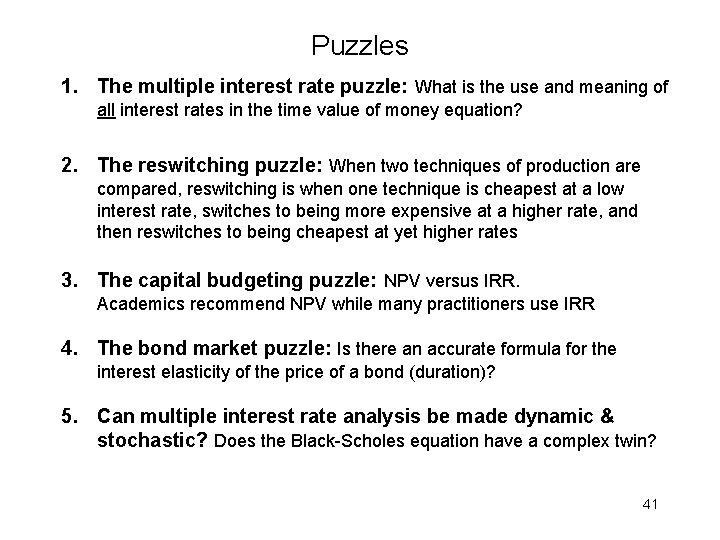
Puzzles 1. The multiple interest rate puzzle: What is the use and meaning of all interest rates in the time value of money equation? 2. The reswitching puzzle: When two techniques of production are compared, reswitching is when one technique is cheapest at a low interest rate, switches to being more expensive at a higher rate, and then reswitches to being cheapest at yet higher rates 3. The capital budgeting puzzle: NPV versus IRR. Academics recommend NPV while many practitioners use IRR 4. The bond market puzzle: Is there an accurate formula for the interest elasticity of the price of a bond (duration)? 5. Can multiple interest rate analysis be made dynamic & stochastic? Does the Black-Scholes equation have a complex twin? 41