Mental Health Plan FeeForService Provider Clinical Documentation Training





- Slides: 145
Mental Health Plan Fee-For-Service Provider Clinical Documentation Training MHP FFS - VERSION 06. 4. 19 1
Introductions Ø What is your name? Ø Are you in the right training? Ø What type of Mental Health Fee for Service Provider are you? (formerly known as Level III Network) • Individual, Group, or Organization Ø Peak of the week? MHP FFS - VERSION 06. 4. 19 2
Psychological Testing ØAssessment and treatment plans are not required for psych testing only cases. ØProgress notes should detail which psychological tests were administered at each session. ØTime spent writing report is claimable and this should be documented within progress notes. ØIf you only conduct psychological testing, the rest of this training will not be relevant to you. If you would like to leave at this time you may. Thank you for all of the great work you do for our consumers. MHP FFS - VERSION 06. 4. 19 3
Fee For Service Providers This training is for mental health providers contracted by Alameda County who claim via paper form CMS 1500. These providers are individual therapists, groups of therapists, and Organizations (Non-Master Contract Organizations). There are some documentation related differences between these providers that will be described in this training. MHP FFS - VERSION 06. 4. 19 4
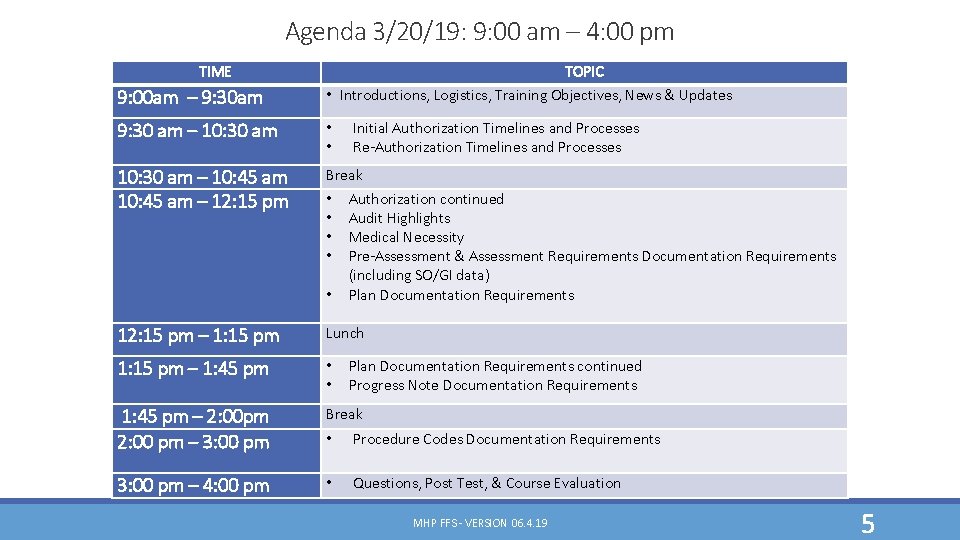
Agenda 3/20/19: 9: 00 am – 4: 00 pm TIME 9: 00 am – 9: 30 am TOPIC • Introductions, Logistics, Training Objectives, News & Updates 9: 30 am – 10: 30 am • • 10: 30 am – 10: 45 am – 12: 15 pm Break • Authorization continued • Audit Highlights • Medical Necessity • Pre-Assessment & Assessment Requirements Documentation Requirements (including SO/GI data) • Plan Documentation Requirements 12: 15 pm – 1: 15 pm Lunch 1: 15 pm – 1: 45 pm • • 1: 45 pm – 2: 00 pm 2: 00 pm – 3: 00 pm Break • Procedure Codes Documentation Requirements 3: 00 pm – 4: 00 pm • Questions, Post Test, & Course Evaluation Initial Authorization Timelines and Processes Re-Authorization Timelines and Processes Plan Documentation Requirements continued Progress Note Documentation Requirements MHP FFS - VERSION 06. 4. 19 5
News and Updates SEE PROVIDER WEBSITE: HTTP: //WWW. ACBHCS. ORG/PROVIDERS/MAIN/INDEX. HTM QA SECTION & SIGN UP FOR UPDATES: HTTP: //WWW. ACBHCS. ORG/PROVIDERS/QA/QA. HTM AUDIT NOTICES, REPORTS & TOOLS: HTTP: //WWW. ACBHCS. ORG/PROVIDERS/QA/QA. HTM MHP FFS - VERSION 06. 4. 19 6
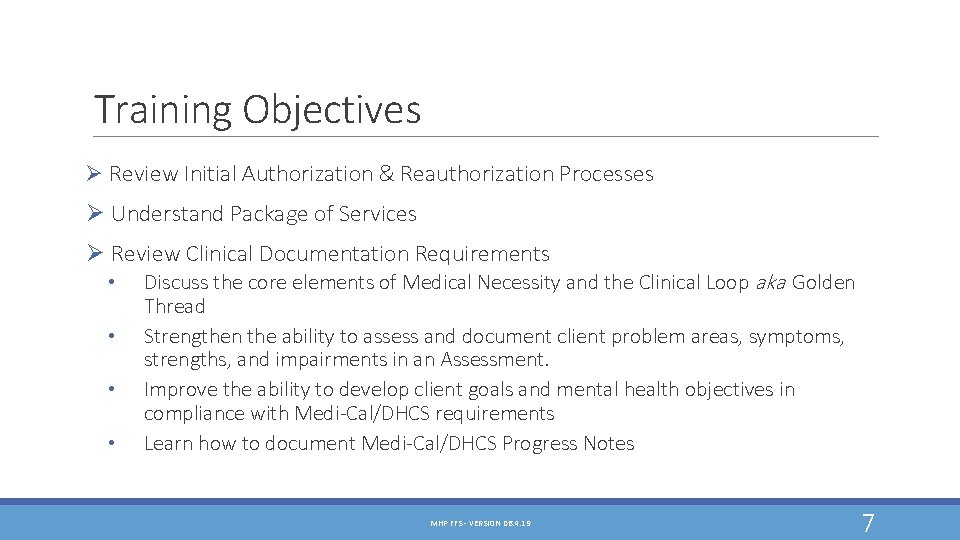
Training Objectives Ø Review Initial Authorization & Reauthorization Processes Ø Understand Package of Services Ø Review Clinical Documentation Requirements • • Discuss the core elements of Medical Necessity and the Clinical Loop aka Golden Thread Strengthen the ability to assess and document client problem areas, symptoms, strengths, and impairments in an Assessment. Improve the ability to develop client goals and mental health objectives in compliance with Medi-Cal/DHCS requirements Learn how to document Medi-Cal/DHCS Progress Notes MHP FFS - VERSION 06. 4. 19 7
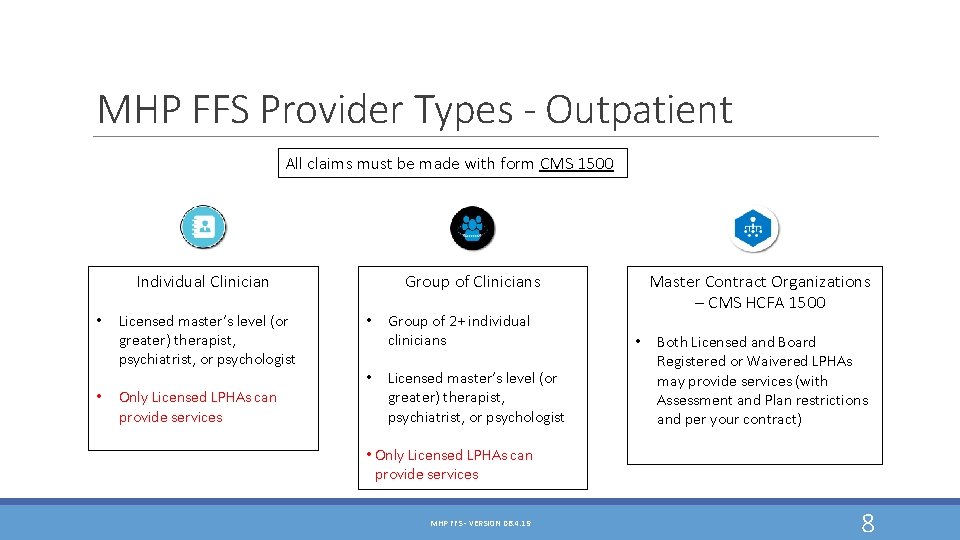
MHP FFS Provider Types - Outpatient All claims must be made with form CMS 1500 Individual Clinician • • Licensed master’s level (or greater) therapist, psychiatrist, or psychologist Only Licensed LPHAs can provide services Master Contract Organizations – CMS HCFA 1500 Group of Clinicians • • Group of 2+ individual clinicians Licensed master’s level (or greater) therapist, psychiatrist, or psychologist • Both Licensed and Board Registered or Waivered LPHAs may provide services (with Assessment and Plan restrictions and per your contract) • Only Licensed LPHAs can provide services MHP FFS - VERSION 06. 4. 19 8
Documentation Training Requirements • Providers are expected to attend a minimum of one ACBH clinical documentation training every three years, as well as any additional ACBH required trainings. • The expectation is for providers to keep up to date with all current policies, procedures and regulations. MHP FFS - VERSION 06. 4. 19 9
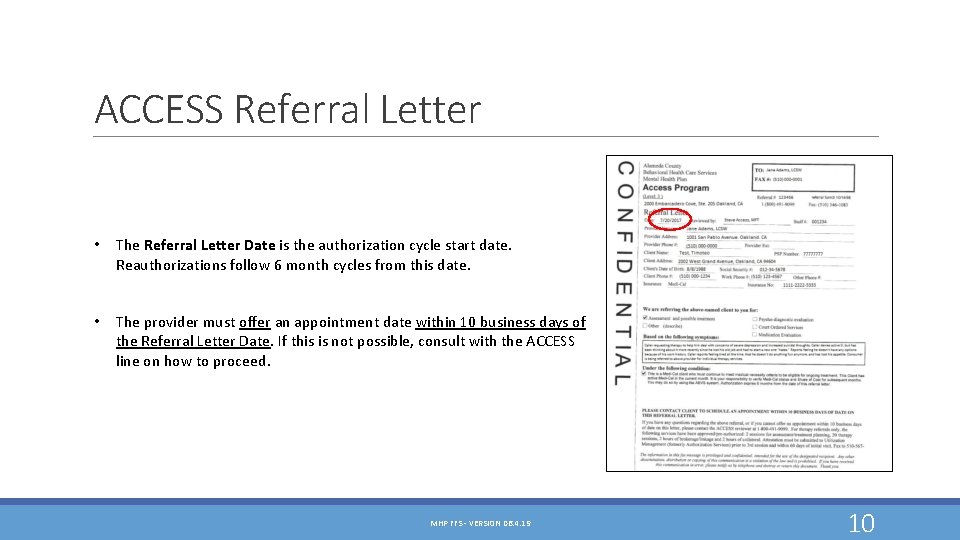
ACCESS Referral Letter • The Referral Letter Date is the authorization cycle start date. Reauthorizations follow 6 month cycles from this date. • The provider must offer an appointment date within 10 business days of the Referral Letter Date. If this is not possible, consult with the ACCESS line on how to proceed. MHP FFS - VERSION 06. 4. 19 10
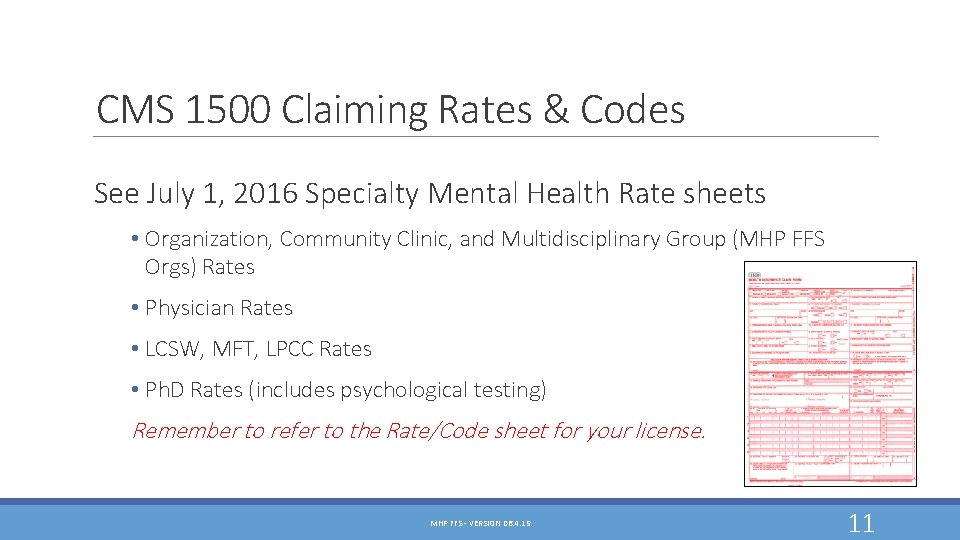
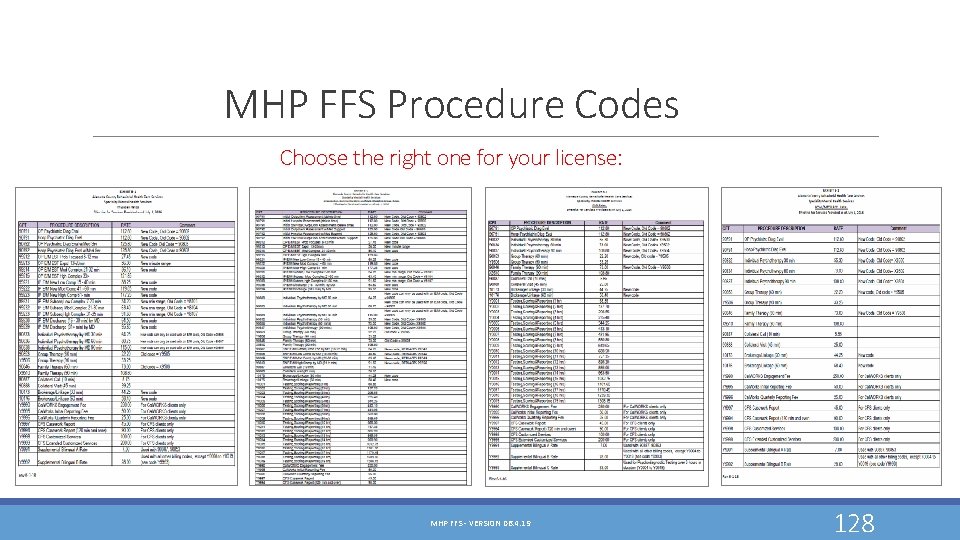
CMS 1500 Claiming Rates & Codes See July 1, 2016 Specialty Mental Health Rate sheets • Organization, Community Clinic, and Multidisciplinary Group (MHP FFS Orgs) Rates • Physician Rates • LCSW, MFT, LPCC Rates • Ph. D Rates (includes psychological testing) Remember to refer to the Rate/Code sheet for your license. MHP FFS - VERSION 06. 4. 19 11
Important Forms Attestation form: http: //www. acbhcs. org/providers/Forms. htm#UM Medi-Cal compliant Assessment and Client Plan forms: http: //www. acbhcs. org/providers/Forms/Provider. Network. htm Request for Continued Services (RCS) form: http: //www. acbhcs. org/providers/Forms. htm#UM MHP FFS - VERSION 06. 4. 19 12
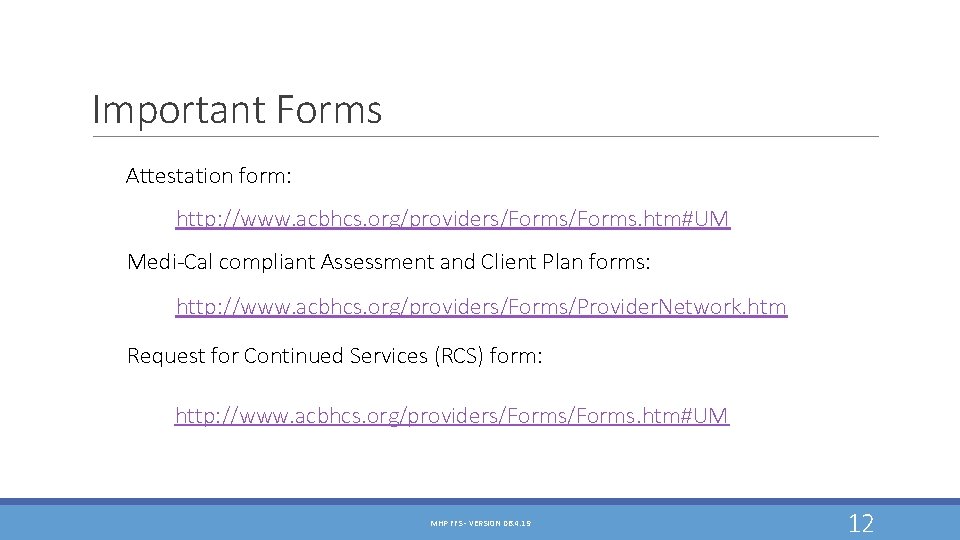
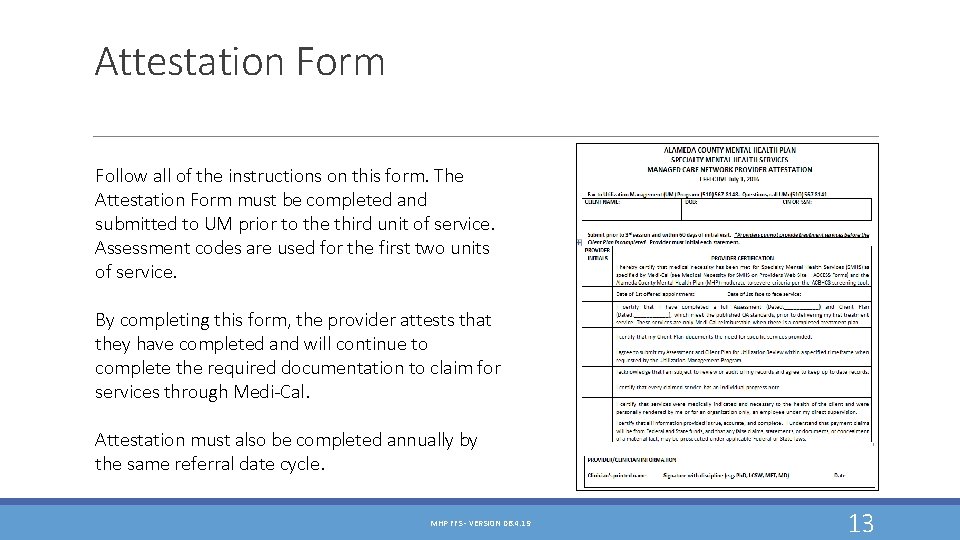
Attestation Form Follow all of the instructions on this form. The Attestation Form must be completed and submitted to UM prior to the third unit of service. Assessment codes are used for the first two units of service. By completing this form, the provider attests that they have completed and will continue to complete the required documentation to claim for services through Medi-Cal. Attestation must also be completed annually by the same referral date cycle. MHP FFS - VERSION 06. 4. 19 13
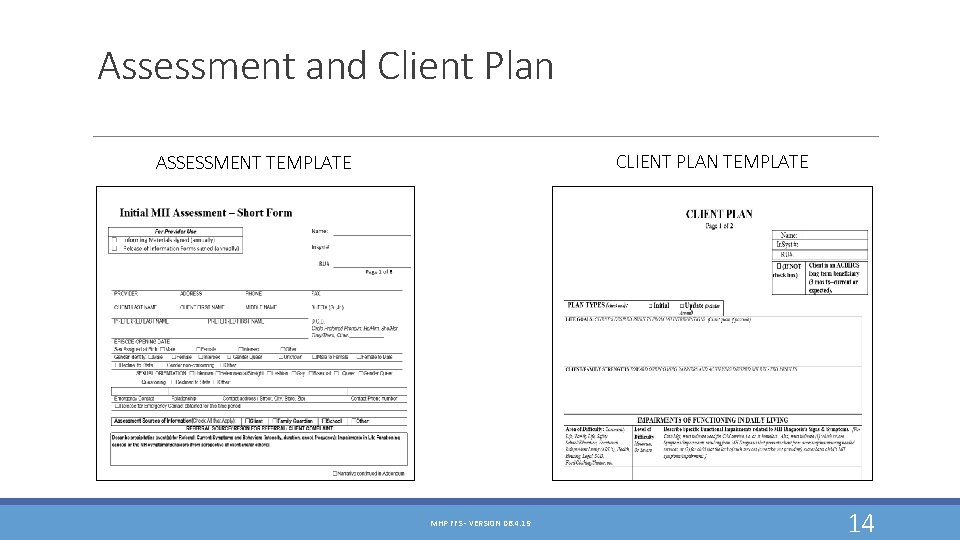
Assessment and Client Plan CLIENT PLAN TEMPLATE ASSESSMENT TEMPLATE MHP FFS - VERSION 06. 4. 19 14
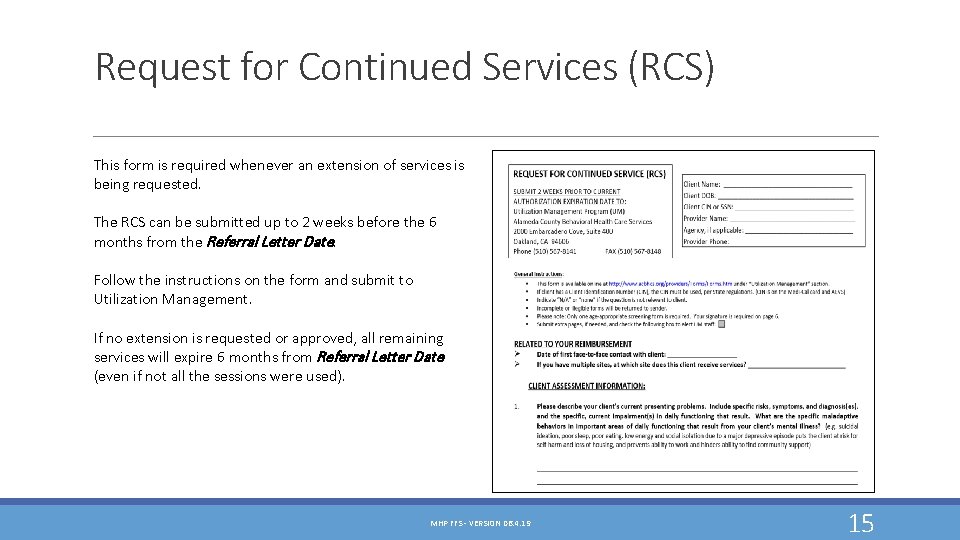
Request for Continued Services (RCS) This form is required whenever an extension of services is being requested. The RCS can be submitted up to 2 weeks before the 6 months from the Referral Letter Date. Follow the instructions on the form and submit to Utilization Management. If no extension is requested or approved, all remaining services will expire 6 months from Referral Letter Date (even if not all the sessions were used). MHP FFS - VERSION 06. 4. 19 15
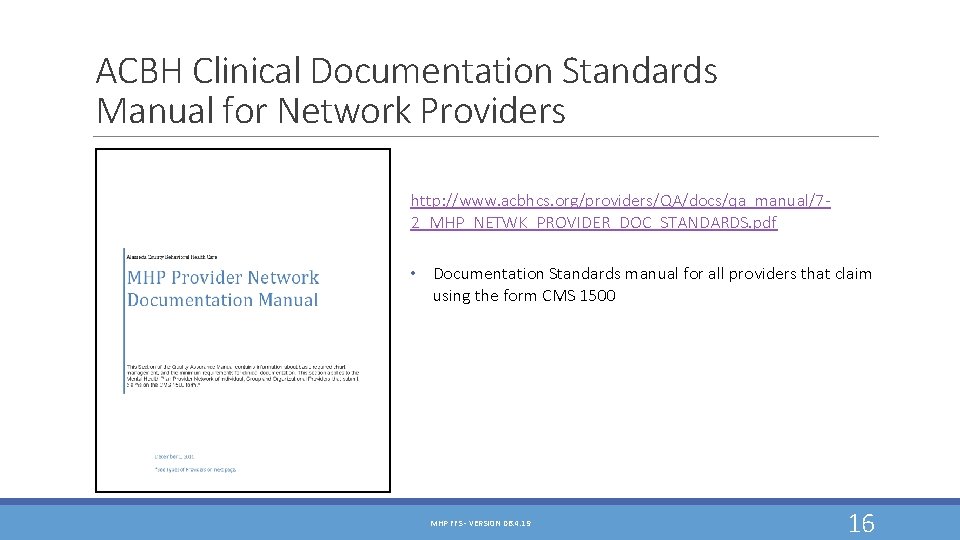
ACBH Clinical Documentation Standards Manual for Network Providers http: //www. acbhcs. org/providers/QA/docs/qa_manual/72_MHP_NETWK_PROVIDER_DOC_STANDARDS. pdf • Documentation Standards manual for all providers that claim using the form CMS 1500 MHP FFS - VERSION 06. 4. 19 16
Insurance Eligibility Verification Alameda County is currently a retrospective payment authorization county. Service authorization is given for 6 months into the future but is not a guarantee of payment. Payment of claims is dependent on continued insurance eligibility, medical necessity, and timeliness of claim submission. It is the provider’s responsibility to check insurance eligibility monthly and understand medical necessity criteria for SMHS. Remember to verify eligibility prior to initially providing services and then on the first of each calendar month. If Medi-Cal has been discontinued, alert the beneficiary to follow-up with the Medi-Cal Office so that hopefully their benefit will be reinstated (usually retroactively if alerted same/next month from discontinuation). It is strongly recommended for the provider to know each of their beneficiary’s Medi-Cal Managed Care Plan (MCP) to help ensure continuity of care as a beneficiary's condition improves from moderate-to-severe to mildto-moderate. See MHP FFS Documentation Standards Manual for more information. MHP FFS - VERSION 06. 4. 19 17
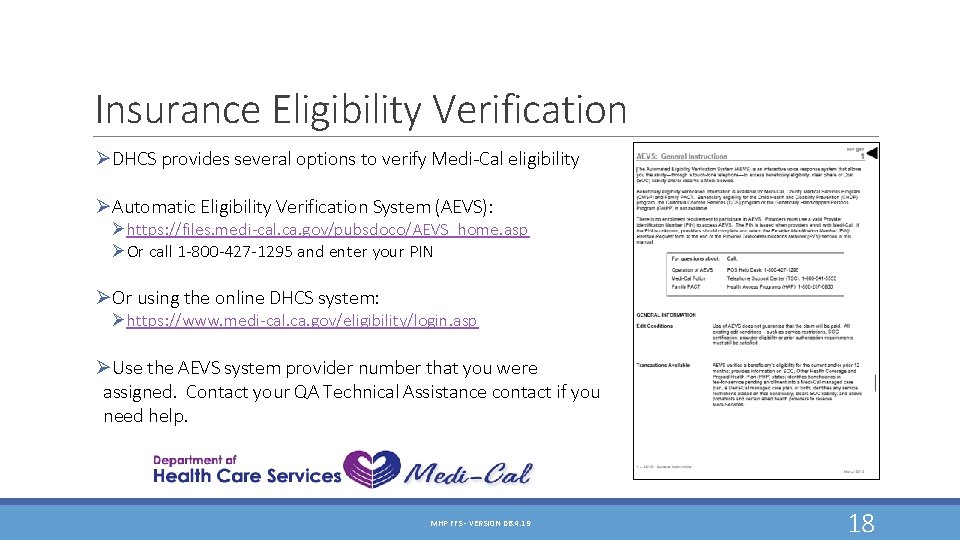
Insurance Eligibility Verification ØDHCS provides several options to verify Medi-Cal eligibility ØAutomatic Eligibility Verification System (AEVS): Øhttps: //files. medi-cal. ca. gov/pubsdoco/AEVS_home. asp ØOr call 1 -800 -427 -1295 and enter your PIN ØOr using the online DHCS system: Øhttps: //www. medi-cal. ca. gov/eligibility/login. asp ØUse the AEVS system provider number that you were assigned. Contact your QA Technical Assistance contact if you need help. MHP FFS - VERSION 06. 4. 19 18
Initial Authorization & Re-Authorization MHP FFS - VERSION 06. 4. 19 19
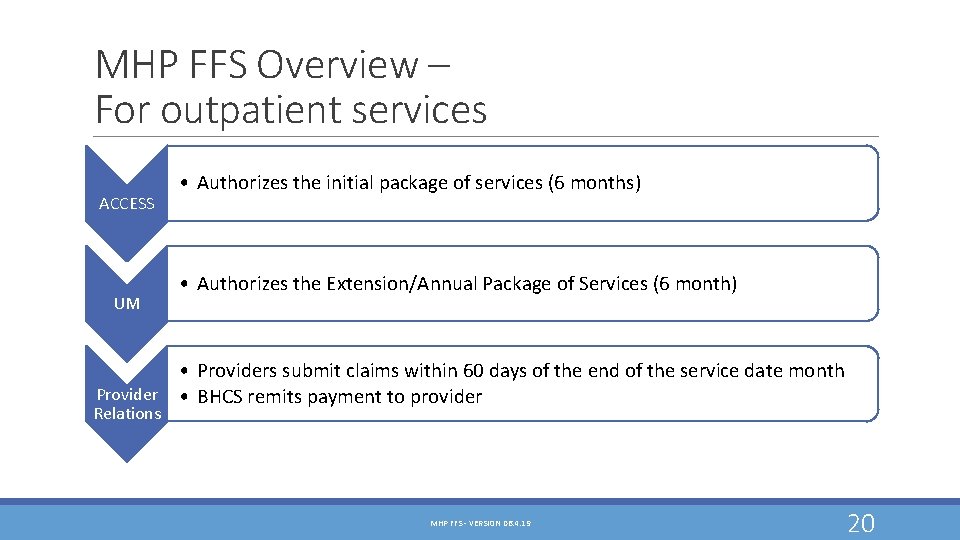
MHP FFS Overview – For outpatient services ACCESS UM • Authorizes the initial package of services (6 months) • Authorizes the Extension/Annual Package of Services (6 month) • Providers submit claims within 60 days of the end of the service date month Provider • BHCS remits payment to provider Relations MHP FFS - VERSION 06. 4. 19 20
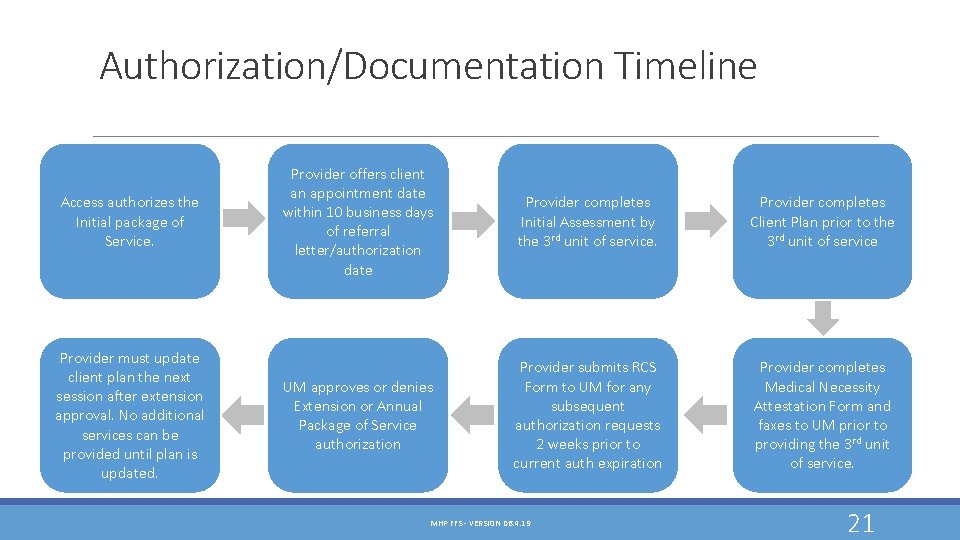
Authorization/Documentation Timeline Access authorizes the Initial package of Service. Provider must update client plan the next session after extension approval. No additional services can be provided until plan is updated. Provider offers client an appointment date within 10 business days of referral letter/authorization date Provider completes Initial Assessment by the 3 rd unit of service. Provider completes Client Plan prior to the 3 rd unit of service UM approves or denies Extension or Annual Package of Service authorization Provider submits RCS Form to UM for any subsequent authorization requests 2 weeks prior to current auth expiration Provider completes Medical Necessity Attestation Form and faxes to UM prior to providing the 3 rd unit of service. MHP FFS - VERSION 06. 4. 19 21
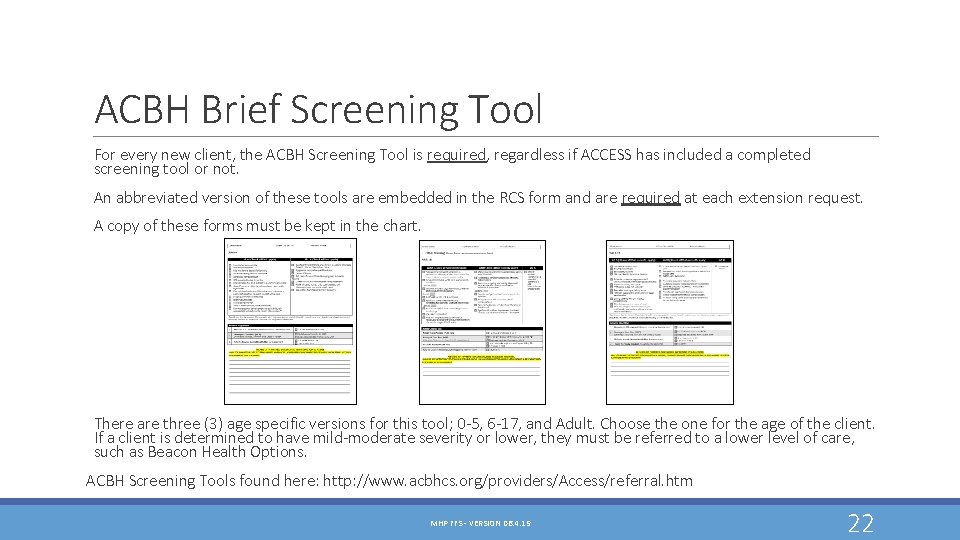
ACBH Brief Screening Tool For every new client, the ACBH Screening Tool is required, regardless if ACCESS has included a completed screening tool or not. An abbreviated version of these tools are embedded in the RCS form and are required at each extension request. A copy of these forms must be kept in the chart. There are three (3) age specific versions for this tool; 0 -5, 6 -17, and Adult. Choose the one for the age of the client. If a client is determined to have mild-moderate severity or lower, they must be referred to a lower level of care, such as Beacon Health Options. ACBH Screening Tools found here: http: //www. acbhcs. org/providers/Access/referral. htm MHP FFS - VERSION 06. 4. 19 22
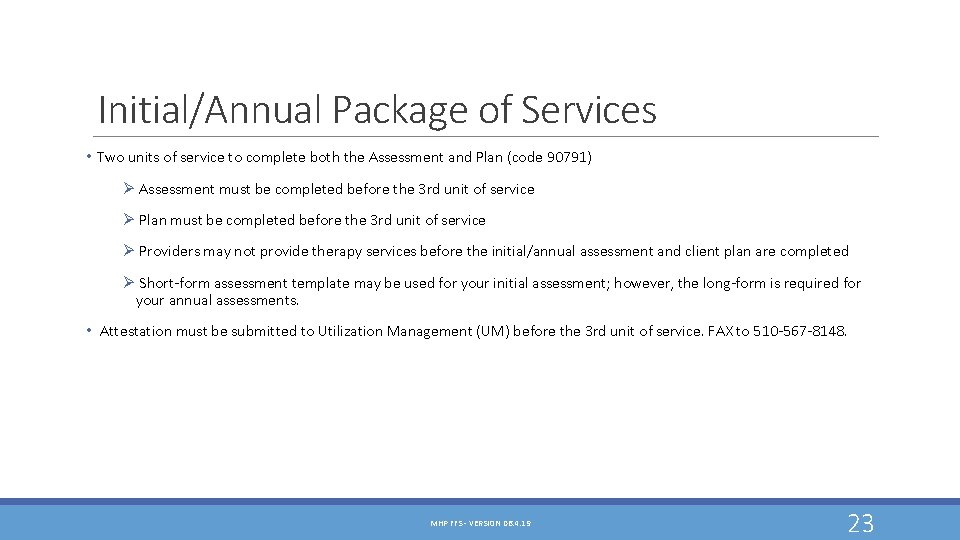
Initial/Annual Package of Services • Two units of service to complete both the Assessment and Plan (code 90791) Ø Assessment must be completed before the 3 rd unit of service Ø Plan must be completed before the 3 rd unit of service Ø Providers may not provide therapy services before the initial/annual assessment and client plan are completed Ø Short-form assessment template may be used for your initial assessment; however, the long-form is required for your annual assessments. • Attestation must be submitted to Utilization Management (UM) before the 3 rd unit of service. FAX to 510 -567 -8148. MHP FFS - VERSION 06. 4. 19 23
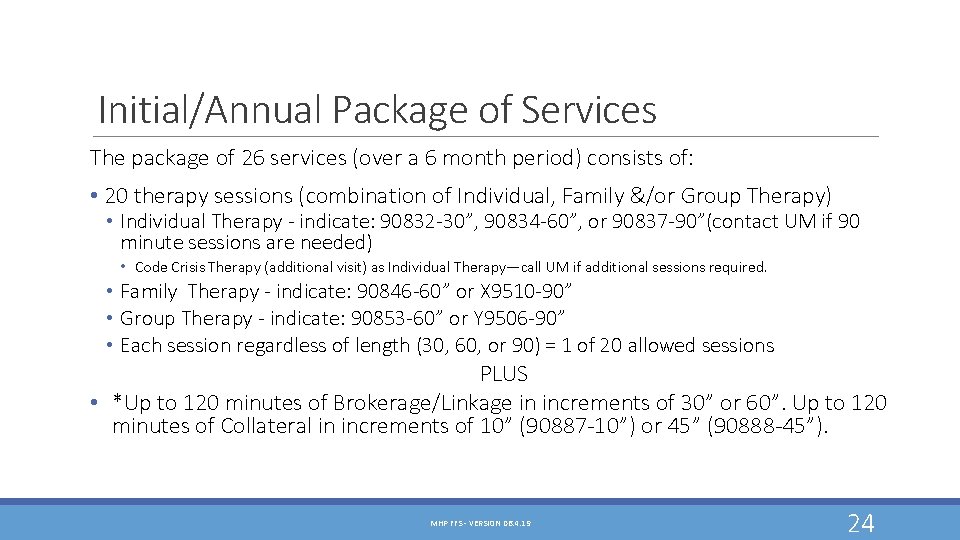
Initial/Annual Package of Services The package of 26 services (over a 6 month period) consists of: • 20 therapy sessions (combination of Individual, Family &/or Group Therapy) • Individual Therapy - indicate: 90832 -30”, 90834 -60”, or 90837 -90”(contact UM if 90 minute sessions are needed) • Code Crisis Therapy (additional visit) as Individual Therapy—call UM if additional sessions required. • Family Therapy - indicate: 90846 -60” or X 9510 -90” • Group Therapy - indicate: 90853 -60” or Y 9506 -90” • Each session regardless of length (30, 60, or 90) = 1 of 20 allowed sessions PLUS • *Up to 120 minutes of Brokerage/Linkage in increments of 30” or 60”. Up to 120 minutes of Collateral in increments of 10” (90887 -10”) or 45” (90888 -45”). MHP FFS - VERSION 06. 4. 19 24
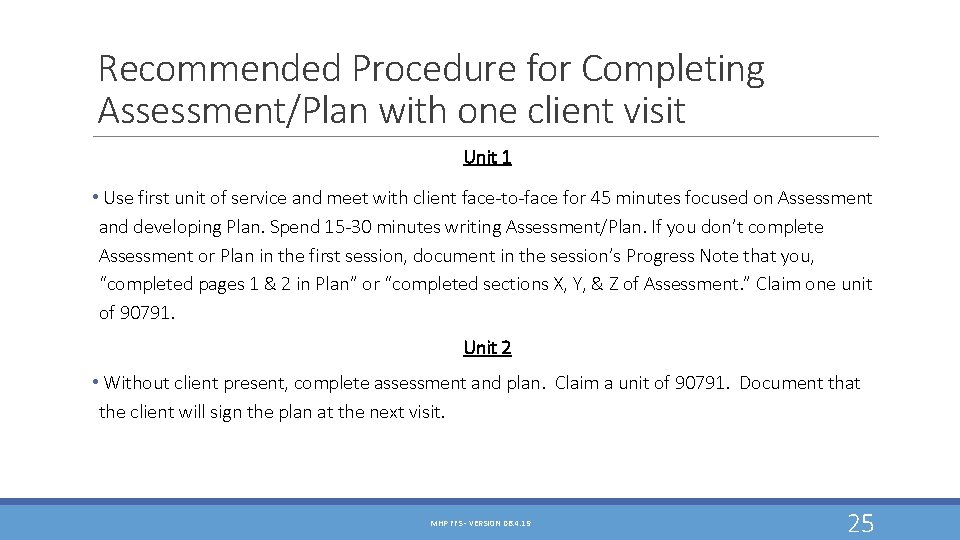
Recommended Procedure for Completing Assessment/Plan with one client visit Unit 1 • Use first unit of service and meet with client face-to-face for 45 minutes focused on Assessment and developing Plan. Spend 15 -30 minutes writing Assessment/Plan. If you don’t complete Assessment or Plan in the first session, document in the session’s Progress Note that you, “completed pages 1 & 2 in Plan” or “completed sections X, Y, & Z of Assessment. ” Claim one unit of 90791. Unit 2 • Without client present, complete assessment and plan. Claim a unit of 90791. Document that the client will sign the plan at the next visit. MHP FFS - VERSION 06. 4. 19 25
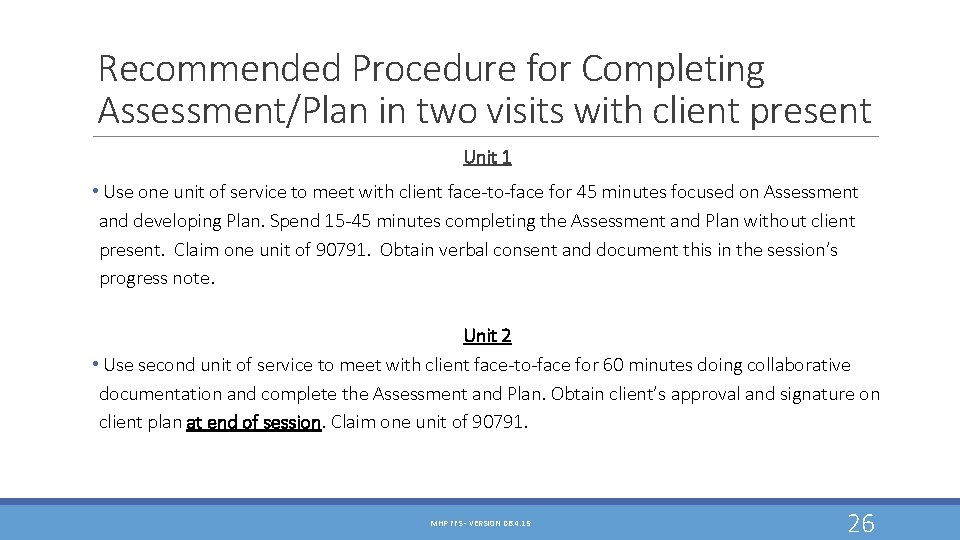
Recommended Procedure for Completing Assessment/Plan in two visits with client present Unit 1 • Use one unit of service to meet with client face-to-face for 45 minutes focused on Assessment and developing Plan. Spend 15 -45 minutes completing the Assessment and Plan without client present. Claim one unit of 90791. Obtain verbal consent and document this in the session’s progress note. Unit 2 • Use second unit of service to meet with client face-to-face for 60 minutes doing collaborative documentation and complete the Assessment and Plan. Obtain client’s approval and signature on client plan at end of session. Claim one unit of 90791. MHP FFS - VERSION 06. 4. 19 26
Re-Authorization MHP FFS - VERSION 06. 4. 19 27
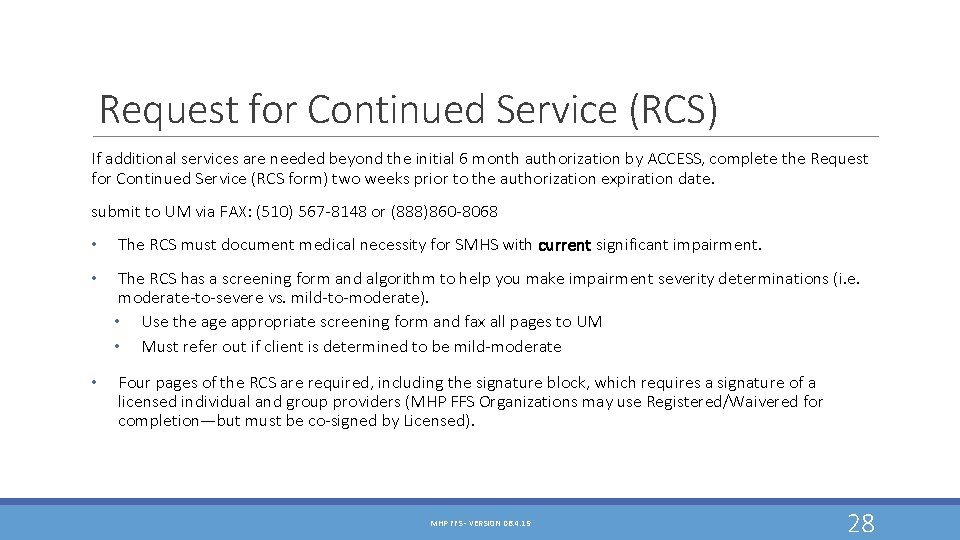
Request for Continued Service (RCS) If additional services are needed beyond the initial 6 month authorization by ACCESS, complete the Request for Continued Service (RCS form) two weeks prior to the authorization expiration date. submit to UM via FAX: (510) 567 -8148 or (888)860 -8068 • The RCS must document medical necessity for SMHS with current significant impairment. • The RCS has a screening form and algorithm to help you make impairment severity determinations (i. e. moderate-to-severe vs. mild-to-moderate). • Use the age appropriate screening form and fax all pages to UM • Must refer out if client is determined to be mild-moderate • Four pages of the RCS are required, including the signature block, which requires a signature of a licensed individual and group providers (MHP FFS Organizations may use Registered/Waivered for completion—but must be co-signed by Licensed). MHP FFS - VERSION 06. 4. 19 28
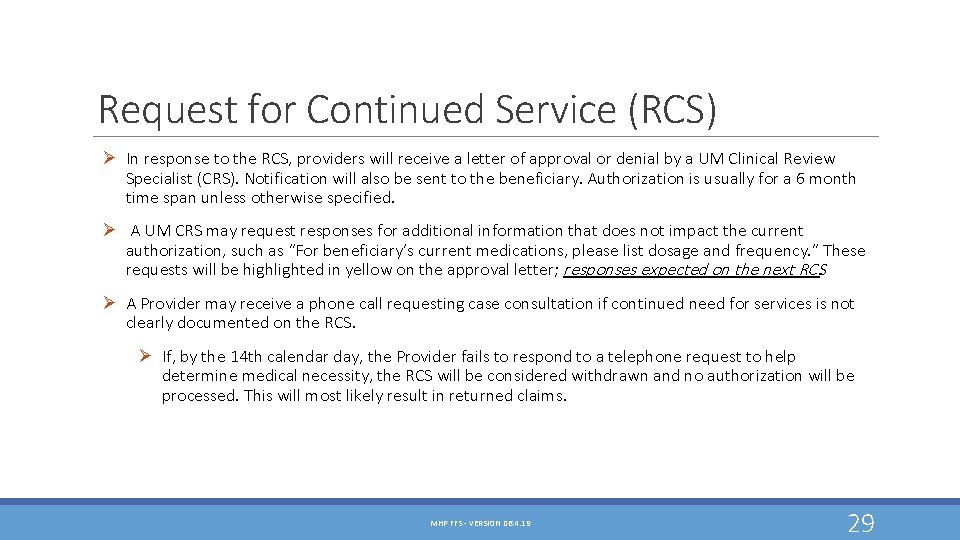
Request for Continued Service (RCS) Ø In response to the RCS, providers will receive a letter of approval or denial by a UM Clinical Review Specialist (CRS). Notification will also be sent to the beneficiary. Authorization is usually for a 6 month time span unless otherwise specified. Ø A UM CRS may request responses for additional information that does not impact the current authorization, such as “For beneficiary’s current medications, please list dosage and frequency. ” These requests will be highlighted in yellow on the approval letter; responses expected on the next RCS. Ø A Provider may receive a phone call requesting case consultation if continued need for services is not clearly documented on the RCS. Ø If, by the 14 th calendar day, the Provider fails to respond to a telephone request to help determine medical necessity, the RCS will be considered withdrawn and no authorization will be processed. This will most likely result in returned claims. MHP FFS - VERSION 06. 4. 19 29
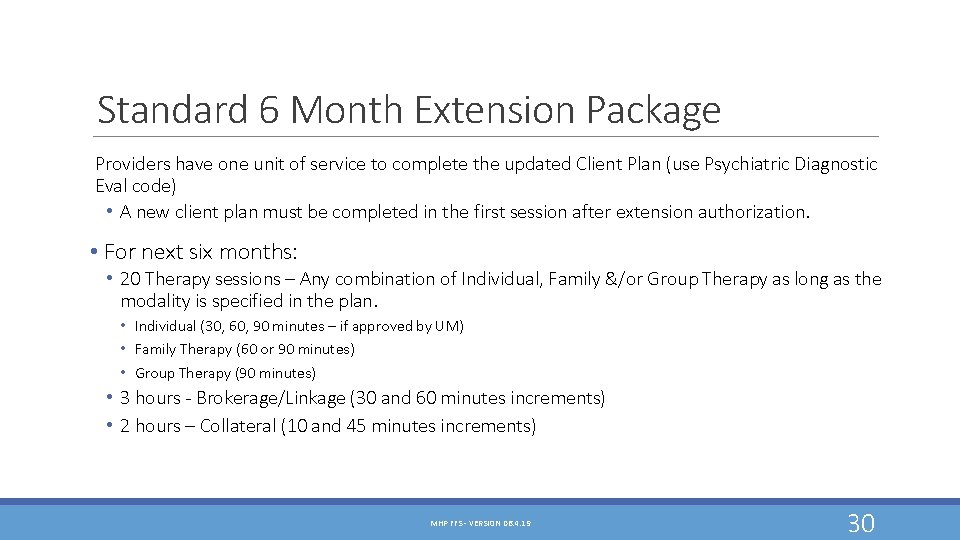
Standard 6 Month Extension Package Providers have one unit of service to complete the updated Client Plan (use Psychiatric Diagnostic Eval code) • A new client plan must be completed in the first session after extension authorization. • For next six months: • 20 Therapy sessions – Any combination of Individual, Family &/or Group Therapy as long as the modality is specified in the plan. • Individual (30, 60, 90 minutes – if approved by UM) • Family Therapy (60 or 90 minutes) • Group Therapy (90 minutes) • 3 hours - Brokerage/Linkage (30 and 60 minutes increments) • 2 hours – Collateral (10 and 45 minutes increments) MHP FFS - VERSION 06. 4. 19 30
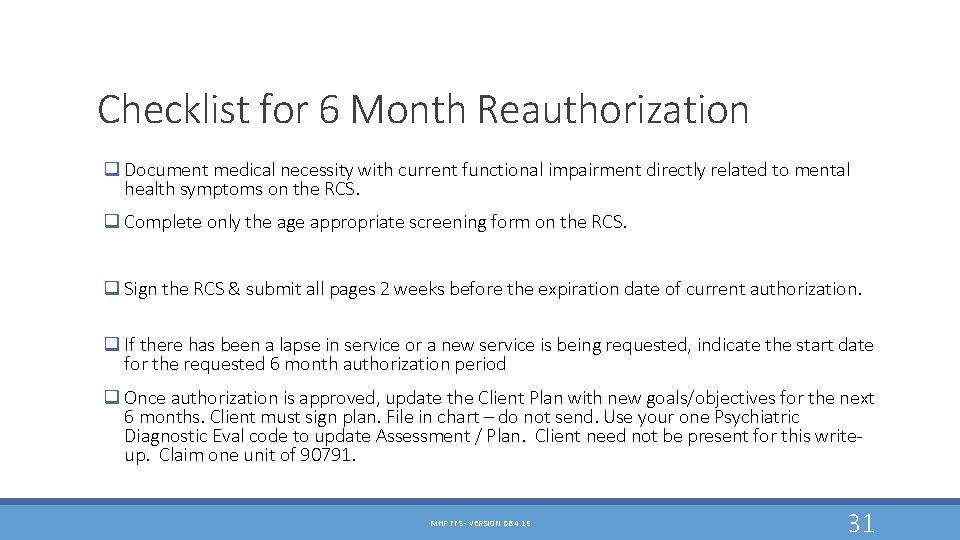
Checklist for 6 Month Reauthorization q Document medical necessity with current functional impairment directly related to mental health symptoms on the RCS. q Complete only the age appropriate screening form on the RCS. q Sign the RCS & submit all pages 2 weeks before the expiration date of current authorization. q If there has been a lapse in service or a new service is being requested, indicate the start date for the requested 6 month authorization period q Once authorization is approved, update the Client Plan with new goals/objectives for the next 6 months. Client must sign plan. File in chart – do not send. Use your one Psychiatric Diagnostic Eval code to update Assessment / Plan. Client need not be present for this writeup. Claim one unit of 90791. MHP FFS - VERSION 06. 4. 19 31
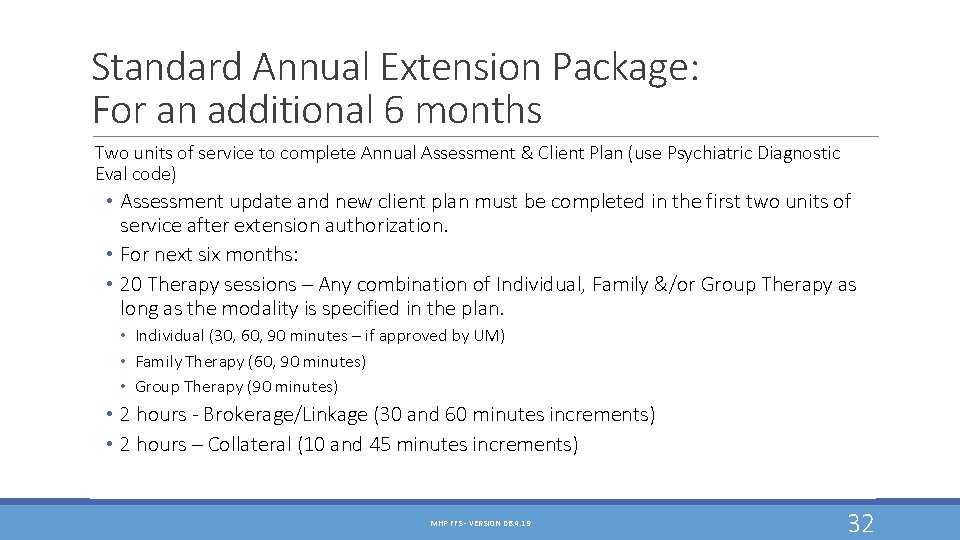
Standard Annual Extension Package: For an additional 6 months Two units of service to complete Annual Assessment & Client Plan (use Psychiatric Diagnostic Eval code) • Assessment update and new client plan must be completed in the first two units of service after extension authorization. • For next six months: • 20 Therapy sessions – Any combination of Individual, Family &/or Group Therapy as long as the modality is specified in the plan. • Individual (30, 60, 90 minutes – if approved by UM) • Family Therapy (60, 90 minutes) • Group Therapy (90 minutes) • 2 hours - Brokerage/Linkage (30 and 60 minutes increments) • 2 hours – Collateral (10 and 45 minutes increments) MHP FFS - VERSION 06. 4. 19 32
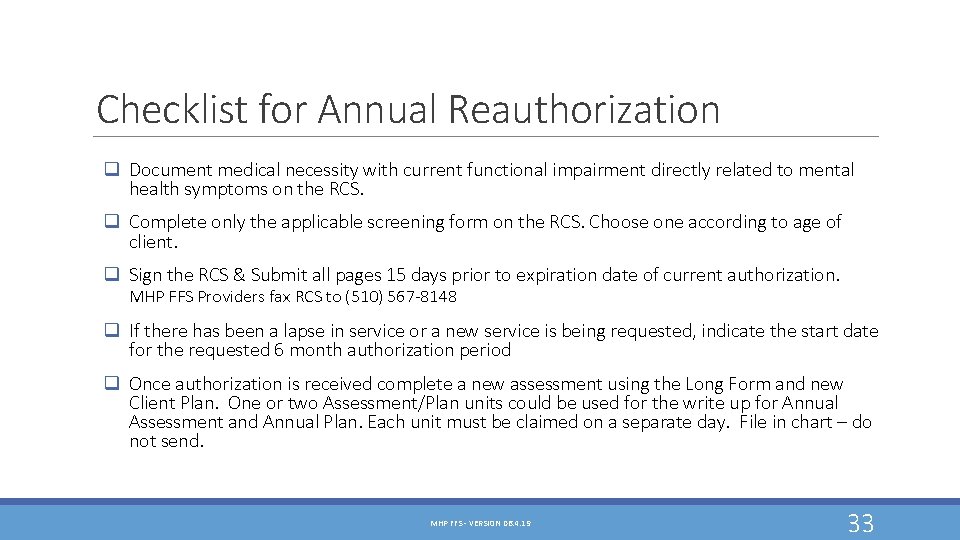
Checklist for Annual Reauthorization q Document medical necessity with current functional impairment directly related to mental health symptoms on the RCS. q Complete only the applicable screening form on the RCS. Choose one according to age of client. q Sign the RCS & Submit all pages 15 days prior to expiration date of current authorization. MHP FFS Providers fax RCS to (510) 567 -8148 q If there has been a lapse in service or a new service is being requested, indicate the start date for the requested 6 month authorization period q Once authorization is received complete a new assessment using the Long Form and new Client Plan. One or two Assessment/Plan units could be used for the write up for Annual Assessment and Annual Plan. Each unit must be claimed on a separate day. File in chart – do not send. MHP FFS - VERSION 06. 4. 19 33
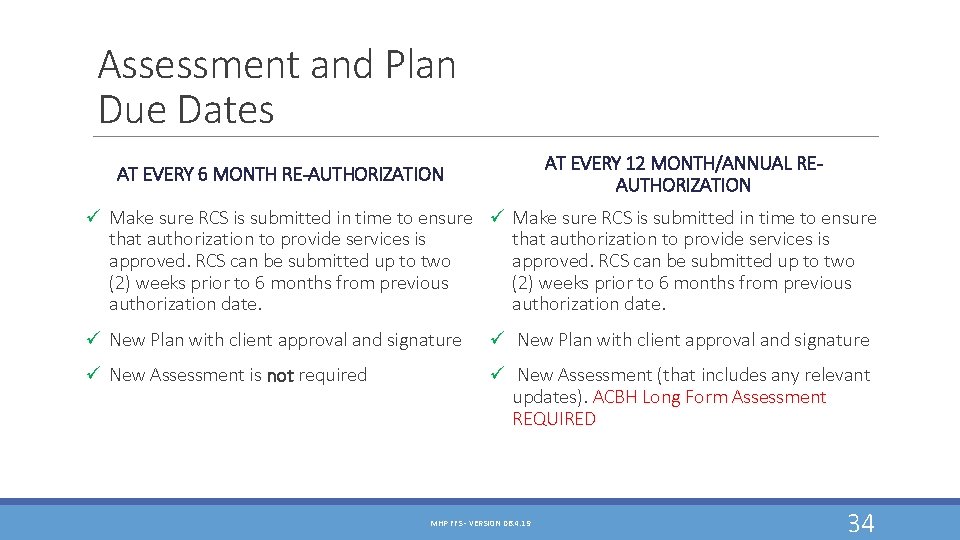
Assessment and Plan Due Dates AT EVERY 12 MONTH/ANNUAL REAUTHORIZATION AT EVERY 6 MONTH RE-AUTHORIZATION ü Make sure RCS is submitted in time to ensure that authorization to provide services is approved. RCS can be submitted up to two (2) weeks prior to 6 months from previous authorization date. ü New Plan with client approval and signature ü New Assessment is not required ü New Assessment (that includes any relevant updates). ACBH Long Form Assessment REQUIRED MHP FFS - VERSION 06. 4. 19 34
Additional Services • The package of services is expected to cover the six month authorization period. Services might need to be rationed in order to adequately provide coverage until reauthorization. • Additional services (i. e. services beyond the package) can only be related to crisis situations. Depending on when the crisis happens, services frequency might need to be adjusted to provide consistent (but less frequent) therapy until reauthorization. Crisis services should be claimed as therapy. • It is expected that 50% of clients served by providers will be extended beyond the initial 6 month authorization period. • If services in addition to the standard package are clinically required and remaining services cannot be adjusted, please contact Utilization Management at (510) 567 -8141 for approval. MHP FFS - VERSION 06. 4. 19 35
Specialty Services Psychodiagnostic Evaluation/Psychological Testing • Any provider may request psychological testing for their client by submitting Psychological Testing Authorization Request (PTAR) form to ACCESS • Must be in treatment for a minimum of three (3) months before requesting testing • http: //www. acbhcs. org/providers/Forms. htm Children and Family Services (paid by Social Services) and Customized Services • Child Welfare Worker (CWW) initiates referral to ACCESS • For Customized Services, CWW must obtain supervisor approval • Providers must submit progress reports or treatment summaries to assigned CWW once every six months or upon request. When authorized by CWW use approved code for claiming this activity. Probation and/or Cal. WORKS recipients • All initial authorizations must come through ACCESS and use assigned Cal. WORK codes. MHP FFS - VERSION 06. 4. 19 36
A note about mild-moderate impairment If a Provider is interested in continuing to work with a beneficiary whose condition improves to mild-to-moderate impairment, it is recommended that the Provider become a Beacon and/or Anthem Blue Cross provider. If you choose not to join their panel, you could request a single case agreement to serve a particular client in need for continuity of care. Beacon Health Options (855) 856 -0577 Anthem Blue Cross (888) 831 -2246 Kaiser Permanante (510) 752 -1075 MHP FFS - VERSION 06. 4. 19 37
Audits MHP FFS - VERSION 06. 4. 19 38
Auditing of Charts To assure compliance with documentation and treatment planning requirements, ACBH Utilization Management will occasionally request treatment documentation for claims review. When UM contacts you regarding this requirement, please submit the requested documents promptly. MHP FFS - VERSION 06. 4. 19 39
Pre-Assessment MHP FFS - VERSION 06. 4. 19 40
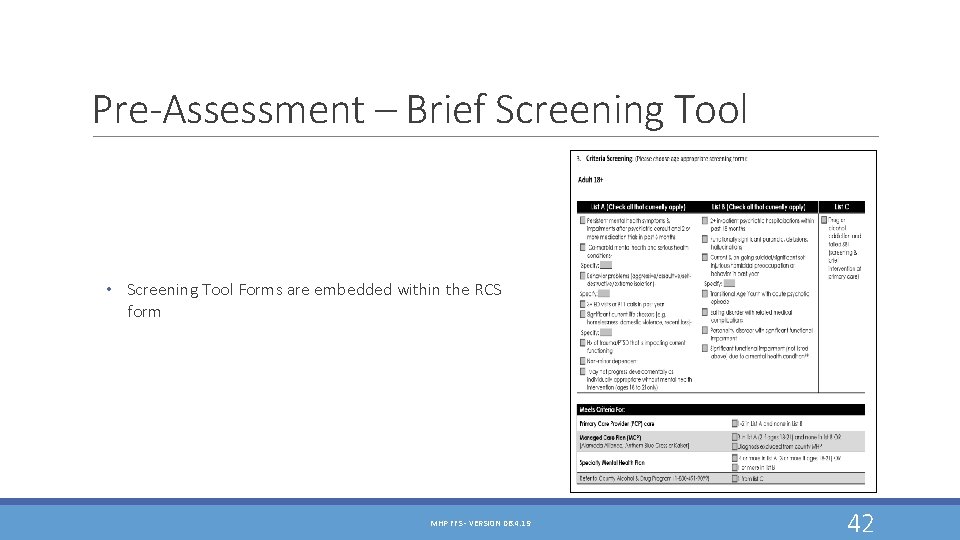
Pre-Assessment – Brief Screening Tool The Brief Screening Tool must be administered in order to determine the severity of client’s sx’s and if they are eligible for SMHS • This must be done before any services can be claimed and with every request for reauthorization. • The Brief Screening Tool is embedded in the RCS, complete the appropriate tool for the client’s age • For Individual and Group Providers the Brief Screening Tool must be administered by a Licensed LPHA. • For Organizations a Waivered/Registered LPHA with a Licensed LPHA co-signature may also complete the BST. • Completion of RCS is not billable. An informational/non-billable progress note should be completed. • Client must continue to meet criteria for Moderate – Severe to be eligible for Specialty Mental Health Services. If client is not referred accurately, this may result in denial of authorization and claim disallowances. MHP FFS - VERSION 06. 4. 19 41
Pre-Assessment – Brief Screening Tool • Screening Tool Forms are embedded within the RCS form MHP FFS - VERSION 06. 4. 19 42
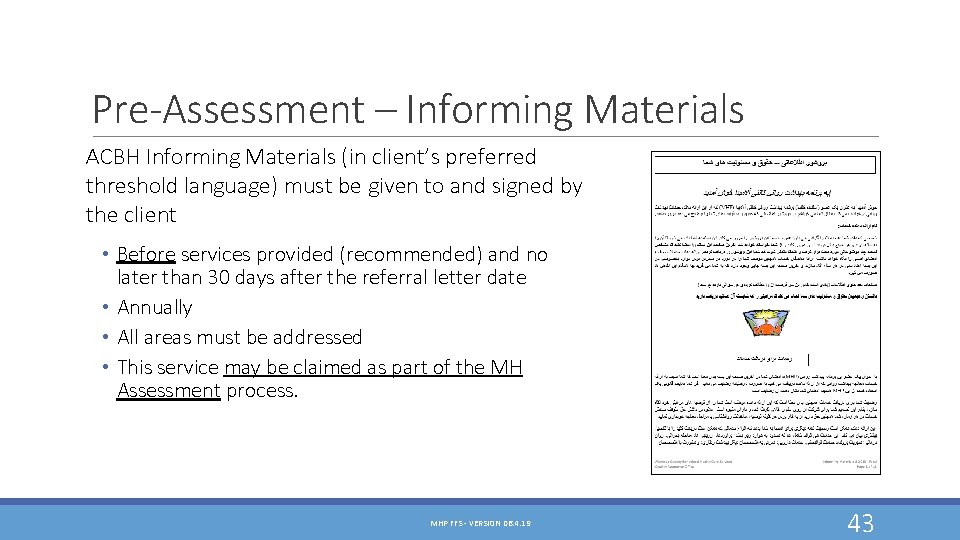
Pre-Assessment – Informing Materials ACBH Informing Materials (in client’s preferred threshold language) must be given to and signed by the client • Before services provided (recommended) and no later than 30 days after the referral letter date • Annually • All areas must be addressed • This service may be claimed as part of the MH Assessment process. MHP FFS - VERSION 06. 4. 19 43
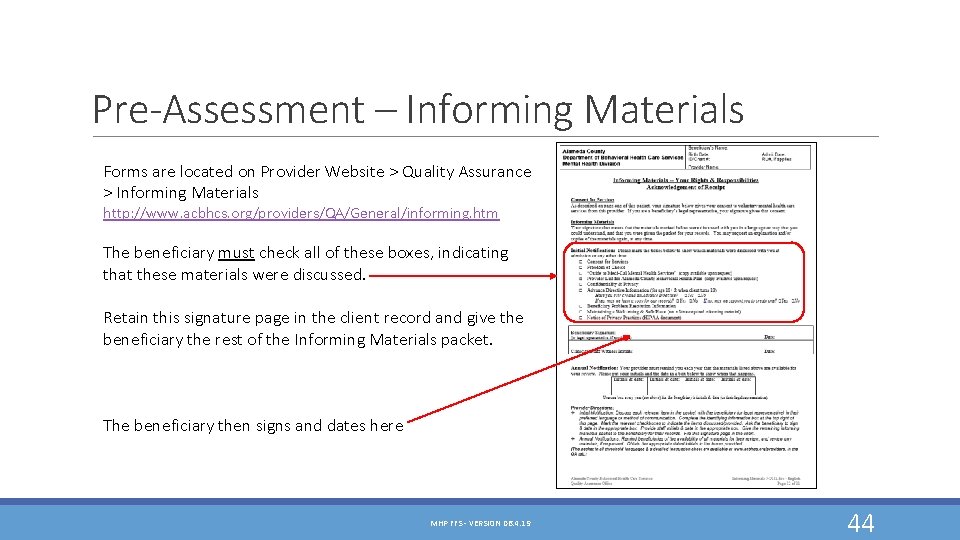
Pre-Assessment – Informing Materials Forms are located on Provider Website > Quality Assurance > Informing Materials http: //www. acbhcs. org/providers/QA/General/informing. htm The beneficiary must check all of these boxes, indicating that these materials were discussed. Retain this signature page in the client record and give the beneficiary the rest of the Informing Materials packet. The beneficiary then signs and dates here MHP FFS - VERSION 06. 4. 19 44
Pre-Assessment – Releases of Information • Must be signed by client • Not required for other Alameda Health Care Services Providers—but recommended • Not required to simply facilitate treatment referral to other MH Providers—but highly recommended • Releases are valid for as long as the client indicates, if no date indicated, default is 12 months. • An actual date is recommended rather than an event such as “until the end of treatment. ” MHP FFS - VERSION 06. 4. 19 45
Medical Necessity MHP FFS - VERSION 06. 4. 19 46
The Golden Thread The “Golden Thread” is the sequence of documentation that supports the demonstration of ongoing medical necessity and ensures all provided services are reimbursable. The sequence of documentation on which medical necessity requirements converge is: Ø The Assessment Ø The Client Plan Ø The Progress Note MHP FFS - VERSION 06. 4. 19 47
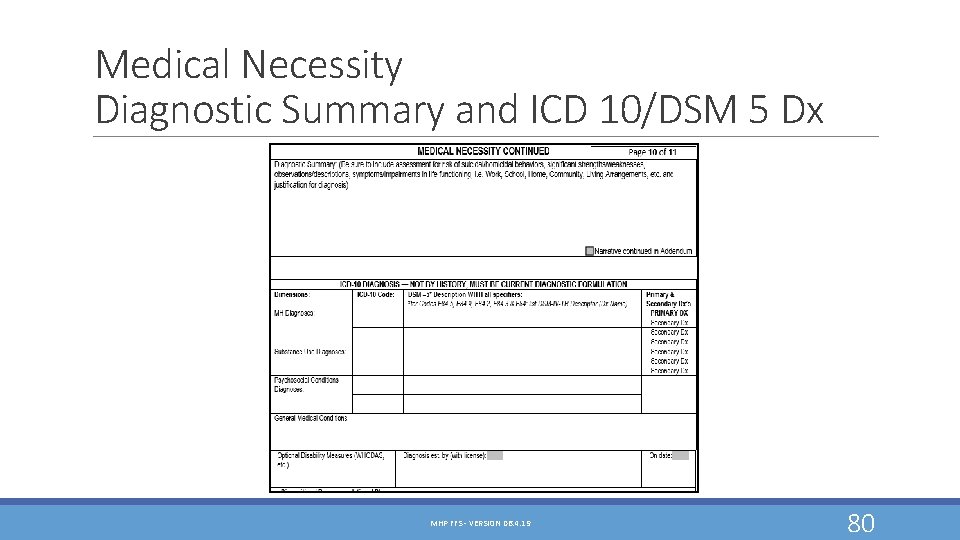
Part 1 – Included Diagnosis • DSM-5 diagnosis must be current (not historical) • For Individual and Group Providers the diagnosis must be established by Licensed LPHA • See scope of practice grid for approved list of LPHAs • For Organizations, if established by Waivered/Registered LPHA, the diagnosis must be co-signed by a Licensed LPHA. • If co-signature is missing, then multiple claims may be disallowed until compliant. MHP FFS - VERSION 06. 4. 19 48
Part 1 – Included Diagnosis • See Lists & Crosswalk – http: //www. acbhcs. org/providers/QA/audit. htm • MH Outpatient M/C Included Dx List—Alpha • MH Outpatient M/C Included Dx List—Numeric • MH M/C Included Dx Crosswalk: DSM-IV to DSM-5 • General Medical Codes List • Psychosocial Conditions List (may use any present in DSM-5). MHP FFS - VERSION 06. 4. 19 49
Part 2 – Qualifying Impairment A Qualifying Impairment (meets one of the following): a) A significant impairment in an important area of life functioning b) A reasonable probability of significant deterioration in an important area of life functioning (without treatment) c) For EPSDT (children < 21 yrs): a reasonable probability that a child will not progress developmentally as individually appropriate MHP FFS - VERSION 06. 4. 19 50
Part 2 – Qualifying Impairment If the client has had recent (within the last 3 months of indication) HI/SI (no plans or means required), or other high risk conditions: A comprehensive Risk Assessment and a formalized, and written Safety Plan – must be created for treatment purposes. See the BHCS Provider website for resources: http: //www. acbhcs. org/providers/QA/docs/2013/TR_Suicide. Homicide_Risk_Assesment. pdf MHP FFS - VERSION 06. 4. 19 51
Part 3 – Treatment will address impairments The focus of treatment are the signs/sx’s of the Included Dx’s and address the following: a) Decrease the significant impairment in an important area of life functioning b) Prevent the probability of significant deterioration in an important area of life functioning c) (For Children - EPSDT) Will allow the child to progress developmentally as individually appropriate. MHP FFS - VERSION 06. 4. 19 52
Assessment MHP FFS - VERSION 06. 4. 19 53
Who can create and complete an Assessment? • For Individual and Group providers, Assessment must be completed by a Licensed LPHA. • Non-Master Contract Organization claiming through a CMS 1500 paper form: Licensed LPHAs OR Waivered/Registered therapists with Licensed LPHA cosignature. MHP FFS - VERSION 06. 4. 19 54
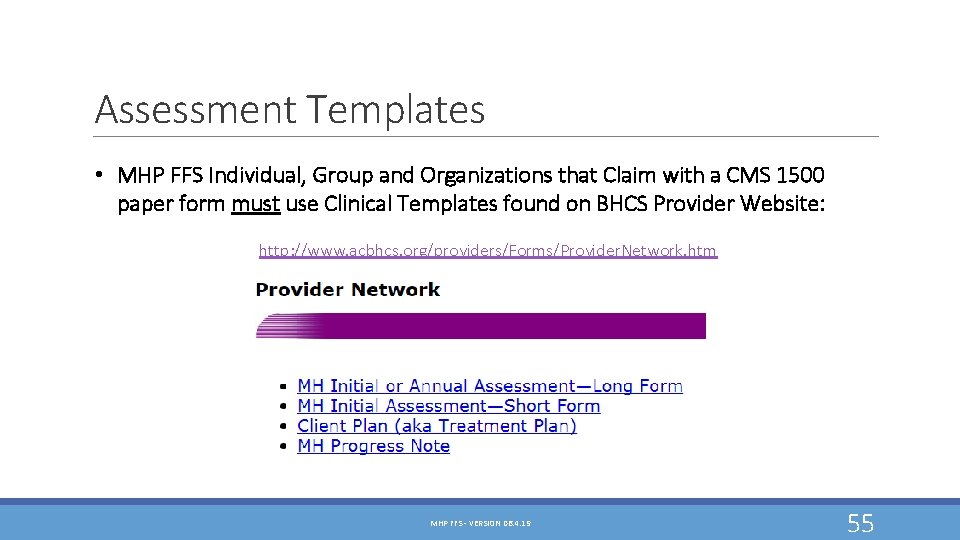
Assessment Templates • MHP FFS Individual, Group and Organizations that Claim with a CMS 1500 paper form must use Clinical Templates found on BHCS Provider Website: http: //www. acbhcs. org/providers/Forms/Provider. Network. htm MHP FFS - VERSION 06. 4. 19 55
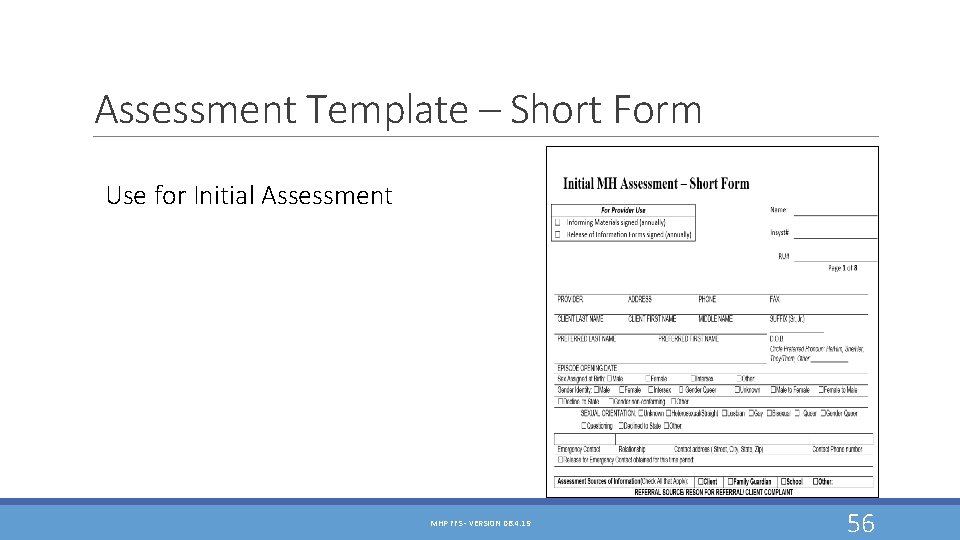
Assessment Template – Short Form Use for Initial Assessment MHP FFS - VERSION 06. 4. 19 56
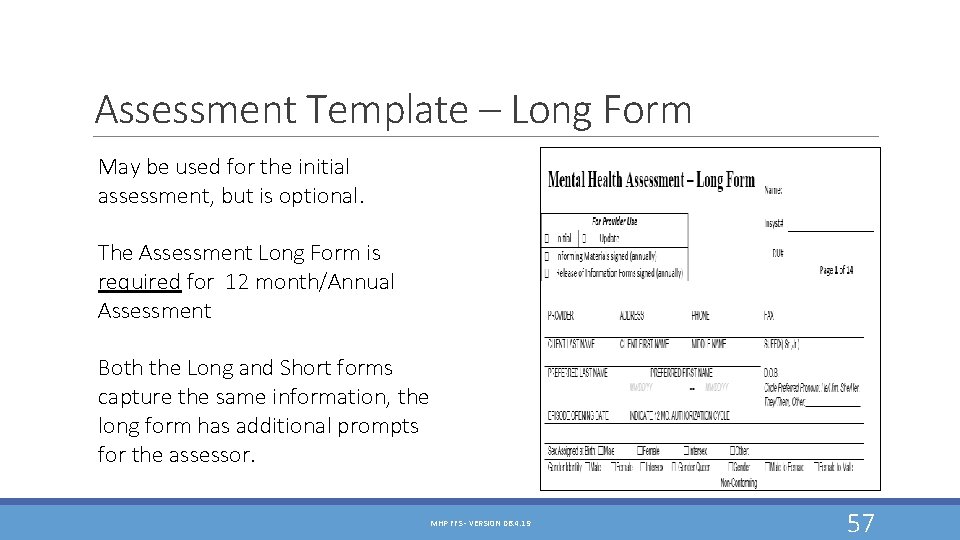
Assessment Template – Long Form May be used for the initial assessment, but is optional. The Assessment Long Form is required for 12 month/Annual Assessment Both the Long and Short forms capture the same information, the long form has additional prompts for the assessor. MHP FFS - VERSION 06. 4. 19 57
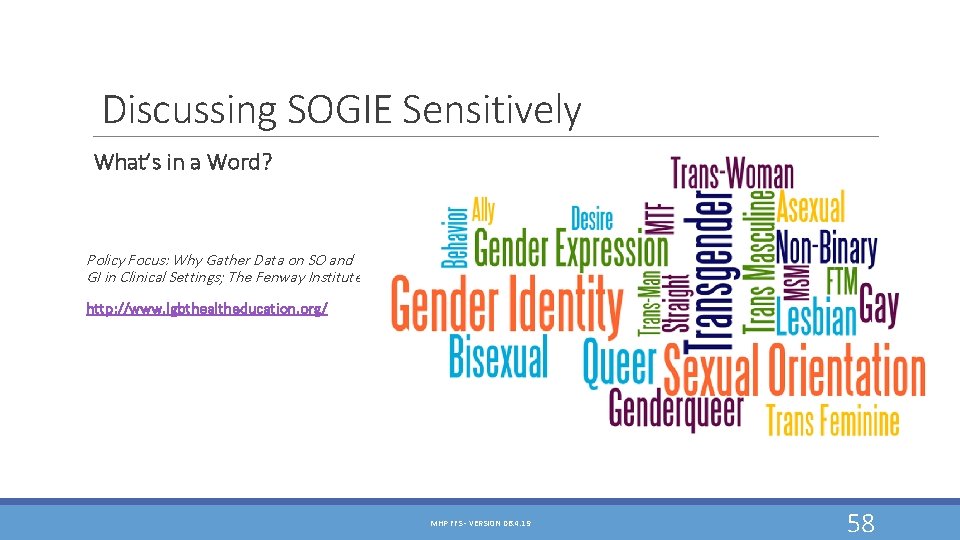
Discussing SOGIE Sensitively What’s in a Word? Policy Focus: Why Gather Data on SO and GI in Clinical Settings; The Fenway Institute http: //www. lgbthealtheducation. org/ MHP FFS - VERSION 06. 4. 19 58
Discussing SOGIE Sensitively The Data collection will serve to identify LGBTQQI 2 -S populations which have historically been underserved as well as to assist the provider in providing culturally sensitive & responsive services. Gathering such data in clinical settings will allow providers to better understand treat their clients, and to compare their clients’ health outcomes with national samples of LGB or LGBT people from health surveys. MHP FFS - VERSION 06. 4. 19 59
Why are we collecting this information? Social determinants affecting the health of LGBTQ individuals largely relate to systemic oppression and discrimination. Lesbian, gay, bisexual, and transgender (LGBT) clients have unique health needs and experience numerous health disparities They are an underserved population that is largely invisible in the health care system Routine and standardized collection of sexual orientation and gender identity (SOGIE) information in medical and electronic health records (EHRs) will help assess access, satisfaction with, quality of care, inform the delivery of appropriate health services, and begin to address health disparities MHP FFS - VERSION 06. 4. 19 60
Why are we collecting this information? National Resource Center for Youth Development - Fact Sheet & Healthy People 2020: LGBT youth are 2 to 3 times more likely to attempt suicide. LGBT youth are more likely to be homeless. Transgender individuals have a high prevalence of HIV/STIs, victimization, mental health issues, suicide and are less likely to have health insurance than heterosexual or LGB individuals. 70% report being harassed at school 90% report feeling unsafe at school Elderly LGBT individuals face additional barriers to health because of isolation and a lack of social services and culturally competent providers. LGBT populations have the highest rates of tobacco, alcohol, and other drug use. MHP FFS - VERSION 06. 4. 19 61
Discussing SOGIE Sensitively Recommendations for Assessment Clinician—Confidentiality & Privacy • LGBT clients may be hesitant to disclose information about their sexual orientation or gender identity due to fears about confidentiality and privacy. • These fears may have to do with not knowing what will happen with this information • Clients may be reluctant to provide such personal information to office staff in a waiting room, because it feels less private than answering the question of a provider in a private office. • During provider-client interaction there are several potential barriers to gathering this information. • Providers may not be comfortable asking these questions, or lack knowledge on how to elicit this information. • Some worry LGBT people will be reluctant to disclose due to anti-LGBT stigma and prejudice. • This may be true, and as a result not all LGBT clients will disclose their sexual or gender identity. MHP FFS - VERSION 06. 4. 19 62
Discussing SOGIE Sensitively Questions recommended by national LGBTQ organizations include: Two-step sex/gender question • What is your current gender identity: male, female, transgender, or other? (For written—select from list. ) • What was your sex at birth: male or female? (For written—select from list. ) And A sexual orientation question • How do you identify? MHP FFS - VERSION 06. 4. 19 63
Discussing SOGIE Sensitively Recommendations for Assessment Clinician—Language and Client Choice to Disclose: • Providers can also use inclusive or neutral language, such as “Do you have a partner? ” instead of asking “Are you married? ” which to most people still refers to heterosexual relationships. • Providers should ask permission to include information about a client’s sexual orientation and gender identity in the medical record, and assure confidentiality. • If self-disclosure does not come up in response to general questions such as those proposed above, further questions can be embedded in the sexual history. Such a history should address sexual risk behavior as well as sexual health, sexual orientation (including identity, behavior, and attraction), and gender identity. ◦ I. e. Many men may disclose they have sex with a man but not identify as LGBTQ. MHP FFS - VERSION 06. 4. 19 64
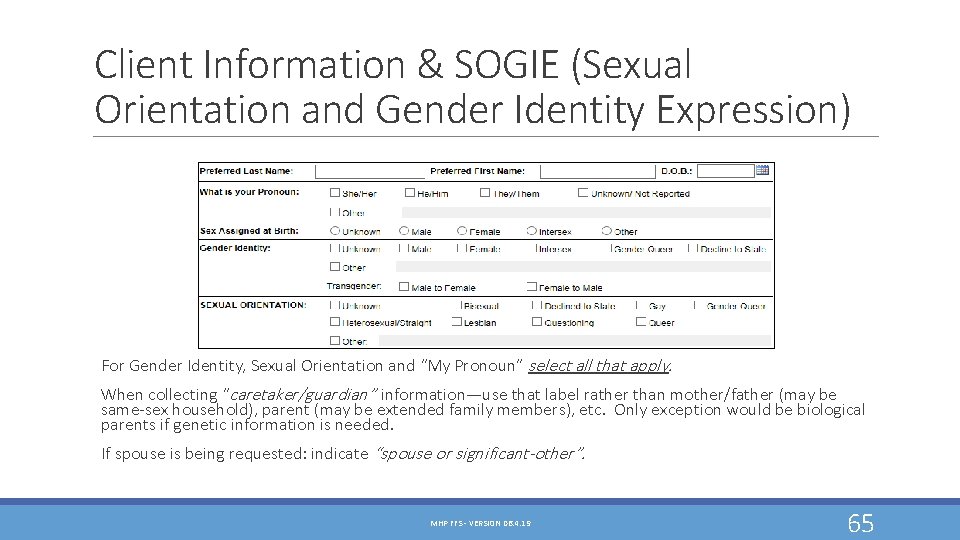
Client Information & SOGIE (Sexual Orientation and Gender Identity Expression) For Gender Identity, Sexual Orientation and “My Pronoun” select all that apply. When collecting “caretaker/guardian” information—use that label rather than mother/father (may be same-sex household), parent (may be extended family members), etc. Only exception would be biological parents if genetic information is needed. If spouse is being requested: indicate “spouse or significant-other”. MHP FFS - VERSION 06. 4. 19 65
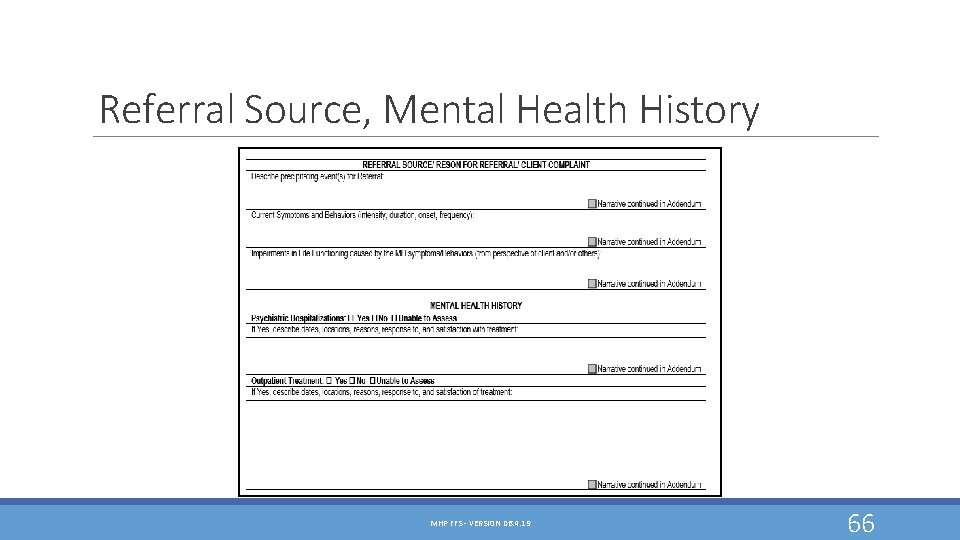
Referral Source, Mental Health History MHP FFS - VERSION 06. 4. 19 66
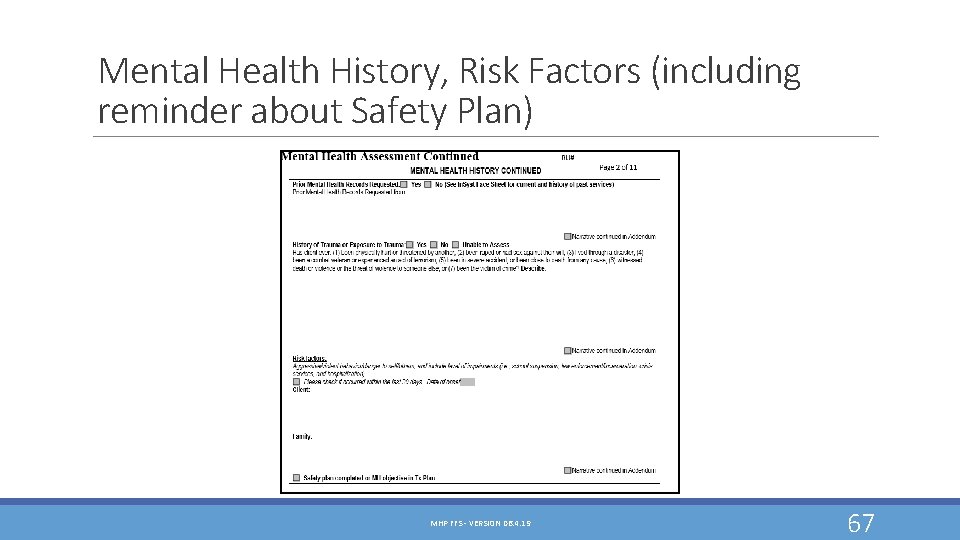
Mental Health History, Risk Factors (including reminder about Safety Plan) MHP FFS - VERSION 06. 4. 19 67
Risk Assessment & Safety Plan ØIf suicidal, homicidal or other significant risk is found during the assessment and occurred within the last 90 days, both a comprehensive risk assessment and a formal written safety plan must be developed in coordination with the client. ØBeyond 90 days of suicidal, homicidal or other significant risk ideation, if it is determined that a Comprehensive Risk Assessment and formal written Safety Plan are not indicated, document the clinical reasoning for this decision. MHP FFS - VERSION 06. 4. 19 68
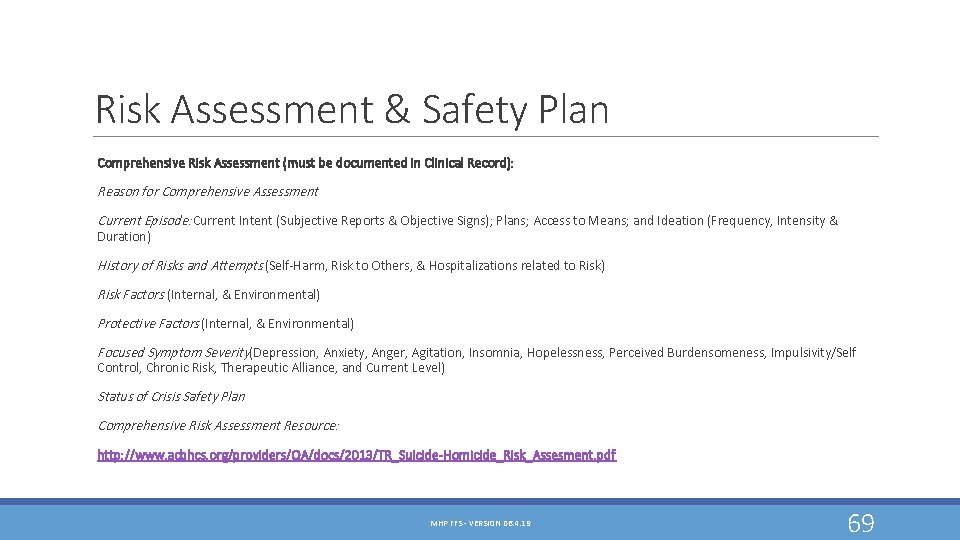
Risk Assessment & Safety Plan Comprehensive Risk Assessment (must be documented in Clinical Record): Reason for Comprehensive Assessment Current Episode: Current Intent (Subjective Reports & Objective Signs); Plans; Access to Means; and Ideation (Frequency, Intensity & Duration) History of Risks and Attempts (Self-Harm, Risk to Others, & Hospitalizations related to Risk) Risk Factors (Internal, & Environmental) Protective Factors (Internal, & Environmental) Focused Symptom Severity (Depression, Anxiety, Anger, Agitation, Insomnia, Hopelessness, Perceived Burdensomeness, Impulsivity/Self Control, Chronic Risk, Therapeutic Alliance, and Current Level) Status of Crisis Safety Plan Comprehensive Risk Assessment Resource: http: //www. acbhcs. org/providers/QA/docs/2013/TR_Suicide-Homicide_Risk_Assesment. pdf MHP FFS - VERSION 06. 4. 19 69
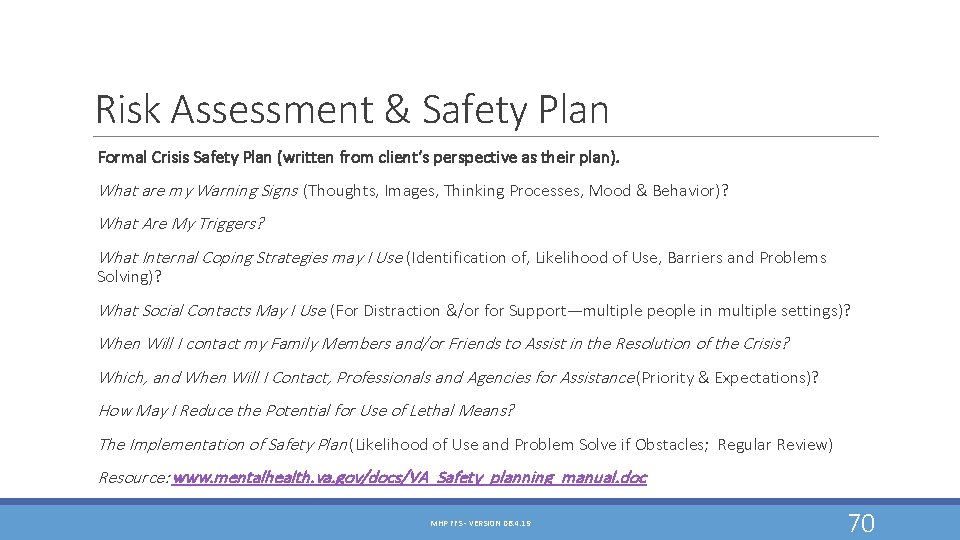
Risk Assessment & Safety Plan Formal Crisis Safety Plan (written from client’s perspective as their plan). What are my Warning Signs (Thoughts, Images, Thinking Processes, Mood & Behavior)? What Are My Triggers? What Internal Coping Strategies may I Use (Identification of, Likelihood of Use, Barriers and Problems Solving)? What Social Contacts May I Use (For Distraction &/or for Support—multiple people in multiple settings)? When Will I contact my Family Members and/or Friends to Assist in the Resolution of the Crisis? Which, and When Will I Contact, Professionals and Agencies for Assistance (Priority & Expectations)? How May I Reduce the Potential for Use of Lethal Means? The Implementation of Safety Plan (Likelihood of Use and Problem Solve if Obstacles; Regular Review) Resource: www. mentalhealth. va. gov/docs/VA_Safety_planning_manual. doc MHP FFS - VERSION 06. 4. 19 70
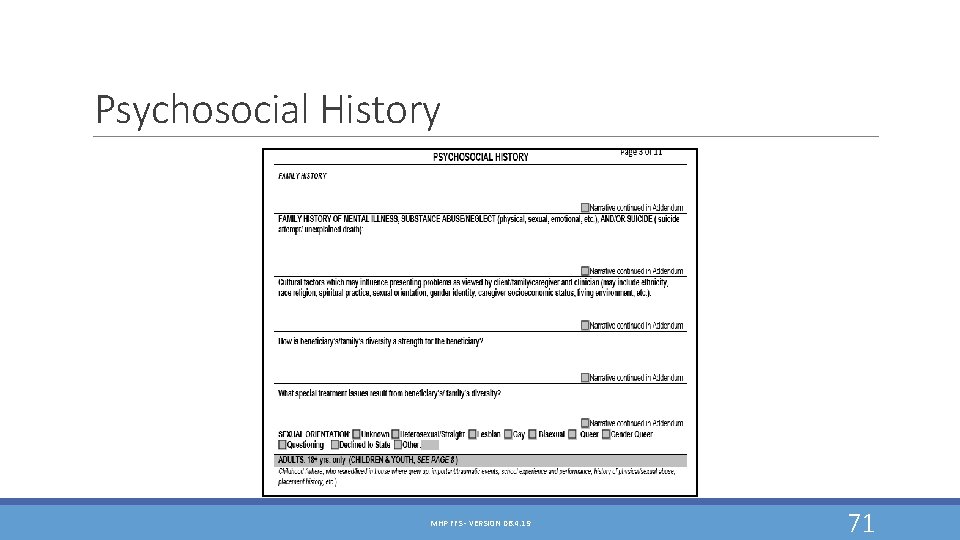
Psychosocial History MHP FFS - VERSION 06. 4. 19 71
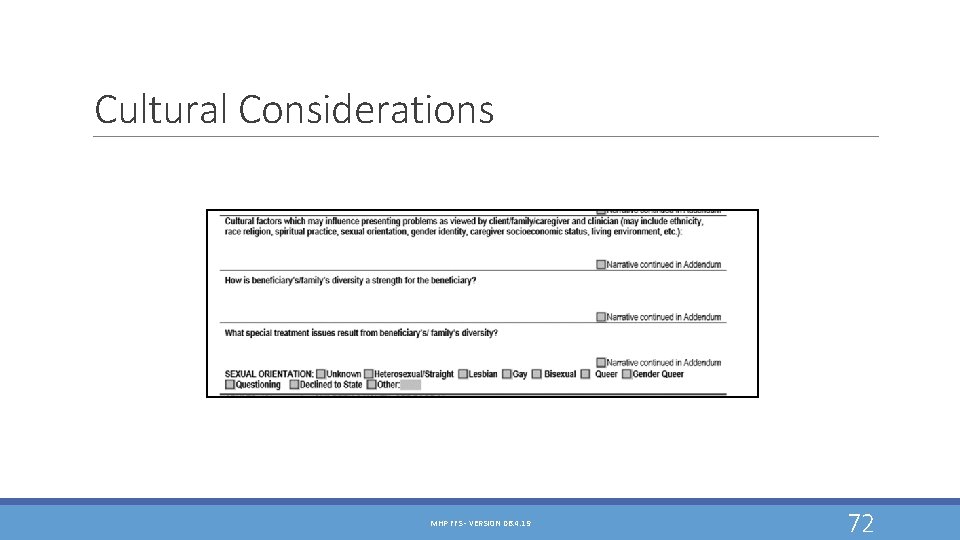
Cultural Considerations MHP FFS - VERSION 06. 4. 19 72
Cultural Considerations Identified during the Assessment Process and addressed in the Plan if appropriate • Language & Physical Limitations • Race, Ethnicity, Socio-Economic Status, Class, Religion, Immigration status/Citizenship, Geography, • Assessment template forms now include SO/GI (Sexual Orientation/Gender Identity) fields MHP FFS - VERSION 06. 4. 19 73
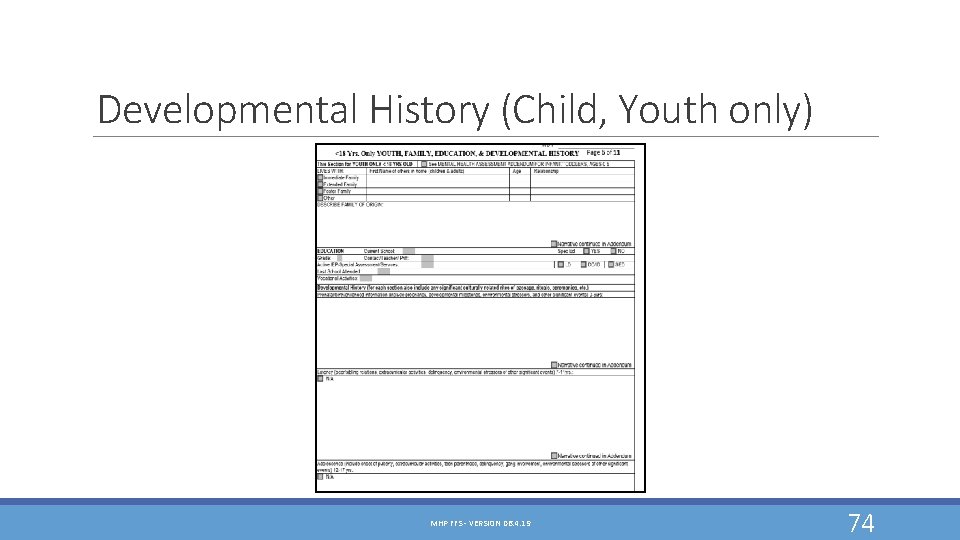
Developmental History (Child, Youth only) MHP FFS - VERSION 06. 4. 19 74
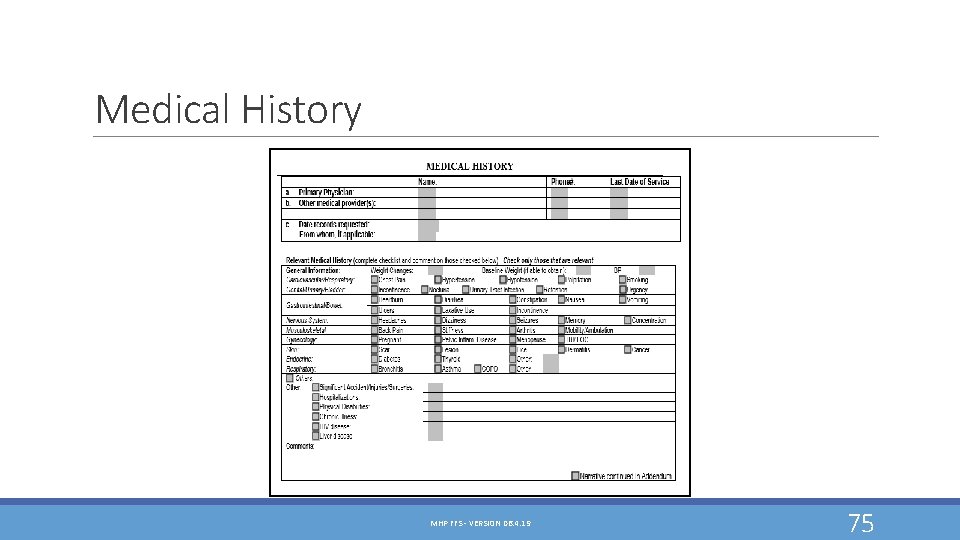
Medical History MHP FFS - VERSION 06. 4. 19 75
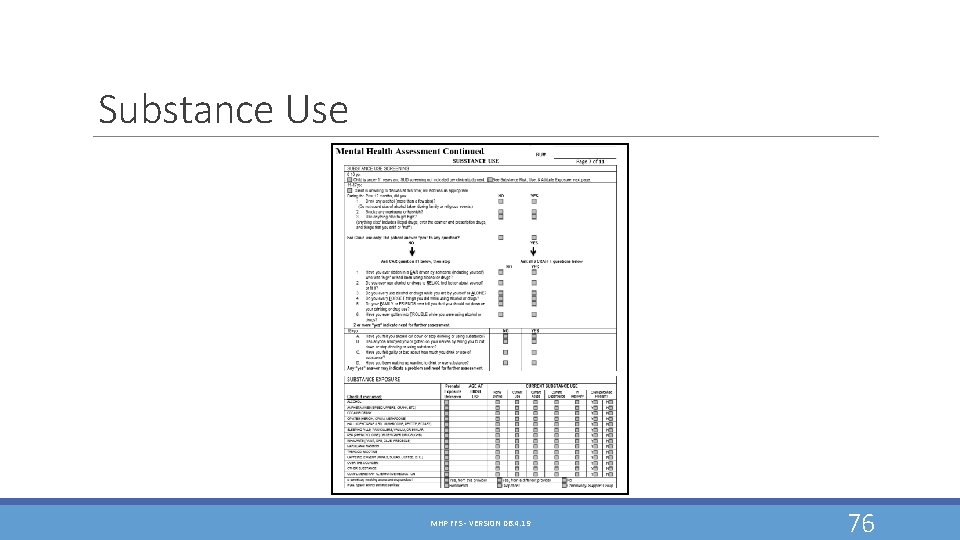
Substance Use MHP FFS - VERSION 06. 4. 19 76
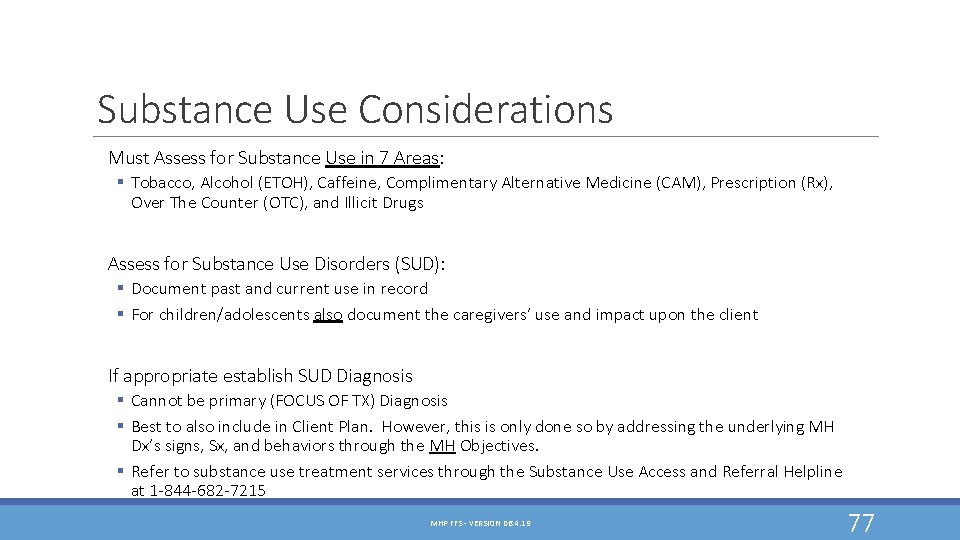
Substance Use Considerations Must Assess for Substance Use in 7 Areas: § Tobacco, Alcohol (ETOH), Caffeine, Complimentary Alternative Medicine (CAM), Prescription (Rx), Over The Counter (OTC), and Illicit Drugs Assess for Substance Use Disorders (SUD): § Document past and current use in record § For children/adolescents also document the caregivers’ use and impact upon the client If appropriate establish SUD Diagnosis § Cannot be primary (FOCUS OF TX) Diagnosis § Best to also include in Client Plan. However, this is only done so by addressing the underlying MH Dx’s signs, Sx, and behaviors through the MH Objectives. § Refer to substance use treatment services through the Substance Use Access and Referral Helpline at 1 -844 -682 -7215 MHP FFS - VERSION 06. 4. 19 77
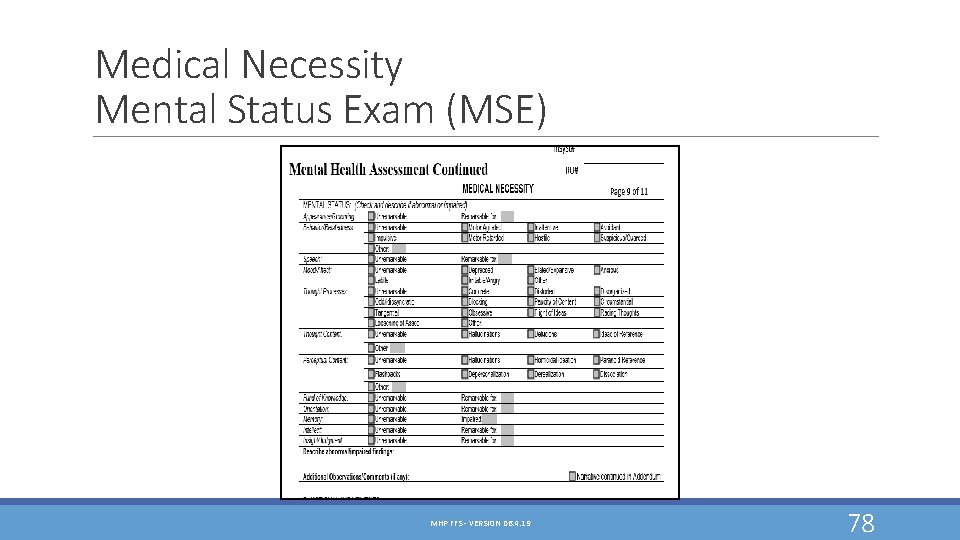
Medical Necessity Mental Status Exam (MSE) MHP FFS - VERSION 06. 4. 19 78
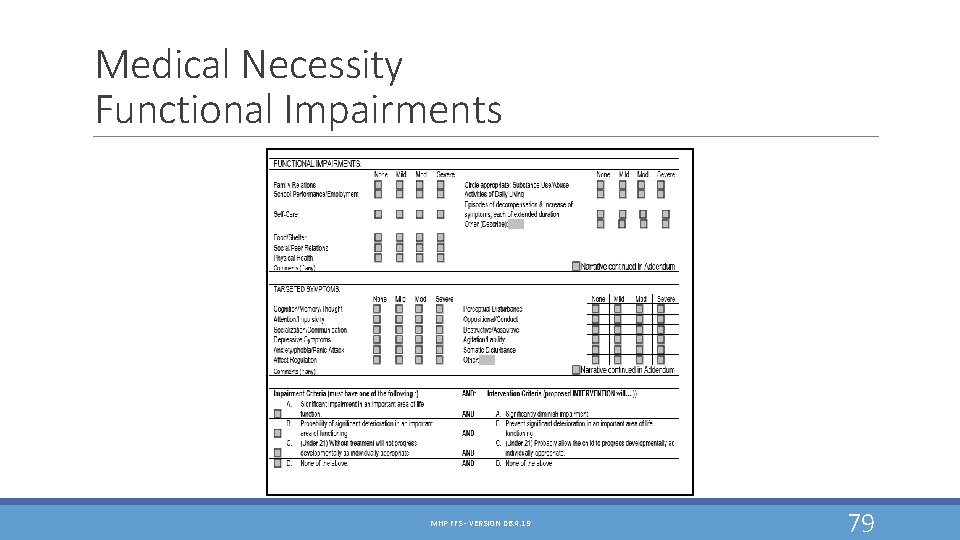
Medical Necessity Functional Impairments MHP FFS - VERSION 06. 4. 19 79
Medical Necessity Diagnostic Summary and ICD 10/DSM 5 Dx MHP FFS - VERSION 06. 4. 19 80
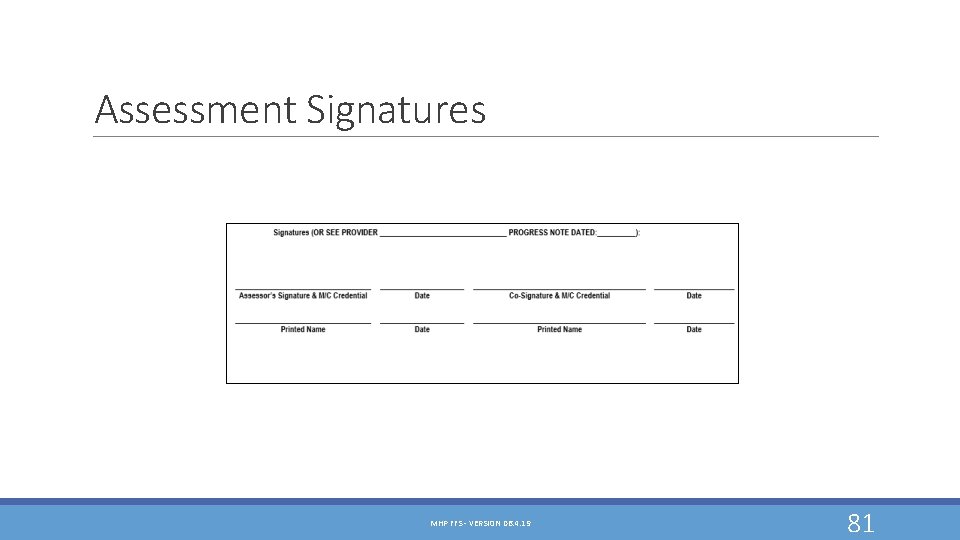
Assessment Signatures MHP FFS - VERSION 06. 4. 19 81
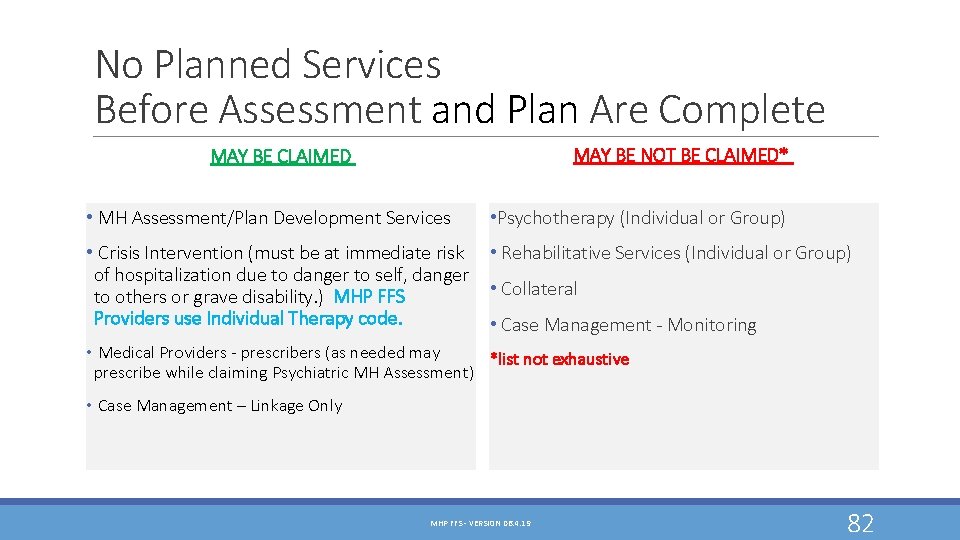
No Planned Services Before Assessment and Plan Are Complete MAY BE NOT BE CLAIMED* MAY BE CLAIMED • MH Assessment/Plan Development Services • Psychotherapy (Individual or Group) • Crisis Intervention (must be at immediate risk of hospitalization due to danger to self, danger to others or grave disability. ) MHP FFS Providers use Individual Therapy code. • Rehabilitative Services (Individual or Group) • Collateral • Case Management - Monitoring • Medical Providers - prescribers (as needed may *list not exhaustive prescribe while claiming Psychiatric MH Assessment) • Case Management – Linkage Only MHP FFS - VERSION 06. 4. 19 82
Medication Services—Prescribers Only • For children who are wards or dependents of the juvenile court and living in an out-of-home placement or in foster care prescribers are required request permission from the court before any psychotropic medications are administered. • See http: //www. courts. ca. gov/documents/jv 217 info. pdf for more specific information about JV-220 requirements. • In addition to a completed JV-220, prescribers must also complete medication consent forms, as described on the following slide. MHP FFS - VERSION 06. 4. 19 83
Medication Services—Prescribers Only Medication Consent Forms • Required for all medications prescribed by Medical Provider • ACBH Medication Consent Forms Required—or equivalent—all sections completed. http: //www. acbhcs. org/providers/Forms. htm#Med_consent • Additional Medication Information Sheets are available online. • If client’s preferred language is other than English use the translated Medication Consent Form that is available in all threshold languages. • Always offer to provide interpretation of the information contained in the Medication Consent Form in their preferred language if client speaks a language other than threshold languages—document this in the progress note. MHP FFS - VERSION 06. 4. 19 84
CANS / ANSA is not & MHP FFS - VERSION 06. 4. 19 are not required at this time. 85
Assessment Finalization Timelines • The Initial Assessment – Short or Long form - is due prior to the client’s 3 rd unit of service. • If client is seen for more than 12 months, the Annual Assessment – Long Form is required and must be completed within the first two units of service. MHP FFS - VERSION 06. 4. 19 86
Client Plans MHP FFS - VERSION 06. 4. 19 87
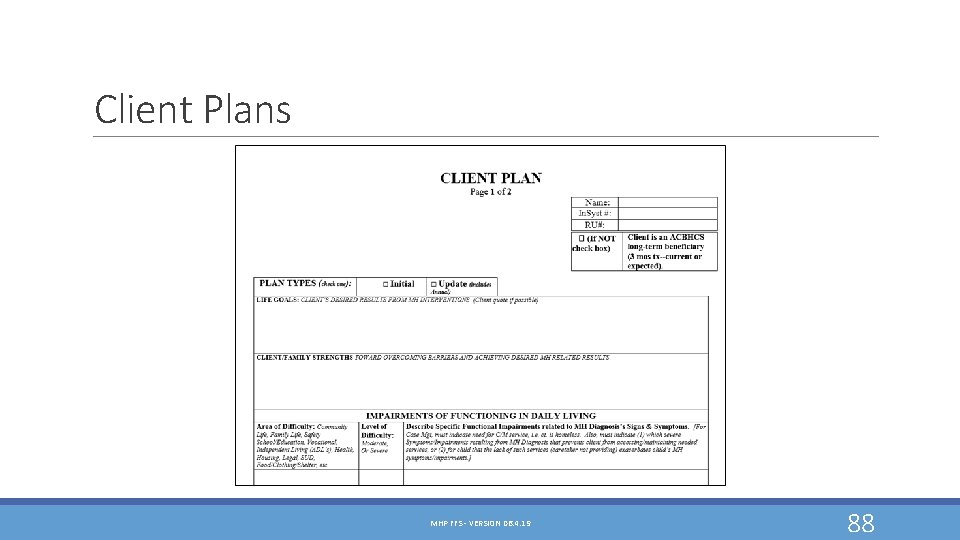
Client Plans MHP FFS - VERSION 06. 4. 19 88
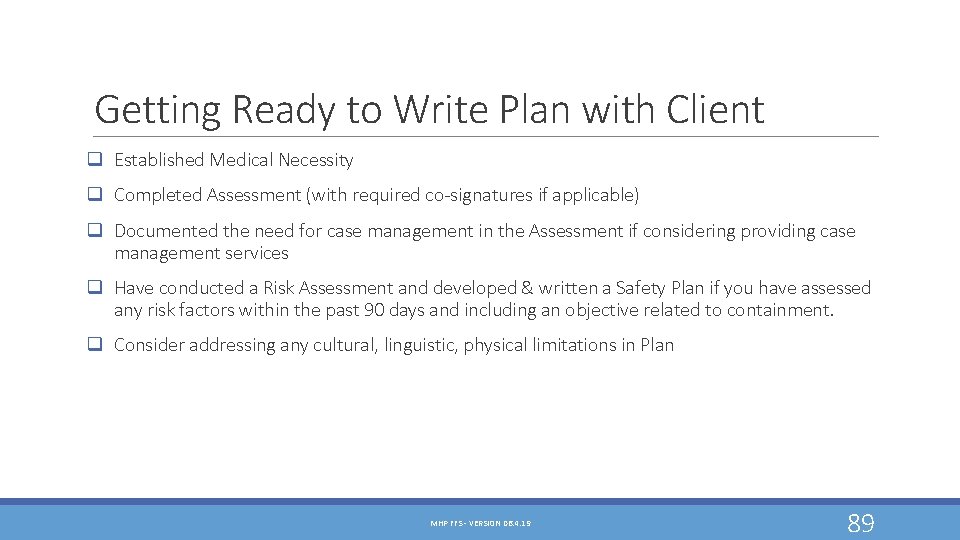
Getting Ready to Write Plan with Client q Established Medical Necessity q Completed Assessment (with required co-signatures if applicable) q Documented the need for case management in the Assessment if considering providing case management services q Have conducted a Risk Assessment and developed & written a Safety Plan if you have assessed any risk factors within the past 90 days and including an objective related to containment. q Consider addressing any cultural, linguistic, physical limitations in Plan MHP FFS - VERSION 06. 4. 19 89
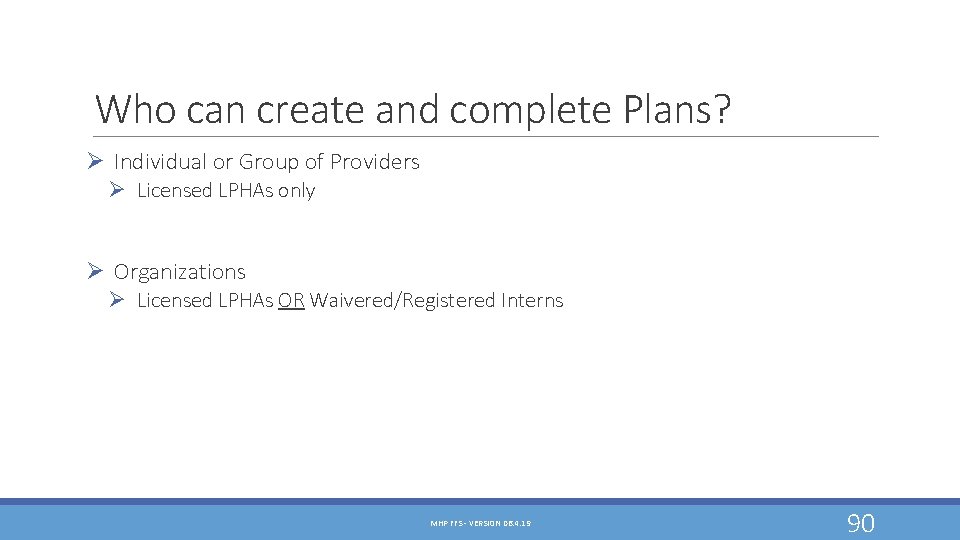
Who can create and complete Plans? Ø Individual or Group of Providers Ø Licensed LPHAs only Ø Organizations Ø Licensed LPHAs OR Waivered/Registered Interns MHP FFS - VERSION 06. 4. 19 90
Plan Finalization Timelines • The Initial Client Plan is due within 60 days of the referral letter date AND prior to the 3 rd unit of service. • If a case is closed before third unit of service, a completed plan is NOT required. • Client plan must be updated immediately following any extension and annual update • Six month plan updates are due before the 2 nd unit of service after the 6 month RCS approval. • Annual/Yearly plans are due by anniversary of the referral letter date. • Once the client signs the plan no changes can be made to that plan. • Client’s/Representative approval and signature must be obtained each time plan is updated. MHP FFS - VERSION 06. 4. 19 91
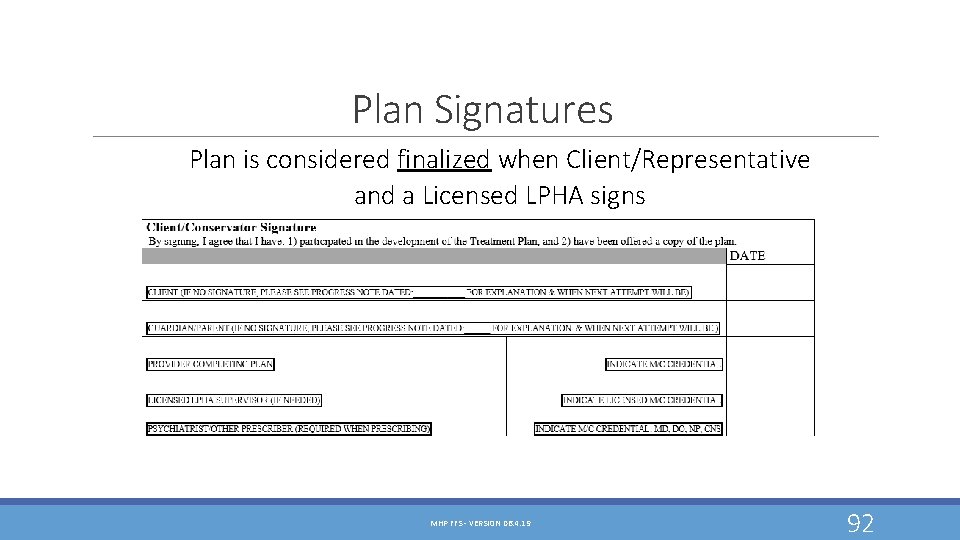
Plan Signatures Plan is considered finalized when Client/Representative and a Licensed LPHA signs MHP FFS - VERSION 06. 4. 19 92
What if I can’t obtain the client’s signature? If you are unable to obtain a client’s signature, you must document either by writing on the plan or in a progress note the reasons why you cannot obtain client’s signature and that you will attempt again at the next face to face session (or clinical reason why contraindicated). ◦ “Client agreed verbally to Client Plan formulation at last visit. Client no showed for today’s session. Will review plan and obtain written signature at next session. ” ◦ “Due to client’s paranoia, client gave verbal consent, but refused to sign plan. Clinician will attempt to obtain signature within next three months. MHP FFS - VERSION 06. 4. 19 93
What if I still can’t obtain client’s signature? If the client does not sign or refuses to sign the Client Plan, regular efforts must be attempted and documented to obtain the client’s approval. If not fully documented per instructions above, DHCS/ACBH QA will disallow all claims made after the date the Plan should have been signed by the client and until all required signatures are obtained. MHP FFS - VERSION 06. 4. 19 94
Additional Client Plan Updates ØProviders must update the treatment plan through-out the year when clinical changes occur. DHCS (and QA) will disallow notes if the treatment plan has not been updated to reflect new client goals, mental health objectives, and events in the client’s life. ØExamples of events requiring a consideration of change to the Plan be documented in the PN include, but are not limited to: Ø Hospitalization, new thoughts or behaviors of self-harm or dangerousness to others, additions of new service modalities (i. e. medication services, case management, group rehab, individual therapy, etc. ), school suspension, placement risk, etc. ØAs needed plan updates are claimed as an Individual Therapy session and each counts as one of the allotted therapy sessions. ØRemember, with every plan update, Brief Screening Tool and new plan signatures are needed MHP FFS - VERSION 06. 4. 19 95
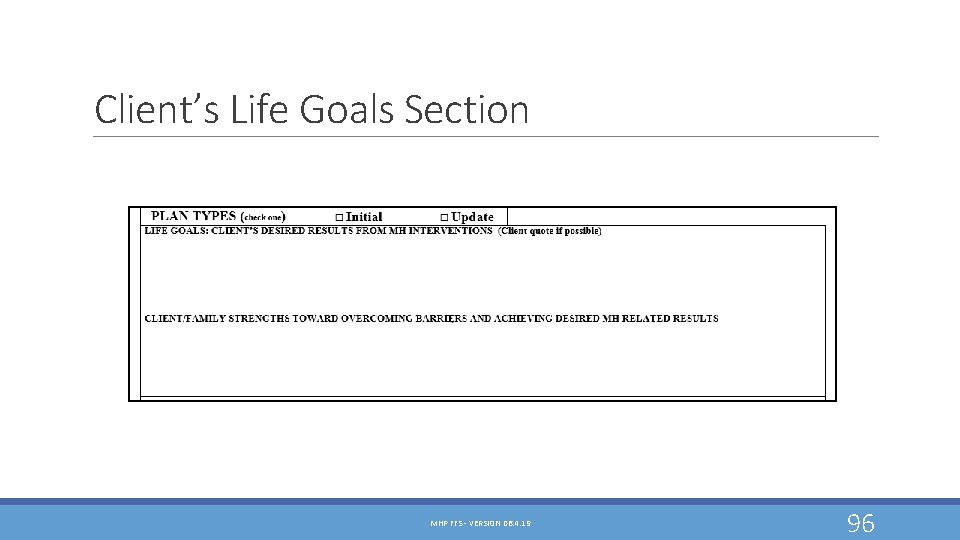
Client’s Life Goals Section MHP FFS - VERSION 06. 4. 19 96
Client Goals The Client Goals are the long-term hopes of the consumer and/or caregiver/parent. Goals… • Should focus upon their personal vision of recovery, wellness, and the life they envision for themselves • Can be in the client’s own words • Increase client engagement and buy-in to services With the client’s goals in mind, providers assist the client by “translating” their goals into short term Mental Health objectives. Client says, “I want to live on my own someday. ” or “I want to have a better relationship with my family. ” To identify what mental health goals to work on, providers can ask “What gets in the way of you achieving these goals? ” MHP FFS - VERSION 06. 4. 19 97
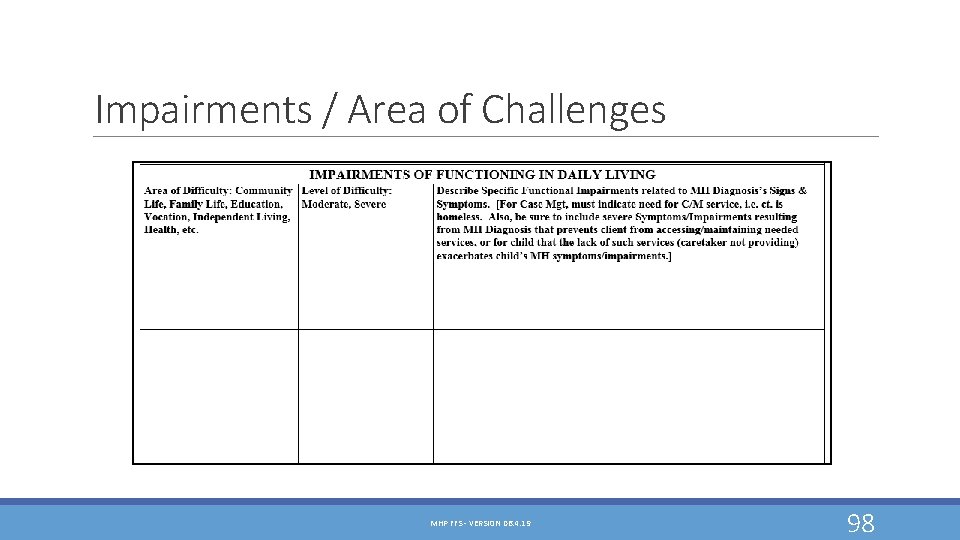
Impairments / Area of Challenges MHP FFS - VERSION 06. 4. 19 98
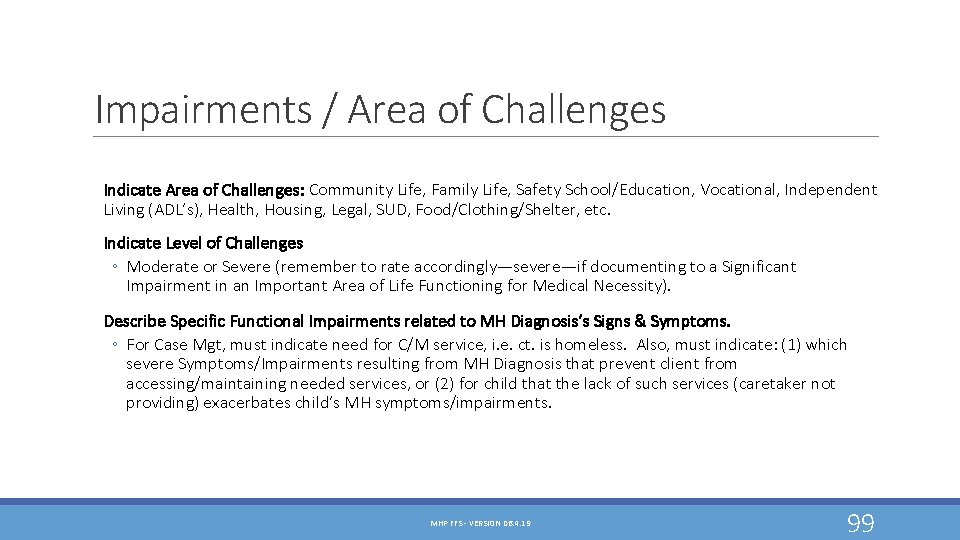
Impairments / Area of Challenges Indicate Area of Challenges: Community Life, Family Life, Safety School/Education, Vocational, Independent Living (ADL’s), Health, Housing, Legal, SUD, Food/Clothing/Shelter, etc. Indicate Level of Challenges ◦ Moderate or Severe (remember to rate accordingly—severe—if documenting to a Significant Impairment in an Important Area of Life Functioning for Medical Necessity). Describe Specific Functional Impairments related to MH Diagnosis’s Signs & Symptoms. ◦ For Case Mgt, must indicate need for C/M service, i. e. ct. is homeless. Also, must indicate: (1) which severe Symptoms/Impairments resulting from MH Diagnosis that prevent client from accessing/maintaining needed services, or (2) for child that the lack of such services (caretaker not providing) exacerbates child’s MH symptoms/impairments. MHP FFS - VERSION 06. 4. 19 99
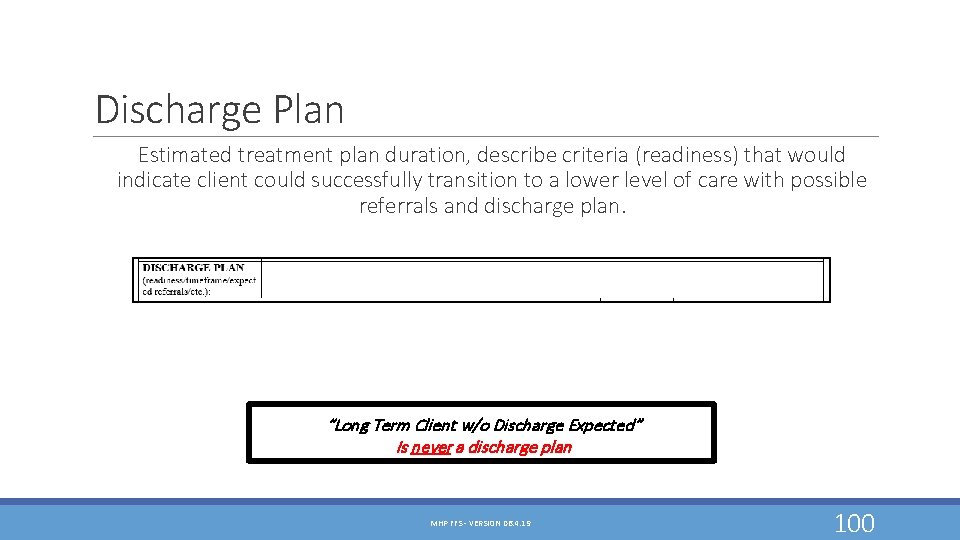
Discharge Plan Estimated treatment plan duration, describe criteria (readiness) that would indicate client could successfully transition to a lower level of care with possible referrals and discharge plan. “Long Term Client w/o Discharge Expected” Is never a discharge plan MHP FFS - VERSION 06. 4. 19 100
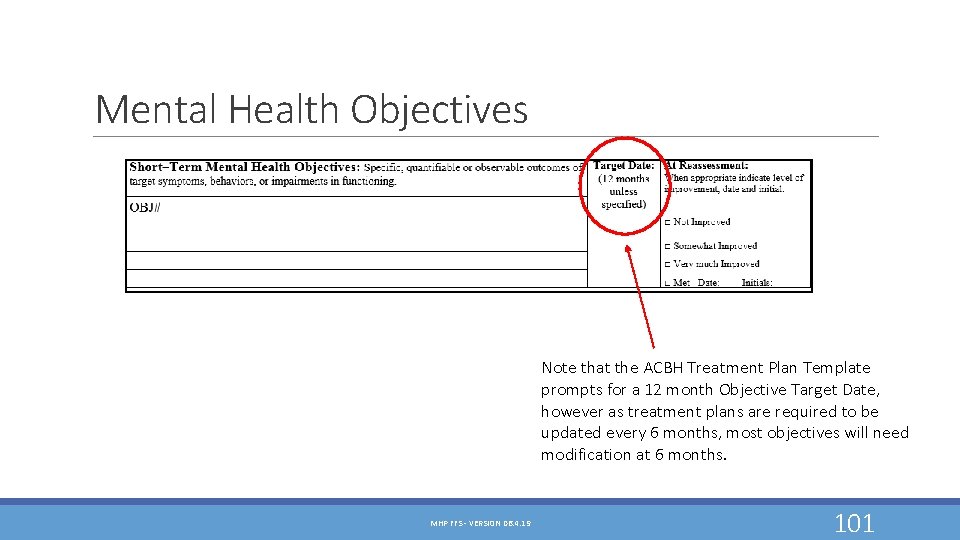
Mental Health Objectives Note that the ACBH Treatment Plan Template prompts for a 12 month Objective Target Date, however as treatment plans are required to be updated every 6 months, most objectives will need modification at 6 months. MHP FFS - VERSION 06. 4. 19 101
Mental Health Objectives All Objectives must directly address the client’s mental health sx’s and cannot focus on finding housing, getting a job, providing SUD counseling, etc. ◦ A way to see if the client (not caregiver) is improving ◦ Measurable change in helping the client achieve their long-term goals ◦ Can address MENTAL HEALTH symptoms, behaviors or impairments identified in the Assessment OR ◦ Be Strength-Based mental health objectives replace problematic Sx with positive MENTAL HEALTH coping skills/behaviors/etc. ◦ Should be based upon the client’s abilities and be meaningful to the client ◦ What are they identifying as the problem? Why did they reach out for help? MHP FFS - VERSION 06. 4. 19 102
SMART Objectives • SMART (Specific, Measurable, Attainable, Realistic and Time-Bound) • Important to look at how they might impact and build upon strengths and supports • Must include duration: at least 6 months • Special note about duration: At least one mental health objective must be valid for 6 months or the plan will need to be updated due to not having any current objectives after the last stated duration (such as only having a MH Objective with a 3 month duration). MHP FFS - VERSION 06. 4. 19 103
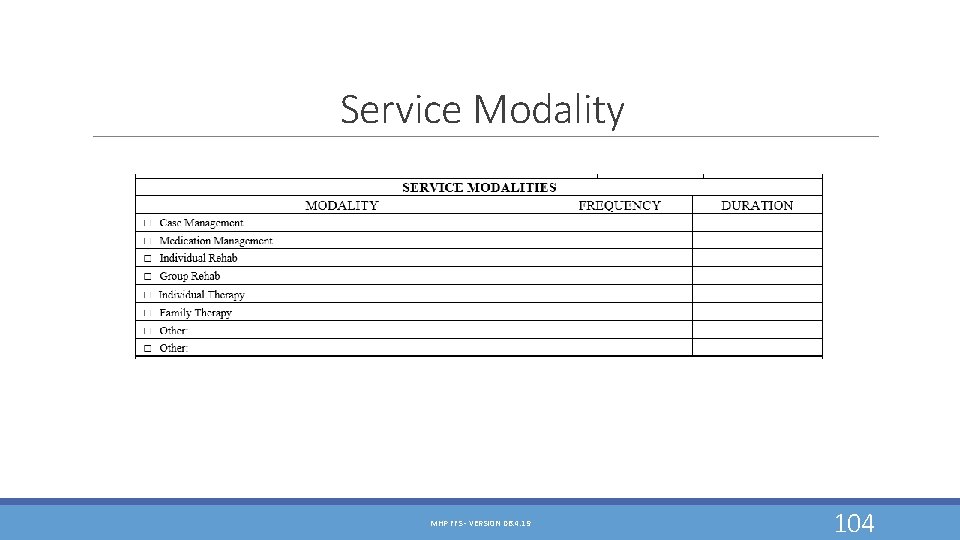
Service Modality MHP FFS - VERSION 06. 4. 19 104
Service Modalities • Identify the proposed type(s) of service modalities to be provided along with a proposed frequency and duration. • If the planned service modality for a claimed service is not in the client plan it MAY NOT BE CLAIMED and MUST be disallowed if it is claimed. This includes Case Management and Collateral. • Don’t include Assessment/Plan Development/Crisis modalities in the plan. MHP FFS - VERSION 06. 4. 19 105
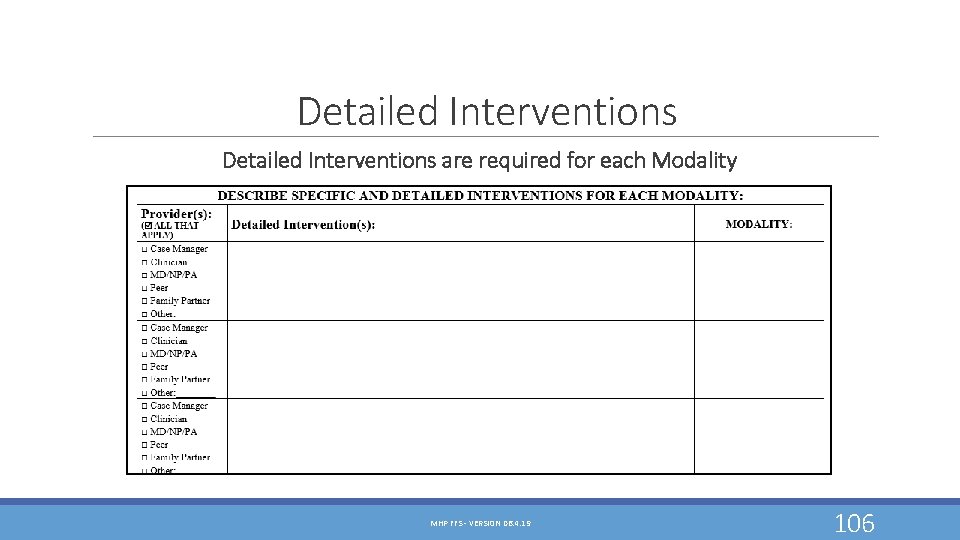
Detailed Interventions are required for each Modality MHP FFS - VERSION 06. 4. 19 106
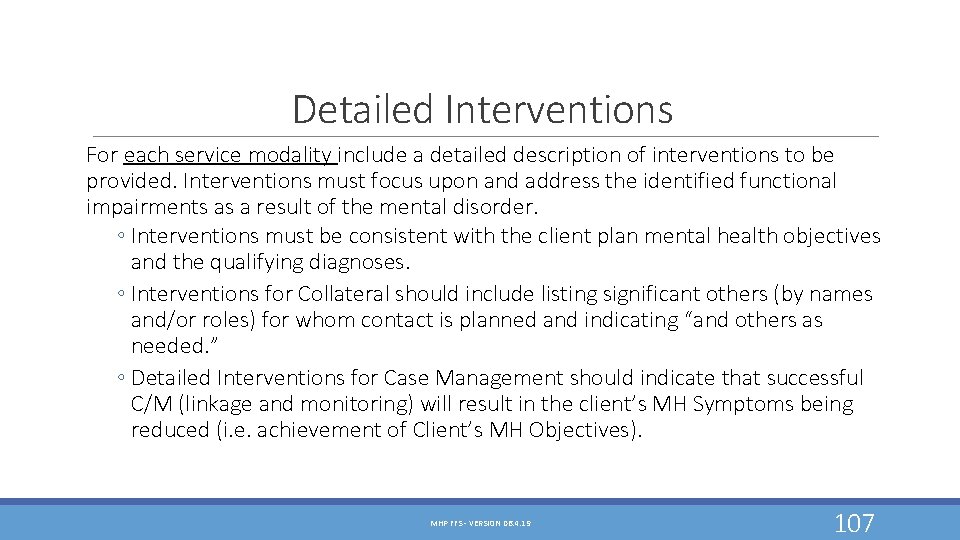
Detailed Interventions For each service modality include a detailed description of interventions to be provided. Interventions must focus upon and address the identified functional impairments as a result of the mental disorder. ◦ Interventions must be consistent with the client plan mental health objectives and the qualifying diagnoses. ◦ Interventions for Collateral should include listing significant others (by names and/or roles) for whom contact is planned and indicating “and others as needed. ” ◦ Detailed Interventions for Case Management should indicate that successful C/M (linkage and monitoring) will result in the client’s MH Symptoms being reduced (i. e. achievement of Client’s MH Objectives). MHP FFS - VERSION 06. 4. 19 107
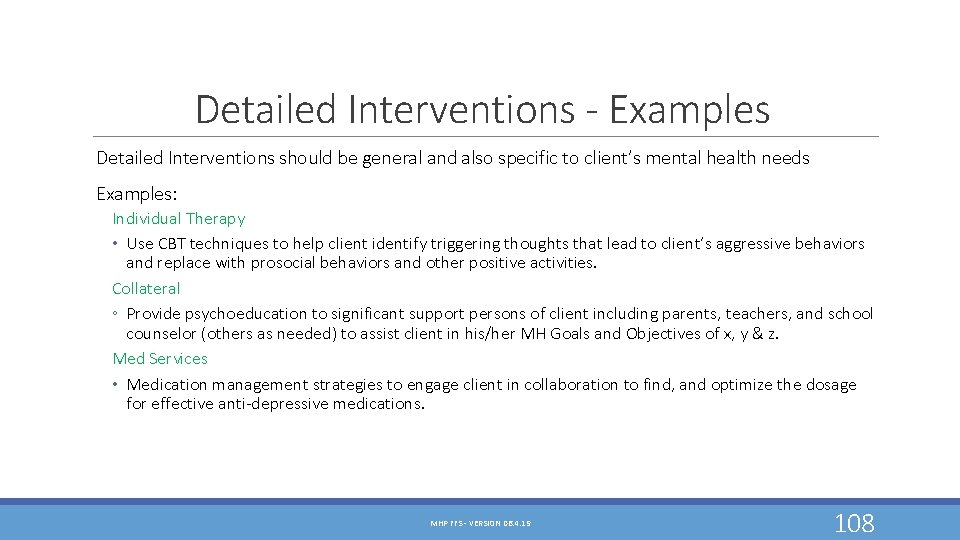
Detailed Interventions - Examples Detailed Interventions should be general and also specific to client’s mental health needs Examples: Individual Therapy • Use CBT techniques to help client identify triggering thoughts that lead to client’s aggressive behaviors and replace with prosocial behaviors and other positive activities. Collateral ◦ Provide psychoeducation to significant support persons of client including parents, teachers, and school counselor (others as needed) to assist client in his/her MH Goals and Objectives of x, y & z. Med Services • Medication management strategies to engage client in collaboration to find, and optimize the dosage for effective anti-depressive medications. MHP FFS - VERSION 06. 4. 19 108
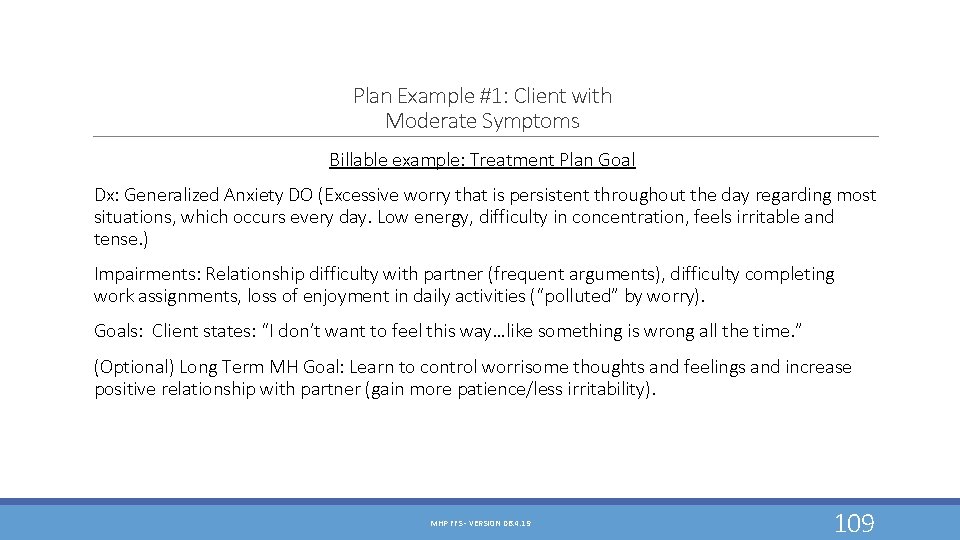
Plan Example #1: Client with Moderate Symptoms Billable example: Treatment Plan Goal Dx: Generalized Anxiety DO (Excessive worry that is persistent throughout the day regarding most situations, which occurs every day. Low energy, difficulty in concentration, feels irritable and tense. ) Impairments: Relationship difficulty with partner (frequent arguments), difficulty completing work assignments, loss of enjoyment in daily activities (“polluted” by worry). Goals: Client states: “I don’t want to feel this way…like something is wrong all the time. ” (Optional) Long Term MH Goal: Learn to control worrisome thoughts and feelings and increase positive relationship with partner (gain more patience/less irritability). MHP FFS - VERSION 06. 4. 19 109
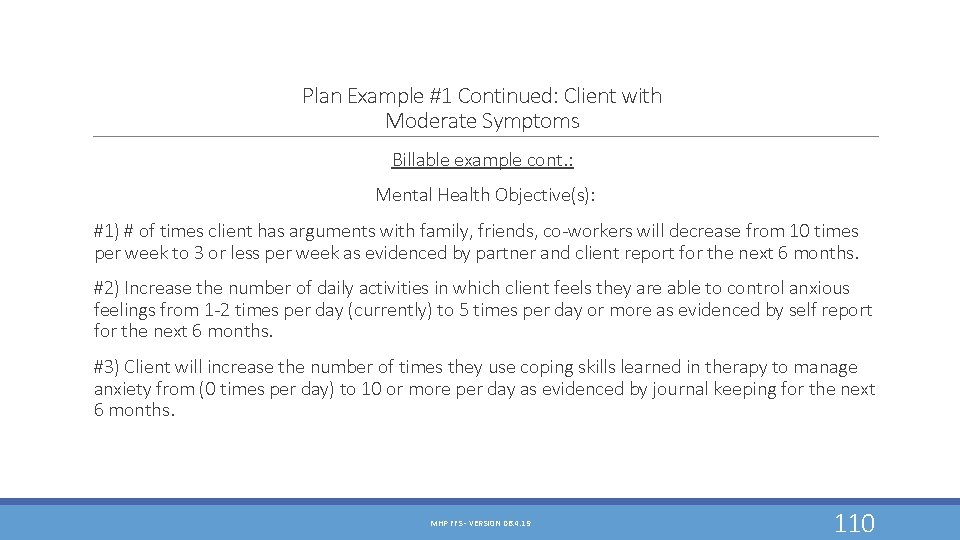
Plan Example #1 Continued: Client with Moderate Symptoms Billable example cont. : Mental Health Objective(s): #1) # of times client has arguments with family, friends, co-workers will decrease from 10 times per week to 3 or less per week as evidenced by partner and client report for the next 6 months. #2) Increase the number of daily activities in which client feels they are able to control anxious feelings from 1 -2 times per day (currently) to 5 times per day or more as evidenced by self report for the next 6 months. #3) Client will increase the number of times they use coping skills learned in therapy to manage anxiety from (0 times per day) to 10 or more per day as evidenced by journal keeping for the next 6 months. MHP FFS - VERSION 06. 4. 19 110
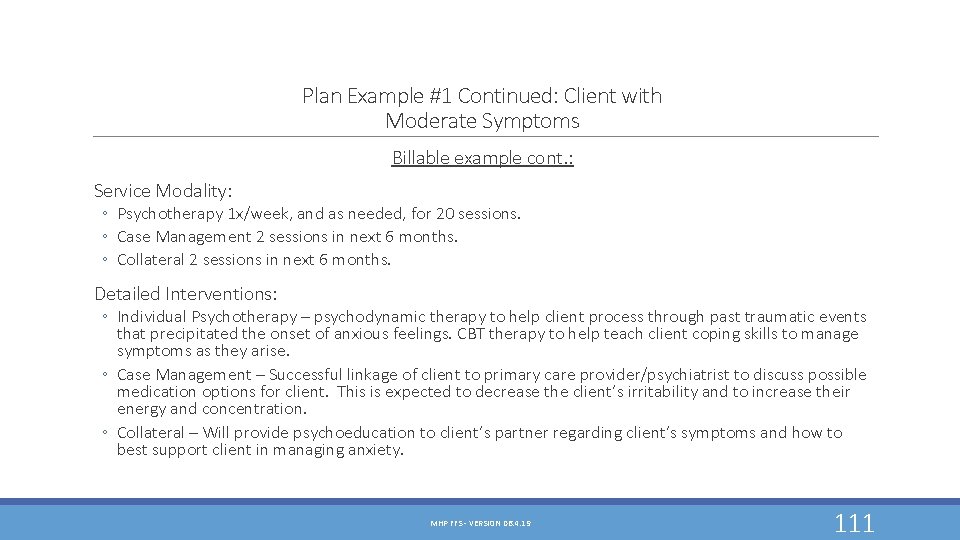
Plan Example #1 Continued: Client with Moderate Symptoms Billable example cont. : Service Modality: ◦ Psychotherapy 1 x/week, and as needed, for 20 sessions. ◦ Case Management 2 sessions in next 6 months. ◦ Collateral 2 sessions in next 6 months. Detailed Interventions: ◦ Individual Psychotherapy – psychodynamic therapy to help client process through past traumatic events that precipitated the onset of anxious feelings. CBT therapy to help teach client coping skills to manage symptoms as they arise. ◦ Case Management – Successful linkage of client to primary care provider/psychiatrist to discuss possible medication options for client. This is expected to decrease the client’s irritability and to increase their energy and concentration. ◦ Collateral – Will provide psychoeducation to client’s partner regarding client’s symptoms and how to best support client in managing anxiety. MHP FFS - VERSION 06. 4. 19 111
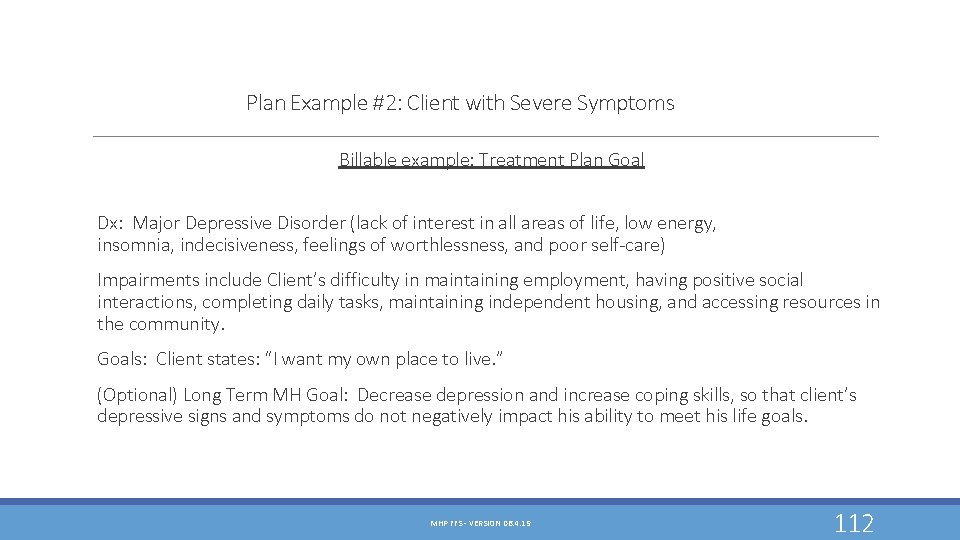
Plan Example #2: Client with Severe Symptoms Billable example: Treatment Plan Goal Dx: Major Depressive Disorder (lack of interest in all areas of life, low energy, insomnia, indecisiveness, feelings of worthlessness, and poor self-care) Impairments include Client’s difficulty in maintaining employment, having positive social interactions, completing daily tasks, maintaining independent housing, and accessing resources in the community. Goals: Client states: “I want my own place to live. ” (Optional) Long Term MH Goal: Decrease depression and increase coping skills, so that client’s depressive signs and symptoms do not negatively impact his ability to meet his life goals. MHP FFS - VERSION 06. 4. 19 112
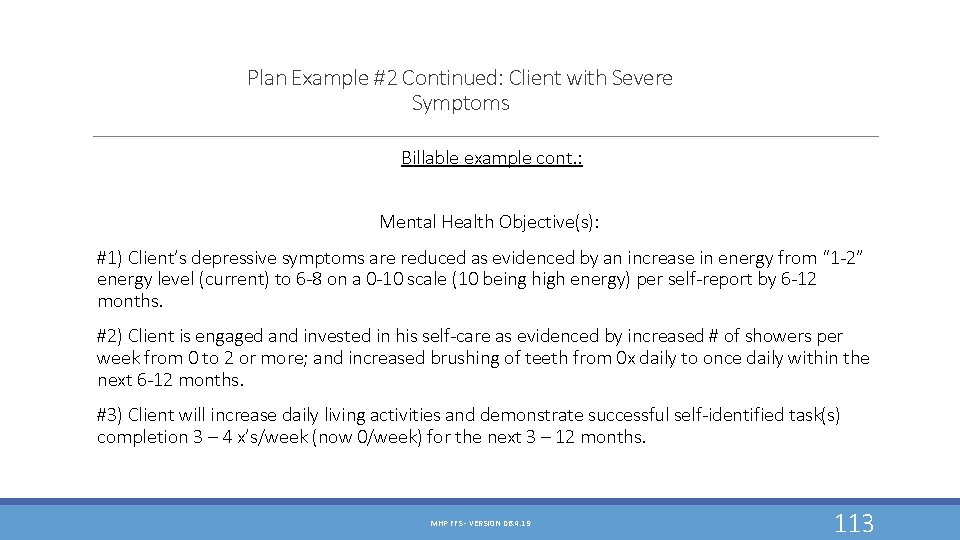
Plan Example #2 Continued: Client with Severe Symptoms Billable example cont. : Mental Health Objective(s): #1) Client’s depressive symptoms are reduced as evidenced by an increase in energy from “ 1 -2” energy level (current) to 6 -8 on a 0 -10 scale (10 being high energy) per self-report by 6 -12 months. #2) Client is engaged and invested in his self-care as evidenced by increased # of showers per week from 0 to 2 or more; and increased brushing of teeth from 0 x daily to once daily within the next 6 -12 months. #3) Client will increase daily living activities and demonstrate successful self-identified task(s) completion 3 – 4 x’s/week (now 0/week) for the next 3 – 12 months. MHP FFS - VERSION 06. 4. 19 113
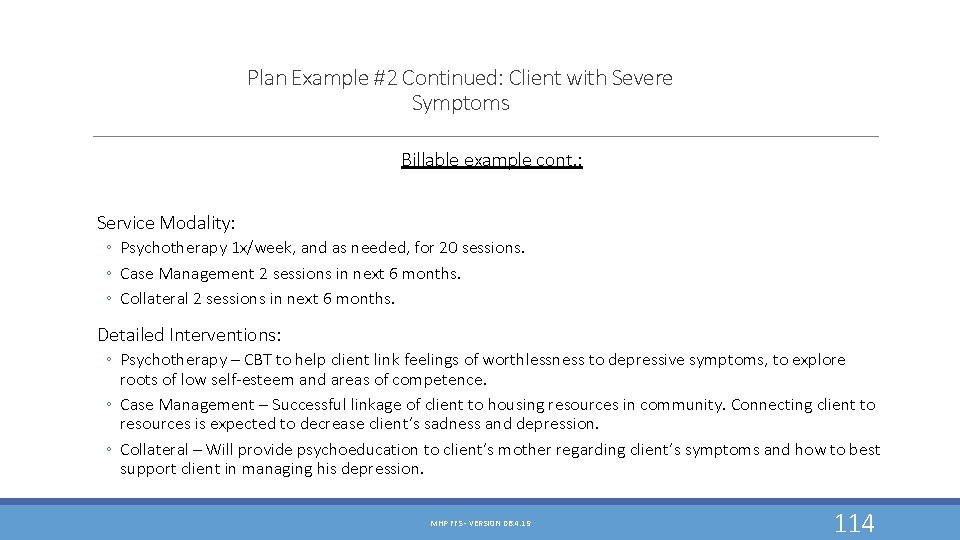
Plan Example #2 Continued: Client with Severe Symptoms Billable example cont. : Service Modality: ◦ Psychotherapy 1 x/week, and as needed, for 20 sessions. ◦ Case Management 2 sessions in next 6 months. ◦ Collateral 2 sessions in next 6 months. Detailed Interventions: ◦ Psychotherapy – CBT to help client link feelings of worthlessness to depressive symptoms, to explore roots of low self-esteem and areas of competence. ◦ Case Management – Successful linkage of client to housing resources in community. Connecting client to resources is expected to decrease client’s sadness and depression. ◦ Collateral – Will provide psychoeducation to client’s mother regarding client’s symptoms and how to best support client in managing his depression. MHP FFS - VERSION 06. 4. 19 114
Progress Notes MHP FFS - VERSION 06. 4. 19 115
Claiming to Medi-Cal ØEvery claim made to Medi-Cal must have a corresponding progress note in the client’s chart ØAll assessment and plan development sessions require progress notes in order to be claimed. The assessment and plan are not enough to complete the claiming process. Use the appropriate Assessment / Psychiatric Diagnostic Evaluation Codes to claim for these services. ØWhen writing notes documenting the Assessment and Plan sessions, if each are completed in one session, the progress note may include a reference to the completed form. For example, “This therapist gathered information to complete the Assessment. See Assessment dated…” ØIf the Assessment or Plan spans multiple sessions, then the progress note may reference completed sections in the assessment or plan, as long as what sections were completed in that session are specified. ØIf it is not possible to reference specific sections of the assessment or plan, then the content of the session must be included in the progress note. MHP FFS - VERSION 06. 4. 19 116
Progress Notes Must… Progress Notes must contain: ◦ Procedure Code of service provided to client ◦ Date of Service ◦ Indicate what language the service was provided (unless English Speaking client and in the MH Assessment it indicates: “English speaking client and all services will be provided in English”). ◦ Legible Provider Signature with Medi-Cal credential and date signed (not date of service) unless written and finalized with signature on the same day. Only use ACBH approved abbreviations. MHP FFS - VERSION 06. 4. 19 117
Progress Notes Must… • Indicate code and minutes designated from Code/Rate Sheet. • Default to the code closest (rounding up and down) to the minutes it took for f-f or phone contact time and documentation time. • Do not put the actual total minutes or break down face-to-face and doc time for example. • e. g. 60 minute Ind. Psychotherapy with 10 minutes documentation should be documented as 90834 -60”. MHP FFS - VERSION 06. 4. 19 118
B/PIRP Format – Progress, Not Process Behavior/Assessment, Purpose/Problem =documents what is presently going on with the client (brief narrative), especially in terms of progress towards MH goals and objectives Intervention by Staff =Identifies what you did today (i. e. , what specific intervention was provided toward the mental health objectives). Cut and paste interventions from previous session may result in a disallowance. Response of Client to Intervention = Identifies client’s response today toward the interventions and impact/progress toward their MH objectives Plan for future services = Provides plan for continued services i. e. collaterals, coordination of care, continue with CBT techniques etc. Can include any follow up by the provider or client—not simply and always: “next session on mm/dd/yy” ØAlways indicate which MH Objective (restate or reference # of Objective in Plan) is being addressed MHP FFS - VERSION 06. 4. 19 119
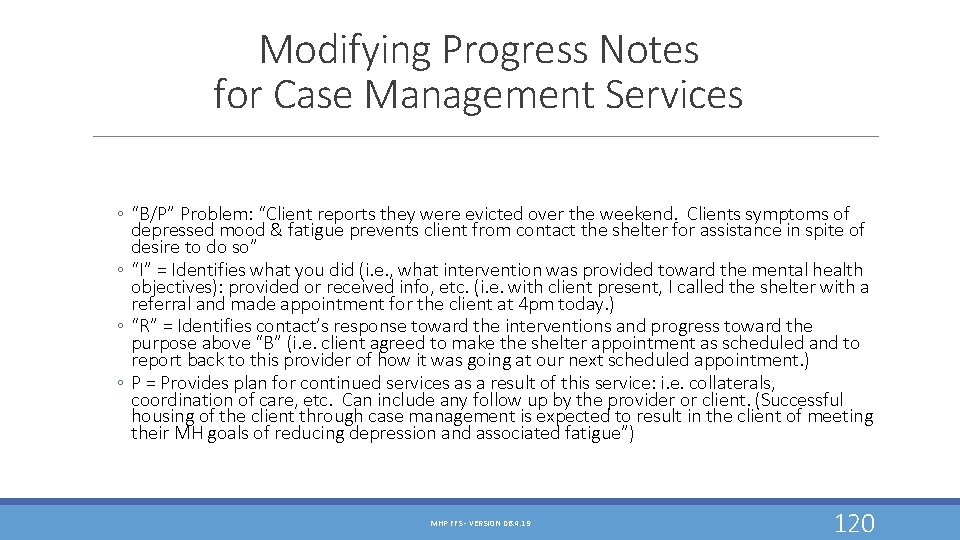
Modifying Progress Notes for Case Management Services ◦ “B/P” Problem: “Client reports they were evicted over the weekend. Clients symptoms of depressed mood & fatigue prevents client from contact the shelter for assistance in spite of desire to do so” ◦ “I” = Identifies what you did (i. e. , what intervention was provided toward the mental health objectives): provided or received info, etc. (i. e. with client present, I called the shelter with a referral and made appointment for the client at 4 pm today. ) ◦ “R” = Identifies contact’s response toward the interventions and progress toward the purpose above “B” (i. e. client agreed to make the shelter appointment as scheduled and to report back to this provider of how it was going at our next scheduled appointment. ) ◦ P = Provides plan for continued services as a result of this service: i. e. collaterals, coordination of care, etc. Can include any follow up by the provider or client. (Successful housing of the client through case management is expected to result in the client of meeting their MH goals of reducing depression and associated fatigue”) MHP FFS - VERSION 06. 4. 19 120
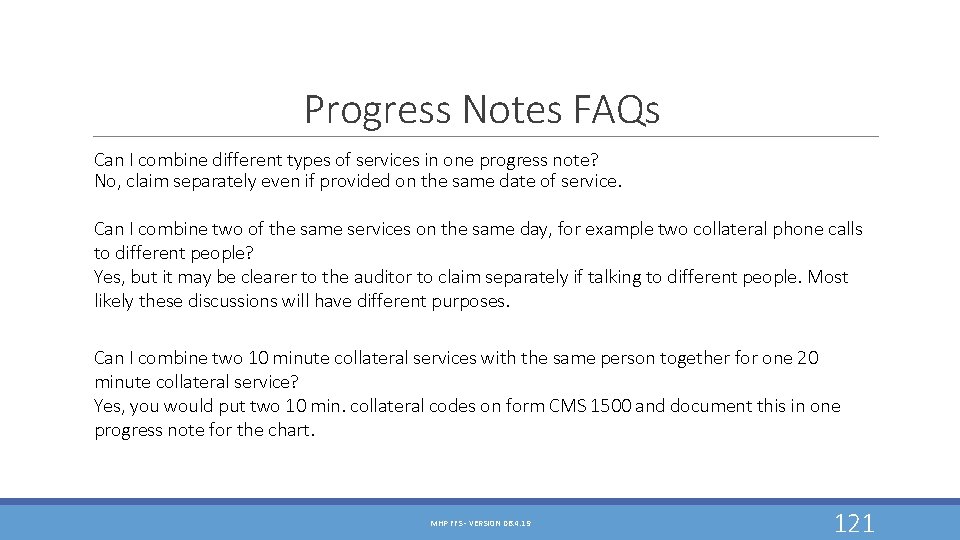
Progress Notes FAQs Can I combine different types of services in one progress note? No, claim separately even if provided on the same date of service. Can I combine two of the same services on the same day, for example two collateral phone calls to different people? Yes, but it may be clearer to the auditor to claim separately if talking to different people. Most likely these discussions will have different purposes. Can I combine two 10 minute collateral services with the same person together for one 20 minute collateral service? Yes, you would put two 10 min. collateral codes on form CMS 1500 and document this in one progress note for the chart. MHP FFS - VERSION 06. 4. 19 121
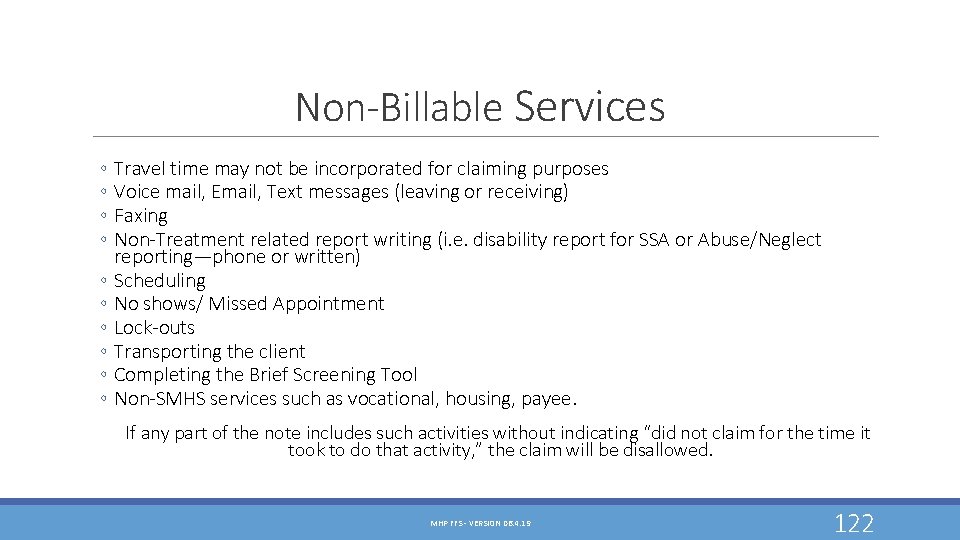
Non-Billable Services ◦ ◦ ◦ ◦ ◦ Travel time may not be incorporated for claiming purposes Voice mail, Email, Text messages (leaving or receiving) Faxing Non-Treatment related report writing (i. e. disability report for SSA or Abuse/Neglect reporting—phone or written) Scheduling No shows/ Missed Appointment Lock-outs Transporting the client Completing the Brief Screening Tool Non-SMHS services such as vocational, housing, payee. If any part of the note includes such activities without indicating “did not claim for the time it took to do that activity, ” the claim will be disallowed. MHP FFS - VERSION 06. 4. 19 122
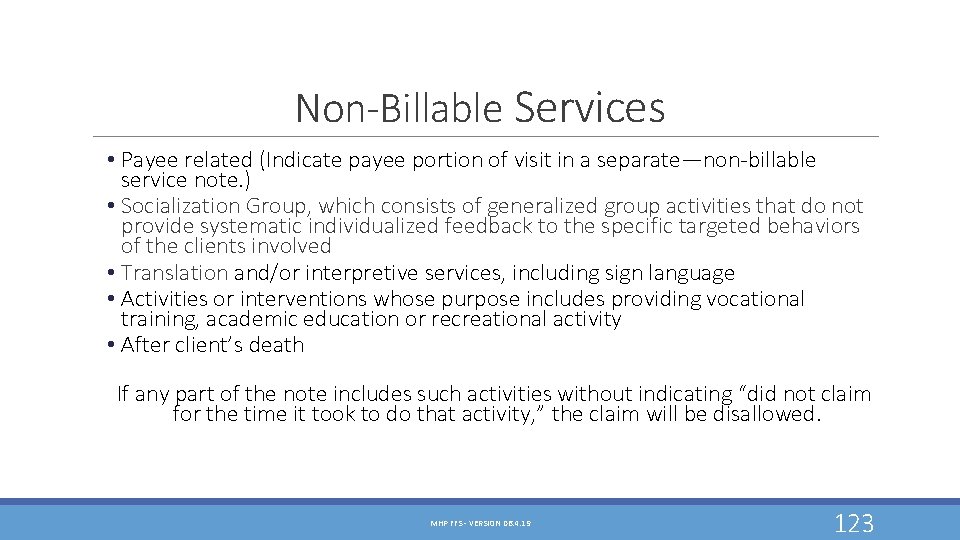
Non-Billable Services • Payee related (Indicate payee portion of visit in a separate—non-billable service note. ) • Socialization Group, which consists of generalized group activities that do not provide systematic individualized feedback to the specific targeted behaviors of the clients involved • Translation and/or interpretive services, including sign language • Activities or interventions whose purpose includes providing vocational training, academic education or recreational activity • After client’s death If any part of the note includes such activities without indicating “did not claim for the time it took to do that activity, ” the claim will be disallowed. MHP FFS - VERSION 06. 4. 19 123
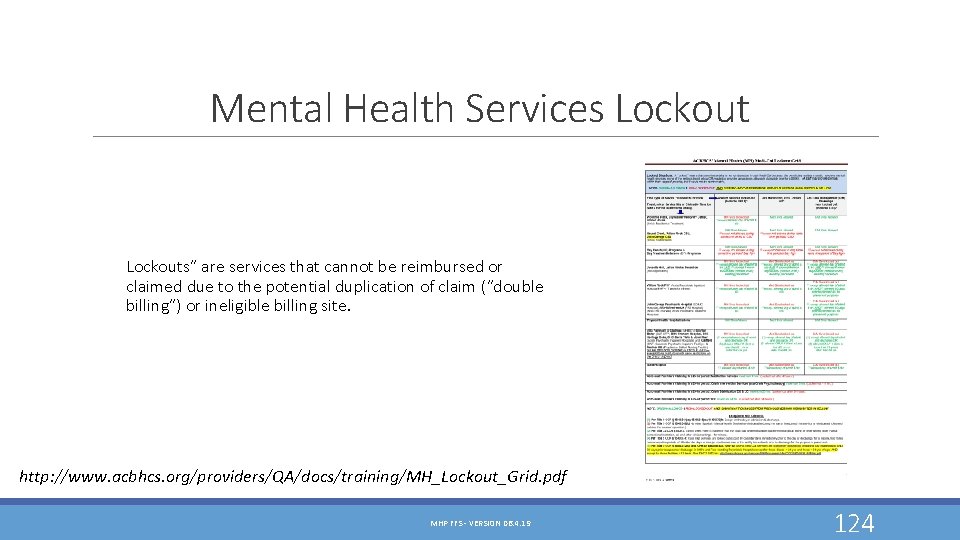
Mental Health Services Lockouts” are services that cannot be reimbursed or claimed due to the potential duplication of claim (“double billing”) or ineligible billing site. http: //www. acbhcs. org/providers/QA/docs/training/MH_Lockout_Grid. pdf MHP FFS - VERSION 06. 4. 19 124
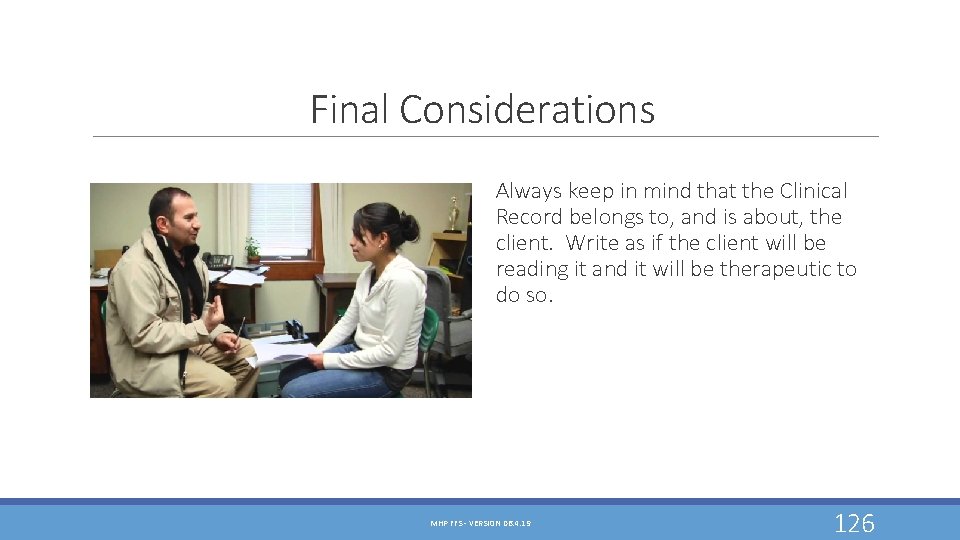
Final Considerations Always keep in mind that the Clinical Record belongs to, and is about, the client. Write as if the client will be reading it and it will be therapeutic to do so. MHP FFS - VERSION 06. 4. 19 126
Procedure Codes MHP FFS - VERSION 06. 4. 19 127
MHP FFS Procedure Codes Choose the right one for your license: MHP FFS - VERSION 06. 4. 19 128
Procedure Code/Services Assessment and Plan Development • Use the same code for both assessment and plan development • Most likely this will be OP Psychiatric Diagnostic Eval (90791) or, for prescribers, OP Psychiatric Diagnostic Eval w/Med Srv (90792). • Indicate code and actual minutes • Using these codes counts towards the authorized two allotted initial Assessment/Plan Development units of service initially and annually. • At 6 month reauthorization, one unit of service is available for plan development. MHP FFS - VERSION 06. 4. 19 129
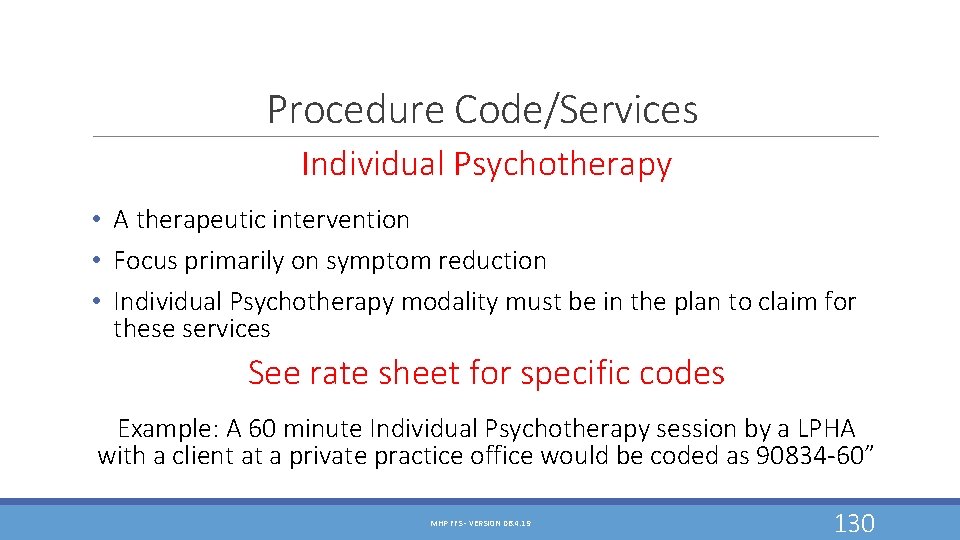
Procedure Code/Services Individual Psychotherapy • A therapeutic intervention • Focus primarily on symptom reduction • Individual Psychotherapy modality must be in the plan to claim for these services See rate sheet for specific codes Example: A 60 minute Individual Psychotherapy session by a LPHA with a client at a private practice office would be coded as 90834 -60” MHP FFS - VERSION 06. 4. 19 130
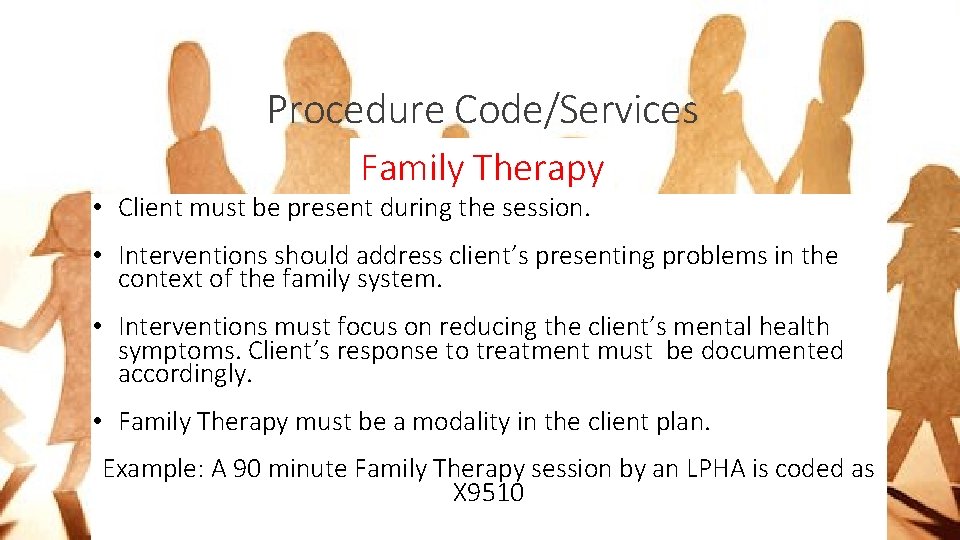
Procedure Code/Services Family Therapy • Client must be present during the session. • Interventions should address client’s presenting problems in the context of the family system. • Interventions must focus on reducing the client’s mental health symptoms. Client’s response to treatment must be documented accordingly. • Family Therapy must be a modality in the client plan. Example: A 90 minute Family Therapy session by an LPHA is coded as X 9510 131 MHP FFS - VERSION 06. 4. 19
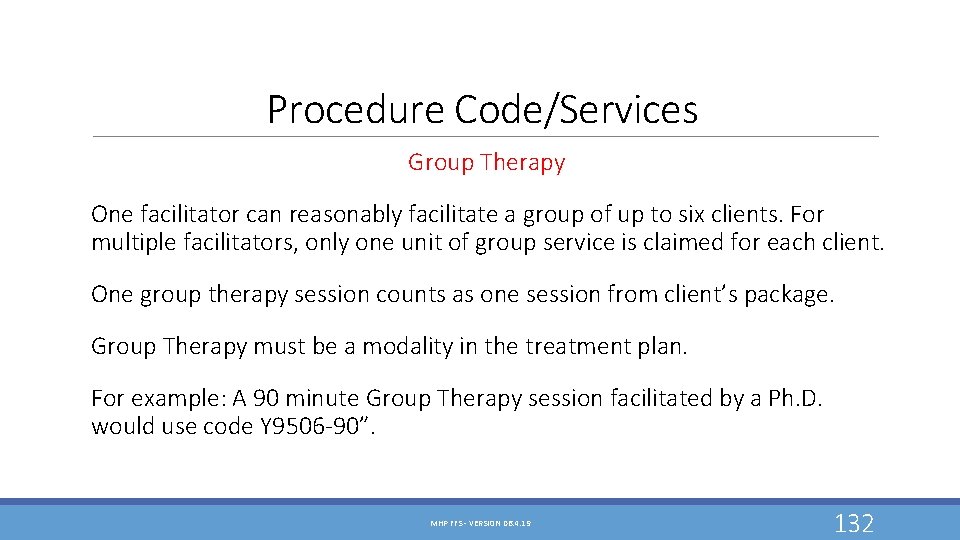
Procedure Code/Services Group Therapy One facilitator can reasonably facilitate a group of up to six clients. For multiple facilitators, only one unit of group service is claimed for each client. One group therapy session counts as one session from client’s package. Group Therapy must be a modality in the treatment plan. For example: A 90 minute Group Therapy session facilitated by a Ph. D. would use code Y 9506 -90”. MHP FFS - VERSION 06. 4. 19 132
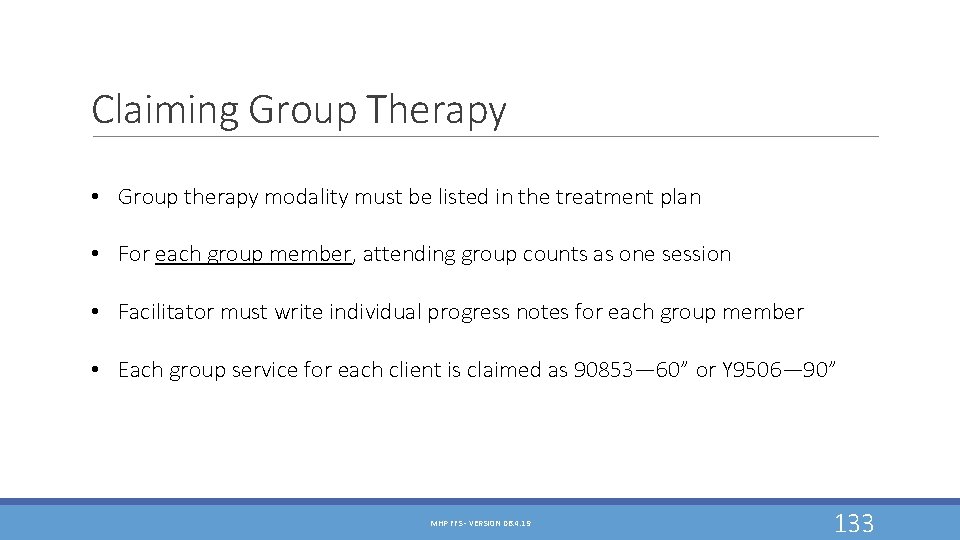
Claiming Group Therapy • Group therapy modality must be listed in the treatment plan • For each group member, attending group counts as one session • Facilitator must write individual progress notes for each group member • Each group service for each client is claimed as 90853— 60” or Y 9506— 90” MHP FFS - VERSION 06. 4. 19 133
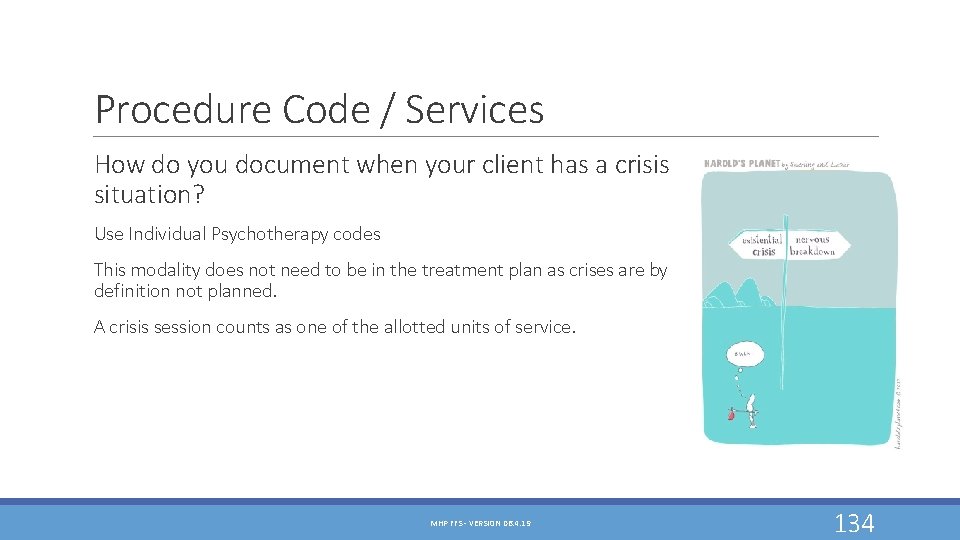
Procedure Code / Services How do you document when your client has a crisis situation? Use Individual Psychotherapy codes This modality does not need to be in the treatment plan as crises are by definition not planned. A crisis session counts as one of the allotted units of service. MHP FFS - VERSION 06. 4. 19 134
Procedure Code/Services Collateral • Modality must be in the treatment plan to claim. • Collateral services are to support the Client Plan by: • Gathering information from any significant support persons • Explaining results of psychiatric, other medical examinations and procedures, or other accumulated data to family or other responsible persons, or • Advising significant support persons how to assist client(s) in order for client to accomplish MH Objectives • Consultation, Training and Psychoeducation of significant support person in client’s life where the focus is always in achieving mental health Objectives in Client Plan—If Plan is not completed, there is no way to do so. • Maximum of 120 minutes TOTAL every 6 months • Collateral Call 90887 -10” or Collateral Visit 90888 -45” (round to closest) MHP FFS - VERSION 06. 4. 19 135
Procedure Code/Services Brokerage / Case Management UNPLANNED SERVICE – for linkage and referral ONLY PLANNED SERVICE — for follow-up which MUST BE IN CLIENT PLAN • Help clients to access medical, educational, social, vocational, rehabilitative, or other community services that are identified in the Client Plan and Assessment. • Service activities may include, but are not limited to: • Communication with client & other individuals • Coordination of care • Referrals • Monitoring service delivery to ensure client’s access to services. • Monitoring client’s progress toward making use of services. • Must meet documentation requirements in earlier slides to claim • MH Plan must document need for case management due to severe impairment due to MH Dx that results in client being unable to make and maintain other community service referrals (Adult), or without such services Child’s MH Sx and Impairments would be exacerbated. Must also document, successful C/M is expected to decrease MH Sx’s and Impairments. • Case Management/Brokerage: 10173 -30” or 10176 -60” (round up or down to the closest time); • 30 or 60 minute increments • Maximum TOTAL time is 120 minutes initial/annual and 180 mins. at 6 month reauthorization. MHP FFS - VERSION 06. 4. 19 136
Psychological Testing Codes • Providers can refer a client for psychological testing after 3 months of treatment. • Psychological Test Authorization Request (PTAR) is required to be submitted to and approved by ACCESS. • Includes Testing, Scoring, Reporting activities (1 – 19 hours total). MHP FFS - VERSION 06. 4. 19 137
Other Procedure Codes Not common and must be specified in Provider contract before they can be used • CFS Casework Report (Y 9997) • CFS Customized Services • Cal. Works related codes • E/M Codes MHP FFS - VERSION 06. 4. 19 138
What is the procedure code? MHP FFS - VERSION 06. 4. 19 139
You’ve been referred a client from ACCESS for family therapy. In the second session you finish the Assessment and start discussing the client plan. The session ends before you have a chance to write up the plan and get client’s signature. What should you do? This session counts as one of the assessment/plan development sessions. The time therapist spends writing up the plan is included in the Psychiatric Diagnostic Evaluation rate. The therapist needs to get the plan signed at the beginning of the next session. The next session would be billed as Family Therapy. MHP FFS - VERSION 06. 4. 19 140
You’re meeting with a client who suffers from severe anxiety for an individual therapy session when they disclose that they use prescription painkillers regularly. They share that they were initially prescribed them after a car accident, but they help the client feel less anxious. They discuss how that their doctor won’t prescribe them any more but they still, “need them to take the edge off. ” They tell you they have “a guy” who helps them get some, but they’re starting to need more and it’s getting very expensive. The “guy” has suggested they try a more potent version he has that’s cheaper, but the client is concerned what that might mean. What should you do? Bill this service as Individual Therapy. Client should be assessed for the need for substance use services. If the plan is updated then it would still be coded as individual therapy and this would count as one of the individual therapy sessions. Make sure to refer the client to substance use services. MHP FFS - VERSION 06. 4. 19 141
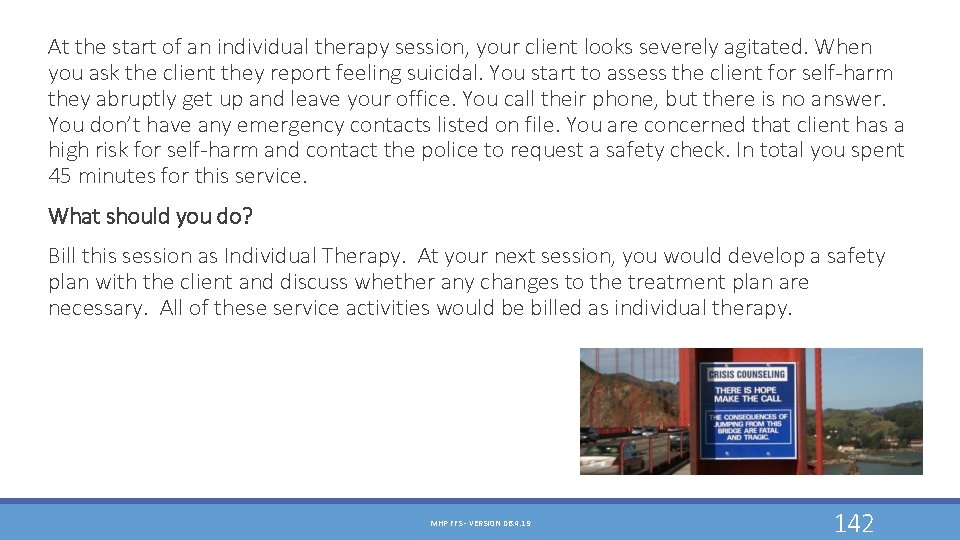
At the start of an individual therapy session, your client looks severely agitated. When you ask the client they report feeling suicidal. You start to assess the client for self-harm they abruptly get up and leave your office. You call their phone, but there is no answer. You don’t have any emergency contacts listed on file. You are concerned that client has a high risk for self-harm and contact the police to request a safety check. In total you spent 45 minutes for this service. What should you do? Bill this session as Individual Therapy. At your next session, you would develop a safety plan with the client and discuss whether any changes to the treatment plan are necessary. All of these service activities would be billed as individual therapy. MHP FFS - VERSION 06. 4. 19 142
Reminders • Providers are expected to carry a minimum caseload of three (3) MHP FFS Provider Network clients (some exceptions apply. ) • Because our beneficiaries typically benefit from connection to additional community resources, providers are expected to use the “Brokerage/Linkage” billable service for assisting clients in connecting with community resources such as primary care physician, housing resources and social services. • Organizational Providers must comply with the OIG and Other Exclusion List Monitoring, Oversite and Reporting Policy MHP FFS - VERSION 06. 4. 19 143
Who you gonna call…. Ø ACCESS for referral questions, (510) 346 -1010 Ø Utilization Management Program Daily Coordinator for RCS & Attestation questions, (510) 567 -8141 Ø Provider Relations for claims processing questions, (800) 878 -1313 Ø Network Office for contract questions, (510) 567 -8296 Ø Quality Assurance for documentation questions, (510) 567 -8105 ◦ QATA@acgov. org MHP FFS - VERSION 06. 4. 19 144
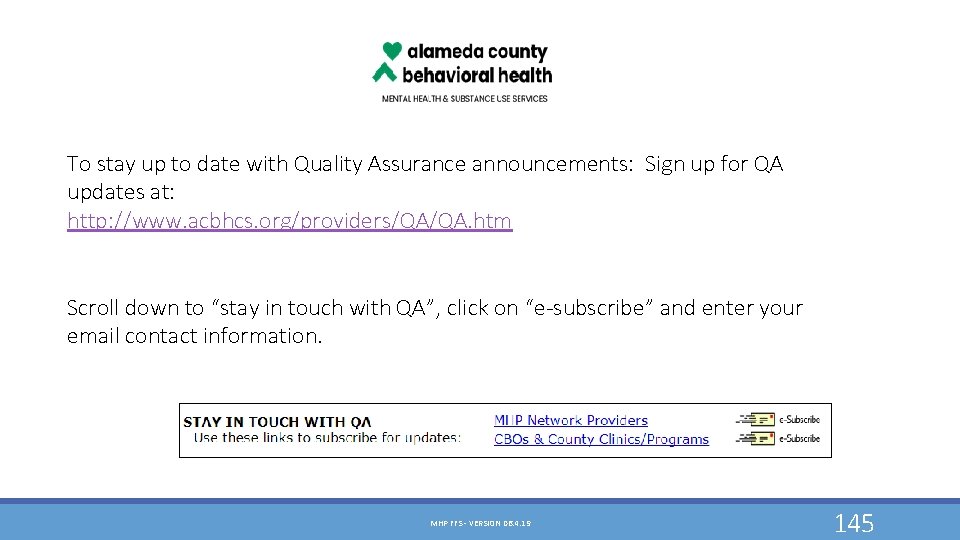
To stay up to date with Quality Assurance announcements: Sign up for QA updates at: http: //www. acbhcs. org/providers/QA/QA. htm Scroll down to “stay in touch with QA”, click on “e-subscribe” and enter your email contact information. MHP FFS - VERSION 06. 4. 19 145
Thank you for coming! MHP FFS - VERSION 06. 4. 19 146