
Leading for Effective School Mental Health ASSIST Summit



- Slides: 57
Leading for Effective School Mental Health ASSIST Summit on Children and Youth Mental Health 2012 1
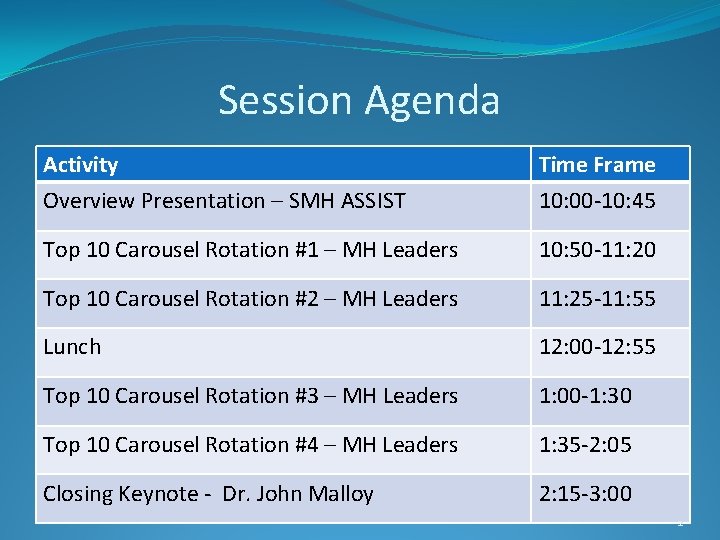
Session Agenda Activity Overview Presentation – SMH ASSIST Time Frame 10: 00 -10: 45 Top 10 Carousel Rotation #1 – MH Leaders 10: 50 -11: 20 Top 10 Carousel Rotation #2 – MH Leaders 11: 25 -11: 55 Lunch 12: 00 -12: 55 Top 10 Carousel Rotation #3 – MH Leaders 1: 00 -1: 30 Top 10 Carousel Rotation #4 – MH Leaders 1: 35 -2: 05 Closing Keynote - Dr. John Malloy 2: 15 -3: 00 2
LEADERSHIP With an elbow partner, or two… What does effective leadership look like at a School or Board level? Paint a Picture… 3
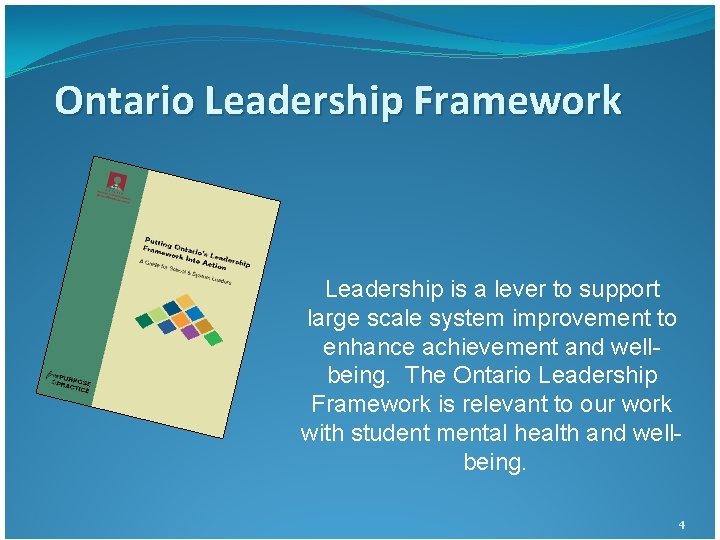
Ontario Leadership Framework Leadership is a lever to support large scale system improvement to enhance achievement and wellbeing. The Ontario Leadership Framework is relevant to our work with student mental health and wellbeing. 4
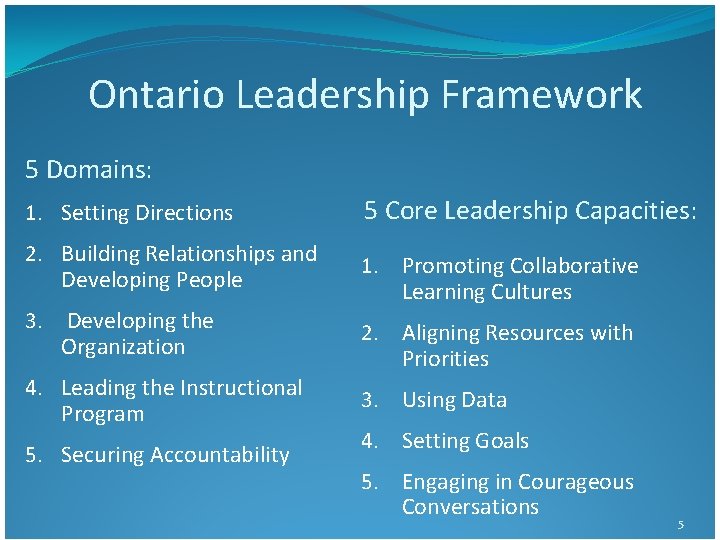
Ontario Leadership Framework 5 Domains: 1. Setting Directions 2. Building Relationships and Developing People 3. Developing the Organization 4. Leading the Instructional Program 5. Securing Accountability 5 Core Leadership Capacities: 1. Promoting Collaborative Learning Cultures 2. Aligning Resources with Priorities 3. Using Data 4. Setting Goals 5. Engaging in Courageous Conversations 5
Jot down a few ideas…. What are some of the qualities of an effective leader? Which of these do you possess, and value most strongly? 6
7
8
Overview � The Promise of School Mental Health � Provincial, National and International Initiatives � Acknowledging Past (and present) Challenges � Ontario’s Mental Health & Addictions Strategy � School Mental Health ASSIST � Top 10 Conditions for Effective School Mental Health 9
The Promise of School Mental Health 10
Mental Health is… “A state of complete physical, mental, and social wellbeing, and not merely the absence of disease or infirmity” World Health Organization 11
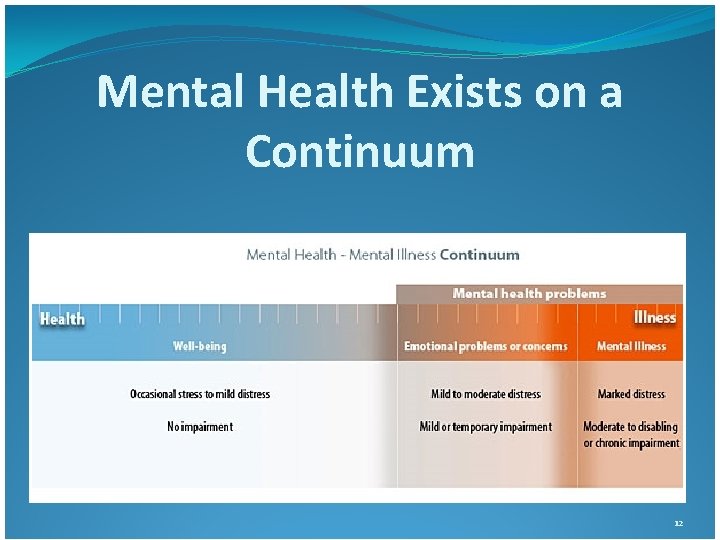
Mental Health Exists on a Continuum 12
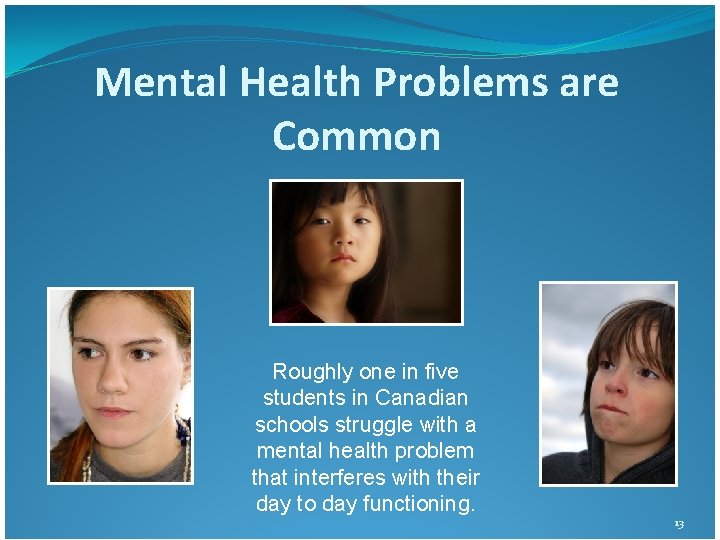
Mental Health Problems are Common Roughly one in five students in Canadian schools struggle with a mental health problem that interferes with their day to day functioning. 13
What are Mental Health Problems? Mental health problems are emotional, behavioural and brainrelated disturbances that interfere with development, personal relationships, and functioning Disturbances that are severe and persistent enough to cause significant symptoms, distress, and impairment in one or more areas of daily life are termed mental health disorders/mental illness. 14
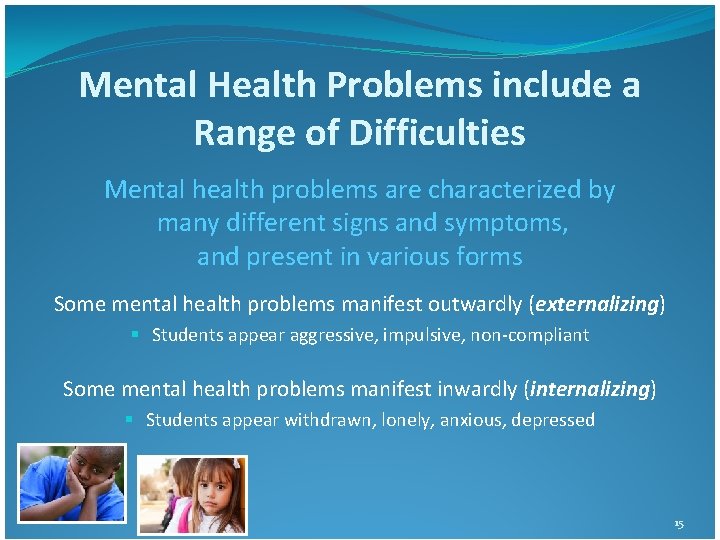
Mental Health Problems include a Range of Difficulties Mental health problems are characterized by many different signs and symptoms, and present in various forms Some mental health problems manifest outwardly (externalizing) § Students appear aggressive, impulsive, non-compliant Some mental health problems manifest inwardly (internalizing) § Students appear withdrawn, lonely, anxious, depressed 15
The Good News � Proven strategies and supports � Psychosocial and pharmacological treatments are most common, and are often used together � While many mental disorders are chronic, we can help with coping � Early identification and intervention improves prognosis 16
But Most Do Not Receive the Help They Need � Up to 80% of children and youth who experience a mental health problem will not receive treatment � Major barriers include: �Lack of, difficulty accessing, or long waitlists for local services �Stigma �Misidentification or lack of identification of symptoms 17
Schools Have a Unique Opportunity Schools are an optimal setting in which to: § § § Reduce stigma Promote positive mental health Build student social-emotional learning skills Prevent mental health problems in high risk groups Identify students in need Build pathways to care 18
School Mental Health is Not New… � Schools and communities in Canada and elsewhere have been dealing with these issues for decades � Inconsistent, fragmented approaches, with pockets of excellence… � What’s new is the galvanizing of research, policy and practice to reach an integrated solution to a complex problem 19
National, International, & provincial initiatives Moving Forward on the Promise of School Mental Health 20
OUT OF THE SHADOWS AT LAST The Standing Senate Committee on Social Affairs, Science and Technology The Honourable Michael J. L. Kirby, Chair May 2006 Making the school a site for the effective delivery of mental health services involves several key steps. First, its potential must be recognized. 21
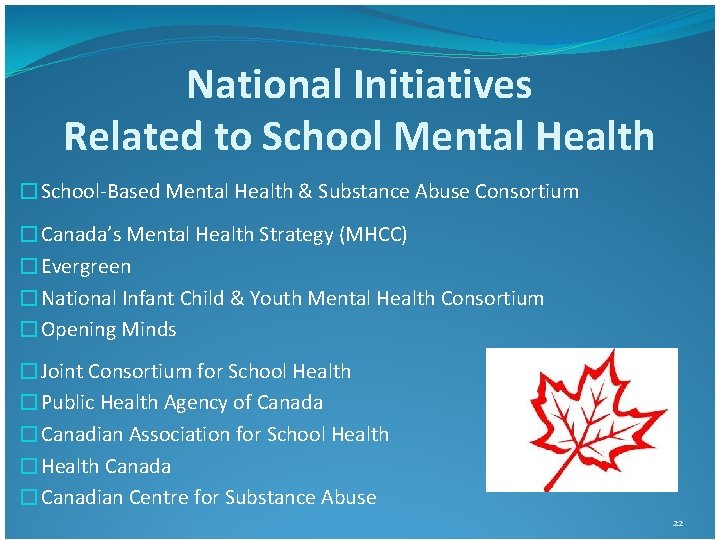
National Initiatives Related to School Mental Health �School-Based Mental Health & Substance Abuse Consortium �Canada’s Mental Health Strategy (MHCC) �Evergreen �National Infant Child & Youth Mental Health Consortium �Opening Minds �Joint Consortium for School Health �Public Health Agency of Canada �Canadian Association for School Health �Health Canada �Canadian Centre for Substance Abuse 22
SBMHSA Consortium � 40 member team of researchers, education professionals, school mental health professionals, etc. � 3 year project �Led by Ontario Centre of Excellence for Child & Youth Mental Health �Synthesis of Research �Scan of Nominated Practices �National Survey Findings: �Research gives us clear direction �Programming does not consistently reflect research �Organizational and systemic barriers impede 23
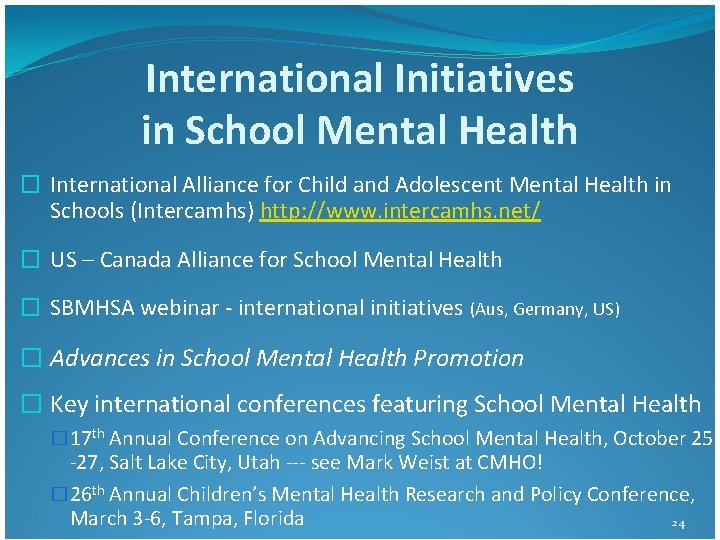
International Initiatives in School Mental Health � International Alliance for Child and Adolescent Mental Health in Schools (Intercamhs) http: //www. intercamhs. net/ � US – Canada Alliance for School Mental Health � SBMHSA webinar - international initiatives (Aus, Germany, US) � Advances in School Mental Health Promotion � Key international conferences featuring School Mental Health � 17 th Annual Conference on Advancing School Mental Health, October 25 -27, Salt Lake City, Utah --- see Mark Weist at CMHO! � 26 th Annual Children’s Mental Health Research and Policy Conference, March 3 -6, Tampa, Florida 24
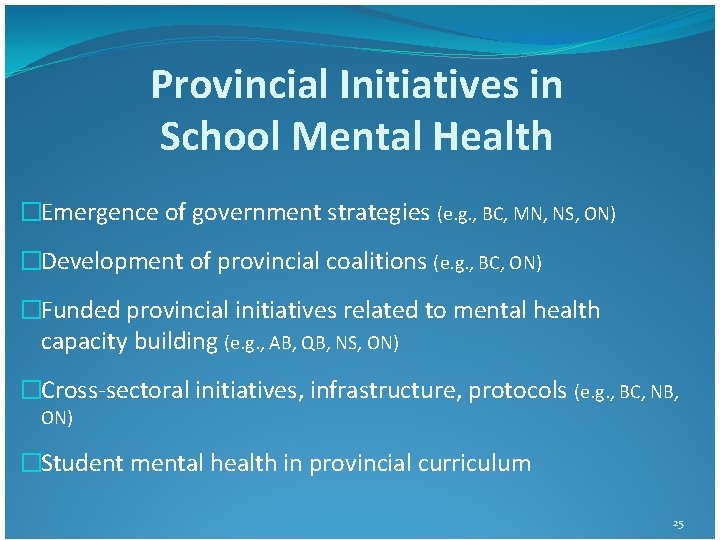
Provincial Initiatives in School Mental Health �Emergence of government strategies (e. g. , BC, MN, NS, ON) �Development of provincial coalitions (e. g. , BC, ON) �Funded provincial initiatives related to mental health capacity building (e. g. , AB, QB, NS, ON) �Cross-sectoral initiatives, infrastructure, protocols (e. g. , BC, NB, ON) �Student mental health in provincial curriculum 25
Acknowledging challenges Learning from past and present 26
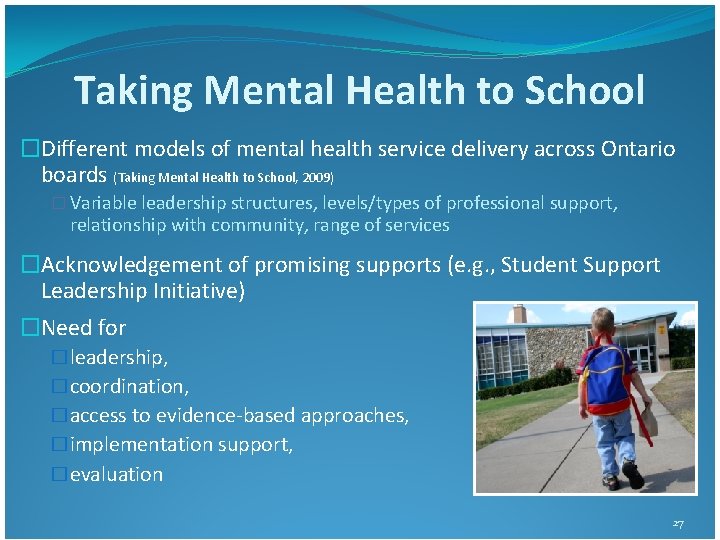
Taking Mental Health to School �Different models of mental health service delivery across Ontario boards (Taking Mental Health to School, 2009) � Variable leadership structures, levels/types of professional support, relationship with community, range of services �Acknowledgement of promising supports (e. g. , Student Support Leadership Initiative) �Need for �leadership, �coordination, �access to evidence-based approaches, �implementation support, �evaluation 27
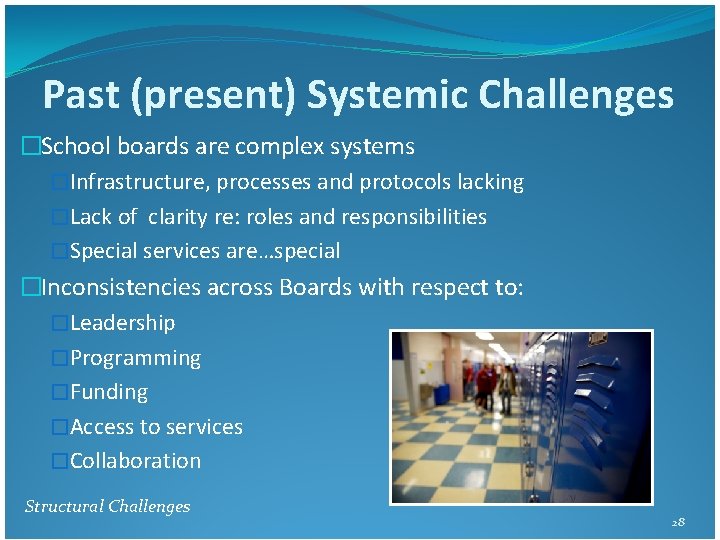
Past (present) Systemic Challenges �School boards are complex systems �Infrastructure, processes and protocols lacking �Lack of clarity re: roles and responsibilities �Special services are…special �Inconsistencies across Boards with respect to: �Leadership �Programming �Funding �Access to services �Collaboration Structural Challenges 28
Past (present) Systemic Challenges �Mental Health is not well understood �Not traditionally part of educator training �PD as a “one time event” �Links to high pressure achievement agenda unclear �Stigma, Attitudinal Biases �Discomfort and fear �Sometimes seen as outside of educator role �Worry about making a mistake, getting too close Knowledge Challenges 29
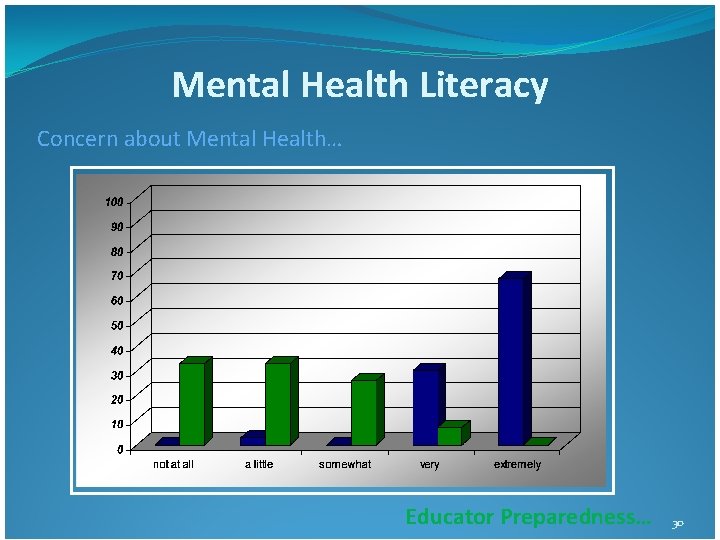
Mental Health Literacy Concern about Mental Health… Educator Preparedness… 30
Past (present) Systemic Challenges �Inconsistent access to high-quality programming �Evidence-based programs are expensive �Regional differences (in services, access, needs) �Funding shortfalls �Competing demands �Academic achievement agenda, with inherent pressures and supports, occupy most of time �Plates are full and increasing �Fragmented systems �Service pathways and protocols are not well-defined Implementation Challenges 31
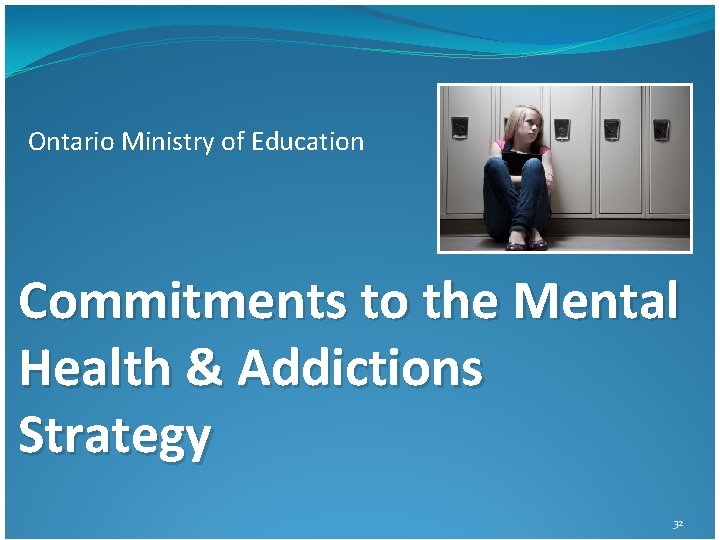
Ontario Ministry of Education Commitments to the Mental Health & Addictions Strategy 32
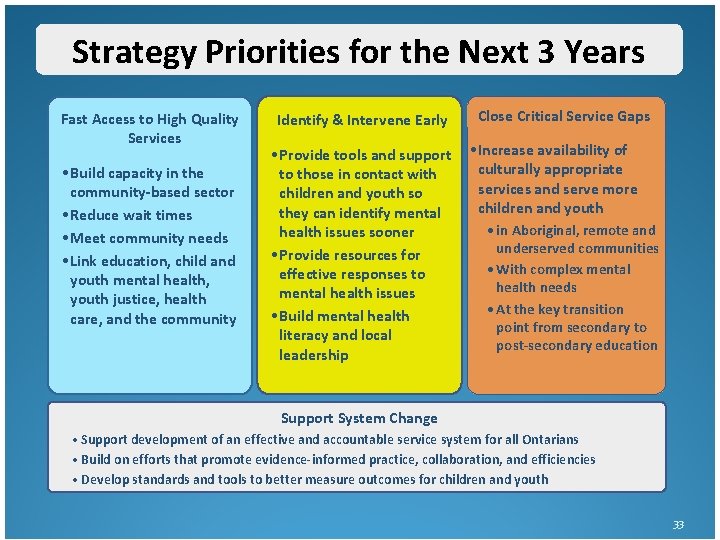
Strategy Priorities for the Next 3 Years Fast Access to High Quality Services • Build capacity in the community-based sector • Reduce wait times • Meet community needs • Link education, child and youth mental health, youth justice, health care, and the community Identify & Intervene Early Close Critical Service Gaps • Provide tools and support • Increase availability of culturally appropriate to those in contact with services and serve more children and youth so children and youth they can identify mental • in Aboriginal, remote and health issues sooner underserved communities • Provide resources for • With complex mental effective responses to health needs mental health issues • At the key transition • Build mental health point from secondary to literacy and local post-secondary education leadership Support System Change • Support development of an effective and accountable service system for all Ontarians • Build on efforts that promote evidence-informed practice, collaboration, and efficiencies • Develop standards and tools to better measure outcomes for children and youth 33
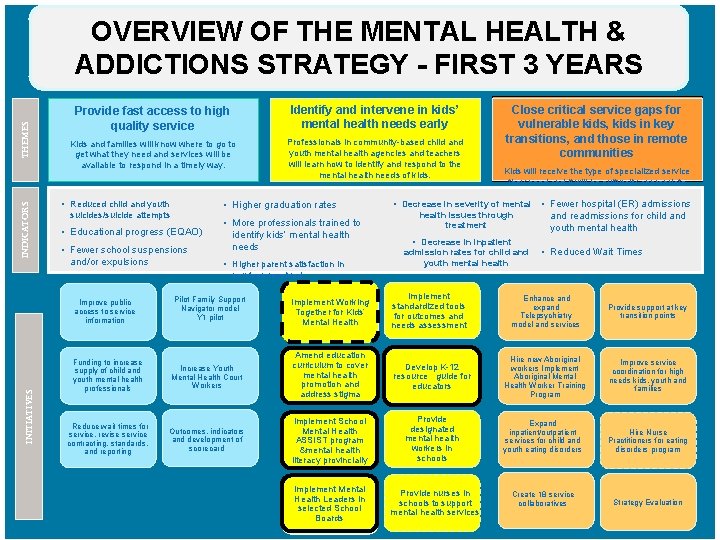
THEMES OVERVIEW OF THE MENTAL HEALTH & ADDICTIONS STRATEGY - Mental FIRST 3 YEARS Starting with Child and Youth Health Our Vision: An Ontario in which children and youth mental health isand recognized as ain key determinant of. Close overallcritical health and well-being, Identify intervene kids’ service gaps and for where Provide fast access to high children and youth reach their full potential. mental health needs early vulnerable kids, kids in key quality service transitions, and those in remote Professionals in community-based child and Kids and families will know where to go to youth mental health agencies and teachers communities get what they need and services will be will learn how to identify and respond to the mental health needs of kids. INDICATORS available to respond in a timely way. • Reduced child and youth • Higher graduation rates suicides/suicide attempts • Educational progress (EQAO) • Fewer school suspensions and/or expulsions • More professionals trained to identify kids’ mental health needs • Higher parent satisfaction in Kids will receive the type of specialized service they need and it will be culturally appropriate • Decrease in severity of mental health issues through treatment • Decrease in inpatient admission rates for child and youth mental health • Fewer hospital (ER) admissions and readmissions for child and youth mental health • Reduced Wait Times services received INITIATIVES Improve public access to service information Pilot Family Support Navigator model Y 1 pilot Implement Working Together for Kids’ Mental Health Implement standardized tools for outcomes and needs assessment Enhance and expand Telepsychiatry model and services Provide support at key transition points Improve service coordination for high needs kids, youth and families Funding to increase supply of child and youth mental health professionals Increase Youth Mental Health Court Workers Amend education curriculum to cover mental health promotion and address stigma Develop K-12 resource guide for educators Hire new Aboriginal workers Implement Aboriginal Mental Health Worker Training Program Reduce wait times for service, revise service contracting, standards, and reporting Outcomes, indicators and development of scorecard Implement School Mental Health ASSIST program &mental health literacy provincially Provide designated mental health workers in schools Expand inpatient/outpatient services for child and youth eating disorders Implement Mental Health Leaders in selected School Boards Provide nurses in schools to support mental health services Hire Nurse Practitioners for eating disorders program 34 Create 18 service collaboratives Strategy Evaluation 34
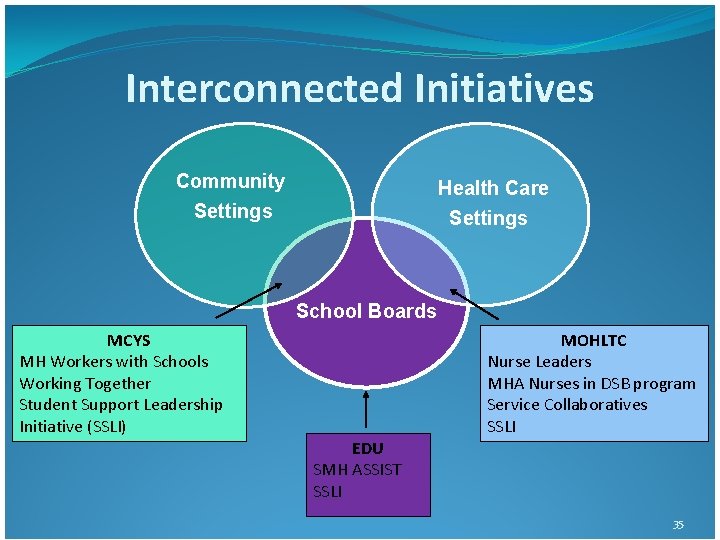
Interconnected Initiatives Community Settings Health Care Settings School Boards MCYS MH Workers with Schools Working Together Student Support Leadership Initiative (SSLI) EDU SMH ASSIST SSLI MOHLTC Nurse Leaders MHA Nurses in DSB program Service Collaboratives SSLI 35
EDU Strategy Commitments � Amend the education curriculum � Develop a K-12 Resource Guide/Website � Provide support for professional learning in mental health for all Ontario educators � Fund and support Mental Health Leaders � Implement School Mental Health ASSIST 36
School Mental Health ASSIST is a provincial implementation support team designed to help Ontario school boards to promote student mental health and wellbeing, through leadership, practical resources and systematic research-based approaches to school mental health. 37
Leadership Structure � Ontario Ministry of Education Lead � Special Education Policy & Programs Branch � School Board Lead � Hamilton-Wentworth District School Board � SMH ASSIST Core Team � Director, and 4+ P/T Implementation Coaches (3 Senior School Mental Health Professionals, 1 Superintendent), . 5 Research Associate (new!) � Cross-Sector Partners � Interministerial Staff Team � Hospital for Sick Children, Ontario Centre of Excellence for Child & Youth MH � Provincial Stakeholder Organizations � Evaluation and Implementation Consultation Team � Drs. Michael Boyle, Bruce Ferguson, Tom Kratochwill, Robert Lucio, Ian Manion, Doris Mc. Whorter, Karen Milligan, Caroline Parkin, Joyce Sebian, Mark Weist 38
Support to ALL Ontario Boards Resources • Webinar series, other staff development materials • Decision support tools • Templates • School Administrators’ Toolkit Consultation Workshops Representation on provincial reference groups & committees 39
Focus Boards � 15 Focus Boards in 2011 -2012 �Another 15 announced for 2012 -2013 �Boards receive 1 FTE Mental Health Leader and SMH ASSIST support �Reciprocal relationship with SMH ASSIST �ASSIST provides leadership & implementation support �Focus Boards help with piloting resources that will be rolled out to all boards in time 40
First Priorities 1. Organizational Conditions for Effective School Mental Health (addressing structural challenges) 2. Mental Health Capacity-Building (addressing knowledge challenges) 3. Implementation of Evidence-Based Mental Health Promotion and Prevention Programming (addressing implementation challenges) 41
Organizational Conditions for Effective School Mental Health 42
Organizational Conditions 1. Commitment 2. School Mental Health Leadership Team 3. Clear & Focused Vision 4. Shared Language 5. Assessment of Initial Capacity 6. Standard Processes 7. PD Protocols 8. School Mental Health Strategy / Action Plan 9. Broad Collaboration 10. Ongoing Quality Improvement 43
Self Reflection �Where is your board currently, TODAY, along each of the conditions… �Feel free to discuss, leave blank… �For your records… 44
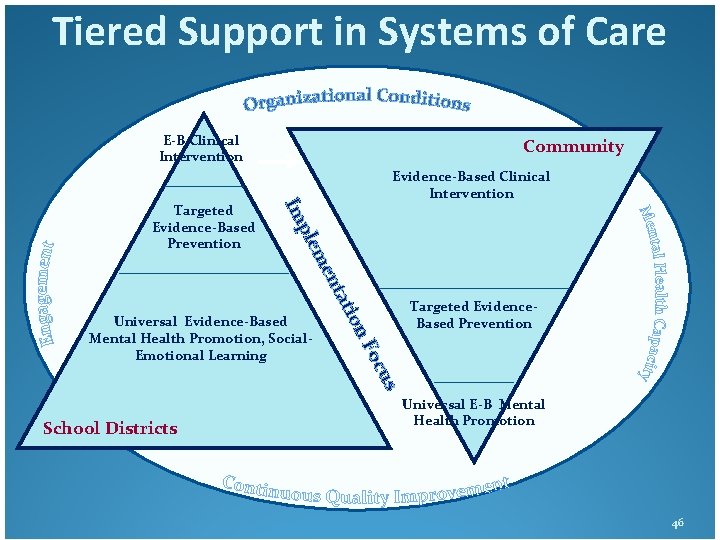
Condition #1 Commitment § Board leaders view child and youth mental health as a priority, and communicate this through action § Board leaders commit to Tiered Support Model § Help board staff to understand the rationale for the model, emphasizing the focus in schools on mental health promotion and prevention and the need to work with community partners for help with students with significant mental health concerns § Board leaders consistently attend community liaison meetings and internal MH team meetings § Board leaders provide visible, strategic and tangible support for needed infrastructure, resources, staffing 45
Tiered Support in Systems of Care E-B Clinical Intervention Evidence-Based Clinical Intervention nta me ple Im Targeted Evidence-Based Prevention Community n tio Fo Universal Evidence-Based Mental Health Promotion, Social. Emotional Learning Targeted Evidence. Based Prevention s cu School Districts Universal E-B Mental Health Promotion 46
Condition #2 School Mental Health Leadership Team § Board has a multidisciplinary, multi-layered mental health leadership team § All of the right people are at the table (in terms of expertise, influence, relationships, representation) § Parent and youth voice are critical § Team has meaningful liaison with community partners § Team is focused on vision-setting, leadership, collaboration, strategy/program selection, problem-solving 47
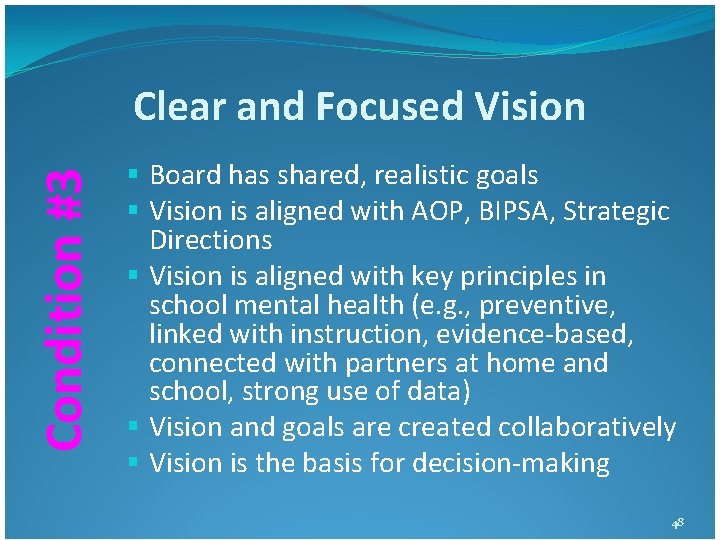
Condition #3 Clear and Focused Vision § Board has shared, realistic goals § Vision is aligned with AOP, BIPSA, Strategic Directions § Vision is aligned with key principles in school mental health (e. g. , preventive, linked with instruction, evidence-based, connected with partners at home and school, strong use of data) § Vision and goals are created collaboratively § Vision is the basis for decision-making 48
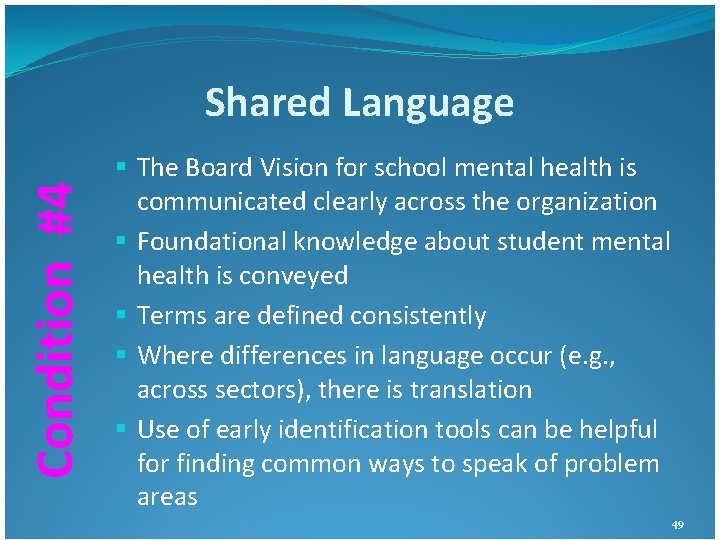
Condition #4 Shared Language § The Board Vision for school mental health is communicated clearly across the organization § Foundational knowledge about student mental health is conveyed § Terms are defined consistently § Where differences in language occur (e. g. , across sectors), there is translation § Use of early identification tools can be helpful for finding common ways to speak of problem areas 49
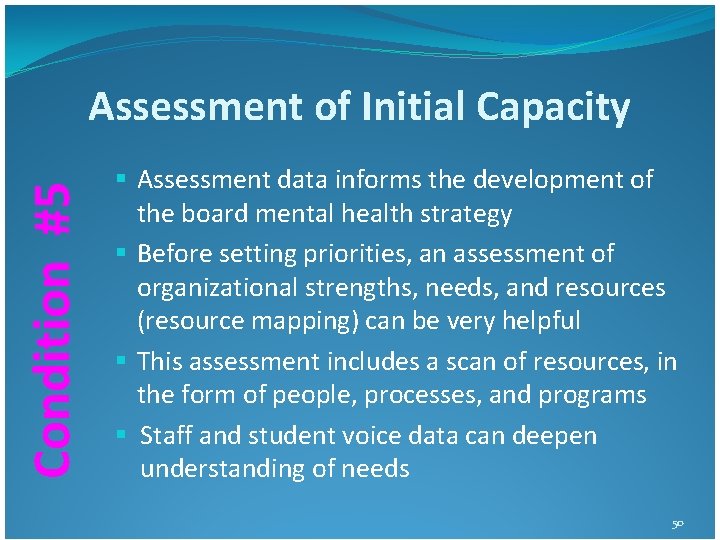
Condition #5 Assessment of Initial Capacity § Assessment data informs the development of the board mental health strategy § Before setting priorities, an assessment of organizational strengths, needs, and resources (resource mapping) can be very helpful § This assessment includes a scan of resources, in the form of people, processes, and programs § Staff and student voice data can deepen understanding of needs 50
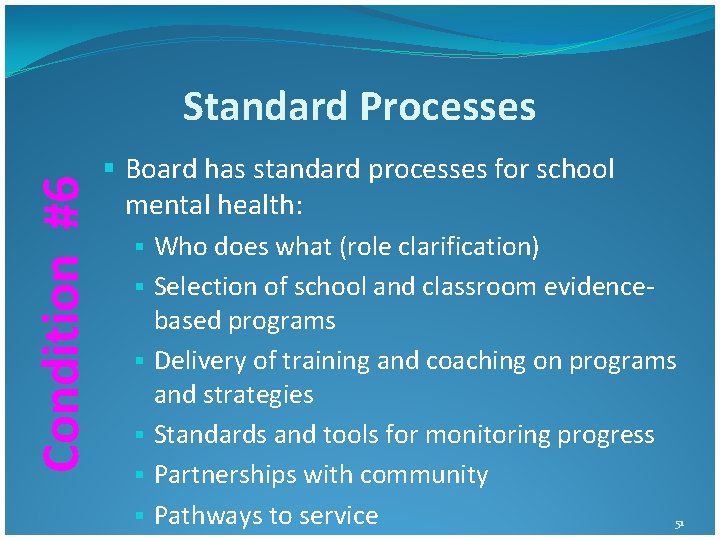
Condition #6 Standard Processes § Board has standard processes for school mental health: § Who does what (role clarification) § Selection of school and classroom evidencebased programs § Delivery of training and coaching on programs and strategies § Standards and tools for monitoring progress § Partnerships with community § Pathways to service 51
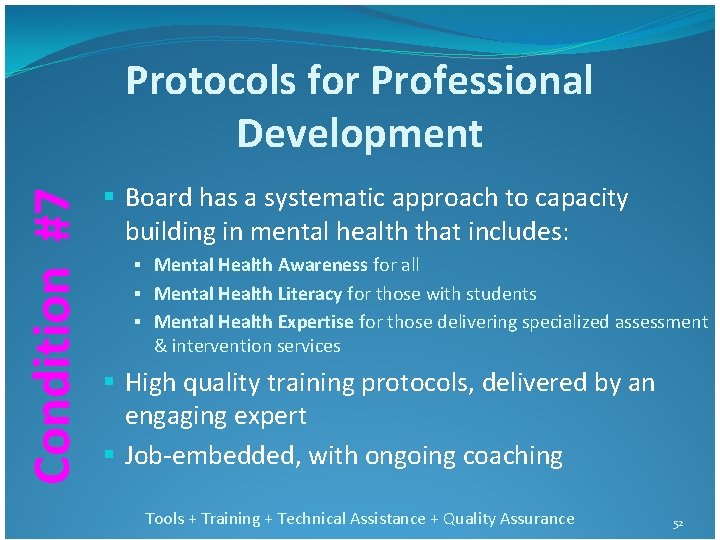
Condition #7 Protocols for Professional Development § Board has a systematic approach to capacity building in mental health that includes: § Mental Health Awareness for all § Mental Health Literacy for those with students § Mental Health Expertise for those delivering specialized assessment & intervention services § High quality training protocols, delivered by an engaging expert § Job-embedded, with ongoing coaching Tools + Training + Technical Assistance + Quality Assurance 52
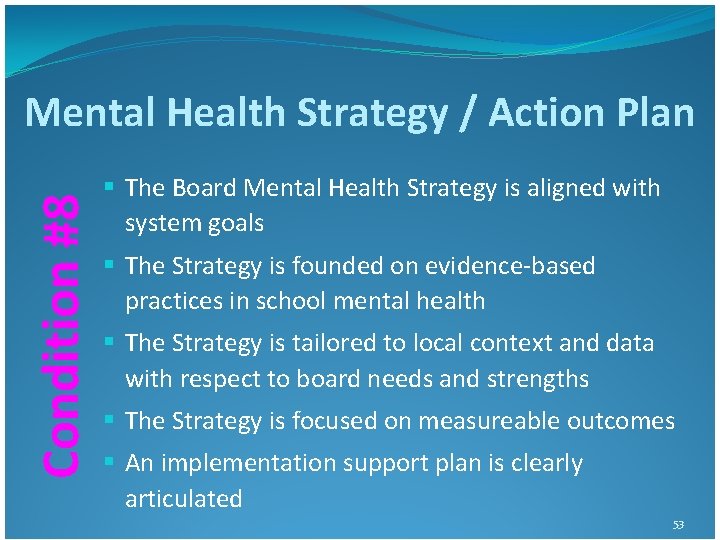
Condition #8 Mental Health Strategy / Action Plan § The Board Mental Health Strategy is aligned with system goals § The Strategy is founded on evidence-based practices in school mental health § The Strategy is tailored to local context and data with respect to board needs and strengths § The Strategy is focused on measureable outcomes § An implementation support plan is clearly articulated 53
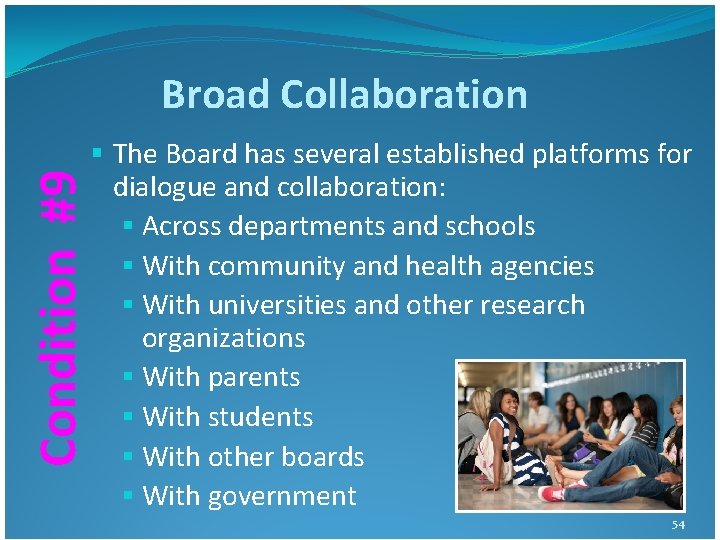
Condition #9 Broad Collaboration § The Board has several established platforms for dialogue and collaboration: § Across departments and schools § With community and health agencies § With universities and other research organizations § With parents § With students § With other boards § With government 54
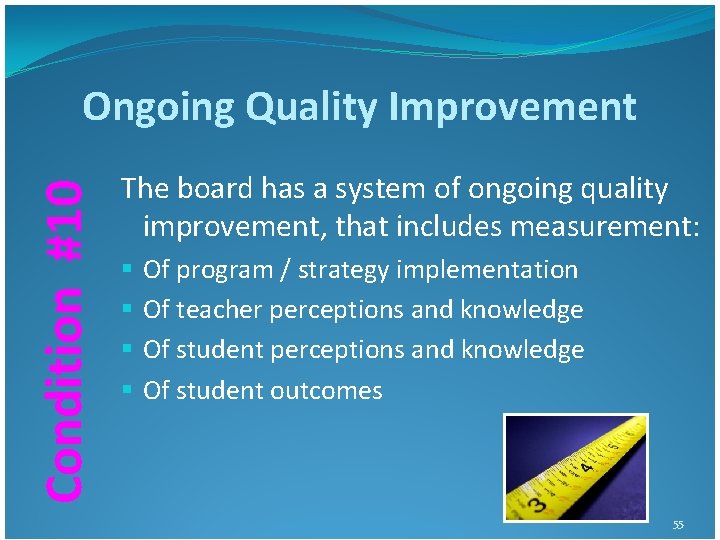
Condition #10 Ongoing Quality Improvement The board has a system of ongoing quality improvement, that includes measurement: § § Of program / strategy implementation Of teacher perceptions and knowledge Of student outcomes 55
Visit SMH ASSIST http: //smh-assist. ca/ 56
Contact School Mental Health ASSIST Kathy Short, Ph. D. , C. Psych. Director, School Mental Health ASSIST Kathy. Short@hwdsb. on. ca 905 -527 -5092, x 2634 School Mental Health ASSIST Questions? ? ? Équipe d’appui en santé mentale pour les écoles 57