Lecture Presentation Chapter 20 Radioactivity and Nuclear Chemistry



- Slides: 76
Lecture Presentation Chapter 20 Radioactivity and Nuclear Chemistry © 2017 Pearson Education, Ltd.
Radioactivity and Nuclear Chemistry • Radioactivity is the emission of subatomic particles or high-energy electromagnetic radiation by the nuclei of certain atoms. • Atoms that emit radiation are said to be radioactive. © 2017 Pearson Education, Ltd.
Medicine and Other Applications • Radioactivity has numerous applications, especially in medicine. • Nuclear radiation is used for the diagnosis and treatment of medical conditions. • Most radioactive emissions can pass through many types of matter (such as body tissue). • Naturally occurring radioactivity is used to estimate the age of fossils, rocks, and ancient artifacts. • Radioactivity led to the discovery of nuclear fission, used for electricity generation and nuclear weapons. © 2017 Pearson Education, Ltd.
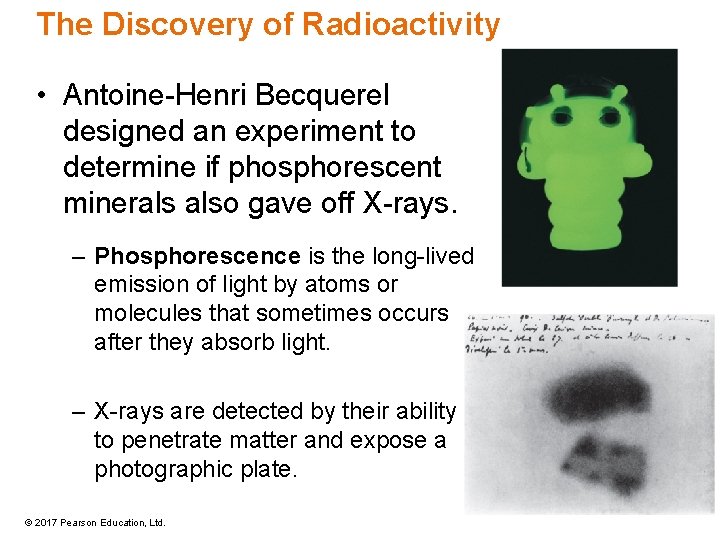
The Discovery of Radioactivity • Antoine-Henri Becquerel designed an experiment to determine if phosphorescent minerals also gave off X-rays. – Phosphorescence is the long-lived emission of light by atoms or molecules that sometimes occurs after they absorb light. – X-rays are detected by their ability to penetrate matter and expose a photographic plate. © 2017 Pearson Education, Ltd.
Discovery of Radioactivity: Becquerel • Becquerel discovered that certain minerals were constantly producing energy rays that could penetrate matter. • Becquerel determined that 1. all the minerals that produced these rays contained uranium, and 2. the rays were produced even though the mineral was not exposed to outside energy. • He called them uranic rays because they were emitted from minerals that contained uranium. – Like X-rays – Not related to phosphorescence © 2017 Pearson Education, Ltd.
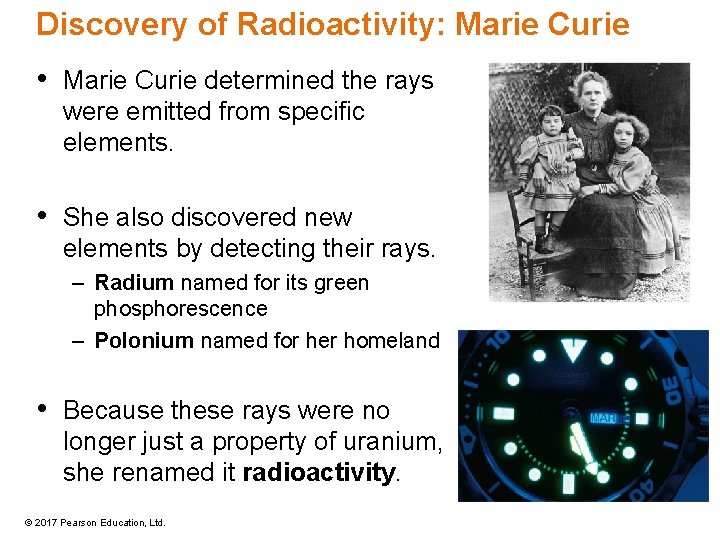
Discovery of Radioactivity: Marie Curie • Marie Curie determined the rays were emitted from specific elements. • She also discovered new elements by detecting their rays. – Radium named for its green phosphorescence – Polonium named for her homeland • Because these rays were no longer just a property of uranium, she renamed it radioactivity. © 2017 Pearson Education, Ltd.
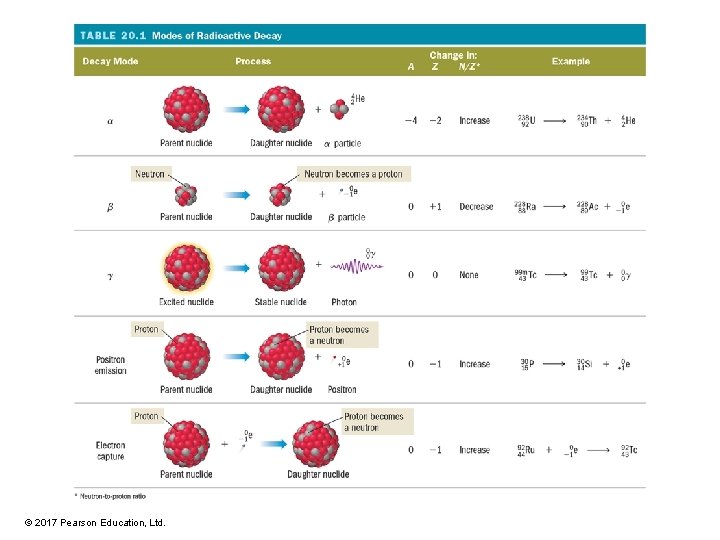
Types of Radioactive Decay • Rutherford discovered three types of rays: – Alpha (a) rays • Have a charge of +2 and a mass of 4 amu • What we now know to be helium nucleus – Beta (b) rays • Have a charge of − 1 c. u. and negligible mass • Electron-like – Gamma (g) rays • Form of light energy (not a particle like a and b) • In addition, some unstable nuclei emit positrons. – Like a positively charged electron • Some unstable nuclei will undergo electron capture. – A low energy electron is pulled into the nucleus. © 2017 Pearson Education, Ltd.
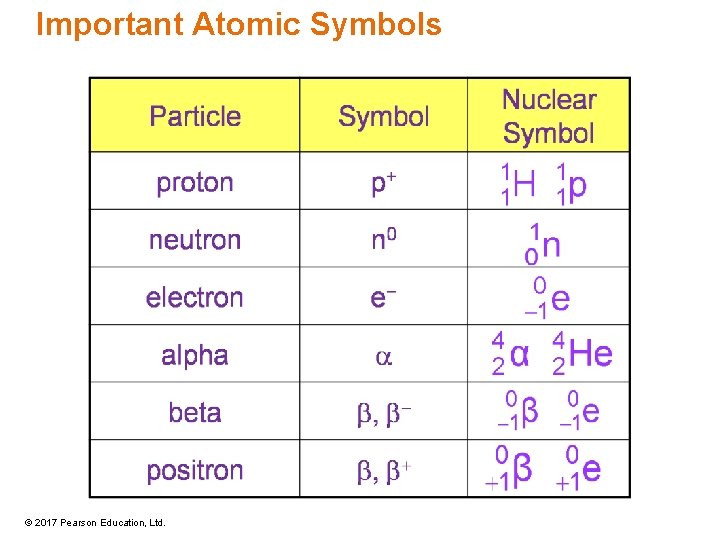
Isotopic Notation • Every atom of an element has the same number of protons. – Atomic number (Z) • Atoms of the same elements can have different numbers of neutrons, isotopes. • Isotopes are identified by their mass number (A). – Mass number = number of protons + neutrons © 2017 Pearson Education, Ltd.
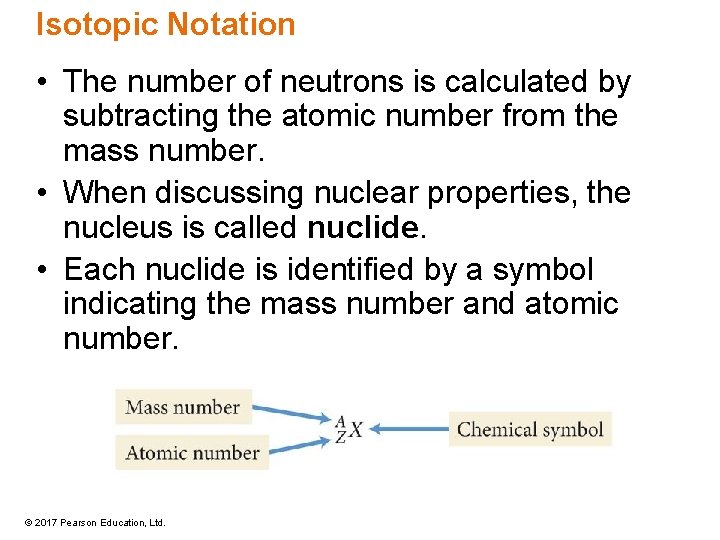
Isotopic Notation • The number of neutrons is calculated by subtracting the atomic number from the mass number. • When discussing nuclear properties, the nucleus is called nuclide. • Each nuclide is identified by a symbol indicating the mass number and atomic number. © 2017 Pearson Education, Ltd.
Important Atomic Symbols © 2017 Pearson Education, Ltd.
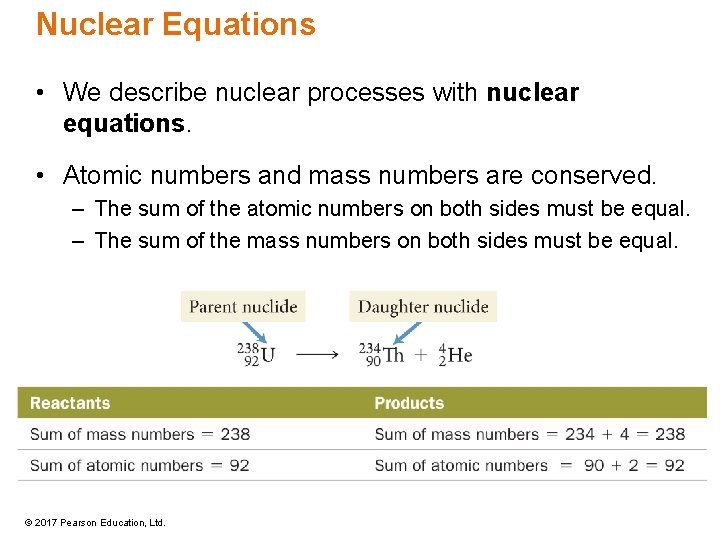
Nuclear Equations • We describe nuclear processes with nuclear equations. • Atomic numbers and mass numbers are conserved. – The sum of the atomic numbers on both sides must be equal. – The sum of the mass numbers on both sides must be equal. © 2017 Pearson Education, Ltd.
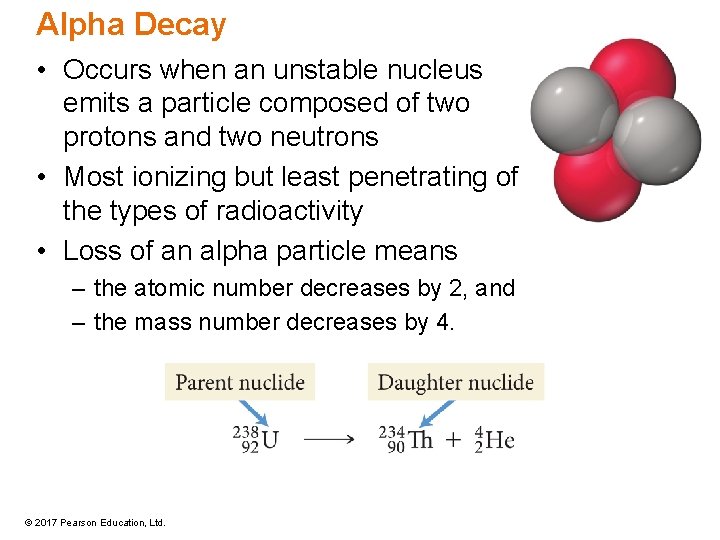
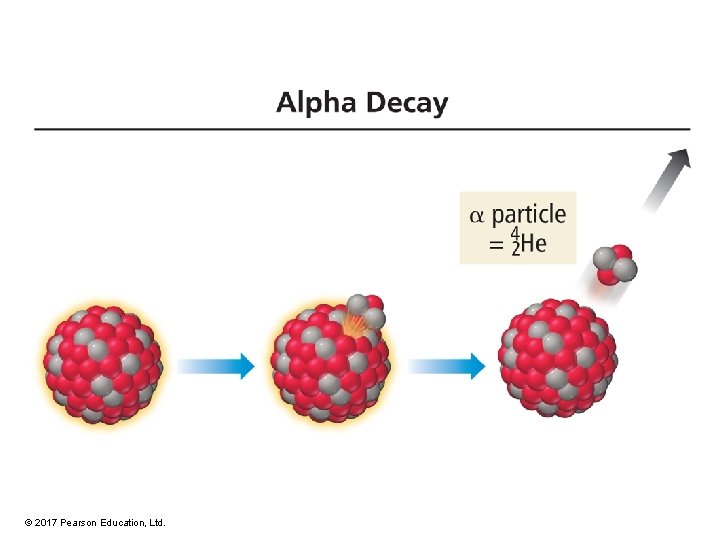
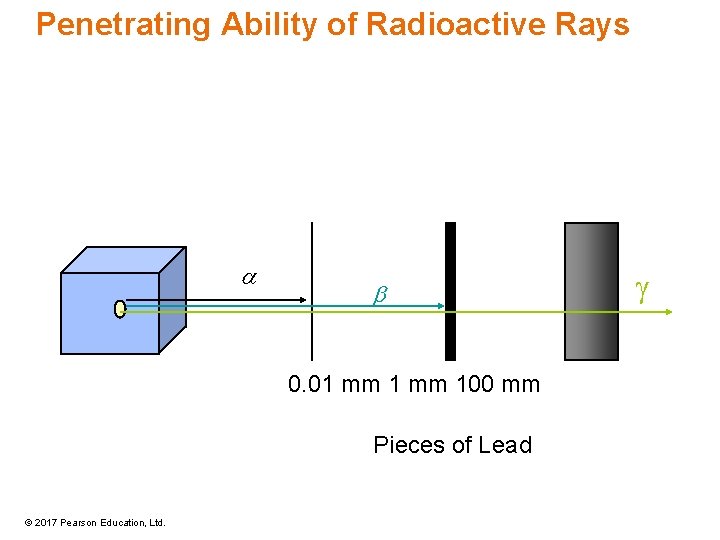
Alpha Decay • Occurs when an unstable nucleus emits a particle composed of two protons and two neutrons • Most ionizing but least penetrating of the types of radioactivity • Loss of an alpha particle means – the atomic number decreases by 2, and – the mass number decreases by 4. © 2017 Pearson Education, Ltd.
© 2017 Pearson Education, Ltd.
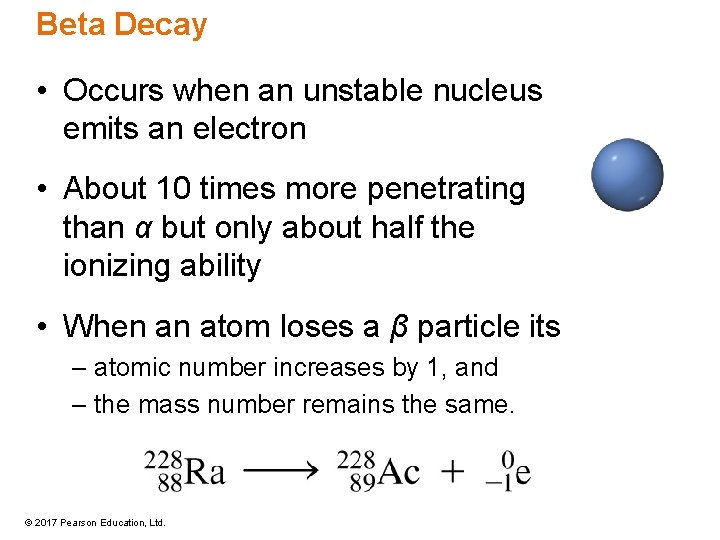
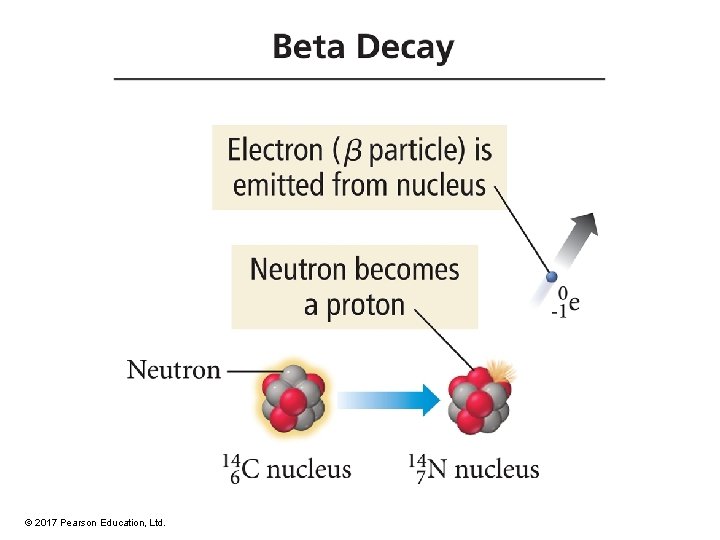
Beta Decay • Occurs when an unstable nucleus emits an electron • About 10 times more penetrating than α but only about half the ionizing ability • When an atom loses a β particle its – atomic number increases by 1, and – the mass number remains the same. © 2017 Pearson Education, Ltd.
© 2017 Pearson Education, Ltd.
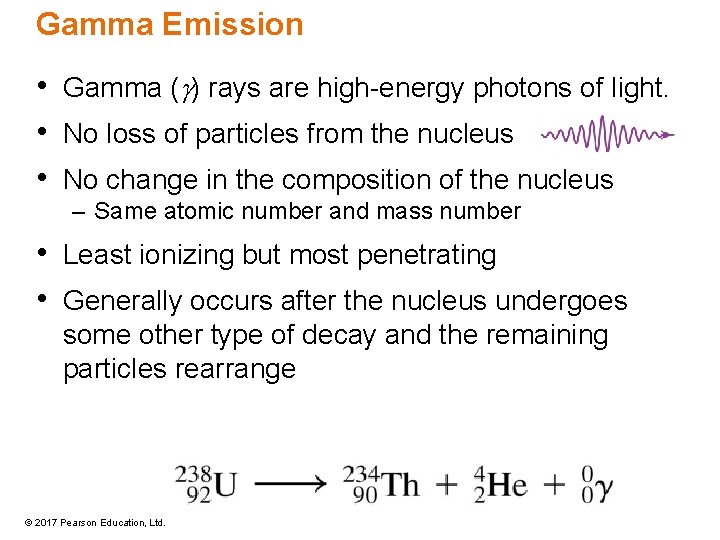
Gamma Emission • Gamma (g) rays are high-energy photons of light. • No loss of particles from the nucleus • No change in the composition of the nucleus – Same atomic number and mass number • Least ionizing but most penetrating • Generally occurs after the nucleus undergoes some other type of decay and the remaining particles rearrange © 2017 Pearson Education, Ltd.
Penetrating Ability of Radioactive Rays a b 0. 01 mm 100 mm Pieces of Lead © 2017 Pearson Education, Ltd. g
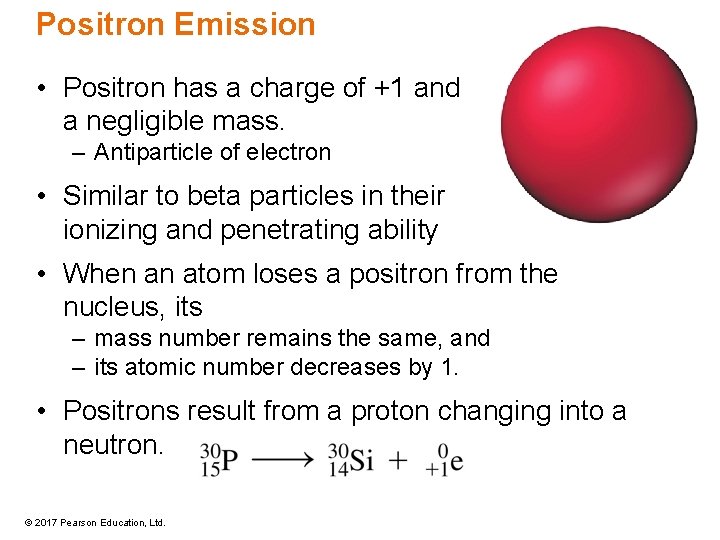
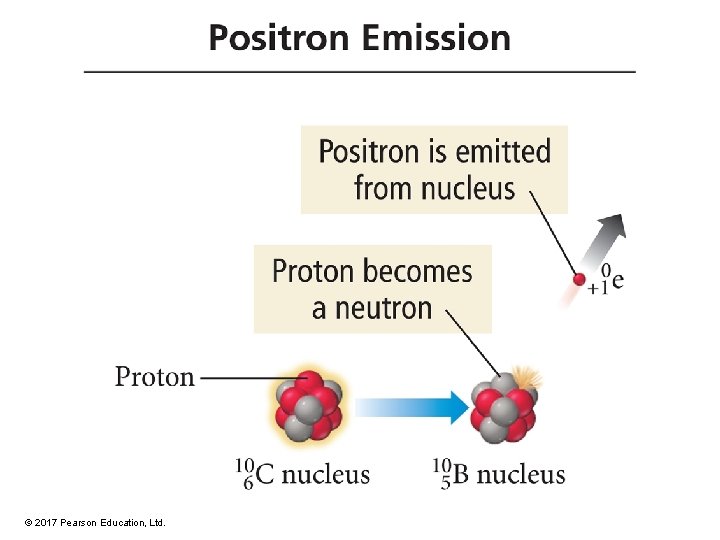
Positron Emission • Positron has a charge of +1 and a negligible mass. – Antiparticle of electron • Similar to beta particles in their ionizing and penetrating ability • When an atom loses a positron from the nucleus, its – mass number remains the same, and – its atomic number decreases by 1. • Positrons result from a proton changing into a neutron. © 2017 Pearson Education, Ltd.
© 2017 Pearson Education, Ltd.
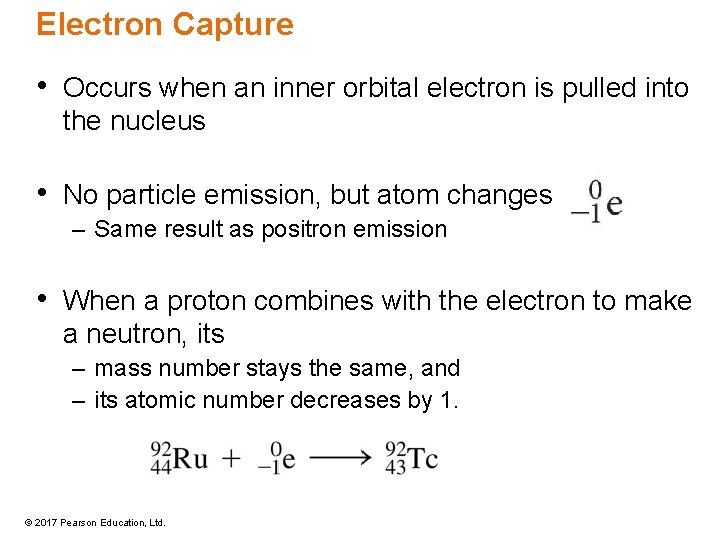
Electron Capture • Occurs when an inner orbital electron is pulled into the nucleus • No particle emission, but atom changes – Same result as positron emission • When a proton combines with the electron to make a neutron, its – mass number stays the same, and – its atomic number decreases by 1. © 2017 Pearson Education, Ltd.
© 2017 Pearson Education, Ltd.
What Causes Radioactivity? • The particles in the nucleus are held together by a very strong attractive force found only in the nucleus called the strong force. – Acts over only very short distances • Protons and neutrons are called nucleons. • The neutrons play an important role in stabilizing the nucleus, since they add to the strong force but don’t repel each other like the protons do. © 2017 Pearson Education, Ltd.
N/Z Ratio • The ratio of neutrons : protons is an important measure of the stability of the nucleus. • If the N/Z ratio is too high, neutrons are converted to protons via b decay. • If the N/Z ratio is too low, protons are converted to neutrons via positron emission or electron capture. – Or via a decay, though not as efficiently © 2017 Pearson Education, Ltd.
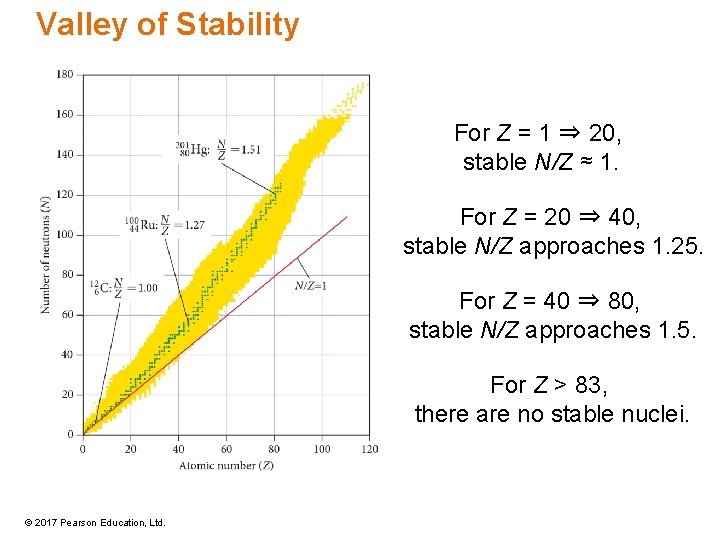
Valley of Stability For Z = 1 ⇒ 20, stable N/Z ≈ 1. For Z = 20 ⇒ 40, stable N/Z approaches 1. 25. For Z = 40 ⇒ 80, stable N/Z approaches 1. 5. For Z > 83, there are no stable nuclei. © 2017 Pearson Education, Ltd.
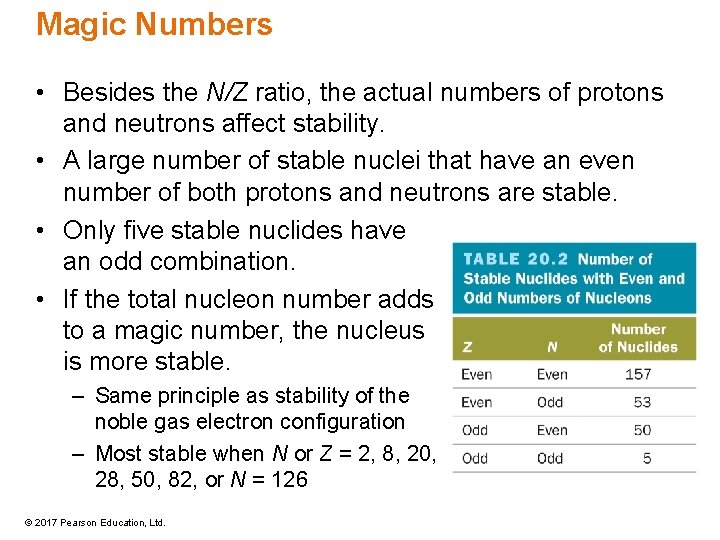
Magic Numbers • Besides the N/Z ratio, the actual numbers of protons and neutrons affect stability. • A large number of stable nuclei that have an even number of both protons and neutrons are stable. • Only five stable nuclides have an odd combination. • If the total nucleon number adds to a magic number, the nucleus is more stable. – Same principle as stability of the noble gas electron configuration – Most stable when N or Z = 2, 8, 20, 28, 50, 82, or N = 126 © 2017 Pearson Education, Ltd.
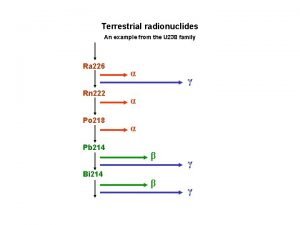
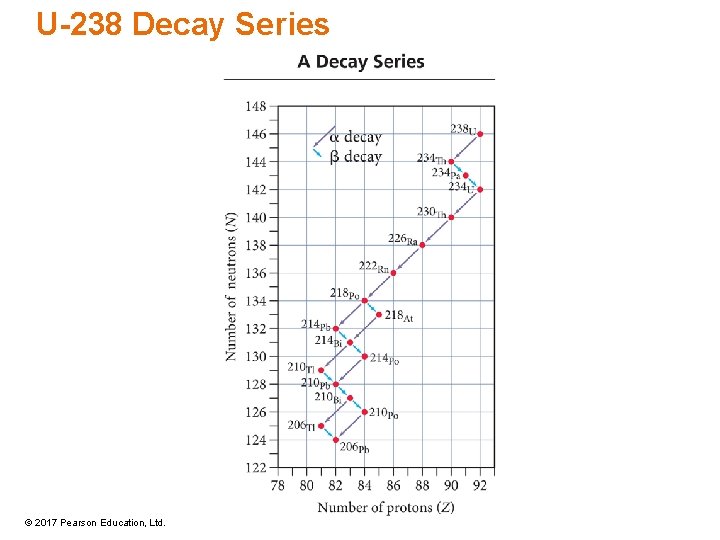
Decay Series • Atoms with Z > 83 are radioactive. • In nature, often one radioactive nuclide changes into another radioactive nuclide. • All of the radioactive nuclides are produced one after the other until a stable nuclide is reached. This process is called a decay series. © 2017 Pearson Education, Ltd.
U-238 Decay Series © 2017 Pearson Education, Ltd.
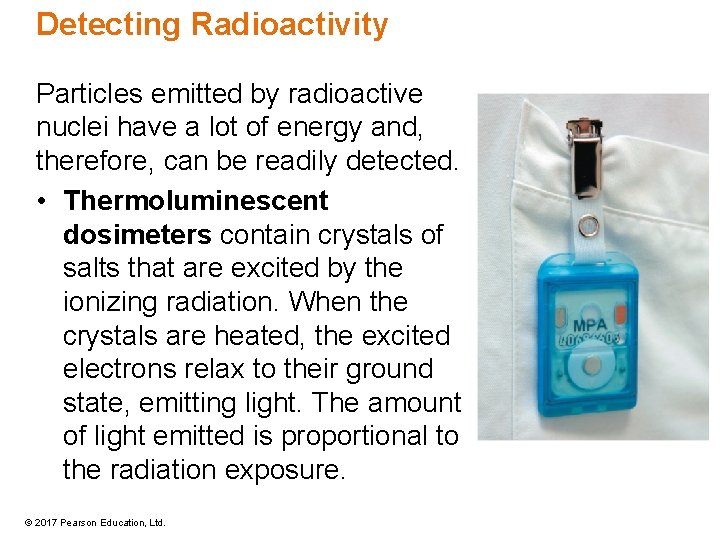
Detecting Radioactivity Particles emitted by radioactive nuclei have a lot of energy and, therefore, can be readily detected. • Thermoluminescent dosimeters contain crystals of salts that are excited by the ionizing radiation. When the crystals are heated, the excited electrons relax to their ground state, emitting light. The amount of light emitted is proportional to the radiation exposure. © 2017 Pearson Education, Ltd.
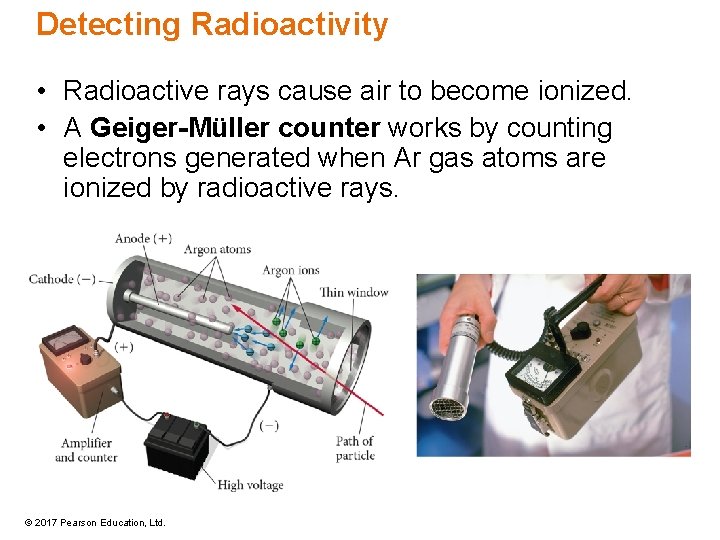
Detecting Radioactivity • Radioactive rays cause air to become ionized. • A Geiger-Müller counter works by counting electrons generated when Ar gas atoms are ionized by radioactive rays. © 2017 Pearson Education, Ltd.
Detecting Radioactivity • Radioactive rays cause certain chemicals to give off a flash of light when they strike the chemical. • A scintillation counter is able to count the number of flashes per minute. © 2017 Pearson Education, Ltd.
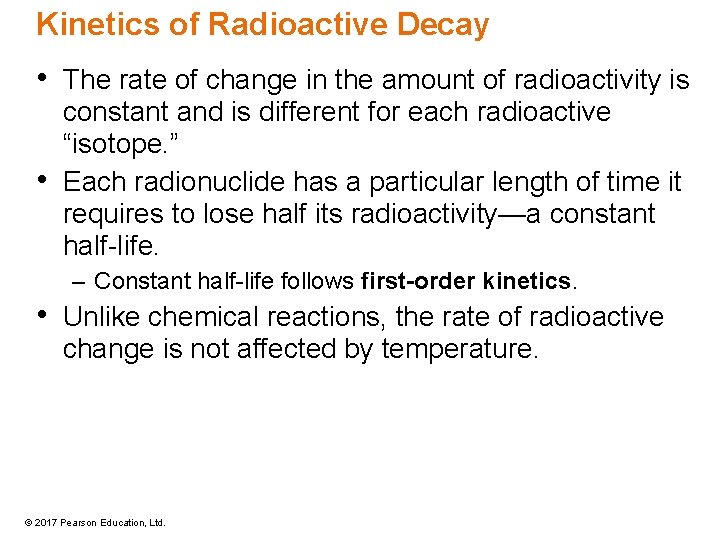
Kinetics of Radioactive Decay • The rate of change in the amount of radioactivity is • constant and is different for each radioactive “isotope. ” Each radionuclide has a particular length of time it requires to lose half its radioactivity—a constant half-life. – Constant half-life follows first-order kinetics. • Unlike chemical reactions, the rate of radioactive change is not affected by temperature. © 2017 Pearson Education, Ltd.
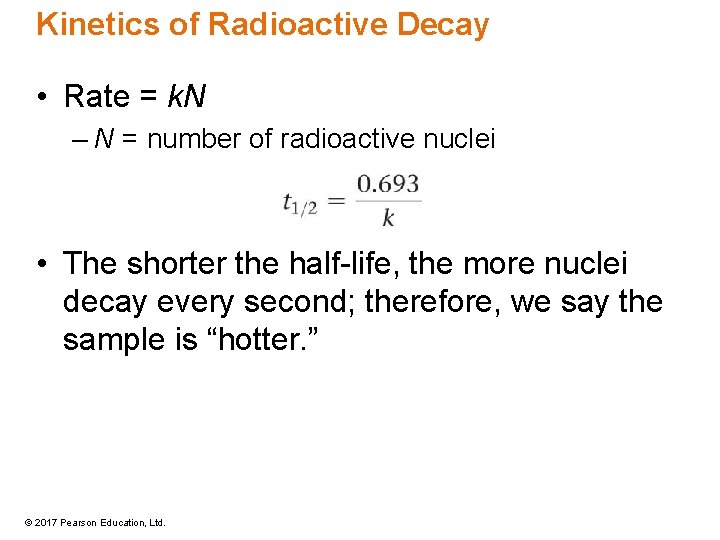
Kinetics of Radioactive Decay • Rate = k. N – N = number of radioactive nuclei • The shorter the half-life, the more nuclei decay every second; therefore, we say the sample is “hotter. ” © 2017 Pearson Education, Ltd.
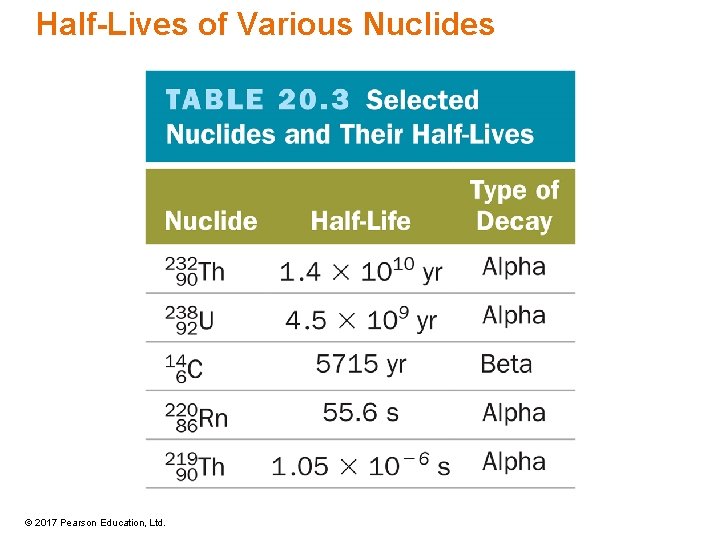
Half-Lives of Various Nuclides © 2017 Pearson Education, Ltd.
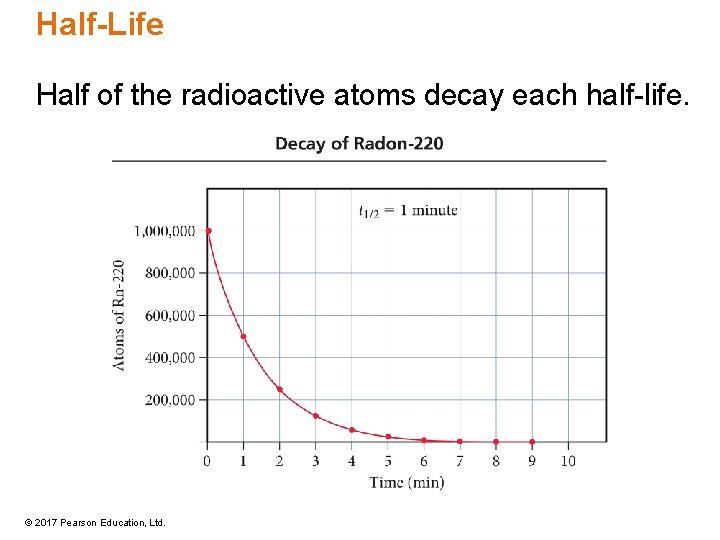
Half-Life Half of the radioactive atoms decay each half-life. © 2017 Pearson Education, Ltd.
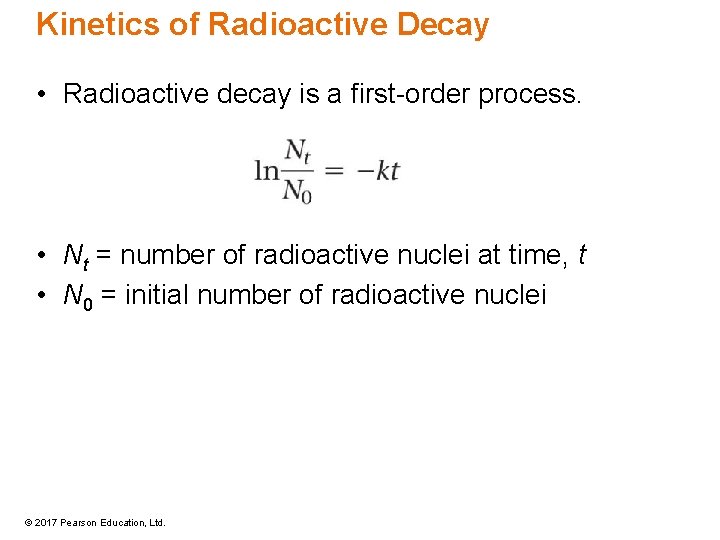
Kinetics of Radioactive Decay • Radioactive decay is a first-order process. • Nt = number of radioactive nuclei at time, t • N 0 = initial number of radioactive nuclei © 2017 Pearson Education, Ltd.
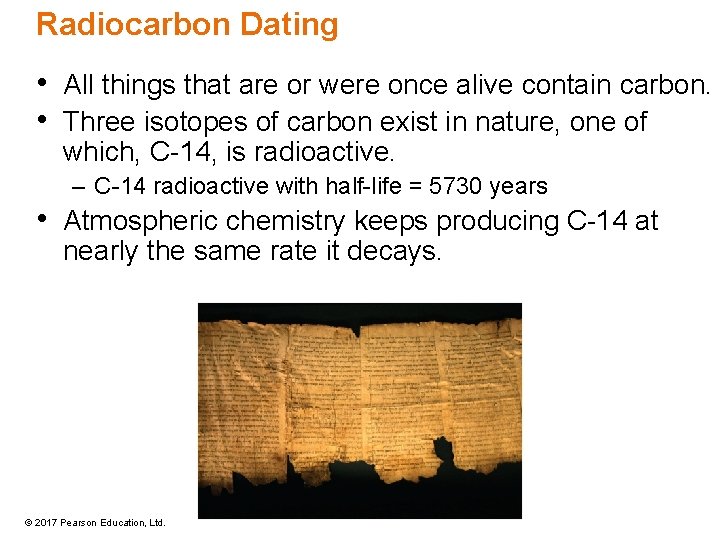
Radiocarbon Dating • All things that are or were once alive contain carbon. • Three isotopes of carbon exist in nature, one of which, C-14, is radioactive. – C-14 radioactive with half-life = 5730 years • Atmospheric chemistry keeps producing C-14 at nearly the same rate it decays. © 2017 Pearson Education, Ltd.
Radiocarbon Dating • While still living, 14 C/12 C is constant because the organism replenishes its supply of carbon. – CO 2 in the air is the ultimate source of all C in an organism. • Once the organism dies, the 14 C/12 C ratio • • • decreases. The half-life of 14 C is 5715 years. By measuring the 14 C/12 C ratio in a once-living artifact and comparing it to the 14 C/12 C ratio in a living organism, we can tell how long ago the organism was alive. The limit for this technique is 50, 000 years old. – About 9 half-lives, after which radioactivity from 14 C will be below background radiation © 2017 Pearson Education, Ltd.
Radiometric Dating • Radiocarbon dating can measure only relatively young • • objecst, <50, 000 years. The most dependable technique relies on the ratio of 238 U to 206 Pb within igneous rocks. Half-life of the decay of 238 U to 206 Pb is 4. 5 × 10⁹ years. Compare the amount of 238 U to 206 Pb in volcanic rocks and meteorites. Earth’s age is estimated to be between 4. 0 and 4. 5 billion years old. – Determined by both 238 U/206 Pb and 40 K/40 Ar dating – Estimated age of the Earth is inconsistent with the estimated age of our universe—about 13. 7 billion years, estimated by expansion rate. © 2017 Pearson Education, Ltd.
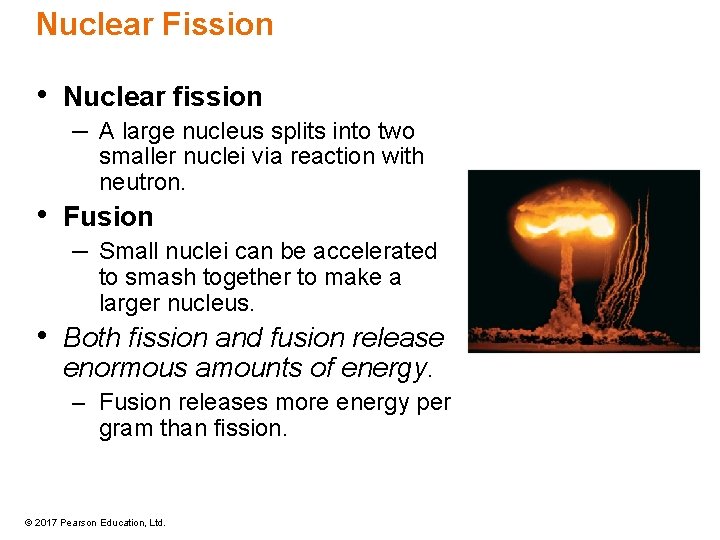
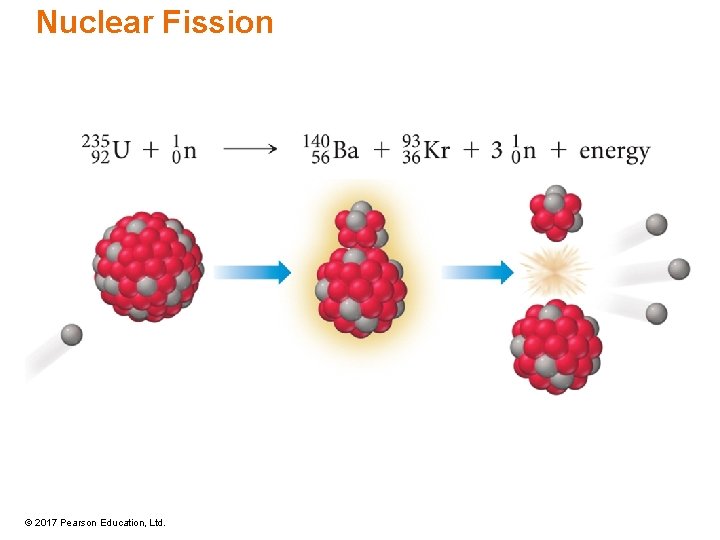
Nuclear Fission • Nuclear fission – A large nucleus splits into two smaller nuclei via reaction with neutron. • Fusion – Small nuclei can be accelerated to smash together to make a larger nucleus. • Both fission and fusion release enormous amounts of energy. – Fusion releases more energy per gram than fission. © 2017 Pearson Education, Ltd.
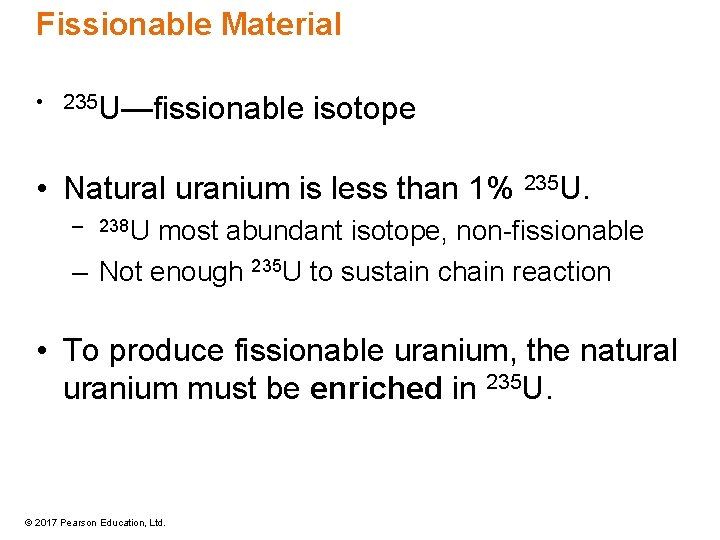
Fissionable Material • 235 U—fissionable isotope • Natural uranium is less than 1% 235 U. – 238 U most abundant isotope, non-fissionable – Not enough 235 U to sustain chain reaction • To produce fissionable uranium, the natural uranium must be enriched in 235 U. © 2017 Pearson Education, Ltd.
Nuclear Fission © 2017 Pearson Education, Ltd.
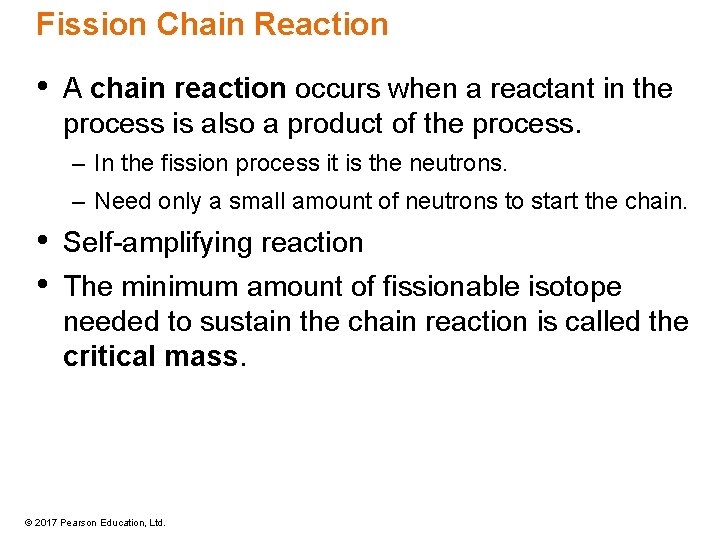
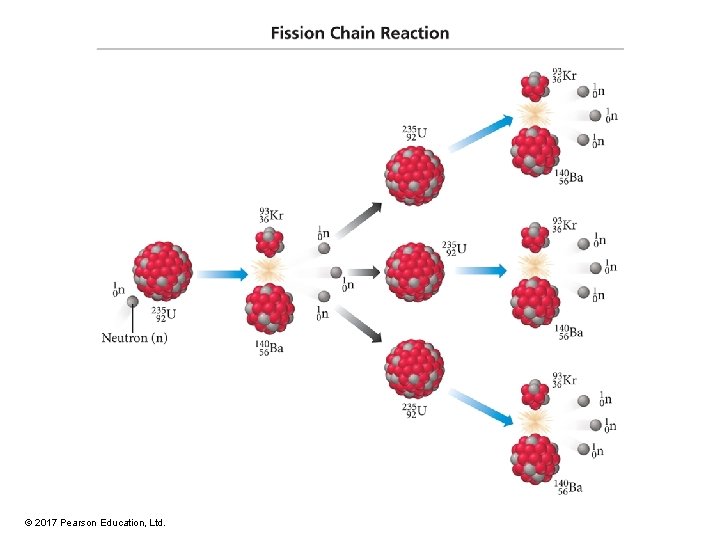
Fission Chain Reaction • A chain reaction occurs when a reactant in the process is also a product of the process. – In the fission process it is the neutrons. – Need only a small amount of neutrons to start the chain. • Self-amplifying reaction • The minimum amount of fissionable isotope needed to sustain the chain reaction is called the critical mass. © 2017 Pearson Education, Ltd.
© 2017 Pearson Education, Ltd.
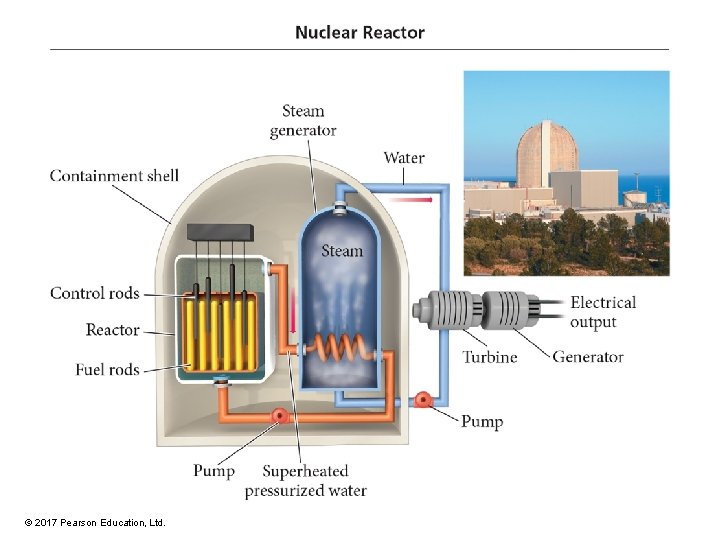
Nuclear Power • Nuclear fission generates enormous amounts of energy. • Nuclear reactors use fission to generate electricity. – About 20% of U. S. electricity – About 70% of electricity in other countries • The heat boils water, turning it to steam. • The steam turns the turbines, generating electricity. © 2017 Pearson Education, Ltd.
© 2017 Pearson Education, Ltd.
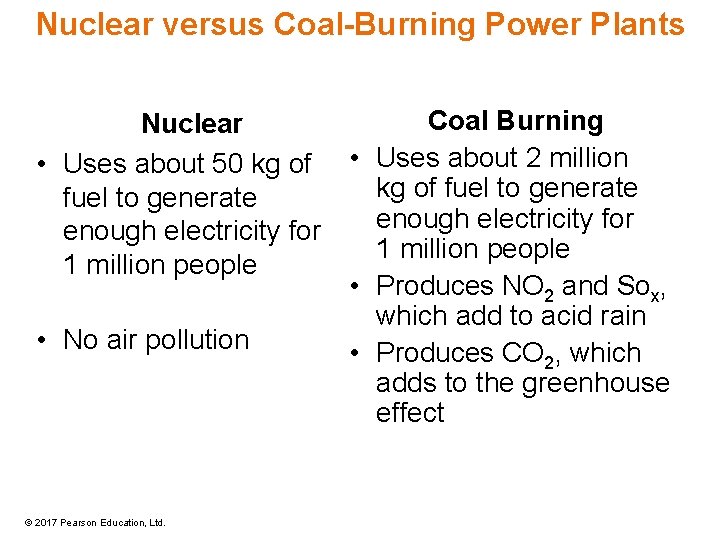
Nuclear versus Coal-Burning Power Plants Nuclear • Uses about 50 kg of fuel to generate enough electricity for 1 million people • No air pollution © 2017 Pearson Education, Ltd. Coal Burning • Uses about 2 million kg of fuel to generate enough electricity for 1 million people • Produces NO 2 and Sox, which add to acid rain • Produces CO 2, which adds to the greenhouse effect
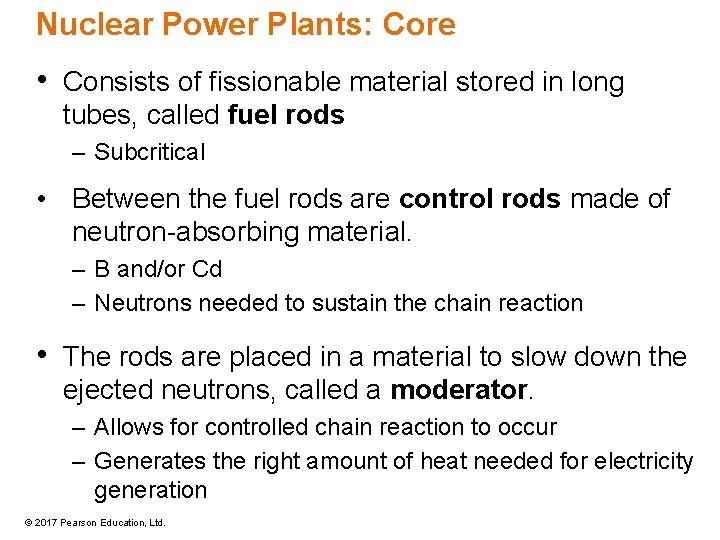
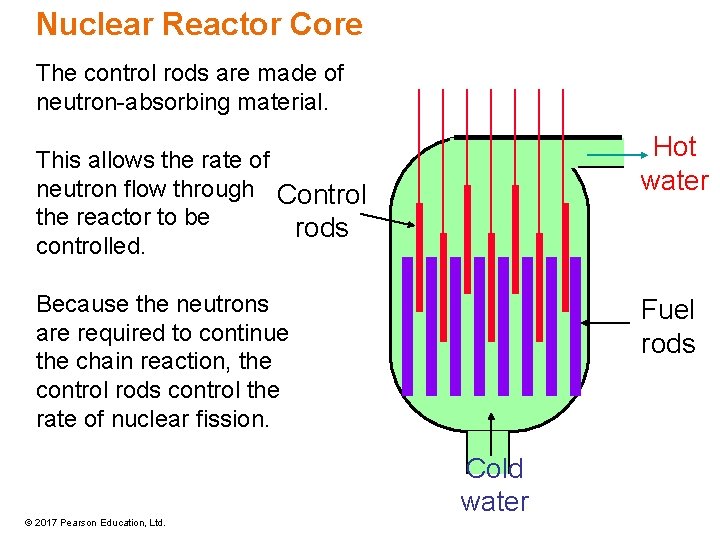
Nuclear Power Plants: Core • Consists of fissionable material stored in long tubes, called fuel rods – Subcritical • Between the fuel rods are control rods made of neutron-absorbing material. – B and/or Cd – Neutrons needed to sustain the chain reaction • The rods are placed in a material to slow down the ejected neutrons, called a moderator. – Allows for controlled chain reaction to occur – Generates the right amount of heat needed for electricity generation © 2017 Pearson Education, Ltd.
Nuclear Reactor Core The control rods are made of neutron-absorbing material. Hot water This allows the rate of neutron flow through Control the reactor to be rods controlled. Because the neutrons are required to continue the chain reaction, the control rods control the rate of nuclear fission. © 2017 Pearson Education, Ltd. Fuel rods Cold water
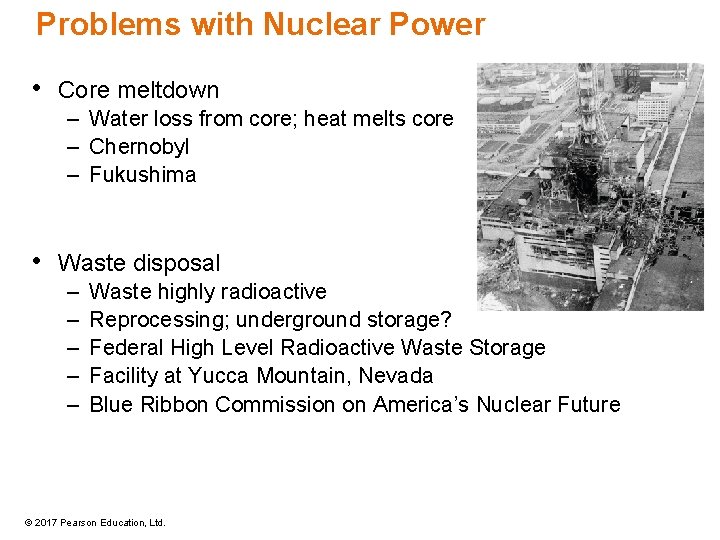
Problems with Nuclear Power • Core meltdown – Water loss from core; heat melts core – Chernobyl – Fukushima • Waste disposal – – – Waste highly radioactive Reprocessing; underground storage? Federal High Level Radioactive Waste Storage Facility at Yucca Mountain, Nevada Blue Ribbon Commission on America’s Nuclear Future © 2017 Pearson Education, Ltd.
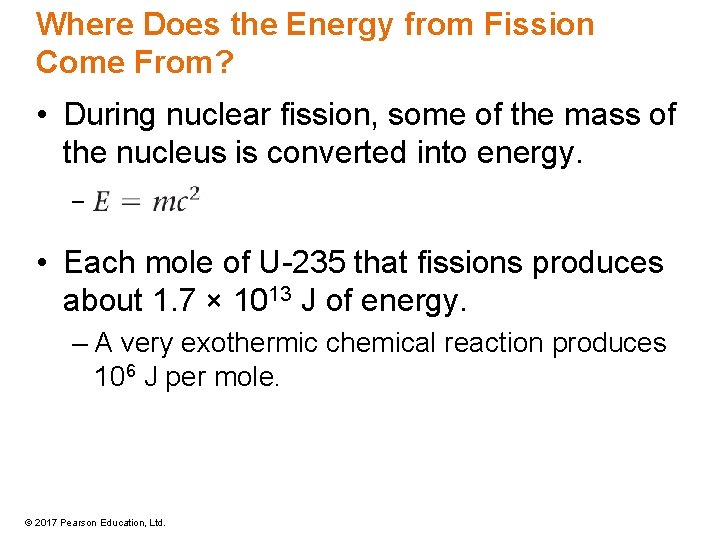
Where Does the Energy from Fission Come From? • During nuclear fission, some of the mass of the nucleus is converted into energy. – • Each mole of U-235 that fissions produces about 1. 7 × 10¹³ J of energy. – A very exothermic chemical reaction produces 106 J per mole. © 2017 Pearson Education, Ltd.
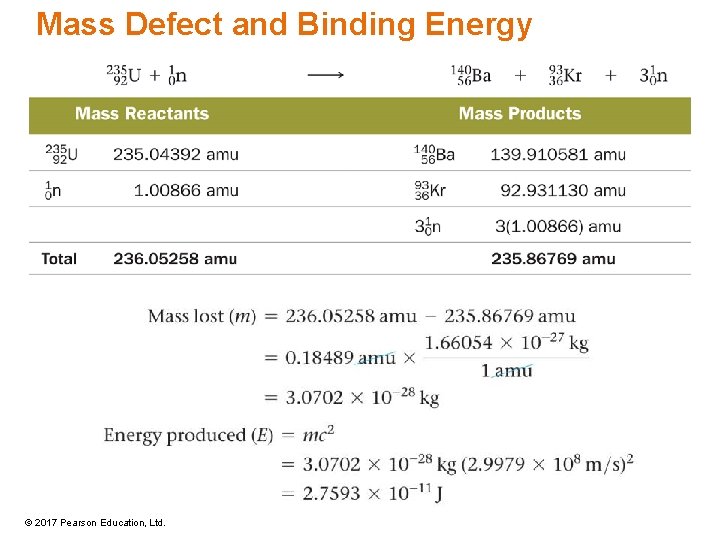
Mass Defect and Binding Energy © 2017 Pearson Education, Ltd.
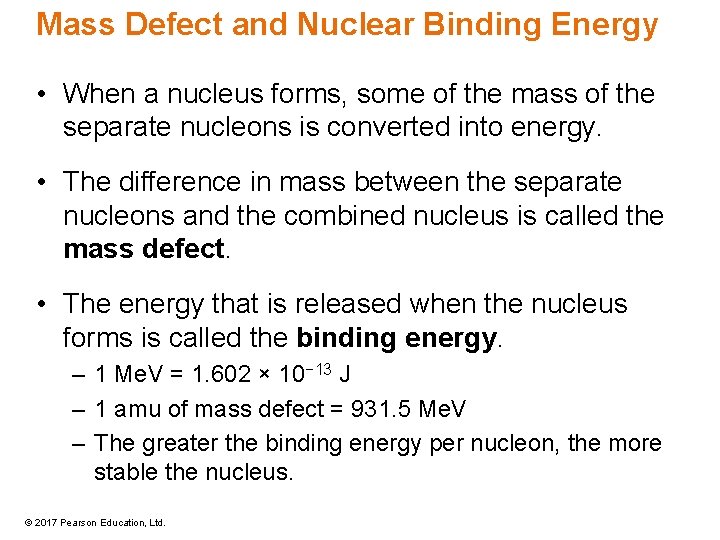
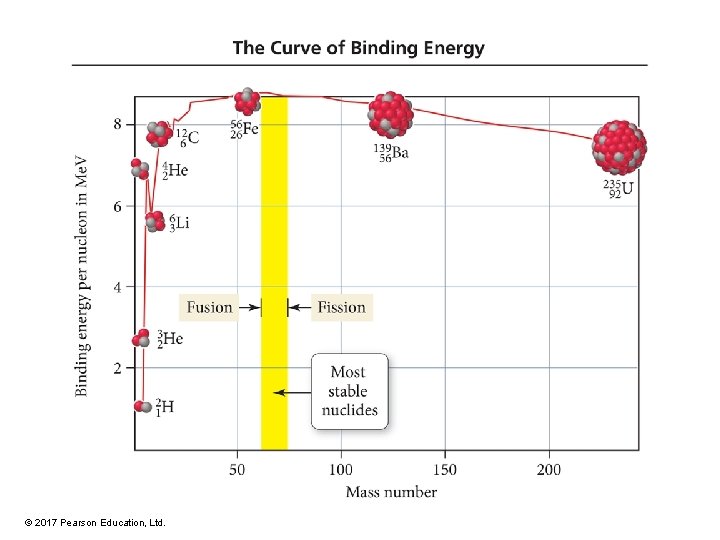
Mass Defect and Nuclear Binding Energy • When a nucleus forms, some of the mass of the separate nucleons is converted into energy. • The difference in mass between the separate nucleons and the combined nucleus is called the mass defect. • The energy that is released when the nucleus forms is called the binding energy. – 1 Me. V = 1. 602 × 10− 13 J – 1 amu of mass defect = 931. 5 Me. V – The greater the binding energy per nucleon, the more stable the nucleus. © 2017 Pearson Education, Ltd.
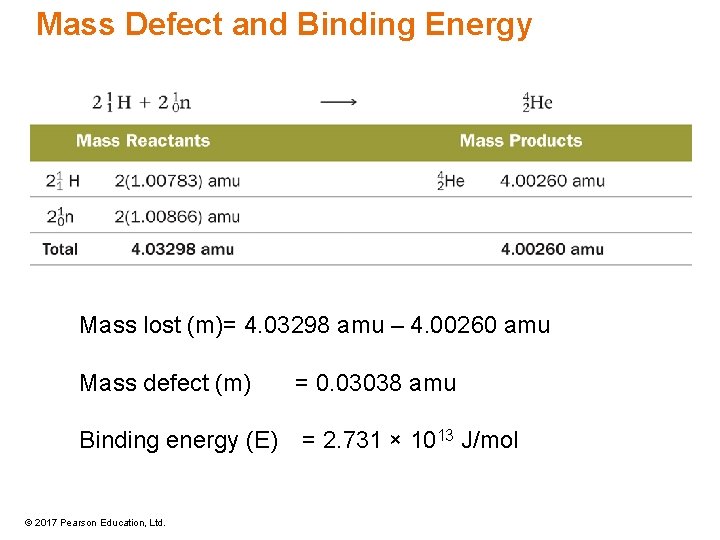
Mass Defect and Binding Energy Mass lost (m)= 4. 03298 amu – 4. 00260 amu Mass defect (m) = 0. 03038 amu Binding energy (E) = 2. 731 × 1013 J/mol © 2017 Pearson Education, Ltd.
© 2017 Pearson Education, Ltd.
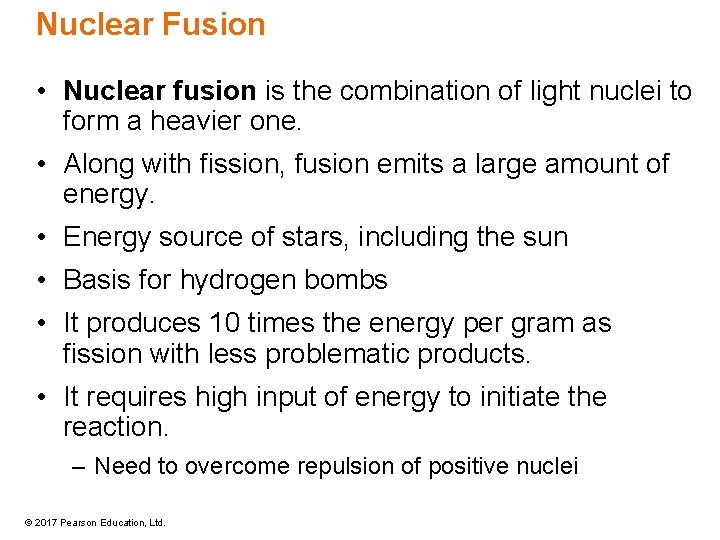
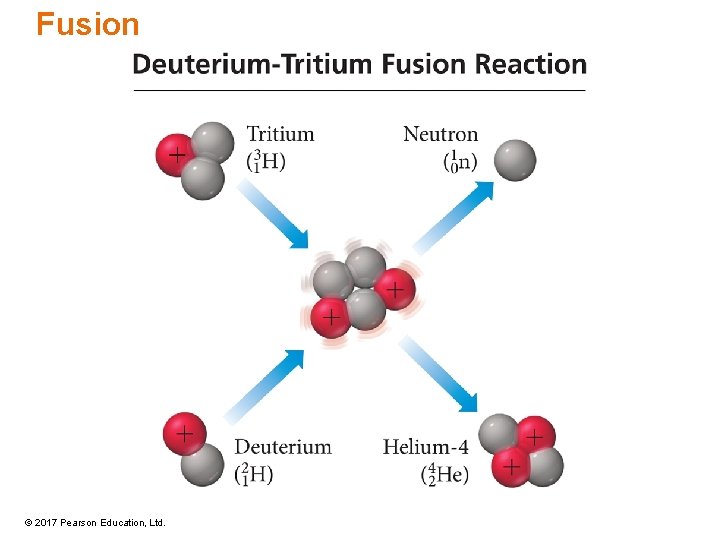
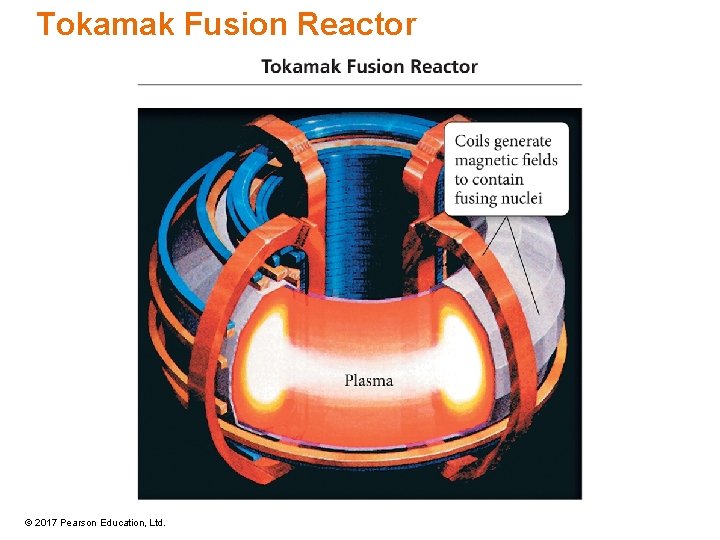
Nuclear Fusion • Nuclear fusion is the combination of light nuclei to form a heavier one. • Along with fission, fusion emits a large amount of energy. • Energy source of stars, including the sun • Basis for hydrogen bombs • It produces 10 times the energy per gram as fission with less problematic products. • It requires high input of energy to initiate the reaction. – Need to overcome repulsion of positive nuclei © 2017 Pearson Education, Ltd.
Fusion © 2017 Pearson Education, Ltd.
Tokamak Fusion Reactor © 2017 Pearson Education, Ltd.
Nuclear Transmutation • Transmutation is when atoms of one element are transformed into atoms of a different element by nuclear reaction. • Reactions involve accelerated high-energy particles smashing into target nuclei. • Usually involve accelerated charged particles – Rutherford made O-17 bombarding N-14 with alpha rays from radium. – Irène Joliot-Curie and husband Frédéric bombarded aluminum-27 with alpha particles to form phosphorus. – Cf-244 is made by bombarding U-238 with C-12 in a particle accelerator. © 2017 Pearson Education, Ltd.
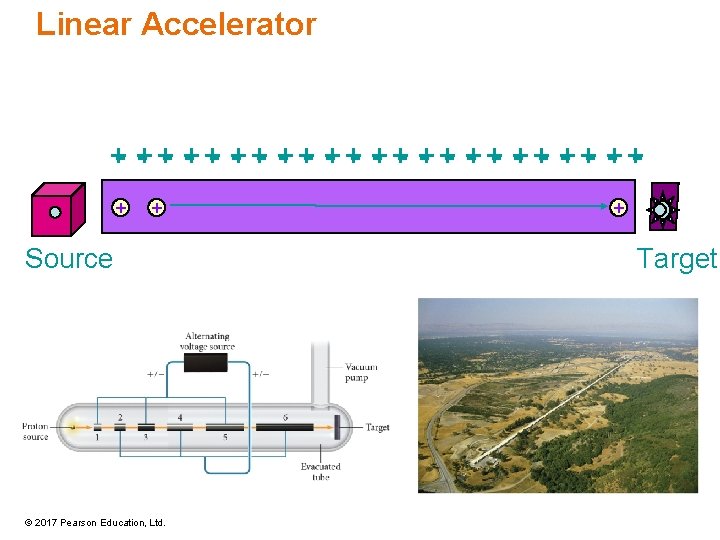
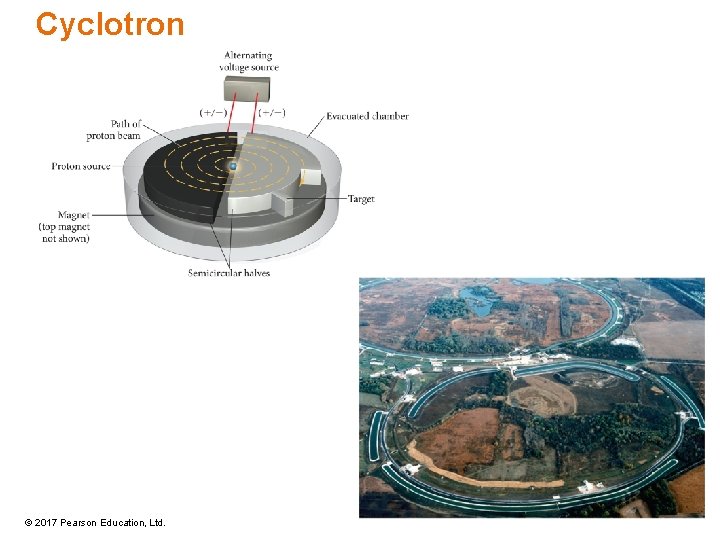
Artificial Transmutation • Bombardment of one nucleus with another causing new atoms to be made – Can also bombard with neutrons • Reaction done in a particle accelerator – Linear – Cyclotron © 2017 Pearson Education, Ltd.
Linear Accelerator +- + - +- + - +- + - ++ + Source © 2017 Pearson Education, Ltd. + Target
Cyclotron © 2017 Pearson Education, Ltd.
Effects of Radiation on Life • Radiation ionizes important molecules in living cells. • Three types of radiation effects: acute radiation damage, increased cancer risk, and genetic effects © 2017 Pearson Education, Ltd.
Acute Effects of Radiation • High levels of radiation over a short period of time kill large numbers of cells. – From a nuclear bomb or exposed reactor core • It causes a weakened immune system and lower ability to absorb nutrients from food. – May result in death, usually from infection © 2017 Pearson Education, Ltd.
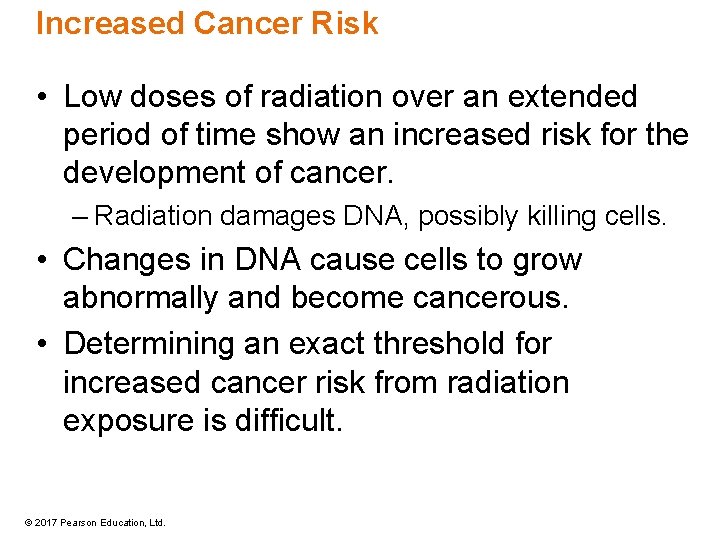
Increased Cancer Risk • Low doses of radiation over an extended period of time show an increased risk for the development of cancer. – Radiation damages DNA, possibly killing cells. • Changes in DNA cause cells to grow abnormally and become cancerous. • Determining an exact threshold for increased cancer risk from radiation exposure is difficult. © 2017 Pearson Education, Ltd.
Genetic Defects • Damage to reproductive cells may lead to genetic defects in offspring. • Observed in laboratory animals but not yet verified in humans © 2017 Pearson Education, Ltd.
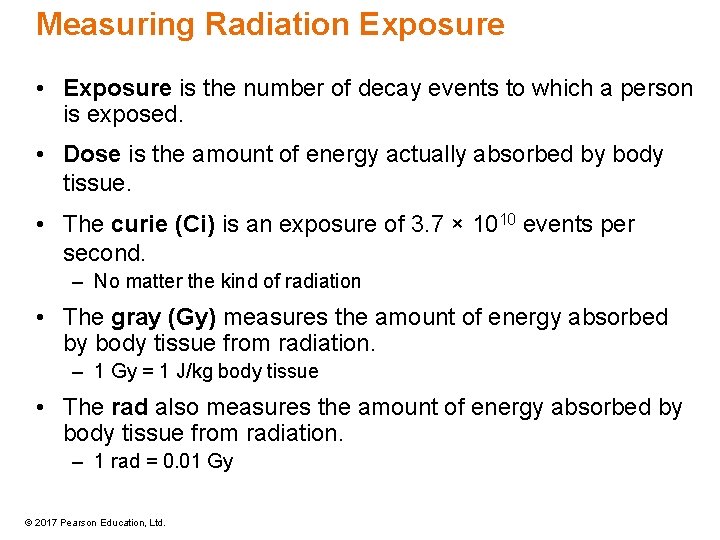
Measuring Radiation Exposure • Exposure is the number of decay events to which a person is exposed. • Dose is the amount of energy actually absorbed by body tissue. • The curie (Ci) is an exposure of 3. 7 × 10¹⁰ events per second. – No matter the kind of radiation • The gray (Gy) measures the amount of energy absorbed by body tissue from radiation. – 1 Gy = 1 J/kg body tissue • The rad also measures the amount of energy absorbed by body tissue from radiation. – 1 rad = 0. 01 Gy © 2017 Pearson Education, Ltd.
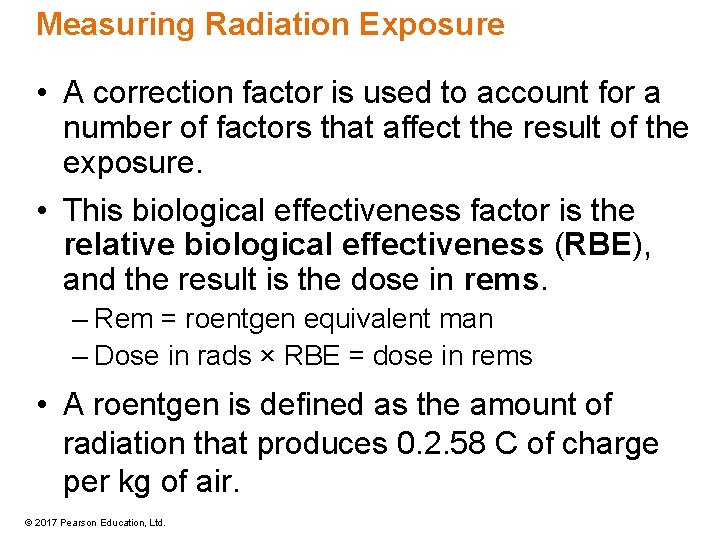
Measuring Radiation Exposure • A correction factor is used to account for a number of factors that affect the result of the exposure. • This biological effectiveness factor is the relative biological effectiveness (RBE), and the result is the dose in rems. – Rem = roentgen equivalent man – Dose in rads × RBE = dose in rems • A roentgen is defined as the amount of radiation that produces 0. 2. 58 C of charge per kg of air. © 2017 Pearson Education, Ltd.
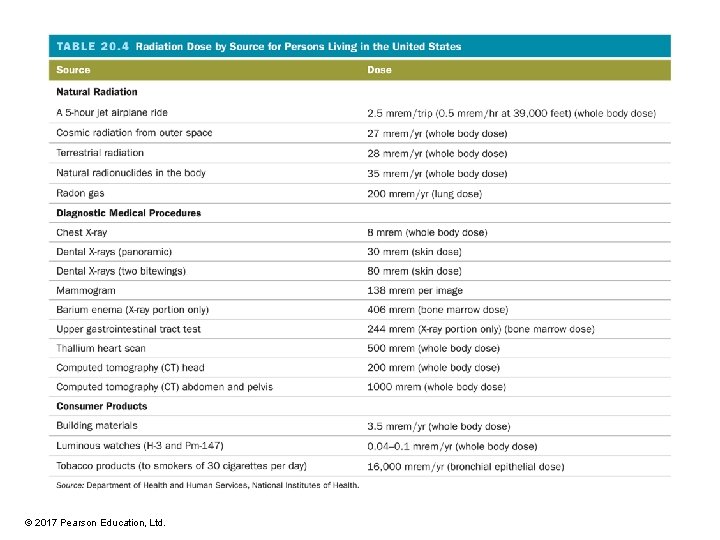
© 2017 Pearson Education, Ltd.
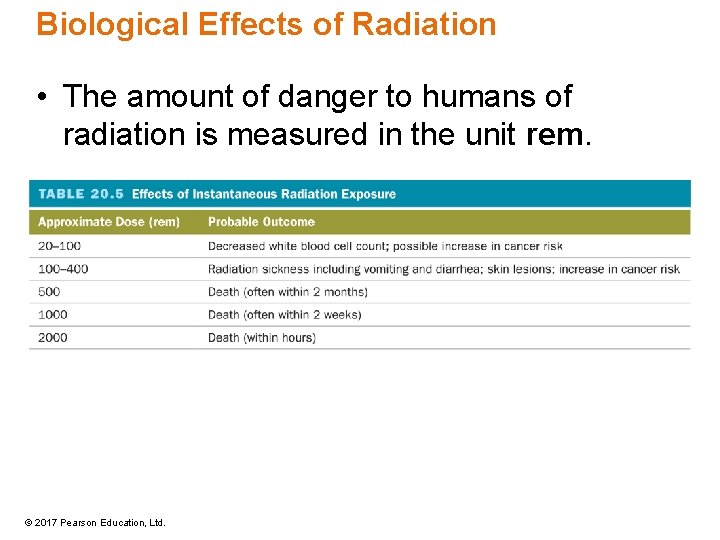
Biological Effects of Radiation • The amount of danger to humans of radiation is measured in the unit rem. © 2017 Pearson Education, Ltd.
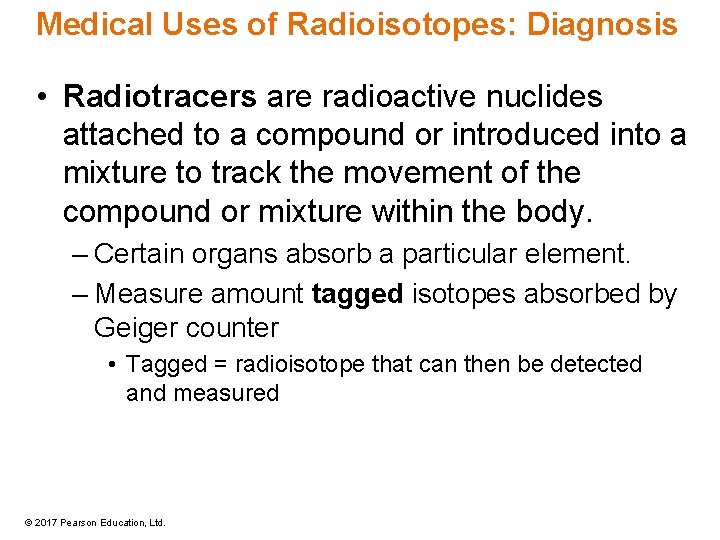
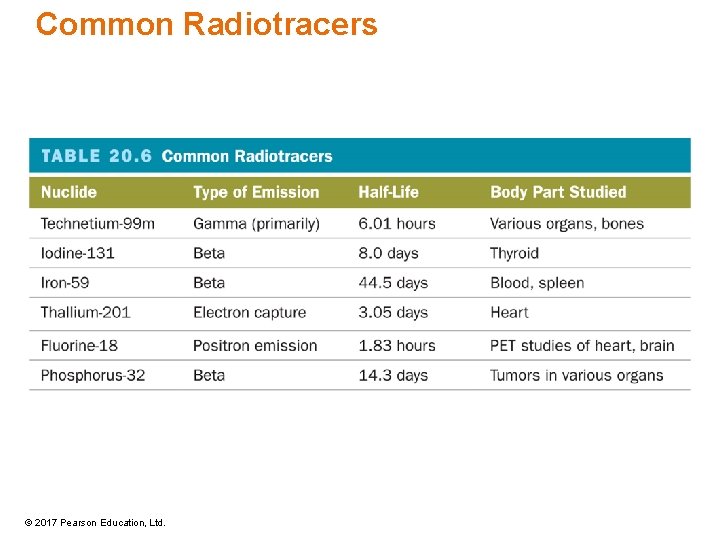
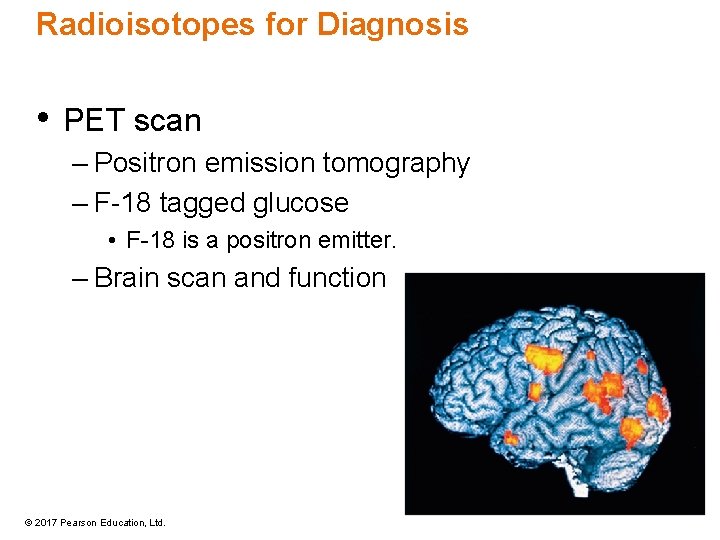
Medical Uses of Radioisotopes: Diagnosis • Radiotracers are radioactive nuclides attached to a compound or introduced into a mixture to track the movement of the compound or mixture within the body. – Certain organs absorb a particular element. – Measure amount tagged isotopes absorbed by Geiger counter • Tagged = radioisotope that can then be detected and measured © 2017 Pearson Education, Ltd.
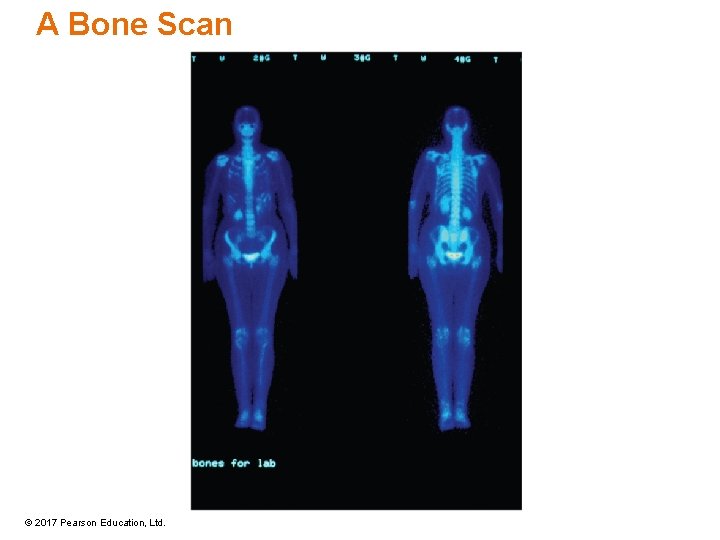
A Bone Scan © 2017 Pearson Education, Ltd.
Common Radiotracers © 2017 Pearson Education, Ltd.
Radioisotopes for Diagnosis • PET scan – Positron emission tomography – F-18 tagged glucose • F-18 is a positron emitter. – Brain scan and function © 2017 Pearson Education, Ltd.
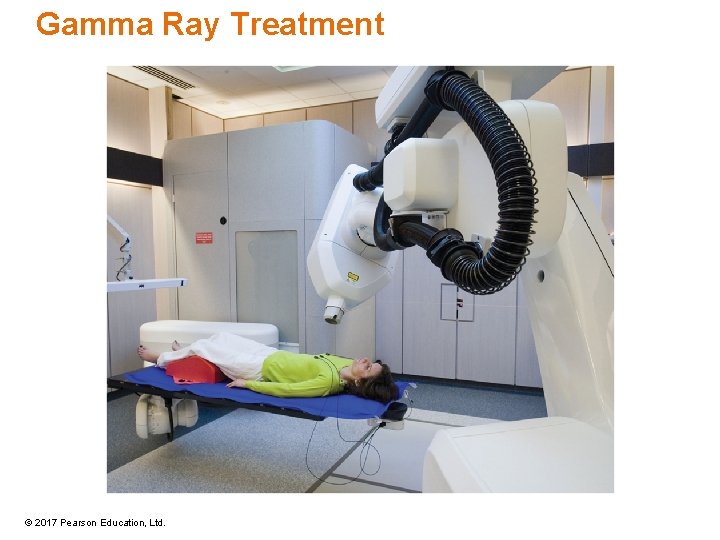
Radiotherapy • Cancer cells are more sensitive to radiation than healthy cells. • Radiation can be used to kill cancer cells without doing significant damage. © 2017 Pearson Education, Ltd.
Gamma Ray Treatment © 2017 Pearson Education, Ltd.
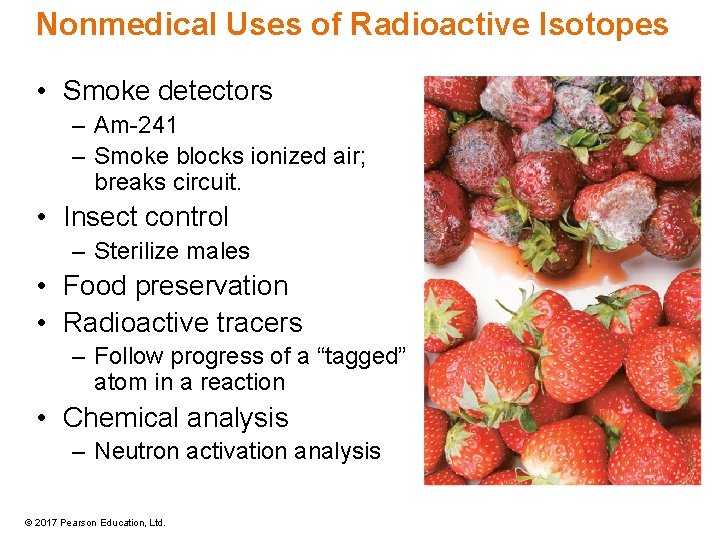
Nonmedical Uses of Radioactive Isotopes • Smoke detectors – Am-241 – Smoke blocks ionized air; breaks circuit. • Insect control – Sterilize males • Food preservation • Radioactive tracers – Follow progress of a “tagged” atom in a reaction • Chemical analysis – Neutron activation analysis © 2017 Pearson Education, Ltd.