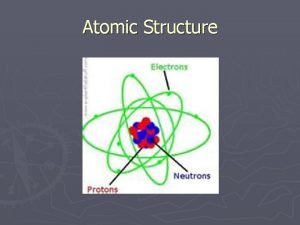
AP Chapter 7 Atomic Structure and Periodicity Section
- Slides: 35
AP* Chapter 7 Atomic Structure and Periodicity
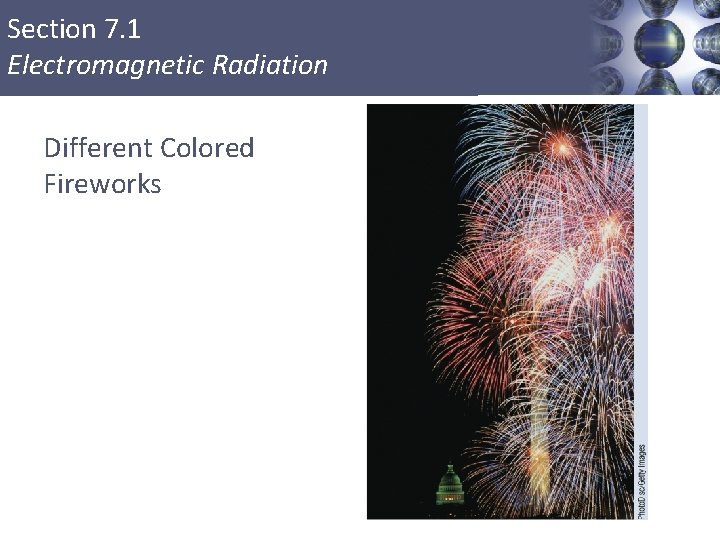
Section 7. 1 Electromagnetic Radiation Different Colored Fireworks Copyright © Cengage Learning. All rights reserved 2
Section 7. 1 Electromagnetic Radiation Questions to Consider § Why do we get colors? § Why do different chemicals give us different colors? Copyright © Cengage Learning. All rights reserved 3
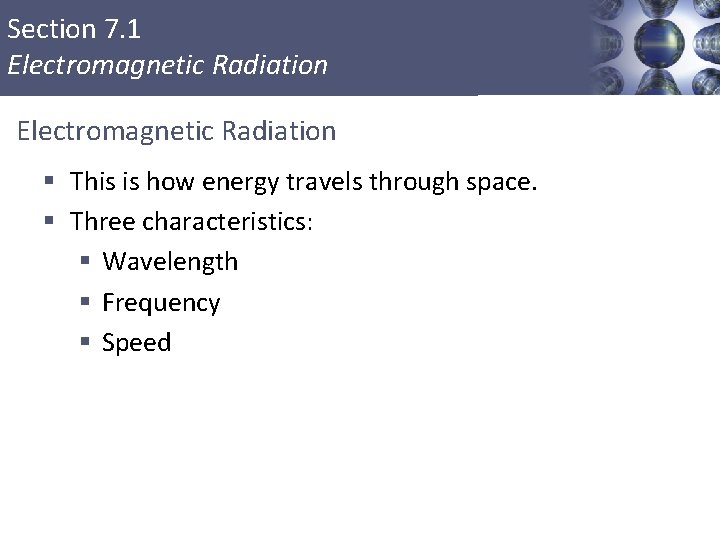
Section 7. 1 Electromagnetic Radiation § This is how energy travels through space. § Three characteristics: § Wavelength § Frequency § Speed Copyright © Cengage Learning. All rights reserved 4
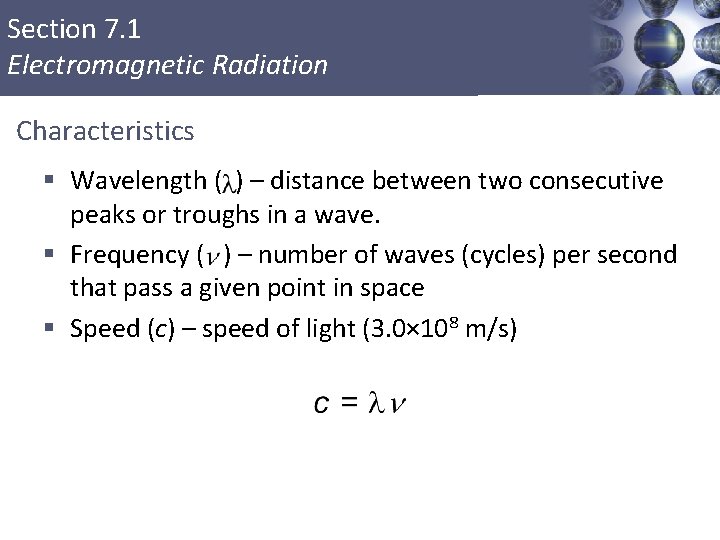
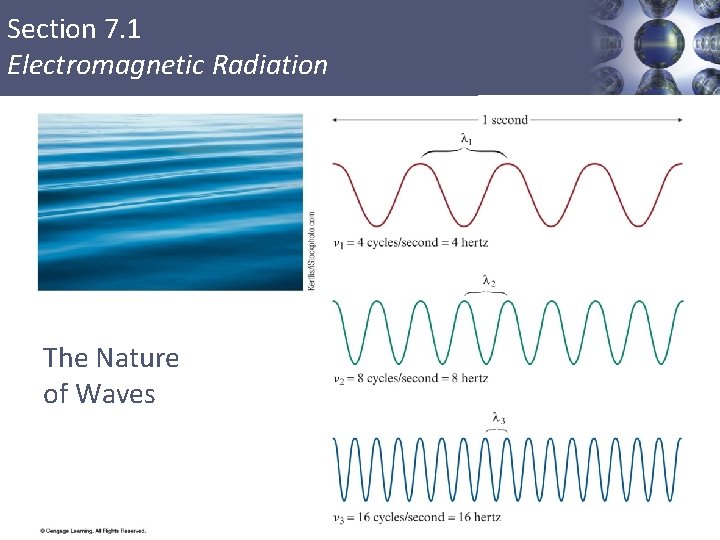
Section 7. 1 Electromagnetic Radiation Characteristics § Wavelength ( ) – distance between two consecutive peaks or troughs in a wave. § Frequency ( ) – number of waves (cycles) per second that pass a given point in space § Speed (c) – speed of light (3. 0× 108 m/s) Copyright © Cengage Learning. All rights reserved 5
Section 7. 1 Electromagnetic Radiation The Nature of Waves 6
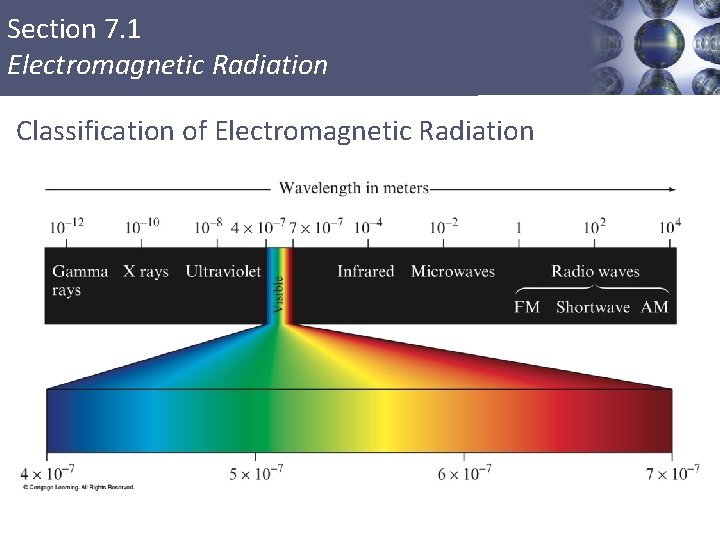
Section 7. 1 Electromagnetic Radiation Classification of Electromagnetic Radiation Copyright © Cengage Learning. All rights reserved 7
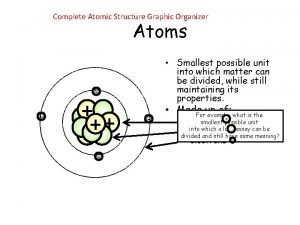
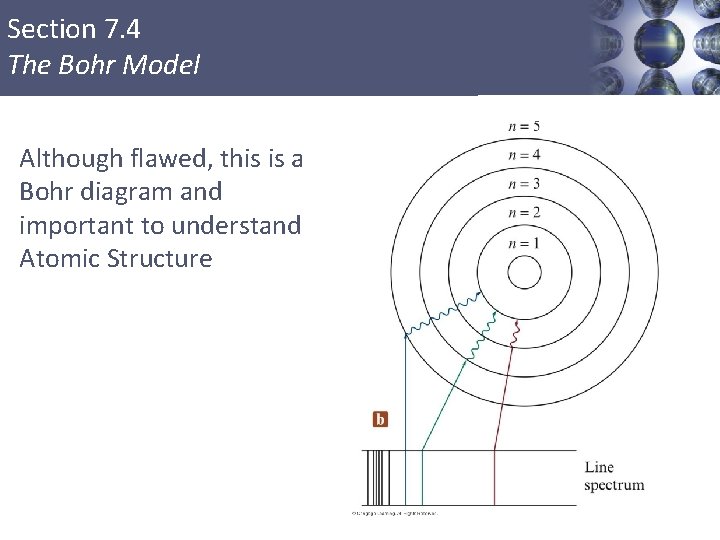
Section 7. 4 The Bohr Model Although flawed, this is a Bohr diagram and important to understand Atomic Structure Copyright © Cengage Learning. All rights reserved 8
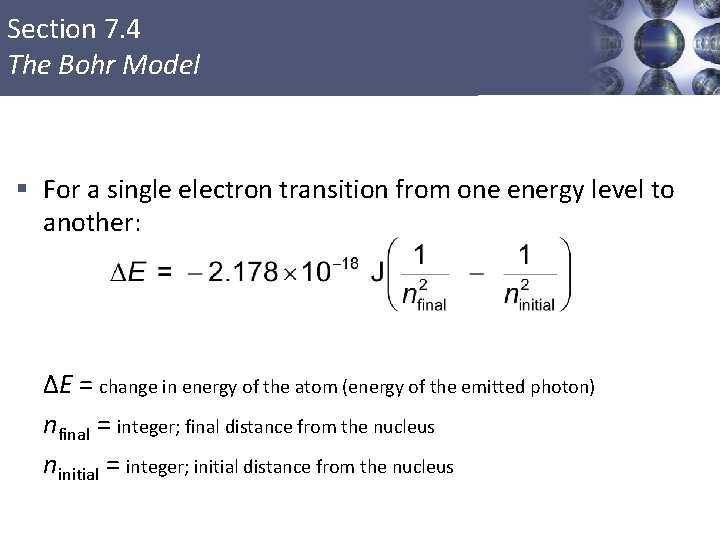
Section 7. 4 The Bohr Model § For a single electron transition from one energy level to another: ΔE = change in energy of the atom (energy of the emitted photon) nfinal = integer; final distance from the nucleus ninitial = integer; initial distance from the nucleus Copyright © Cengage Learning. All rights reserved 9
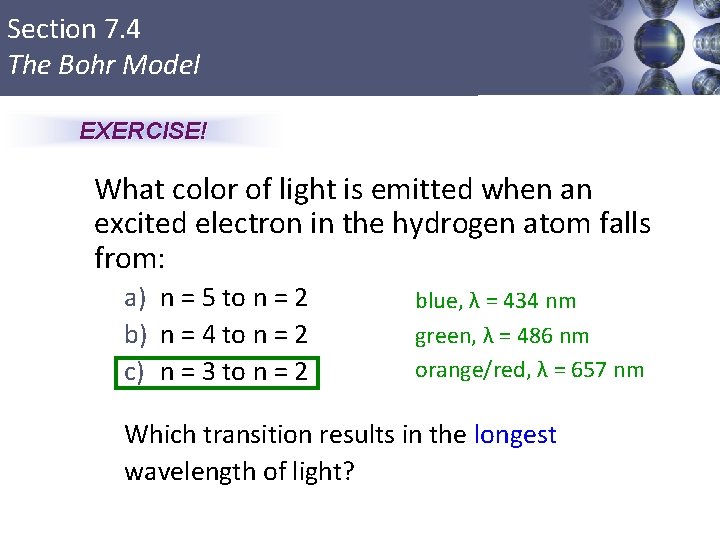
Section 7. 4 The Bohr Model EXERCISE! What color of light is emitted when an excited electron in the hydrogen atom falls from: a) n = 5 to n = 2 b) n = 4 to n = 2 c) n = 3 to n = 2 blue, λ = 434 nm green, λ = 486 nm orange/red, λ = 657 nm Which transition results in the longest wavelength of light? Copyright © Cengage Learning. All rights reserved 10
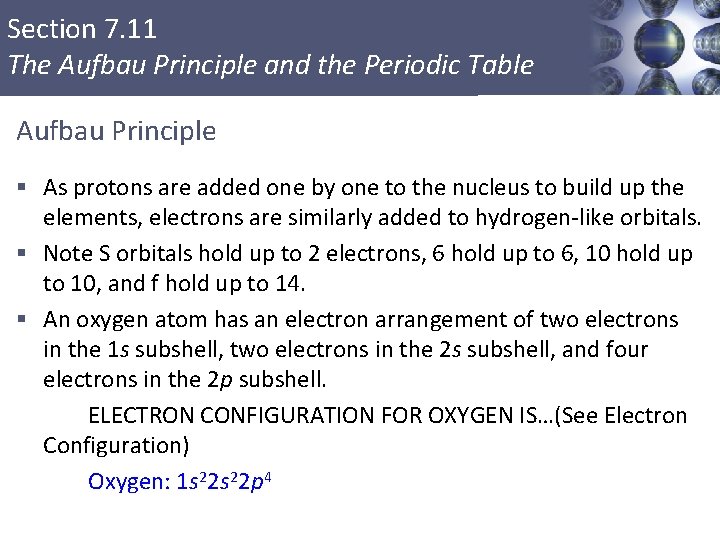
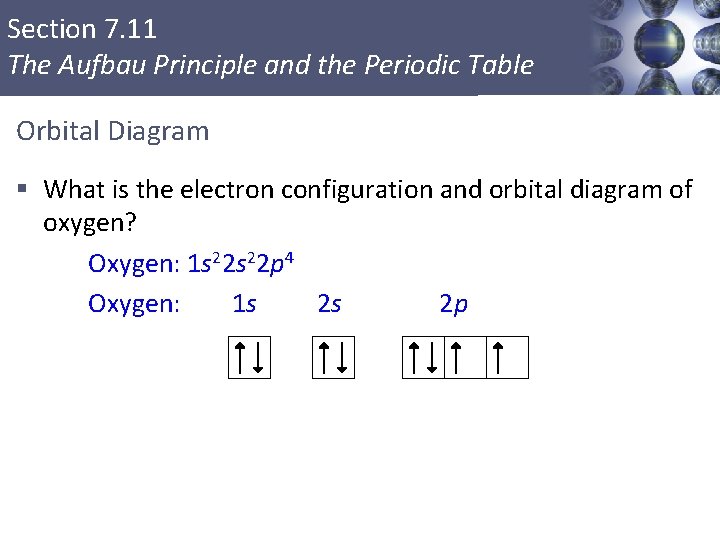
Section 7. 11 The Aufbau Principle and the Periodic Table Aufbau Principle § As protons are added one by one to the nucleus to build up the elements, electrons are similarly added to hydrogen-like orbitals. § Note S orbitals hold up to 2 electrons, 6 hold up to 6, 10 hold up to 10, and f hold up to 14. § An oxygen atom has an electron arrangement of two electrons in the 1 s subshell, two electrons in the 2 s subshell, and four electrons in the 2 p subshell. ELECTRON CONFIGURATION FOR OXYGEN IS…(See Electron Configuration) Oxygen: 1 s 22 p 4 Copyright © Cengage Learning. All rights reserved 11
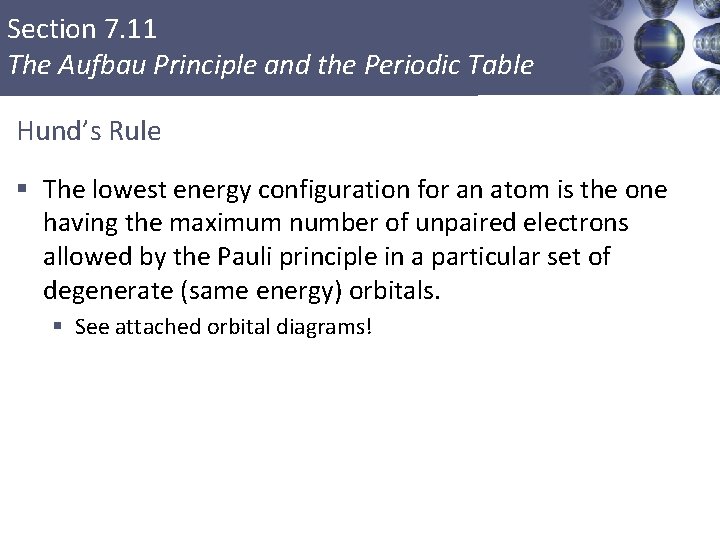
Section 7. 11 The Aufbau Principle and the Periodic Table Hund’s Rule § The lowest energy configuration for an atom is the one having the maximum number of unpaired electrons allowed by the Pauli principle in a particular set of degenerate (same energy) orbitals. § See attached orbital diagrams! Copyright © Cengage Learning. All rights reserved 12
Section 7. 11 The Aufbau Principle and the Periodic Table Orbital Diagram § What is the electron configuration and orbital diagram of oxygen? Oxygen: 1 s 22 p 4 Oxygen: 1 s 2 p Copyright © Cengage Learning. All rights reserved 13
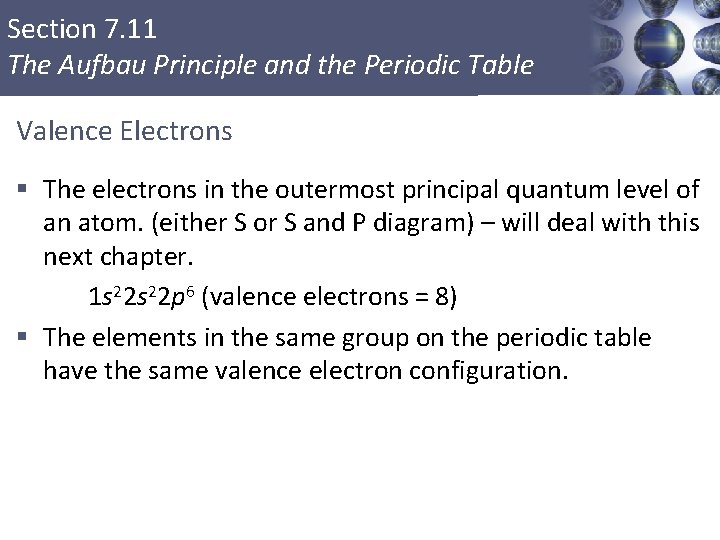
Section 7. 11 The Aufbau Principle and the Periodic Table Valence Electrons § The electrons in the outermost principal quantum level of an atom. (either S or S and P diagram) – will deal with this next chapter. 1 s 22 p 6 (valence electrons = 8) § The elements in the same group on the periodic table have the same valence electron configuration. Copyright © Cengage Learning. All rights reserved 14
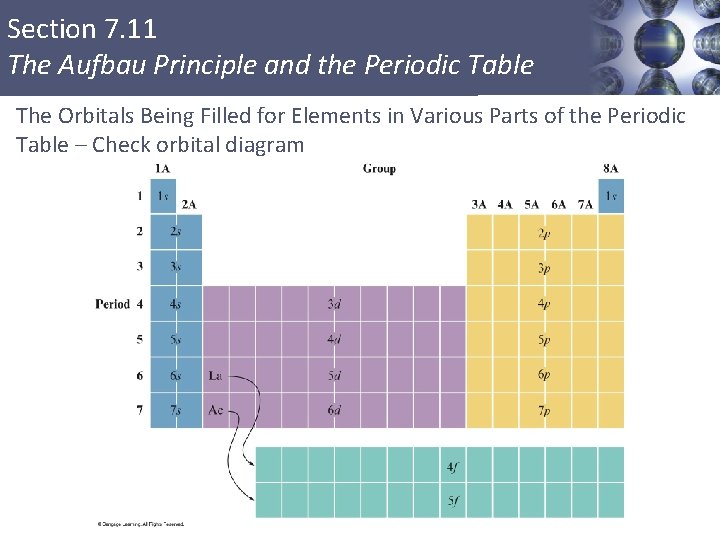
Section 7. 11 The Aufbau Principle and the Periodic Table The Orbitals Being Filled for Elements in Various Parts of the Periodic Table – Check orbital diagram Copyright © Cengage Learning. All rights reserved 15
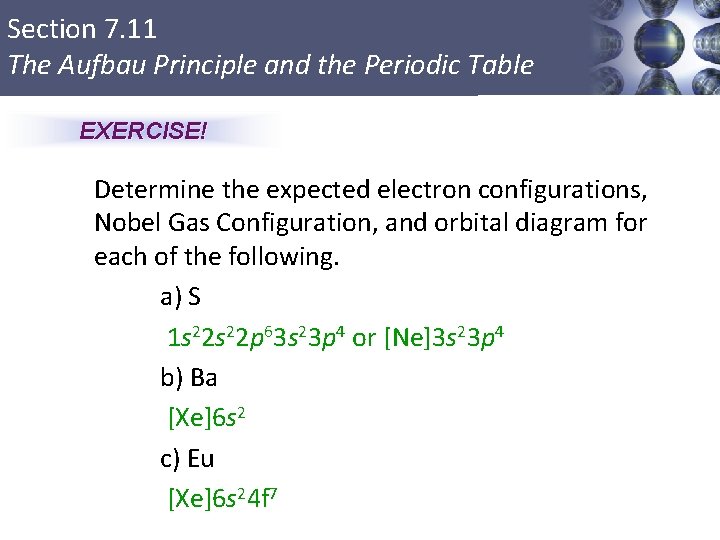
Section 7. 11 The Aufbau Principle and the Periodic Table EXERCISE! Determine the expected electron configurations, Nobel Gas Configuration, and orbital diagram for each of the following. a) S 1 s 22 p 63 s 23 p 4 or [Ne]3 s 23 p 4 b) Ba [Xe]6 s 2 c) Eu [Xe]6 s 24 f 7 Copyright © Cengage Learning. All rights reserved 16
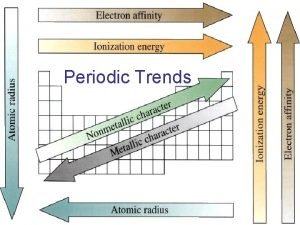
Section 7. 12 Periodic Trends in Atomic Properties Periodic Trends – There are trends on the periodic table! – See trends sheet, KNOW THESE! § Ionization Energy § Electron Affinity § Atomic Radius
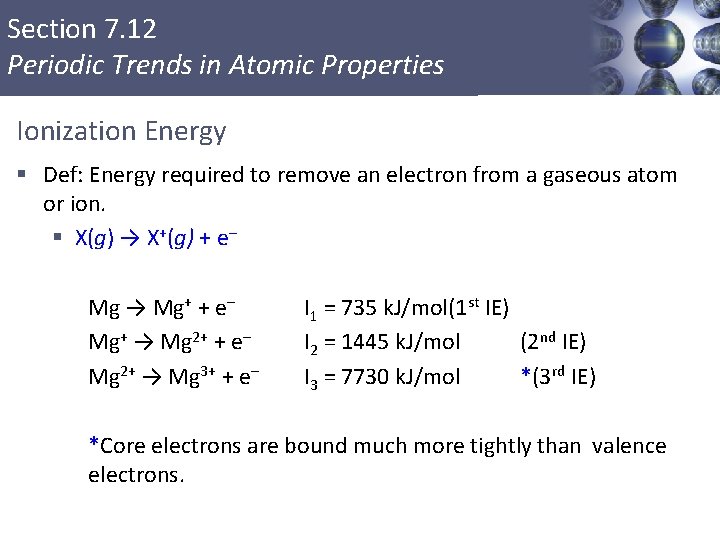
Section 7. 12 Periodic Trends in Atomic Properties Ionization Energy § Def: Energy required to remove an electron from a gaseous atom or ion. § X(g) → X+(g) + e– Mg → Mg+ + e– Mg+ → Mg 2+ + e– Mg 2+ → Mg 3+ + e– I 1 = 735 k. J/mol(1 st IE) I 2 = 1445 k. J/mol (2 nd IE) I 3 = 7730 k. J/mol *(3 rd IE) *Core electrons are bound much more tightly than valence electrons.
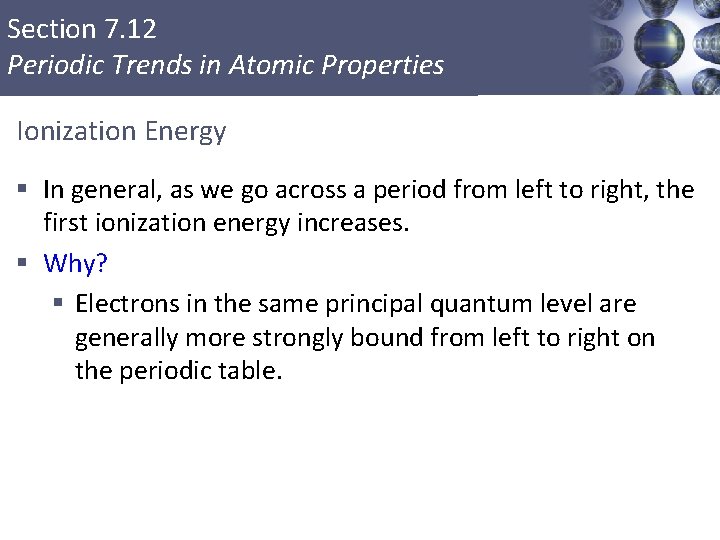
Section 7. 12 Periodic Trends in Atomic Properties Ionization Energy § In general, as we go across a period from left to right, the first ionization energy increases. § Why? § Electrons in the same principal quantum level are generally more strongly bound from left to right on the periodic table.
Section 7. 12 Periodic Trends in Atomic Properties Ionization Energy § In general, as we go down a group from top to bottom, the first ionization energy decreases. § Why? § The electrons being removed are, on average, farther from the nucleus.
Section 7. 12 Periodic Trends in Atomic Properties CONCEPT CHECK! Which atom would require more energy to remove an electron? Why? Na Cl
Section 7. 12 Periodic Trends in Atomic Properties CONCEPT CHECK! Which atom would require more energy to remove an electron? Why? Li Cs
Section 7. 12 Periodic Trends in Atomic Properties CONCEPT CHECK! Which has the larger second ionization energy? Why? Lithium or Beryllium
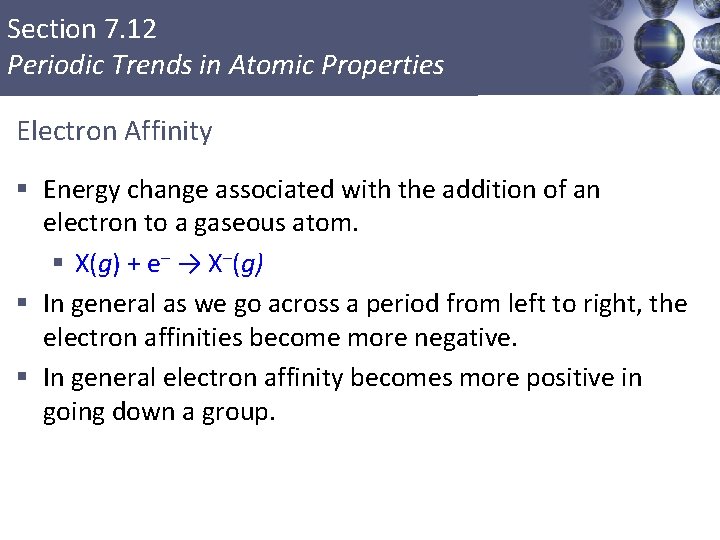
Section 7. 12 Periodic Trends in Atomic Properties Electron Affinity § Energy change associated with the addition of an electron to a gaseous atom. § X(g) + e– → X–(g) § In general as we go across a period from left to right, the electron affinities become more negative. § In general electron affinity becomes more positive in going down a group.
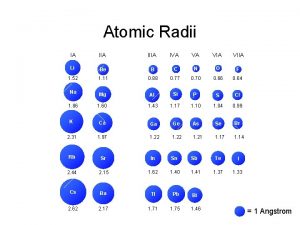
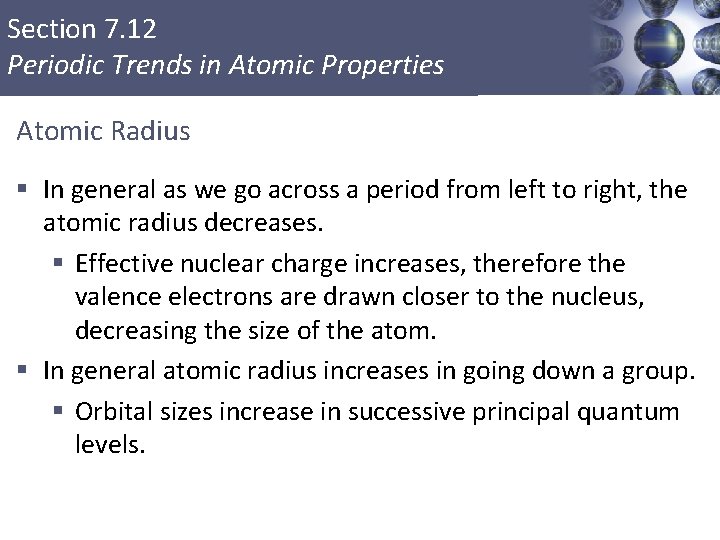
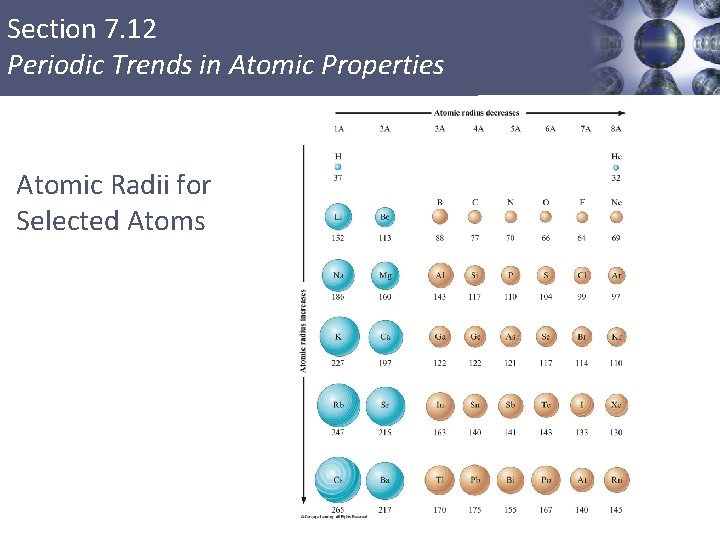
Section 7. 12 Periodic Trends in Atomic Properties Atomic Radius § In general as we go across a period from left to right, the atomic radius decreases. § Effective nuclear charge increases, therefore the valence electrons are drawn closer to the nucleus, decreasing the size of the atom. § In general atomic radius increases in going down a group. § Orbital sizes increase in successive principal quantum levels.
Section 7. 12 Periodic Trends in Atomic Properties Atomic Radii for Selected Atoms
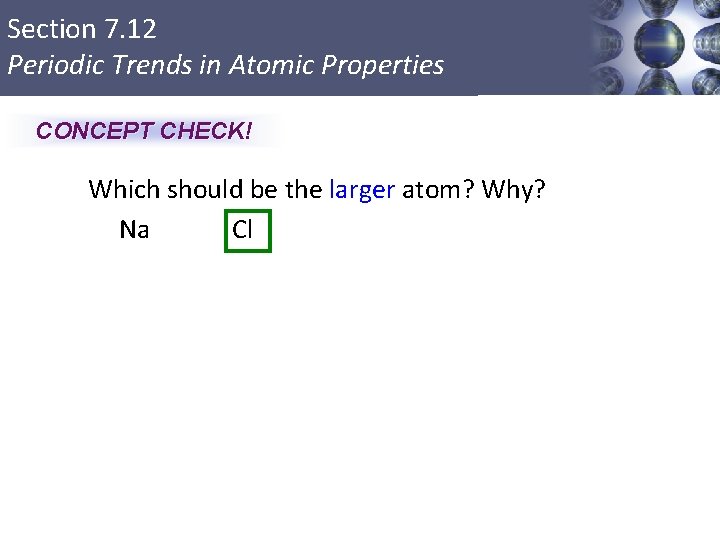
Section 7. 12 Periodic Trends in Atomic Properties CONCEPT CHECK! Which should be the larger atom? Why? Na Cl
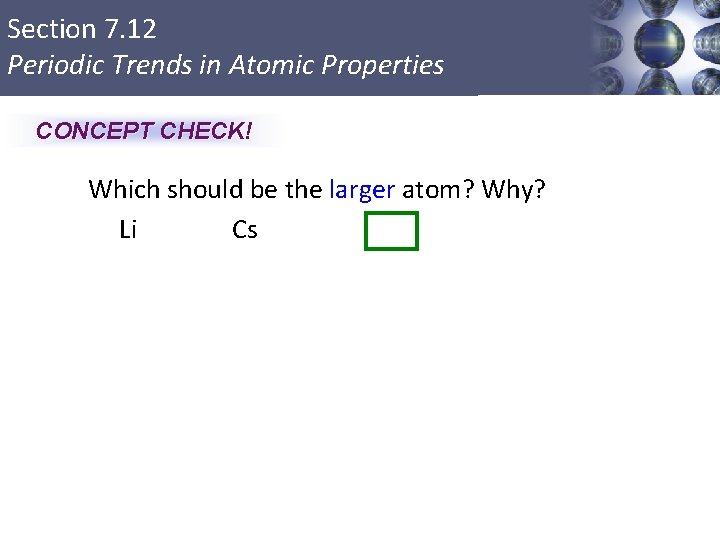
Section 7. 12 Periodic Trends in Atomic Properties CONCEPT CHECK! Which should be the larger atom? Why? Li Cs
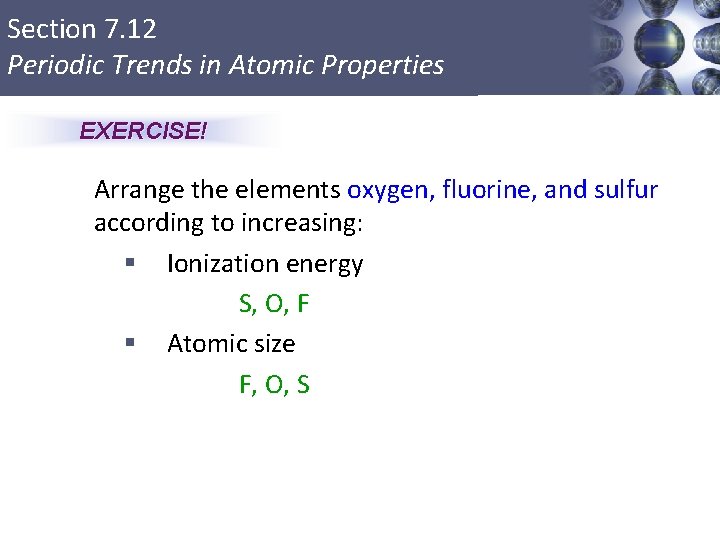
Section 7. 12 Periodic Trends in Atomic Properties EXERCISE! Arrange the elements oxygen, fluorine, and sulfur according to increasing: § Ionization energy S, O, F § Atomic size F, O, S
Section 7. 13 The Properties of a Group: The Alkali Metals AP Learning Objectives, Margin Notes and References § Learning Objectives § § LO 1. 9 The student is able to predict and/or justify trends in atomic properties based on location on the periodic table and/or the shell model. LO 1. 10 Students can justify with evidence the arrangement of the periodic table and can apply periodic properties to chemical reactivity.
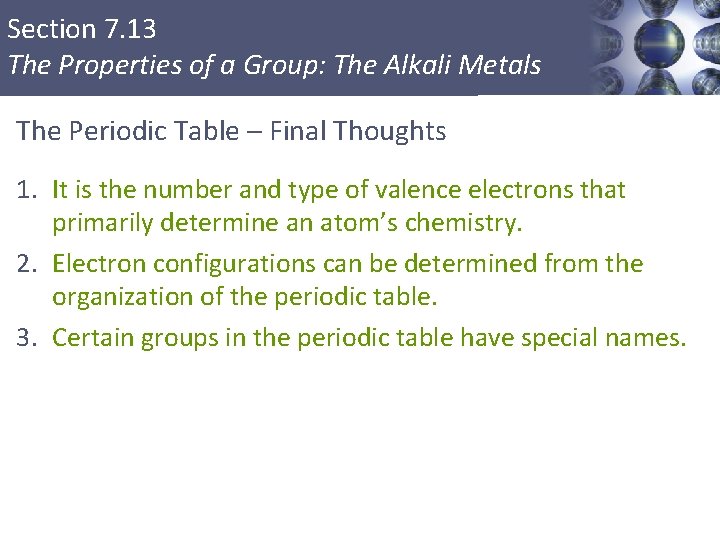
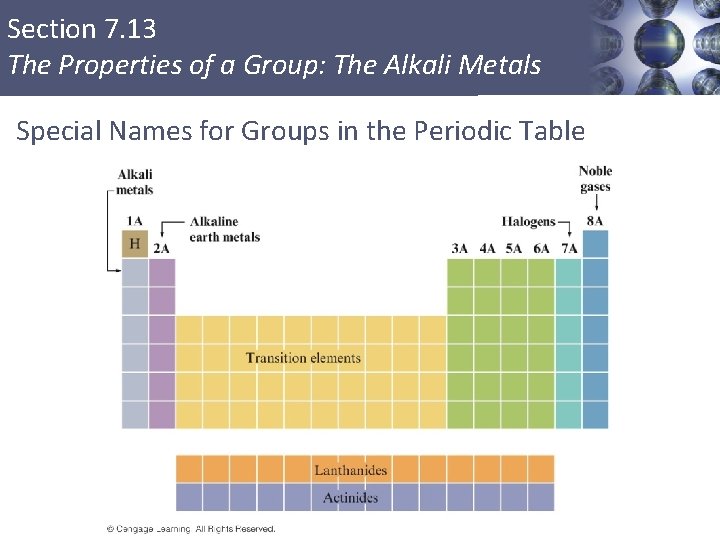
Section 7. 13 The Properties of a Group: The Alkali Metals The Periodic Table – Final Thoughts 1. It is the number and type of valence electrons that primarily determine an atom’s chemistry. 2. Electron configurations can be determined from the organization of the periodic table. 3. Certain groups in the periodic table have special names. Copyright © Cengage Learning. All rights reserved 31
Section 7. 13 The Properties of a Group: The Alkali Metals Special Names for Groups in the Periodic Table Copyright © Cengage Learning. All rights reserved 32
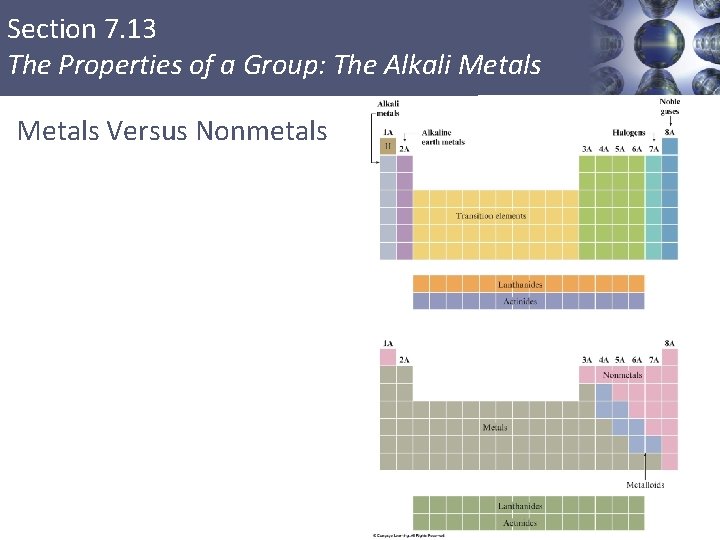
Section 7. 13 The Properties of a Group: The Alkali Metals The Periodic Table – Final Thoughts 4. Basic division of the elements in the periodic table is into metals and nonmetals. Copyright © Cengage Learning. All rights reserved 33
Section 7. 13 The Properties of a Group: The Alkali Metals Versus Nonmetals Copyright © Cengage Learning. All rights reserved 34
Section 7. 13 The Properties of a Group: The Alkali Metals § Going down group: KNOW SHEET Ø Ø Ionization energy decreases Atomic radius increases Density increases Melting and boiling points smoothly decrease Copyright © Cengage Learning. All rights reserved 35