Introduction to Machine Learning Dan Roth danrothseas upenn


- Slides: 117
Introduction to Machine Learning Dan Roth danroth@seas. upenn. edu|http: //www. cis. upenn. edu/~danroth/|461 C, 3401 Walnut Slides were created by Dan Roth (for CIS 519/419 at Penn or CS 446 at UIUC), Some slides were taken with approval from other authors who have made their ML slides available. CIS 419/519 Fall’ 2020 1
Course Overview The class is recorded Will be available on the web site – Introduction: Basic problems and questions – A detailed example: Linear classifiers; key algorithmic idea – Two Basic Paradigms: » Discriminative Learning & Generative/Probabilistic Learning – Learning Protocols: » Supervised; Unsupervised; Semi-supervised – Algorithms » » » » Gradient Descent Decision Trees Linear Representations: (Perceptron; SVMs; Kernels) Neural Networks/Deep Learning Probabilistic Representations (naïve Bayes) Unsupervised /Semi supervised: EM Clustering; Dimensionality Reduction – Modeling; Evaluation; Real world challenges – Ethics CIS 419/519 Fall’ 2020 2
CIS 419/519: Applied Machine Learning • • Monday, Wednesday: 10: 30 pm-12: 00 pm On Zoom Started this week (My) Office hours: Mon 5 -6 pm; Tue 12 -1 pm TAs Office Hours also started 13 TAs Assignments: 5 Problems set (Python Programming) – Weekly (light) on-line quizzes • • • Weekly Discussion Sessions Mid Term Exam (take home) [Project] (We’ll talk about it later) Final (take home) No real textbook: HW 0 !!! Go to the web site Be on Piazza Registration for Class – Slides/Mitchell/Goldberg/Other Books/Lecture notes /Literature CIS 419/519 Fall’ 2020 3
CIS 519: What have you learned so far? • What do you need to know: Participate, Ask Questions – Some exposure to: • Theory of Computation • Probability Theory • Linear Algebra § Applied Machine Learning § Applied: mostly in HW – Programming (Python) • Homework 0 § Machine learning: mostly in class, quizzes, exams – If you could not comfortably deal with 2/3 of this within a few hours, please take the prerequisites first; come back next semester/year. CIS 419/519 Fall’ 2020 4
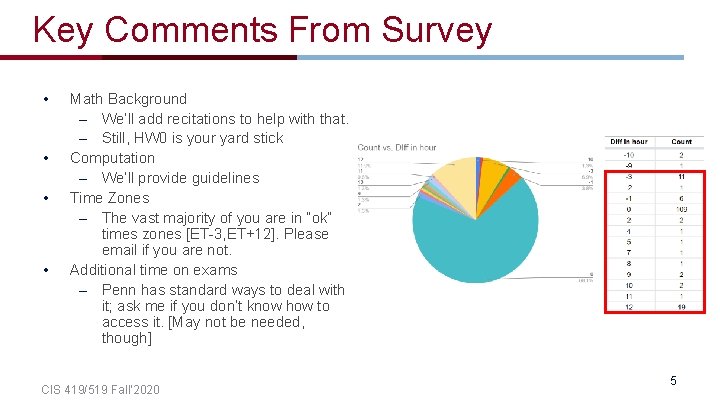
Key Comments From Survey • • Math Background – We’ll add recitations to help with that. – Still, HW 0 is your yard stick Computation – We’ll provide guidelines Time Zones – The vast majority of you are in “ok” times zones [ET-3, ET+12]. Please email if you are not. Additional time on exams – Penn has standard ways to deal with it; ask me if you don’t know how to access it. [May not be needed, though] CIS 419/519 Fall’ 2020 5
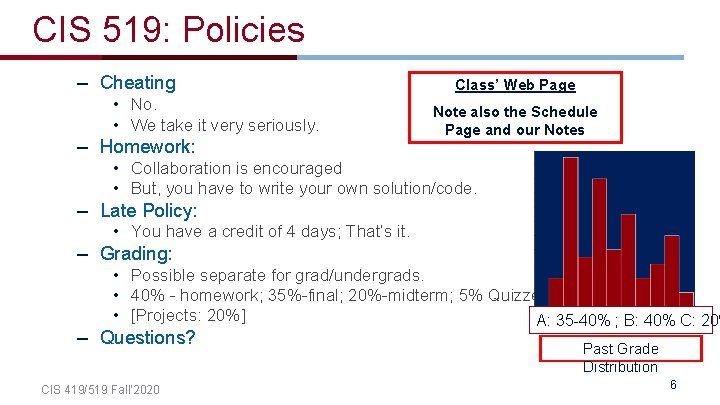
CIS 519: Policies – Cheating • No. • We take it very seriously. – Homework: Class’ Web Page Note also the Schedule Page and our Notes • Collaboration is encouraged • But, you have to write your own solution/code. – Late Policy: • You have a credit of 4 days; That’s it. – Grading: • Possible separate for grad/undergrads. • 40% - homework; 35%-final; 20%-midterm; 5% Quizzes • [Projects: 20%] A: 35 -40% ; B: 40% C: 20% – Questions? CIS 419/519 Fall’ 2020 Past Grade Distribution 6
CIS 519 on the web • Check our class website: – Schedule, slides, videos, policies • • https: //www. seas. upenn. edu/~cis 519/fall 2020/ Sign up, participate in our Piazza forum: Announcements and discussions https: //piazza. com/class/kec 0 q 01 gqceim Check out our team Office hours [Optional] Discussion Sessions CIS 419/519 Fall’ 2020 7
CIS 419/519 Fall’ 2020 8
CIS 419/519 Fall’ 2020 9
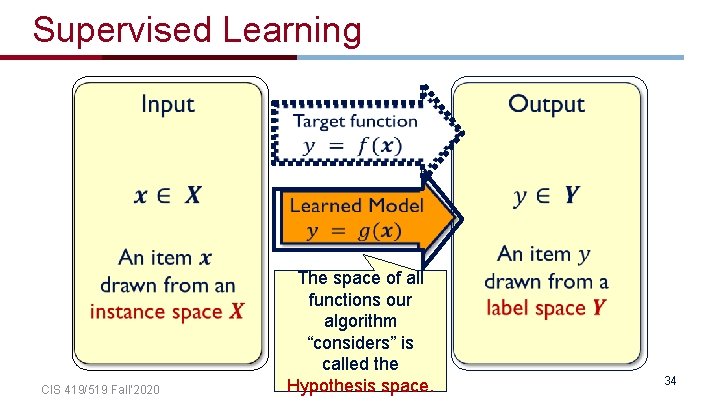
Today • Introduce some key concepts in Machine Learning – At a high level • Representation • Supervised Learning Protocol • New Concepts: – – Instance Space Label Space Model A Hypothesis Space CIS 419/519 Fall’ 2020 10
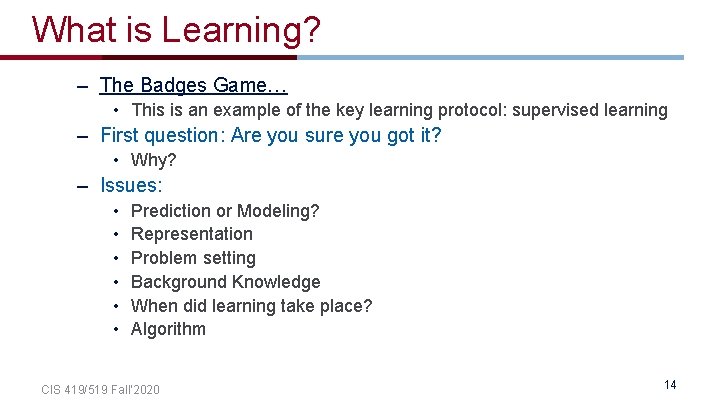
What is Learning? – The Badges Game… • This is an example of the key learning protocol: supervised learning – First question: Are you sure you got it? • Why? – Issues: • • • Prediction or Modeling? Representation Problem setting Background Knowledge When did learning take place? Algorithm CIS 419/519 Fall’ 2020 11
CIS 419/519 Fall’ 2020 12
CIS 419/519 Fall’ 2020 13
What is Learning? – The Badges Game… • This is an example of the key learning protocol: supervised learning – First question: Are you sure you got it? • Why? – Issues: • • • Prediction or Modeling? Representation Problem setting Background Knowledge When did learning take place? Algorithm CIS 419/519 Fall’ 2020 14
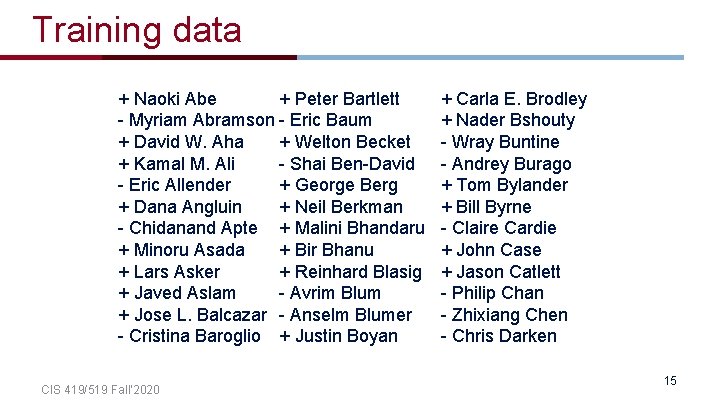
Training data + Naoki Abe + Peter Bartlett - Myriam Abramson - Eric Baum + David W. Aha + Welton Becket + Kamal M. Ali - Shai Ben-David - Eric Allender + George Berg + Dana Angluin + Neil Berkman - Chidanand Apte + Malini Bhandaru + Minoru Asada + Bir Bhanu + Lars Asker + Reinhard Blasig + Javed Aslam - Avrim Blum + Jose L. Balcazar - Anselm Blumer - Cristina Baroglio + Justin Boyan CIS 419/519 Fall’ 2020 + Carla E. Brodley + Nader Bshouty - Wray Buntine - Andrey Burago + Tom Bylander + Bill Byrne - Claire Cardie + John Case + Jason Catlett - Philip Chan - Zhixiang Chen - Chris Darken 15
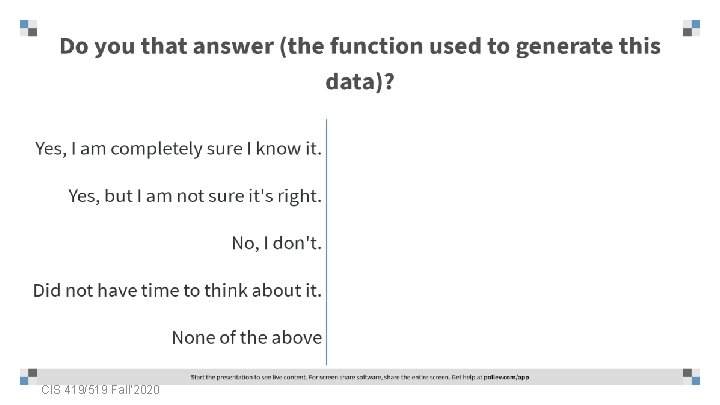
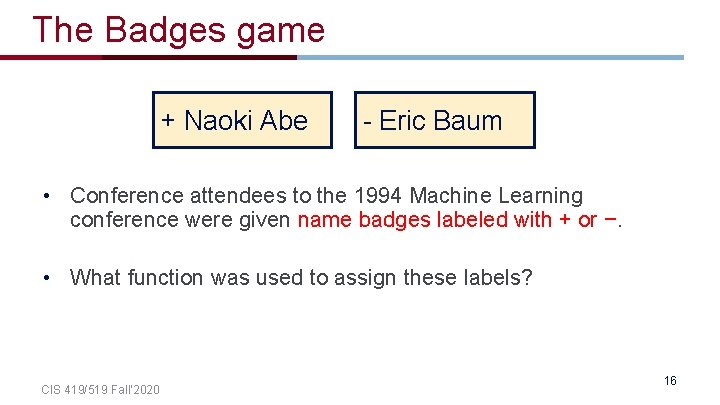
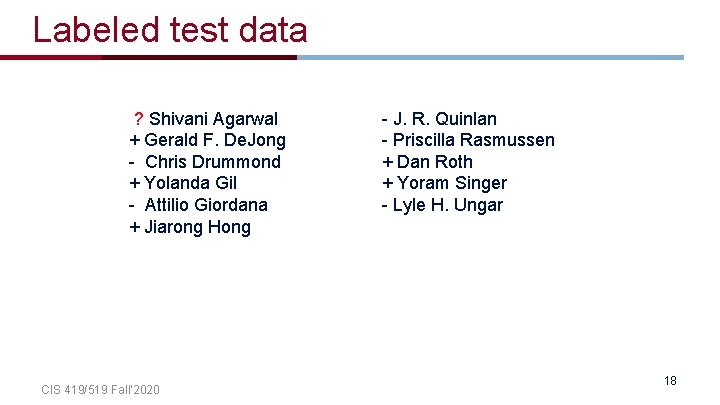
The Badges game + Naoki Abe - Eric Baum • Conference attendees to the 1994 Machine Learning conference were given name badges labeled with + or −. • What function was used to assign these labels? CIS 419/519 Fall’ 2020 16
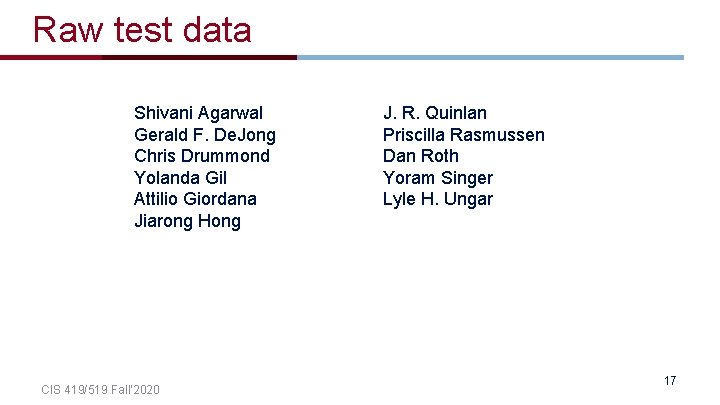
Raw test data Shivani Agarwal Gerald F. De. Jong Chris Drummond Yolanda Gil Attilio Giordana Jiarong Hong CIS 419/519 Fall’ 2020 J. R. Quinlan Priscilla Rasmussen Dan Roth Yoram Singer Lyle H. Ungar 17
Labeled test data ? Shivani Agarwal + Gerald F. De. Jong - Chris Drummond + Yolanda Gil - Attilio Giordana + Jiarong Hong CIS 419/519 Fall’ 2020 - J. R. Quinlan - Priscilla Rasmussen + Dan Roth + Yoram Singer - Lyle H. Ungar 18
CIS 419/519 Fall’ 2020 19
CIS 419/519 Fall’ 2020 20
CIS 419/519 Fall’ 2020 21
CIS 419/519 Fall’ 2020 22
CIS 419/519 Fall’ 2020 23
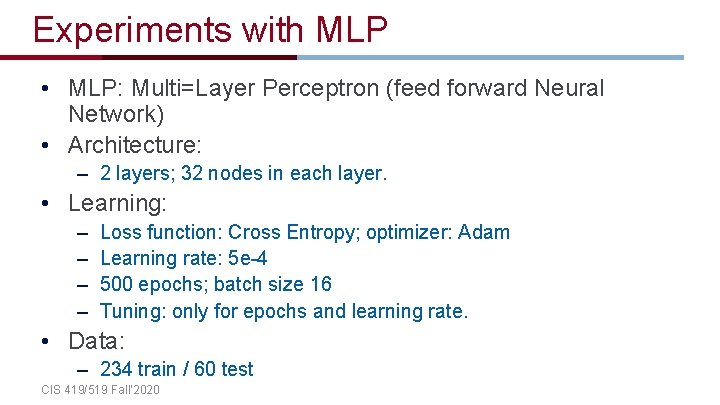
Experiments with MLP • MLP: Multi=Layer Perceptron (feed forward Neural Network) • Architecture: – 2 layers; 32 nodes in each layer. • Learning: – – Loss function: Cross Entropy; optimizer: Adam Learning rate: 5 e-4 500 epochs; batch size 16 Tuning: only for epochs and learning rate. • Data: – 234 train / 60 test CIS 419/519 Fall’ 2020
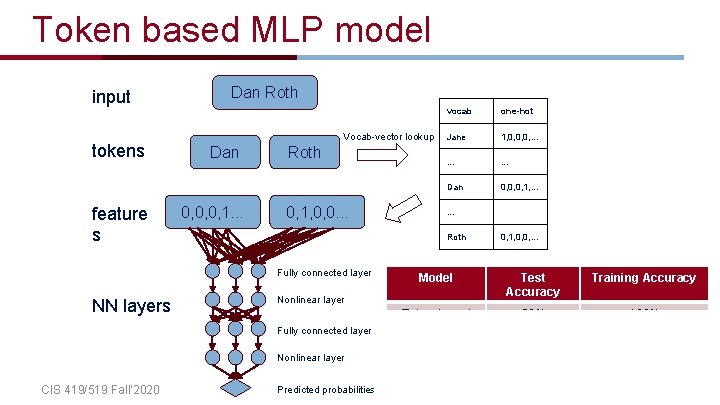
Token based MLP model input tokens feature s Dan Roth Vocab-vector lookup Dan 0, 0, 0, 1. . . Roth 0, 1, 0, 0. . . Jane 1, 0, 0, 0, . . Dan 0, 0, 0, 1, . . . Nonlinear layer Predicted probabilities 0, 1, 0, 0, . . . Model Test Accuracy Training Accuracy Token based MLP 58% 100% T 5 -3 B 52% 100% Nonlinear layer Fully connected layer CIS 419/519 Fall’ 2020 one-hot Roth Fully connected layer NN layers vocab
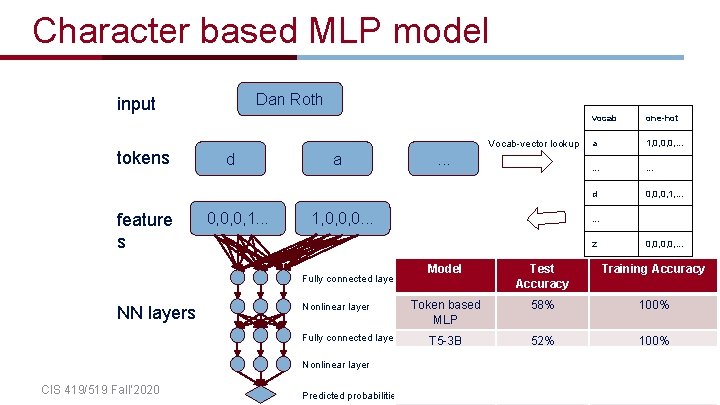
Character based MLP model Dan Roth input tokens feature s Vocab-vector lookup d 0, 0, 0, 1. . . a 1, 0, 0, 0, . . d 0, 0, 0, 1, . . . 0, 0, . . . Model Test Accuracy Training Accuracy Token based MLP 58% 100% T 5 -3 B 52% 100% Nonlinear layer Char. based MLP 92% 100% Predicted probabilities Char. based 100% Nonlinear layer Fully connected layer CIS 419/519 Fall’ 2020 one-hot z Fully connected layer NN layers . . . vocab
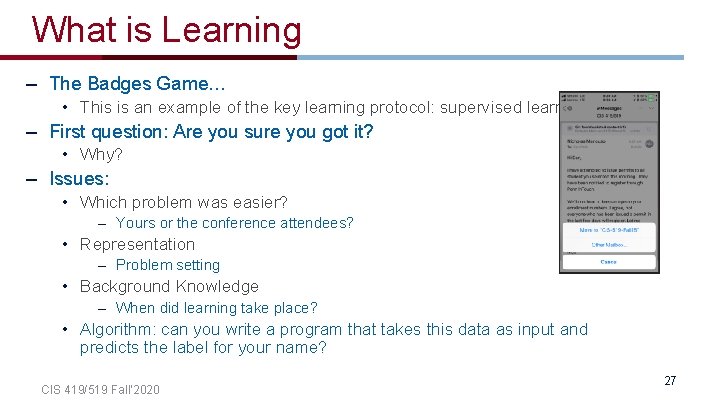
What is Learning – The Badges Game… • This is an example of the key learning protocol: supervised learning – First question: Are you sure you got it? • Why? – Issues: • Which problem was easier? – Yours or the conference attendees? • Representation – Problem setting • Background Knowledge – When did learning take place? • Algorithm: can you write a program that takes this data as input and predicts the label for your name? CIS 419/519 Fall’ 2020 27
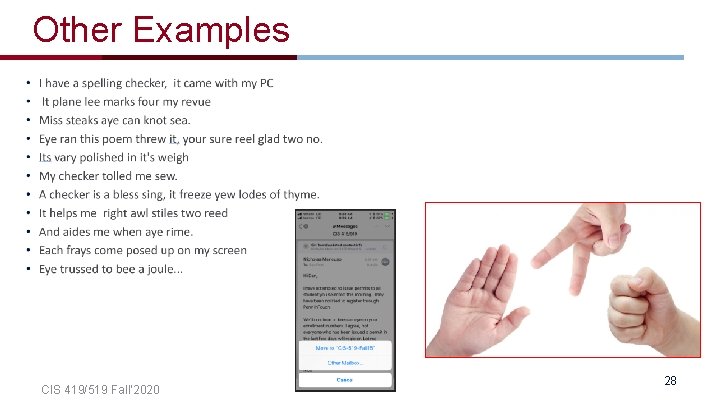
Other Examples CIS 419/519 Fall’ 2020 28
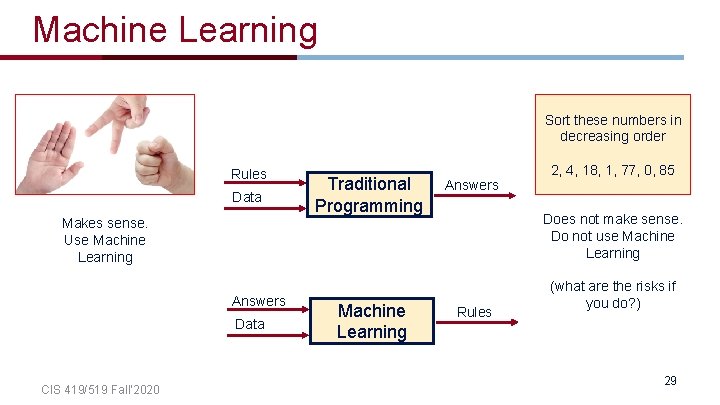
Machine Learning Sort these numbers in decreasing order Rules Data Traditional Programming Answers Does not make sense. Do not use Machine Learning Makes sense. Use Machine Learning Answers Data CIS 419/519 Fall’ 2020 Machine Learning 2, 4, 18, 1, 77, 0, 85 Rules (what are the risks if you do? ) 29
CIS 419/519 Fall’ 2020 30
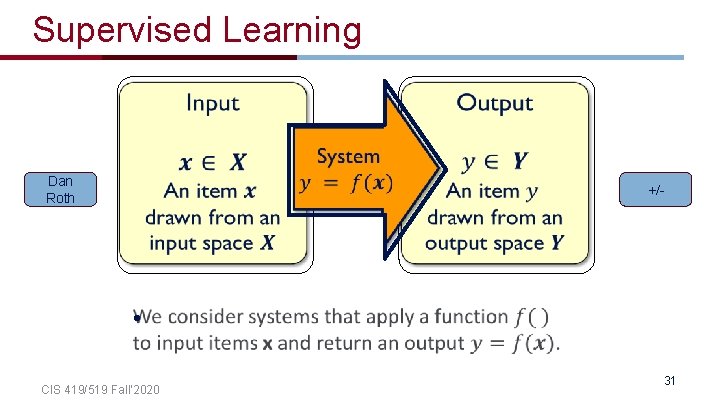
Supervised Learning Dan Roth +/- • CIS 419/519 Fall’ 2020 31
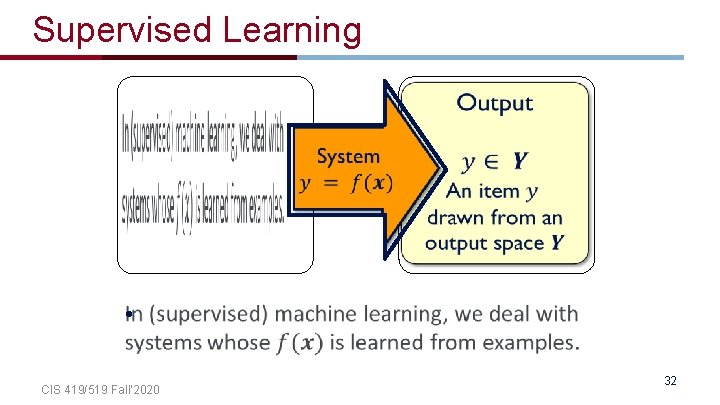
Supervised Learning • CIS 419/519 Fall’ 2020 32
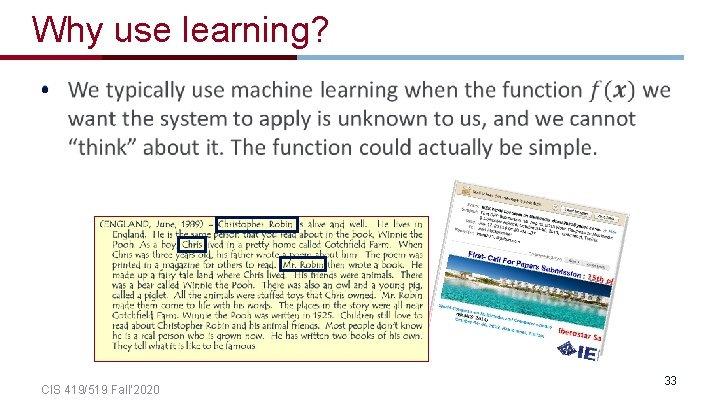
Why use learning? • CIS 419/519 Fall’ 2020 33
Supervised Learning CIS 419/519 Fall’ 2020 The space of all functions our algorithm “considers” is called the Hypothesis space. 34
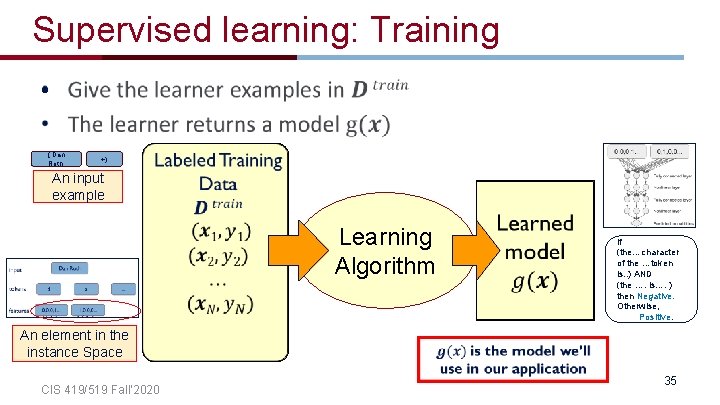
Supervised learning: Training • ( Dan Roth, +) An input example Learning Algorithm An element in the instance Space CIS 419/519 Fall’ 2020 If (the…character of the …token is. . ) AND (the …. is…. ) then Negative. Otherwise, Positive. 35
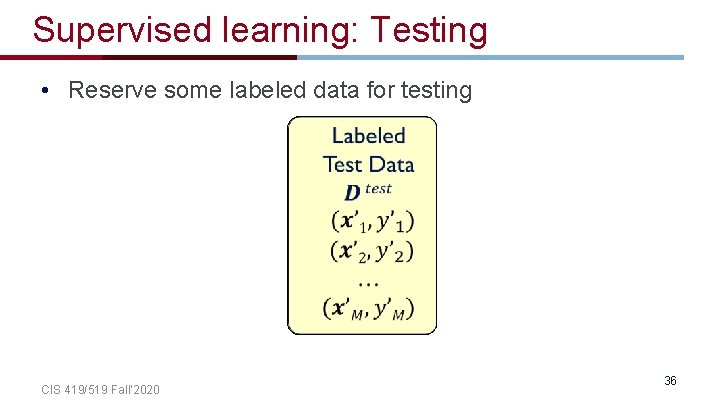
Supervised learning: Testing • Reserve some labeled data for testing CIS 419/519 Fall’ 2020 36
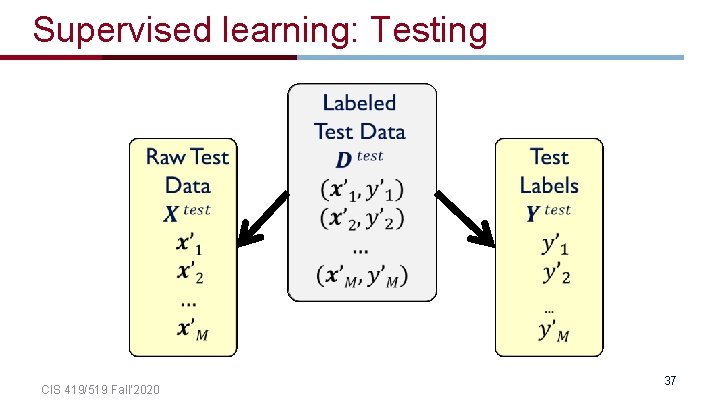
Supervised learning: Testing CIS 419/519 Fall’ 2020 37
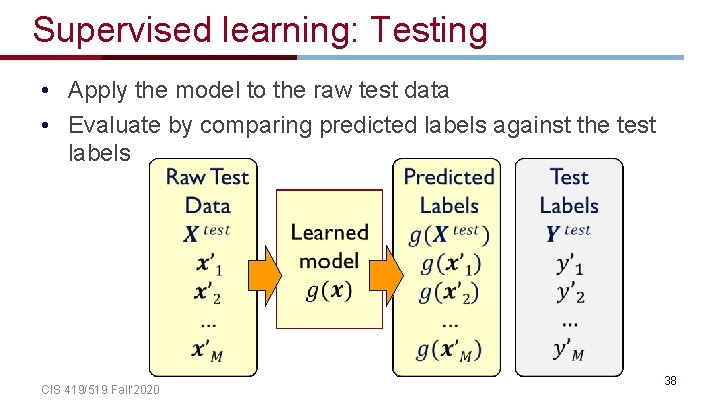
Supervised learning: Testing • Apply the model to the raw test data • Evaluate by comparing predicted labels against the test labels CIS 419/519 Fall’ 2020 38
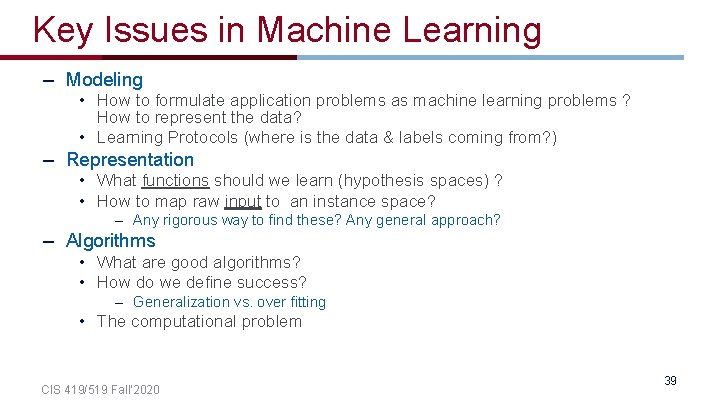
Key Issues in Machine Learning – Modeling • How to formulate application problems as machine learning problems ? How to represent the data? • Learning Protocols (where is the data & labels coming from? ) – Representation • What functions should we learn (hypothesis spaces) ? • How to map raw input to an instance space? – Any rigorous way to find these? Any general approach? – Algorithms • What are good algorithms? • How do we define success? – Generalization vs. over fitting • The computational problem CIS 419/519 Fall’ 2020 39
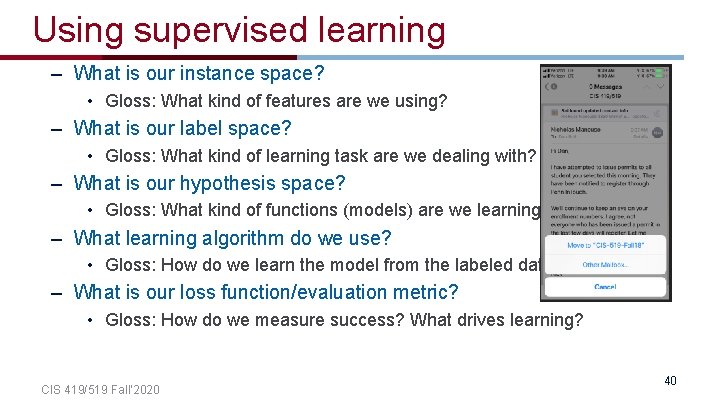
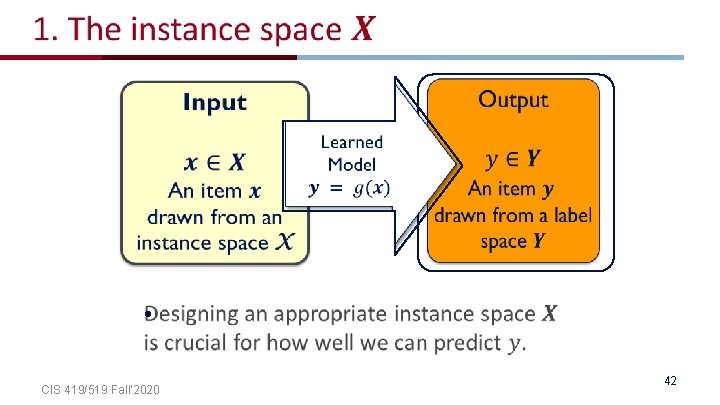
Using supervised learning – What is our instance space? • Gloss: What kind of features are we using? – What is our label space? • Gloss: What kind of learning task are we dealing with? – What is our hypothesis space? • Gloss: What kind of functions (models) are we learning? – What learning algorithm do we use? • Gloss: How do we learn the model from the labeled data? – What is our loss function/evaluation metric? • Gloss: How do we measure success? What drives learning? CIS 419/519 Fall’ 2020 40
CIS 419/519 Fall’ 2020 41
• CIS 419/519 Fall’ 2020 42
Instance Spaces • What instance spaces would you consider? CIS 419/519 Fall’ 2020 43
CIS 419/519 Fall’ 2020 44
CIS 419/519 Fall’ 2020 45
CIS 419/519 Fall’ 2020 46
Administration (9/14/20) Are we recording? YES! Will be available on the web site – HW 0: please complete it. It’s mandatory (graded Pass/Fail) – 1 st quiz is out this week (Thursday night; due on Sunday night) – HW 1 will be released next week. – Questions? • Please ask/comment during class. – Feedback/Suggestions? CIS 419/519 Fall’ 2020 47
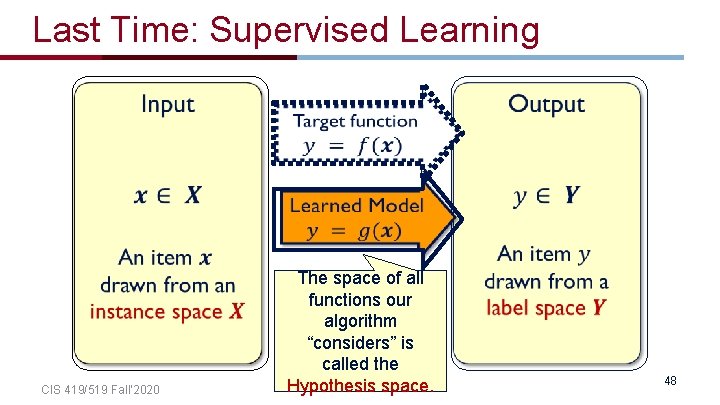
Last Time: Supervised Learning CIS 419/519 Fall’ 2020 The space of all functions our algorithm “considers” is called the Hypothesis space. 48
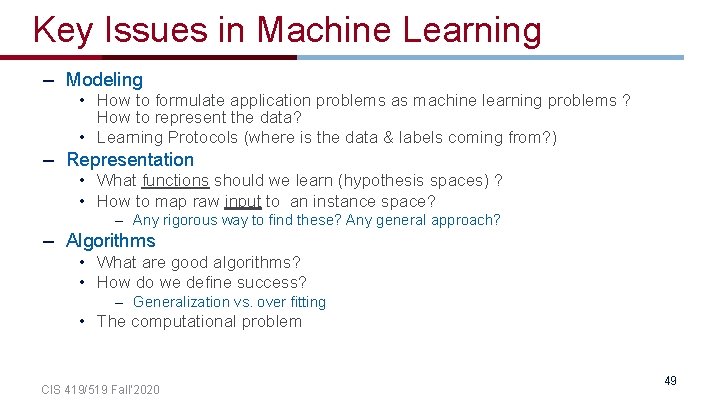
Key Issues in Machine Learning – Modeling • How to formulate application problems as machine learning problems ? How to represent the data? • Learning Protocols (where is the data & labels coming from? ) – Representation • What functions should we learn (hypothesis spaces) ? • How to map raw input to an instance space? – Any rigorous way to find these? Any general approach? – Algorithms • What are good algorithms? • How do we define success? – Generalization vs. over fitting • The computational problem CIS 419/519 Fall’ 2020 49
Today • We’ll go in more details into the concepts introduced last time – Instance Space & Hypothesis Space – (since we’ll keep, for the most part, the labels to be Boolean {Yes/No}) • We’ll begin to formalize – Modeling and Representation • We’ll see our first Learning Algorithm CIS 419/519 Fall’ 2020 50
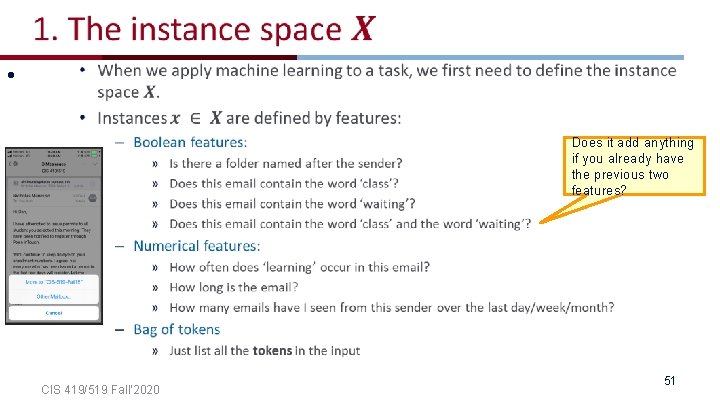
• Does it add anything if you already have the previous two features? CIS 419/519 Fall’ 2020 51
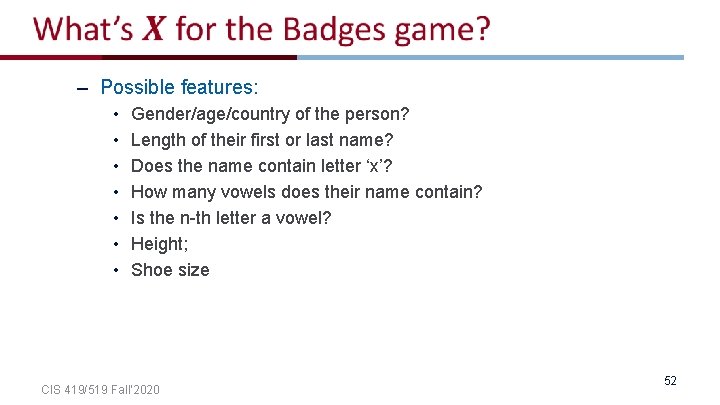
– Possible features: • • Gender/age/country of the person? Length of their first or last name? Does the name contain letter ‘x’? How many vowels does their name contain? Is the n-th letter a vowel? Height; Shoe size CIS 419/519 Fall’ 2020 52
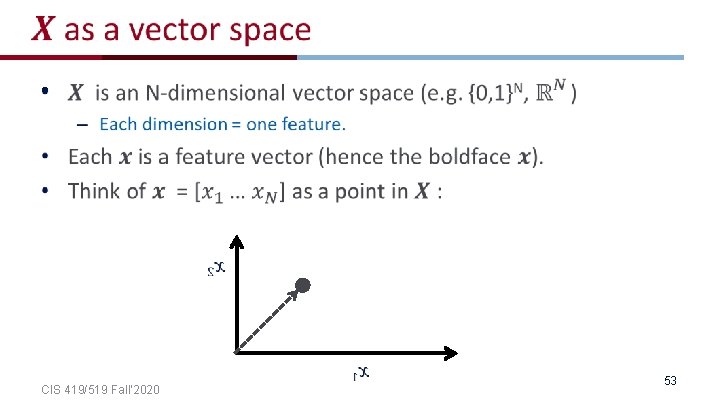
• CIS 419/519 Fall’ 2020 53
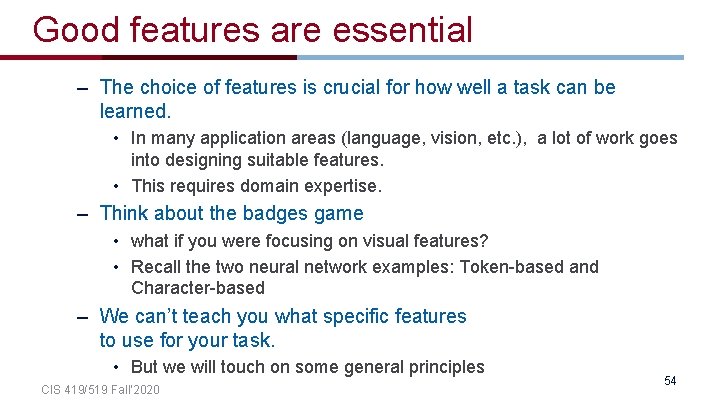
Good features are essential – The choice of features is crucial for how well a task can be learned. • In many application areas (language, vision, etc. ), a lot of work goes into designing suitable features. • This requires domain expertise. – Think about the badges game • what if you were focusing on visual features? • Recall the two neural network examples: Token-based and Character-based – We can’t teach you what specific features to use for your task. • But we will touch on some general principles CIS 419/519 Fall’ 2020 54
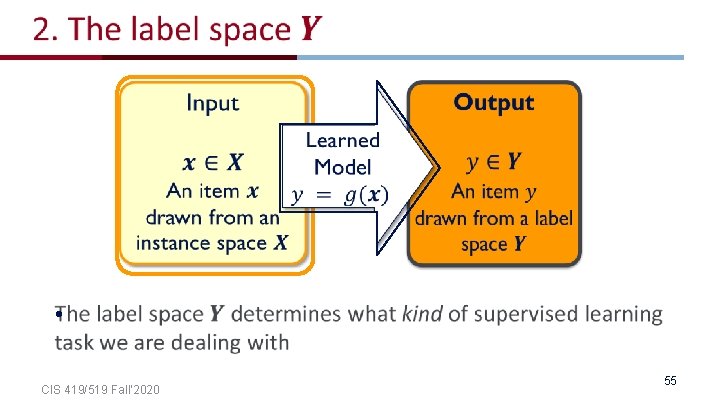
• CIS 419/519 Fall’ 2020 55
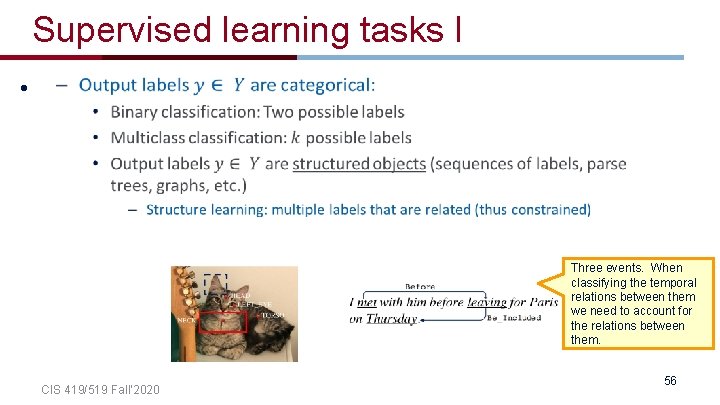
Supervised learning tasks I • Three events. When classifying the temporal relations between them we need to account for the relations between them. CIS 419/519 Fall’ 2020 56
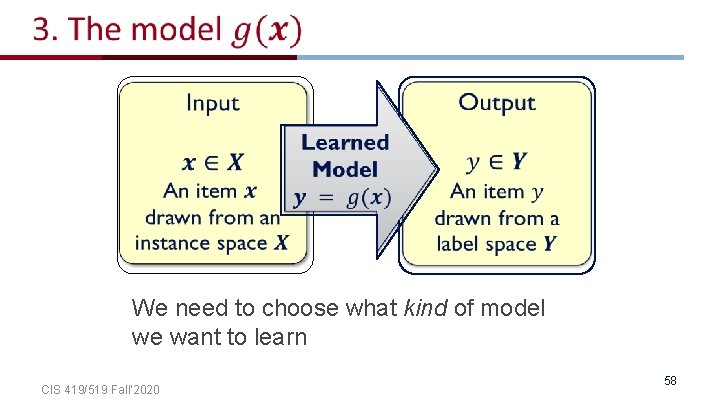
We need to choose what kind of model we want to learn CIS 419/519 Fall’ 2020 58
CIS 419/519 Fall’ 2020 59
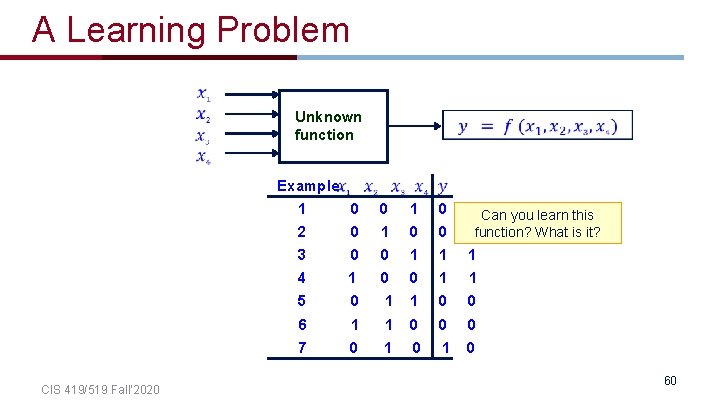
A Learning Problem Unknown function Example CIS 419/519 Fall’ 2020 1 0 2 0 1 0 0 0 Can you learn this 0 function? What is it? 3 0 0 1 1 1 4 1 0 0 1 1 5 0 1 1 0 0 6 1 1 0 0 0 7 0 1 0 60
CIS 419/519 Fall’ 2020 61
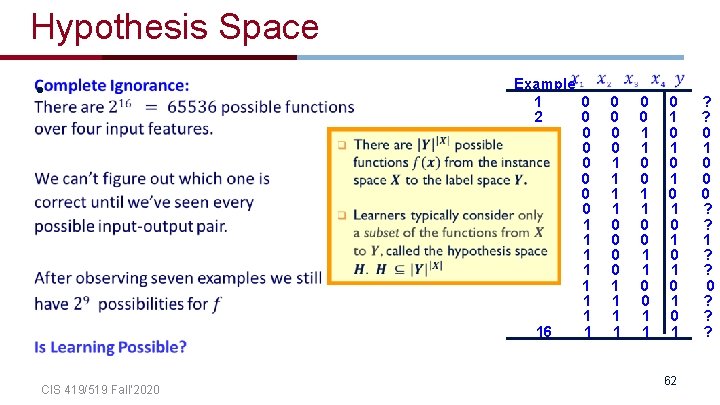
Hypothesis Space • CIS 419/519 Fall’ 2020 Example 1 0 2 0 0 0 0 1 1 1 16 1 0 0 0 0 1 1 1 1 0 0 1 1 0 1 0 1 62 ? ? 0 1 0 0 0 ? ? 1 ? ? 0 ? ? ?
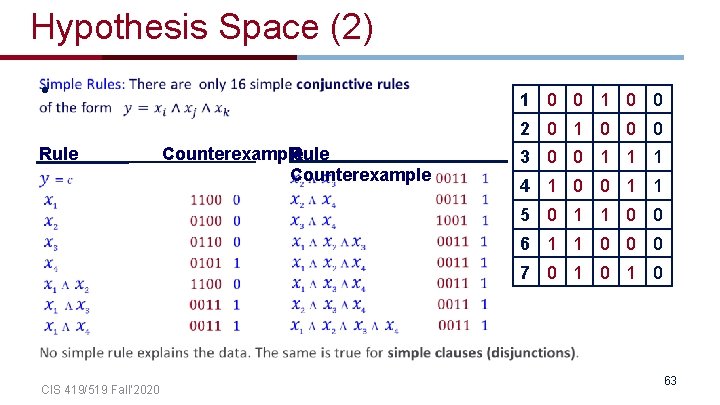
Hypothesis Space (2) • 1 0 0 2 0 1 0 0 0 Rule Counterexample 3 0 0 1 1 1 4 1 0 0 1 1 5 0 1 1 0 0 6 1 1 0 0 0 7 0 1 0 CIS 419/519 Fall’ 2020 63
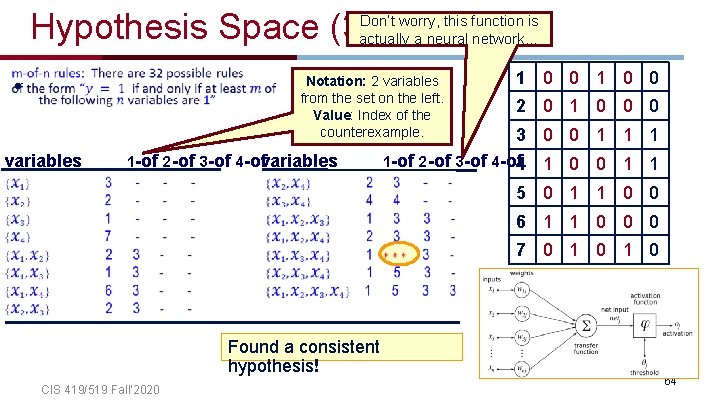
Don’t worry, this function is Hypothesis Space (3)actually a neural network… • variables Notation: 2 variables from the set on the left. Value: Index of the counterexample. 1 -of 2 -of 3 -of 4 -ofvariables 1 0 0 2 0 1 0 0 0 3 0 0 1 1 -of 2 -of 3 -of 4 1 0 0 1 1 5 0 1 1 0 0 6 1 1 0 0 0 7 0 1 0 Found a consistent hypothesis! CIS 419/519 Fall’ 2020 64
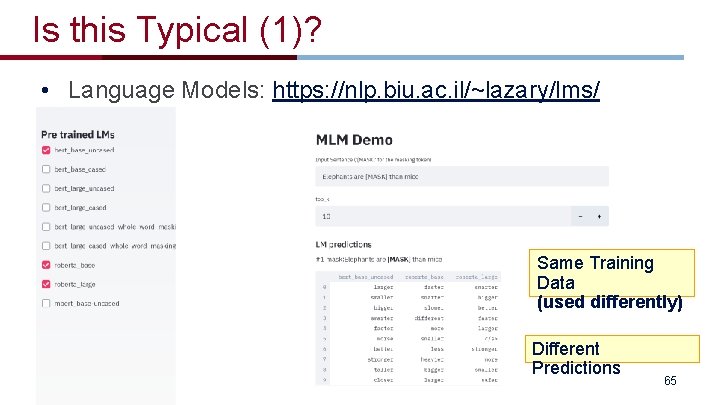
Is this Typical (1)? • Language Models: https: //nlp. biu. ac. il/~lazary/lms/ Same Training Data (used differently) Different Predictions CIS 419/519 Fall’ 2020 65
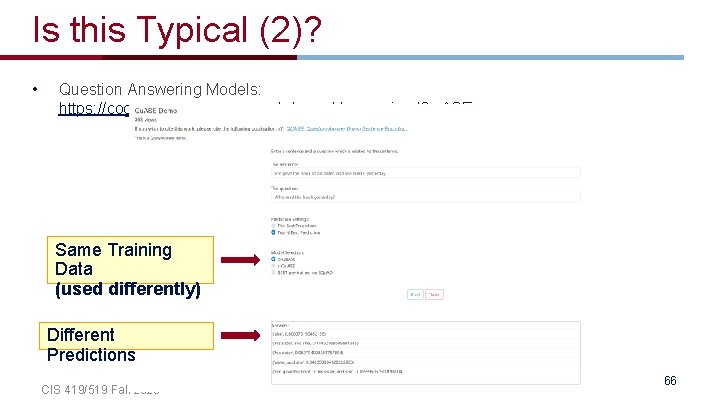
Is this Typical (2)? • Question Answering Models: https: //cogcomp. seas. upenn. edu/page/demo_view/Qu. ASE Same Training Data (used differently) Different Predictions CIS 419/519 Fall’ 2020 66
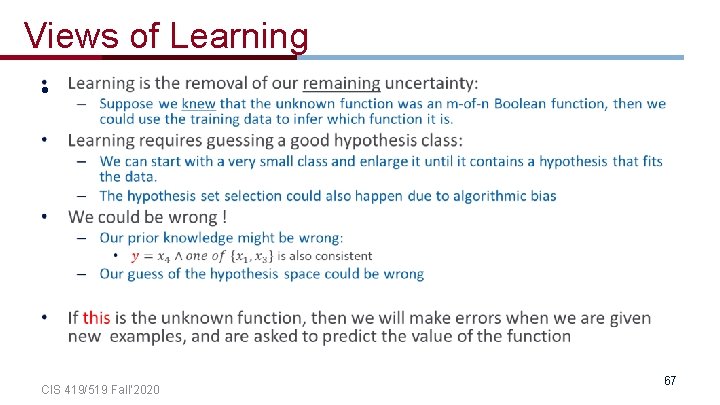
Views of Learning • CIS 419/519 Fall’ 2020 67
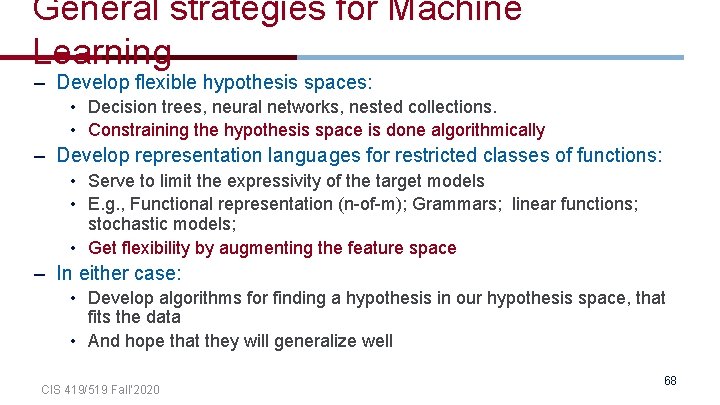
General strategies for Machine Learning – Develop flexible hypothesis spaces: • Decision trees, neural networks, nested collections. • Constraining the hypothesis space is done algorithmically – Develop representation languages for restricted classes of functions: • Serve to limit the expressivity of the target models • E. g. , Functional representation (n-of-m); Grammars; linear functions; stochastic models; • Get flexibility by augmenting the feature space – In either case: • Develop algorithms for finding a hypothesis in our hypothesis space, that fits the data • And hope that they will generalize well CIS 419/519 Fall’ 2020 68
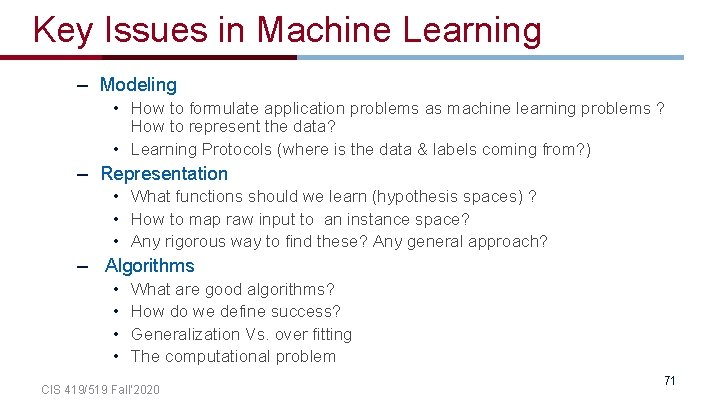
Key Issues in Machine Learning – Modeling • How to formulate application problems as machine learning problems ? How to represent the data? • Learning Protocols (where is the data & labels coming from? ) – Representation • What functions should we learn (hypothesis spaces) ? • How to map raw input to an instance space? • Any rigorous way to find these? Any general approach? – Algorithms • • What are good algorithms? How do we define success? Generalization Vs. over fitting The computational problem CIS 419/519 Fall’ 2020 71
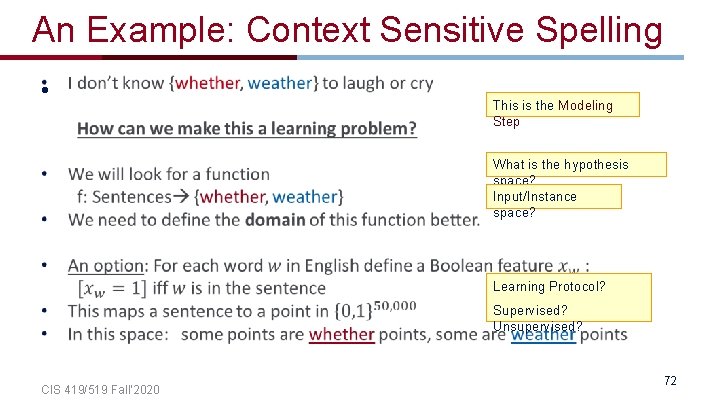
An Example: Context Sensitive Spelling • This is the Modeling Step What is the hypothesis space? Input/Instance space? Learning Protocol? Supervised? Unsupervised? CIS 419/519 Fall’ 2020 72
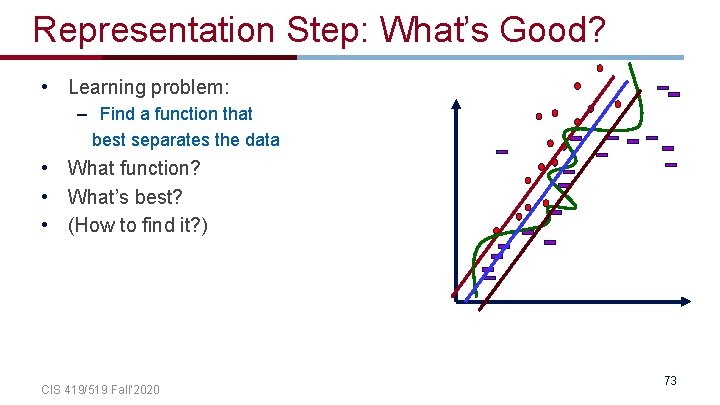
Representation Step: What’s Good? • Learning problem: – Find a function that best separates the data • What function? • What’s best? • (How to find it? ) CIS 419/519 Fall’ 2020 73
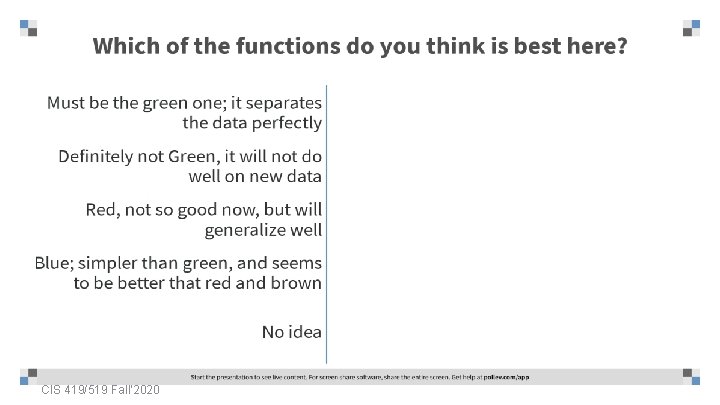
CIS 419/519 Fall’ 2020 74
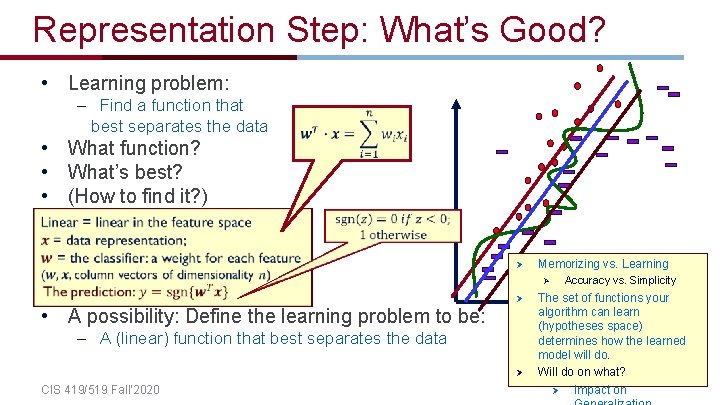
Representation Step: What’s Good? • Learning problem: – Find a function that best separates the data • What function? • What’s best? • (How to find it? ) Ø Memorizing vs. Learning Ø Ø • A possibility: Define the learning problem to be: – A (linear) function that best separates the data Ø CIS 419/519 Fall’ 2020 Accuracy vs. Simplicity The set of functions your algorithm can learn (hypotheses space) determines how the learned model will do. Will do on what? 75 Ø Impact on
A Small Detour • Let’s talk a bit about expressivity of functions CIS 419/519 Fall’ 2020 76
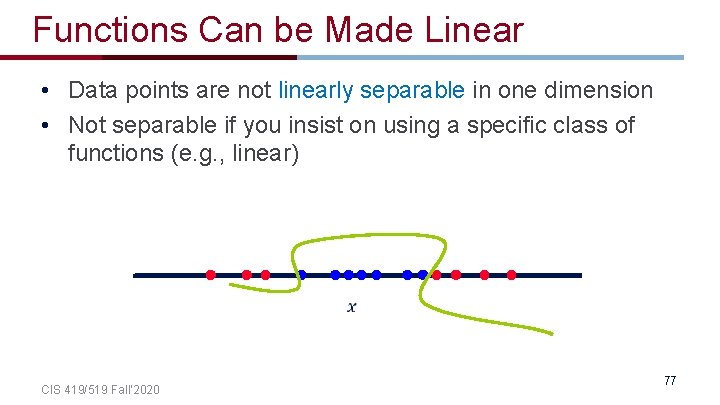
Functions Can be Made Linear • Data points are not linearly separable in one dimension • Not separable if you insist on using a specific class of functions (e. g. , linear) CIS 419/519 Fall’ 2020 77
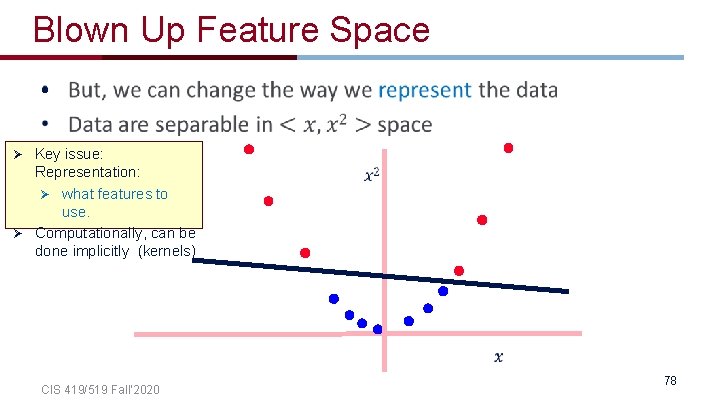
Blown Up Feature Space • Ø Ø Key issue: Representation: Ø what features to use. Computationally, can be done implicitly (kernels) CIS 419/519 Fall’ 2020 78
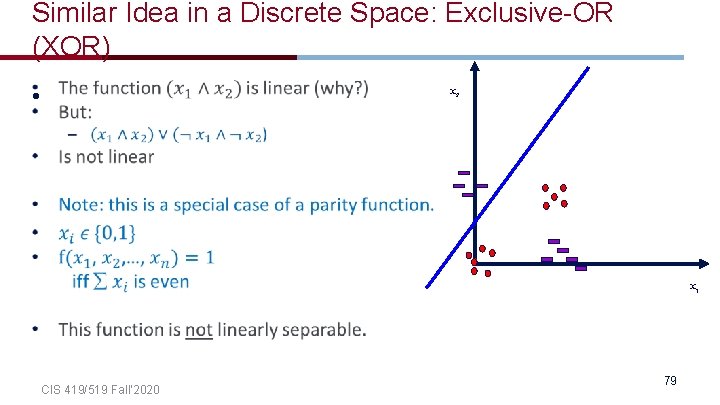
Similar Idea in a Discrete Space: Exclusive-OR (XOR) • x 2 x 1 CIS 419/519 Fall’ 2020 79
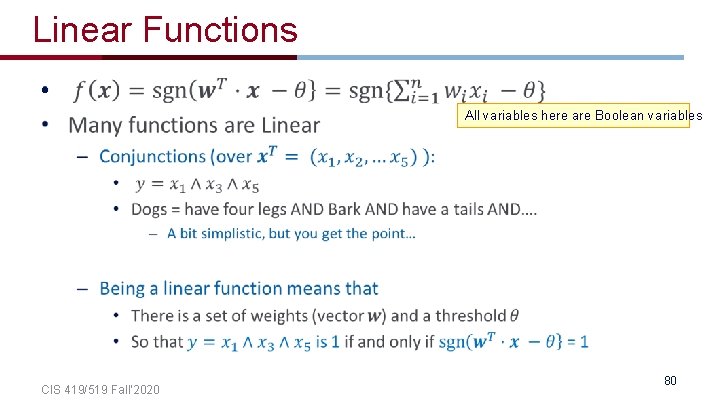
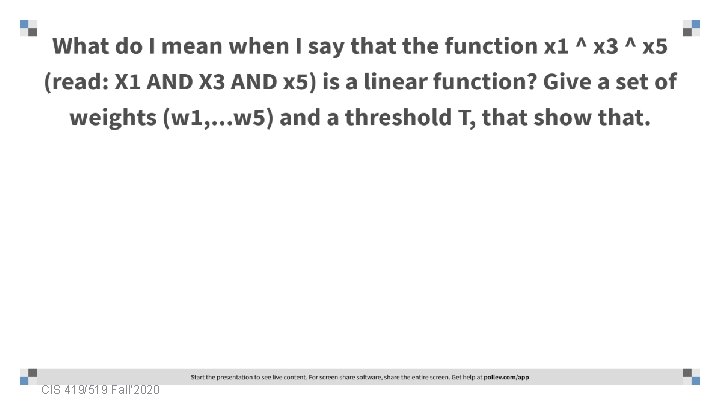
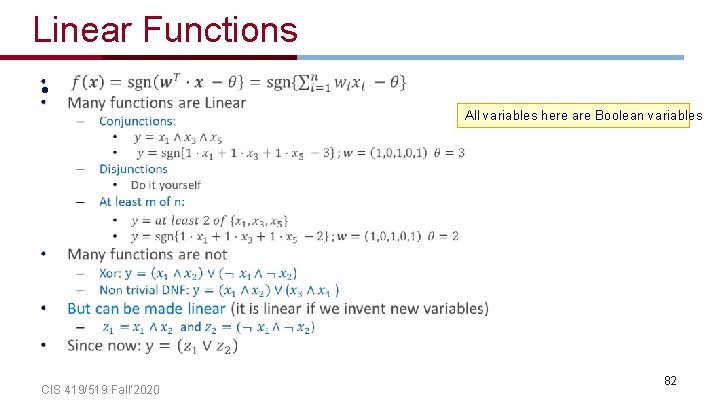
Linear Functions • All variables here are Boolean variables CIS 419/519 Fall’ 2020 80
CIS 419/519 Fall’ 2020 81
Linear Functions • All variables here are Boolean variables CIS 419/519 Fall’ 2020 82
Representation • The next few hidden slides provide a detailed explanation of feature generation in the discrete case. • View • We may discuss later CIS 419/519 Fall’ 2020 83
Key Issues in Machine Learning – Modeling • How to formulate application problems as machine learning problems ? How to represent the data? • Learning Protocols (where is the data & labels coming from? ) – Representation • What functions should we learn (hypothesis spaces) ? • How to map raw input to an instance space? • Any rigorous way to find these? Any general approach? – Algorithms • • What are good algorithms? How do we define success? Generalization Vs. over fitting The computational problem CIS 419/519 Fall’ 2020 88
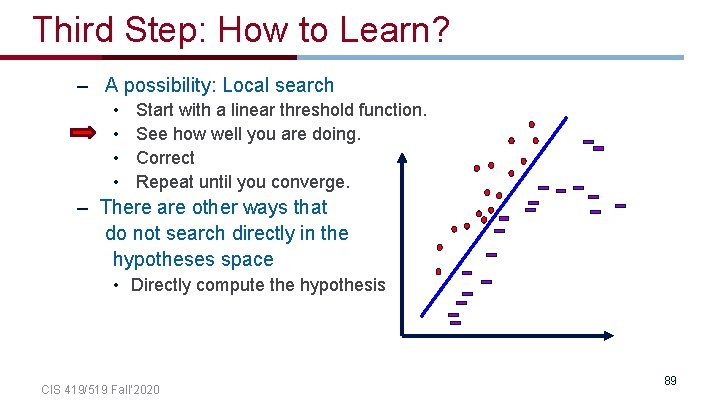
Third Step: How to Learn? – A possibility: Local search • • Start with a linear threshold function. See how well you are doing. Correct Repeat until you converge. – There are other ways that do not search directly in the hypotheses space • Directly compute the hypothesis CIS 419/519 Fall’ 2020 89
CIS 419/519 Fall’ 2020 90
CIS 419/519 Fall’ 2020 91
CIS 419/519 Fall’ 2020 92
Administration (9/16/20) Are we recording? YES! Available on the web site – 1 st quiz is out this week (Thursday night; due on Sunday night) – HW 1 will be released next week. – Questions? • Please ask/comment during class. – Feedback/Suggestions? CIS 419/519 Fall’ 2020 93
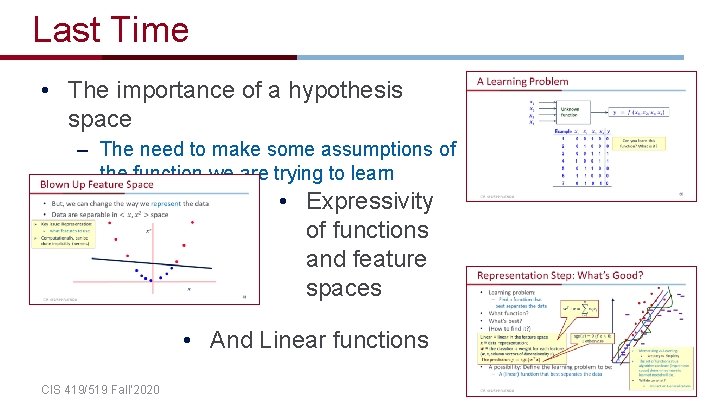
Last Time • The importance of a hypothesis space – The need to make some assumptions of the function we are trying to learn • Expressivity of functions and feature spaces • And Linear functions CIS 419/519 Fall’ 2020 94
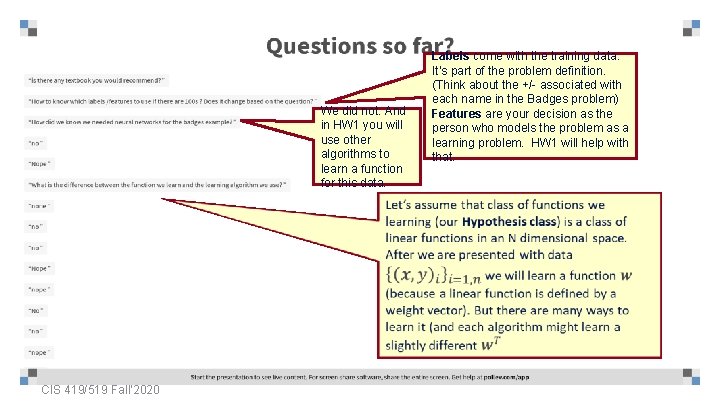
We did not. And in HW 1 you will use other algorithms to learn a function for this data. Labels come with the training data. It’s part of the problem definition. (Think about the +/- associated with each name in the Badges problem) Features are your decision as the person who models the problem as a learning problem. HW 1 will help with that. CIS 419/519 Fall’ 2020 95
Some Questions You Asked • Any Text Book? – Not Really – Some options: • Machine Learning by Tom Mitchell • A Course in Machine Learning by Hal Daumé III • Pattern Recognition and Machine Learning by Bishop CIS 419/519 Fall’ 2020 96
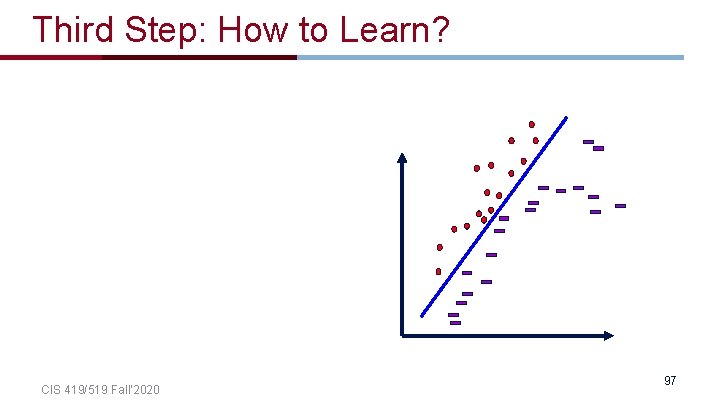
Third Step: How to Learn? CIS 419/519 Fall’ 2020 97
CIS 419/519 Fall’ 2020 98
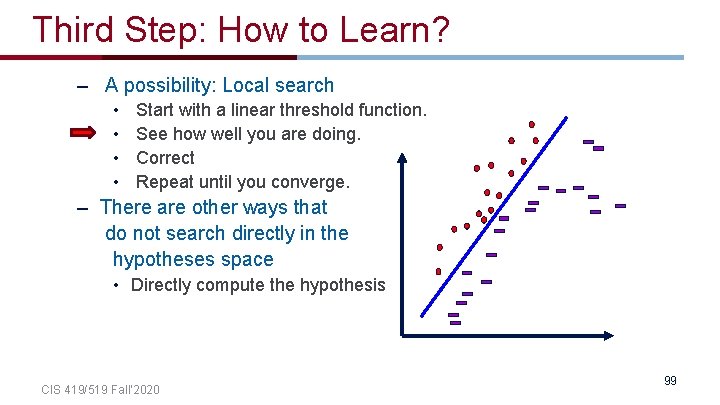
Third Step: How to Learn? – A possibility: Local search • • Start with a linear threshold function. See how well you are doing. Correct Repeat until you converge. – There are other ways that do not search directly in the hypotheses space • Directly compute the hypothesis CIS 419/519 Fall’ 2020 99
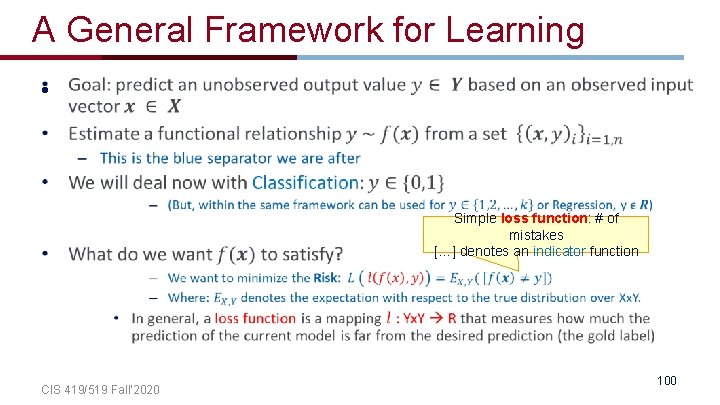
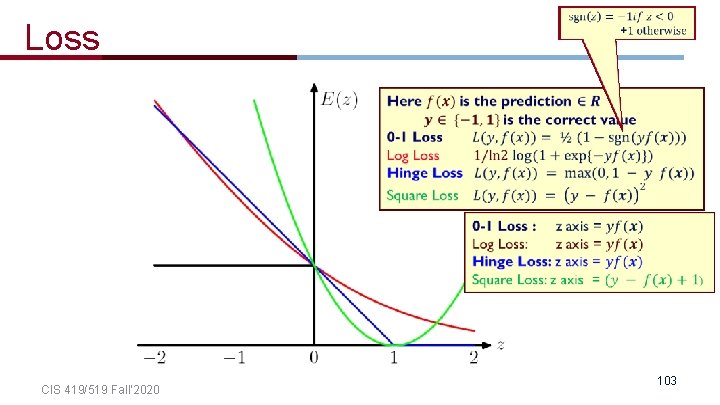
A General Framework for Learning • Simple loss function: # of mistakes […] denotes an indicator function CIS 419/519 Fall’ 2020 100
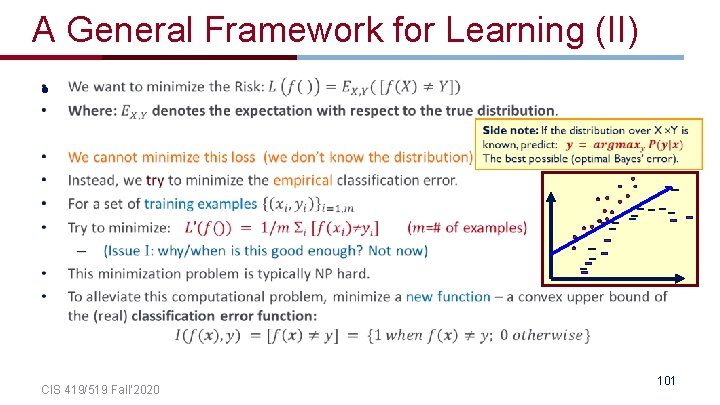
A General Framework for Learning (II) • CIS 419/519 Fall’ 2020 101
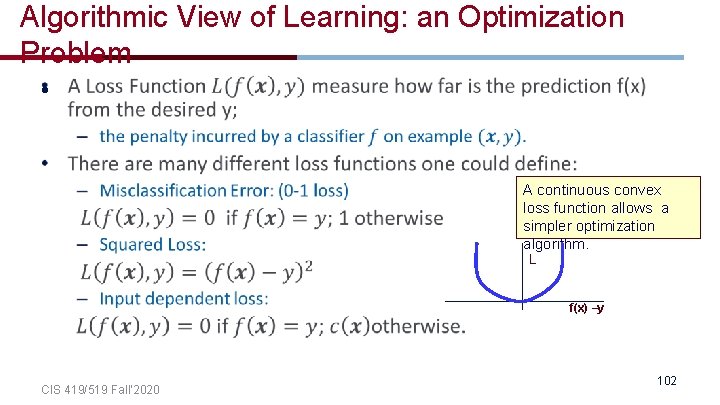
Algorithmic View of Learning: an Optimization Problem • A continuous convex loss function allows a simpler optimization algorithm. L f(x) –y CIS 419/519 Fall’ 2020 102
Loss CIS 419/519 Fall’ 2020 103
Example Putting it all together: A Learning Algorithm CIS 419/519 Fall’ 2020
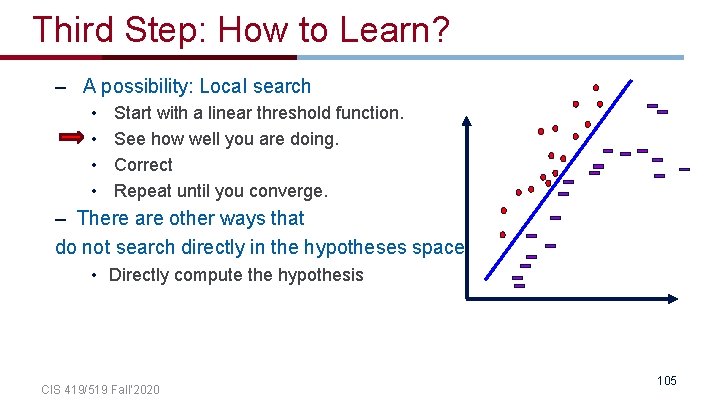
Third Step: How to Learn? – A possibility: Local search • • Start with a linear threshold function. See how well you are doing. Correct Repeat until you converge. – There are other ways that do not search directly in the hypotheses space • Directly compute the hypothesis CIS 419/519 Fall’ 2020 105
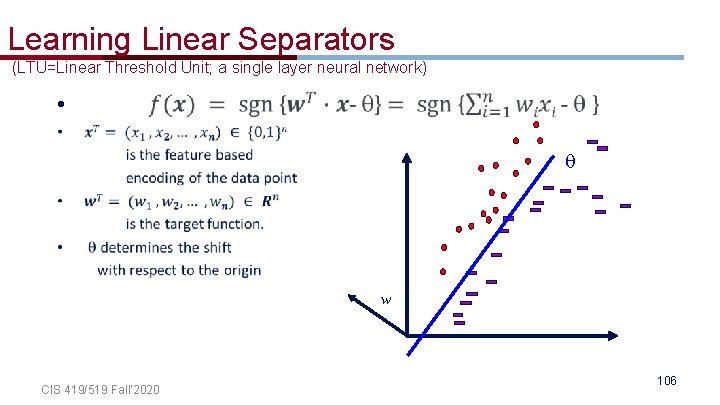
Learning Linear Separators (LTU=Linear Threshold Unit; a single layer neural network) • w CIS 419/519 Fall’ 2020 106
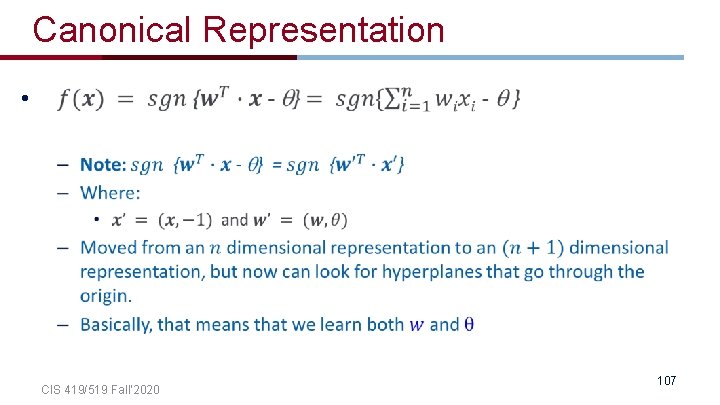
Canonical Representation • CIS 419/519 Fall’ 2020 107
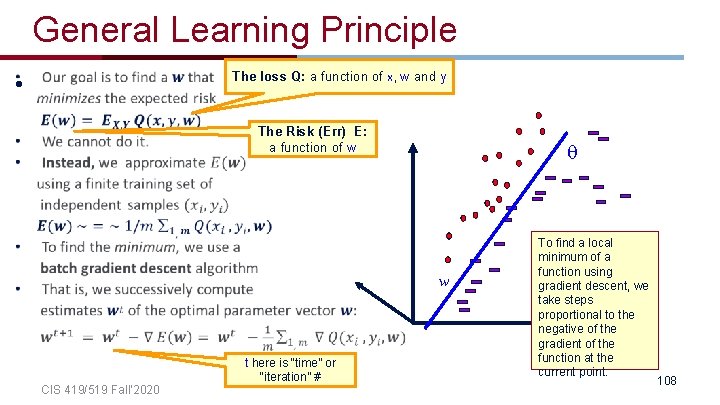
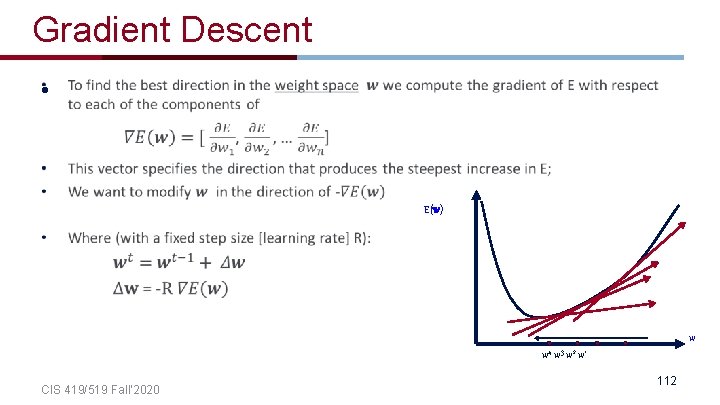
General Learning Principle • The loss Q: a function of x, w and y The Risk (Err) E: a function of w w CIS 419/519 Fall’ 2020 t here is “time” or “iteration” # To find a local minimum of a function using gradient descent, we take steps proportional to the negative of the gradient of the function at the current point. 108
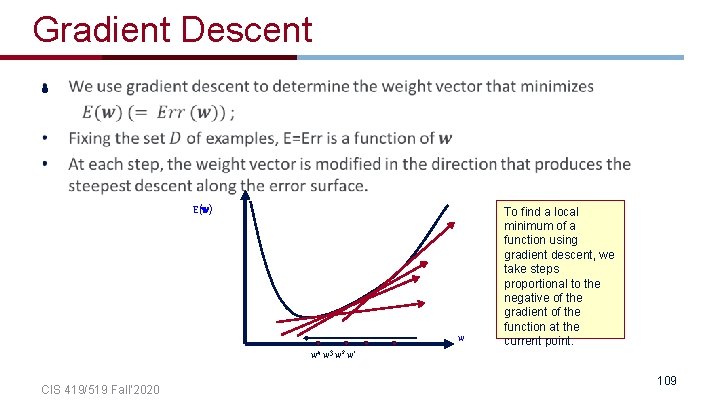
Gradient Descent • E(w) w To find a local minimum of a function using gradient descent, we take steps proportional to the negative of the gradient of the function at the current point. w 4 w 3 w 2 w 1 CIS 419/519 Fall’ 2020 109
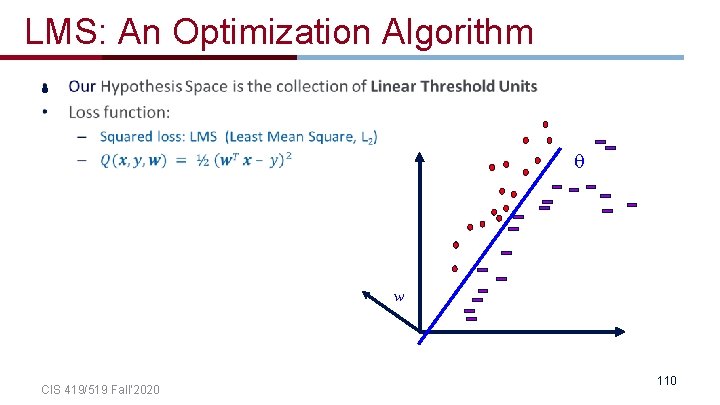
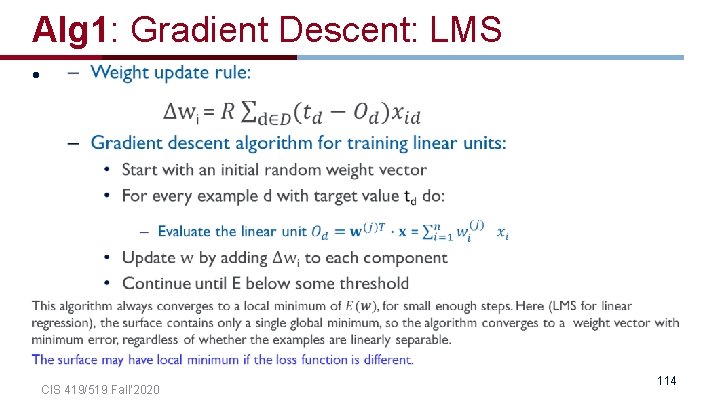
LMS: An Optimization Algorithm • w CIS 419/519 Fall’ 2020 110
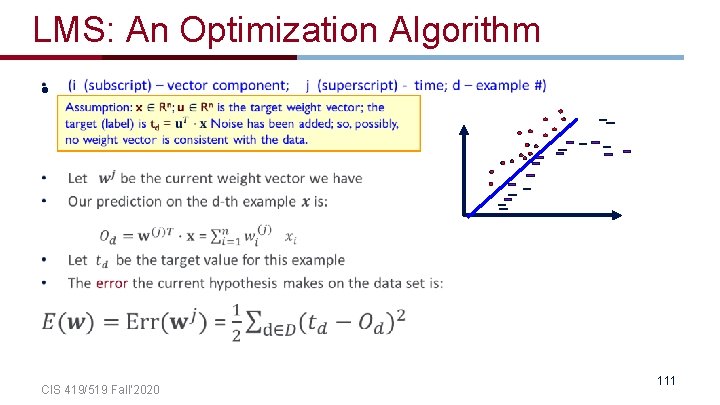
LMS: An Optimization Algorithm • CIS 419/519 Fall’ 2020 111
Gradient Descent • E(w) w w 4 w 3 w 2 w 1 CIS 419/519 Fall’ 2020 112
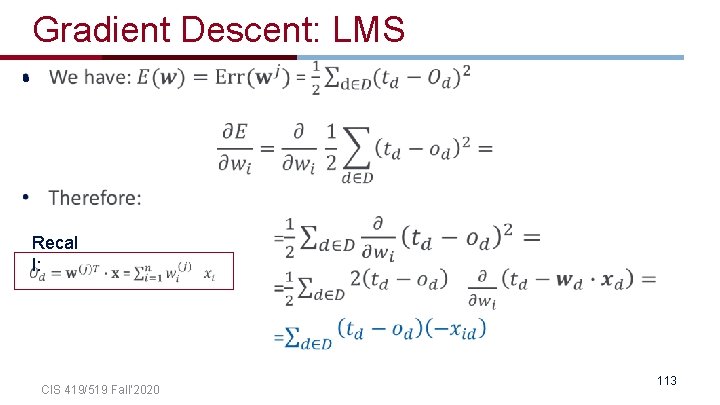
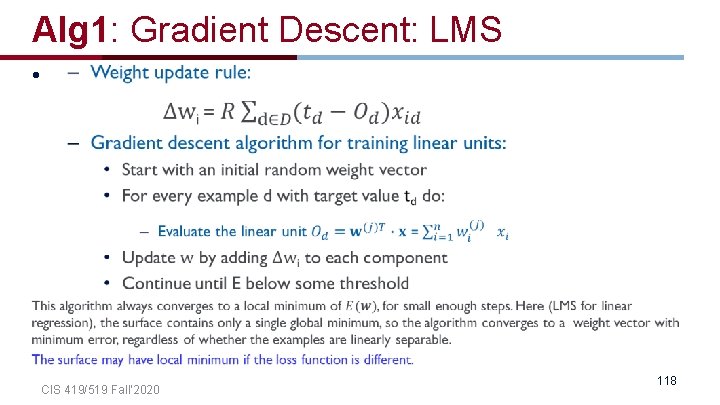
Gradient Descent: LMS • Recal l: CIS 419/519 Fall’ 2020 113
Alg 1: Gradient Descent: LMS • CIS 419/519 Fall’ 2020 114
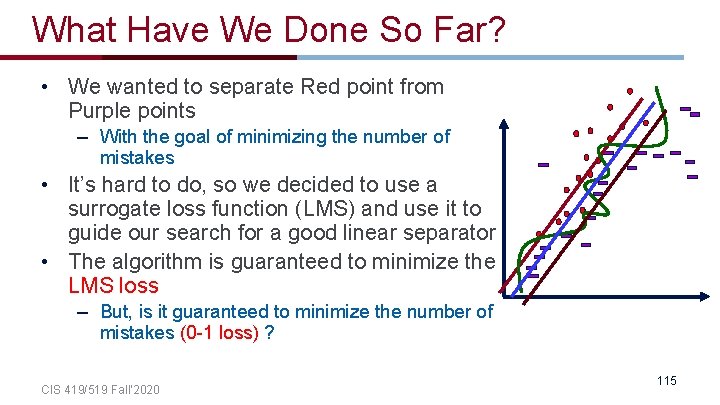
What Have We Done So Far? • We wanted to separate Red point from Purple points – With the goal of minimizing the number of mistakes • It’s hard to do, so we decided to use a surrogate loss function (LMS) and use it to guide our search for a good linear separator • The algorithm is guaranteed to minimize the LMS loss – But, is it guaranteed to minimize the number of mistakes (0 -1 loss) ? CIS 419/519 Fall’ 2020 115
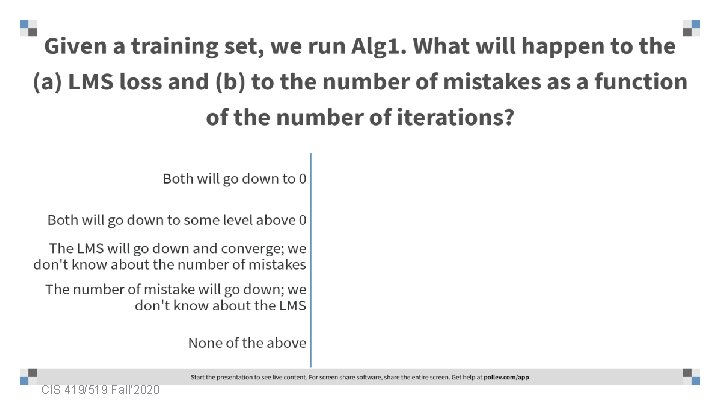
CIS 419/519 Fall’ 2020 116
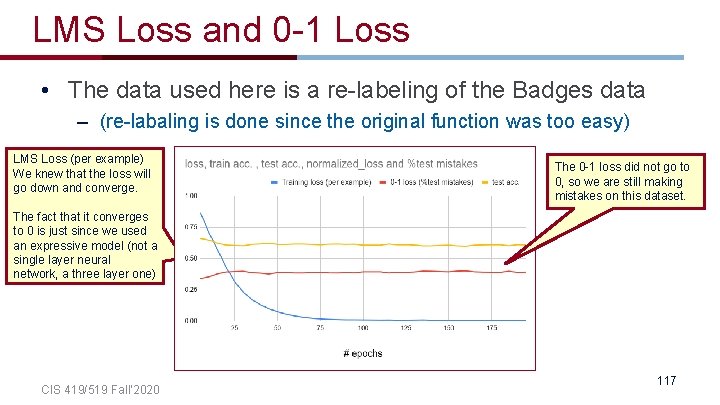
LMS Loss and 0 -1 Loss • The data used here is a re-labeling of the Badges data – (re-labaling is done since the original function was too easy) LMS Loss (per example) We knew that the loss will go down and converge. The 0 -1 loss did not go to 0, so we are still making mistakes on this dataset. The fact that it converges to 0 is just since we used an expressive model (not a single layer neural network, a three layer one) CIS 419/519 Fall’ 2020 117
Alg 1: Gradient Descent: LMS • CIS 419/519 Fall’ 2020 118
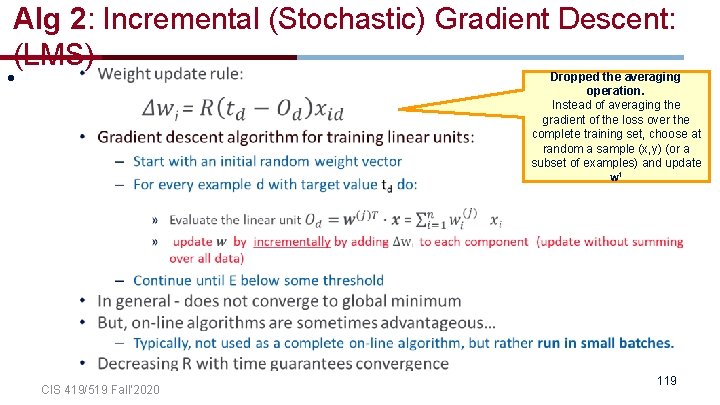
Alg 2: Incremental (Stochastic) Gradient Descent: (LMS) • Dropped the averaging operation. Instead of averaging the gradient of the loss over the complete training set, choose at random a sample (x, y) (or a subset of examples) and update wt CIS 419/519 Fall’ 2020 119
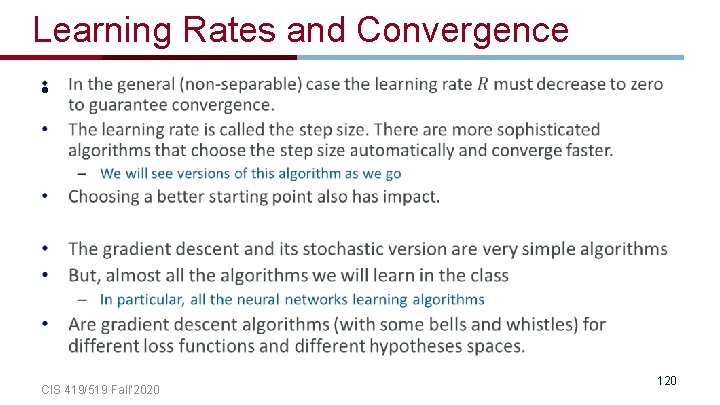
Learning Rates and Convergence • CIS 419/519 Fall’ 2020 120
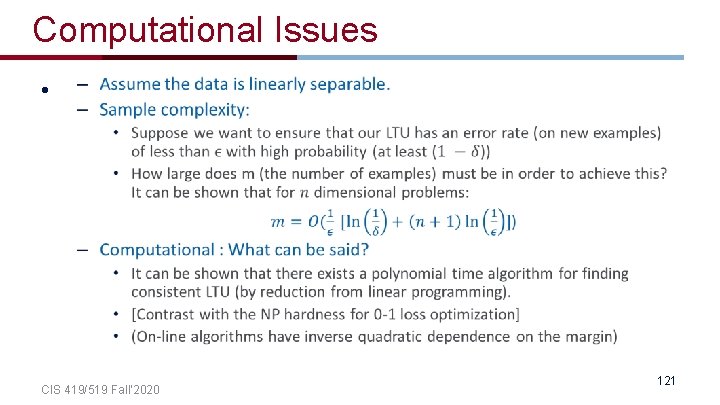
Computational Issues • CIS 419/519 Fall’ 2020 121
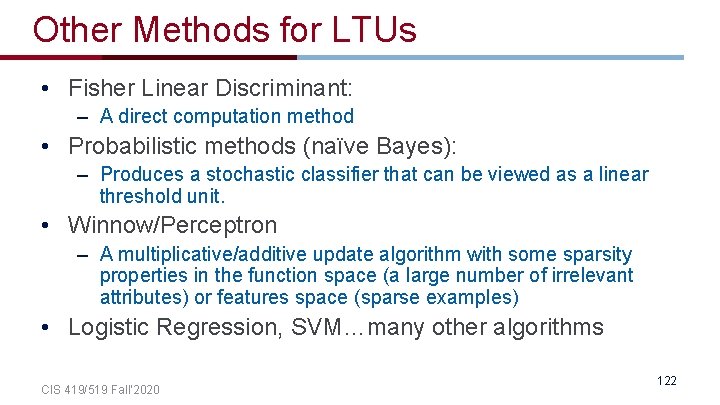
Other Methods for LTUs • Fisher Linear Discriminant: – A direct computation method • Probabilistic methods (naïve Bayes): – Produces a stochastic classifier that can be viewed as a linear threshold unit. • Winnow/Perceptron – A multiplicative/additive update algorithm with some sparsity properties in the function space (a large number of irrelevant attributes) or features space (sparse examples) • Logistic Regression, SVM…many other algorithms CIS 419/519 Fall’ 2020 122
CIS 419/519 Fall’ 2020 123
CIS 419/519 Fall’ 2020 124