
Whats a little leakage between friends Sebastian Angel
What’s a little leakage between friends? Sebastian Angel UPenn David Lazar MIT CSAIL Ioanna Tzialla NYU
Metadata-private messaging (MPM) systems • Allow bidirectional communication without leaking metadata to: • Network providers • Servers used to proxy messages • Users not involved in the communication • Anonymity is not a goal (sender and recipient know each other) • Recent examples: Vuvuzela [SOSP ‘ 15], Pung [OSDI ‘ 16], Stadium [SOSP ‘ 17], Atom [SOSP ‘ 17], MCMix [USENIX Security ‘ 17], Karaoke [OSDI ‘ 18]
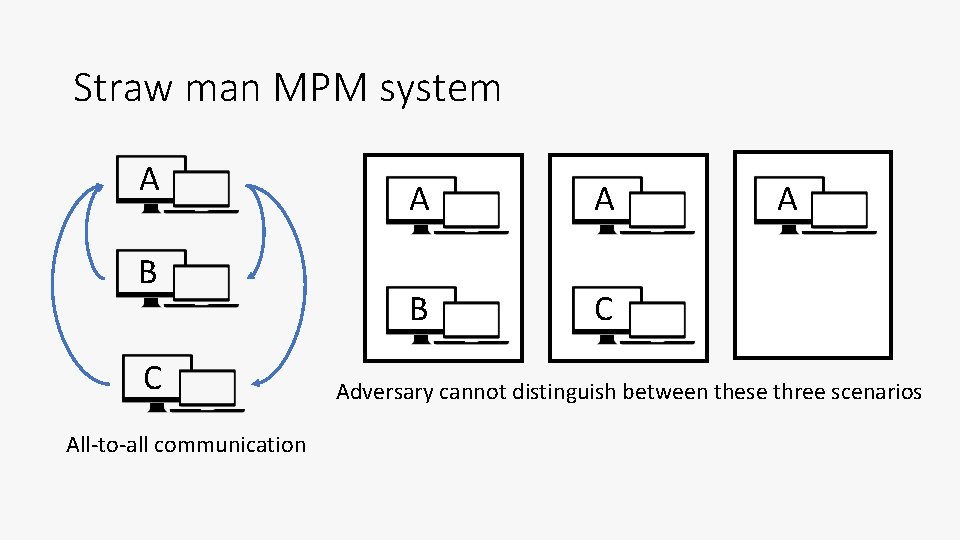
Straw man MPM system A B C All-to-all communication A A B C A Adversary cannot distinguish between these three scenarios
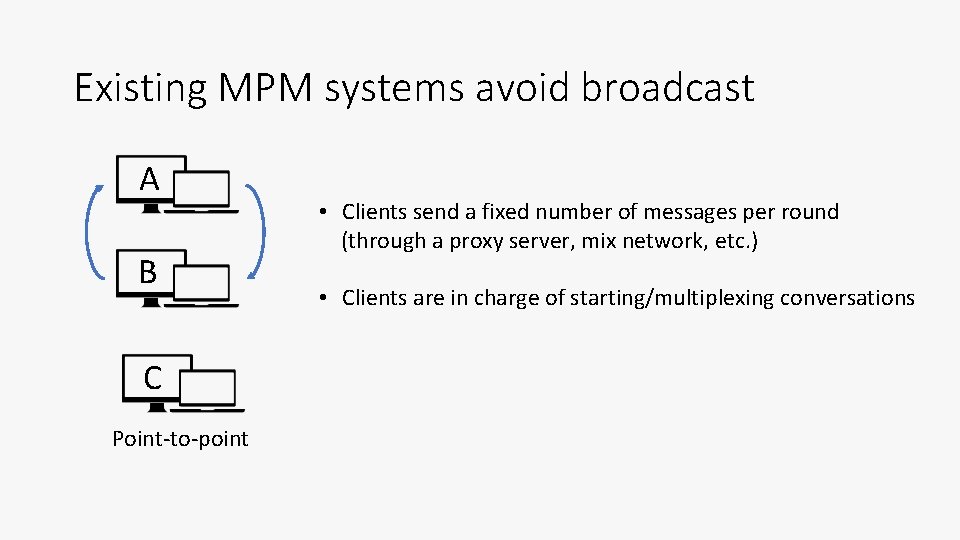
Existing MPM systems avoid broadcast A B C Point-to-point • Clients send a fixed number of messages per round (through a proxy server, mix network, etc. ) • Clients are in charge of starting/multiplexing conversations
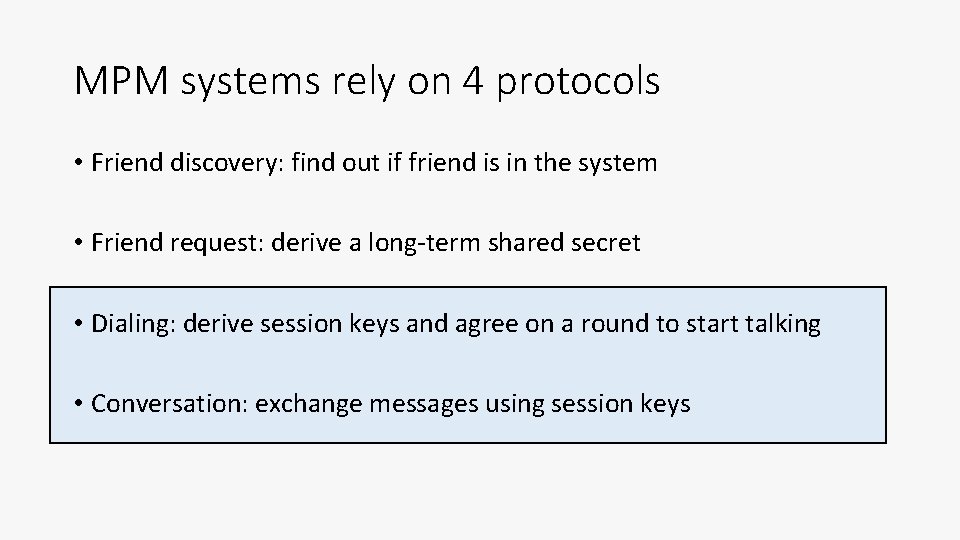
MPM systems rely on 4 protocols • Friend discovery: find out if friend is in the system • Friend request: derive a long-term shared secret • Dialing: derive session keys and agree on a round to start talking • Conversation: exchange messages using session keys
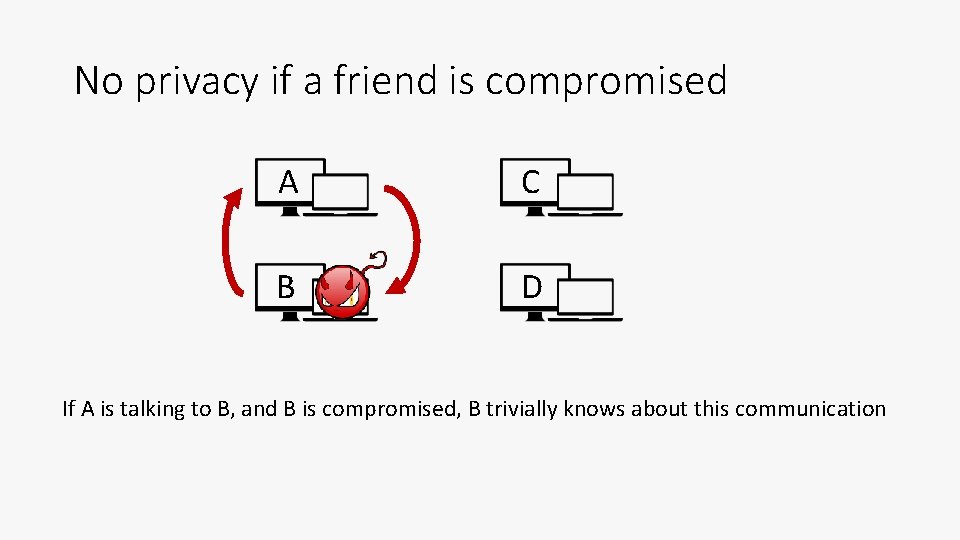
No privacy if a friend is compromised A C B D If A is talking to B, and B is compromised, B trivially knows about this communication
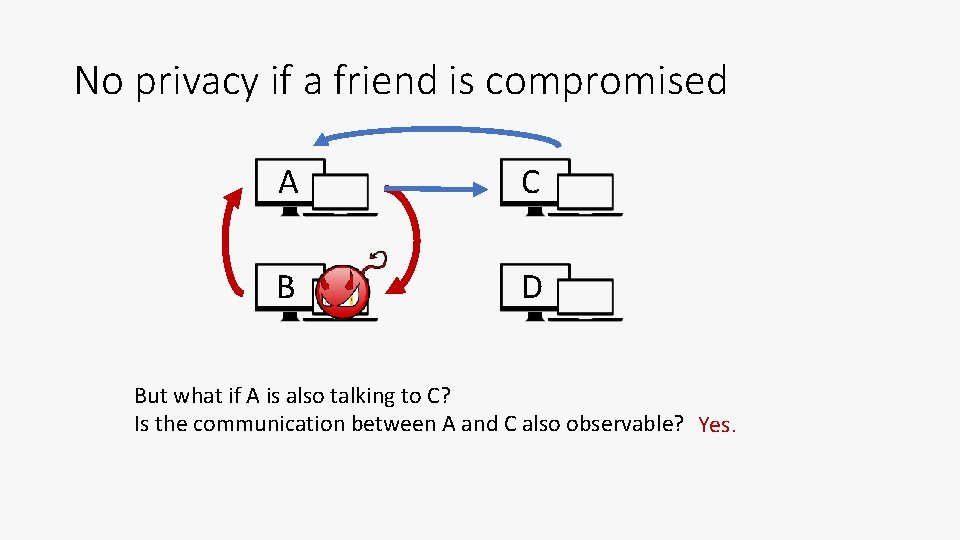
No privacy if a friend is compromised A C B D But what if A is also talking to C? Is the communication between A and C also observable? Yes.
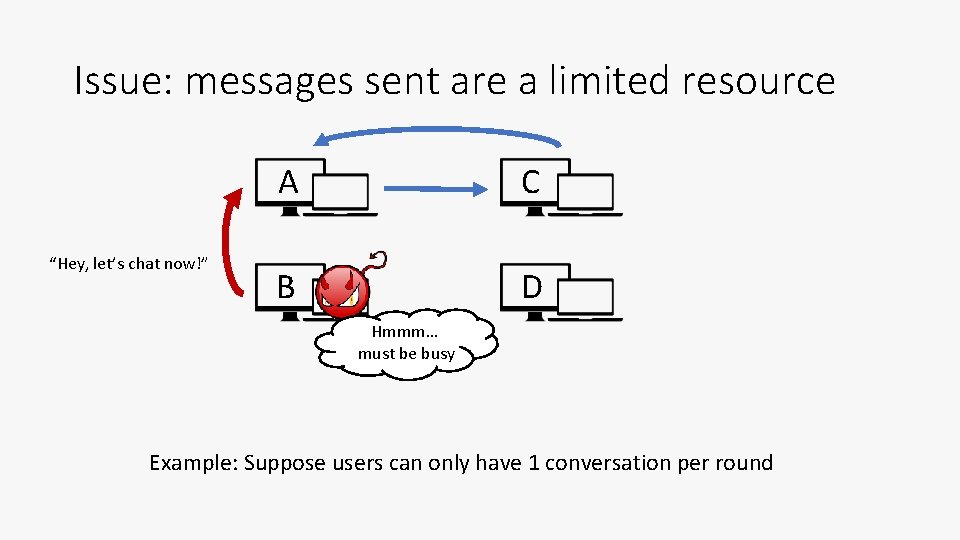
Issue: messages sent are a limited resource “Hey, let’s chat now!” A C B D Hmmm… must be busy Example: Suppose users can only have 1 conversation per round
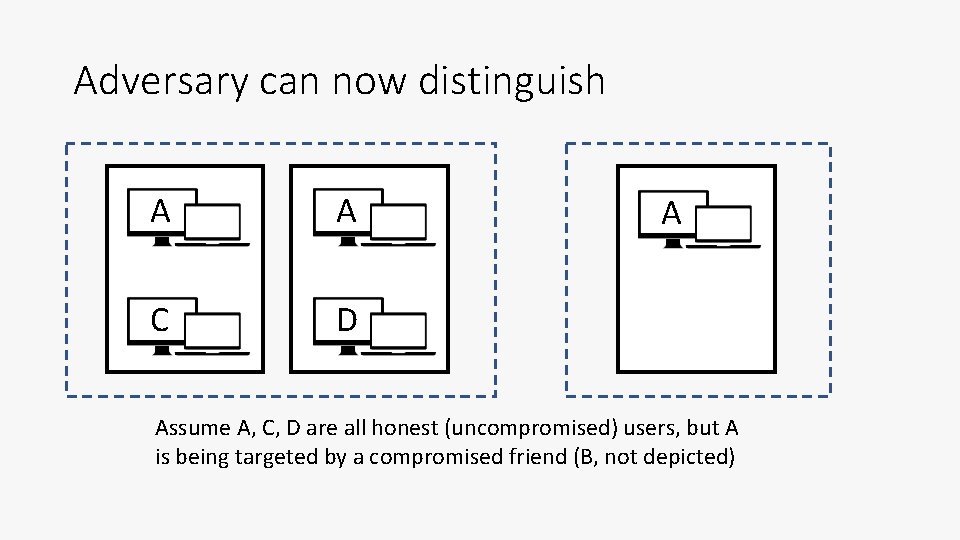
Adversary can now distinguish A A C D A Assume A, C, D are all honest (uncompromised) users, but A is being targeted by a compromised friend (B, not depicted)
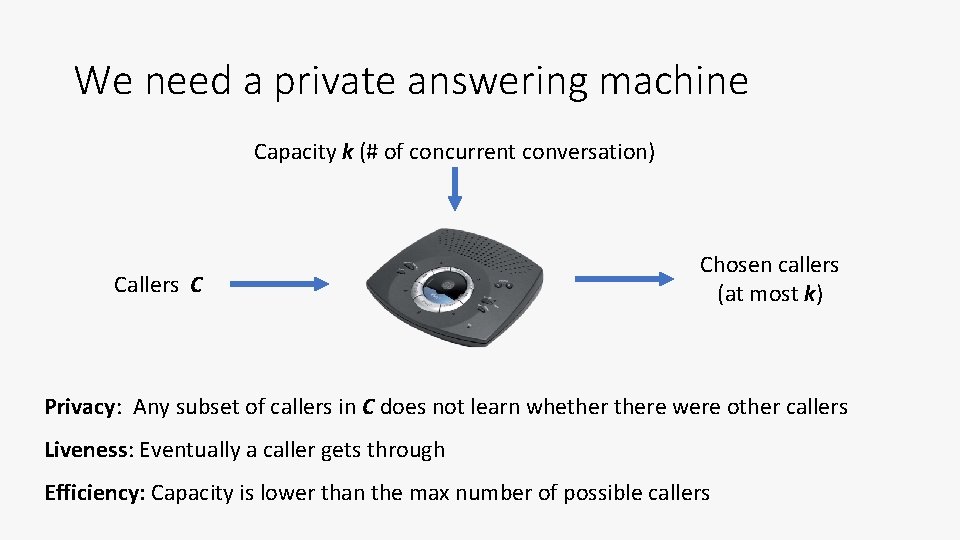
We need a private answering machine Capacity k (# of concurrent conversation) Callers C Chosen callers (at most k) Privacy: Any subset of callers in C does not learn whethere were other callers Liveness: Eventually a caller gets through Efficiency: Capacity is lower than the max number of possible callers
Is there a private, live, and efficient answering machine? Not possible without some assumptions
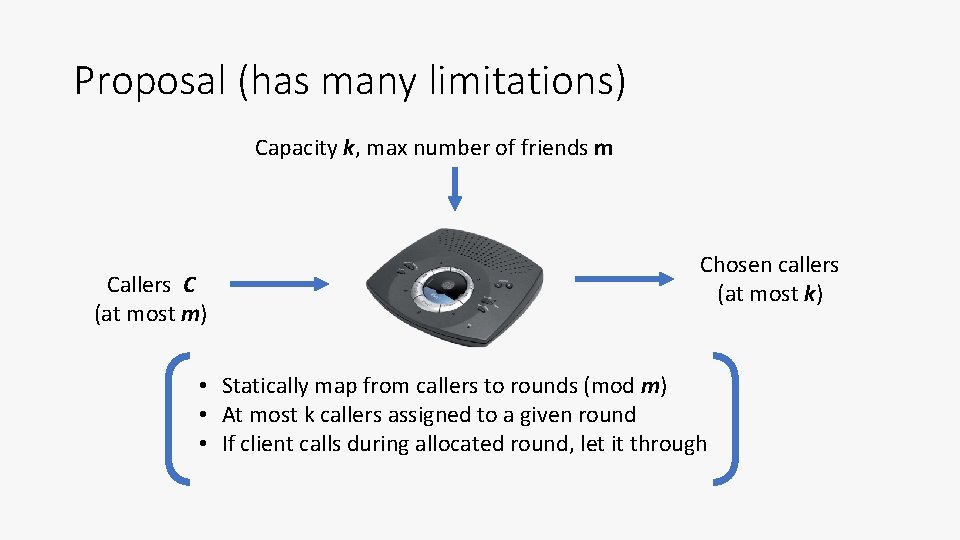
Proposal (has many limitations) Capacity k, max number of friends m Callers C (at most m) Chosen callers (at most k) • Statically map from callers to rounds (mod m) • At most k callers assigned to a given round • If client calls during allocated round, let it through
Drawbacks of our proposal • Requires clients to set a bound on number of friends • And this bound might leak • Introduces high latency • Lower capacity or more friends => higher latency • Needs additional mechanisms: • A might assign to B round 1, but B might assign to A round 3 • Need overlapping rounds (or messages can’t be ephemeral) to communicate
Summary • Existing MPM systems that support dialing are susceptible to compromised friend attacks • These attacks enable existing disclosure, intersection, hitting set attacks • Can prevent attacks with all-to-all communication • But this leads to high network costs • Can prevent attack with a private answering machine • But our proposal has many limitations • Can we do better?
- Slides: 14