
Global Learning of Focused Entailment Graphs Jonathan Berant
Global Learning of Focused Entailment Graphs Jonathan Berant, Ido Dagan, Jacob Glodberger ACL, 2010 Hangfeng He (hangfeng@seas. upenn. edu) February 06, 2019
Problem 2
Motivation • Previous work mainly focuses on learning each entailment rule in isolation • Snow et al. (2006) use greedy search to make use of the transitive relation • Can we make use of the knowledge (e. g. transitivity and prior) to learn entailment relations between predicates using a global approach? 3
Contents • • • Problem and Motivation Focused Entailment Graphs Learning Entailment Graph Edges Experimental Evaluation Discussion 4
Previous approaches • Snow et al. ’s algorithm for taxonomy induction (2006) – Constraint: transitive relation – Greedy search: adds at each step the set of hyponyms that maximize the probability of the evidence while respecting the transitivity constraint • Relational view of meaning (class) – A natural inference formulation then becomes that of textual entailment: determining whether one snippet of text (Text; Premise) entails another (Hypothesis) 5
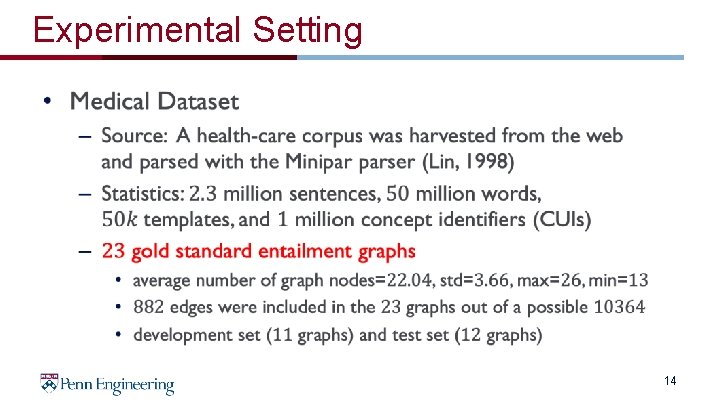
Contributions of this work • Main Contributions – Focused entailment graphs: a novel hierarchical presentation scheme for corpus propositions referring to a target concept – A global optimization algorithm for learning entailment relations between predicates represented as propositional templates – Extra: provide a medical dataset for evaluating entailment 6
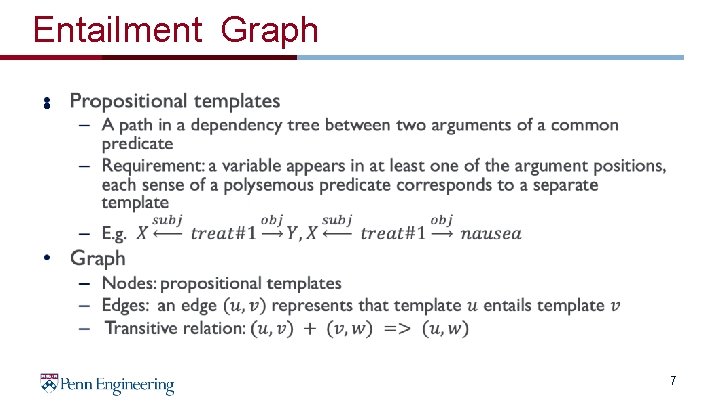
Entailment Graph • 7
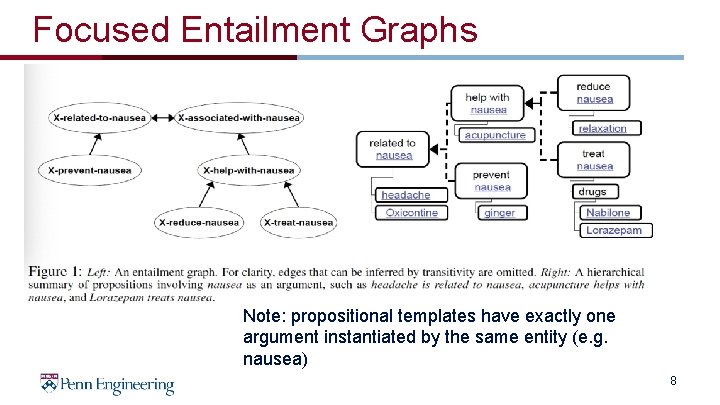
Focused Entailment Graphs Note: propositional templates have exactly one argument instantiated by the same entity (e. g. nausea) 8
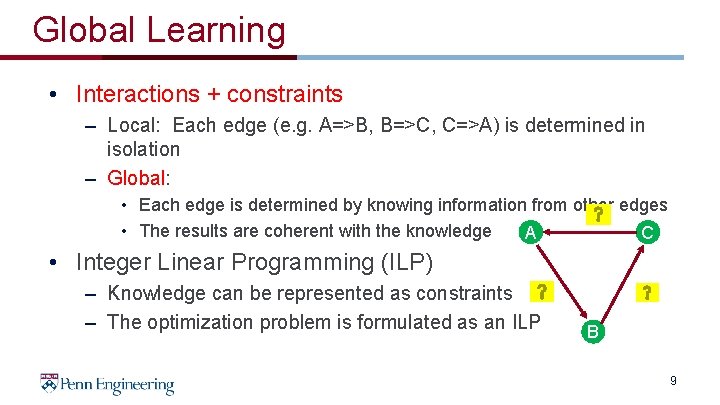
Global Learning • Interactions + constraints – Local: Each edge (e. g. A=>B, B=>C, C=>A) is determined in isolation – Global: • Each edge is determined by knowing information from other edges • The results are coherent with the knowledge C A • Integer Linear Programming (ILP) – Knowledge can be represented as constraints – The optimization problem is formulated as an ILP B 9
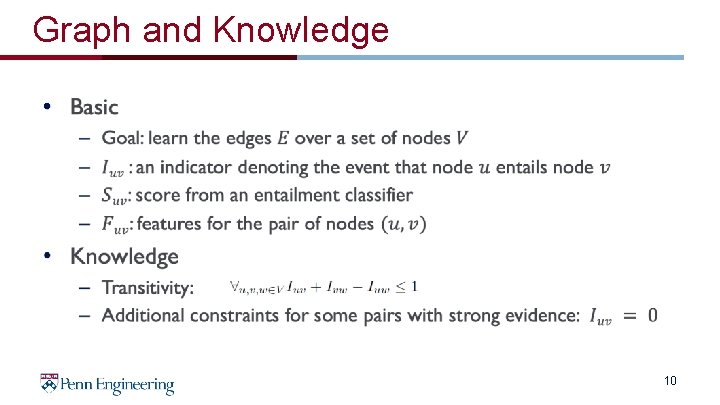
Graph and Knowledge • 10
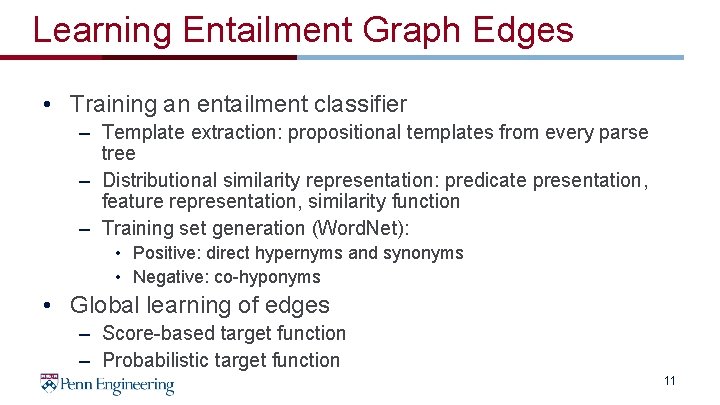
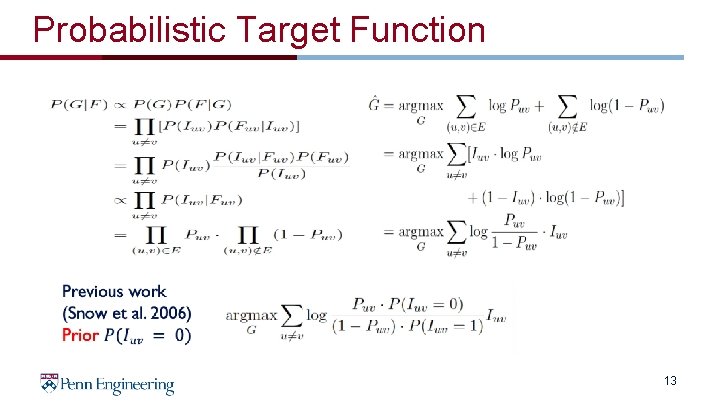
Learning Entailment Graph Edges • Training an entailment classifier – Template extraction: propositional templates from every parse tree – Distributional similarity representation: predicate presentation, feature representation, similarity function – Training set generation (Word. Net): • Positive: direct hypernyms and synonyms • Negative: co-hyponyms • Global learning of edges – Score-based target function – Probabilistic target function 11
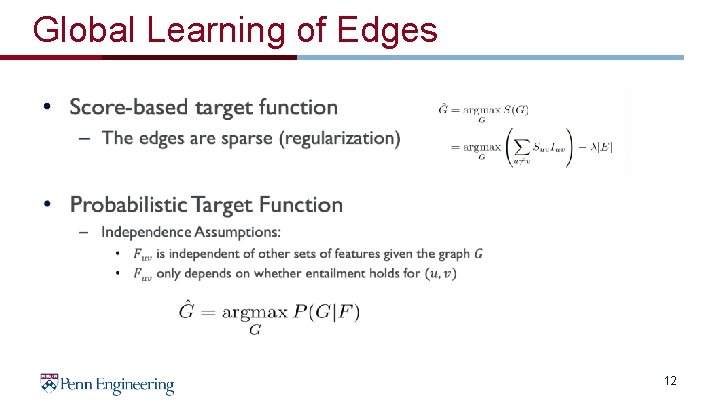
Global Learning of Edges • 12
Probabilistic Target Function 13
Experimental Setting 14
Results 15
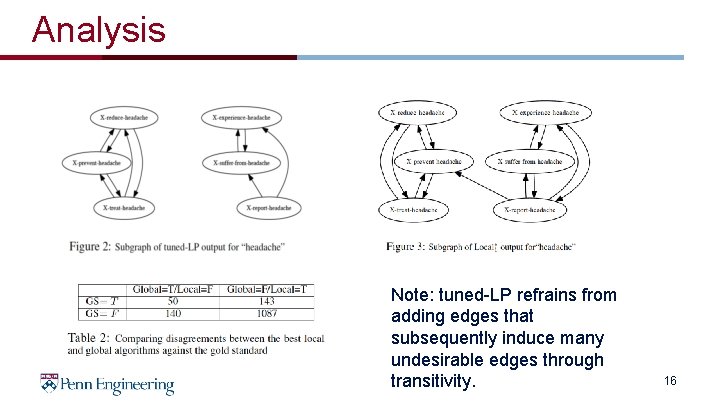
Analysis Note: tuned-LP refrains from adding edges that subsequently induce many undesirable edges through transitivity. 16
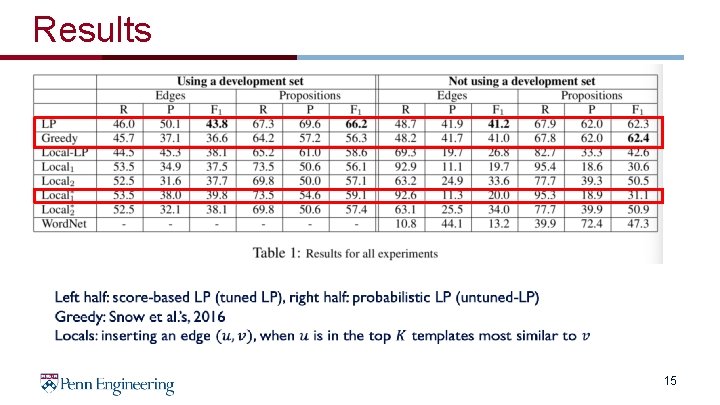
Conclusions • Take-aways – Focused entailment graphs can represent corpus propositions referring to a target concept, which reduces the size of the entailment graphs – Use Integer Linear Programming (ILP) to solve the optimization problem with constraints for global learning of edges – The medical entailment datasets can be used 17
Future Work • Main shortcomings – Learn general entailment graphs over a large number of nodes • Possible solutions – First assign edges with high confidence, then do global learning on the remaining edges – The key is to reduce the number of variables 18
- Slides: 18