Idea Machine Michael Joiner Ph D Director of
- Slides: 13
Idea. Machine Michael Joiner, Ph. D Director of Academic Engagement mjoiner@wharton. upenn. edu
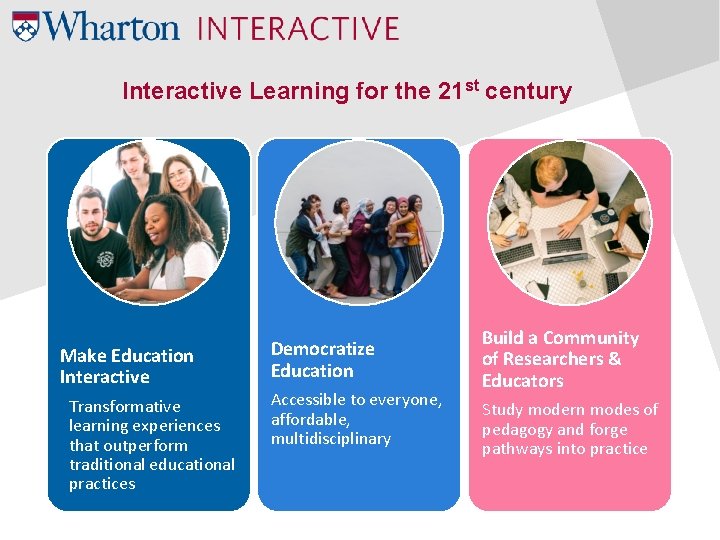
Interactive Learning for the 21 st century Make Education Interactive Transformative learning experiences that outperform traditional educational practices Democratize Education Accessible to everyone, affordable, multidisciplinary Build a Community of Researchers & Educators Study modern modes of pedagogy and forge pathways into practice
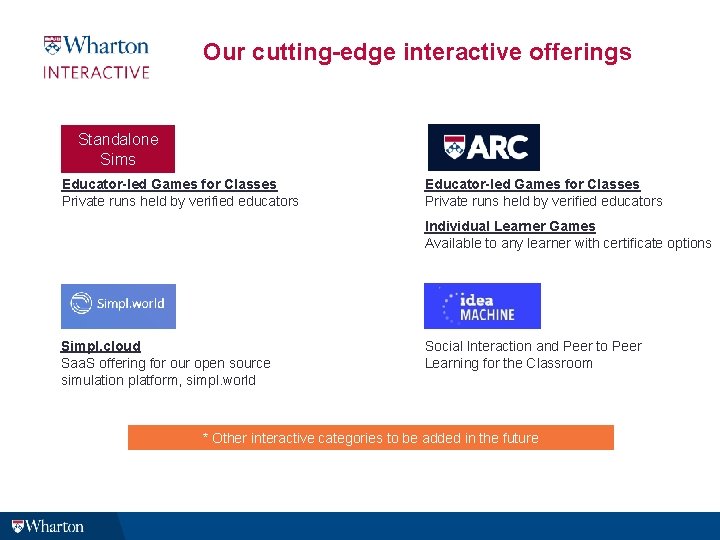
Our cutting-edge interactive offerings Standalone Sims Educator-led Games for Classes Private runs held by verified educators Individual Learner Games Available to any learner with certificate options Simpl. cloud Saa. S offering for our open source simulation platform, simpl. world Social Interaction and Peer to Peer Learning for the Classroom * Other interactive categories to be added in the future
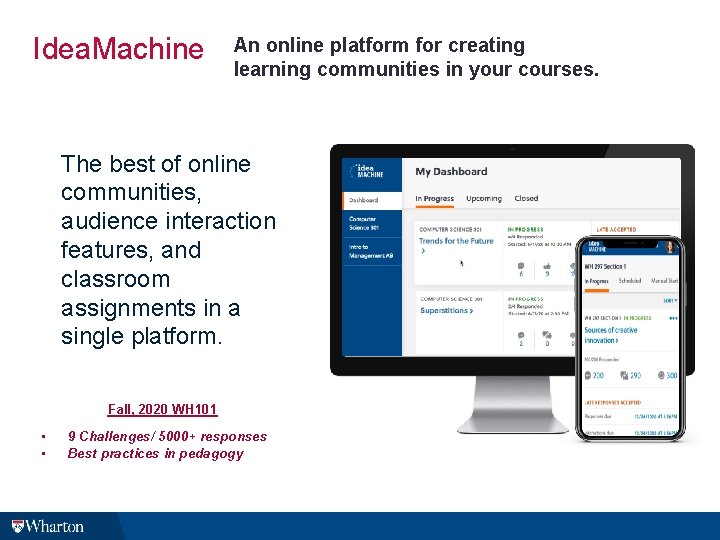
Idea. Machine An online platform for creating learning communities in your courses. The best of online communities, audience interaction features, and classroom assignments in a single platform. Fall, 2020 WH 101 • • 9 Challenges/ 5000+ responses Best practices in pedagogy
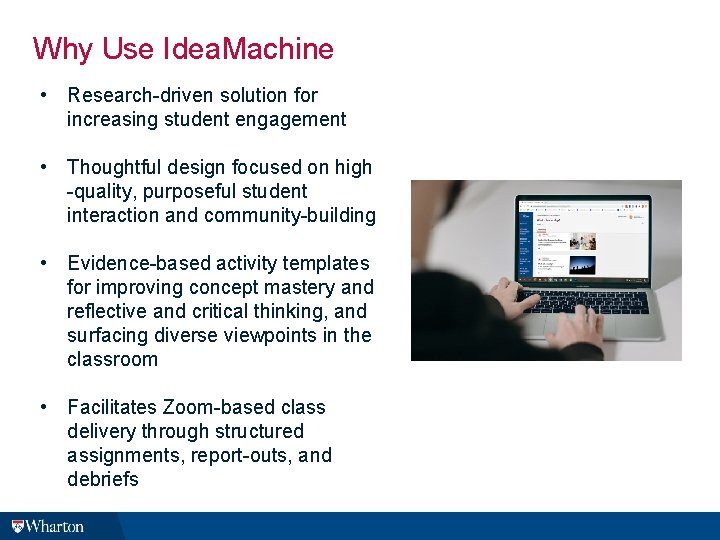
Why Use Idea. Machine • Research-driven solution for increasing student engagement • Thoughtful design focused on high -quality, purposeful student interaction and community-building • Evidence-based activity templates for improving concept mastery and reflective and critical thinking, and surfacing diverse viewpoints in the classroom • Facilitates Zoom-based class delivery through structured assignments, report-outs, and debriefs
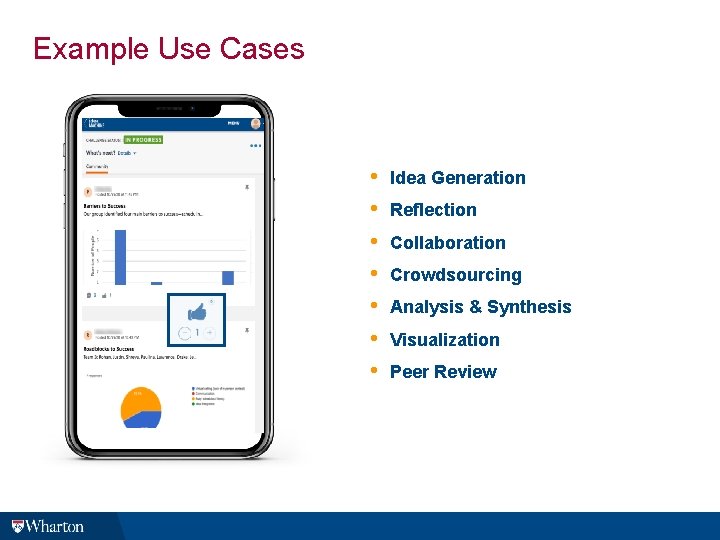
Example Use Cases • • Idea Generation Reflection Collaboration Crowdsourcing Analysis & Synthesis Visualization Peer Review
“Idea. Machine gives me the ability to surprise students and keeps them engaged in the classroom in ways that other traditional learning methods don’t. The assignments themselves can be empowering. ” Emily Cox Pahnke Professor of Management and Organization The University of Washington Foster School of Business Read her Idea. Machine Entrepreneurship case study at: https: //interactive. wharton. upenn. edu/learning-insights/asking-lots-questions -and-talking-fishmongers/ IM demo
Challenge 1 – General Question & Response Building Community in Remote Classes using: • Social community • Responses and interactions • Voting • Options for displaying responder names in the Social Community: hidden or public • Pinning and filtering responses • Debrief presentation mode In the Classroom • Helps students retain what they have learned • Helps you identify gaps in students’ knowledge and tailor your discussion For more information, see Using Your Discussion Board Effectively on our website: https: //interactive. wharton. upenn. edu/learning-insights/using-your-discussion -board-effectively-asking-students-questions-promote-practice-andreflection/
Challenge 2 – Using a Pedagogical Template • • • Key differentiator of IM is our challenge templates (a. k. a. Wizards), which help instructors create challenges and assignments easily (turnkey) based on latest learning science. Many challenge templates to be released in January 2021, such as: • Curiosity template – designed to spark student interest in an essential course question. 1 2 • Reflection template – asks students to review what they have learned and explore how their thinking has changed. 3 4 In the Classroom: Teach Me 5 6 7 • Teaching or explaining something to someone else helps you learn • Asks students to explain a course concept to their peers and provide a real-world example of that concept. • Helps students remember and articulate what they learned, and recognize any gaps in their understanding, creating a concrete association for later recall
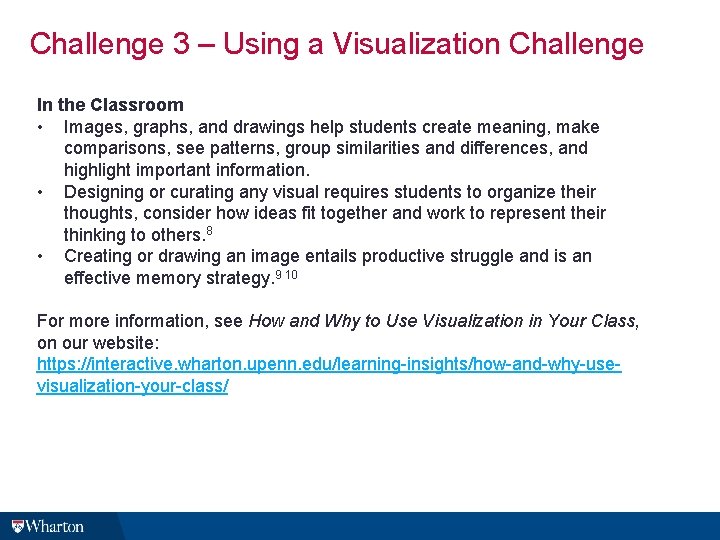
Challenge 3 – Using a Visualization Challenge In the Classroom • Images, graphs, and drawings help students create meaning, make comparisons, see patterns, group similarities and differences, and highlight important information. • Designing or curating any visual requires students to organize their thoughts, consider how ideas fit together and work to represent their thinking to others. 8 • Creating or drawing an image entails productive struggle and is an effective memory strategy. 9 10 For more information, see How and Why to Use Visualization in Your Class, on our website: https: //interactive. wharton. upenn. edu/learning-insights/how-and-why-usevisualization-your-class/
Creating a Challenge
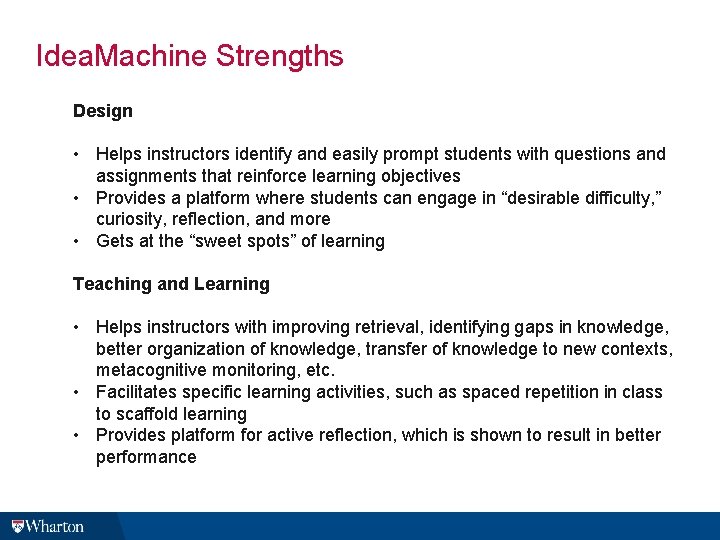
Idea. Machine Strengths Design • Helps instructors identify and easily prompt students with questions and assignments that reinforce learning objectives • Provides a platform where students can engage in “desirable difficulty, ” curiosity, reflection, and more • Gets at the “sweet spots” of learning Teaching and Learning • Helps instructors with improving retrieval, identifying gaps in knowledge, better organization of knowledge, transfer of knowledge to new contexts, metacognitive monitoring, etc. • Facilitates specific learning activities, such as spaced repetition in class to scaffold learning • Provides platform for active reflection, which is shown to result in better performance
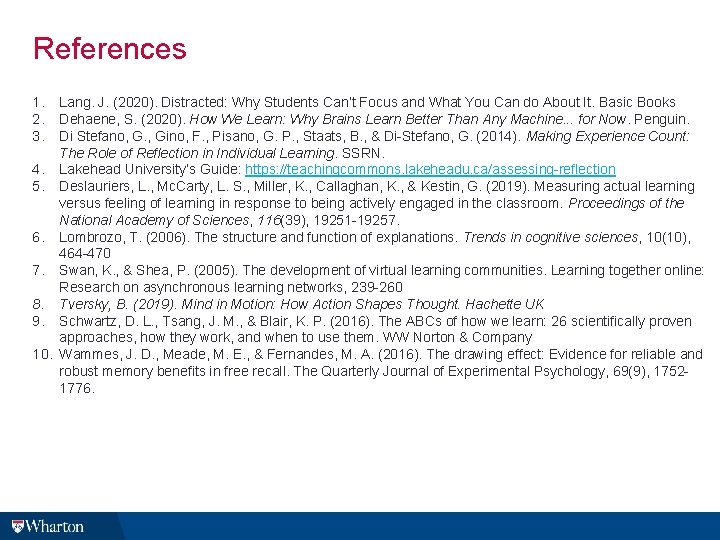
References 1. 2. 3. Lang. J. (2020). Distracted: Why Students Can’t Focus and What You Can do About It. Basic Books Dehaene, S. (2020). How We Learn: Why Brains Learn Better Than Any Machine. . . for Now. Penguin. Di Stefano, G. , Gino, F. , Pisano, G. P. , Staats, B. , & Di-Stefano, G. (2014). Making Experience Count: The Role of Reflection in Individual Learning. SSRN. 4. Lakehead University’s Guide: https: //teachingcommons. lakeheadu. ca/assessing-reflection 5. Deslauriers, L. , Mc. Carty, L. S. , Miller, K. , Callaghan, K. , & Kestin, G. (2019). Measuring actual learning versus feeling of learning in response to being actively engaged in the classroom. Proceedings of the National Academy of Sciences, 116(39), 19251 -19257. 6. Lombrozo, T. (2006). The structure and function of explanations. Trends in cognitive sciences, 10(10), 464 -470 7. Swan, K. , & Shea, P. (2005). The development of virtual learning communities. Learning together online: Research on asynchronous learning networks, 239 -260 8. Tversky, B. (2019). Mind in Motion: How Action Shapes Thought. Hachette UK 9. Schwartz, D. L. , Tsang, J. M. , & Blair, K. P. (2016). The ABCs of how we learn: 26 scientifically proven approaches, how they work, and when to use them. WW Norton & Company 10. Wammes, J. D. , Meade, M. E. , & Fernandes, M. A. (2016). The drawing effect: Evidence for reliable and robust memory benefits in free recall. The Quarterly Journal of Experimental Psychology, 69(9), 17521776.