Machine Learning for Actuaries Valerie du Preez Steven



- Slides: 42
Machine Learning for Actuaries Valerie du Preez Steven Perkins 21 March 2018
Introductions Valerie du Preez Steven Perkins Life Insurance Actuary Actuarial & Data Science Manager Specialising in actuarial finance and risk. Embracing Insurtech. Opinions my own. Actuary with pensions and UK motor experience as well as Ph. D in machine learning 2
Agenda Working Party Overview A Life Actuary’s View The Core Concepts Machine Learning made easy Case Studies Conclusion: the face of disruption Q&A 3
Section 1: Working Party Overview 4
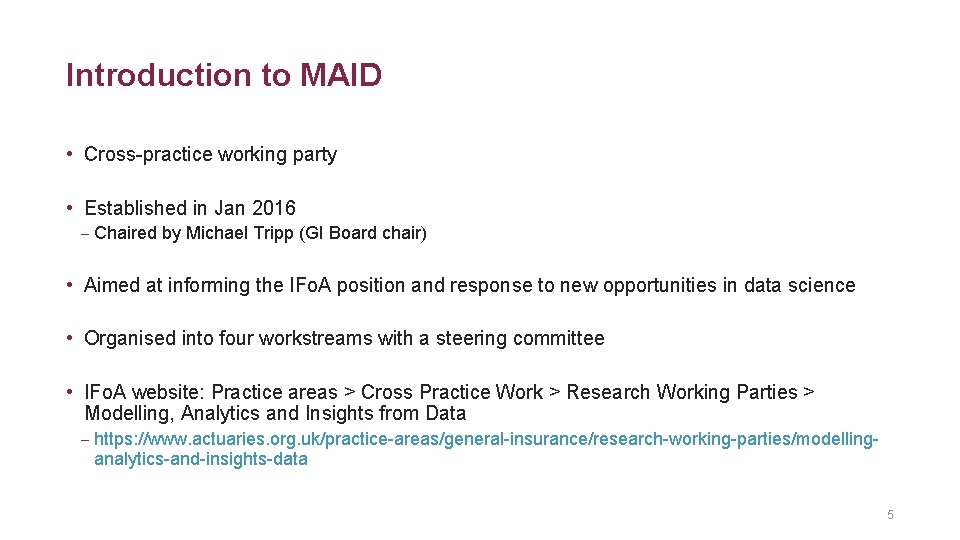
Introduction to MAID • Cross-practice working party • Established in Jan 2016 − Chaired by Michael Tripp (GI Board chair) • Aimed at informing the IFo. A position and response to new opportunities in data science • Organised into four workstreams with a steering committee • IFo. A website: Practice areas > Cross Practice Work > Research Working Parties > Modelling, Analytics and Insights from Data − https: //www. actuaries. org. uk/practice-areas/general-insurance/research-working-parties/modellinganalytics-and-insights-data 5
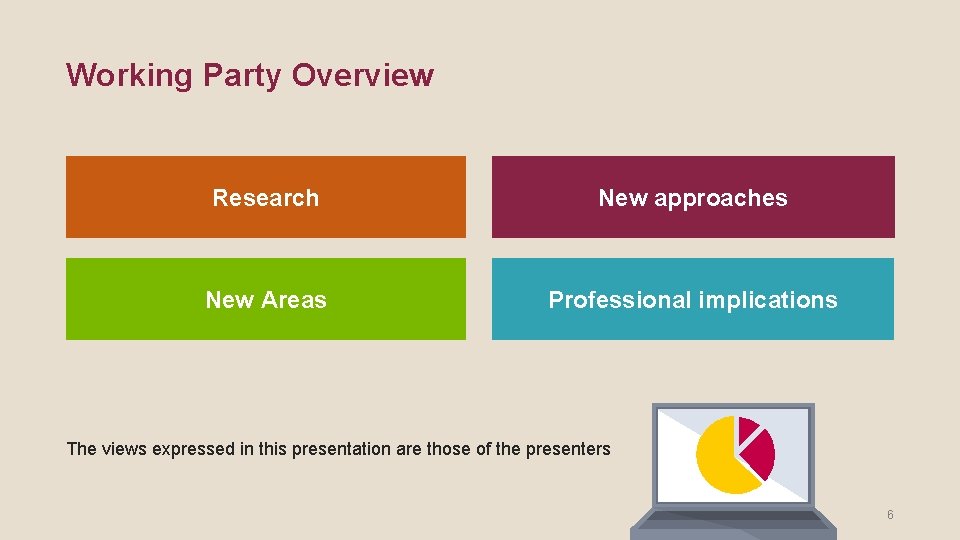
Working Party Overview Research New approaches New Areas Professional implications The views expressed in this presentation are those of the presenters 6
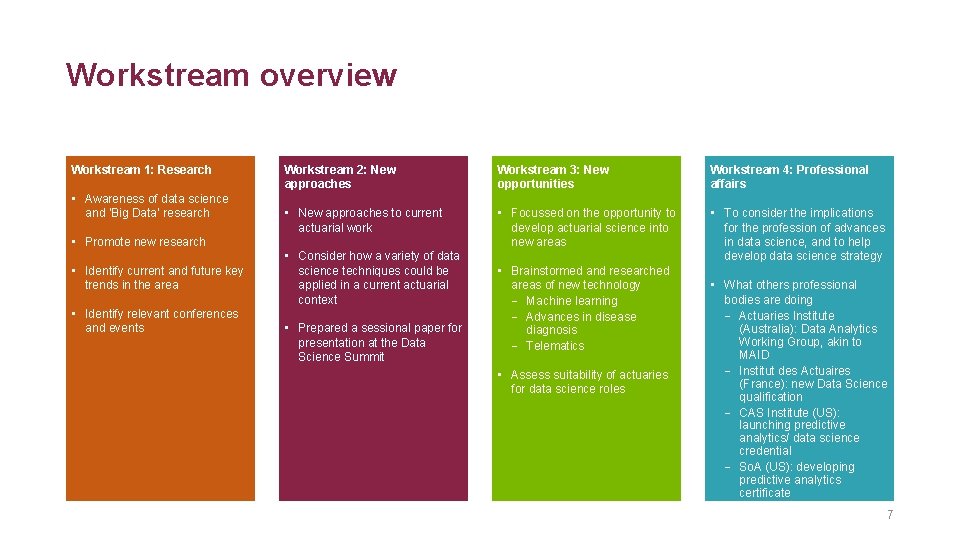
Workstream overview Workstream 1: Research • Awareness of data science and ‘Big Data’ research Workstream 2: New approaches Workstream 3: New opportunities Workstream 4: Professional affairs • New approaches to current actuarial work • Focussed on the opportunity to develop actuarial science into new areas • To consider the implications for the profession of advances in data science, and to help develop data science strategy • Promote new research • Identify current and future key trends in the area • Identify relevant conferences and events • Consider how a variety of data science techniques could be applied in a current actuarial context • Prepared a sessional paper for presentation at the Data Science Summit • Brainstormed and researched areas of new technology − Machine learning − Advances in disease diagnosis − Telematics • Assess suitability of actuaries for data science roles • What others professional bodies are doing − Actuaries Institute (Australia): Data Analytics Working Group, akin to MAID − Institut des Actuaires (France): new Data Science qualification − CAS Institute (US): launching predictive analytics/ data science credential − So. A (US): developing predictive analytics certificate 7
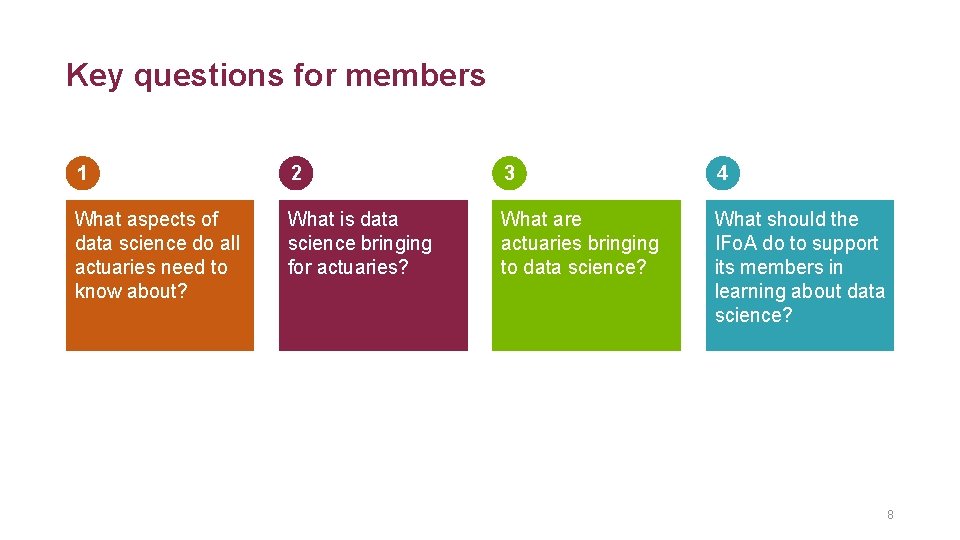
Key questions for members 1 2 3 4 What aspects of data science do all actuaries need to know about? What is data science bringing for actuaries? What are actuaries bringing to data science? What should the IFo. A do to support its members in learning about data science? 8
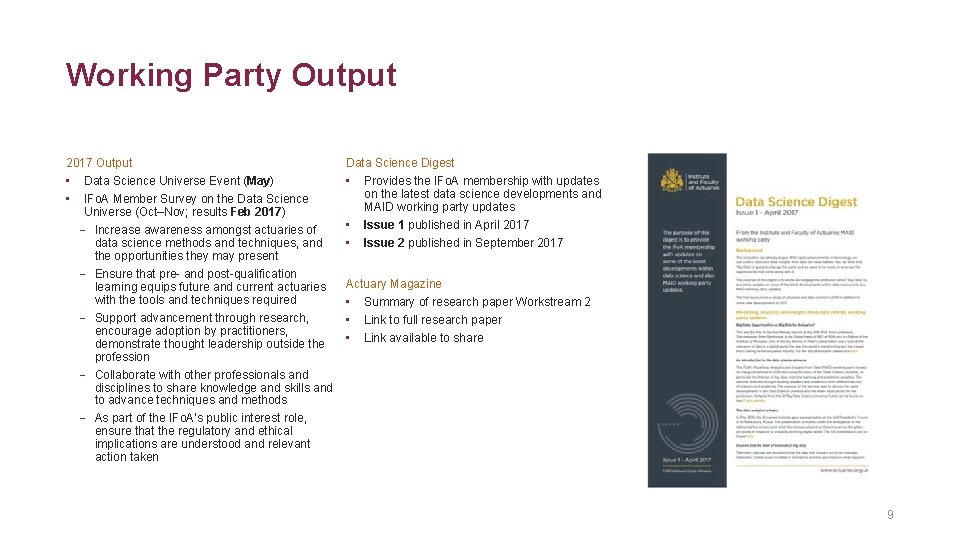
Working Party Output 2017 Output • Data Science Universe Event (May) • IFo. A Member Survey on the Data Science Universe (Oct–Nov; results Feb 2017) − Increase awareness amongst actuaries of data science methods and techniques, and the opportunities they may present − Ensure that pre- and post-qualification learning equips future and current actuaries with the tools and techniques required − Support advancement through research, encourage adoption by practitioners, demonstrate thought leadership outside the profession − Collaborate with other professionals and disciplines to share knowledge and skills and to advance techniques and methods − As part of the IFo. A’s public interest role, ensure that the regulatory and ethical implications are understood and relevant action taken Data Science Digest • Provides the IFo. A membership with updates on the latest data science developments and MAID working party updates • Issue 1 published in April 2017 • Issue 2 published in September 2017 Actuary Magazine • Summary of research paper Workstream 2 • Link to full research paper • Link available to share 9
The data challenge New forms of data New types of model New forms of analysis 10
Section 2: A Life Actuary’s View 11
A Life Actuary’s View Key topics Be part of the revolution Innovation, hot topics, machine learning robotics An introduction to R Exploring and performing examples Involvement in Modelling, Analytics and Insights from Data (MAID) Bridging the gap between data scientists and actuaries “An experienced Actuary empowered by real time data and non-linear models will be hugely valuable. ” Augment rather than replace 12
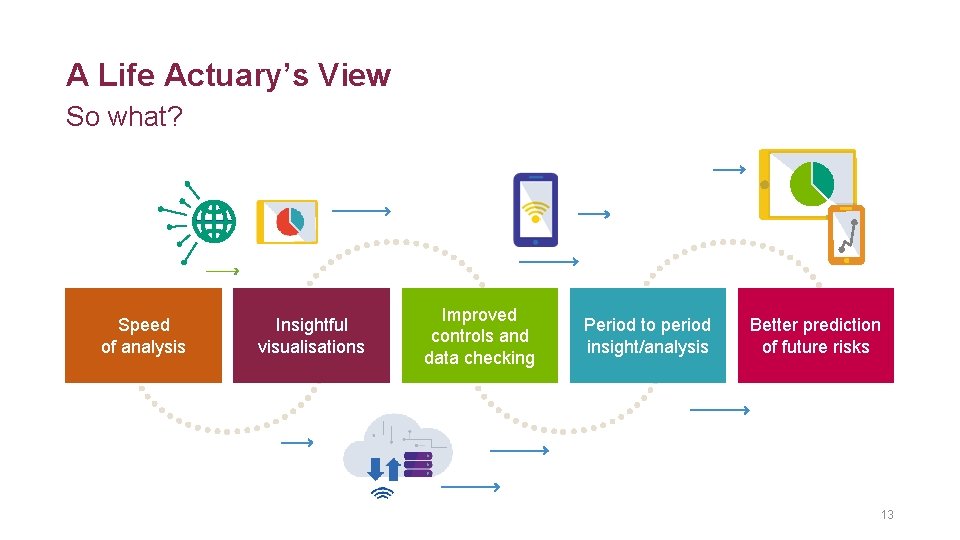
A Life Actuary’s View So what? Speed of analysis Insightful visualisations Improved controls and data checking Period to period insight/analysis Better prediction of future risks 13
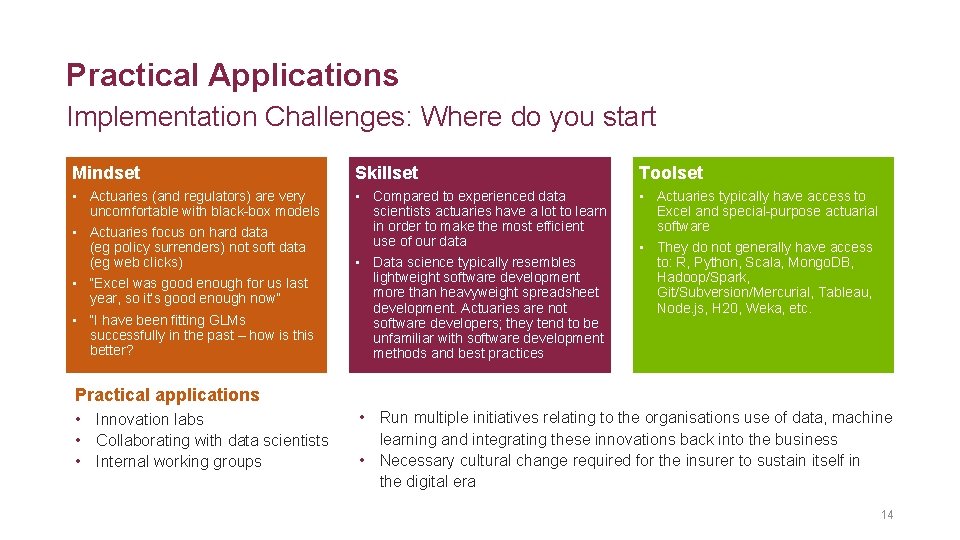
Practical Applications Implementation Challenges: Where do you start Mindset Skillset Toolset • Actuaries (and regulators) are very uncomfortable with black-box models • Actuaries focus on hard data (eg policy surrenders) not soft data (eg web clicks) • “Excel was good enough for us last year, so it’s good enough now” • “I have been fitting GLMs successfully in the past – how is this better? • Compared to experienced data scientists actuaries have a lot to learn in order to make the most efficient use of our data • Data science typically resembles lightweight software development more than heavyweight spreadsheet development. Actuaries are not software developers; they tend to be unfamiliar with software development methods and best practices • Actuaries typically have access to Excel and special-purpose actuarial software • They do not generally have access to: R, Python, Scala, Mongo. DB, Hadoop/Spark, Git/Subversion/Mercurial, Tableau, Node. js, H 20, Weka, etc. Practical applications • Innovation labs • Collaborating with data scientists • Internal working groups • Run multiple initiatives relating to the organisations use of data, machine learning and integrating these innovations back into the business • Necessary cultural change required for the insurer to sustain itself in the digital era 14
Section 3: Beyond the Buzzwords 15
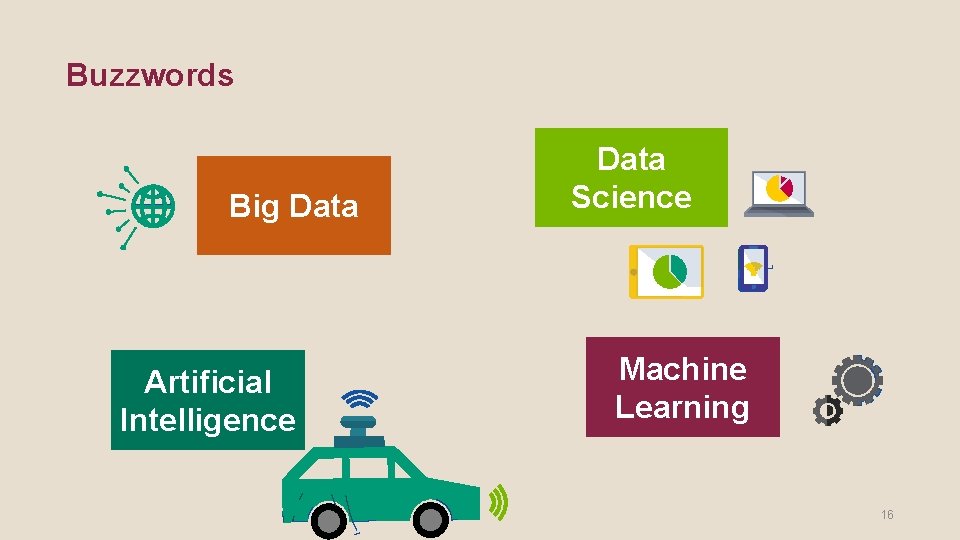
Buzzwords Big Data Artificial Intelligence Data Science Machine Learning 16
Buzzwords Data Science 17
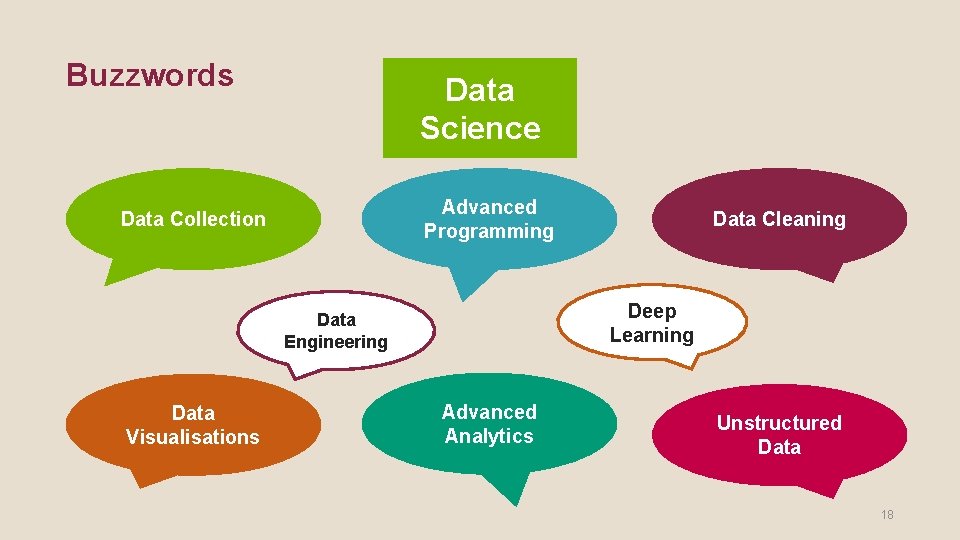
Buzzwords Data Science Advanced Programming Data Collection Deep Learning Data Engineering Data Visualisations Data Cleaning Advanced Analytics Unstructured Data 18
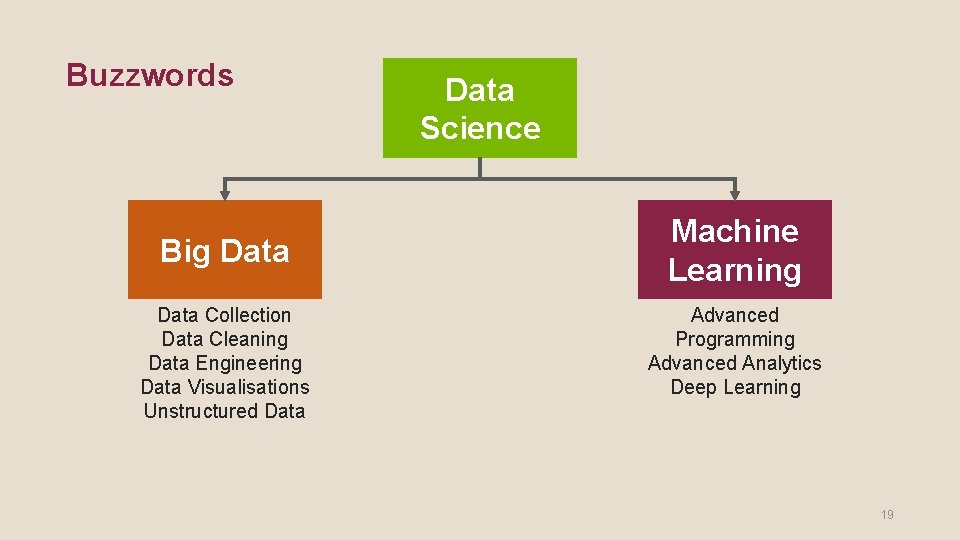
Buzzwords Big Data Collection Data Cleaning Data Engineering Data Visualisations Unstructured Data Science Machine Learning Advanced Programming Advanced Analytics Deep Learning 19
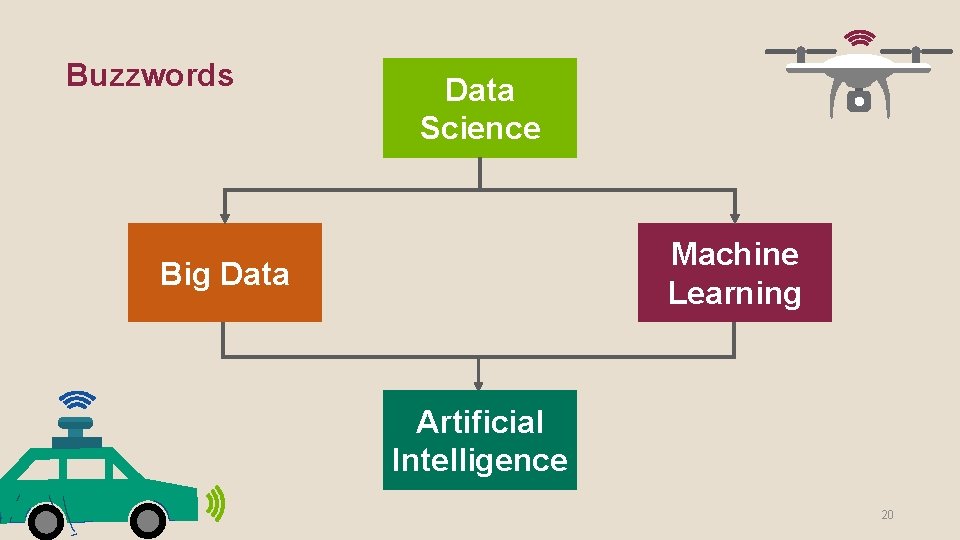
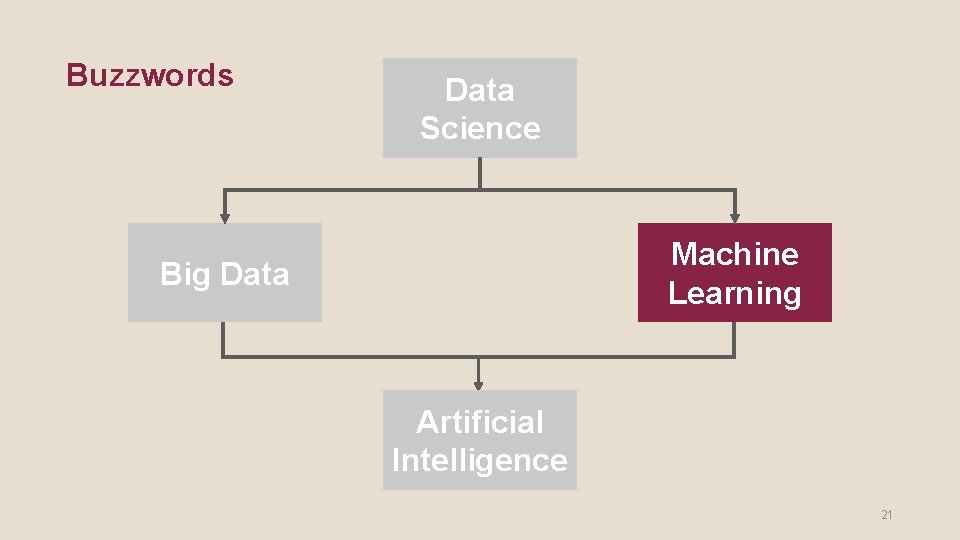
Buzzwords Data Science Machine Learning Big Data Artificial Intelligence 20
Buzzwords Data Science Machine Learning Big Data Artificial Intelligence 21
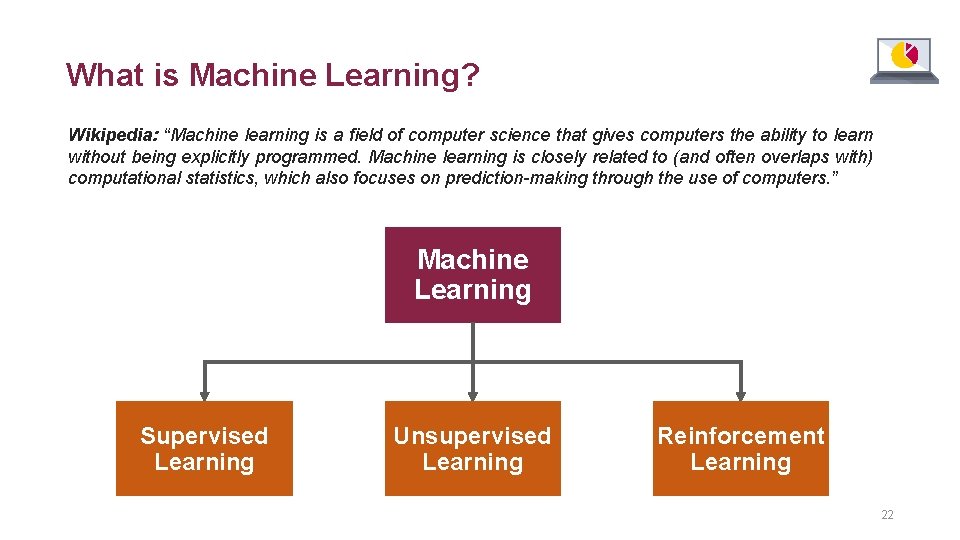
What is Machine Learning? Wikipedia: “Machine learning is a field of computer science that gives computers the ability to learn without being explicitly programmed. Machine learning is closely related to (and often overlaps with) computational statistics, which also focuses on prediction-making through the use of computers. ” Machine Learning Supervised Learning Unsupervised Learning Reinforcement Learning 22
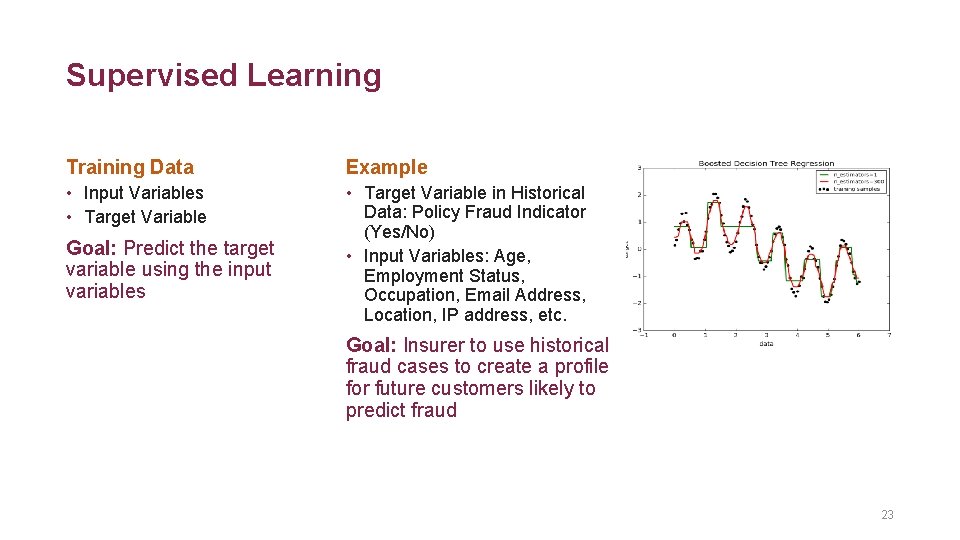
Supervised Learning Training Data Example • Input Variables • Target Variable in Historical Data: Policy Fraud Indicator (Yes/No) • Input Variables: Age, Employment Status, Occupation, Email Address, Location, IP address, etc. Goal: Predict the target variable using the input variables Goal: Insurer to use historical fraud cases to create a profile for future customers likely to predict fraud 23
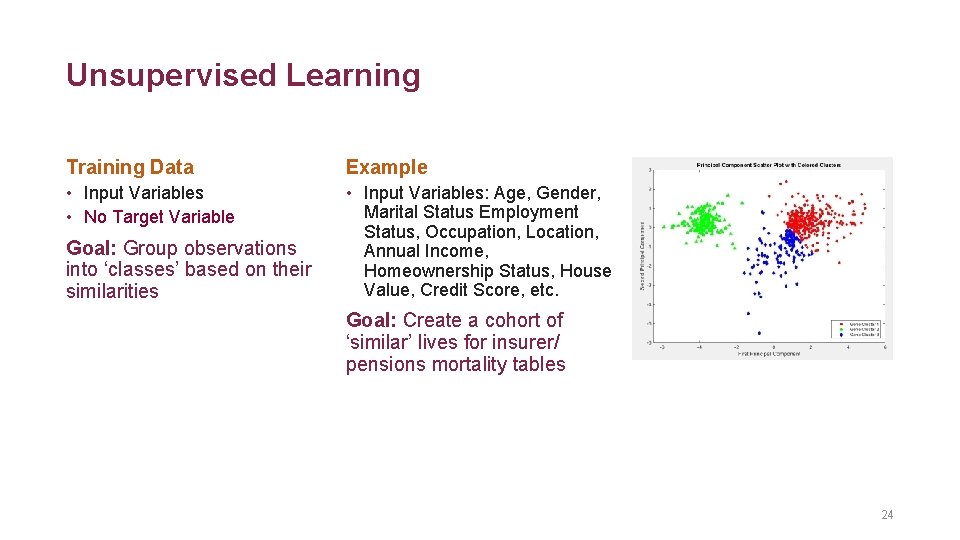
Unsupervised Learning Training Data Example • Input Variables • No Target Variable • Input Variables: Age, Gender, Marital Status Employment Status, Occupation, Location, Annual Income, Homeownership Status, House Value, Credit Score, etc. Goal: Group observations into ‘classes’ based on their similarities Goal: Create a cohort of ‘similar’ lives for insurer/ pensions mortality tables 24
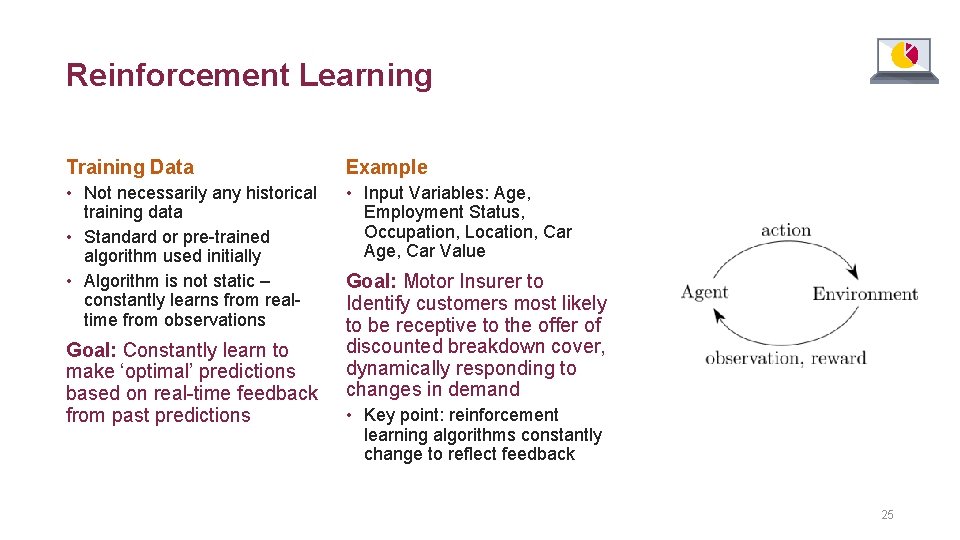
Reinforcement Learning Training Data Example • Not necessarily any historical training data • Standard or pre-trained algorithm used initially • Algorithm is not static – constantly learns from realtime from observations • Input Variables: Age, Employment Status, Occupation, Location, Car Age, Car Value Goal: Constantly learn to make ‘optimal’ predictions based on real-time feedback from past predictions Goal: Motor Insurer to Identify customers most likely to be receptive to the offer of discounted breakdown cover, dynamically responding to changes in demand • Key point: reinforcement learning algorithms constantly change to reflect feedback 25
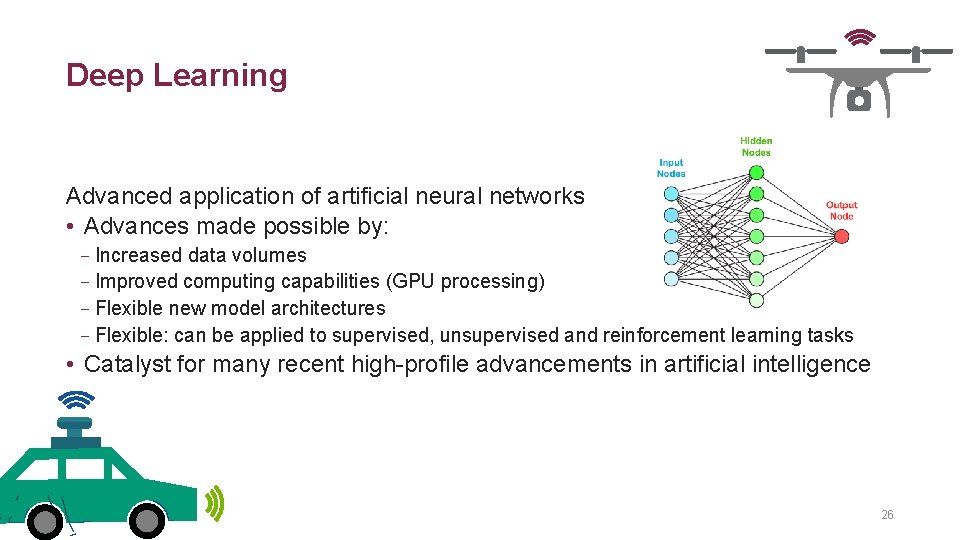
Deep Learning Advanced application of artificial neural networks • Advances made possible by: − Increased data volumes − Improved computing capabilities (GPU processing) − Flexible new model architectures − Flexible: can be applied to supervised, unsupervised and reinforcement learning tasks • Catalyst for many recent high-profile advancements in artificial intelligence 26
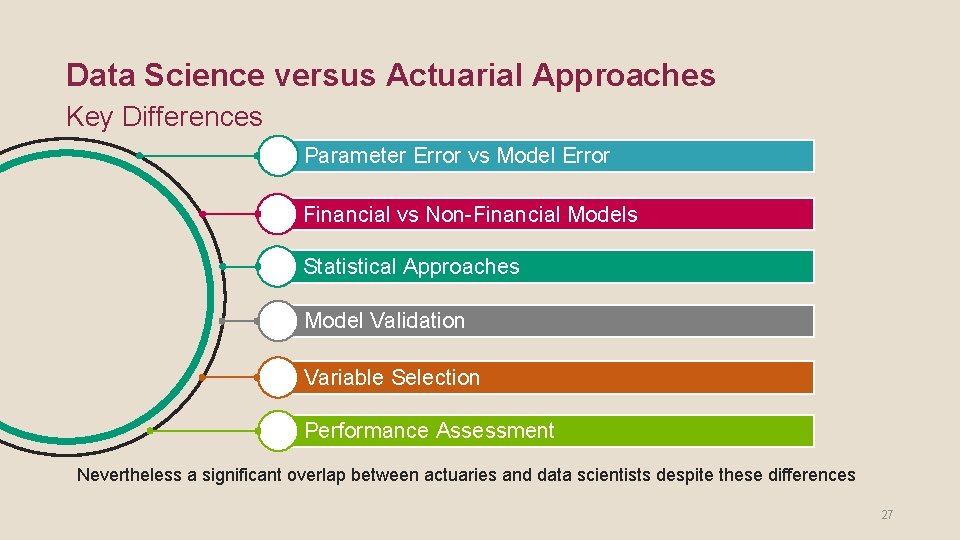
Data Science versus Actuarial Approaches Key Differences Parameter Error vs Model Error Financial vs Non-Financial Models Statistical Approaches Model Validation Variable Selection Performance Assessment Nevertheless a significant overlap between actuaries and data scientists despite these differences 27
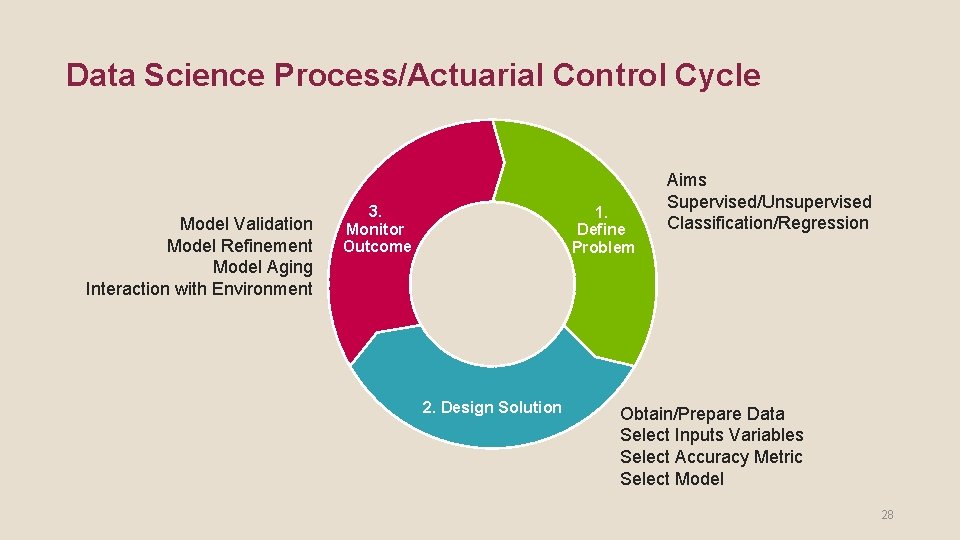
Data Science Process/Actuarial Process Control Cycle Model Validation Model Refinement Model Aging Interaction with Environment 3. Monitor Outcome 1. Define Problem 2. Design Solution Aims Supervised/Unsupervised Classification/Regression Obtain/Prepare Data Select Inputs Variables Select Accuracy Metric Select Model 28
Data Science Benefits to Actuaries Improved Data Quality • Machine learning is a key driver for companies to improve data capture and storage New Data Sources • Machine learning potentially opens up opportunities for actuaries to explore alternative data sources Speed of Analysis • Machine learning models can generally be fitted and validated in a short space of time New Modelling Techniques • Utilising alternative modelling approaches allows different perspectives to be gained on data New Approaches to Problems • Produce a wider variety of models quickly - better ability to select the appropriate modelling approach for a given problem Improved Data Visualisations • Increasing power to produce stunning visualisations of data which can itself provide new perspectives on a task 29
Section 4: Case Studies 30
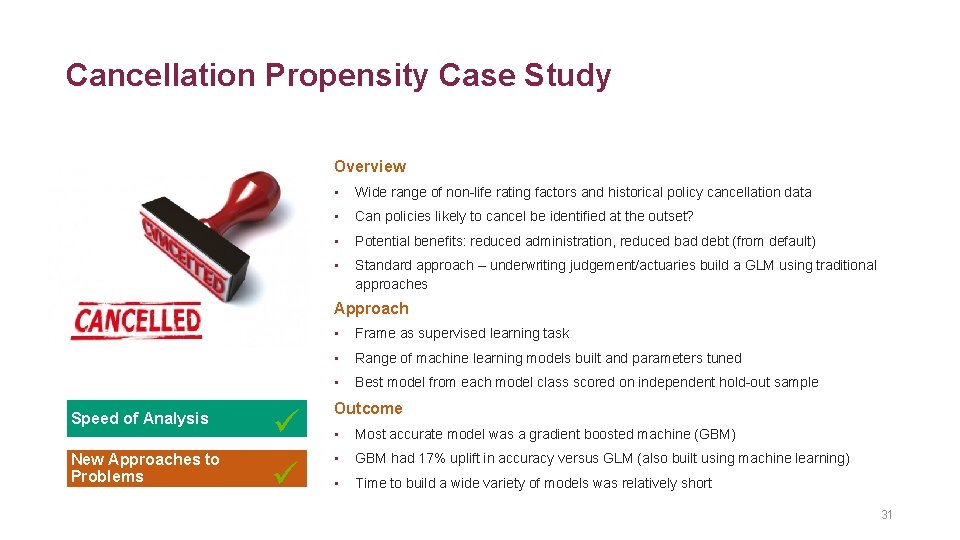
Cancellation Propensity Case Study Overview • Wide range of non-life rating factors and historical policy cancellation data • Can policies likely to cancel be identified at the outset? • Potential benefits: reduced administration, reduced bad debt (from default) • Standard approach – underwriting judgement/actuaries build a GLM using traditional approaches Approach Speed of Analysis New Approaches to Problems • Frame as supervised learning task • Range of machine learning models built and parameters tuned • Best model from each model class scored on independent hold-out sample Outcome • Most accurate model was a gradient boosted machine (GBM) • GBM had 17% uplift in accuracy versus GLM (also built using machine learning) • Time to build a wide variety of models was relatively short 31
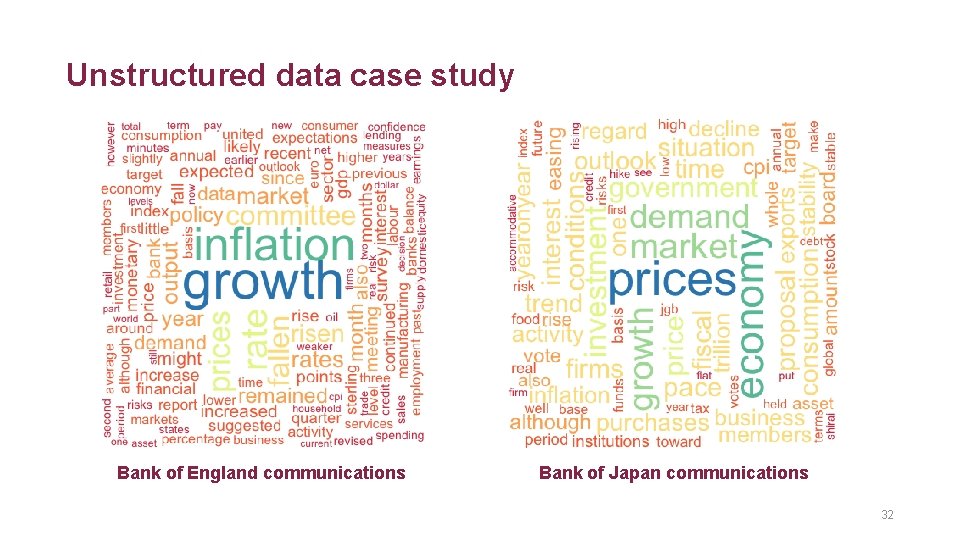
Unstructured data case study Bank of England communications Bank of Japan communications 32
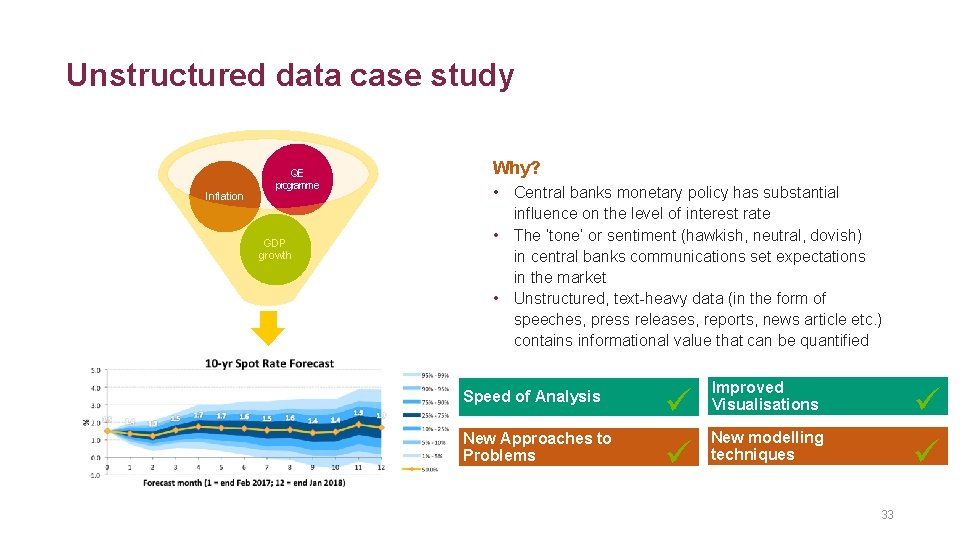
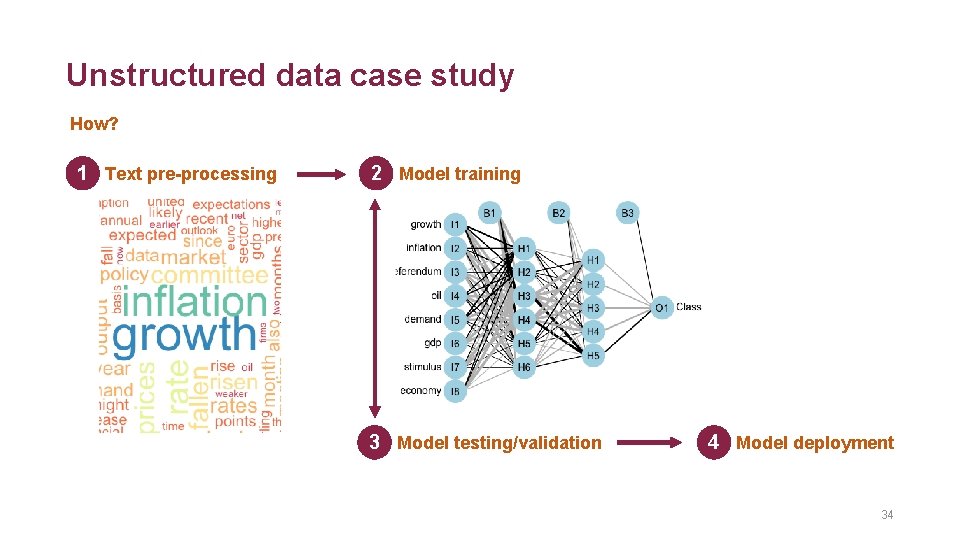
Unstructured data case study Inflation QE programme GDP growth Interest rate forecast Why? • Central banks monetary policy has substantial influence on the level of interest rate • The ‘tone’ or sentiment (hawkish, neutral, dovish) in central banks communications set expectations in the market • Unstructured, text-heavy data (in the form of speeches, press releases, reports, news article etc. ) contains informational value that can be quantified Speed of Analysis New Approaches to Problems Improved Visualisations New modelling techniques 33
Unstructured data case study How? 1 Text pre-processing 2 Model training 3 Model testing/validation 4 Model deployment 34
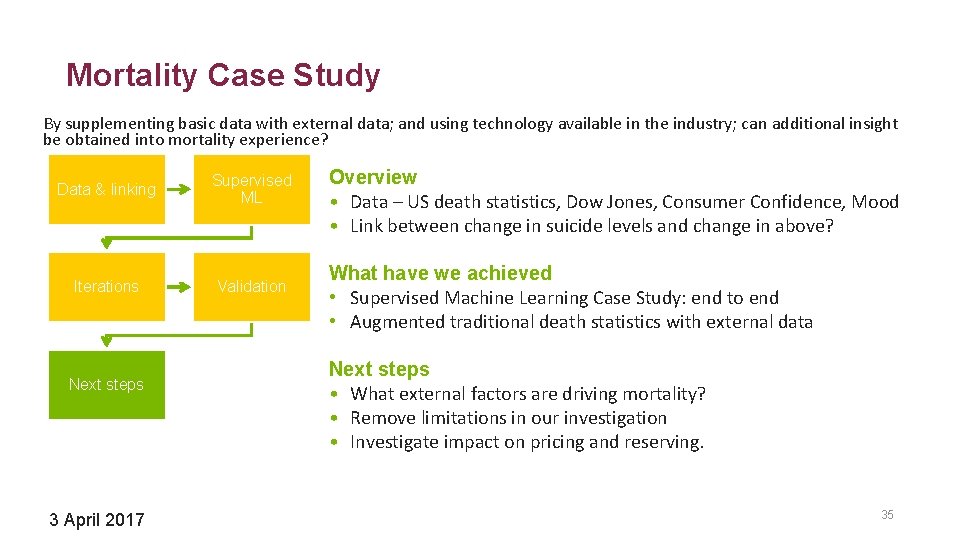
Mortality Case Study By supplementing basic data with external data; and using technology available in the industry; can additional insight be obtained into mortality experience? Data & linking Supervised ML Iterations Validation Next steps 3 April 2017 Overview • Data – US death statistics, Dow Jones, Consumer Confidence, Mood • Link between change in suicide levels and change in above? What have we achieved • Supervised Machine Learning Case Study: end to end • Augmented traditional death statistics with external data Next steps • What external factors are driving mortality? • Remove limitations in our investigation • Investigate impact on pricing and reserving. 35
Section 5: The Face of Disruption 36
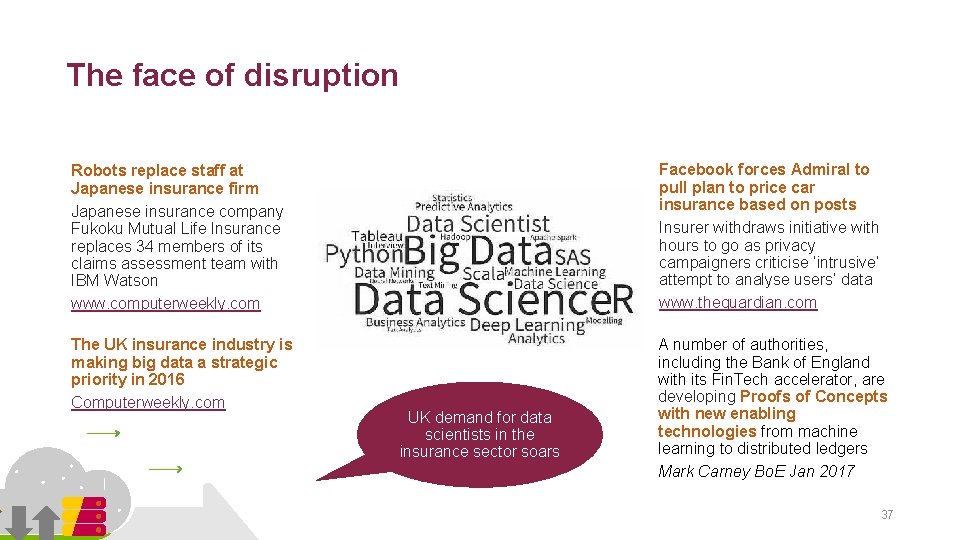
The face of disruption Robots replace staff at Japanese insurance firm Japanese insurance company Fukoku Mutual Life Insurance replaces 34 members of its claims assessment team with IBM Watson www. computerweekly. com Facebook forces Admiral to pull plan to price car insurance based on posts Insurer withdraws initiative with hours to go as privacy campaigners criticise ‘intrusive’ attempt to analyse users’ data www. theguardian. com The UK insurance industry is making big data a strategic priority in 2016 Computerweekly. com A number of authorities, including the Bank of England with its Fin. Tech accelerator, are developing Proofs of Concepts with new enabling technologies from machine learning to distributed ledgers Mark Carney Bo. E Jan 2017 UK demand for data scientists in the insurance sector soars 37
Final Thoughts 38
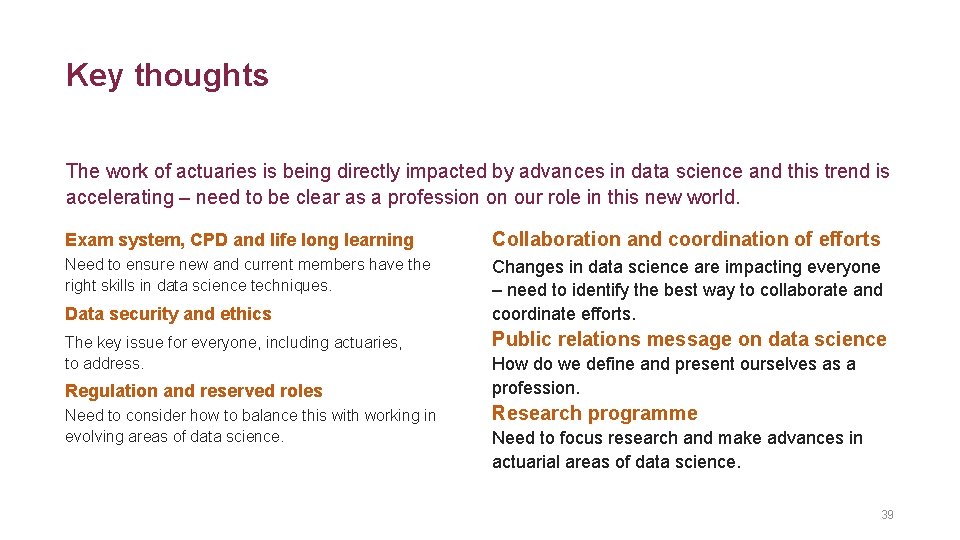
Key thoughts The work of actuaries is being directly impacted by advances in data science and this trend is accelerating – need to be clear as a profession on our role in this new world. Exam system, CPD and life long learning Collaboration and coordination of efforts Need to ensure new and current members have the right skills in data science techniques. Changes in data science are impacting everyone – need to identify the best way to collaborate and coordinate efforts. Public relations message on data science How do we define and present ourselves as a profession. Data security and ethics The key issue for everyone, including actuaries, to address. Regulation and reserved roles Need to consider how to balance this with working in evolving areas of data science. Research programme Need to focus research and make advances in actuarial areas of data science. 39
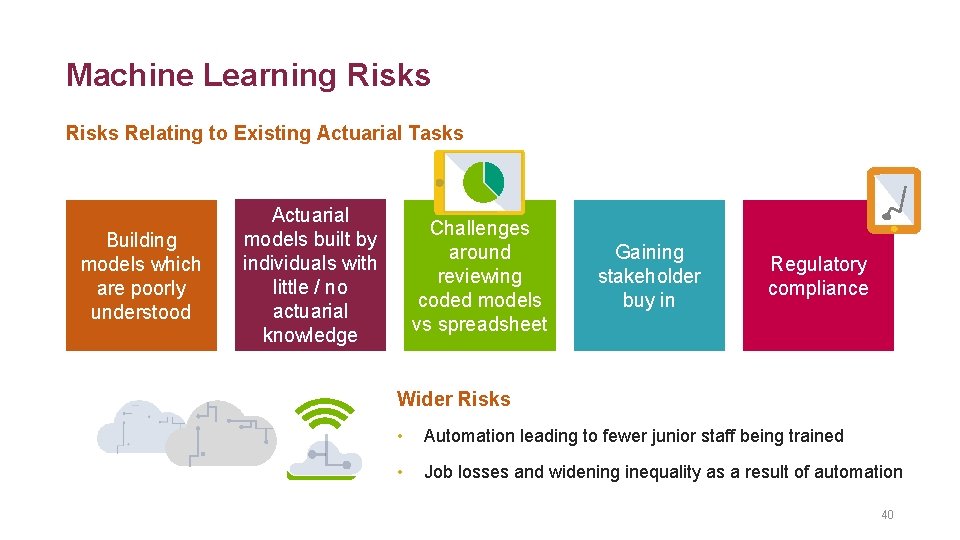
Machine Learning Risks Relating to Existing Actuarial Tasks Building models which are poorly understood Actuarial models built by individuals with little / no actuarial knowledge Challenges around reviewing coded models vs spreadsheet Gaining stakeholder buy in Regulatory compliance Wider Risks • Automation leading to fewer junior staff being trained • Job losses and widening inequality as a result of automation 40
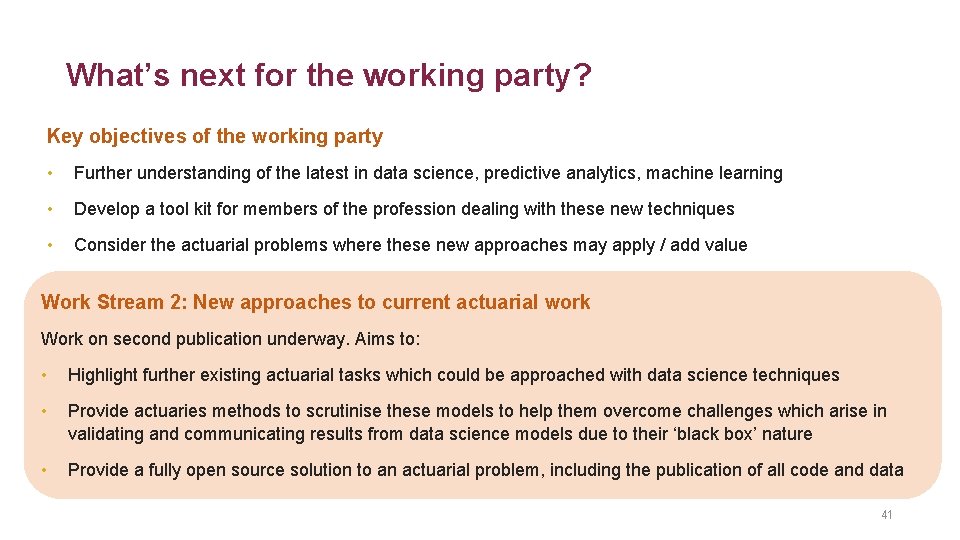
What’s next for the working party? Key objectives of the working party • Further understanding of the latest in data science, predictive analytics, machine learning • Develop a tool kit for members of the profession dealing with these new techniques • Consider the actuarial problems where these new approaches may apply / add value Work Stream 2: New approaches to current actuarial work Work on second publication underway. Aims to: • Highlight further existing actuarial tasks which could be approached with data science techniques • Provide actuaries methods to scrutinise these models to help them overcome challenges which arise in validating and communicating results from data science models due to their ‘black box’ nature • Provide a fully open source solution to an actuarial problem, including the publication of all code and data 41
Q&A