
Turning the Brain on for Reading Dr Valerie
Turning the Brain on for Reading Dr. Valerie Scaramella-Nowinski Drina Madden M. A. , C. A. S. C. H. I. L. D Foundation www. childhealthlearn. org
Brain Scan to Lesson Plan Rhythms Reflexes Relationships C. H. I. L. D Foundation www. childhealthlearn. org
Brain Scan to Lesson Plan Development is dependent upon: Genetic Predisposition Brain Structure - Electrical – Chemical Pathways Internal Economy C. H. I. L. D Foundation www. childhealthlearn. org External/Environmental Cues
Awakening the Brain Understanding Brain Pathways Leads to More Specific Diagnosis and Treatment Leads to Healthy Development C. H. I. L. D Foundation www. childhealthlearn. org
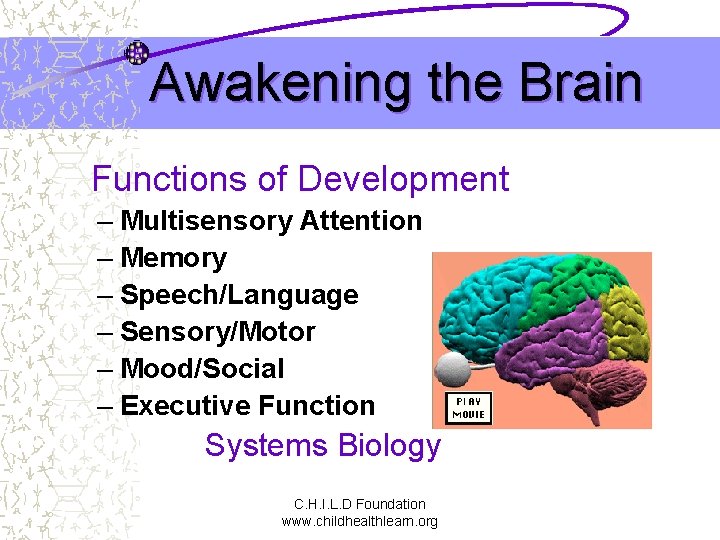
Awakening the Brain Functions of Development – Multisensory Attention – Memory – Speech/Language – Sensory/Motor – Mood/Social – Executive Function Systems Biology C. H. I. L. D Foundation www. childhealthlearn. org
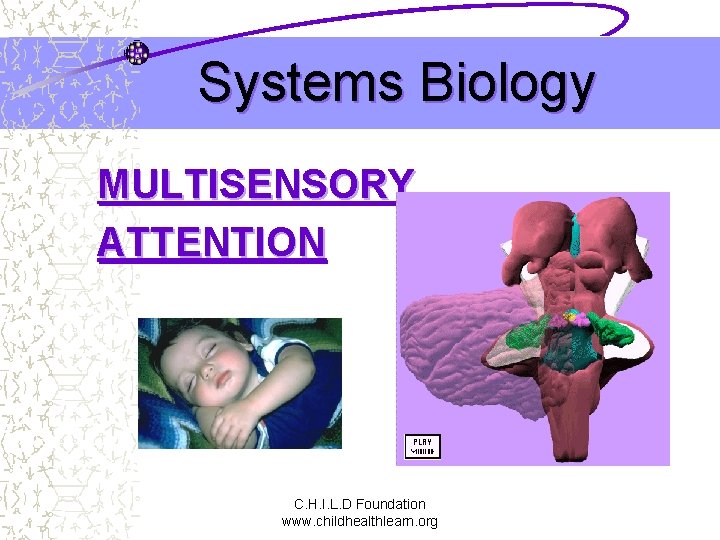
Systems Biology MULTISENSORY ATTENTION C. H. I. L. D Foundation www. childhealthlearn. org
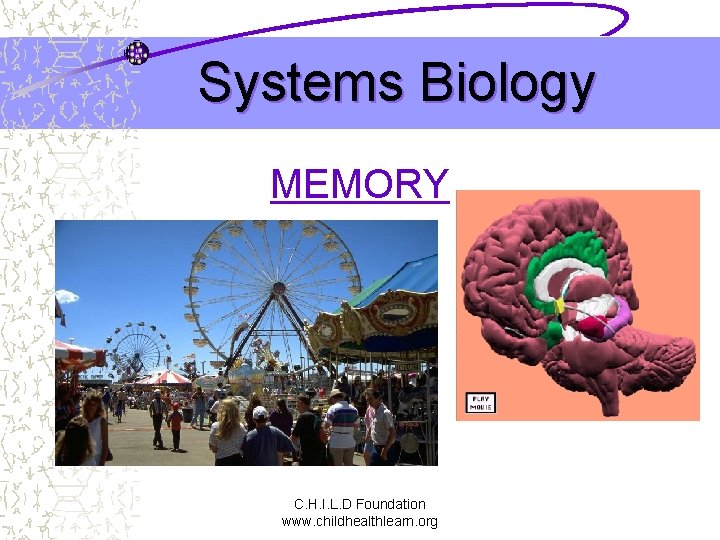
Systems Biology MEMORY C. H. I. L. D Foundation www. childhealthlearn. org
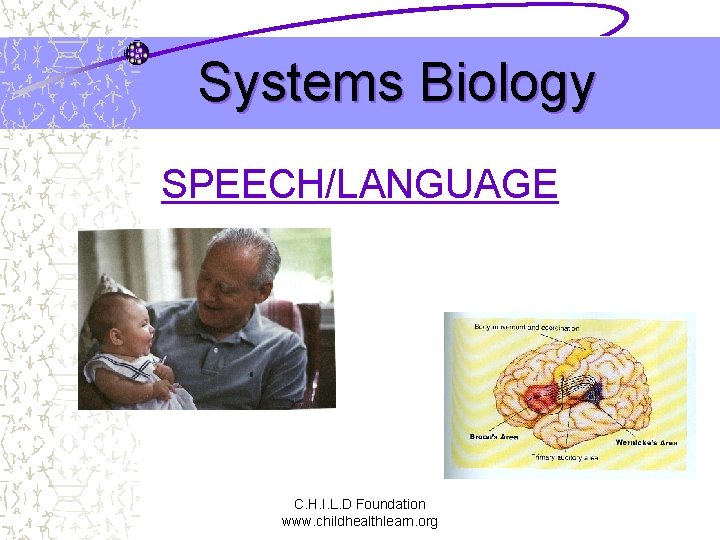
Systems Biology SPEECH/LANGUAGE C. H. I. L. D Foundation www. childhealthlearn. org
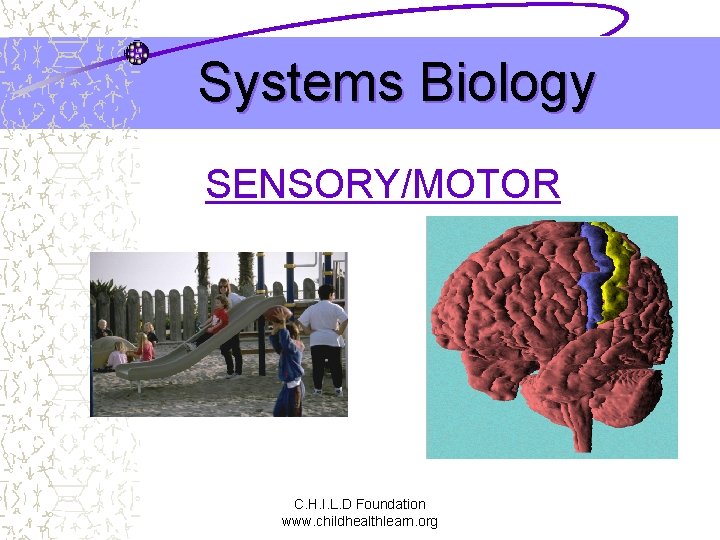
Systems Biology SENSORY/MOTOR C. H. I. L. D Foundation www. childhealthlearn. org
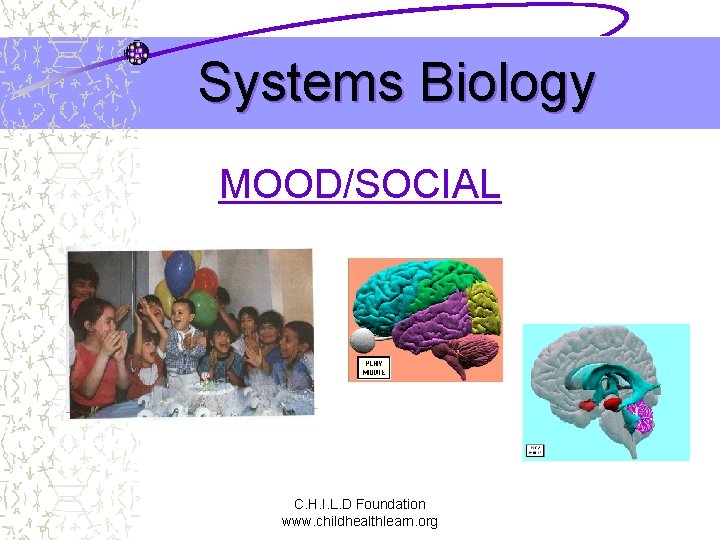
Systems Biology MOOD/SOCIAL C. H. I. L. D Foundation www. childhealthlearn. org
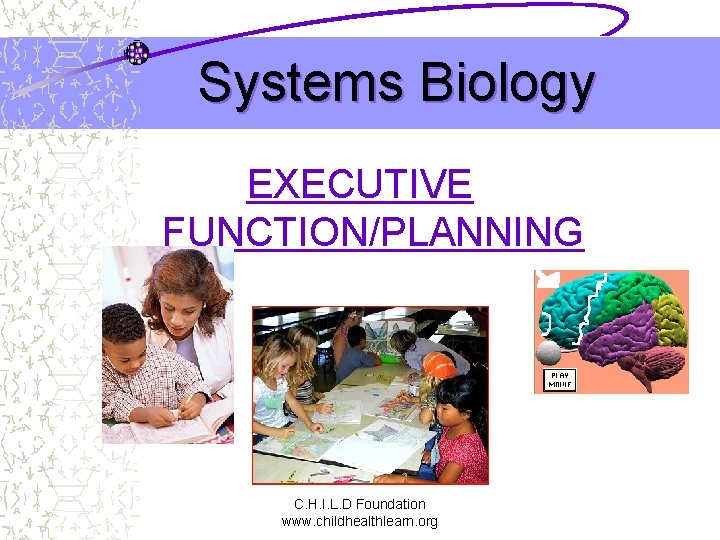
Systems Biology EXECUTIVE FUNCTION/PLANNING C. H. I. L. D Foundation www. childhealthlearn. org
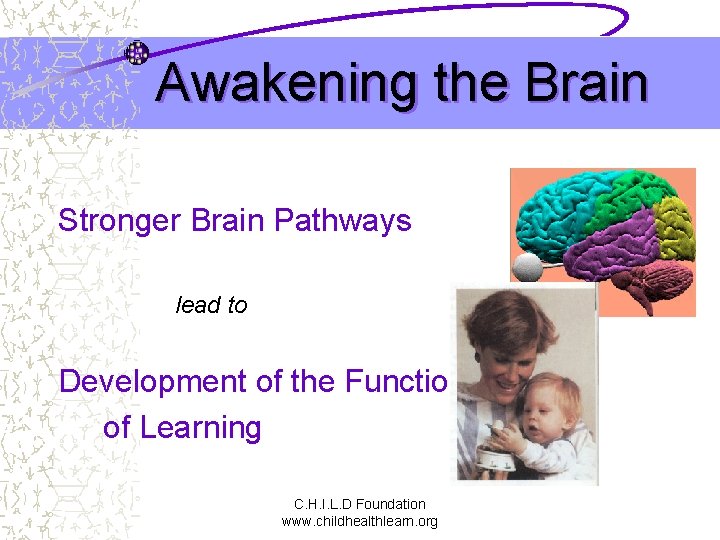
Awakening the Brain Stronger Brain Pathways lead to Development of the Functions of Learning C. H. I. L. D Foundation www. childhealthlearn. org
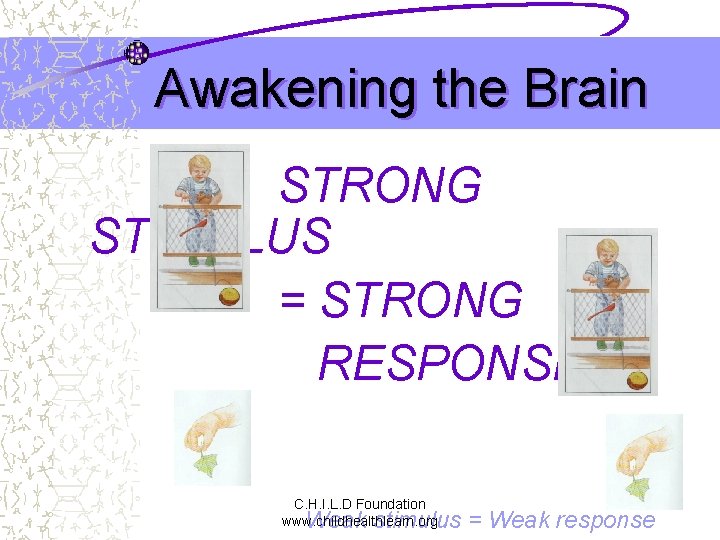
Awakening the Brain STRONG STIMULUS = STRONG RESPONSE C. H. I. L. D Foundation www. childhealthlearn. org Weak stimulus = Weak response
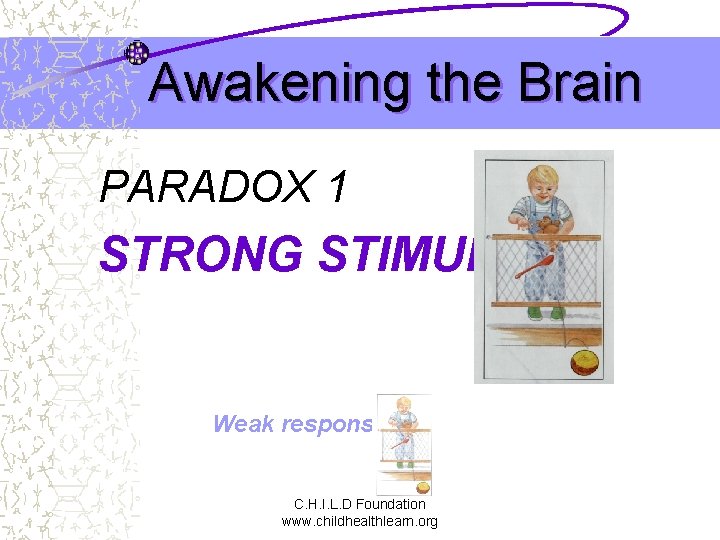
Awakening the Brain PARADOX 1 STRONG STIMULI Weak response C. H. I. L. D Foundation www. childhealthlearn. org
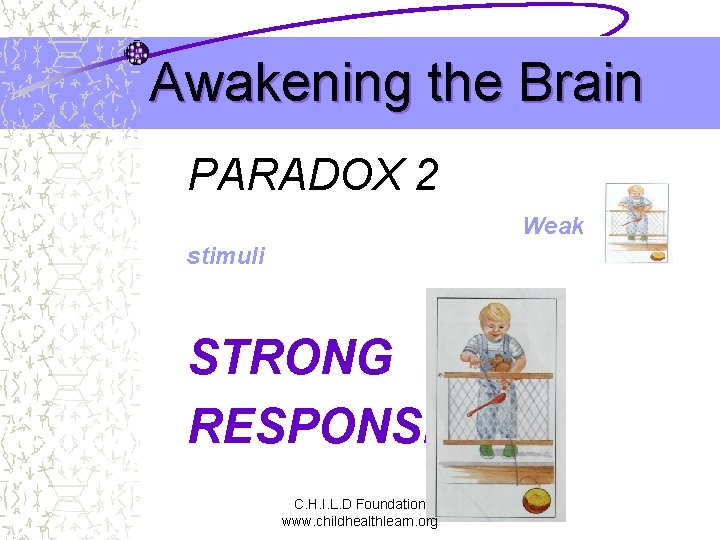
Awakening the Brain PARADOX 2 Weak stimuli STRONG RESPONSE C. H. I. L. D Foundation www. childhealthlearn. org
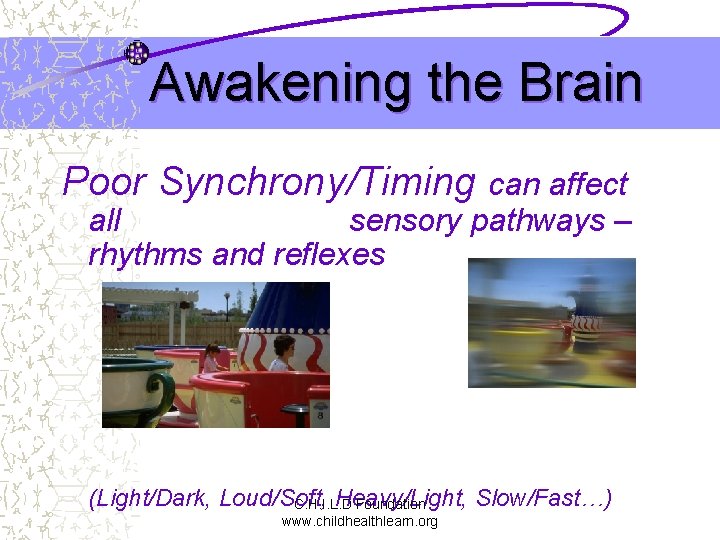
Awakening the Brain Poor Synchrony/Timing can affect all sensory pathways – rhythms and reflexes (Light/Dark, Loud/Soft, Heavy/Light, Slow/Fast…) C. H. I. L. D Foundation www. childhealthlearn. org
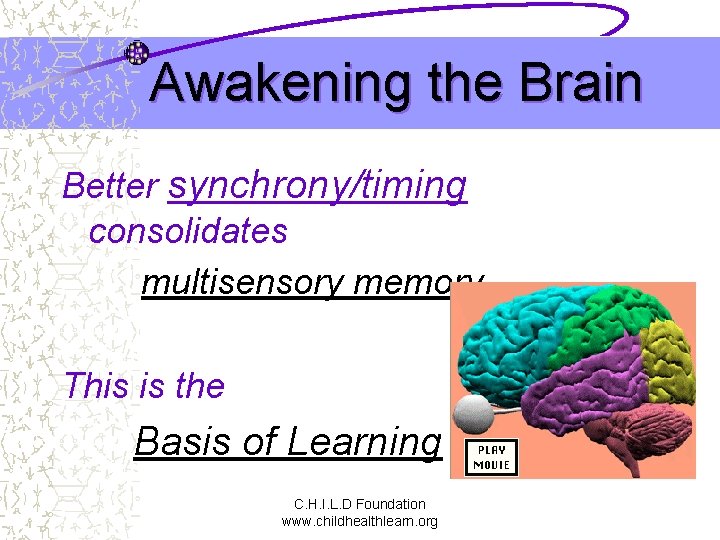
Awakening the Brain Better synchrony/timing consolidates multisensory memory This is the Basis of Learning C. H. I. L. D Foundation www. childhealthlearn. org
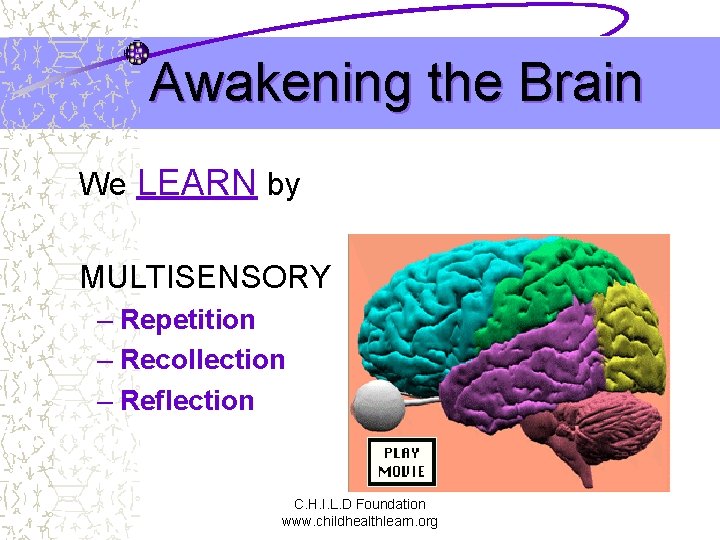
Awakening the Brain We LEARN by MULTISENSORY – Repetition – Recollection – Reflection C. H. I. L. D Foundation www. childhealthlearn. org
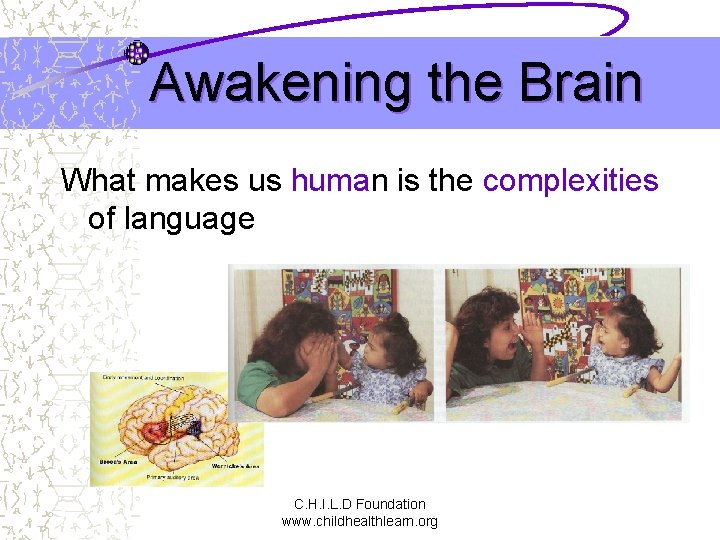
Awakening the Brain What makes us human is the complexities of language C. H. I. L. D Foundation www. childhealthlearn. org
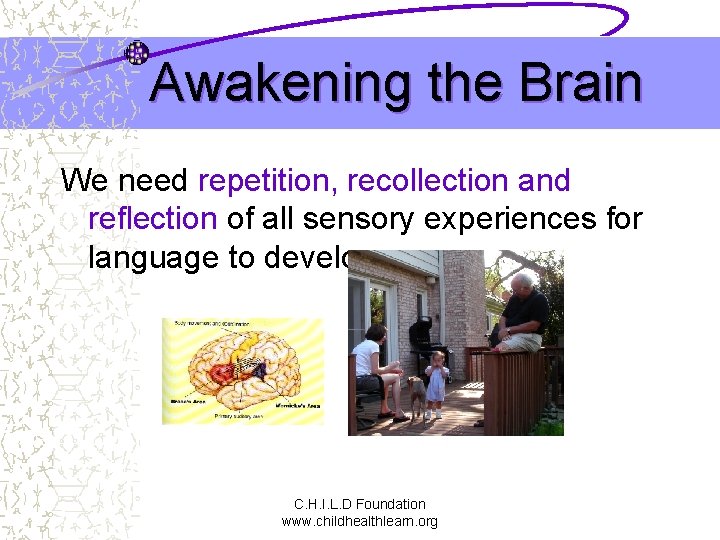
Awakening the Brain We need repetition, recollection and reflection of all sensory experiences for language to develop C. H. I. L. D Foundation www. childhealthlearn. org
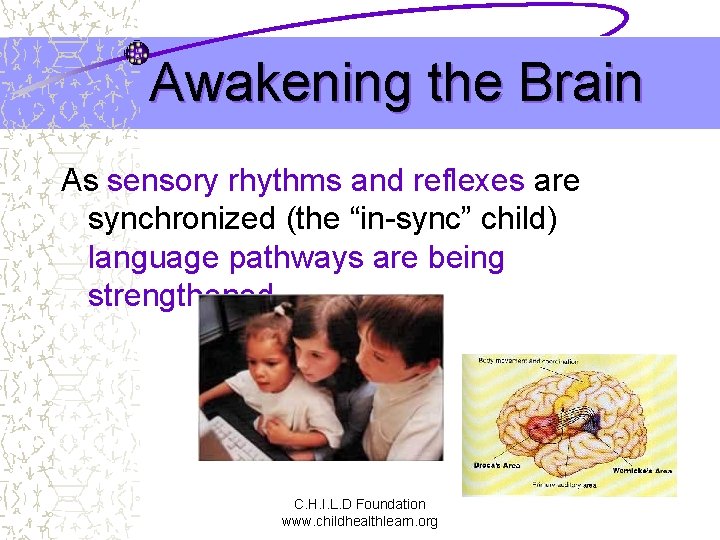
Awakening the Brain As sensory rhythms and reflexes are synchronized (the “in-sync” child) language pathways are being strengthened C. H. I. L. D Foundation www. childhealthlearn. org
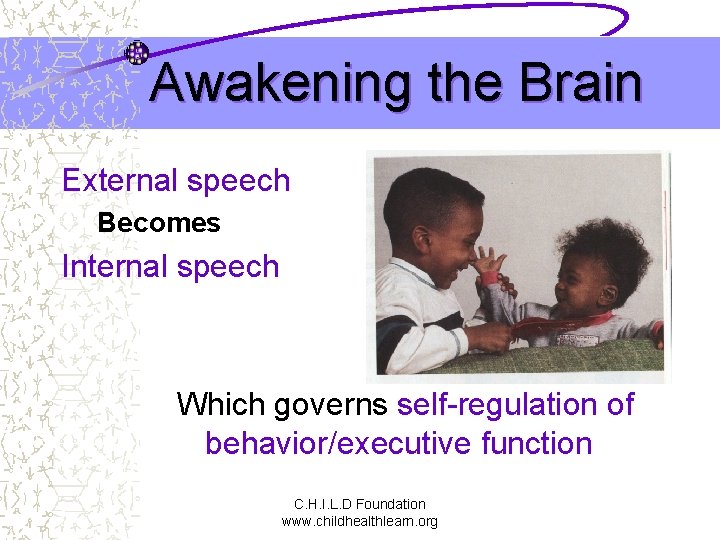
Awakening the Brain External speech Becomes Internal speech Which governs self-regulation of behavior/executive function C. H. I. L. D Foundation www. childhealthlearn. org
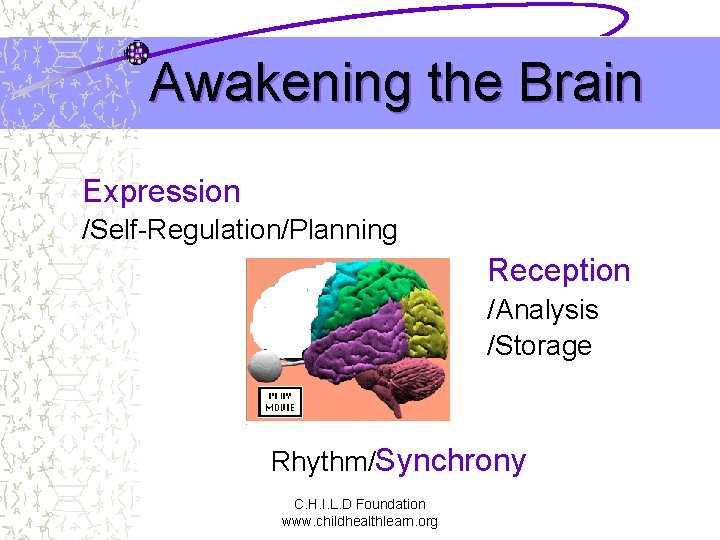
Awakening the Brain Expression /Self-Regulation/Planning Reception /Analysis /Storage Rhythm/Synchrony C. H. I. L. D Foundation www. childhealthlearn. org
Awakening the Brain WHAT’S THE BRAIN DOING WHILE YOU LEARN? WHAT’S LANGUAGE ALL ABOUT? DYSLEXIA TURN ON THE BRAIN FOR LANGUAGE/READING C. H. I. L. D Foundation www. childhealthlearn. org
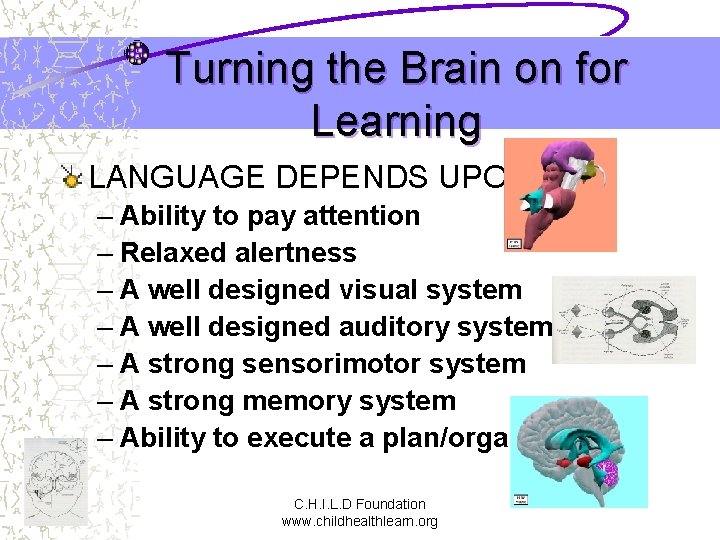
Turning the Brain on for Learning LANGUAGE DEPENDS UPON – Ability to pay attention – Relaxed alertness – A well designed visual system – A well designed auditory system – A strong sensorimotor system – A strong memory system – Ability to execute a plan/organize C. H. I. L. D Foundation www. childhealthlearn. org
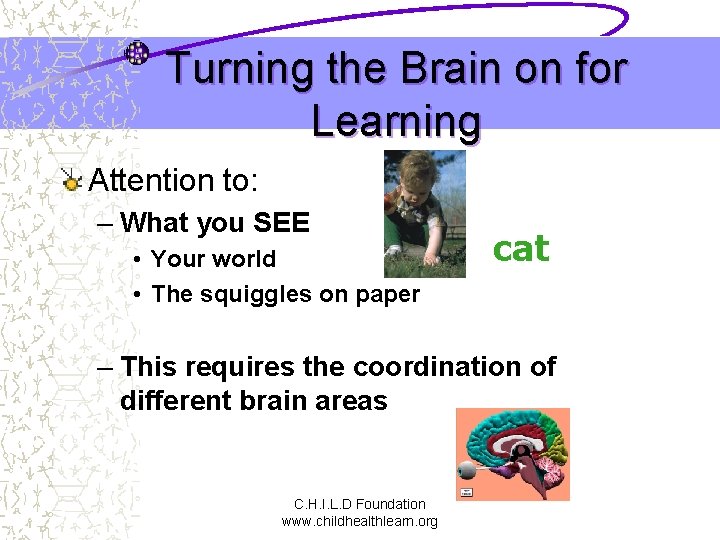
Turning the Brain on for Learning Attention to: – What you SEE • Your world • The squiggles on paper cat – This requires the coordination of different brain areas C. H. I. L. D Foundation www. childhealthlearn. org
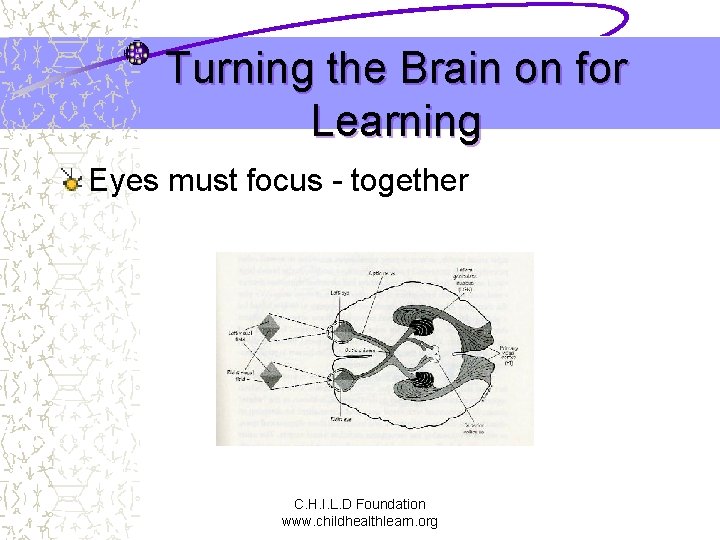
Turning the Brain on for Learning Eyes must focus - together C. H. I. L. D Foundation www. childhealthlearn. org
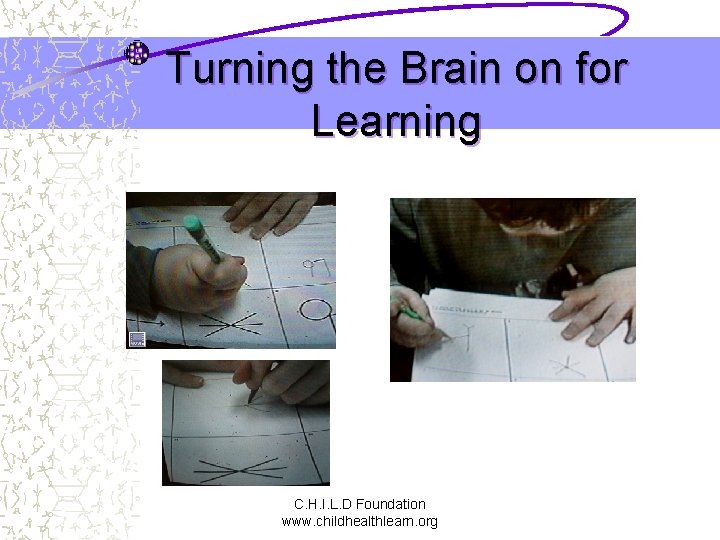
Turning the Brain on for Learning C. H. I. L. D Foundation www. childhealthlearn. org
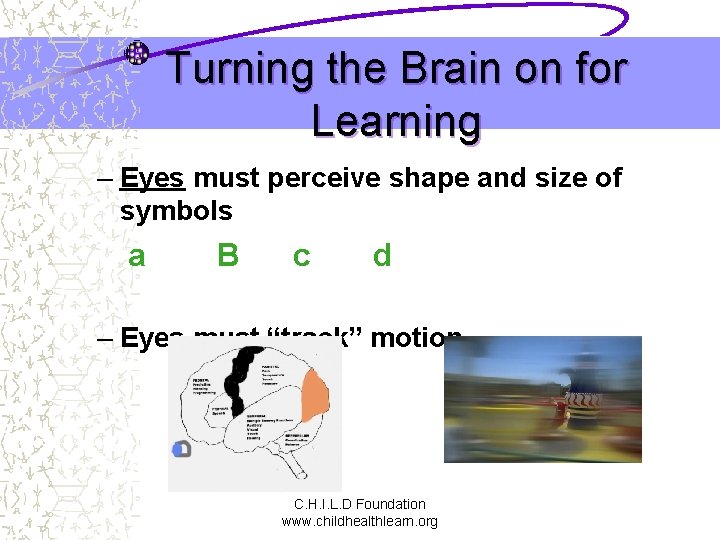
Turning the Brain on for Learning – Eyes must perceive shape and size of symbols a B c d – Eyes must “track” motion C. H. I. L. D Foundation www. childhealthlearn. org
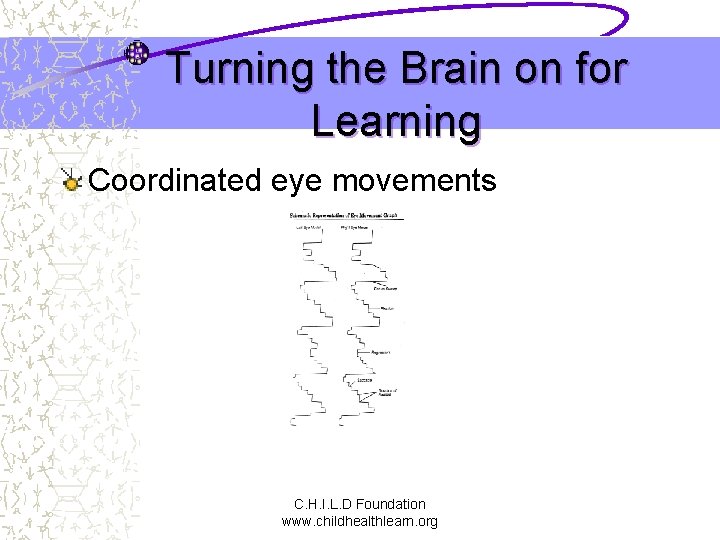
Turning the Brain on for Learning Coordinated eye movements C. H. I. L. D Foundation www. childhealthlearn. org
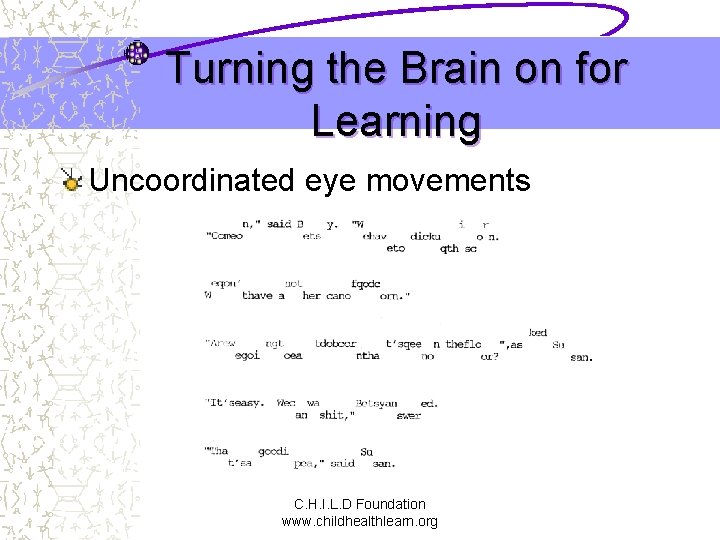
Turning the Brain on for Learning Uncoordinated eye movements C. H. I. L. D Foundation www. childhealthlearn. org
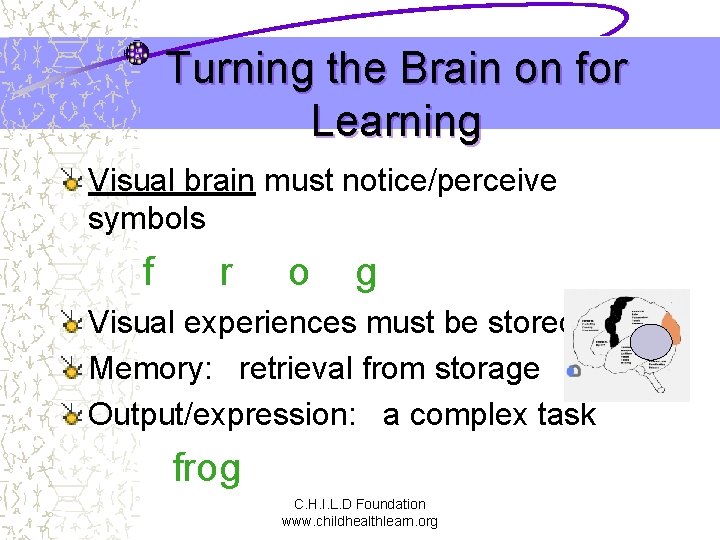
Turning the Brain on for Learning Visual brain must notice/perceive symbols f r o g Visual experiences must be stored Memory: retrieval from storage Output/expression: a complex task frog C. H. I. L. D Foundation www. childhealthlearn. org
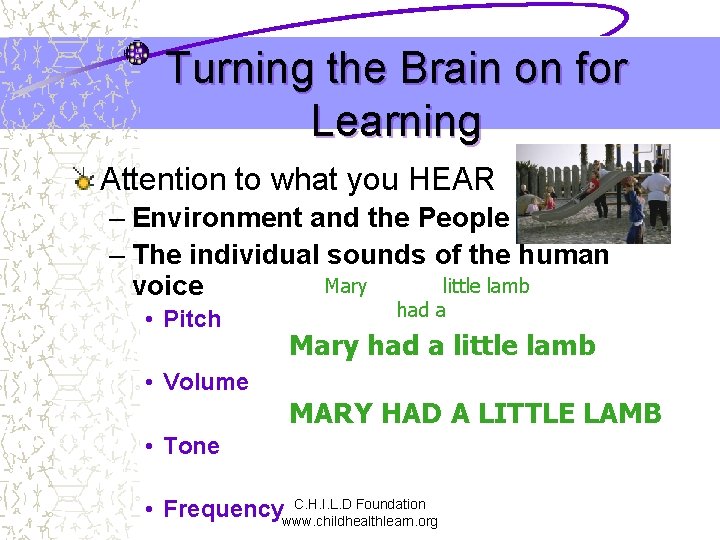
Turning the Brain on for Learning Attention to what you HEAR – Environment and the People in it – The individual sounds of the human Mary little lamb voice • Pitch • Volume had a Mary had a little lamb MARY HAD A LITTLE LAMB • Tone C. H. I. L. D Foundation • Frequencywww. childhealthlearn. org
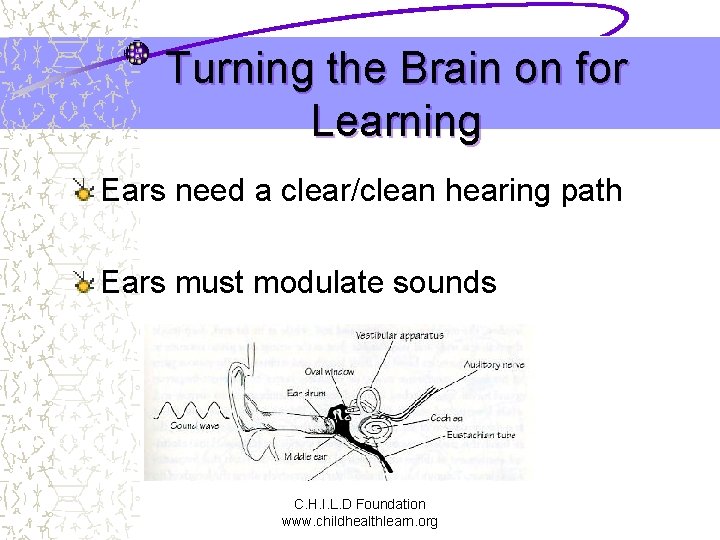
Turning the Brain on for Learning Ears need a clear/clean hearing path Ears must modulate sounds C. H. I. L. D Foundation www. childhealthlearn. org
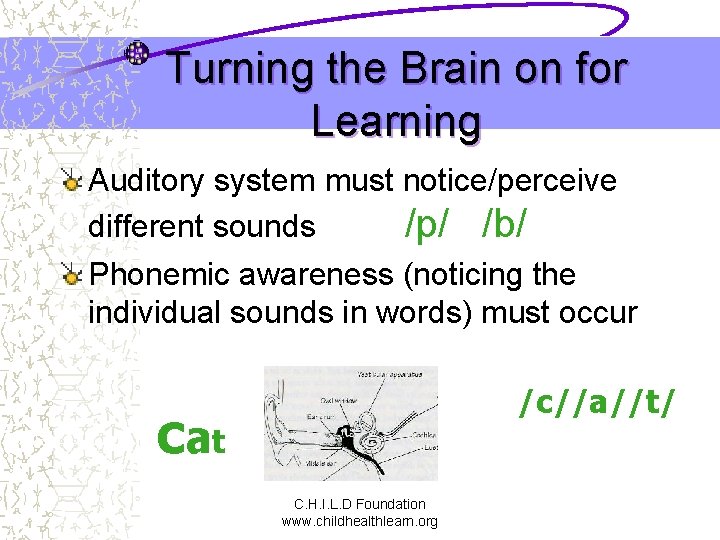
Turning the Brain on for Learning Auditory system must notice/perceive different sounds /p/ /b/ Phonemic awareness (noticing the individual sounds in words) must occur /c//a//t/ ca t C. H. I. L. D Foundation www. childhealthlearn. org
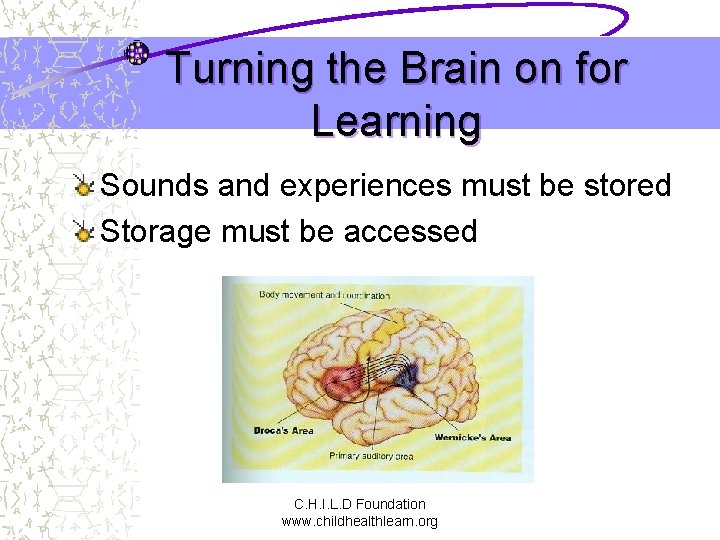
Turning the Brain on for Learning Sounds and experiences must be stored Storage must be accessed C. H. I. L. D Foundation www. childhealthlearn. org
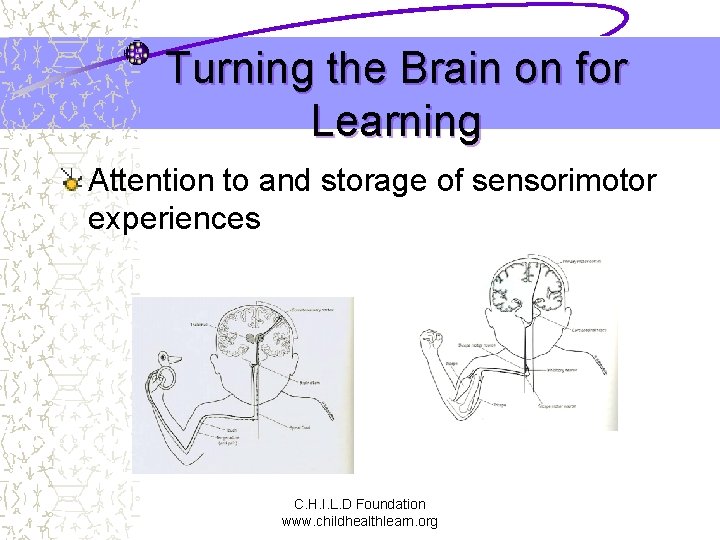
Turning the Brain on for Learning Attention to and storage of sensorimotor experiences C. H. I. L. D Foundation www. childhealthlearn. org
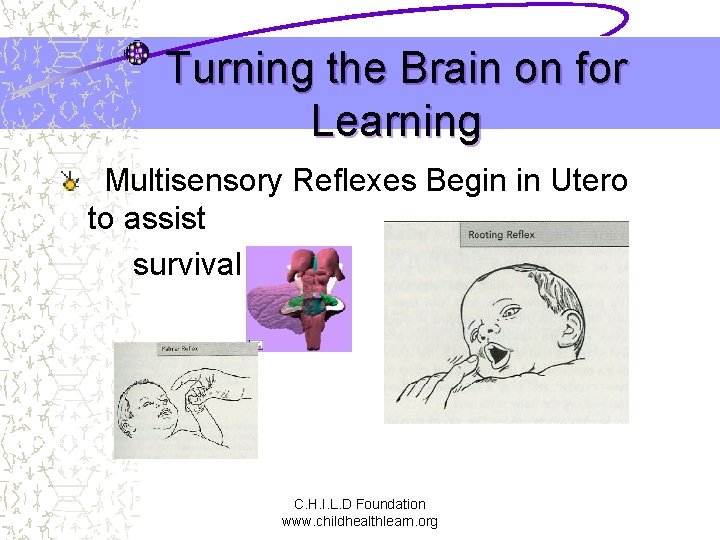
Turning the Brain on for Learning Multisensory Reflexes Begin in Utero to assist survival C. H. I. L. D Foundation www. childhealthlearn. org
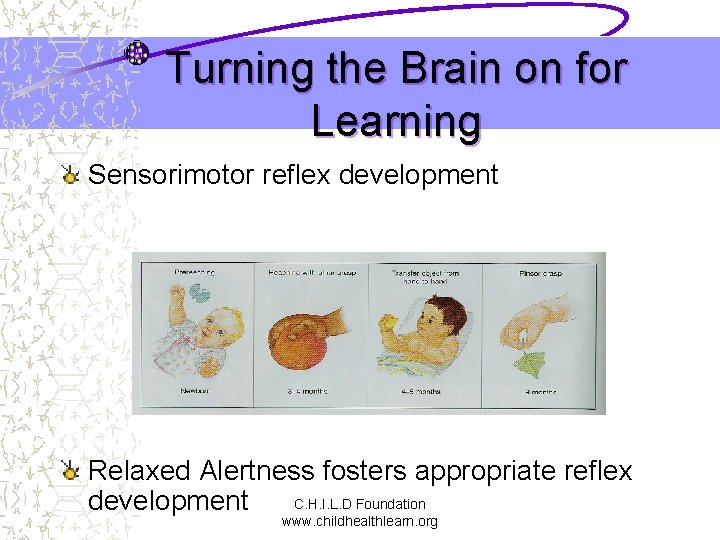
Turning the Brain on for Learning Sensorimotor reflex development Relaxed Alertness fosters appropriate reflex C. H. I. L. D Foundation development www. childhealthlearn. org
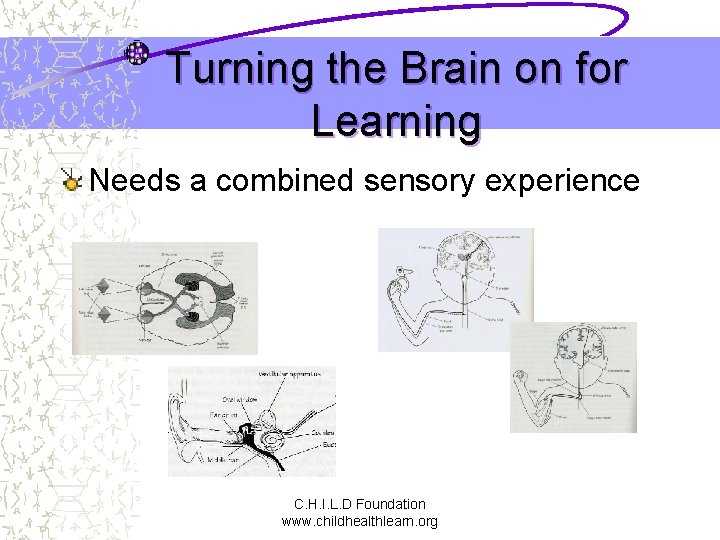
Turning the Brain on for Learning Needs a combined sensory experience C. H. I. L. D Foundation www. childhealthlearn. org
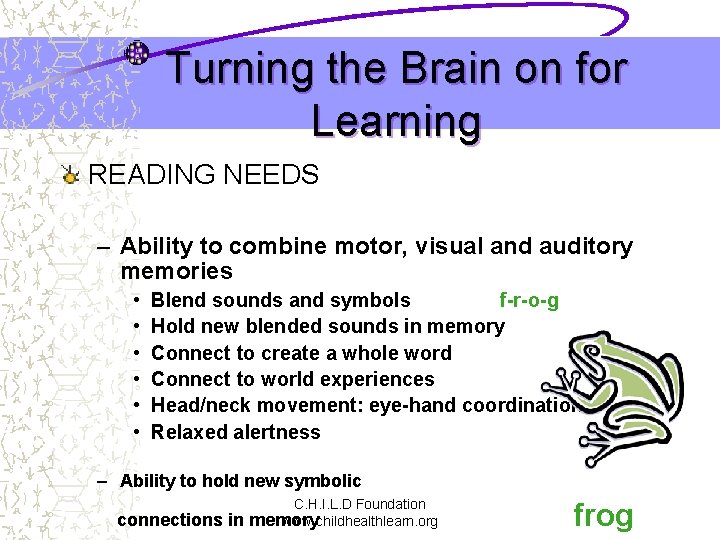
Turning the Brain on for Learning READING NEEDS – Ability to combine motor, visual and auditory memories • • • Blend sounds and symbols f-r-o-g Hold new blended sounds in memory Connect to create a whole word Connect to world experiences Head/neck movement: eye-hand coordination Relaxed alertness – Ability to hold new symbolic connections in C. H. I. L. D Foundation memory www. childhealthlearn. org frog
Turning the Brain on for Learning READING NEEDS – Ability to apply meaning to the combined words and experiences “I love to read” – Ability to recall the full impressions gained through the reading process • • • Images Posture Words Word meaning Understanding of content C. H. I. L. D Foundation www. childhealthlearn. org
Turning the Brain on for Learning READING NEEDS – To be applied to everyday life memories – To enhance abstract thinking C. H. I. L. D Foundation www. childhealthlearn. org
Turn On The Reading Brain The human brain is not hard-wired for reading C. H. I. L. D Foundation www. childhealthlearn. org
Dyslexia is a difficulty with the multisensory regulation of language – Attention, reception, storage, expression – Verbal and nonverbal C. H. I. L. D Foundation www. childhealthlearn. org
Dyslexia A student can be GIFTED and have Dyslexia C. H. I. L. D Foundation www. childhealthlearn. org
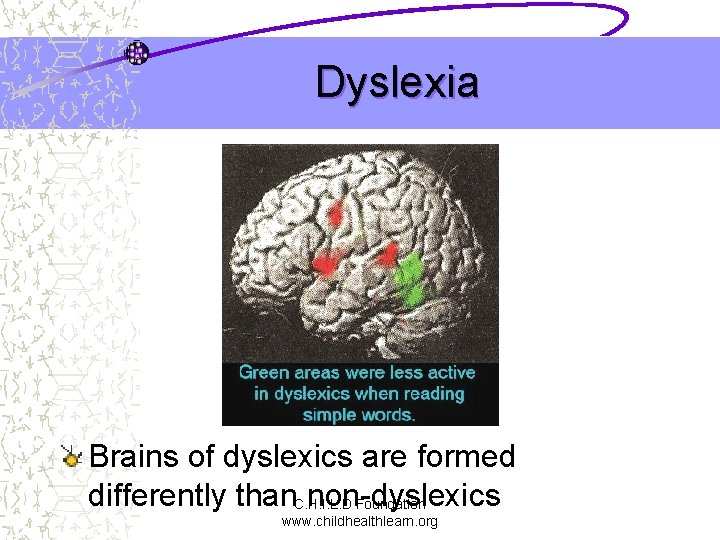
Dyslexia Brains of dyslexics are formed differently than. C. H. I. L. D non-dyslexics Foundation www. childhealthlearn. org
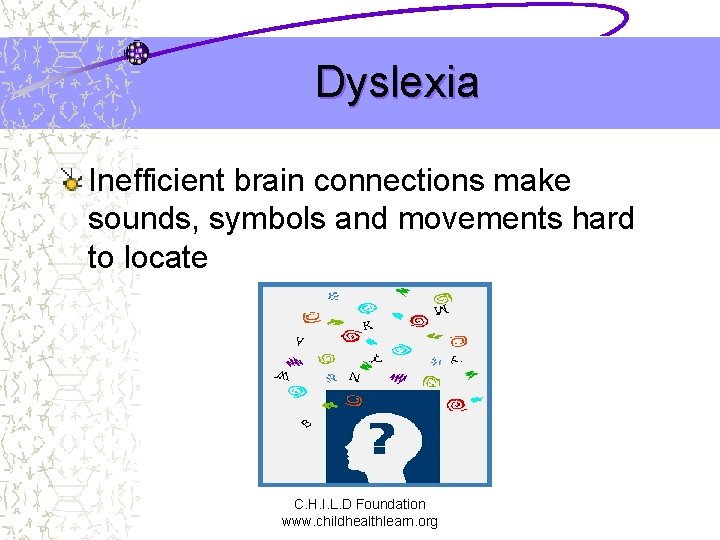
Dyslexia Inefficient brain connections make sounds, symbols and movements hard to locate C. H. I. L. D Foundation www. childhealthlearn. org
Dyslexia Dyslexics have cognitive difficulty associated with: – Visual to verbal coding – Short term memory – Order perception – Sequencing C. H. I. L. D Foundation www. childhealthlearn. org
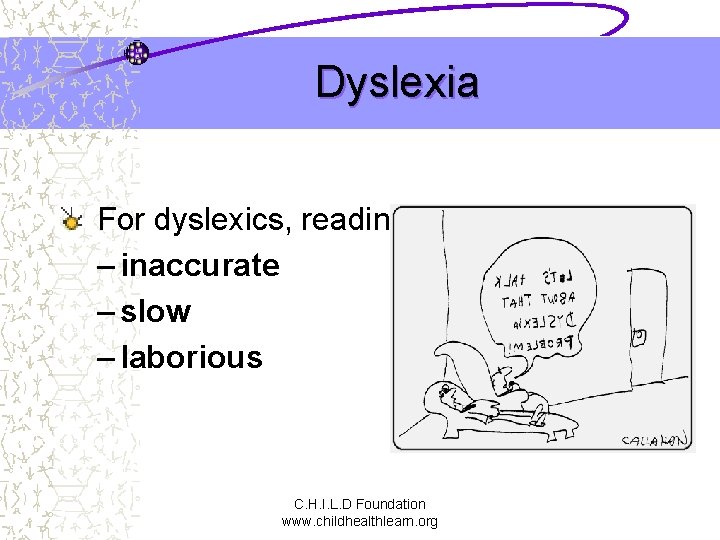
Dyslexia For dyslexics, reading is – inaccurate – slow – laborious C. H. I. L. D Foundation www. childhealthlearn. org
NIH Facts about Dyslexia Affects at least 1 of 5 children in U. S. The most common and prevalent of all learning disabilities Affects girls and boys equally Most people inherit it Leading cause of reading failure and school dropouts in our nation C. H. I. L. D Foundation www. childhealthlearn. org
NIH Facts about Dyslexia Dyslexic children have difficulty with the sound/symbol relationship of the written code because of neurophysiological differences Early intervention is essential It is identifiable with 92% accuracy at ages 51/2 to 61/2 C. H. I. L. D Foundation www. childhealthlearn. org
NIH Facts about Dyslexia It is primarily due to linguistic deficits – a language processing problem. Reading failure caused by dyslexia is highly preventable through brain training – from attention, to memory, to perception through direct, explicit, repetitive instruction. C. H. I. L. D Foundation www. childhealthlearn. org
NIH Facts about Dyslexia Children do not outgrow dyslexia or reading failure Of children who display reading failure in the 1 st grade, 74% will be poor readers in the 9 th grade… UNLESS they receive brain changing instruction C. H. I. L. D Foundation www. childhealthlearn. org
NIH Facts about Dyslexia “Whole language” is not supported by research as an approach to teach dyslexics. Dyslexia and ADD often occur within the same child “The current discrepancy model to establish eligibility for special education services is not a valid C. H. I. L. D Foundation diagnostic marker for dyslexia. ” www. childhealthlearn. org
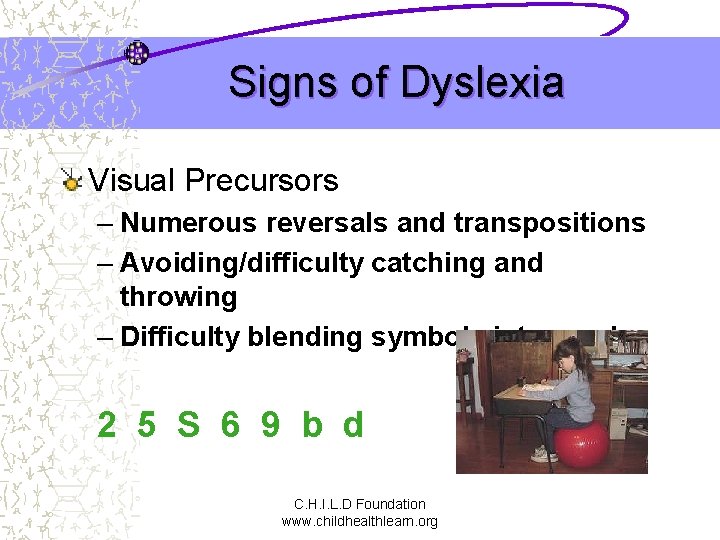
Signs of Dyslexia Visual Precursors – Numerous reversals and transpositions – Avoiding/difficulty catching and throwing – Difficulty blending symbols into words 2 5 S 6 9 b d C. H. I. L. D Foundation www. childhealthlearn. org
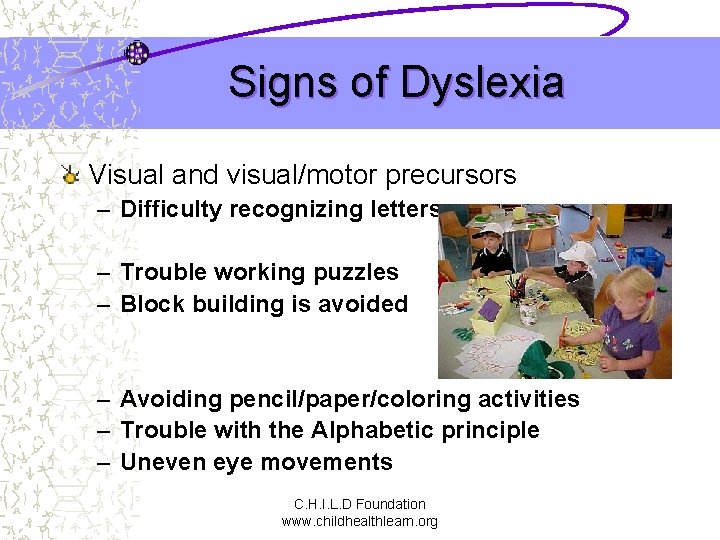
Signs of Dyslexia Visual and visual/motor precursors – Difficulty recognizing letters – Trouble working puzzles – Block building is avoided – Avoiding pencil/paper/coloring activities – Trouble with the Alphabetic principle – Uneven eye movements C. H. I. L. D Foundation www. childhealthlearn. org
Signs of Dyslexia Sensorimotor difficulties – Perceiving lines – Feeling shapes – Perceiving symbols (letters and numbers) lll OOO 2 llll 6 9 5 S C. H. I. L. D Foundation www. childhealthlearn. org
Signs of Dyslexia Auditory/Verbal Precursors – Articulation problems – Difficulty learning rhymes – Trouble following and remembering oral directions – Difficulty with word retrieval C. H. I. L. D Foundation www. childhealthlearn. org
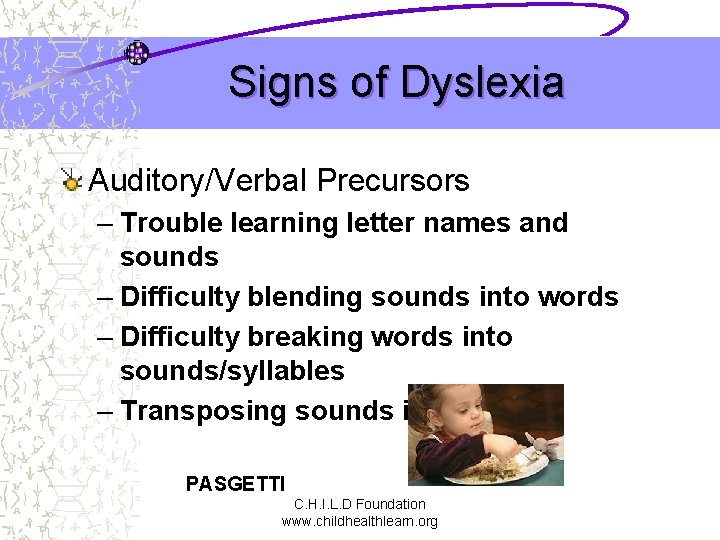
Signs of Dyslexia Auditory/Verbal Precursors – Trouble learning letter names and sounds – Difficulty blending sounds into words – Difficulty breaking words into sounds/syllables – Transposing sounds in words PASGETTI C. H. I. L. D Foundation www. childhealthlearn. org
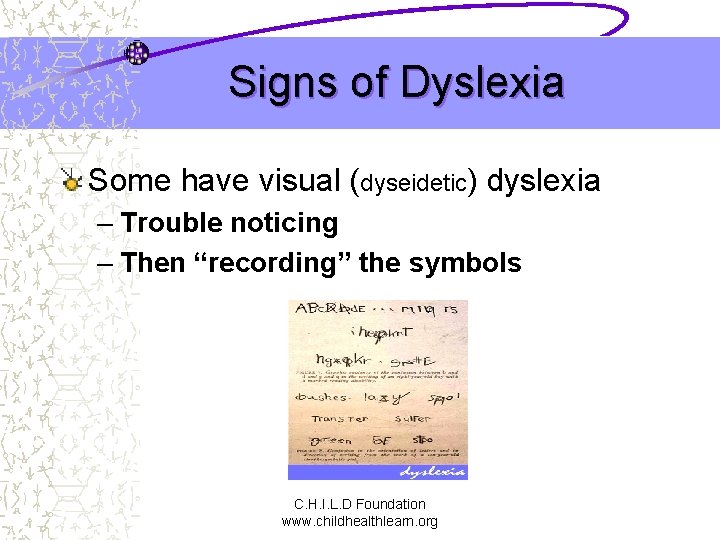
Signs of Dyslexia Some have visual (dyseidetic) dyslexia – Trouble noticing – Then “recording” the symbols C. H. I. L. D Foundation www. childhealthlearn. org
Signs of Dyslexia Visual (dyseidetic) dyslexics – reading – – May invert or reverse letters Rate of perception is slow Loses place or skips lines or parts Adds words that aren’t there – ocassionally changing meaning – May omit or change punctuation – changing meaning – Make guesses or says words that look similar – surprise/surface – May confuse letter order - place/palace C. H. I. L. D Foundation www. childhealthlearn. org
Signs of Dyslexia Visual dyslexics – spelling – May visualize beginning and end of word but omit the middle – Spells phonetically – sight/site – Mixes capitals and small letters – Inverts letters/numbers – Reverses letters/numbers – Gives correct letters in the wrong sequence C. H. I. L. D Foundation www. childhealthlearn. org
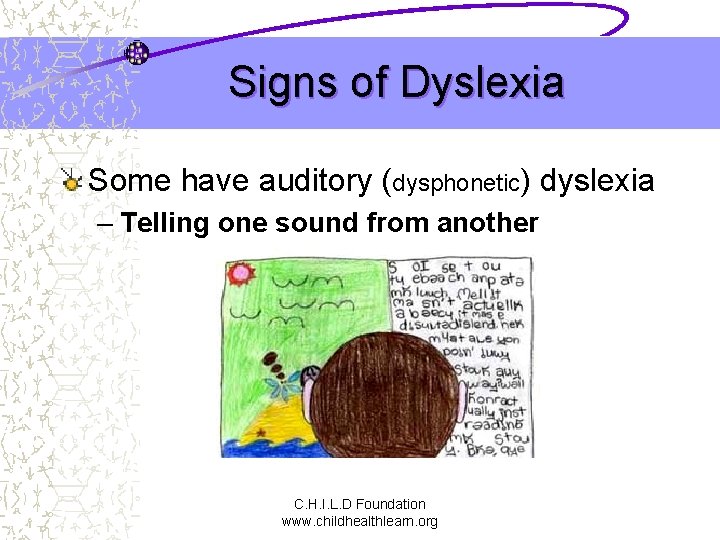
Signs of Dyslexia Some have auditory (dysphonetic) dyslexia – Telling one sound from another C. H. I. L. D Foundation www. childhealthlearn. org
Signs of Dyslexia Auditory (dysphonetic) dyslexics – reading – – – Substitution of sounds Poor sound blending to make words Knows names but not the sounds of letters Poor phonic attack When stuck on a word, may not sound it out Word finding difficulties • Substitutes words • Uses synonyms – mommy/mother C. H. I. L. D Foundation www. childhealthlearn. org
Signs of Dyslexia Auditory dyslexics – spelling – Omit endings – Use synonyms – Omits second letter in blends – fed/fled – Confuses voiced and unvoiced pairs – p/b, f/v, ch/sh – Doesn’t hear subtle differences – leaves out vowels – Confuses vowels – Makes wild guesses C. H. I. L. D Foundation www. childhealthlearn. org
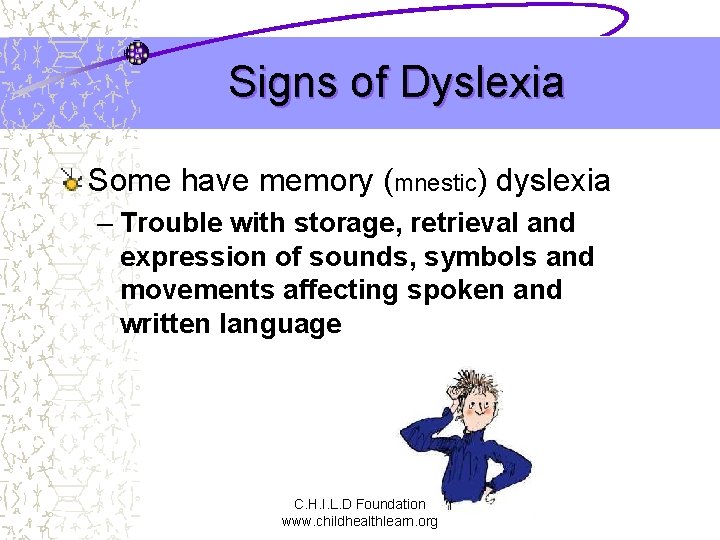
Signs of Dyslexia Some have memory (mnestic) dyslexia – Trouble with storage, retrieval and expression of sounds, symbols and movements affecting spoken and written language C. H. I. L. D Foundation www. childhealthlearn. org
Signs of Dyslexia Mnestic dyslexia can also affect sequential and simultaneous processing – Math • Facts • Sequencing of problems • Reading of word problems – Word order of language/semantics C. H. I. L. D Foundation www. childhealthlearn. org
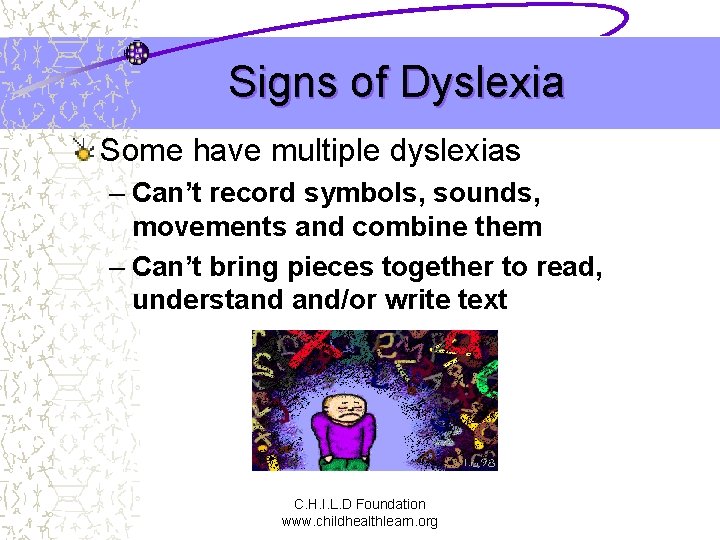
Signs of Dyslexia Some have multiple dyslexias – Can’t record symbols, sounds, movements and combine them – Can’t bring pieces together to read, understand and/or write text C. H. I. L. D Foundation www. childhealthlearn. org
Dyslexia They need – Relaxed Alertness – Awareness of sounds, symbols and tactile stimuli – Deep, repetitive sound/symbol/sensorimotor connections – GIFT OF TIME C. H. I. L. D Foundation www. childhealthlearn. org
Turn On the Reading Brain Repetition, Recollection and Reflection Can change brain design C. H. I. L. D Foundation www. childhealthlearn. org
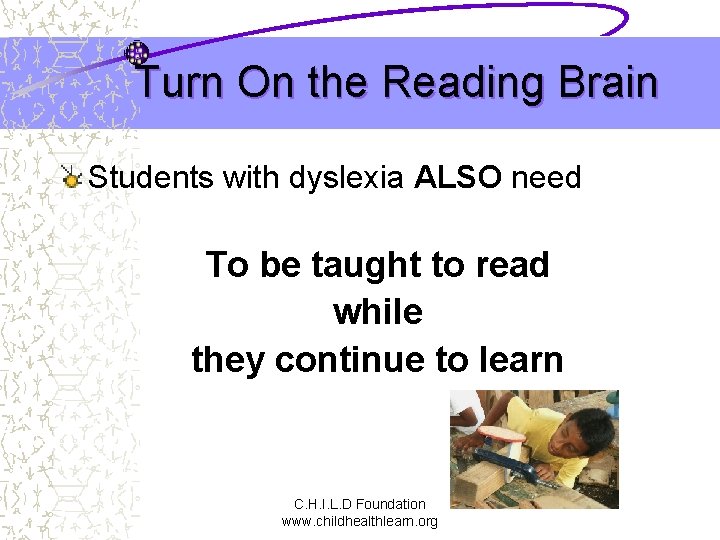
Turn On the Reading Brain Students with dyslexia ALSO need To be taught to read while they continue to learn C. H. I. L. D Foundation www. childhealthlearn. org

Turn On The Reading Brain Essential Skills To. . UNLOCK THE CODE n Relaxed alertness/attention n Smooth eye movement n Phonetic awareness n Tactile awareness n Visual awareness n Body awareness and body control C. H. I. L. D Foundation www. childhealthlearn. org

Turn On The Reading Brain Essential Skills To. . UNLOCK THE CODE – Attention – Balance – Posture – Fine/gross motor skills – Visual and visual/motor integration – Speech/sounds perception/integration – Sound/symbol perception/integration C. H. I. L. D Foundation www. childhealthlearn. org
Turn On The Reading Brain Essential Skills To. . UNLOCK THE CODE – Relaxed alertness – Multisensory attention – Multisensory recognition – Multisensory memory – Multisensory expression C. H. I. L. D Foundation www. childhealthlearn. org
Turn On The Reading Brain Strengthen Auditory Connections – Make sure auditory system is working properly – Attention to sound • Surround the child with good music – “Music for Babies” or “…Children”, etc. • Work with rhythms and rhymes • Metronome and Rhythm Band can help • Sing to and with the child C. H. I. L. D Foundation www. childhealthlearn. org
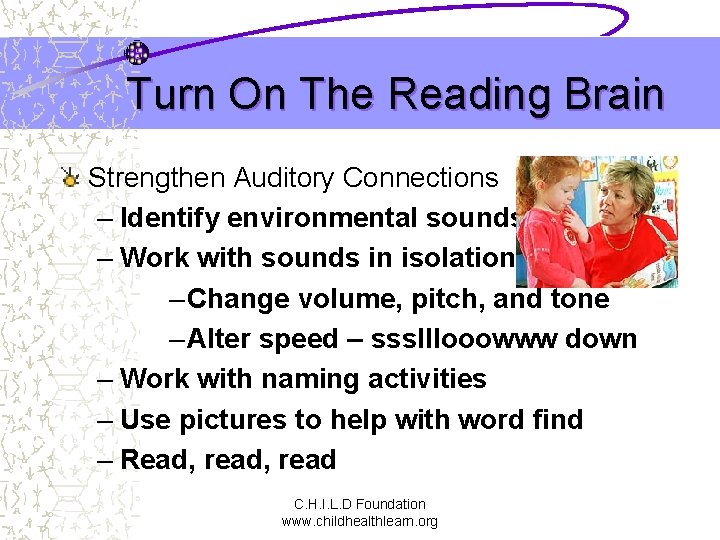
Turn On The Reading Brain Strengthen Auditory Connections – Identify environmental sounds – Work with sounds in isolation – Change volume, pitch, and tone – Alter speed – ssslllooowww down – Work with naming activities – Use pictures to help with word find – Read, read C. H. I. L. D Foundation www. childhealthlearn. org
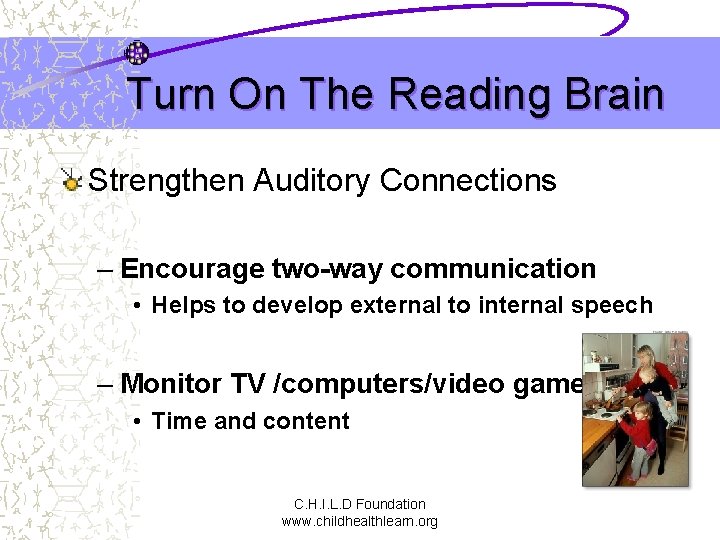
Turn On The Reading Brain Strengthen Auditory Connections – Encourage two-way communication • Helps to develop external to internal speech – Monitor TV /computers/video games • Time and content C. H. I. L. D Foundation www. childhealthlearn. org
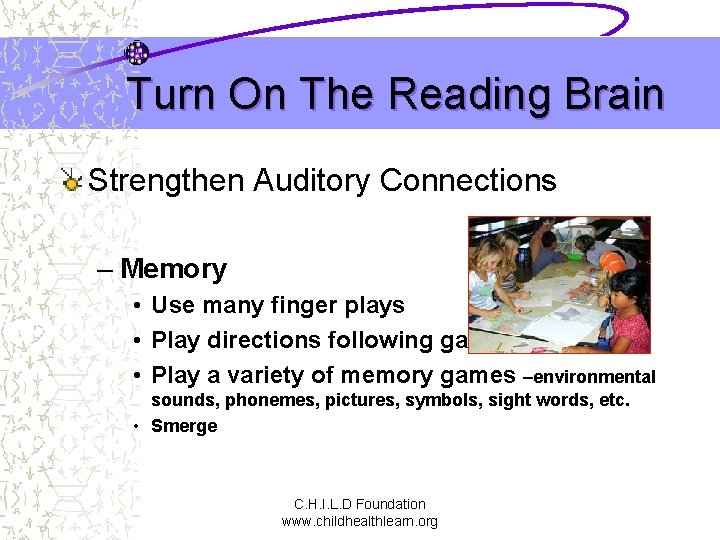
Turn On The Reading Brain Strengthen Auditory Connections – Memory • Use many finger plays • Play directions following games • Play a variety of memory games –environmental sounds, phonemes, pictures, symbols, sight words, etc. • Smerge C. H. I. L. D Foundation www. childhealthlearn. org
Turn On The Reading Brain Strengthen visual connections – Attention/Perception • Introduce puzzles from simple to complex – Use verbal cues when working puzzles • • Matching games Scanning games Categorizing activities Foster block building that requires following picture directions – Use verbal cues to assist visual awareness • Use colored lenses C. H. I. L. D Foundation www. childhealthlearn. org
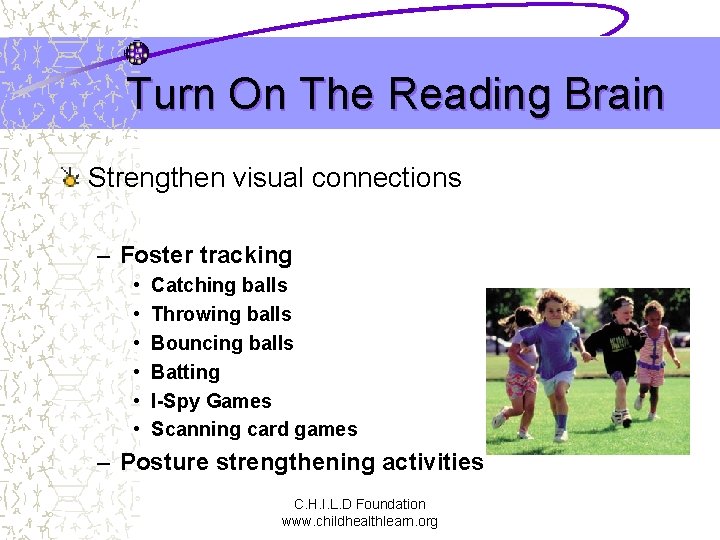
Turn On The Reading Brain Strengthen visual connections – Foster tracking • • • Catching balls Throwing balls Bouncing balls Batting I-Spy Games Scanning card games – Posture strengthening activities C. H. I. L. D Foundation www. childhealthlearn. org
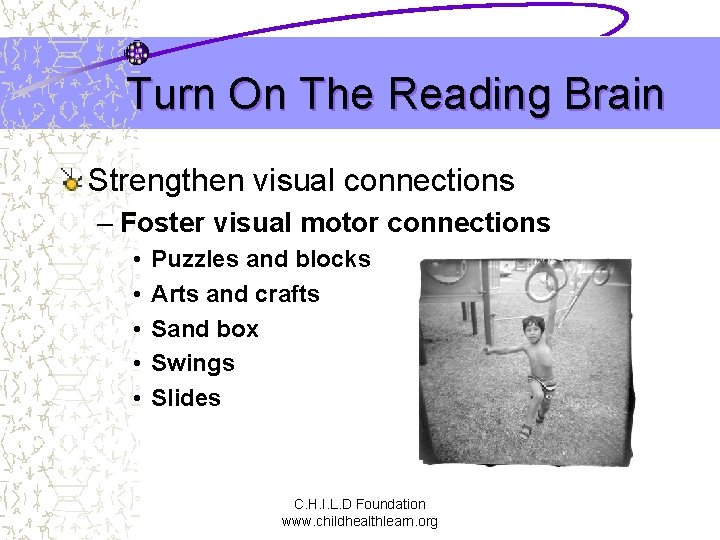
Turn On The Reading Brain Strengthen visual connections – Foster visual motor connections • • • Puzzles and blocks Arts and crafts Sand box Swings Slides C. H. I. L. D Foundation www. childhealthlearn. org
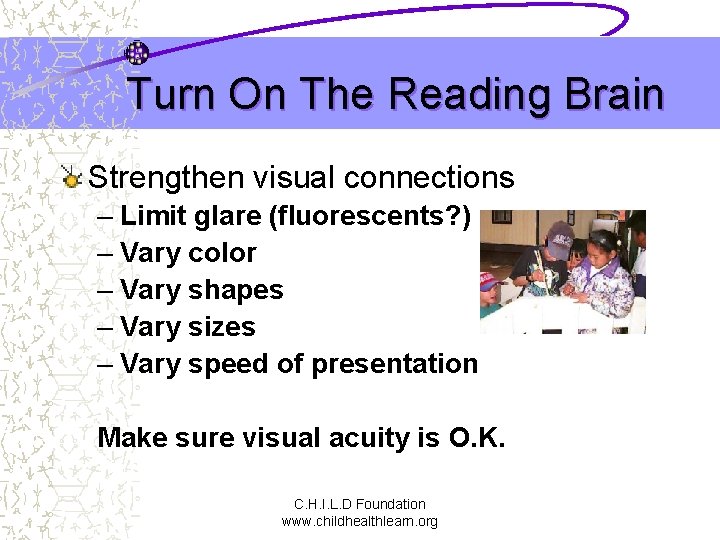
Turn On The Reading Brain Strengthen visual connections – Limit glare (fluorescents? ) – Vary color – Vary shapes – Vary sizes – Vary speed of presentation Make sure visual acuity is O. K. C. H. I. L. D Foundation www. childhealthlearn. org
Turn On The Reading Brain Strengthen visual connections – Strengthen visual memory • Play memory games with cards • Play I-Spy in the car and restaurants • Waldo C. H. I. L. D Foundation www. childhealthlearn. org
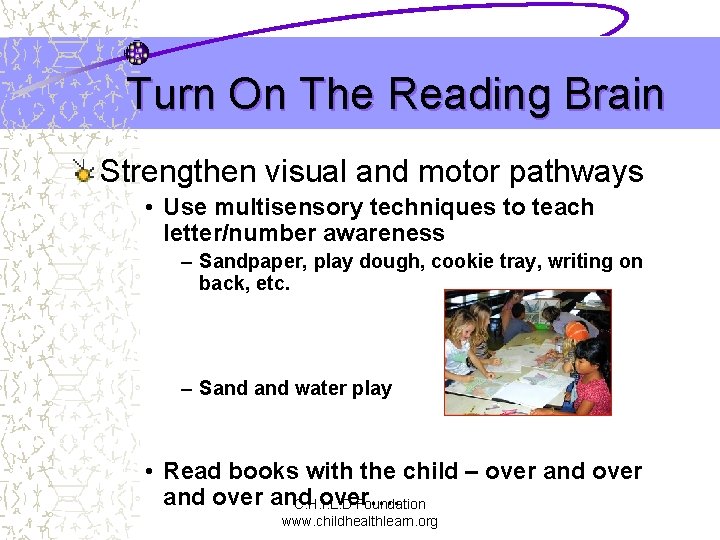
Turn On The Reading Brain Strengthen visual and motor pathways • Use multisensory techniques to teach letter/number awareness – Sandpaper, play dough, cookie tray, writing on back, etc. – Sand water play • Read books with the child – over and over…. C. H. I. L. D Foundation www. childhealthlearn. org
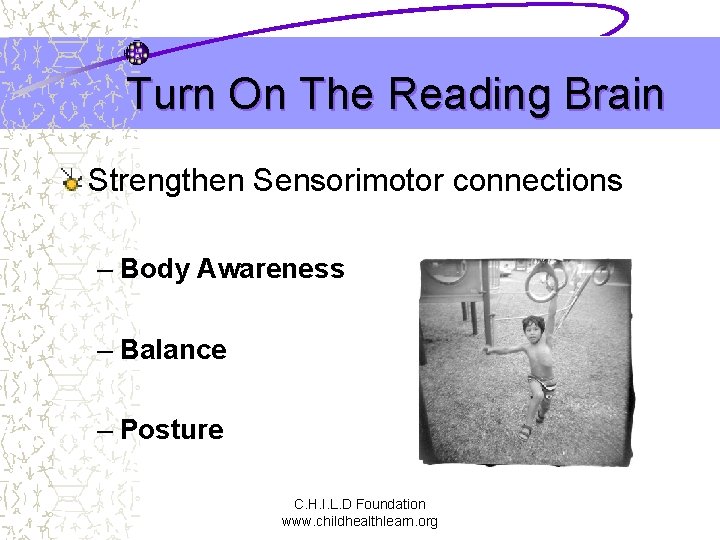
Turn On The Reading Brain Strengthen Sensorimotor connections – Body Awareness – Balance – Posture C. H. I. L. D Foundation www. childhealthlearn. org
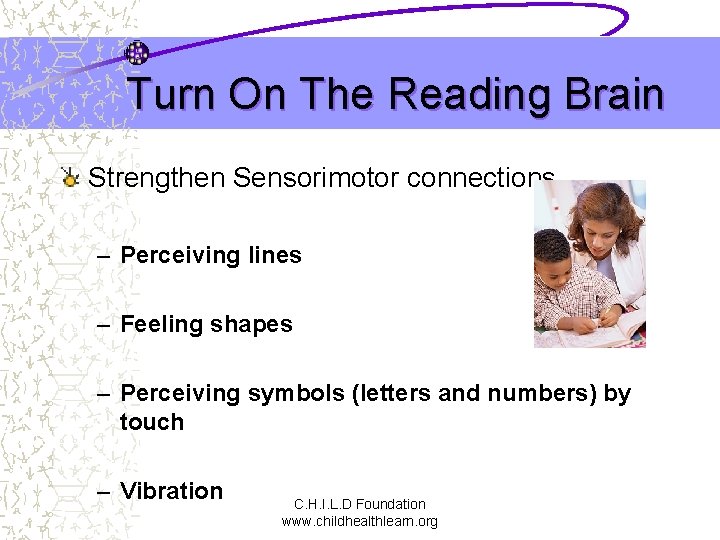
Turn On The Reading Brain Strengthen Sensorimotor connections – Perceiving lines – Feeling shapes – Perceiving symbols (letters and numbers) by touch – Vibration C. H. I. L. D Foundation www. childhealthlearn. org
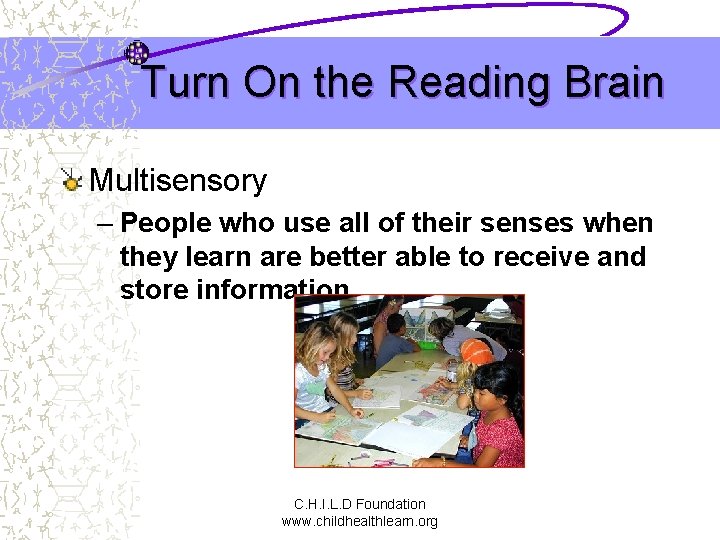
Turn On the Reading Brain Multisensory – People who use all of their senses when they learn are better able to receive and store information C. H. I. L. D Foundation www. childhealthlearn. org
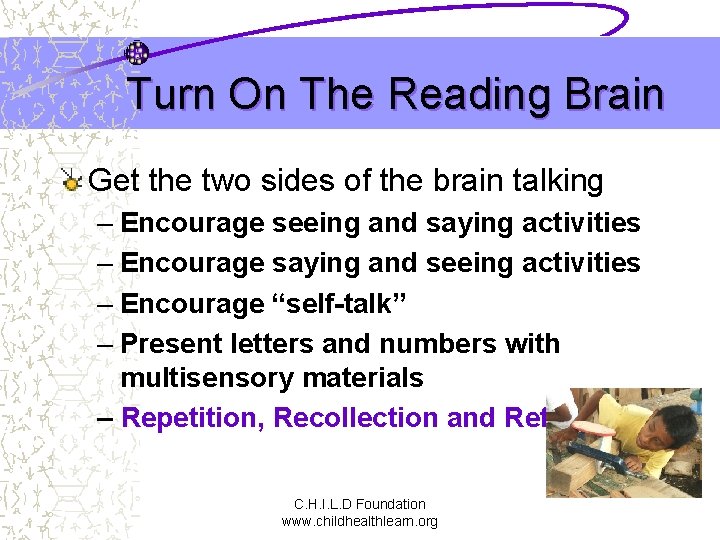
Turn On The Reading Brain Get the two sides of the brain talking – Encourage seeing and saying activities – Encourage saying and seeing activities – Encourage “self-talk” – Present letters and numbers with multisensory materials – Repetition, Recollection and Reflection C. H. I. L. D Foundation www. childhealthlearn. org
Teach the Dyslexic Brain To Learn Dyslexics need MORE sensory preparation Dyslexics need MORE repetition, recollection and reflection C. H. I. L. D Foundation www. childhealthlearn. org
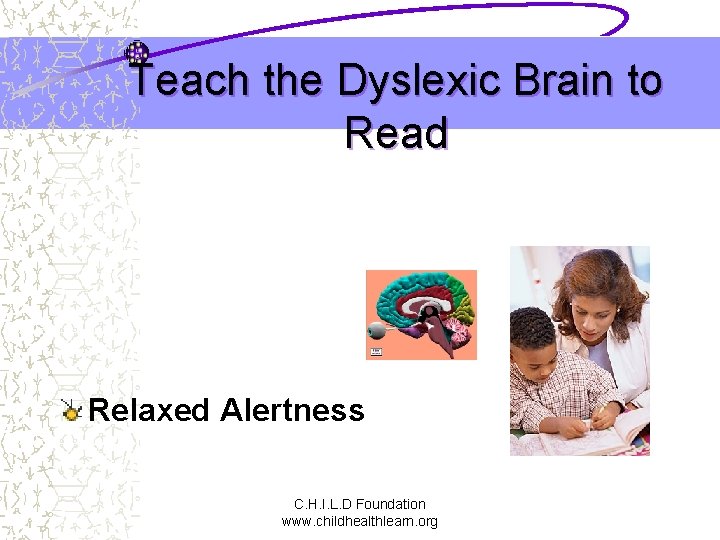
Teach the Dyslexic Brain to Read Relaxed Alertness C. H. I. L. D Foundation www. childhealthlearn. org
Teach the Dyslexic Brain to Read Directly assist attention and sensory modulation – Sound • Therapeutic listening programs such as TLP, DLS and others similar to these based on the work of Tomatis and Samonas, etc. • Earobics, Fas. Forword, Lexia, etc. • Soundscape • Sound Tracks C. H. I. L. D Foundation www. childhealthlearn. org
Teach the Dyslexic Brain to Read Directly assist attention and sensory modulation – Visual • Eye movement programs such as Eye. Q, etc. • Visual exercises with tracking/scanning, matching and perceptual practice – – Solitaire games Kings in the Corner Sequence Scan C. H. I. L. D Foundation www. childhealthlearn. org
Teach the Dyslexic Brain to Read Directly assist attention and sensory modulation – Tactile • Sensory/motor processing exercises • Movement programs – Feldenkrais, Brain Gym, Gymbaroo, etc. • Play doh plus letter/number formation C. H. I. L. D Foundation www. childhealthlearn. org
Teach the Dyslexic Brain to Read Strengthen multisensory reception and storage – Programs that are based on researched success – These programs must be: • • Direct Repetitive Multisensory C. H. I. L. D Foundation www. childhealthlearn. org Teach phonemic awareness
Teach the Dyslexic Brain to Read Strengthen multisensory reception and storage – The programs must include: • Direct, explicit teaching of every rule. – Dyslexics do not intuit anything about written language – One rule must be taught at a time and practiced until it is stable in both reading and spelling C. H. I. L. D Foundation www. childhealthlearn. org
Teach the Dyslexic Brain to Read Strengthen multisensory reception and storage – The programs must include: • Teaching that is systematic to “fill the holes” in the foundation • The logic behind language and rules practiced to automaticity • Consistent review to solidify the learning C. H. I. L. D Foundation www. childhealthlearn. org
Teach the Dyslexic Brain to Read Strengthen multisensory reception and storage – The programs must include: • Consistent word building and analytic pulling apart of words • Continuous assessment to be certain that UNDERSTANDING is growing not just blind application C. H. I. L. D Foundation www. childhealthlearn. org
Teach the Dyslexic Brain to Read Strengthen multisensory reception and storage – Reading Programs for dyslexics MUST include: • Relaxed Alertness C. H. I. L. D Foundation www. childhealthlearn. org
Teach the Dyslexic Brain to Read Strengthen multisensory reception and storage – Phoneme awareness must be taught directly • • Phoneme segmentation Phoneme deletion Phoneme matching Phoneme counting Phoneme substitution Blending Rhyming C. H. I. L. D Foundation www. childhealthlearn. org
Teach the Brain to Read Strengthen multisensory reception and storage – Reading Programs for dyslexics MUST include: • Phoneme/Grapheme Correspondence – Which sounds are represented by which letter(s) – How to blend the letters into single-syllable words C. H. I. L. D Foundation www. childhealthlearn. org
Teach the Brain to Read Strengthen multisensory reception and storage – Reading Programs for dyslexics MUST include • Teaching the Six Types of Syllables that compose English words – They will know what sound the vowel will make – If they hear the vowel sounds, they will know how the syllable must be spelled to make the sound C. H. I. L. D Foundation www. childhealthlearn. org
Teach the Brain to Read Strengthen multisensory reception and storage – Reading Programs for dyslexics MUST include: • Teaching of probabilities and rules – /SHUN/ can be spelled TION, SION, OR CION • Roots, suffixes and morphology must be taught • Expand vocabulary C. H. I. L. D Foundation www. childhealthlearn. org
Teach the Brain to Read Multisensory expression/executive function – Reading programs for dyslexics MUST include: • Movement from external to internal questioning and speech – Explained – Modeled – Practiced • Analysis of material – Genre – Text structure – Text organization C. H. I. L. D Foundation www. childhealthlearn. org
Teach the Brain to Read Multisensory expression/executive function – Expansion of comprehension ability – – Visualizing and verbalizing - Lindamood Probing Use of open-ended questions Sentence structure, text cohesion, punctuation, phrasing and grammar must be taught directly C. H. I. L. D Foundation www. childhealthlearn. org
Dyslexia In The Classroom School aged students with dyslexia need: – THE GIFT OF TIME • Extra time for tests • Shortened assignments • Assisted reading • Study guides for test preparation – Assisted writing – Spelling treated as a separate subject – Alternative assigments C. H. I. L. D Foundation www. childhealthlearn. org
Dyslexia In The Classroom Students with visual dyslexia need: – A guide card while reading – Two guide cards while taking tests that have an answer sheet – Minimized copying from board and books • Have them take notes for practice • Supply full set of clear notes C. H. I. L. D Foundation www. childhealthlearn. org
Dyslexia In The Classroom Students with auditory dyslexia need: – Words slowed down • Directions • Explanations – – Much repetition of verbal input Much visual, whole presentation Warning when they will be called on Spelling treated as a separate subject C. H. I. L. D Foundation www. childhealthlearn. org
Dyslexia In The Classroom Students with memory-based dyslexia need: – Repetition – Clarification – Assignment structure assistance • Missing, late, incorrectly completed assignments are “symptoms” of the need for greater support – Memory devices (Memory Power for Exams, etc. ) often using both sides of the brain – Books on tape – MUCH VISUAL, WHOLE presentation C. H. I. L. D Foundation www. childhealthlearn. org
Dyslexia In The Classroom Student with dyslexia often need: – Recognition of their math talent – Math fact learning assistance plus calculator – Use of a calculator that shows whole math sentence • See and say – Math problem “cheat sheets” – Recognition of their difficulty with sequential solving – No speeded math fact tests C. H. I. L. D Foundation – Graph paper orwww. childhealthlearn. org vertical lines when doing math
Dyslexia In The Classroom Students with dyslexia often need: – Study guides for test preparation – Extra time for tests – Shortened tests • Fewer questions • Fewer choices for answers – – Extra time for homework Shortened assignments Minimized essays Tests read to them C. H. I. L. D Foundation www. childhealthlearn. org
Dyslexia In The Classroom Students with dyslexia need to be encouraged to use good posture – Feet flat on the floor or resting on a stool – Straighten back – Straighten head – Head elbow distance from work – Pencil held where both eyes can see at the same time. C. H. I. L. D Foundation www. childhealthlearn. org
Dyslexia In The Classroom Students with dyslexia often need: – An environment free of pattern glare • Reduce the area of the test that is visible • Reduce contrast between lines • Reduce light levels or use properly prescribed tinted lenses • Change the size of text – Seating in the least distracting portion of the classroom C. H. I. L. D Foundation www. childhealthlearn. org
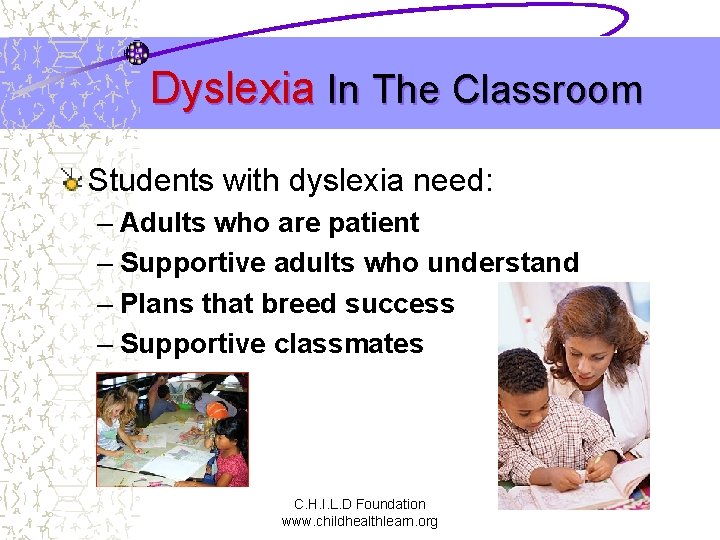
Dyslexia In The Classroom Students with dyslexia need: – Adults who are patient – Supportive adults who understand – Plans that breed success – Supportive classmates C. H. I. L. D Foundation www. childhealthlearn. org
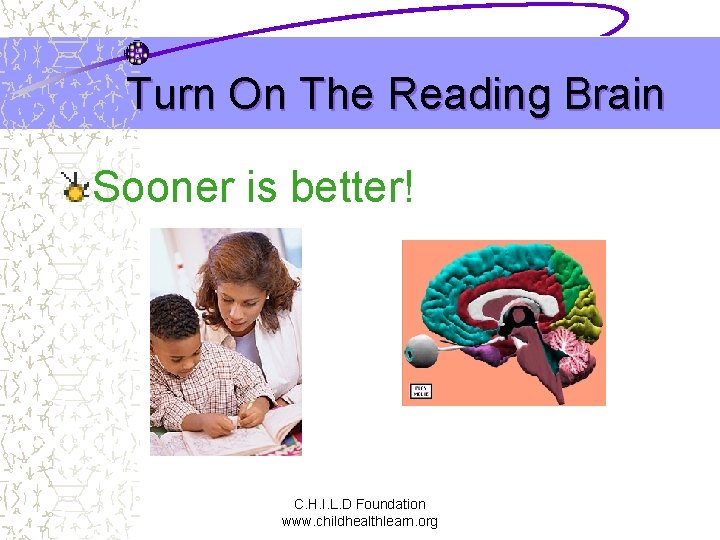
Turn On The Reading Brain Sooner is better! C. H. I. L. D Foundation www. childhealthlearn. org
Teach the Brain to Read Brain design is NOT Destiny C. H. I. L. D Foundation www. childhealthlearn. org
- Slides: 116