Food Quality Assurance FE 425 Lectures until visa


- Slides: 161
Food Quality Assurance FE 425 Lectures until visa exam
Quality In manufacturing, a measure of excellence or a state of being free from defects, deficiencies and significant variations. It is brought about by strict and consistent commitment to certain standards that achieve uniformity of a product in order to satisfy specific customer or user requirements.
Quality The totality of features and characteristics of a product or service that bears its ability to satisfy stated or implied needs.
Common Meanings of Quality • Quality is fitness for use • Quality is meeting customers expectations • Quality is exceeding the customers expectations • Quality is superiority to competitors
The Difference between Quality Assurance and Quality Control • Inspection and testing are • Quality audit is an examples of the quality example control process. of quality assurance. • Quality control identifies the • The goal of the quality defects after the product is assurance process is to develop a process so tha produced but is not yet defects do not arise whe released or is still in the you are producing the production phase. product
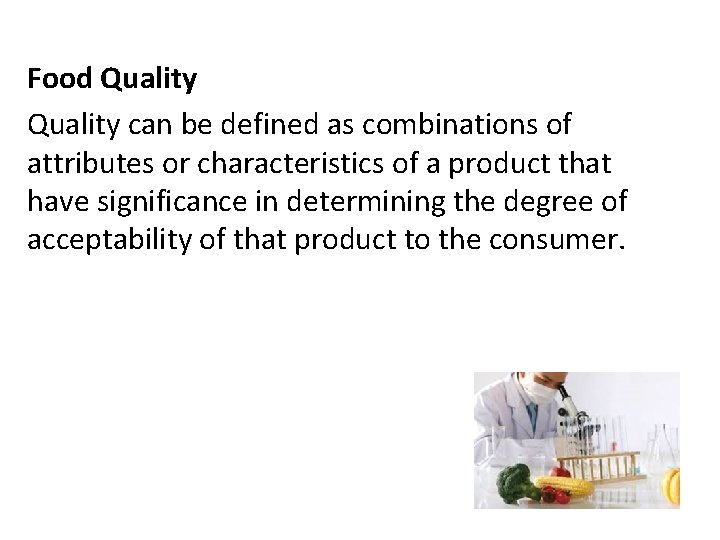
Food Quality can be defined as combinations of attributes or characteristics of a product that have significance in determining the degree of acceptability of that product to the consumer.
Food Quality It can also be said as measure of purity, strength, physicochemical & oregano-leptic characteristic of food products but the classical definition of quality is composite of these characters that differentiate between individual units of the products & have significance in determining the degree of acceptability of that unit by the user
Definition Quality is a measure of the degree of excellence or degree of acceptability by the consumer. It can be defined as “summary of features and characteristics of a product or service that bear on its ability to satisfy stated or implied needs”. In simple words the product should have attributes to “satisfy the wants/ needs of the consumer or conformance with the user’s requirements”. It also covers the safety and value for money. Food quality can be considered as
Every food product has characteristics and indices measurable by sensory, physical, chemical, or microbiological methods. Some characteristics are easily perceived; others are unseen. Understanding these quality characteristics and being familiar with the appropriate measuring tools are vital to quality control and the quality assurance of food products.
a complex characteristic of food that determines its value or acceptability to consumers. Thus it may be defined as “the composite of those characteristics which have significance in determining the degree of acceptability by the buyer. These characteristics should also have the ability to differentiate individual unit of the product. ”
Components The important components of food quality are: food safety, sensory characteristics and nutritional value. Safety of food is a basic requirement of food quality. “Food safety” implies absence or acceptable and safe levels of contaminants, a dulterants, naturally occurring toxins or any other substance that may make food injurious to health on an acute or chronic basis. Besides safety, quality attributes include: nutritional value; organoleptic properties such as appearance, colour, texture, taste; and functional properties.
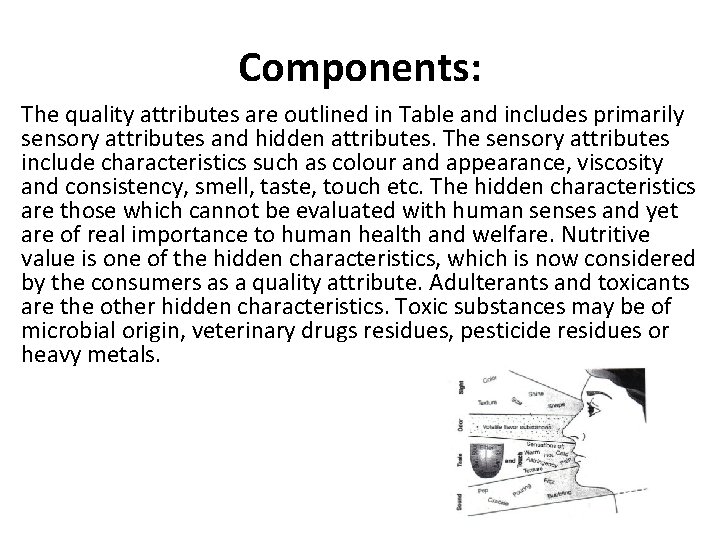
Components: The quality attributes are outlined in Table and includes primarily sensory attributes and hidden attributes. The sensory attributes include characteristics such as colour and appearance, viscosity and consistency, smell, taste, touch etc. The hidden characteristics are those which cannot be evaluated with human senses and yet are of real importance to human health and welfare. Nutritive value is one of the hidden characteristics, which is now considered by the consumers as a quality attribute. Adulterants and toxicants are the other hidden characteristics. Toxic substances may be of microbial origin, veterinary drugs residues, pesticide residues or heavy metals.
Food safety: In order to understand “food safety” we must first know the terms safe and hazard. “Safe” means that nothing harmful happens when we consume a food. A “hazard” is the capacity of a thing to cause harm. The objective of the food safety is to protect the food supply from microbial, chemical and physical hazards or contamination that may occur during all stages of production and handling-management of animals at farm, transportation, storage of raw milk, processing, production of value added products, distribution and storage of end products. It aims for keeping food wholesome and free from food borne illness. The important associated definitions and factors are described for better understanding of the food safety.
Food borne illness: Food borne illness or food poisoning is caused by consuming food contaminated with pathogenic bacteria, toxins, viruses or parasites. The contamination may or may not alter a food’s organoleptic properties but cause illness and disease to human beings after consumption and usually arises from improper handling, preparation or storage of food.
Food-borne diseases are classified as food infections or food intoxications. Food infections involve microorganisms present in the food at the time of consumption which then grow in the host and cause illness and disease. Food intoxications involve toxic substances produced in foods by microorganisms prior to consumption and cause disease upon ingestion. The toxin producing microorganisms need not to grow in the host to produce a disease or even be present in the food. So we must acknowledge that intoxication can occur even if no viable microorganisms are ingested.
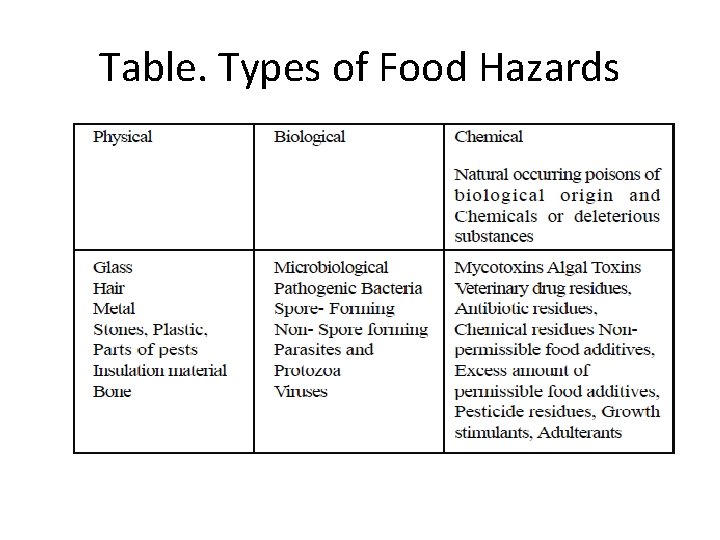
Food hazards: Food becomes hazardous by contamination. Contamination is the unintended presence of harmful substances or microorganisms in food. Food hazards can be defined as a biological, chemical or physical agent in a food, with the potential to cause an adverse health effect (Table). Physical hazards are foreign particles, like glass/wood or metal pieces, stone, bone fragments, feathers, fibre, hair, etc. Chemical hazards include substances such as cleaning solutions and sanitizers, non permitted adulterants, pesticide and heavy metal residues. Biological hazards come mainly from microorganisms
Quality , Ministry of Health is pursuing a broad and long-term science based strategy to improve the food safety and to better protect the public health. Part of this strategy is a farmto-table approach to improve the safety of food at each step in the food production, distribution, and marketing chain
Table. Types of Food Hazards
Safety concerns: We know that the goal of food safety is to reduce the size of risks to the lowest reasonable level without severe disruption of the food supply. For this we should first identify hazards related to foods or food components and then estimate the size of the risk that the hazard will cause. It is important to note that all foods have some degree of risk and that no food is absolutely “safe. ” The important consideration becomes “the size of the risk and how the size of the risk can be reduced” without eliminating the food source.
The Benefits of Quality Assurance and Quality Control • It gives you a high quality output. • It increases the efficiency of operations. • It brings customer satisfaction, which affects your brand helps you grow your business. • If your product is of good quality, you will not need much rework and there will not be much after-sale support required. This will help you save a lot of money. • A high level of confidence and a motivated team.
Quality Assurance (QA) systems The food industry has a number of Quality Assurance (QA) systems available like GMP (Good Manufacturing Practices), HACCP (Hazard Analysis. Critical Control Points), ISO (International Organisation for Standardisation) standards. These systems and their combinations are recommended for food quality and safety assurance. The agri-food production requires a specific approach to achieve the expected quality level. It is important to know to what extent the systems contribute to the total quality of the product and to balance the tools used for achieving the quality and safety objective
-A quality management system (QMS) system can be defined as: a set of coordinated activities to direct and control an organization in order to continually improve the effectiveness and efficiency of it performance. Food quality is a complex concept that can be assessed only in relation to food safety. To be considered safe for consumption, a food must meet: legislative requirements; technological criteria; hygiene requirements; transport and handling requirements; trading conditions and satisfy its intended use. .
The relation between quality and safety is intricate and although safety cannot be viewed as a totally independent aspect from quality, recognising the complexity of both concepts brought the need of managing them separately
In fact the reasoning behind separating food safety from quality was the need to place the concept of safety first and above all the other quality aspects. The result can be classified in quality assurance systems (QA) that includes the prerequisites (GMPs, GHPs, GAPs) and HACCP; quality management systems (QMS) that refers to ISO or TQM; and integrated systems (IS) such as ISO 22000.
Qulity Assurance systems The systems can be classified according to the extent of activities they cover, in: - basic safety systems: prerequisites (GAPs, GMPs, GLPs, etc. ); advanced safety systems such as HACCP; - integrated food safety management – ISO 22000; - basic quality management systems - ISO 9001; - advanced quality management systems - ISO 9004. A part of the quality assurance systems and prerequisite programs that are applied by the industry are presented bellow.
FE 425 Food Quality Assurance Assist. Prof. Dr. Çisem BULUT ALBAYRAK
Food safety concerns: is their breakout a product of problems in the food system? • E. coli 0157: H 7 • Salmonella • “Mad cow”, Bovine spongiform encephalopathy (BSE) • SARS (Sudden Acute Respiratory Syndrome)
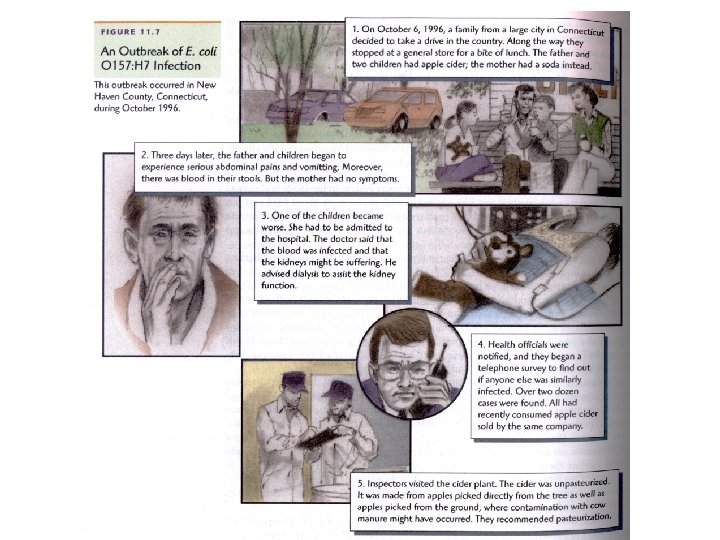
Escherichia coli • Hemolytic diarrhea caused by strain of E. coli O 157: H 7 in hamburger meat • 1993 - 500 Jack-in-the-Box patrons • 1998 - 25 million pounds Hudson Co. hamburger recalled • Animals can have it without causing symptoms, problem when butchering, entering from fecal material
Microbes in manure that might affect organic produce • Killed at 60°C in compost • No evidence that there is any E coli poisoning resulting from organically manured land (Soil Asso 2001) • “No evidence at present to support the assertion with organically grown produce is any more or less safe than conventionally grown” recently tested and confirmed in UK with 3200 samples
Salmonella • Genus Salmonella includes 2400 pathogenic species causes diseases in chickens and turkeys and then consumers via poultry and eggs • 50 billion eggs sold/year and 20 million infected with Salmonella • New--pasteurization of eggs 1 hr at 56°C (or 134° F)
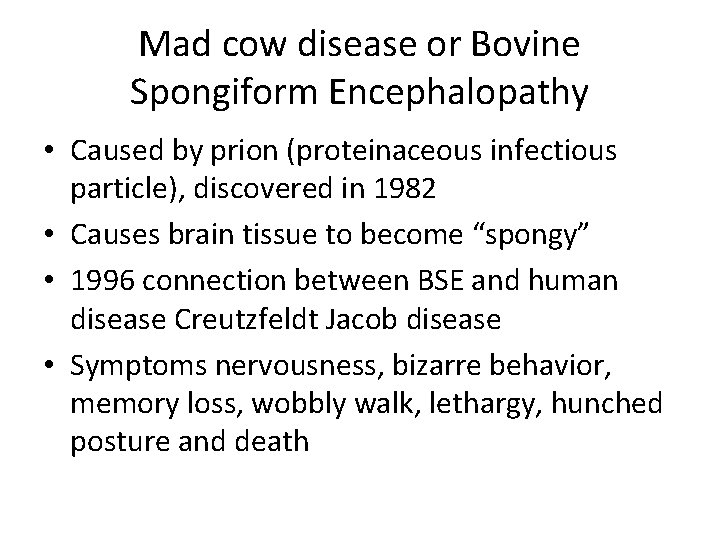
Mad cow disease or Bovine Spongiform Encephalopathy • Caused by prion (proteinaceous infectious particle), discovered in 1982 • Causes brain tissue to become “spongy” • 1996 connection between BSE and human disease Creutzfeldt Jacob disease • Symptoms nervousness, bizarre behavior, memory loss, wobbly walk, lethargy, hunched posture and death
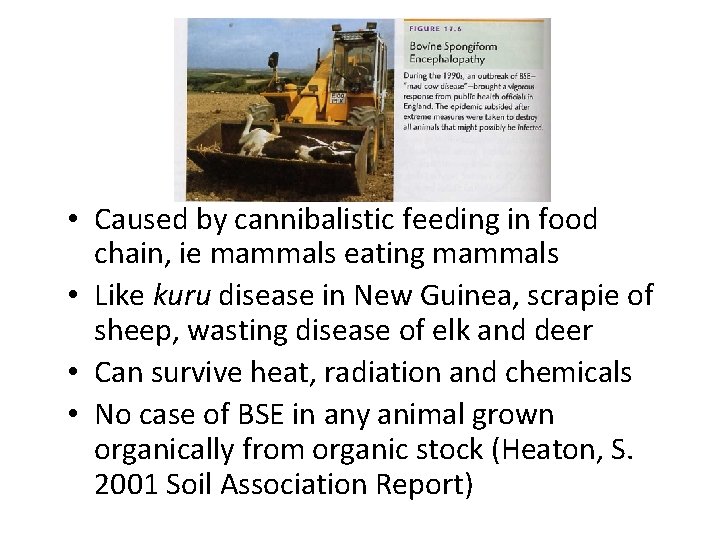
• Caused by cannibalistic feeding in food chain, ie mammals eating mammals • Like kuru disease in New Guinea, scrapie of sheep, wasting disease of elk and deer • Can survive heat, radiation and chemicals • No case of BSE in any animal grown organically from organic stock (Heaton, S. 2001 Soil Association Report)
E. coli
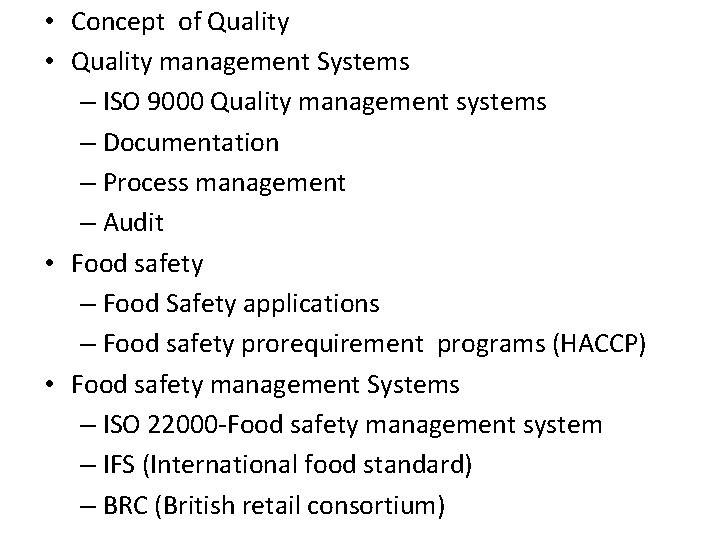
• Concept of Quality • Quality management Systems – ISO 9000 Quality management systems – Documentation – Process management – Audit • Food safety – Food Safety applications – Food safety prorequirement programs (HACCP) • Food safety management Systems – ISO 22000 -Food safety management system – IFS (International food standard) – BRC (British retail consortium)
• • Quality Assurance Total Quality Management GMP/GHP, GLP, GAP Sanitary and Hygienic Practices
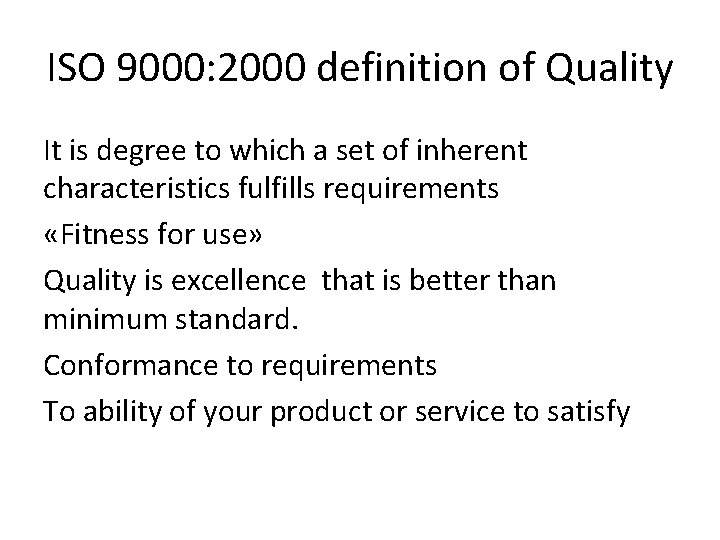
ISO 9000: 2000 definition of Quality It is degree to which a set of inherent characteristics fulfills requirements «Fitness for use» Quality is excellence that is better than minimum standard. Conformance to requirements To ability of your product or service to satisfy
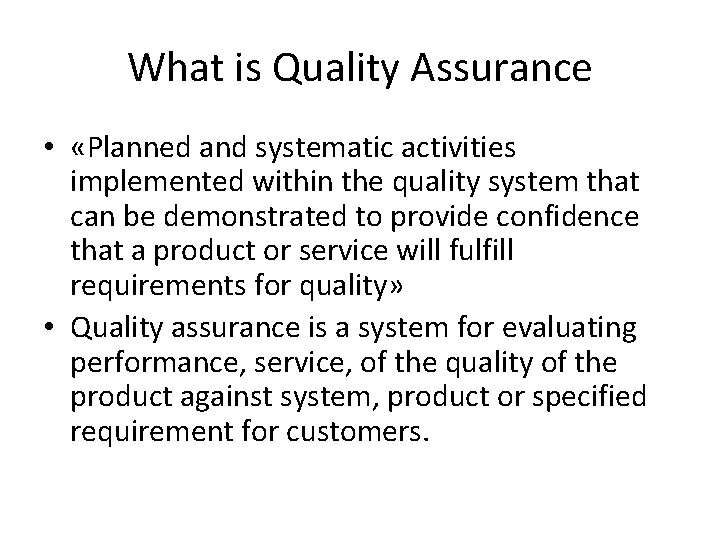
What is Quality Assurance • «Planned and systematic activities implemented within the quality system that can be demonstrated to provide confidence that a product or service will fulfill requirements for quality» • Quality assurance is a system for evaluating performance, service, of the quality of the product against system, product or specified requirement for customers.
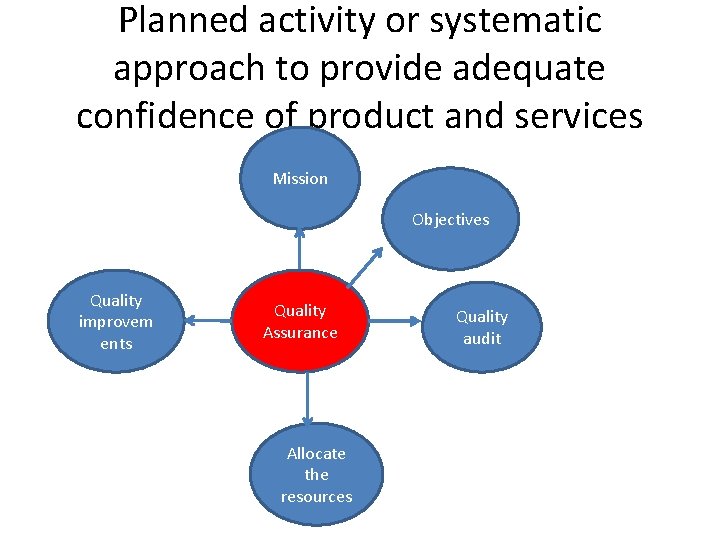
Planned activity or systematic approach to provide adequate confidence of product and services Mission Objectives Quality improvem ents Quality Assurance Allocate the resources Quality audit
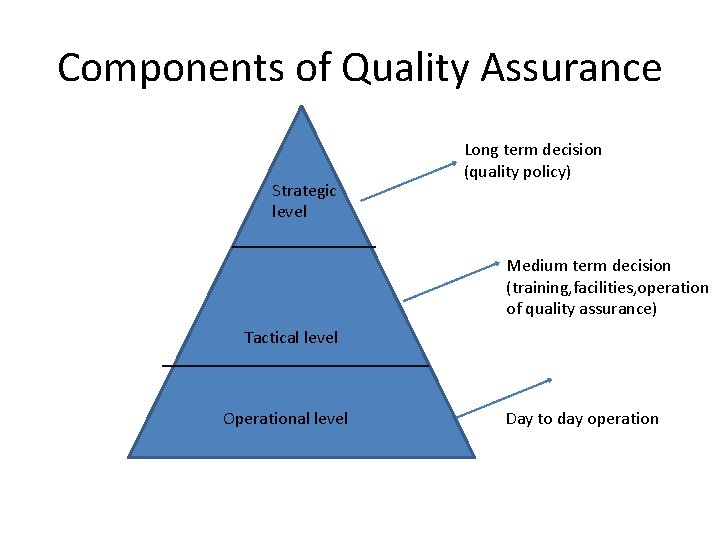
Components of Quality Assurance Strategic level Long term decision (quality policy) Medium term decision (training, facilities, operation of quality assurance) Tactical level Operational level Day to day operation
Quality Assurance • QA is a way of preventing mistakes and defects in manufactured products and avoiding problems when delivering solutions or services to customers • ISO 9000 defined «A part of quality management focused on providing confidence that quality requirements will be fulfilled»
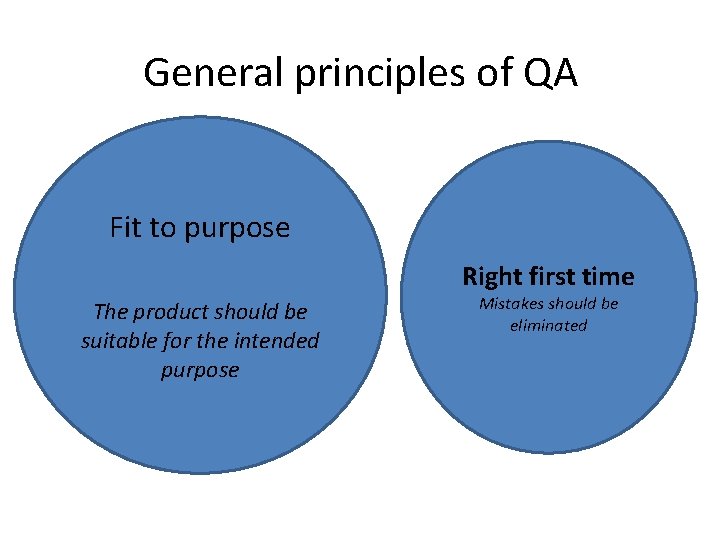
General principles of QA Fit to purpose Right first time The product should be suitable for the intended purpose Mistakes should be eliminated
Functions of Quality Assurance • To maintain standards and specification for all raw material and finished product. • To give service to company in all areas related to product quality includes troubleshooting, visiting, production, facilities, designing ands training quality control panel • To produce information that is accurate, reliable and adequate for the intended purpose. • Evaluating performance, service, of the quality of a product against a system, standard or specified requirement for customers
Activities in Quality Assurance • • • Planning Data collection Quality Control Documentation Evaluation Reporting activities
Objective of Quality Assurance • Managing good manufacturing practices(GMP) including • Managing Good Laboratory Practices(GLP) • Managing a safety programme • Assuring quality of raw materials • Assuring quality and traceability of finished product • Evaluating plant environment • Developing HACCP plan
Total Quality Management • TOTAL-Made up of the whole • QUALİTY-Degree of excellence a product or service provides • MANAGEMENT-Act, manner of handling (or)Art.
What Does Total Quality Mean? A philosophy that involves everyone in an organization in continual effort to improve quality and achieve customer satisfaction
What’s the goal of TQM «Do the right things right the first time, every time»
• Total Quality Management (or TQM) is a supervision concepts coined by W Edwards Deming • «Total quality management is an approach that seeks to improve quality and performance which will meet or exceed customer expectations»
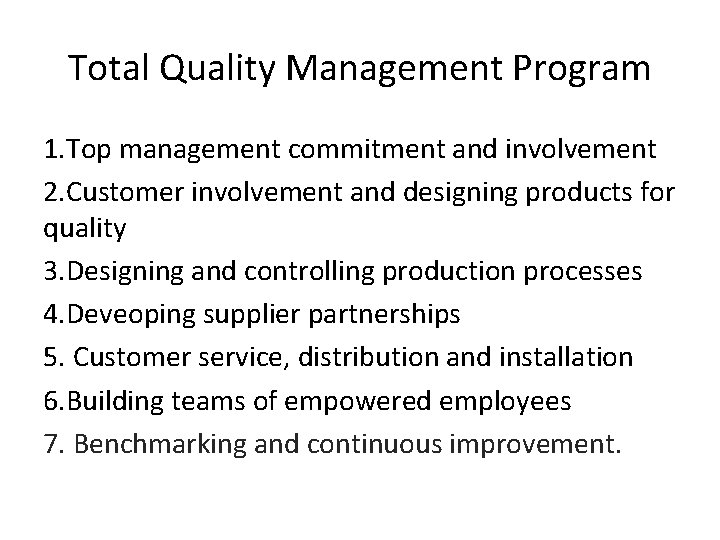
Total Quality Management Program 1. Top management commitment and involvement 2. Customer involvement and designing products for quality 3. Designing and controlling production processes 4. Deveoping supplier partnerships 5. Customer service, distribution and installation 6. Building teams of empowered employees 7. Benchmarking and continuous improvement.
TQM in Food Industry Systems for development of Quality assurance GMP-Good Manufacturing Practices HACCP-Hazard analysis and critical control points ISO-International organization for standards BRC-(British Retail Consortium)
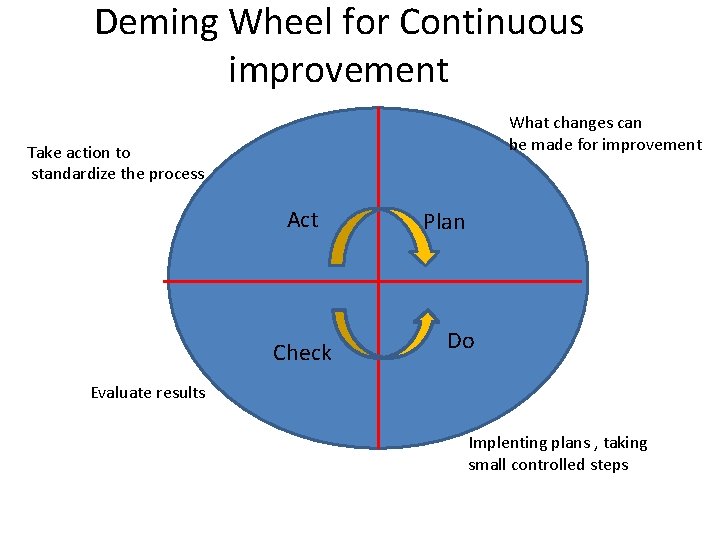
Deming Wheel for Continuous improvement What changes can be made for improvement Take action to standardize the process Act Check Plan Do Evaluate results Implenting plans , taking small controlled steps
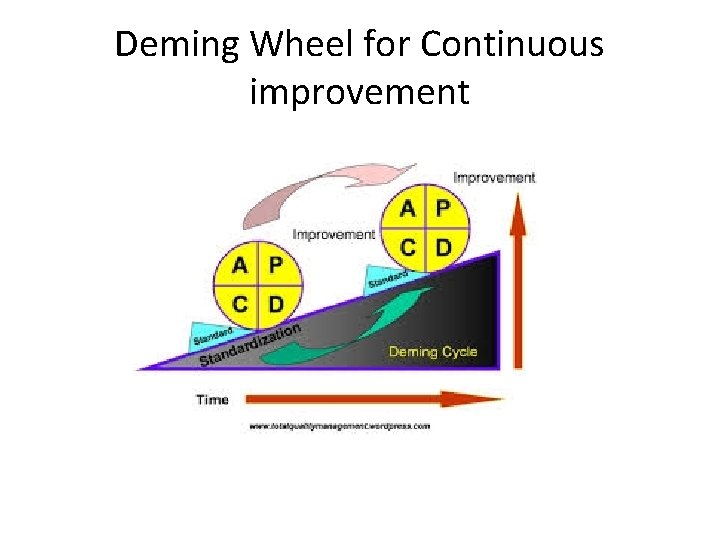
Deming Wheel for Continuous improvement
TQM is the integration of all functions and processes within an organization in order to achieve continuous improvement of the qulity of goods and services. The goal is customer satisfaction
Objective of TQM 1. Process improvement 2. Defect prevention 3. Measurement system capacity 4. Devepoing improving check list 5. Helping teams make better decisions 6. Developing operational definitions 7. Observing behavior changes over a period of time
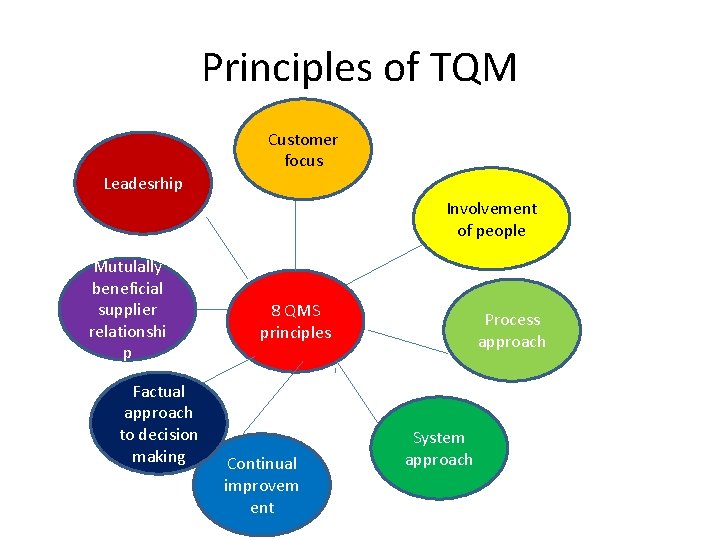
Principles of TQM Customer focus Leadesrhip Involvement of people Mutulally beneficial supplier relationshi p Factual approach to decision making 8 QMS principles Continual improvem ent Process approach System approach
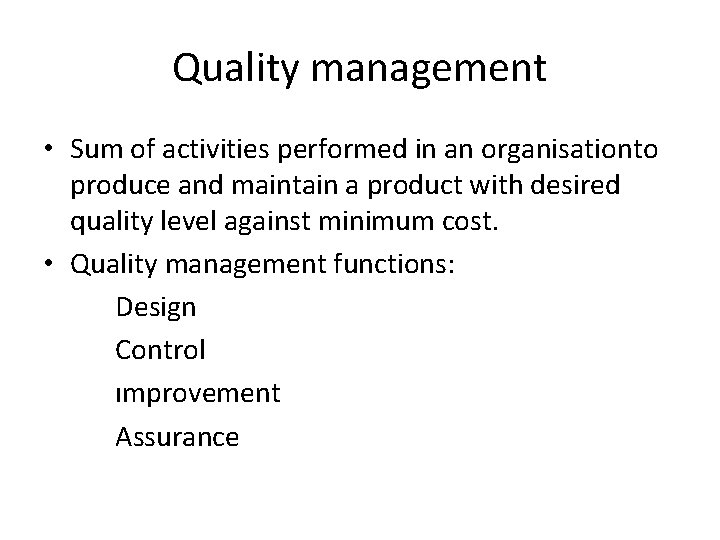
Quality management • Sum of activities performed in an organisationto produce and maintain a product with desired quality level against minimum cost. • Quality management functions: Design Control ımprovement Assurance
Good Manufacturing Practices «Good manufacturing practice is that part of quality assurance which ensures that products are consistently produced and controlled to the quality standards appropriate to their intended use and as required by the marketing authorization or product specification»
Definition Good Manufacturing practice guidelines provide guidance for manufacturing, testing and quality assurance in order to ensure that a food product is safe for human consumption.
General guidelines for GMP • • Plant maintenance Storage Work surfaces Supervision Walls Training Doors Plant construction and design • Air quality and ventilation • Water • Windows • Lighting • Cleaning and sanitation • Personal Hygiene • Ceiling • Staff hygiene • Foods
Good Agricultural Practices • «GAP are set of practices that address to environments, eco and social sustainability for all farm processes for safety and quality produces» • GAP are a collection of principle to apply for on farm production and post production processes resulting in safe and heathy food agricultural products, while taking into account economical, social and environmental sustainability»
Objectives of GAP 1. To ensure safety and quality of produce in food chain 2. To capture new market advantage 3. To improve use of natural resources 4. To improve workers health and working conditions 5. To create new market oppotunites to farmers and to exporters 6. To export trade of agricultural produce.
FE 425 Food Quality Assurance Lecture-3 (HACCP sysytem)
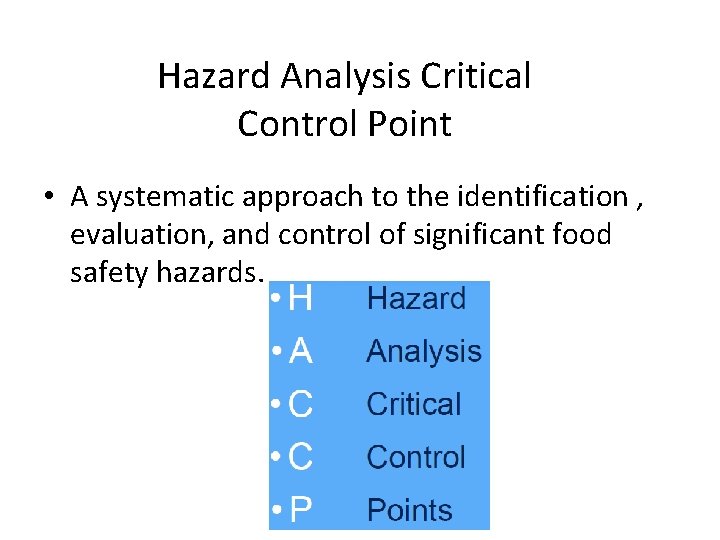
Hazard Analysis Critical Control Point • A systematic approach to the identification , evaluation, and control of significant food safety hazards.
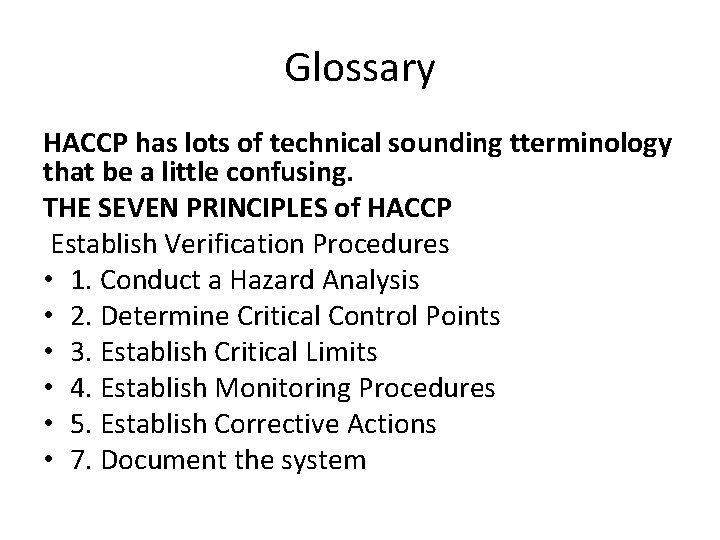
Glossary HACCP has lots of technical sounding tterminology that be a little confusing. THE SEVEN PRINCIPLES of HACCP Establish Verification Procedures • 1. Conduct a Hazard Analysis • 2. Determine Critical Control Points • 3. Establish Critical Limits • 4. Establish Monitoring Procedures • 5. Establish Corrective Actions • 7. Document the system
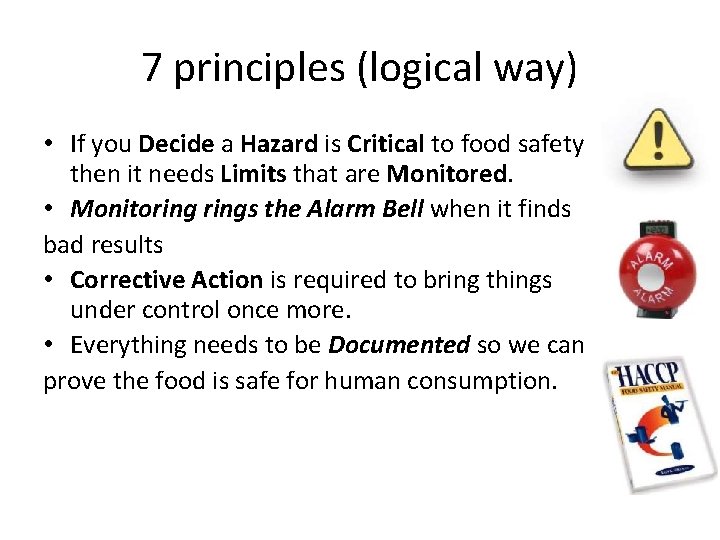
7 principles (logical way) • If you Decide a Hazard is Critical to food safety then it needs Limits that are Monitored. • Monitorings the Alarm Bell when it finds bad results • Corrective Action is required to bring things under control once more. • Everything needs to be Documented so we can prove the food is safe for human consumption.
HACCP Team The HACCP Team is the group of people who are responsible for Documenting and Managing the HACCP system. They do the following tasks: • Draw up the HACCP plans • Train Staff in the use of the system • Carry out tasks to check the HACCP plan is effective, accurate and is being followed by staff The HACCP Team is usually a group of people with varied knowledge, skill and experience so that a better all roundview of the hazards and their control is possible.
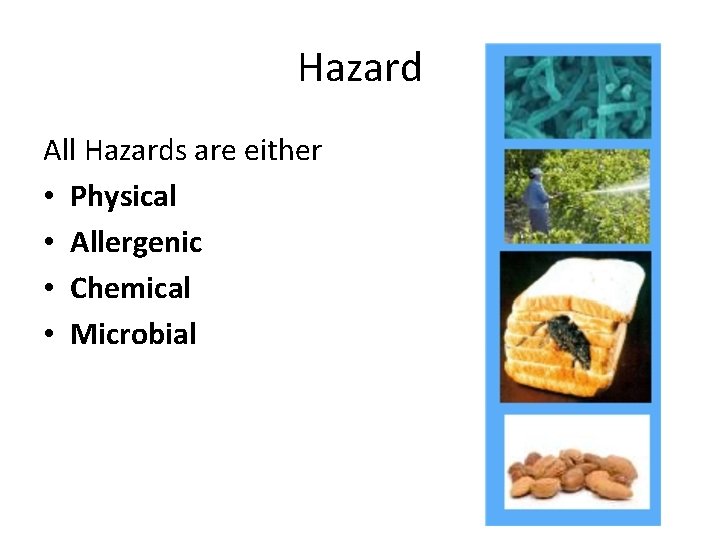
Hazard All Hazards are either • Physical • Allergenic • Chemical • Microbial
Hazard Anaysis This is when we. . . • Make a LIST of the things that could go wrong • Assess the RISK of each Hazard • WRITE DOWN the Hazards that require CONTROL together with the means of CONTROL
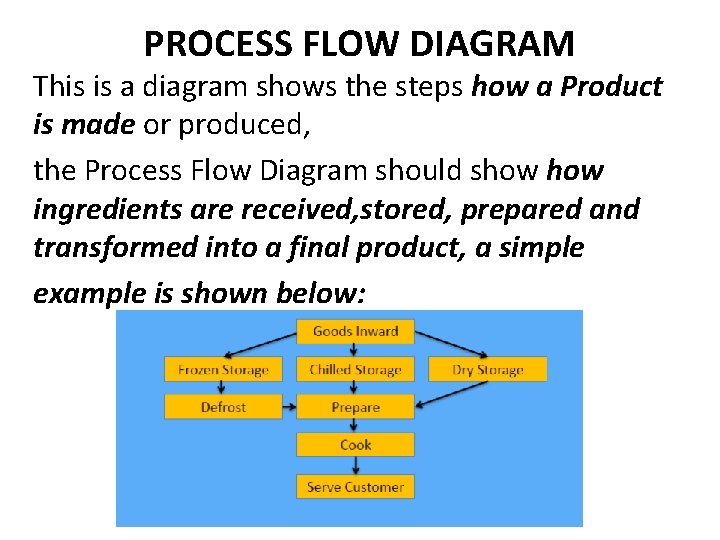
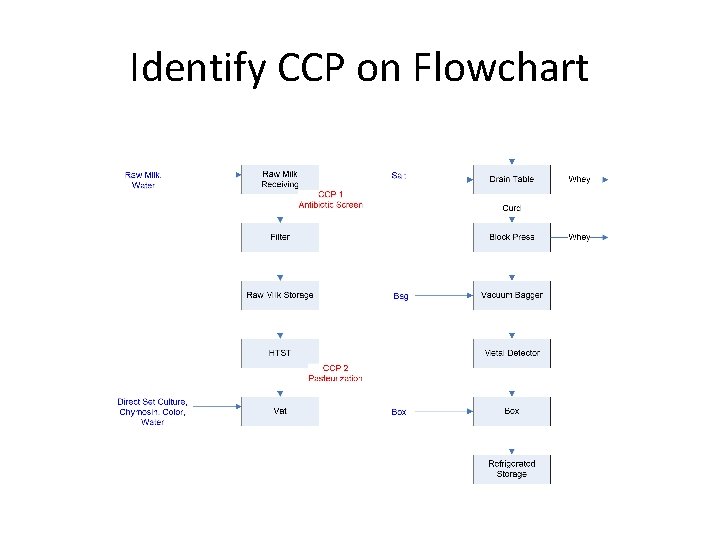
PROCESS FLOW DIAGRAM This is a diagram shows the steps how a Product is made or produced, the Process Flow Diagram should show ingredients are received, stored, prepared and transformed into a final product, a simple example is shown below:
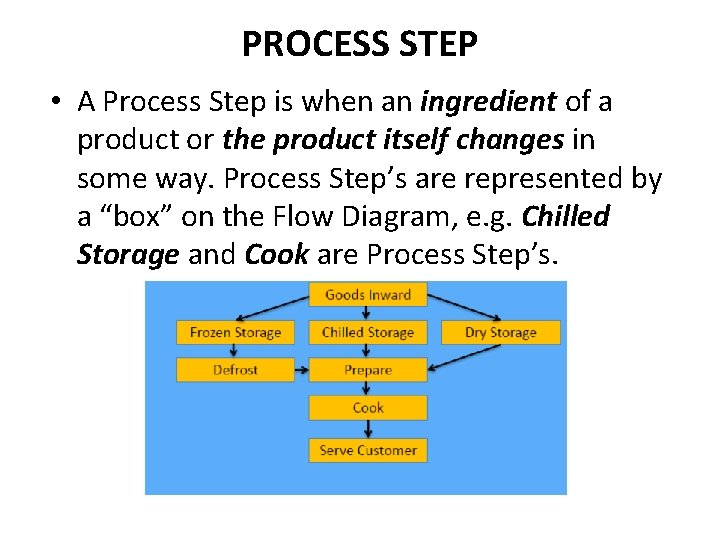
PROCESS STEP • A Process Step is when an ingredient of a product or the product itself changes in some way. Process Step’s are represented by a “box” on the Flow Diagram, e. g. Chilled Storage and Cook are Process Step’s.
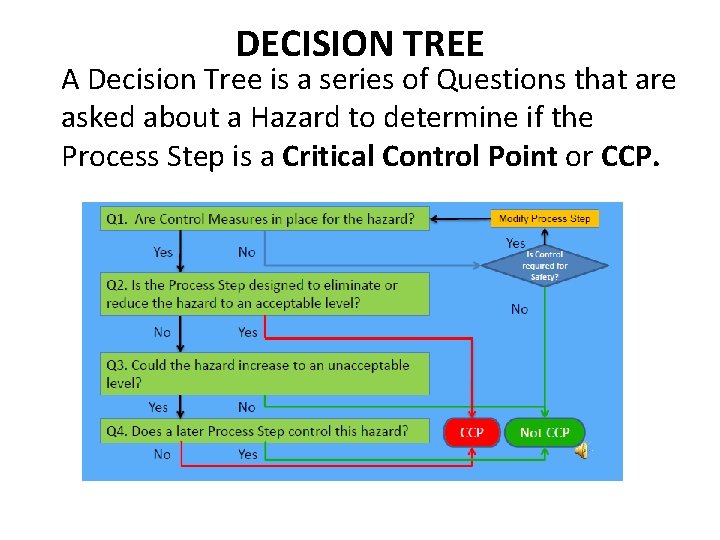
DECISION TREE A Decision Tree is a series of Questions that are asked about a Hazard to determine if the Process Step is a Critical Control Point or CCP.
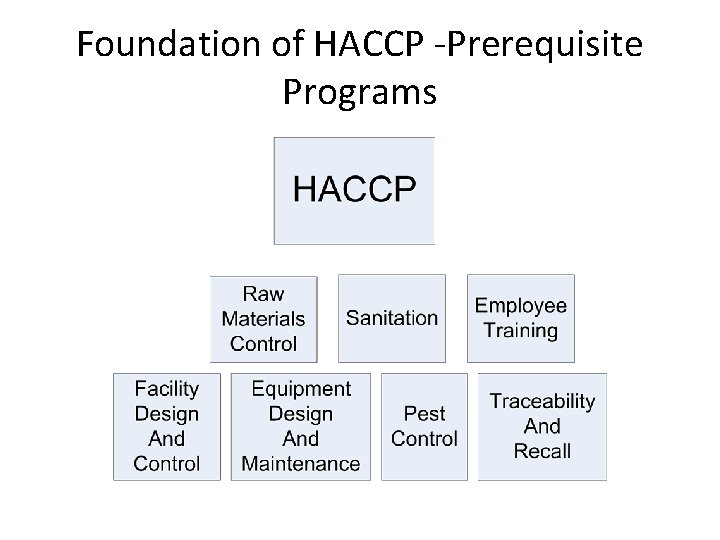
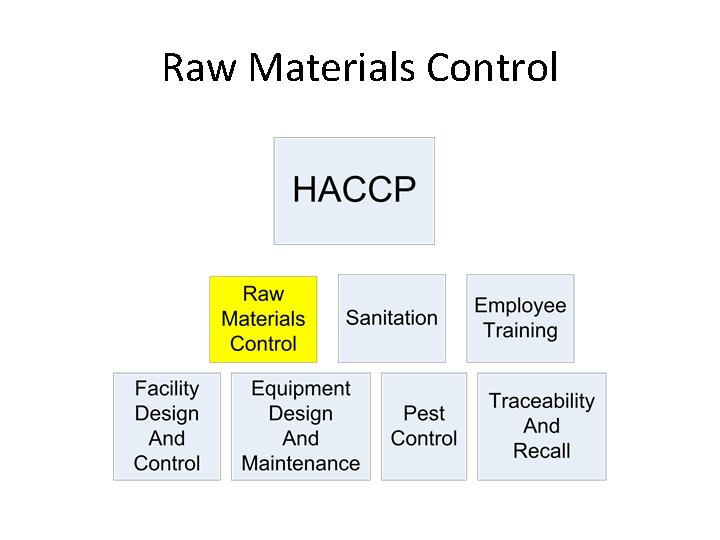
Foundation of HACCP -Prerequisite Programs
CONTROL MEASURE A Control Measure is a method of ELIMINATING or REDUCING a Hazard to a safe or ACCEPTABLE level. . for example
CRITICAL CONTROL POINTS After Hazard Analysis we need to decide which Hazards are CRITICAL to FOOD SAFETY. These are called Critical Control Points or CCP’s A Process Step is said to be a CCP When: 1. The Process Step is designed to CONTROL the Hazard, e. g. Cooking, Chilled Storage or Metal Detection 2. A LATER Process Step will NOT Eliminate or Reduce the Hazard to an acceptable level. e. g. Once food is Cooked that’s the LAST chance to destroy harmful bacteria.
CRITICAL LIMIT When we have identified a Critical Control Point using the Decision Tree we need to set Critical Limits. These are values at which theazard is known to be reduced to a safe or acceptable level. Some examples are given below; • Temperature of food in fridge 1 -5 o. C • Cooking temperature 75 o. C for a minimum of 2 minutes
MONITORING PROCEDURE A Monitoring Procedure is a planned and documented method forchecking that the all CCP’s are within their Critical Limit’s. • Check and record temperature of food in fridge every 4 hrs. • Check and record cooking temperature each batch made. Monitoring Procedure’s result in records that prove food is safe for human consumption.
CORRECTIVE ACTION A Corrective Action is a pre-planned and documented method for regaining“Control” when Monitoring detects values outside their Critical Limit’s. Check and record temperature of food in fridge every 4 hrs. Examples; Corrective Action: Remove food to alternative fridge, discard suspect food, repair fridge. All Corrective Actions should be logged in the HACCP Manual and procedures reviewed as a result of the intervention.
VALIDATION Validation is a way of checking the EFFECTIVENESS of the HACCP Plan, i. e. Is the HACCP Plan VALID? Check samples of food after Cooking to ensure there are no harmful bacteria in the food. Proof of Validation should be from a combination of external and internal sources and it should be logged in the HACCP Manual. Examples: EFFECTIVENESS: Having an absence of dangerous bacteria proves that the Control Measure “Cooking” is effective.
VERIFICATION Verification is a way of checking that the HACCP plan is being used and followed as intended. Example: • Review the Process Flow and Hazard Analysis to ensure that it remains accurate. • Checks: “Walk through” the Process Flow and ensureit is correct and look for any new hazards Verification is a way of making sure the HACCP plan is correct and that staff are using it correctly.
SUMMARY • HACCP stands for Hazard Analysis Critical Control Points • A HACCP Team normally produces and manages the HACCP system • The SEVEN Principles of HACCP mean that we need to IDENTIFY and MONITOR CRITICAL HAZARDS in order to PROVE we are making SAFE FOOD • HACCP is based on SEVEN Principles • Critical Control Points require Monitoring to ensure the food is SAFE • A HACCP Plan needs to be regularly VALIDATED for EFFECTIVENESS • A HACCP System needs to be VERIFIED to ensure it remains UP TO DATE
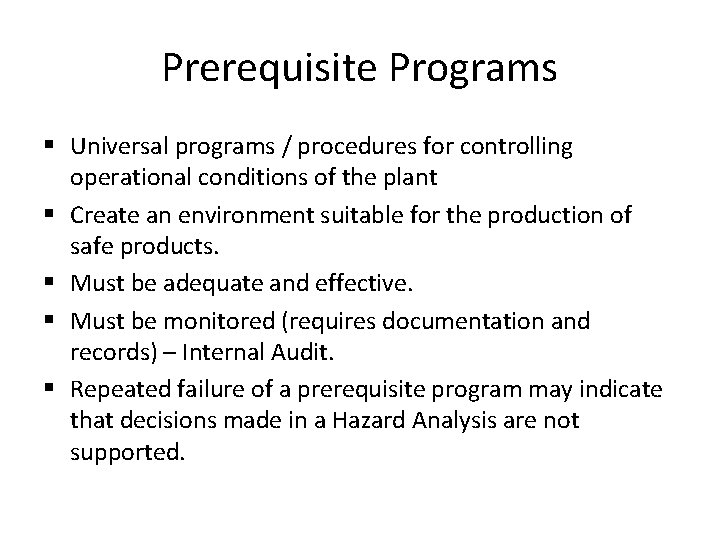
Prerequisite Programs § Universal programs / procedures for controlling operational conditions of the plant § Create an environment suitable for the production of safe products. § Must be adequate and effective. § Must be monitored (requires documentation and records) – Internal Audit. § Repeated failure of a prerequisite program may indicate that decisions made in a Hazard Analysis are not supported.
Raw Materials Control
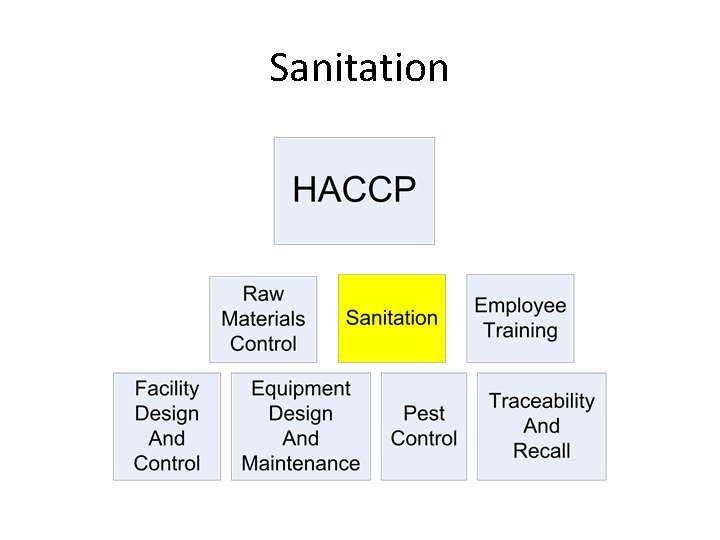
Sanitation
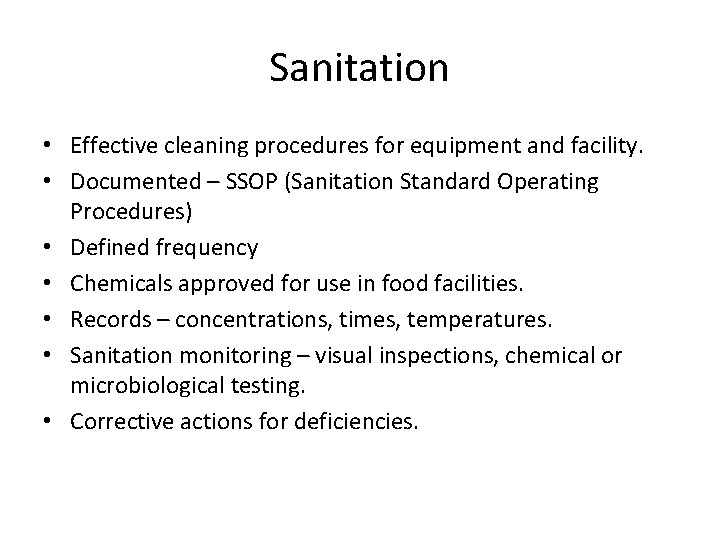
Sanitation • Effective cleaning procedures for equipment and facility. • Documented – SSOP (Sanitation Standard Operating Procedures) • Defined frequency • Chemicals approved for use in food facilities. • Records – concentrations, times, temperatures. • Sanitation monitoring – visual inspections, chemical or microbiological testing. • Corrective actions for deficiencies.
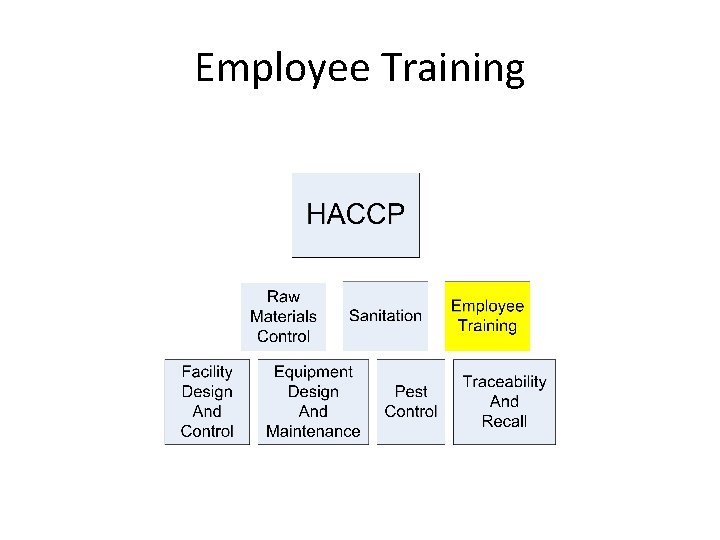
Employee Training
Employee Training • Records of training required. • Hygienic Practices – Disease Control – Cleanliness – outer garments, hand-washing, unsecured jewelry and other objects, use of gloves, hair and beard nets, eating, drinking, tobacco use, nail polish, etc. • Manufacturing Controls – Traffic flow to prevent cross contamination – Ingredient / product handling to protect product – Control measures (p. H, cook time / temp, moisture, etc) – Scheduling sequential runs to prevent cross contamination (as for allergens) • Food Defense
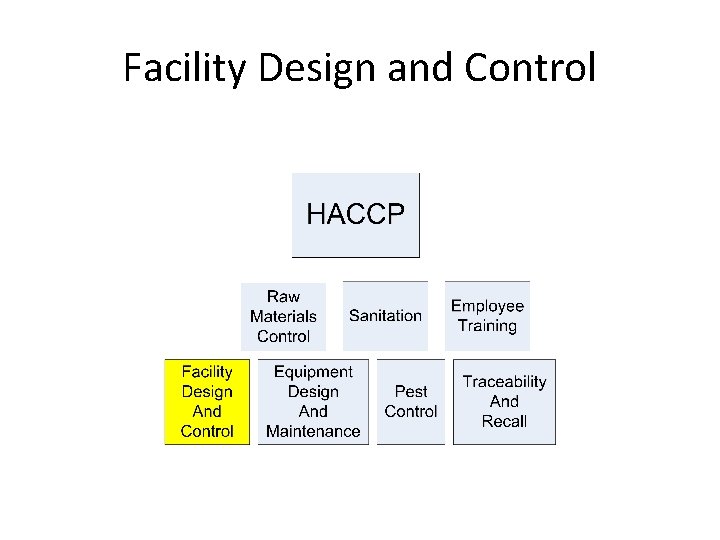
Facility Design and Control
Facility Design and Control • Grounds – Eliminate pest harborage areas – Properly grade roads, yards, parking lots • Building – Provide sufficient space for placement of equipment and storage of materials – Prevent cross contamination
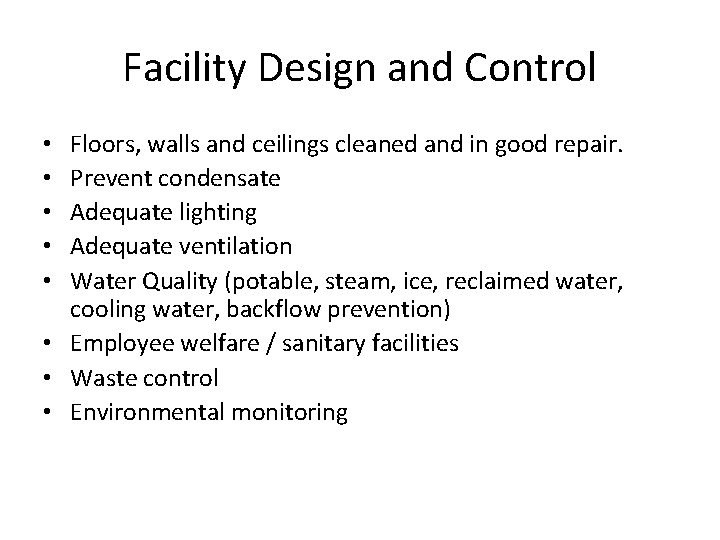
Facility Design and Control Floors, walls and ceilings cleaned and in good repair. Prevent condensate Adequate lighting Adequate ventilation Water Quality (potable, steam, ice, reclaimed water, cooling water, backflow prevention) • Employee welfare / sanitary facilities • Waste control • Environmental monitoring • • •
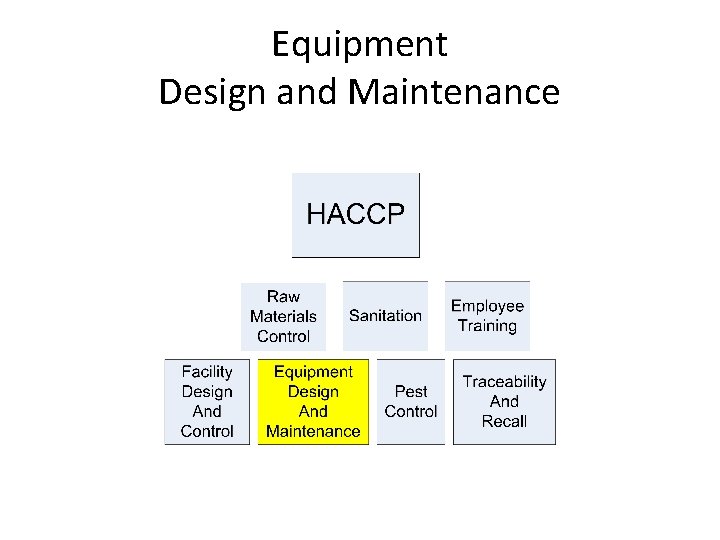
Equipment Design and Maintenance
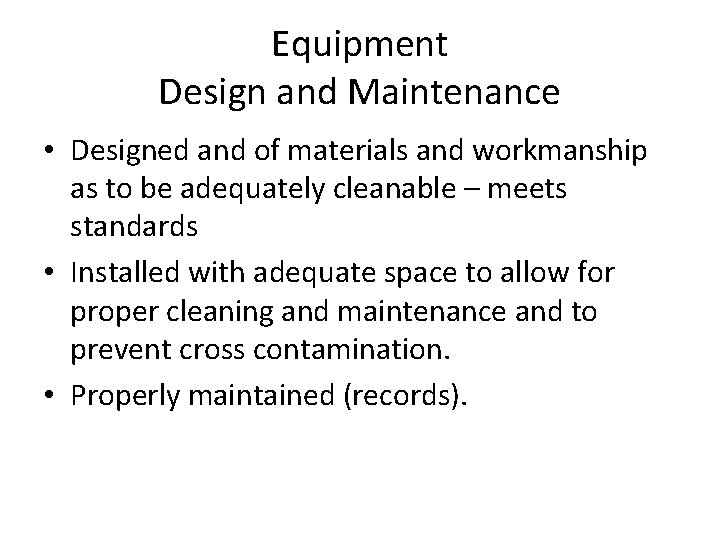
Equipment Design and Maintenance • Designed and of materials and workmanship as to be adequately cleanable – meets standards • Installed with adequate space to allow for proper cleaning and maintenance and to prevent cross contamination. • Properly maintained (records).
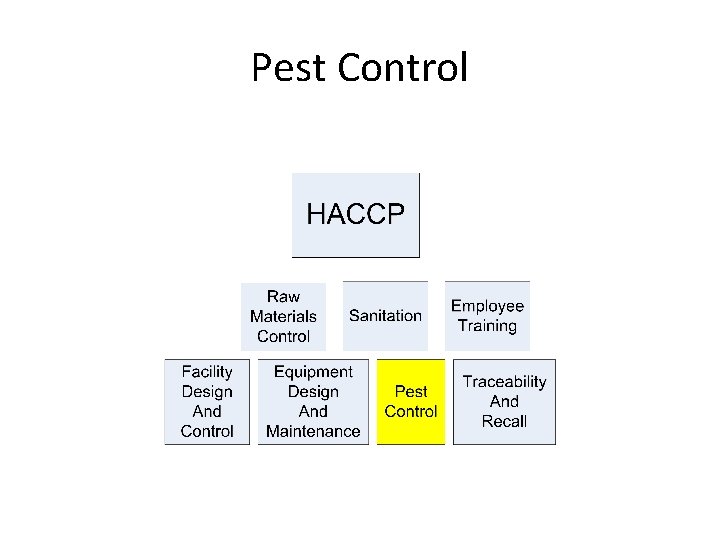
Pest Control
Pest Control • Prevention is key (design, maintenance and sanitation) • Rodent control • Insect control • Bird / Bat Control
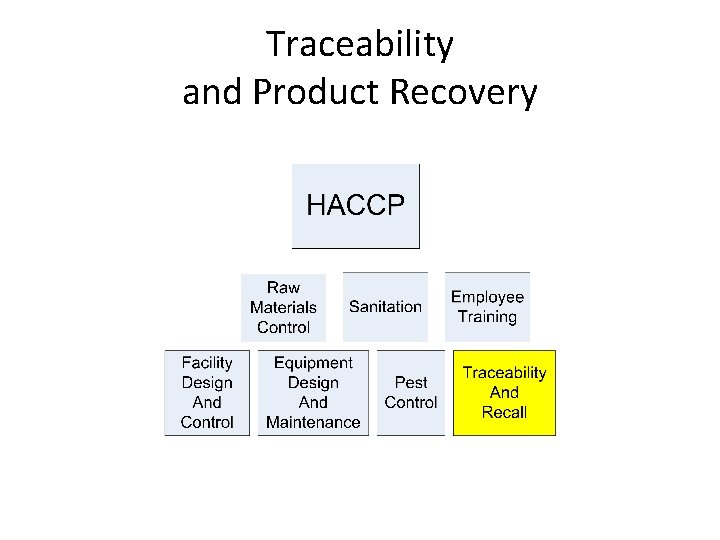
Traceability and Product Recovery
Traceability and Product Recovery • Documented program with written procedures to meet federal requirements. • Program should include – Product Identification / Lot coding – Finished product distribution records retained beyond shelf life of product – Responsible individuals and their roles – Identification of Key Contacts – Internal, supplier customer – Mock Recovery Program – One step forward, one step back
Steps to HACCP Implementation • Assemble the HACCP Team • Describe the food and its distribution • Describe the intended use and consumers of the food • Develop a flow diagram which describes the process • Verify the Flow Diagram
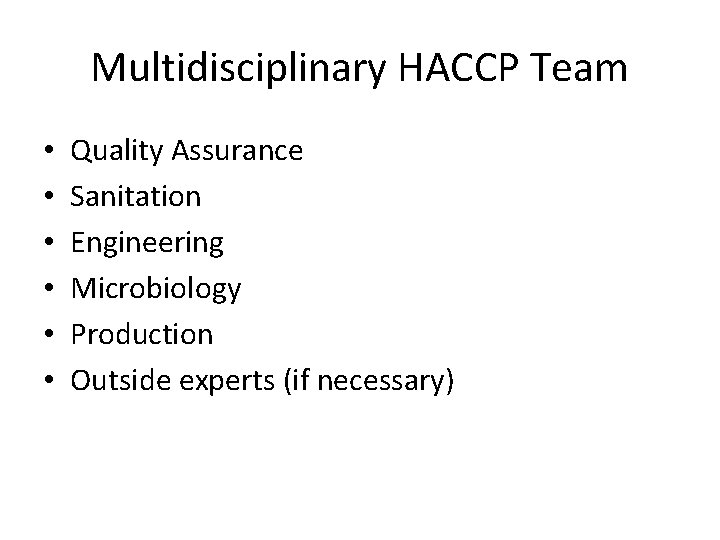
Multidisciplinary HACCP Team • • • Quality Assurance Sanitation Engineering Microbiology Production Outside experts (if necessary)
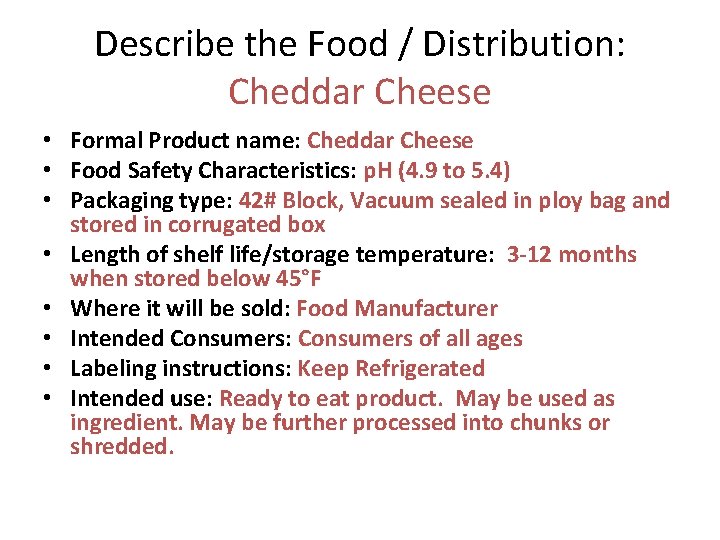
Describe the Food / Distribution: Cheddar Cheese • Formal Product name: Cheddar Cheese • Food Safety Characteristics: p. H (4. 9 to 5. 4) • Packaging type: 42# Block, Vacuum sealed in ploy bag and stored in corrugated box • Length of shelf life/storage temperature: 3 -12 months when stored below 45°F • Where it will be sold: Food Manufacturer • Intended Consumers: Consumers of all ages • Labeling instructions: Keep Refrigerated • Intended use: Ready to eat product. May be used as ingredient. May be further processed into chunks or shredded.
Develop a Flow Diagram
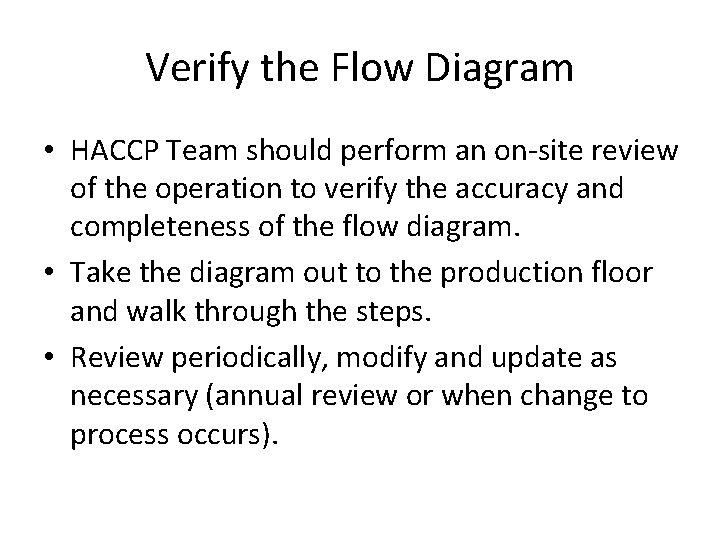
Verify the Flow Diagram • HACCP Team should perform an on-site review of the operation to verify the accuracy and completeness of the flow diagram. • Take the diagram out to the production floor and walk through the steps. • Review periodically, modify and update as necessary (annual review or when change to process occurs).
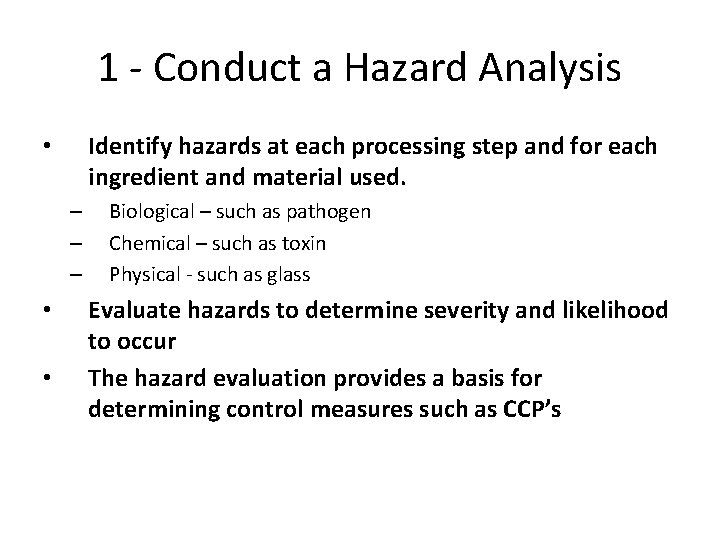
1 - Conduct a Hazard Analysis Identify hazards at each processing step and for each ingredient and material used. • – – – • • Biological – such as pathogen Chemical – such as toxin Physical - such as glass Evaluate hazards to determine severity and likelihood to occur The hazard evaluation provides a basis for determining control measures such as CCP’s
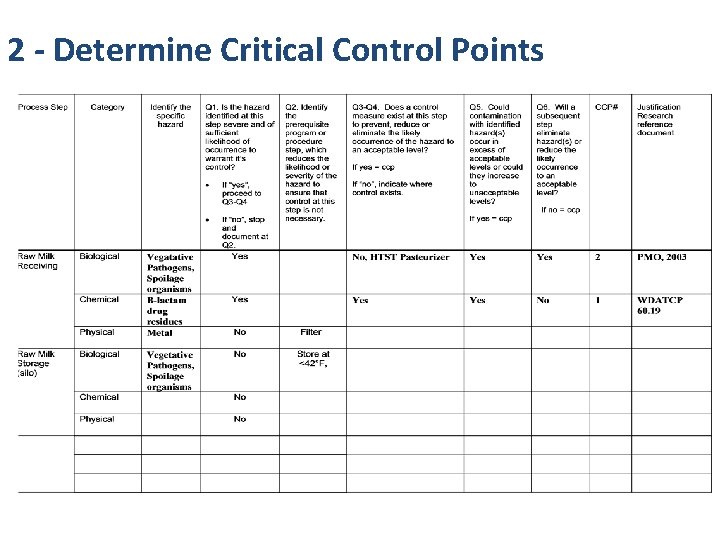
2 - Determine Critical Control Points • A critical control point (CCP) is defined as a step at which control can be applied and is essential to prevent or eliminate a food safety hazard or reduce it to an acceptable level. • Information from the hazard analysis should enable the HACCP team to identify which steps in the process are CCPs.
3 – Establish Critical Limits • A critical limit must be scientifically based and is a maximum and / or minimum value to which a biological, chemical or physical parameter must be controlled at a CCP to prevent, eliminate or reduce the food safety hazard to an acceptable level. • Examples: Temperature, time, Water Activity, p. H, safe tolerance level for drug residues
4 – Establish Monitoring Procedures • Monitoring is a planned sequence of observations or measurements used to assess whether a CCP is under control. • Monitoring should produce an accurate record for use in verification. • Where there is loss of control (a CCP limit is exceeded) there must be documented corrective action.
Monitoring • Continuous is desirable (recording chart) but where not possible, frequency for monitoring must be established. • Responsibility for monitoring must be assigned - Position title / work station
5 - Establish Corrective Actions • Corrective actions are procedures to be followed when a deviation occurs. • Corrective actions must be specific. – Halt production of product – Isolate the affected product – Return the process to control – Determine the disposition of the product • Records must be kept for a reasonable period after the shelf life of the product
6 _ Establish Verification Procedures • Establish procedures to verify that the system is working properly. • Might include calibration and testing of monitoring equipment, demonstration of system performance, documented record review
7 - Records • Identify records that are being used to monitor control points – Records of training – Records at process step (recording charts, temperature records, etc) – Deviation logs – Verification and Validation Records – Records to show changes to the HACCP Plan
Consider our example
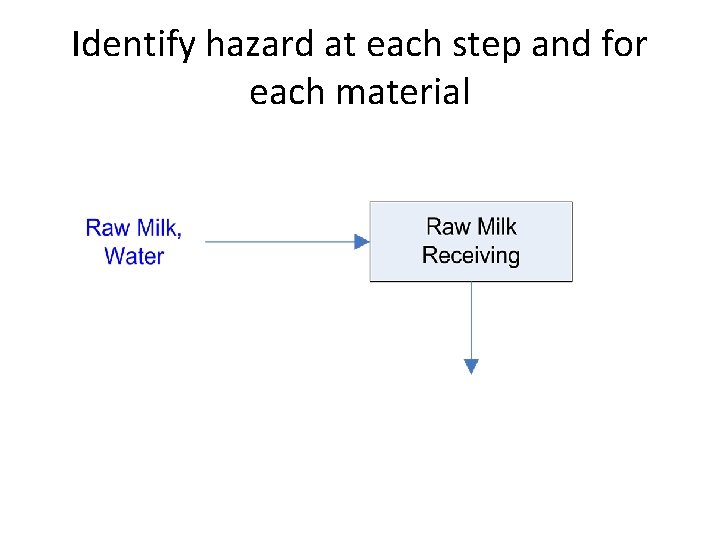
Identify hazard at each step and for each material
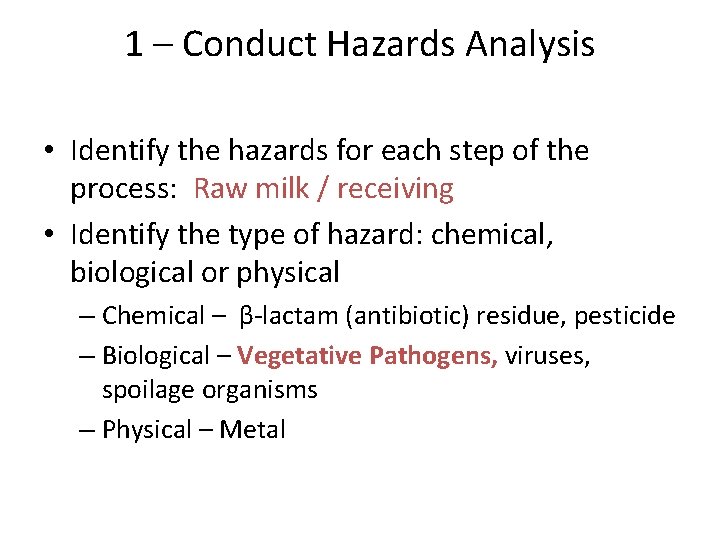
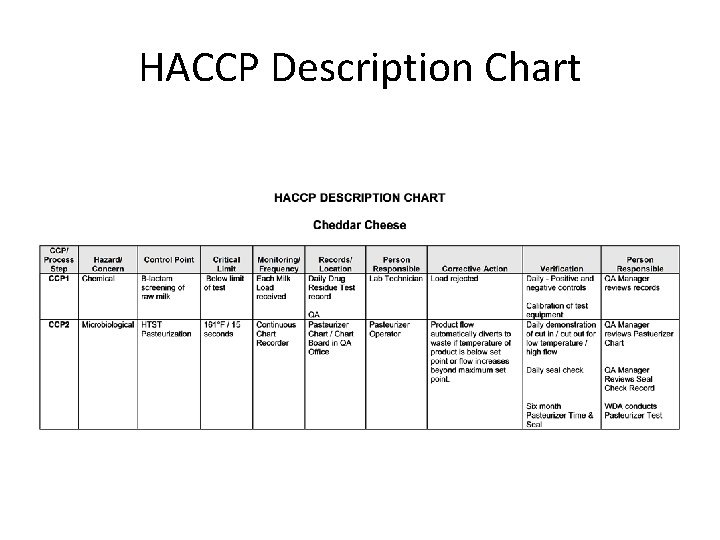
1 – Conduct Hazards Analysis • Identify the hazards for each step of the process: Raw milk / receiving • Identify the type of hazard: chemical, biological or physical – Chemical – β-lactam (antibiotic) residue, pesticide – Biological – Vegetative Pathogens, viruses, spoilage organisms – Physical – Metal
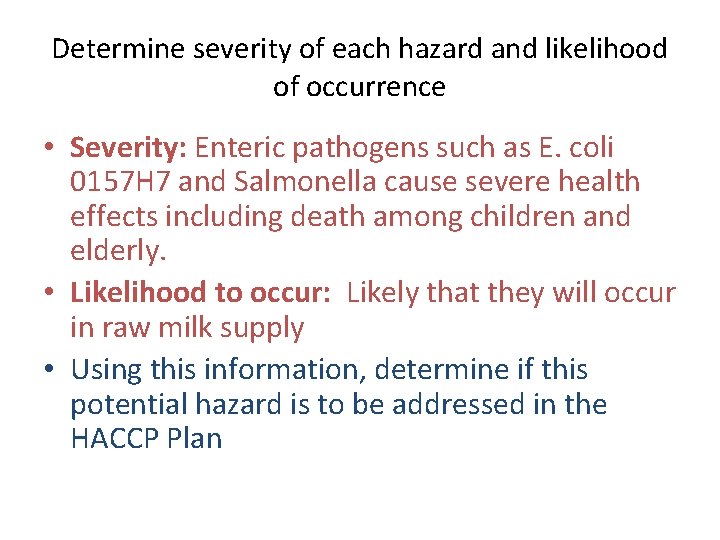
Determine severity of each hazard and likelihood of occurrence • Severity: Enteric pathogens such as E. coli 0157 H 7 and Salmonella cause severe health effects including death among children and elderly. • Likelihood to occur: Likely that they will occur in raw milk supply • Using this information, determine if this potential hazard is to be addressed in the HACCP Plan
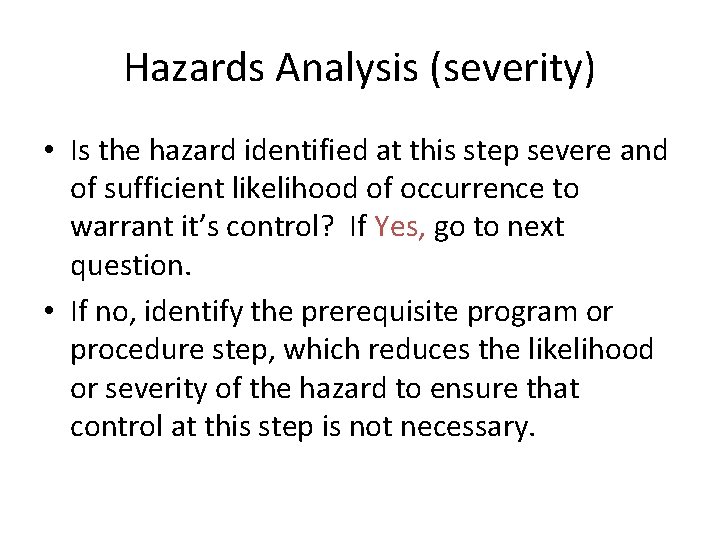
Hazards Analysis (severity) • Is the hazard identified at this step severe and of sufficient likelihood of occurrence to warrant it’s control? If Yes, go to next question. • If no, identify the prerequisite program or procedure step, which reduces the likelihood or severity of the hazard to ensure that control at this step is not necessary.
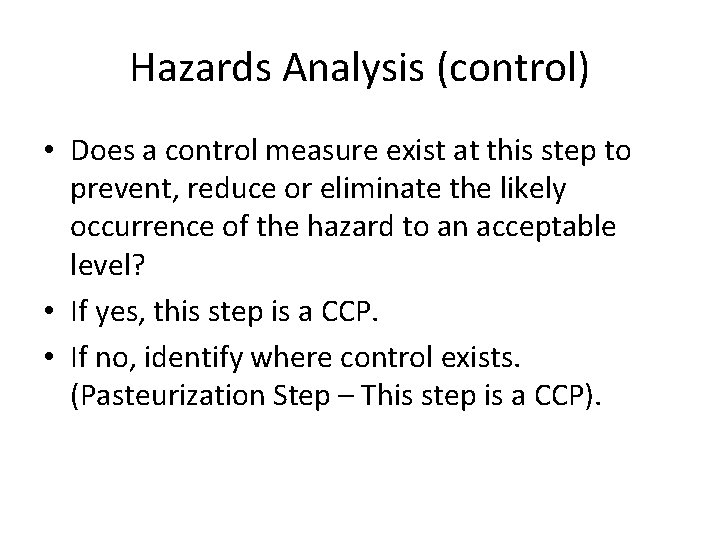
Hazards Analysis (control) • Does a control measure exist at this step to prevent, reduce or eliminate the likely occurrence of the hazard to an acceptable level? • If yes, this step is a CCP. • If no, identify where control exists. (Pasteurization Step – This step is a CCP).
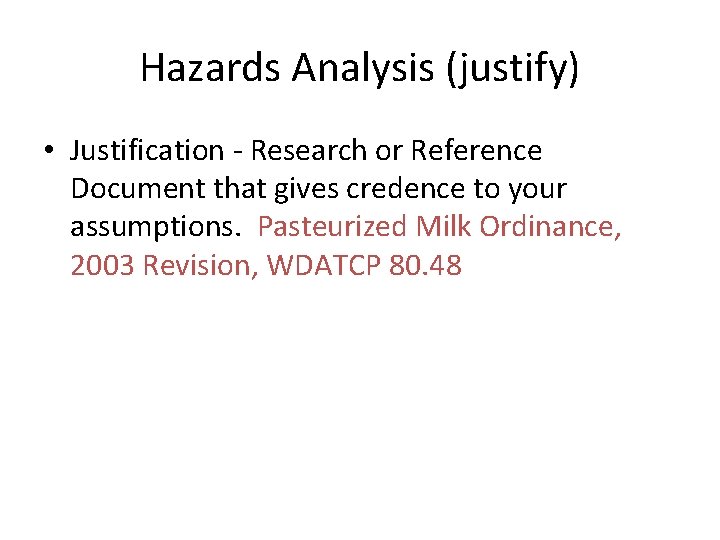
Hazards Analysis (justify) • Justification - Research or Reference Document that gives credence to your assumptions. Pasteurized Milk Ordinance, 2003 Revision, WDATCP 80. 48
2 - Determine Critical Control Points
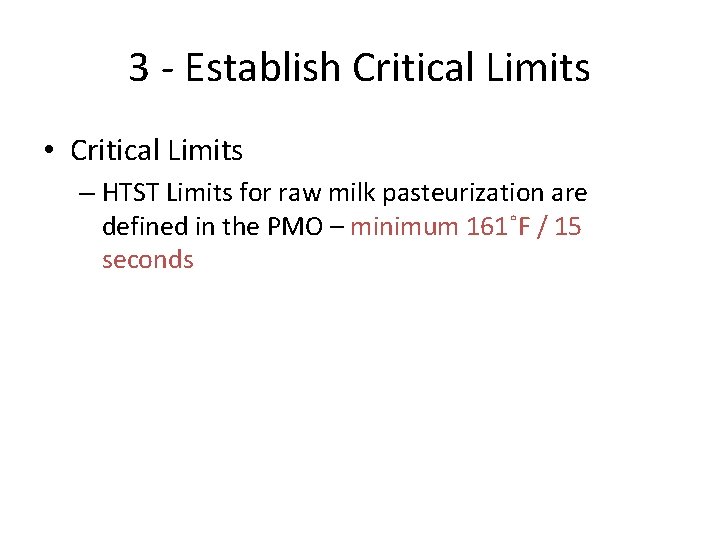
3 - Establish Critical Limits • Critical Limits – HTST Limits for raw milk pasteurization are defined in the PMO – minimum 161˚F / 15 seconds
4 - Establish Monitoring Procedures • Continuous chart monitoring of temperature and flow rate. • Performed by Pasteurizer Operator in the Pasteurizer Room.
5 - Establish Corrective Actions • When minimum time or temperature requirement is not met, product automatically diverts to back to the balance tank prior to the HTST Pasteurizer. Forward flow is prevented. • Product diversion must be indicated on Pasteurizer Recording chart. These instances should be carefully reviewed by Licensed Pasteurizer Operator.
6 _ Establish Verification Procedures • Daily: Proper performance of HTST is demonstrated after sanitation and before product (Cut In / Cut Out) and recorded on the continuous chart. Charts verified Licensed Pasteurizer Operator. • Six months: Representative from WDA Tests Pasteurizer / time (maximum allowable flow for specified distance) and temperature. All controls are sealed. Records are retained by facility and state. • Daily: Seal check – verify that all seals are intact. Record reviewed by Licensed Pasteurizer Operator.
7 – Establish Records • • Pasteurizer Charts Seal Check Record WDA Pasteurizer Time / Seal Record. Other Equipment Calibration and testing records.
Identify CCP on Flowchart
HACCP Description Chart
What is ISO? International Standards for Business, Government and Society www. iso. ch The International Organization for Standardization (ISO) creates many different types of standards ISO is made up of standards institutes from 154 different countries Member countries work together to develop and approve standards
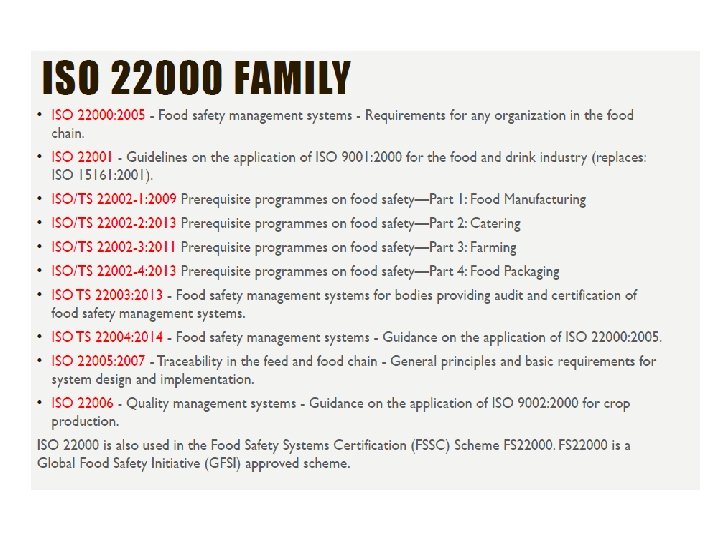
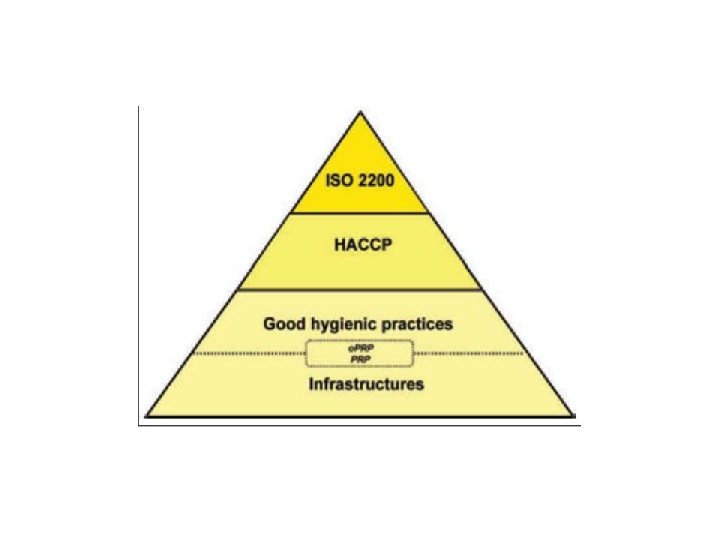
INTRODUCTION OF ISO 22000 By the early 2000 s, a number of standards have been developed by different private and national organizations around the world. This led to complications when companies started using their own in-house developed codes to audit their suppliers. Different audit criteria made it nearly impossible for suppliers to fulfill all requirements in the global market. In 2001, the International Organization for Standardization (ISO) started working on an auditable standard for Food Safety Management System (FSMS). This international FSMS standard, known as ISO 22000, was finally published on September 1, 2005. It is a framework that combines prerequisite programs, the HACCP principles and application steps as described by the Codex Alimentarius Commission and elements of the ISO 9001: 2000 standard. Within two years, the standard has been implemented by organizations in more than 50 countries as an alternative to more than 20 food safety schemes developed by individual companies in the sector for auditing their suppliers.
What is ISO 22000? It is a Food Safety Management System (FSMS) that uses a management systems approach as well as a HACCP process. The goal of ISO 22000 is to provide one internationally recognized standard for a food safety management system that can be applied to any organization in the food chain.
Introduction In order to understand the significance of ISO 22000 we must first understand what ISO 22000 is about and how is it applicable to the food industry. To achieve these objectives we must ask the following questions: • What ISO 22000 means? -ISO 22000 means consensus agreements between all the economic stakeholders concerned: suppliers; users; government regulators; other interest groups, such as consumers 129
How ISO 22000 benefit society? • For businesses, the widespread adoption of ISO 22000 means that suppliers can base the development of their products and services on specifications that have wide acceptance in their sectors; • This, in turn, means that businesses using ISO 22000 are increasingly free to compete on many more markets around the world 130
How ISO 22000 benefit consumers? • For consumers: - conformity of products and services to International Standards -provides assurance about: -quality -safety -reliability 131
How ISO 22000 benefit trade officials? • For trade officials negotiating the emergence of regional and global markets, IS 0 22000 create "a level playing field" for all competitors on those markets; • The existence of divergent national or regional standards can create technical barriers to trade, even when there is political agreement to do away with restrictive import quotas and the like; • International Standards are the technical means by which political trade agreements can be put into practice 132
How ISO 22000 benefit developing countries? • For developing countries, ISO 22000 represents an international consensus and constitute an important source of technological know-how; • By defining the characteristics that products and services will be expected to meet on export markets; • International Standards give developing countries a basis for making the right decisions when investing their scarce resources and thus avoid squandering them 133
How ISO 22000 benefit governments? • For governments, ISO 22000 provides: -technological and scientific know-how -bases for developing health, safety and environmental legislation -education of food regulatory personnel 134
How ISO 22000 benefit governments? (Cont’d) -certification or registration -international acceptance of standards used globally -economic benefits -social benefits -trade liberalization -food quality -food safety -food security 135
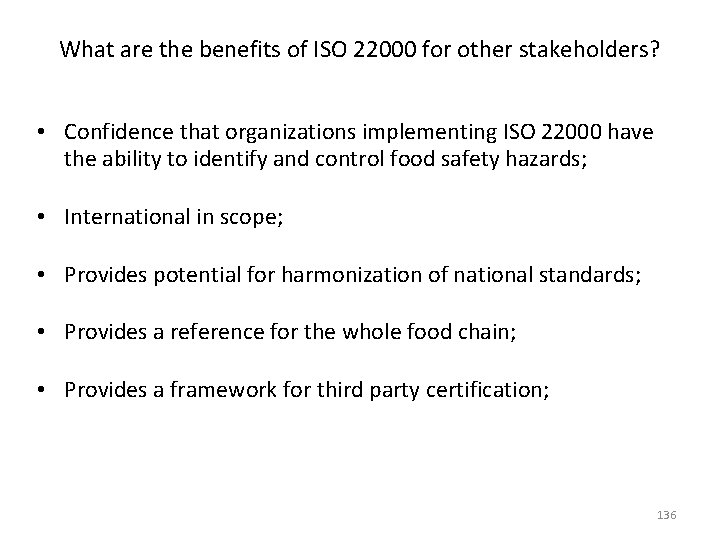
What are the benefits of ISO 22000 for other stakeholders? • Confidence that organizations implementing ISO 22000 have the ability to identify and control food safety hazards; • International in scope; • Provides potential for harmonization of national standards; • Provides a reference for the whole food chain; • Provides a framework for third party certification; 136
ISO 22000: 2005
What is FS 22000? FS 22000 is a Food Safety Certification Scheme that uses ISO 22000 and PAS 220 specifies requirements for Prerequisite Programs for food manufacturers This document was added to ISO 22000 to create a system that could be benchmarked by the Global Food Safety Initiative FS 22000 was originally called FSSC 22000. It has been shortened To FS 22000 for simplicity
FS 22000 or ISO 22000? Manufacturers can choose ISO 22000 or FS 22000 If your customers want a GFSI(Global Food Safety Initiative ) registration scheme then you will use FS 22000 You will need to evaluate your market and determine which standard is most appropriate FS 22000 applies only to food manufacturer, so if you are not a manufacturer, you will use ISO 22000
ISO 22000 for the food safety • Is related to the presence of and levels of food-borne hazards in food at the point of consumption • As food safety hazards may be introduced at any stage of the food chain, adequate control throughout the food chain is essential • Is a joint responsibility of all parties participating in the food chain • Failures in food supply can cause human suffering, death, poor reputation, violations, poor nutrition, poor quality products and decreased profits
Key elements Standard specifies the requirements for a food safety management system that combines the following generally recognized key elements to ensure food safety along the food chain, up to the point of final consumption: • interactive communication • system management • prerequisite programmes • HACCP principles
• ISO 22000 intends to define the Food Safety Management System requirements that companies need to meet in order to comply with food safety regulations all over the world. • ISO 22000: 2005 takes a food chain approach to food safety. It defines a set of general food safety management requirements that apply not only to food producers and manufacturers, but to all the organizations that participate in the food supply chain. • ISO 22000 specifies the requirements for an FSMS that combines the following key elements to ensure food safety along the food chain:
Difference between HACCP and ISO 22000 Besides the fact that HACCP is a food safety system, and ISO 22000 is a food safety management system standard, differences between these two include the following: • ISO 22000 allows the development of a food safety management system by external experts for any company, and this includes implementation and verification of all or part of activities involved in the system • ISO 22000 also refers to good practices in sectors and general hygiene rules published by Codex Alimentarius. • Besides the internal communication, external communication is also a condition for establishing, implementing and updating the FSMS according to ISO 22000. • ISO 22000 demands risk analysis to evaluate each food safety hazards identified. • ISO 22000 demands documentation of PRPs. • HACCP uses the traditional concept of dividing control measures into two groups: prerequisites and measures applied at critical control points (CCPs). In the case of ISO 22000, these concepts are reorganized in a logical order by adding a group of control measures named operational prerequisite programs (o. PRPs).
Difference between HACCP and ISO 22000 • ISO 22000 demands monitoring system and planning of corrective actions for operational PRPs, as for CCPs. • ISO 22000 demands analysis and improvement according to the outcome of monitoring of o. PRPs and HACCP plan. • ISO 22000 also requires the review and identification of specifications, formulation and origin for input and end-products. • ISO 22000 separates and clarifies verification activities and validation activities. • Allergen control is a required prerequisite program in ISO 22000; however it is not mentioned in HACCP. • ISO 22000, new terms have been developed, such as “potentially unsafe product” and the term “withdrawal” for product recall and product recollection activities. • ISO 22000 requires continual improvement and updating of the management system.
This International Standard specifies the requirements for a food safety management system that combines the following generally recognized key elements to ensure food safety along the food chain, up to the point of final consumption; these elements are: • interactive communication; • system management; • process control (ISO 9001); • HACCP principles; • prerequisite programs. 149
• Communication along the food chain is essential to ensure that all relevant food safety hazards are identified and adequately controlled at each step within the food chain. • This implies communication of the needs of the organization to both organizations upstream in the food chain and organizations downstream in the food chain. • This implies communication of the needs of the organization to both organizations upstream in the food chain and organizations downstream in the food chain. 150
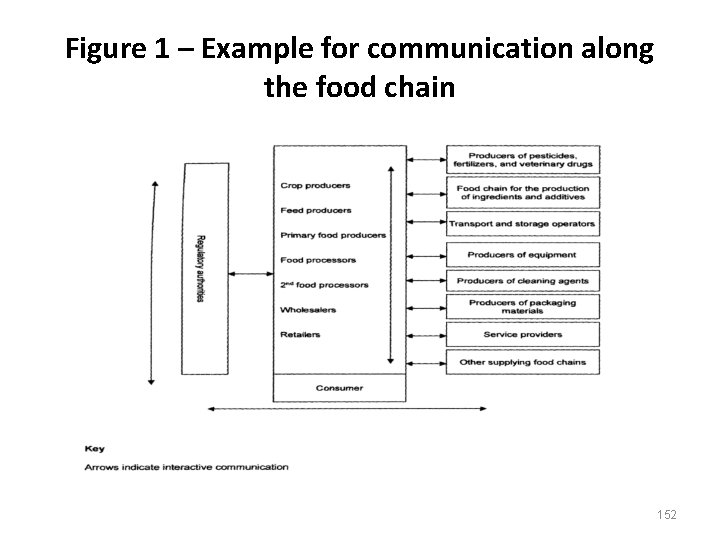
• Communication with customers and suppliers, based on the information generated through systematic hazard analysis, will also assist in substantiating customer and supplier requirements with regard to their feasibility, need and impact on the end product. • Recognition of the organization's role and position within the food chain is essential to ensure effective interactive communication throughout the chain in order to deliver safe food products to the final consumer. • The possible scope of the communication channels among typical interested parties of the food chain is schematically exemplified in Figure 1. 151
Figure 1 – Example for communication along the food chain 152
• This International Standard integrates the principles of the Hazard Analysis and Critical Control Point (HACCP) system and application steps developed by the Codex Alimentarius Commission and dynamically combines it with prerequisite programs (PRP(s)) necessary to control and reduce any food safety hazards identified for the end products delivered to the next step in the food chain to acceptable levels. • Hazard analysis is the key to an effective food safety management system, as it organizes the knowledge required to design an effective combination of control measures. 153
• This International Standard requires that all hazards that may be reasonably expected to occur in the food chain, including hazards that may be associated with the type of process and facilities used, are identified and assessed, resulting in a clear determination of those to be controlled within the organization and those that are to be controlled (or are already controlled) by other organizations within the food chain and/or by the final consumer. • Thus, this standard provides the means to document and justify both inclusions and omissions in setting control measures. 154
• Infrastructure and maintenance programs are used to address basic requirements of food hygiene and accepted good (manufacturing, agricultural, hygienic, etc. ) practices of a more permanent nature; whereas operational PRP(s) are used to control or reduce the impact of identified food safety hazards in the product or the processing environment. • The HACCP plan is used to manage the CCP(s) identified to eliminate, prevent or reduce specified food safety hazards from the product, as determined during hazard analysis. • During hazard analysis the organization determines the strategy to be used to ensure hazard control by combining the PRP(s) and the HACCP plan. 155
• This International Standard requires that organizations identify, monitor, control and routinely update both the PRP(s) and the HACCP plan. • To facilitate the application of this International Standard, it has been developed as an auditable standard. • However, individual organizations are free to choose the necessary methods and approaches to fulfill the requirements of this International Standard. • To assist individual organizations with development and implementation of this International Standard an informative explanation and guide for its use are provided in Annex A. 156
This International Standard recognizes that there are differences amongst organizations within the food chain. It specifies a mechanism that will allow a small and/or less developed organization, such as a small farm, a small packer-distributor, a small retail or food service outlet, to implement an externally developed and designed combination of PRP(s) and HACCP plans, if a) it is demonstrated that it has been developed in compliance with the requirements of this International Standard specified for the hazard analysis, PRP(s) and HACCP plan, b) specific measures have been undertaken to adapt the externally developed system to the organization, and 157
c) it has been implemented and is operated in accordance with the other requirements of this International Standard. The most effective food safety systems are designed, operated and updated within the framework of a structured management system and incorporated into the overall management activities of the organization. This provides maximum benefit for the organization and interested parties. This International Standard has taken due consideration of the provisions of ISO 9001: 2000 in order to enhance compatibility of the two standards. 158
The correspondence between ISO 9001: 2000 and this International Standard is provided in Annex B. This International Standard may be applied independently from other management system standards. Its implementation can be aligned or integrated with existing related management system requirements while organizations may utilize existing management system(s) to establish a food safety management system that complies with the requirements of this International Standard. 159
How ISO 22000 benefits everyone? • ISO 22000 can contribute to the quality of life in general by: -ensuring safe food -reducing foodborne diseases -better quality and safer jobs in the food industry -better utilization of resources -more efficient validation and documentation of techniques, methods and procedures -increased profits -increased potential for economic growth and development 160
Quiz Questions 1. Write a brief description for food quality. What are the important components of the food quality? 2. Give an example for food safety concern and make suggestion to prevent or eliminate it. 3. Write long form of following terms HACCP, GMP, GHP, ISO, BRC and ISO. 4. Write seven principles in HACCP system approach 5. Write 2 difference between HACCP and ISO 22000