MEDICAL QUALITY ASSURANCE COMMISSION Error Disclosure Washington Association

- Slides: 23
MEDICAL QUALITY ASSURANCE COMMISSION: Error Disclosure Washington Association Medical Staff Services April 27, 2017 Jimi Bush: Performance and Outreach Manager
Objectives Discuss common health care communication tools; • Discuss how communication can transcend throughout the health care community as a whole; • Discuss error disclosure in the health care community; • Review the communication and resolution program guidelines from the commission; • Practice disclosing an error; • Washington State Medical Quality Assurance Commission @Wa. Med. Board Jimi. Bush@doh. wa. gov
Disclosing harmful events We disclose errors and harmful events because it protects patient safety • Improves the culture of health care • • • Open Transparent • Supportive • Teamwork • Committed to learning • Respect Patients want jargon-free statement that an error occurred and; A basic description of what the error was and why it happened; • Patients dislike explanations that seem evasive. Washington State Medical Quality Assurance Commission @Wa. Med. Board Jimi. Bush@doh. wa. gov
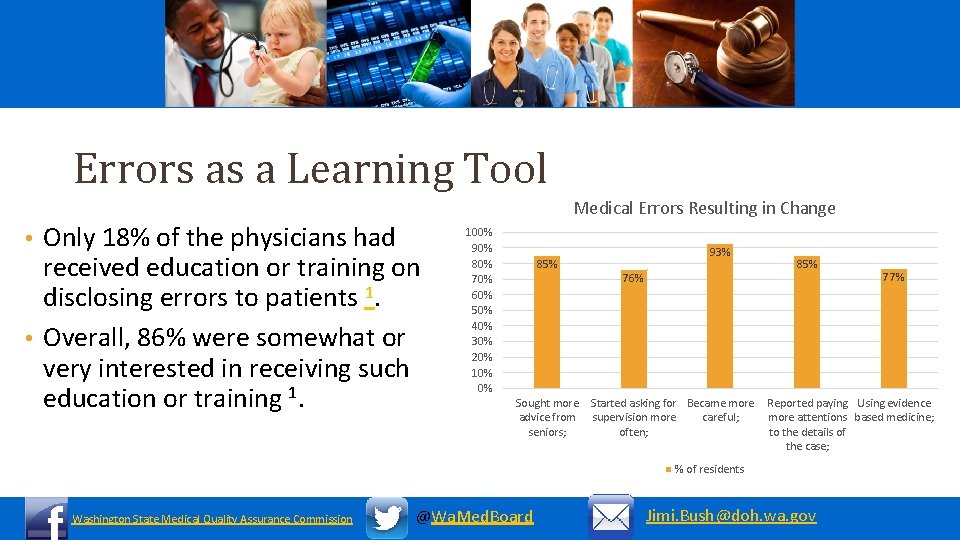
Errors as a Learning Tool Only 18% of the physicians had received education or training on disclosing errors to patients 1. • Overall, 86% were somewhat or very interested in receiving such education or training 1. • Medical Errors Resulting in Change 100% 90% 80% 70% 60% 50% 40% 30% 20% 10% 0% 85% 93% 76% 85% Sought more Started asking for Became more Reported paying Using evidence advice from supervision more careful; more attentions based medicine; seniors; often; to the details of the case; % of residents Washington State Medical Quality Assurance Commission 77% @Wa. Med. Board Jimi. Bush@doh. wa. gov
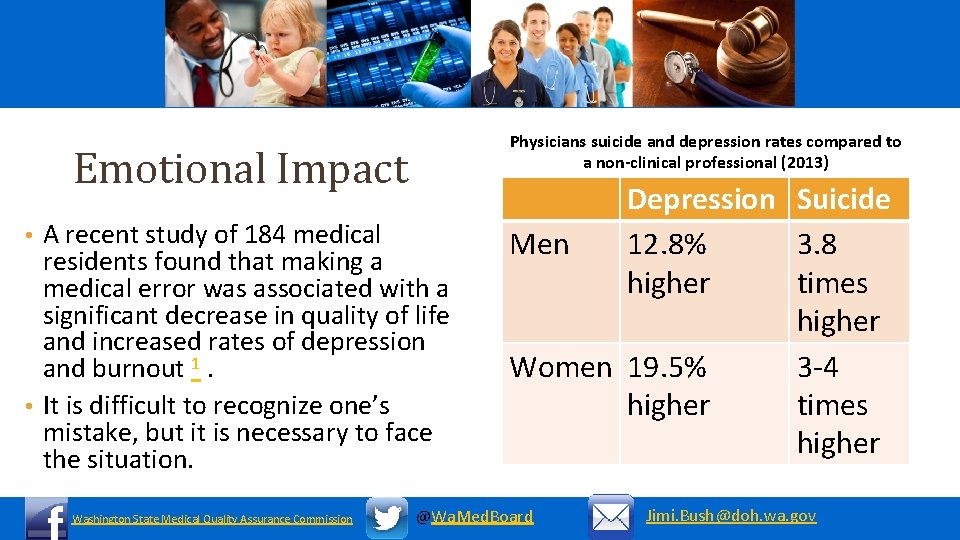
Physicians suicide and depression rates compared to a non-clinical professional (2013) Emotional Impact A recent study of 184 medical residents found that making a medical error was associated with a significant decrease in quality of life and increased rates of depression and burnout 1. • It is difficult to recognize one’s mistake, but it is necessary to face the situation. • Washington State Medical Quality Assurance Commission Depression Suicide Men 12. 8% 3. 8 higher times higher Women 19. 5% 3 -4 higher times higher @Wa. Med. Board Jimi. Bush@doh. wa. gov
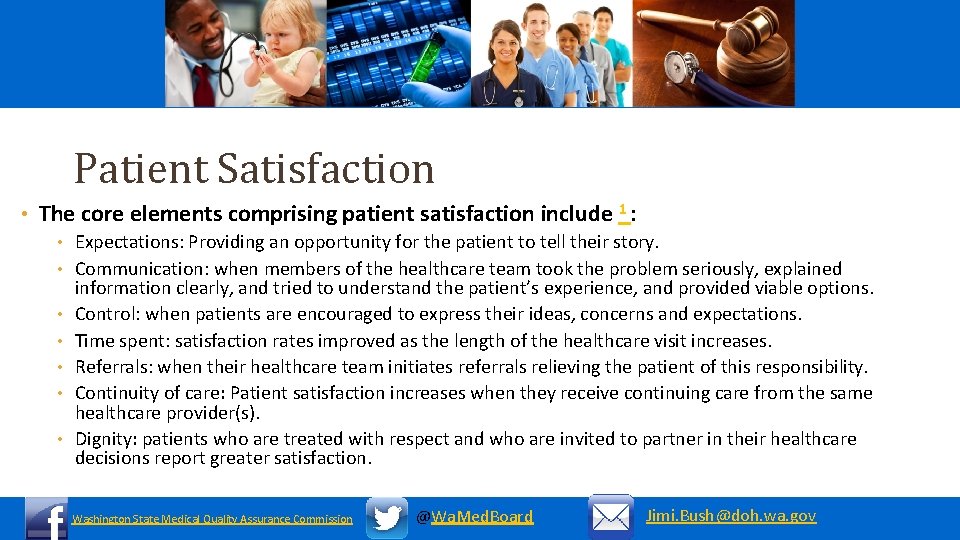
Patient Satisfaction • The core elements comprising patient satisfaction include 1 : • • Expectations: Providing an opportunity for the patient to tell their story. Communication: when members of the healthcare team took the problem seriously, explained information clearly, and tried to understand the patient’s experience, and provided viable options. Control: when patients are encouraged to express their ideas, concerns and expectations. Time spent: satisfaction rates improved as the length of the healthcare visit increases. Referrals: when their healthcare team initiates referrals relieving the patient of this responsibility. Continuity of care: Patient satisfaction increases when they receive continuing care from the same healthcare provider(s). Dignity: patients who are treated with respect and who are invited to partner in their healthcare decisions report greater satisfaction. Washington State Medical Quality Assurance Commission @Wa. Med. Board Jimi. Bush@doh. wa. gov
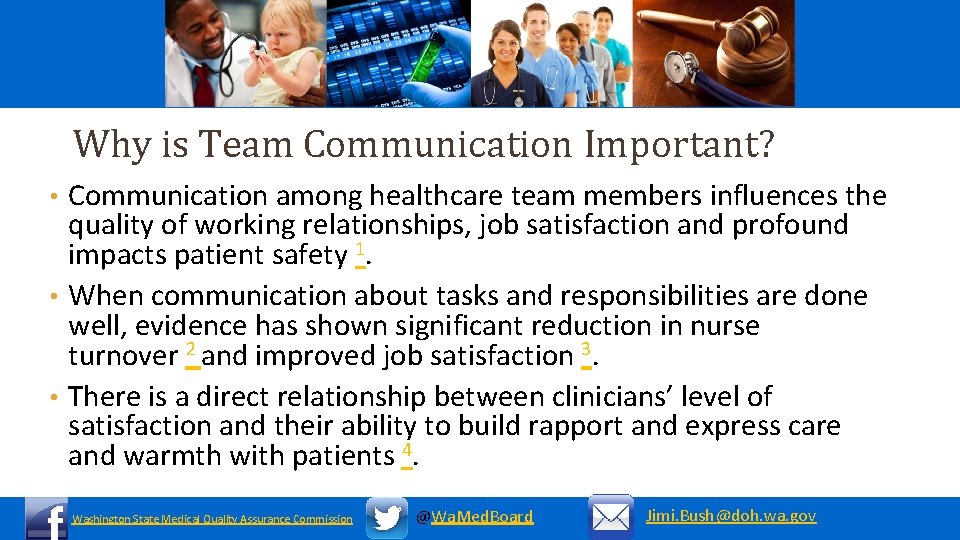
Why is Team Communication Important? Communication among healthcare team members influences the quality of working relationships, job satisfaction and profound impacts patient safety 1. • When communication about tasks and responsibilities are done well, evidence has shown significant reduction in nurse turnover 2 and improved job satisfaction 3. • There is a direct relationship between clinicians’ level of satisfaction and their ability to build rapport and express care and warmth with patients 4. • Washington State Medical Quality Assurance Commission @Wa. Med. Board Jimi. Bush@doh. wa. gov
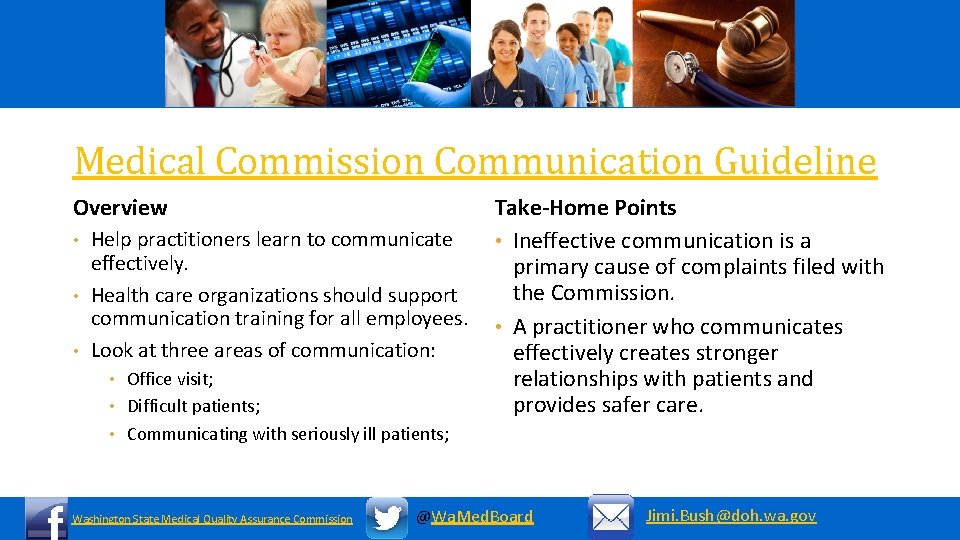
Medical Commission Communication Guideline Overview Help practitioners learn to communicate effectively. • Health care organizations should support communication training for all employees. • Look at three areas of communication: • Office visit; • Difficult patients; • Communicating with seriously ill patients; • Washington State Medical Quality Assurance Commission Take-Home Points • Ineffective communication is a primary cause of complaints filed with the Commission. • A practitioner who communicates effectively creates stronger relationships with patients and provides safer care. @Wa. Med. Board Jimi. Bush@doh. wa. gov
Communication Guideline: The Office Visit Take a deep breath • Sit down, lean forward, make eye contact • Give your complete attention • Be empathetic • Slow down • Keep it simple • Tell the truth • Washington State Medical Quality Assurance Commission • Never answer a feeling with a fact • Watch the patient’s body and face • Be prepared for a reaction • Make a positive statement • Make a partnership statement @Wa. Med. Board Jimi. Bush@doh. wa. gov
A Collaborative Approach to Reducing Medical Error and Enhancing Patient Safety Guideline Physicians wonder whether to take personal responsibility for an error, especially given that most errors are not failures of individual providers but rather breakdowns in the system of care. • A new regulatory model is needed, one that focuses less on punishment and more on improving systems and preventing error. • The Commission believes that a more effective regulatory approach is to work directly with entities in the health care system to foster open communication. • Washington State Medical Quality Assurance Commission @Wa. Med. Board Jimi. Bush@doh. wa. gov
A Collaborative Approach to Reducing Medical Error and Enhancing Patient Safety Guideline Communication and Resolution Programs (CRP) • Promote a patient-centered response to unanticipated outcomes: • • CRPs are characterized by: • • • When a patient is harmed by medical care, providers should be able to tell the patient exactly what happened, what steps will be taken to address the event, and how similar outcomes will be prevented. Open and prompt communication; Support for involved patients, families, and care providers; Rapid investigation and closure of gaps that contributed to the unanticipated outcome; Proactive resolution; Providers must: • • • Report unanticipated outcomes as soon as they occur; Participate in efforts to understand whether the unanticipated outcome was due to medical error or system failure; Participate in efforts to prevent recurrences; Washington State Medical Quality Assurance Commission @Wa. Med. Board Jimi. Bush@doh. wa. gov
Steps in disclosing an error 1. 2. 3. 4. 5. Acknowledge the error; Conduct blame-free team conversation; Explain the error to the patient/ family in an explicit, jargon free, way; Immediate investigation to determine the factors that led to the event; Communicating the findings of the investigation to the patient and the patient’s family; a) b) 6. 7. 8. Explain what you/the health care system will do to correct the error Explain what you/ health care system will do to prevent the error from occurring again Apologize; A change to the system to prevent the event from re-occurring; Shared learning; Washington State Medical Quality Assurance Commission @Wa. Med. Board Jimi. Bush@doh. wa. gov
NURSE • A helpful mnemonic summarizes what to do in responding and accepting patient emotions. • • • Name the emotion Understand Respect Support Explore Washington State Medical Quality Assurance Commission @Wa. Med. Board Jimi. Bush@doh. wa. gov
N NURSE mnemonic Washington State Medical Quality Assurance Commission Naming the emotion • Begin by naming a patient emotion for yourself. • Name the emotion as to talk to the patient. • Read non-verbal clues that patients display. • Be suggestive, not declarative. @Wa. Med. Board Jimi. Bush@doh. wa. gov
U NURSE mnemonic Washington State Medical Quality Assurance Commission Understand • Builds the relationship • Avoid premature reassurance • Understanding may involve Exploration • Active listening • Use of silence • @Wa. Med. Board Jimi. Bush@doh. wa. gov
R NURSE mnemonic Washington State Medical Quality Assurance Commission Respecting • Non-verbal • Verbal helps • Respecting emotions is an important step in showing empathy • Strong emotion deserves strong acknowledgement @Wa. Med. Board Jimi. Bush@doh. wa. gov
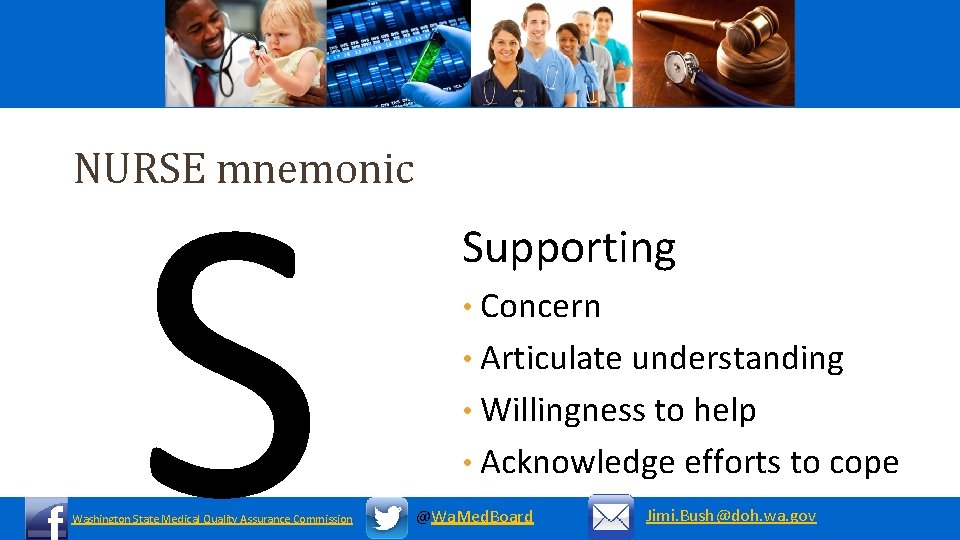
S NURSE mnemonic Washington State Medical Quality Assurance Commission Supporting • Concern • Articulate understanding • Willingness to help • Acknowledge efforts to cope @Wa. Med. Board Jimi. Bush@doh. wa. gov
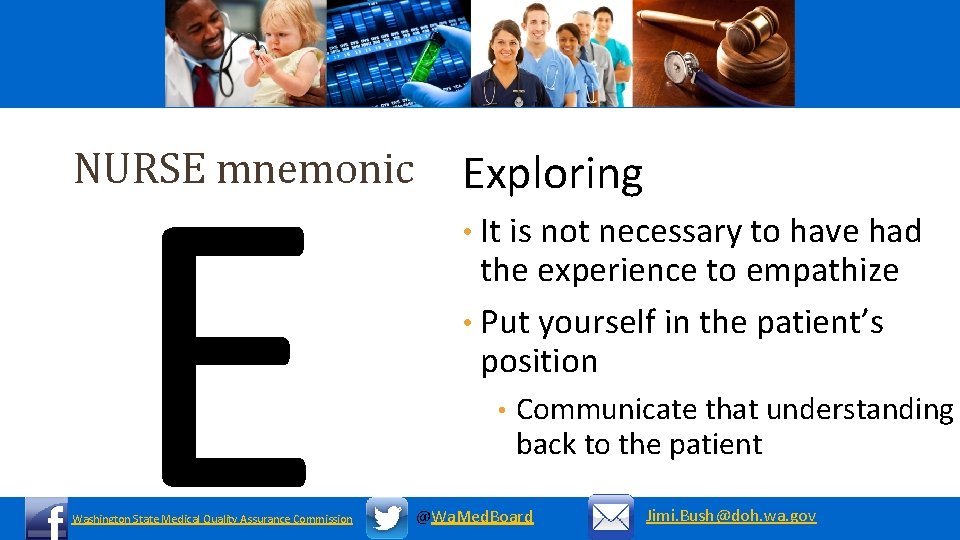
E NURSE mnemonic Washington State Medical Quality Assurance Commission Exploring • It is not necessary to have had the experience to empathize • Put yourself in the patient’s position • Communicate that understanding back to the patient @Wa. Med. Board Jimi. Bush@doh. wa. gov
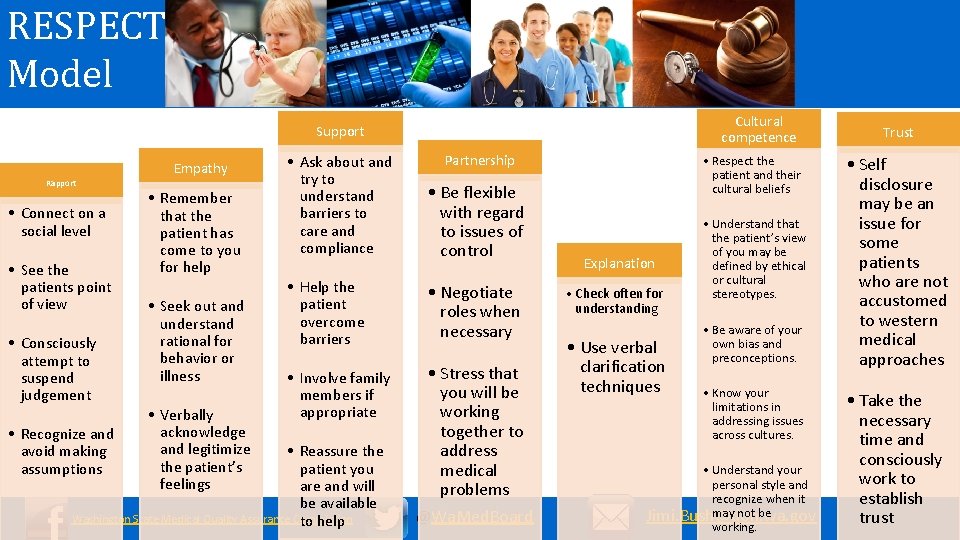
RESPECT Model Cultural competence Support Empathy Rapport • Connect on a social level • See the patients point of view • Consciously attempt to suspend judgement • Recognize and avoid making assumptions • Remember that the patient has come to you for help • Seek out and understand rational for behavior or illness • Verbally acknowledge and legitimize the patient’s feelings • Ask about and try to understand barriers to care and compliance • Be flexible with regard to issues of control • Help the patient overcome barriers • Negotiate roles when necessary • Involve family members if appropriate • Reassure the patient you are and will be available Washington State Medical Quality Assurance Commission to help Partnership • Stress that you will be working together to address medical problems @Wa. Med. Board • Respect the patient and their cultural beliefs Explanation • Check often for understanding • Use verbal clarification techniques • Understand that the patient’s view of you may be defined by ethical or cultural stereotypes. • Be aware of your own bias and preconceptions. • Know your limitations in addressing issues across cultures. • Understand your personal style and recognize when it may not be Jimi. Bush@doh. wa. gov working. Trust • Self disclosure may be an issue for some patients who are not accustomed to western medical approaches • Take the necessary time and consciously work to establish trust
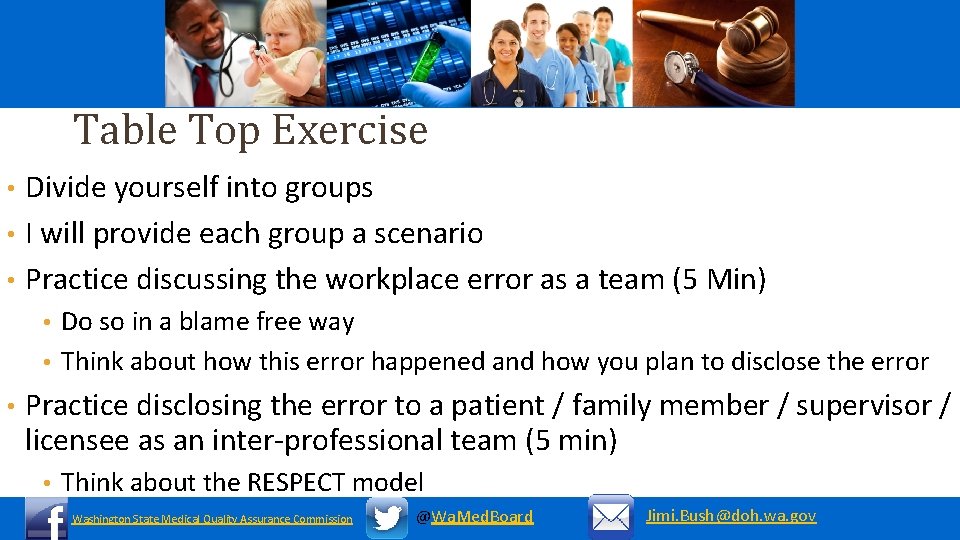
Table Top Exercise Divide yourself into groups • I will provide each group a scenario • Practice discussing the workplace error as a team (5 Min) • Do so in a blame free way • Think about how this error happened and how you plan to disclose the error • • Practice disclosing the error to a patient / family member / supervisor / licensee as an inter-professional team (5 min) • Think about the RESPECT model Washington State Medical Quality Assurance Commission @Wa. Med. Board Jimi. Bush@doh. wa. gov
NOW STOP One person from each group move to a different table-You are the affected party • The group will disclose the error to you • Washington State Medical Quality Assurance Commission @Wa. Med. Board Jimi. Bush@doh. wa. gov
Feedback • • • What were key observations from discussing the error as a team? What were the key observations from disclosing the error to the affected party? Affected parties: Did the group disclose the error honestly, clearly and compassionately? What are strengths and challenges of open disclosure of (medical) errors? What are the strengths and challenges of inter-professional teams around error disclosure? Do you experience professional barriers that make error disclosure challenging? Washington State Medical Quality Assurance Commission @Wa. Med. Board Jimi. Bush@doh. wa. gov
Questions? Jimi. bush@doh. wa. gov www. doh. wa. gov/medical Washington State Medical Quality Assurance Commission @Wa. Med. Board Jimi. Bush@doh. wa. gov