Emotional Intelligence Corporate Training Materials Module One Getting
- Slides: 109
Emotional Intelligence Corporate Training Materials
Module One: Getting Started An employee with high emotional intelligence can manage his or her own impulses, communicate with others effectively, manage change well, solve problems, and use humor to build rapport in tense situations. Whatever the mind can conceive and believe, the mind can achieve. Dr. Napoleon Hill
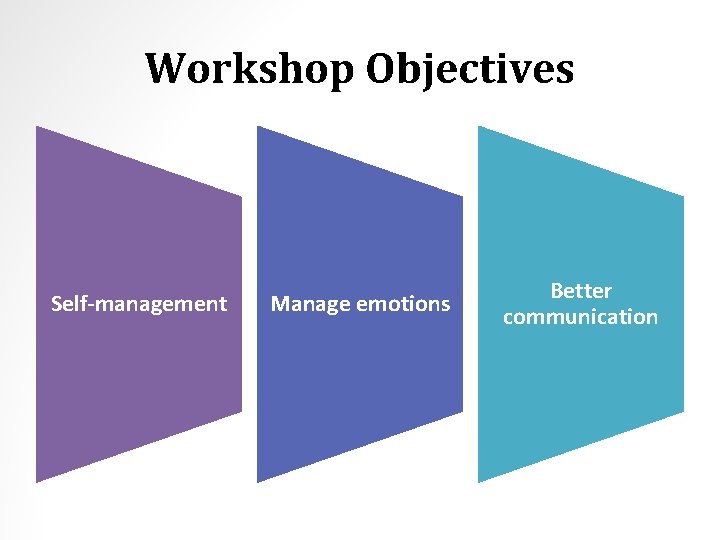
Workshop Objectives Self-management Manage emotions Better communication
Module Two: What is Emotional Intelligence is a part of you that affects every aspect of your life. Understanding the root causes of your emotions and how to use them can help you to effectively identify who you are and how you interact with others. Experience is not what happens to you – it’s how you interpret what happens to you. Aldous Huxley
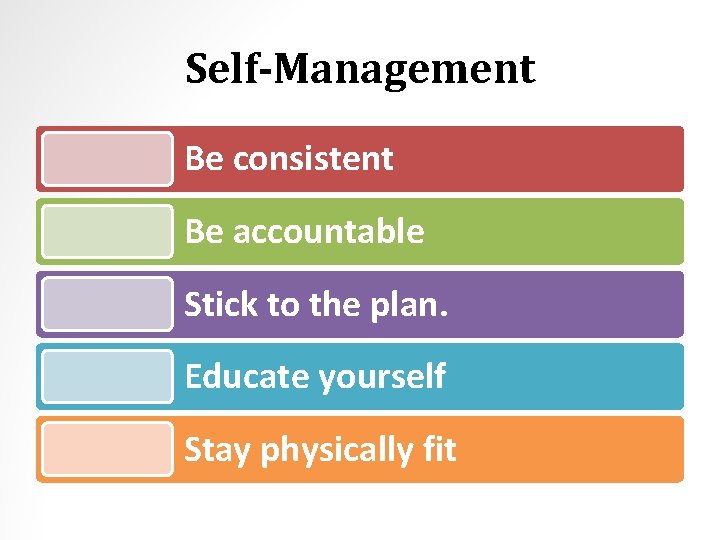
Self-Management Be consistent Be accountable Stick to the plan. Educate yourself Stay physically fit
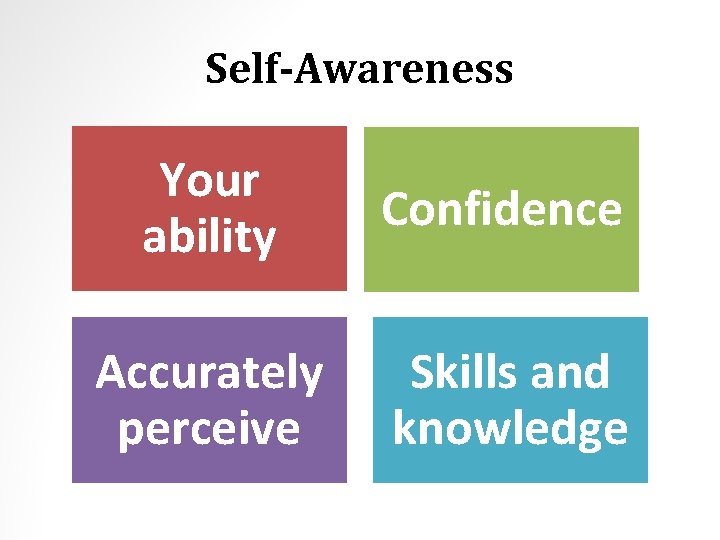
Self-Awareness Your ability Confidence Accurately perceive Skills and knowledge
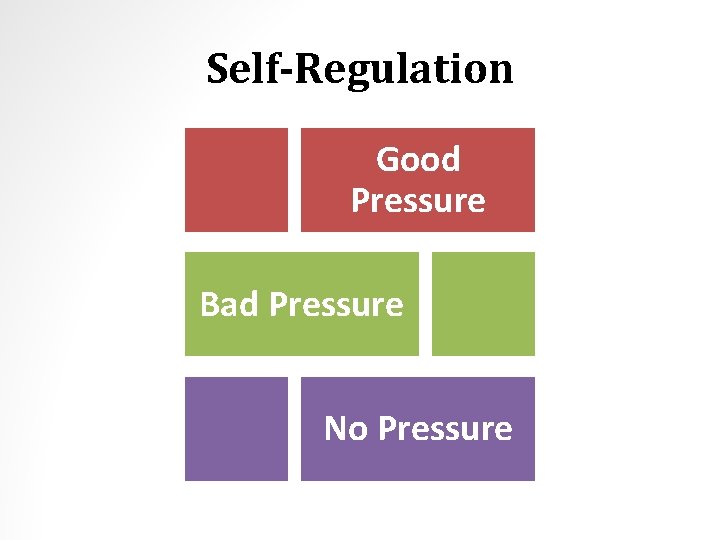
Self-Regulation Good Pressure Bad Pressure No Pressure
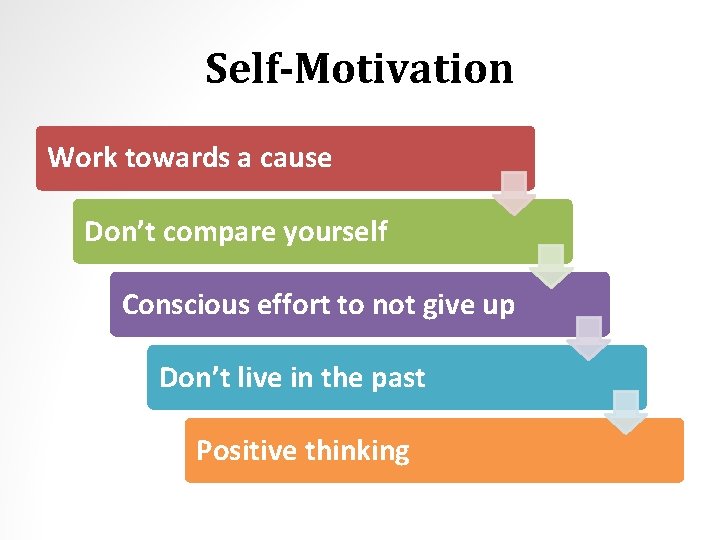
Self-Motivation Work towards a cause Don’t compare yourself Conscious effort to not give up Don’t live in the past Positive thinking
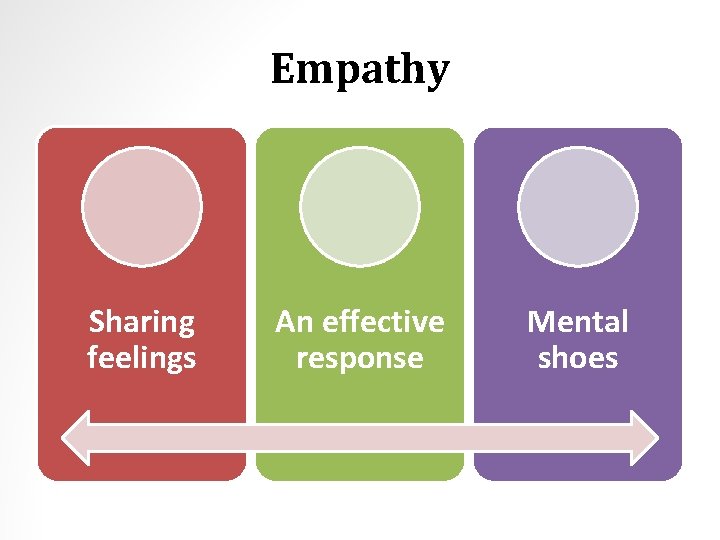
Empathy Sharing feelings An effective response Mental shoes
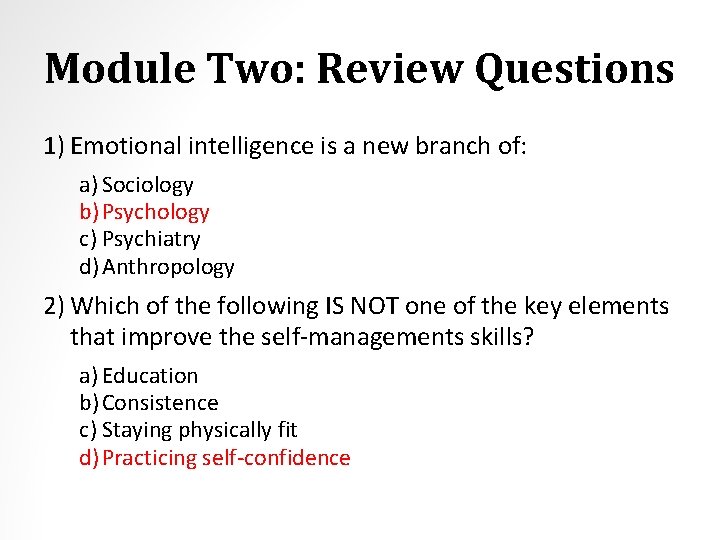
Module Two: Review Questions 1) Emotional intelligence is a new branch of: a) Sociology b) Psychology c) Psychiatry d) Anthropology 2) Which of the following IS NOT one of the key elements that improve the self-managements skills? a) Education b) Consistence c) Staying physically fit d) Practicing self-confidence
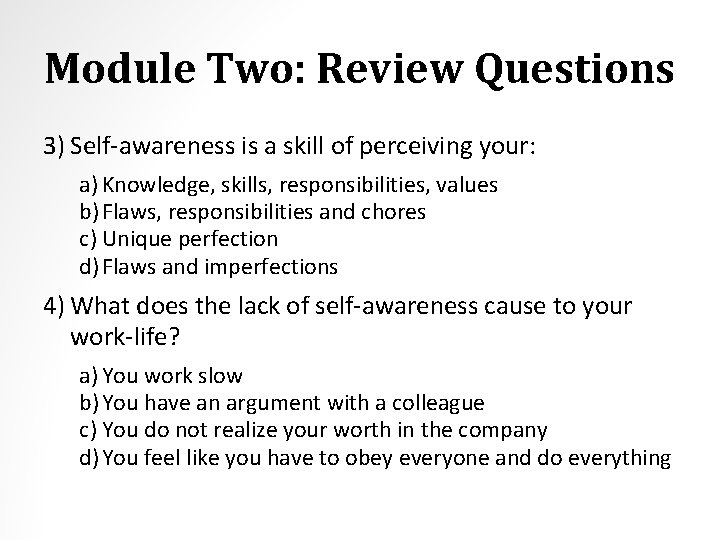
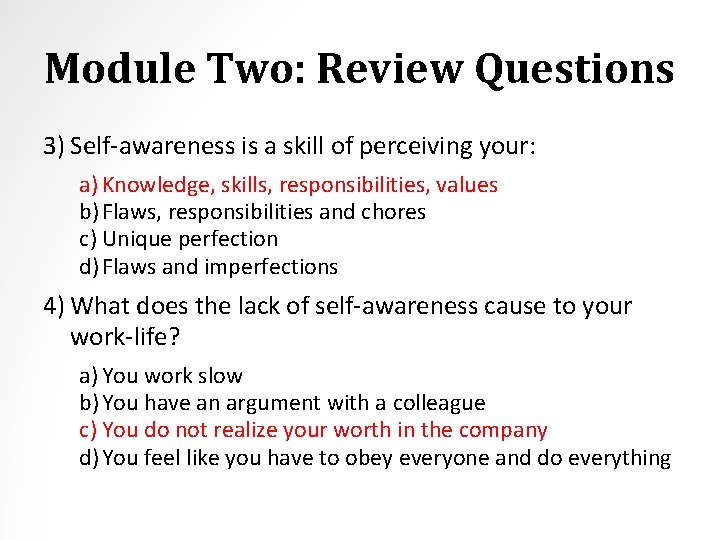
Module Two: Review Questions 3) Self-awareness is a skill of perceiving your: a) Knowledge, skills, responsibilities, values b) Flaws, responsibilities and chores c) Unique perfection d) Flaws and imperfections 4) What does the lack of self-awareness cause to your work-life? a) You work slow b) You have an argument with a colleague c) You do not realize your worth in the company d) You feel like you have to obey everyone and do everything
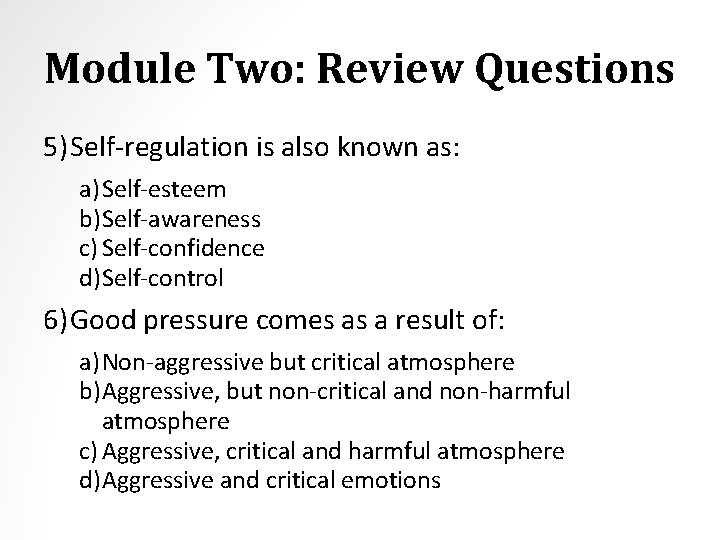
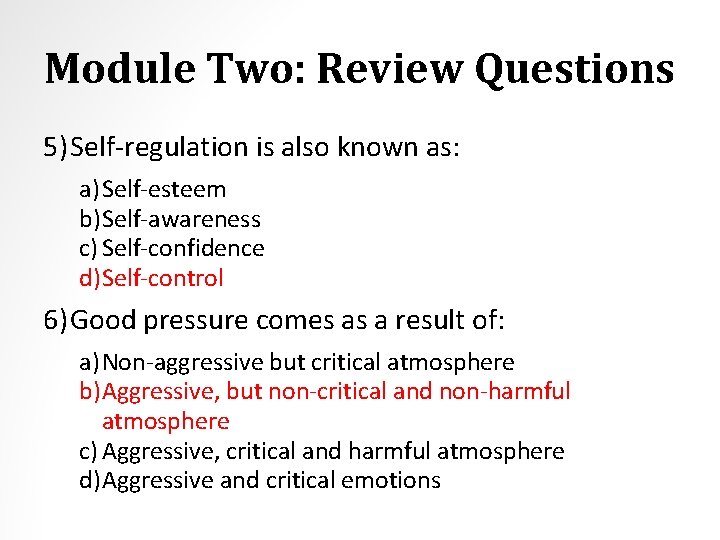
Module Two: Review Questions 5) Self-regulation is also known as: a) Self-esteem b)Self-awareness c) Self-confidence d)Self-control 6) Good pressure comes as a result of: a) Non-aggressive but critical atmosphere b)Aggressive, but non-critical and non-harmful atmosphere c) Aggressive, critical and harmful atmosphere d)Aggressive and critical emotions
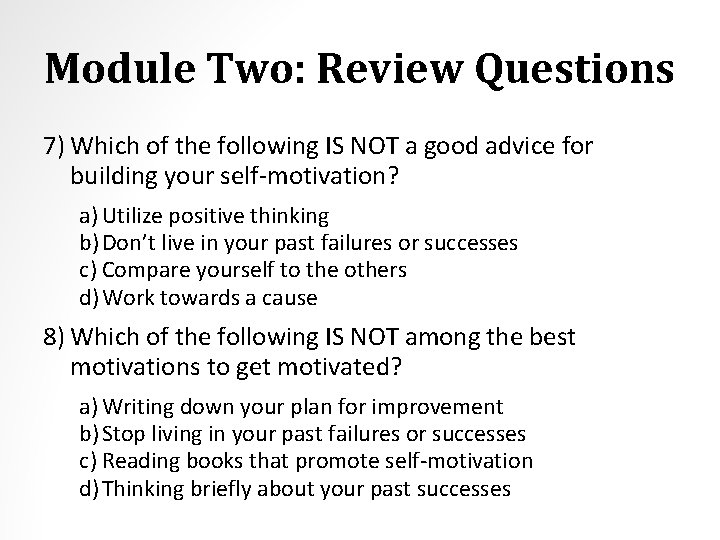
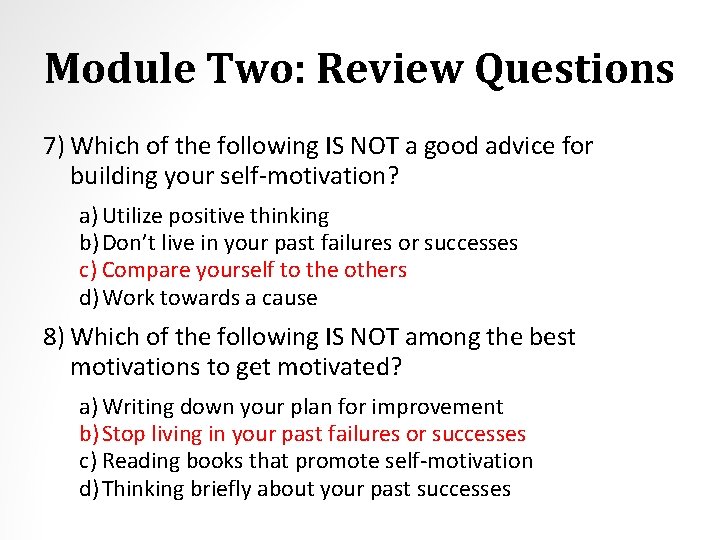
Module Two: Review Questions 7) Which of the following IS NOT a good advice for building your self-motivation? a) Utilize positive thinking b) Don’t live in your past failures or successes c) Compare yourself to the others d) Work towards a cause 8) Which of the following IS NOT among the best motivations to get motivated? a) Writing down your plan for improvement b) Stop living in your past failures or successes c) Reading books that promote self-motivation d) Thinking briefly about your past successes
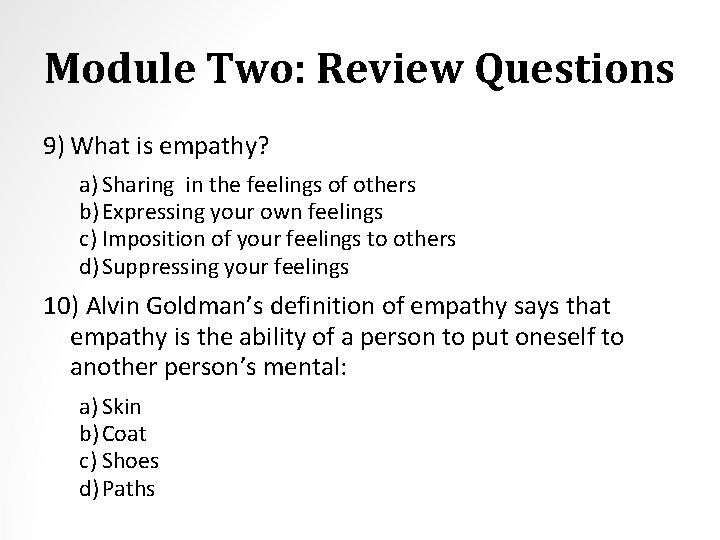
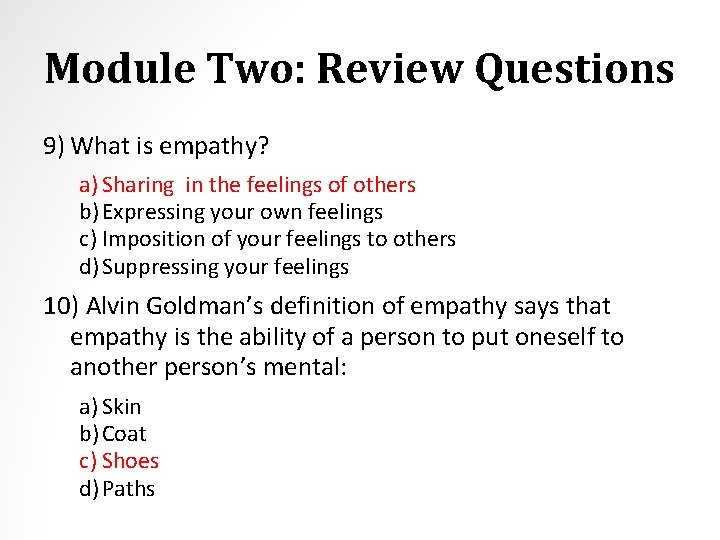
Module Two: Review Questions 9) What is empathy? a) Sharing in the feelings of others b) Expressing your own feelings c) Imposition of your feelings to others d) Suppressing your feelings 10) Alvin Goldman’s definition of empathy says that empathy is the ability of a person to put oneself to another person’s mental: a) Skin b) Coat c) Shoes d) Paths
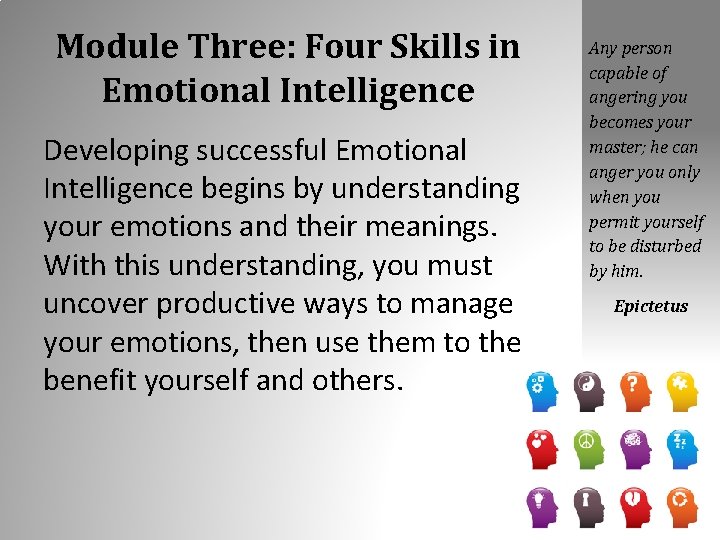
Module Three: Four Skills in Emotional Intelligence Developing successful Emotional Intelligence begins by understanding your emotions and their meanings. With this understanding, you must uncover productive ways to manage your emotions, then use them to the benefit yourself and others. Any person capable of angering you becomes your master; he can anger you only when you permit yourself to be disturbed by him. Epictetus
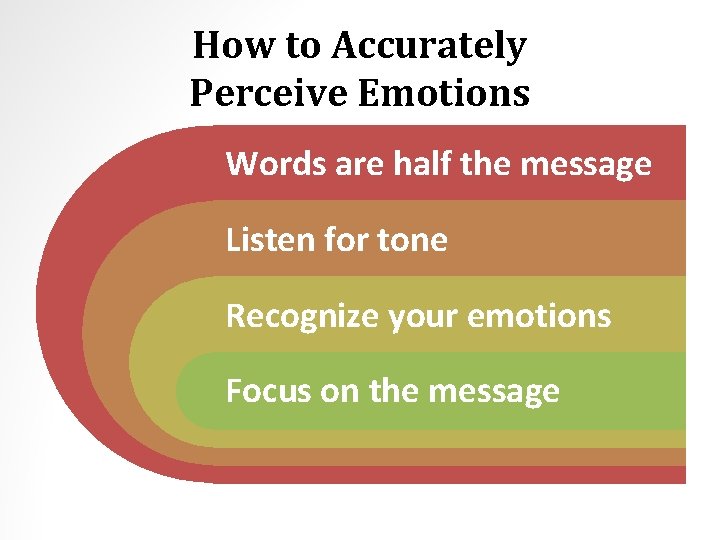
How to Accurately Perceive Emotions Words are half the message Listen for tone Recognize your emotions Focus on the message
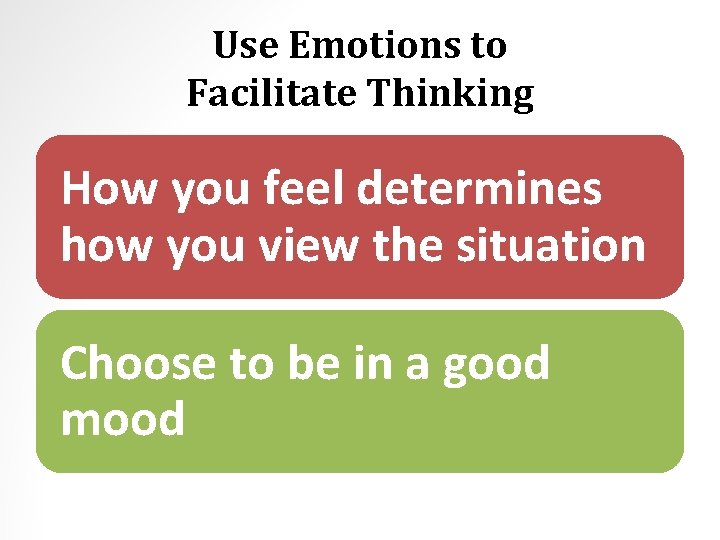
Use Emotions to Facilitate Thinking How you feel determines how you view the situation Choose to be in a good mood
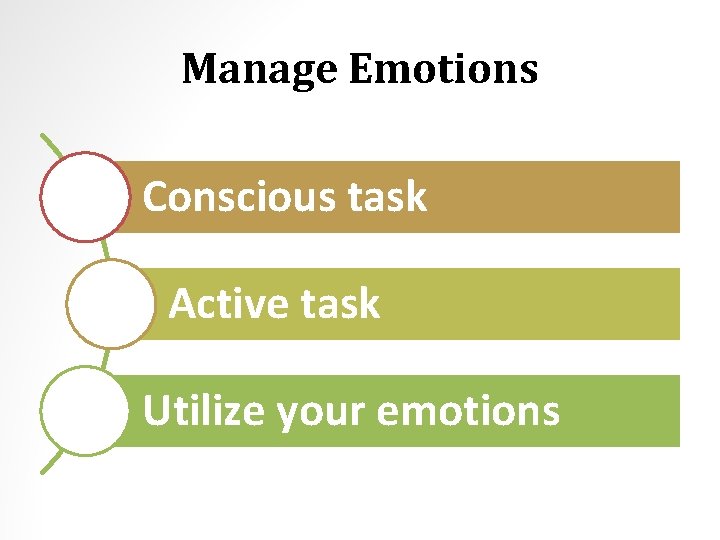
Manage Emotions Conscious task Active task Utilize your emotions
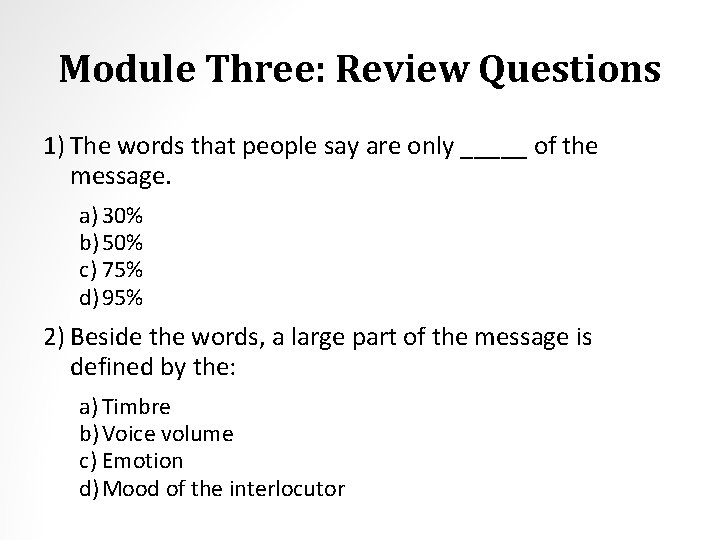
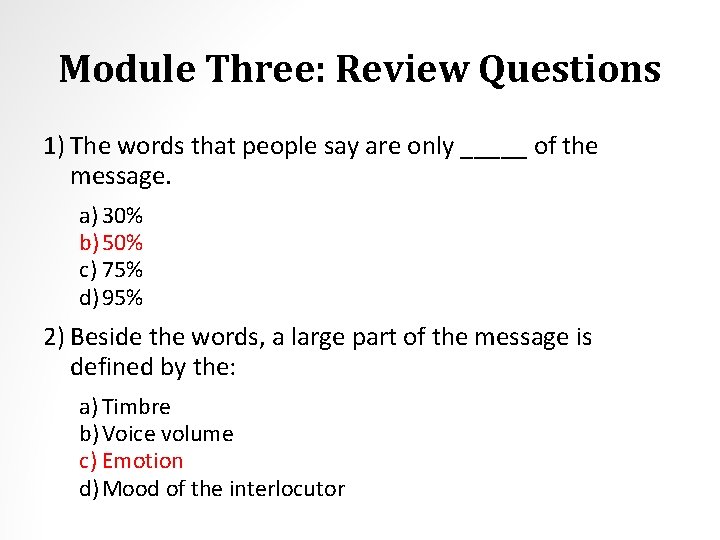
Module Three: Review Questions 1) The words that people say are only _____ of the message. a) 30% b) 50% c) 75% d) 95% 2) Beside the words, a large part of the message is defined by the: a) Timbre b) Voice volume c) Emotion d) Mood of the interlocutor
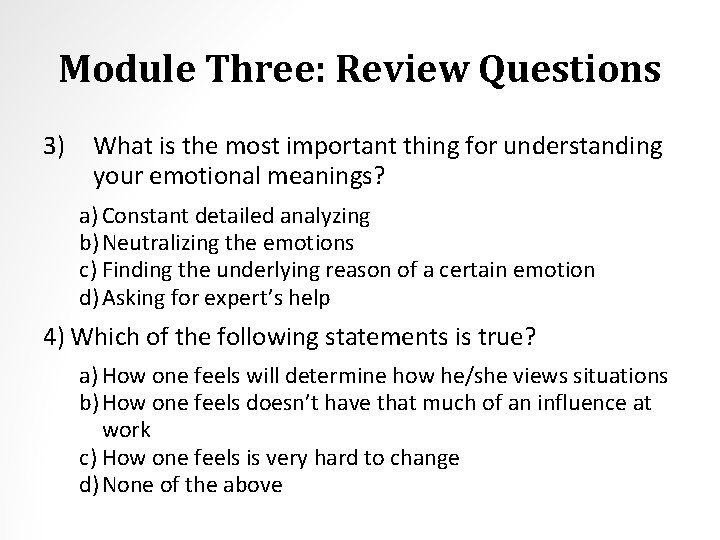
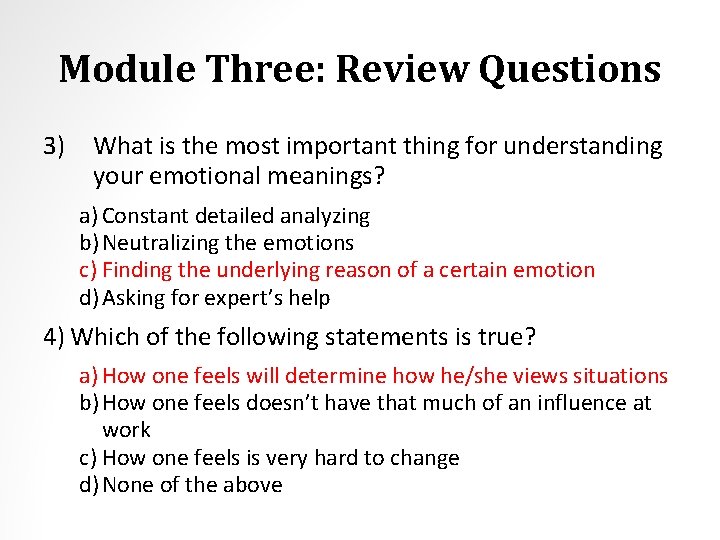
Module Three: Review Questions 3) What is the most important thing for understanding your emotional meanings? a) Constant detailed analyzing b) Neutralizing the emotions c) Finding the underlying reason of a certain emotion d) Asking for expert’s help 4) Which of the following statements is true? a) How one feels will determine how he/she views situations b) How one feels doesn’t have that much of an influence at work c) How one feels is very hard to change d) None of the above
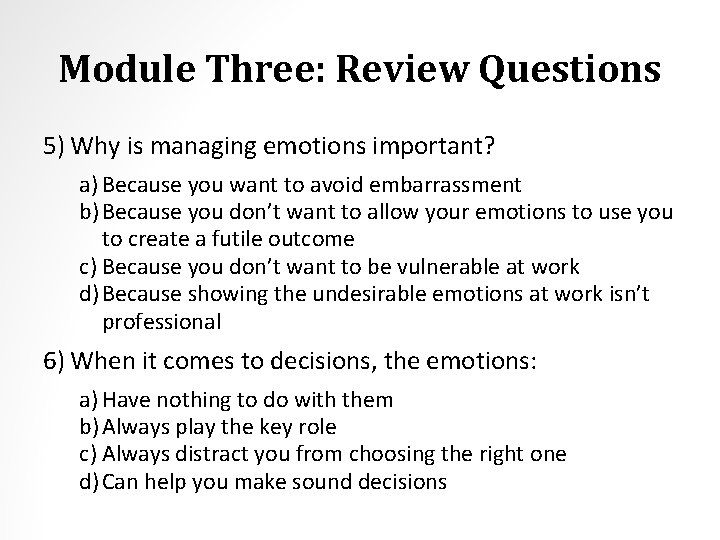
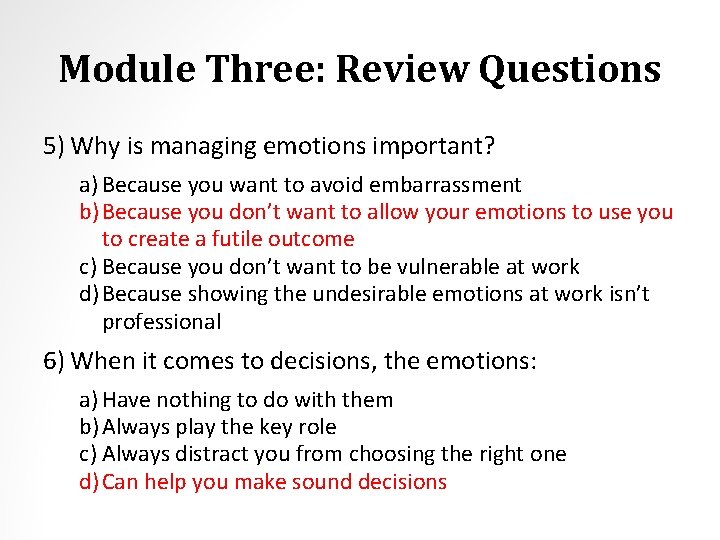
Module Three: Review Questions 5) Why is managing emotions important? a) Because you want to avoid embarrassment b) Because you don’t want to allow your emotions to use you to create a futile outcome c) Because you don’t want to be vulnerable at work d) Because showing the undesirable emotions at work isn’t professional 6) When it comes to decisions, the emotions: a) Have nothing to do with them b) Always play the key role c) Always distract you from choosing the right one d) Can help you make sound decisions
Module Four: Verbal Communication Skills Strong verbal communication skills are important in all facets of life. Without these essentials, one may find it hard to get a personal point across, articulate needs and desires or even compete in the business world. There are many factors that contribute to solid communication skills. The greatest ability in business is to get along with others and influence their actions. John Hancock
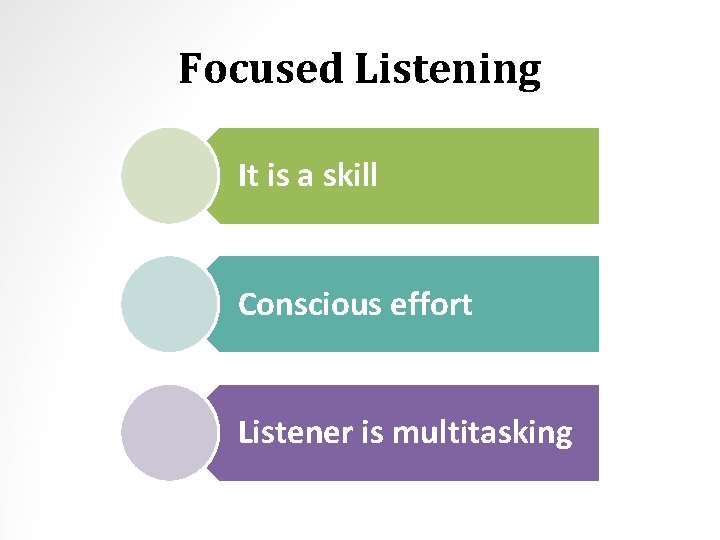
Focused Listening It is a skill Conscious effort Listener is multitasking
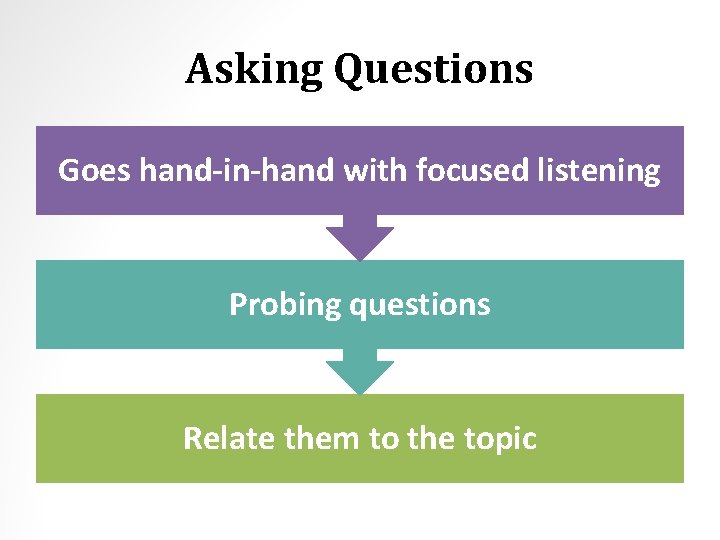
Asking Questions Goes hand-in-hand with focused listening Probing questions Relate them to the topic
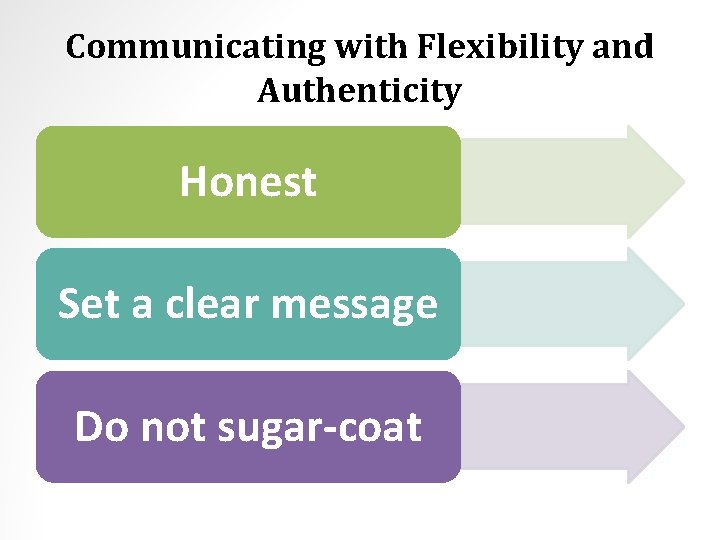
Communicating with Flexibility and Authenticity Honest Set a clear message Do not sugar-coat
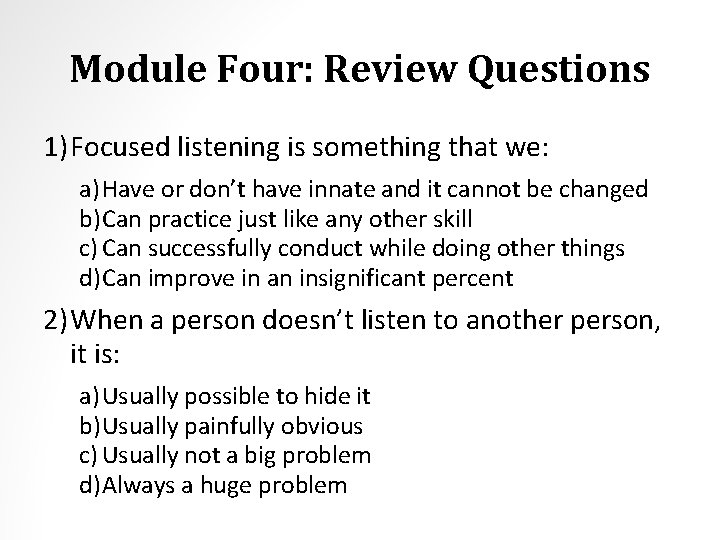
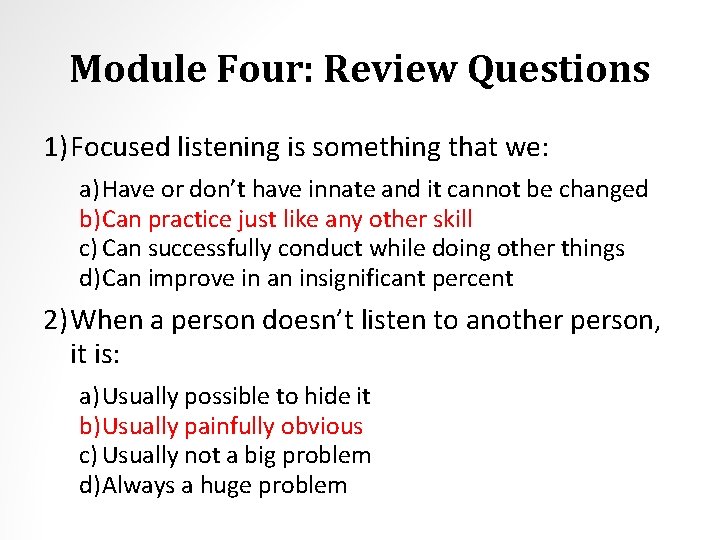
Module Four: Review Questions 1) Focused listening is something that we: a) Have or don’t have innate and it cannot be changed b)Can practice just like any other skill c) Can successfully conduct while doing other things d)Can improve in an insignificant percent 2) When a person doesn’t listen to another person, it is: a) Usually possible to hide it b)Usually painfully obvious c) Usually not a big problem d)Always a huge problem
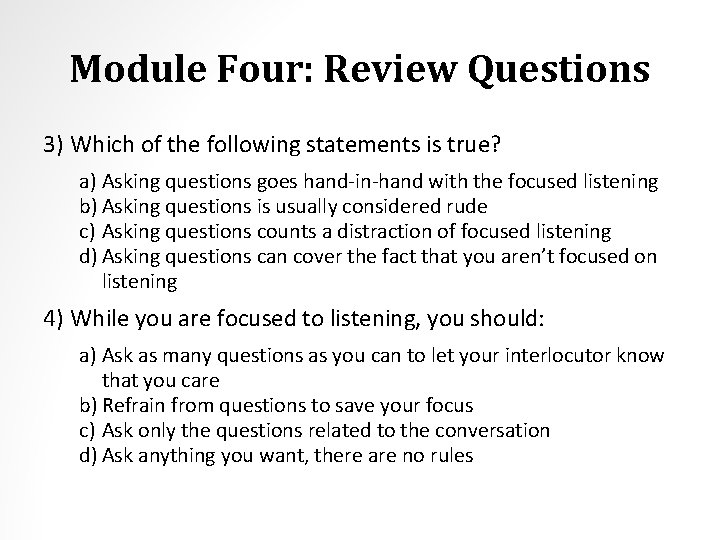
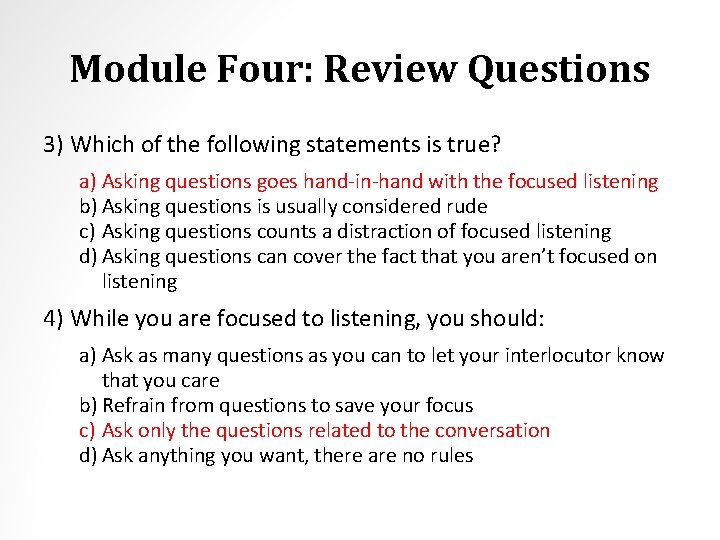
Module Four: Review Questions 3) Which of the following statements is true? a) Asking questions goes hand-in-hand with the focused listening b) Asking questions is usually considered rude c) Asking questions counts a distraction of focused listening d) Asking questions can cover the fact that you aren’t focused on listening 4) While you are focused to listening, you should: a) Ask as many questions as you can to let your interlocutor know that you care b) Refrain from questions to save your focus c) Ask only the questions related to the conversation d) Ask anything you want, there are no rules
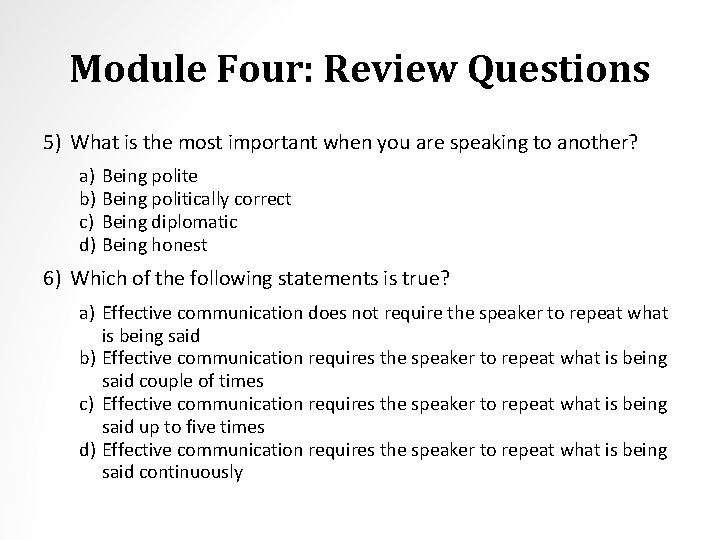
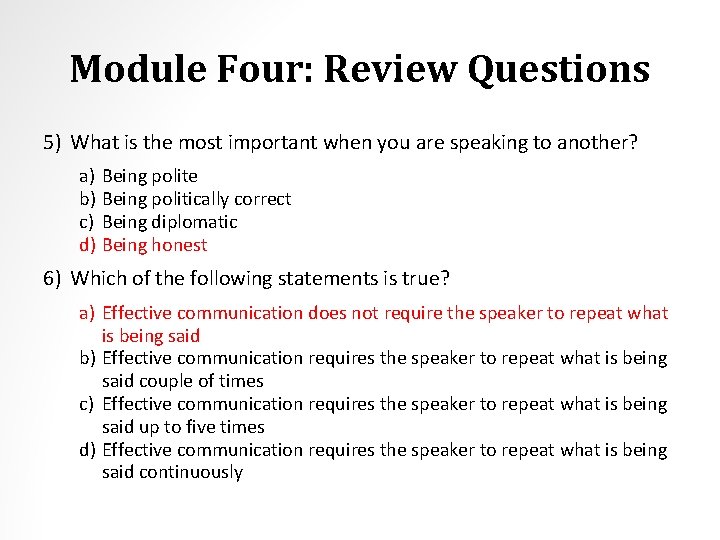
Module Four: Review Questions 5) What is the most important when you are speaking to another? a) Being polite b) Being politically correct c) Being diplomatic d) Being honest 6) Which of the following statements is true? a) Effective communication does not require the speaker to repeat what is being said b) Effective communication requires the speaker to repeat what is being said couple of times c) Effective communication requires the speaker to repeat what is being said up to five times d) Effective communication requires the speaker to repeat what is being said continuously
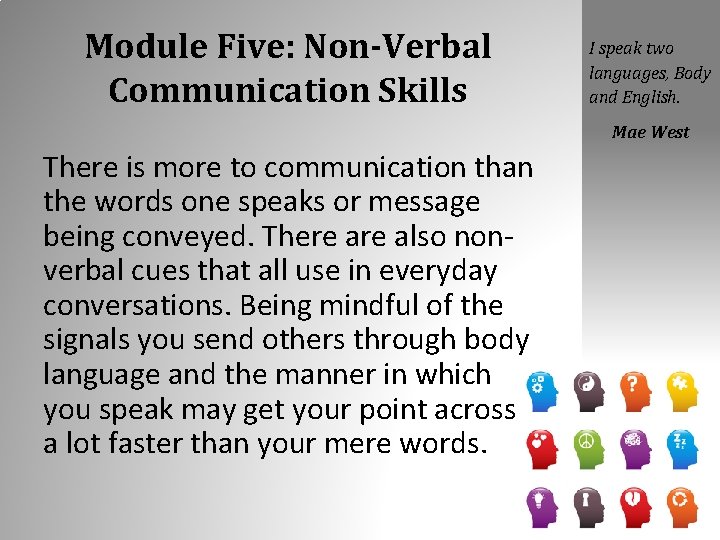
Module Five: Non-Verbal Communication Skills I speak two languages, Body and English. Mae West There is more to communication than the words one speaks or message being conveyed. There also nonverbal cues that all use in everyday conversations. Being mindful of the signals you send others through body language and the manner in which you speak may get your point across a lot faster than your mere words.
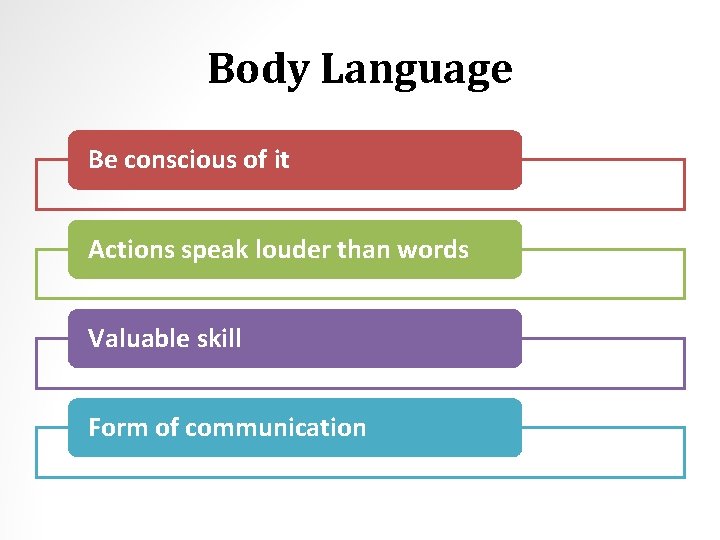
Body Language Be conscious of it Actions speak louder than words Valuable skill Form of communication
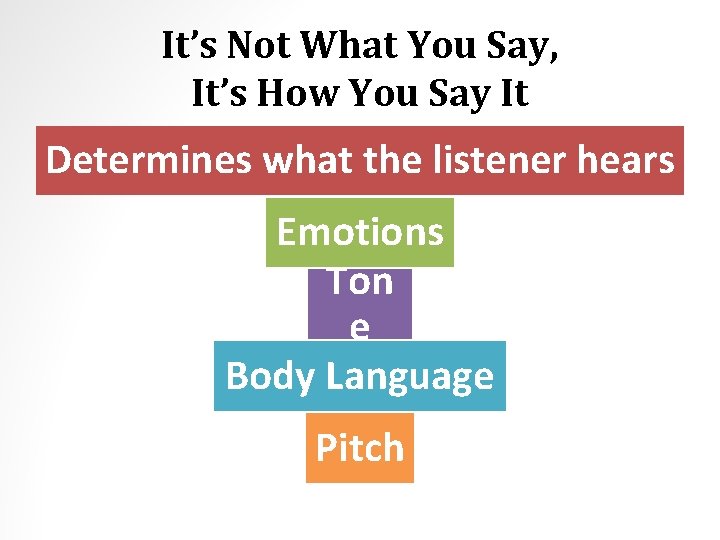
It’s Not What You Say, It’s How You Say It Determines what the listener hears Emotions Ton e Body Language Pitch
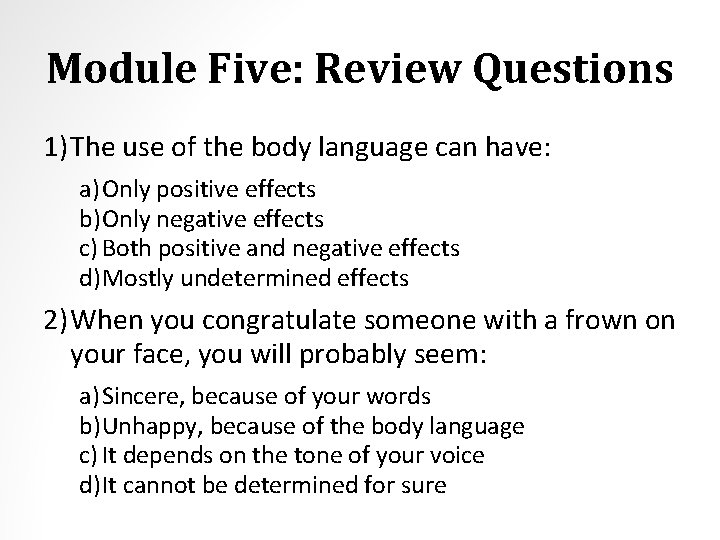
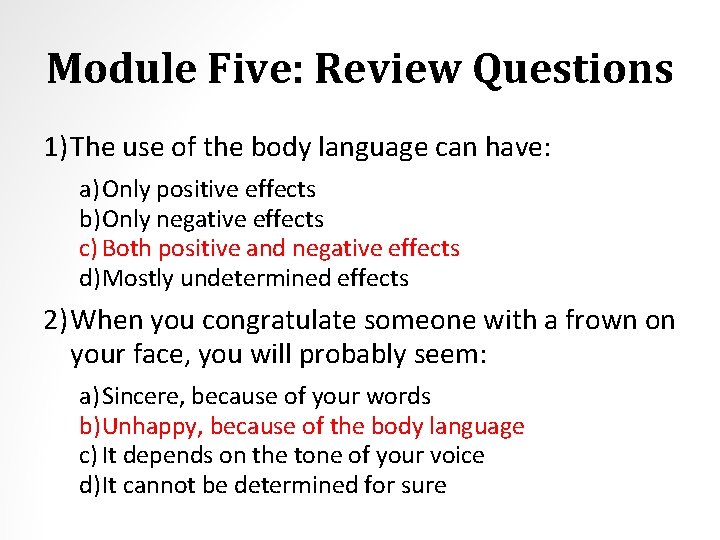
Module Five: Review Questions 1) The use of the body language can have: a) Only positive effects b)Only negative effects c) Both positive and negative effects d)Mostly undetermined effects 2) When you congratulate someone with a frown on your face, you will probably seem: a) Sincere, because of your words b)Unhappy, because of the body language c) It depends on the tone of your voice d)It cannot be determined for sure
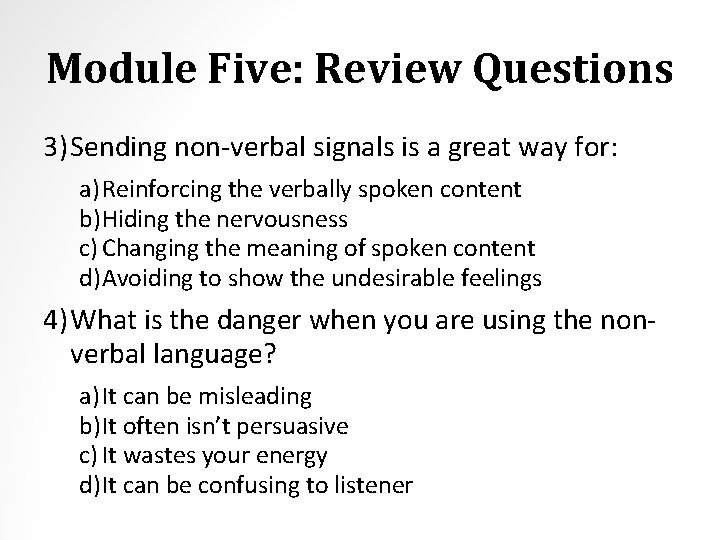
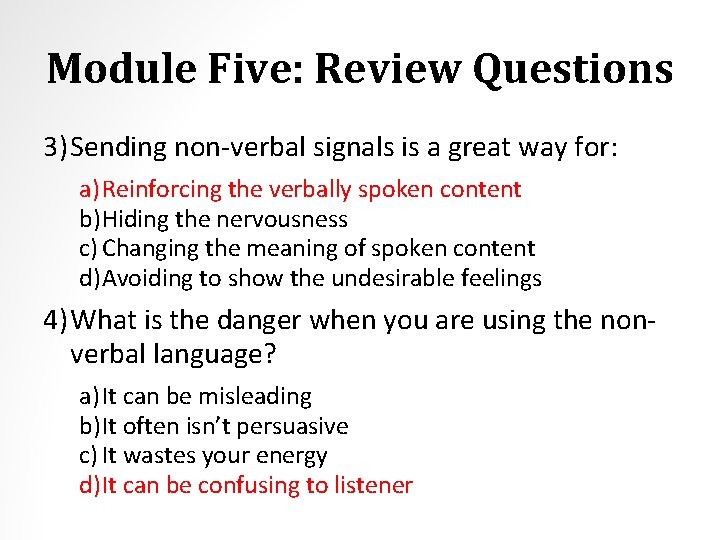
Module Five: Review Questions 3) Sending non-verbal signals is a great way for: a) Reinforcing the verbally spoken content b)Hiding the nervousness c) Changing the meaning of spoken content d)Avoiding to show the undesirable feelings 4) What is the danger when you are using the nonverbal language? a) It can be misleading b)It often isn’t persuasive c) It wastes your energy d)It can be confusing to listener
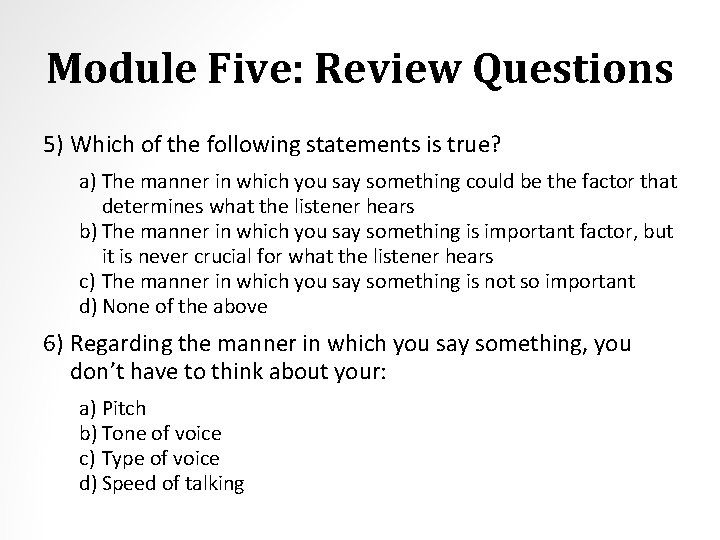
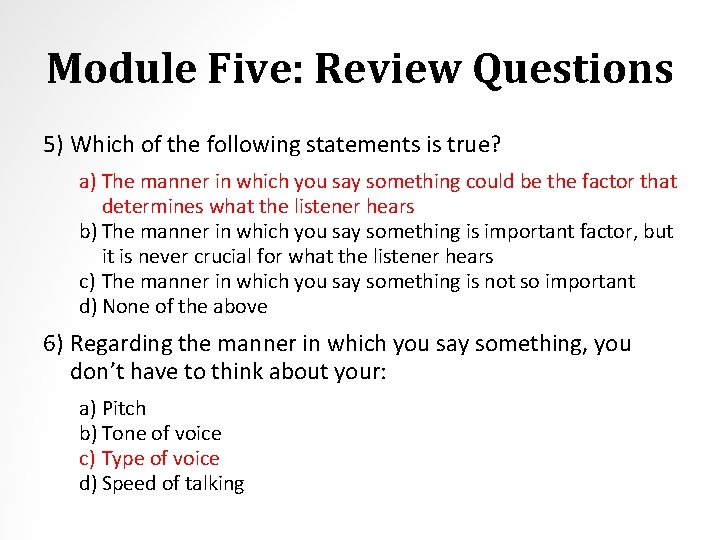
Module Five: Review Questions 5) Which of the following statements is true? a) The manner in which you say something could be the factor that determines what the listener hears b) The manner in which you say something is important factor, but it is never crucial for what the listener hears c) The manner in which you say something is not so important d) None of the above 6) Regarding the manner in which you say something, you don’t have to think about your: a) Pitch b) Tone of voice c) Type of voice d) Speed of talking
Module Six: Social Management and Responsibility The terms Social management and responsibility refer to a group or organization’s participation in environmental, ethical, and social issues outside of the organization itself. The greatest reward is to know that one can speak and emit articulate sounds and utter words that describe things, events and emotions. Camillo Jose Cela
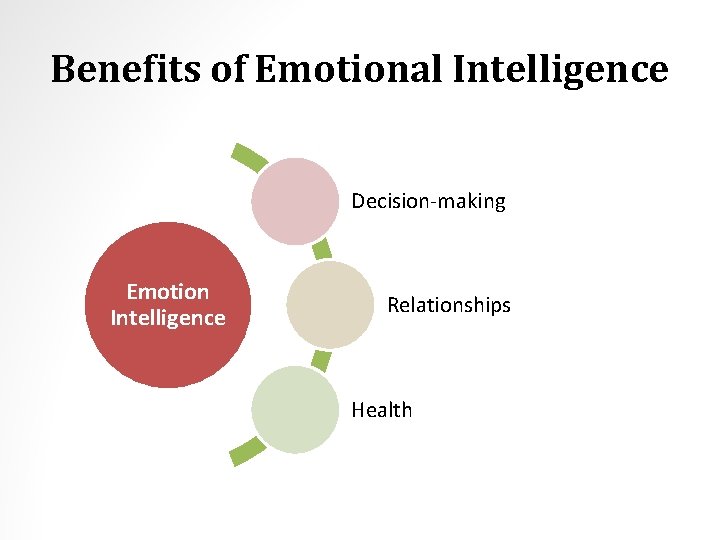
Benefits of Emotional Intelligence Decision-making Emotion Intelligence Relationships Health
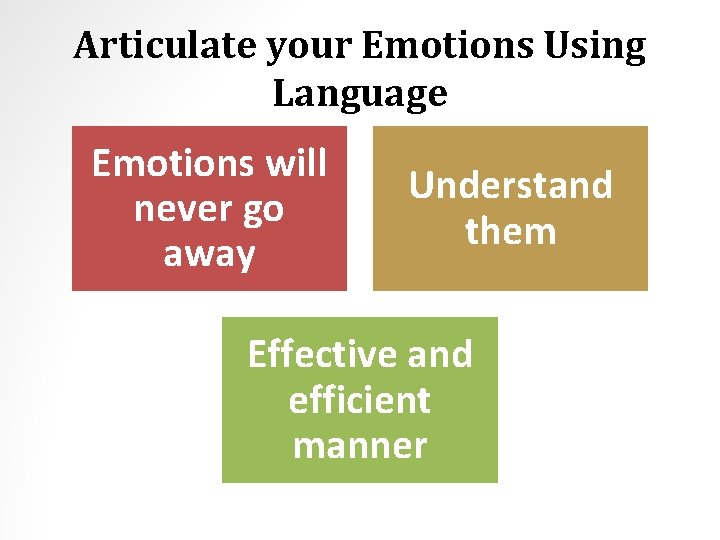
Articulate your Emotions Using Language Emotions will never go away Understand them Effective and efficient manner
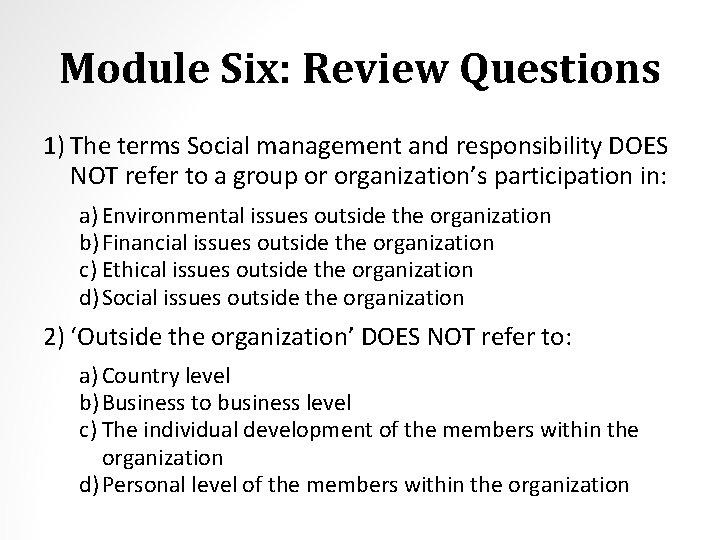
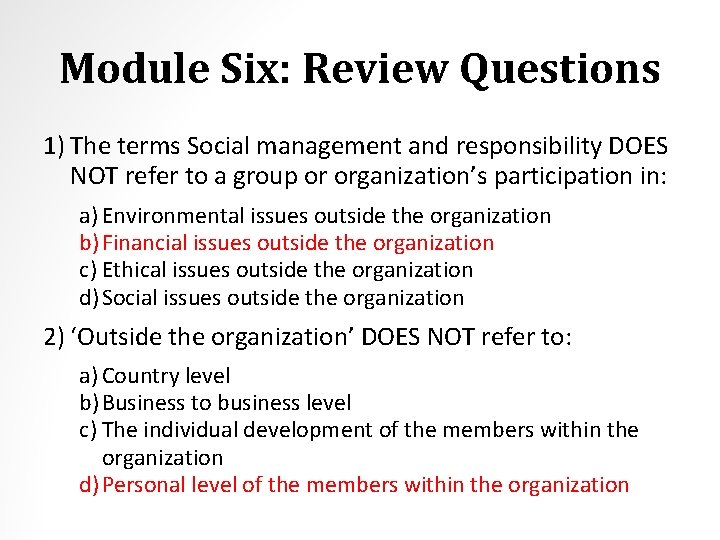
Module Six: Review Questions 1) The terms Social management and responsibility DOES NOT refer to a group or organization’s participation in: a) Environmental issues outside the organization b) Financial issues outside the organization c) Ethical issues outside the organization d) Social issues outside the organization 2) ‘Outside the organization’ DOES NOT refer to: a) Country level b) Business to business level c) The individual development of the members within the organization d) Personal level of the members within the organization
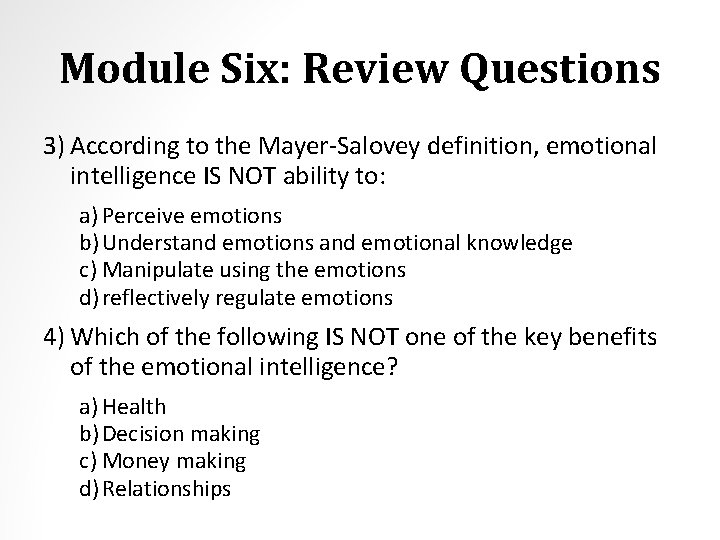
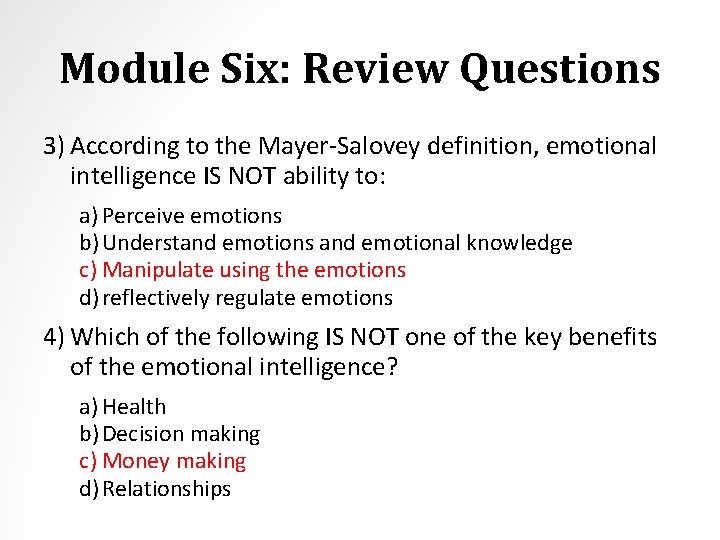
Module Six: Review Questions 3) According to the Mayer-Salovey definition, emotional intelligence IS NOT ability to: a) Perceive emotions b) Understand emotions and emotional knowledge c) Manipulate using the emotions d) reflectively regulate emotions 4) Which of the following IS NOT one of the key benefits of the emotional intelligence? a) Health b) Decision making c) Money making d) Relationships
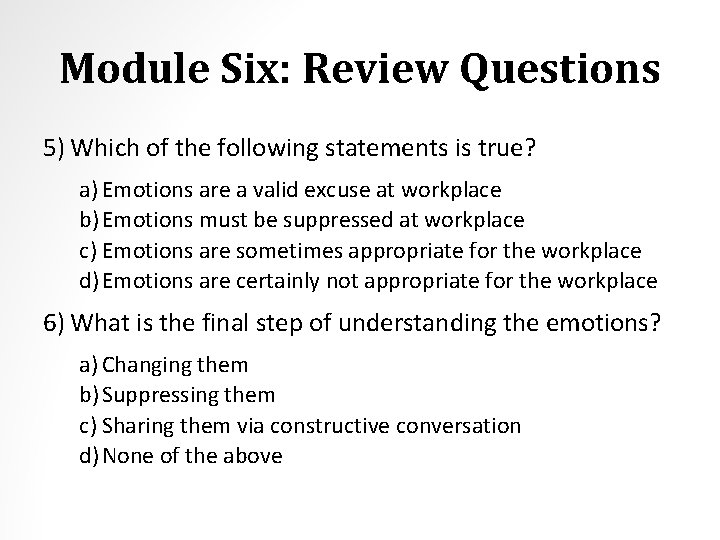
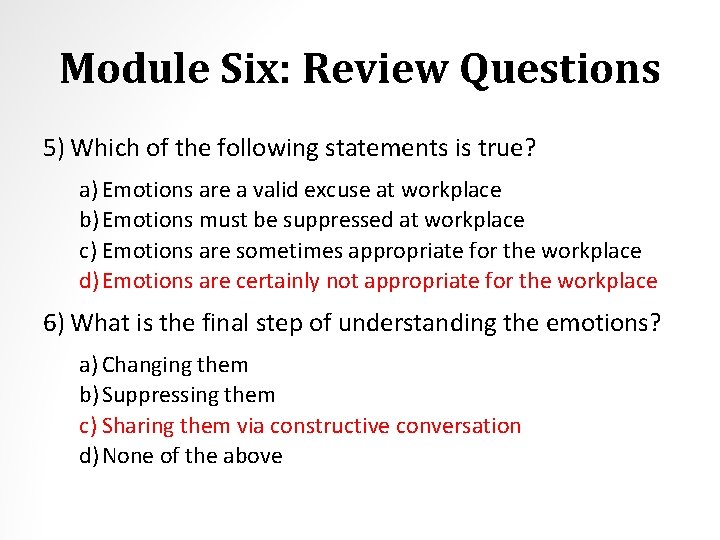
Module Six: Review Questions 5) Which of the following statements is true? a) Emotions are a valid excuse at workplace b) Emotions must be suppressed at workplace c) Emotions are sometimes appropriate for the workplace d) Emotions are certainly not appropriate for the workplace 6) What is the final step of understanding the emotions? a) Changing them b) Suppressing them c) Sharing them via constructive conversation d) None of the above
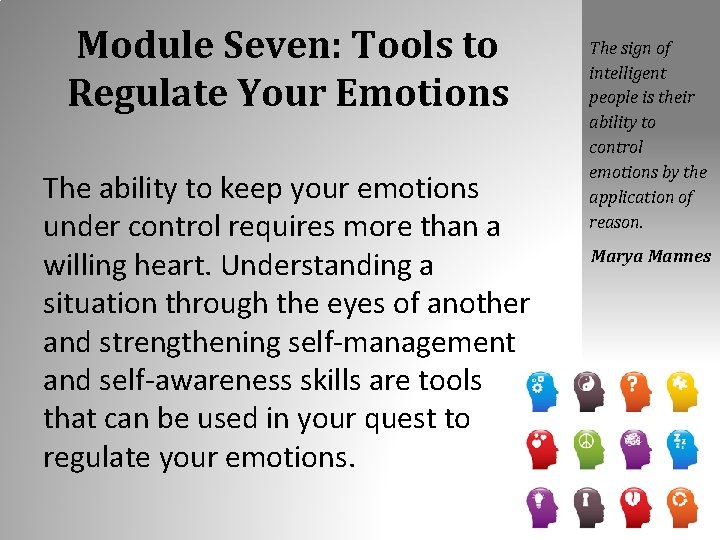
Module Seven: Tools to Regulate Your Emotions The ability to keep your emotions under control requires more than a willing heart. Understanding a situation through the eyes of another and strengthening self-management and self-awareness skills are tools that can be used in your quest to regulate your emotions. The sign of intelligent people is their ability to control emotions by the application of reason. Marya Mannes
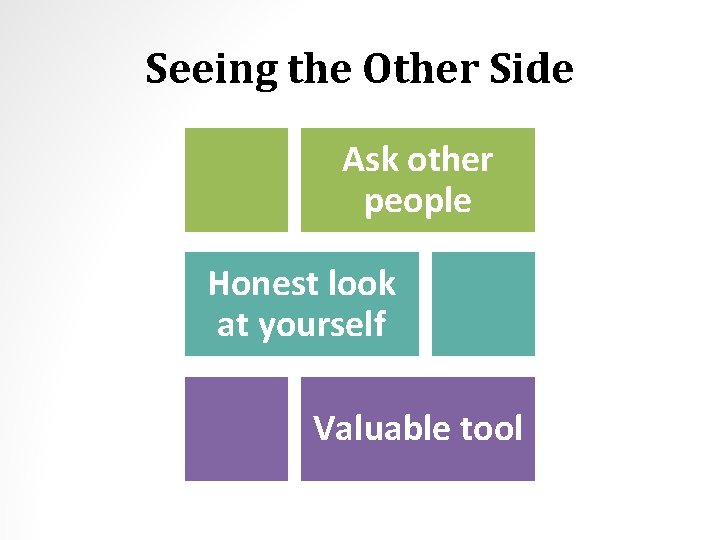
Seeing the Other Side Ask other people Honest look at yourself Valuable tool
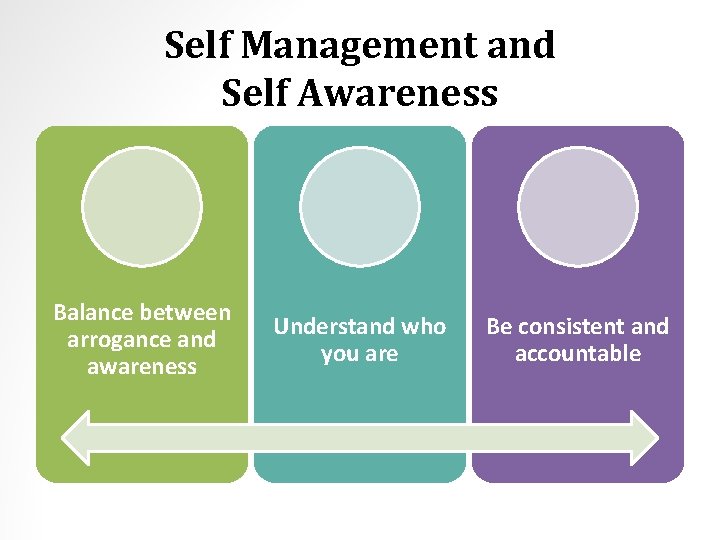
Self Management and Self Awareness Balance between arrogance and awareness Understand who you are Be consistent and accountable
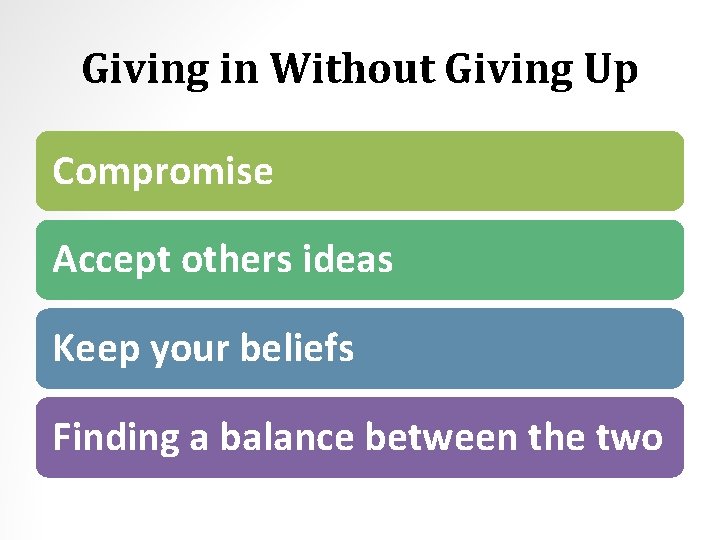
Giving in Without Giving Up Compromise Accept others ideas Keep your beliefs Finding a balance between the two
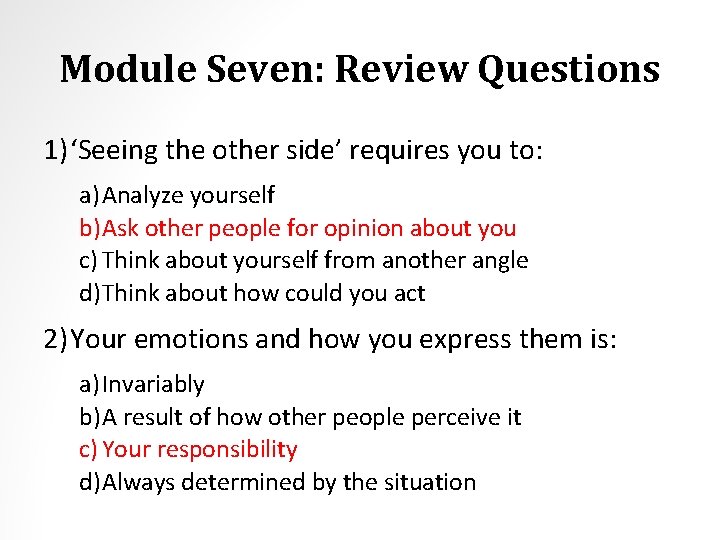
Module Seven: Review Questions 1) ‘Seeing the other side’ requires you to: a) Analyze yourself b)Ask other people for opinion about you c) Think about yourself from another angle d)Think about how could you act 2) Your emotions and how you express them is: a) Invariably b)A result of how other people perceive it c) Your responsibility d)Always determined by the situation
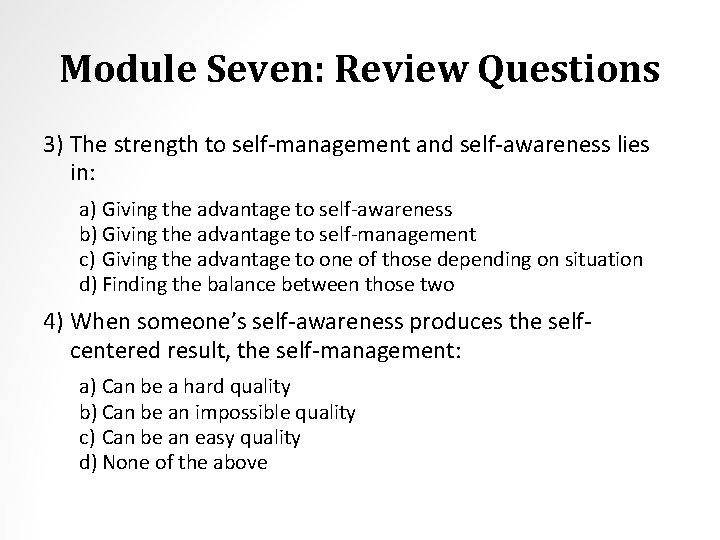
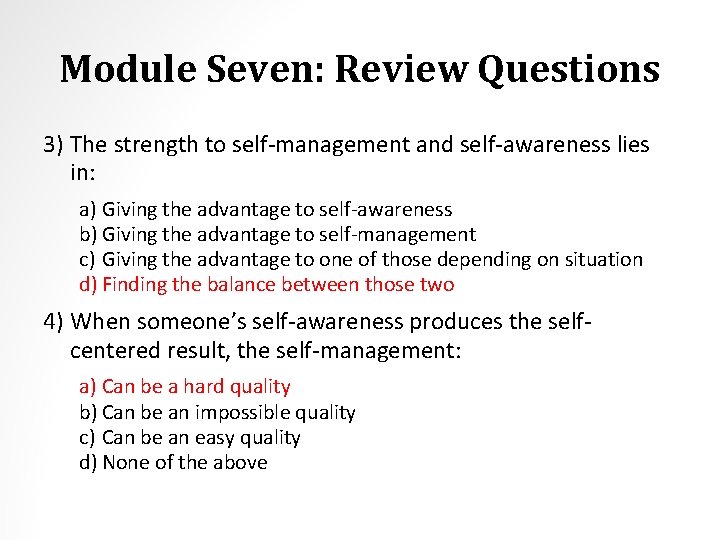
Module Seven: Review Questions 3) The strength to self-management and self-awareness lies in: a) Giving the advantage to self-awareness b) Giving the advantage to self-management c) Giving the advantage to one of those depending on situation d) Finding the balance between those two 4) When someone’s self-awareness produces the selfcentered result, the self-management: a) Can be a hard quality b) Can be an impossible quality c) Can be an easy quality d) None of the above
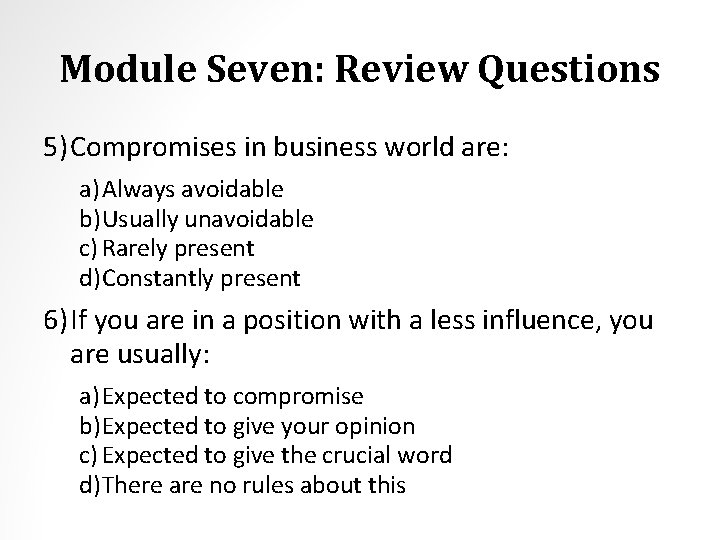
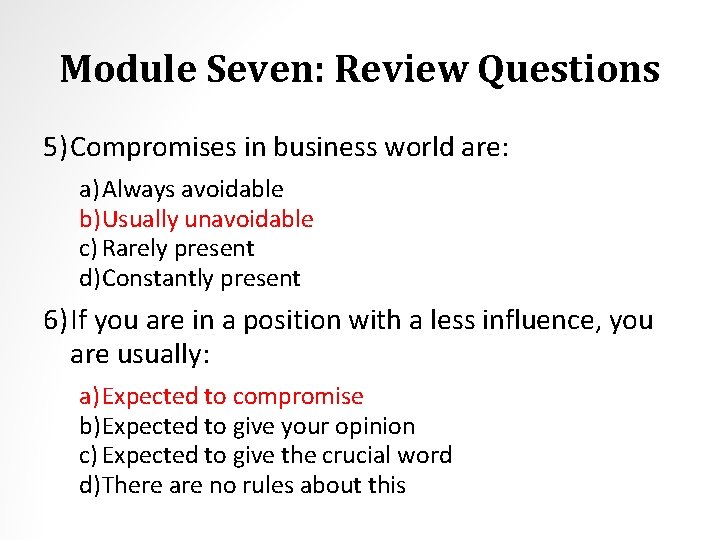
Module Seven: Review Questions 5) Compromises in business world are: a) Always avoidable b)Usually unavoidable c) Rarely present d)Constantly present 6) If you are in a position with a less influence, you are usually: a) Expected to compromise b)Expected to give your opinion c) Expected to give the crucial word d)There are no rules about this
Module Eight: Gaining Control Having control or the lack thereof could be the difference between building a successful career and no career at all. If you have control over these aspects of your life, pat yourself on the back No one can make you feel inferior without your consent. Eleanor Roosevelt
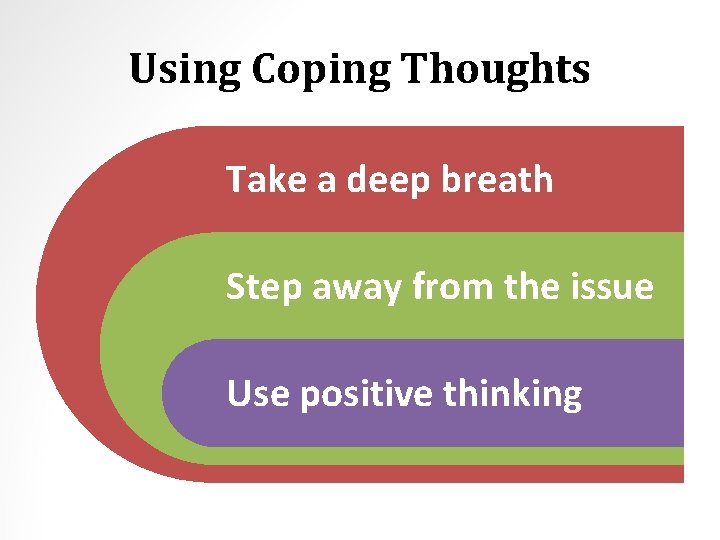
Using Coping Thoughts Take a deep breath Step away from the issue Use positive thinking
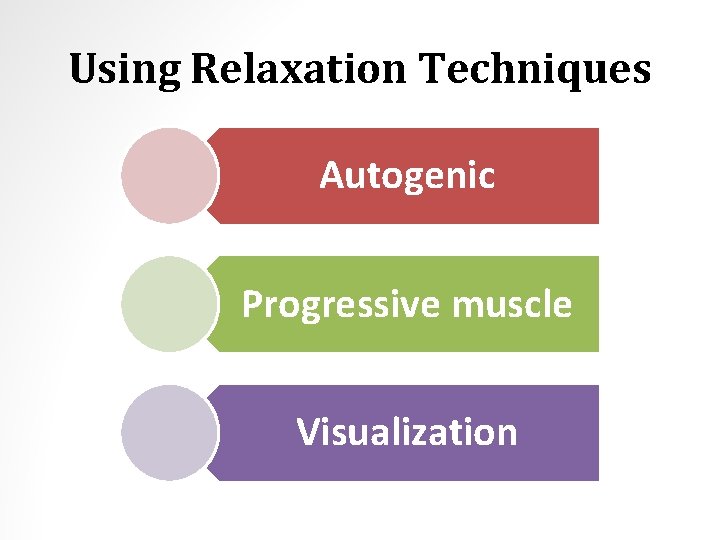
Using Relaxation Techniques Autogenic Progressive muscle Visualization
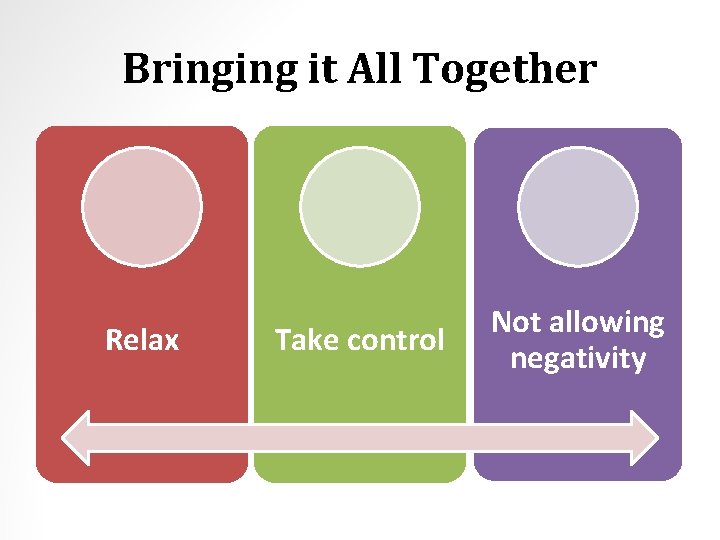
Bringing it All Together Relax Take control Not allowing negativity
Module Eight: Review Questions 1) Which of the following IS NOT one of the advices for coping situations: a) Taking a deep breath b) Using positive thinking c) Stepping away from the issue d) Delaying involvement in such situations 2) Which of the following statements IS NOT true? a) The control a company has is equally important as the control an individual has over oneself b) Having control could be the difference between building a successful career and no career at all c) Even if the situation requires you to physically act, you have to be focused on your thoughts d) All the statements above are true
Module Eight: Review Questions 3) The relaxation techniques DO NOT reduce stress symptoms by: a) Boosting confidence to handle problems b) Distracting your mind from the problems c) Improving concentration d) Reducing muscle tension and chronic pain 4) Which of the following IS NOT one of the common types of relaxation techniques? a) Autogenic b) Visualization c) Heterogenic d) Progressive muscle
Module Eight: Review Questions 5) If you have mastered the coping with difficult situations, it: a) May not be necessary to engage in relaxation techniques b) Is necessary to engage in relaxation techniques occasionally c) Is still necessary to engage in relaxation techniques d) Is highly required to engage in relaxation techniques 6) What is the ultimate goal in dealing with everyday working situations? a) Being right b) Avoiding problems c) Avoiding negativity d) Suppressing problems
Module Nine: Business Practices (I) There is more to the workplace than the business itself. An employee’s makeup, which is emotions and their ability to manage them, level of Emotional Intelligence and communication skills are all a part of whether or not a business is successful. It is very important to understand that emotional intelligence is not the opposite of intelligence, it is not the triumph of heart over head— it is the unique intersection of both. David Caruso
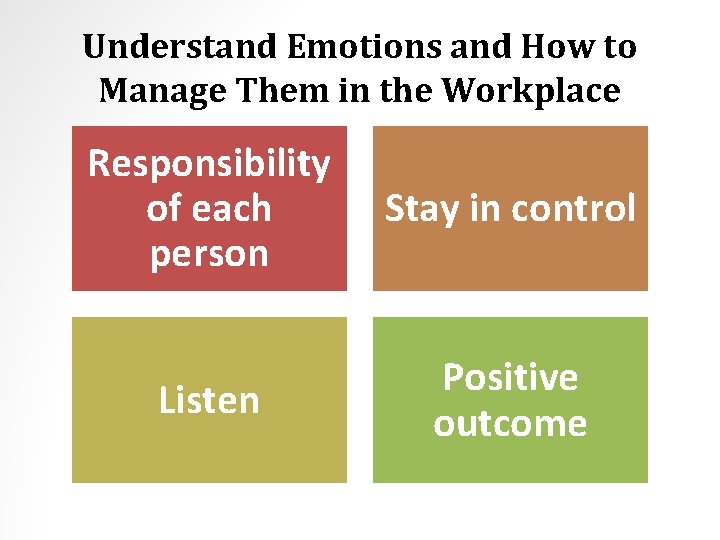
Understand Emotions and How to Manage Them in the Workplace Responsibility of each person Stay in control Listen Positive outcome
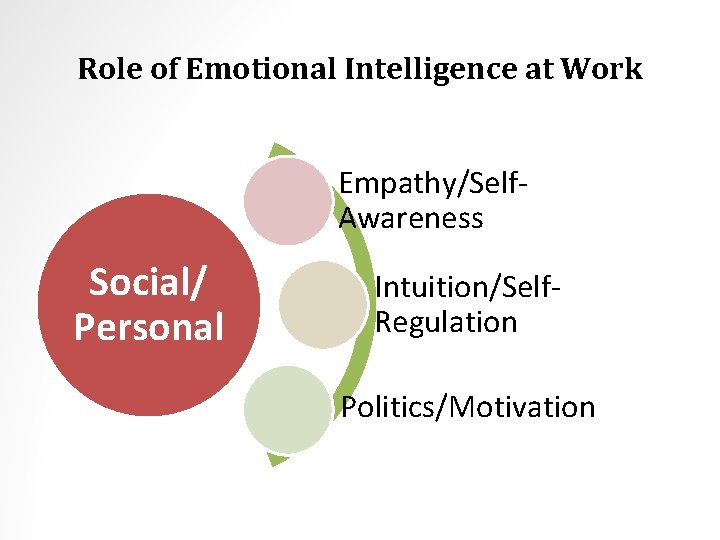
Role of Emotional Intelligence at Work Empathy/Self. Awareness Social/ Personal Intuition/Self. Regulation Politics/Motivation
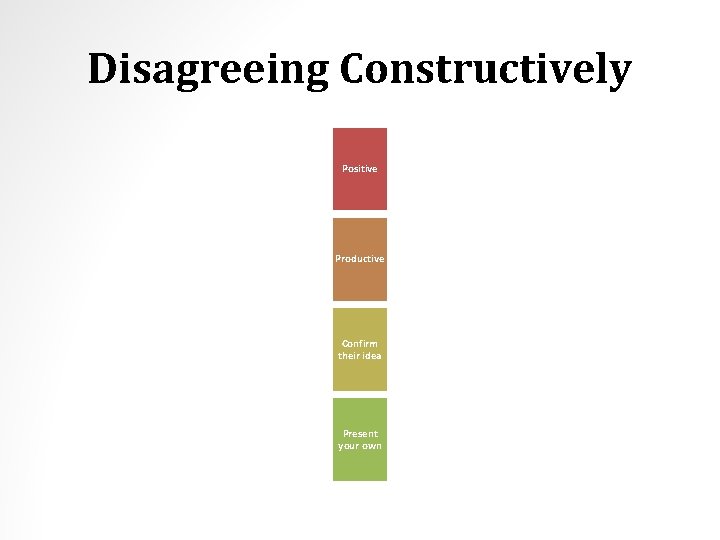
Disagreeing Constructively Positive Productive Confirm their idea Present your own
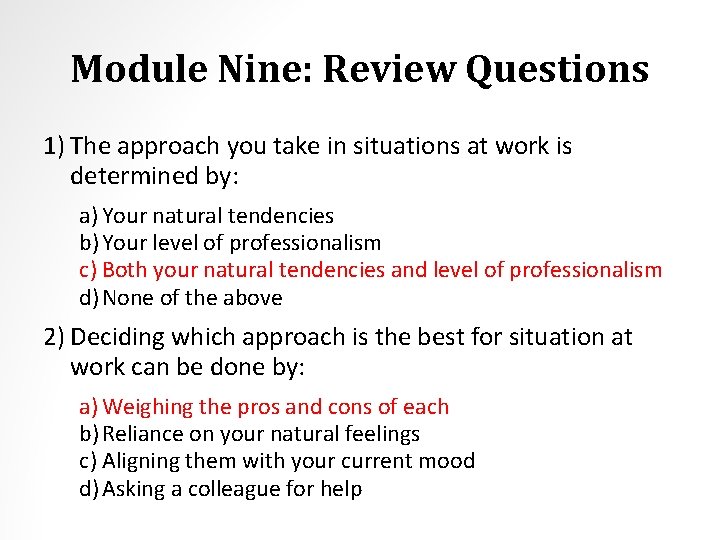
Module Nine: Review Questions 1) The approach you take in situations at work is determined by: a) Your natural tendencies b) Your level of professionalism c) Both your natural tendencies and level of professionalism d) None of the above 2) Deciding which approach is the best for situation at work can be done by: a) Weighing the pros and cons of each b) Reliance on your natural feelings c) Aligning them with your current mood d) Asking a colleague for help
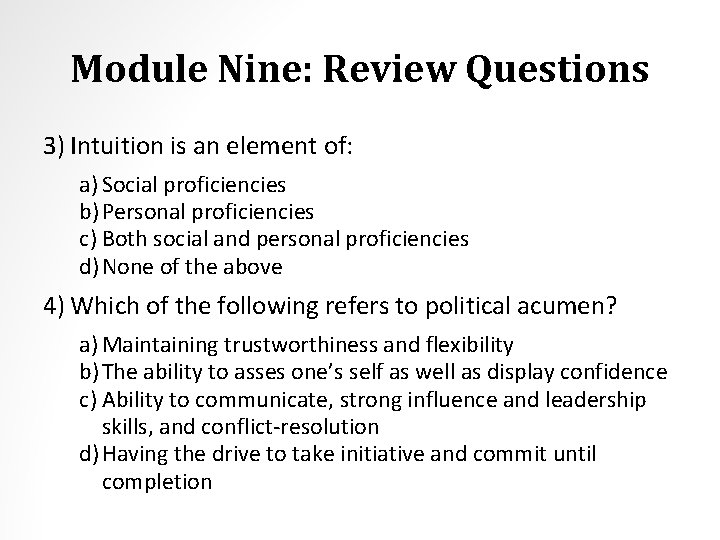
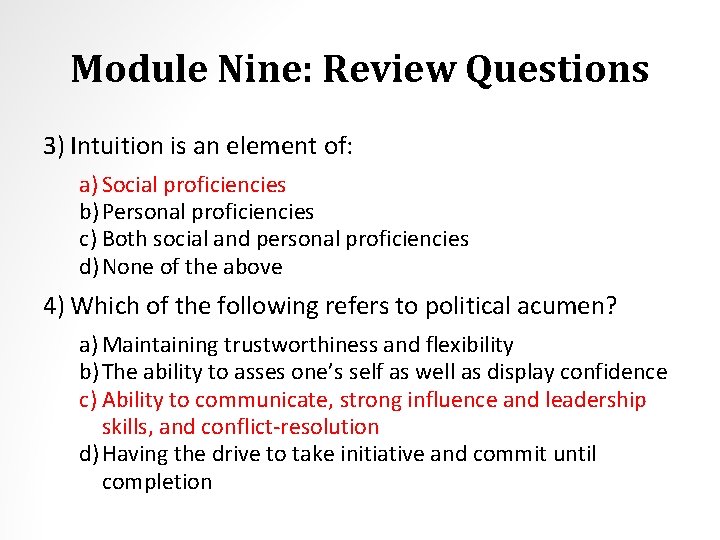
Module Nine: Review Questions 3) Intuition is an element of: a) Social proficiencies b) Personal proficiencies c) Both social and personal proficiencies d) None of the above 4) Which of the following refers to political acumen? a) Maintaining trustworthiness and flexibility b) The ability to asses one’s self as well as display confidence c) Ability to communicate, strong influence and leadership skills, and conflict-resolution d) Having the drive to take initiative and commit until completion
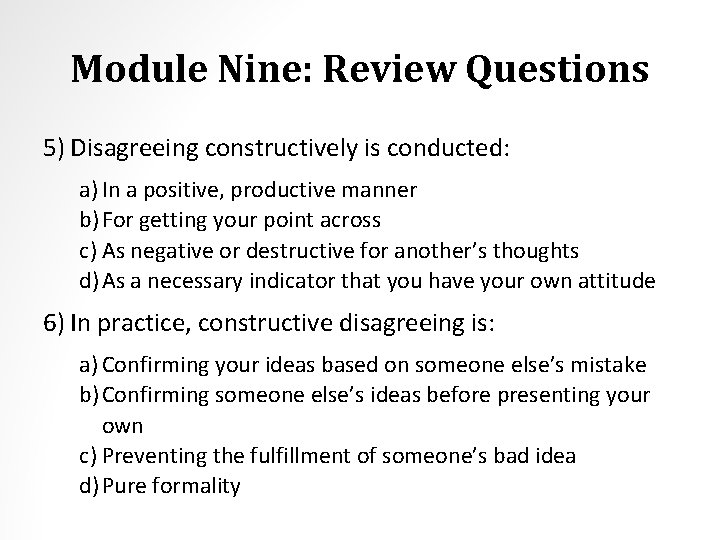
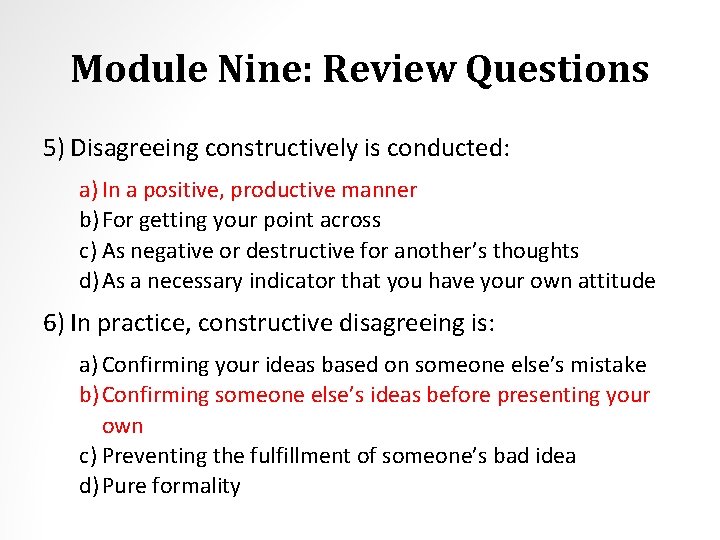
Module Nine: Review Questions 5) Disagreeing constructively is conducted: a) In a positive, productive manner b) For getting your point across c) As negative or destructive for another’s thoughts d) As a necessary indicator that you have your own attitude 6) In practice, constructive disagreeing is: a) Confirming your ideas based on someone else’s mistake b) Confirming someone else’s ideas before presenting your own c) Preventing the fulfillment of someone’s bad idea d) Pure formality
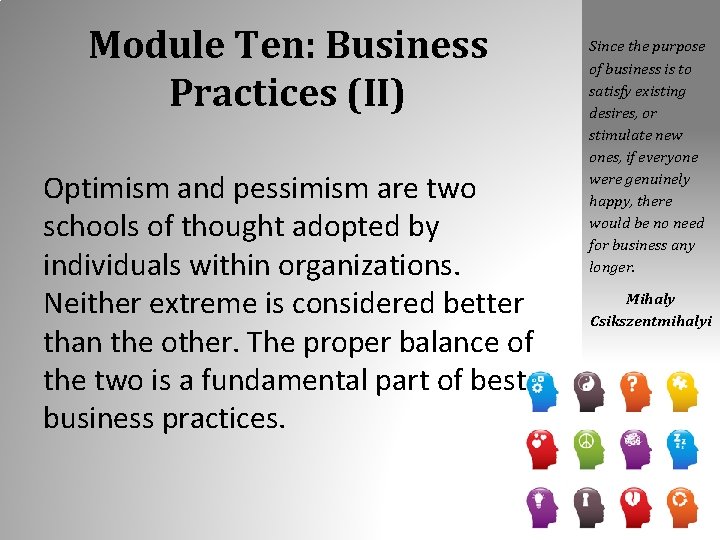
Module Ten: Business Practices (II) Optimism and pessimism are two schools of thought adopted by individuals within organizations. Neither extreme is considered better than the other. The proper balance of the two is a fundamental part of best business practices. Since the purpose of business is to satisfy existing desires, or stimulate new ones, if everyone were genuinely happy, there would be no need for business any longer. Mihaly Csikszentmihalyi
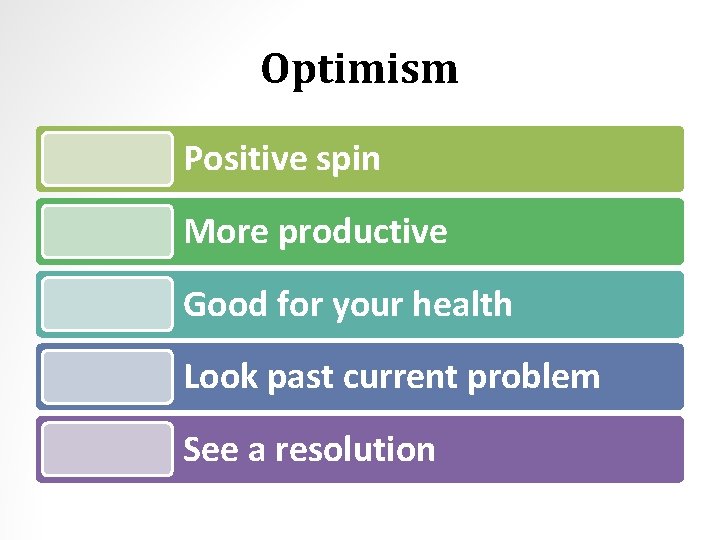
Optimism Positive spin More productive Good for your health Look past current problem See a resolution
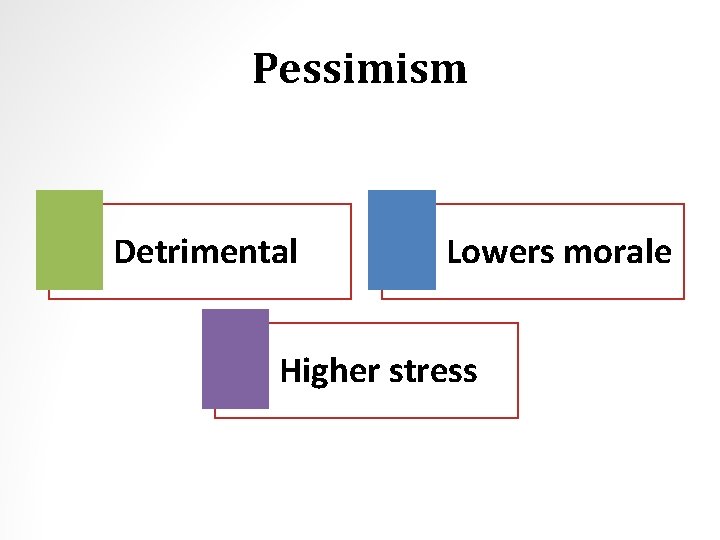
Pessimism Detrimental Lowers morale Higher stress
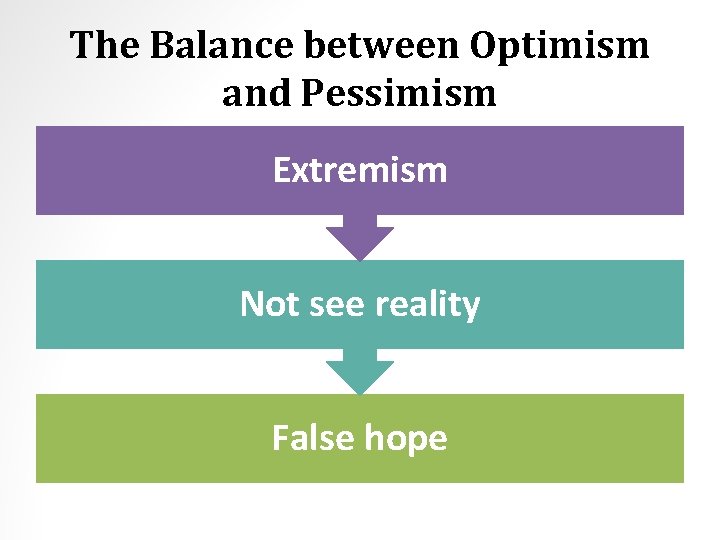
The Balance between Optimism and Pessimism Extremism Not see reality False hope
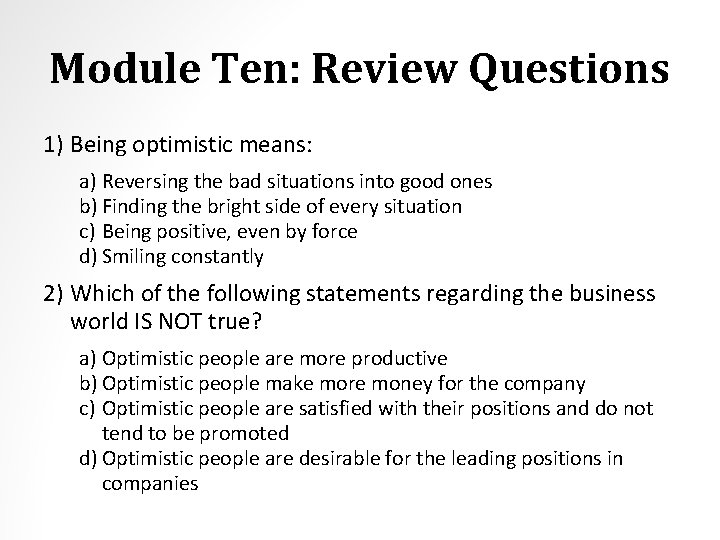
Module Ten: Review Questions 1) Being optimistic means: a) Reversing the bad situations into good ones b) Finding the bright side of every situation c) Being positive, even by force d) Smiling constantly 2) Which of the following statements regarding the business world IS NOT true? a) Optimistic people are more productive b) Optimistic people make more money for the company c) Optimistic people are satisfied with their positions and do not tend to be promoted d) Optimistic people are desirable for the leading positions in companies
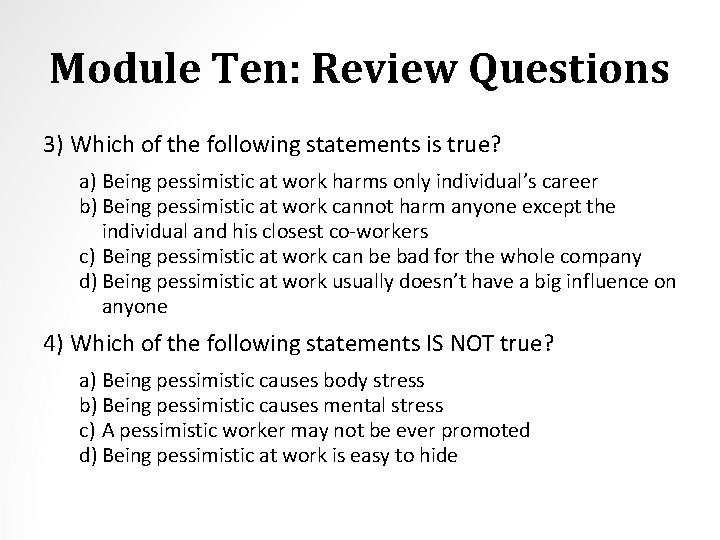
Module Ten: Review Questions 3) Which of the following statements is true? a) Being pessimistic at work harms only individual’s career b) Being pessimistic at work cannot harm anyone except the individual and his closest co-workers c) Being pessimistic at work can be bad for the whole company d) Being pessimistic at work usually doesn’t have a big influence on anyone 4) Which of the following statements IS NOT true? a) Being pessimistic causes body stress b) Being pessimistic causes mental stress c) A pessimistic worker may not be ever promoted d) Being pessimistic at work is easy to hide
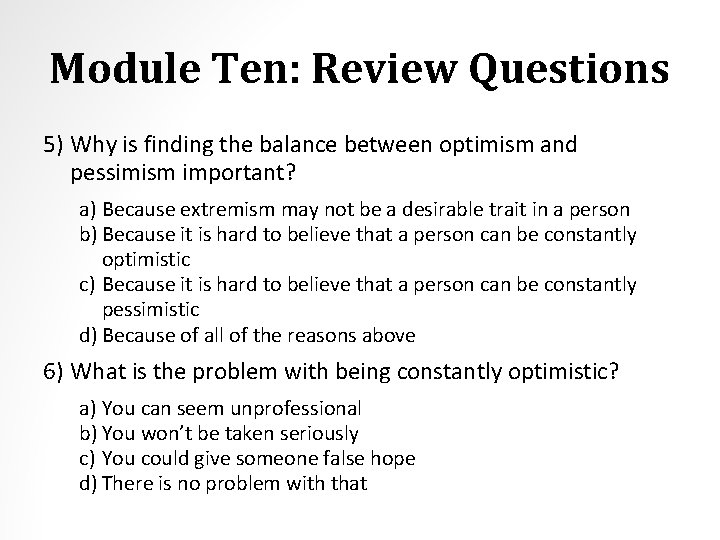
Module Ten: Review Questions 5) Why is finding the balance between optimism and pessimism important? a) Because extremism may not be a desirable trait in a person b) Because it is hard to believe that a person can be constantly optimistic c) Because it is hard to believe that a person can be constantly pessimistic d) Because of all of the reasons above 6) What is the problem with being constantly optimistic? a) You can seem unprofessional b) You won’t be taken seriously c) You could give someone false hope d) There is no problem with that
Module Eleven: Making an Impact There are opportunities we face each day that allow us to make an impact on the lives of others. How we impact others is up to us. It requires a conscious effort on our part to decide if we are going to leave a legacy of good or bad. It’s easy to make a buck. It’s a lot tougher to make a difference. Tom Brokaw
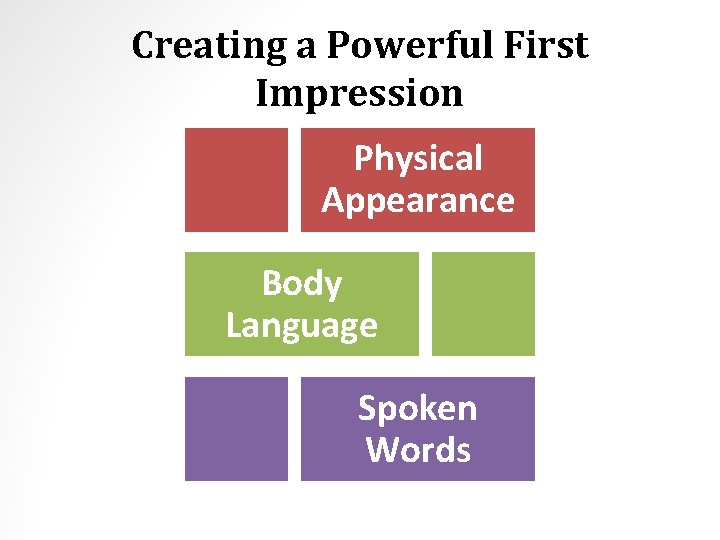
Creating a Powerful First Impression Physical Appearance Body Language Spoken Words
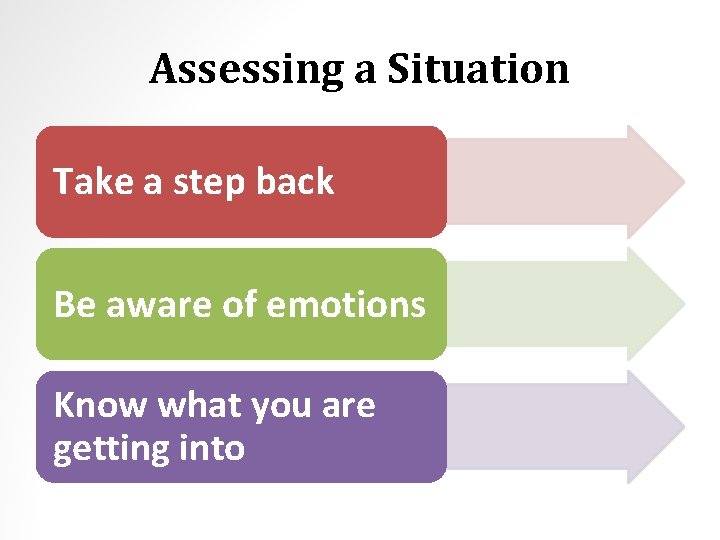
Assessing a Situation Take a step back Be aware of emotions Know what you are getting into
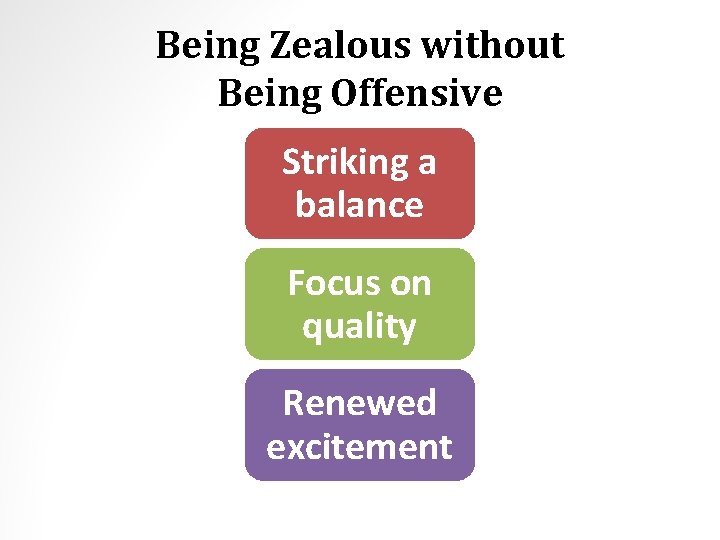
Being Zealous without Being Offensive Striking a balance Focus on quality Renewed excitement
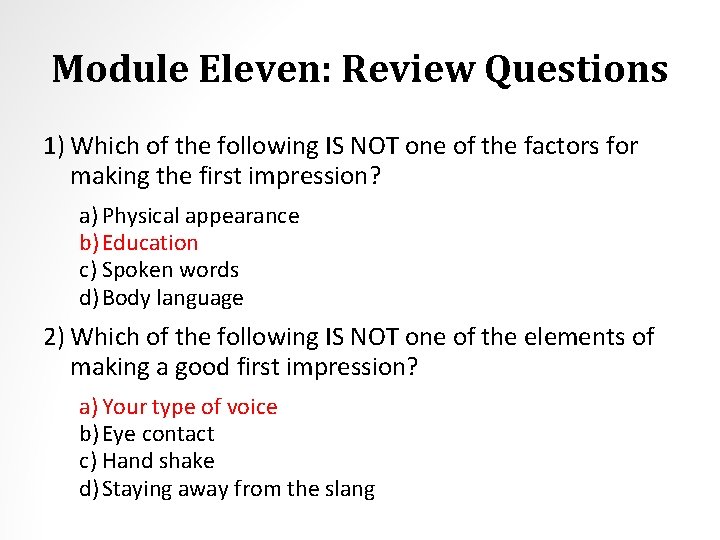
Module Eleven: Review Questions 1) Which of the following IS NOT one of the factors for making the first impression? a) Physical appearance b) Education c) Spoken words d) Body language 2) Which of the following IS NOT one of the elements of making a good first impression? a) Your type of voice b) Eye contact c) Hand shake d) Staying away from the slang
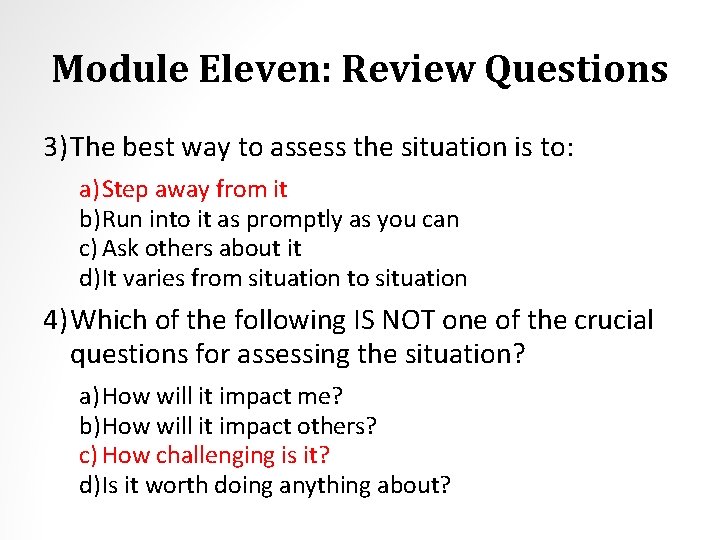
Module Eleven: Review Questions 3) The best way to assess the situation is to: a) Step away from it b)Run into it as promptly as you can c) Ask others about it d)It varies from situation to situation 4) Which of the following IS NOT one of the crucial questions for assessing the situation? a) How will it impact me? b)How will it impact others? c) How challenging is it? d)Is it worth doing anything about?
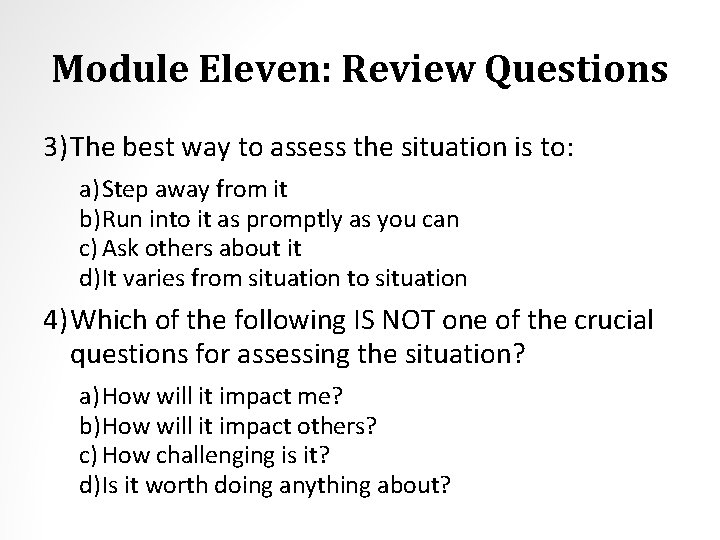
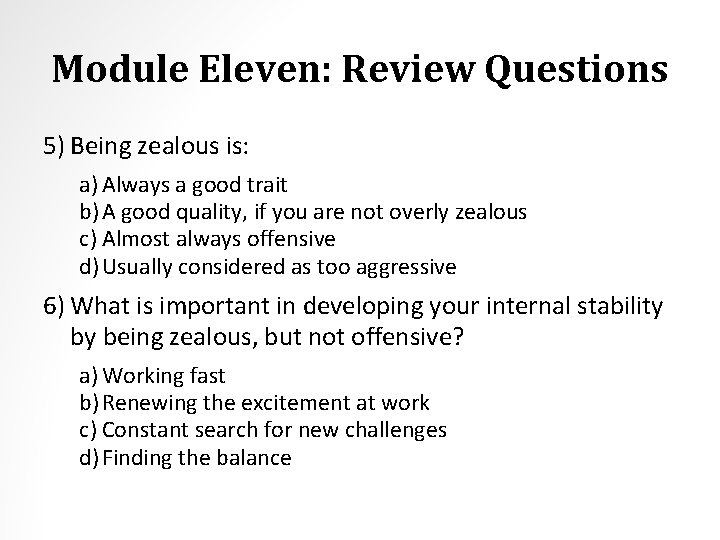
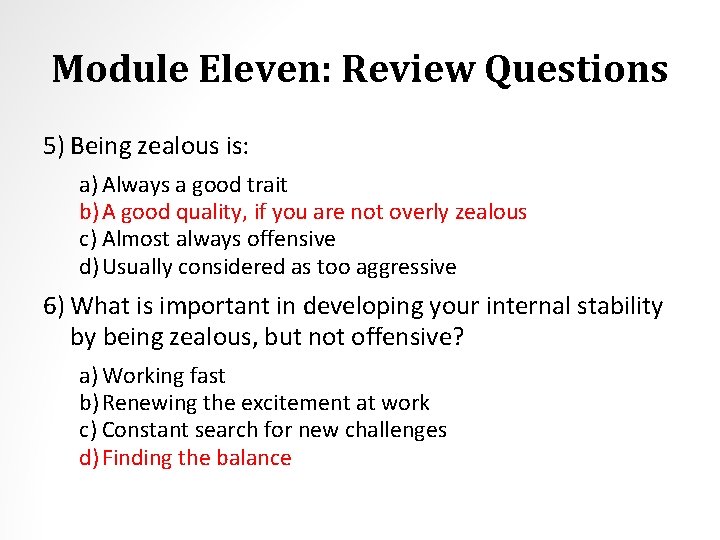
Module Eleven: Review Questions 5) Being zealous is: a) Always a good trait b) A good quality, if you are not overly zealous c) Almost always offensive d) Usually considered as too aggressive 6) What is important in developing your internal stability by being zealous, but not offensive? a) Working fast b) Renewing the excitement at work c) Constant search for new challenges d) Finding the balance
Module Twelve: Wrapping Up Please take a moment to review and update your action plan. This will be a key tool to guide your progress in the days, weeks, months, and years to come. We wish you the best of luck on the rest of your travels! Whatever is begun in anger, ends in shame. Benjamin Franklin
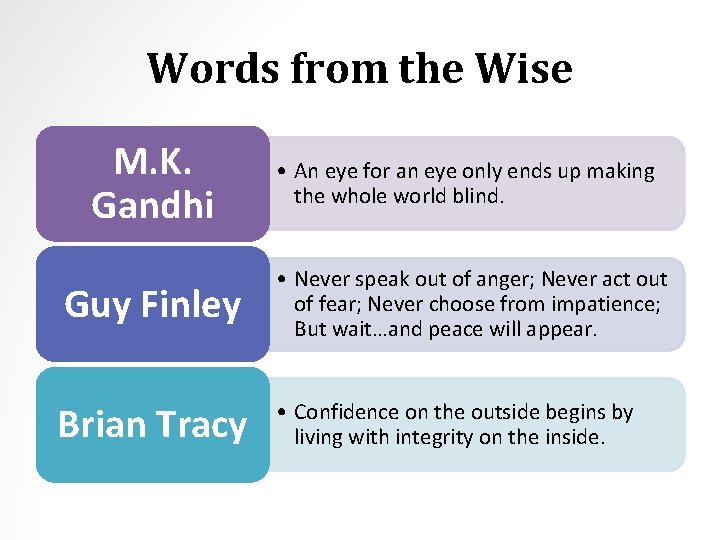
Words from the Wise M. K. Gandhi • An eye for an eye only ends up making the whole world blind. Guy Finley • Never speak out of anger; Never act out of fear; Never choose from impatience; But wait…and peace will appear. Brian Tracy • Confidence on the outside begins by living with integrity on the inside.