Trauma Sensitive Schools and Social and Emotional Learning

- Slides: 45
Trauma Sensitive Schools and Social and Emotional Learning: Universal Approaches to Student Wellness Julie Incitti, MSW, CAPSW School Social Work Consultant 2019
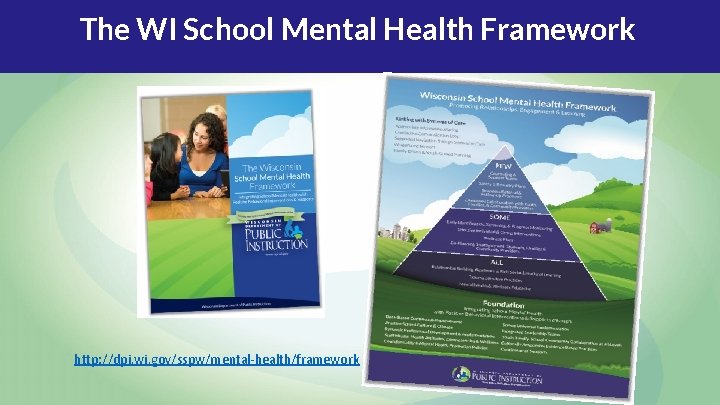
The WI School Mental Health Framework http: //dpi. wi. gov/sspw/mental-health/framework
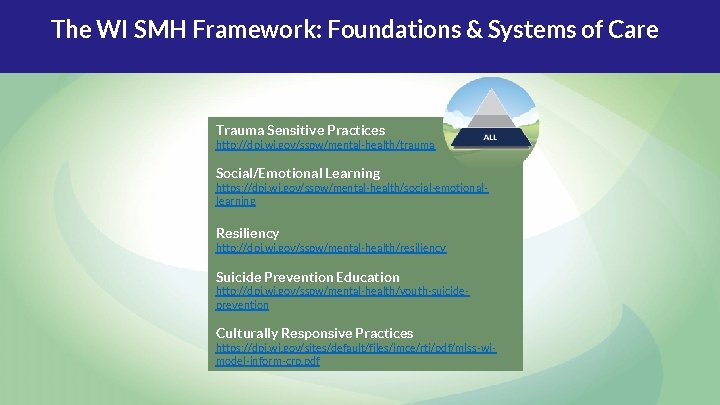
The WI SMH Framework: Foundations & Systems of Care Trauma Sensitive Practices http: //dpi. wi. gov/sspw/mental-health/trauma Social/Emotional Learning https: //dpi. wi. gov/sspw/mental-health/social-emotionallearning Resiliency http: //dpi. wi. gov/sspw/mental-health/resiliency Suicide Prevention Education http: //dpi. wi. gov/sspw/mental-health/youth-suicideprevention Culturally Responsive Practices https: //dpi. wi. gov/sites/default/files/imce/rti/pdf/mlss-wimodel-inform-crp. pdf
What We Know About Learning 1. The brain never stops growing, changing, responding to interaction and environments a. Effective learning happens i. in caring relationships ii. when physically and emotionally safe iii. when sense of belonging, connection, engagement iv. when opportunities for challenge, failure, and success are plentiful 2. Individuals learn skills and concepts in different ways at different times 3. Positive, stable relationships can buffer the potentially negative effects of even serious adversity (Linda Darling-Hammond and Channa M. Cook-Harvey, Educating the Whole Child: Improving School Climate to Support Student Success, Learning Policy Institute, 2018 https: //learningpolicyinstitute. org/sites/default/files/product-files/Educating_Whole_Child_REPORT. pdf )
What We Know About Learning (cont) 4. Adversity affects learning and the philosophy, policies, and interventions schools employ make a difference 5. Emotions and social relationships affect learning a. Interest and excitement increase learning b. Fear, anxiety, self doubt reduce learning c. Positive social and emotional skills that build on a foundation of empathy and self awareness contribute to relationships, safe environments and learning 6. Learning is increased with hands-on learning, skill practice, goal setting, and a sense of mastery (Linda Darling-Hammond and Channa M. Cook-Harvey, Educating the Whole Child: Improving School Climate to Support Student Success, Learning Policy Institute, 2018 https: //learningpolicyinstitute. org/sites/default/files/productfiles/Educating_Whole_Child_REPORT. pdf)
Trauma 1. Exposure to an event that threatens or harms the physical or emotional integrity of the individual or someone close to the individual 2. Overwhelms the person’s ability to respond 3. Creates significant difficulty in functioning Tim Grove, Saint. A (2010)
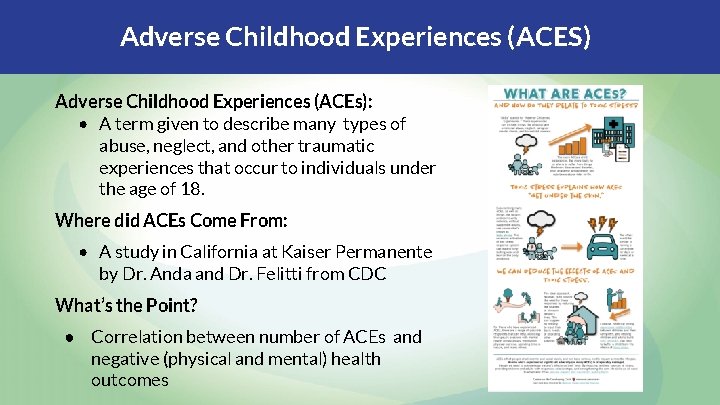
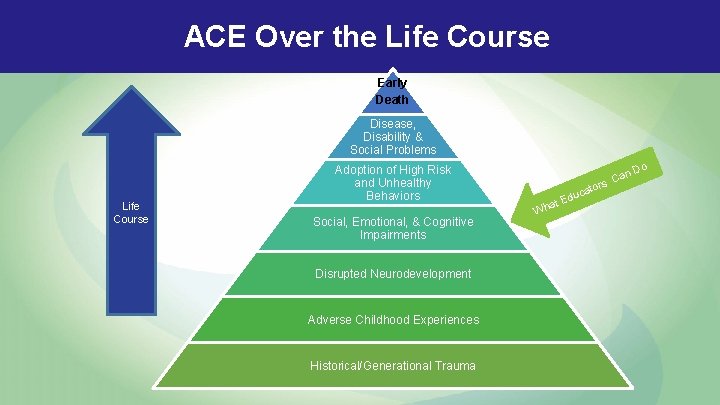
Adverse Childhood Experiences (ACES) Adverse Childhood Experiences (ACEs): • A term given to describe many types of abuse, neglect, and other traumatic experiences that occur to individuals under the age of 18. Where did ACEs Come From: • A study in California at Kaiser Permanente by Dr. Anda and Dr. Felitti from CDC What’s the Point? ● Correlation between number of ACEs and negative (physical and mental) health outcomes
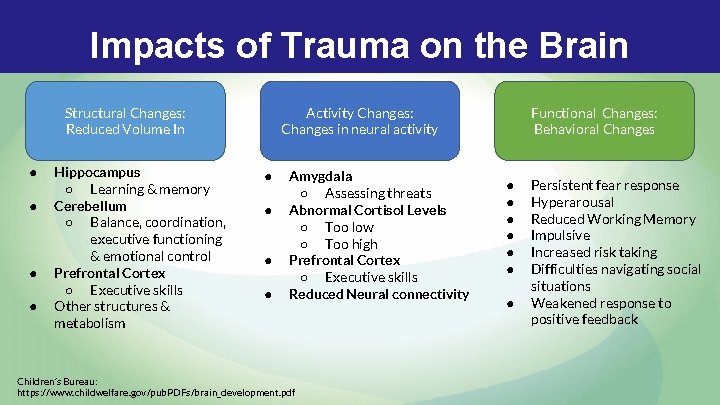
Impacts of Trauma on the Brain Structural Changes: Reduced Volume In ● ● Hippocampus ○ Learning & memory Cerebellum ○ Balance, coordination, executive functioning & emotional control Prefrontal Cortex ○ Executive skills Other structures & metabolism Activity Changes: Changes in neural activity ● ● Amygdala ○ Assessing threats Abnormal Cortisol Levels ○ Too low ○ Too high Prefrontal Cortex ○ Executive skills Reduced Neural connectivity Children’s Bureau: https: //www. childwelfare. gov/pub. PDFs/brain_development. pdf Functional Changes: Behavioral Changes ● ● ● ● Persistent fear response Hyperarousal Reduced Working Memory Impulsive Increased risk taking Difficulties navigating social situations Weakened response to positive feedback
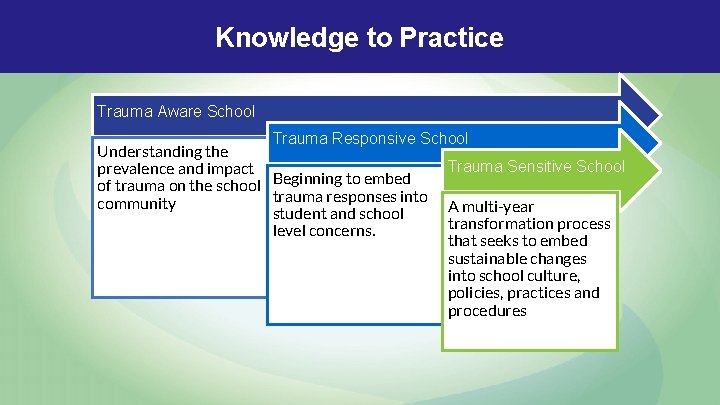
What Is a Trauma Sensitive School? "Trauma Sensitive Schools (TSS) is an innovation in which schools infuse the core values safety, trust, choice, collaboration and empowerment into their Multi-level System of Support’s practices, assessments and program adjustments. TSS acknowledges the high prevalence of traumatic exposure for students, the importance of staff wellness and strives to meet the unique needs of all learners. ” Black, P. , Cook, E. , & Daniel, S. 2017
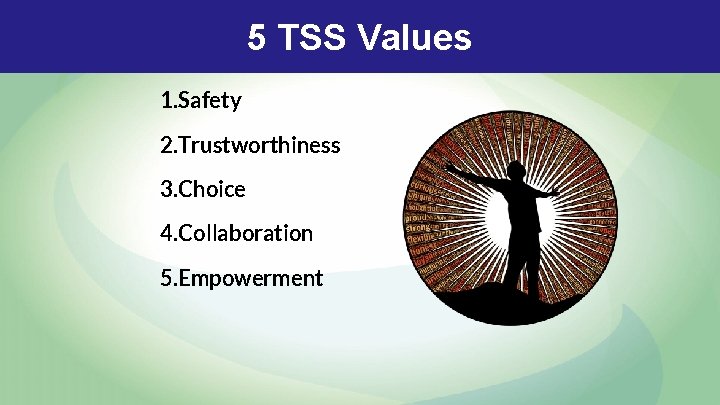
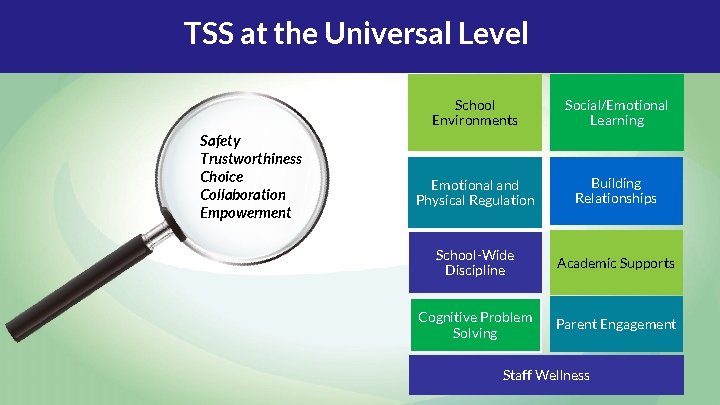
5 TSS Values 1. Safety 2. Trustworthiness 3. Choice 4. Collaboration 5. Empowerment
Knowledge to Practice Trauma Aware School Trauma Responsive School Understanding the Trauma Sensitive School prevalence and impact of trauma on the school Beginning to embed trauma responses into community A multi-year student and school transformation process level concerns. that seeks to embed sustainable changes into school culture, policies, practices and procedures
TSS at the Universal Level Safety Trustworthiness Choice Collaboration Empowerment School Environments Social/Emotional Learning Emotional and Physical Regulation Building Relationships School-Wide Discipline Academic Supports Cognitive Problem Solving Parent Engagement Staff Wellness
ACE Over the Life Course Early Death Disease, Disability & Social Problems Life Course Adoption of High Risk and Unhealthy Behaviors Social, Emotional, & Cognitive Impairments Disrupted Neurodevelopment Adverse Childhood Experiences Historical/Generational Trauma Can s r o at duc E t a Wh Do
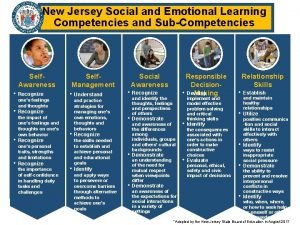
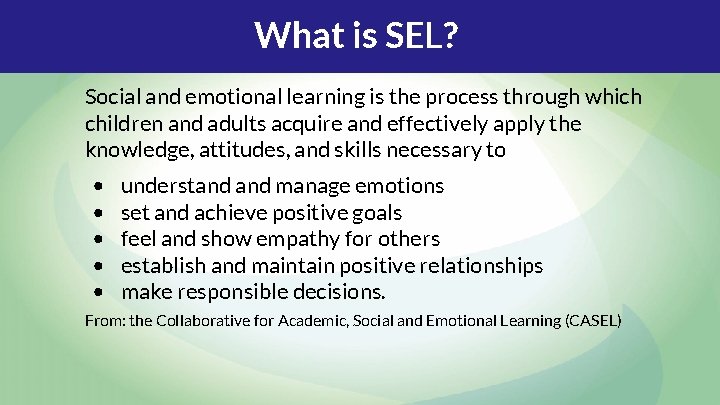
What is SEL? Social and emotional learning is the process through which children and adults acquire and effectively apply the knowledge, attitudes, and skills necessary to • • • understand manage emotions set and achieve positive goals feel and show empathy for others establish and maintain positive relationships make responsible decisions. From: the Collaborative for Academic, Social and Emotional Learning (CASEL)
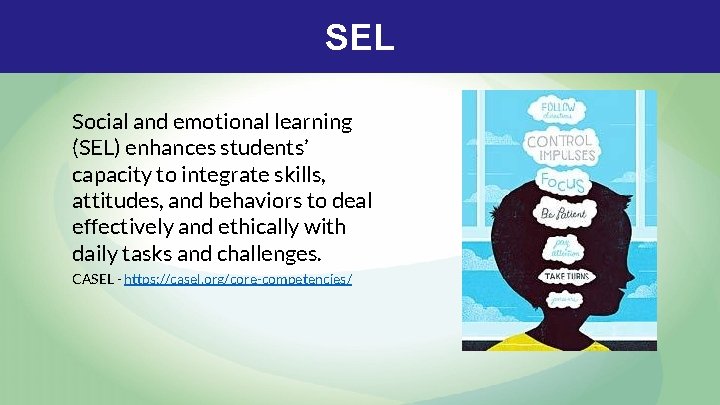
SEL Social and emotional learning (SEL) enhances students’ capacity to integrate skills, attitudes, and behaviors to deal effectively and ethically with daily tasks and challenges. CASEL - https: //casel. org/core-competencies/
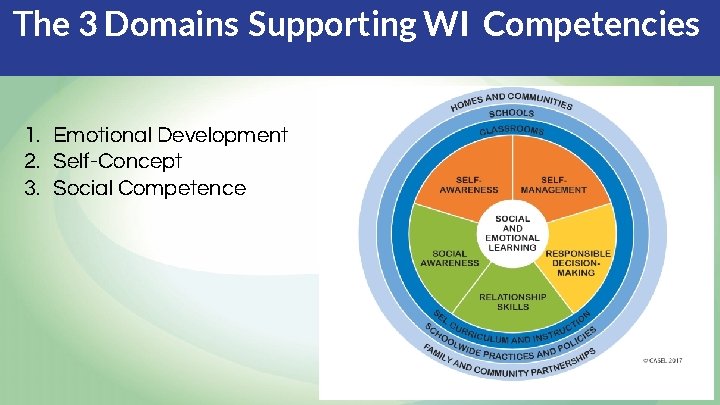
Wisconsin Mental Health The 3 Domains Supporting WIInitiative Competencies 1. Emotional Development 2. Self-Concept 3. Social Competence
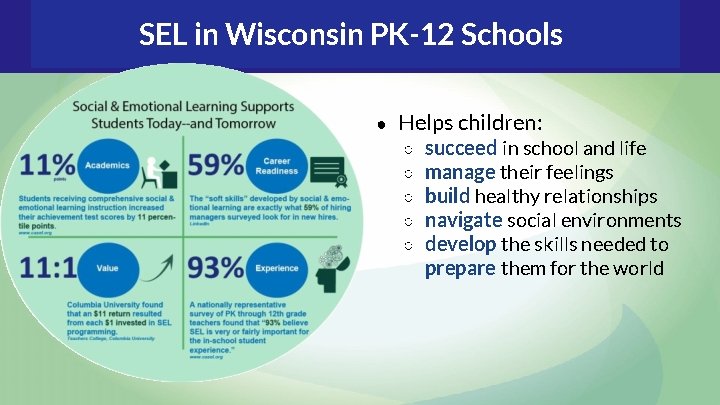
SEL in Wisconsin PK-12 Schools ● Helps children: ○ ○ ○ succeed in school and life manage their feelings build healthy relationships navigate social environments develop the skills needed to prepare them for the world
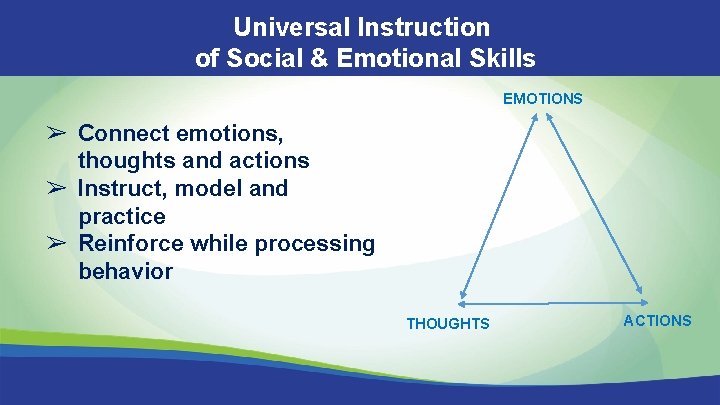
Universal Instruction of Social & Emotional Skills EMOTIONS ➢ Connect emotions, thoughts and actions ➢ Instruct, model and practice ➢ Reinforce while processing behavior THOUGHTS ACTIONS
SEL as TSS Strategy ● Skills to cope with (trauma-related) triggers ● A safe supportive learning environment is created when students and staff have good social and emotional skills ● A safe supportive learning environment is good for academic learning ● Students affected by trauma especially benefit from safe supportive environments
SEL as TSS Strategy (cont) ● Staff who are able to regulate their own emotions, come from a place of understanding, encourage caring supportive relationships ● Skills to increase their ability to access their educational program such as self-regulation, problem-solving, ● Skills to develop healthy peer relationships, effective teamwork, and to recognize and respond to unhealthy relationships ● Recognizes that executive functioning develops over time and can be taught
TSS is Conducive to SEL ● All people do well if they can ● What happened to you, not ‘what is wrong with you’ ● Caring supportive adult relationships ● Attention to triggers ● Provides sense of belonging and purpose ● Focus on how we do what we do
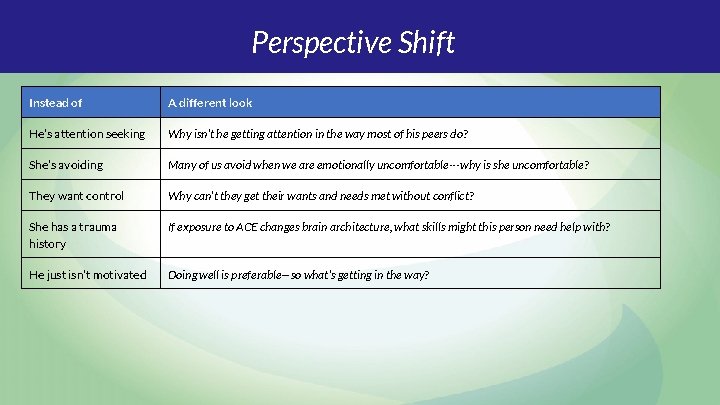
Perspective Shift Instead of A different look He’s attention seeking Why isn’t he getting attention in the way most of his peers do? She’s avoiding Many of us avoid when we are emotionally uncomfortable---why is she uncomfortable? They want control Why can’t they get their wants and needs met without conflict? She has a trauma history If exposure to ACE changes brain architecture, what skills might this person need help with? He just isn’t motivated Doing well is preferable—so what’s getting in the way?
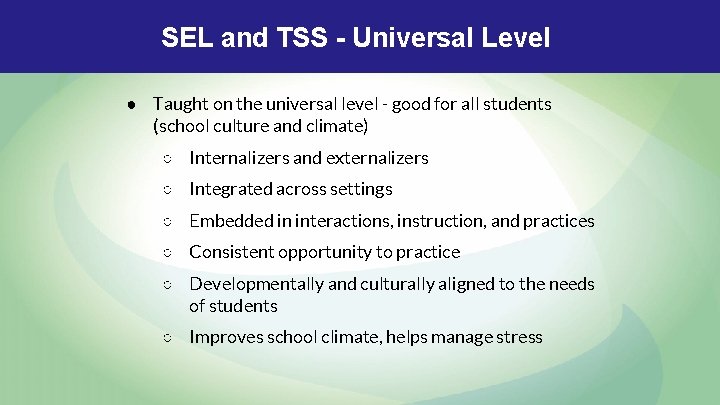
SEL and TSS - Universal Level ● Taught on the universal level - good for all students (school culture and climate) ○ Internalizers and externalizers ○ Integrated across settings ○ Embedded in interactions, instruction, and practices ○ Consistent opportunity to practice ○ Developmentally and culturally aligned to the needs of students ○ Improves school climate, helps manage stress
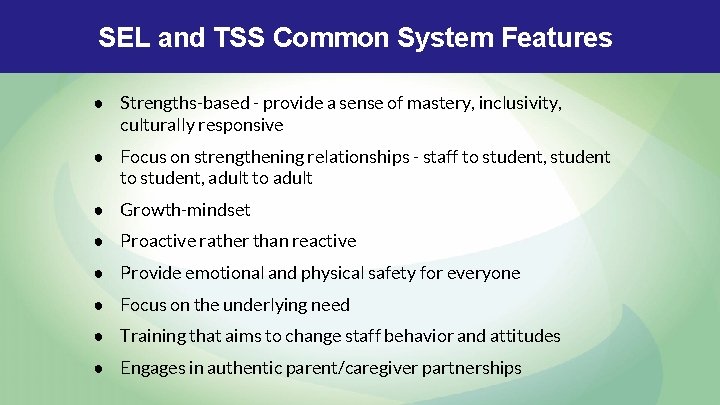
SEL and TSS Common System Features ● Strengths-based - provide a sense of mastery, inclusivity, culturally responsive ● Focus on strengthening relationships - staff to student, student to student, adult to adult ● Growth-mindset ● Proactive rather than reactive ● Provide emotional and physical safety for everyone ● Focus on the underlying need ● Training that aims to change staff behavior and attitudes ● Engages in authentic parent/caregiver partnerships
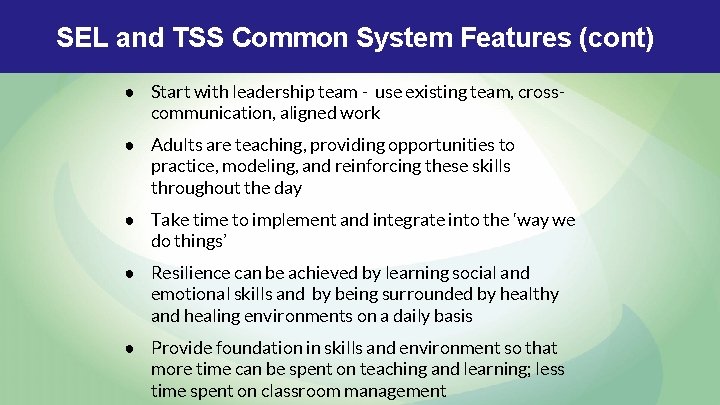
SEL and TSS Common System Features (cont) ● Start with leadership team - use existing team, crosscommunication, aligned work ● Adults are teaching, providing opportunities to practice, modeling, and reinforcing these skills throughout the day ● Take time to implement and integrate into the ‘way we do things’ ● Resilience can be achieved by learning social and emotional skills and by being surrounded by healthy and healing environments on a daily basis ● Provide foundation in skills and environment so that more time can be spent on teaching and learning; less time spent on classroom management
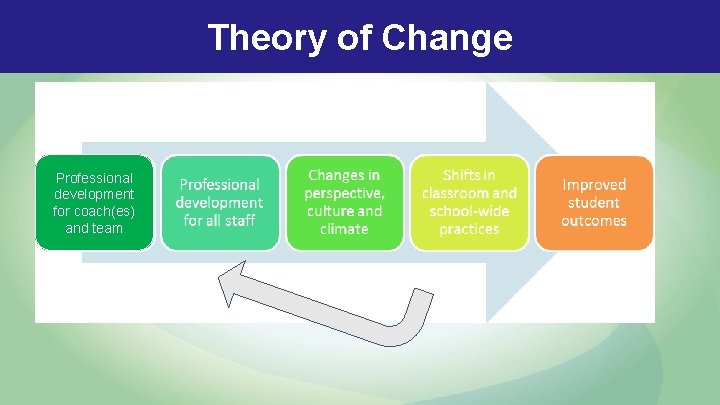
Theory of Change Professional development for coach(es) and team
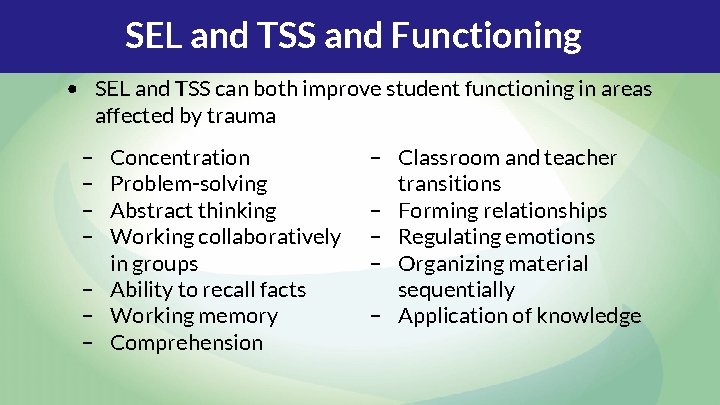
SEL and TSS and Functioning • SEL and TSS can both improve student functioning in areas affected by trauma – – Concentration Problem-solving Abstract thinking Working collaboratively in groups – Ability to recall facts – Working memory – Comprehension – Classroom and teacher transitions – Forming relationships – Regulating emotions – Organizing material sequentially – Application of knowledge
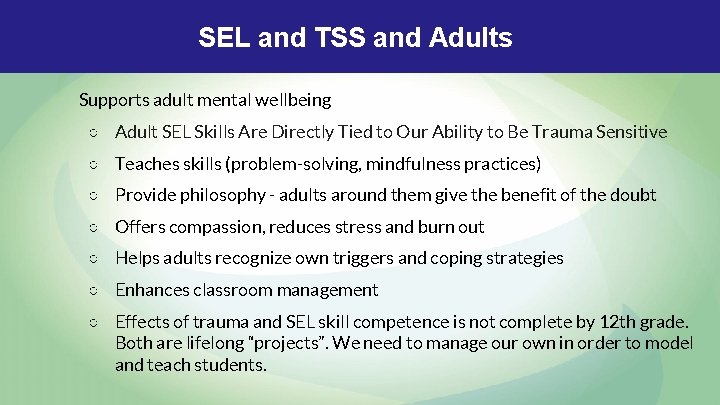
SEL and TSS and Adults Supports adult mental wellbeing ○ Adult SEL Skills Are Directly Tied to Our Ability to Be Trauma Sensitive ○ Teaches skills (problem-solving, mindfulness practices) ○ Provide philosophy - adults around them give the benefit of the doubt ○ Offers compassion, reduces stress and burn out ○ Helps adults recognize own triggers and coping strategies ○ Enhances classroom management ○ Effects of trauma and SEL skill competence is not complete by 12 th grade. Both are lifelong “projects”. We need to manage our own in order to model and teach students.
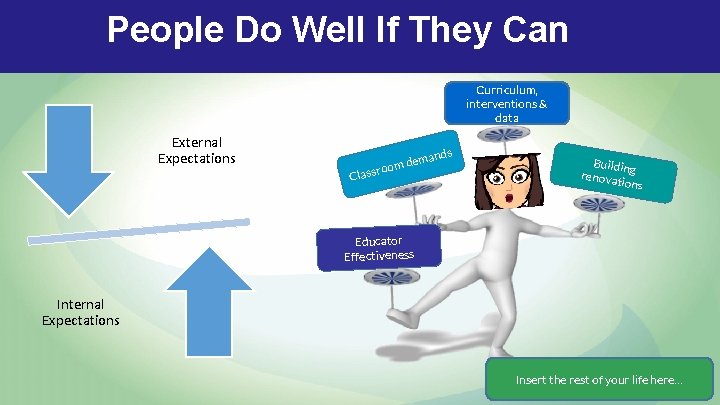
People Do Well If They Can Curriculum, interventions & data External Expectations s mand m de ssroo Cla Buildin g renova tions Educator Effectiveness Internal Expectations Insert the rest of your life here…
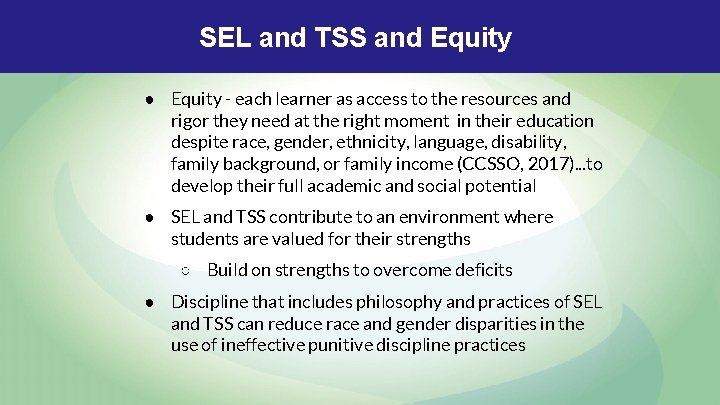
SEL and TSS and Equity ● Equity - each learner as access to the resources and rigor they need at the right moment in their education despite race, gender, ethnicity, language, disability, family background, or family income (CCSSO, 2017). . . to develop their full academic and social potential ● SEL and TSS contribute to an environment where students are valued for their strengths ○ Build on strengths to overcome deficits ● Discipline that includes philosophy and practices of SEL and TSS can reduce race and gender disparities in the use of ineffective punitive discipline practices
SEL and TSS and Equity (cont) ● A student’s sense of how they see themselves impacts their school experience ○ Beliefs about own learning ○ Feeling of belonging ○ Feeling that culture is respected ○ Is their effort valued ● Prioritize the nurturing of caring supportive relationships students, families, communities ● Behaviors understood in context ○ Outbursts, violence, defiance viewed as externalizing behaviors related to trauma ○ Agitation, withdrawal, aggression are warning signs of depression
Equity as Access From Applying an Equity Lens to Social, Emotional, and Academic Development: ● Five barriers contribute to inequitable access to a highquality SEL education ○ poverty ○ exclusionary discipline practices and policies ○ lack of trauma-informed practices ○ implicit bias in school staff ○ educator stress and burnout (Simmons DN, Brackett MA, and Adler N, Applying an Equity Lens to Social, Emotional, and Academic Development, Robert Wood Johnson Foundation, 2018 https: //www. rwjf. org/en/library/research/2018/06/applying-an-equity-lens-to-socialemotional-and-academic-development. html)
Equity as Access (cont) From Applying an Equity Lens to Social, Emotional, and Academic Development: ● Five opportunities identified for overcoming those barriers ○ school racial and socioeconomic integration initiatives ○ restorative justice practices for school discipline ○ trauma-informed system interventions ○ culturally competent and equity-literate educators ○ SEL and mindfulness programming to support students and teachers (Simmons DN, Brackett MA, and Adler N, Applying an Equity Lens to Social, Emotional, and Academic Development, Robert Wood Johnson Foundation, 2018 https: //www. rwjf. org/en/library/research/2018/06/applying-an-equity-lens-to-socialemotional-and-academic-development. html)
SEL and TSS and Discipline policies and procedures are aligned with SEL and TSS Clear limits and boundaries are set and enforced Discipline within the context of continued relationship Restore the harm, return to the community Ask what can be learned from the situation - learning moment Provide rational detachment - it’s not about you(adult) Consider institutional bias, how behaviors are viewed, how behaviors are punished ● Involve natural supports (caregivers, allies) ● (video: https: //www. policeone. com/police-products/trafficenforcement/videos/183517519 -LAs-favorite-traffic-cop/) ● ● ● ●
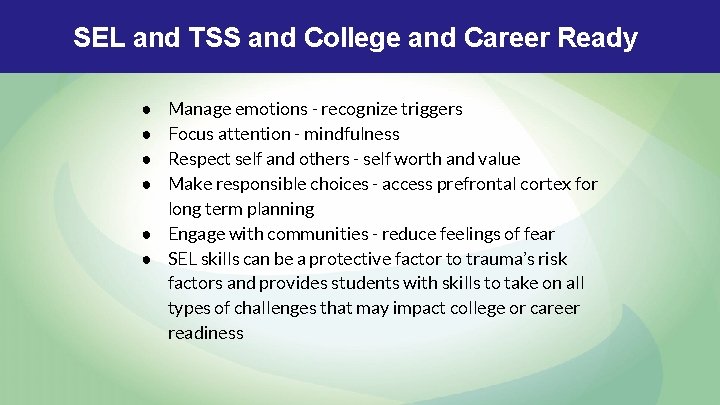
SEL and TSS and College and Career Ready Manage emotions - recognize triggers Focus attention - mindfulness Respect self and others - self worth and value Make responsible choices - access prefrontal cortex for long term planning ● Engage with communities - reduce feelings of fear ● SEL skills can be a protective factor to trauma’s risk factors and provides students with skills to take on all types of challenges that may impact college or career readiness ● ●
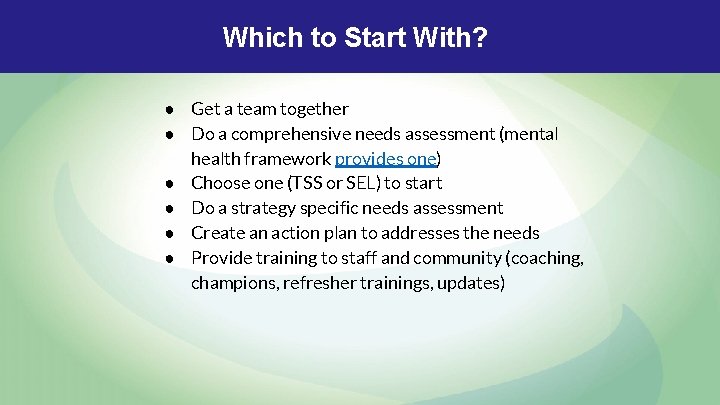
Which to Start With? ● Get a team together ● Do a comprehensive needs assessment (mental health framework provides one) ● Choose one (TSS or SEL) to start ● Do a strategy specific needs assessment ● Create an action plan to addresses the needs ● Provide training to staff and community (coaching, champions, refresher trainings, updates)
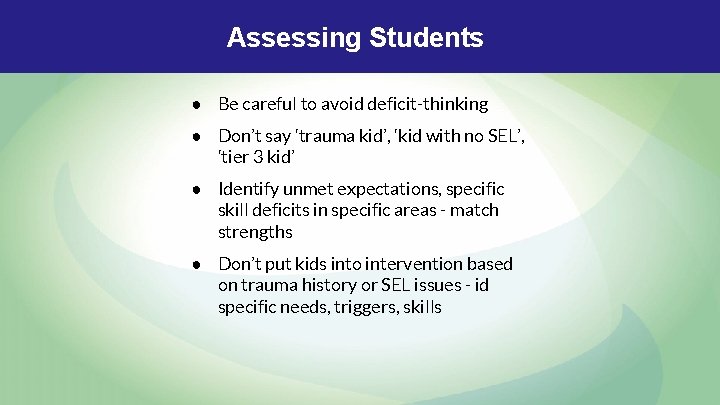
Assessing Students ● Be careful to avoid deficit-thinking ● Don’t say ‘trauma kid’, ‘kid with no SEL’, ‘tier 3 kid’ ● Identify unmet expectations, specific skill deficits in specific areas - match strengths ● Don’t put kids into intervention based on trauma history or SEL issues - id specific needs, triggers, skills
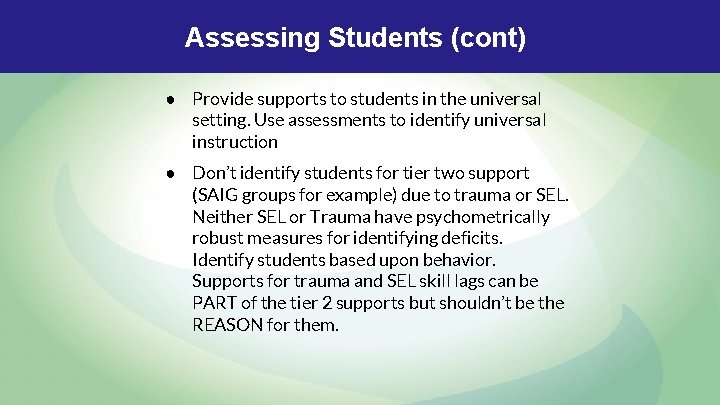
Assessing Students (cont) ● Provide supports to students in the universal setting. Use assessments to identify universal instruction ● Don’t identify students for tier two support (SAIG groups for example) due to trauma or SEL. Neither SEL or Trauma have psychometrically robust measures for identifying deficits. Identify students based upon behavior. Supports for trauma and SEL skill lags can be PART of the tier 2 supports but shouldn’t be the REASON for them.
Key Takeaways “Major domains of human development—social, emotional, cognitive, linguistic, academic—are deeply intertwined in the brain and in behavior, and all are central to learning. ” The Evidence Base for How We Learn Supporting Students’ Social, Emotional, and Academic Development: Consensus Statements of Evidence From the Council of Distinguished Scientists https: //assets. aspeninstitute. org/content/uploads/2017/09/SEADResearch-Brief-9. 12_updated-web. pdf
Key Takeaways (cont) ● SEL and TSS philosophy and practices. . . ○ support each other ○ implemented at the universal level ○ for students AND ADULTS ○ need firm limits and boundaries ○ must include an attention to cultural responsive practices and equity of access and outcomes
Key Takeaways (cont) ● SEL and TSS philosophy and practices. . . ○ emphasizes the importance of. . . ■ caring relationships ■ safe, supportive, inclusive environments ■ sense of belonging ■ increasing protective factors and resilience for students and staff ■ need a team to lead and champion ■ are possible!
Special Thanks • Beth Herman - DPI Consultant • Members of the DPI SSPW Team who work on continuous improvement of the mental health framework adn who have provided content used in this presentation (Elizabeth Cook, Monica Caldwell, Beth Herman, Gregg Curtis, Louise Wilson, Kate Mc. Coy, Elizabeth Krubsack, Kathryn Bush…)
Resources • In-depth Professional Development on Trauma Sensitive Schools , including many of the resources shared today: http: //dpi. wi. gov/sspw/mentalhealth/trauma • Resources and support for School Mental Health in Wisconsin http: //dpi. wi. gov/sspw/mental-health : • Wisconsin’s Framework for an Equitable Multi-Level System of Support: https: //dpi. wi. gov/rti
Resources • Elizabeth Cook, SEL as a Universal Trauma Sensitive Practice, Powerpoint, 2018 • Wisconsin Department of Public Instruction, Wisconsin School Mental Health Project Trauma-Sensitive Schools Professional Development: Social & Emotional Learning Online Module , accessed March 2019, https: //dpi. wi. gov/sspw/mental-health/trauma/modules • The Evidence Base for How We Learn: Supporting Students’ Social, Emotional, and Academic Development: Consensus Statements of Evidence From the Council of Distinguished Scientists https: //assets. aspeninstitute. org/content/uploads/2017/09/SEAD-Research-Brief-9. 12_updated-web. pdf • Mary Fertakis, Social and Emotional Learning and Equity, Power point 2017, https: //cdn-files. nsba. org/s 3 fspublic/Presentation_Fertakis_1. pdf • Executive Function, Alberta Family Wellness, video, https: //www. albertafamilywellness. org/resources/watch/executivefunction • https: //www. edsurge. com/news/2018 -07 -02 -integrating-sel-equity-and-trauma-work-for-multiplied-success • Simmons DN, Brackett MA, and Adler N, Applying an Equity Lens to Social, Emotional, and Academic Development, Robert Wood Johnson Foundation, 2018 - https: //www. rwjf. org/en/library/research/2018/06/applying-an-equitylens-to-social-emotional-and-academic-development. html • Linda Darling-Hammond and Channa M. Cook-Harvey, Educating the Whole Child: Improving School Climate to Support Student Success, Learning Policy Institute, 2018 https: //learningpolicyinstitute. org/sites/default/files/product-
Questions! Julie Incitti, MSW, CAPSW School Social Work Consultant (608) 266 -0963 Julie. Incitti@dpi. wi. gov Beth Herman, MSE School Mental Health Training Consultant (608) 267 -9242 Beth. Herman@dpi. wi. gov