
Unit 5 HOSPITALITY TEAM LEADERSHIP and SUPERVISION Business
Unit 5: HOSPITALITY TEAM LEADERSHIP and SUPERVISION
Business Functions Human Resources ¡ Sales and Marketing ¡ Research and Development ¡ Production/Operations ¡ Customer Service ¡ Finance and Accounts ¡ Administration and IT ¡
Human Resources ¡ Recruitment and retention l l ¡ ¡ ¡ Job descriptions Person Specifications Dismissal Redundancy Motivation Professional development and training Health and safety and conditions at work Liaison with trade unions
Sales and Marketing ¡ ¡ ¡ Market research Promotion strategies Pricing strategies Sales strategies The sales team Product – advice on new product development, product improvement, extension strategies, target markets
Research and Development New product development ¡ Product improvements ¡ Competitive advantage ¡ Value added ¡ Product testing ¡ Efficiency gains ¡ Cost savings ¡
Finance and Accounts ¡ Cash flow l l ¡ ¡ Preparing accounts Raising finance l l ¡ Monitoring income/revenue Monitoring expenditure Shares Loans Links with all other functional areas
Production/Operations ¡ ¡ ¡ Acquiring resources Planning output – labour, capital, land Monitoring costs Projections on future output Production methods l l ¡ Batch Flow Job Cell Efficiency
Customer Service Monitoring distribution ¡ After-sales service ¡ Handling consumer enquiries ¡ Offering advice to consumers ¡ Dealing with customer complaints ¡ Publicity and public relations ¡
Business Organisation ¡ ¡ ¡ Organisation by type Global businesses – complex organisation structures National – organisation possibly stretches throughout the country Regional – could be through a county or wider area (North West, South East, etc. ) Local – small organisations serving local area or community
Business Organisation ¡ ¡ ¡ Authority – the right to make decisions and carry out tasks Span of control – the number of people a superior is responsible for Chain of Command – the relationship between different levels of authority in the business Hierarchy – shows the line management in the business and who has specific responsibilities Delegation – authority to carry out actions passed from superior to subordinate Empowerment – giving responsibilities to people at all levels of the business to make decisions
Administration and IT • Managing estates – cleaning, health and safety, maintenance, security • Reception • Clerical work – reporting, record keeping, communication • Overview of quality control • Use of IT systems
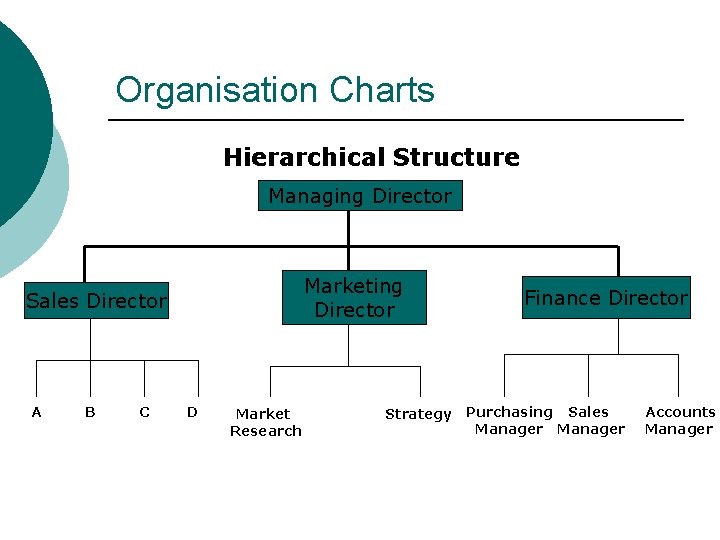
Organisation Charts Hierarchical Structure Managing Director Marketing Director Sales Director A B C D Market Research Finance Director Strategy Purchasing Sales Manager Accounts Manager
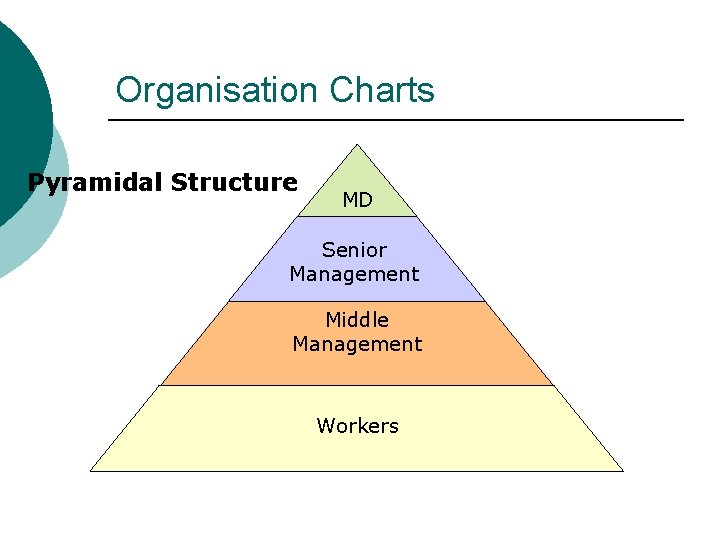
Organisation Charts Pyramidal Structure MD Senior Management Middle Management Workers
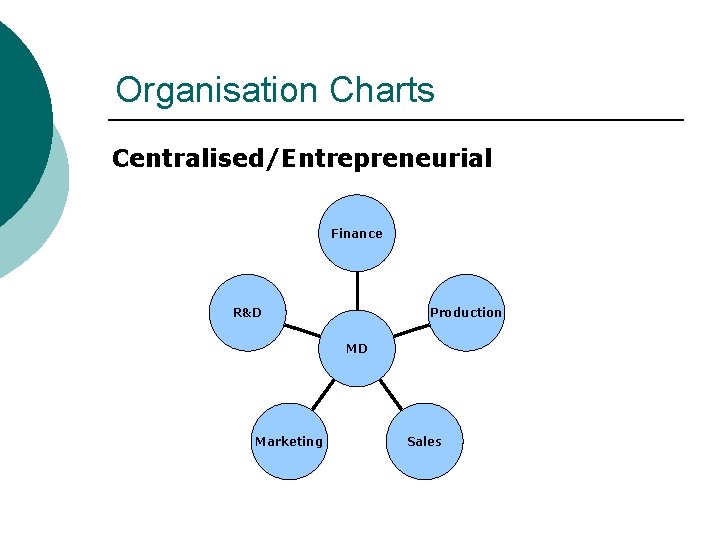
Organisation Charts Centralised/Entrepreneurial Finance R&D Production MD Marketing Sales
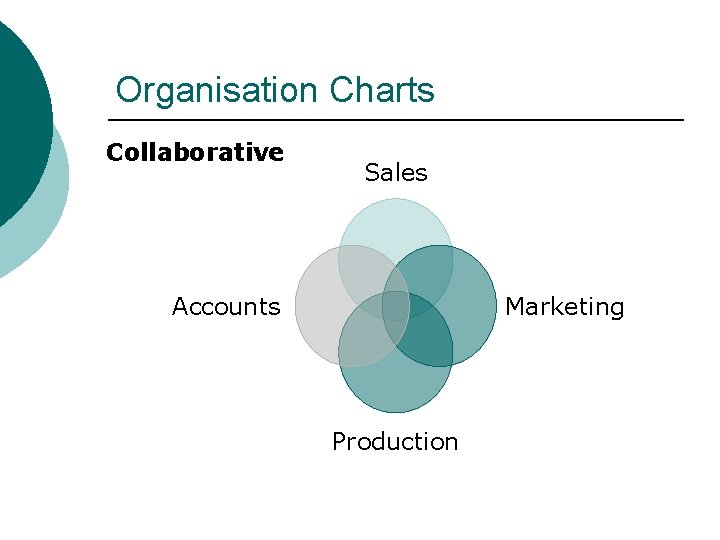
Organisation Charts Collaborative Sales Accounts Marketing Production
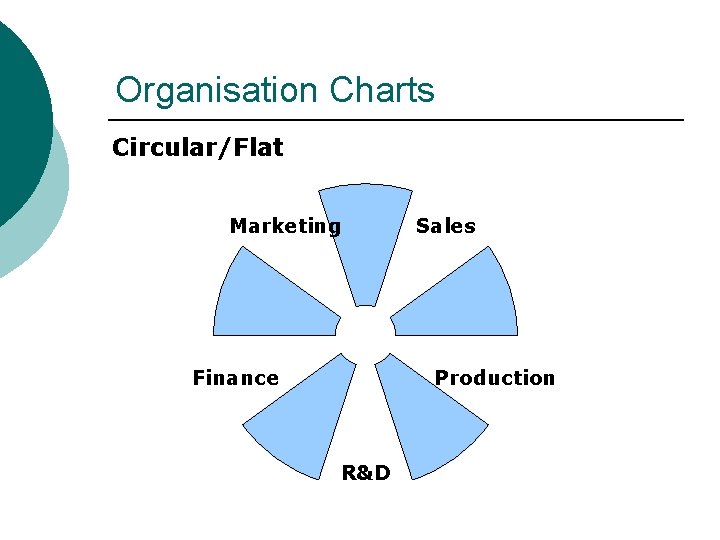
Organisation Charts Circular/Flat Marketing Finance Sales Production R&D
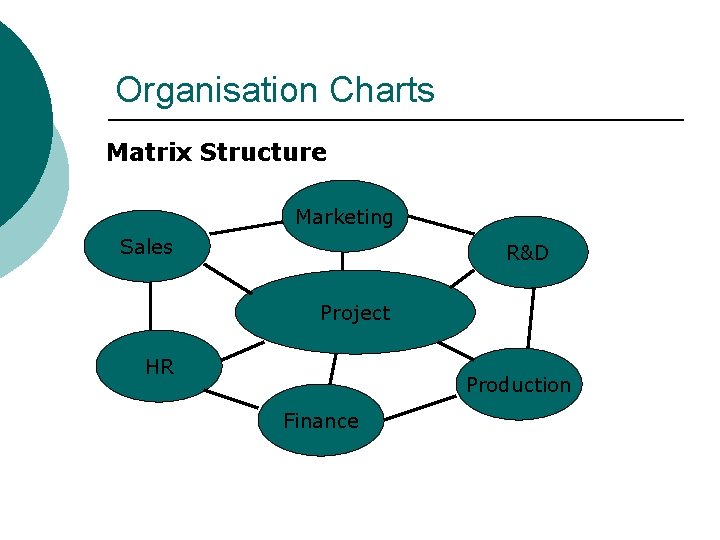
Organisation Charts Matrix Structure Marketing Sales R&D Project HR Production Finance
Organisation Charts Changes to business structures ¡ Linked to new thinking on leadership and management ¡ Less hierarchical ¡ Emphasis on communication and collaboration between sections ¡ Global businesses – more complex structures ¡
Summary:
Management styles
PERSONAL TEST WHO AM I?
The first leader we will talk about is the impoverished leader…
IMPOVERISHED

IMPOVERISHED
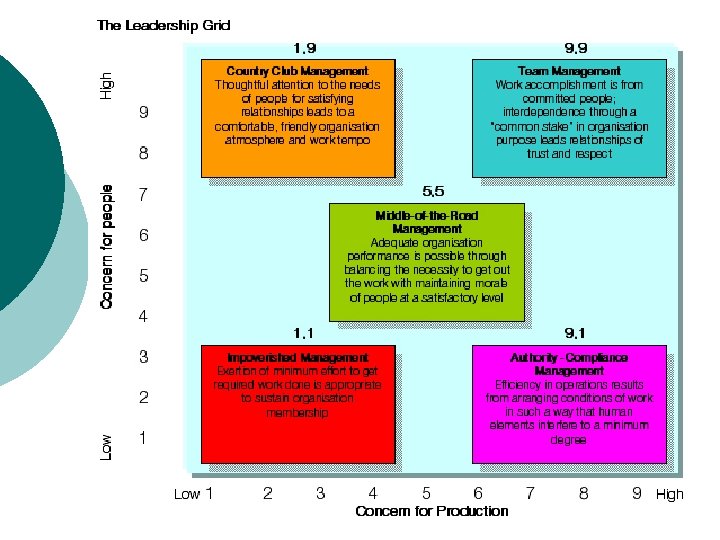
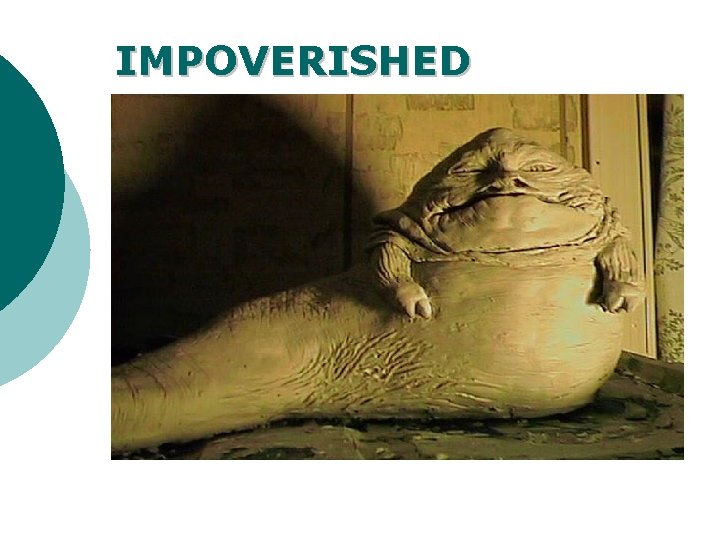
IMPOVERISHED Impoverished Leader (low task, low relationship) A leader who uses a "delegate and disappear" management style. Since they are not committed to either task accomplishment or maintenance; they essentially allow their team to do whatever it wishes and prefer to detach themselves from the team process by allowing the team to suffer from a series of power struggles. Minimum effort to get the work done. A basically lazy approach that avoids as much work as possible.
COUNTRY CLUB
COUNTRY CLUB
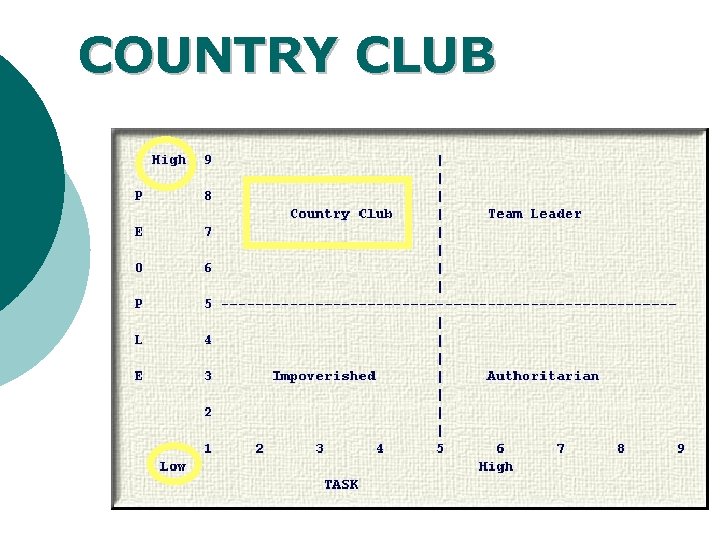
COUNTRY CLUB Country Club Leader (low task, high relationship) This person uses predominantly reward power to maintain discipline and to encourage the team to accomplish its goals. Conversely, they are almost incapable of employing the more punitive coercive and legitimate powers. This inability results from fear that using such powers could jeopardize relationships with the other team members. Care and concern for the people, with a comfortable and friendly environment and collegial style. But a low focus on task may give questionable results.
AUTHORITARIAN
AUTHORITARIAN
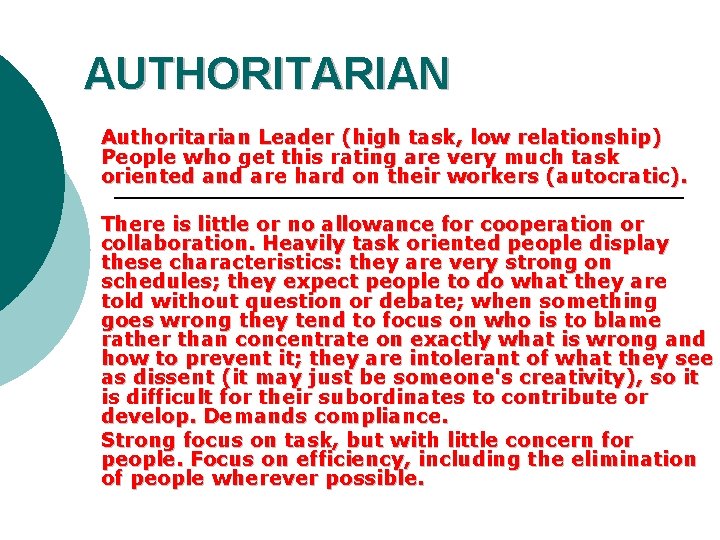
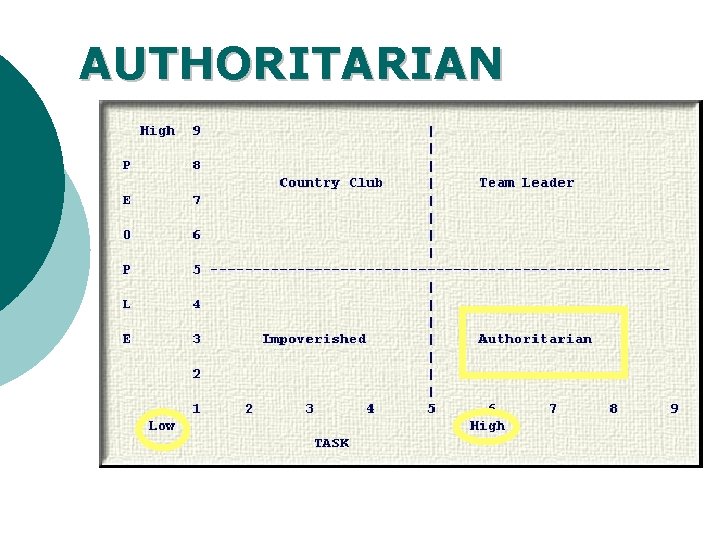
AUTHORITARIAN Authoritarian Leader (high task, low relationship) People who get this rating are very much task oriented and are hard on their workers (autocratic). There is little or no allowance for cooperation or collaboration. Heavily task oriented people display these characteristics: they are very strong on schedules; they expect people to do what they are told without question or debate; when something goes wrong they tend to focus on who is to blame rather than concentrate on exactly what is wrong and how to prevent it; they are intolerant of what they see as dissent (it may just be someone's creativity), so it is difficult for their subordinates to contribute or develop. Demands compliance. Strong focus on task, but with little concern for people. Focus on efficiency, including the elimination of people wherever possible.
TEAM LEADER
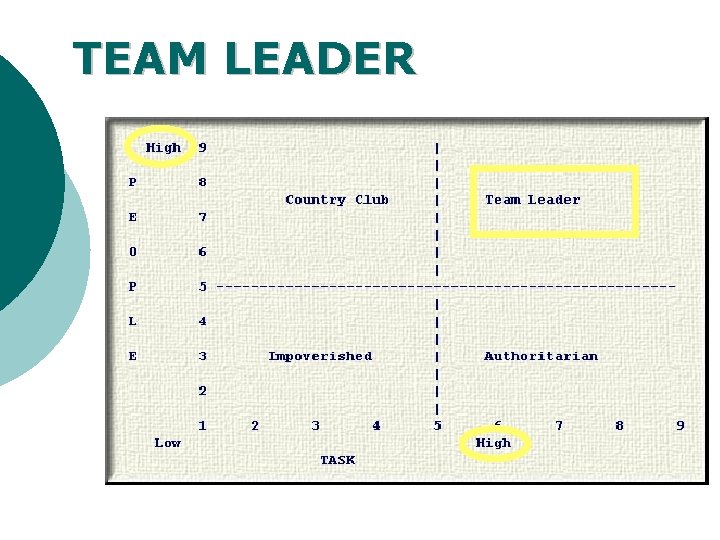
TEAM LEADER
Team Leader (high task, high relationship) This type of person leads by positive example and endeavors to foster a team environment in which all team members can reach their highest potential, both as team members and as people. They encourage the team to reach team goals as effectively as possible, while also working tirelessly to strengthen the bonds among the various members. They normally form and lead some of the most productive teams. Firing on all cylinders: people are committed to task and leader is committed to people (as well as task).
When is Team Leader the Best? The most desirable place for a leader to be along the two axis at most times would be a 9 on task and a 9 on people -- the Team Leader. However, do not entirely dismiss the other three. Certain situations might call for one of the other three to be used at times. For example, by playing the Impoverished Leader, you allow your team to gain self-reliance. Be an Authoritarian Leader to instill a sense of discipline in an unmotivated worker. By carefully studying the situation and the forces affecting it, you will know at what points along the axis you need to be in order to achieve the desired result.
Are Leaders Born or Made?
What Is Leadership? ¡ Many theories (trait, behavioral, etc. ) ¡ Is it the same as management? ¡ A definition of leadership ¡ Formal and informal leaders ¡ Leadership and management
A Leadership Story: ¡ ¡ ¡ A group of workers and their leaders are set a task of clearing a road through a dense jungle on a remote island to get to the coast where an estuary provides a perfect site for a port. The leaders organise the labour into efficient units and monitor the distribution and use of capital assets – progress is excellent. The leaders continue to monitor and evaluate progress, making adjustments along the way to ensure the progress is maintained and efficiency increased wherever possible. Then, one day amidst all the hustle and bustle and activity, one person climbs up a nearby tree. The person surveys the scene from the top of the tree.
A Leadership Story: And shouts down to the assembled group below… ¡ “Wrong Way!” ¡ ¡ ¡ (Story adapted from Stephen Covey (2004) “The Seven Habits of Highly Effective People” Simon & Schuster). “Management is doing things right, leadership is doing the right things” (Warren Bennis and Peter Drucker)
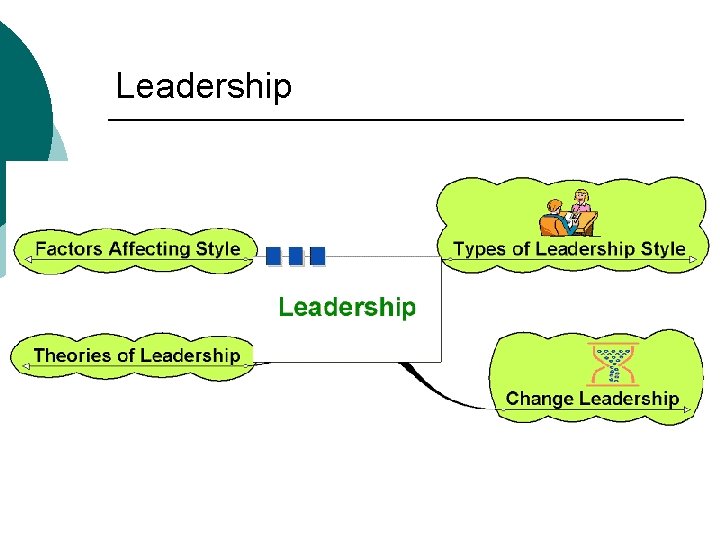
Leadership
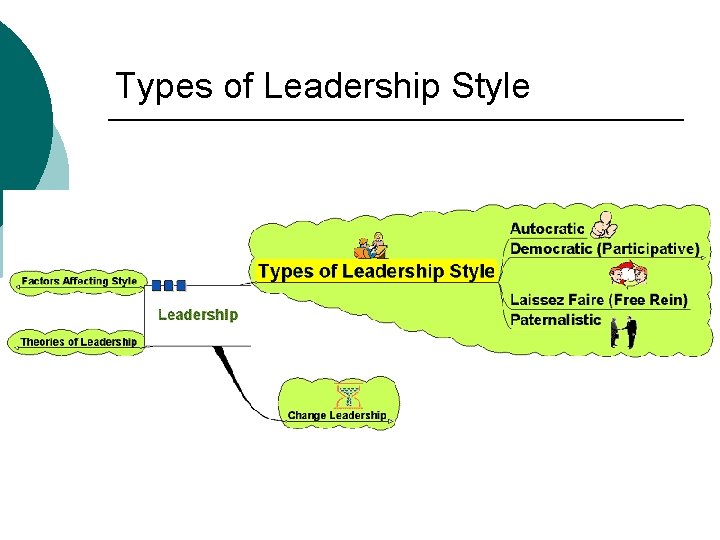
Types of Leadership Style
Types of Leadership Style ¡ Autocratic: l l Leader makes decisions without reference to anyone else High degree of dependency on the leader Can create de-motivation and alienation of staff May be valuable in some types of business where decisions need to be made quickly and decisively
Types of Leadership Style ¡ ¡ Democratic: Encourages decision making from different perspectives – leadership may be emphasised throughout the organisation l l Consultative: process of consultation before decisions are taken Persuasive: Leader takes decision and seeks to persuade others that the decision is correct
Types of Leadership Style ¡ Democratic: l l May help motivation and involvement Workers feel ownership of the firm and its ideas Improves the sharing of ideas and experiences within the business Can delay decision making
Types of Leadership Style ¡ Laissez-Faire: l l l ‘Let it be’ – the leadership responsibilities are shared by all Can be very useful in businesses where creative ideas are important Can be highly motivational, as people have control over their working life Can make coordination and decision making time-consuming and lacking in overall direction Relies on good team work Relies on good interpersonal relations
Types of Leadership Style Paternalistic: ¡ Leader acts as a ‘father figure’ ¡ Paternalistic leader makes decision but may consult ¡ Believes in the need to support staff ¡
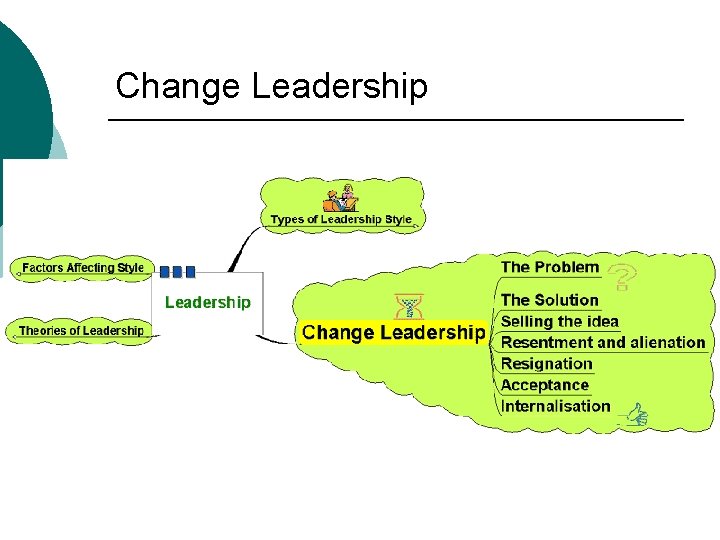
Change Leadership
Change Leadership ¡ ¡ The most challenging aspect of business is leading and managing change The business environment is subject to fast-paced economic and social change Modern business must adapt and be flexible to survive Problems in leading change stem mainly from human resource management
Change Leadership Leaders need to be aware of how change impacts on workers: ¡ Series of self-esteem states identified by Adams et al and cited by Garrett ¡ l l Adams, J. Hayes, J. and Hopson, B. (eds) (1976) Transition: understanding and managing change personal change London, Martin Robertson Garrett, V. (1997) Managing Change in School leadership for the 21 st century Brett Davies and Linda Ellison, London, Routledge
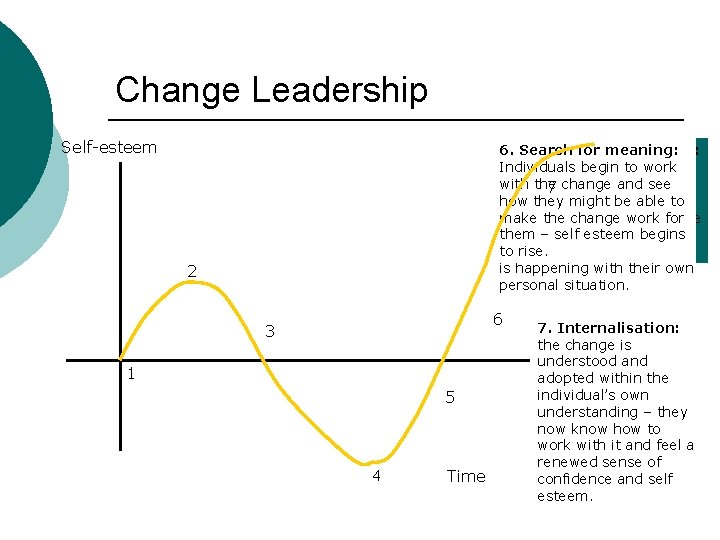
Change Leadership Self-esteem 6. Search 2. 3. 4. 5. Minimisation: Depression: Acceptance/letting Testing 1. Immobilisation for out: meaning: as. As reality thego: change begins The Individuals lowest – as to becomes dawn rumours point begin staff in clearer, toof selfwork may the people feel esteem interact with alienated the change finally with change to circulate, the fit and sees in and change, angry, the people see the 7 try change feelings starting they how they start individual with to ofmight to a accept their lack ask feels be questions of own the able control some to personal of inevitable. to make events seesense the how position overtake change Fear of they shock of might and work the people and may future for tryato and is work them feature they possible with –believe self feel the esteem ofdepressed disbelief that change. this it stage. begins will – as so notrise. they to affect try much tothem. reconcile so that they what is happening deem it worthy with their of own personal doing situation. nothing. 2 6 3 1 5 4 Time 7. Internalisation: the change is understood and adopted within the individual’s own understanding – they now know how to work with it and feel a renewed sense of confidence and self esteem.
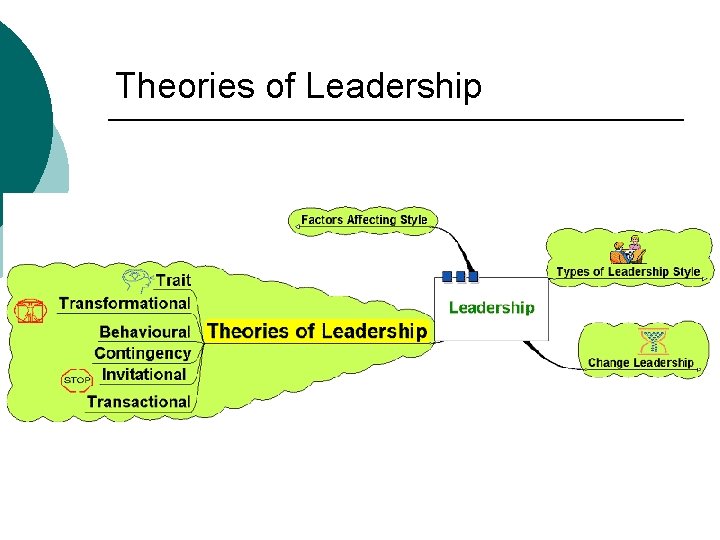
Theories of Leadership
Theories of Leadership ¡ ¡ Trait theories: Is there a set of characteristics that determine a good leader? l l l Personality? Dominance and personal presence? Charisma? Self confidence? Achievement? Ability to formulate a clear vision?
Theories of Leadership ¡ Trait theories: l l Are such characteristics inherently gender biased? Do such characteristics produce good leaders? Is leadership more than just bringing about change? Does this imply that leaders are born not bred?
Theories of Leadership ¡ ¡ Behavioural: Imply that leaders can be trained – focus on the way of doing things l l Structure based behavioural theories – focus on the leader instituting structures – task orientated Relationship based behavioural theories – focus on the development and maintenance of relationships – process orientated
Theories of Leadership ¡ ¡ ¡ Contingency Theories: Leadership as being more flexible – different leadership styles used at different times depending on the circumstance. Suggests leadership is not a fixed series of characteristics that can be transposed into different contexts
Theories of Leadership ¡ May depend on: l l l Type of staff History of the business Culture of the business Quality of the relationships Nature of the changes needed Accepted norms within the institution
Theories of Leadership ¡ Transformational: l ¡ Widespread changes to a business or organisation Requires: l l l Long term strategic planning Clear objectives Clear vision Leading by example – walk the walk Efficiency of systems and processes
Theories of Leadership ¡ Invitational Leadership: l l Improving the atmosphere and message sent out by the organisation Focus on reducing negative messages sent out through the everyday actions of the business both externally and, crucially, internally Review internal processes to reduce these Build relationships and sense of belonging and identity with the organisation – that gets communicated to customers, etc.
Theories of Leadership ¡ Transactional Theories: l l Focus on the management of the organisation Focus on procedures and efficiency Focus on working to rules and contracts Managing current issues and problems
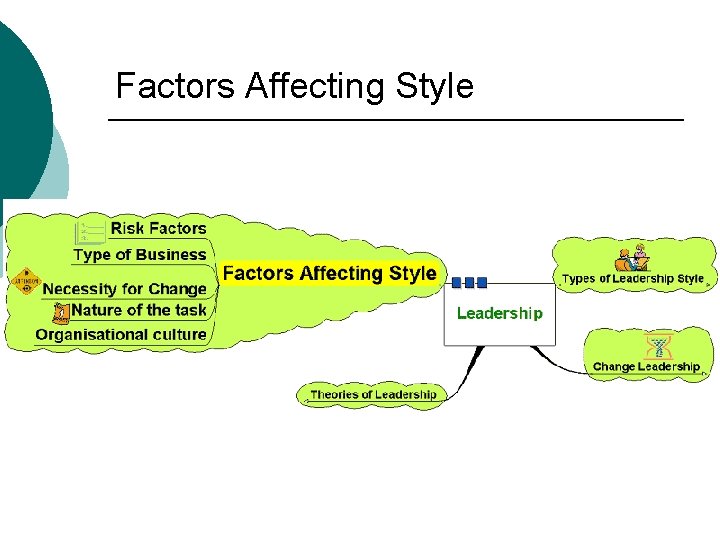
Factors Affecting Style
Factors Affecting Style ¡ Leadership style may be dependent on various factors: l l l Risk - decision making and change initiatives based on degree of risk involved Type of business – creative business or supply driven? How important change is – change for change’s sake? Organisational culture – may be long embedded and difficult to change Nature of the task – needing cooperation? Direction? Structure?
Trait Theory Leadership Traits: represent the personal characteristics that differentiate leaders from followers. • Historic findings reveal that leaders and followers vary by - intelligence - dominance - self-confidence - level of energy and activity - task-relevant knowledge • Contemporary findings show that - people tend to perceive that someone is a leader when he or she exhibits traits associated with intelligence, masculinity, and dominance - people want their leaders to be credible - credible leaders are honest, forward-looking, inspiring, and competent
Trait Theory (continued) • Gender and leadership - men and women were seen as displaying more task and social leadership, respectively - women used a more democratic or participative style than men, and men used a more autocratic and directive style than women - men and women were equally assertive - women executives, when rated by their peers, managers and direct reports, scored higher than their male counterparts on a variety of effectiveness criteria
Key Leadership Traits to Develop ¡ ¡ ¡ ¡ ¡ Self-Confidence Trustworthiness Assertiveness Emotional Stability Sense of Humor Self-Awareness and Self-Objectivity Cognitive Skills Emotional Intelligence Passion and Enthusiasm
Transactional versus Charismatic Leadership Transactional Leadership: focuses on the interpersonal interactions between managers and employees Transactional Leaders - use contingent rewards to motivate employees - exert corrective action only when employees fail to obtain performance goals
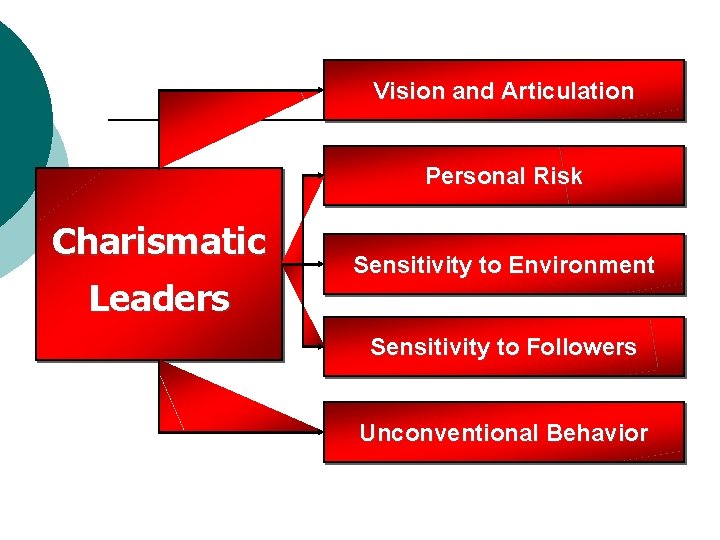
Vision and Articulation Personal Risk Charismatic Leaders Sensitivity to Environment Sensitivity to Followers Unconventional Behavior
Developing Charisma ¡ ¡ ¡ Communicate a Vision Make frequent use of metaphors and analogies Inspire trust and confidence Be highly energetic and goal oriented Be emotionally expressive and warm Make ample use of your true stories Smile frequently, even if you are unhappy Be candid Make everyone feel that he/she is important Make non-verbal signals of self-confidence Be willing to take risks
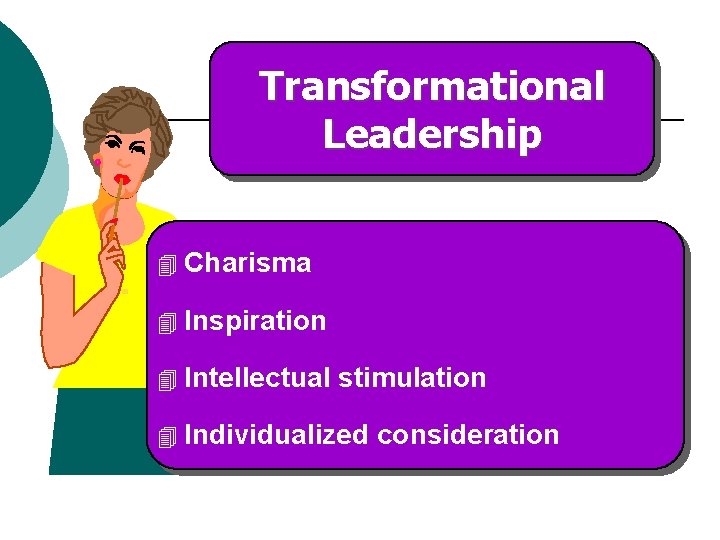
Transformational Leadership 4 Charisma 4 Inspiration 4 Intellectual stimulation 4 Individualized consideration
Developing Team Leader Skills ¡ ¡ ¡ ¡ ¡ Build a Mission Statement Show your team members that they are trusted Encourage team members to recognize each others accomplishments Establish a sense of urgency and High Performance standards Encourage honest criticism Use team symbols Use peer evaluations Help team members see the ‘Big Picture’ Minimize formation of ‘In-groups’ and ‘Outgroups’
Servant Leadership and Superleadership • Servant Leadership represents a philosophy in which leaders focus on increased service to others rather than to oneself. • A superleader is someone who leads others to lead themselves by developing employees’ selfmanagement skills. • Superleaders attempt to increase employees’ feelings of personal control and intrinsic motivation.
Developing your own Leadership Potential Acquire broad experience ¡ Model effective leaders ¡ Self-develop leadership traits ¡ Become an integrated human being (know thyself) ¡ Practice a little leadership ¡ Help your leader lead ¡
Session Objectives Understand why teams are important ¡ Explore elements of successful teams ¡ Review elements of effective team leadership and followership ¡ Explore the link between emotional intelligence and successful teams ¡ Discuss implications for Extension teams ¡
Agenda § § § Welcome and Introduction Best Team/Worst Team Exercise Team Effectiveness 101 Building Emotional Intelligence in Teams Q&A/Discussion
BEST TEAM & WORST TEAM EXERCISE n Think of a team you have been a part of that was an excellent experience. The team performed well. It was the best team experience you’ve ever had. § Think of a team you have been a part of that was an awful experience. The team performed poorly. The worst team experience you’ve ever had. § Underneath each team name, write notes describing the characteristics or circumstances that contributed to that experience.
What makes the difference? At your tables, discuss the differences you find between your two teams. 2. What similarities, themes or patterns emerge from the comparisons across all your lists? 1. 3. Be prepared to report the most important themes, patterns, or similarities.
Why Teams? Democracy at work ¡ Embrace and enhance change ¡ Human development ¡ Effective decision making ¡ Network development/connectivity ¡
Successful Team Elements Clear purpose ¡ Team member attributes ¡ Unified commitment ¡ Strong relationships ¡ Communication ¡
Successful Team Elements (cont) Trust and confidence ¡ Accountability ¡ Leadership ¡ Clear, enticing roles & responsibilities ¡ Physical factors ¡
Effective Team Leadership A move from manager of tasks to facilitator of process ¡ A move from leader as individual to leadership as a team skill ¡
Team Leadership Goal Increase group development and performance ¡ Build trust, autonomy and authority of team members ¡ Construct an environment that fosters collaborative learning ¡
Team Leader Roles Co-learner ¡ Resource ¡ Model ¡ Problem solver ¡ Trouble shooter ¡ Advocate of collaborative learning ¡
Team Facilitation Skills Manage the communication process ¡ Serve as a neutral person in directing discussion ¡ Work for good use of time ¡ Stimulate creative and critical thinking ¡ Promote teamwork and cooperation ¡
Team Leadership Tips Know yourself ¡ Be a situational leader ¡ Know what aspects of leadership are not situational ¡ Work with others different than you ¡ 80% of value comes in the first 50% of time ¡
Team Leadership Tips (cont) Share power with others ¡ Suspicion and rumors can lead to reality ¡ Motivate others through shared beliefs and values ¡ Actively manage conflict ¡ Build trust ¡
Team Follower Tips Take responsibility ¡ Follow through ¡ Contribute ¡ Listen ¡ Communicate clearly ¡ Give helpful and positive feedback ¡ Accept and use feedback ¡
The Educator’s Role Architect of a safe and fertile environment for successful teamwork
Building Emotional Intelligence in Teams
What is Emotional Intelligence? A Review. . .
What is Emotional Intelligence? ¡ ¡ The capacity for recognizing our own emotions and those of others, for motivating ourselves and others, and for managing emotions well in ourselves and in our relationships In sum: l Understanding Yourself l Managing Yourself l Understanding Others l Managing Others
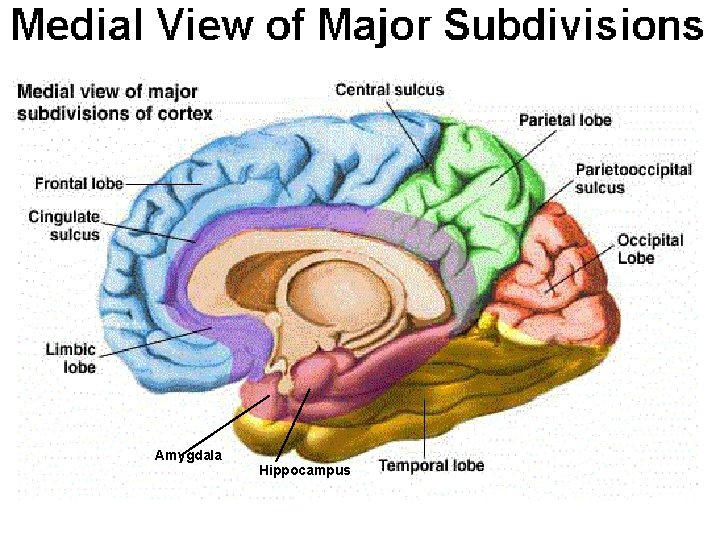
Amygdala Hippocampus
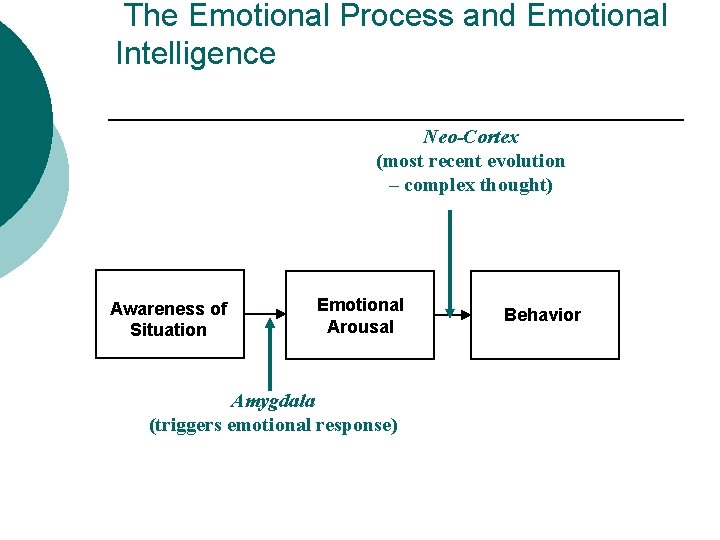
The Emotional Process and Emotional Intelligence Neo-Cortex (most recent evolution – complex thought) Awareness of Situation Emotional Arousal Amygdala (triggers emotional response) Behavior
Emotional Intelligence (EI) Model
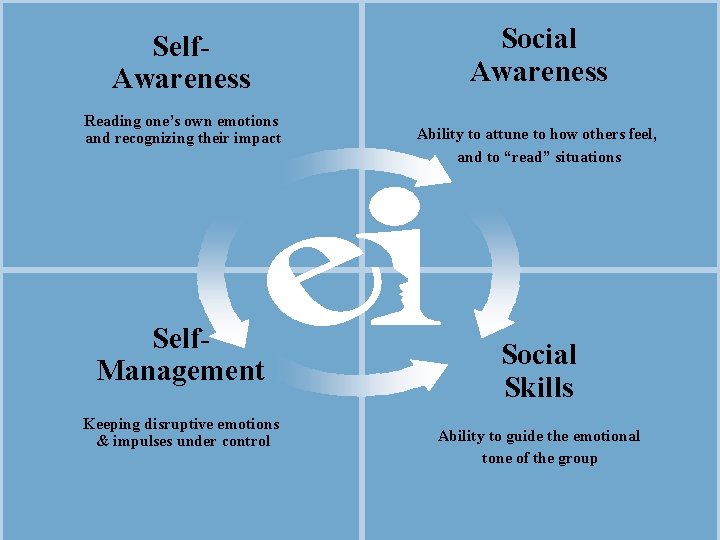
Self. Awareness Reading one’s own emotions and recognizing their impact Self. Management Keeping disruptive emotions & impulses under control Social Awareness Ability to attune to how others feel, and to “read” situations Social Skills Ability to guide the emotional tone of the group
The Business Case DOES EI MAKE A DIFFERENCE?
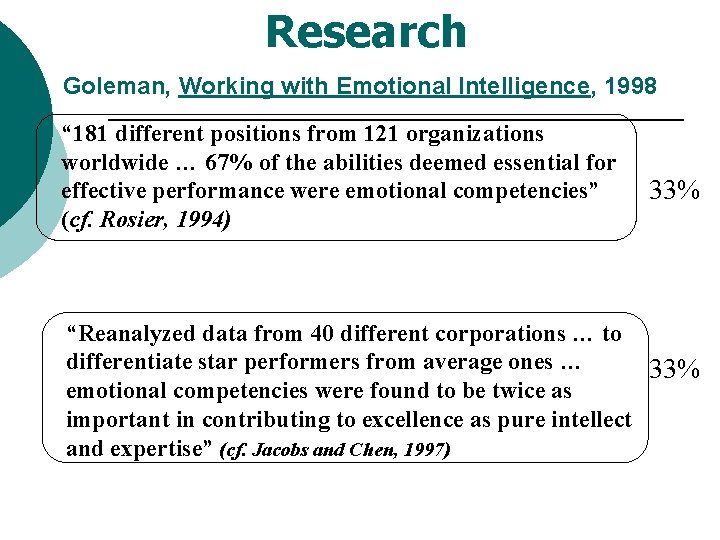
Research Goleman, Working with Emotional Intelligence, 1998 “ 181 different positions from 121 organizations worldwide … 67% of the abilities deemed essential for effective performance were emotional competencies” (cf. Rosier, 1994) 33% “Reanalyzed data from 40 different corporations … to differentiate star performers from average ones … 33% emotional competencies were found to be twice as important in contributing to excellence as pure intellect and expertise” (cf. Jacobs and Chen, 1997)
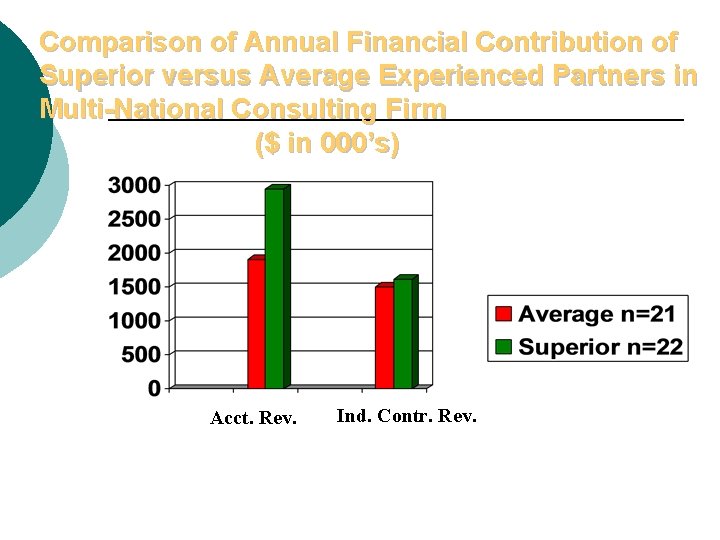
Comparison of Annual Financial Contribution of Superior versus Average Experienced Partners in Multi-National Consulting Firm ($ in 000’s) Acct. Rev. Ind. Contr. Rev.
The Case for EI Why Do Smart People Fail? ¡ Intellectual Abilities l Intellectual capability (IQ), knowledge, and technical expertise are threshold ¡ Emotional Intelligence l Emotional Intelligence (EI) is the differentiating factor in success
Group Emotional Intelligence Model
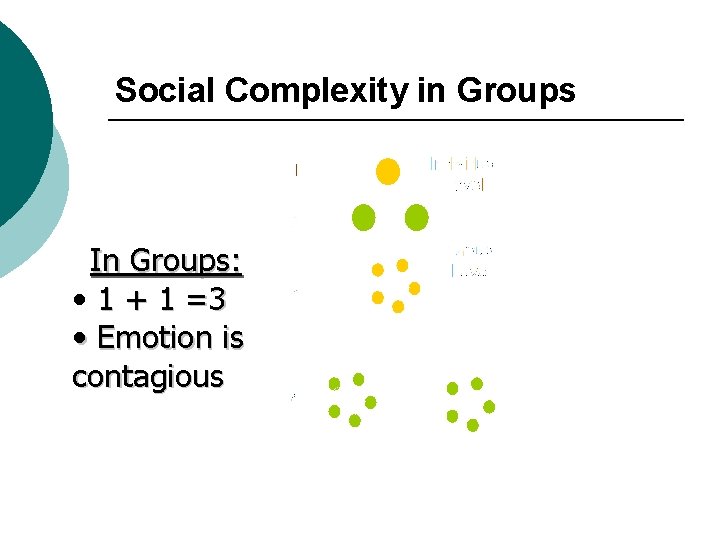
Social Complexity in Groups In Groups: • 1 + 1 =3 • Emotion is contagious
What is Group Emotional Intelligence? ¡ The ability of a team to generate operating norms that increase awareness of emotion and management of behavior in ways that have positive emotional consequences
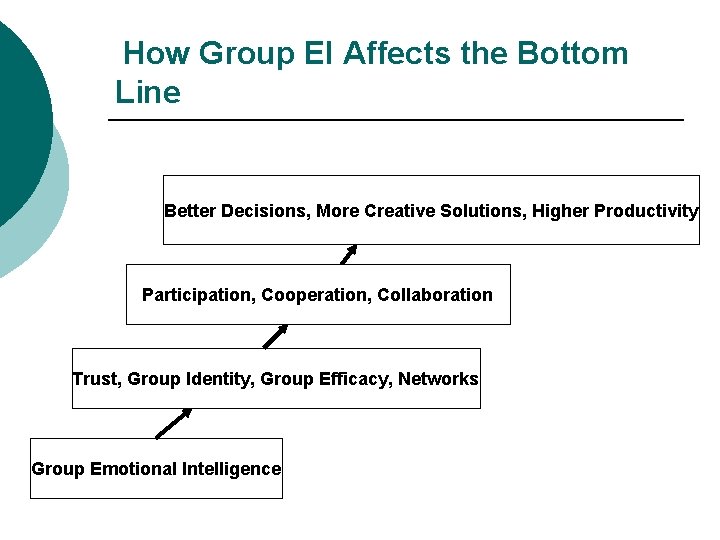
How Group EI Affects the Bottom Line Better Decisions, More Creative Solutions, Higher Productivity Participation, Cooperation, Collaboration Trust, Group Identity, Group Efficacy, Networks Group Emotional Intelligence
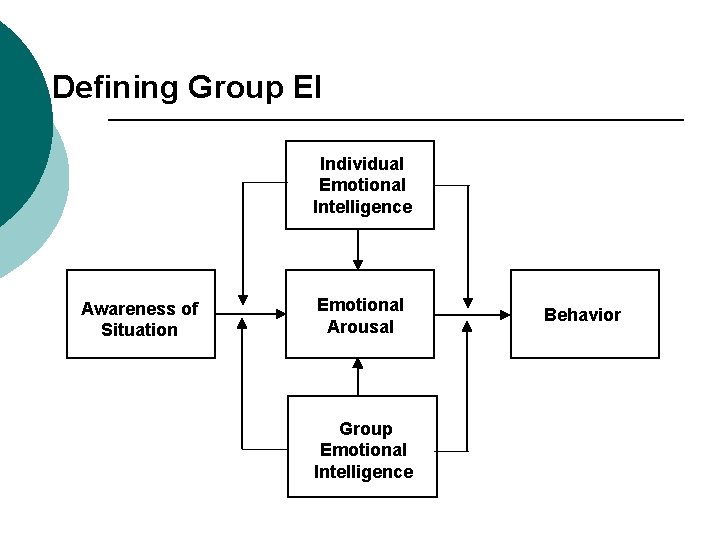
Defining Group EI Individual Emotional Intelligence Awareness of Situation Emotional Arousal Group Emotional Intelligence Behavior
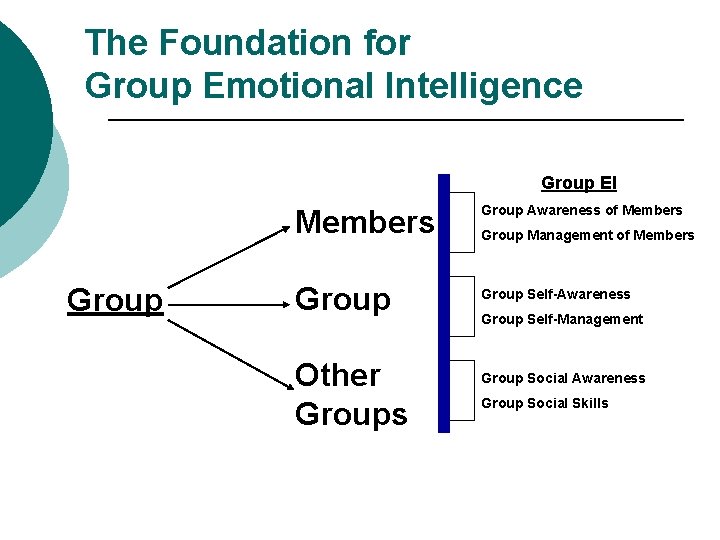
The Foundation for Group Emotional Intelligence Group EI Group Members Group Awareness of Members Group Self-Awareness Other Groups Group Management of Members Group Self-Management Group Social Awareness Group Social Skills
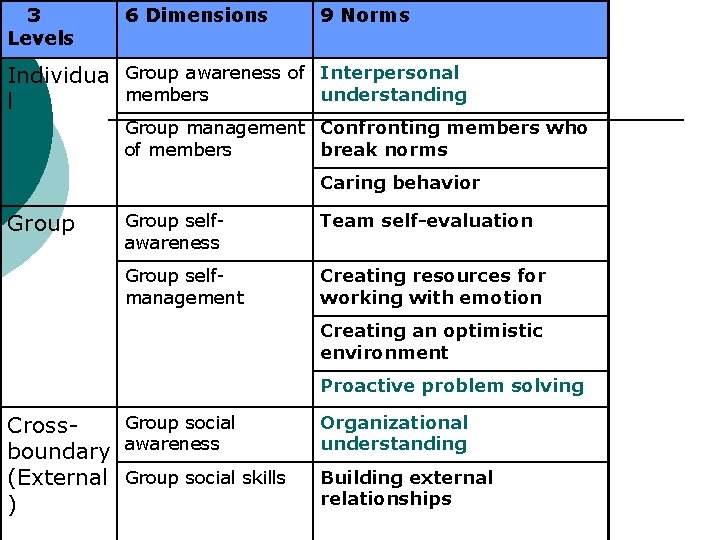
3 Levels 6 Dimensions 9 Norms Individua Group awareness of Interpersonal members understanding l Group management Confronting members who of members break norms Caring behavior Group selfawareness Team self-evaluation Group selfmanagement Creating resources for working with emotion Creating an optimistic environment Proactive problem solving Group social Crossboundary awareness (External Group social skills ) Organizational understanding Building external relationships
What is Group EI? ¡ ¡ It is not about… catching and suppressing emotions as they bubble up It is not about… being nice ¡ It is about. . . bringing emotions to the surface and proactively understanding their meaning and impact on the team and its performance
SUMMARY ¡ EI and Group EI have significant financial impact ¡ EI and Group EI can be developed ¡ Small changes in EI and Group EI can have a big impact – you do not have to show all competencies/ norms all the time
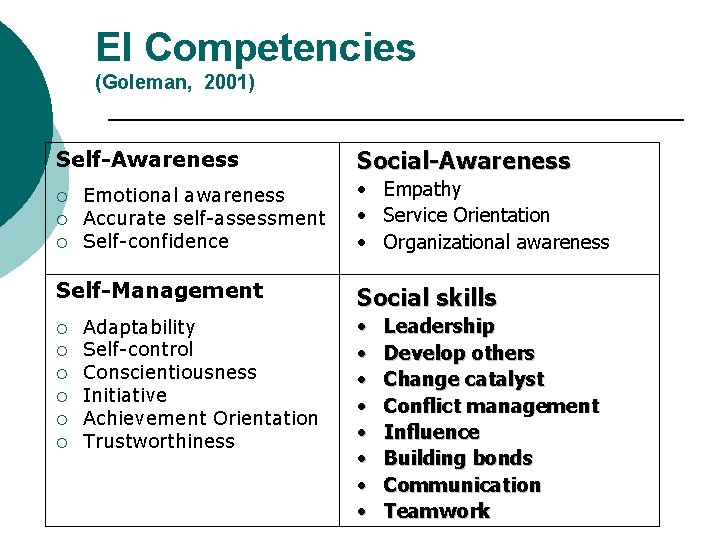
EI Competencies (Goleman, 2001) Self-Awareness ¡ ¡ ¡ Emotional awareness Accurate self-assessment Self-confidence Self-Management ¡ ¡ ¡ Adaptability Self-control Conscientiousness Initiative Achievement Orientation Trustworthiness Social-Awareness • Empathy • Service Orientation • Organizational awareness Social skills • • Leadership Develop others Change catalyst Conflict management Influence Building bonds Communication Teamwork
- Slides: 108