
Journal Emotional Intelligence 1 Emotional intelligence and the





- Slides: 103
Journal : Emotional Intelligence 1. Emotional intelligence and the construction and regulation of feelings - John D. Mayer 2. A Review of Emotional Intelligence by Daniel Goleman: Implications for Technical Education - Dick Culver 3. Kecerdasan Emotional ( KE ) dalam Kepemimpinan (dikutip dari bahan kuliah, atas izin Prof dr Achmad Sujudi) Fathema Djan Dosen: dr. Andreasta Meliala
• Emotional intelligence and the construction and regulation of feelings • John D. Mayer University of New Hampshire, USA Peter Salovey Yale University, USA Jurnal 1 Emotional Intelligence Fathema Djan
Definition • Emotionally intelligent people are defined in part as those who regulate their emotions according to a logically consistent model of emotional functioning.
• . We indentify and compare several models of emotion regulation; for example, one internally consistent model includes tenets such as “happiness” should be optimized over the lifetime
• Next, we apply that internally consistent model to the way a person can intervene in mood construction and regulation at non-, low -, and high-conscious levels of experience. Research related to the construction and regulation of emotion at each of these levels is reviewed.
• Finally, we connect our concept of emotionally intelligent regulation to its potential applications to personality and clinical psychology.
Jurnal Emotional Intelligence ke 2 • A Review of Emotional Intelligence by Daniel Goleman: Implications for Technical Education • Dick Culver • Abstract: Goleman’s book, Emotional • Intelligence Watson School of Engineering and Applied Science
Abstract Holds some valuable lessons as we attempt to design more effective educational programs. Goleman takes a more holistic approach to defining intelligence than the traditional IQ, which focuses on cognitive intelligence. By incorporating the cognitive AND affective dimensions of intelligence, he demonstrates that, to be successful in life, it takes more than just being “smart. ” We are all aware of “smart” students who flunk out of college, or those who graduate near the top of their class only to be a failure in the work place. Goleman shows that the seeds of what he calls emotional intelligence are sown early in life.
• and affect not only how the person gets along with others, but also how they succeed in academic pursuits. In contrast to cognitive intelligence, which is “God given”, emotional intelligence can be strengthened later in life with proper tutoring and commitment.
• Goleman’s ideas are a valuable complement to the author's earlier studies of Perry’s model of intellectual and ethical development in college students. This paper describes Goleman’s hypotheses and suggests how they might impact technical education.
Introduction Learning is an emotional process. If you doubt this, recall the excitement you felt when you finally succeeded in working a really difficult problem or finished a major paper. Remember the dread of entering an exam room when you weren’t sure about the material. If there is no emotion, there probably isn’t much learning going on. Consider the nodding heads in the typical large lecture.
• If learning is under the control of the emotions, then it behooves us to understand how we can use them to enhance learning in our students. • It is also important to help students know how their “emotional intelligence” works to help or hinder their success as a college student. • Fortunately, in the past fifteen years, significant new insights as to how the brain produces emotions have been discovered and the way in which they affect performance in all aspects of life has begun to emerge.
Research • This research has been made accessible to the public in Daniel Goleman’s book, Emotional. Intelligence. [1] Goleman presents convincing evidence that the emotional intelligence quotient (EQ) is just as important in academic success as cognitive intelligence, as measured by IQ or SAT scores. A person with a low IQ may never be able to under-stand an abstract concept, but there are numerous examples of people with high IQ who never finish high school.
So, what is EQ ? • A study of high school valedictorians and salutatorians found that only onein four made it to the “top” of their profession in their professional lives. • As Goleman states, “The SAT may primarily be a good measure of a person’s aptitude for being a college professor. ” EQ, on the other hand, seems to be a good indicator for success in a variety of endeavors and, with a reasonable IQ, is a good measure of success in college. • The good news is that, while IQ seems to be genetically endowed, there is evidence that EQ can be enhanced with proper training and learning environment. • So, what is EQ?
Emotions and Emotional Intelligence • An emotion is a physiological response to a situation that is too important to leave to intellect alone, such as danger, painful loss, persisting toward a goal despite frustrations, bonding with a mate, building a family. • In effect, we have two minds, one that thinks and one that feels. The brain evolved.
Amygdala: The Emotional Sentinel Researchers like Eckman have identified the physiological process for the emotional rush. When an external stimulus is received by one of our senses (eye, ear, taste, nose, touch) it goes first to the thalamus, where it is translated into the language ofthe brain. Most of the message goes to the neocortex, the seat of rational thought, where it is analyzed and assessed for meaning and appropriate response. If that response is emotional, a signal goes to the amygdala, a small almond-shaped region in the brain, to activate the emotional centers.
But a small portion of the original signal also goes straight from the thalamus to the amygdala, allowing a faster (but less precise) response. Thus, the amygdala can trigger an emotional response before the cortical centers have fully understood what is happening. The amygdala houses memories and response repertoires that we enact without quite realizing why we do so. This fast response can be life saving in desperate situations, but can also result in inappropriate action.
• life saving in desperate situations, but can also result in inappropriate action. The amygdala matures very quickly in an infant’s brain. • The interactions between the infant and caretakers during the first years lay down a set of emotional responses, a blueprint for emotional life. • More slowly, the neocortex, which is the source of rational thought, evolves based on cognitive training. • It is because of this more gradual and extensive development of the neocortex that human beings are capable of the higher levels of rational reasoning unique to our species.
• The connection between the amygdala and the neocortex is critical to the functioning of the human mind. • A brilliant corporate lawyer developed a brain tumor. When the tumor was removed, the link between the cortex and the amygdala was destroyed. Although he appeared just as bright in analyzing complex data, he lost his job and marriage because he could not make a decision. • Decision making is tied to the emotions since it is valuebased.
• It is the design exercises in engineering programs, which require decision making. • Donald Woods defines “problem solving”, where ill-defined problems require valuebased decisions, as distinct from “exercise solving” which refers to “recalling” familiar solutions to previously-solved problems. [3]
Emotional Intelligence Properly used, the emotions are an essential tool for successful and fulfilling life. But of control, emotions can result in disaster. In our day to- day life, they affect our relations with other people, our self-identity, and our ability to complete a task
• To be effective, our cognitive processes must be in control of our emotions, so that they work for us rather than against us. Salovey[4] combined the work of several researchers to define the following measures of effective use of emotion, i. e. Emotional Intelligence (paraphrasing Goleman): • 1. Knowing one’s emotions: Self-awareness – recognizing a feeling as it happens – is the keyst oneof EQ. • The ability to monitor feelings from moment to moment, cognitively as well as affectually, is crucial to psychological insight and selfunderstanding. • An inability to read our true feelings leaves us at their mercy.
• 2. Managing emotions: Handling feelings so they are appropriate is an ability that builds self-awareness. • Having the capacity to soo the oneself, shake off rampant anxiety, gloom or irritability is critical to recovery from life’s setbacks and upsets.
• 3. Motivating Oneself: Marshaling emotions in the service of a goal is essential for paying attention, for self-motivation and mastery, and for creativity. Emotional self-control – delaying gratification and stifling impulsiveness – underlies accomplishment of every sort. • And being able to get into the “flow state” (to be described below) enables outstanding performance of all kinds. • People with this skill are more highly productive and effective at whatever they undertake.
• 4. Recognizing emotions in others: Empathy, another ability that builds on emotional selfawareness, is the fundamental “people skill. ” People who are empathic are attuned to the subtle social signals that indicate what others need or want. Empathy kindles altruism, which is the basis for social morality.
• 5. Handling Relationships: The art of relationships is, in large part, skill in managing emotions in others. This ability undergirds leadership and interpersonal effectiveness. • People differ in their abilities in each of these five EQ domains; some of us are quite adept at handling our own anxiety but not at soothing someone else’s. • But, the cognitive region of the brain is flexible and is constantly learning. Lapses in emotional skills can be remedied: each of these domains represents a body of habit and response that, with the right effort, can be improved. • This capacity for long-term growth of emotional control is the basis for emerging educational programs, such as the Self Science curriculum described below.
Academic Exellence Perhaps the most important element of EQ for effective academic performance is delaying gratification. Goleman describes an experiment in which fouryear olds were given a challenge: “You can have on marshmallow now but, if you will wait until I have run an errand, you can have two marshmallows. ” Some grabbed the marshmallow as soon as the experimenter left the room, while others waited as long as twenty minutes.
• This ability to resist impulse proved to be critical in subsequent academic success. Those children who deferred gratification at the age of four, were more socially competent as adolescents, less likely to freeze under stress, accepted challenges, were self-reliant and dependable; they took initiative and plunged into projects. • When the four year-olds who grabbed the marshmallo immediately reached adolescence, they were shy, stubborn and indecisive; they would tend to overreact to irritations with a sharp temper. • Upon high school graduation, those who delayed taking the marshmallow had SAT scores over 200 points higher than those who did not, even though there was little evidence of a difference in IQ at the age of four.
Perry’s Scheme In my previous work using Perry’s model • for intellectual development in the college years, we found that intellectual growth was by no means assured simply by being in college. [5] • Perry talked about the emotional risk inherent in moving from one position to another, particularly in the fundamental change which occurs in reaching for position five – Contextual Relativism. Perry said that people learn best in their pleasure zone – between panic and boredom. [6]
• , Goleman describes optimum performance as occurring when people are in “flow, ” an emotional state in which the individual is grappling with a challenge which is within reach but requires total concentration. • People who experience flow find it an invigorating state, described as spontaneous joy, even rapture. • Athletes achieve maximum performance in flow, as do artists, writers, composers, and musicians. Interestingly, the emotional energy level is low when a person is in flow, because no energy is being expended on anxiety or peripheral concerns.
• A mechanical analogy would be that of a system which is being excited at its natural frequency. • A minimum of effort is required to keep it moving since all input energy is going into reinforcing the desired motion. • Creative achievements depend on single-minded immersion, such as occurs in flow. • A study of students in a high school of sciences found that students who were most successful were in flow 40 percent of the time when doing their studying. • Low achievers with the same score on a math proficiency test found that study provided flow only 16 percent of the time. • More often than not, study created anxiety, with demands outreaching the students’ ability. [7]
• Therefore, a learning environment in which students are challenged at an appropriate level, which can produce flow, will be more productive. • Descriptions of the individualized active learning activities used in cooperative learning suggest that it promotes this type of concentration. [8]
Growth and Change While the intellectual growth that Perry describes can be considered cognitive development, the actual process of facing the challenges associated with that growth is clearly affective. Perry speaks with compassion about the agonizing that students endure as they give up a simple explanation for a more complex and useful understanding of life’s challenges. [6] A hallmark of people who have achieved Perry position 5 is the ability for metathinking, the ability to step outside oneself and think about the process that is being used to approach the problem - the ability to look at a problem from multiple perspectives. This requires the selfawareness described in EQ
• Perry talks about growth • occurring in spurts of new discovery and achievement • followed by a stabilizing period in which the new • insights and capabilities are assimilated into other • phases of one’s life. This relates to The EQ ability • of emotional self-control, to stay with the task until • the new plateau has been achieved.
• In Emotional Intelligence, Goleman explains that some people are “naturals” at high levels of emotional functioning. • For most of us, deficits can result in limitations in performance and satisfaction in one or more parts of our life. • For the “naturals”, as with people who have a high IQ, a natural athlete, artist, or musician, appropriate emotional responses come easily without thinking. • As we work to strengthen our emotional functioning, the new behavior is learned and so must be applied consciously until it is mastered. Studies of “expert” behavior describe four levels of functioning:
• unconscious incompetence, conscious competence and, at the highest level, unconscious competence. • At the lowest level, a person is not aware of his inability to perform a particular task. When he becomes aware of the limitation and chooses to learn the skill required to complete the task, he is at level two. • After study and practice, he achieves conscious mastery. With continued practice, he eventually reaches a point where he can perform the desired task withoutthinking about it. [10]
Social Competence Looking at the ABET 2000 criteria, it is clear that promoting EQ underlies success in achieving the successful engineering program. [8] ABET 2000 identifies 11 competencies that the students should have achieveby graduation. Two competencies deal with knowing science, math and engineering an solving engineering problems. These require the motivation to persevere in study until mastery is attained. Design of experiments and system design require the decision making skills referred to by Woods. [3] Functioning on multidisciplinary teams, communicating effectively and engaging in life-long learning require effective people skills. Under-standing contemporary issues and the impact of engineering solutions on society,
Incorporating EQ in the Curriculum Academic programs which incorporate Emotional Intelligence training as part of the curriculum are being created at forward-lookingschools such as the Nueva School in California. [14] • The “Self Science” curriculum at Nueva deals with the following topics: • Self-awareness: observing yourself and recognizingyour feelings, building a vocabulary of feelings; knowing the relationship between thoughts, feelings, and reactions.
• Personal decision-making: examining your actions and knowing their consequences; knowing if thought feeling is ruling a decision; applying these insights to issues such as sex or drugs. • Managing feelings: monitoring “self-talk” to catch negative messages such as internal put-downs; realizing what is behind a feeling (e. g. the hurt that underlies anger); finding ways to handle fears and anxieties, anger, and sadness • Handling stress: learning to value exercise, guided imagery, and relaxation methods • Empathy: understanding others’ feeling and concerns and being able to relate to their perspective; appreciating the differences in how people feel about things
• Communications: talking about feelings effectively; becoming a good listener and question-asker; distinguishing between what someone does or says and your own reactions or judgements about it; sending “I” messages instead of blame • Self-disclosure: valuing openness and building trust in a relationship; knowing when it’s safe to risk talking about your private feelings • Insight: identifying patterns in your emotional life and reactions; recognizing similar patterns in others
• Self-Acceptance: feeling pride and seeing yourself in a positive light; recognizing your strengths and weaknesses; being able to laugh at yourself • Personal responsibility: taking responsibility; recognizing the consequences of your decisions and actions, accepting your feelings and moods, following through on commitments (e. g. , to studying)
• Assertiveness: stating your concerns and feelings without anger or passivity • Group dynamics: cooperation; knowing when and how to lead, when to follow • Conflict resolution: how to fight fair with other kids, with parents, with teachers; the win/win model for negotiating compromise.
EQ and Academic Survival Our engineering students, as a group, come from a responsible segment of the youth culture, but they are still part of it. It is easy to assume that they do not suffer the problems that we hear about on the news. But they still are influenced by the messages that are being sent to them by TV, movies, the Internet and their peers. Youth today are, accordingto educational research, overstimulated. [15] They tend to have short attention spans, and are more likely to respon emotionally to a challenge than in previous generations. Curricula like Self Science and the new “Danger High” computer multi-media game are being used to help youth deal with the challenges in their environment. [16]
• A large number make very low grades on their first exams, particularly in subjects like math and physics. • If they have never dealt with academic failure before, this may be thrown on top of the pile of emotional drivers that already have them confused and frightened. • It is not surprising that they are tempted to turn to drink and/or drugs to ease the pain and confusion, or sleepin for half the day, missing classes and getting further behind in their work. They are clearly out of their pleasure zone. • Knowing how to control their emotions is critical to survival of that early period oftransition to college. Of course, for some that is not • a problem. • Dan Budny‘s research shows that students’ first semester grades are the best predictor of
• satisfactory completion of the college degree, muchbetter than SAT scores or class rank in highschool. [17] • I contend that their ability to excel in the first semester is in large part a measure of their EQ. • Students with a high EQ are prepared to deal with the challenges of the new environment, setting up a responsible schedule and study plan, meeting new people, and dealing with the frustrations and anxieties of being out of control of the new environment.
• For those that are not well prepared for this, the college has an opportunity to provide programmed support so that they have a chance of survival. • The student has to show some responsibility in taking advantage of what is provided, but an impersonal program will doom many potential engineers to leaving the program before they get started.
• With Goleman’s clear description of EQ, we have a new insight into what such a program should provide and the reasons for it. • In a future paper, I will survey some of the innovative programs being developed i engineering schools across the country a indicate how they are working to promote a more effective EQ in their students.
• One of the most stressful times in a person’s life is the first year of college. • A freshman is away from home for the first time. They have to make new friends and don’t know what the social code is. • They are in large, impersonal classes, studying material that may be beyond their ability.
• Terima kasih
EMOTIONAL INTELLIGENCE ( EI ) • EMOTIONAL INTELLIGENCE ( EI ) Kecerdasan Emotional ( KE ) * dalam Kepemimpinan ( dikutip dari bahan kuliah, atas izin Prof dr Achmad Sujudi ) Fathema Djan
• Beberapa pengertian tentang emosi , yang pada umumnya merupakan suatu reaksi terhadap sesuatu seperti sedih, marah dll, tetapi emosi juga merupakan suatu respon berupa suatu perilaku atau behavior yang khusus pada manusia disertai dengan perasaan atu felling yang sebenarnya berupa perilaku atau behavior untuk mempertahankan diri atau survival ataupun reproduksi.
• Pusat emosi dan perasaan berada pada susunan syaraf pusat yaitu otak didaerah orbito frontal cortex • Suatu respon yang kompleks merupakan masalah yang kompleks juga tdd, analisa situasi sosial yamg menyangkut analisa sensoris, ingatan, pengalaman, dan pertimbangan ( judtment ). Reaksi emosional positif atsu negatif tergantung proses diatas.
• Pusat emosional tidak sepenuhya berada di orbito frontal cortex tetapi terdapat peran dri cerebral cortex terutama yang kanan. • Sedangkan yang kiri berperan untuk kecerdasan( intellegent ) dan analisa thinking ( Logical thinking ) termasuk kemampuan matematik • Ke 2 nya dapat dikembangkan menjadi humaniora dan matemetik yang keduanya diharapkan berfungsi sempurna. Keduanya diperlukan untuk berinteraksi dengan masyarakat dalam menilai ketidakpastian atau sebagai oppotunity atau commitment.
• Organisasi yang semakin komples terutama yangmenyangkut manusia dan hubungan antar manusia memerlukan kepemimpinan atau leadership yang pada dasarnya membutuhkan suatu kemampuan untuk menghadapi dan mengelola emosi ( emotional intelligence – EI ) selain kemampuan analitik /logik. Hal ini berpusat pada otak kiri ( numerik , matematik )sedangkan otak sebelah kanan kurang dipakai dimana sebenarnya sisi kanan adalah pusat humanity, intuisi, empaty.
• Sehingga banyak penelitian yang membuktikan bahwa organisasi yang banyak berhasil adalah yang memiliki kepemimpinan kecerdasan emosional yang baik disamping kecerdasan intelektual.
• SEORANG YANG TELAH DIBERI GAJI TINGGI KOK TIDAK SENANG BAGAIMANA SEORANG MANAJER MERESPON DENGAN OTAK KIRI YAITU MATEMATIKA SEDANGKAN KURANG MEMAKAI OTAK KANAN HUMANIORA DAN MENGELOLA EMOSI
• If IQ rules, it is only because we let it. And when we let it rule , we choose a bad master.
• Kecerdasan emosional dalam kehidupan sehari sangat berkaitan kepada diri kita sendiri dan orang lain karena kita harus berinteralsi dan terlibat dengan orang lain dalam kehidupan kiata diperlukan pemahahaman terhadap informasi agar kita dapat menggunakan emosi dan mengendalikan emosi kita.
• Kemampuan kita menggunakan kecerdasan emosional yang kita miliki secara efektif merupakan suatu ability dan dimanfaatkan untuk berbagai hal dalam mengefektifkan segala sesuatu yang berhubungan dengan organisasi kita.
Pengukuran Kemampuan Emotional • PENGUKURAN Kemampuan dinyatakan sebagai dalam bentuk Emotional Quotiont (EQ ) sebagai pasangan dari Intelligent Quotient ( IQ ). • Menurut Cooper & Sawaf 1997 Namanya Emotional Mapping untuk EQ menyampaikannya dalam bentuk peta emosional (Emotional Mapping )
• Cara mengetahui EI ( Emotional Intelligence ) adalah dengan ada nya sense of Humour • Humour is by far the most significant behavior of human intelligent _ Dr. Edward de. Bono. Salah satu cara mengetahui kecerdasan emotional adalah dengan melihat kepekaan dan kemampuan dalam menangkap humor.
• Orang yang memiliki rasa humor yang tinggi akan mempunyai daya tahan terhadap stress atau suatu tekanan karena lebih mempunyai kelenturan perasaan ( flexible )dan lebih kreatif dalam menanggapi suatu tekanan. • Kreativitas kita akan berkurang apabila menghadapi sesuatu tekanan dengan cara sangat tegang dan serius. • Masalah masalah ini biasanya berkaitan dengan perasaan , motivasi, kepentingan, arti ( meaning ), nilai ( values ) , filosofi, dan ideologi
• Dalam pelaksanaannya mesalah tersebut dapat berupa kejujuran, integritas, tust, ketahanan ( resiiience ), intuisi, imajinasi, sensitivitas, empati, keberani an, hati nurani (conscience ), penghargaan dan humor. • Pada dasarnya masalah diatas adalah masalah leadership
• Great leadership work through the emotions Pemimpin yang hebat memimpin melalui emosi) • Their success depend onhow they do it (Kesusesan mereka bergantung pada bagaimana mengatur /mengendalikan emosi tersebut) • Penggunaan yang tepan oleh Leader akan dapat mengajak pengikutnya ke suatu tujuan • Juga dapat mengajak orang lain ke suatu tujuan dengan pandai mengambil hati “ to win the heart “ • Peran pertama dan utama anda sebagai pemimpin adalah mengatur energi anda sendiri dan kemudian menyelaraskan dengan energi yang ada disekitar anda( membangun orchestra )
Cooper & Sawaf (1997) kemudian memberikan gambaran tentang pengembangan kecerdasan emosional melalui 4 tahapan, yaitu: 1. Tahap Pemahaman Emosional (Emotional Literacy) 2. Tahap Ketahanan Emosional (Emotional Fitness) 3. Tahap Kedalaman Emosional (Emotional Depth) 4. Tahap Kemapanan Emosional (Emotional Alchemy)
Empat Sisi Kecerdasan Emosional
(1) Kecakapan Emosional Jujur kepada diri sendiri dan menjadi diri sendiri: membangun kesadaran, kata hati, rasa hormat, tanggung jawab dan hubungan
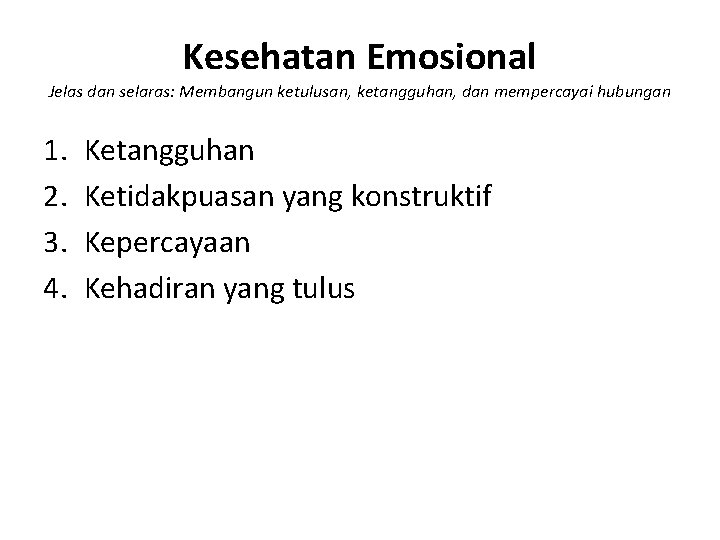
(2) Kesehatan Emosional Jelas dan selaras: Membangun ketulusan, ketangguhan, dan mempercayai hubungan
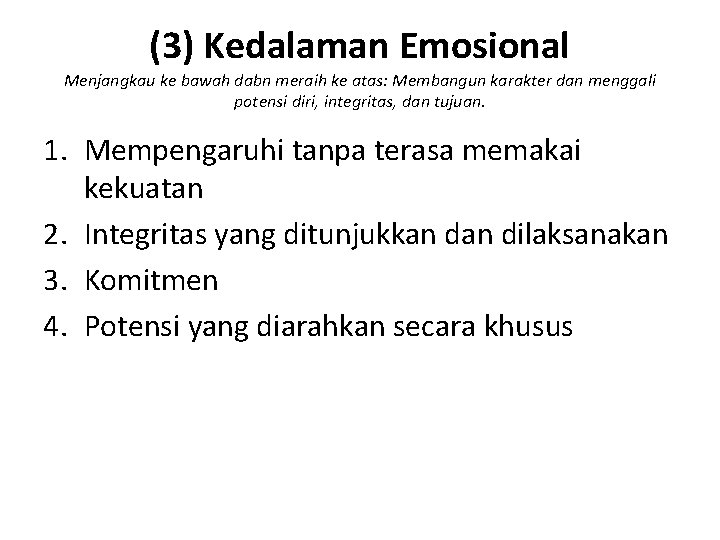
(3) Kedalaman Emosional Menjangkau ke bawah dabn meraih ke atas: Membangun karakter dan menggali potensi diri, integritas, dan tujuan.
(4) Ramalan Emosional Merasakan peluang & bersaing untuk masa depan: Membangun inovasi intuitif; transformasi situasional dan kecerdasan
Kecakapan Emosional Jujur kepada diri sendiri dan menjadi diri sendiri: membangun kesadaran, kata hati, rasa hormat, tanggung jawab dan hubungan 1. 2. 3. 4. Kejujuran emosional Energi emosional Umpan balik emosional Keterkaitan emosional dan intuisi
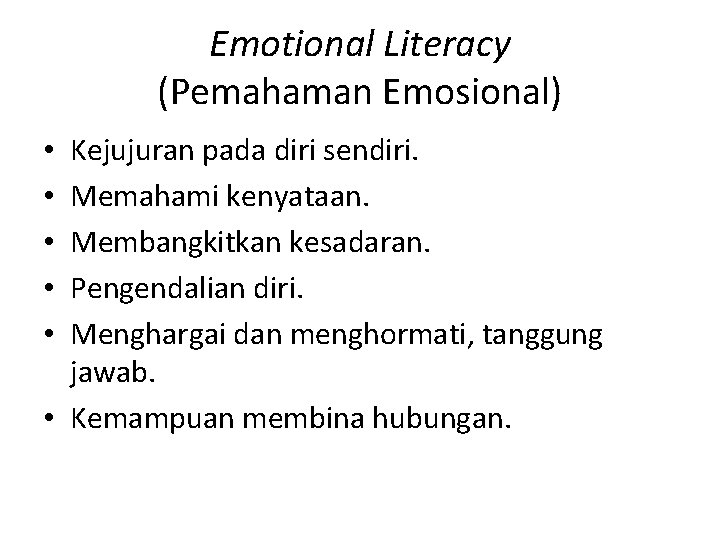
Emotional Literacy (Pemahaman Emosional) Kejujuran pada diri sendiri. Memahami kenyataan. Membangkitkan kesadaran. Pengendalian diri. Menghargai dan menghormati, tanggung jawab. • Kemampuan membina hubungan. • • •
Kesehatan Emosional Jelas dan selaras: Membangun ketulusan, ketangguhan, dan mempercayai hubungan 1. 2. 3. 4. Ketangguhan Ketidakpuasan yang konstruktif Kepercayaan Kehadiran yang tulus
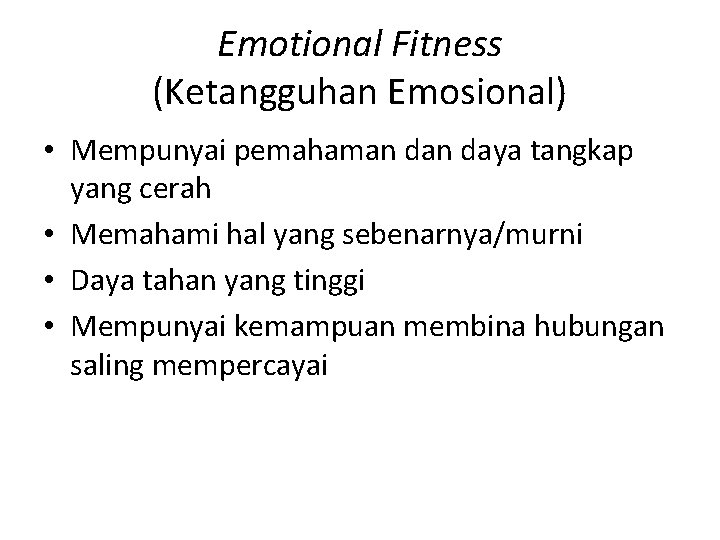
Emotional Fitness (Ketangguhan Emosional) • Mempunyai pemahaman daya tangkap yang cerah • Memahami hal yang sebenarnya/murni • Daya tahan yang tinggi • Mempunyai kemampuan membina hubungan saling mempercayai
(3) Kedalaman Emosional Menjangkau ke bawah dabn meraih ke atas: Membangun karakter dan menggali potensi diri, integritas, dan tujuan. 1. Mempengaruhi tanpa terasa memakai kekuatan 2. Integritas yang ditunjukkan dilaksanakan 3. Komitmen 4. Potensi yang diarahkan secara khusus
Kedalaman Emosional • Mencapai suatu tahapan karakter yang penuh integritas sehingga dapat membangun komitmen. • Mempengaruhi tanpa pemaksaan (influence without authority). • Kemampuan/potensi untuk mengarahkan. • Menerapkan integritas.
Kemapanan Emosional Merasakan peluang & bersaing untuk masa depan: Membangun inovasi intuitif, transformasi situasional dan kecerdasan 1. 2. 3. 4. Kemampuan/memiliki intuisi Pemikiran/Pandangan sesuai waktu Merasakan adanya peluang Melihat & membangun masa depan
Kemapanan Emosional • Melihat berbagai kesempatan dan gambaran masa depan. • Mempunyai kemampuan intuisi, inovasi dan transformasi. • Menularkan kecerdasan emosional kepada pengikut.
Daniel Goleman • Kecerdasan emosional adalah suatu kapasitas untuk mengenal perasaannya sendiri dan orang lain untuk menimbulkan suatu motivasi bersama melalui suatu pengelolaan (managemen) hubungan emosi (regulate one’s own and other feelings and use to guid thought and action).
5 Dasar Kemampuan Emosional dengan Kompetensi Sosial (Daniel Goleman) 1. 2. 3. 4. 5. Kesadaran diri (self Awareness) Pengendalian diri (Self Regulation) Mempunyai motivasi Empati Keterampilan sosial
Perkembangan KE • KE berkembang seperti halnya kecerdasan intelektual sehingga IQ dan EQ dapat berkembang bersama dan seimbang terutama mulai pada usia muda dimana seseorang dapat belajar dan mengembangkan kemampuannya melalui berbagai pengalaman dikatakan bahwa sesorang sampai mempunyai suatu kematangan (Maturity)
Perkembangan KE • Perkembangan IQ dapat mempunyai keterbatasan (genetik), demikian juga perkembangan EQ. Namun demikian EQ dapat dikembangkan melalui berbagai pelatihan. • Orang mempunyai rata-rata IQ dan EQ untuk keperluan hubungan interpersonal maupun dalam hubungan penyelesaian masalah-masalah.
Kekeliruan anggapan (Misconception) • Mempunyai kecerdasan emosional tidak berarti hanya menjadi orang baik saja (being nice). • Tidak berarti memberikan keleluasaan kepada orang lain untuk menurutkan emosinya, tetapi melakukan suatu pendekatan perasaan secara efektif dan tepat.
• Dari penelitian perkembangan EQ pada orang dengan IQ normal akan menambah kemampuannya untuk sukses, dibandingkan dengan sebaliknya. • Kita sekarang berada pada suatu jaman dan juga masa depan yang sangat memerlukan kemampuan untuk bekerjasama (handling our relationship more artfully)
Emotional Competence frame work menurut Goleman Lima kemampuan yang disebutkan oleh Goleman dapat diperluas lagi menjadi kemampuan-kemampuan yang lebih detail tetapi pada dasarnya kemampuan tersebut (emotional competence framework) terdiri dari dua kemampuan: 1. Personal Competence (kompetensi Pribadi) 2. Sosial Competence • Understanding Others (memahami orang lain). • Developing Others (mengembangkan pengikutnya). • Service Orientation (berpikiran untuk menolong dan membantu). • Leveraging Diversity (mengembangkan kesempatan-kesempatan melalui berbagai kemampuan individu yang berbeda). • Political Awarenes (dapat membaca emosidalam suatu kelompok) yang dapat menimbulkan berbagai pengaruh dan kekuatan).
3. Ketrampilan Sosial (social skill) • Keterampilan mempengaruhi. • Keterampilan komunikasi. • Keterampilan mengelola konflik. • Keterampilan mencari jalan untuk mempersatukan. • Keterampilan untuk mendorong kearah perubahan (Change catalyst). • Keterampilan bersama (Collaboration & Cooperation) • Keterampilan menyusun tim.
• Penerapan kecerdasan emosional melalui berbagai keterampilan tersebut , tidak dapat dilakukan demikian saja, diperlukan suatu iklim yang sesuai. • Suatu keterampilan mungkin lebih diperlukan daripada keterampilan yang lain. • Beberapa keterampilan bersama-sama akan membuahkan hasil.
• Untuk suatu tugas mungkin diperlukan keterampilan yang berbeda. • Tidak mungkin seseorang mempunyai kemampuan yang menyeluruh karena itu kesadaran akan kemampuannya menjadi sangat penting
Kelemahan – kelemahan emosional • Kelemahan emosional terutama terlihat pada sikap defensif yang muncul dalam beberapa bentuk antaralain fakta yang diingkari, informasi yang dibelokkan , rasionalisasi dan justifikasi. • Ambisi yang berlebihan. (Blind ambition)-to win or appear”right” at all costs(“JAIM”). • Tujuan yang tidak realistik. • Haus kekuasaan (Power Hungry).
Kelemahan kelemahan emosional • Memanfaatkan orang lain (Drives others) – Tidak melakukan pendelegasian yang baik. • Nafsu untuk selalu menang (Addicted to glory) • Ingin kelihatan “baik” dengan berbagai cara (Needs to look good at all costs) • Menolak dan tidak tahan kritik (Rejects criticism, need to seem perfect) – tidak menyalahkan pihal lain.
Kelemahan Emosionil “Top Down” Leadership • Kepemimpinan dari “atas ke bawah” – Penyalahgunaan wewenang – Delegasi yang tidak sepenuhnya – Tidak mendengarkan pendapat – Kediktatoran dalam pengambilan keputusan – Tidak bisa melepaskan – Sikap egosentris
Seharusnya: • Bukan penyalahgunaan wewenang melainkan melayani semua. • Bukan pendelegasian yang tidak penuh , melainkan memberi ruang dan kebebasan bagi orang untuk menjadi diri sendiri. • Bukan kurang mendengarkan , melainkan perhatian pada kebutuhan orang lain. • Bukan diktator, melainkan mitra dalam proses • Bukan menahan , melainkan melepaskan dengan panduan. • Bukan egosentris, melainkan memberdayakan.
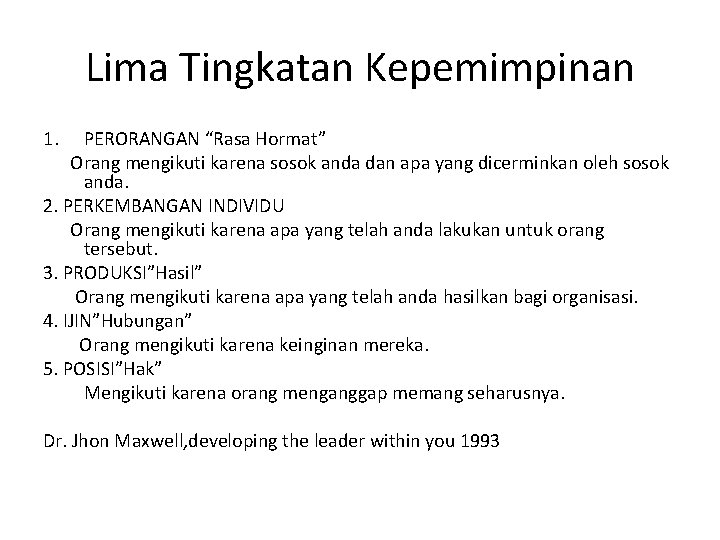
Lima Tingkatan Kepemimpinan 1. PERORANGAN “Rasa Hormat” Orang mengikuti karena sosok anda dan apa yang dicerminkan oleh sosok anda. 2. PERKEMBANGAN INDIVIDU Orang mengikuti karena apa yang telah anda lakukan untuk orang tersebut. 3. PRODUKSI”Hasil” Orang mengikuti karena apa yang telah anda hasilkan bagi organisasi. 4. IJIN”Hubungan” Orang mengikuti karena keinginan mereka. 5. POSISI”Hak” Mengikuti karena orang menganggap memang seharusnya. Dr. Jhon Maxwell, developing the leader within you 1993
• Untuk mencapai tingkat-tingkat kepemimpinan tersebut, (1 -5) tentu sangat berkaitan dengan kecerdasan emosinil. • The most important unit in any operation is the “man”. Unsur yang sangat penting & menentukan dalam organisasi manusia adalah: manusia
Teori X dan Teori Y • Ada 2 sudut pandang terhadap manusia/peserta/pengikut (follower). kedua sudut pandang ini, dikenal sebagai Theory X & Theory Y, yang kelihatannya bertentangan namun kedua-duanya benar pada situasi tertentu.
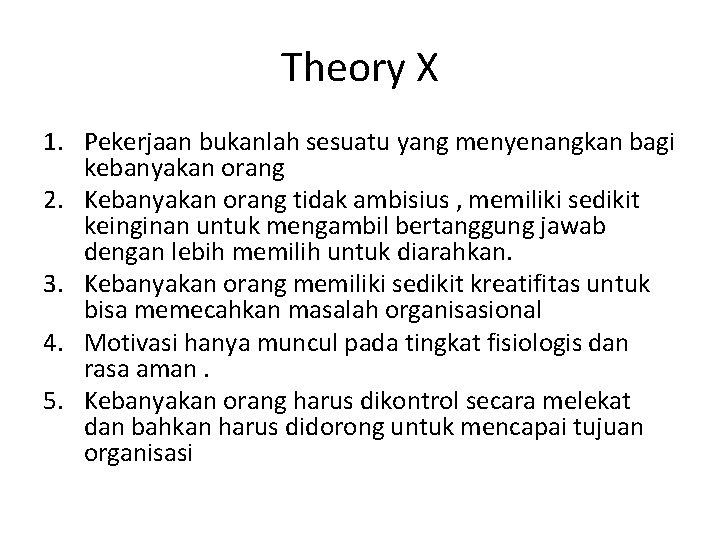
Theory X 1. Pekerjaan bukanlah sesuatu yang menyenangkan bagi kebanyakan orang 2. Kebanyakan orang tidak ambisius , memiliki sedikit keinginan untuk mengambil bertanggung jawab dengan lebih memilih untuk diarahkan. 3. Kebanyakan orang memiliki sedikit kreatifitas untuk bisa memecahkan masalah organisasional 4. Motivasi hanya muncul pada tingkat fisiologis dan rasa aman. 5. Kebanyakan orang harus dikontrol secara melekat dan bahkan harus didorong untuk mencapai tujuan organisasi
Theory Y 1. 2. 3. 4. 5. 6. Bekerja secara alamiah , jika keadaanya mendukung. Kendali diri terkadang tidak bisa ditawar dalam mencapai tujuan. Kapasitas berupa kreatifitas dalam memecahkan masalah organisasional ada secara merata dalam organisasi. Organisasi muncul ditingkat sosial , harga diri dan perwujudan diri serta ditingkat fisiologis dan rasa aman. Orang-orang bisa mengarahkan dirinya sendiri dan memiliki kretifitas apabila dimotivasi dengan benar. Dengan kepemimpinan yang baik , Theory Y akan berlaku Hersey and Blanchard, 1982: 49
“leadership is a mean” • Kepemimpinan adalah suatu sarana , suatu jalan atau suatu cara untuk menuju suatu tujuan organisasi. • Menuju keadaan yang lebih baik dan yang dikehendaki/ diidamkan bersama Peter F Druker
Kesimpulan • Kecerdasan secara umum terdiri dari kecerdasan intelektual dan kecerdasan emosional yang keduanya sama pentingnya namun dari penelitian didapat bahwa kecerdasan emosional mempunyai peran yang lebih besar untuk sukses dan berkembangnyaa sebuah organisasi maupun pribadi. • Kecerdasan emosional merupakan unsur yang penting bagi kepemimpinan selain kecerdasan intelektual. • Kecerdasan emosional dapat dikembangkan dengan pelatihan-pelatihan.
• Kecerdasan intelektual lebih mudah diukur dengan suatu koefisien intelektual (IQ) • Bagi kecerdasan emosional sedang dikembangkan alat-alat (tools) untuk dapat dilakukan pengukurannya (antara lain emotional mapping)
• Kecerdasan dan kemampuan emosional secara umum dapat melahirkan pemimpin-pemimpin dari berbagai lapisan sesuai dengan tingkatan dan tahapannya (Leaders at all levels)
PENUTUP • Kecerdasan emosional yang digambarkan di atas dapat dikembangkan dengan berbagai latihan dengan kesungguhan. • Keberhasilan, menjadi cerdas secara emosional memang tergantung dari sifat awal/genetik tetapi sebagai kemampuan dan keterampilan dapat dikembangkan. • Pelatihan kepemimpinan seharusnya disertai dengan pelatihan untuk meningkatkan kecerdasan emosional.
• Pengenalan tentang kekuatan diri kita pada kemampuan yang mana tentunya sangat penting, dengan demikian ada keterampilan yang lebih mudah didapat dibandingkan keterampilan lain yang membutuhkan kerja lebih keras.