
Lean Process And Six Sigma Corporate Training Materials

- Slides: 136
Lean Process And Six Sigma Corporate Training Materials
Module One: Getting Started Welcome to the Six Sigma workshop. The last couple of decades companies have embraced Six Sigma to generate more profit and greater savings. So what is Six Sigma? Six Sigma is a data-driven approach for eliminating defects and waste in any business process. Quality means doing it right when no one is looking. Henry Ford
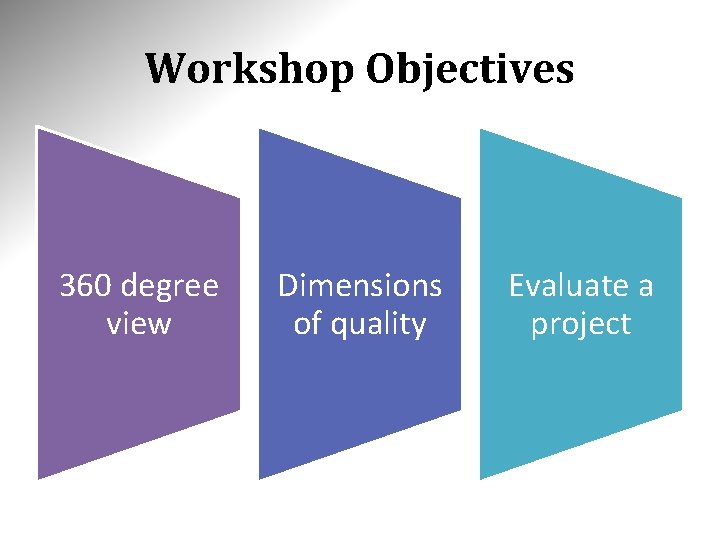
Workshop Objectives 360 degree view Dimensions of quality Evaluate a project
Module Two: Understanding Lean and Six Sigma are buzz-words we hear in business all of the time. Before we get started, let’s make sure we all understand just what we mean by “lean” and “Six Sigma”. Six Sigma is the most important training thing we have ever had. It’s better than going to Harvard Business School. Jack Welch
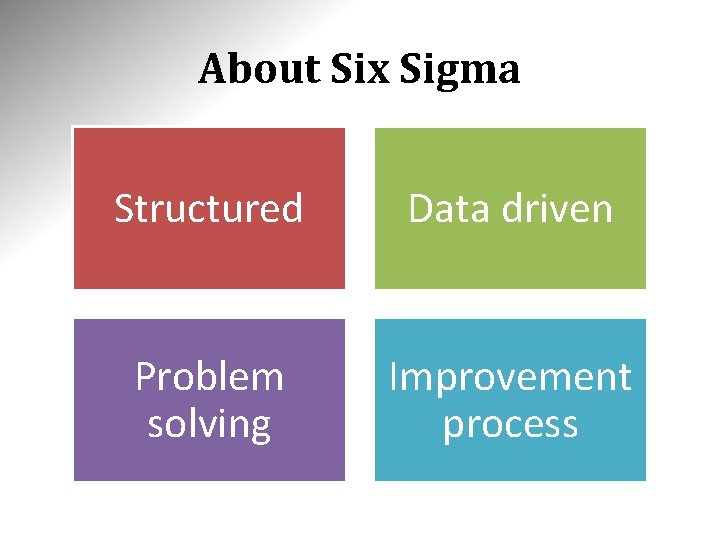
About Six Sigma Structured Data driven Problem solving Improvement process
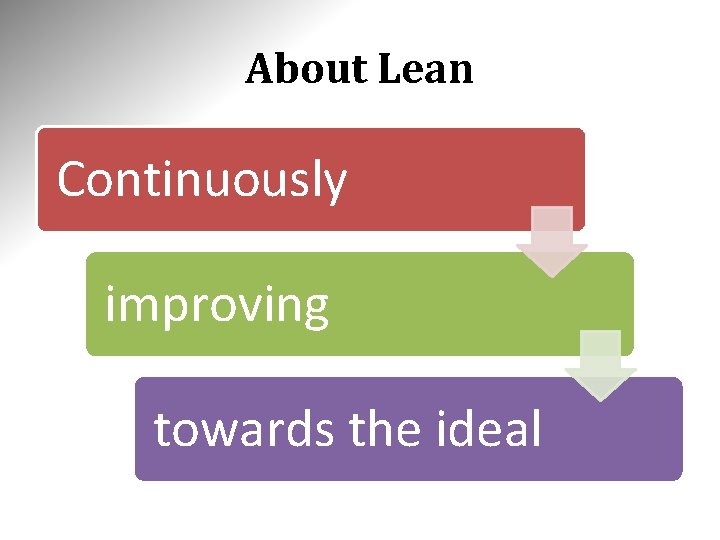
About Lean Continuously improving towards the ideal
History Behind Lean Traced back to Benjamin Franklin Toyota Inspired by Henry Ford Common sense
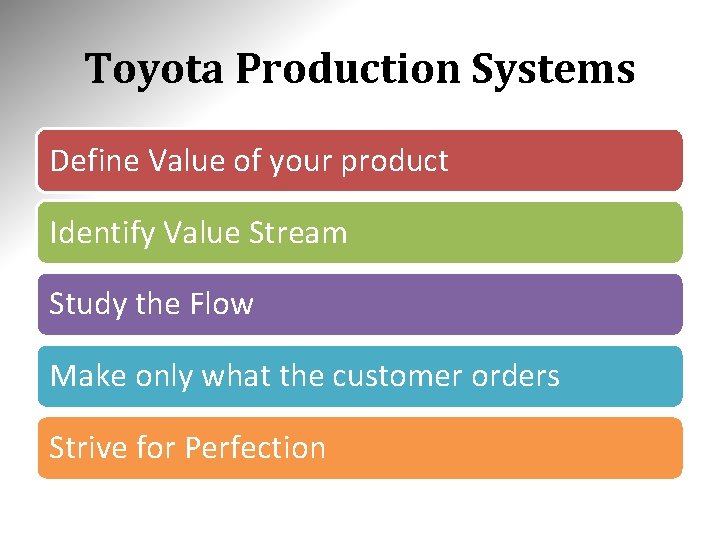
Toyota Production Systems Define Value of your product Identify Value Stream Study the Flow Make only what the customer orders Strive for Perfection
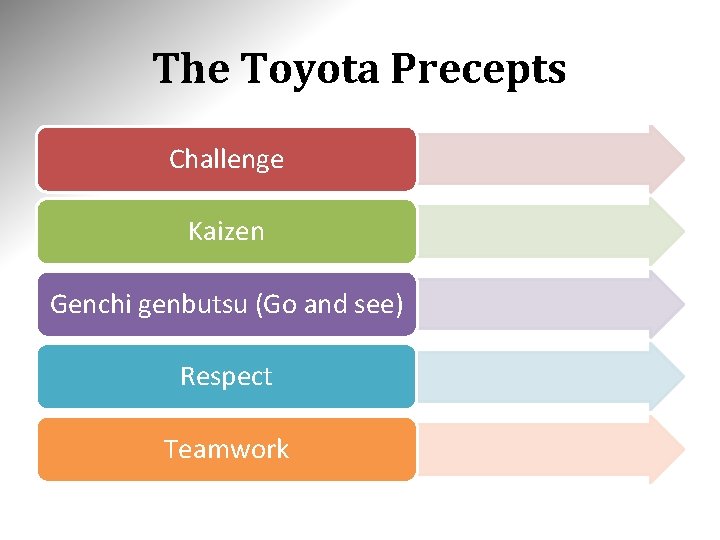
The Toyota Precepts Challenge Kaizen Genchi genbutsu (Go and see) Respect Teamwork
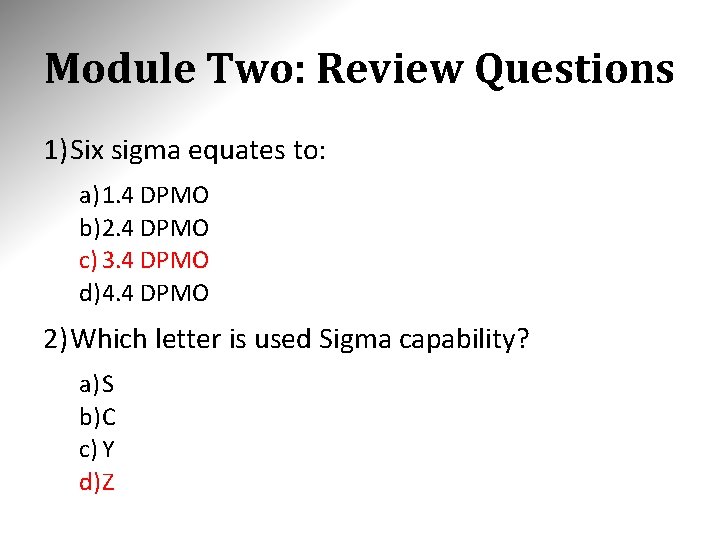
Module Two: Review Questions 1) Six sigma equates to: a) 1. 4 DPMO b)2. 4 DPMO c) 3. 4 DPMO d)4. 4 DPMO 2) Which letter is used Sigma capability? a) S b)C c) Y d)Z
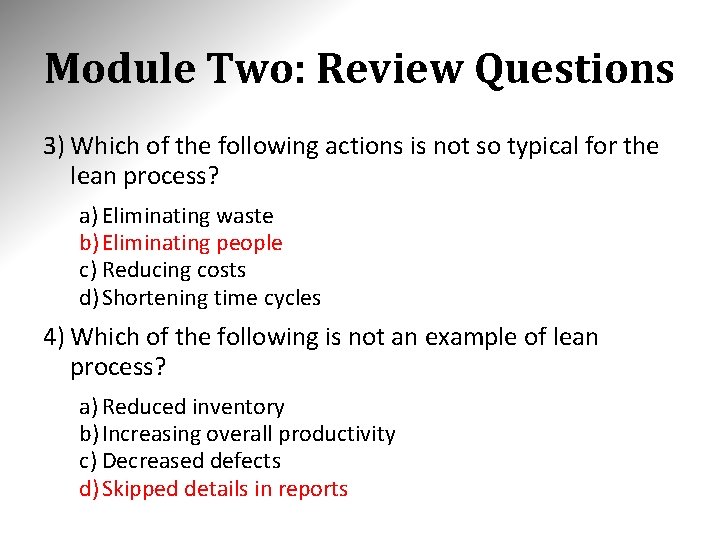
Module Two: Review Questions 3) Which of the following actions is not so typical for the lean process? a) Eliminating waste b) Eliminating people c) Reducing costs d) Shortening time cycles 4) Which of the following is not an example of lean process? a) Reduced inventory b) Increasing overall productivity c) Decreased defects d) Skipped details in reports
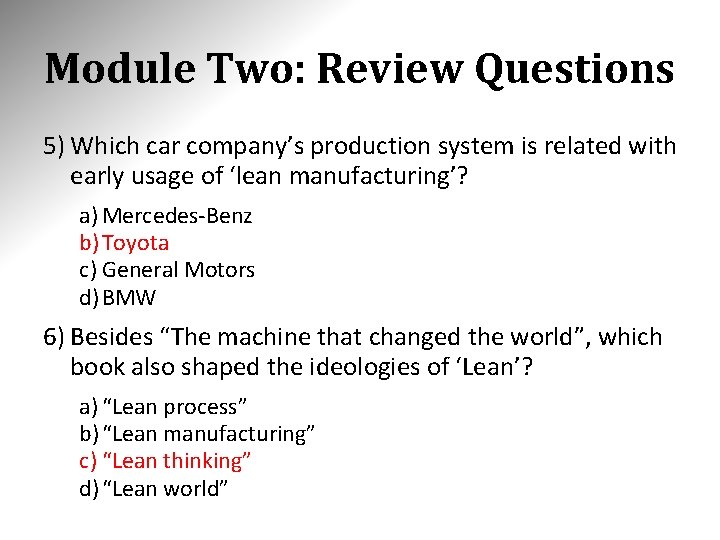
Module Two: Review Questions 5) Which car company’s production system is related with early usage of ‘lean manufacturing’? a) Mercedes-Benz b) Toyota c) General Motors d) BMW 6) Besides “The machine that changed the world”, which book also shaped the ideologies of ‘Lean’? a) “Lean process” b) “Lean manufacturing” c) “Lean thinking” d) “Lean world”
Module Two: Review Questions 7) What was the original name of TPS? a) Just in time production b)Just right production c) Just precise production d)Just appropriate production 8) What is the last step of TPS? a) Defining value of your product b)Striving for perfection c) Making only what the customer orders d)Studying the flow of your product
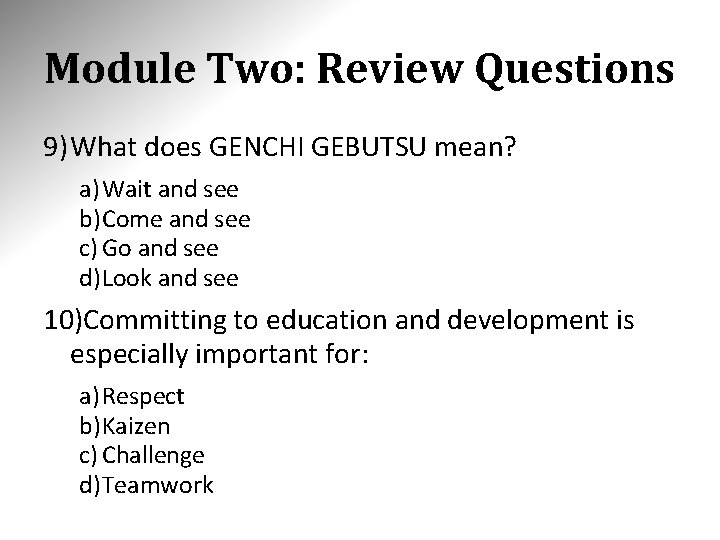
Module Two: Review Questions 9) What does GENCHI GEBUTSU mean? a) Wait and see b)Come and see c) Go and see d)Look and see 10)Committing to education and development is especially important for: a) Respect b)Kaizen c) Challenge d)Teamwork
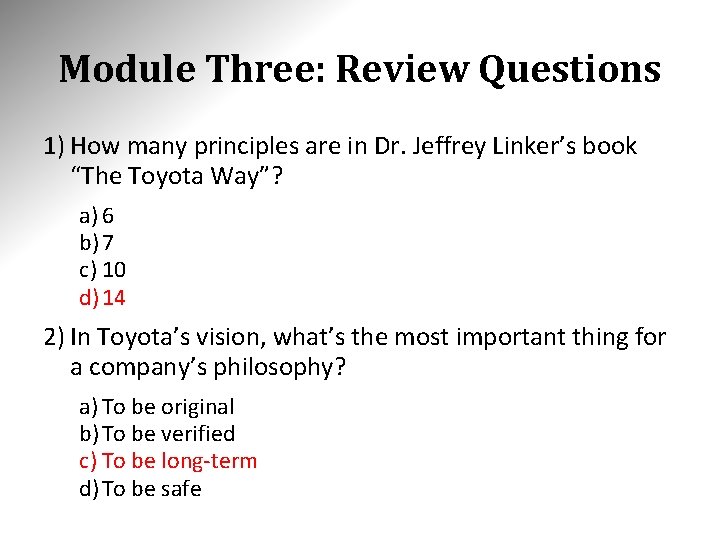
Module Three: Liker’s Toyota Way Do you value practices, or do you practice values? Anonymous In this module we will look closer at Toyota’s philosophies that have become a spiritual pinnacle of modern manufacturing. “The Toyota Way” is a book about the 14 principles that drive Toyota’s culture.
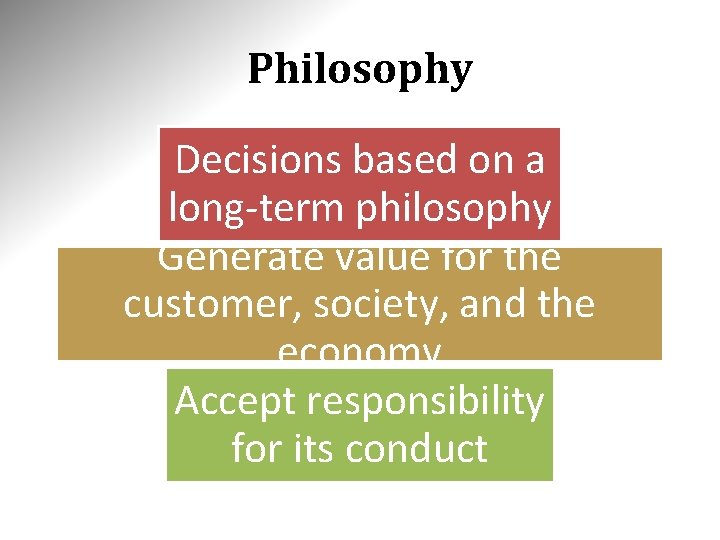
Philosophy Decisions based on a long-term philosophy Generate value for the customer, society, and the economy Accept responsibility for its conduct
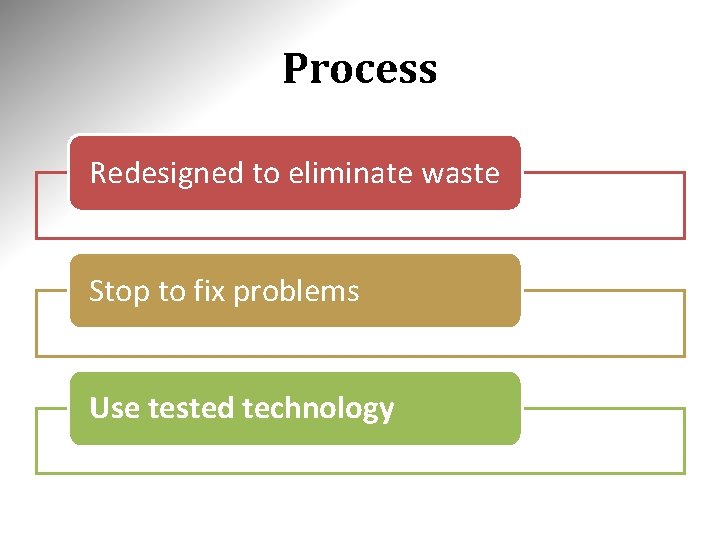
Process Redesigned to eliminate waste Stop to fix problems Use tested technology
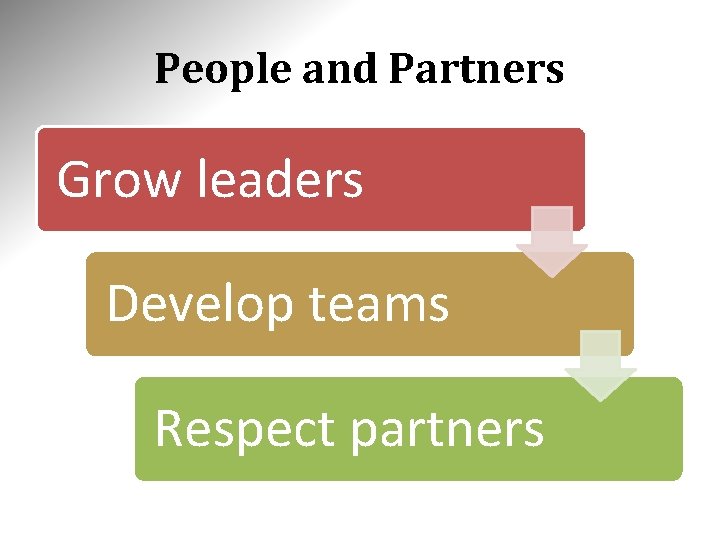
People and Partners Grow leaders Develop teams Respect partners
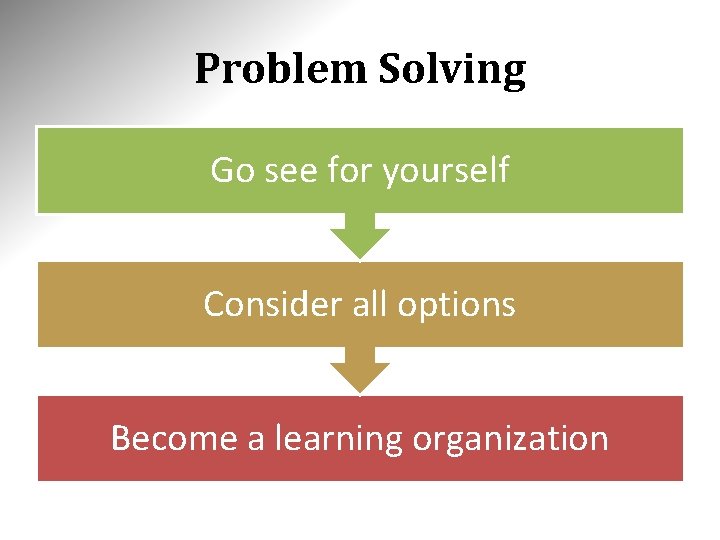
Problem Solving Go see for yourself Consider all options Become a learning organization
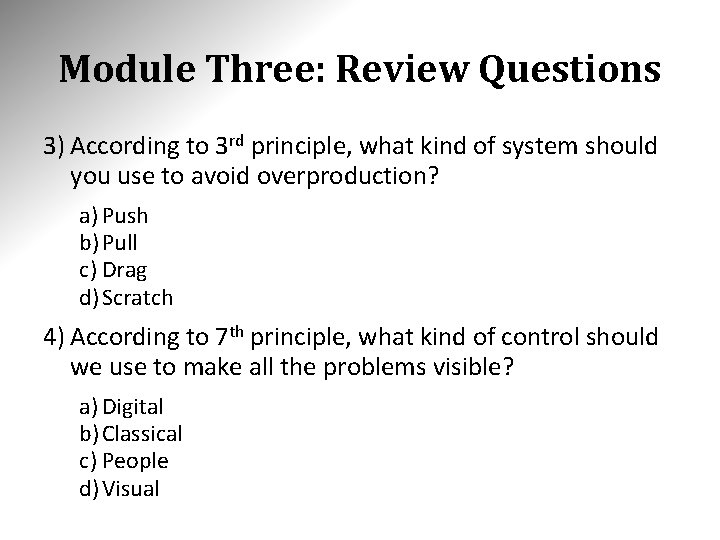
Module Three: Review Questions 1) How many principles are in Dr. Jeffrey Linker’s book “The Toyota Way”? a) 6 b) 7 c) 10 d) 14 2) In Toyota’s vision, what’s the most important thing for a company’s philosophy? a) To be original b) To be verified c) To be long-term d) To be safe
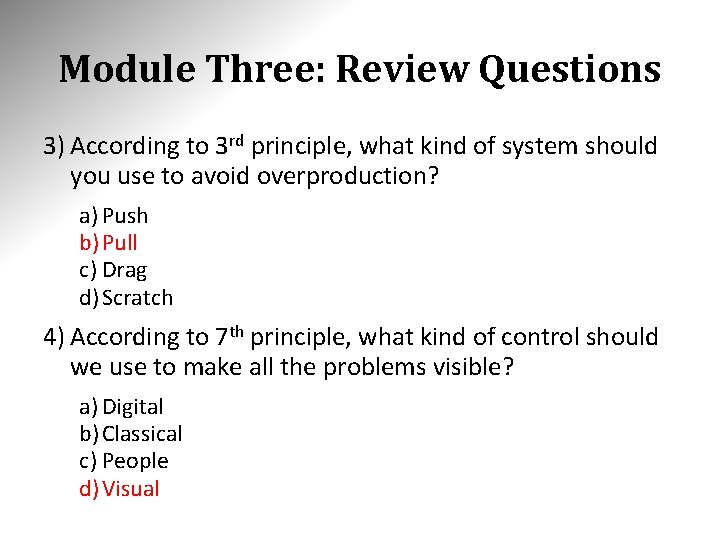
Module Three: Review Questions 3) According to 3 rd principle, what kind of system should you use to avoid overproduction? a) Push b) Pull c) Drag d) Scratch 4) According to 7 th principle, what kind of control should we use to make all the problems visible? a) Digital b) Classical c) People d) Visual
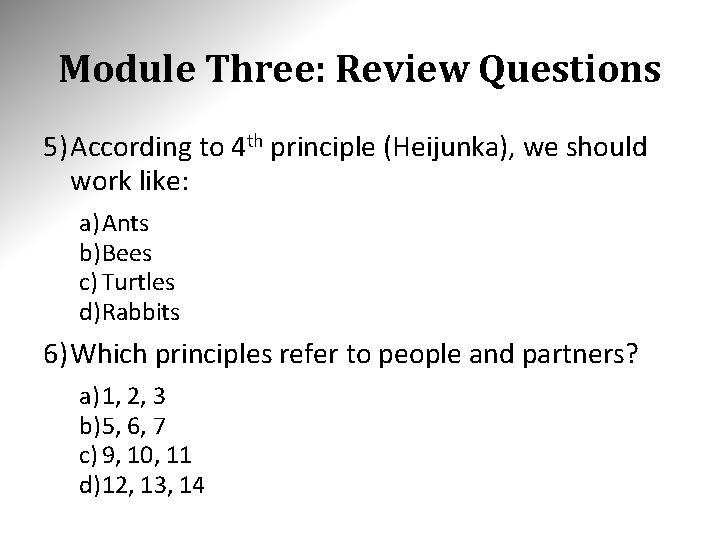
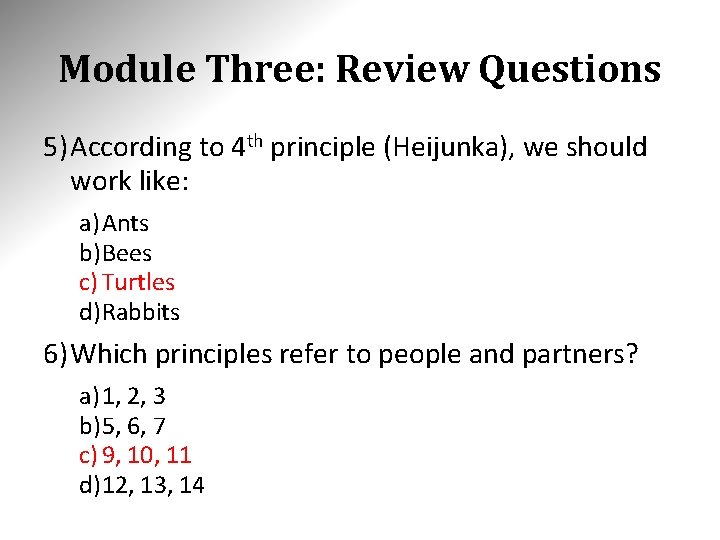
Module Three: Review Questions 5) According to 4 th principle (Heijunka), we should work like: a) Ants b)Bees c) Turtles d)Rabbits 6) Which principles refer to people and partners? a) 1, 2, 3 b)5, 6, 7 c) 9, 10, 11 d)12, 13, 14
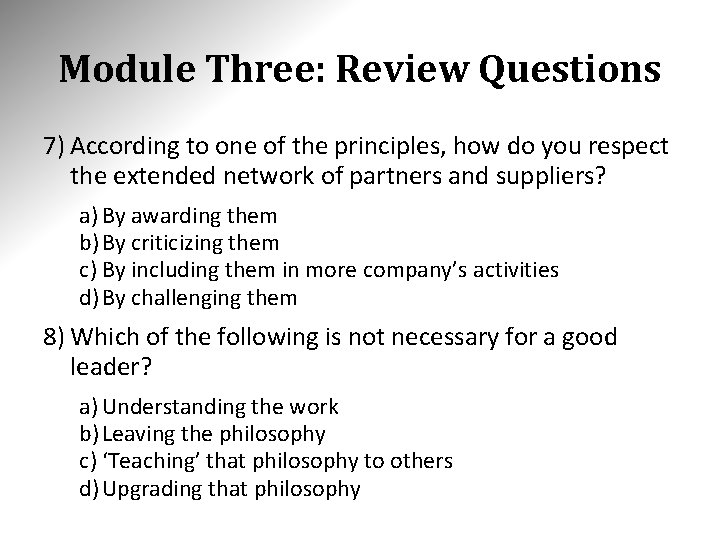
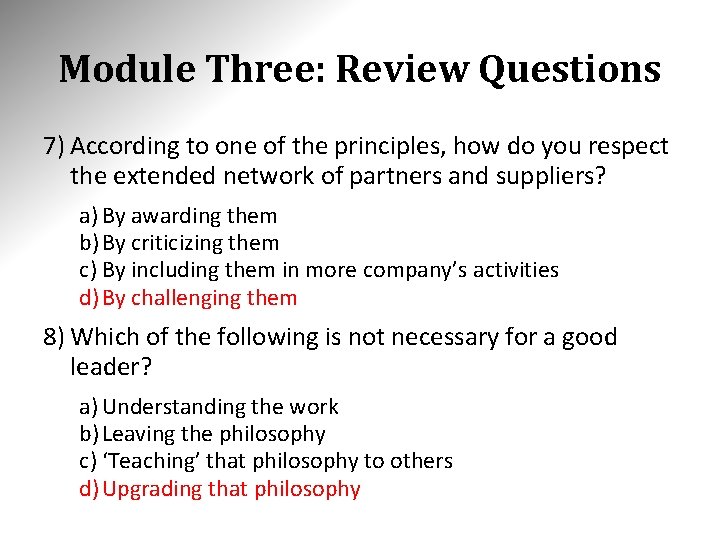
Module Three: Review Questions 7) According to one of the principles, how do you respect the extended network of partners and suppliers? a) By awarding them b) By criticizing them c) By including them in more company’s activities d) By challenging them 8) Which of the following is not necessary for a good leader? a) Understanding the work b) Leaving the philosophy c) ‘Teaching’ that philosophy to others d) Upgrading that philosophy
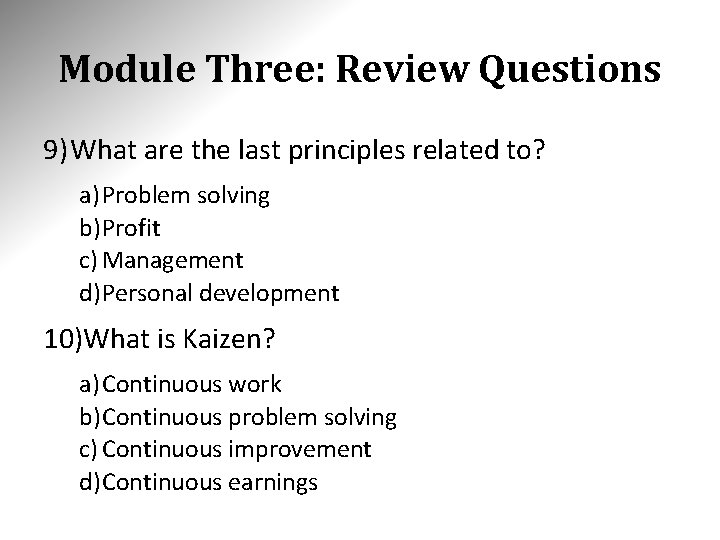
Module Three: Review Questions 9) What are the last principles related to? a) Problem solving b)Profit c) Management d)Personal development 10)What is Kaizen? a) Continuous work b)Continuous problem solving c) Continuous improvement d)Continuous earnings
Module Four: The TPS House If TPS is a mindset, then what’s holding it all together, is the TPS House. In this module we look at the TPS house, the blueprint for a Lean Enterprise that has become one of the most recognizable symbols of modern manufacturing. Toyota is as much a state of mind as it is a car company. USA Today
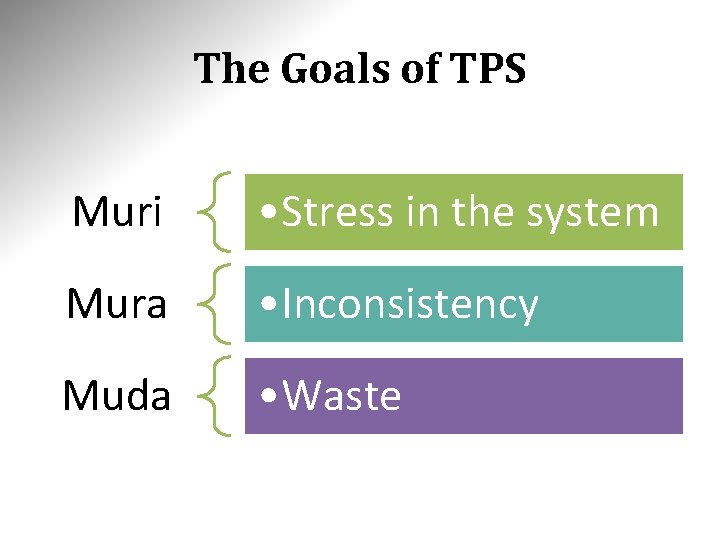
The Goals of TPS Muri • Stress in the system Mura • Inconsistency Muda • Waste
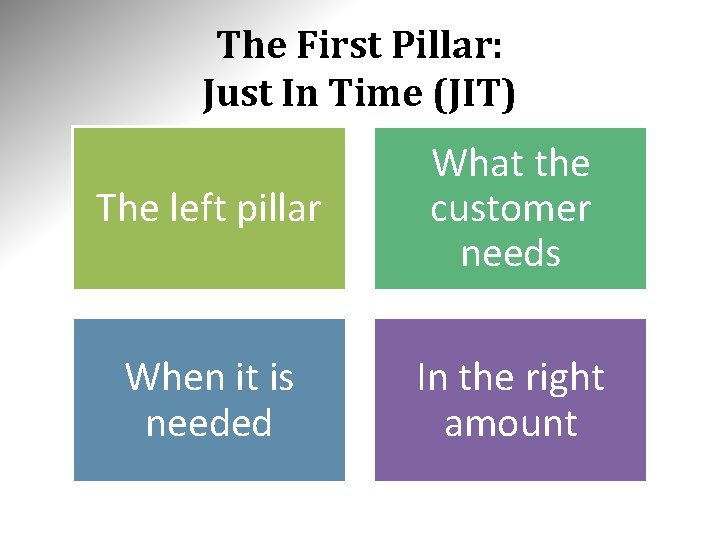
The First Pillar: Just In Time (JIT) The left pillar What the customer needs When it is needed In the right amount
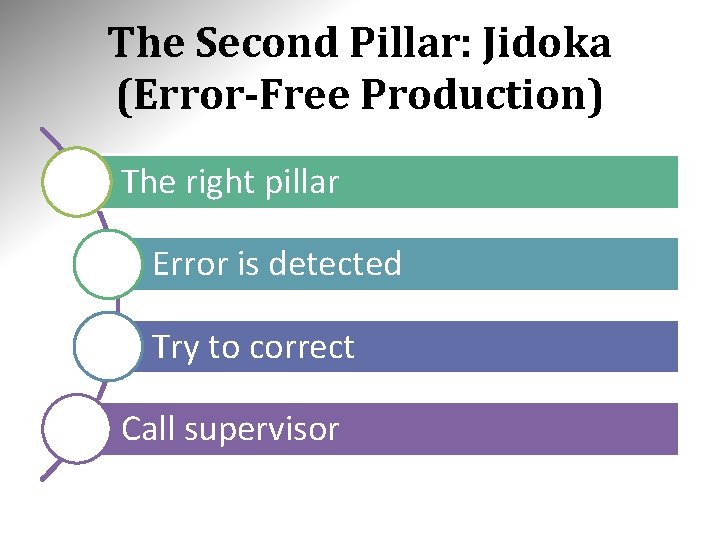
The Second Pillar: Jidoka (Error-Free Production) The right pillar Error is detected Try to correct Call supervisor
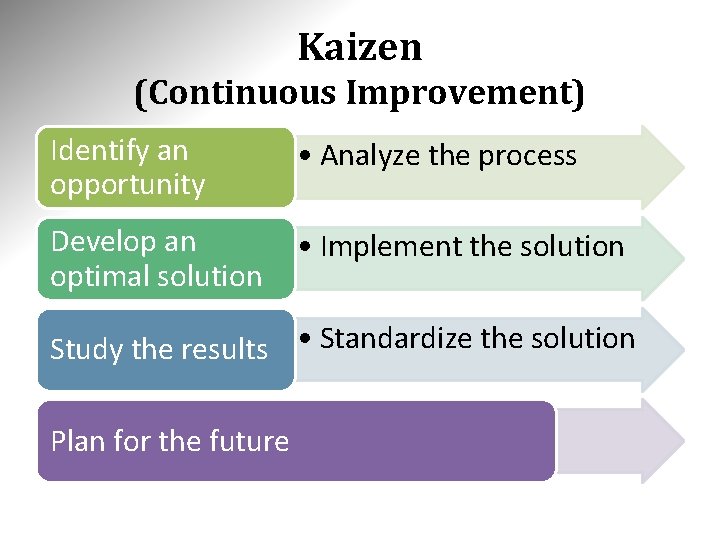
Kaizen (Continuous Improvement) Identify an opportunity • Analyze the process Develop an optimal solution • Implement the solution Study the results • Standardize the solution Plan for the future
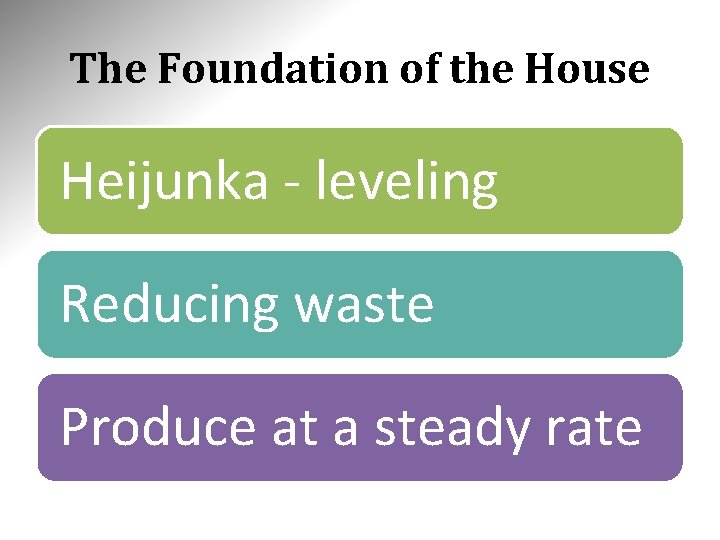
The Foundation of the House Heijunka - leveling Reducing waste Produce at a steady rate
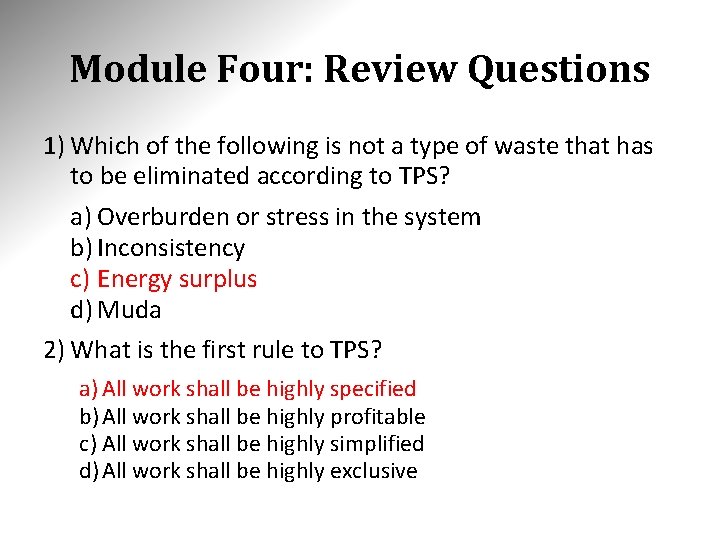
Module Four: Review Questions 1) Which of the following is not a type of waste that has to be eliminated according to TPS? a) Overburden or stress in the system b) Inconsistency c) Energy surplus d) Muda 2) What is the first rule to TPS? a) All work shall be highly specified b) All work shall be highly profitable c) All work shall be highly simplified d) All work shall be highly exclusive
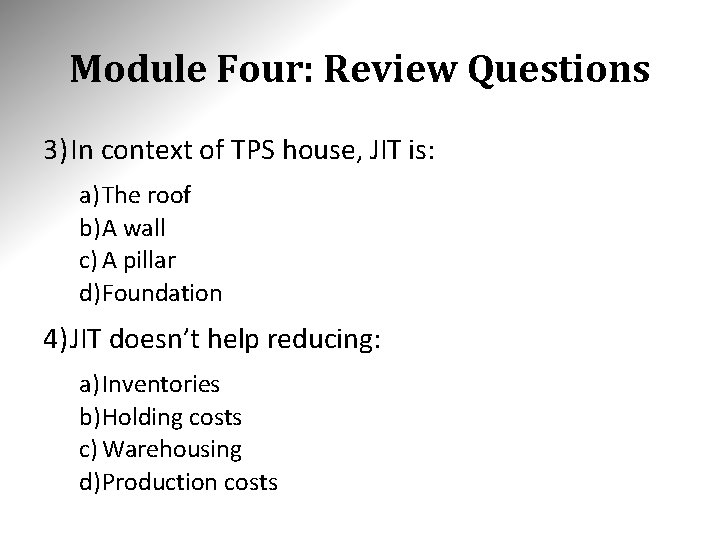
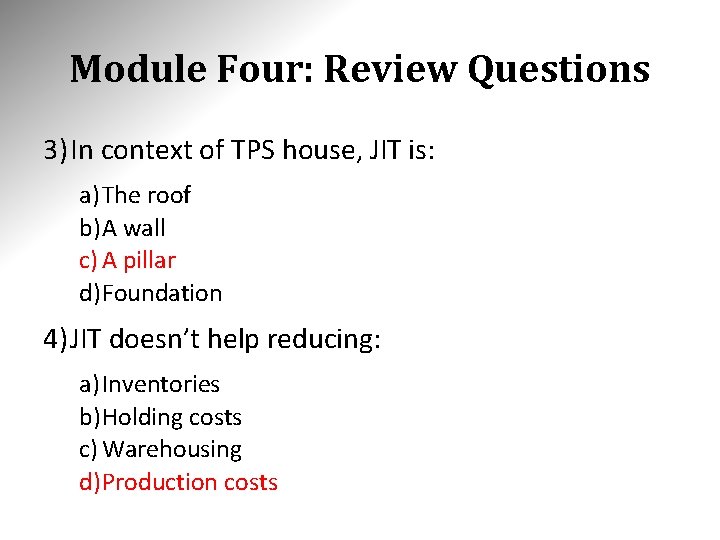
Module Four: Review Questions 3) In context of TPS house, JIT is: a) The roof b)A wall c) A pillar d)Foundation 4) JIT doesn’t help reducing: a) Inventories b)Holding costs c) Warehousing d)Production costs
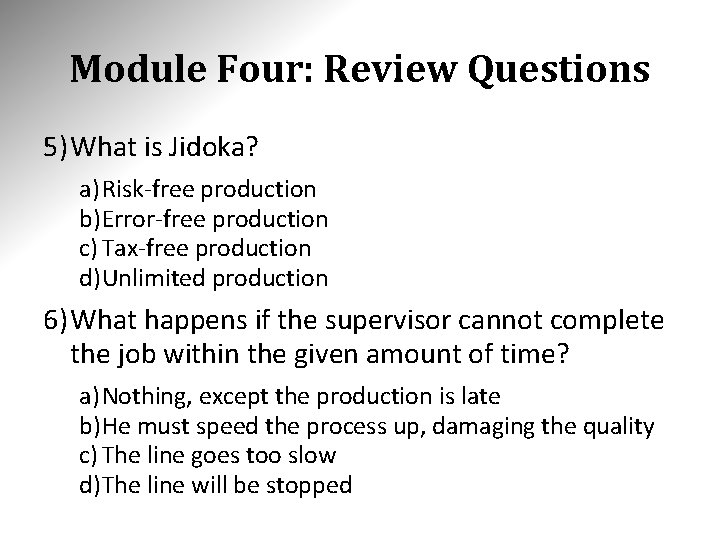
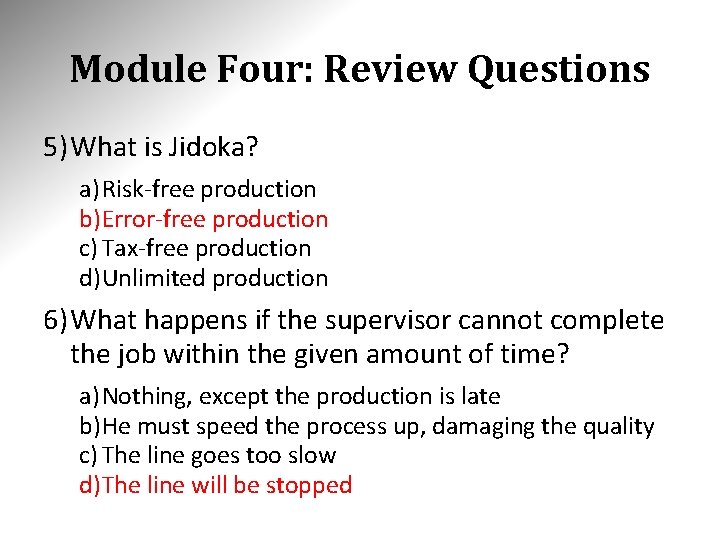
Module Four: Review Questions 5) What is Jidoka? a) Risk-free production b)Error-free production c) Tax-free production d)Unlimited production 6) What happens if the supervisor cannot complete the job within the given amount of time? a) Nothing, except the production is late b)He must speed the process up, damaging the quality c) The line goes too slow d)The line will be stopped
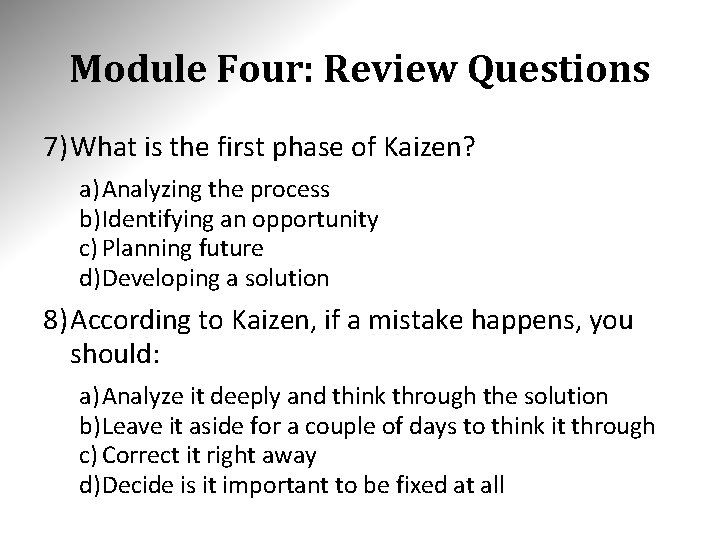
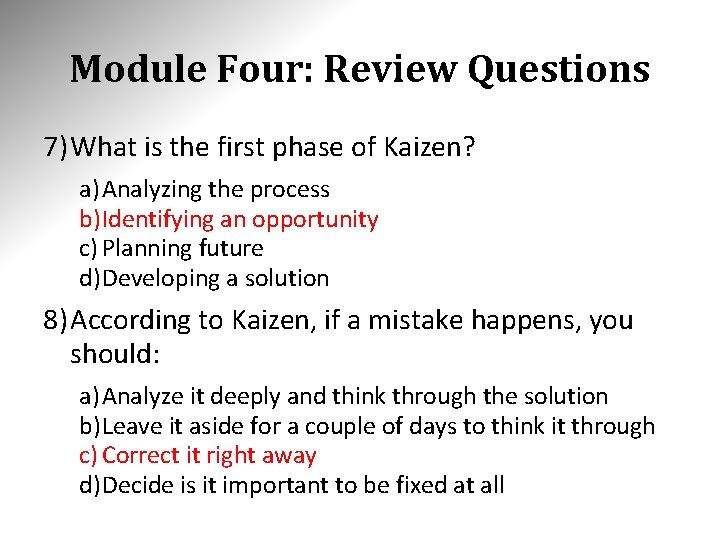
Module Four: Review Questions 7) What is the first phase of Kaizen? a) Analyzing the process b)Identifying an opportunity c) Planning future d)Developing a solution 8) According to Kaizen, if a mistake happens, you should: a) Analyze it deeply and think through the solution b)Leave it aside for a couple of days to think it through c) Correct it right away d)Decide is it important to be fixed at all
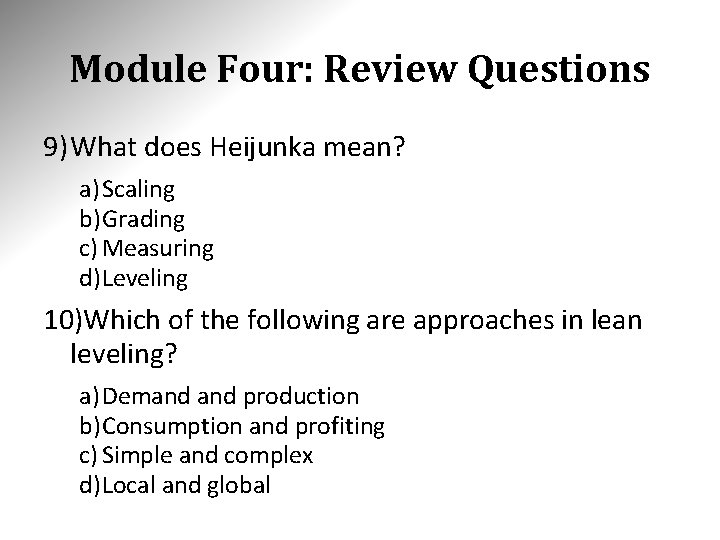
Module Four: Review Questions 9) What does Heijunka mean? a) Scaling b)Grading c) Measuring d)Leveling 10)Which of the following are approaches in lean leveling? a) Demand production b)Consumption and profiting c) Simple and complex d)Local and global
Module Five: The Five Principles of Lean Business In this module we’ll look closer at five great principles that are also known as Womack’s Principles. Benchmarking of automotive production facilities, Womack developed a set of five principles that form the basis lean enterprise implementation. The results were published in the book “Lean Thinking”, a milestone in Lean Management. There are so many men who can figure out costs, and so few who can measure values. Anonymous
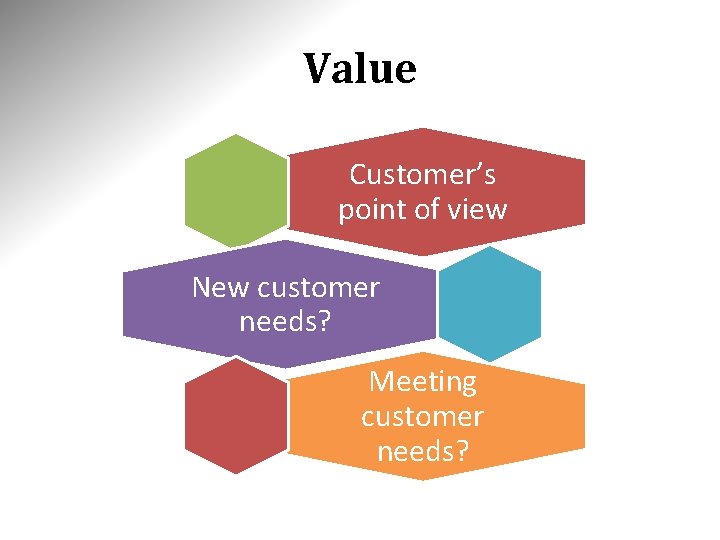
Value Customer’s point of view New customer needs? Meeting customer needs?
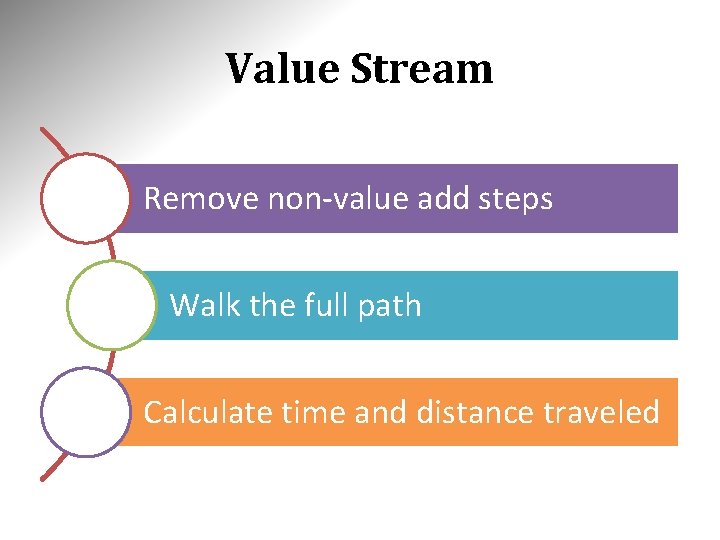
Value Stream Remove non-value add steps Walk the full path Calculate time and distance traveled
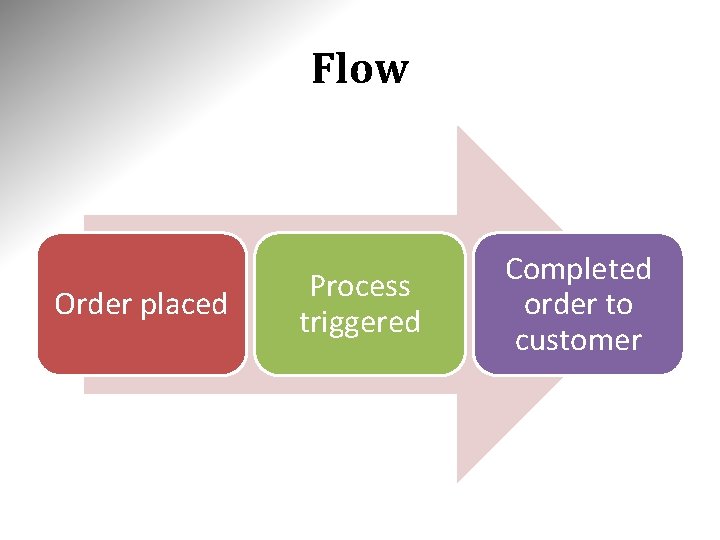
Flow Order placed Process triggered Completed order to customer
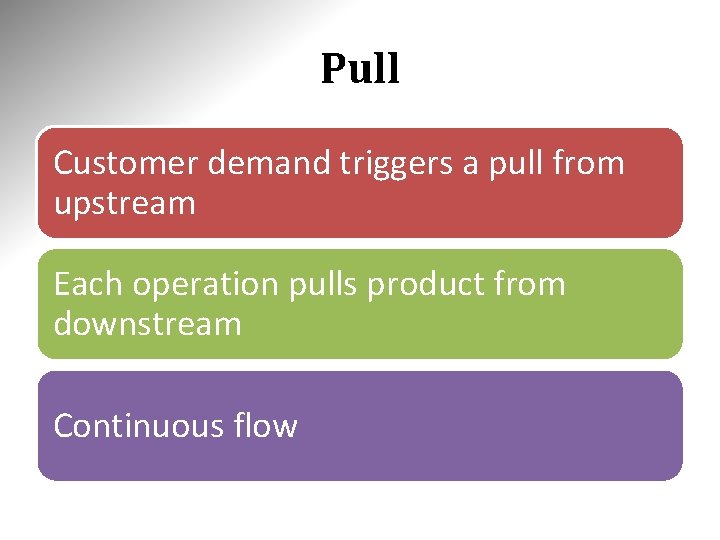
Pull Customer demand triggers a pull from upstream Each operation pulls product from downstream Continuous flow
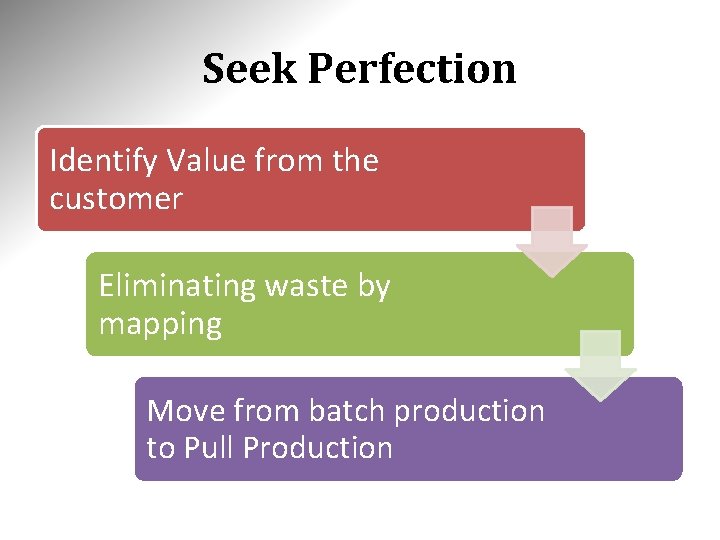
Seek Perfection Identify Value from the customer Eliminating waste by mapping Move from batch production to Pull Production
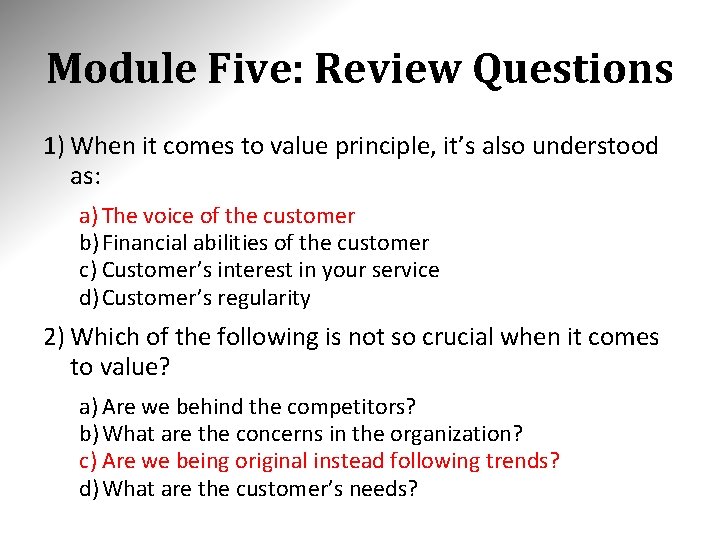
Module Five: Review Questions 1) When it comes to value principle, it’s also understood as: a) The voice of the customer b) Financial abilities of the customer c) Customer’s interest in your service d) Customer’s regularity 2) Which of the following is not so crucial when it comes to value? a) Are we behind the competitors? b) What are the concerns in the organization? c) Are we being original instead following trends? d) What are the customer’s needs?
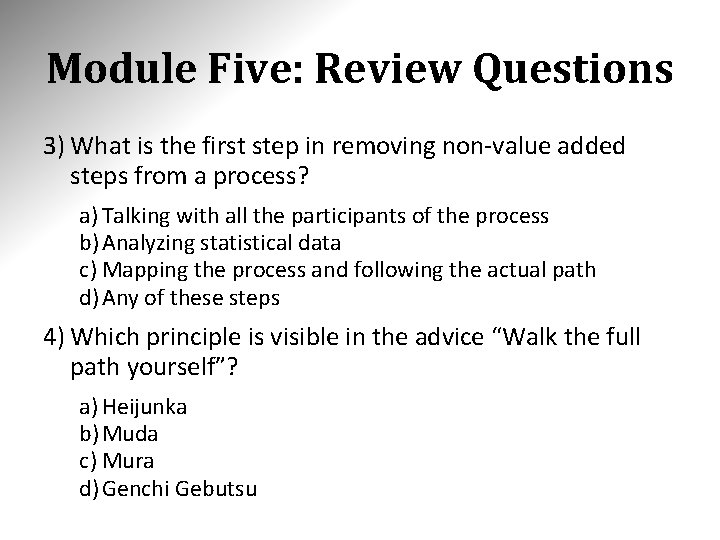
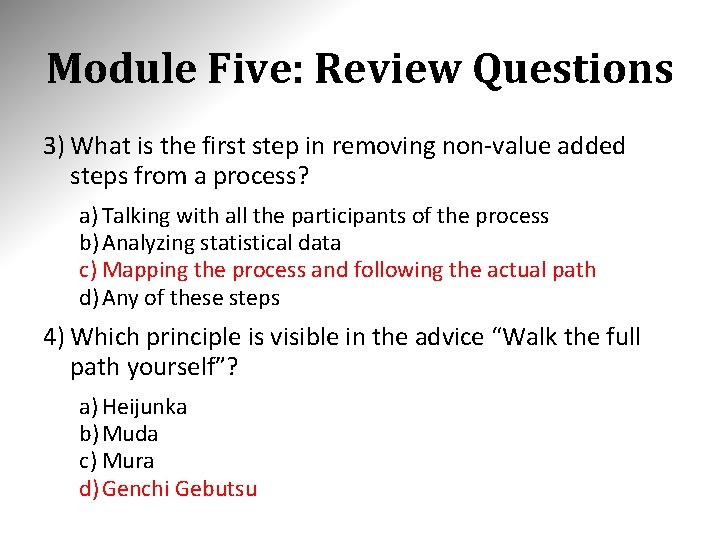
Module Five: Review Questions 3) What is the first step in removing non-value added steps from a process? a) Talking with all the participants of the process b) Analyzing statistical data c) Mapping the process and following the actual path d) Any of these steps 4) Which principle is visible in the advice “Walk the full path yourself”? a) Heijunka b) Muda c) Mura d) Genchi Gebutsu
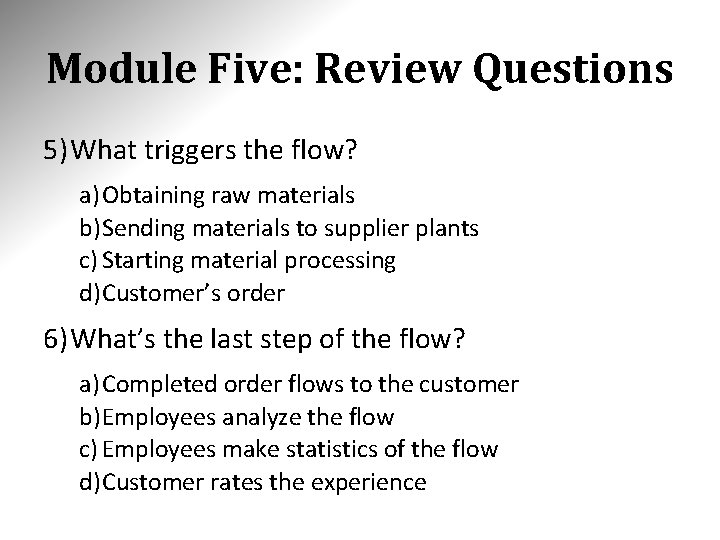
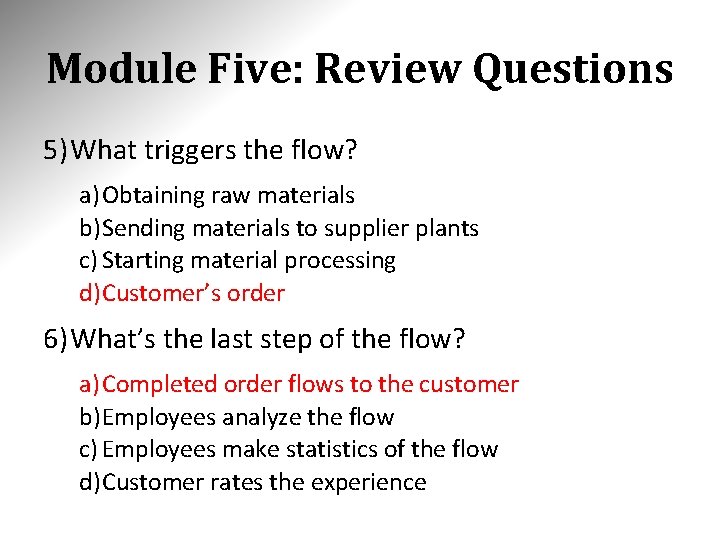
Module Five: Review Questions 5) What triggers the flow? a) Obtaining raw materials b)Sending materials to supplier plants c) Starting material processing d)Customer’s order 6) What’s the last step of the flow? a) Completed order flows to the customer b)Employees analyze the flow c) Employees make statistics of the flow d)Customer rates the experience
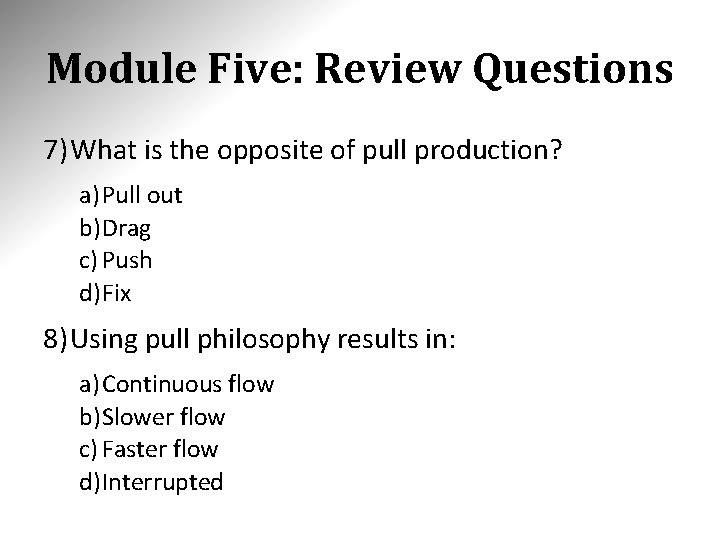
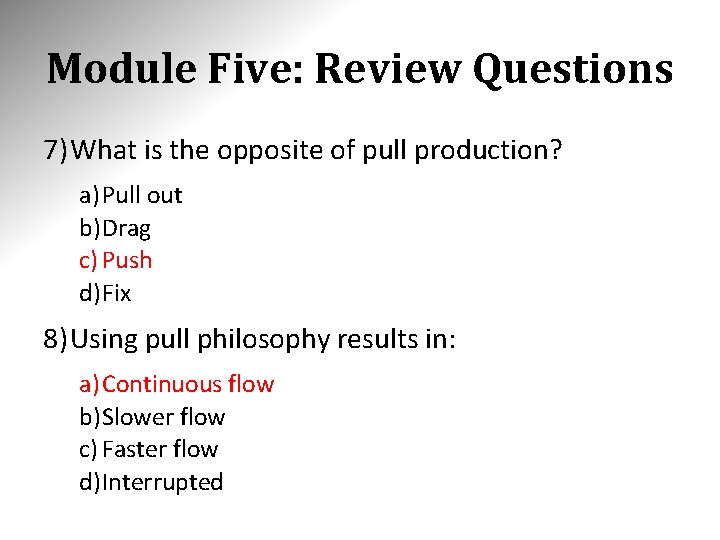
Module Five: Review Questions 7) What is the opposite of pull production? a) Pull out b)Drag c) Push d)Fix 8) Using pull philosophy results in: a) Continuous flow b)Slower flow c) Faster flow d)Interrupted
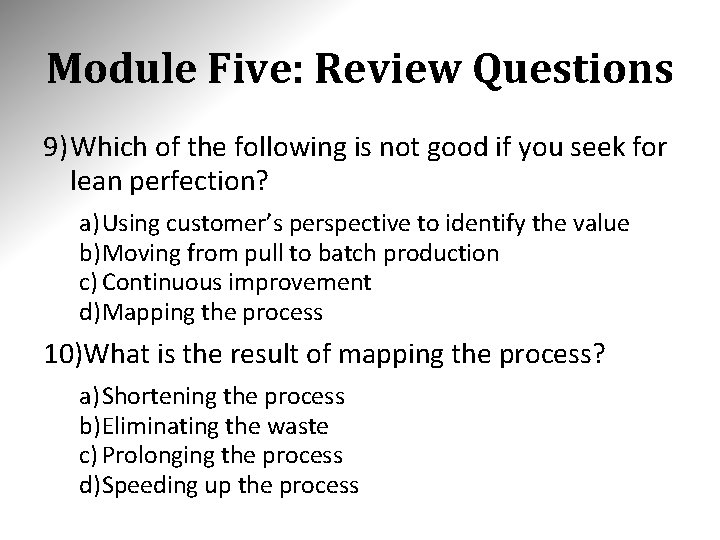
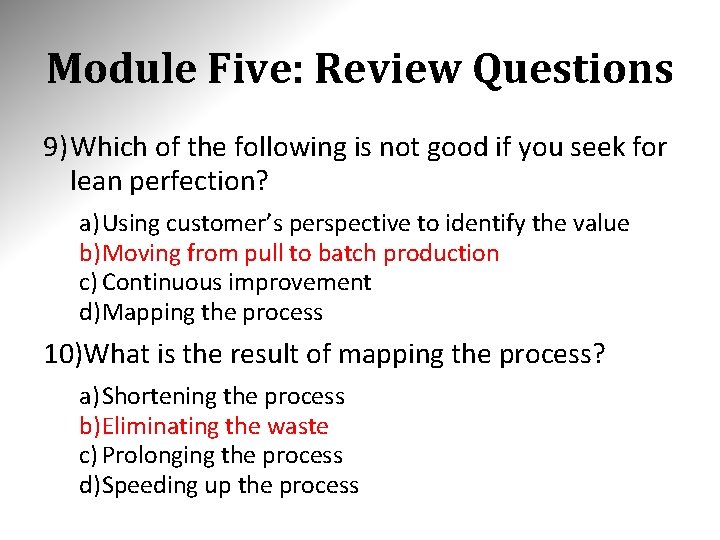
Module Five: Review Questions 9) Which of the following is not good if you seek for lean perfection? a) Using customer’s perspective to identify the value b)Moving from pull to batch production c) Continuous improvement d)Mapping the process 10)What is the result of mapping the process? a) Shortening the process b)Eliminating the waste c) Prolonging the process d)Speeding up the process
Module Six: The First Improvement Concept (Value) The Kano model is a theory of product development and customer satisfaction. The Kano model assumes that every customer has a unique preference, and that a product has attributes that have different values to different customers. The secret to success is to treat all customers as if your world revolves around them. Michael Dell
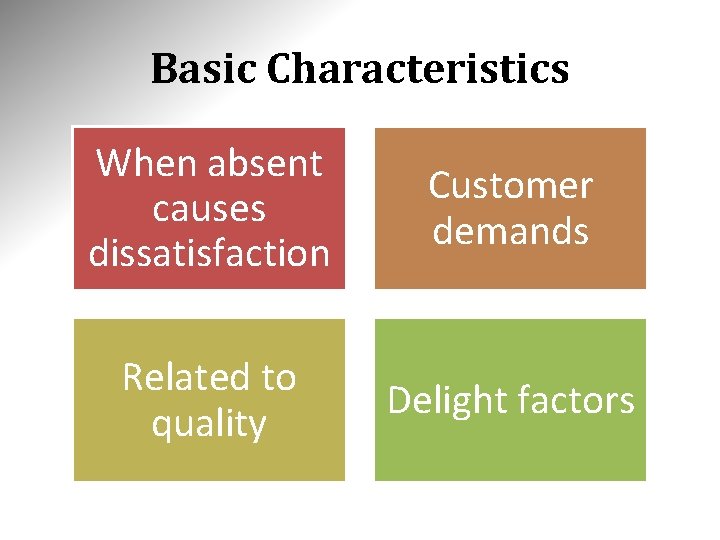
Basic Characteristics When absent causes dissatisfaction Customer demands Related to quality Delight factors
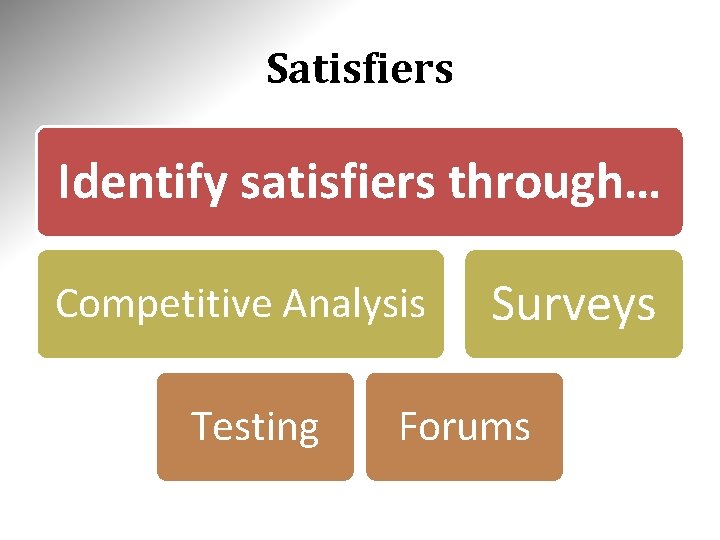
Satisfiers Identify satisfiers through… Competitive Analysis Testing Surveys Forums
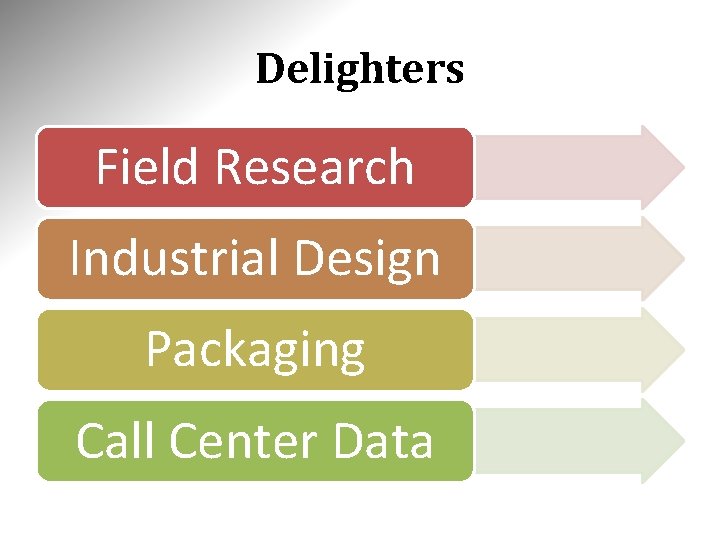
Delighters Field Research Industrial Design Packaging Call Center Data
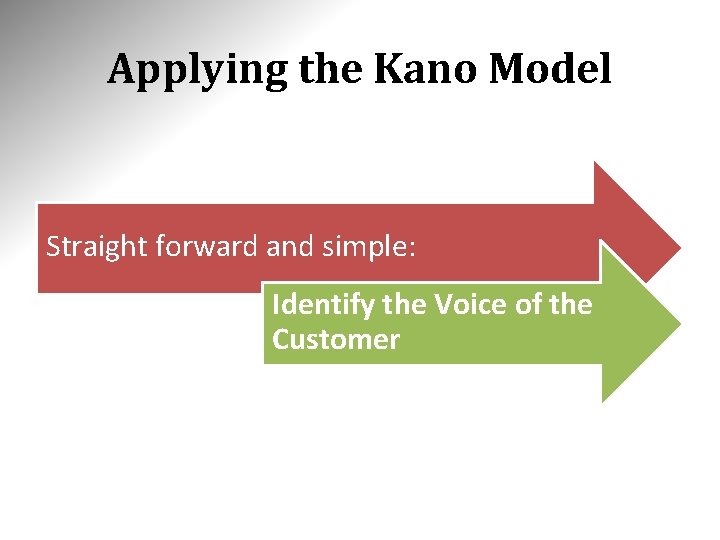
Applying the Kano Model Straight forward and simple: Identify the Voice of the Customer
Module Six: Review Questions 1) When was Kano model introduced? a) In 30 s b) In 60 s c) In 80 s d) In 00 s 2) How many attribute classes does Kano use? a) Two b) Three c) Four d) Six
Module Six: Review Questions 3) Which of the following is not one of the ways to gather data and identify customer’s satisfiers? a) Search log b) Survey c) Competitive analysis d) All of the above are useful ways to do that 4) Which of these Internet ways may be the most useful to identify satisfiers? a) Internet presentations b) Promo websites c) Customer forums d) Online shops
Module Six: Review Questions 5) Packaging and industrial design are tightly related to: a) Satisfiers b) Delighters c) Performance abilities d) Multi-functionality 6) What should you do after you gather data to improve your product? a) Try to adjust data to your product b) Brainstorm features and functionality for your product c) Compare gathered data with data about your product d) All of the above
Module Six: Review Questions 7) Which phrase is an intruder? a) Dissatisfied b)More is better c) Must be d)Cost of entry 8) CTQ’s stands for: a) Crucial to quantity characteristics b)Crucial to quality characteristics c) Critical to quantity characteristics d)Critical to quality characteristics
Module Seven: The Second Improvement Concept (Waste) Muda is the waste and work that does not add any value to the product and that the customer would not pay for if given a choice. All waste has a cost that is direct loss to the company. In Lean and Six Sigma manufacturing, the focus is especially on eliminating three types of waste: • Muda (Waste) • Muri (Strain/Overburden) • Mura (Unevenness) There is nothing so useless as doing efficiently that which should not be done at all. Peter F. Drucker
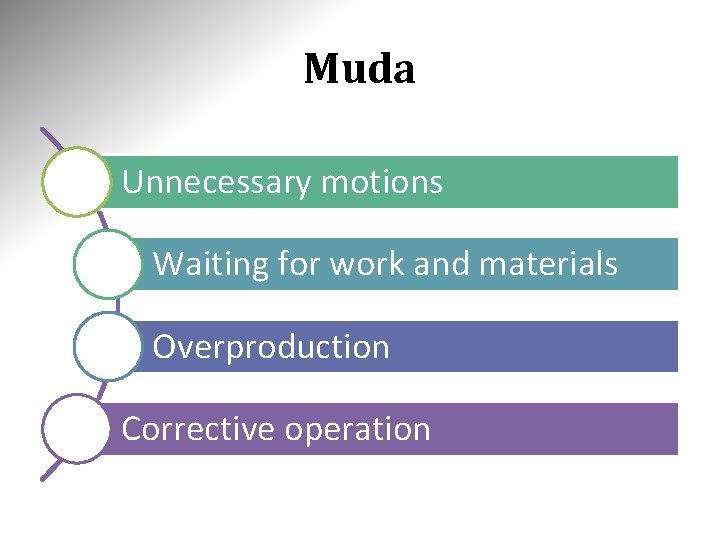
Muda Unnecessary motions Waiting for work and materials Overproduction Corrective operation
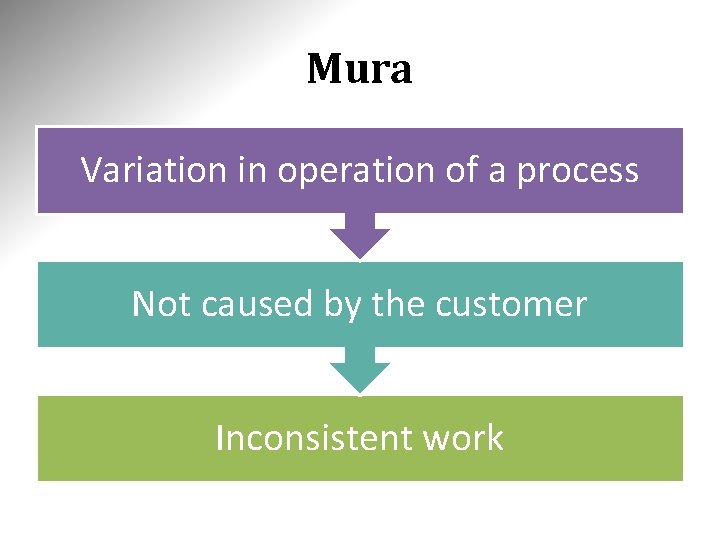
Mura Variation in operation of a process Not caused by the customer Inconsistent work
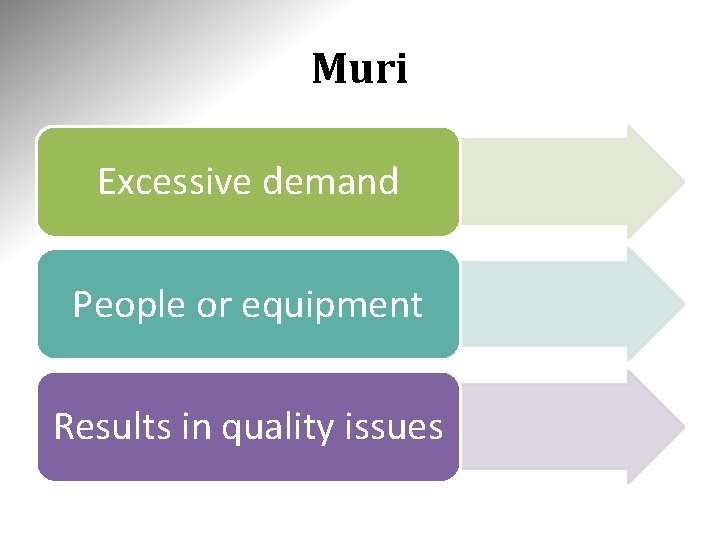
Muri Excessive demand People or equipment Results in quality issues
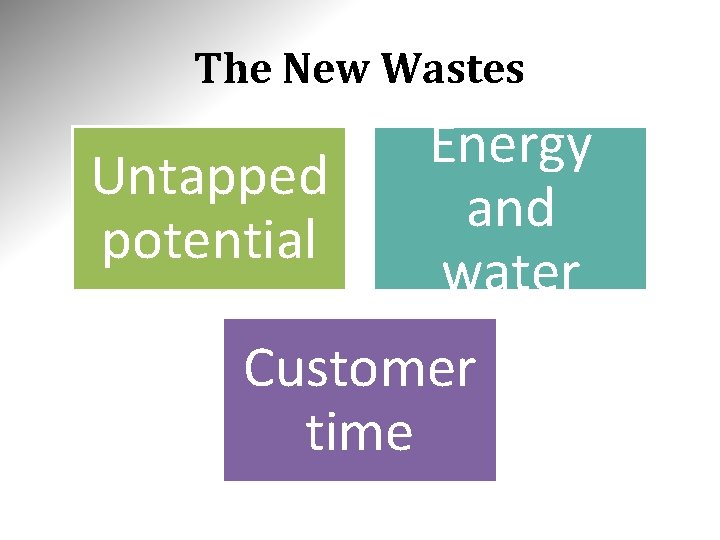
The New Wastes Untapped potential Energy and water Customer time
Module Seven: Review Questions 1) Which of the following is not a type of waste especially important to be eliminated in Lean and Six Sigma? a) Muda b) Muri c) Mura d) Mudi 2) Which of the following is not a type of Muda waste according to TPS? a) Overproduction b) Inventories c) Catering d) Transportations
Module Seven: Review Questions 3) In TPS, unevenness is called: a) Muri b)Mura c) Mure d)Muru 4) Mura is not: a) Irregular b)Inconsistent c) Homogenized d)Unbalanced
Module Seven: Review Questions 5) Muri means putting excessive demand on equipment, facilities, and people caused by: a) Mura b) Muda c) Mura and/or Muda d) Mura and/or Muro 6) Which of the following is not an example of Muri? a) Pushing too hard b) Working harder in the morning to spend the rest of the day doing nothing c) Lifting heavy weight d) Repeating tiring action
Module Seven: Review Questions 7) What’s the name of the type of waste which is not among the three basic types? a) The late waste b)The new waste c) The modern waste d)The current waste 8) Which of the following is a basic type of waste? a) Waste in human potential b)Wasting customer’s time c) Transportation waste d)Wasted energy and water
Module Eight: The Third Improvement Concept (Variation) Variation is deviation from expectation. The size, trends, nature, causes, effects and control of this variation is the center of Six Sigma methodology. In this module we will discuss variation. Statistics as a key technology is not merely an operational tool for profitable business. But as a powerful accelerator and catalyst for economic development. P. C. Mahalanobis
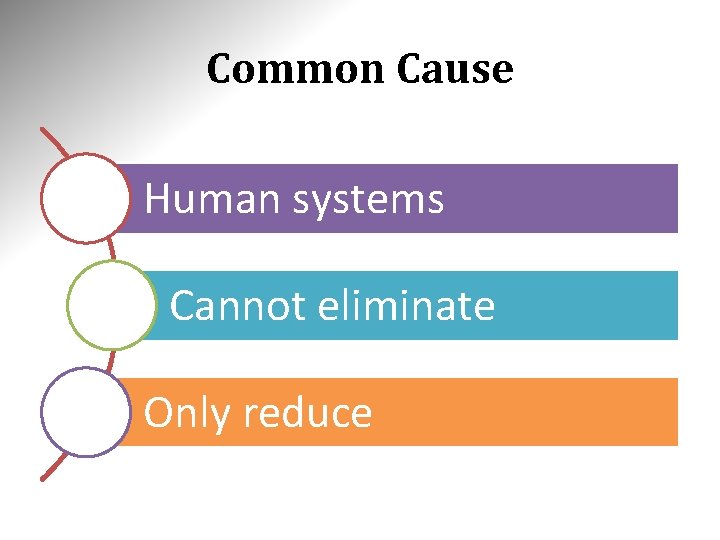
Common Cause Human systems Cannot eliminate Only reduce
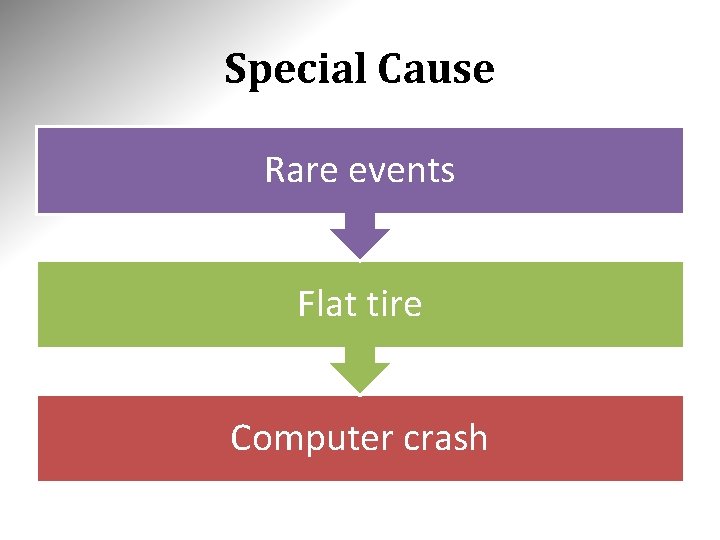
Special Cause Rare events Flat tire Computer crash
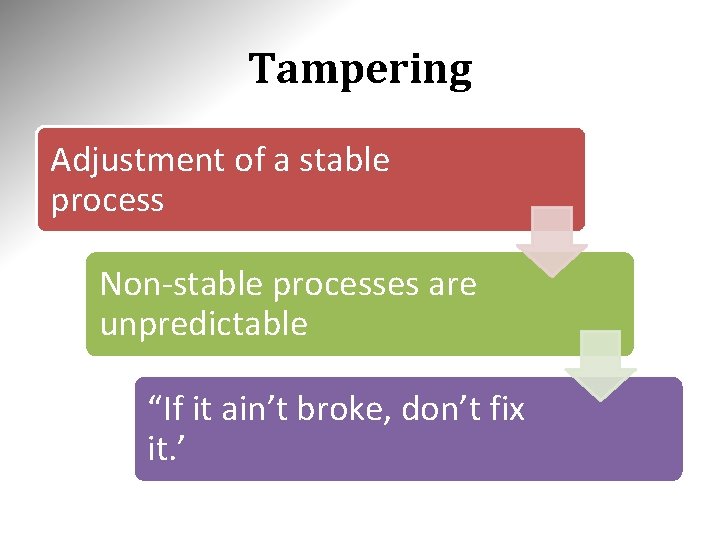
Tampering Adjustment of a stable process Non-stable processes are unpredictable “If it ain’t broke, don’t fix it. ’
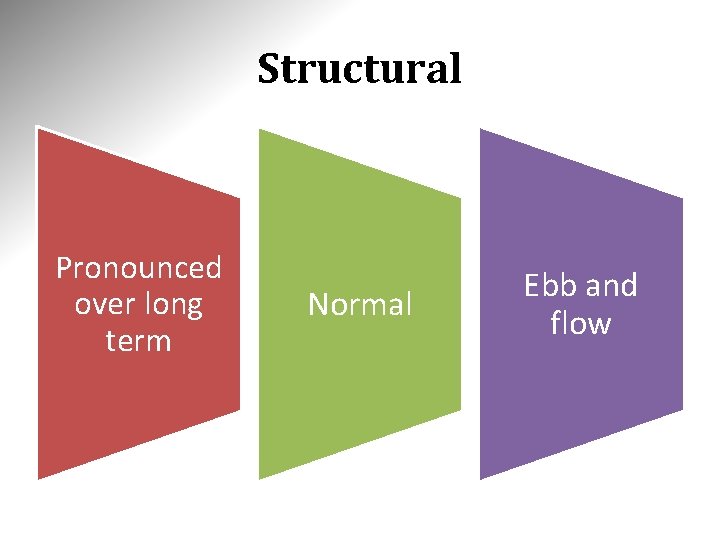
Structural Pronounced over long term Normal Ebb and flow
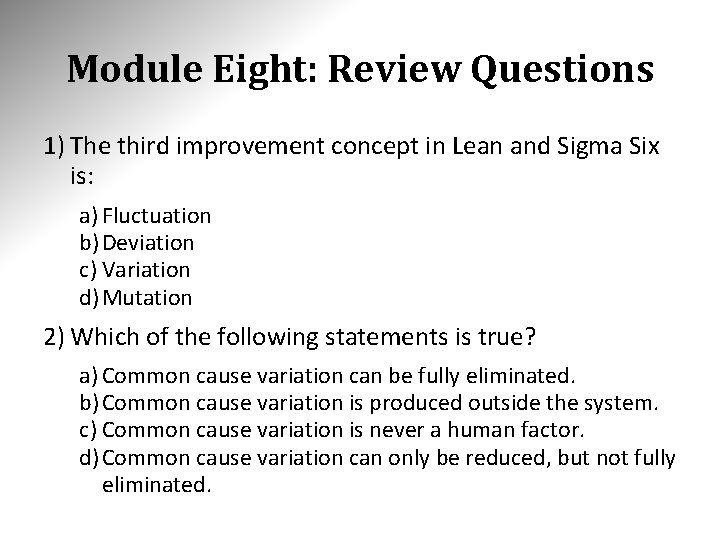
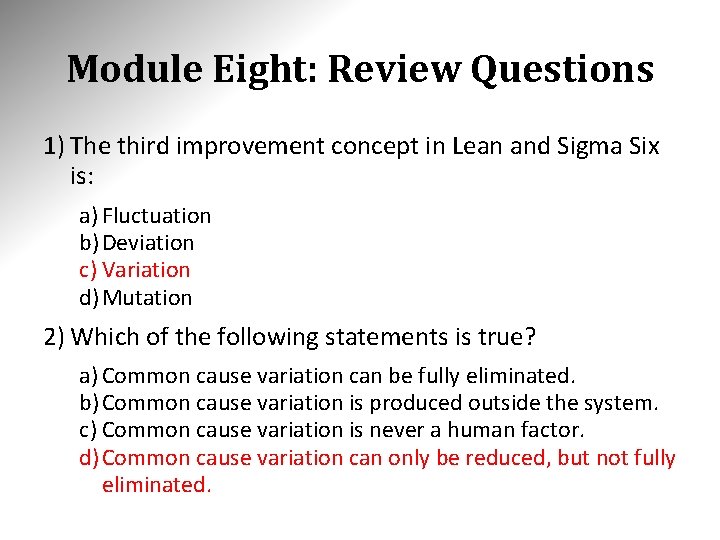
Module Eight: Review Questions 1) The third improvement concept in Lean and Sigma Six is: a) Fluctuation b) Deviation c) Variation d) Mutation 2) Which of the following statements is true? a) Common cause variation can be fully eliminated. b) Common cause variation is produced outside the system. c) Common cause variation is never a human factor. d) Common cause variation can only be reduced, but not fully eliminated.
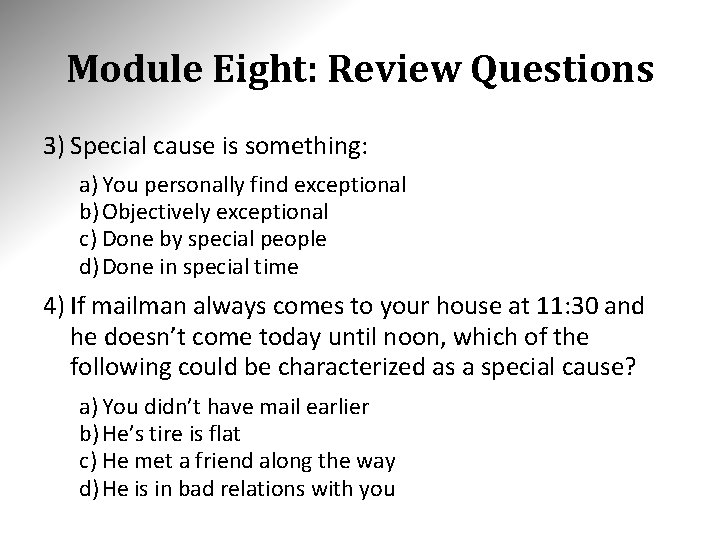
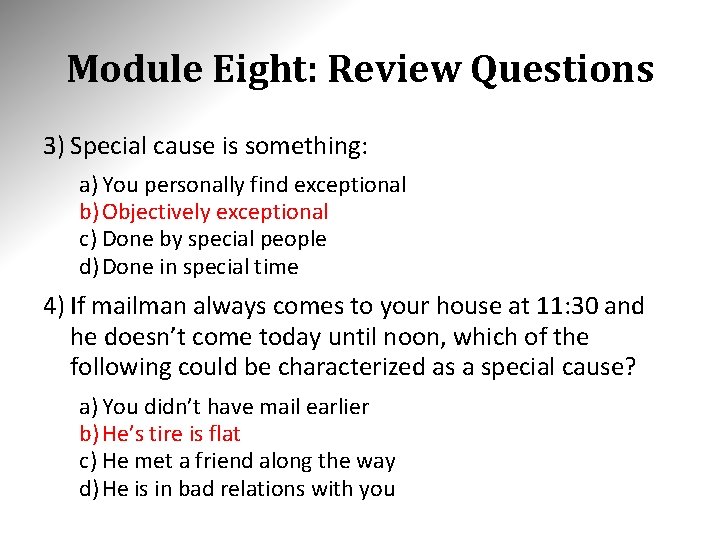
Module Eight: Review Questions 3) Special cause is something: a) You personally find exceptional b) Objectively exceptional c) Done by special people d) Done in special time 4) If mailman always comes to your house at 11: 30 and he doesn’t come today until noon, which of the following could be characterized as a special cause? a) You didn’t have mail earlier b) He’s tire is flat c) He met a friend along the way d) He is in bad relations with you
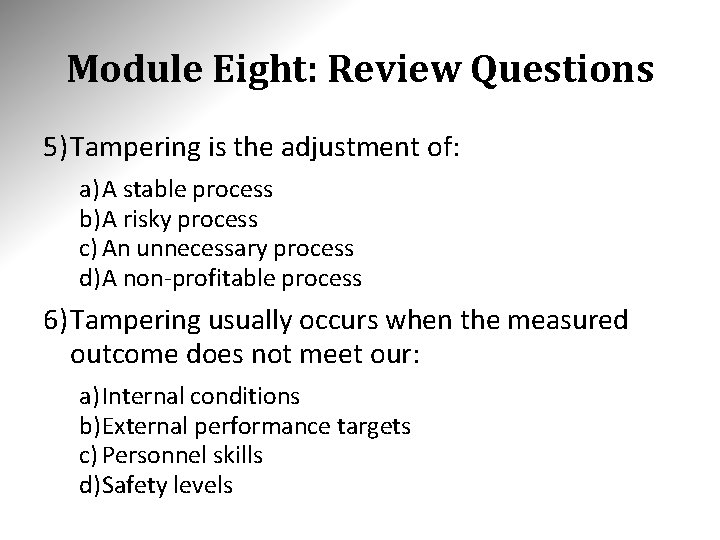
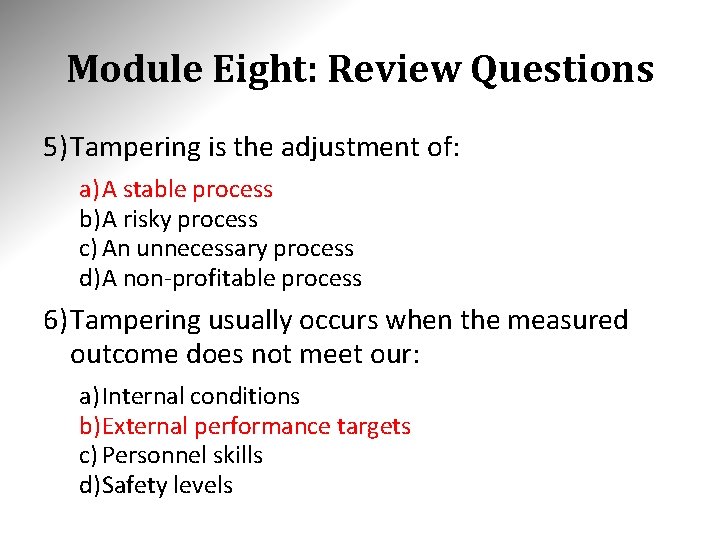
Module Eight: Review Questions 5) Tampering is the adjustment of: a) A stable process b)A risky process c) An unnecessary process d)A non-profitable process 6) Tampering usually occurs when the measured outcome does not meet our: a) Internal conditions b)External performance targets c) Personnel skills d)Safety levels
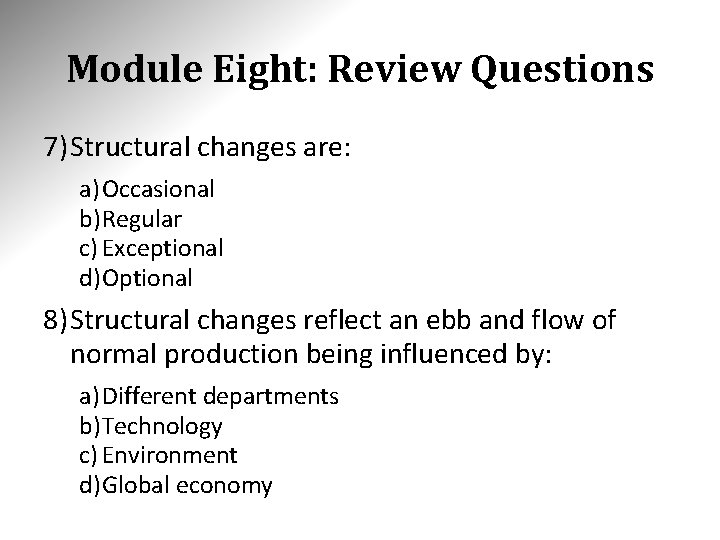
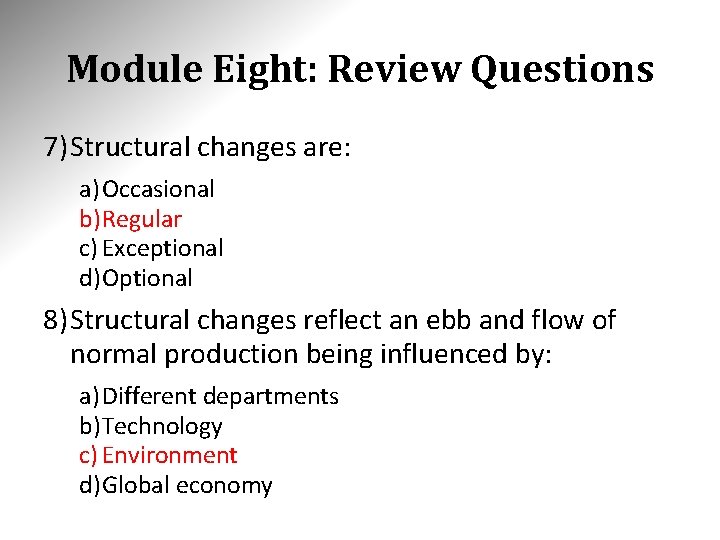
Module Eight: Review Questions 7) Structural changes are: a) Occasional b)Regular c) Exceptional d)Optional 8) Structural changes reflect an ebb and flow of normal production being influenced by: a) Different departments b)Technology c) Environment d)Global economy
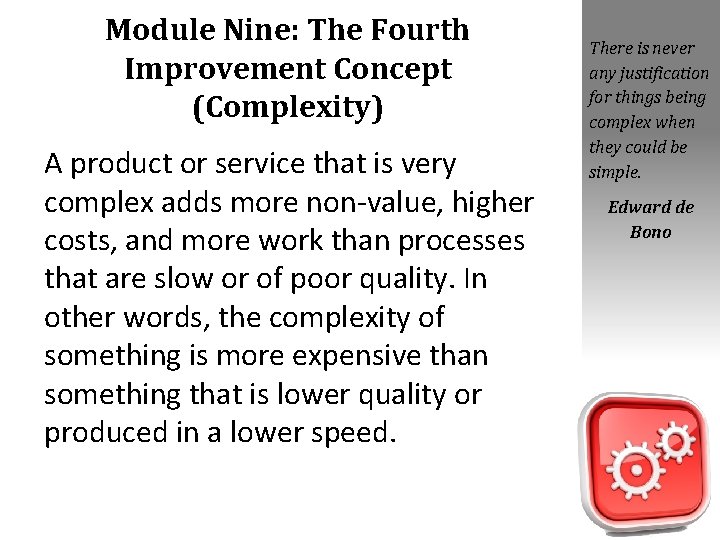
Module Nine: The Fourth Improvement Concept (Complexity) A product or service that is very complex adds more non-value, higher costs, and more work than processes that are slow or of poor quality. In other words, the complexity of something is more expensive than something that is lower quality or produced in a lower speed. There is never any justification for things being complex when they could be simple. Edward de Bono
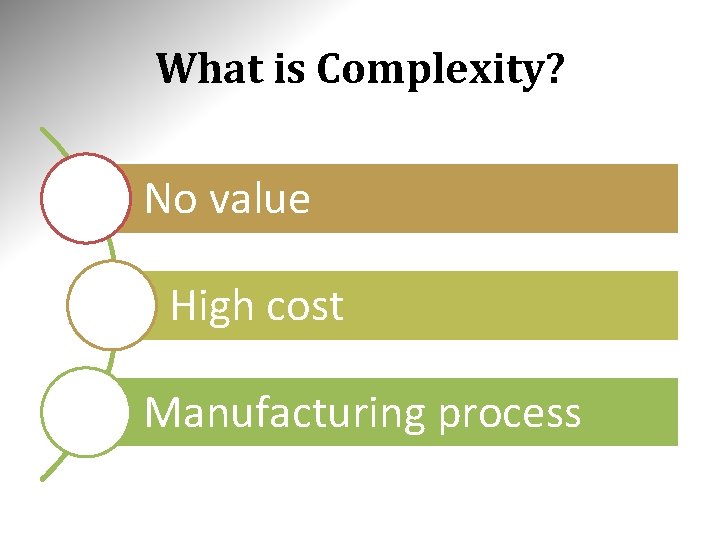
What is Complexity? No value High cost Manufacturing process
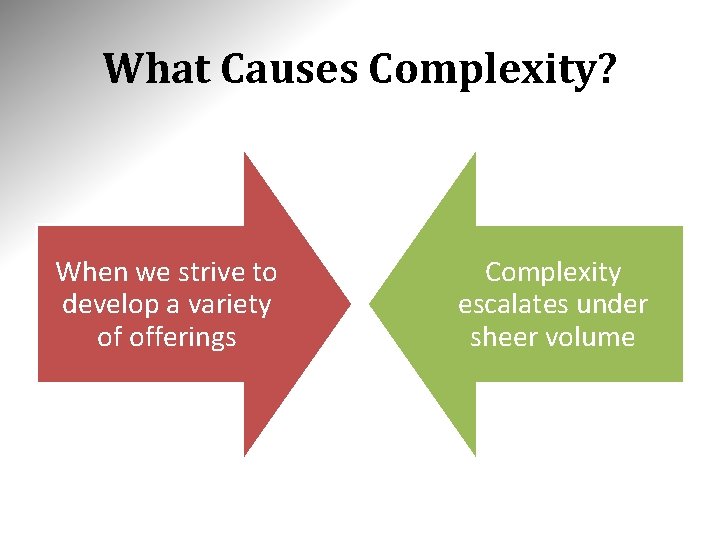
What Causes Complexity? When we strive to develop a variety of offerings Complexity escalates under sheer volume
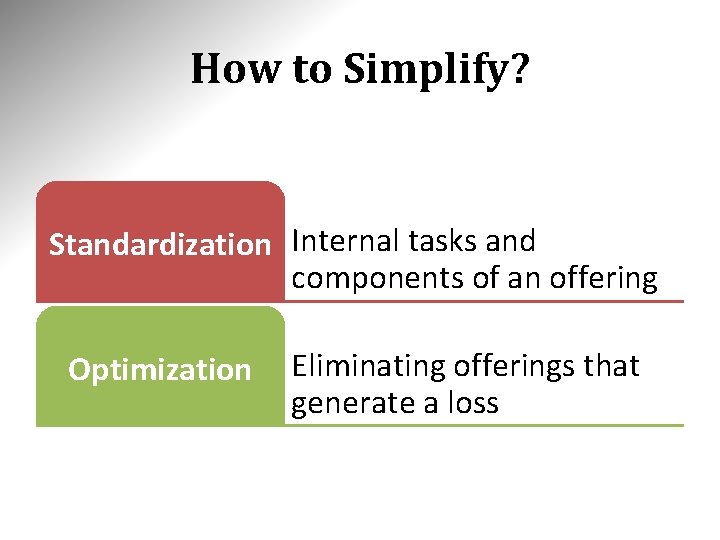
How to Simplify? Standardization Internal tasks and components of an offering Optimization Eliminating offerings that generate a loss
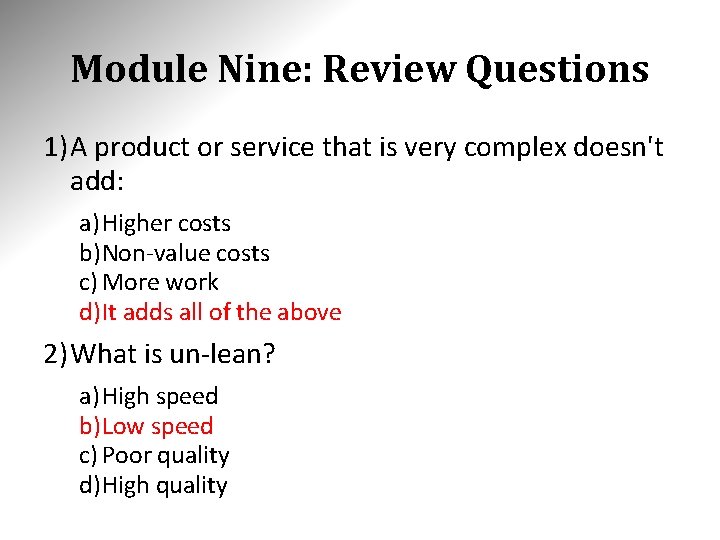
Module Nine: Review Questions 1) A product or service that is very complex doesn't add: a) Higher costs b)Non-value costs c) More work d)It adds all of the above 2) What is un-lean? a) High speed b)Low speed c) Poor quality d)High quality
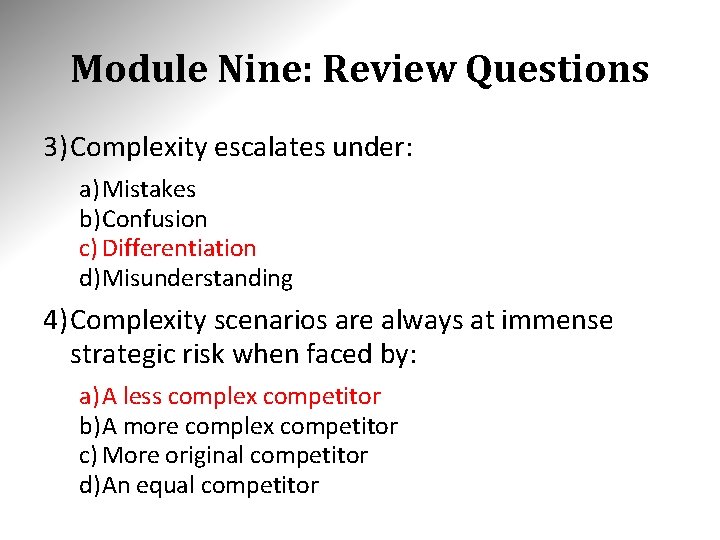
Module Nine: Review Questions 3) Complexity escalates under: a) Mistakes b)Confusion c) Differentiation d)Misunderstanding 4) Complexity scenarios are always at immense strategic risk when faced by: a) A less complex competitor b)A more complex competitor c) More original competitor d)An equal competitor
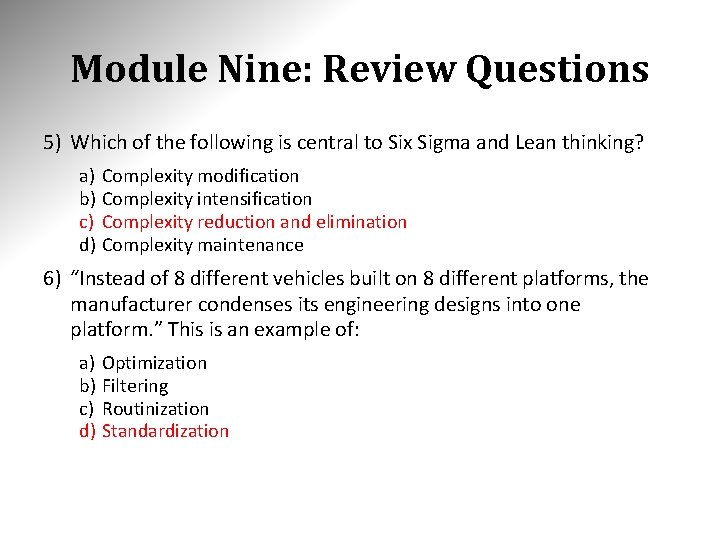
Module Nine: Review Questions 5) Which of the following is central to Six Sigma and Lean thinking? a) Complexity modification b) Complexity intensification c) Complexity reduction and elimination d) Complexity maintenance 6) “Instead of 8 different vehicles built on 8 different platforms, the manufacturer condenses its engineering designs into one platform. ” This is an example of: a) Optimization b) Filtering c) Routinization d) Standardization
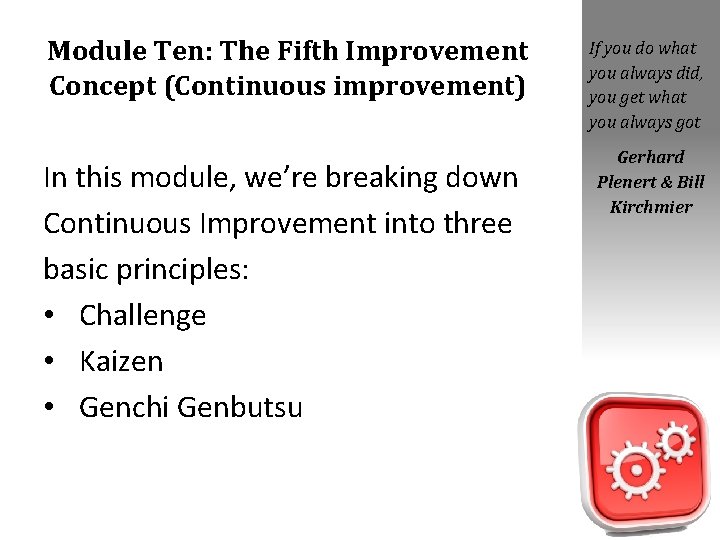
Module Ten: The Fifth Improvement Concept (Continuous improvement) In this module, we’re breaking down Continuous Improvement into three basic principles: • Challenge • Kaizen • Genchi Genbutsu If you do what you always did, you get what you always got Gerhard Plenert & Bill Kirchmier
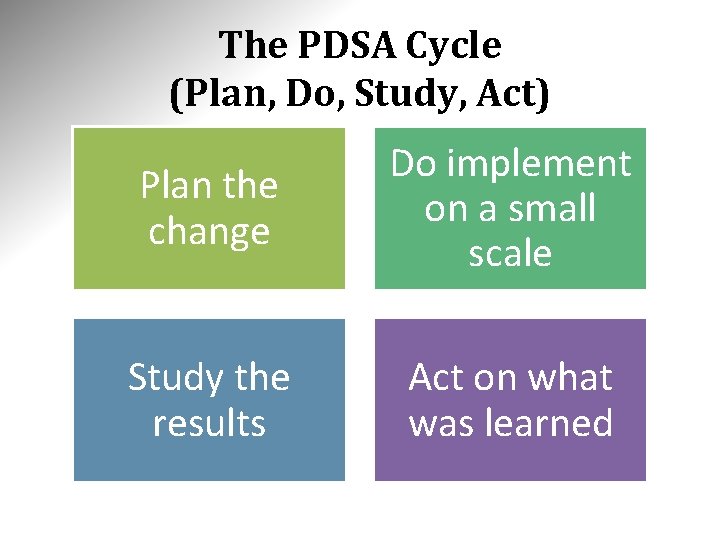
The PDSA Cycle (Plan, Do, Study, Act) Plan the change Do implement on a small scale Study the results Act on what was learned
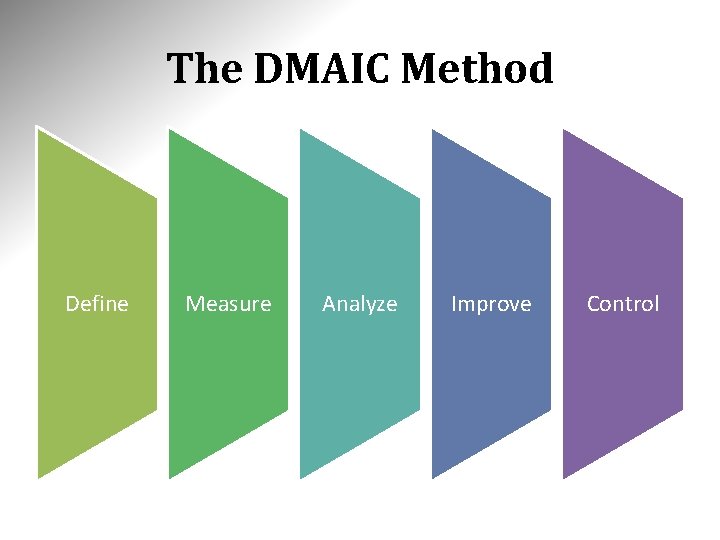
The DMAIC Method Define Measure Analyze Improve Control
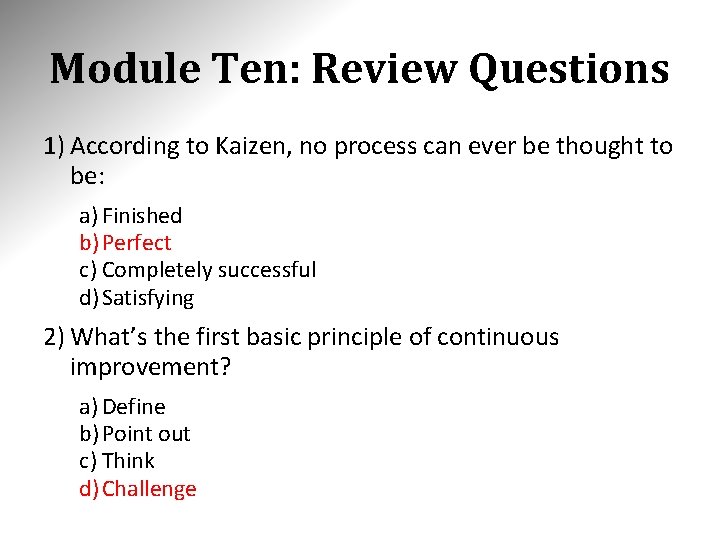
Module Ten: Review Questions 1) According to Kaizen, no process can ever be thought to be: a) Finished b) Perfect c) Completely successful d) Satisfying 2) What’s the first basic principle of continuous improvement? a) Define b) Point out c) Think d) Challenge
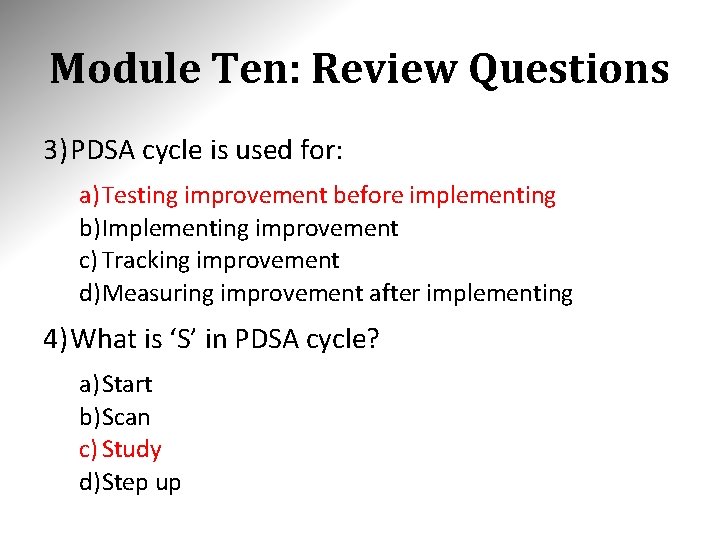
Module Ten: Review Questions 3) PDSA cycle is used for: a) Testing improvement before implementing b)Implementing improvement c) Tracking improvement d)Measuring improvement after implementing 4) What is ‘S’ in PDSA cycle? a) Start b)Scan c) Study d)Step up
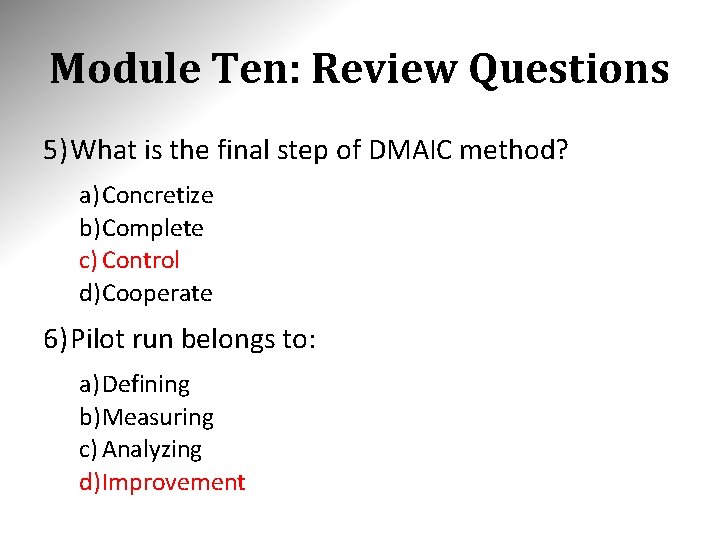
Module Ten: Review Questions 5) What is the final step of DMAIC method? a) Concretize b)Complete c) Control d)Cooperate 6) Pilot run belongs to: a) Defining b)Measuring c) Analyzing d)Improvement
Module Eleven: The Improvement Toolkit So what happens now? Module Eleven provides some basic methods and organizational advice for the journey ahead. Six Sigma can be a long journey but with a basic understanding of its methods and tools it will improve your work and personal life. Quality is never an accident; it is always the result of intelligent effort. John Ruskin
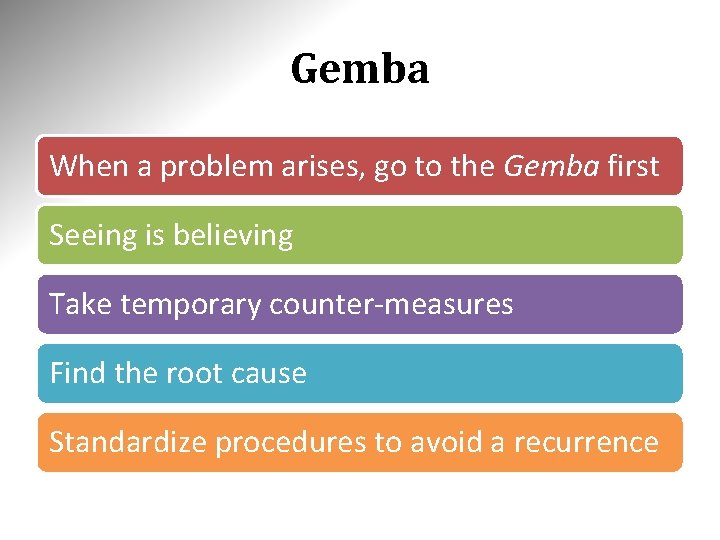
Gemba When a problem arises, go to the Gemba first Seeing is believing Take temporary counter-measures Find the root cause Standardize procedures to avoid a recurrence
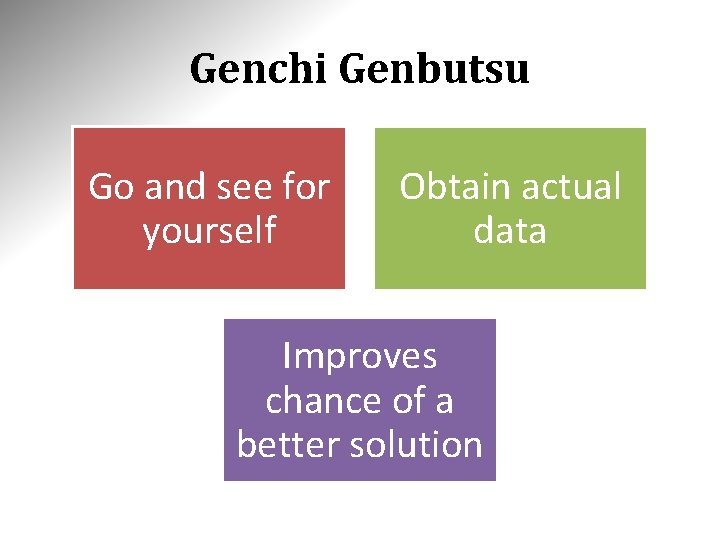
Genchi Genbutsu Go and see for yourself Obtain actual data Improves chance of a better solution
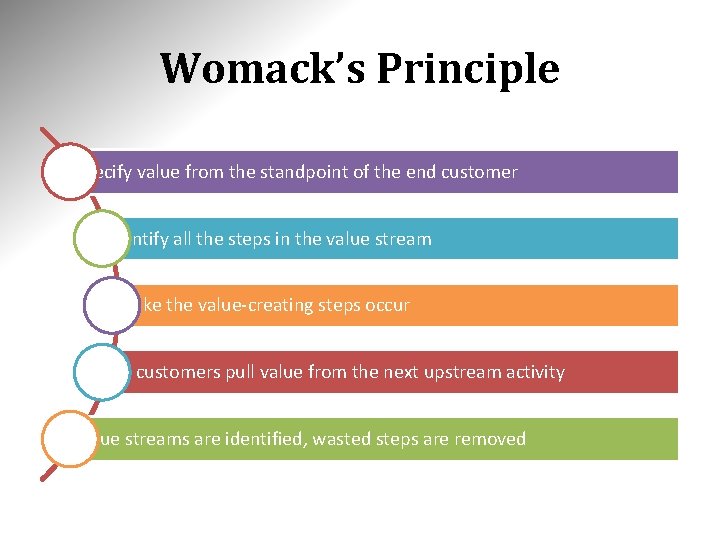
Womack’s Principle Specify value from the standpoint of the end customer Identify all the steps in the value stream Make the value-creating steps occur Let customers pull value from the next upstream activity Value streams are identified, wasted steps are removed
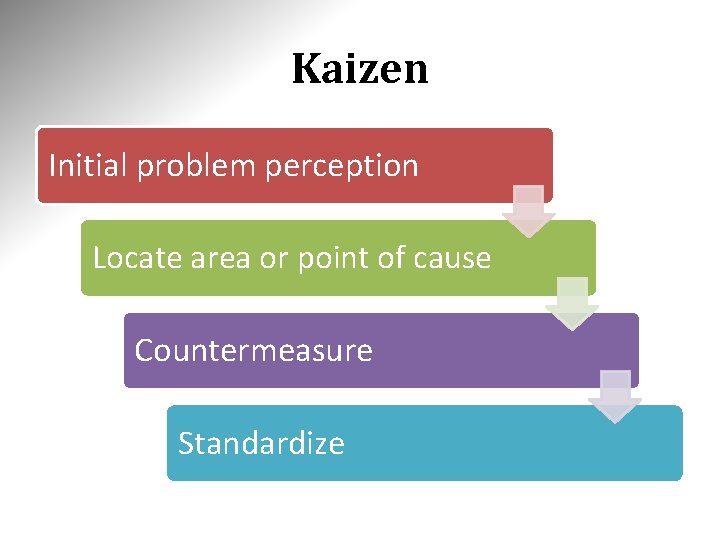
Kaizen Initial problem perception Locate area or point of cause Countermeasure Standardize
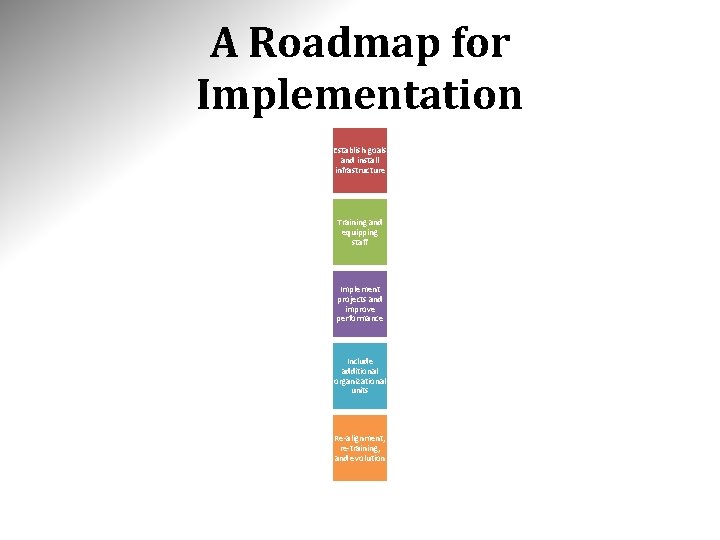
A Roadmap for Implementation Establish goals and install infrastructure Training and equipping staff Implement projects and improve performance Include additional organizational units Re-alignment, re-training, and evolution
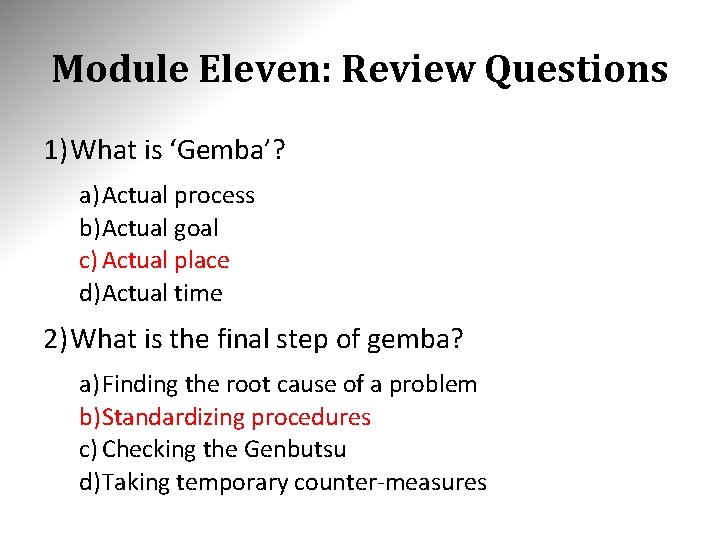
Module Eleven: Review Questions 1) What is ‘Gemba’? a) Actual process b)Actual goal c) Actual place d)Actual time 2) What is the final step of gemba? a) Finding the root cause of a problem b)Standardizing procedures c) Checking the Genbutsu d)Taking temporary counter-measures
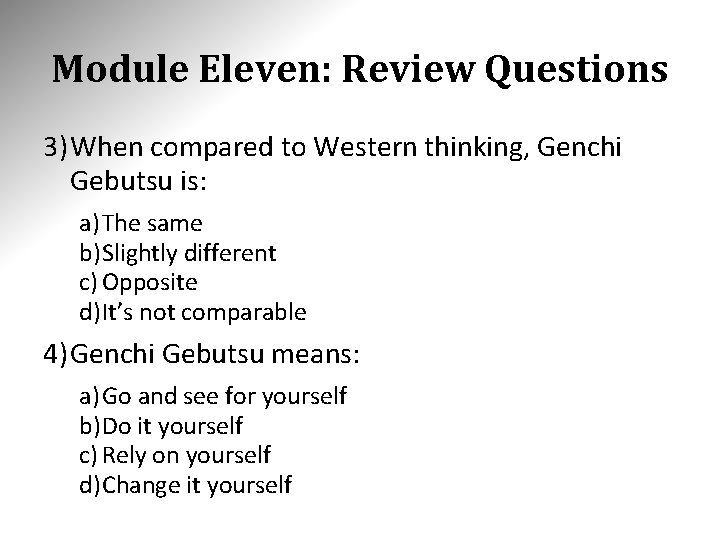
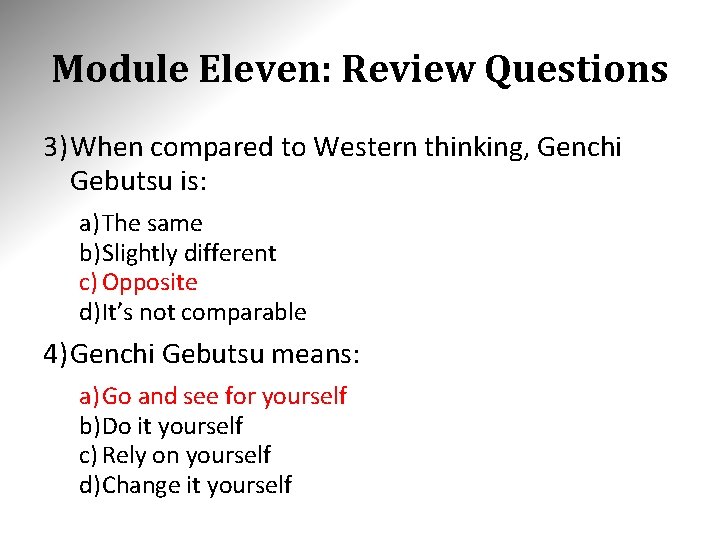
Module Eleven: Review Questions 3) When compared to Western thinking, Genchi Gebutsu is: a) The same b)Slightly different c) Opposite d)It’s not comparable 4) Genchi Gebutsu means: a) Go and see for yourself b)Do it yourself c) Rely on yourself d)Change it yourself
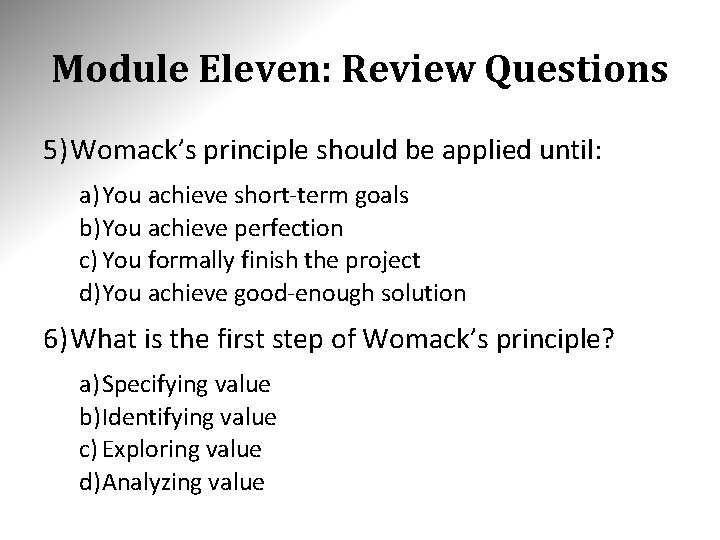
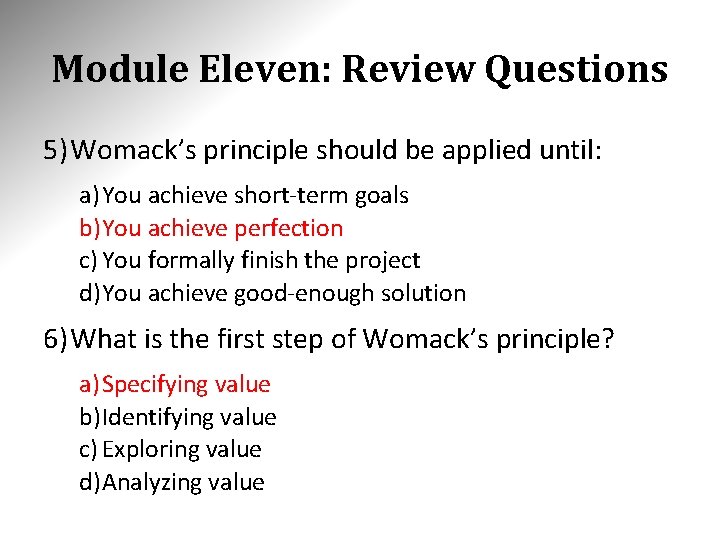
Module Eleven: Review Questions 5) Womack’s principle should be applied until: a) You achieve short-term goals b)You achieve perfection c) You formally finish the project d)You achieve good-enough solution 6) What is the first step of Womack’s principle? a) Specifying value b)Identifying value c) Exploring value d)Analyzing value
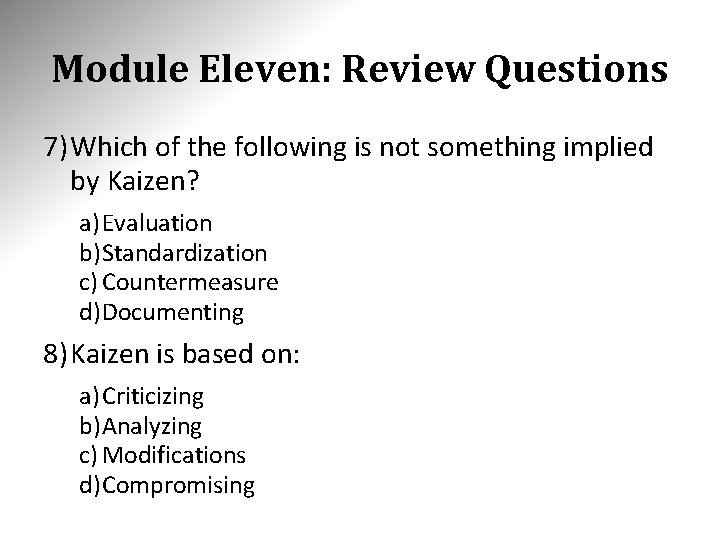
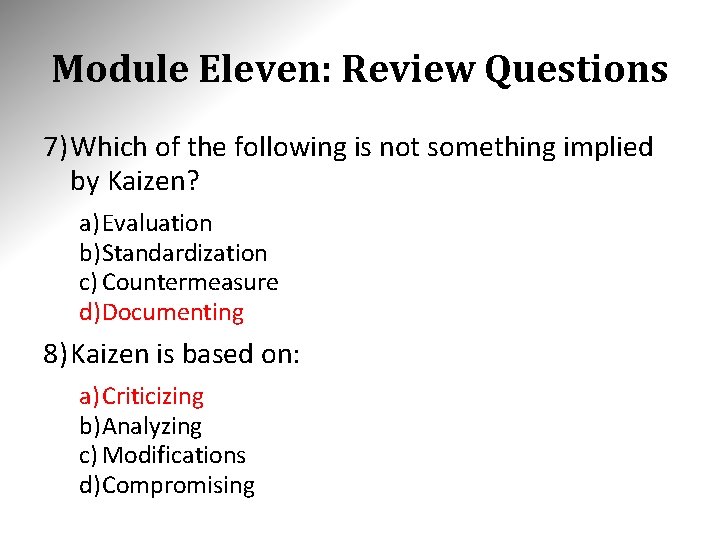
Module Eleven: Review Questions 7) Which of the following is not something implied by Kaizen? a) Evaluation b)Standardization c) Countermeasure d)Documenting 8) Kaizen is based on: a) Criticizing b)Analyzing c) Modifications d)Compromising
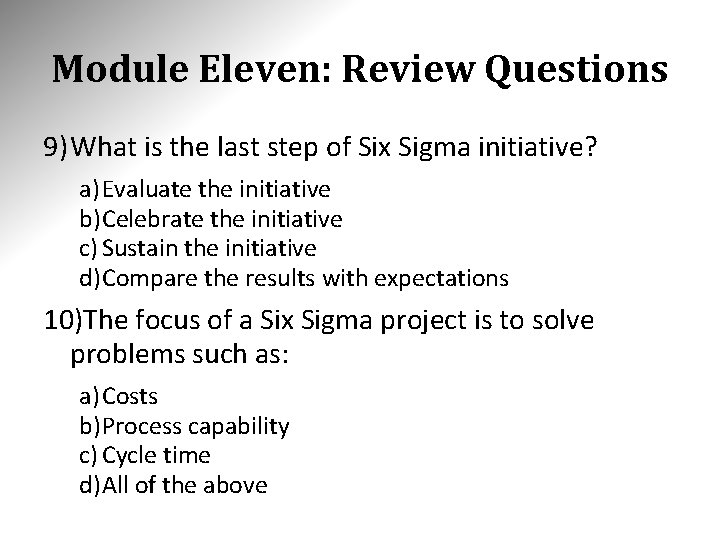
Module Eleven: Review Questions 9) What is the last step of Six Sigma initiative? a) Evaluate the initiative b)Celebrate the initiative c) Sustain the initiative d)Compare the results with expectations 10)The focus of a Six Sigma project is to solve problems such as: a) Costs b)Process capability c) Cycle time d)All of the above
Module Twelve: Wrapping Up Although this workshop is coming to a close, we hope that your journey to improve your Six Sigma is just beginning. Please take a moment to review and update your action plan. This will be a key tool to guide your progress in the days, weeks, months, and years to come. We wish you the best of luck on the rest of your travels! Tell me and I will forget, show me and I may remember, involve me and I’ll understand Chinese Proverb
Words from the Wise We can't act on what we don't know We won't know until we search We won't search for what we don't question With Six Sigma, you can find the answers