
Exploring Emotional Intelligence among African American Senior Pastors
- Slides: 18
Exploring Emotional Intelligence among African American Senior Pastors Pearl Richardson Smith, Ph. D. Mercer University College of Continuing and Professional Studies
Problem Statement • Black pastors in the protestant church reported having problems interacting with others and feeling unappreciated more than their white counterpart. (Barna, 2006). • African American Baptist pastors encounter professional challenges which can affect their ability to successfully fulfill their role and responsibilities as they understand them. These challenges emerge from their interaction with the stakeholders and organizational dynamics of their religious institution. (Colvin, 2012).
Selected Literature • Boyatzis, R. , Brizz T. & Godwin, L. (2011). The Effect of Religious Leaders' Emotional and Social Competencies on Improving Parish Vibrancy. Journal of Leadership & Organizational Studies, 18. 192206. • Goleman, D. , Boyatzis, R. & Mc. Kee, A. (2002). Primal leadership: Learning to lead with emotional intelligence. • Manala, M. (2010). A triad of pastoral leadership for congregational health and well-being: Leader, manager and servant in a shared and equipping ministry. HTS Teologiese Studies/Theological Studies, 66. • Tourville, S. (2008). Training Pastors in emotional intelligence and situational leadership. • Villa, D. D. (2003). Maintaining personal resiliency: Lessons learned from evangelical protestant clergy. Journal of Psychology and Theology, 31. 339 -347.
Purpose • The purpose of this study was to explore how African American senior pastors in the protestant church practice and perceive emotional intelligence.
Research Question • How do African American senior pastors practice and perceive emotional intelligence?
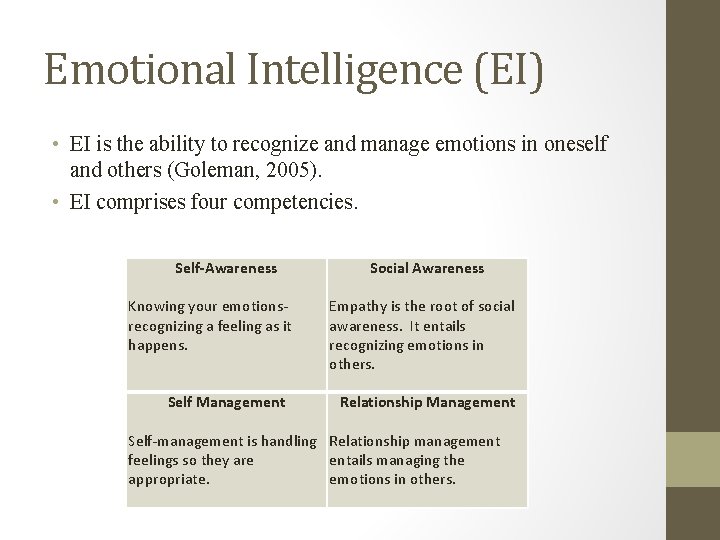
Emotional Intelligence (EI) • EI is the ability to recognize and manage emotions in oneself and others (Goleman, 2005). • EI comprises four competencies. Self-Awareness Social Awareness Knowing your emotions- recognizing a feeling as it happens. Self Management Self-management is handling feelings so they are appropriate. Empathy is the root of social awareness. It entails recognizing emotions in others. Relationship Management Relationship management entails managing the emotions in others.
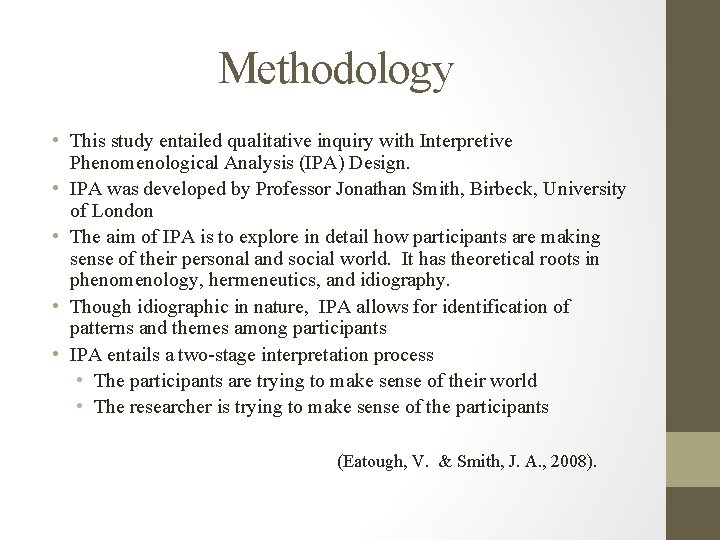
Methodology • This study entailed qualitative inquiry with Interpretive Phenomenological Analysis (IPA) Design. • IPA was developed by Professor Jonathan Smith, Birbeck, University of London • The aim of IPA is to explore in detail how participants are making sense of their personal and social world. It has theoretical roots in phenomenology, hermeneutics, and idiography. • Though idiographic in nature, IPA allows for identification of patterns and themes among participants • IPA entails a two-stage interpretation process • The participants are trying to make sense of their world • The researcher is trying to make sense of the participants (Eatough, V. & Smith, J. A. , 2008).
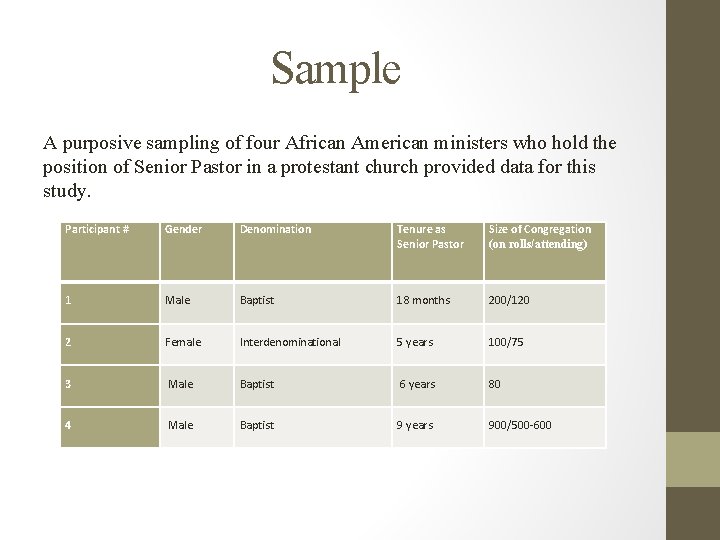
Sample A purposive sampling of four African American ministers who hold the position of Senior Pastor in a protestant church provided data for this study. Participant # Gender Denomination Tenure as Senior Pastor Size of Congregation (on rolls/attending) 1 Male Baptist 18 months 200/120 2 Female Interdenominational 5 years 100/75 3 Male Baptist 6 years 80 4 Male Baptist 9 years 900/500 -600
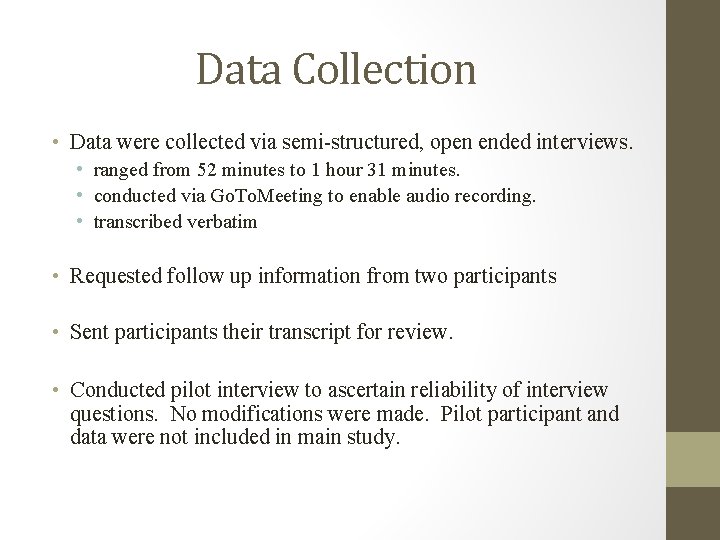
Data Collection • Data were collected via semi-structured, open ended interviews. • ranged from 52 minutes to 1 hour 31 minutes. • conducted via Go. To. Meeting to enable audio recording. • transcribed verbatim • Requested follow up information from two participants • Sent participants their transcript for review. • Conducted pilot interview to ascertain reliability of interview questions. No modifications were made. Pilot participant and data were not included in main study.
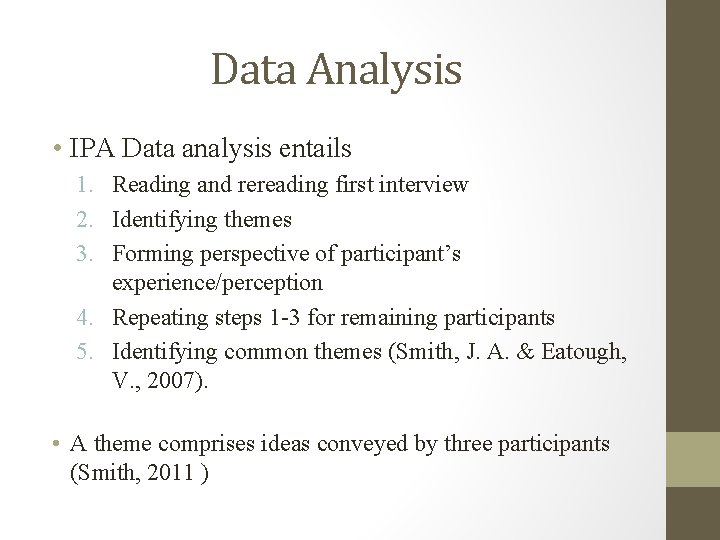
Data Analysis • IPA Data analysis entails 1. Reading and rereading first interview 2. Identifying themes 3. Forming perspective of participant’s experience/perception 4. Repeating steps 1 -3 for remaining participants 5. Identifying common themes (Smith, J. A. & Eatough, V. , 2007). • A theme comprises ideas conveyed by three participants (Smith, 2011 )
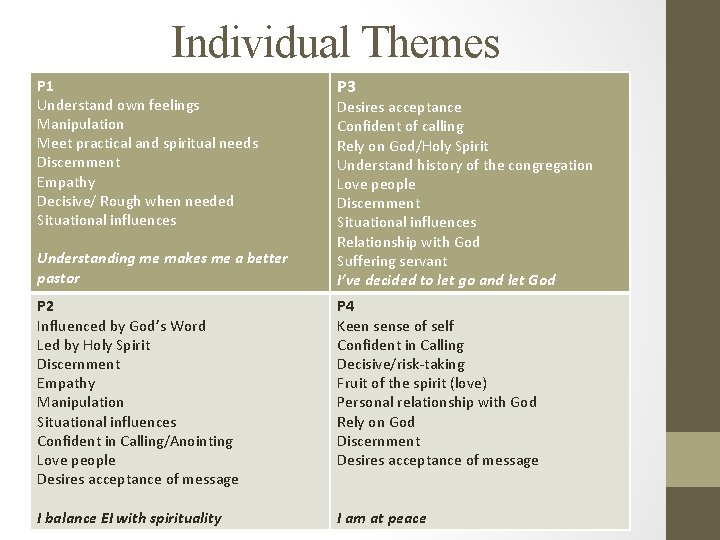
Individual Themes P 1 Understand own feelings Manipulation Meet practical and spiritual needs Discernment Empathy Decisive/ Rough when needed Situational influences Understanding me makes me a better pastor P 3 Desires acceptance Confident of calling Rely on God/Holy Spirit Understand history of the congregation Love people Discernment Situational influences Relationship with God Suffering servant I’ve decided to let go and let God P 2 Influenced by God’s Word Led by Holy Spirit Discernment Empathy Manipulation Situational influences Confident in Calling/Anointing Love people Desires acceptance of message P 4 Keen sense of self Confident in Calling Decisive/risk-taking Fruit of the spirit (love) Personal relationship with God Rely on God Discernment Desires acceptance of message I balance EI with spirituality I am at peace
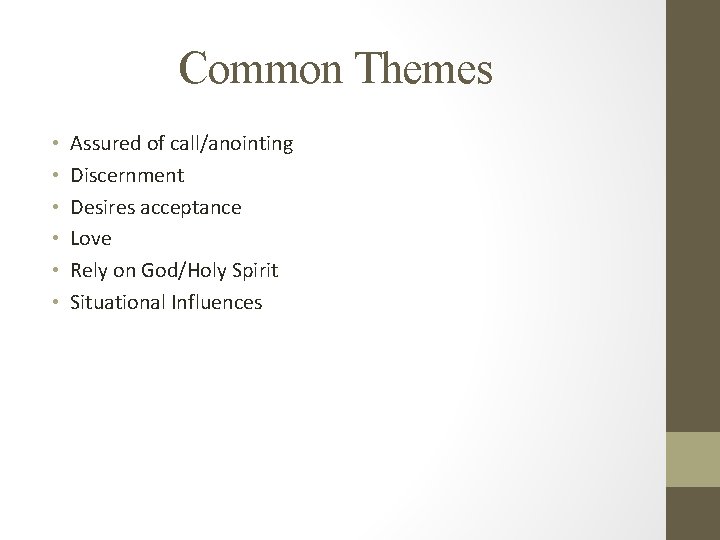
Common Themes • • • Assured of call/anointing Discernment Desires acceptance Love Rely on God/Holy Spirit Situational Influences
Conclusion • Emotional Intelligence is essential for effective church leadership. Pastors must be confident in their call to the ministry and to the church where they are serving. They use discernment to assess people and situations and react accordingly. They realize some situations are beyond their control and rely on the Holy Spirit/God to move in those instances. Pastors desire acceptance but understand rejection is inherent in the job, just as Jesus was not always appreciated by His followers. Finally, love enables pastors to get through the challenging times.
Limitations/Delimitations • Participants’ understanding of emotional intelligence • Provided overview prior to interview • Inability to observe body language • Go. To. Meeting has webcam functionality; however, only two participants had webcam access • Participants’ willingness to be open • Asked participants to discuss an event in which they did not practice sound EI •
Recommendations for Future Research • Explore EI among African American senior pastors of mega churches. • Explore EI among African American senior pastors from church with more organizational structure/accountability (e. g. , AME, Church of God in Christ, etc. ). • Conduct longitudinal study of among African American senior pastors before and after receiving EI training.
References Barna, G. (2006). Pastors feel confident in ministry, but many struggle in the interaction with others. Barna. Group. Retrieved from https: //www. barna. org/barnaupdate/leadership/150 -pastors-feel-confident-in-ministry-but-many-struggle-in-theirinteraction-with-others#. U 0 g 6 YHTD 8 d. U Colvin, J. (2012). An examination of the professional development of African American Baptist pastors: A comparative case study. (Doctoral Dissertation). Available from Pro. Qust Dissertations and theses database. (IUMI No. 3512498). Goleman, D. (2005). Emotional Intelligence. New York, NY: Bantam Books. Smith, J. A. (2011). Evaluating the contribution of interpretative phenomenological analysis. Health Psychology Review, 5, 9 -27. doi: 10. 1080/17437199. 2010. 510659
References (cont’d) Smith, J. A. & Eatough, V. (2007). Interpretative Phenomenological Analysis. In Evanthia Lyons & Adrian Coyle. (Eds. ). Analysing Qualitative Data in Psychology (pp. 35 -51). London, England: SAGE. doi: 10. 4135/9781446207536. d 10 Eatough, V. & Smith, J. A. (2008). Interpretative Phenomenological Analysis. In Carla Willig & Wendy Stainton-Rogers (Eds). The SAGE Handbook of Qualitative Research in Psychology. (pp. 179 -195). London, England: SAGE Publications Ltd. doi: 10. 4135/9781848607927
Bio Pearl R. Smith, Ph. D. has been an instructor with Mercer University since 2006. She teaches courses in the Organizational Leadership and Human Resources degree programs. In addition, she serves as adjunct faculty for Shorter University and University of Phoenix. Dr. Smith is also an independent consultant who specializes in coaching, training, and dissertation consulting & editing. Prior to starting her independent practice, she worked for the federal government, retiring after 27 years of service. Dr. Smith holds a Ph. D. in Organizational Leadership from Regent University. She pursued her undergraduate and graduate studies at George Mason University, graduating with honors. She has been recognized by numerous organizations for her professional, academic, and community accomplishments. A native of Louisville, KY, Dr. Smith resides in Douglasville, GA with her husband two sons.