ELL Leadership Academy Karina E Chapa M Ed


- Slides: 87
ELL Leadership Academy Karina E. Chapa, M. Ed. Language Proficiency, Biliteracy and Cultural Diversity Director kchapa@esc 1. net Twitter @esc 1 bilingual @bilingualpride © 2018 Region One Education Service Center
PROFESSIONAL LEARNING ESSENTIAL AGREEMENTS § § Be respectful of others Be an active participant Take care of your needs Use electronic devices as learning tools © 2018 Region One Education Service Center
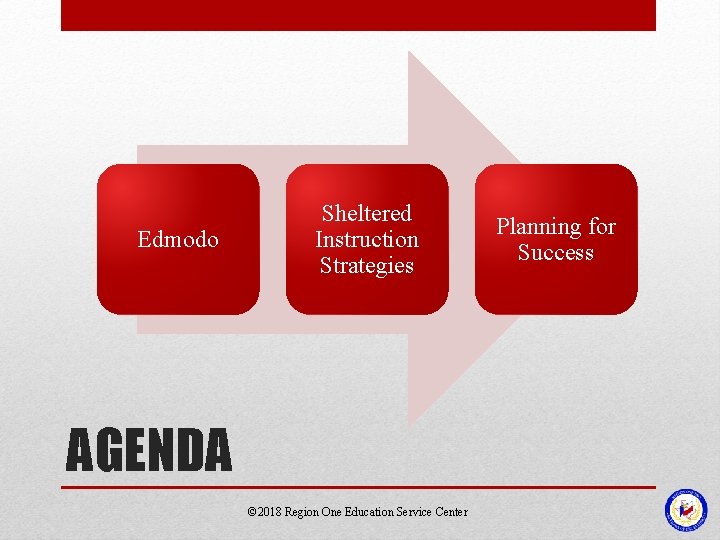
Edmodo Sheltered Instruction Strategies AGENDA © 2018 Region One Education Service Center Planning for Success
Edmodo Assignment 1. If you brought a video of you presenting ELL info to your staff/peers, get a colored index card. www. edmodo. com 2. Let’s mingle! Edmodo Code: 4 ya 7 st © 2017 Region One Education Service Center
Edmodo Assignment 1. Write the most important idea that you read on Chapter 5 and explain how you can implement this idea in your campus/district. www. edmodo. com 2. Respond to someone else’s comment Edmodo Code: 4 ya 7 st © 2018 Region One Education Service Center
SHELTERED INSTRUCTION Strategies © 2018 Region One Education Service Center
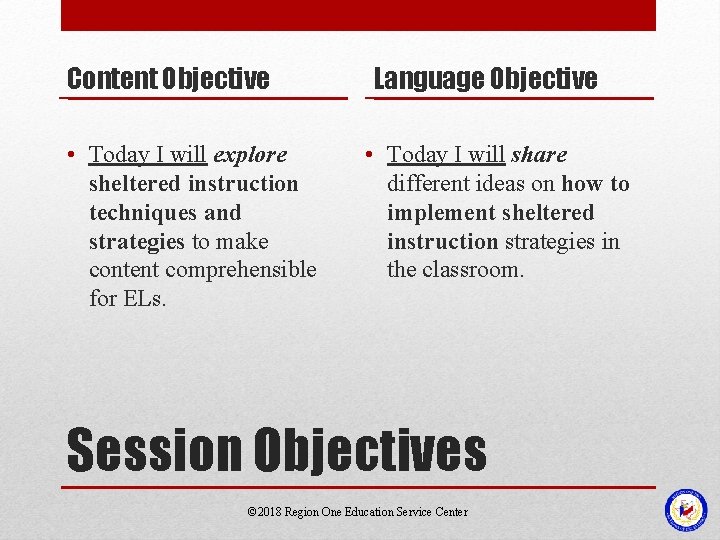
Content Objective • Today I will explore sheltered instruction techniques and strategies to make content comprehensible for ELs. Language Objective • Today I will share different ideas on how to implement sheltered instruction strategies in the classroom. Session Objectives © 2018 Region One Education Service Center
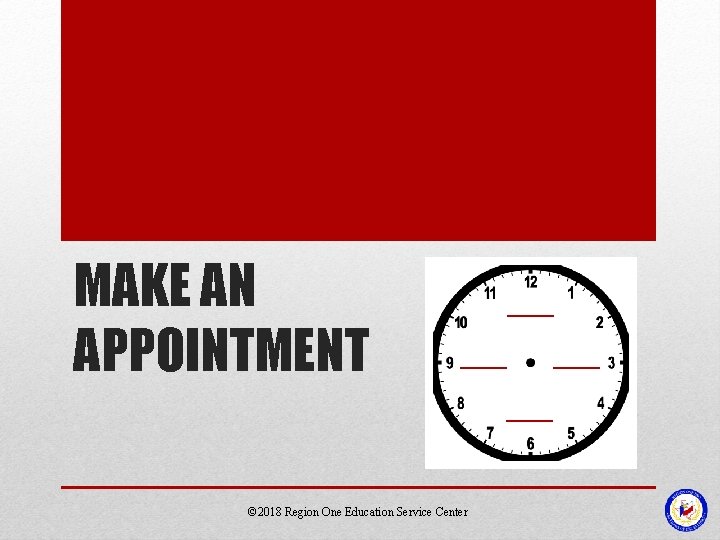
MAKE AN APPOINTMENT © 2018 Region One Education Service Center
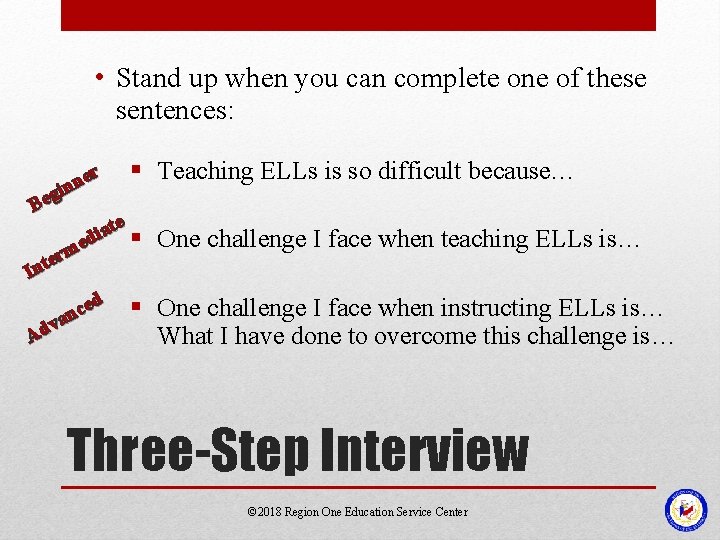
• Stand up when you can complete one of these sentences: er § n gin e B te a i § ed m er t n I d e c an v Ad Teaching ELLs is so difficult because… One challenge I face when teaching ELLs is… § One challenge I face when instructing ELLs is… What I have done to overcome this challenge is… Three-Step Interview © 2018 Region One Education Service Center
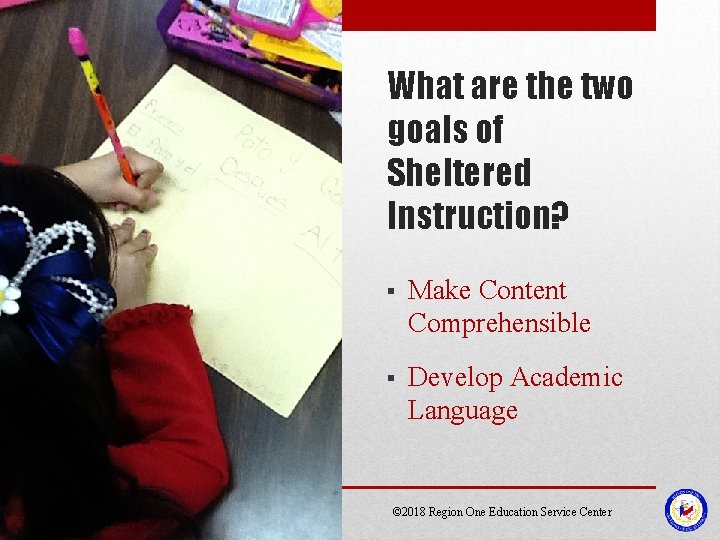
What are the two goals of Sheltered Instruction? § Make Content Comprehensible § Develop Academic Language © 2018 Region One Education Service Center
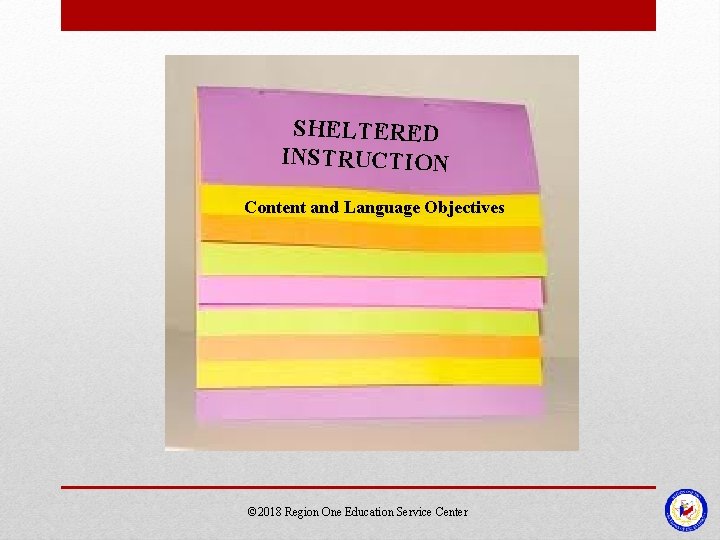
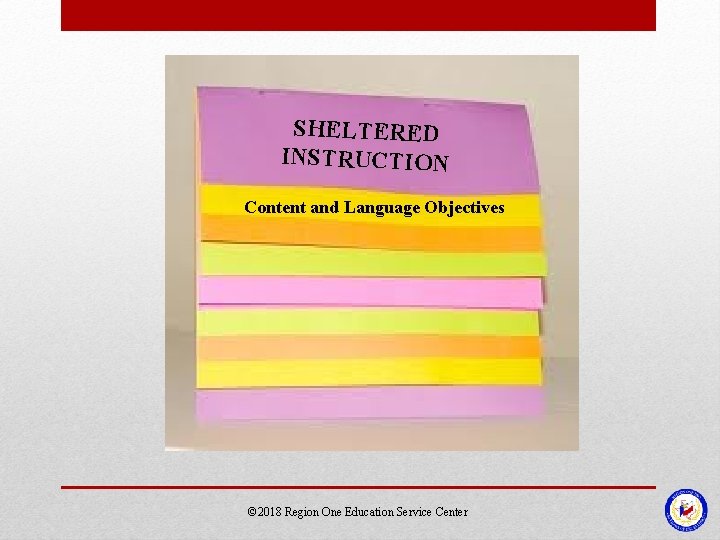
SHELTERED INSTRUCTION Content and Language Objectives © 2018 Region One Education Service Center
CONTENT AND LANGUAGE OBJECTIVES © 2018 Region One Education Service Center
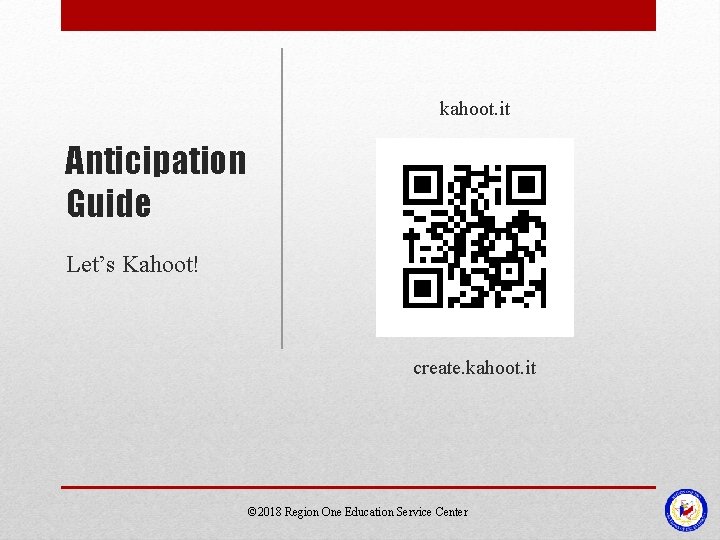
kahoot. it Anticipation Guide Let’s Kahoot! create. kahoot. it © 2018 Region One Education Service Center
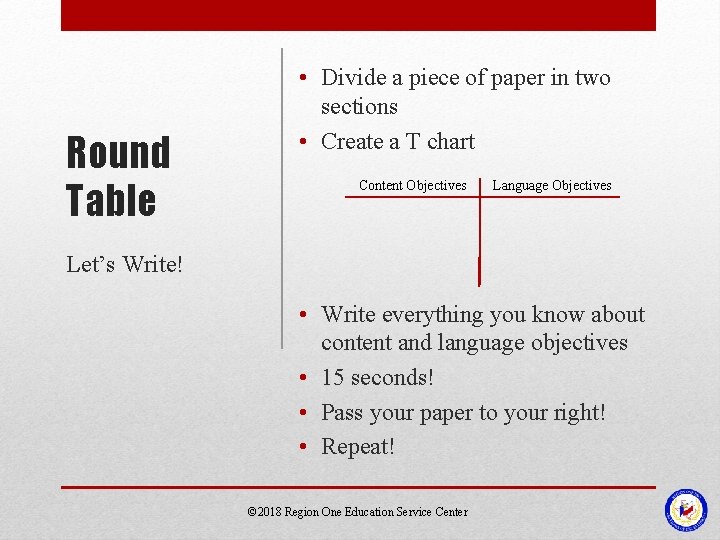
Round Table • Divide a piece of paper in two sections • Create a T chart Content Objectives Language Objectives Let’s Write! • Write everything you know about content and language objectives • 15 seconds! • Pass your paper to your right! • Repeat! © 2018 Region One Education Service Center
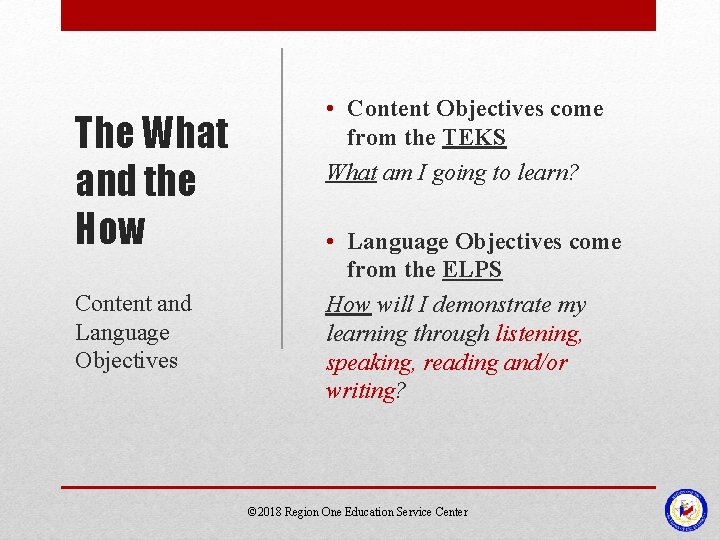
The What and the How Content and Language Objectives • Content Objectives come from the TEKS What am I going to learn? • Language Objectives come from the ELPS How will I demonstrate my learning through listening, speaking, reading and/or writing? © 2018 Region One Education Service Center
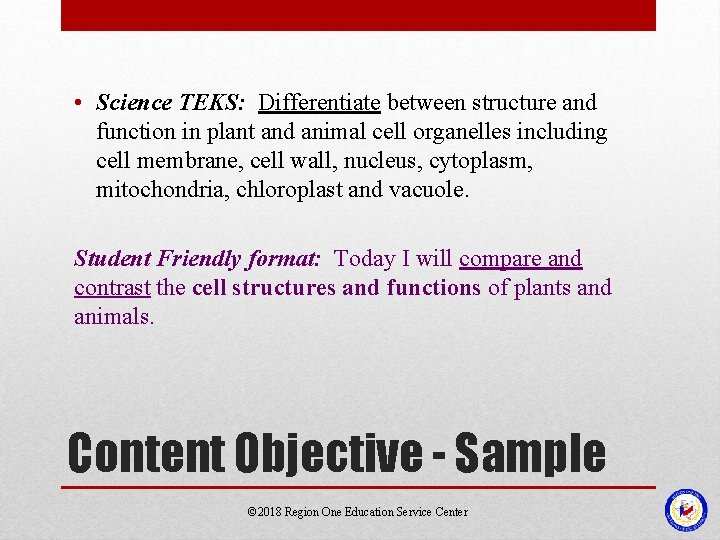
• Science TEKS: Differentiate between structure and function in plant and animal cell organelles including cell membrane, cell wall, nucleus, cytoplasm, mitochondria, chloroplast and vacuole. Student Friendly format: Today I will compare and contrast the cell structures and functions of plants and animals. Content Objective - Sample © 2018 Region One Education Service Center
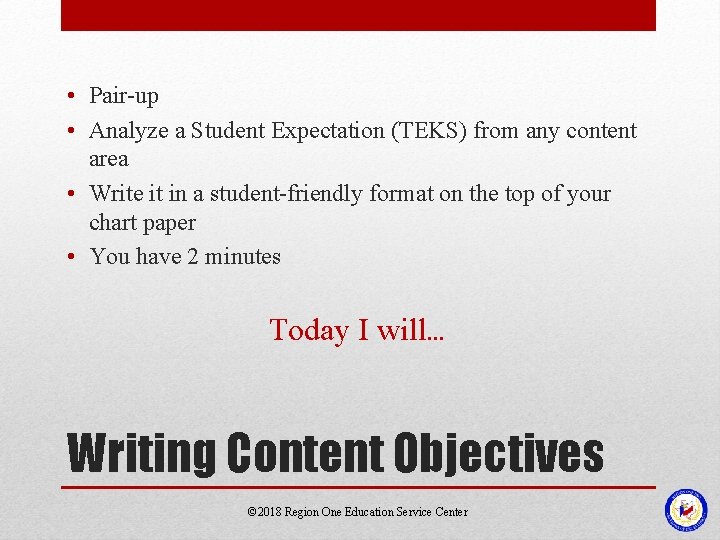
• Pair-up • Analyze a Student Expectation (TEKS) from any content area • Write it in a student-friendly format on the top of your chart paper • You have 2 minutes Today I will… Writing Content Objectives © 2018 Region One Education Service Center
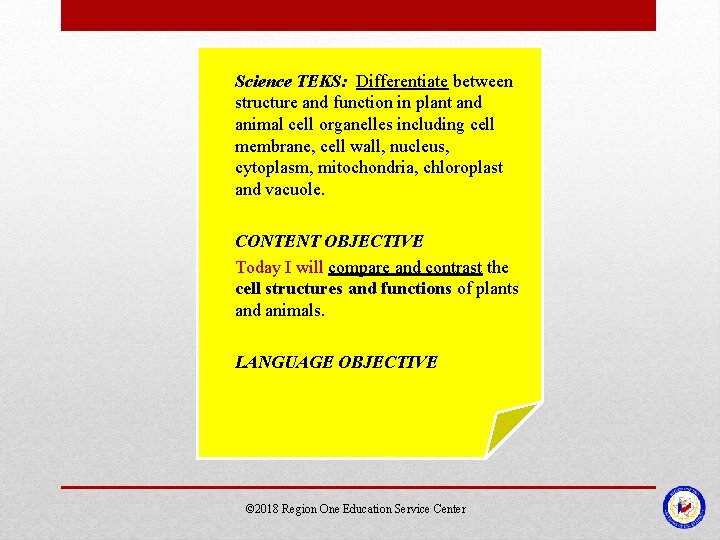
Science TEKS: Differentiate between structure and function in plant and animal cell organelles including cell membrane, cell wall, nucleus, cytoplasm, mitochondria, chloroplast and vacuole. CONTENT OBJECTIVE Today I will compare and contrast the cell structures and functions of plants and animals. LANGUAGE OBJECTIVE © 2018 Region One Education Service Center
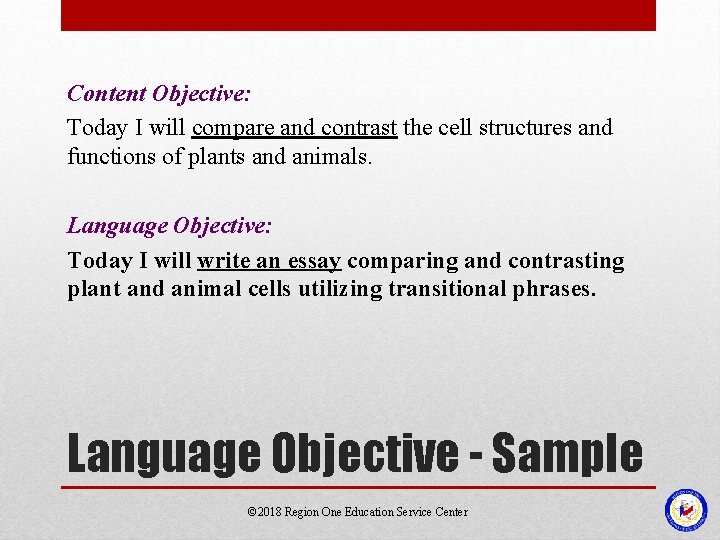
Content Objective: Today I will compare and contrast the cell structures and functions of plants and animals. Language Objective: Today I will write an essay comparing and contrasting plant and animal cells utilizing transitional phrases. Language Objective - Sample © 2018 Region One Education Service Center
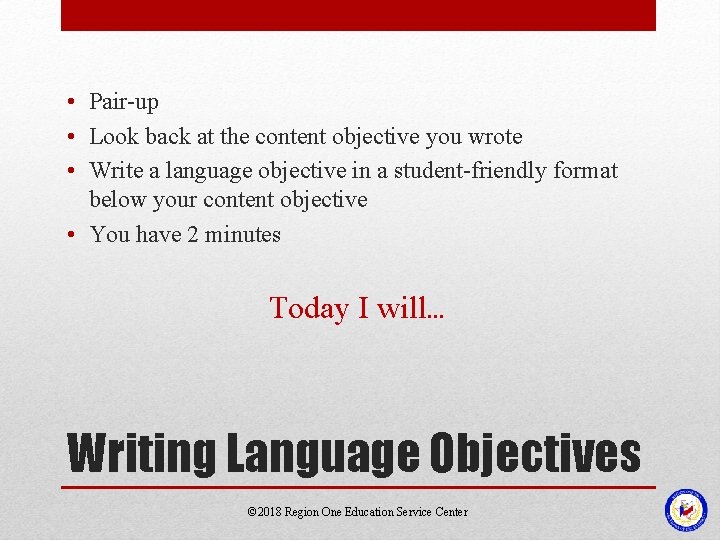
• Pair-up • Look back at the content objective you wrote • Write a language objective in a student-friendly format below your content objective • You have 2 minutes Today I will… Writing Language Objectives © 2018 Region One Education Service Center
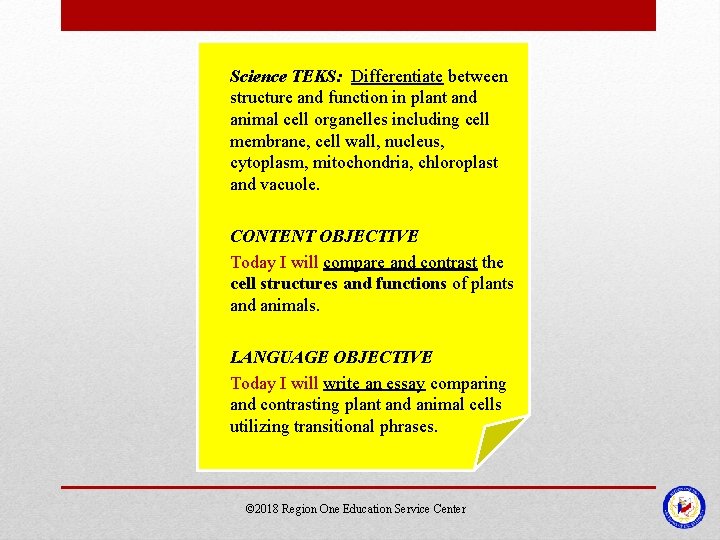
Science TEKS: Differentiate between structure and function in plant and animal cell organelles including cell membrane, cell wall, nucleus, cytoplasm, mitochondria, chloroplast and vacuole. CONTENT OBJECTIVE Today I will compare and contrast the cell structures and functions of plants and animals. LANGUAGE OBJECTIVE Today I will write an essay comparing and contrasting plant and animal cells utilizing transitional phrases. © 2018 Region One Education Service Center
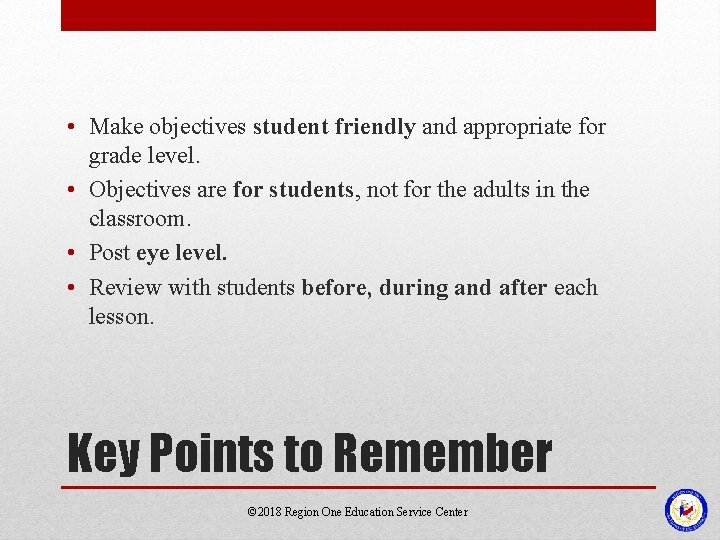
• Make objectives student friendly and appropriate for grade level. • Objectives are for students, not for the adults in the classroom. • Post eye level. • Review with students before, during and after each lesson. Key Points to Remember © 2018 Region One Education Service Center
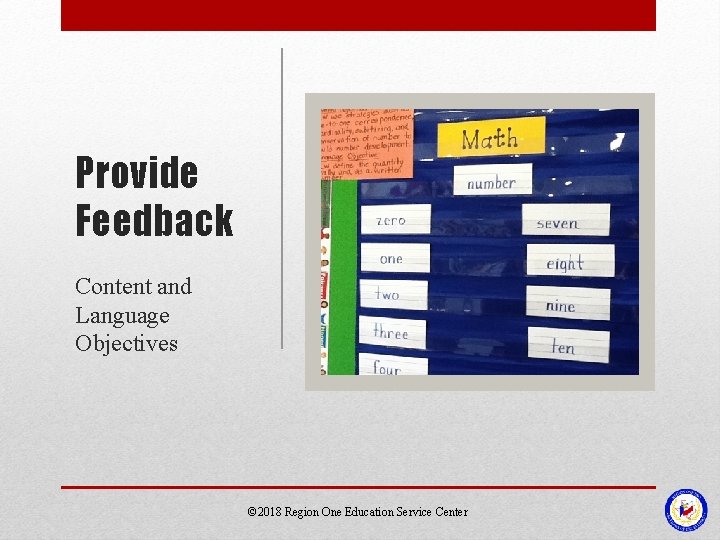
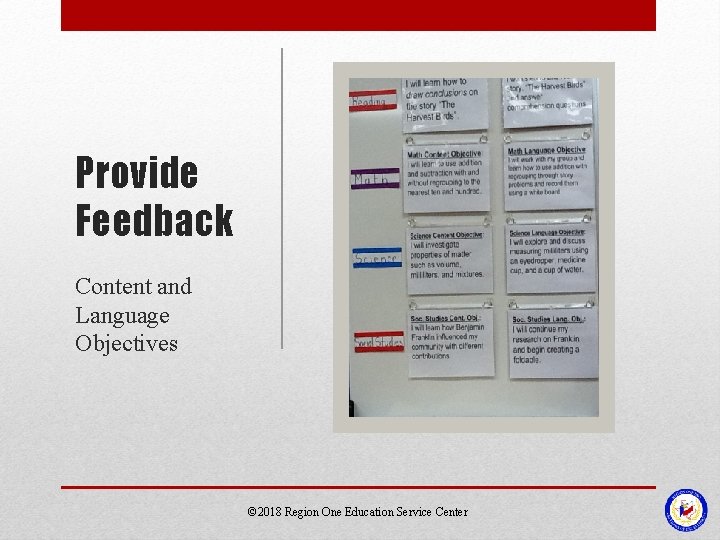
Provide Feedback Content and Language Objectives © 2018 Region One Education Service Center
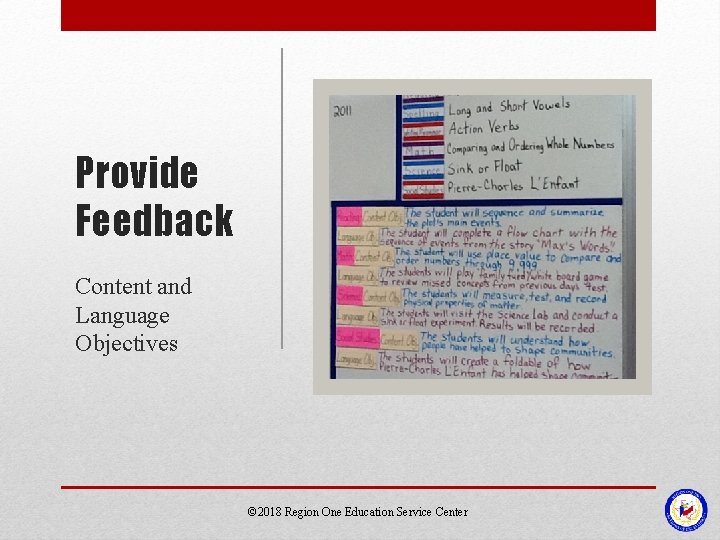
Provide Feedback Content and Language Objectives © 2018 Region One Education Service Center
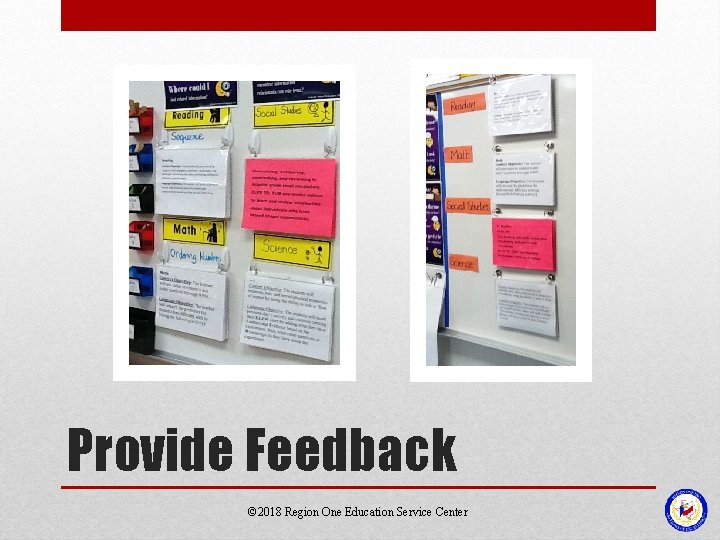
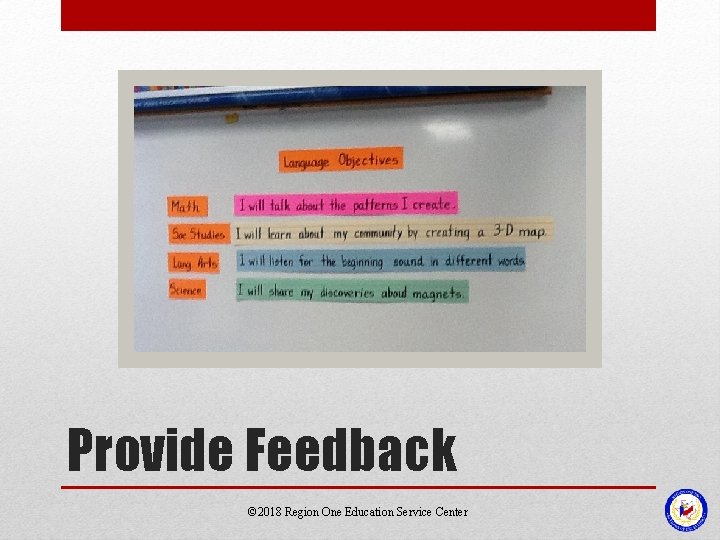
Provide Feedback © 2018 Region One Education Service Center
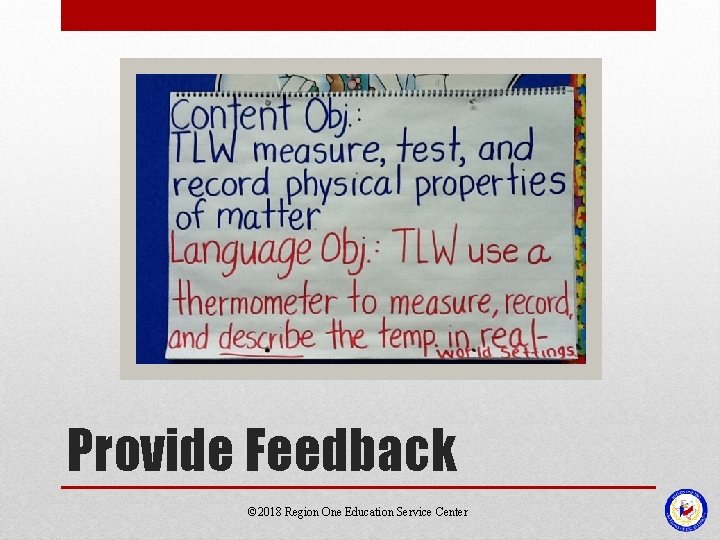
Provide Feedback © 2018 Region One Education Service Center
Provide Feedback © 2018 Region One Education Service Center
Provide Feedback Content and Language Objectives © 2018 Region One Education Service Center
SHELTERED INSTRUCTION Content and Language Objectives © 2018 Region One Education Service Center
SPEAKING IN COMPLETE SENTENCES © 2018 Region One Education Service Center
Why is it important to encourage English Learners to speak in complete sentences? Write your individual answer on a piece of paper. § Share with a partner and add any new ideas to your paper. § Now share your answers with another pair and keep adding new ideas to your own papers. § As a whole table come up with a final complete answer. § 1 -2 -4 -ALL © 2018 Region One Education Service Center
Does this mean that students need to answer in complete sentences all the time? TIP: Provide students with sentence frames and sentence starters if they are struggling to produce complete thoughts in English. Use of Complete Sentences © 2018 Region One Education Service Center
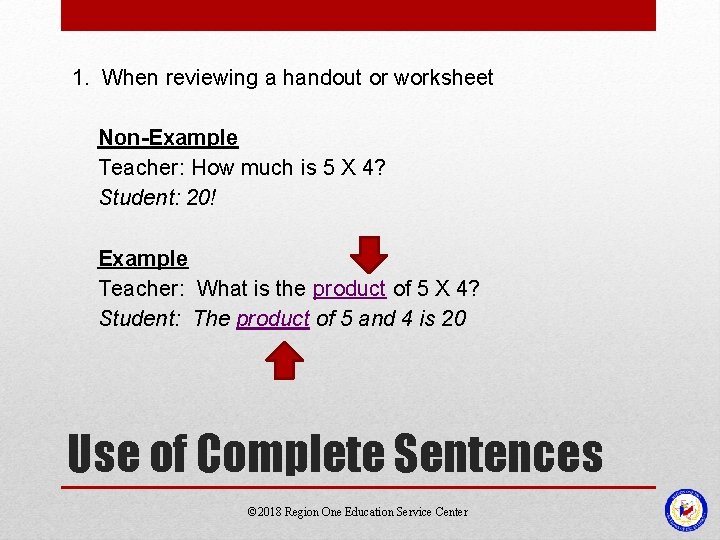
1. When reviewing a handout or worksheet Non-Example Teacher: How much is 5 X 4? Student: 20! Example Teacher: What is the product of 5 X 4? Student: The product of 5 and 4 is 20 Use of Complete Sentences © 2018 Region One Education Service Center
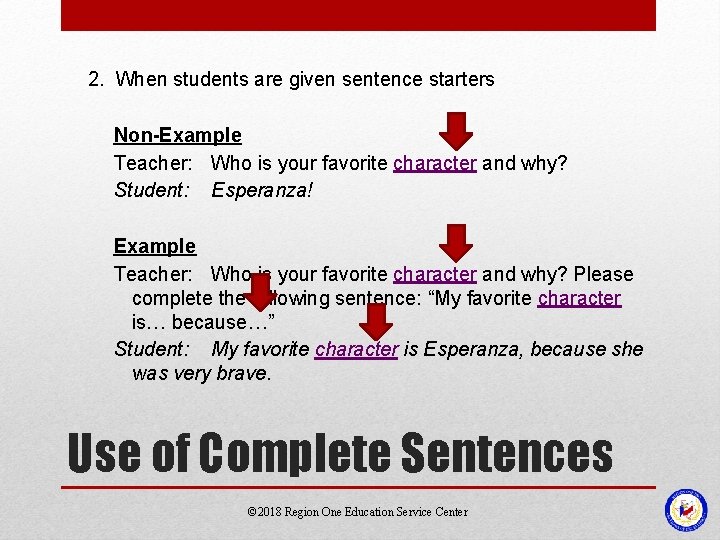
2. When students are given sentence starters Non-Example Teacher: Who is your favorite character and why? Student: Esperanza! Example Teacher: Who is your favorite character and why? Please complete the following sentence: “My favorite character is… because…” Student: My favorite character is Esperanza, because she was very brave. Use of Complete Sentences © 2018 Region One Education Service Center
• Using the Content and Language Objectives that you developed, write 2 questions and 2 sentence stems that your students might be able to answer throughout the lesson. • Write them on post-its and place them on your chart paper. Your Turn! Gallery Walk! © 2018 Region One Education Service Center
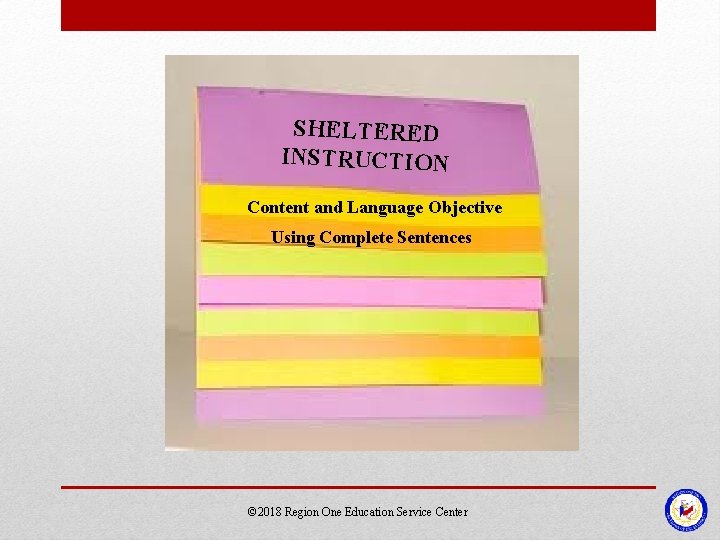
SHELTERED INSTRUCTION Content and Language Objective Using Complete Sentences © 2018 Region One Education Service Center
RANDOMIZATION TECHNIQUES © 2018 Region One Education Service Center
Write-Read-Trade 1. Stand up when you complete in writing one of these sentences: § I select who I call on by… § In my classroom, I include randomization because… § The most beneficial randomization technique I have used is… because… 2. Find your 12 o’clock, share your answers and trade your papers. Randomization Techniques © 2018 Region One Education Service Center
§ Is it possible to randomize and differentiate instruction at the same time? Randomize and rotate who is called on, so students of all language levels can participate! Randomization Techniques © 2018 Region One Education Service Center
§ Lucky sticks § Beach ball § Index cards with student names § Class list/roster § Color/numbers § Birthdays § Physical characteristics: longest hair, eye color… § Jenga § Pick up sticks § Career cards § Apps § Popcorn Randomization Techniques © 2018 Region One Education Service Center
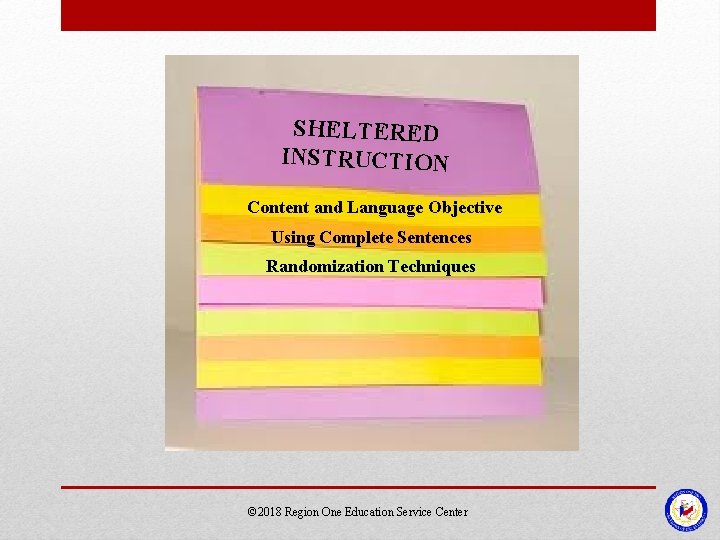
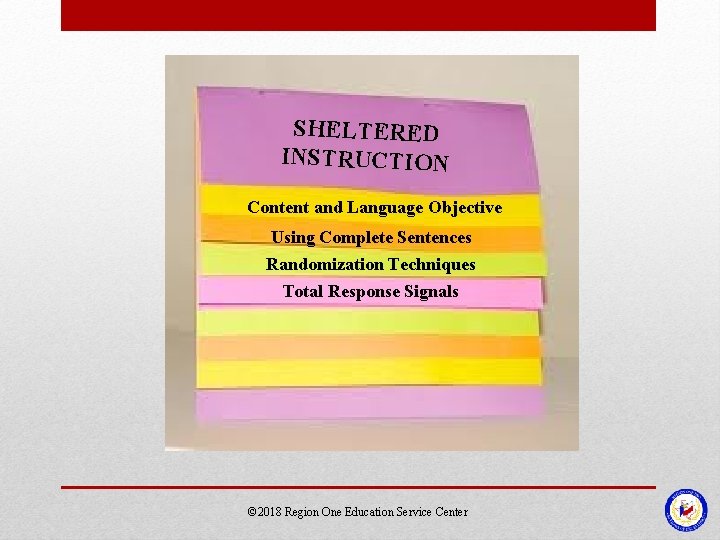
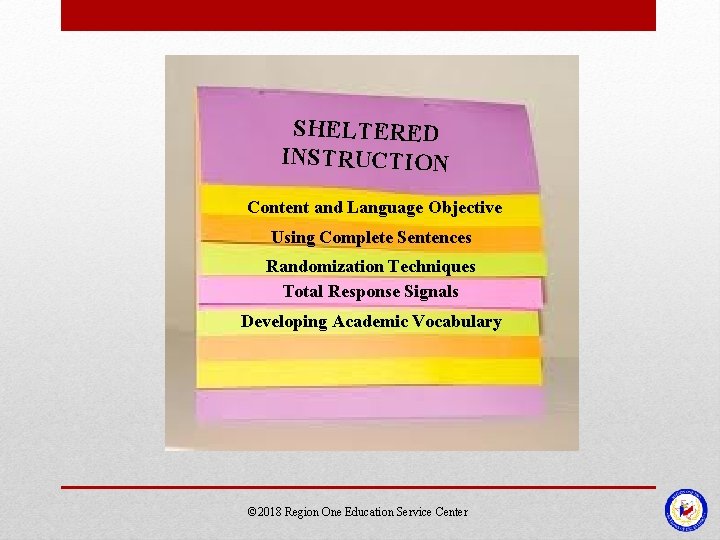
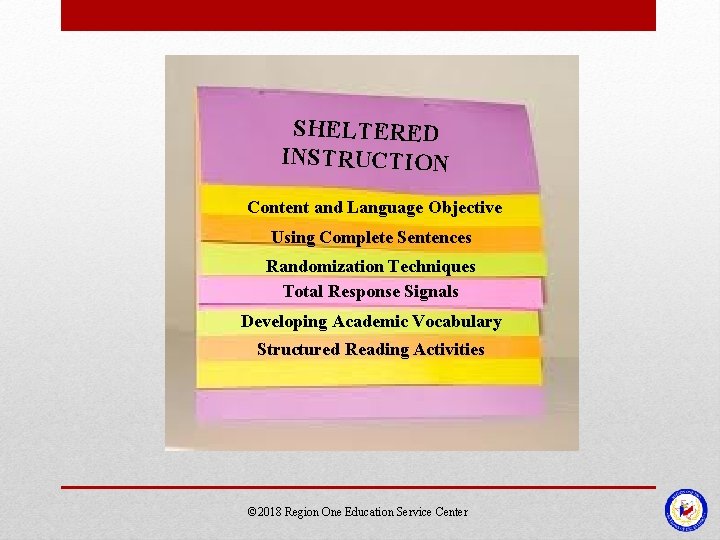
SHELTERED INSTRUCTION Content and Language Objective Using Complete Sentences Randomization Techniques © 2018 Region One Education Service Center
TOTAL RESPONSE SIGNALS © 2018 Region One Education Service Center
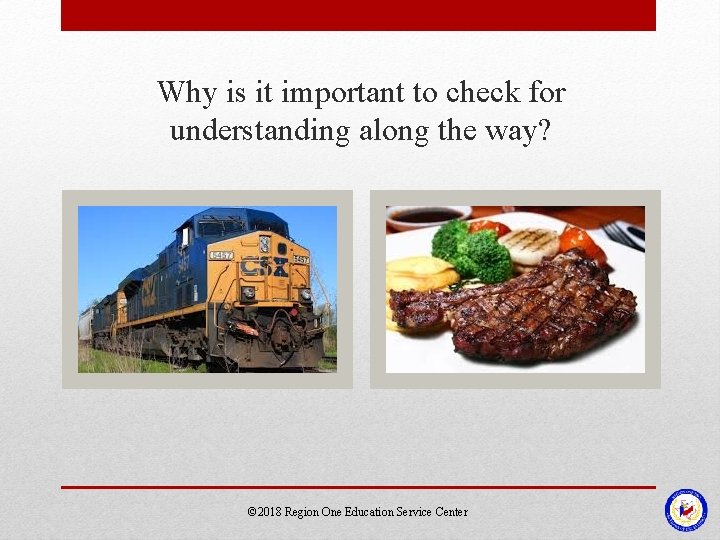
Why is it important to check for understanding along the way? © 2018 Region One Education Service Center
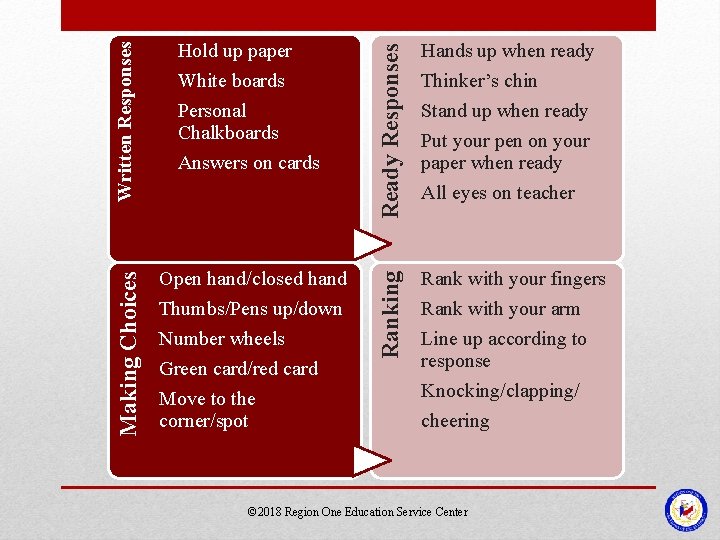
Move to the corner/spot Ready Responses Making Choices Open hand/closed hand Thumbs/Pens up/down Number wheels Green card/red card Hands up when ready Thinker’s chin Stand up when ready Put your pen on your paper when ready All eyes on teacher Ranking Written Responses Hold up paper White boards Personal Chalkboards Answers on cards Rank with your fingers Rank with your arm Line up according to response Knocking/clapping/ cheering © 2018 Region One Education Service Center
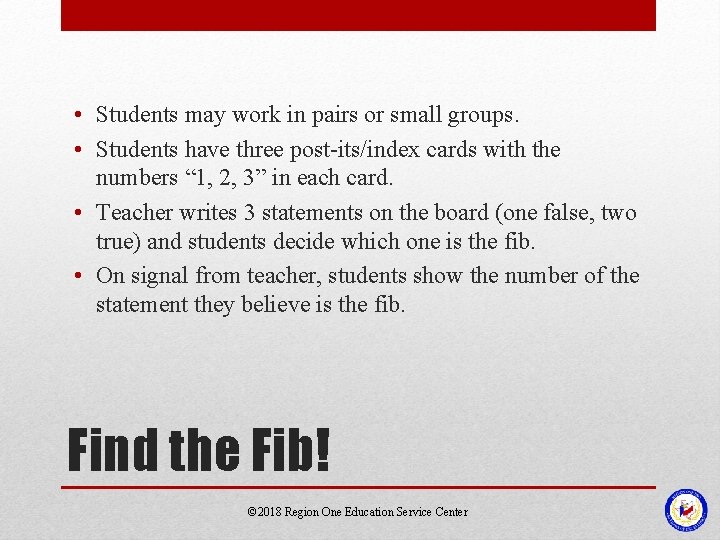
• Students may work in pairs or small groups. • Students have three post-its/index cards with the numbers “ 1, 2, 3” in each card. • Teacher writes 3 statements on the board (one false, two true) and students decide which one is the fib. • On signal from teacher, students show the number of the statement they believe is the fib. Find the Fib! © 2018 Region One Education Service Center
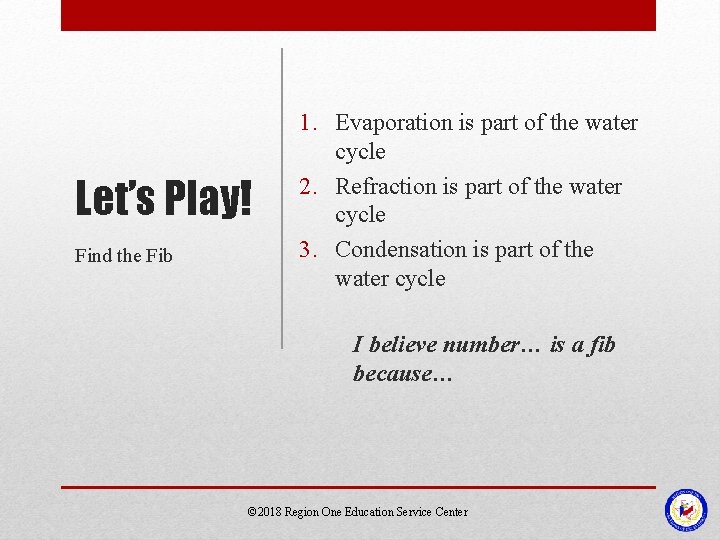
Let’s Play! Find the Fib 1. Evaporation is part of the water cycle 2. Refraction is part of the water cycle 3. Condensation is part of the water cycle I believe number… is a fib because… © 2018 Region One Education Service Center
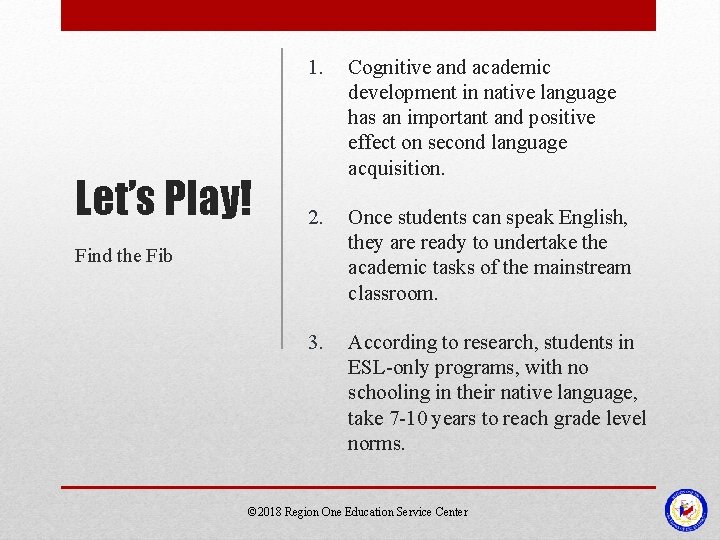
Let’s Play! 1. Cognitive and academic development in native language has an important and positive effect on second language acquisition. 2. Once students can speak English, they are ready to undertake the academic tasks of the mainstream classroom. 3. According to research, students in ESL-only programs, with no schooling in their native language, take 7 -10 years to reach grade level norms. Find the Fib © 2018 Region One Education Service Center
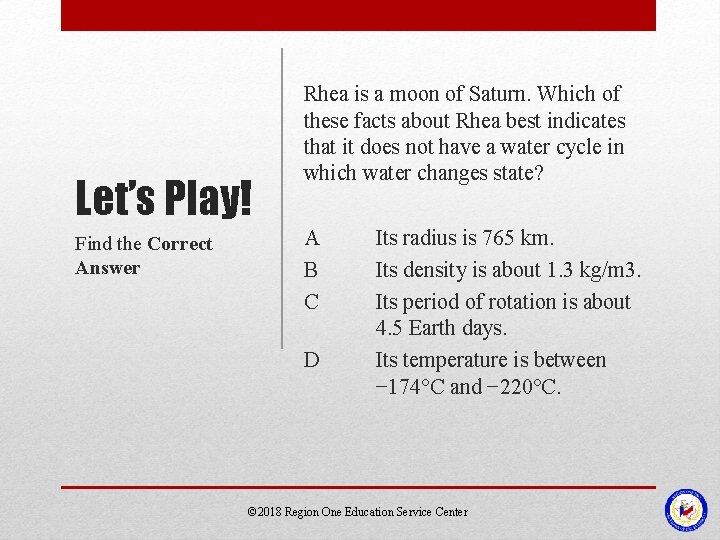
Let’s Play! Find the Correct Answer Rhea is a moon of Saturn. Which of these facts about Rhea best indicates that it does not have a water cycle in which water changes state? A B C D Its radius is 765 km. Its density is about 1. 3 kg/m 3. Its period of rotation is about 4. 5 Earth days. Its temperature is between − 174°C and − 220°C. © 2018 Region One Education Service Center
SHELTERED INSTRUCTION Content and Language Objective Using Complete Sentences Randomization Techniques Total Response Signals © 2018 Region One Education Service Center
DEVELOPING ACADEMIC VOCABULARY © 2018 Region One Education Service Center
1. When you can complete this sentence in your mind, please stand up. Academic vocabulary development is important for ALL students, but especially for ELs, because… 2. Find your 9 o’clock appointment and share your responses. © 2018 Region One Education Service Center
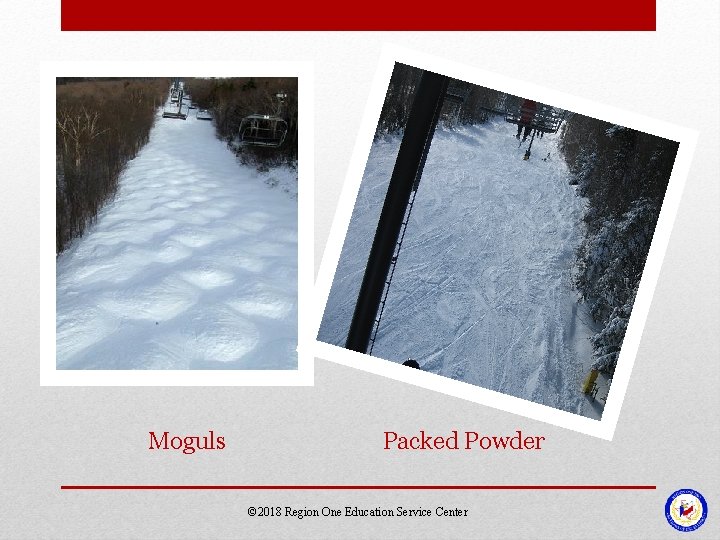
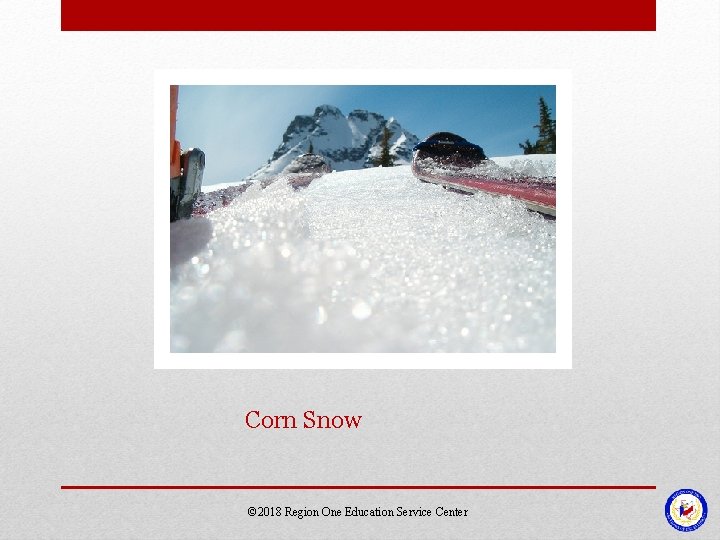
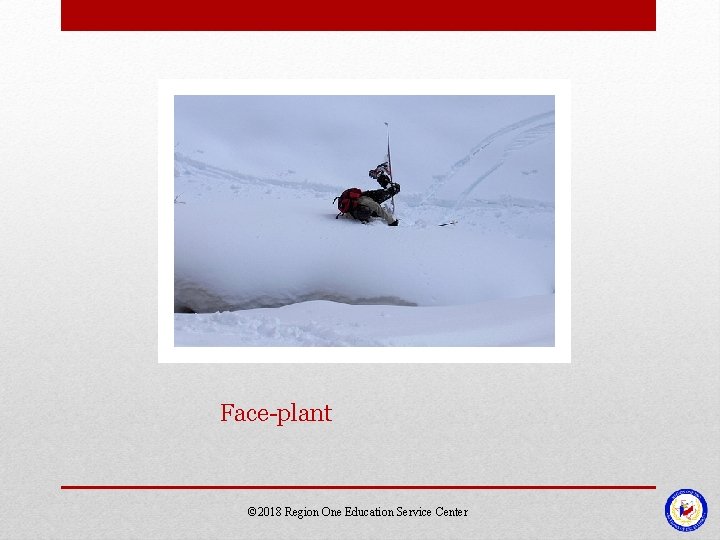
What does this mean? Carving is appropriate for most green and blue slopes and even some black slopes. However, if you try to carve through moguls, especially in packed powder or corn snow, you’re going to face-plant. © 2018 Region One Education Service Center
What does this mean? Carving is appropriate for most green and blue slopes and even some black slopes. However, if you try to carve through moguls, especially in packed powder or corn snow, you’re going to face-plant. © 2018 Region One Education Service Center
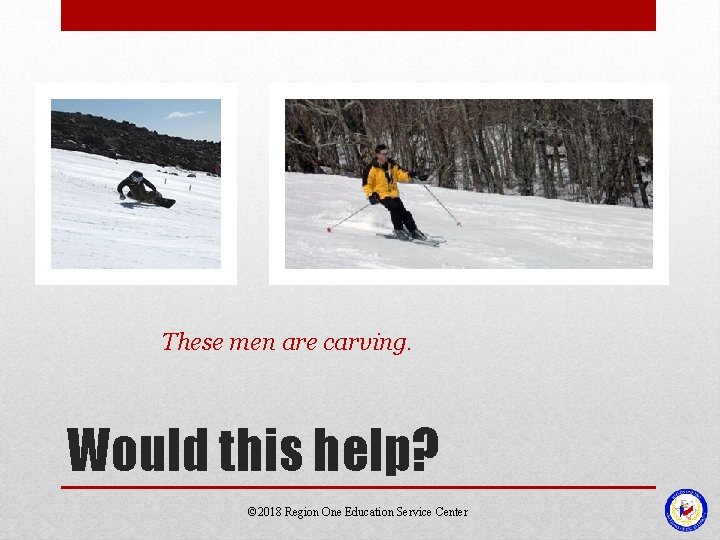
These men are carving. Would this help? © 2018 Region One Education Service Center
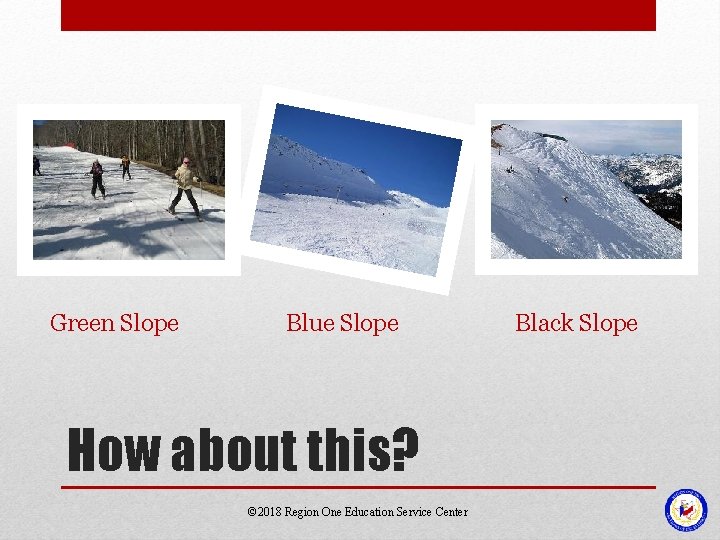
Green Slope Blue Slope How about this? © 2018 Region One Education Service Center Black Slope
Moguls Packed Powder © 2018 Region One Education Service Center
Corn Snow © 2018 Region One Education Service Center
Face-plant © 2018 Region One Education Service Center
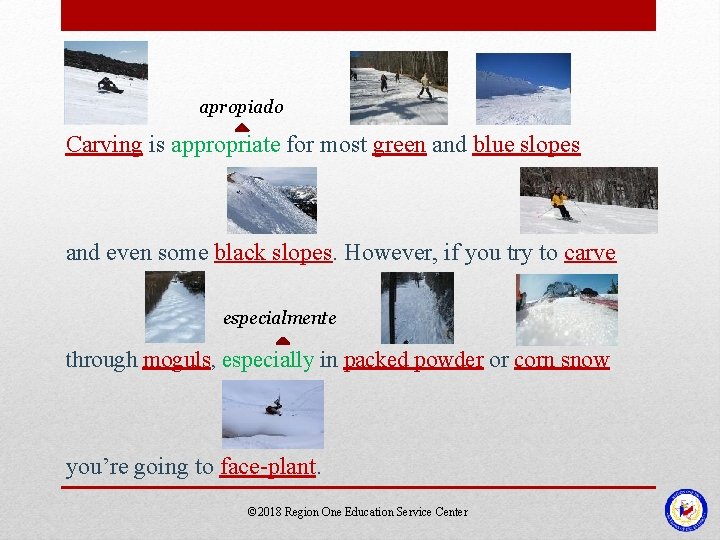
apropiado Carving is appropriate for most green and blue slopes and even some black slopes. However, if you try to carve especialmente through moguls, especially in packed powder or corn snow you’re going to face-plant. © 2018 Region One Education Service Center
Vocabulary Experts Expert Groups • Number Heads 1 -8 • Form Expert Groups • Each team creates a visual explaining the activity • Back to original groups © 2018 Region One Education Service Center
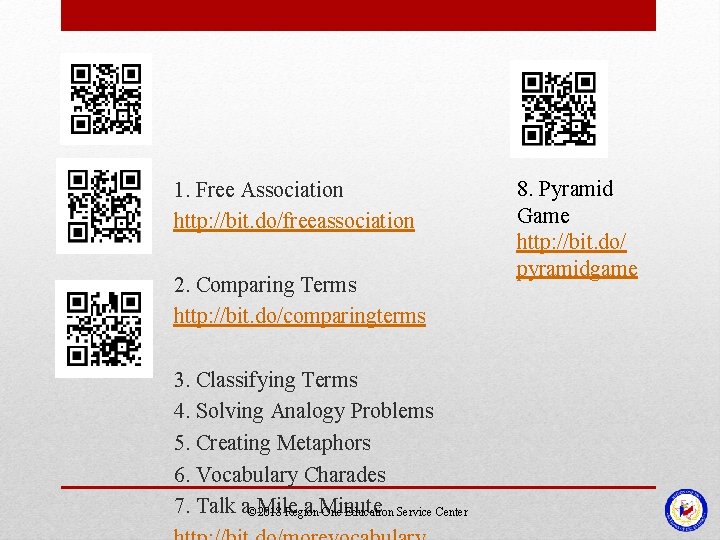
1. Free Association http: //bit. do/freeassociation 2. Comparing Terms http: //bit. do/comparingterms 3. Classifying Terms 4. Solving Analogy Problems 5. Creating Metaphors 6. Vocabulary Charades 7. Talk a© 2018 Mile a Minute Region One Education Service Center 8. Pyramid Game http: //bit. do/ pyramidgame
SHELTERED INSTRUCTION Content and Language Objective Using Complete Sentences Randomization Techniques Total Response Signals Developing Academic Vocabulary © 2018 Region One Education Service Center
STRUCTURED READING AND WRITING ACTIVITIES © 2018 Region One Education Service Center
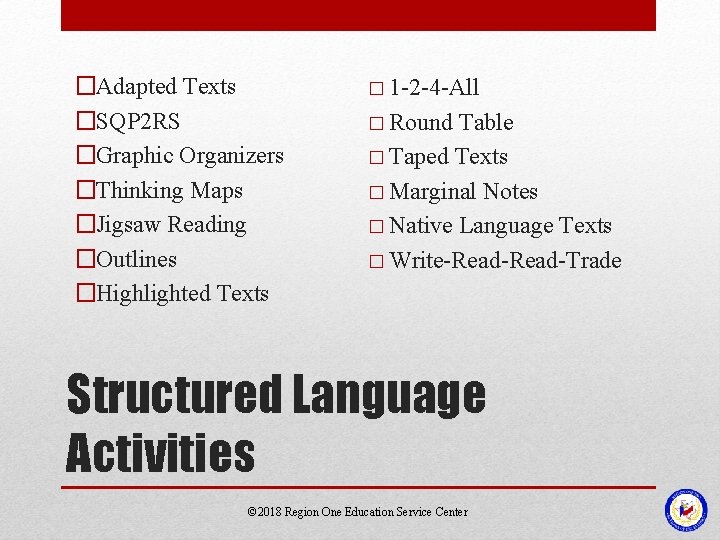
�Adapted Texts �SQP 2 RS �Graphic Organizers �Thinking Maps �Jigsaw Reading �Outlines �Highlighted Texts � 1 -2 -4 -All � Round Table � Taped Texts � Marginal Notes � Native Language Texts � Write-Read-Trade Structured Language Activities © 2018 Region One Education Service Center
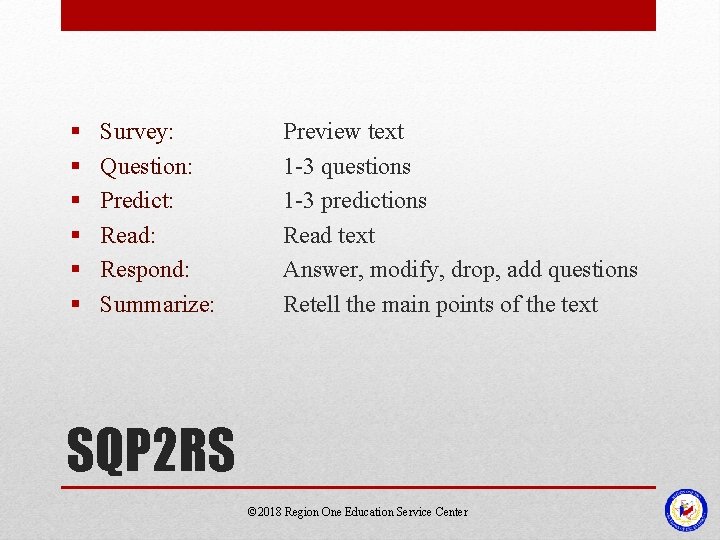
§ § § Survey: Question: Predict: Read: Respond: Summarize: Preview text 1 -3 questions 1 -3 predictions Read text Answer, modify, drop, add questions Retell the main points of the text SQP 2 RS © 2018 Region One Education Service Center
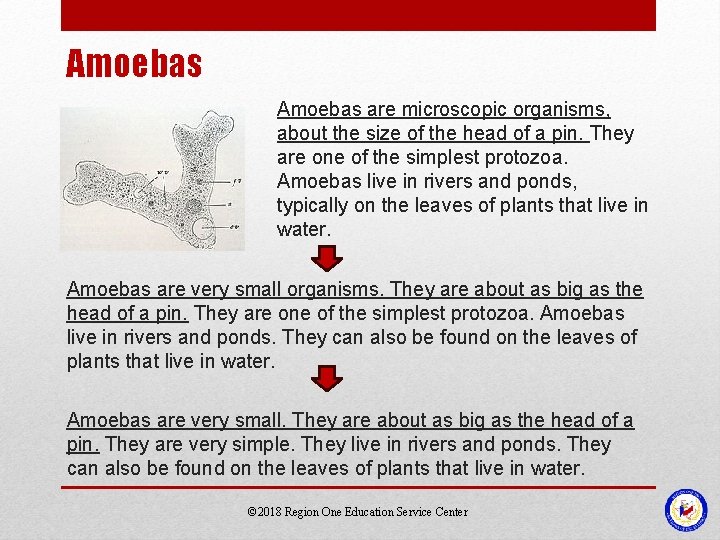
Amoebas are microscopic organisms, about the size of the head of a pin. They are one of the simplest protozoa. Amoebas live in rivers and ponds, typically on the leaves of plants that live in water. Amoebas are very small organisms. They are about as big as the head of a pin. They are one of the simplest protozoa. Amoebas live in rivers and ponds. They can also be found on the leaves of plants that live in water. Amoebas are very small. They are about as big as the head of a pin. They are very simple. They live in rivers and ponds. They can also be found on the leaves of plants that live in water. © 2018 Region One Education Service Center
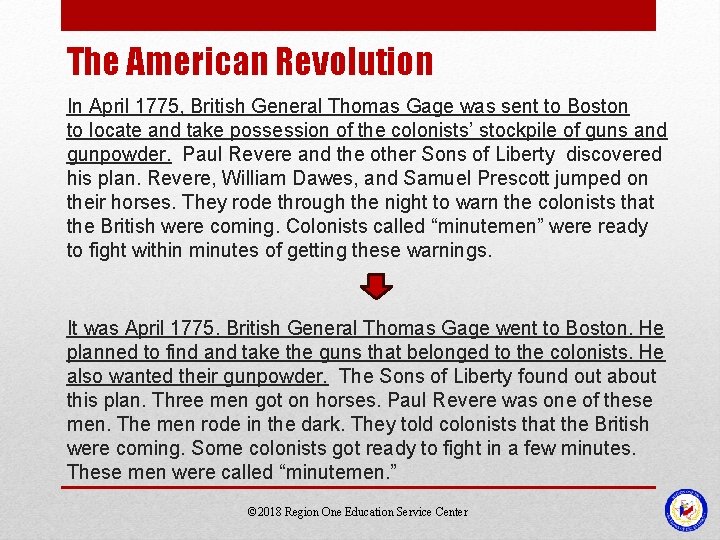
The American Revolution In April 1775, British General Thomas Gage was sent to Boston to locate and take possession of the colonists’ stockpile of guns and gunpowder. Paul Revere and the other Sons of Liberty discovered his plan. Revere, William Dawes, and Samuel Prescott jumped on their horses. They rode through the night to warn the colonists that the British were coming. Colonists called “minutemen” were ready to fight within minutes of getting these warnings. It was April 1775. British General Thomas Gage went to Boston. He planned to find and take the guns that belonged to the colonists. He also wanted their gunpowder. The Sons of Liberty found out about this plan. Three men got on horses. Paul Revere was one of these men. The men rode in the dark. They told colonists that the British were coming. Some colonists got ready to fight in a few minutes. These men were called “minutemen. ” © 2018 Region One Education Service Center
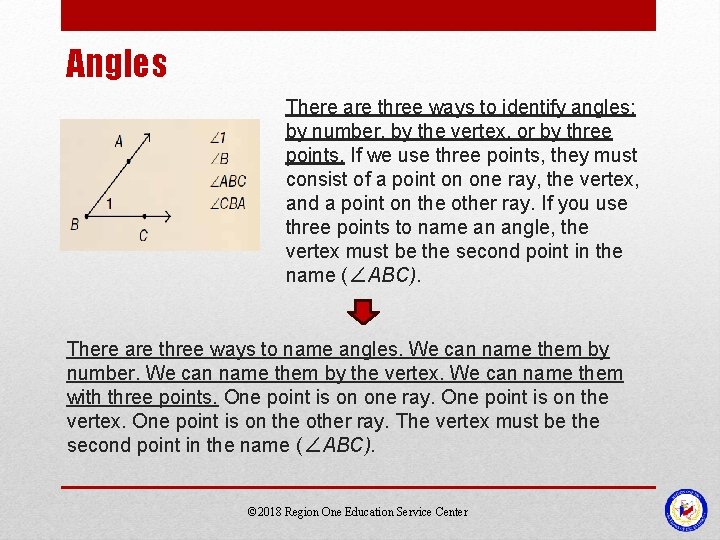
Angles There are three ways to identify angles: by number, by the vertex, or by three points. If we use three points, they must consist of a point on one ray, the vertex, and a point on the other ray. If you use three points to name an angle, the vertex must be the second point in the name (∠ABC). There are three ways to name angles. We can name them by number. We can name them by the vertex. We can name them with three points. One point is on one ray. One point is on the vertex. One point is on the other ray. The vertex must be the second point in the name (∠ABC). © 2018 Region One Education Service Center
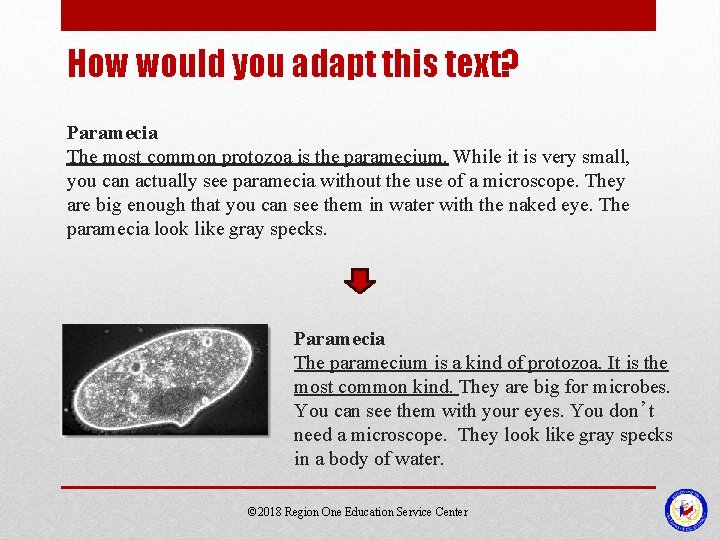
How would you adapt this text? Paramecia The most common protozoa is the paramecium. While it is very small, you can actually see paramecia without the use of a microscope. They are big enough that you can see them in water with the naked eye. The paramecia look like gray specks. Paramecia The paramecium is a kind of protozoa. It is the most common kind. They are big for microbes. You can see them with your eyes. You don’t need a microscope. They look like gray specks in a body of water. © 2018 Region One Education Service Center
• One of the benefits of including structured reading and writing activities in my classroom is… • One of the challenges of including structured reading and writing activities in my class is… • Something I can do to overcome this challenge is… Go to your 6 o’clock © 2018 Region One Education Service Center
SHELTERED INSTRUCTION Content and Language Objective Using Complete Sentences Randomization Techniques Total Response Signals Developing Academic Vocabulary Structured Reading Activities © 2018 Region One Education Service Center
STRUCTURED CONVERSATIONS © 2018 Region One Education Service Center
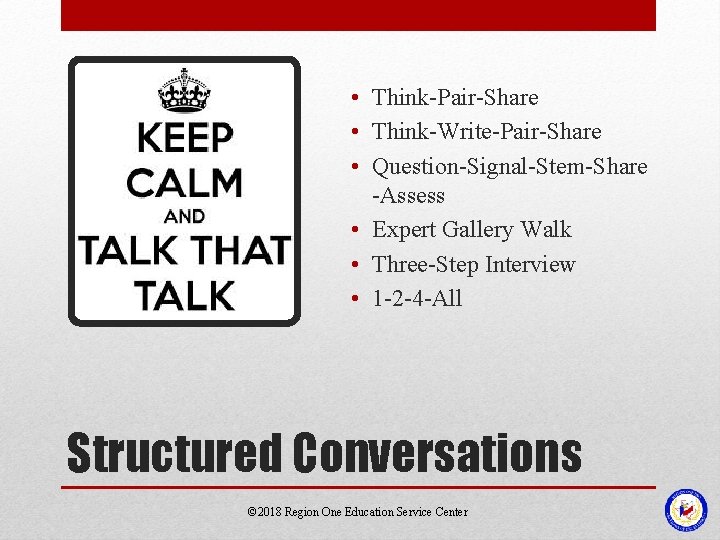
• Think-Pair-Share • Think-Write-Pair-Share • Question-Signal-Stem-Share -Assess • Expert Gallery Walk • Three-Step Interview • 1 -2 -4 -All Structured Conversations © 2018 Region One Education Service Center
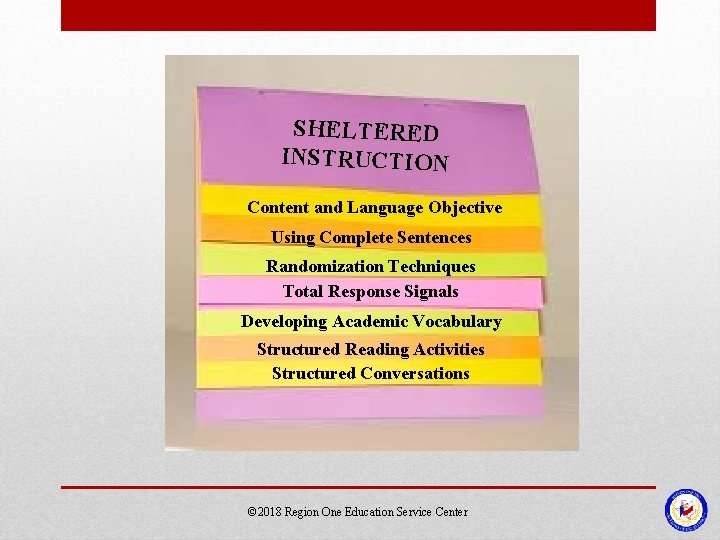
SHELTERED INSTRUCTION Content and Language Objective Using Complete Sentences Randomization Techniques Total Response Signals Developing Academic Vocabulary Structured Reading Activities Structured Conversations © 2018 Region One Education Service Center
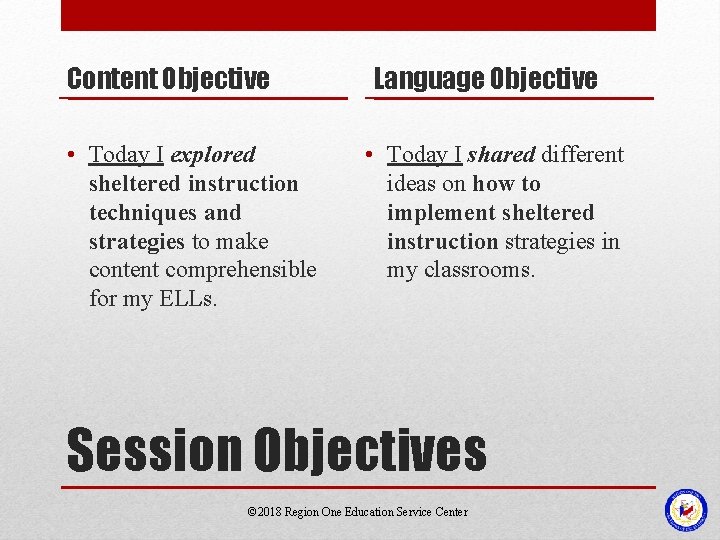
Content Objective • Today I explored sheltered instruction techniques and strategies to make content comprehensible for my ELLs. Language Objective • Today I shared different ideas on how to implement sheltered instruction strategies in my classrooms. Session Objectives © 2018 Region One Education Service Center
PLANNING FOR SUCCESS With Thinking Maps © 2018 Region One Education Service Center
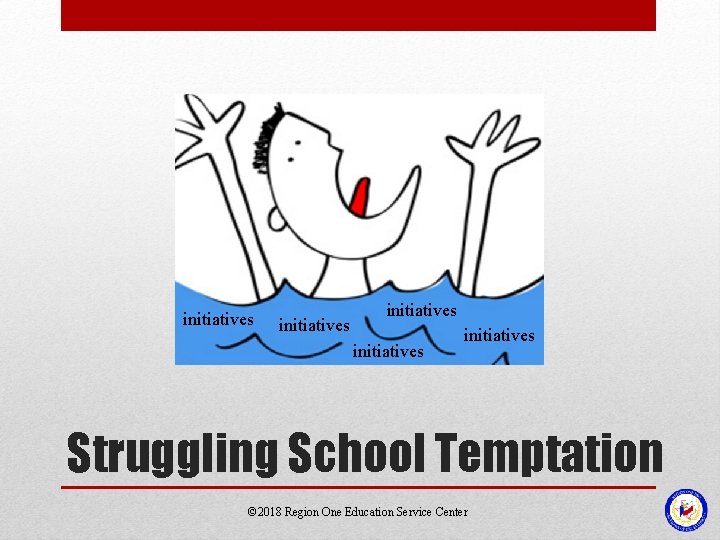
initiatives initiatives Struggling School Temptation © 2018 Region One Education Service Center
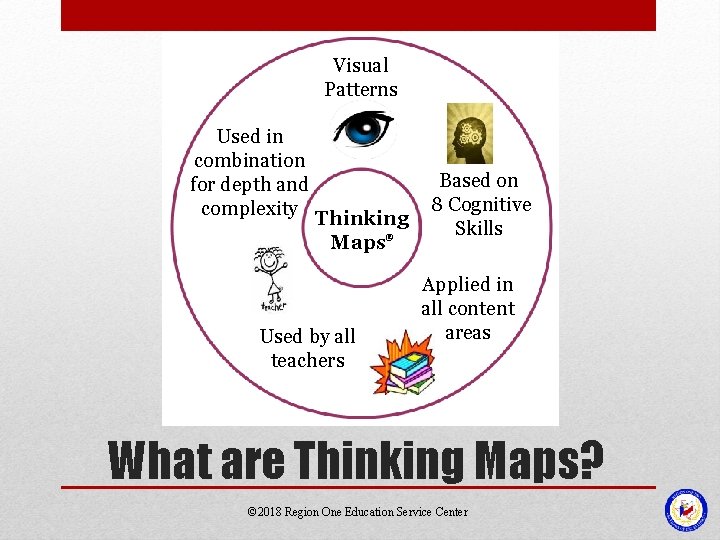
Visual Patterns Used in combination for depth and complexity Thinking Maps ® Used by all teachers Based on 8 Cognitive Skills Applied in all content areas What are Thinking Maps? © 2018 Region One Education Service Center
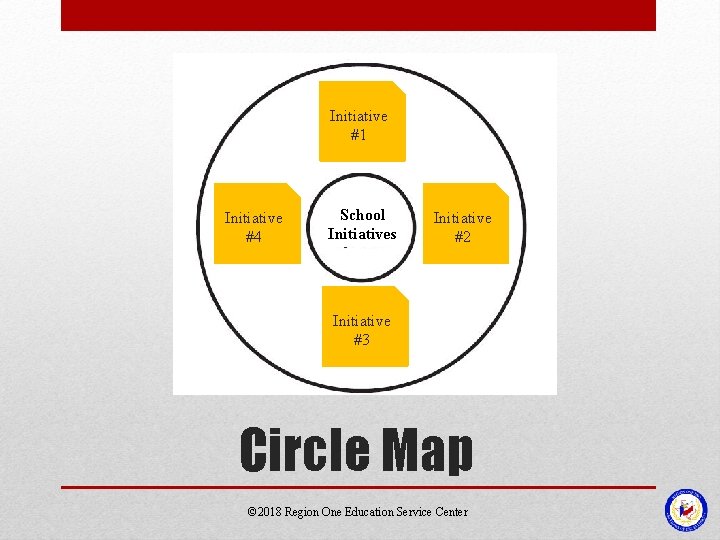
Initiative #1 Initiative #4 School Initiatives Initiative #2 Initiative #3 Circle Map © 2018 Region One Education Service Center
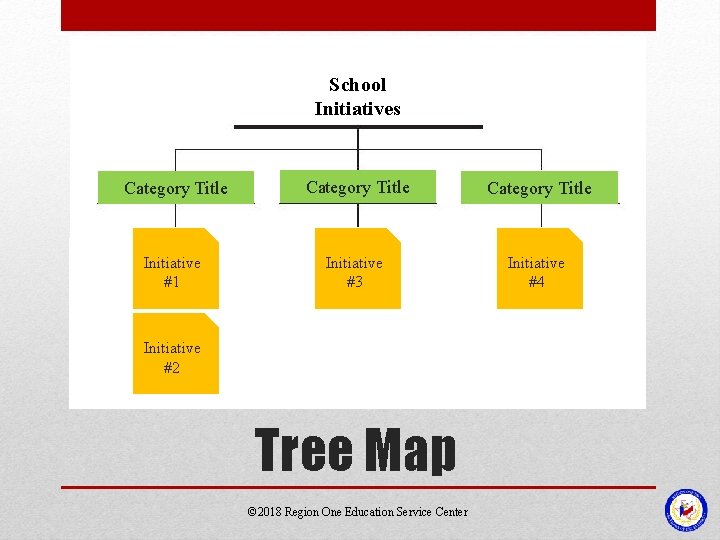
School Initiatives Category Title Initiative #1 Initiative #3 Initiative #4 Initiative #2 Tree Map © 2018 Region One Education Service Center
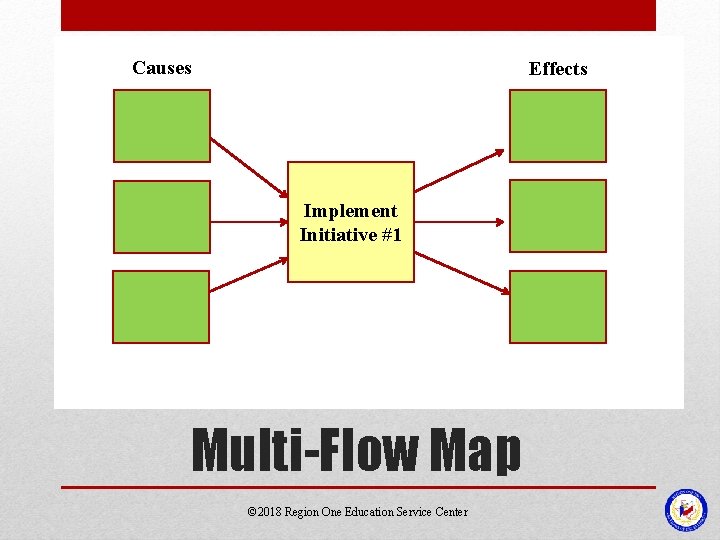
Causes Effects Implement Initiative #1 Multi-Flow Map © 2018 Region One Education Service Center
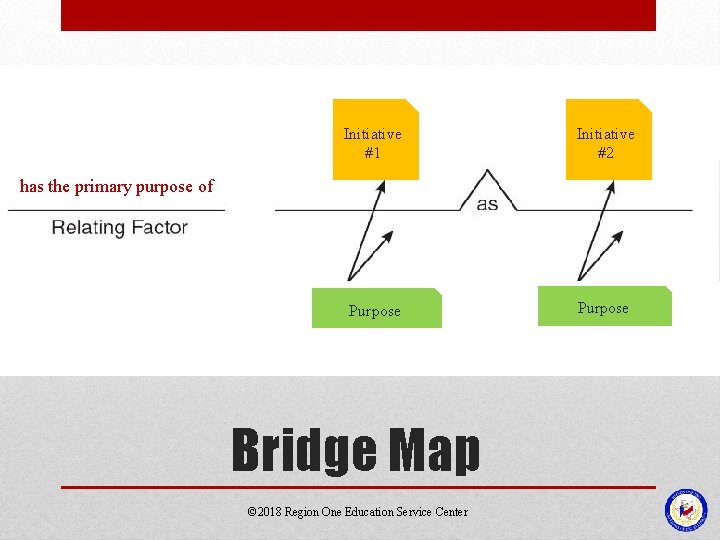
Initiative #1 Initiative #2 Purpose has the primary purpose of Bridge Map © 2018 Region One Education Service Center
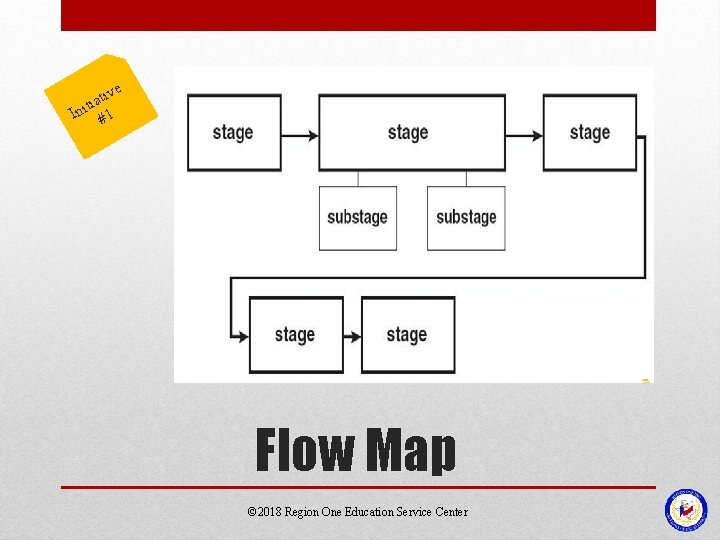
ive t a ti Ini #1 Flow Map © 2018 Region One Education Service Center
NOW WHAT? Next Steps © 2018 Region One Education Service Center
www. 16 personalities. com Leadership: Know Thyself © 2018 Region One Education Service Center
3 Things I learned at the Academy… 2 Things that I shared with my staff… 1 Thing that I will implement next year… http: //backchannelchat. com/chat/bk 1 zn or Go to www. backchannel. com and enter code bk 1 zn Exit Tickets © 2018 Region One Education Service Center
Mil gracias Karina E. Chapa, M. Ed. Language Proficiency, Biliteracy and Cultural Diversity Director kchapa@esc 1. net Facebook: Region One ESC Bilingual Twitter @esc 1 bilingual @bilingualpride © 2018 Region One Education Service Center