DATACENTERED CROWDSOURCING WORKSHOP PROF TOVA MILO SLAVA NOVGORODOV




- Slides: 84
DATA-CENTERED CROWDSOURCING WORKSHOP PROF. TOVA MILO SLAVA NOVGORODOV TEL AVIV UNIVERSITY 2014/2015
ADMINISTRATIVE NOTES Course goal: Learn about crowd-data sourcing and prepare a final project (improvement of existing problem’s solution / solving new problem) Group size: ~4 students Requirements: Data. Bases (SQL) is recommended, Web programming (we will do a short overview), (optionally) Mobile development (we will not teach it)
ADMINISTRATIVE NOTES (2) Schedule: • 3 intro meetings • • 1 st meeting – overview of crowdsourcing • 2 nd meeting – open problems, possible projects • 3 rd meeting – Web programming overview, SDK Mid-term meeting • Final meeting and projects presentation • Dates: http: //slavanov. com/teaching/crowd 1415 b/
WHAT IS CROWDSOURCING? Crowdsourcing = Crowd + Outsourcing Crowdsourcing is the act of sourcing tasks traditionally performed by specific individuals to a group of people or community (crowd) through an open call.
CROWDSOURCING Main idea: Harness the crowd to a “task” • Task: solve bugs • Task: find an appropriate treatment to an illness • Task: construct a database of facts … Why now? • Internet and smart phones … We are all connected, all of the time!!!
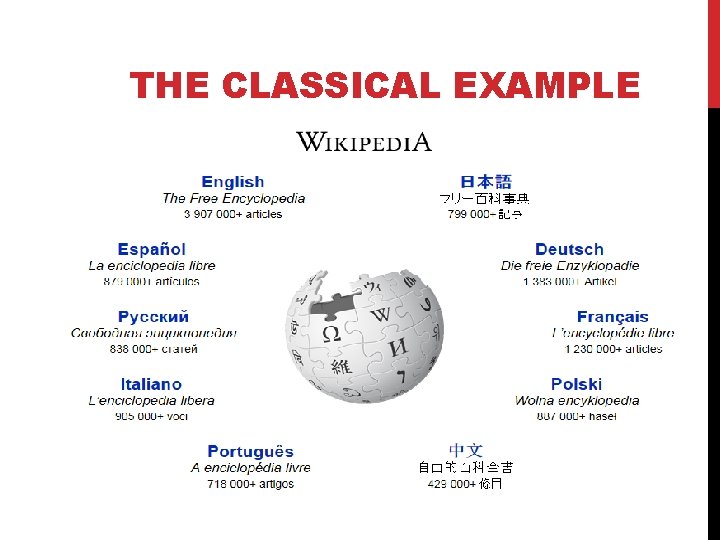
THE CLASSICAL EXAMPLE
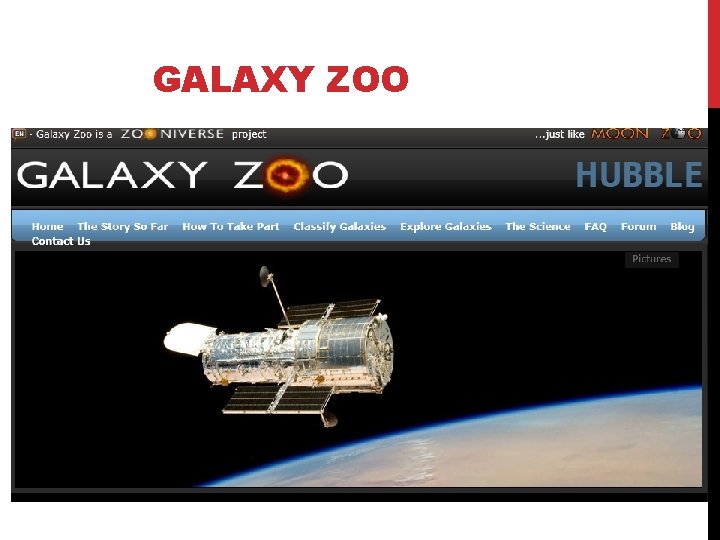
GALAXY ZOO
MORE
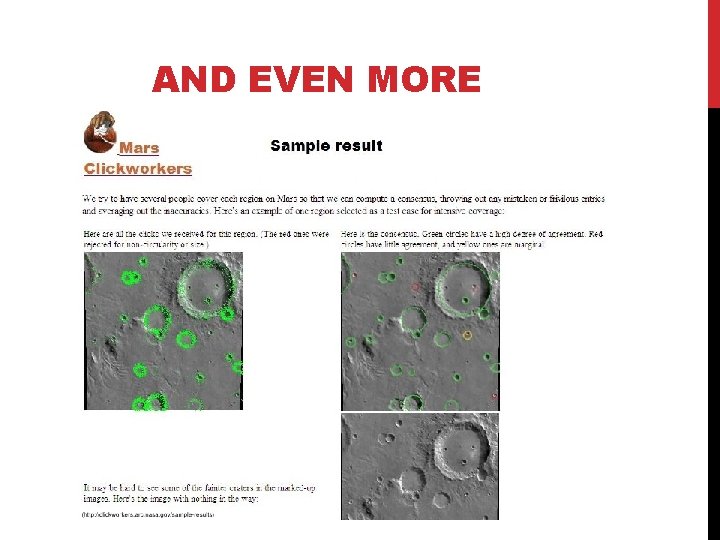
AND EVEN MORE
CROWDSOURCING: UNIFYING PRINCIPLES Main goal • “Outsourcing” a task to a crowd of users Kinds of tasks • Tasks that can be performed by a computer, but inefficiently • Tasks that can’t be performed by a computer Challenges • How to motivate the crowd? • Get data, minimize errors, estimate quality • Direct users to contribute where is most needed they are experts
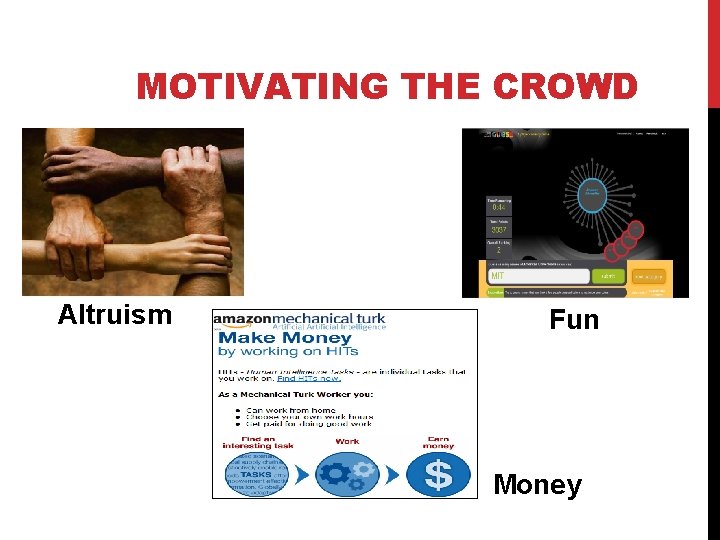
MOTIVATING THE CROWD Altruism Fun Money
CROWD DATA SOURCING Outsourcing data collection to the crowd of Web users • When people can provide the data • When people are the only source of data • When people can efficiently clean and/or organize the data Two main aspects [DFKK’ 12]: • Using the crowd to create better databases • Using database technologies to create better crowd datasourcing applications [DFKK’ 12]: Crowdsourcing Applications and Platforms: A Data Management Perspective, A. Doan, M. J. Franklin, D. Kossmann, T. Kraska, VLDB 2011
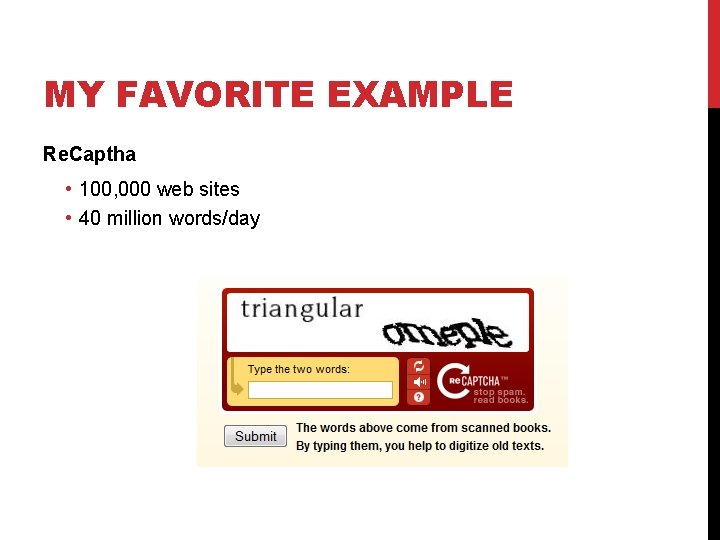
MY FAVORITE EXAMPLE Re. Captha • 100, 000 web sites • 40 million words/day
CROWDSOURCING RESEARCH GROUPS An incomplete list of groups working on Crowdsourcing: • Qurk (MIT) • Crowd. DB (Berkeley and ETH Zurich) • Deco (Stanford and UCSC) • Crowd. Forge (CMU) • HKUST DB Group • Walmart. Labs • Mo. Da. S (Tel Aviv University) …
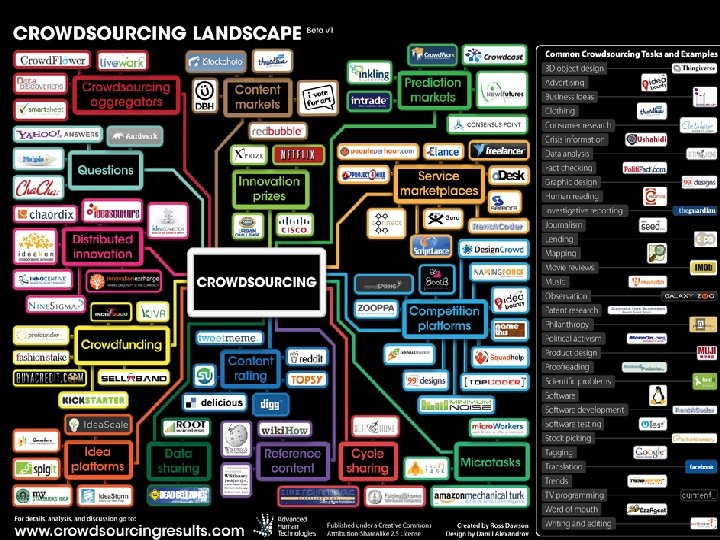
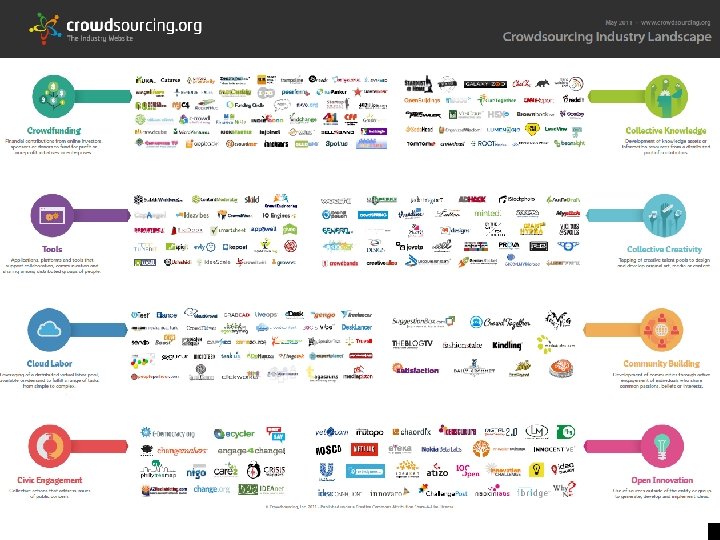
CROWDSOURCING MARKETPLACES
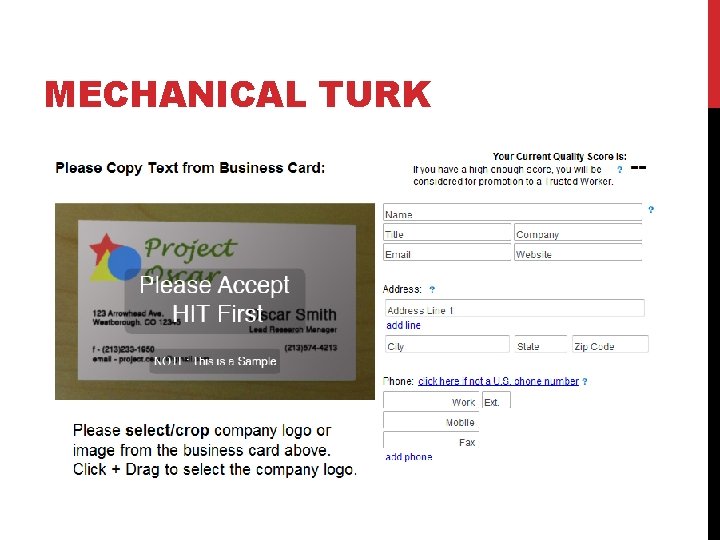
MECHANICAL TURK
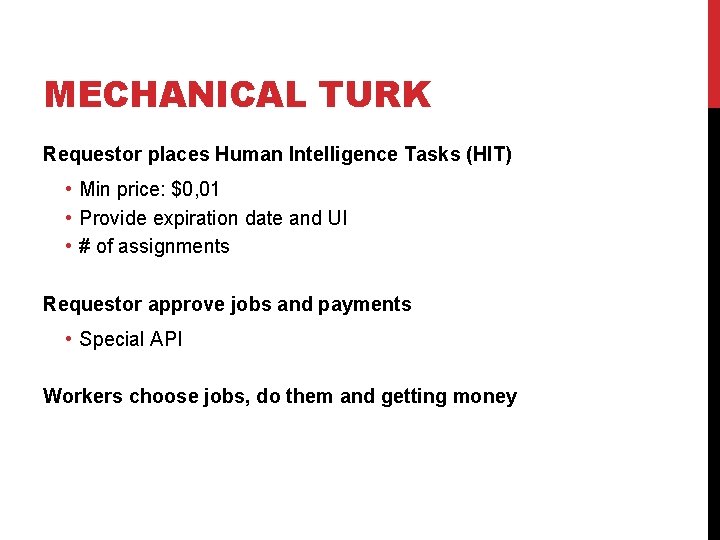
MECHANICAL TURK Requestor places Human Intelligence Tasks (HIT) • Min price: $0, 01 • Provide expiration date and UI • # of assignments Requestor approve jobs and payments • Special API Workers choose jobs, do them and getting money
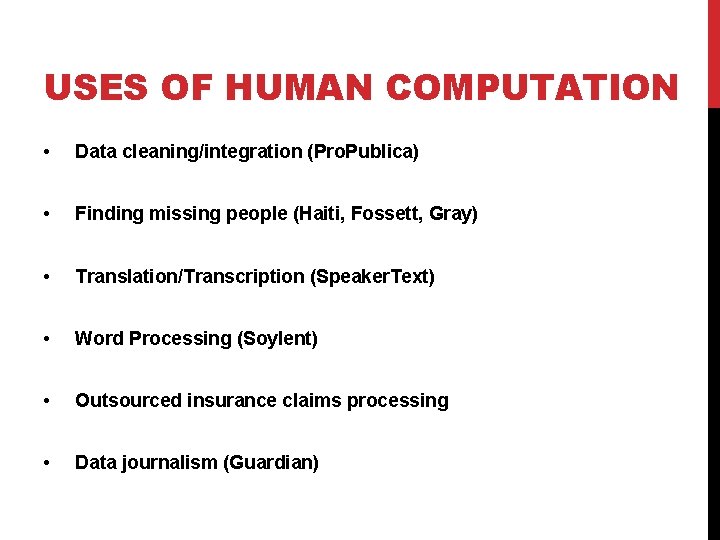
USES OF HUMAN COMPUTATION • Data cleaning/integration (Pro. Publica) • Finding missing people (Haiti, Fossett, Gray) • Translation/Transcription (Speaker. Text) • Word Processing (Soylent) • Outsourced insurance claims processing • Data journalism (Guardian)
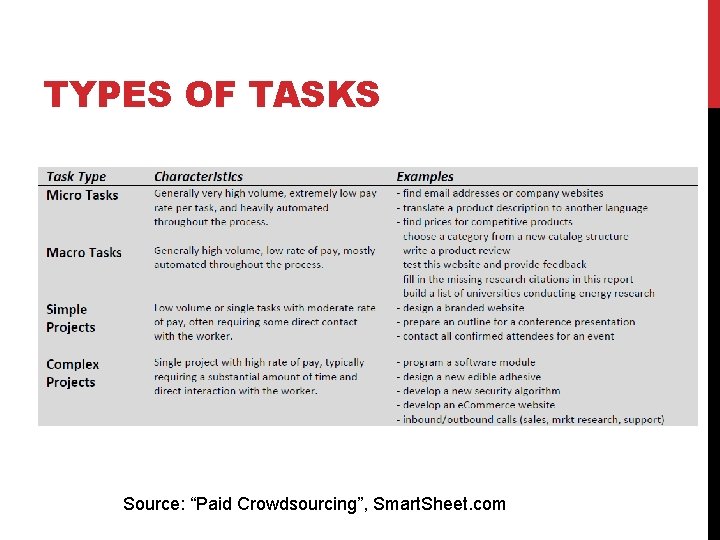
TYPES OF TASKS Source: “Paid Crowdsourcing”, Smart. Sheet. com
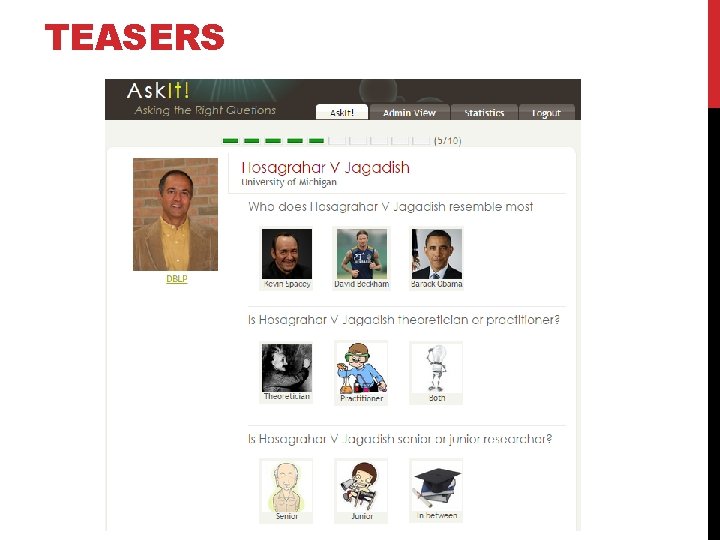
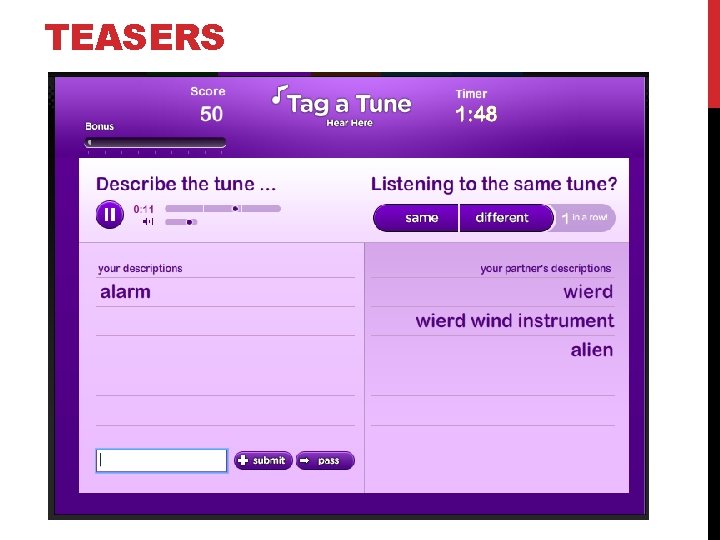
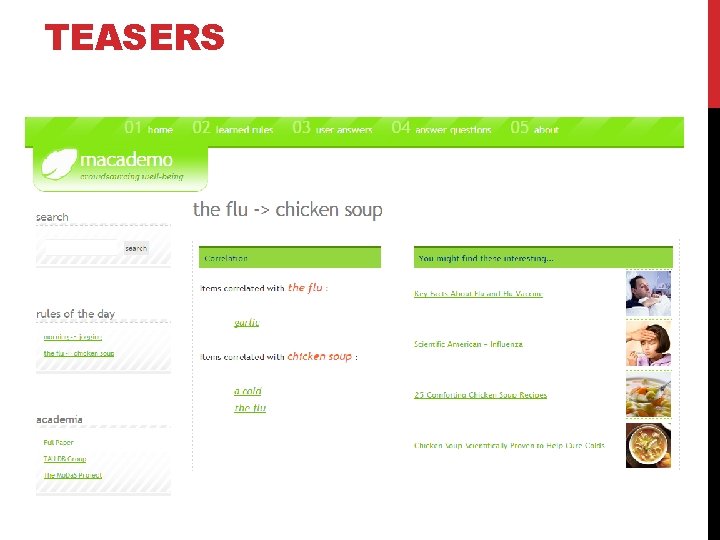
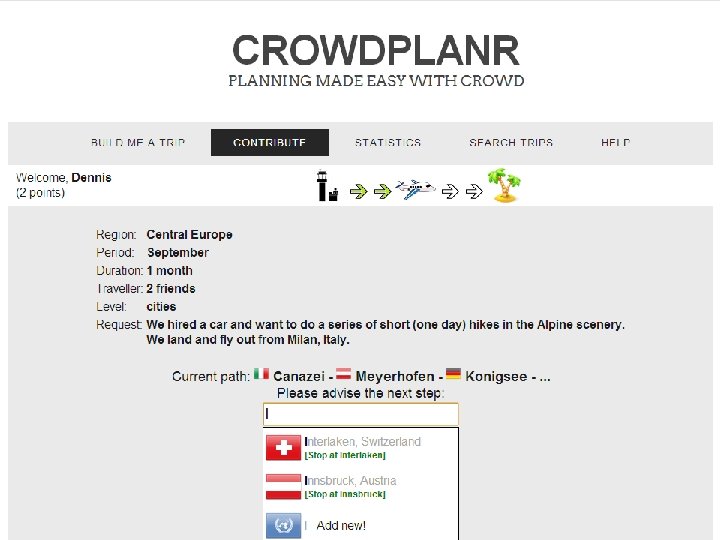
OVERVIEW OF RECENT RESEARCH • Crowdsourced Databases, Query evaluation, Sorts/joins, Top-K • Crowd. DB, Qurk, Deco, • Crowdsourced Data Collection/Cleaning • Ask. It, QOCO, …. • Crowd sourced Data Mining • Crowd. Mining, OASSIS, … • Image tagging, media meta-data collection • Crowdsourced recommendations and planning
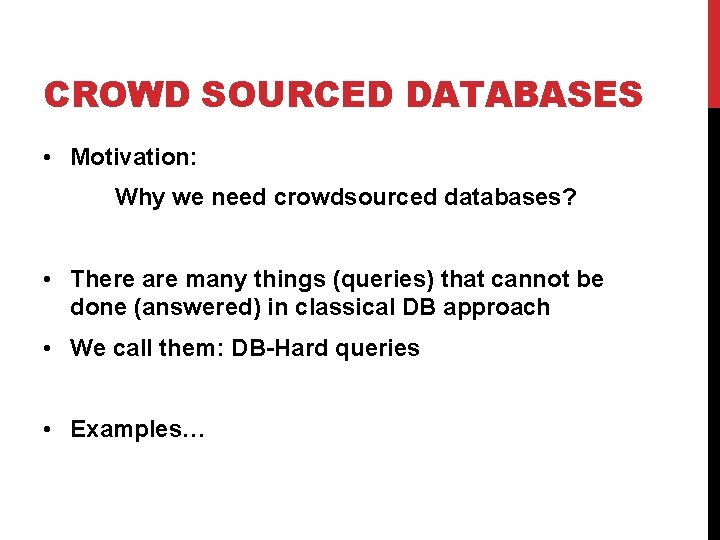
CROWD SOURCED DATABASES • Motivation: Why we need crowdsourced databases? • There are many things (queries) that cannot be done (answered) in classical DB approach • We call them: DB-Hard queries • Examples…
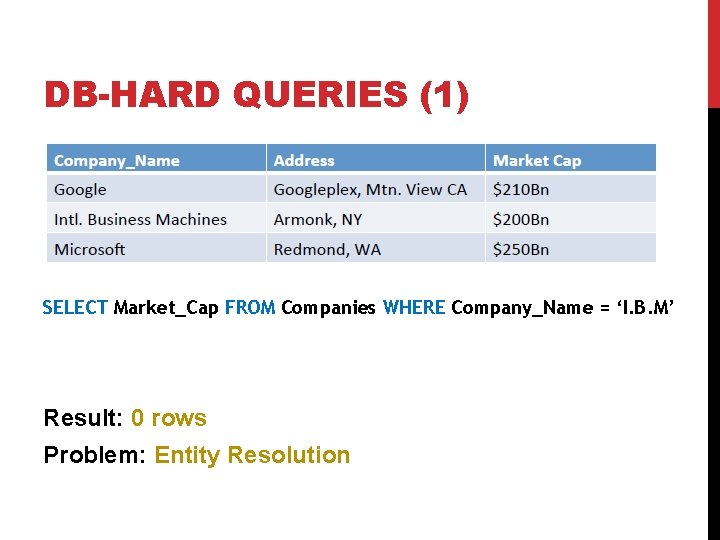
DB-HARD QUERIES (1) SELECT Market_Cap FROM Companies WHERE Company_Name = ‘I. B. M’ Result: 0 rows Problem: Entity Resolution
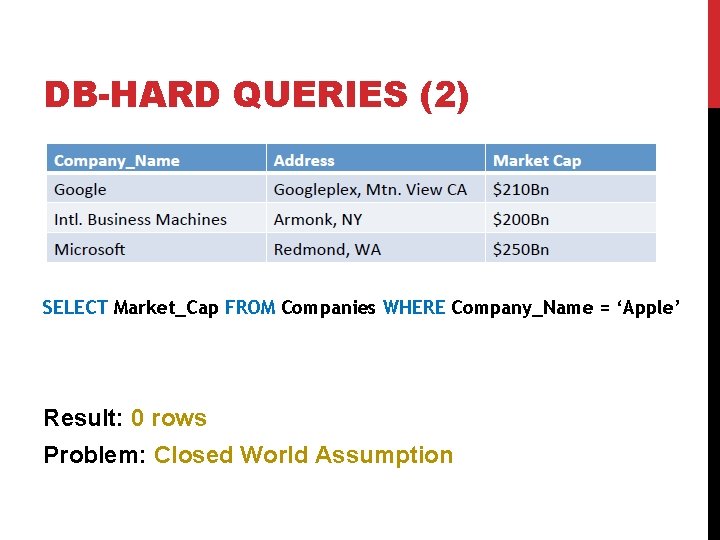
DB-HARD QUERIES (2) SELECT Market_Cap FROM Companies WHERE Company_Name = ‘Apple’ Result: 0 rows Problem: Closed World Assumption
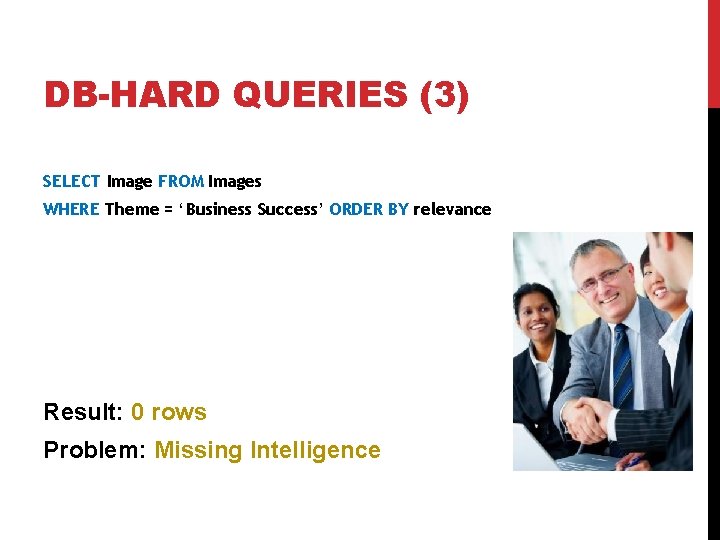
DB-HARD QUERIES (3) SELECT Image FROM Images WHERE Theme = ‘Business Success’ ORDER BY relevance Result: 0 rows Problem: Missing Intelligence
CROWDDB Use the crowd to answer DB-Hard queries • Use the crowd when: • Looking for new data (Open World Assumption) • Doing a fuzzy comparison • Recognize patterns • Don’t use the crowd when: • Doing anything the computer already does well
CLOSED WORLD VS OPEN WORLD OWA • Used in Knowledge representation CWA • Used in classical DBMS Example: • Statement: Marry is citizen of France • Question: Is Paul citizen of France? • CWA: No • OWA: Unknown
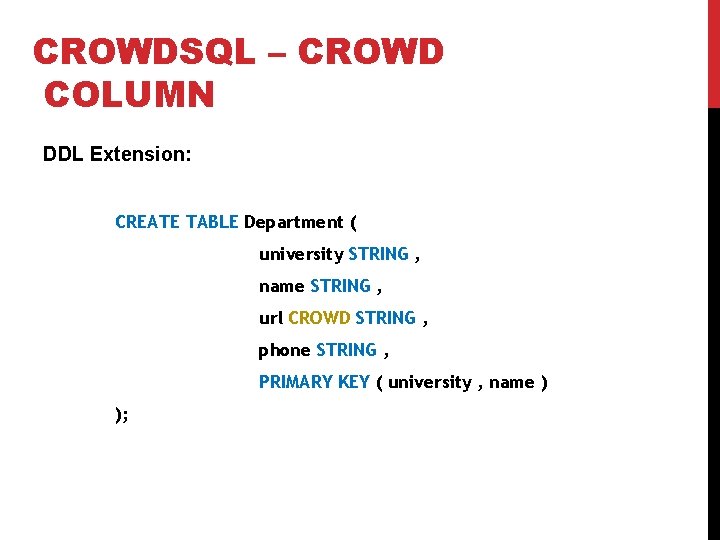
CROWDSQL – CROWD COLUMN DDL Extension: CREATE TABLE Department ( university STRING , name STRING , url CROWD STRING , phone STRING , PRIMARY KEY ( university , name ) );
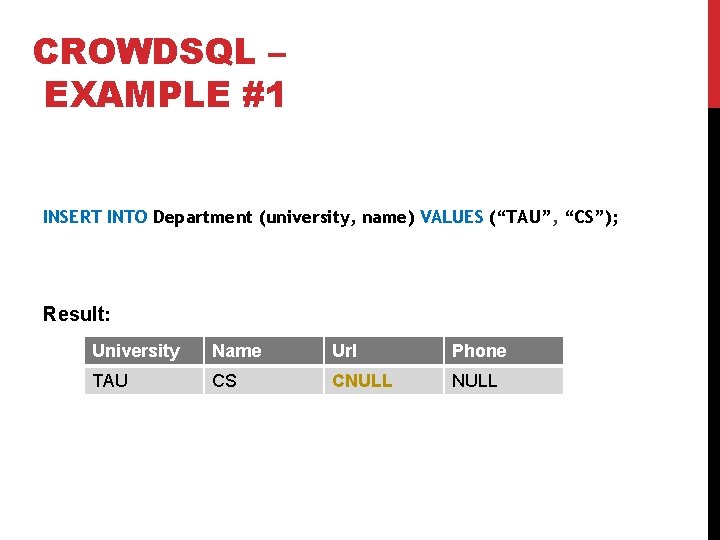
CROWDSQL – EXAMPLE #1 INSERT INTO Department (university, name) VALUES (“TAU”, “CS”); Result: University Name Url Phone TAU CS CNULL
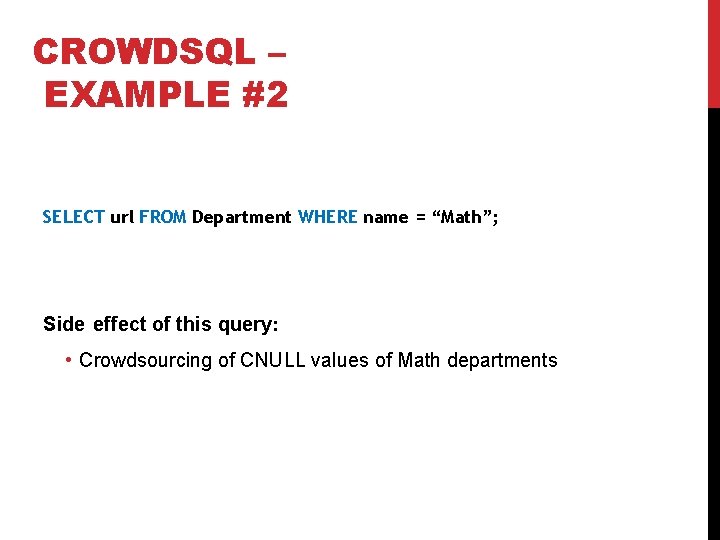
CROWDSQL – EXAMPLE #2 SELECT url FROM Department WHERE name = “Math”; Side effect of this query: • Crowdsourcing of CNULL values of Math departments
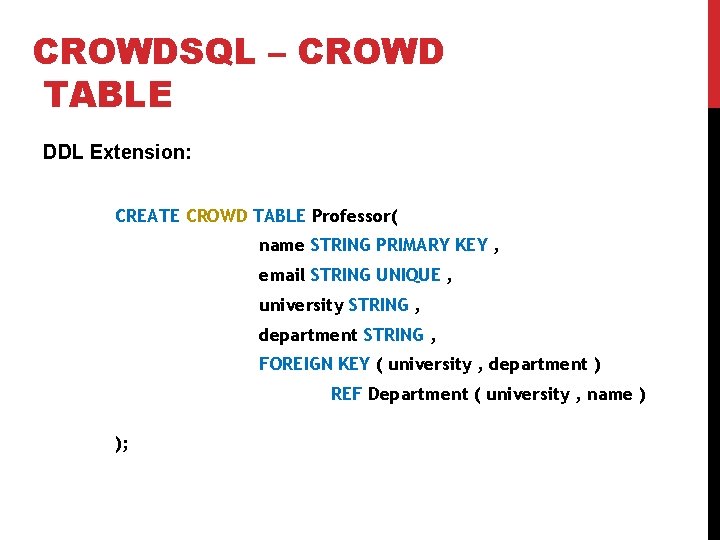
CROWDSQL – CROWD TABLE DDL Extension: CREATE CROWD TABLE Professor( name STRING PRIMARY KEY , email STRING UNIQUE , university STRING , department STRING , FOREIGN KEY ( university , department ) REF Department ( university , name ) );
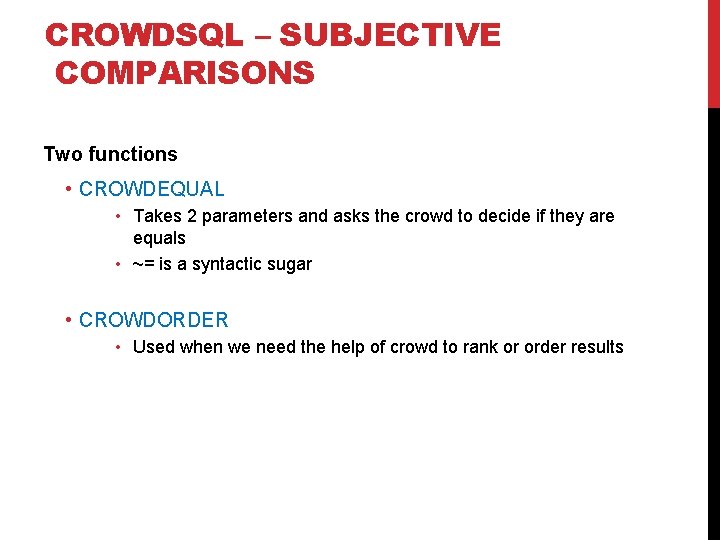
CROWDSQL – SUBJECTIVE COMPARISONS Two functions • CROWDEQUAL • Takes 2 parameters and asks the crowd to decide if they are equals • ~= is a syntactic sugar • CROWDORDER • Used when we need the help of crowd to rank or order results
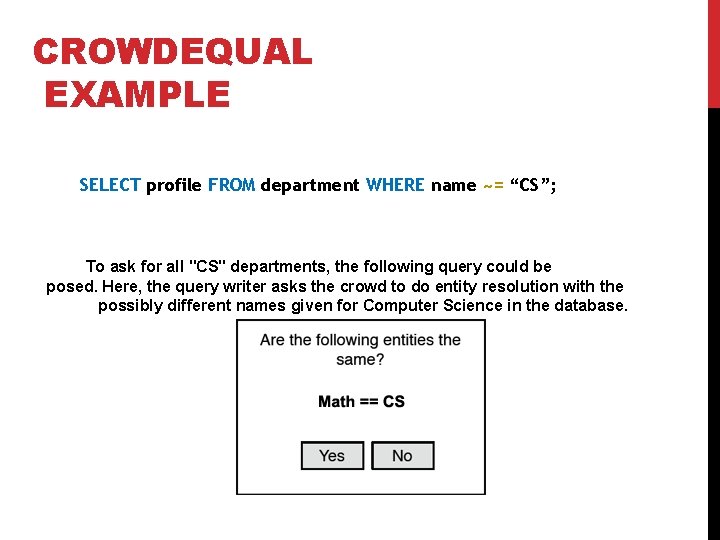
CROWDEQUAL EXAMPLE SELECT profile FROM department WHERE name ~= “CS”; To ask for all "CS" departments, the following query could be posed. Here, the query writer asks the crowd to do entity resolution with the possibly different names given for Computer Science in the database.
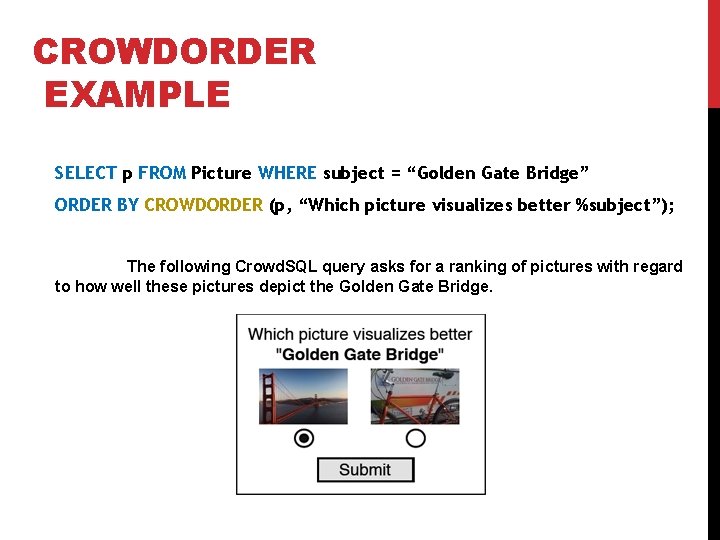
CROWDORDER EXAMPLE SELECT p FROM Picture WHERE subject = “Golden Gate Bridge” ORDER BY CROWDORDER (p, “Which picture visualizes better %subject”); The following Crowd. SQL query asks for a ranking of pictures with regard to how well these pictures depict the Golden Gate Bridge.
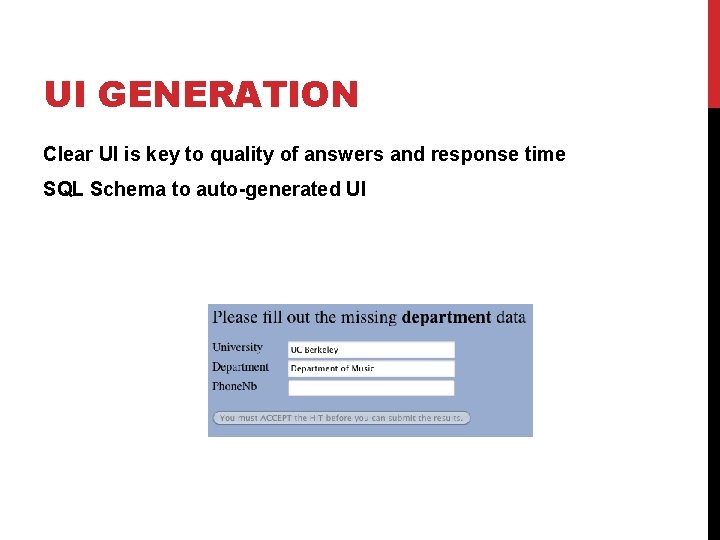
UI GENERATION Clear UI is key to quality of answers and response time SQL Schema to auto-generated UI
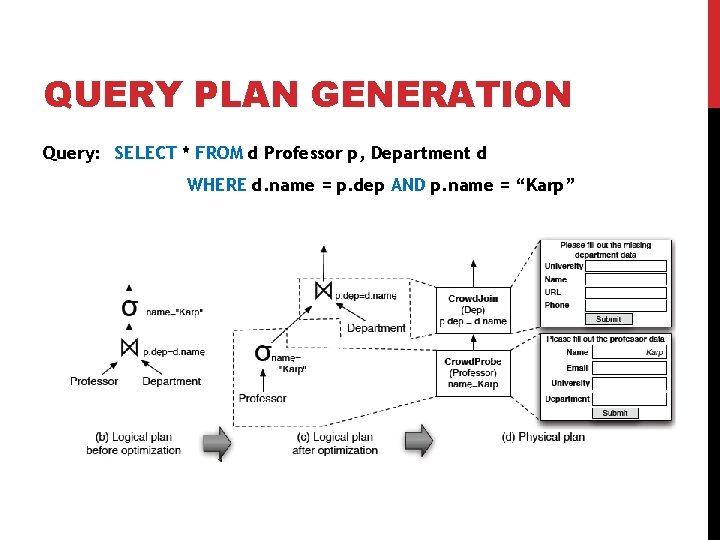
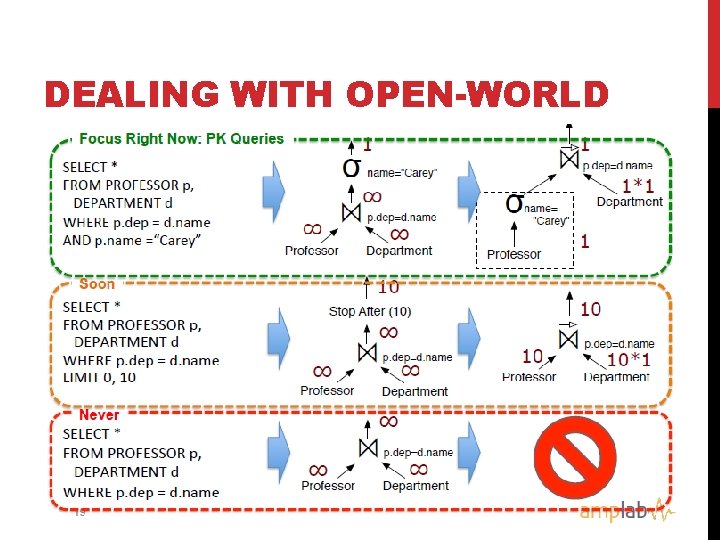
QUERY PLAN GENERATION Query: SELECT * FROM d Professor p, Department d WHERE d. name = p. dep AND p. name = “Karp”
DEALING WITH OPEN-WORLD
Qurk (MIT): Declarative workflow management system that allows human computation over data (human is a part of query execution)
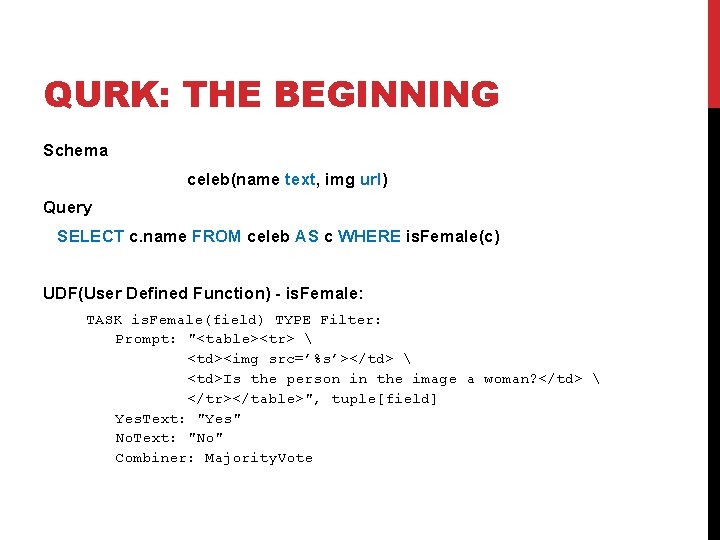
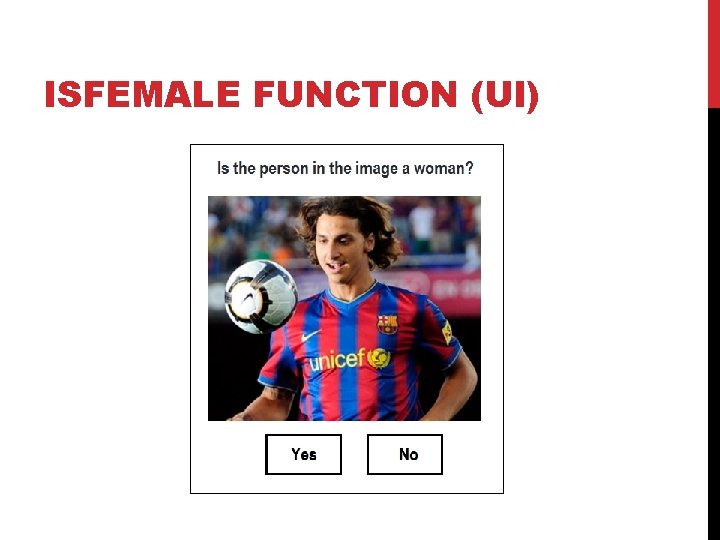
QURK: THE BEGINNING Schema celeb(name text, img url) Query SELECT c. name FROM celeb AS c WHERE is. Female(c) UDF(User Defined Function) - is. Female: TASK is. Female(field) TYPE Filter: Prompt: "<table><tr> <td><img src=’%s’></td> <td>Is the person in the image a woman? </td> </tr></table>", tuple[field] Yes. Text: "Yes" No. Text: "No" Combiner: Majority. Vote
ISFEMALE FUNCTION (UI)
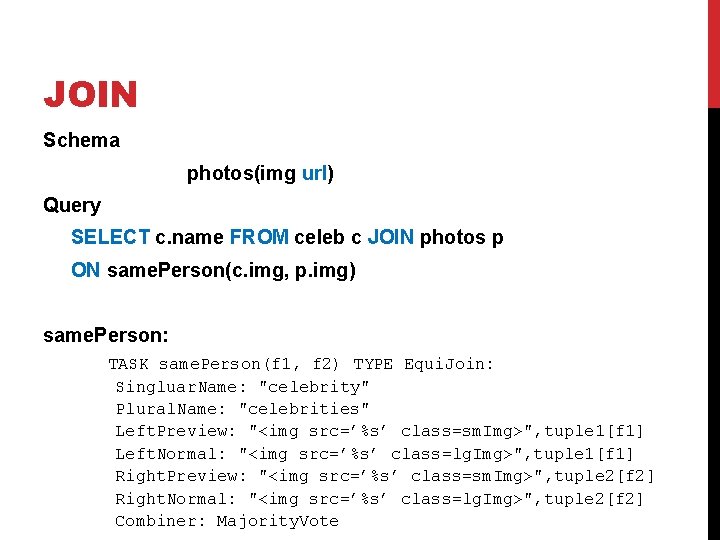
JOIN Schema photos(img url) Query SELECT c. name FROM celeb c JOIN photos p ON same. Person(c. img, p. img) same. Person: TASK same. Person(f 1, f 2) TYPE Equi. Join: Singluar. Name: "celebrity" Plural. Name: "celebrities" Left. Preview: "<img src=’%s’ class=sm. Img>", tuple 1[f 1] Left. Normal: "<img src=’%s’ class=lg. Img>", tuple 1[f 1] Right. Preview: "<img src=’%s’ class=sm. Img>", tuple 2[f 2] Right. Normal: "<img src=’%s’ class=lg. Img>", tuple 2[f 2] Combiner: Majority. Vote
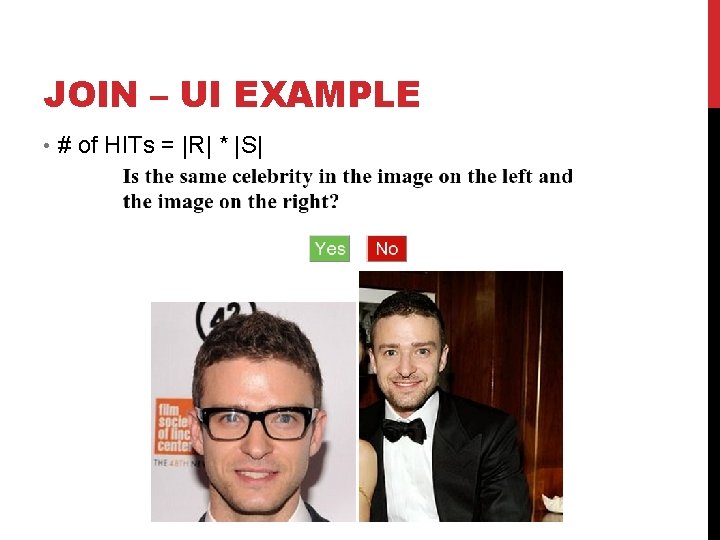
JOIN – UI EXAMPLE • # of HITs = |R| * |S|
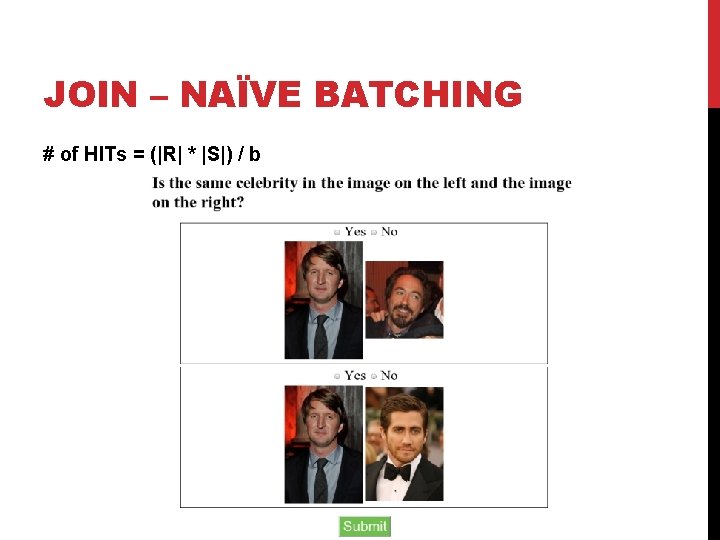
JOIN – NAÏVE BATCHING # of HITs = (|R| * |S|) / b
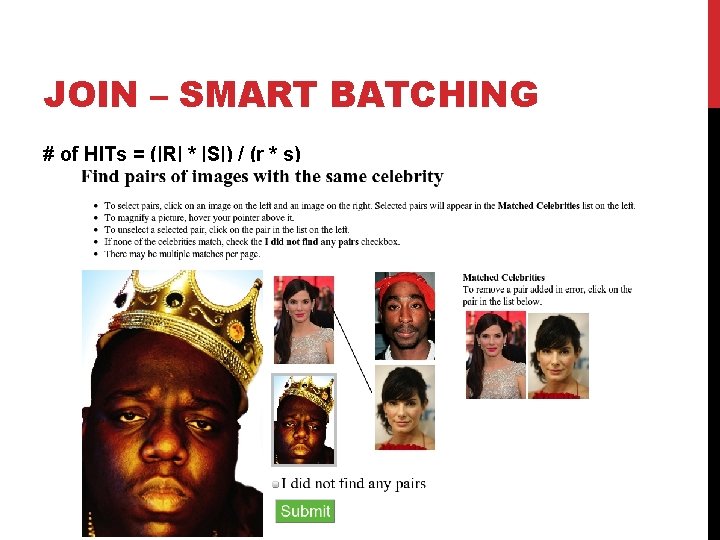
JOIN – SMART BATCHING # of HITs = (|R| * |S|) / (r * s)
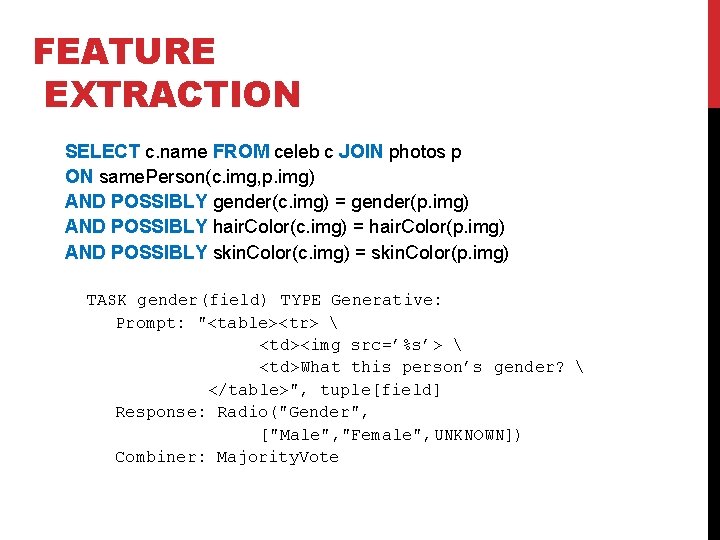
FEATURE EXTRACTION SELECT c. name FROM celeb c JOIN photos p ON same. Person(c. img, p. img) AND POSSIBLY gender(c. img) = gender(p. img) AND POSSIBLY hair. Color(c. img) = hair. Color(p. img) AND POSSIBLY skin. Color(c. img) = skin. Color(p. img) TASK gender(field) TYPE Generative: Prompt: "<table><tr> <td><img src=’%s’> <td>What this person’s gender? </table>", tuple[field] Response: Radio("Gender", ["Male", "Female", UNKNOWN]) Combiner: Majority. Vote
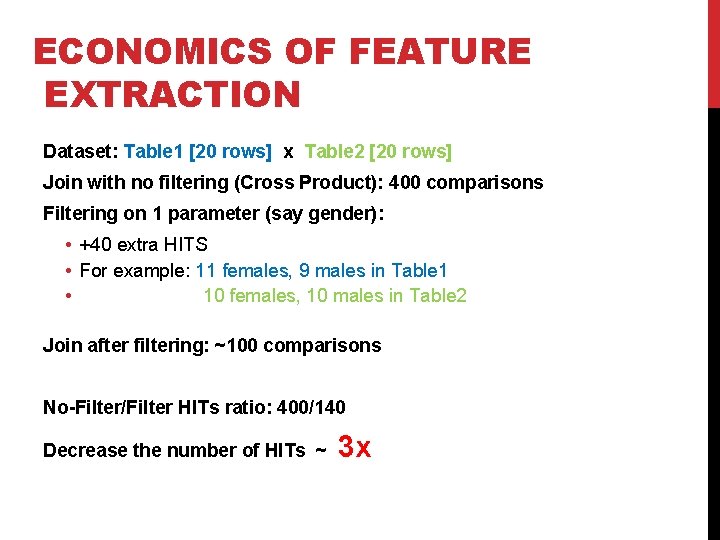
ECONOMICS OF FEATURE EXTRACTION Dataset: Table 1 [20 rows] x Table 2 [20 rows] Join with no filtering (Cross Product): 400 comparisons Filtering on 1 parameter (say gender): • +40 extra HITS • For example: 11 females, 9 males in Table 1 • 10 females, 10 males in Table 2 Join after filtering: ~100 comparisons No-Filter/Filter HITs ratio: 400/140 Decrease the number of HITs ~ 3 x
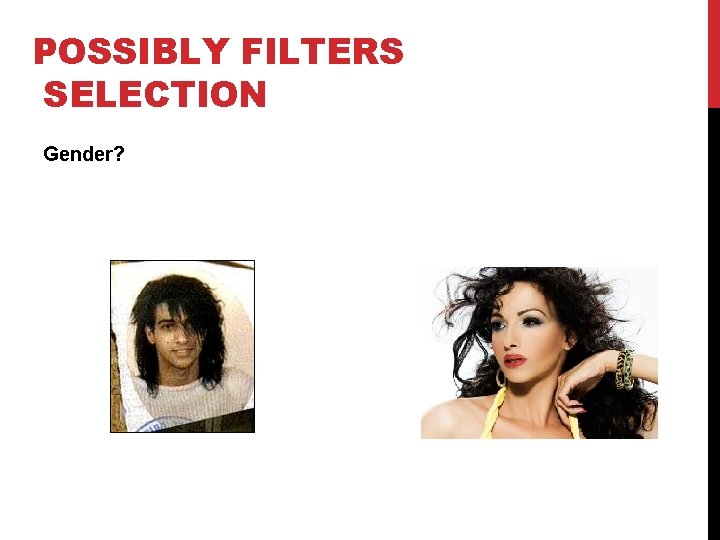
POSSIBLY FILTERS SELECTION Gender?
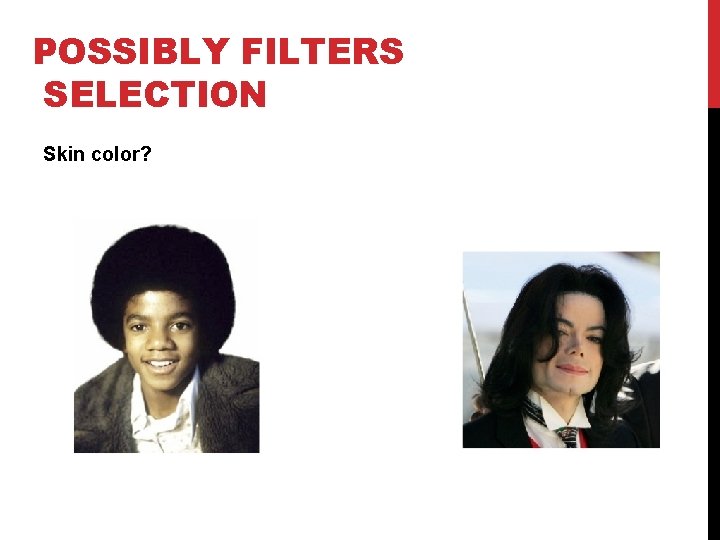
POSSIBLY FILTERS SELECTION Skin color?
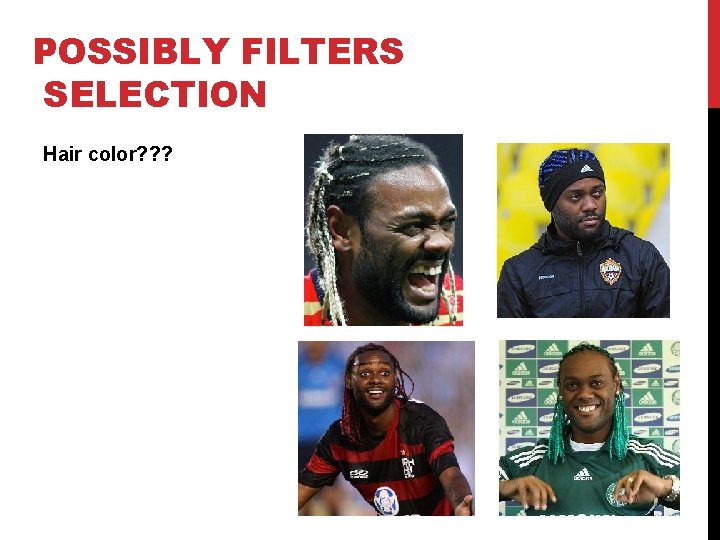
POSSIBLY FILTERS SELECTION Hair color? ? ?
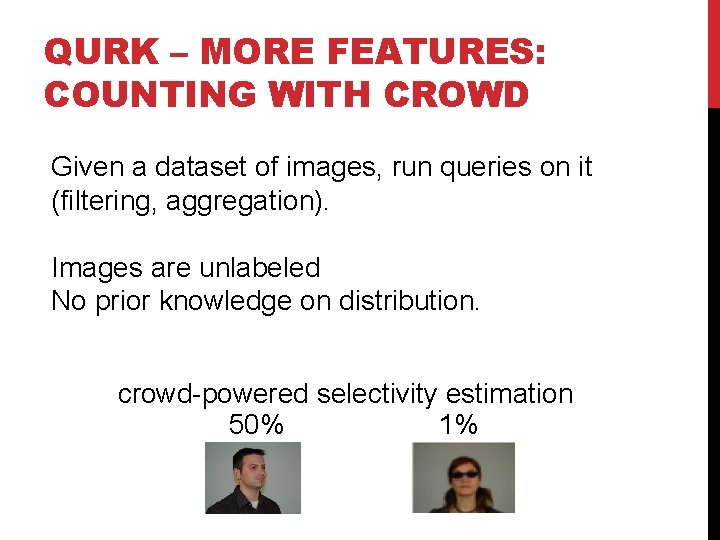
QURK – MORE FEATURES: COUNTING WITH CROWD Given a dataset of images, run queries on it (filtering, aggregation). Images are unlabeled No prior knowledge on distribution. crowd-powered selectivity estimation 50% 1%
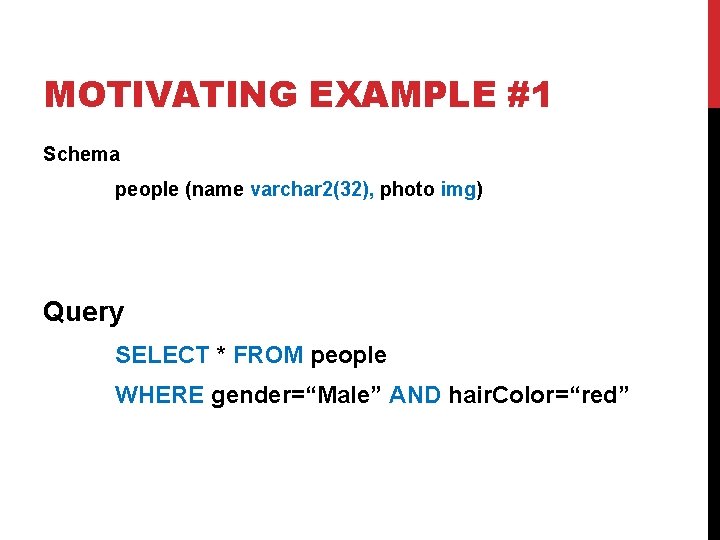
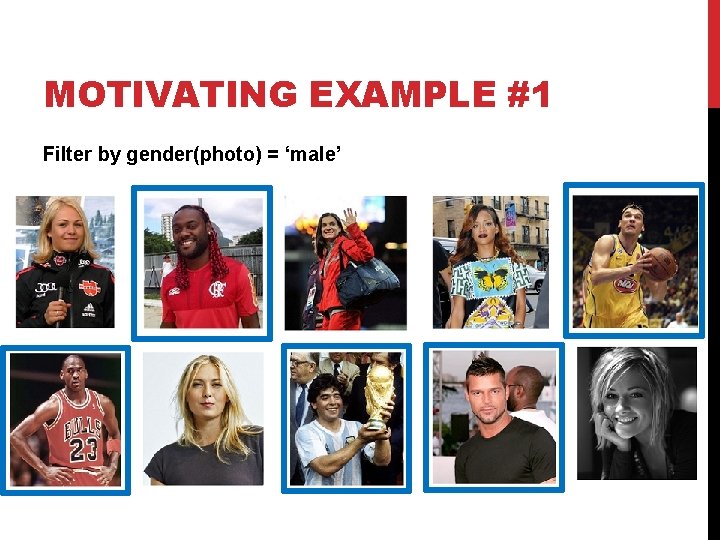
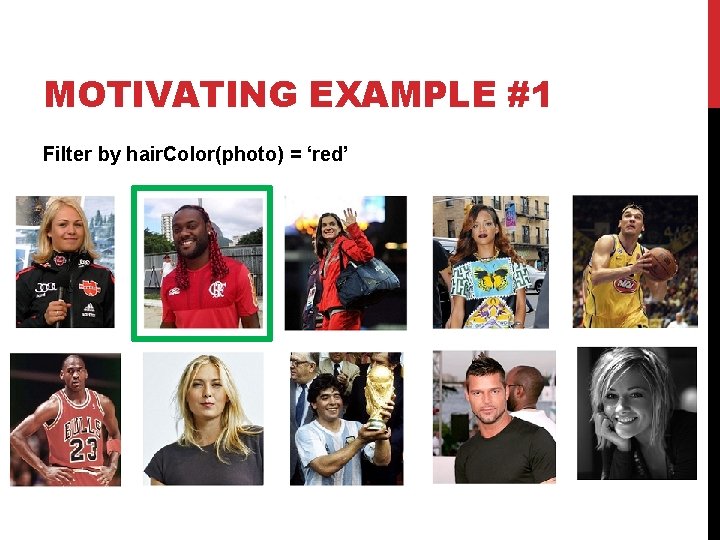
MOTIVATING EXAMPLE #1 Schema people (name varchar 2(32), photo img) Query SELECT * FROM people WHERE gender=“Male” AND hair. Color=“red”
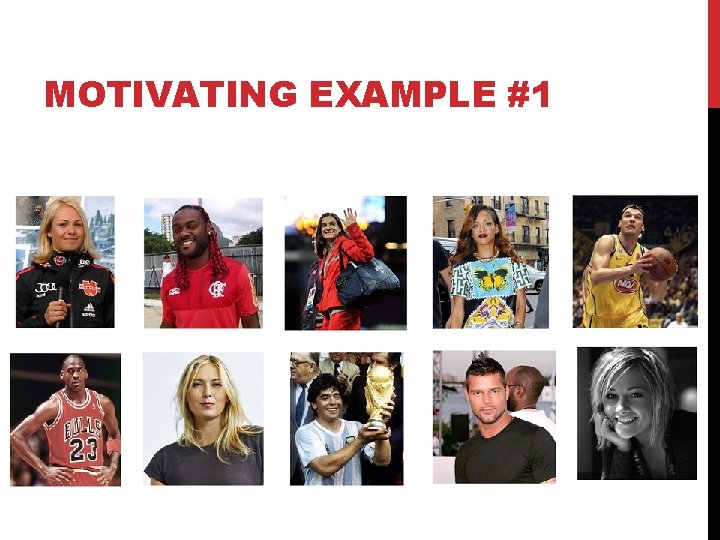
MOTIVATING EXAMPLE #1
MOTIVATING EXAMPLE #1 Filter by gender(photo) = ‘male’
MOTIVATING EXAMPLE #1 Filter by hair. Color(photo) = ‘red’
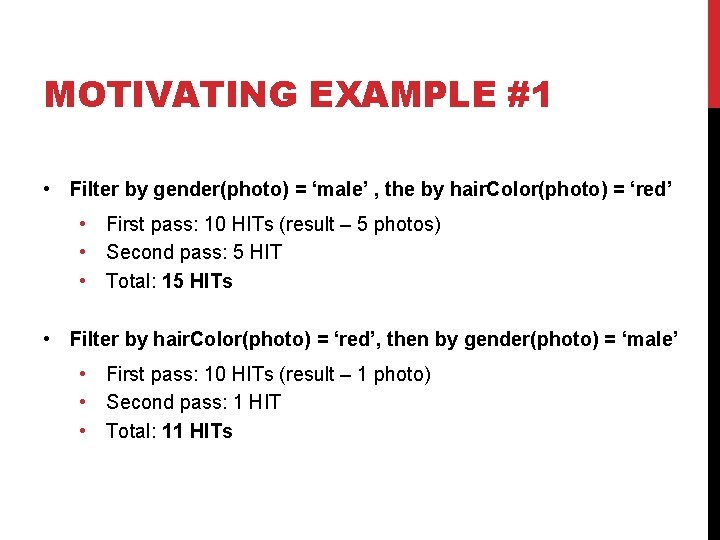
MOTIVATING EXAMPLE #1 • Filter by gender(photo) = ‘male’ , the by hair. Color(photo) = ‘red’ • First pass: 10 HITs (result – 5 photos) • Second pass: 5 HIT • Total: 15 HITs • Filter by hair. Color(photo) = ‘red’, then by gender(photo) = ‘male’ • First pass: 10 HITs (result – 1 photo) • Second pass: 1 HIT • Total: 11 HITs
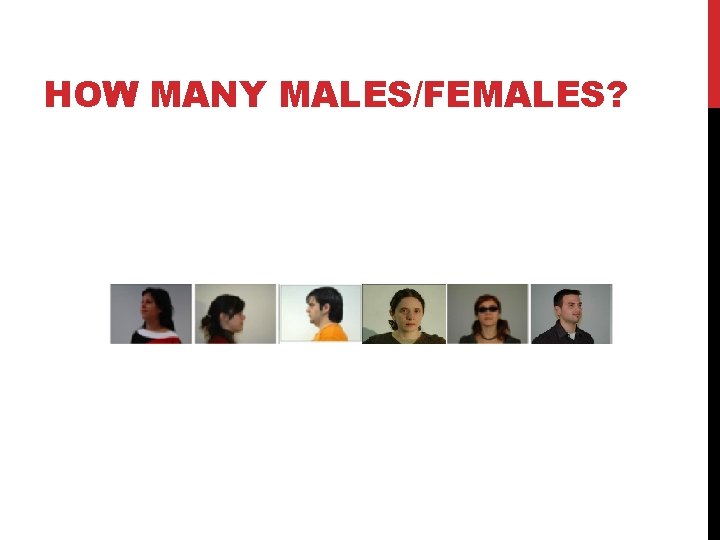
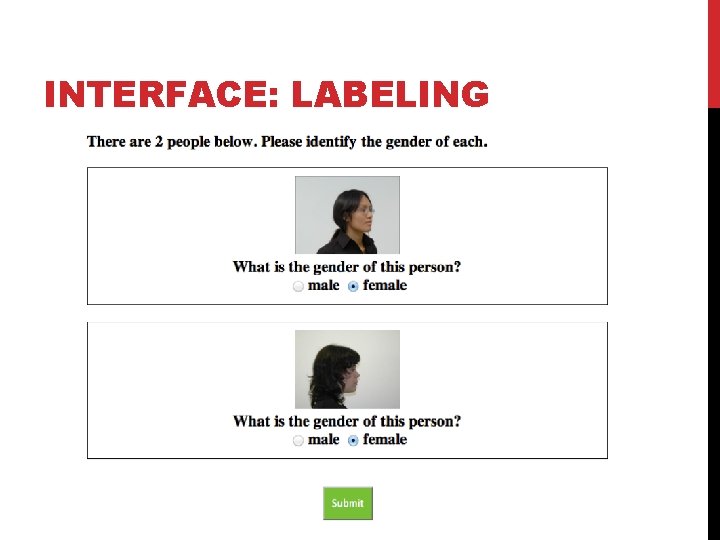
HOW MANY MALES/FEMALES?
INTERFACE: LABELING
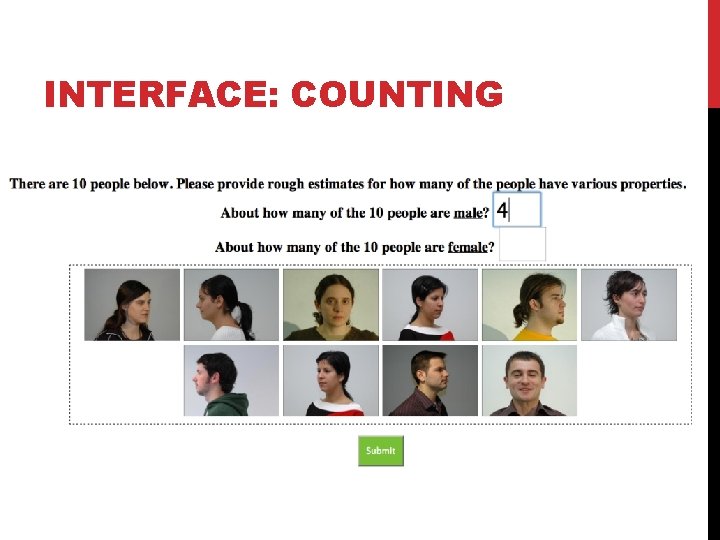
INTERFACE: COUNTING
ESTIMATING COUNTS • Can’t show all the images to every user • Show random sample • Sampling error • Worker error • Dependent samples
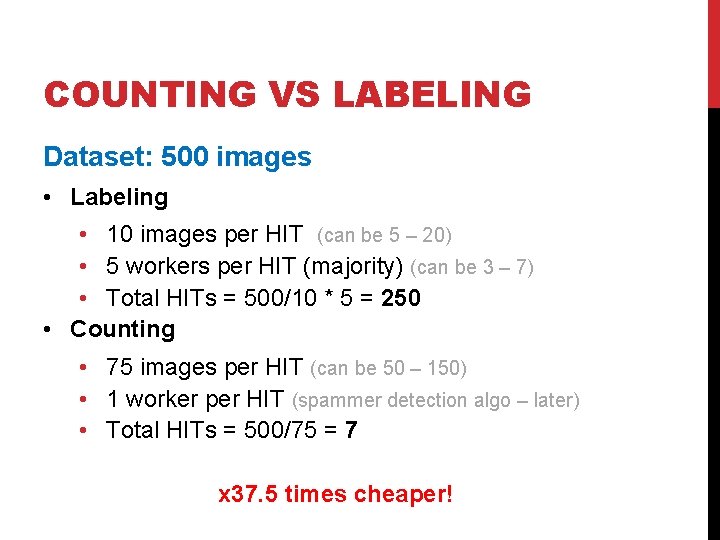
COUNTING VS LABELING Dataset: 500 images • Labeling • 10 images per HIT (can be 5 – 20) • 5 workers per HIT (majority) (can be 3 – 7) • Total HITs = 500/10 * 5 = 250 • Counting • 75 images per HIT (can be 50 – 150) • 1 worker per HIT (spammer detection algo – later) • Total HITs = 500/75 = 7 x 37. 5 times cheaper!
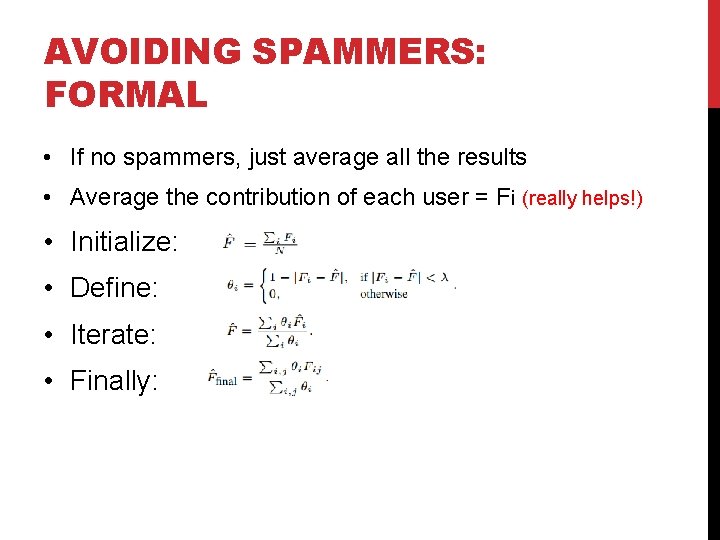
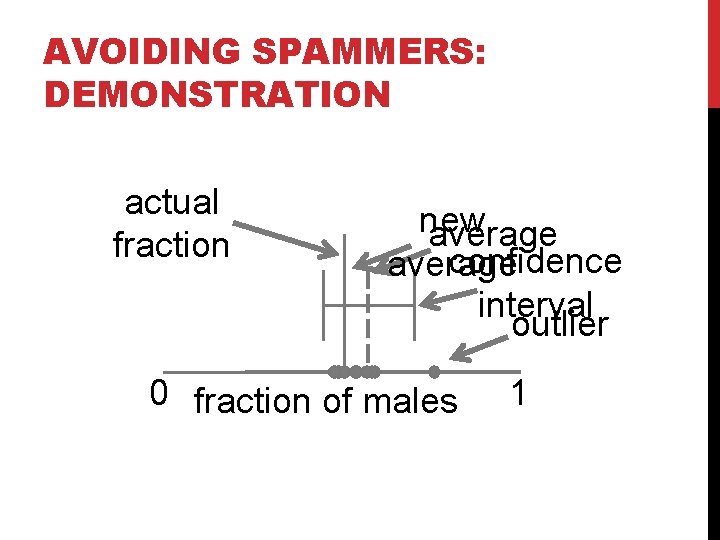
AVOIDING SPAMMERS: FORMAL • If no spammers, just average all the results • Average the contribution of each user = Fi (really helps!) • Initialize: • Define: • Iterate: • Finally:
AVOIDING SPAMMERS: DEMONSTRATION actual fraction naverage ew confidence average interval outlier 0 fraction of males 1
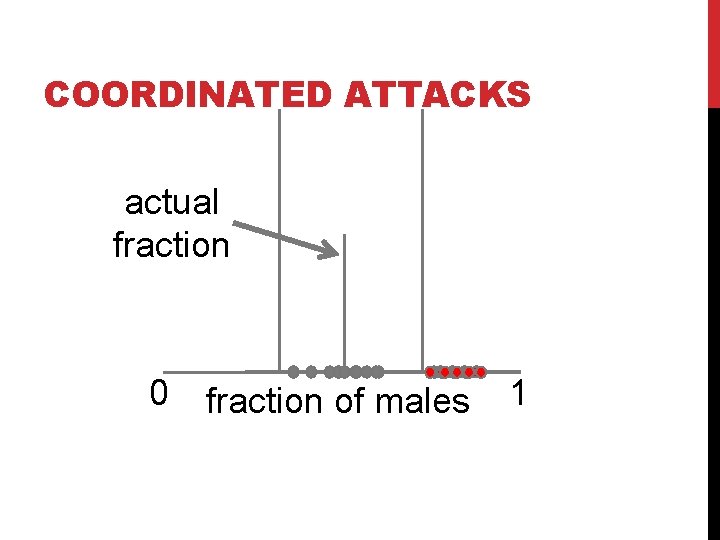
COORDINATED ATTACKS actual fraction 0 fraction of males 1
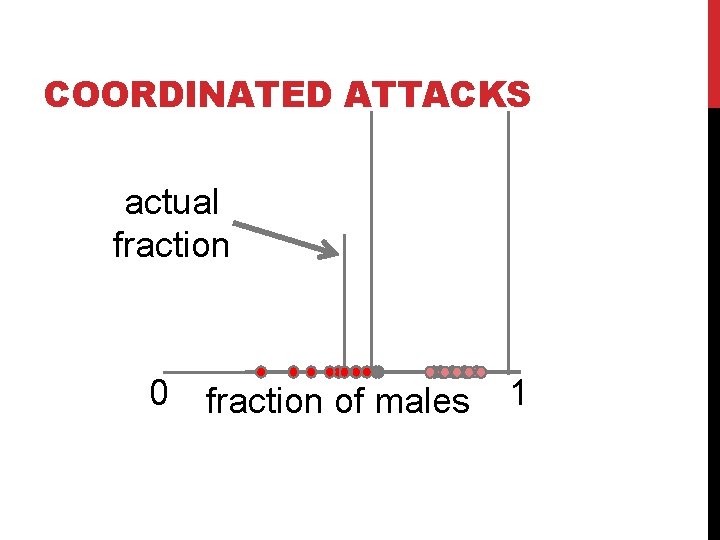
COORDINATED ATTACKS actual fraction 0 fraction of males 1
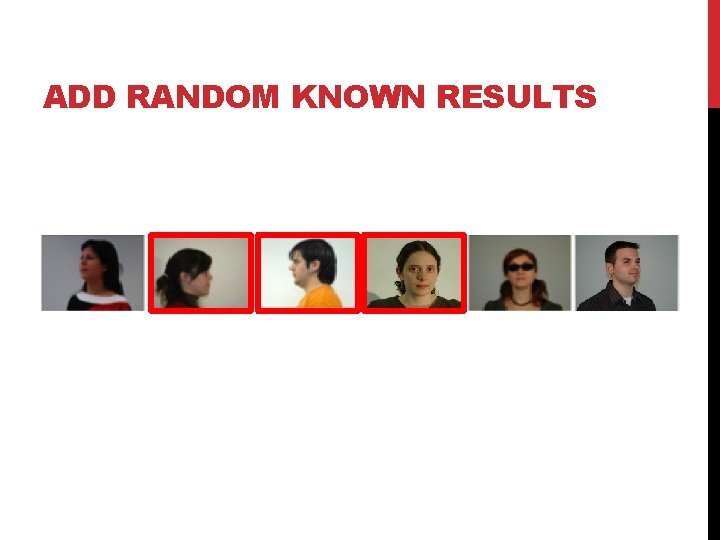
ADD RANDOM KNOWN RESULTS
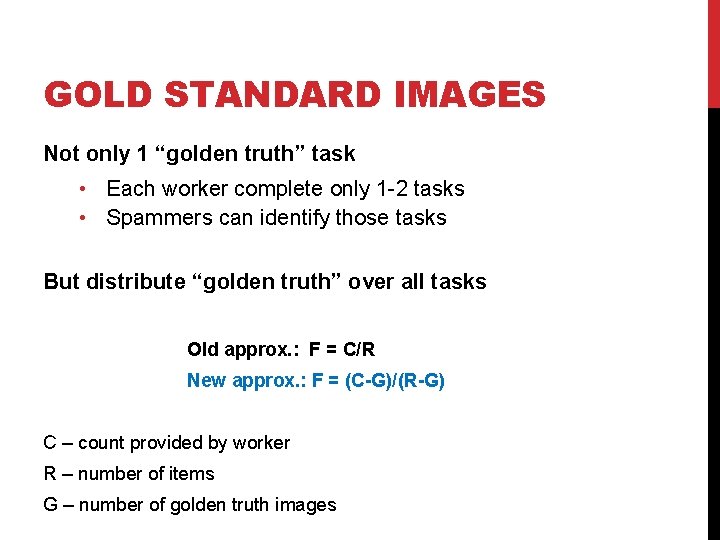
GOLD STANDARD IMAGES Not only 1 “golden truth” task • Each worker complete only 1 -2 tasks • Spammers can identify those tasks But distribute “golden truth” over all tasks Old approx. : F = C/R New approx. : F = (C-G)/(R-G) C – count provided by worker R – number of items G – number of golden truth images
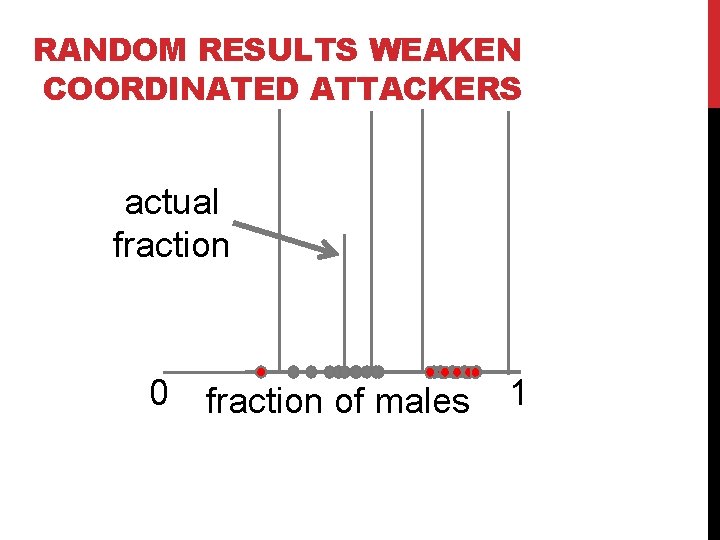
RANDOM RESULTS WEAKEN COORDINATED ATTACKERS actual fraction 0 fraction of males 1
TRADEOFF can withstand extreme coordinated attacks (>70% attackers) in exchange for commensurate number of known labels
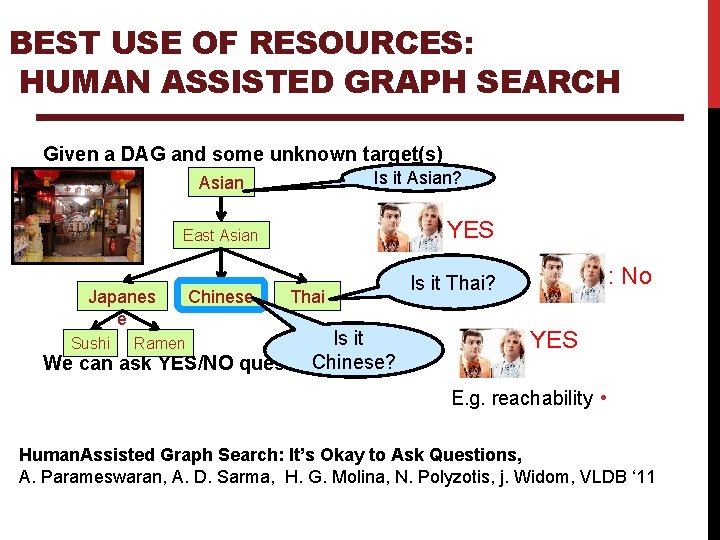
BEST USE OF RESOURCES: HUMAN ASSISTED GRAPH SEARCH Given a DAG and some unknown target(s) Is it Asian? Asian : YES East Asian Japanes e Chinese Thai Is it Chinese? We can ask YES/NO questions Sushi Ramen : No Is it Thai? : YES E. g. reachability • Human. Assisted Graph Search: It’s Okay to Ask Questions, A. Parameswaran, A. D. Sarma, H. G. Molina, N. Polyzotis, j. Widom, VLDB ‘ 11
THE OBJECTIVE Find an optimal set of questions to find the target nodes • Optimize cost: Minimal # of questions • Optimize accuracy: Minimal # of possible targets Challenges • Answer correlations (Falafel Middle Eastern) • Location in the graph affects information gain (leaves are likely to get a NO) • Asking several questions in parallel to reduce latency
PROBLEM DIMENSIONS Single target/Multiple targets Online/Offline • Online: one question at a time • Offline: pre-compute all questions • Hybrid approach Graph structure
IMPORTANCE OF (GOOD) UI • Good UI – better results • Good UI – faster results • Bad UI – inaccurate results • Bad UI – workers leave without completing the task
CHALLENGES Open vs. closed world assumption Asking the right questions Estimating the quality of answers Incremental processing of updates
MORE CHALLENGES Distributed management of huge data Processing of textual answers Semantics More ideas?
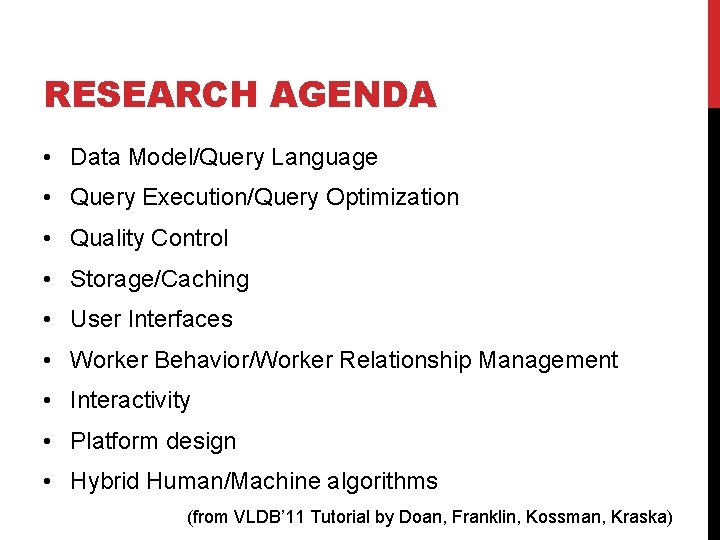
RESEARCH AGENDA • Data Model/Query Language • Query Execution/Query Optimization • Quality Control • Storage/Caching • User Interfaces • Worker Behavior/Worker Relationship Management • Interactivity • Platform design • Hybrid Human/Machine algorithms (from VLDB’ 11 Tutorial by Doan, Franklin, Kossman, Kraska)
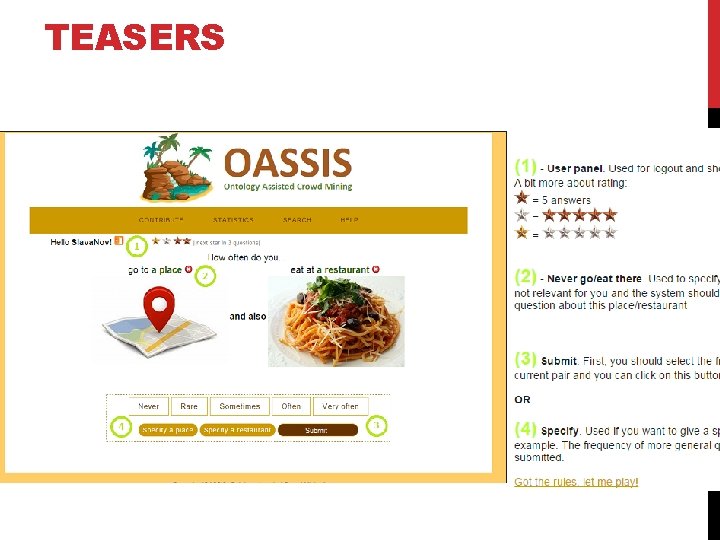
TEASERS
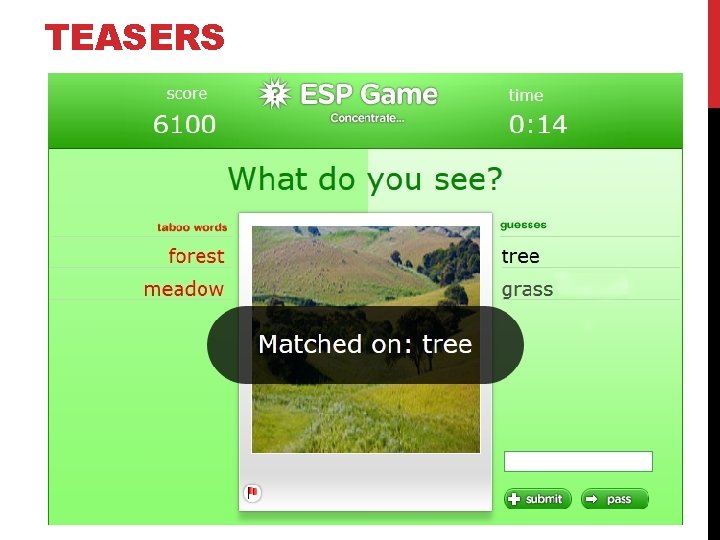
TEASERS
TEASERS
TEASERS
TEASERS
More – next week… Questions?
REFERENCES This presentation partially based on: • “Counting with Crowd” slides by Adam Marcus • Crowdsourcing tutorial from VLDB’ 11 by Doan, Franklin, Kossman and Kraska • “Introduction to Crowdsourcing” slides by Tova Milo References: https: //users. soe. ucsc. edu/~alkis/papers/ivd. pdf https: //amplab. cs. berkeley. edu/wp-content/uploads/2011/06/Crowd. DB-Answering. Queries-with-Crowdsourcing. pdf http: //db. csail. mit. edu/pubs/mturk-cameraready. pdf