
PIXEL Workshop 2010 1 Petra Riedler on behalf
PIXEL Workshop 2010 1 Petra Riedler on behalf of the ALICE Silicon Pixel Detector Project in the ALICE Collaboration P. Riedler - CERN THE ALICE SILICON PIXEL DETECTOR – COMMISSIONING, OPERATION AND PERFORMANCE WITH PROTON-PROTON BEAMS
PIXEL Workshop 2010 OUTLOOK P. Riedler - CERN The ALICE SPD Operation with cosmics and in p-p collisions Preparation for heavy ion run 2

PIXEL Workshop 2010 ALICE INNER TRACKING SYSTEM P. Riedler - CERN ITS (Inner Tracking System) consists of 2 layers of silicon pixel (SPD), 2 layers of silicon drift (SDD) and 2 layers of silicon strip detectors (SSD) 6 layer ITS 3
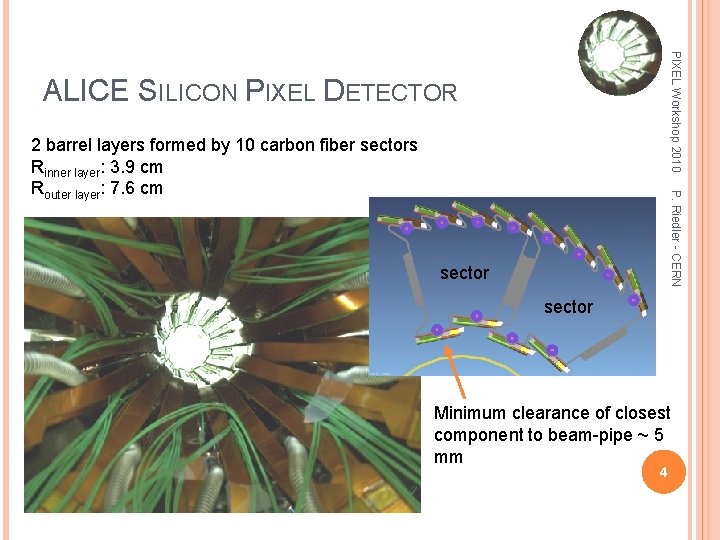
PIXEL Workshop 2010 ALICE SILICON PIXEL DETECTOR P. Riedler - CERN 2 barrel layers formed by 10 carbon fiber sectors Rinner layer: 3. 9 cm Router layer: 7. 6 cm sector Minimum clearance of closest component to beam-pipe ~ 5 mm 4
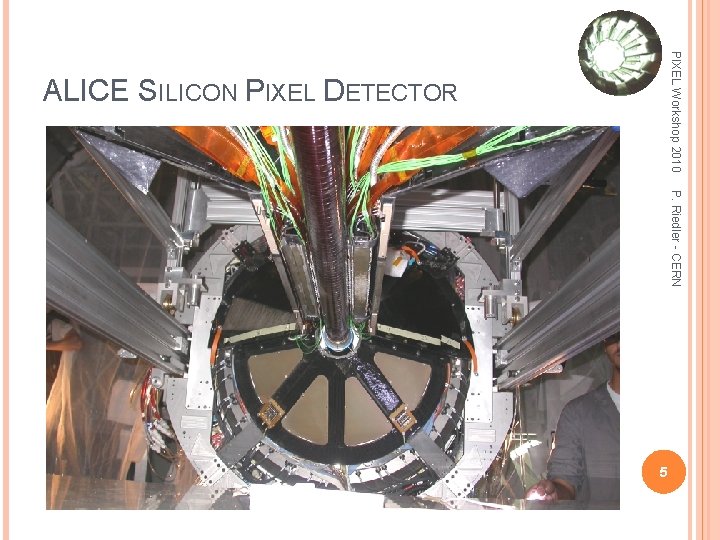
PIXEL Workshop 2010 ALICE SILICON PIXEL DETECTOR P. Riedler - CERN 5
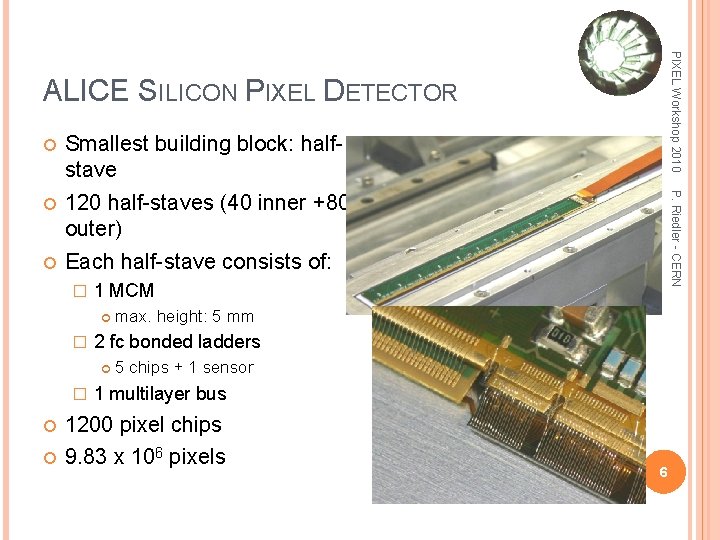
PIXEL Workshop 2010 ALICE SILICON PIXEL DETECTOR � 1 MCM � max. height: 5 mm 2 fc bonded ladders � P. Riedler - CERN Smallest building block: halfstave 120 half-staves (40 inner +80 outer) Each half-stave consists of: 5 chips + 1 sensor 1 multilayer bus 1200 pixel chips 9. 83 x 106 pixels 6
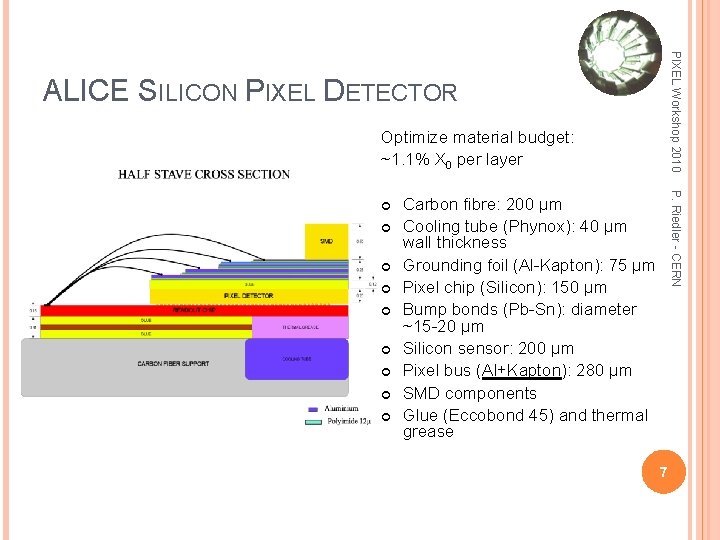
PIXEL Workshop 2010 ALICE SILICON PIXEL DETECTOR Optimize material budget: ~1. 1% X 0 per layer P. Riedler - CERN Carbon fibre: 200 µm Cooling tube (Phynox): 40 µm wall thickness Grounding foil (Al-Kapton): 75 µm Pixel chip (Silicon): 150 µm Bump bonds (Pb-Sn): diameter ~15 -20 µm Silicon sensor: 200 µm Pixel bus (Al+Kapton): 280 µm SMD components Glue (Eccobond 45) and thermal grease 7
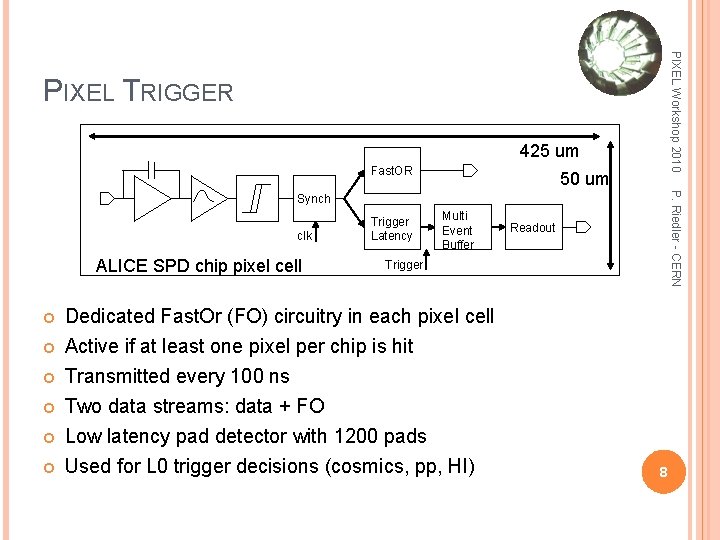
PIXEL Workshop 2010 PIXEL TRIGGER 425 um Fast. OR 50 um P. Riedler - CERN Synch clk ALICE SPD chip pixel cell Trigger Latency Multi Event Buffer Readout Trigger Dedicated Fast. Or (FO) circuitry in each pixel cell Active if at least one pixel per chip is hit Transmitted every 100 ns Two data streams: data + FO Low latency pad detector with 1200 pads Used for L 0 trigger decisions (cosmics, pp, HI) 8
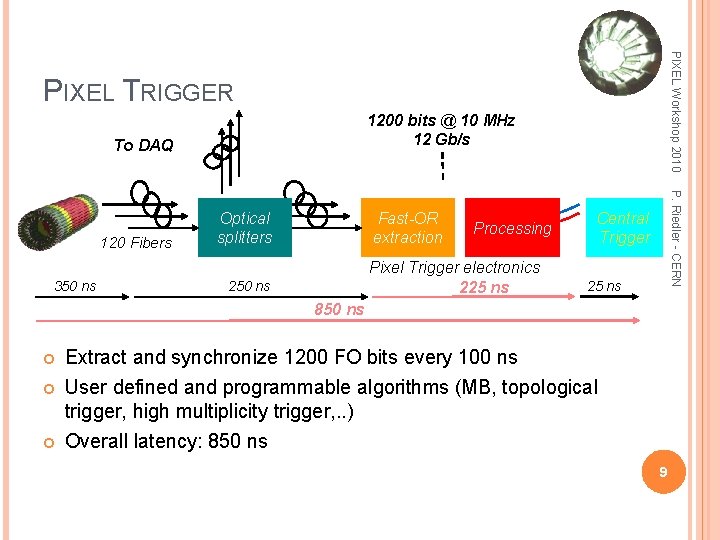
PIXEL Workshop 2010 PIXEL TRIGGER 1200 bits @ 10 MHz 12 Gb/s To DAQ 350 ns Fast-OR extraction Processing Pixel Trigger electronics 225 ns 250 ns P. Riedler - CERN 120 Fibers Optical splitters Central Trigger 25 ns 850 ns Extract and synchronize 1200 FO bits every 100 ns User defined and programmable algorithms (MB, topological trigger, high multiplicity trigger, . . ) Overall latency: 850 ns 9
P. Riedler - CERN SPD fully commissioned in the lab (CERN DSF) prior to installation in the pit Installed in summer 2007 in ALICE First switch-on of half of the detector: December 2007 (no connection of one side possible due to ongoing installation work) Fully connected and operated in 2008: data taking with cosmics SPD trigger used to trigger ALICE during cosmic runs PIXEL Workshop 2010 COMMISSIONING 10
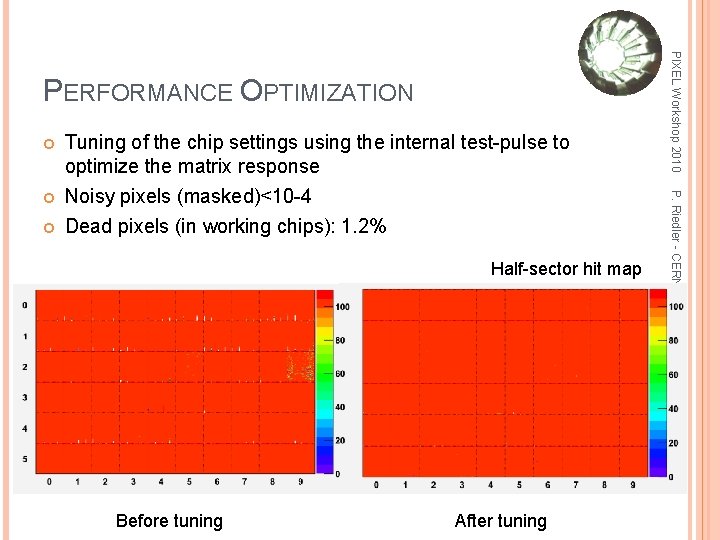
Tuning of the chip settings using the internal test-pulse to optimize the matrix response Noisy pixels (masked)<10 -4 Dead pixels (in working chips): 1. 2% Half-sector hit map P. Riedler - CERN PIXEL Workshop 2010 PERFORMANCE OPTIMIZATION 11 Before tuning After tuning
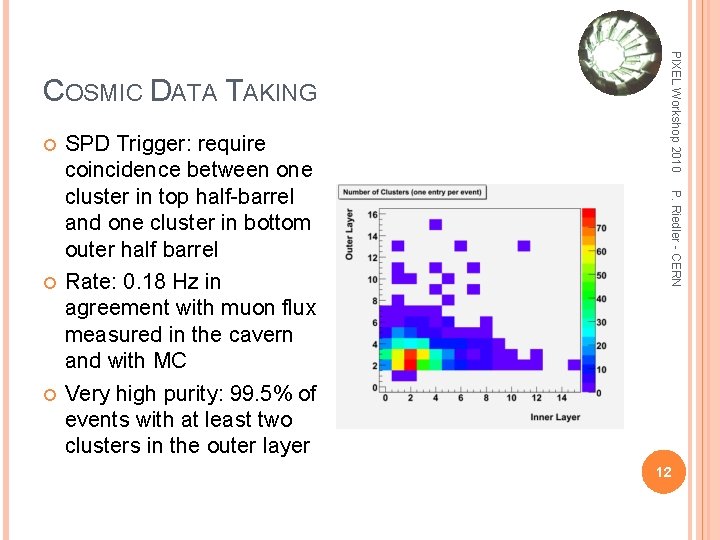
P. Riedler - CERN SPD Trigger: require coincidence between one cluster in top half-barrel and one cluster in bottom outer half barrel Rate: 0. 18 Hz in agreement with muon flux measured in the cavern and with MC Very high purity: 99. 5% of events with at least two clusters in the outer layer PIXEL Workshop 2010 COSMIC DATA TAKING 12
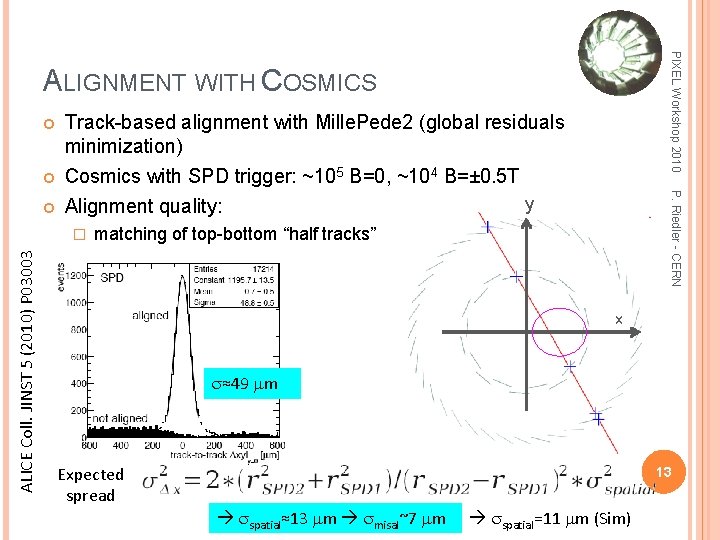
PIXEL Workshop 2010 ALIGNMENT WITH COSMICS Track-based alignment with Mille. Pede 2 (global residuals minimization) Cosmics with SPD trigger: ~105 B=0, ~104 B=± 0. 5 T y Alignment quality: ALICE Coll. JINST 5 (2010) P 03003 � P. Riedler - CERN matching of top-bottom “half tracks” x s≈49 mm Expected spread 13 sspatial≈13 mm smisal~7 mm sspatial=11 mm (Sim)
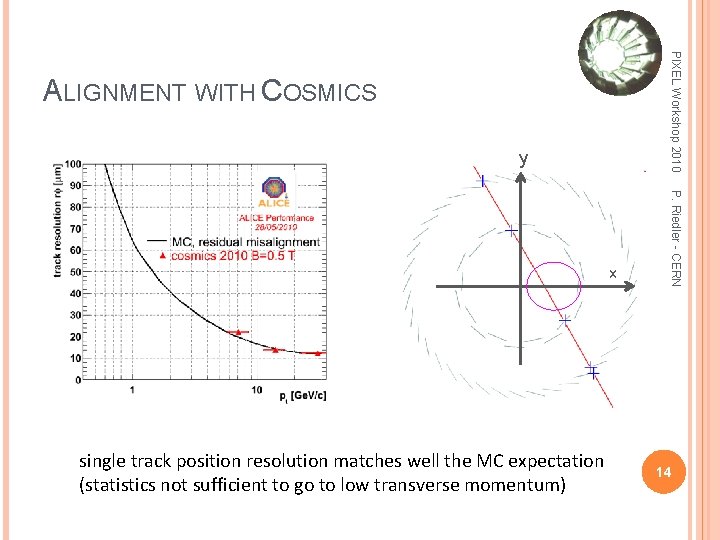
PIXEL Workshop 2010 ALIGNMENT WITH COSMICS y single track position resolution matches well the MC expectation (statistics not sufficient to go to low transverse momentum) P. Riedler - CERN x 14
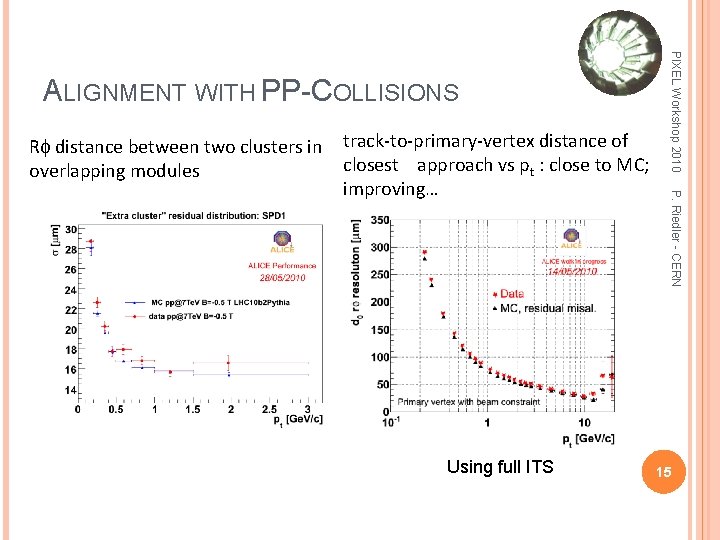
Rf distance between two clusters in overlapping modules Using full ITS P. Riedler - CERN track-to-primary-vertex distance of closest approach vs pt : close to MC; improving… PIXEL Workshop 2010 ALIGNMENT WITH PP-COLLISIONS 15
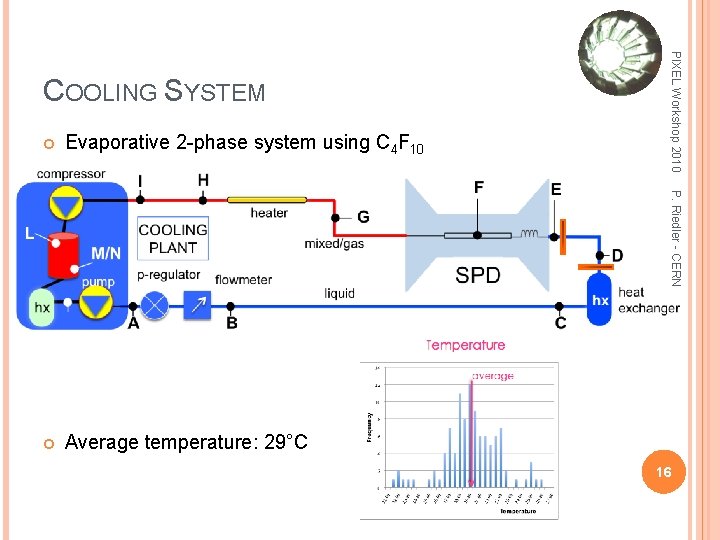
Evaporative 2 -phase system using C 4 F 10 Average temperature: 29°C P. Riedler - CERN PIXEL Workshop 2010 COOLING SYSTEM 16
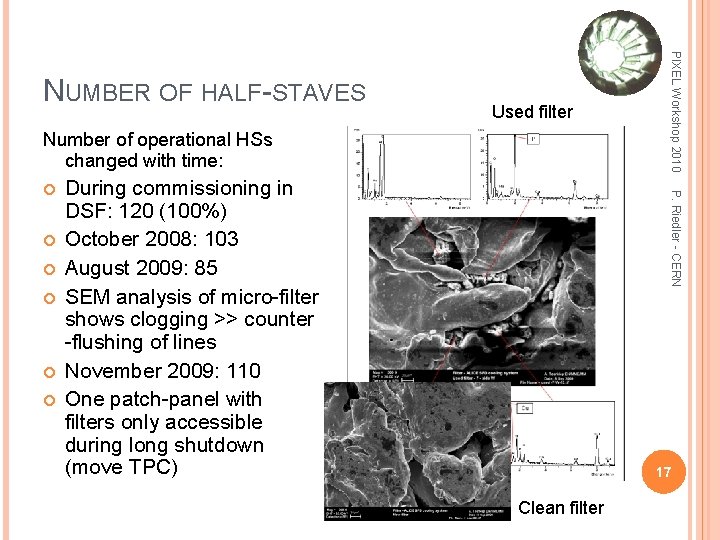
Used filter Number of operational HSs changed with time: During commissioning in DSF: 120 (100%) October 2008: 103 August 2009: 85 SEM analysis of micro-filter shows clogging >> counter -flushing of lines November 2009: 110 One patch-panel with filters only accessible during long shutdown (move TPC) P. Riedler - CERN PIXEL Workshop 2010 NUMBER OF HALF-STAVES 17 Clean filter
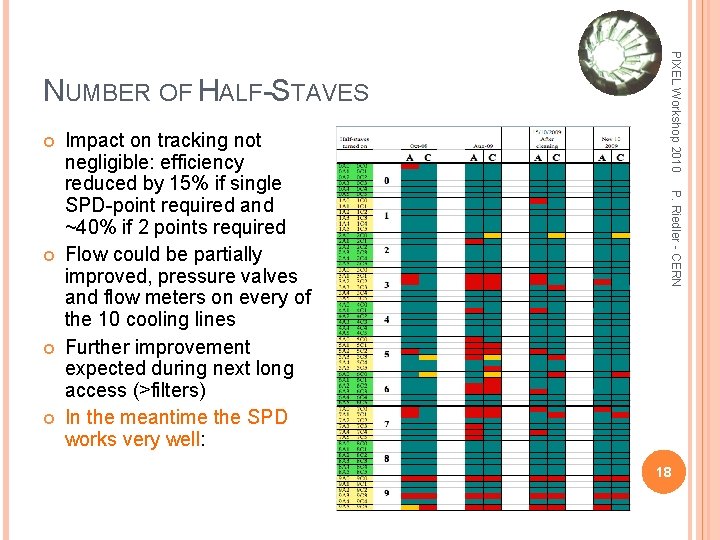
P. Riedler - CERN Impact on tracking not negligible: efficiency reduced by 15% if single SPD-point required and ~40% if 2 points required Flow could be partially improved, pressure valves and flow meters on every of the 10 cooling lines Further improvement expected during next long access (>filters) In the meantime the SPD works very well: PIXEL Workshop 2010 NUMBER OF HALF-STAVES 18
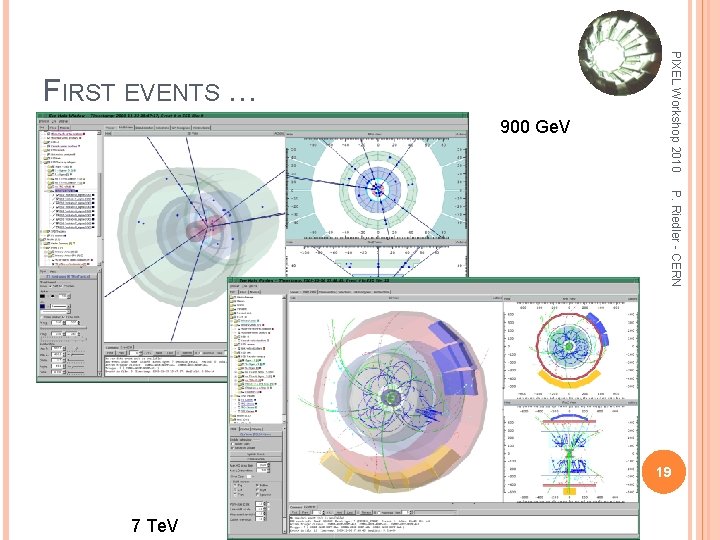
900 Ge. V P. Riedler - CERN 7 Te. V PIXEL Workshop 2010 FIRST EVENTS … 19
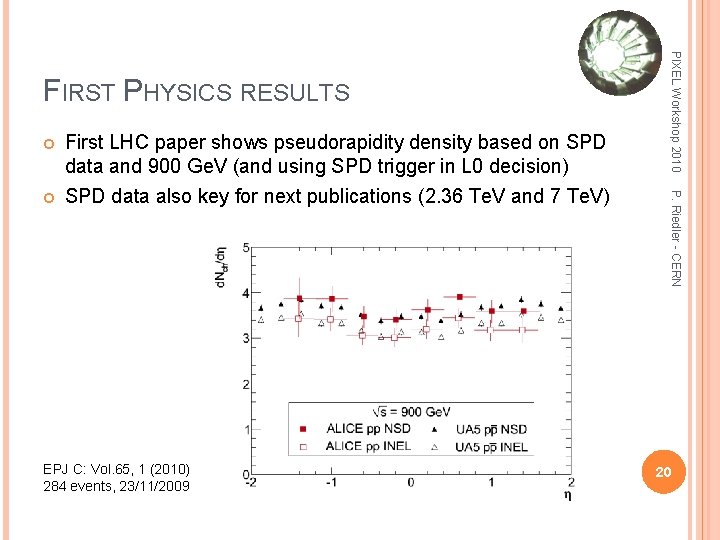
First LHC paper shows pseudorapidity density based on SPD data and 900 Ge. V (and using SPD trigger in L 0 decision) SPD data also key for next publications (2. 36 Te. V and 7 Te. V) EPJ C: Vol. 65, 1 (2010) 284 events, 23/11/2009 P. Riedler - CERN PIXEL Workshop 2010 FIRST PHYSICS RESULTS 20
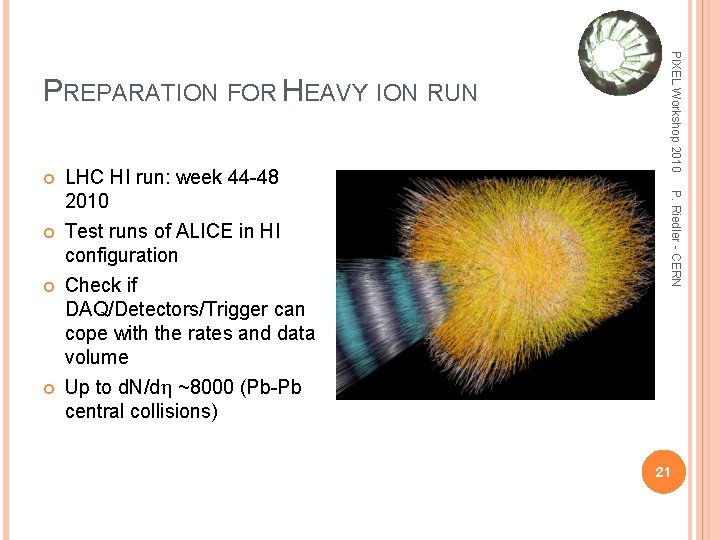
LHC HI run: week 44 -48 2010 Test runs of ALICE in HI configuration Check if DAQ/Detectors/Trigger can cope with the rates and data volume Up to d. N/dh ~8000 (Pb-Pb central collisions) P. Riedler - CERN PIXEL Workshop 2010 PREPARATION FOR HEAVY ION RUN 21
SPD: � No P. Riedler - CERN difference in the operation of the readout in pp and ion-ion runs � Frontend ASICs were designed to cope with expected HI rates and occupancy � Zero suppression and formatting is done off detector in the control room – no inefficiencies (loss of hits) of the readout up to average pixel occupancy of 12. 5% PIXEL Workshop 2010 PREPARATION FOR HEAVY ION RUN Specific tests carried out using the SPD and the setup in the test-facility (small scale SPD): � Increase data size to expected 246 k. B/event on real detector by lowering threshold on full detector � Dedicated tests in the test-facility: increase data volume by injecting test charge 22
Thinning studies Novel sensors (epi, edgeless, …) Monolithic pixels (Le. Pix) First results from tests in the next PIXEL workshop P. Riedler - CERN The ALICE SPD has proven to be very robust and able to provide key data and trigger information for the first running at LHC Further improvements of the cooling system are foreseen for the next long shutdown In the meantime several publications are based on SPD data and trigger and more are in preparation Different options for a future pixel detector in ALICE are being explored: PIXEL Workshop 2010 SUMMARY AND OUTLOOK 23
- Slides: 23