
Vladimir Zakharov the Poet Slava Muchnick Alex Shafarenko
- Slides: 11
Vladimir Zakharov the Poet Slava Muchnick, Alex Shafarenko Ancient Purple Translations
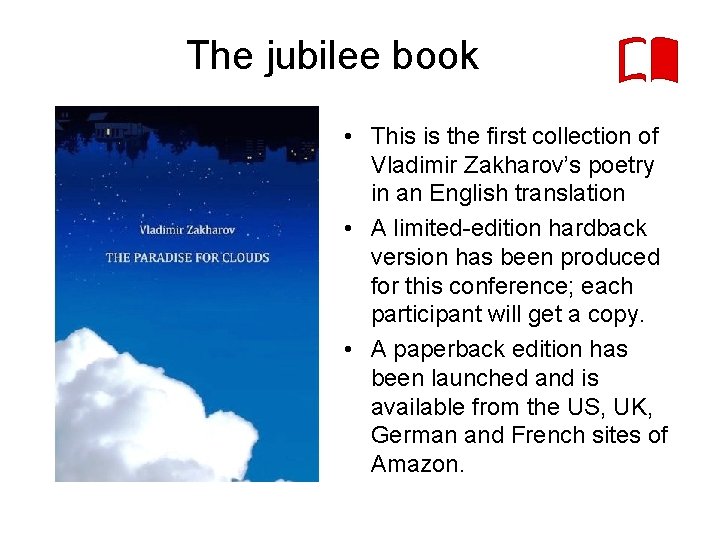
The jubilee book • This is the first collection of Vladimir Zakharov’s poetry in an English translation • A limited-edition hardback version has been produced for this conference; each participant will get a copy. • A paperback edition has been launched and is available from the US, UK, German and French sites of Amazon.
What kind of poet he is? Vladimir Zakharov is a dedicated follower of Russian poetic tradition. Here a few basic facts about it: • Poets strive to be unlike anybody else. • The sense of a mission and the drive to be the best rather than merely different. • Employing metre and rhyme most of the time. Free verse exists in Russian poetry as a niche area and as a modernist movement. None of these aspects makes translating Zakharov’s poetry into English any easier.
His way with poetic form (1) The full range of metric paradigms: • Standard syllabic-accentual metres • Logaoedics • Accentual verse • Free verse The full range of rhyming paradigms: • Fully rhymed verse; partially rhymed; unrhymed • Variable length of endings in an otherwise stable scheme • Varying the scheme within a piece • Mixing basic and sophisticated rhymes
His way with poetic form (2) A wide range of stanzaic shapes: • The quatrain is his favourite • Other formats are widely used • Many poems mix stanzas of different shape, which in unusual in Russian poetry Overall: • Fluidity – actively varying the form within one poem • The form closely follows the meaning and engages in a complex interplay with it.
Poetic form in translation (1) Joseph Brodsky on translating Russian poetry: … verse meters in themselves are kinds of spiritual magnitudes for which nothing can be substituted. They cannot be replaced even by each other, let alone by free verse. Differences in meters are differences in breath and in heartbeat. Differences in rhyming pattern are those of brain functions.
Poetic form in translation (2) Vladimir Nabokov on translating Russian poetry: A tortured author and a deceived reader, this is the inevitable outcome of arty paraphrase. The only object and justification of translation is the conveying of the most exact information possible and this can be only achieved by a literal translation, with notes. Walter Arndt on Vladimir Nabokov’s position: …sad ritual murder performed for the purposes of an ever more insatiable lexical necrophilia.
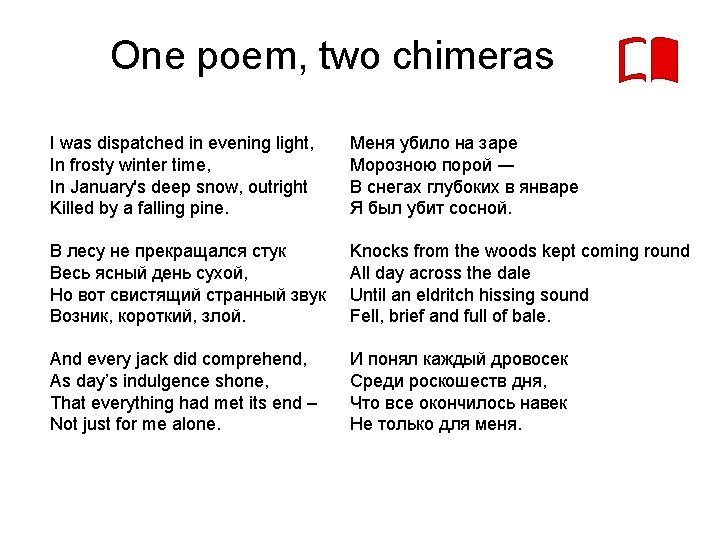
Congruent translation • Strict metric observance • Reproducing the rhyme scheme but not necessarily the quality of rhyme. • Different treatment of two kinds of meaning found in the original: – The key image-making semantics. It is rendered “sense for sense” as closely as possible. – The meaning that appears to have been chosen chiefly for the sake of form. It undergoes an “arty paraphrase” as the form of the poem is reconstructed in the target language. • To test the result, units of translation can be interleaved with those of the original to produce a viable chimera.
One poem, two chimeras I was dispatched in evening light, In frosty winter time, In January's deep snow, outright Killed by a falling pine. Меня убило на заре Морозною порой ― В снегах глубоких в январе Я был убит сосной. В лесу не прекращался стук Весь ясный день сухой, Но вот свистящий странный звук Возник, короткий, злой. Knocks from the woods kept coming round All day across the dale Until an eldritch hissing sound Fell, brief and full of bale. And every jack did comprehend, As day’s indulgence shone, That everything had met its end – Not just for me alone. И понял каждый дровосек Среди роскошеств дня, Что все окончилось навек Не только для меня.
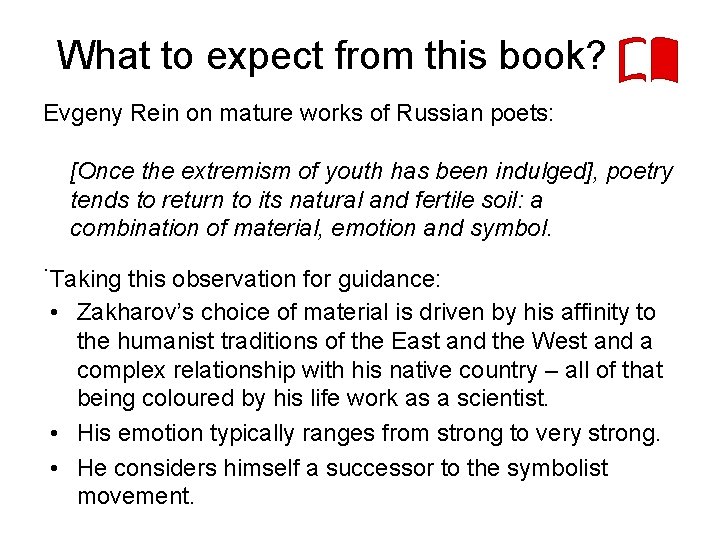
What to expect from this book? Evgeny Rein on mature works of Russian poets: [Once the extremism of youth has been indulged], poetry tends to return to its natural and fertile soil: a combination of material, emotion and symbol. . Taking this observation for guidance: • Zakharov’s choice of material is driven by his affinity to the humanist traditions of the East and the West and a complex relationship with his native country – all of that being coloured by his life work as a scientist. • His emotion typically ranges from strong to very strong. • He considers himself a successor to the symbolist movement.
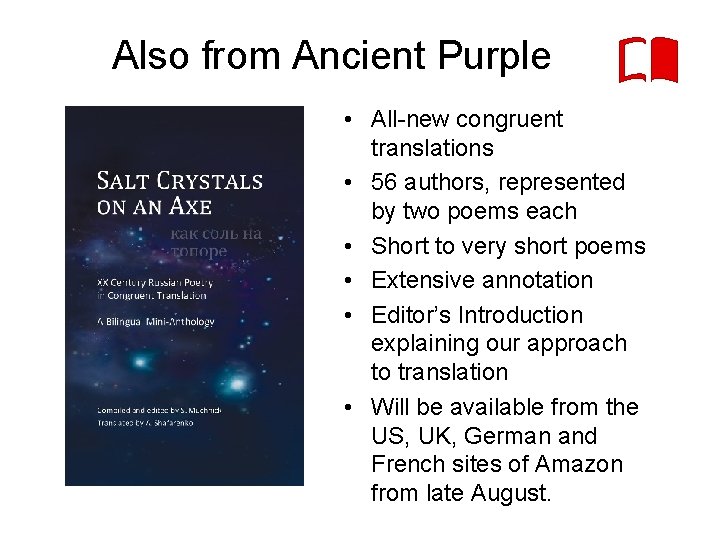
Also from Ancient Purple • All-new congruent translations • 56 authors, represented by two poems each • Short to very short poems • Extensive annotation • Editor’s Introduction explaining our approach to translation • Will be available from the US, UK, German and French sites of Amazon from late August.