
THE PEP Workshop Green Healthfriendly Sustainable Mobility in
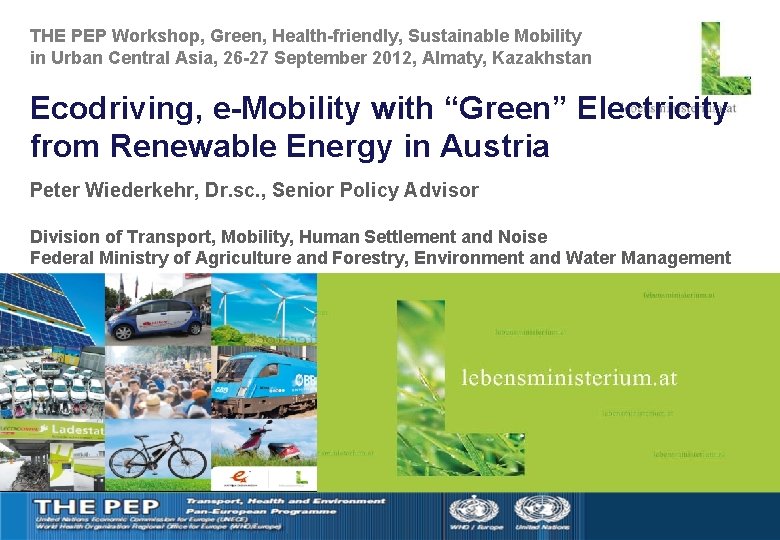
THE PEP Workshop, Green, Health-friendly, Sustainable Mobility in Urban Central Asia, 26 -27 September 2012, Almaty, Kazakhstan Ecodriving, e-Mobility with “Green” Electricity from Renewable Energy in Austria Peter Wiederkehr, Dr. sc. , Senior Policy Advisor Division of Transport, Mobility, Human Settlement and Noise Federal Ministry of Agriculture and Forestry, Environment and Water Management Slide 1
Ecodriving Program Austria • • Started in 2004 by the Ministry for Environment Ecodriving is integral part of the national strategies on energy and climate protection • Part of the support program klima: aktiv mobil of the Ministry for Environment, implemented by Austrian Energy Agency • Accounted fuel savings of 5%: 400. 000 tons of CO 2 p. a. 170 million litres of diesel fuel p. a. Slide 2
Facts & Figures Austria ü 1000 Ecodriving trainers ü 235 company fleet operators trained ü 20. 000 training participants ü 90. 000 learner drivers trained p. a. saving of 50. 000 tons CO 2 p. a. …equals 20 Mio liter diesel p. a. ! Slide 3
Elements of the Eco. Driving Program Austria • • • Nationally coordinated trainings for drivers of cars, trucks, busses and agricultural tractors Elaborated handbooks and teaching material Certification scheme: klima: aktiv mobil master trainers Motivation and awarding: competitions Label for “green” driving schools Communication and awarness raising campaigns Slide 4
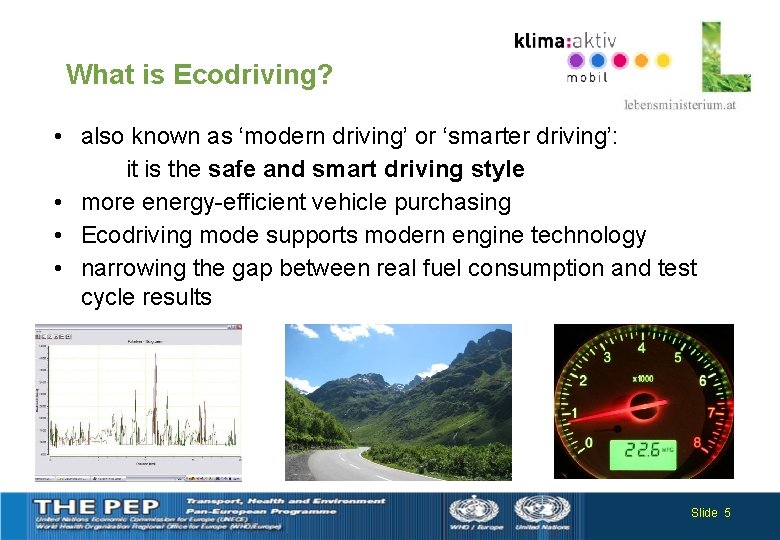
What is Ecodriving? • also known as ‘modern driving’ or ‘smarter driving’: it is the safe and smart driving style • more energy-efficient vehicle purchasing • Ecodriving mode supports modern engine technology • narrowing the gap between real fuel consumption and test cycle results Slide 5
Positive Effects of Ecodriving • Sustainable decrease of fuel consumption and CO 2 emissions by 5% (truck, bus) to 20% (cars, LDV) • Reduced noise (due to lower rpm) • Positive impact on traffic safety: up to 40% less accidents • Lower maintenance costs (e. g. brakes, tyres) • Less stress (less shifting gears, less braking) Slide 6
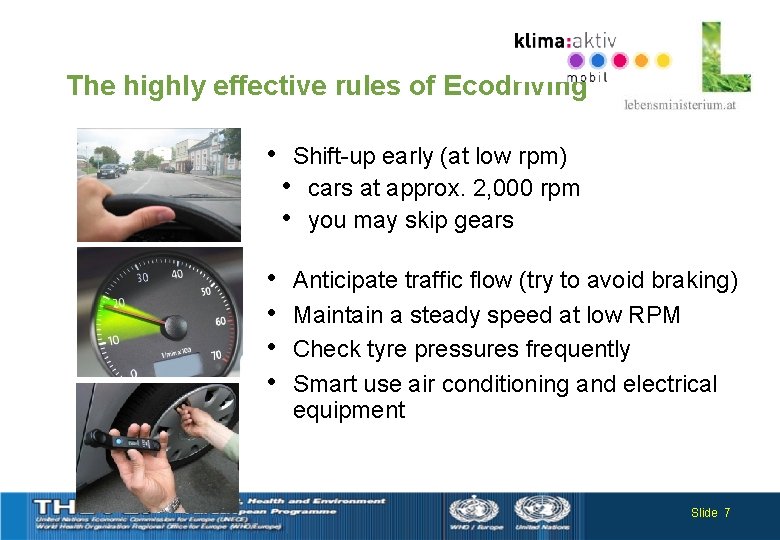
The highly effective rules of Ecodriving • • • Shift-up early (at low rpm) • cars at approx. 2, 000 rpm • you may skip gears Anticipate traffic flow (try to avoid braking) Maintain a steady speed at low RPM Check tyre pressures frequently Smart use air conditioning and electrical equipment Slide 7
Good practice rules of Ecodriving • Avoid idling - drive-off immediately after starting the engine; do not warm up the engine by idling, switch-off the engine at longer stops • Improve aerodynamics - close windows when driving at higher speeds • Fuel efficiency devices - make use of fuel saving of in-car devices (revolution counter, on-board computer, cruise control) • Mode of transport - avoid short car trips and consider alternative means of transport • Purchase of car - Fuel-saving starts with puchasing a fuel efficient low-emission car Slide 8
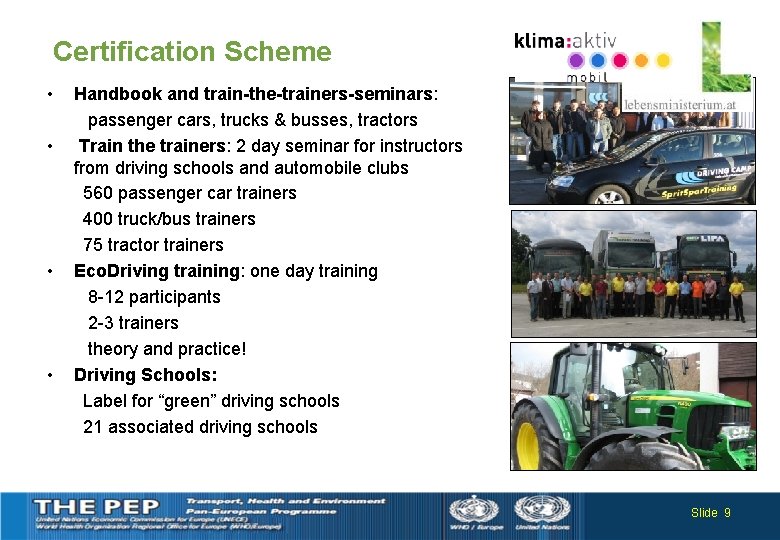
Certification Scheme • • Handbook and train-the-trainers-seminars: passenger cars, trucks & busses, tractors Train the trainers: 2 day seminar for instructors from driving schools and automobile clubs 560 passenger car trainers 400 truck/bus trainers 75 tractor trainers Eco. Driving training: one day training 8 -12 participants 2 -3 trainers theory and practice! Driving Schools: Label for “green” driving schools 21 associated driving schools Slide 9
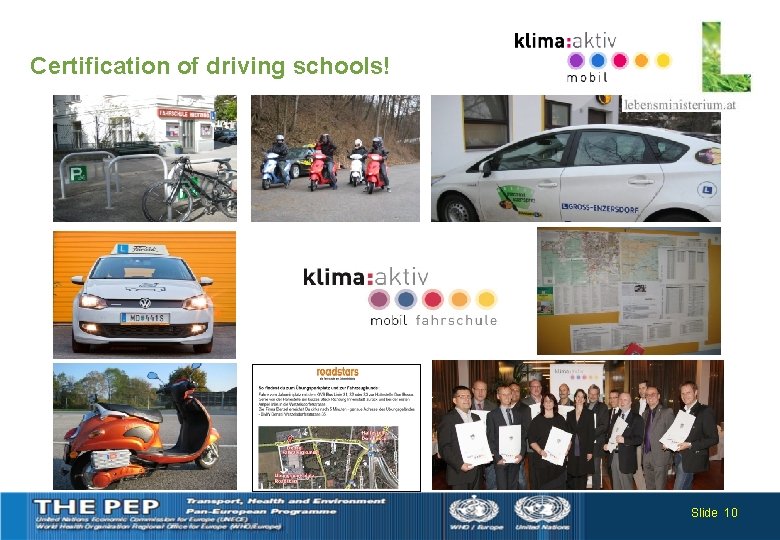
Certification of driving schools! Slide 10
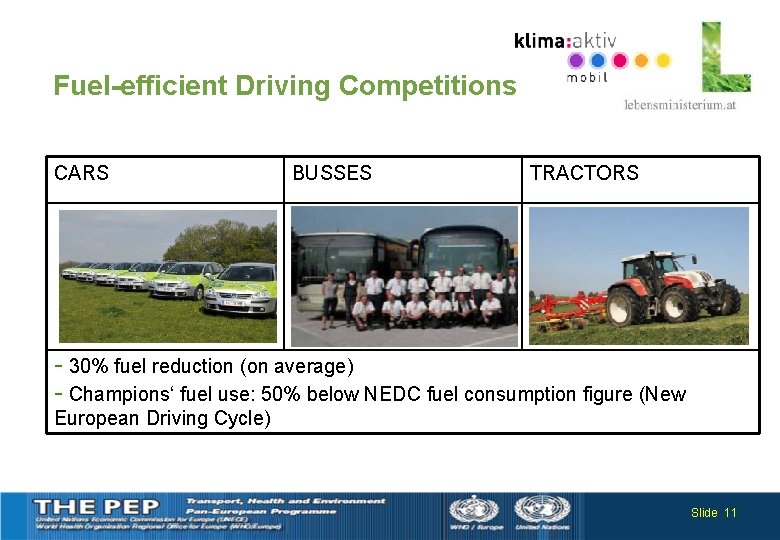
Fuel-efficient Driving Competitions CARS BUSSES TRACTORS - 30% fuel reduction (on average) - Champions‘ fuel use: 50% below NEDC fuel consumption figure (New European Driving Cycle) Slide 11
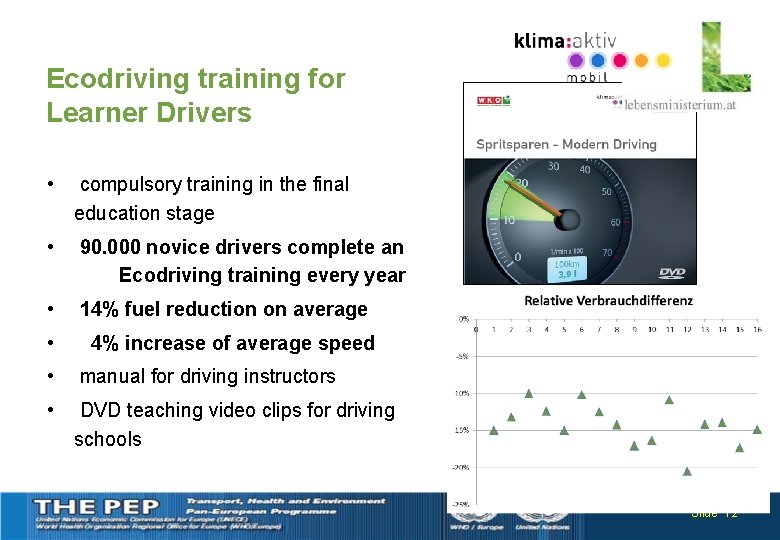
Ecodriving training for Learner Drivers • compulsory training in the final education stage • 90. 000 novice drivers complete an Ecodriving training every year • 14% fuel reduction on average • 4% increase of average speed • manual for driving instructors • DVD teaching video clips for driving schools Slide 12
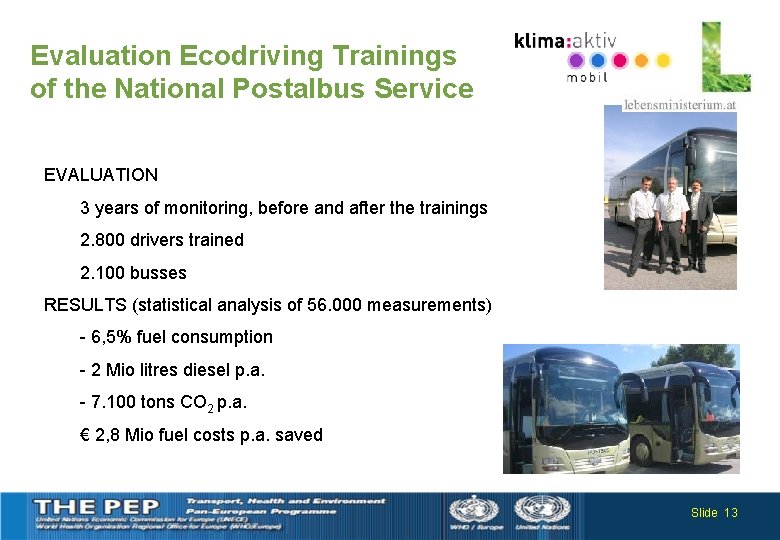
Evaluation Ecodriving Trainings of the National Postalbus Service EVALUATION 3 years of monitoring, before and after the trainings 2. 800 drivers trained 2. 100 busses RESULTS (statistical analysis of 56. 000 measurements) - 6, 5% fuel consumption - 2 Mio litres diesel p. a. - 7. 100 tons CO 2 p. a. € 2, 8 Mio fuel costs p. a. saved Slide 13
International Eco-Driving EU-project ECOWILL 2010 -2013 AEA: coordinator of 13 national partners Participating international organisations: ACEA, CIECA, EFA, FIA, Ford, Leaseplan Focus 1: Ecodriving for learner drivers Focus 2: Short duration trainings (~1 h) for licensed drivers Monitoring the effectiveness of trainings Website: www. ecodrive. org Slide 14
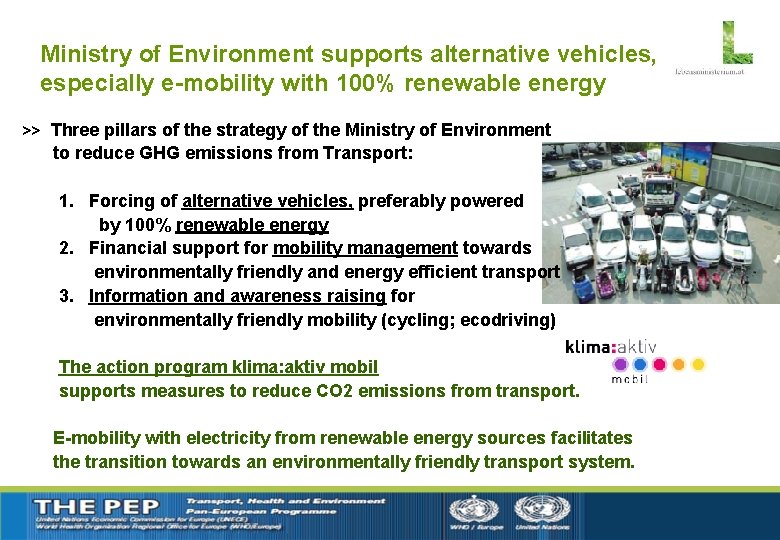
Ministry of Environment supports alternative vehicles, especially e-mobility with 100% renewable energy >> Three pillars of the strategy of the Ministry of Environment to reduce GHG emissions from Transport: 1. Forcing of alternative vehicles, preferably powered by 100% renewable energy 2. Financial support for mobility management towards environmentally friendly and energy efficient transport 3. Information and awareness raising for environmentally friendly mobility (cycling; ecodriving) The action program klima: aktiv mobil supports measures to reduce CO 2 emissions from transport. E-mobility with electricity from renewable energy sources facilitates the transition towards an environmentally friendly transport system. Division V/5 Transport/Mobility/Human Settlement/Noise Sheet 15
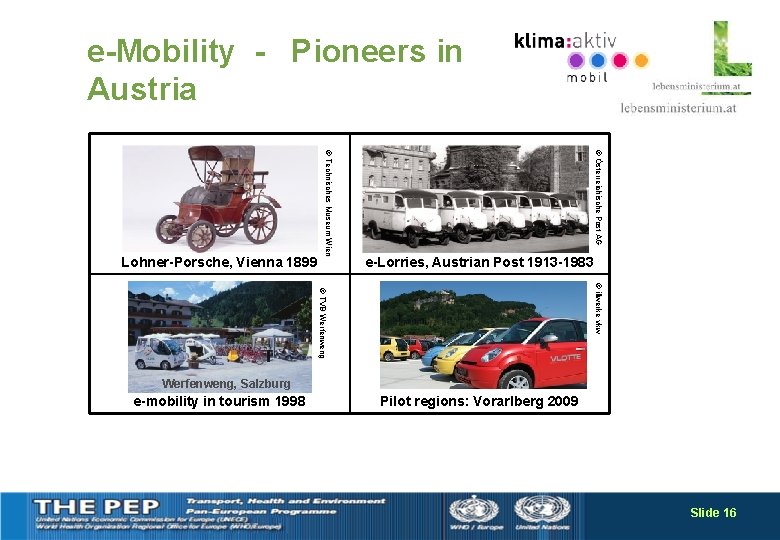
e-Mobility - Pioneers in Austria © Österreichische Post AG © Technisches Museum Wien Lohner-Porsche, Vienna 1899 e-Lorries, Austrian Post 1913 -1983 © illwerke vkw © TVB Werfenweng, Salzburg e-mobility in tourism 1998 Pilot regions: Vorarlberg 2009 Slide 16
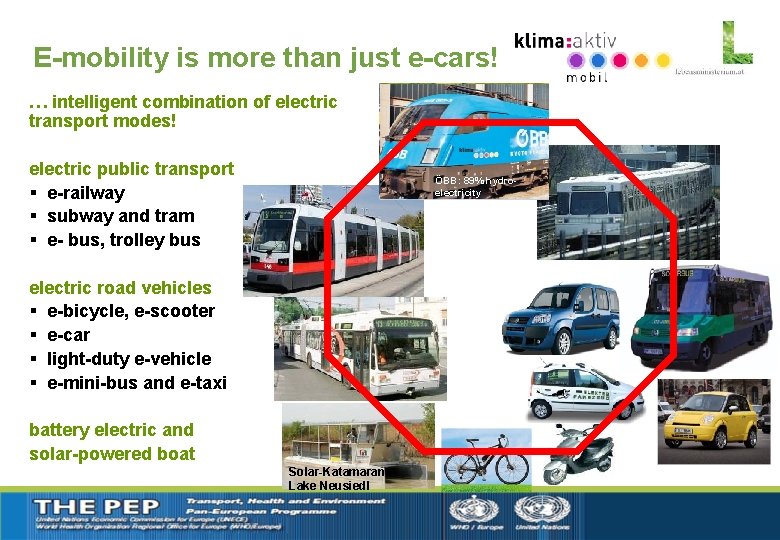
E-mobility is more than just e-cars! … intelligent combination of electric transport modes! electric public transport § e-railway § subway and tram § e- bus, trolley bus ÖBB: 89% hydroelectricity electric road vehicles § e-bicycle, e-scooter § e-car § light-duty e-vehicle § e-mini-bus and e-taxi battery electric and solar-powered boat Solar-Katamaran Lake Neusiedl Division V/5 Sheet 17 the klima: aktiv mobil program supports environmentally friendly mobility! Transport/Mobility/Human Settlement/Noise
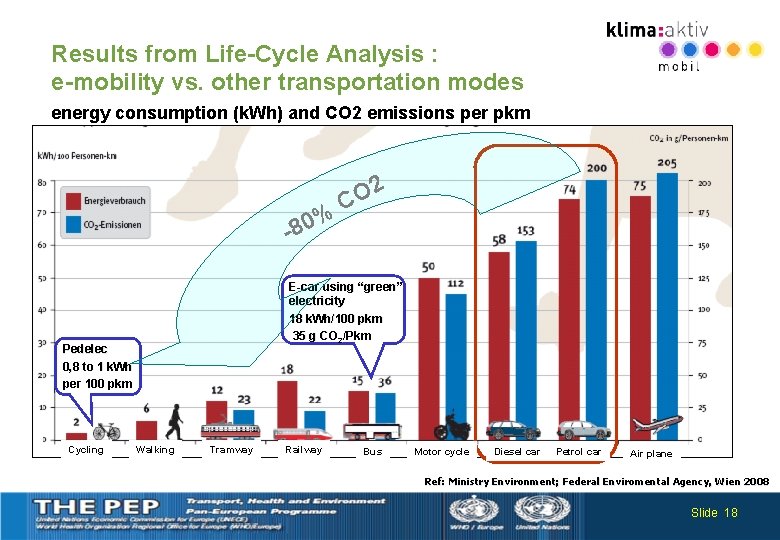
Results from Life-Cycle Analysis : e-mobility vs. other transportation modes energy consumption (k. Wh) and CO 2 emissions per pkm 2 O C % -80 E-car using “green” electricity 18 k. Wh/100 pkm 35 g CO 2/Pkm Pedelec 0, 8 to 1 k. Wh per 100 pkm Cycling Walking Tramway Railway Bus Motor cycle Diesel car Petrol car Air plane Ref: Ministry Environment; Federal Enviromental Agency, Wien 2008 Slide 18
National e-mobility initiatives in Austria > National Energy Strategy 2010: mobility strategy e-mobility goal: 250’ 000 EVs; CO 2 reduction 430’ 000 tonnes > National Implementation Plan for e-Mobility in Austria by 65 individual measures (energy, charging, vehicles, research, training) > Ministry of Environment Financial support for e-mobility with renewables; klima: aktiv mobil support program for alternative vehicles) > Ministry of Transport, Innovation & Technology • RT&D, technological programs (A 3 plus, “New energies 2020“) > Climate- and Energy Fund (Ministries of Environment & Transport) • 8 Pilot regions for e-mobility with 100% renewable energy • Technological lighthouses on e-mobility • Information platform www. e-connected. at Division V/5 Transport/Mobility/Human Settlement/Noise Sheet 19
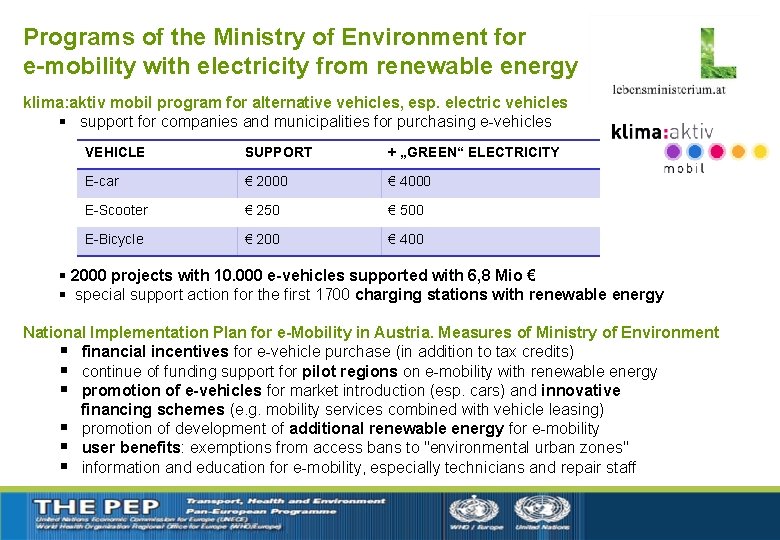
Programs of the Ministry of Environment for e-mobility with electricity from renewable energy klima: aktiv mobil program for alternative vehicles, esp. electric vehicles § support for companies and municipalities for purchasing e-vehicles VEHICLE SUPPORT + „GREEN“ ELECTRICITY E-car € 2000 € 4000 E-Scooter € 250 € 500 E-Bicycle € 200 € 400 § 2000 projects with 10. 000 e-vehicles supported with 6, 8 Mio € § special support action for the first 1700 charging stations with renewable energy National Implementation Plan for e-Mobility in Austria. Measures of Ministry of Environment § financial incentives for e-vehicle purchase (in addition to tax credits) § continue of funding support for pilot regions on e-mobility with renewable energy § promotion of e-vehicles for market introduction (esp. cars) and innovative financing schemes (e. g. mobility services combined with vehicle leasing) § promotion of development of additional renewable energy for e-mobility § user benefits: exemptions from access bans to "environmental urban zones" § information and education for e-mobility, especially technicians and repair staff Division V/5 Transport/Mobility/Human Settlement/Noise Sheet 20
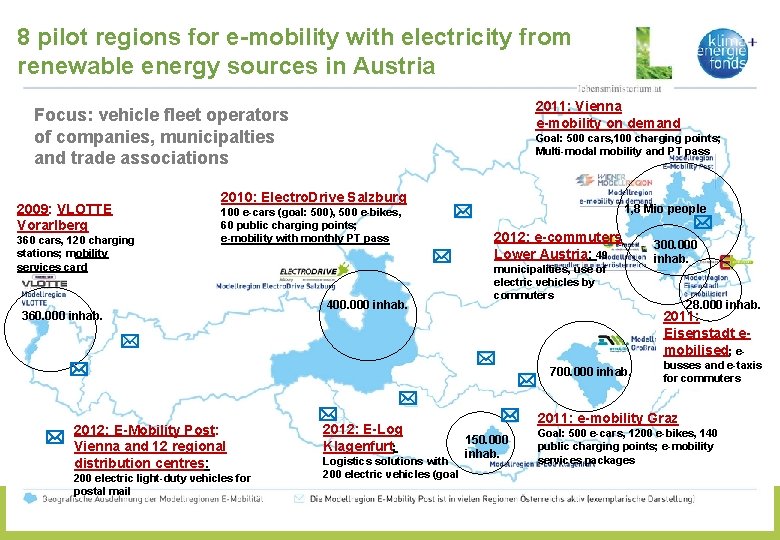
8 pilot regions for e-mobility with electricity from renewable energy sources in Austria 2011: Vienna e-mobility on demand Focus: vehicle fleet operators of companies, municipalties and trade associations Goal: 500 cars, 100 charging points; Multi-modal mobility and PT pass 2010: Electro. Drive Salzburg 2009: VLOTTE Vorarlberg 360 cars, 120 charging stations; mobility services card * 100 e-cars (goal: 500), 500 e-bikes, 60 public charging points; e-mobility with monthly PT pass * 400. 000 inhab. 360. 000 inhab. * 2012: e-commuters Lower Austria: 49 municipalities, use of electric vehicles by commuters * * 2012: E-Log Klagenfurt: 2012: E-Mobility Post: Vienna and 12 regional distribution centres: 200 electric light-duty vehicles for postal mail Logistics solutions with 200 electric vehicles (goal * 300. 000 inhab. 28. 000 inhab. 2011: Eisenstadt emobilised; e- * * * 1, 8 Mio people * * 150. 000 inhab. Division V/5 Transport/Mobility/Human Settlement/Noise 700. 000 inhab. busses and e-taxis for commuters 2011: e-mobility Graz Goal: 500 e-cars, 1200 e-bikes, 140 public charging points; e-mobility services packages Sheet 21
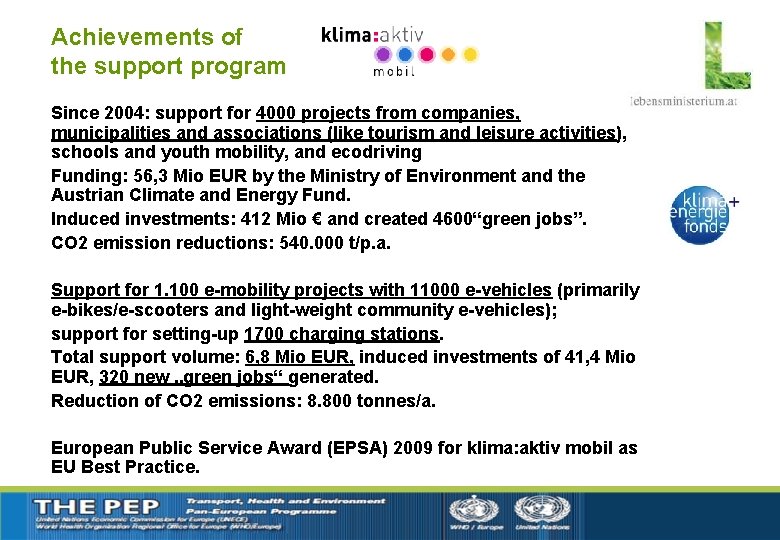
Achievements of the support program Since 2004: support for 4000 projects from companies, municipalities and associations (like tourism and leisure activities), schools and youth mobility, and ecodriving Funding: 56, 3 Mio EUR by the Ministry of Environment and the Austrian Climate and Energy Fund. Induced investments: 412 Mio € and created 4600“green jobs”. CO 2 emission reductions: 540. 000 t/p. a. Support for 1. 100 e-mobility projects with 11000 e-vehicles (primarily e-bikes/e-scooters and light-weight community e-vehicles); support for setting-up 1700 charging stations. Total support volume: 6, 8 Mio EUR, induced investments of 41, 4 Mio EUR, 320 new „green jobs“ generated. Reduction of CO 2 emissions: 8. 800 tonnes/a. European Public Service Award (EPSA) 2009 for klima: aktiv mobil as EU Best Practice. Division V/5 Transport/Mobility/Human Settlement/Noise Sheet 22
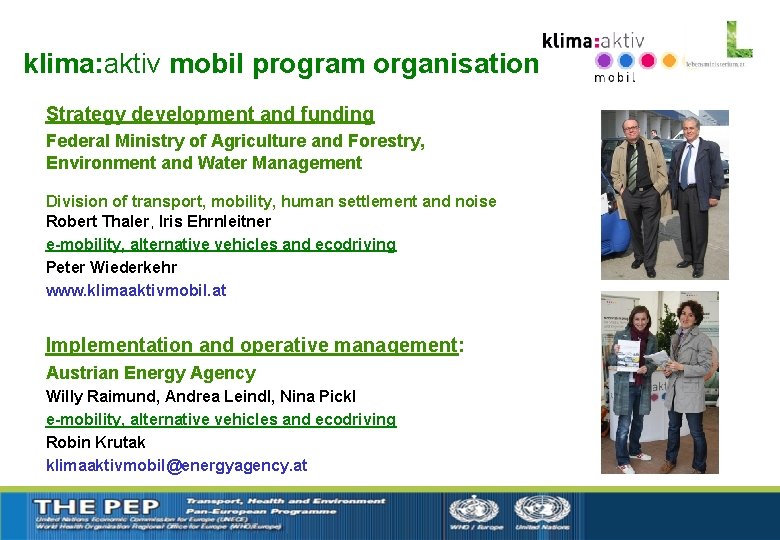
klima: aktiv mobil program organisation Strategy development and funding Federal Ministry of Agriculture and Forestry, Environment and Water Management Division of transport, mobility, human settlement and noise Robert Thaler, Iris Ehrnleitner e-mobility, alternative vehicles and ecodriving Peter Wiederkehr www. klimaaktivmobil. at Implementation and operative management: Austrian Energy Agency Willy Raimund, Andrea Leindl, Nina Pickl e-mobility, alternative vehicles and ecodriving Robin Krutak klimaaktivmobil@energyagency. at Division V/5 Transport/Mobility/Human Settlement/Noise Sheet 23
klima: aktiv mobil Support for e-mobility with renewable energy! Thank you for your attention! Slide 24
- Slides: 24