Clearance of the Cardiac Patient for Noncardiac Surgery




- Slides: 39
Clearance of the Cardiac Patient for Non-cardiac Surgery Evaluation and Management
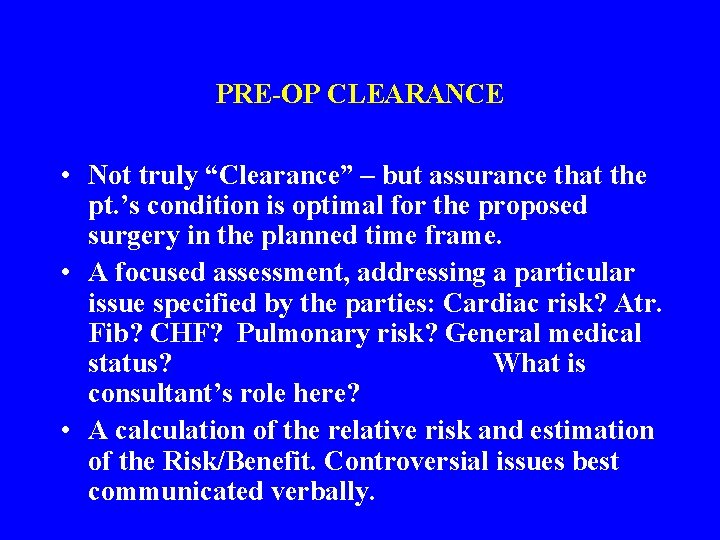
PRE-OP CLEARANCE • Not truly “Clearance” – but assurance that the pt. ’s condition is optimal for the proposed surgery in the planned time frame. • A focused assessment, addressing a particular issue specified by the parties: Cardiac risk? Atr. Fib? CHF? Pulmonary risk? General medical status? What is consultant’s role here? • A calculation of the relative risk and estimation of the Risk/Benefit. Controversial issues best communicated verbally.
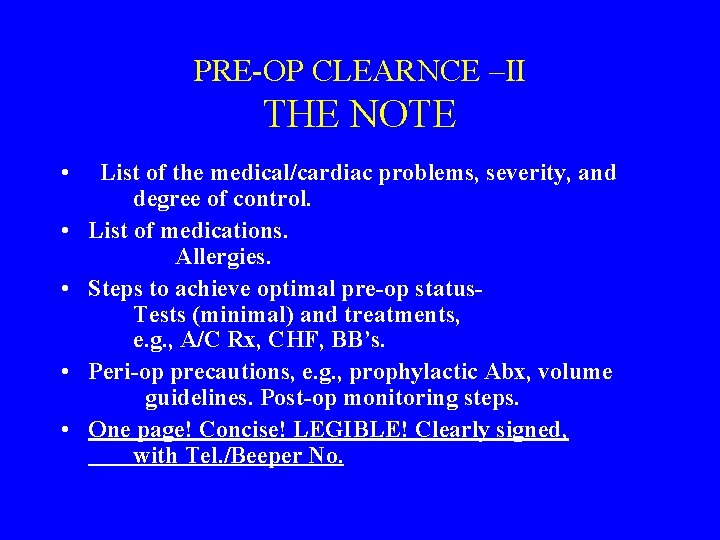
PRE-OP CLEARNCE –II THE NOTE • • • List of the medical/cardiac problems, severity, and degree of control. List of medications. Allergies. Steps to achieve optimal pre-op status. Tests (minimal) and treatments, e. g. , A/C Rx, CHF, BB’s. Peri-op precautions, e. g. , prophylactic Abx, volume guidelines. Post-op monitoring steps. One page! Concise! LEGIBLE! Clearly signed, with Tel. /Beeper No.
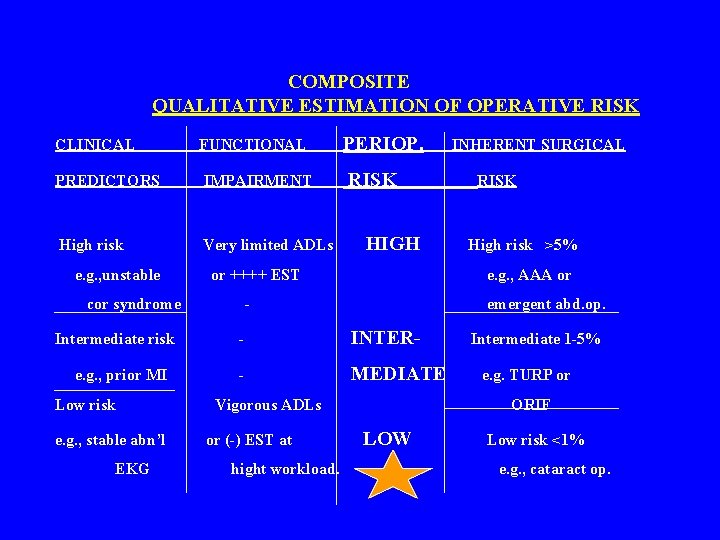
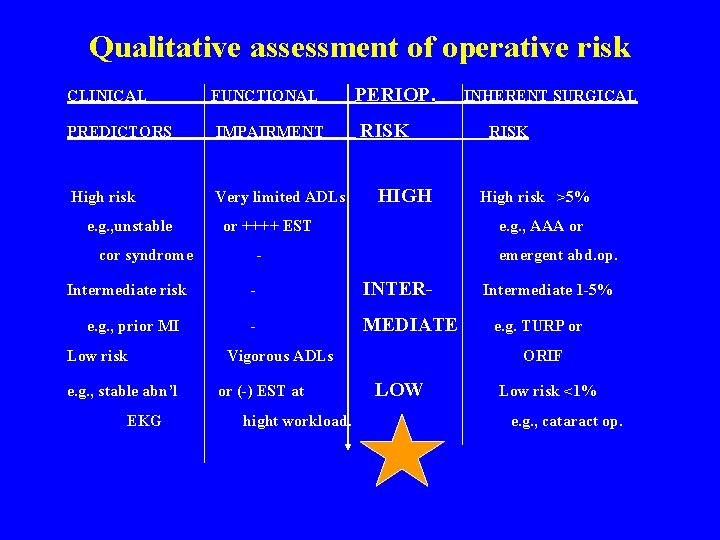
COMPOSITE QUALITATIVE ESTIMATION OF OPERATIVE RISK CLINICAL FUNCTIONAL PREDICTORS IMPAIRMENT High risk Very limited ADLs e. g. , unstable e. g. , prior MI Low risk e. g. , stable abn’l EKG RISK HIGH or ++++ EST cor syndrome Intermediate risk PERIOP. High risk >5% emergent abd. op. - INTER- - MEDIATE Vigorous ADLs hight workload. RISK e. g. , AAA or - or (-) EST at INHERENT SURGICAL Intermediate 1 -5% e. g. TURP or ORIF LOW Low risk <1% e. g. , cataract op.
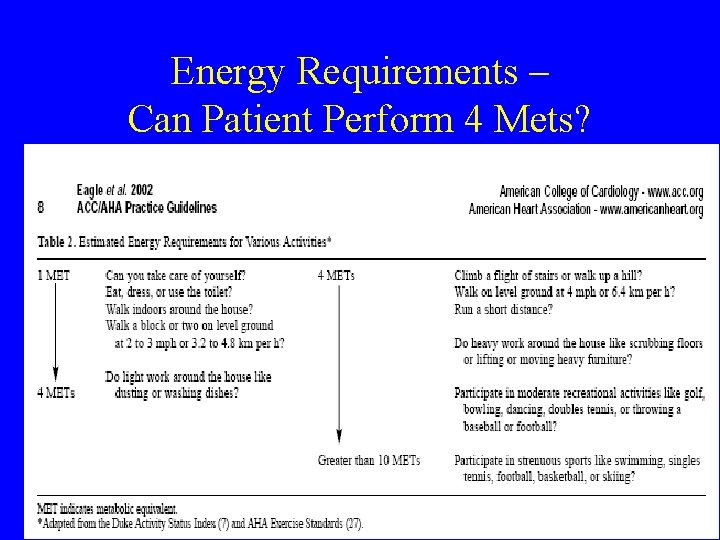
Energy Requirements – Can Patient Perform 4 Mets?
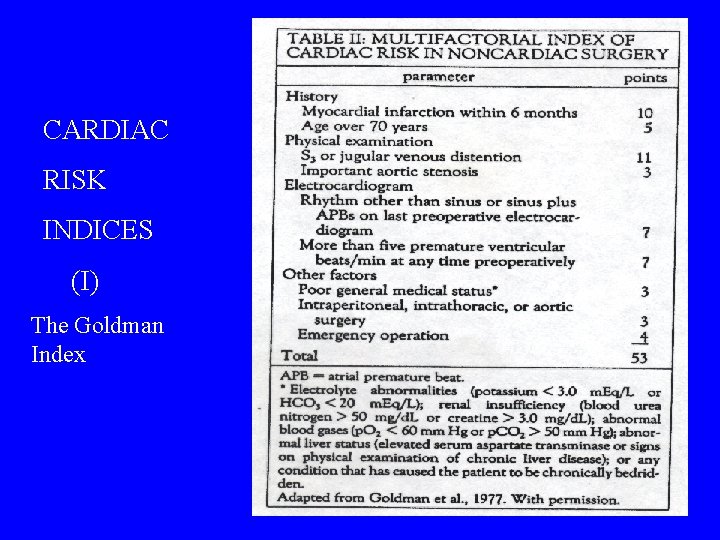
CARDIAC RISK INDICES (I) The Goldman Index
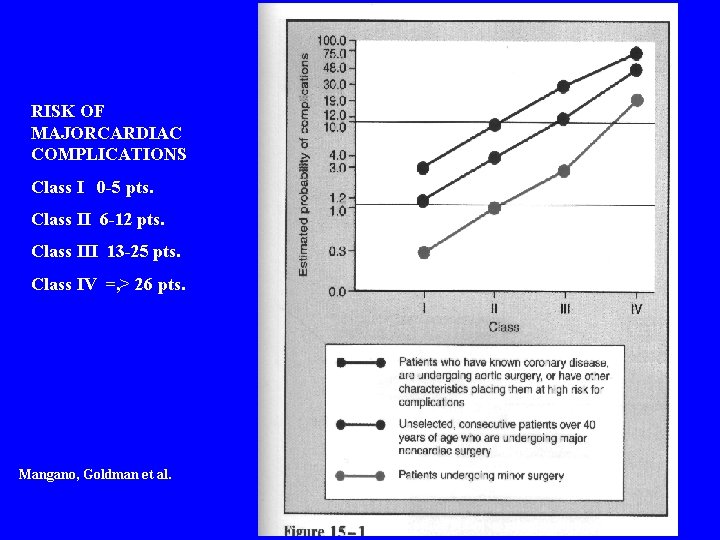
RISK OF MAJORCARDIAC COMPLICATIONS Class I 0 -5 pts. Class II 6 -12 pts. Class III 13 -25 pts. Class IV =, > 26 pts. Mangano, Goldman et al.
(II) ACC AHA Guidelines
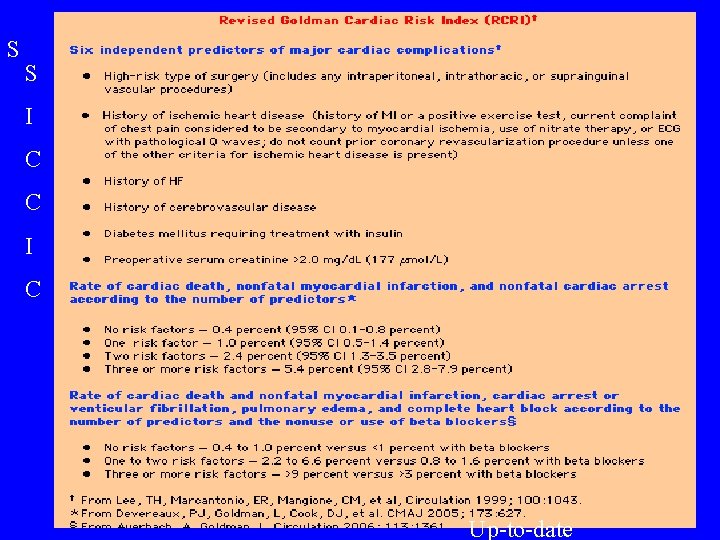
S S I C C I C Up-to-date
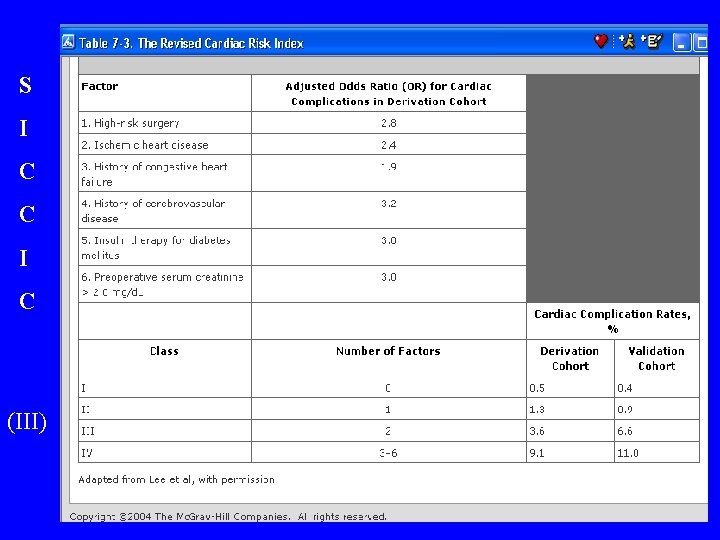
S I C C I C (III)
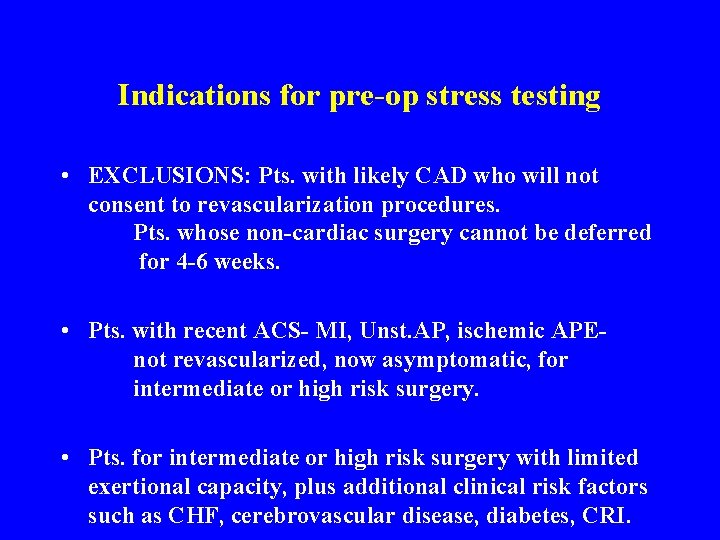
Indications for pre-op stress testing • EXCLUSIONS: Pts. with likely CAD who will not consent to revascularization procedures. Pts. whose non-cardiac surgery cannot be deferred for 4 -6 weeks. • Pts. with recent ACS- MI, Unst. AP, ischemic APEnot revascularized, now asymptomatic, for intermediate or high risk surgery. • Pts. for intermediate or high risk surgery with limited exertional capacity, plus additional clinical risk factors such as CHF, cerebrovascular disease, diabetes, CRI.
Risk Reduction for the Cardiac Patient for Non-cardiac Surgery Choice of procedure Choice of surgeon and hospital Choice of pre-op interventions and meds. Optimization of status in time allotted(? )
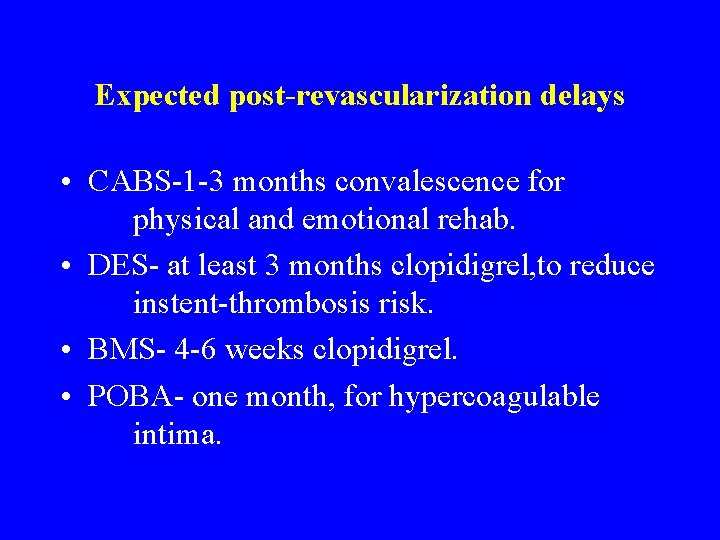
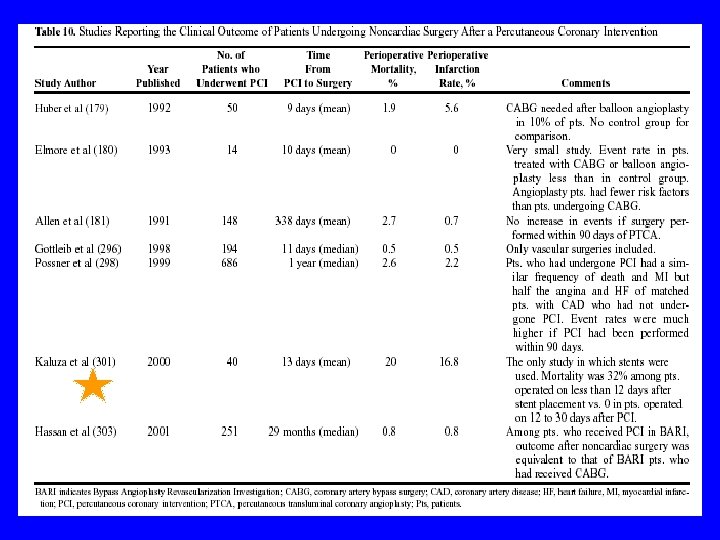
Expected post-revascularization delays • CABS-1 -3 months convalescence for physical and emotional rehab. • DES- at least 3 months clopidigrel, to reduce instent-thrombosis risk. • BMS- 4 -6 weeks clopidigrel. • POBA- one month, for hypercoagulable intima.
8/56= 14% MACE- IF WITHIN 6 WEEKS OF PCI. Am. J. Cardiol. 2005; 95: 755
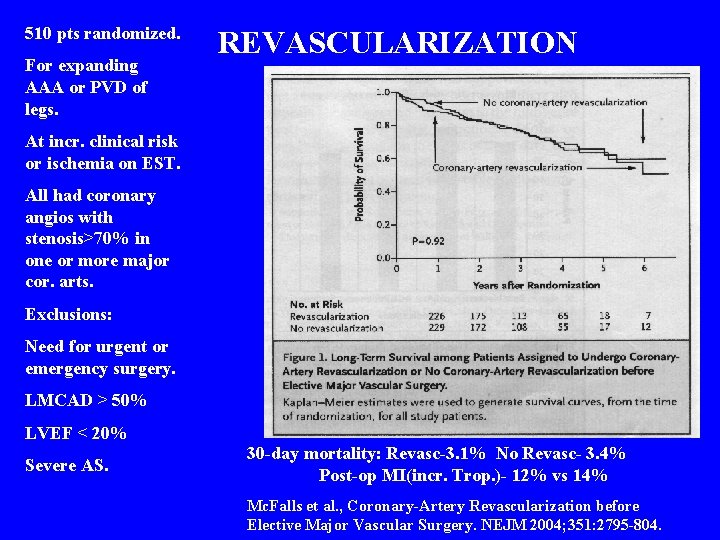
510 pts randomized. For expanding AAA or PVD of legs. REVASCULARIZATION At incr. clinical risk or ischemia on EST. All had coronary angios with stenosis>70% in one or more major cor. arts. Exclusions: Need for urgent or emergency surgery. LMCAD > 50% LVEF < 20% Severe AS. 30 -day mortality: Revasc-3. 1% No Revasc- 3. 4% Post-op MI(incr. Trop. )- 12% vs 14% Mc. Falls et al. , Coronary-Artery Revascularization before Elective Major Vascular Surgery. NEJM 2004; 351: 2795 -804.
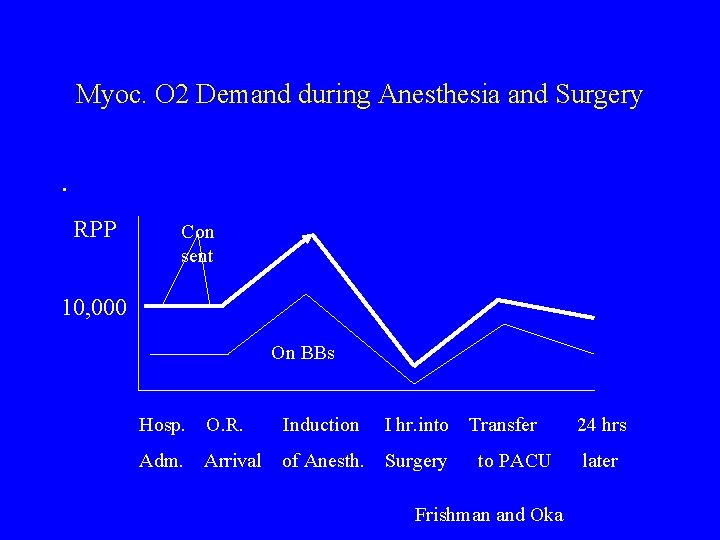
Myoc. O 2 Demand during Anesthesia and Surgery . RPP Con sent 10, 000 On BBs Hosp. O. R. Induction I hr. into Adm. Arrival of Anesth. Surgery Transfer to PACU Frishman and Oka 24 hrs later
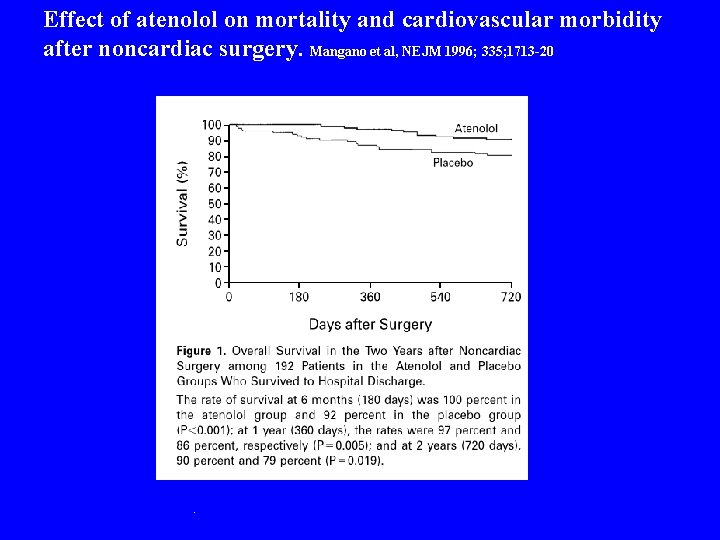
Effect of atenolol on mortality and cardiovascular morbidity after noncardiac surgery. Mangano et al, NEJM 1996; 335; 1713 -20 .
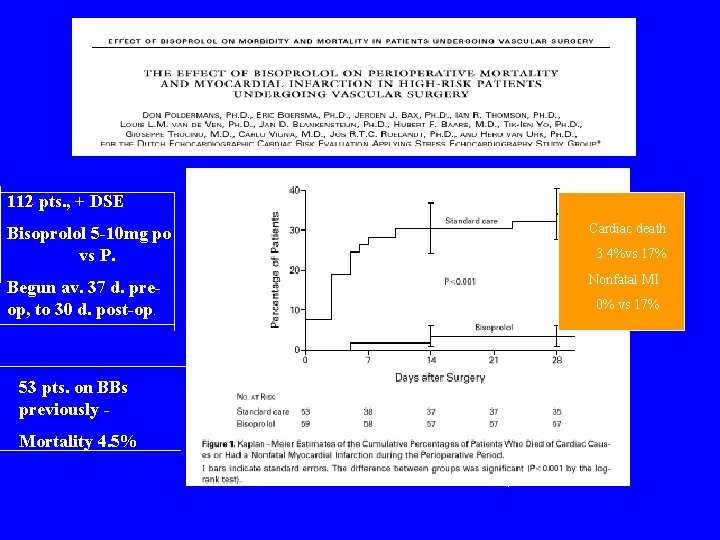
112 pts. , + DSE Bisoprolol 5 -10 mg po vs P. Begun av. 37 d. preop, to 30 d. post-op. Cardiac death Cardiacdeath 3. 4%vs 17% Nonfatal MI 0% vs 17% 53 pts. on BBs previously Mortality 4. 5% NEJM 1999; 341: 1789 -94
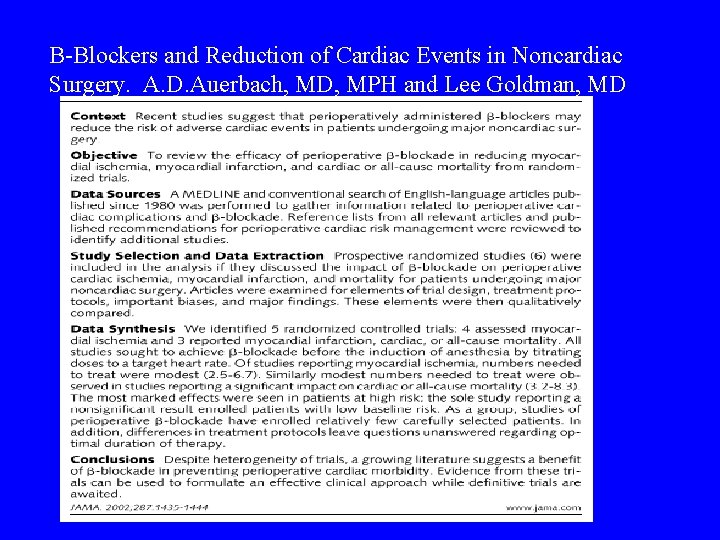
B-Blockers and Reduction of Cardiac Events in Noncardiac Surgery. A. D. Auerbach, MD, MPH and Lee Goldman, MD
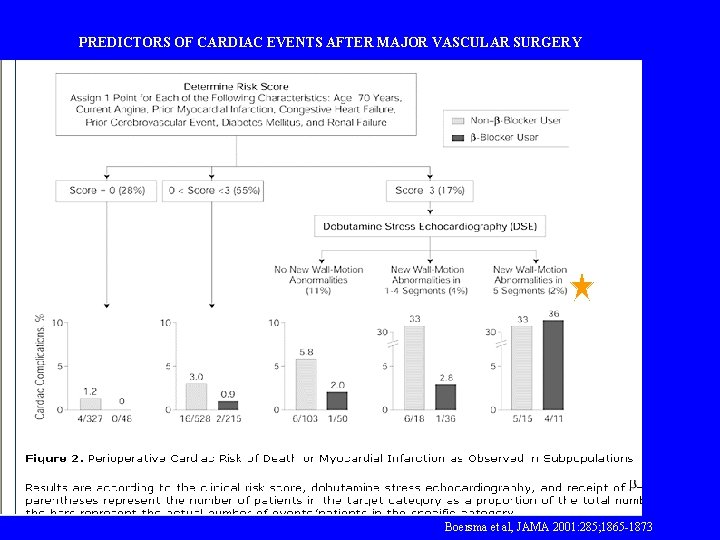
PREDICTORS OF CARDIAC EVENTS AFTER MAJOR VASCULAR SURGERY Boersma et al, JAMA 2001: 285; 1865 -1873
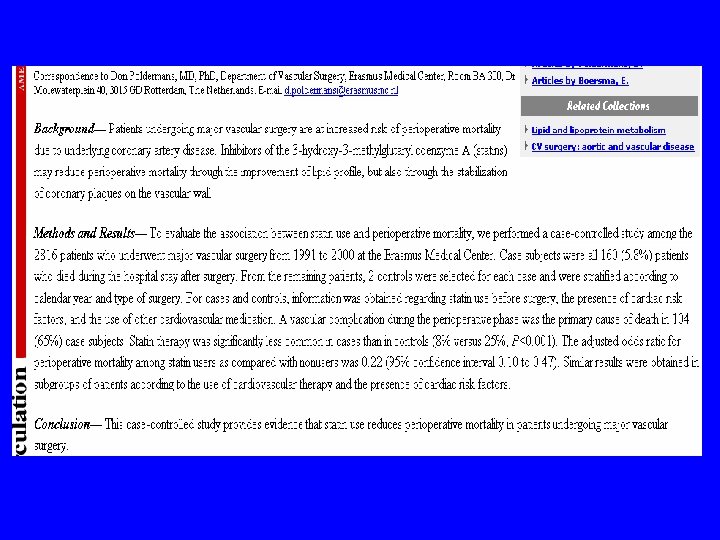
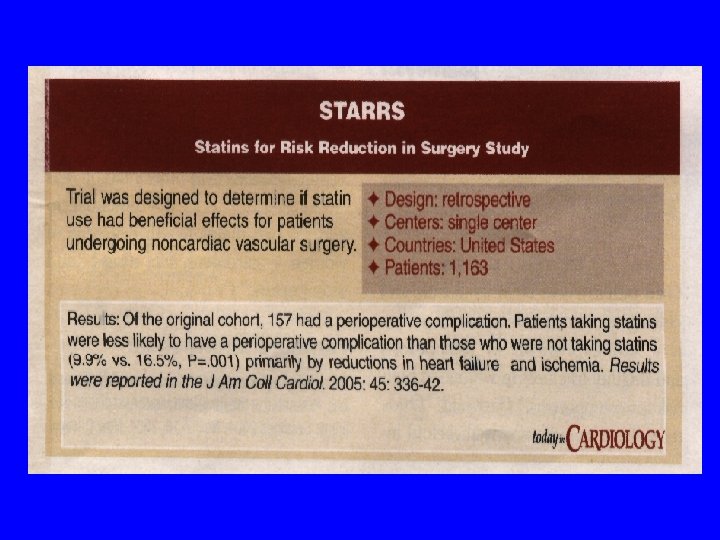
Case control study. 2816 pts. - vasc. Surgery- 160 died - each compared to 2 survivors matched by year and surgery. Statin use - in Deaths: 8%. - in Survivors: 25% OR for periop. mortality among statin users vs. nonusers: 0. 22 (0. 10 -0. 47)
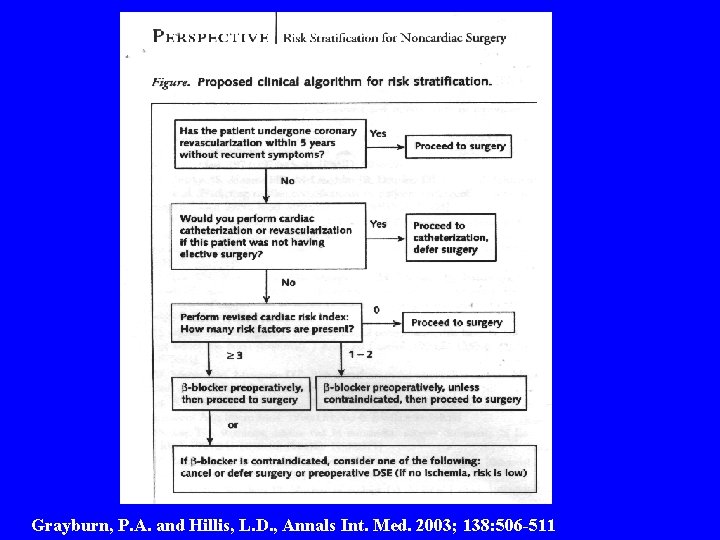
Grayburn, P. A. and Hillis, L. D. , Annals Int. Med. 2003; 138: 506 -511
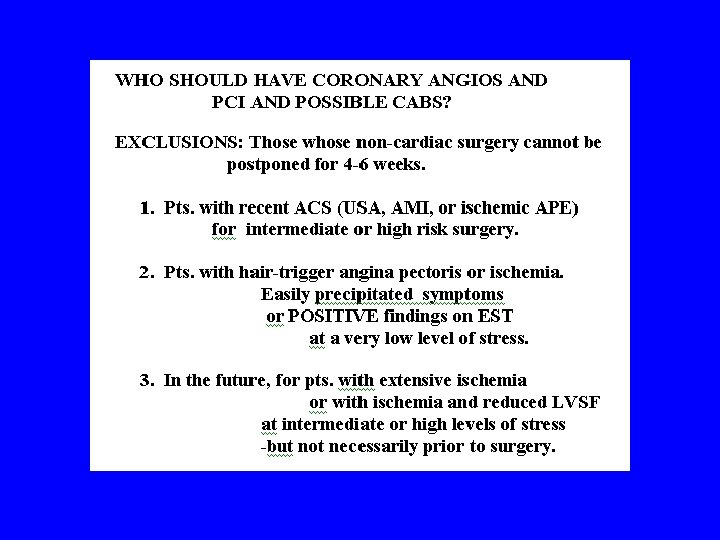
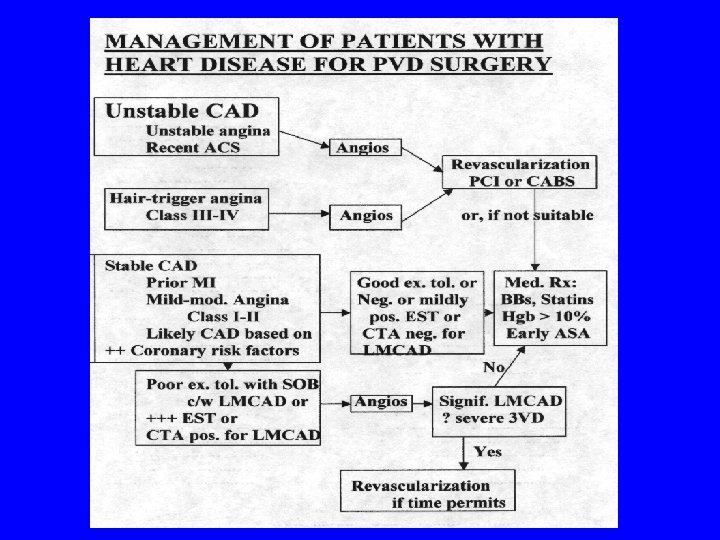
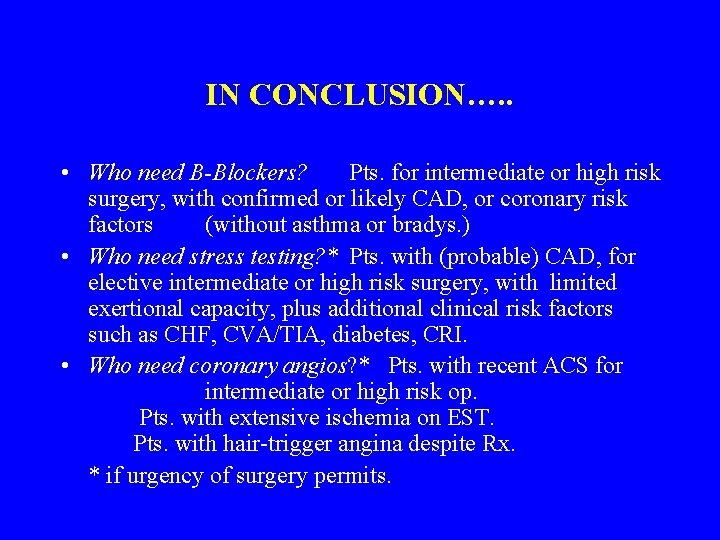
IN CONCLUSION…. . • Who need B-Blockers? Pts. for intermediate or high risk surgery, with confirmed or likely CAD, or coronary risk factors (without asthma or bradys. ) • Who need stress testing? * Pts. with (probable) CAD, for elective intermediate or high risk surgery, with limited exertional capacity, plus additional clinical risk factors such as CHF, CVA/TIA, diabetes, CRI. • Who need coronary angios? * Pts. with recent ACS for intermediate or high risk op. Pts. with extensive ischemia on EST. Pts. with hair-trigger angina despite Rx. * if urgency of surgery permits.
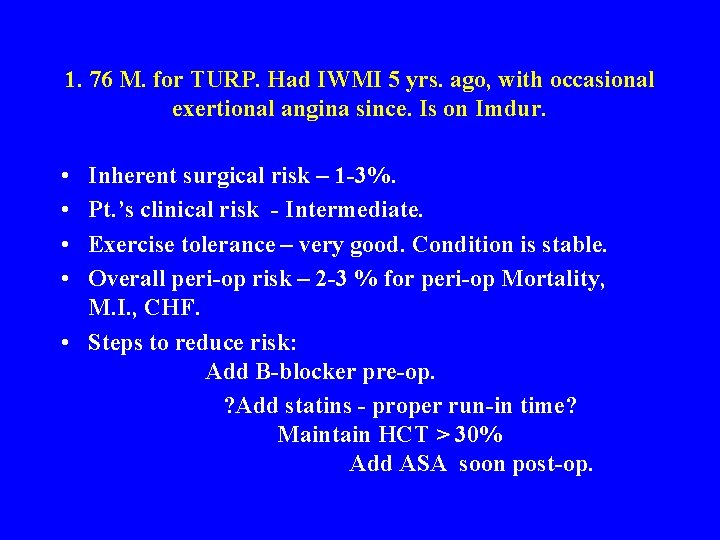
1. 76 M. for TURP. Had IWMI 5 yrs. ago, with occasional exertional angina since. Is on Imdur. • • Inherent surgical risk – 1 -3%. Pt. ’s clinical risk - Intermediate. Exercise tolerance – very good. Condition is stable. Overall peri-op risk – 2 -3 % for peri-op Mortality, M. I. , CHF. • Steps to reduce risk: Add B-blocker pre-op. ? Add statins - proper run-in time? Maintain HCT > 30% Add ASA soon post-op.
Qualitative assessment of operative risk CLINICAL FUNCTIONAL PREDICTORS IMPAIRMENT High risk Very limited ADLs e. g. , unstable e. g. , prior MI Low risk e. g. , stable abn’l EKG RISK HIGH or ++++ EST cor syndrome Intermediate risk PERIOP. High risk >5% emergent abd. op. - INTER- - MEDIATE Vigorous ADLs hight workload. RISK e. g. , AAA or - or (-) EST at INHERENT SURGICAL Intermediate 1 -5% e. g. TURP or ORIF LOW Low risk <1% e. g. , cataract op.
2. 72 yo W. –acute NSTEMI 2 wks. ago. Has 2 cm. left breast nodule. • Clinical risk intermediate or high, depending on ease of precipitating ischemia. • Surgical risk- low for biopsy - intermediate for mastectomy. • Moderate time pressures for interventionchiefly emotional: PCI and Plavix x 6 weeks to 3 -6 months? CABS and rehab x two months? EST and BB’s in one-two weeks?
3. 73 yo M. has ischemic rest pain. Also HTN, LVH and angina on Rx. Fem-pop bypass proposed. • • • Surgical risk- intermediate –to - high. Clinical risk- Intermediate. Exercise tolerance – limited by claudication. Time factor - < 30 days- no gangrene yet. Options? - BB’s -EST stratification - PCI - CABS • If 2 -block claudication w/o rest pain? Med. management or possibly iliac stent. Future CAD risk stratifiction.
4. 54 yo W. needs hysterectomy, has anemia. Has HTN and NSSTTC. • Surgical risk is intermediate; low if laparoscopic. • Clinical risk low (hypertension) - or intermediate ( if NSSTTC are significant and new. ) • Exercise tolerance very good. • Time factor – not urgent. • Steps: Obtain old EKGs. Start HTN Rx- BB’s, diuretics, ACE-inhibs. Consider EST if duration of STTC is unknown.
5. 80 yo W. , left hip IT fracture x 5 wks, history of HTN, and atrial fibrillation. • Heart rate control- BB’s, CCB’s, digoxin. • Heart disease assessment – Px, 2 DE. Stress testing and revascularization are precluded by the fracture. • Anticoagulation Rx- indicated but not urgent. Long term use will depend on reliability and communication issues. • Orthopedic time frame – elective at this point.
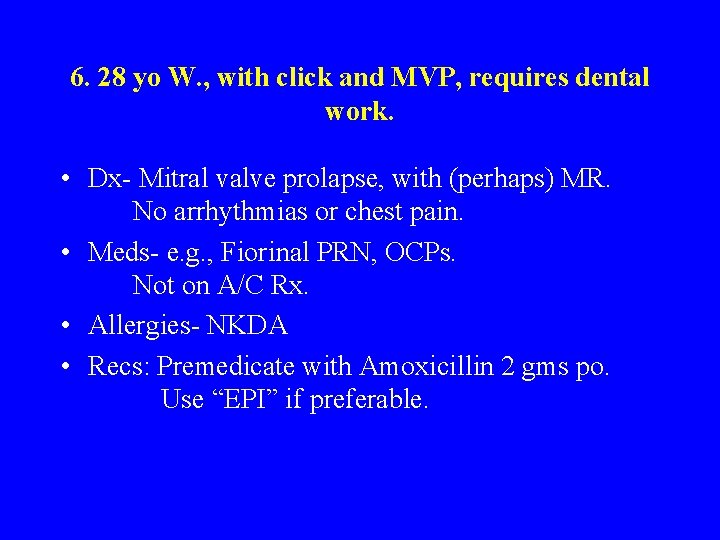
6. 28 yo W. , with click and MVP, requires dental work. • Dx- Mitral valve prolapse, with (perhaps) MR. No arrhythmias or chest pain. • Meds- e. g. , Fiorinal PRN, OCPs. Not on A/C Rx. • Allergies- NKDA • Recs: Premedicate with Amoxicillin 2 gms po. Use “EPI” if preferable.
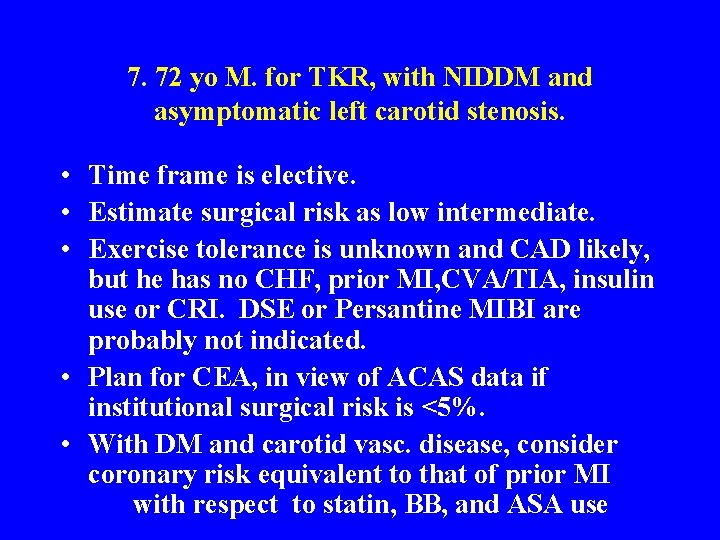
7. 72 yo M. for TKR, with NIDDM and asymptomatic left carotid stenosis. • Time frame is elective. • Estimate surgical risk as low intermediate. • Exercise tolerance is unknown and CAD likely, but he has no CHF, prior MI, CVA/TIA, insulin use or CRI. DSE or Persantine MIBI are probably not indicated. • Plan for CEA, in view of ACAS data if institutional surgical risk is <5%. • With DM and carotid vasc. disease, consider coronary risk equivalent to that of prior MI with respect to statin, BB, and ASA use
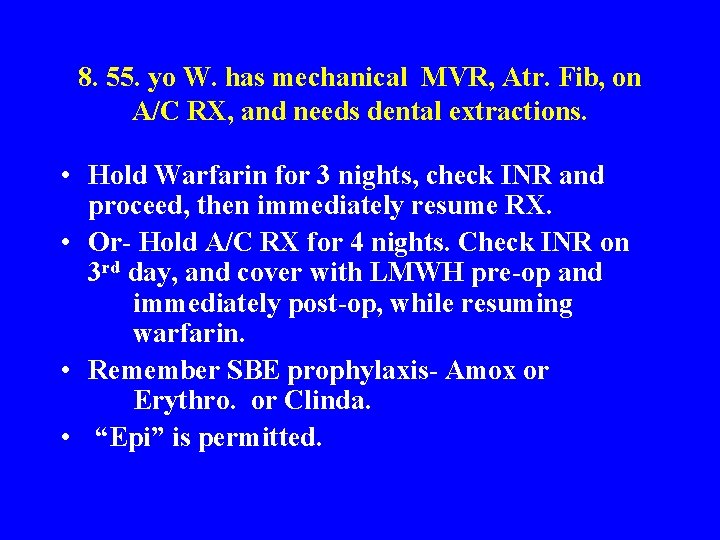
8. 55. yo W. has mechanical MVR, Atr. Fib, on A/C RX, and needs dental extractions. • Hold Warfarin for 3 nights, check INR and proceed, then immediately resume RX. • Or- Hold A/C RX for 4 nights. Check INR on 3 rd day, and cover with LMWH pre-op and immediately post-op, while resuming warfarin. • Remember SBE prophylaxis- Amox or Erythro. or Clinda. • “Epi” is permitted.