CHAPTER 7 QUADRATIC EQUATIONS AND FUNCTIONS 7 1








- Slides: 67
CHAPTER 7 QUADRATIC EQUATIONS AND FUNCTIONS
7 -1 Completing the Square
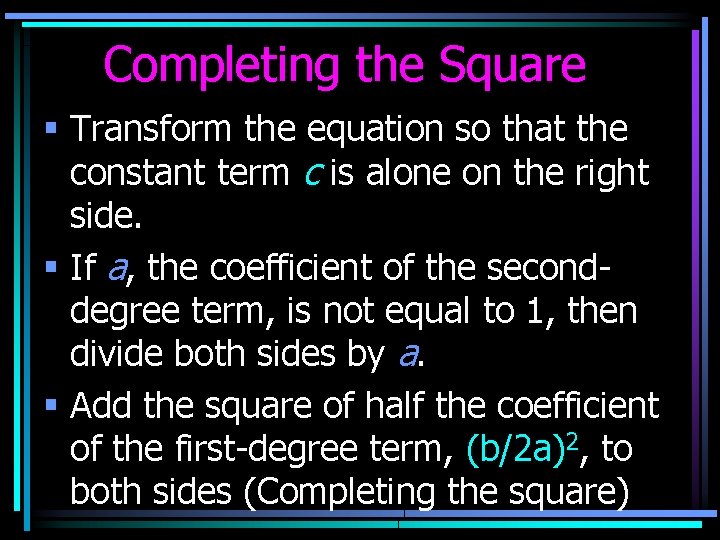
Completing the Square § Transform the equation so that the constant term c is alone on the right side. § If a, the coefficient of the seconddegree term, is not equal to 1, then divide both sides by a. § Add the square of half the coefficient of the first-degree term, (b/2 a)2, to both sides (Completing the square)
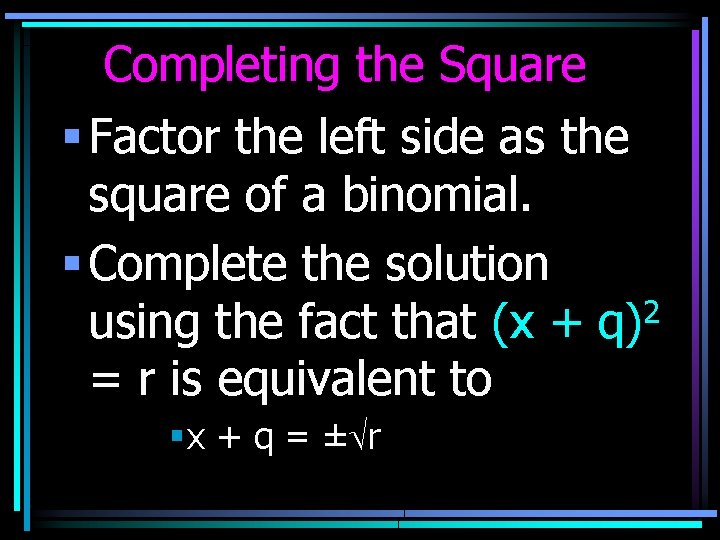
Completing the Square § Factor the left side as the square of a binomial. § Complete the solution 2 using the fact that (x + q) = r is equivalent to § x + q = ± r
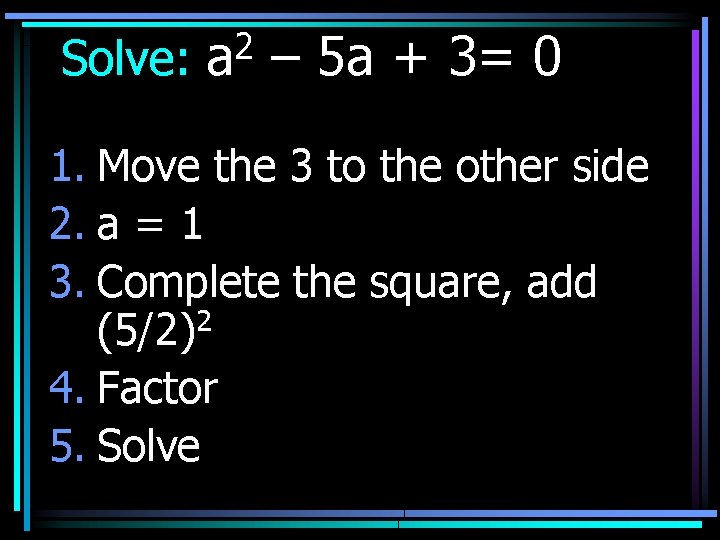
Solve: 2 a – 5 a + 3= 0 1. Move the 3 to the other side 2. a = 1 3. Complete the square, add 2 (5/2) 4. Factor 5. Solve
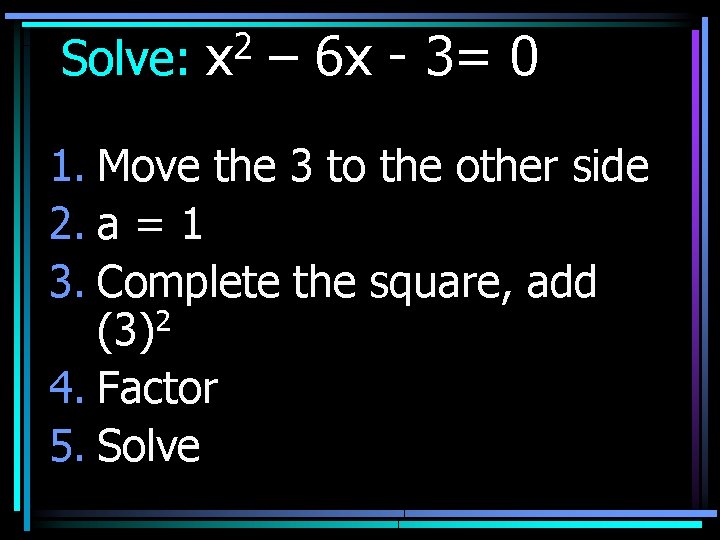
Solve: 2 x – 6 x - 3= 0 1. Move the 3 to the other side 2. a = 1 3. Complete the square, add 2 (3) 4. Factor 5. Solve
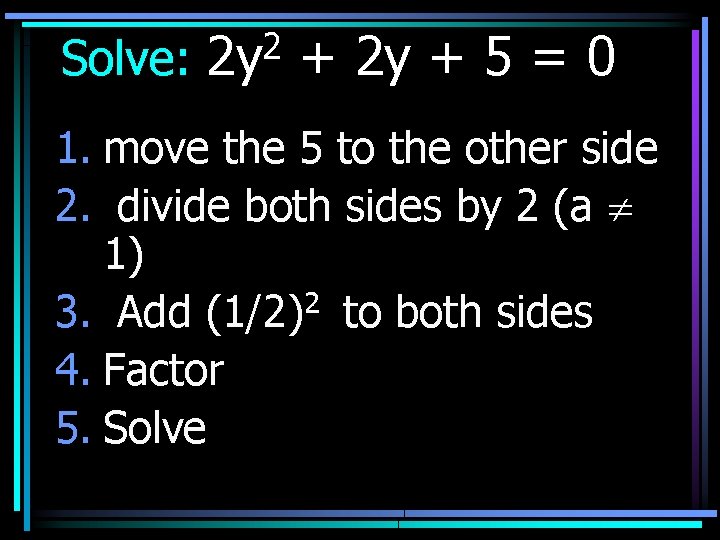
Solve: 2 2 y + 5 = 0 1. move the 5 to the other side 2. divide both sides by 2 (a 1) 3. Add (1/2)2 to both sides 4. Factor 5. Solve
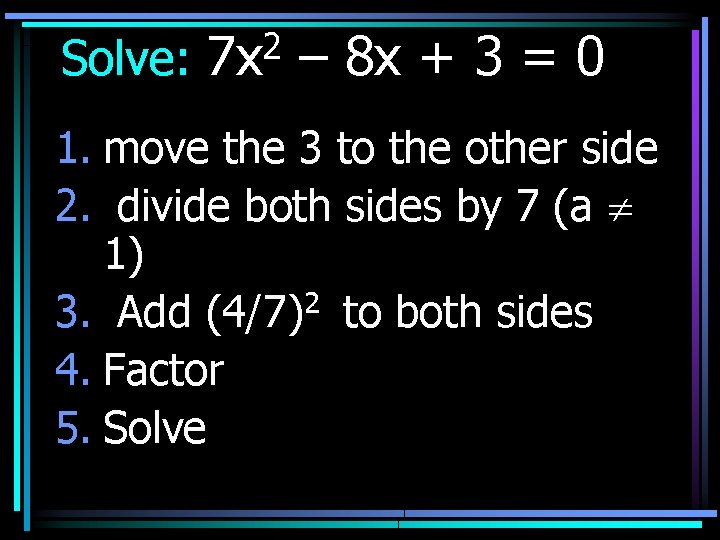
Solve: 2 7 x – 8 x + 3 = 0 1. move the 3 to the other side 2. divide both sides by 7 (a 1) 3. Add (4/7)2 to both sides 4. Factor 5. Solve
7 -2 Quadratic Formula
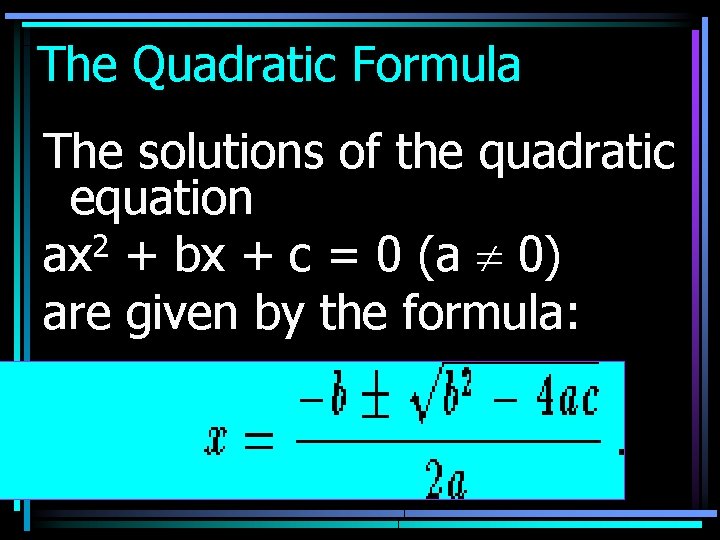
The Quadratic Formula The solutions of the quadratic equation ax 2 + bx + c = 0 (a 0) are given by the formula:
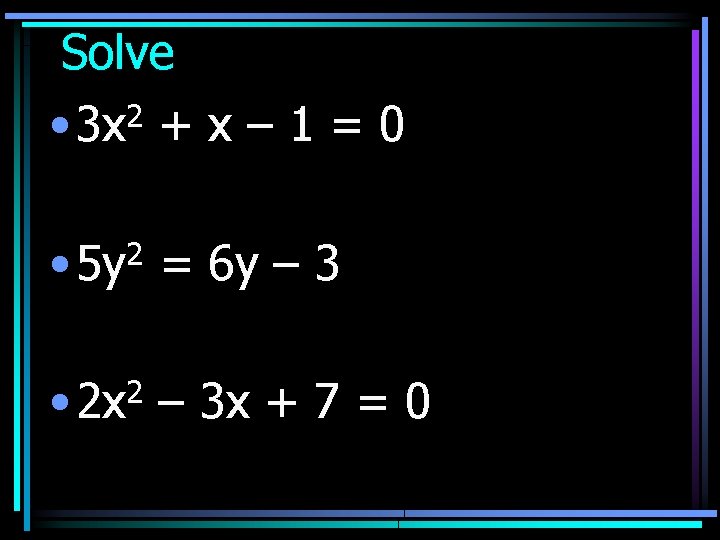
Solve 2 • 3 x +x– 1=0 • 5 y 2 = 6 y – 3 2 • 2 x – 3 x + 7 = 0
7 -3 The Discriminant
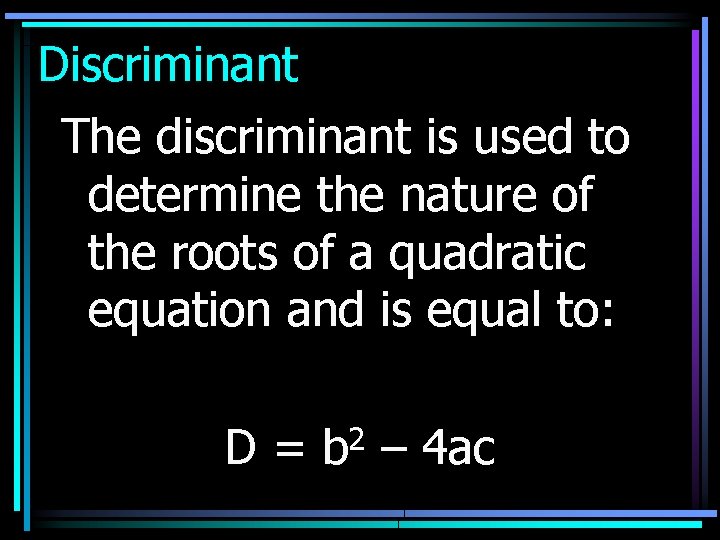
Discriminant The discriminant is used to determine the nature of the roots of a quadratic equation and is equal to: D= 2 b – 4 ac
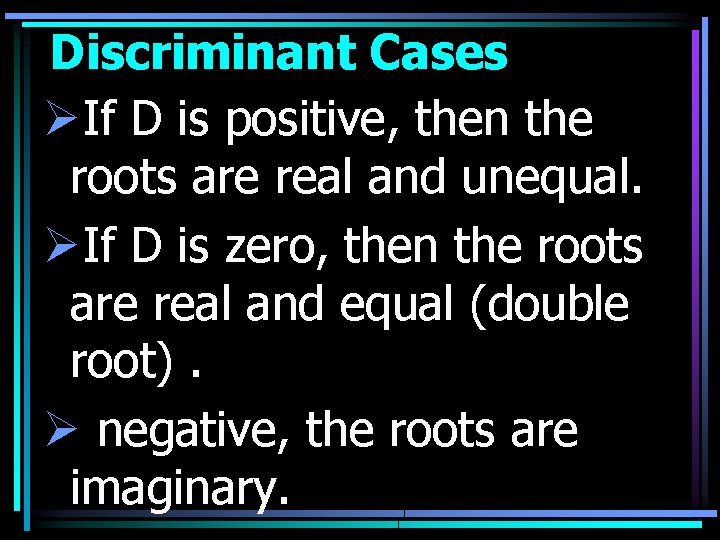
Discriminant Cases ØIf D is positive, then the roots are real and unequal. ØIf D is zero, then the roots are real and equal (double root). Ø negative, the roots are imaginary.
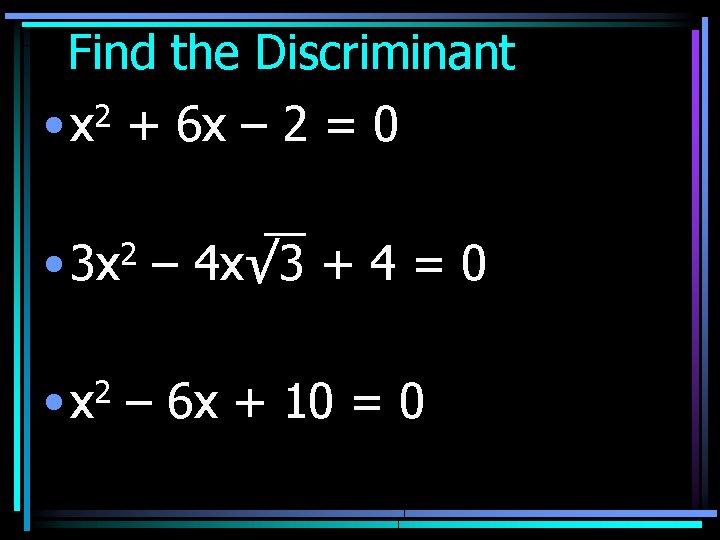
Find the Discriminant 2 • x + 6 x – 2 = 0 • 3 x 2 – 4 x√ 3 + 4 = 0 2 • x – 6 x + 10 = 0
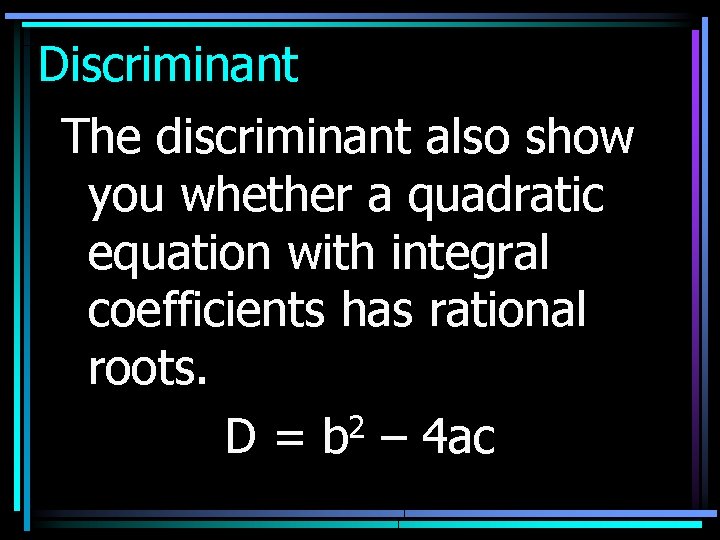
Discriminant The discriminant also show you whether a quadratic equation with integral coefficients has rational roots. 2 D = b – 4 ac
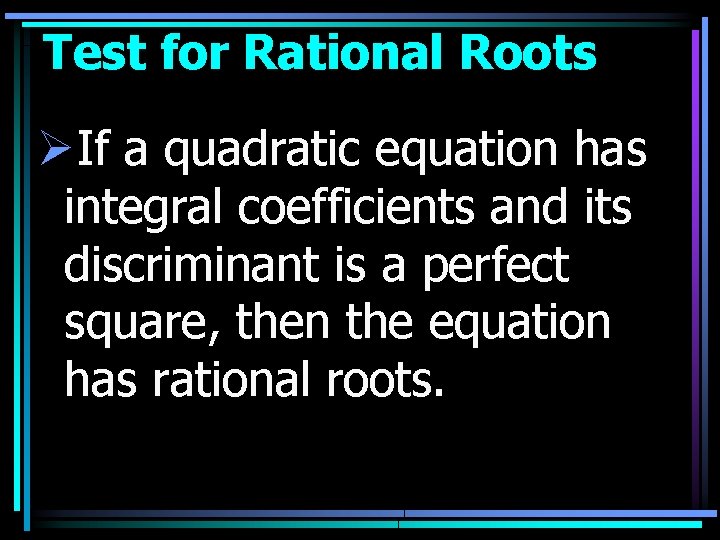
Test for Rational Roots ØIf a quadratic equation has integral coefficients and its discriminant is a perfect square, then the equation has rational roots.
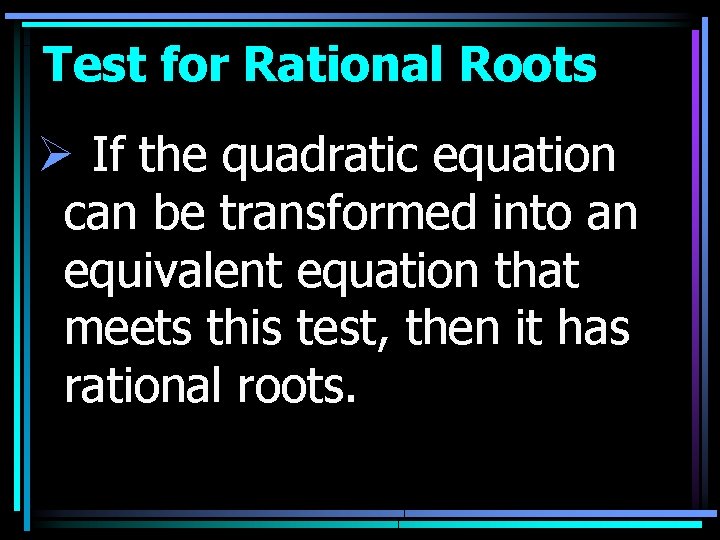
Test for Rational Roots Ø If the quadratic equation can be transformed into an equivalent equation that meets this test, then it has rational roots.
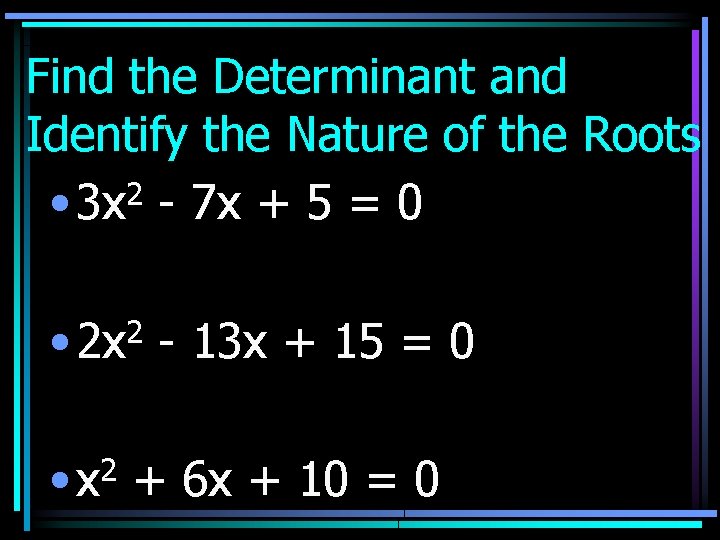
Find the Determinant and Identify the Nature of the Roots • 3 x 2 - 7 x + 5 = 0 2 • 2 x - 13 x + 15 = 0 • x 2 + 6 x + 10 = 0
7 -4 Equations in Quadratic Form
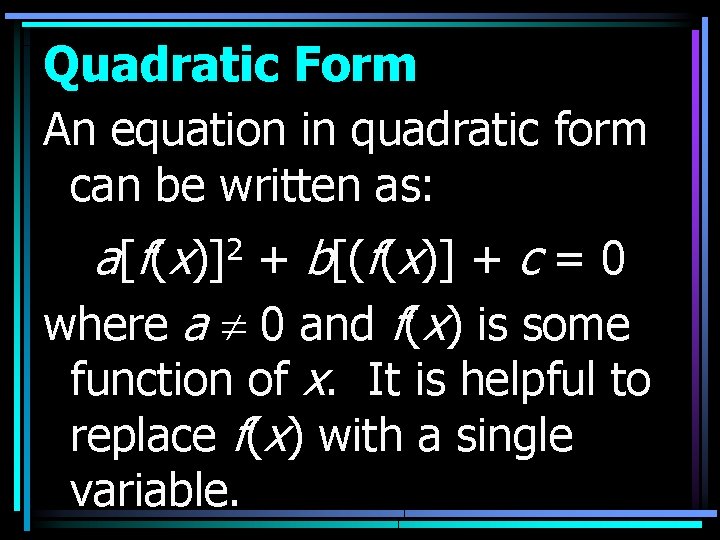
Quadratic Form An equation in quadratic form can be written as: a[f(x)]2 + b[(f(x)] + c = 0 where a 0 and f(x) is some function of x. It is helpful to replace f(x) with a single variable.
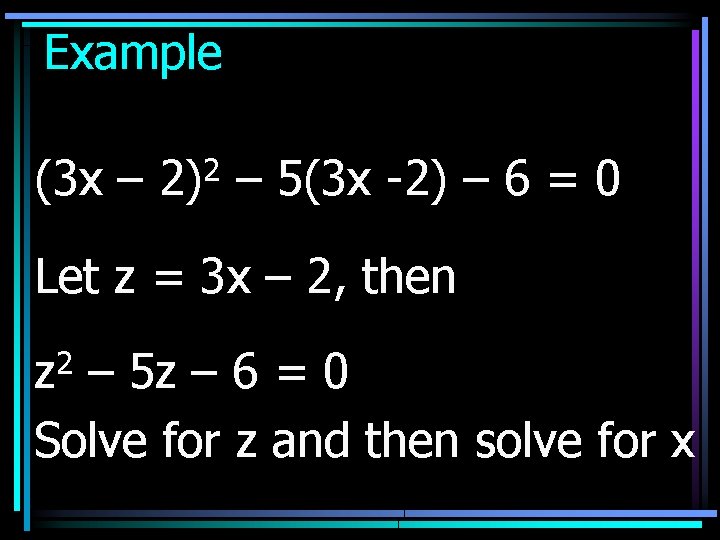
Example (3 x – 2)2 – 5(3 x -2) – 6 = 0 Let z = 3 x – 2, then 2 z – 5 z – 6 = 0 Solve for z and then solve for x
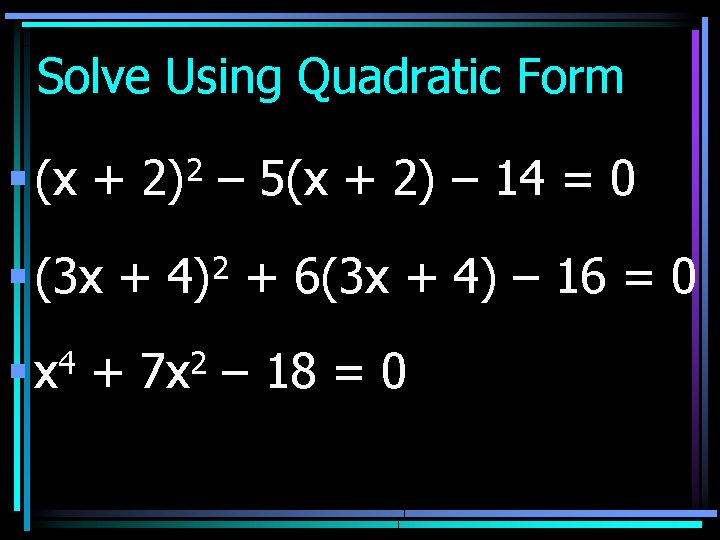
Solve Using Quadratic Form § (x + 2)2 – 5(x + 2) – 14 = 0 § (3 x + 4 §x + 2 4) 2 7 x + 6(3 x + 4) – 16 = 0 – 18 = 0
7 -5 Graphing y – k = a(x- 2 h)
Parabola is the set of all points in the plane equidistant from a given line and a given point not on the line. Parabolas have an axis of symmetry (mirror image) either the x-axis or the y-axis. and
Parabola The point where the parabola crosses it axis is the vertex. The graph is a smooth curve.
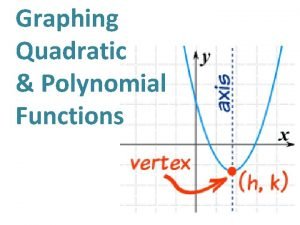
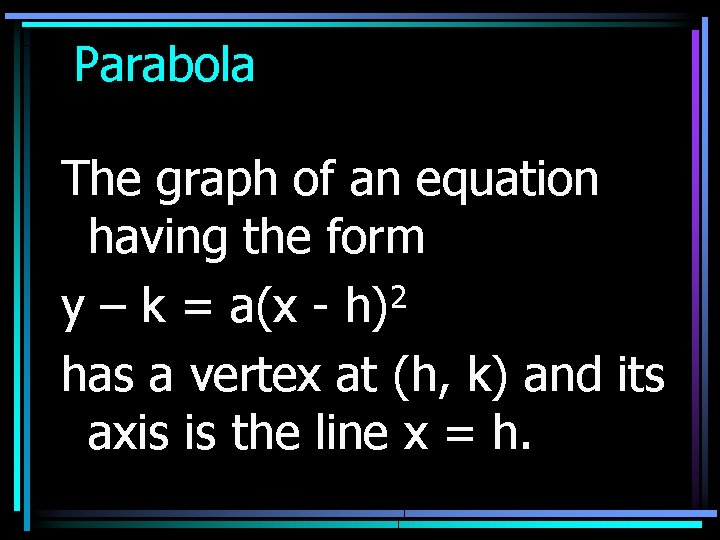
Parabola The graph of an equation having the form 2 y – k = a(x - h) has a vertex at (h, k) and its axis is the line x = h.
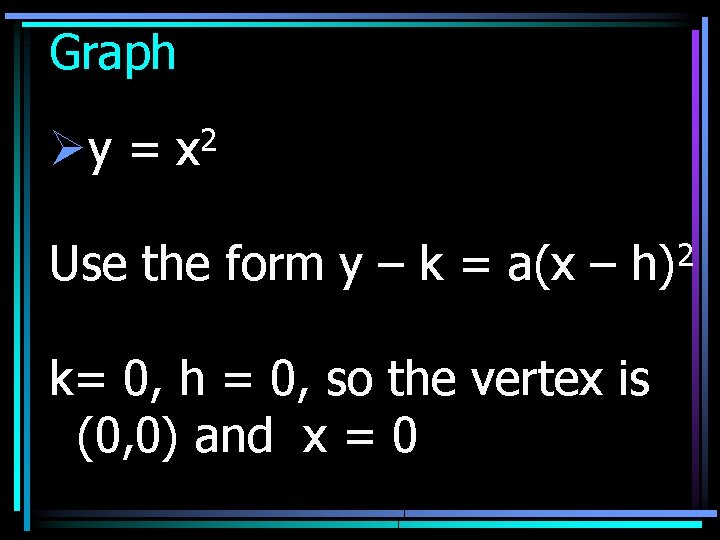
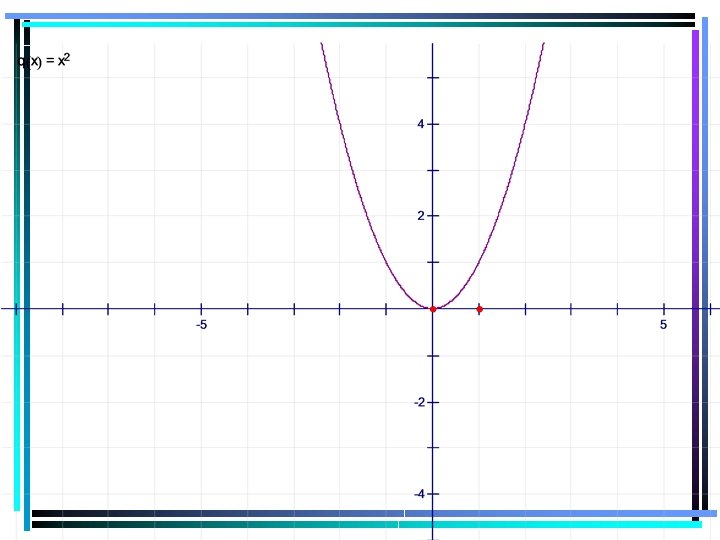
Graph Øy = 2 x Use the form y – k = a(x – 2 h) k= 0, h = 0, so the vertex is (0, 0) and x = 0
Table of Values 0 0 1 1 -1 1 2 4 -2 4
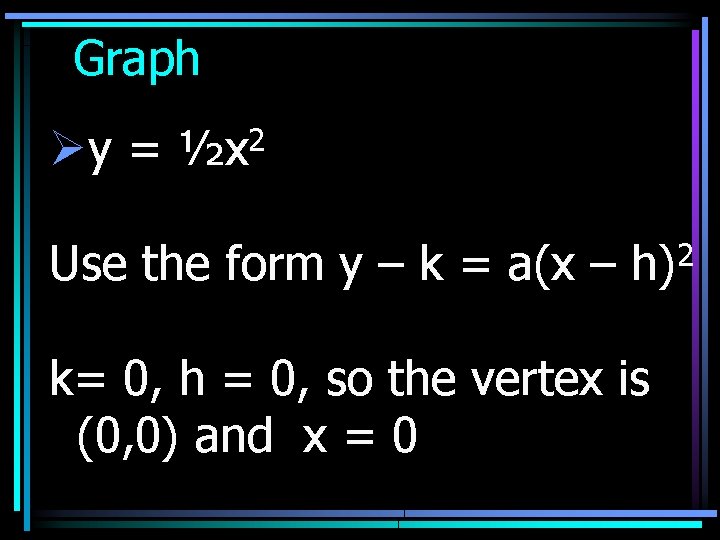
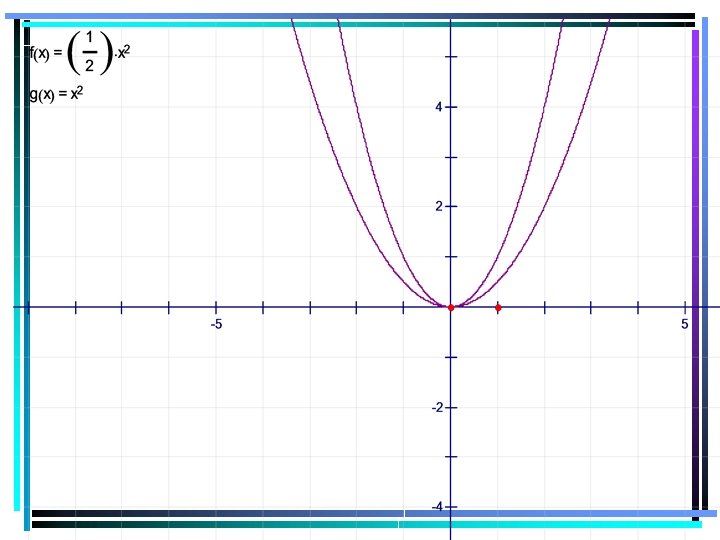
Graph Øy = 2 ½x Use the form y – k = a(x – 2 h) k= 0, h = 0, so the vertex is (0, 0) and x = 0
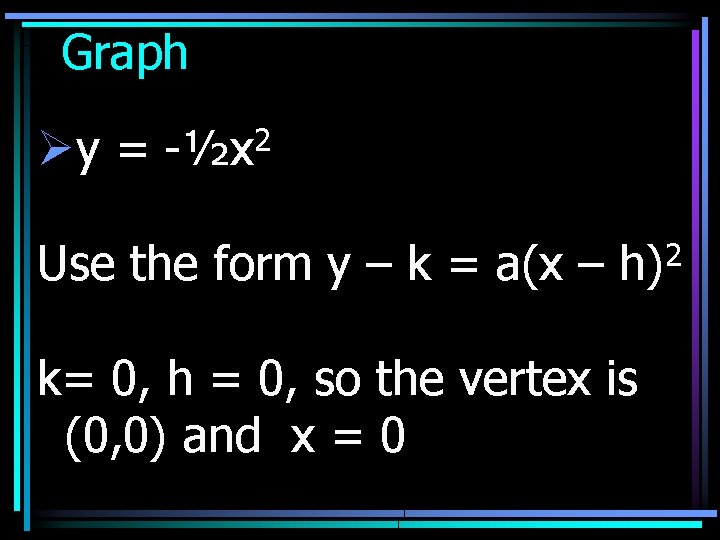
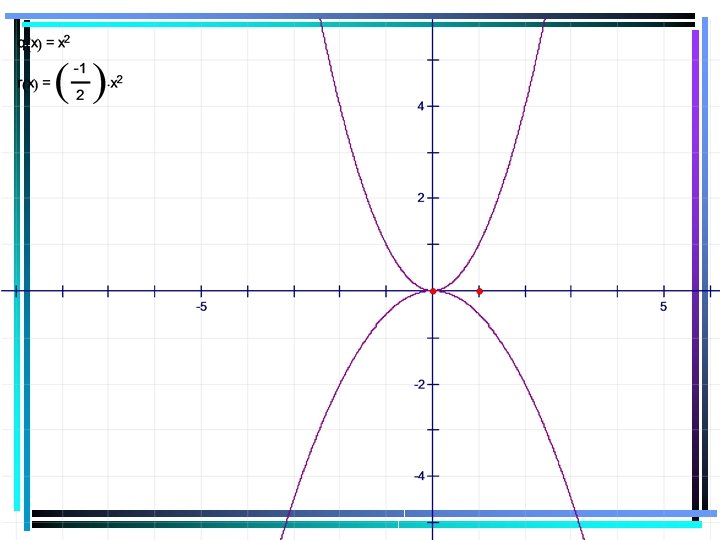
Graph Øy = 2 -½x Use the form y – k = a(x – 2 h) k= 0, h = 0, so the vertex is (0, 0) and x = 0
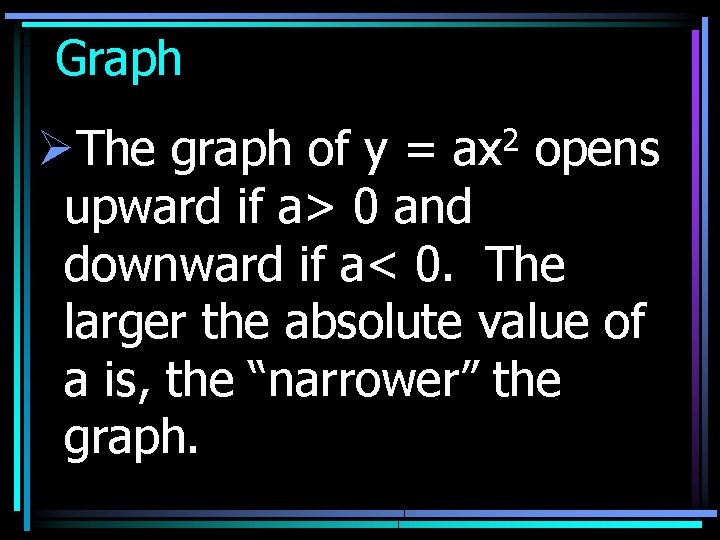
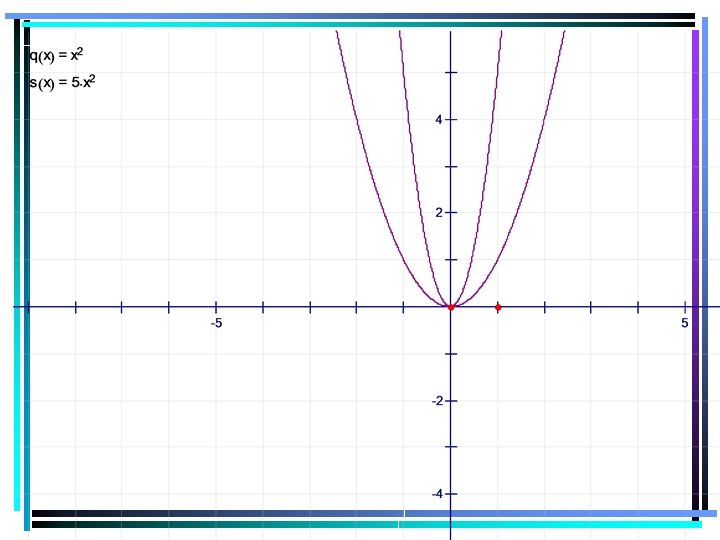
Graph 2 ax ØThe graph of y = opens upward if a> 0 and downward if a< 0. The larger the absolute value of a is, the “narrower” the graph.
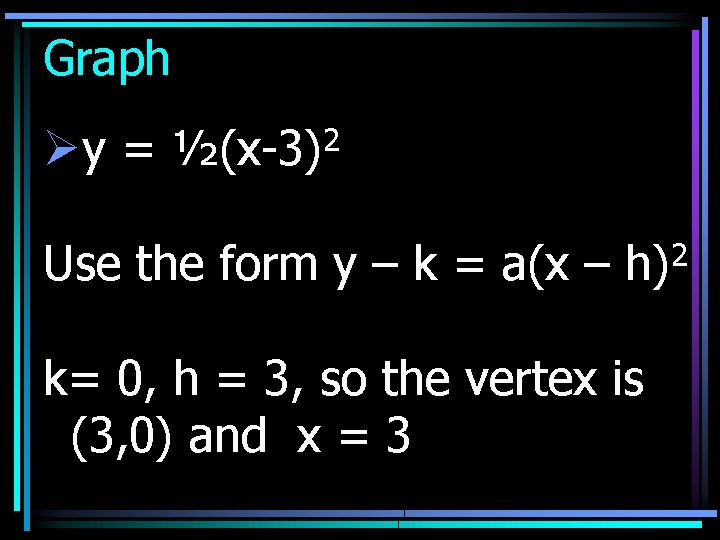
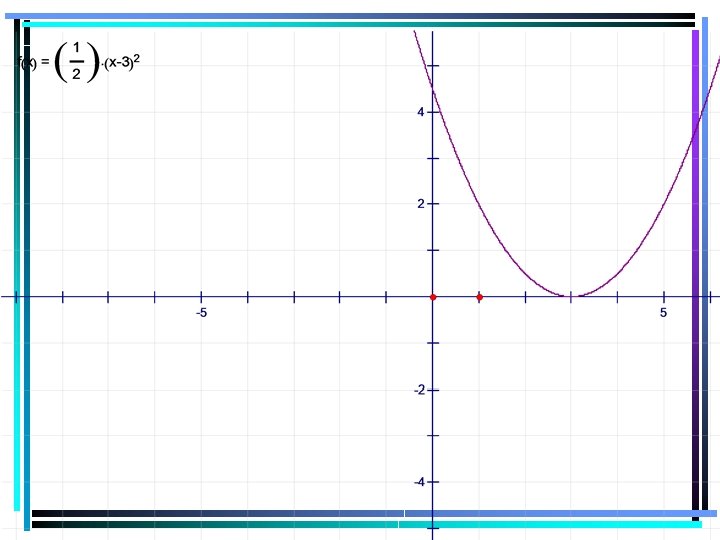
Graph Øy = 2 ½(x-3) Use the form y – k = a(x – 2 h) k= 0, h = 3, so the vertex is (3, 0) and x = 3
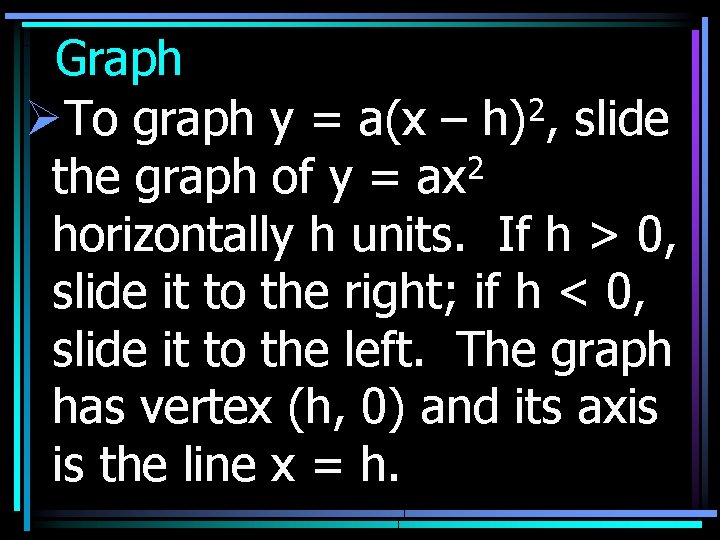
Graph ØTo graph y = a(x – h)2, slide 2 the graph of y = ax horizontally h units. If h > 0, slide it to the right; if h < 0, slide it to the left. The graph has vertex (h, 0) and its axis is the line x = h.
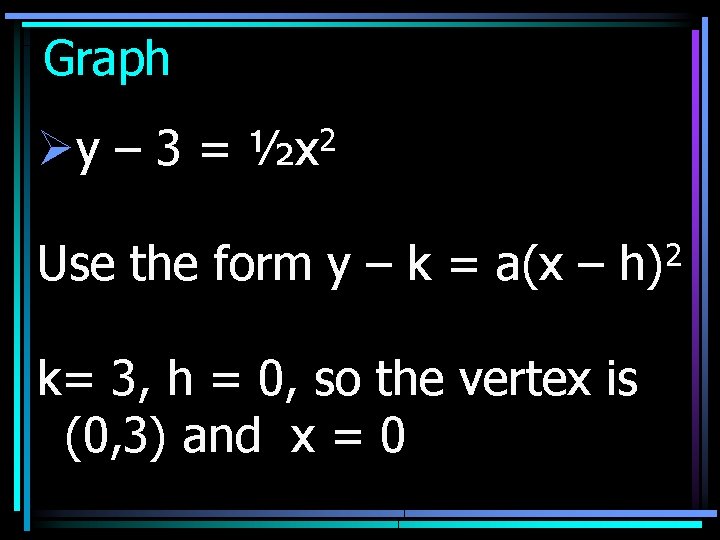
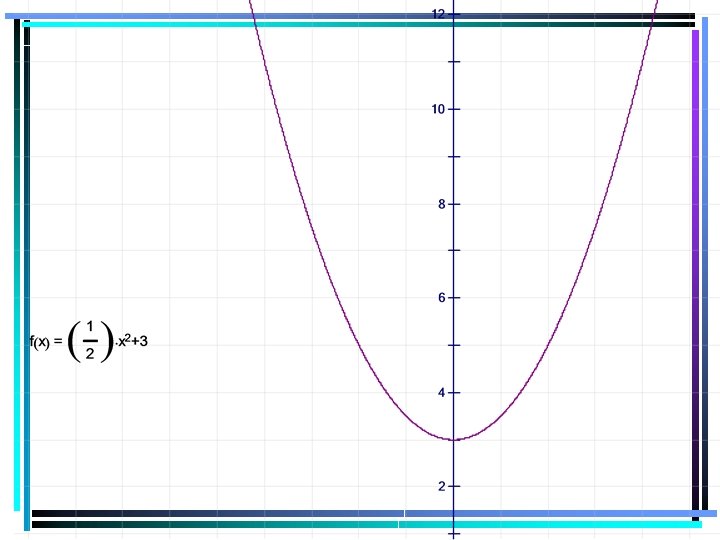
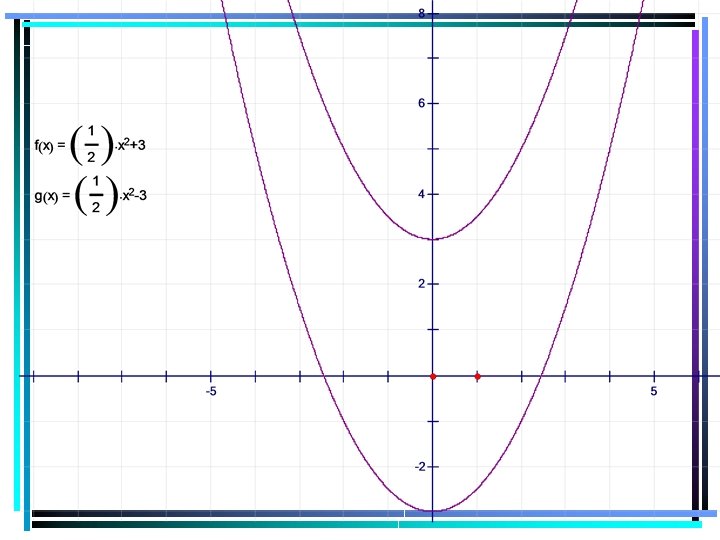
Graph Øy – 3 = 2 ½x Use the form y – k = a(x – 2 h) k= 3, h = 0, so the vertex is (0, 3) and x = 0
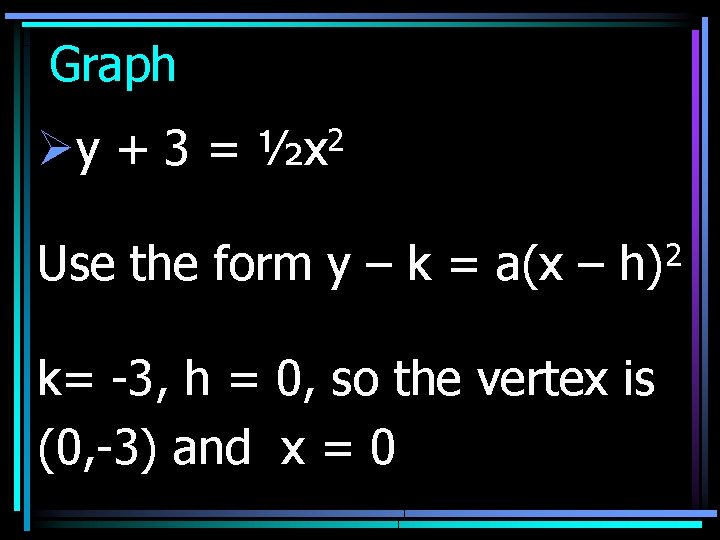
Graph Øy + 3 = 2 ½x Use the form y – k = a(x – 2 h) k= -3, h = 0, so the vertex is (0, -3) and x = 0
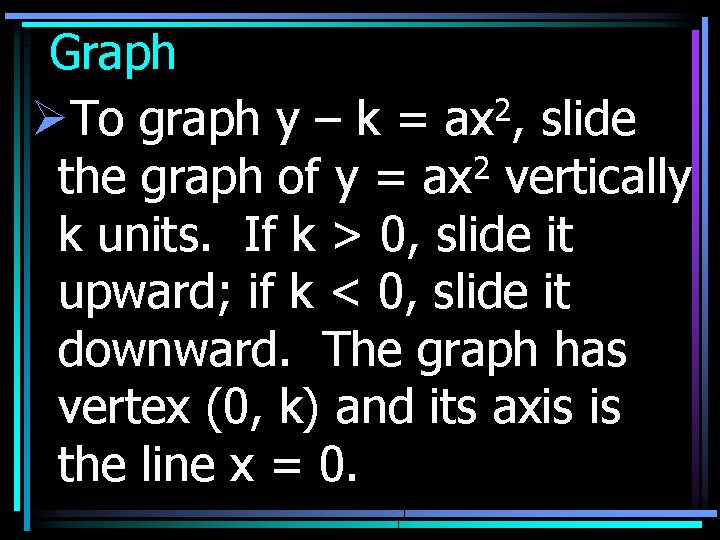
Graph ØTo graph y – k = ax 2, slide 2 the graph of y = ax vertically k units. If k > 0, slide it upward; if k < 0, slide it downward. The graph has vertex (0, k) and its axis is the line x = 0.
7 -6 Quadratic Functions
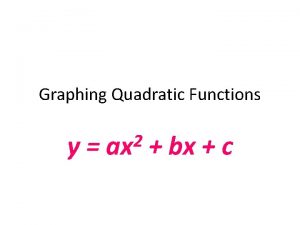
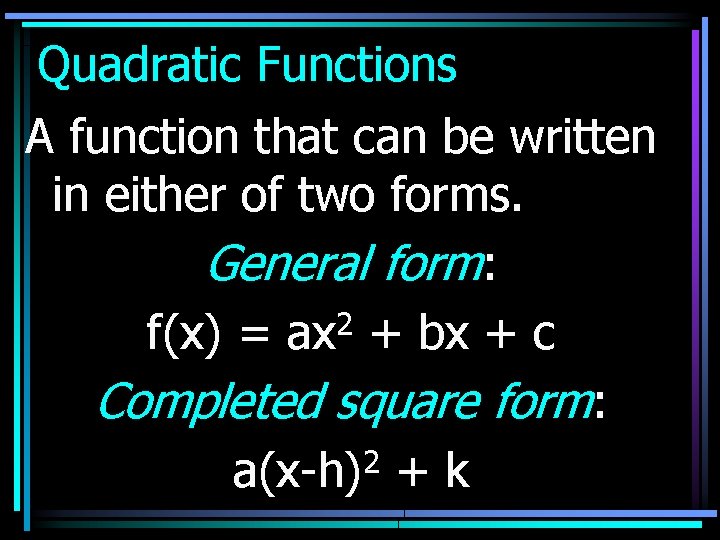
Quadratic Functions A function that can be written in either of two forms. General form: 2 f(x) = ax + bx + c Completed square form: a(x-h)2 + k
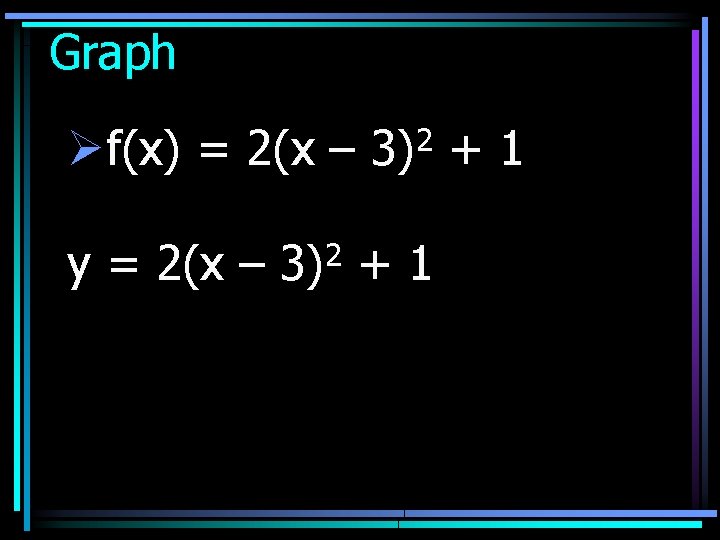
Graph Øf(x) = 2(x – y = 2(x – 2 3) +1 +1
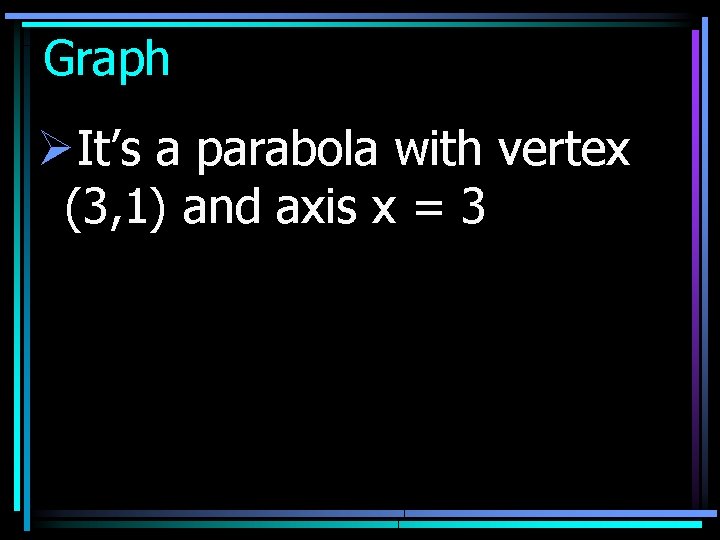
Graph ØIt’s a parabola with vertex (3, 1) and axis x = 3
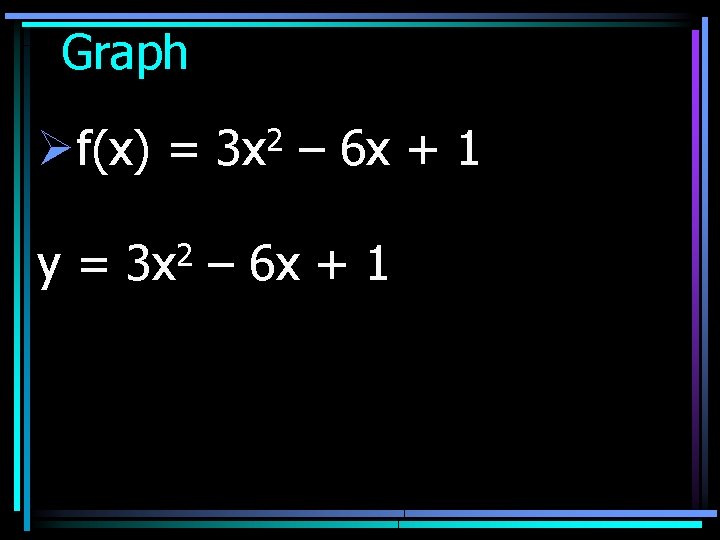
Graph Øf(x) = y= 2 3 x – 6 x + 1
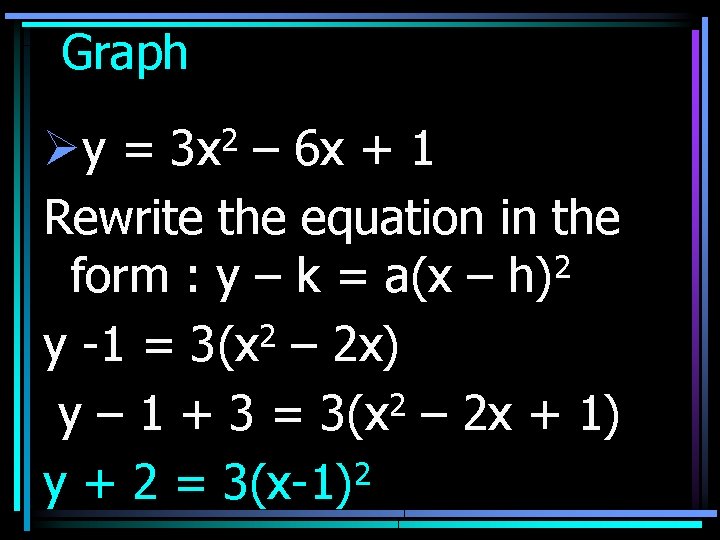
Graph 2 3 x Øy = – 6 x + 1 Rewrite the equation in the 2 form : y – k = a(x – h) 2 y -1 = 3(x – 2 x) 2 y – 1 + 3 = 3(x – 2 x + 1) y + 2 = 3(x-1)2
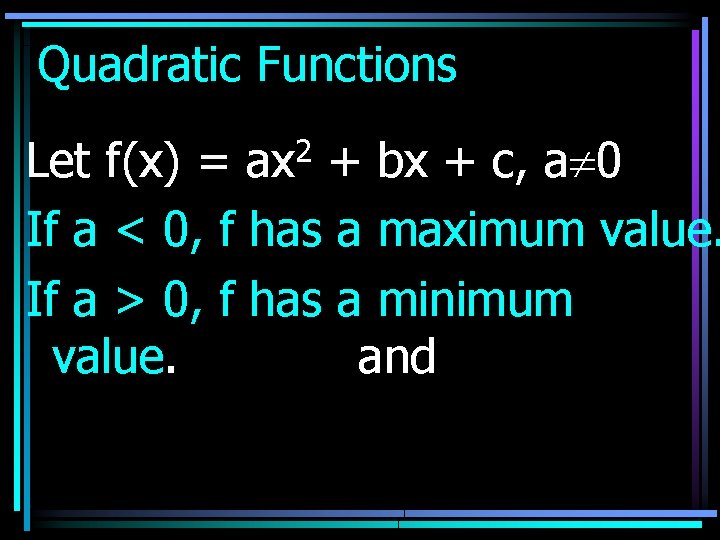
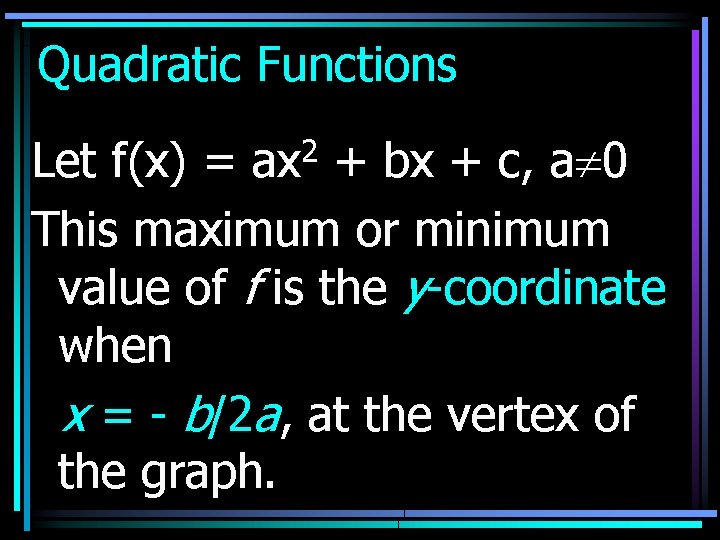
Quadratic Functions 2 ax Let f(x) = + bx + c, a 0 If a < 0, f has a maximum value. If a > 0, f has a minimum value. and
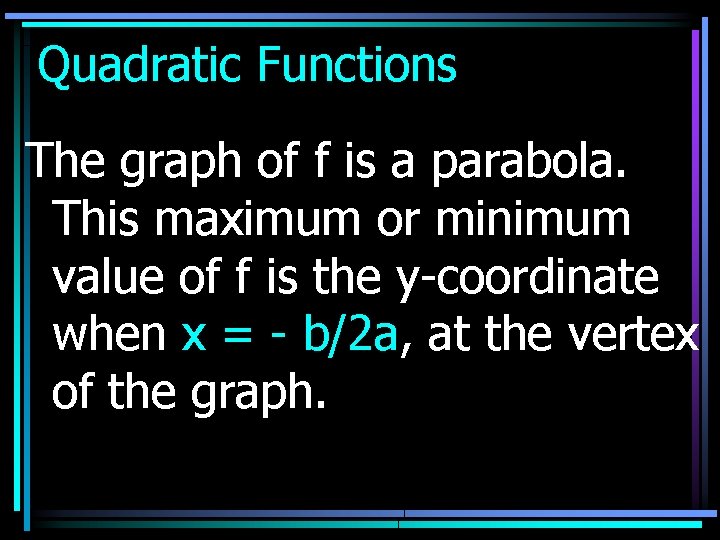
Quadratic Functions The graph of f is a parabola. This maximum or minimum value of f is the y-coordinate when x = - b/2 a, at the vertex of the graph.
Quadratic Functions 2 ax Let f(x) = + bx + c, a 0 This maximum or minimum value of f is the y-coordinate when x = - b/2 a, at the vertex of the graph.
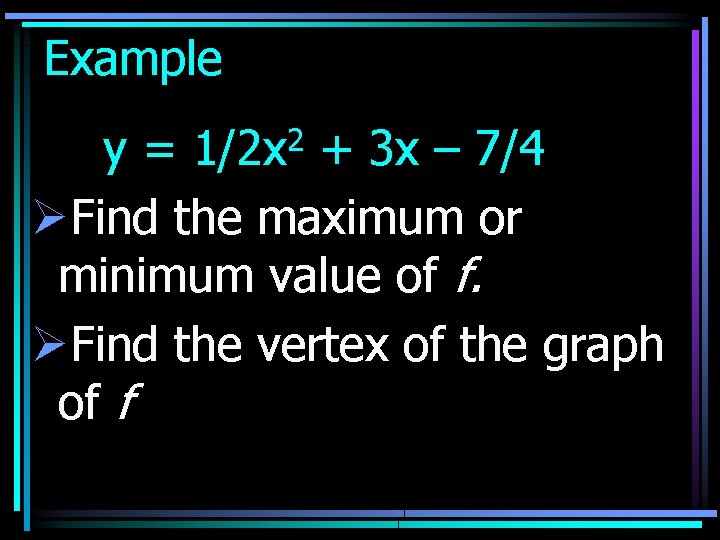
Example 2 1/2 x y= + 3 x – 7/4 ØFind the maximum or minimum value of f. ØFind the vertex of the graph of f
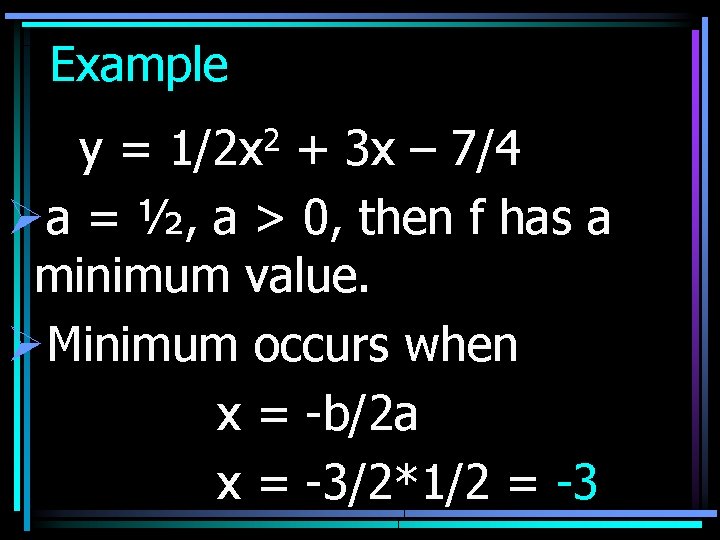
Example 2 1/2 x y= + 3 x – 7/4 Øa = ½, a > 0, then f has a minimum value. ØMinimum occurs when x = -b/2 a x = -3/2*1/2 = -3
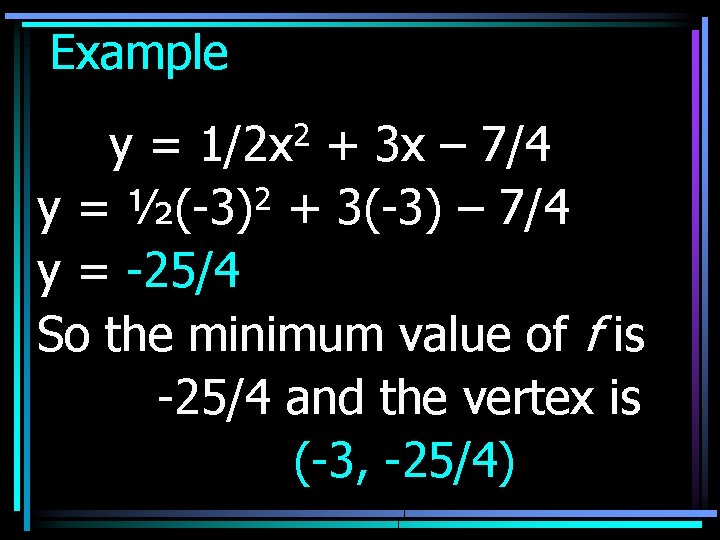
Example 2 1/2 x y= + 3 x – 7/4 y = ½(-3)2 + 3(-3) – 7/4 y = -25/4 So the minimum value of f is -25/4 and the vertex is (-3, -25/4)
7 -7 Writing Quadratic Equations and Functions
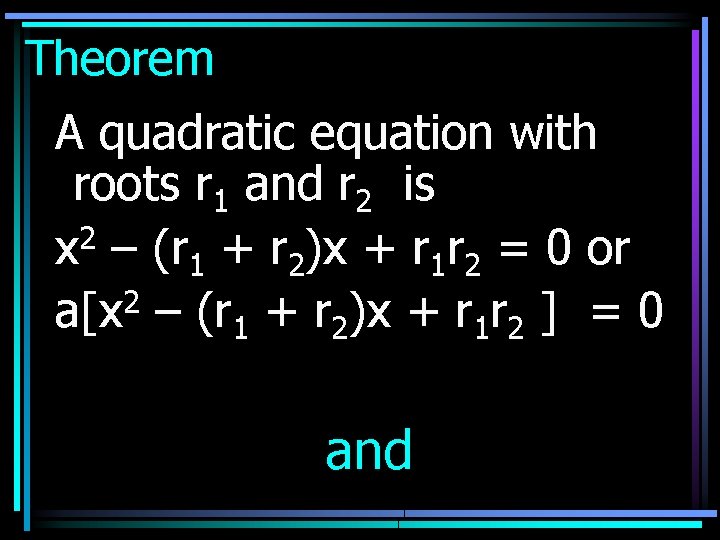
Theorem A quadratic equation with roots r 1 and r 2 is x 2 – (r 1 + r 2)x + r 1 r 2 = 0 or a[x 2 – (r 1 + r 2)x + r 1 r 2 ] = 0 and
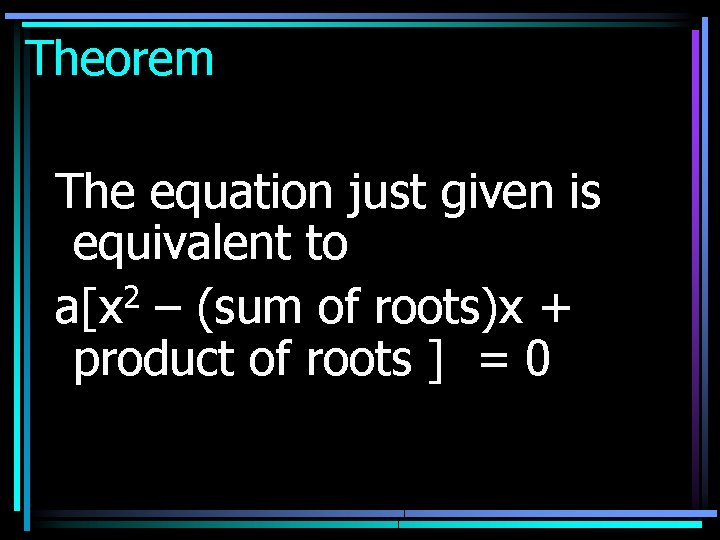
Theorem The equation just given is equivalent to a[x 2 – (sum of roots)x + product of roots ] = 0
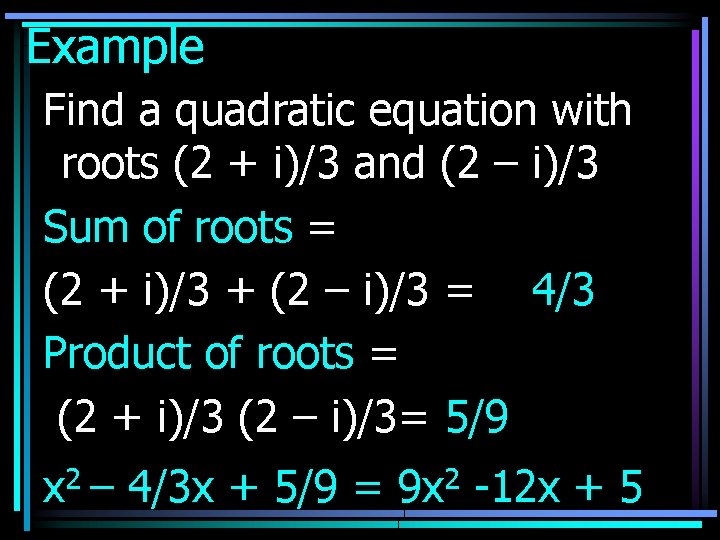
Example Find a quadratic equation with roots (2 + i)/3 and (2 – i)/3 Sum of roots = (2 + i)/3 + (2 – i)/3 = 4/3 Product of roots = (2 + i)/3 (2 – i)/3= 5/9 x 2 – 4/3 x + 5/9 = 9 x 2 -12 x + 5
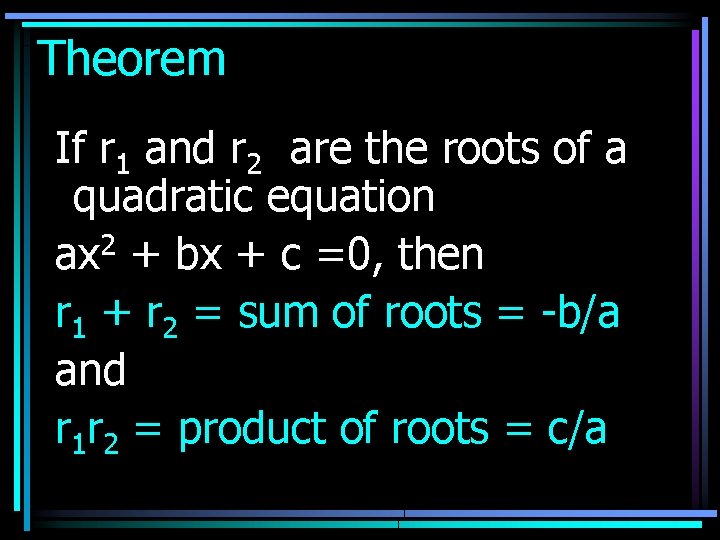
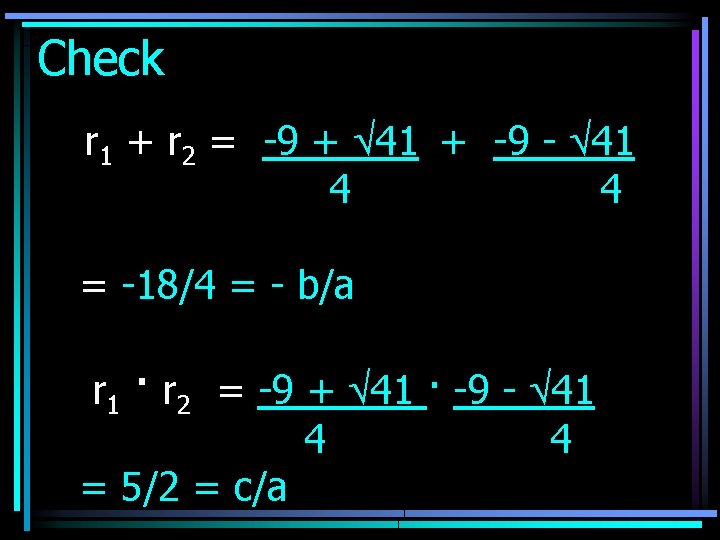
Theorem If r 1 and r 2 are the roots of a quadratic equation 2 ax + bx + c =0, then r 1 + r 2 = sum of roots = -b/a and r 1 r 2 = product of roots = c/a
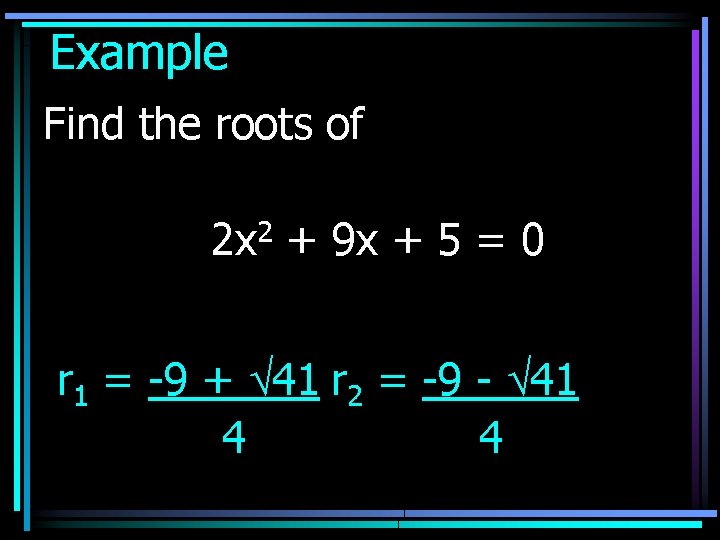
Example Find the roots of 2 x 2 + 9 x + 5 = 0 r 1 = -9 + 41 r 2 = -9 - 41 4 4
Check r 1 + r 2 = -9 + 41 + -9 - 41 4 4 = -18/4 = - b/a r 1 · r 2 = -9 + 41 · -9 - 41 = 5/2 = c/a 4 4
END