Area Wildlife CDE Training Spring 2019 2019 Area

- Slides: 100
Area Wildlife CDE Training Spring 2019
2019 Area Training Game Bird Biology Practicum
2019 AREA WILDLIFE CDE TRAINING GAME BIRD BIOLOGY PRACTICUM Identify the call provided: A. Redhead B. Blue-winged Teal C. Green-winged Teal D. Hooded Merganser E. Wood Duck #1
2019 AREA WILDLIFE CDE TRAINING GAME BIRD BIOLOGY PRACTICUM Identify the call provided: A. Woodcock B. Crow C. Hooded Merganser D. Redhead E. Canvasback #2
2019 AREA WILDLIFE CDE TRAINING GAME BIRD BIOLOGY PRACTICUM Identify the call provided: A. Bobwhite Quail B. Ruffed Grouse C. Mourning Dove D. Woodcock E. Wild Turkey #3
2019 AREA WILDLIFE CDE TRAINING GAME BIRD BIOLOGY PRACTICUM Identify the call provided: A. Bobwhite Quail B. Ruffed Grouse C. Mourning Dove D. Woodcock E. Wild Turkey #4
2019 AREA WILDLIFE CDE TRAINING GAME BIRD BIOLOGY PRACTICUM Identify the call provided: A. Woodcock B. Crow C. Redhead D. Hooded Merganser E. Canvasback #5
2019 AREA WILDLIFE CDE TRAINING GAME BIRD BIOLOGY PRACTICUM Identify what bird the egg came from: A. B. C. D. E. Mallard Wood Duck Canada Goose Crow Mourning Dove #6
2019 AREA WILDLIFE CDE TRAINING GAME BIRD BIOLOGY PRACTICUM Identify the specimen: A. B. C. D. E. Ring-necked Duck Wood Duck Mallard Blue-winged Teal Green-winged Teal #7
2019 AREA WILDLIFE CDE TRAINING GAME BIRD BIOLOGY PRACTICUM Identify the bird from the specimen: A. B. C. D. E. Bobwhite Quail Mourning Dove Canada Goose Wild Turkey Mallard #8
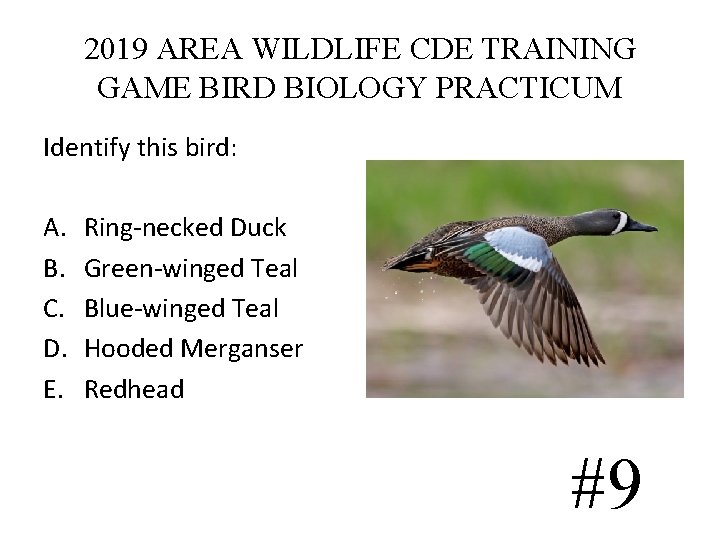
2019 AREA WILDLIFE CDE TRAINING GAME BIRD BIOLOGY PRACTICUM Identify this bird: A. B. C. D. E. Ring-necked Duck Green-winged Teal Blue-winged Teal Hooded Merganser Redhead #9
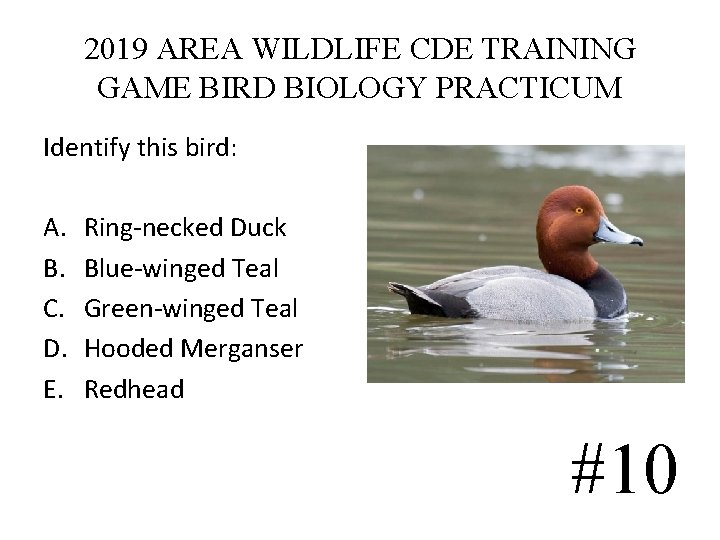
2019 AREA WILDLIFE CDE TRAINING GAME BIRD BIOLOGY PRACTICUM Identify this bird: A. B. C. D. E. Ring-necked Duck Blue-winged Teal Green-winged Teal Hooded Merganser Redhead #10
2019 AREA WILDLIFE CDE TRAINING GAME BIRD BIOLOGY PRACTICUM Which of the following has negatively impacted bobwhite quail habitat. A. Advanced natural succession and intensive monoculture farming. B. Exotic and invasive grasses C. Intensive timber management and declining use of prescribed burning. D. All of the above #11
2019 AREA WILDLIFE CDE TRAINING GAME BIRD BIOLOGY PRACTICUM Which of the following habitats best suites the Blue Winged Teal? A. They nest among grasses or herbaceous vegetation and forage in summer in shallow ponds or pond-marsh mixes. They are flightless during their late summer molt, and they spend this time in prairie potholes or large marshes. B. They need large expanses of clumped native warm season grasses mixed with annual weeds, legumes, briars and other woody thickets that are thick above but open underneath. C. They are common birds of fields, open woodlands, and forests. They thrive around people, and you’ll often find them in agricultural fields, lawns, parking lots, athletic fields, roadsides, towns and city garbage dumps. D. You can see them nearly anywhere except the deep woods. Look for them in fields or patches of bare ground, or on overhead perches like telephone wires. #12
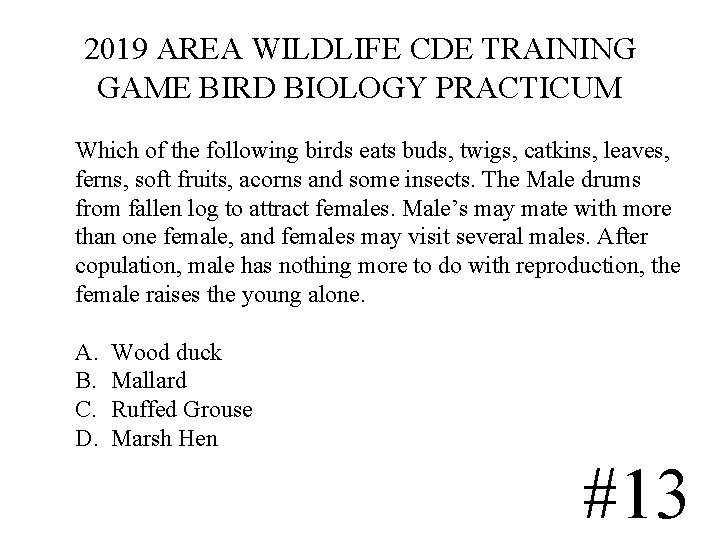
2019 AREA WILDLIFE CDE TRAINING GAME BIRD BIOLOGY PRACTICUM Which of the following birds eats buds, twigs, catkins, leaves, ferns, soft fruits, acorns and some insects. The Male drums from fallen log to attract females. Male’s may mate with more than one female, and females may visit several males. After copulation, male has nothing more to do with reproduction, the female raises the young alone. A. B. C. D. Wood duck Mallard Ruffed Grouse Marsh Hen #13
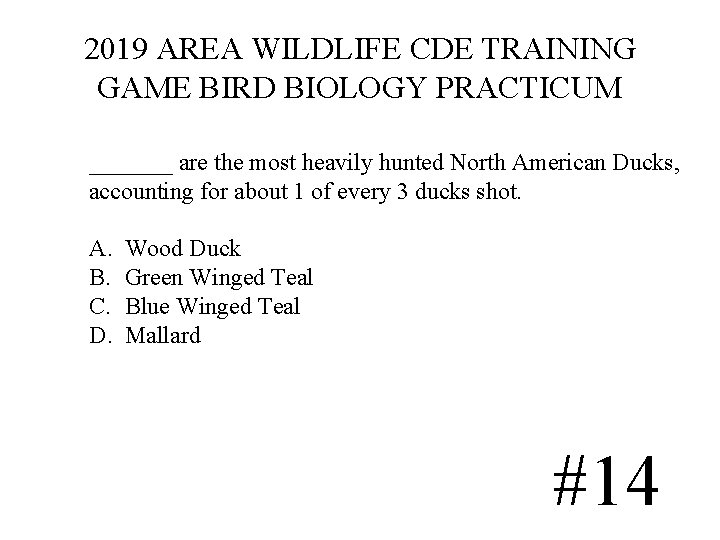
2019 AREA WILDLIFE CDE TRAINING GAME BIRD BIOLOGY PRACTICUM _______ are the most heavily hunted North American Ducks, accounting for about 1 of every 3 ducks shot. A. B. C. D. Wood Duck Green Winged Teal Blue Winged Teal Mallard #14
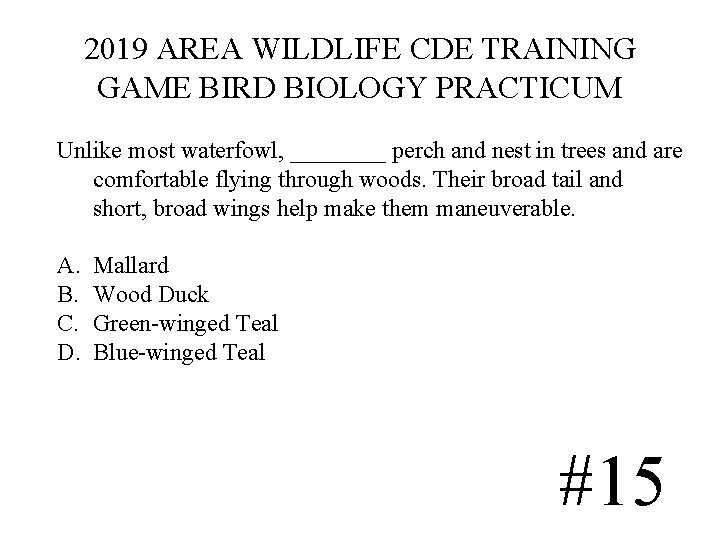
2019 AREA WILDLIFE CDE TRAINING GAME BIRD BIOLOGY PRACTICUM Unlike most waterfowl, ____ perch and nest in trees and are comfortable flying through woods. Their broad tail and short, broad wings help make them maneuverable. A. B. C. D. Mallard Wood Duck Green-winged Teal Blue-winged Teal #15
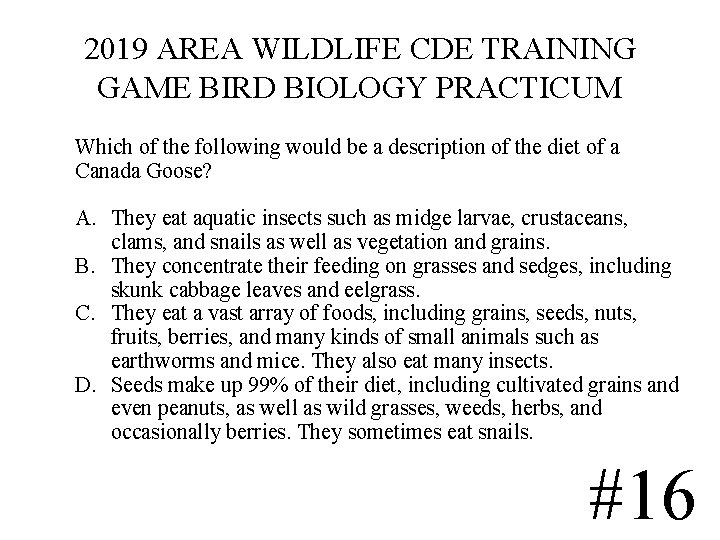
2019 AREA WILDLIFE CDE TRAINING GAME BIRD BIOLOGY PRACTICUM Which of the following would be a description of the diet of a Canada Goose? A. They eat aquatic insects such as midge larvae, crustaceans, clams, and snails as well as vegetation and grains. B. They concentrate their feeding on grasses and sedges, including skunk cabbage leaves and eelgrass. C. They eat a vast array of foods, including grains, seeds, nuts, fruits, berries, and many kinds of small animals such as earthworms and mice. They also eat many insects. D. Seeds make up 99% of their diet, including cultivated grains and even peanuts, as well as wild grasses, weeds, herbs, and occasionally berries. They sometimes eat snails. #16
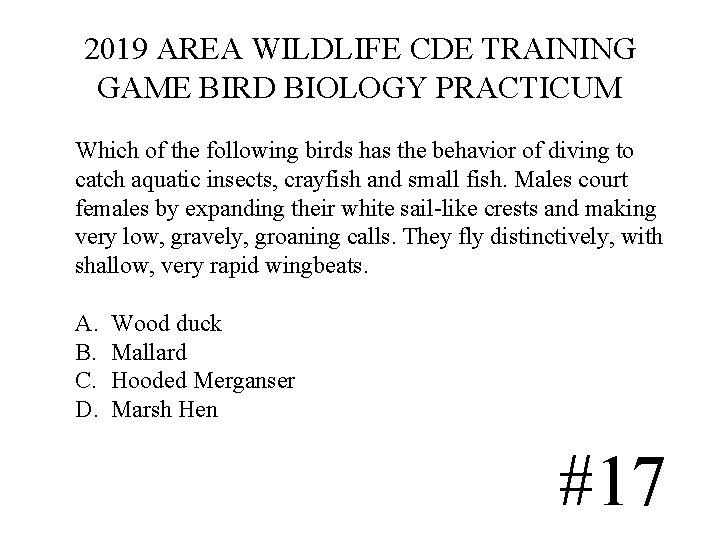
2019 AREA WILDLIFE CDE TRAINING GAME BIRD BIOLOGY PRACTICUM Which of the following birds has the behavior of diving to catch aquatic insects, crayfish and small fish. Males court females by expanding their white sail-like crests and making very low, gravely, groaning calls. They fly distinctively, with shallow, very rapid wingbeats. A. B. C. D. Wood duck Mallard Hooded Merganser Marsh Hen #17
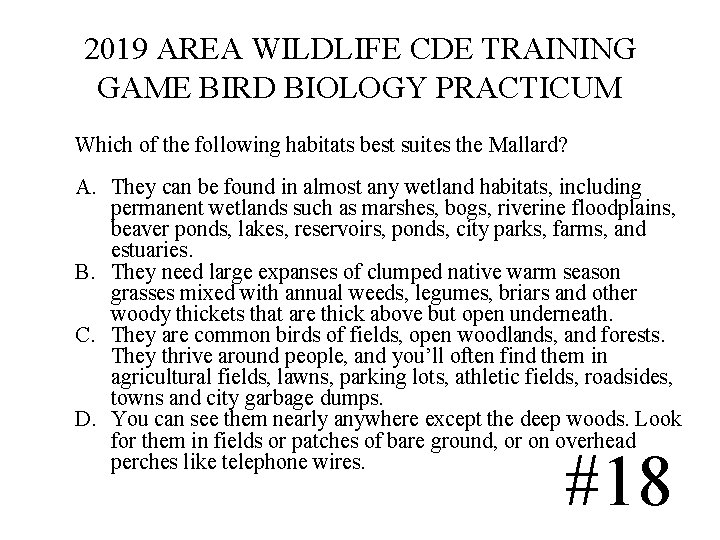
2019 AREA WILDLIFE CDE TRAINING GAME BIRD BIOLOGY PRACTICUM Which of the following habitats best suites the Mallard? A. They can be found in almost any wetland habitats, including permanent wetlands such as marshes, bogs, riverine floodplains, beaver ponds, lakes, reservoirs, ponds, city parks, farms, and estuaries. B. They need large expanses of clumped native warm season grasses mixed with annual weeds, legumes, briars and other woody thickets that are thick above but open underneath. C. They are common birds of fields, open woodlands, and forests. They thrive around people, and you’ll often find them in agricultural fields, lawns, parking lots, athletic fields, roadsides, towns and city garbage dumps. D. You can see them nearly anywhere except the deep woods. Look for them in fields or patches of bare ground, or on overhead perches like telephone wires. #18
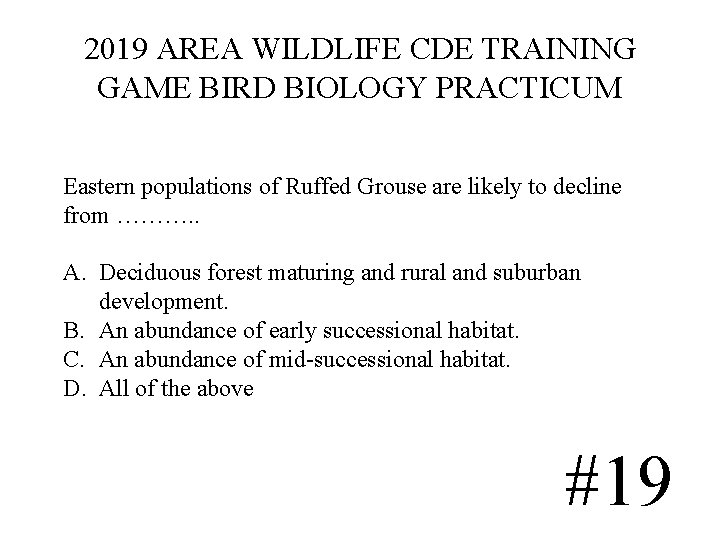
2019 AREA WILDLIFE CDE TRAINING GAME BIRD BIOLOGY PRACTICUM Eastern populations of Ruffed Grouse are likely to decline from ………. . A. Deciduous forest maturing and rural and suburban development. B. An abundance of early successional habitat. C. An abundance of mid-successional habitat. D. All of the above #19
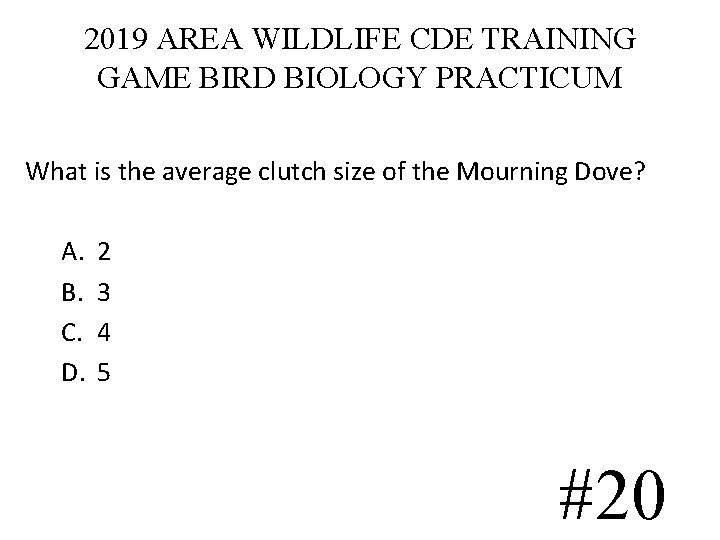
2019 AREA WILDLIFE CDE TRAINING GAME BIRD BIOLOGY PRACTICUM What is the average clutch size of the Mourning Dove? A. B. C. D. 2 3 4 5 #20
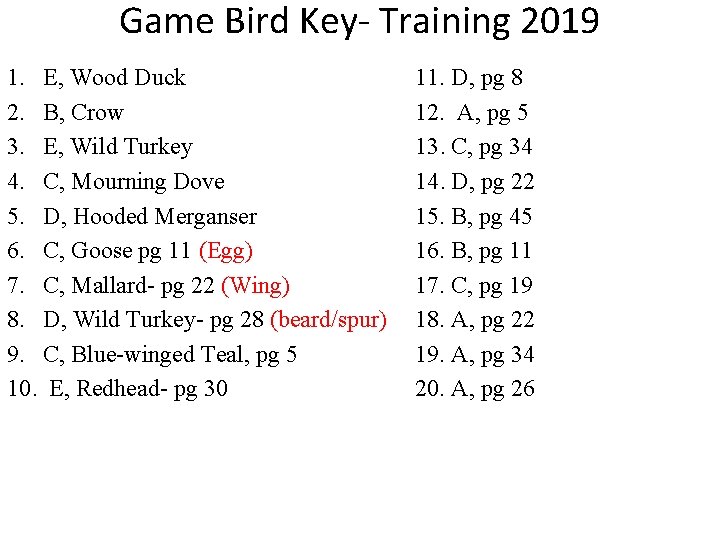
Game Bird Key- Training 2019 1. E, Wood Duck 2. B, Crow 3. E, Wild Turkey 4. C, Mourning Dove 5. D, Hooded Merganser 6. C, Goose pg 11 (Egg) 7. C, Mallard- pg 22 (Wing) 8. D, Wild Turkey- pg 28 (beard/spur) 9. C, Blue-winged Teal, pg 5 10. E, Redhead- pg 30 11. D, pg 8 12. A, pg 5 13. C, pg 34 14. D, pg 22 15. B, pg 45 16. B, pg 11 17. C, pg 19 18. A, pg 22 19. A, pg 34 20. A, pg 26
2019 Area Training Whitetail Deer Management Practicum
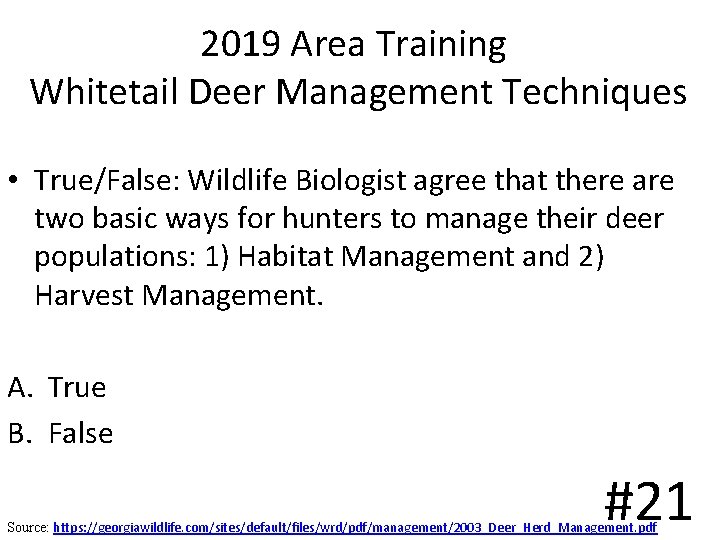
2019 Area Training Whitetail Deer Management Techniques • True/False: Wildlife Biologist agree that there are two basic ways for hunters to manage their deer populations: 1) Habitat Management and 2) Harvest Management. A. True B. False #21 Source: https: //georgiawildlife. com/sites/default/files/wrd/pdf/management/2003_Deer_Herd_Management. pdf
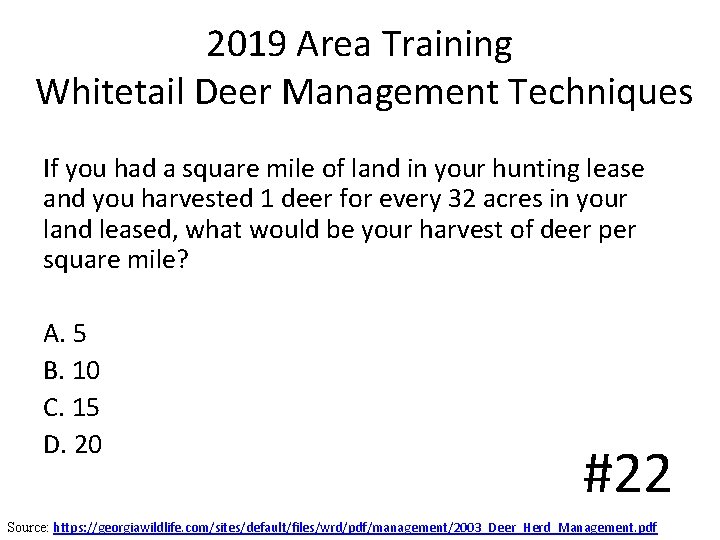
2019 Area Training Whitetail Deer Management Techniques If you had a square mile of land in your hunting lease and you harvested 1 deer for every 32 acres in your land leased, what would be your harvest of deer per square mile? A. 5 B. 10 C. 15 D. 20 #22 Source: https: //georgiawildlife. com/sites/default/files/wrd/pdf/management/2003_Deer_Herd_Management. pdf
2019 Area Training Whitetail Deer Management Techniques Which of the following is an advantage of the Quality Deer Objective? A. Difficult to define “quality” or “trophy” as it varies by area of the state and by individual clubs and members. B. Some nice young bucks must be passed up, or length of season voluntarily shortened, or buck bag limit voluntarily reduced by hunter C. Relatively large number of does in the harvest. D. Poor reproduction
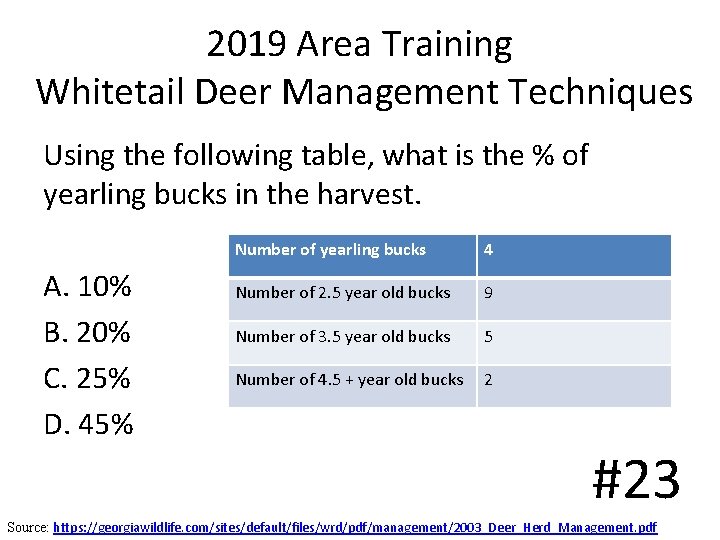
2019 Area Training Whitetail Deer Management Techniques Using the following table, what is the % of yearling bucks in the harvest. A. 10% B. 20% C. 25% D. 45% Number of yearling bucks 4 Number of 2. 5 year old bucks 9 Number of 3. 5 year old bucks 5 Number of 4. 5 + year old bucks 2 #23 Source: https: //georgiawildlife. com/sites/default/files/wrd/pdf/management/2003_Deer_Herd_Management. pdf
2019 Area Training Whitetail Deer Management Techniques The _______ Physiographic regions are the most productive deer regions in Georgia and contain the great majority of deer leases. A. Ridge and Valley, Blue Ridge Mountains and Piedmont. B. Piedmont, Blue Ridge Mountains and Lower Coastal Plain C. Piedmont, Ridge and Valley, Upper Coastal Plain. D. Upper Coastal Plain, Lower Coastal Plain and Blue Ridge Mountains. #24 Source: https: //georgiawildlife. com/sites/default/files/wrd/pdf/management/2003_Deer_Herd_Management. pdf
2019 Area Training Whitetail Deer Management Techniques Which of the following is an advantage to the Quality Deer Objective? A. Behavior of young bucks is observed and enjoyed. B. Difficult to define “quality” or “trophy” as it varies by area of the state and by individual clubs and members. C. Some nice young bucks must be passed up, or length of season voluntarily shortened, or buck bag limit voluntarily reduced by hunters. D. Some young bucks will be lost to hunters on surrounding properties. #25 Source: https: //georgiawildlife. com/sites/default/files/wrd/pdf/management/2003_Deer_Herd_Management. pdf
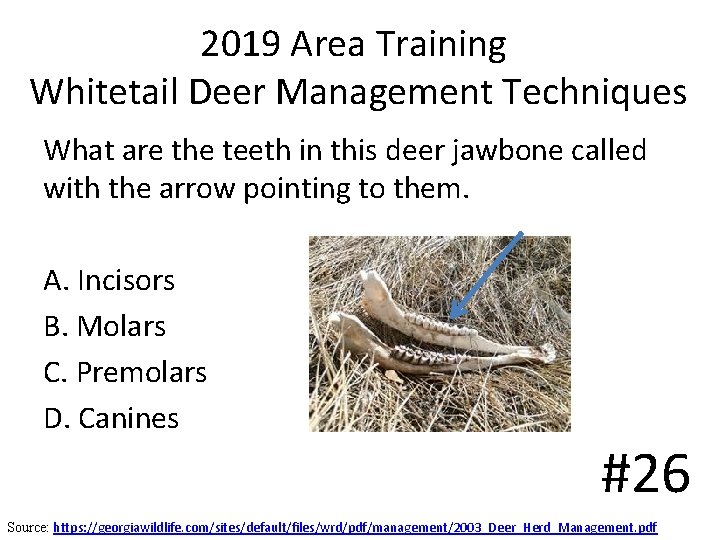
2019 Area Training Whitetail Deer Management Techniques What are the teeth in this deer jawbone called with the arrow pointing to them. A. Incisors B. Molars C. Premolars D. Canines #26 Source: https: //georgiawildlife. com/sites/default/files/wrd/pdf/management/2003_Deer_Herd_Management. pdf
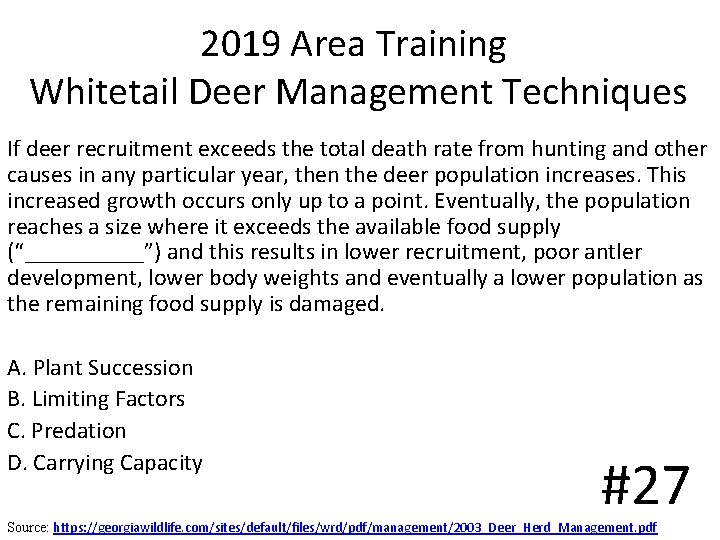
2019 Area Training Whitetail Deer Management Techniques If deer recruitment exceeds the total death rate from hunting and other causes in any particular year, then the deer population increases. This increased growth occurs only up to a point. Eventually, the population reaches a size where it exceeds the available food supply (“_____”) and this results in lower recruitment, poor antler development, lower body weights and eventually a lower population as the remaining food supply is damaged. A. Plant Succession B. Limiting Factors C. Predation D. Carrying Capacity #27 Source: https: //georgiawildlife. com/sites/default/files/wrd/pdf/management/2003_Deer_Herd_Management. pdf
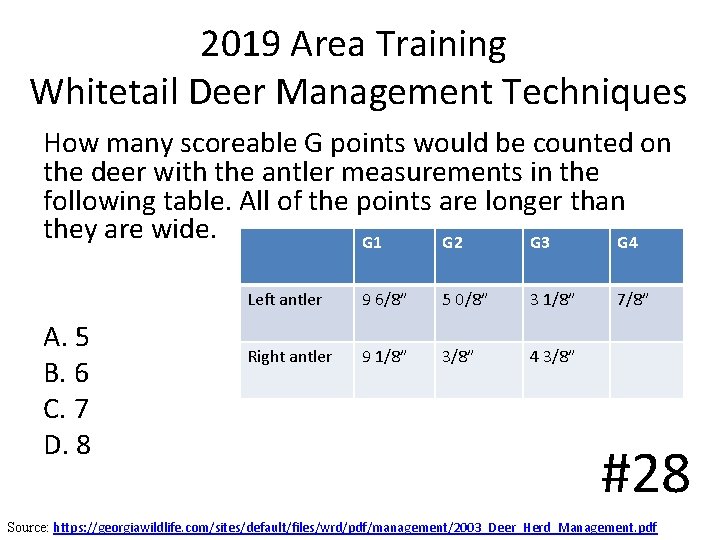
2019 Area Training Whitetail Deer Management Techniques How many scoreable G points would be counted on the deer with the antler measurements in the following table. All of the points are longer than they are wide. G 1 G 2 G 3 G 4 A. 5 B. 6 C. 7 D. 8 Left antler 9 6/8” 5 0/8” 3 1/8” Right antler 9 1/8” 3/8” 4 3/8” 7/8” #28 Source: https: //georgiawildlife. com/sites/default/files/wrd/pdf/management/2003_Deer_Herd_Management. pdf
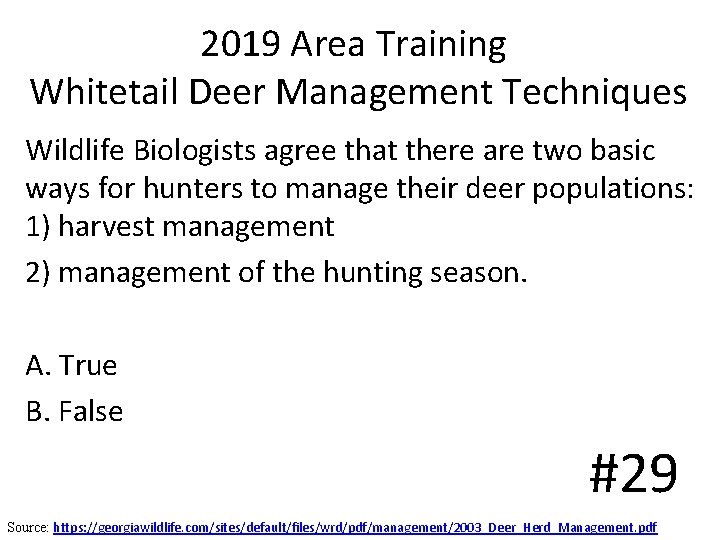
2019 Area Training Whitetail Deer Management Techniques Wildlife Biologists agree that there are two basic ways for hunters to manage their deer populations: 1) harvest management 2) management of the hunting season. A. True B. False #29 Source: https: //georgiawildlife. com/sites/default/files/wrd/pdf/management/2003_Deer_Herd_Management. pdf
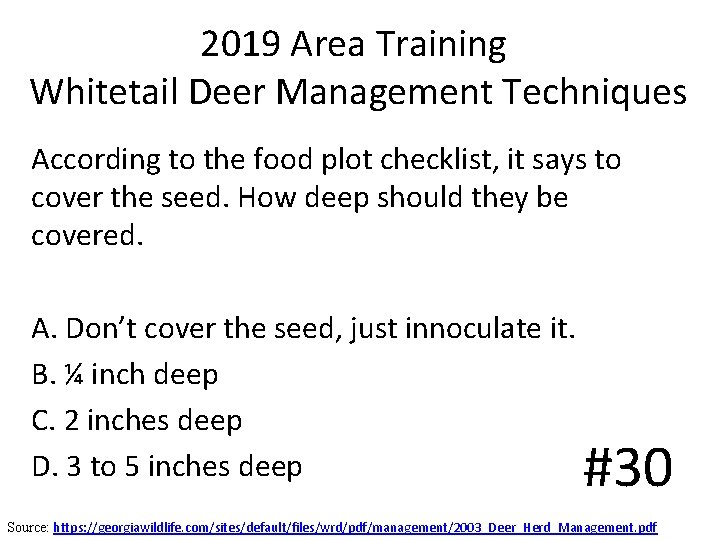
2019 Area Training Whitetail Deer Management Techniques According to the food plot checklist, it says to cover the seed. How deep should they be covered. A. Don’t cover the seed, just innoculate it. B. ¼ inch deep C. 2 inches deep D. 3 to 5 inches deep #30 Source: https: //georgiawildlife. com/sites/default/files/wrd/pdf/management/2003_Deer_Herd_Management. pdf
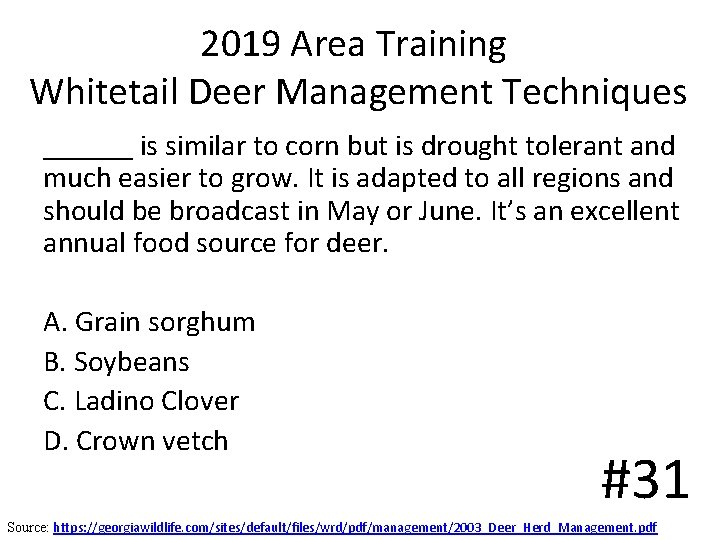
2019 Area Training Whitetail Deer Management Techniques ______ is similar to corn but is drought tolerant and much easier to grow. It is adapted to all regions and should be broadcast in May or June. It’s an excellent annual food source for deer. A. Grain sorghum B. Soybeans C. Ladino Clover D. Crown vetch #31 Source: https: //georgiawildlife. com/sites/default/files/wrd/pdf/management/2003_Deer_Herd_Management. pdf
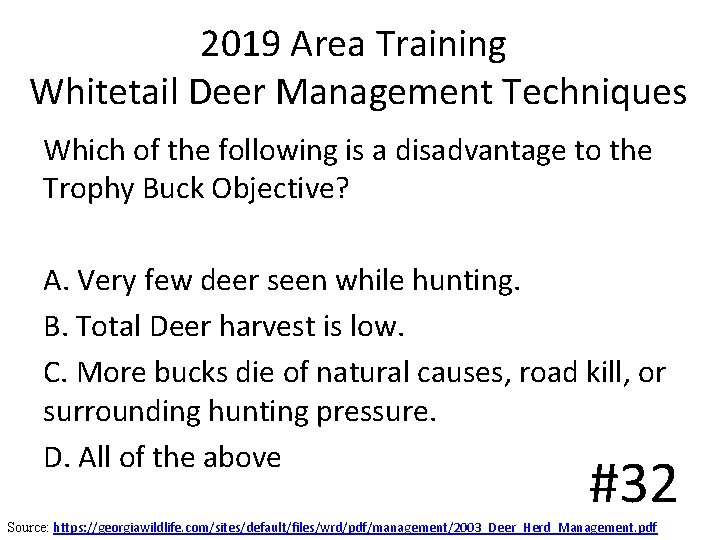
2019 Area Training Whitetail Deer Management Techniques Which of the following is a disadvantage to the Trophy Buck Objective? A. Very few deer seen while hunting. B. Total Deer harvest is low. C. More bucks die of natural causes, road kill, or surrounding hunting pressure. D. All of the above #32 Source: https: //georgiawildlife. com/sites/default/files/wrd/pdf/management/2003_Deer_Herd_Management. pdf
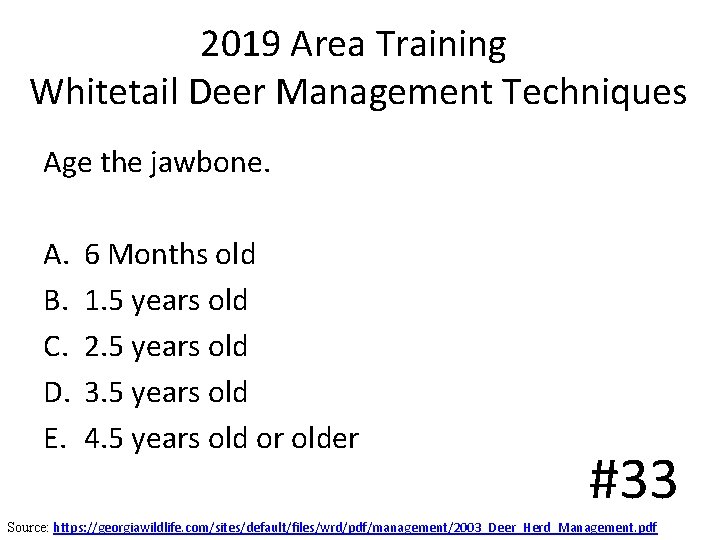
2019 Area Training Whitetail Deer Management Techniques Age the jawbone. A. B. C. D. E. 6 Months old 1. 5 years old 2. 5 years old 3. 5 years old 4. 5 years old or older #33 Source: https: //georgiawildlife. com/sites/default/files/wrd/pdf/management/2003_Deer_Herd_Management. pdf
2019 Area Training Whitetail Deer Management Techniques Age the jawbone. A. B. C. D. E. 6 Months old 1. 5 years old 2. 5 years old 3. 5 years old 4. 5 years old or older #34 Source: https: //georgiawildlife. com/sites/default/files/wrd/pdf/management/2003_Deer_Herd_Management. pdf
2019 Area Training Whitetail Deer Management Techniques Age the jawbone. A. B. C. D. E. 6 Months old 1. 5 years old 2. 5 years old 3. 5 years old 4. 5 years old or older #35 Source: https: //georgiawildlife. com/sites/default/files/wrd/pdf/management/2003_Deer_Herd_Management. pdf
2019 Area Training Whitetail Deer Management Techniques Age the jawbone. A. B. C. D. E. 6 Months old 1. 5 years old 2. 5 years old 3. 5 years old 4. 5 years old or older #36 Source: https: //georgiawildlife. com/sites/default/files/wrd/pdf/management/2003_Deer_Herd_Management. pdf
2019 Area Training Whitetail Deer Management Techniques Measure the ______________ A. ______ B. ______ C. ______ D. ______ E. ______ Source: http: //www. boone-crockett. org/pdf/SC_whitetail_typical. pdf #37
2019 Area Training Whitetail Deer Management Techniques Measure the ______________ A. ______ B. ______ C. ______ D. ______ E. ______ Source: http: //www. boone-crockett. org/pdf/SC_whitetail_typical. pdf #38
2019 Area Training Whitetail Deer Management Techniques Measure the ______________ A. ______ B. ______ C. ______ D. ______ E. ______ Source: http: //www. boone-crockett. org/pdf/SC_whitetail_typical. pdf #39
2019 Area Training Whitetail Deer Management Techniques Measure the ______________ A. ______ B. ______ C. ______ D. ______ E. ______ Source: http: //www. boone-crockett. org/pdf/SC_whitetail_typical. pdf #40
2019 Area Training Whitetail Deer Management Techniques Key 21. A, pg 5 22. D, pg 15 23. B, pg 18 24. C, pg 15 25. A, pg 8 26. B, pg 32 27. D, pg 6 28. A, pg 11 29. B, pg 5 30. B, pg 31 31. A, pg 25 32. D, pg 8 33. 34. 35. 36. 37. 38. 39. 40.
2019 Area Wildlife Training General Identification Practicum
2019 AREA WILDLIFE CDE TRAINING GENERAL IDENTIFICATION A. Black Bear B. Coyote C. Feral Hog D. Fox E. Bobcat #41
2019 AREA WILDLIFE CDE TRAINING GENERAL IDENTIFICATION A. Canebrake Rattlesnake B. Copperhead Snake C. Coral Snake D. Pigmy Rattlesnake E. Eastern Diamondback Rattlesnake #42
2019 AREA WILDLIFE CDE TRAINING GENERAL IDENTIFICATION A. Barred Owl B. Great Horned Owl C. Kestrel D. Cooper’s Hawk E. Redtail Hawk #43
2019 AREA WILDLIFE CDE TRAINING GENERAL IDENTIFICATION A. Eastern Cottontail B. Squirrel C. Opossum D. Raccoon E. Skunk #44
2019 AREA WILDLIFE CDE TRAINING GENERAL IDENTIFICATION A. Coyote B. Fox C. Bobcat D. Opossum E. Raccoon #45
2019 AREA WILDLIFE CDE TRAINING GENERAL IDENTIFICATION A. Pigmy Rattlesnake B. Garter Snake C. Coral Snake D. King Snake E. Eastern Hognose Snake #46
2019 AREA WILDLIFE CDE TRAINING GENERAL IDENTIFICATION A. Armadillo B. Bat C. Eastern Cottontail Rabbit D. Field Mouse E. Mole #47
2019 AREA WILDLIFE CDE TRAINING GENERAL IDENTIFICATION A. Eastern Bluebird B. Kestrel C. Red-cockaded Woodpecker D. Ruby Throated Hummingbird E. Screech Owl #48
2019 AREA WILDLIFE CDE TRAINING GENERAL IDENTIFICATION A. Bobcat B. Raccoon C. Skunk D. Coyote E. Fox #49
2019 AREA WILDLIFE CDE TRAINING GENERAL IDENTIFICATION A. American Beautyberry B. Blackberry C. Blueberries D. Chinaberry E. Sparkleberry #50
2019 AREA WILDLIFE CDE TRAINING GENERAL IDENTIFICATION A. Black Cherry B. Plum C. Blackgum D. Crabapple E. Persimmon #51
2019 AREA WILDLIFE CDE TRAINING GENERAL IDENTIFICATION A. Austrian Winter Pea B. Cowpeas C. Japanese Honeysuckle D. Vetch E. Partridge Pea #52
2019 AREA WILDLIFE CDE TRAINING GENERAL IDENTIFICATION A. Blackgum B. Persimmon C. Black Cherry D. Flowering Dogwood E. Crabapple #53
2019 AREA WILDLIFE CDE TRAINING GENERAL IDENTIFICATION A. Browntop Millet B. Clover C. Lespedeza D. Oats E. Ryegrass #54
2019 AREA WILDLIFE CDE TRAINING GENERAL IDENTIFICATION A. Corn B. Chufa C. Peanuts D. Pecan E. Soybeans #55
2019 AREA WILDLIFE CDE TRAINING GENERAL IDENTIFICATION A. Dove Proso B. Browntop Millet C. Forage Chicory D. Turnips E. Wheat #56
2019 AREA WILDLIFE CDE TRAINING GENERAL IDENTIFICATION A. Chestnut Oak B. Northern Red Oak C. Post Oak D. White Oak E. Southern Red Oak #57
2019 AREA WILDLIFE CDE TRAINING GENERAL IDENTIFICATION A. Lespedeza B. Grain Sorghum C. Oats D. Ryegrass E. Wheat #58
2019 AREA WILDLIFE CDE TRAINING GENERAL IDENTIFICATION A. Beggarweed B. Greenbriar C. Pigweed D. Ragweed E. Kudzu #59
2019 AREA WILDLIFE CDE TRAINING GENERAL IDENTIFICATION A. Chestnut Oak B. Turkey Oak C. Sawtooth Oak D. Northern Red Oak E. Southern Red Oak #60
2019 AREA WILDLIFE CDE TRAINING GENERAL IDENTIFICATION A. Hickory B. Pecan C. Mulberry D. Honeylocust E. Longleaf Pine #61
2019 AREA WILDLIFE CDE TRAINING GENERAL IDENTIFICATION A. Cultipacker B. Disk Harrow C. Grain Drill D. Soil Sampling Auger E. Broadcast Spreader #62
2019 AREA WILDLIFE CDE TRAINING GENERAL IDENTIFICATION A. Clinometer B. Compass C. Range Finder D. GPS Unit E. Wind Speed Meter #63
2019 AREA WILDLIFE CDE TRAINING GENERAL IDENTIFICATION A. Gambrel B. Jawbone Extractor C. Mammal Traps D. Drip Torch E. Cultipacker #64
2019 AREA WILDLIFE CDE TRAINING GENERAL IDENTIFICATION A. Logger’s Tape B. Prism C. Compass D. Clinometer E. Soil Sampling Auger #65
2019 Area Training Aquatic Management Practicum
2019 AREA WILDLIFE CDE TRAINING AQUATIC MANAGEMENT Which of the following is the scientific name for Largemouth Bass? A. B. C. D. Micropterus salmoides Oncorhynchus mykiss Lepomis machrochirus Morone saxatilus Source: https: //secure. caes. uga. edu/extension/publications/files/pdf/B%20732_1. PDF #66
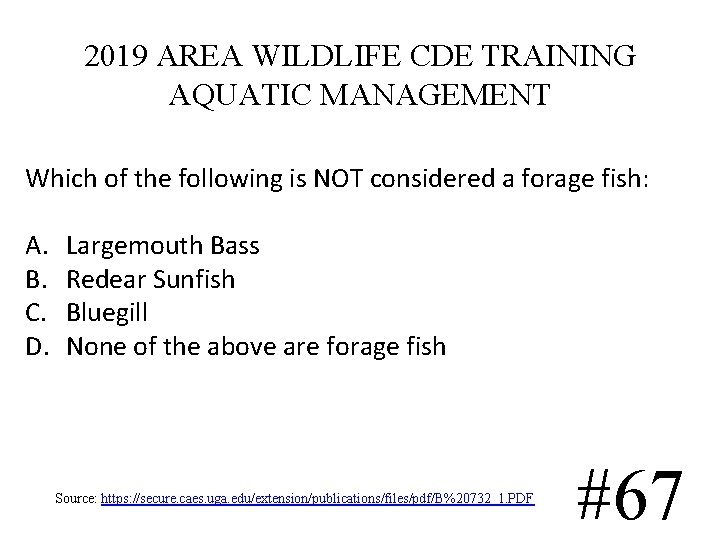
2019 AREA WILDLIFE CDE TRAINING AQUATIC MANAGEMENT Which of the following is NOT considered a forage fish: A. B. C. D. Largemouth Bass Redear Sunfish Bluegill None of the above are forage fish Source: https: //secure. caes. uga. edu/extension/publications/files/pdf/B%20732_1. PDF #67
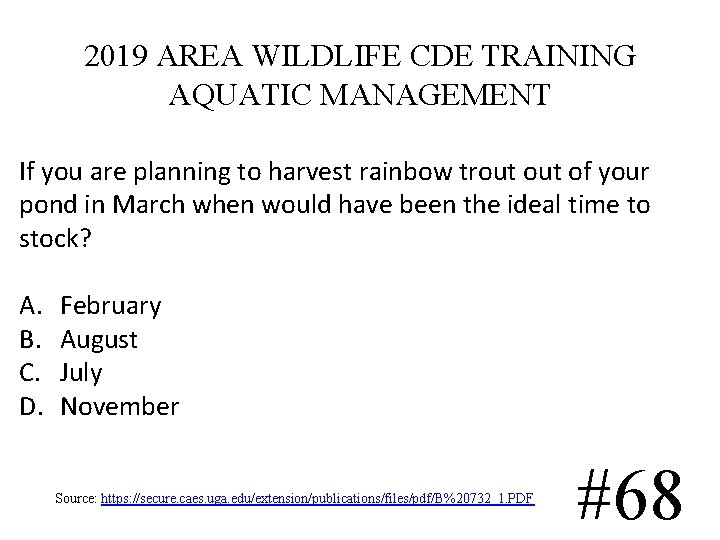
2019 AREA WILDLIFE CDE TRAINING AQUATIC MANAGEMENT If you are planning to harvest rainbow trout of your pond in March when would have been the ideal time to stock? A. B. C. D. February August July November Source: https: //secure. caes. uga. edu/extension/publications/files/pdf/B%20732_1. PDF #68
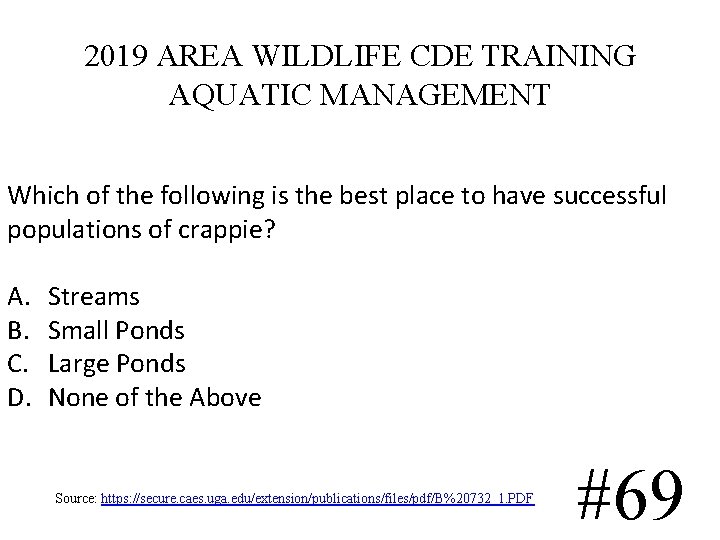
2019 AREA WILDLIFE CDE TRAINING AQUATIC MANAGEMENT Which of the following is the best place to have successful populations of crappie? A. B. C. D. Streams Small Ponds Large Ponds None of the Above Source: https: //secure. caes. uga. edu/extension/publications/files/pdf/B%20732_1. PDF #69
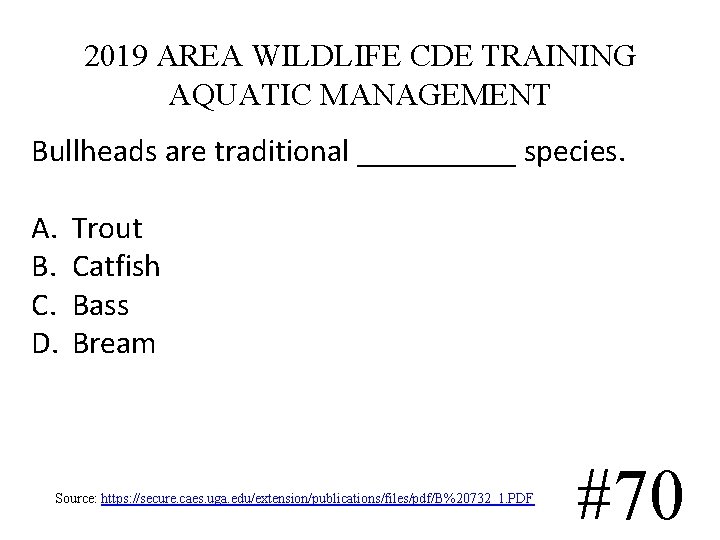
2019 AREA WILDLIFE CDE TRAINING AQUATIC MANAGEMENT Bullheads are traditional _____ species. A. B. C. D. Trout Catfish Bass Bream Source: https: //secure. caes. uga. edu/extension/publications/files/pdf/B%20732_1. PDF #70
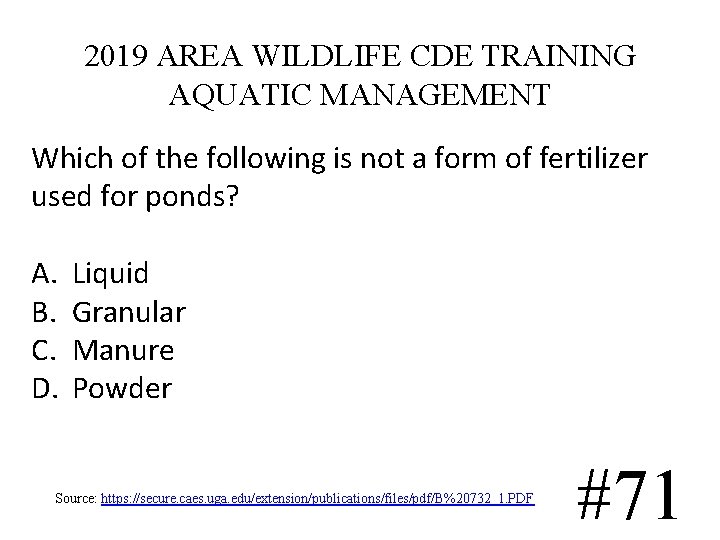
2019 AREA WILDLIFE CDE TRAINING AQUATIC MANAGEMENT Which of the following is not a form of fertilizer used for ponds? A. B. C. D. Liquid Granular Manure Powder Source: https: //secure. caes. uga. edu/extension/publications/files/pdf/B%20732_1. PDF #71
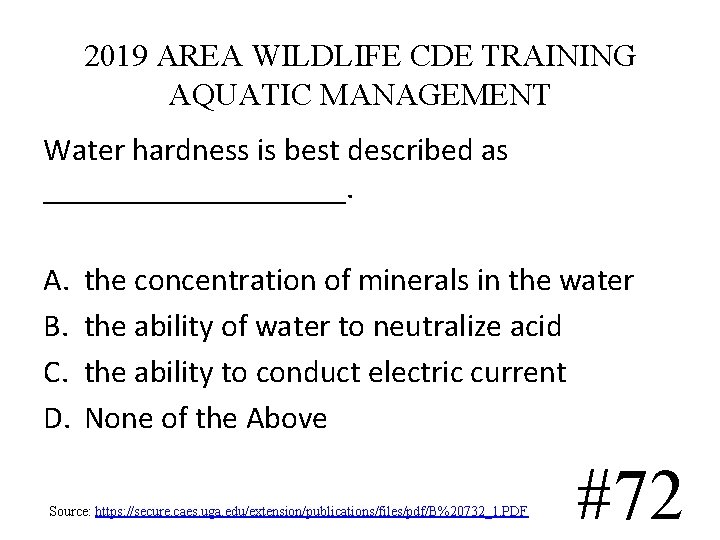
2019 AREA WILDLIFE CDE TRAINING AQUATIC MANAGEMENT Water hardness is best described as __________. A. B. C. D. the concentration of minerals in the water the ability of water to neutralize acid the ability to conduct electric current None of the Above Source: https: //secure. caes. uga. edu/extension/publications/files/pdf/B%20732_1. PDF #72
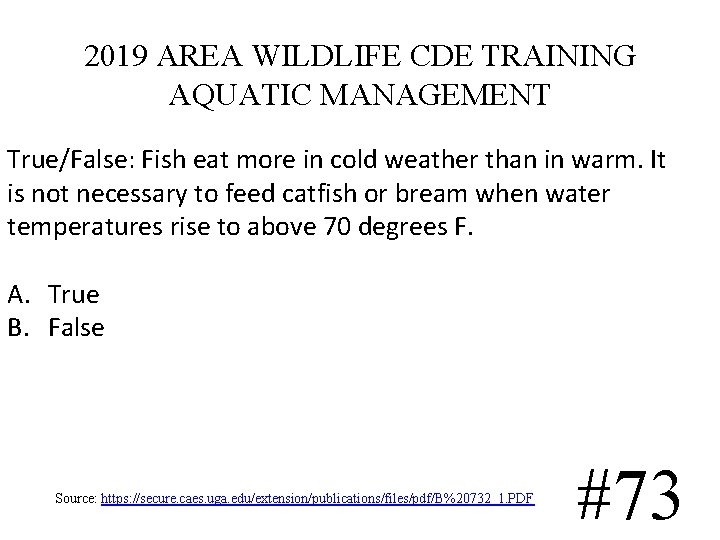
2019 AREA WILDLIFE CDE TRAINING AQUATIC MANAGEMENT True/False: Fish eat more in cold weather than in warm. It is not necessary to feed catfish or bream when water temperatures rise to above 70 degrees F. A. True B. False Source: https: //secure. caes. uga. edu/extension/publications/files/pdf/B%20732_1. PDF #73
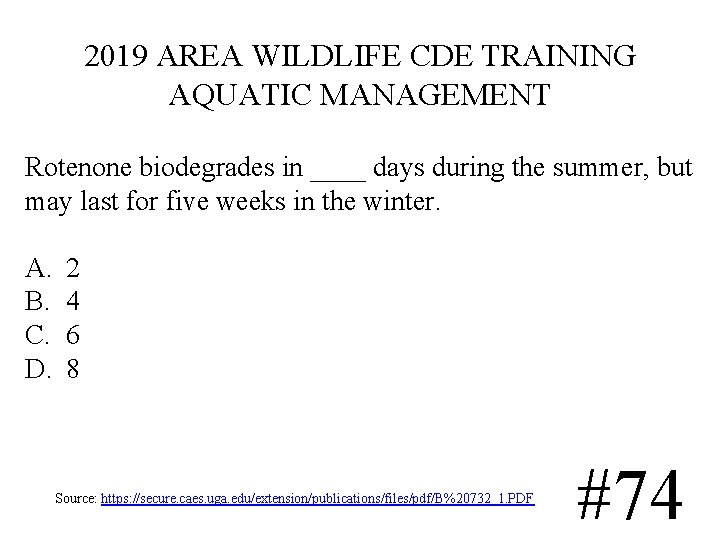
2019 AREA WILDLIFE CDE TRAINING AQUATIC MANAGEMENT Rotenone biodegrades in ____ days during the summer, but may last for five weeks in the winter. A. B. C. D. 2 4 6 8 Source: https: //secure. caes. uga. edu/extension/publications/files/pdf/B%20732_1. PDF #74
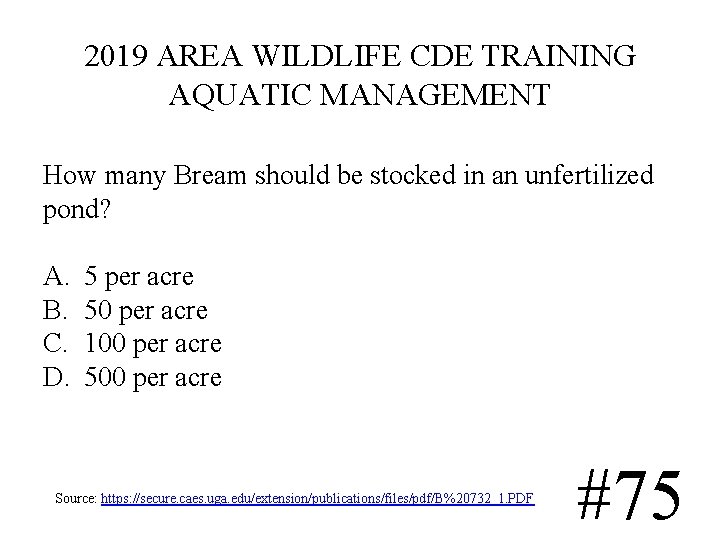
2019 AREA WILDLIFE CDE TRAINING AQUATIC MANAGEMENT How many Bream should be stocked in an unfertilized pond? A. B. C. D. 5 per acre 50 per acre 100 per acre 500 per acre Source: https: //secure. caes. uga. edu/extension/publications/files/pdf/B%20732_1. PDF #75
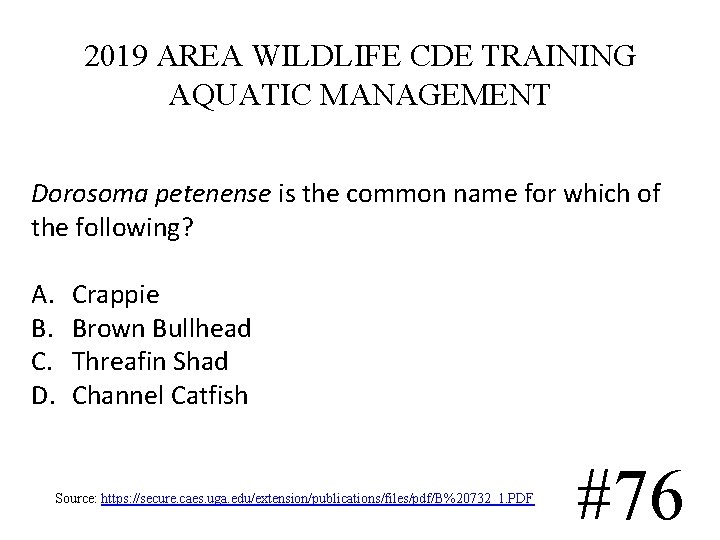
2019 AREA WILDLIFE CDE TRAINING AQUATIC MANAGEMENT Dorosoma petenense is the common name for which of the following? A. B. C. D. Crappie Brown Bullhead Threafin Shad Channel Catfish Source: https: //secure. caes. uga. edu/extension/publications/files/pdf/B%20732_1. PDF #76
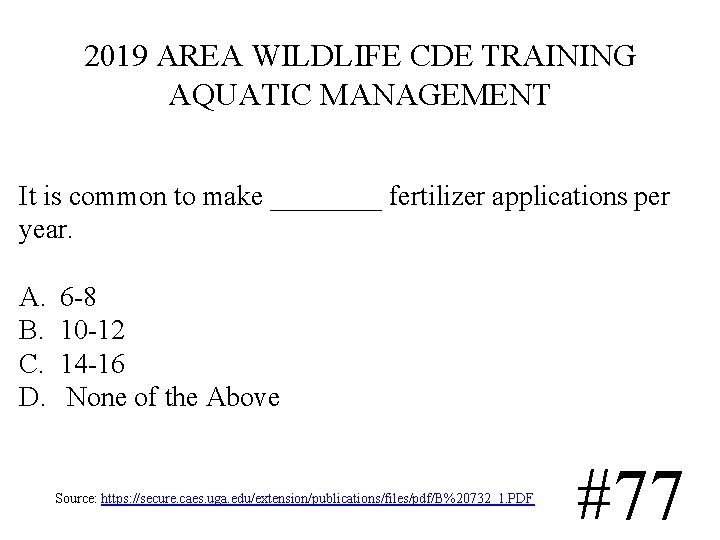
2019 AREA WILDLIFE CDE TRAINING AQUATIC MANAGEMENT It is common to make ____ fertilizer applications per year. A. B. C. D. 6 -8 10 -12 14 -16 None of the Above Source: https: //secure. caes. uga. edu/extension/publications/files/pdf/B%20732_1. PDF #77
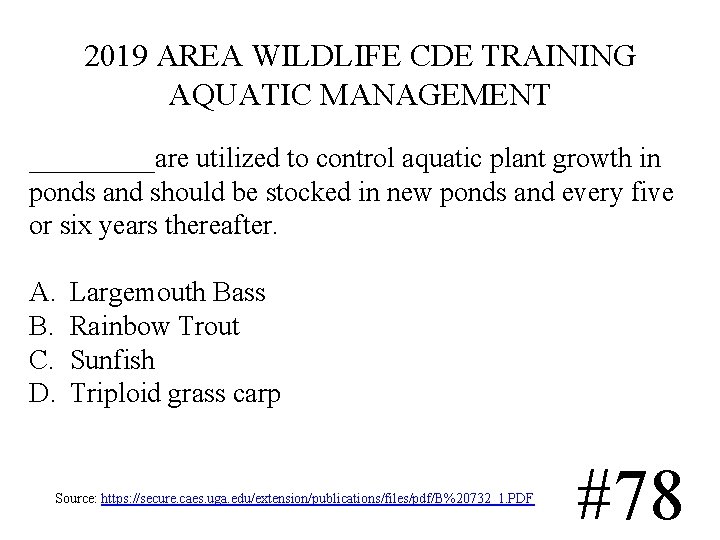
2019 AREA WILDLIFE CDE TRAINING AQUATIC MANAGEMENT _____are utilized to control aquatic plant growth in ponds and should be stocked in new ponds and every five or six years thereafter. A. B. C. D. Largemouth Bass Rainbow Trout Sunfish Triploid grass carp Source: https: //secure. caes. uga. edu/extension/publications/files/pdf/B%20732_1. PDF #78
2019 AREA WILDLIFE CDE TRAINING AQUATIC MANAGEMENT A. Buttonbush B. Elderberry C. Water Primrose D. Smartweed E. Waterlilly #79
2019 AREA WILDLIFE CDE TRAINING AQUATIC MANAGEMENT A. Baldcypress B. Water Oak C. Catalpa D. Elderberry E. Pondcypress #80
2019 AREA WILDLIFE CDE TRAINING AQUATIC MANAGEMENT A. Black Crappie B. Bluegill C. Warmouth D. Redear Sunfish E. Redbreast Sunfish #81
2019 AREA WILDLIFE CDE TRAINING AQUATIC MANAGEMENT A. Alligator B. Bullfrog C. Crayfish D. Banded/Northern Water Snake E. Cottonmouth #82
2019 AREA WILDLIFE CDE TRAINING AQUATIC MANAGEMENT A. Great Blue Heron B. Beaver C. River Otter D. Muskrat E. Nutria #83
2019 AREA WILDLIFE CDE TRAINING AQUATIC MANAGEMENT A. Buttonbush B. Elderberry C. Water Primrose D. Smartweed E. Waterlilly #84
2019 AREA WILDLIFE CDE TRAINING AQUATIC MANAGEMENT A. Baldcypress B. Water Oak C. Catalpa D. Elderberry E. Pondcypress #85
2019 AREA WILDLIFE CDE TRAINING AQUATIC MANAGEMENT A. Alligator Snapping Turtle B. Common Snapping Turtle C. Slider Turtle D. Bullfrog E. Alligator #86
A. Channel Catfish B. Flathead Catfish C. Grass Carp D. Gar E. Bowfin #87
2019 AREA WILDLIFE CDE TRAINING AQUATIC MANAGEMENT A. Largemouth Bass B. Smallmouth Bass C. Hybrid Striped Bass D. Striped Bass E. Grass Carp #88
2019 AREA WILDLIFE CDE TRAINING AQUATIC MANAGEMENT A. Brook Trout B. Brown Trout C. Rainbow Trout D. Chain Pickerel E. Bowfin #89
2019 AREA WILDLIFE CDE TRAINING AQUATIC MANAGEMENT A. Black Crappie B. Bluegill C. Warmouth D. Redear Sunfish E. Shad #90
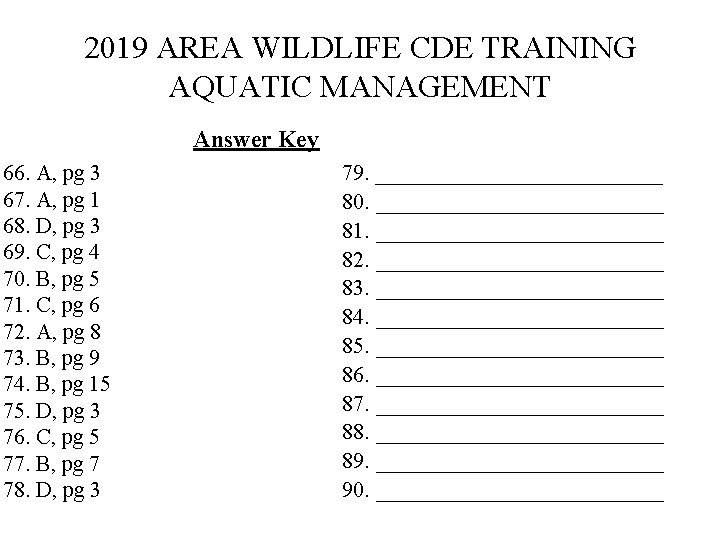
2019 AREA WILDLIFE CDE TRAINING AQUATIC MANAGEMENT Answer Key 66. A, pg 3 67. A, pg 1 68. D, pg 3 69. C, pg 4 70. B, pg 5 71. C, pg 6 72. A, pg 8 73. B, pg 9 74. B, pg 15 75. D, pg 3 76. C, pg 5 77. B, pg 7 78. D, pg 3 79. ____________ 80. ____________ 81. ____________ 82. ____________ 83. ____________ 84. ____________ 85. ____________ 86. ____________ 87. ____________ 88. ____________ 89. ____________ 90. ____________