
Trees 2 Binary trees Section 4 2 1
Trees 2 Binary trees • Section 4. 2 1
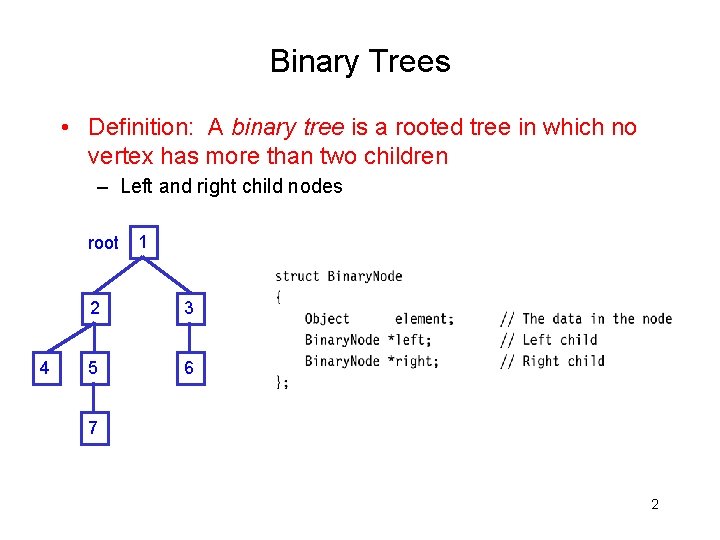
Binary Trees • Definition: A binary tree is a rooted tree in which no vertex has more than two children – Left and right child nodes root 4 1 2 3 5 6 7 2
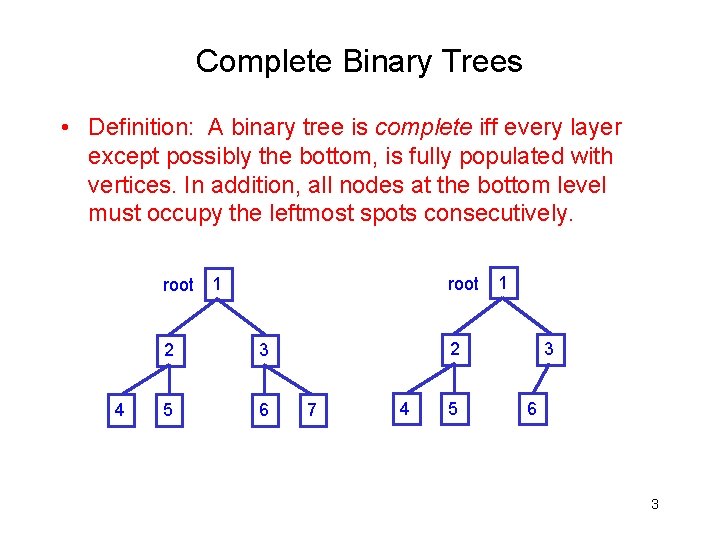
Complete Binary Trees • Definition: A binary tree is complete iff every layer except possibly the bottom, is fully populated with vertices. In addition, all nodes at the bottom level must occupy the leftmost spots consecutively. root 4 root 1 2 3 5 6 1 2 7 4 5 3 6 3
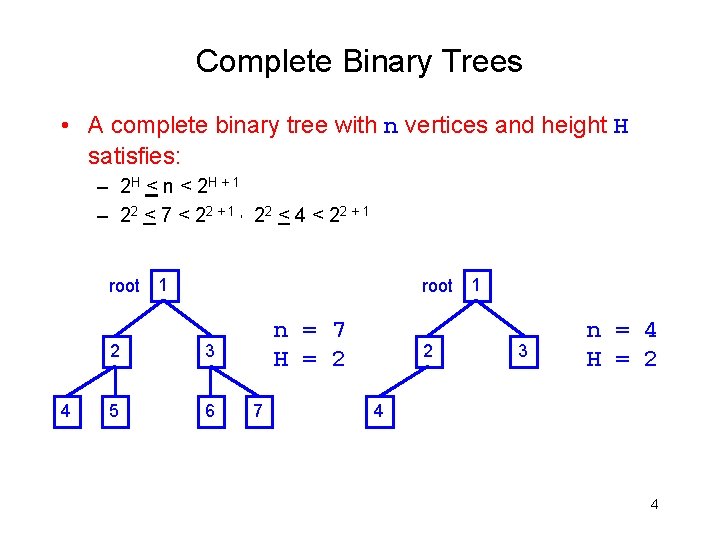
Complete Binary Trees • A complete binary tree with n vertices and height H satisfies: – 2 H < n < 2 H + 1 – 22 < 7 < 2 2 + 1 , 2 2 < 4 < 2 2 + 1 root 4 1 root 2 3 5 6 n = 7 H = 2 7 2 1 3 n = 4 H = 2 4 4
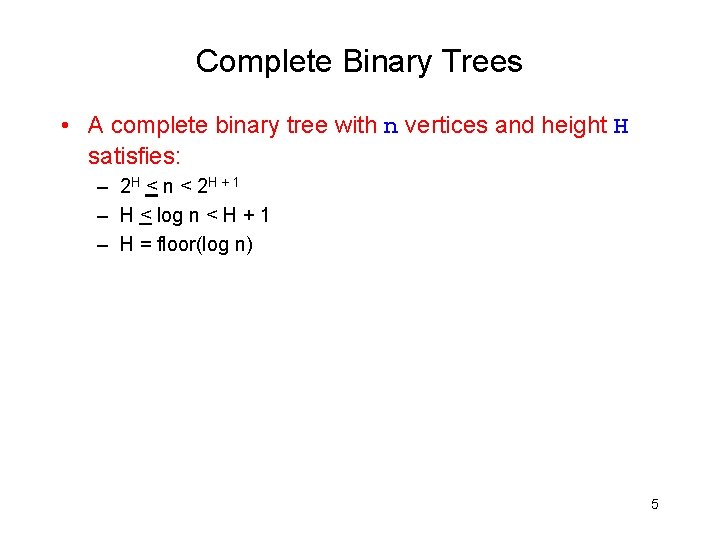
Complete Binary Trees • A complete binary tree with n vertices and height H satisfies: – 2 H < n < 2 H + 1 – H < log n < H + 1 – H = floor(log n) 5
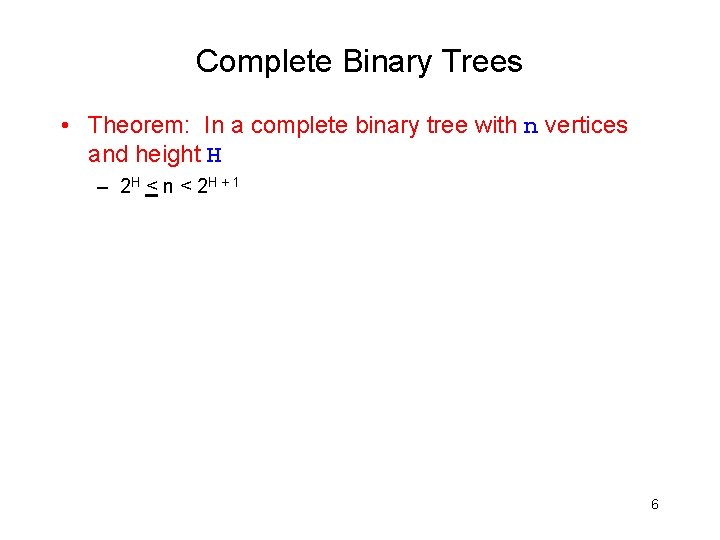
Complete Binary Trees • Theorem: In a complete binary tree with n vertices and height H – 2 H < n < 2 H + 1 6
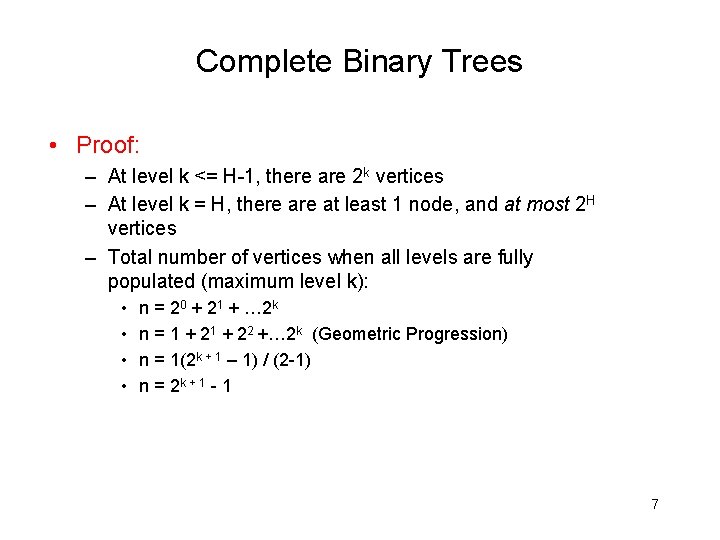
Complete Binary Trees • Proof: – At level k <= H-1, there are 2 k vertices – At level k = H, there at least 1 node, and at most 2 H vertices – Total number of vertices when all levels are fully populated (maximum level k): • • n = 20 + 21 + … 2 k n = 1 + 22 +… 2 k (Geometric Progression) n = 1(2 k + 1 – 1) / (2 -1) n = 2 k + 1 - 1 7
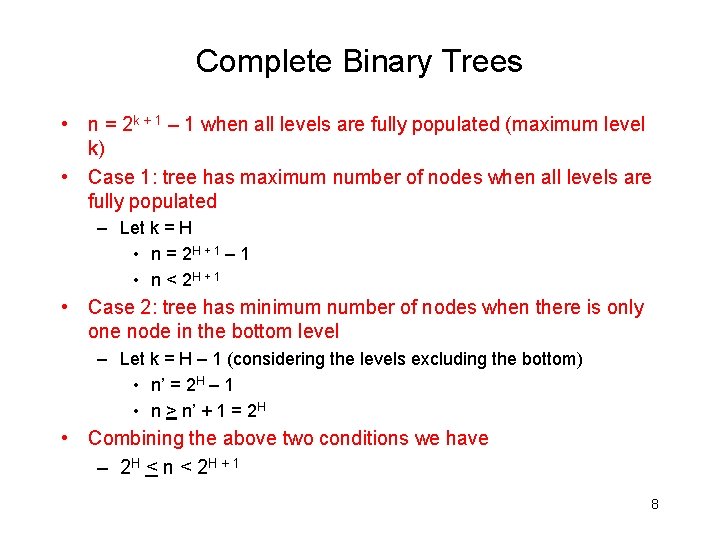
Complete Binary Trees • n = 2 k + 1 – 1 when all levels are fully populated (maximum level k) • Case 1: tree has maximum number of nodes when all levels are fully populated – Let k = H • n = 2 H + 1 – 1 • n < 2 H + 1 • Case 2: tree has minimum number of nodes when there is only one node in the bottom level – Let k = H – 1 (considering the levels excluding the bottom) • n’ = 2 H – 1 • n > n’ + 1 = 2 H • Combining the above two conditions we have – 2 H < n < 2 H + 1 8
Vector Representation of Complete Binary Tree • Tree data – Vector elements carry data • Tree structure – – Vector indices carry tree structure Index order = levelorder Tree structure is implicit Uses integer arithmetic for tree navigation 9
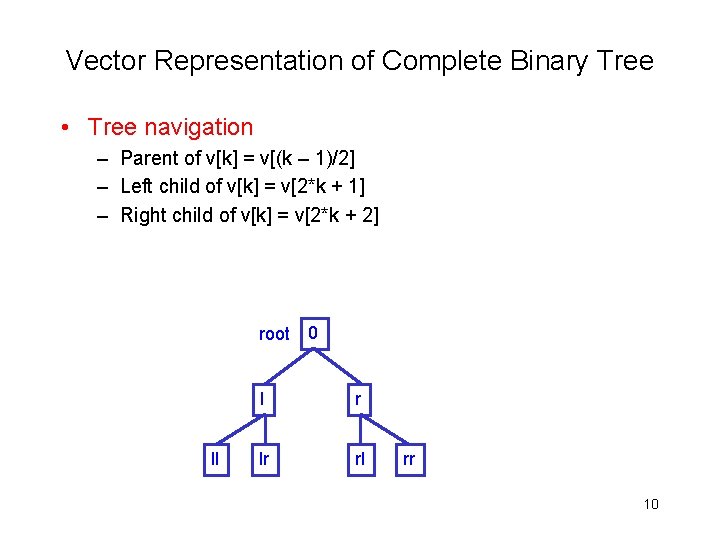
Vector Representation of Complete Binary Tree • Tree navigation – Parent of v[k] = v[(k – 1)/2] – Left child of v[k] = v[2*k + 1] – Right child of v[k] = v[2*k + 2] root ll 0 l r lr rl rr 10
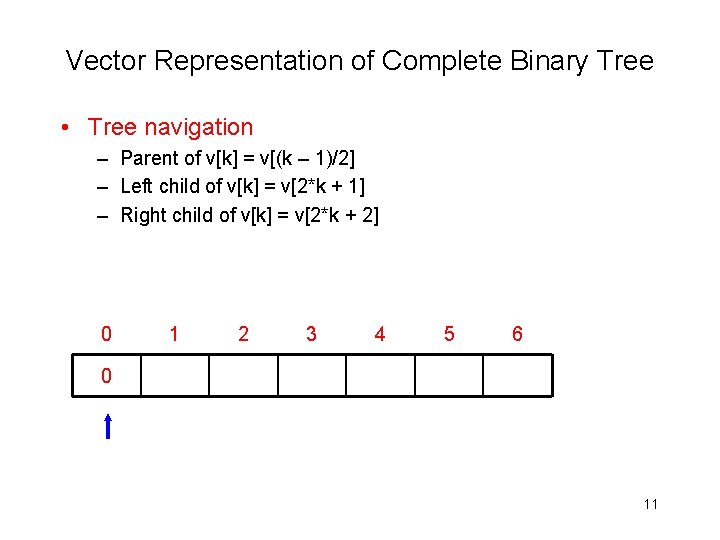
Vector Representation of Complete Binary Tree • Tree navigation – Parent of v[k] = v[(k – 1)/2] – Left child of v[k] = v[2*k + 1] – Right child of v[k] = v[2*k + 2] 0 1 2 3 4 5 6 0 11
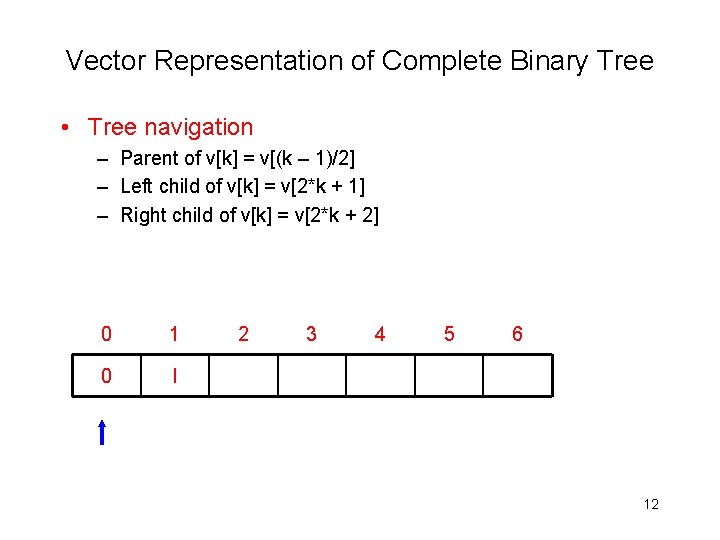
Vector Representation of Complete Binary Tree • Tree navigation – Parent of v[k] = v[(k – 1)/2] – Left child of v[k] = v[2*k + 1] – Right child of v[k] = v[2*k + 2] 0 1 0 l 2 3 4 5 6 12
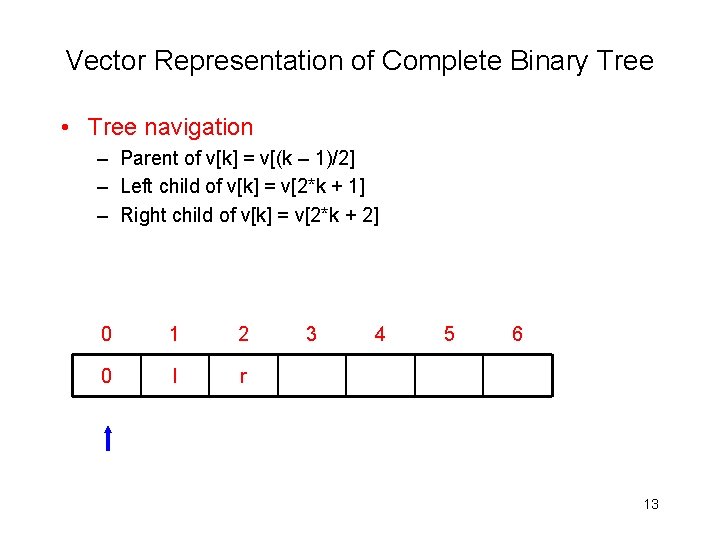
Vector Representation of Complete Binary Tree • Tree navigation – Parent of v[k] = v[(k – 1)/2] – Left child of v[k] = v[2*k + 1] – Right child of v[k] = v[2*k + 2] 0 1 2 0 l r 3 4 5 6 13
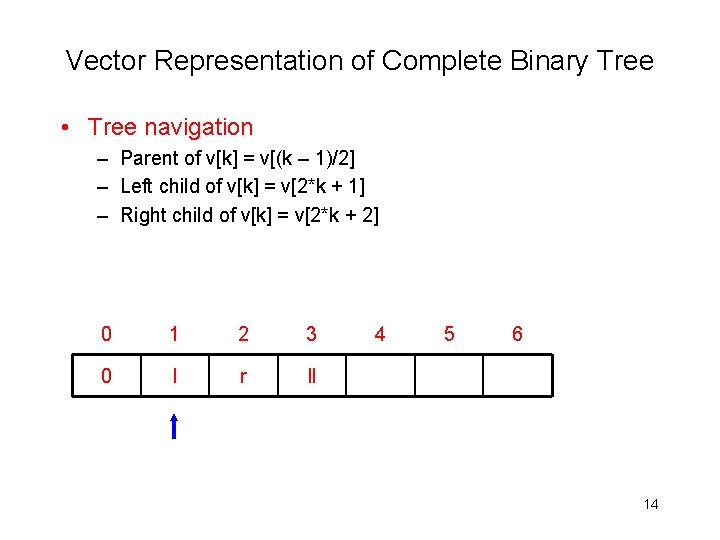
Vector Representation of Complete Binary Tree • Tree navigation – Parent of v[k] = v[(k – 1)/2] – Left child of v[k] = v[2*k + 1] – Right child of v[k] = v[2*k + 2] 0 1 2 3 0 l r ll 4 5 6 14
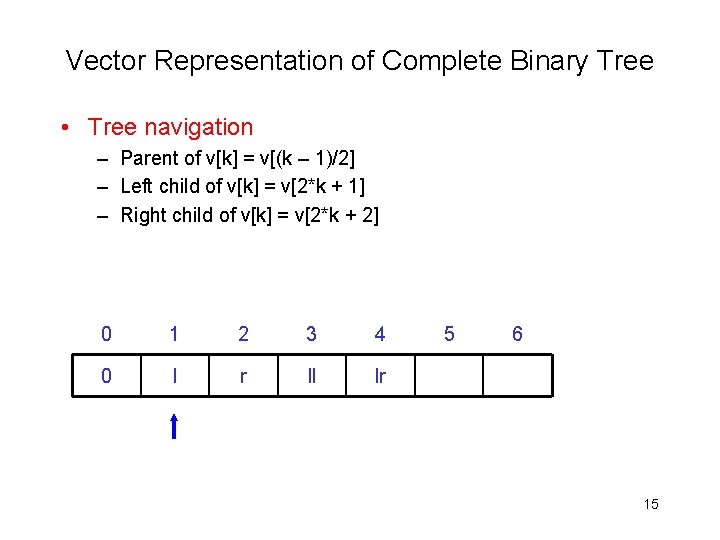
Vector Representation of Complete Binary Tree • Tree navigation – Parent of v[k] = v[(k – 1)/2] – Left child of v[k] = v[2*k + 1] – Right child of v[k] = v[2*k + 2] 0 1 2 3 4 0 l r ll lr 5 6 15
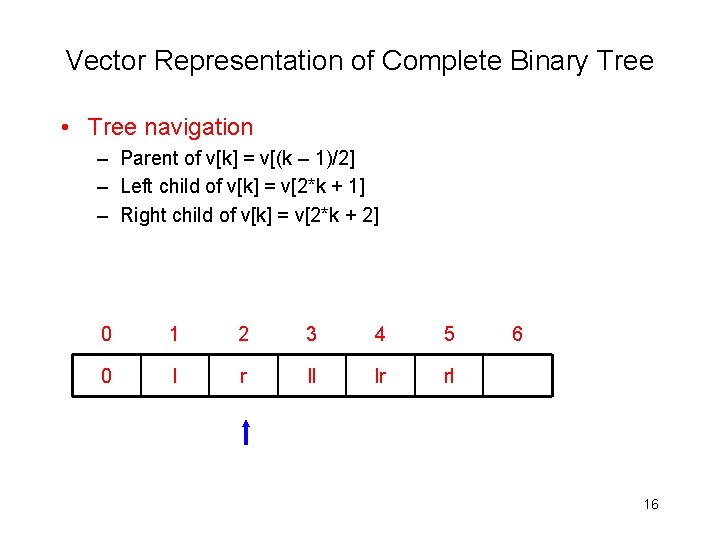
Vector Representation of Complete Binary Tree • Tree navigation – Parent of v[k] = v[(k – 1)/2] – Left child of v[k] = v[2*k + 1] – Right child of v[k] = v[2*k + 2] 0 1 2 3 4 5 0 l r ll lr rl 6 16
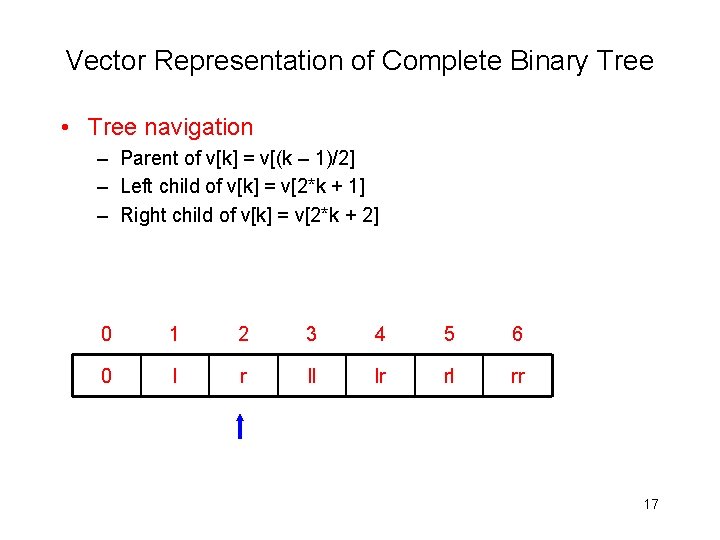
Vector Representation of Complete Binary Tree • Tree navigation – Parent of v[k] = v[(k – 1)/2] – Left child of v[k] = v[2*k + 1] – Right child of v[k] = v[2*k + 2] 0 1 2 3 4 5 6 0 l r ll lr rl rr 17
Binary Tree Traversals • Inorder traversal – Definition: left child, vertex, right child (recursive) – Algorithm: depth-first search (visit between children) 18
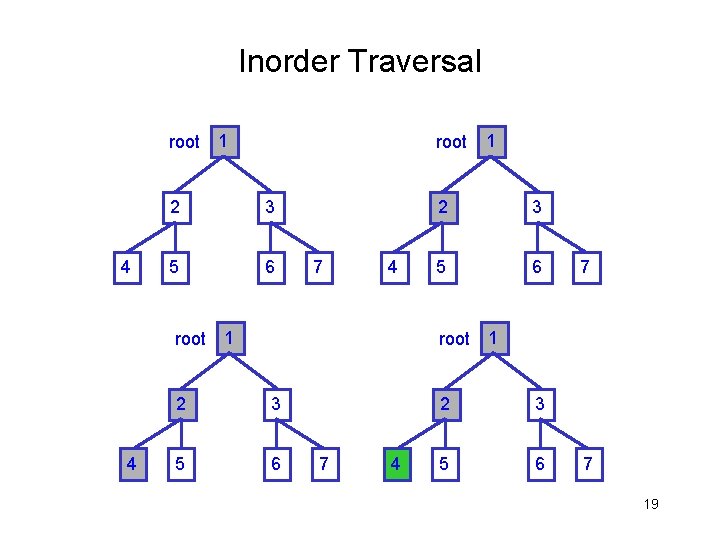
Inorder Traversal root 4 root 2 3 5 6 root 4 1 7 4 1 2 3 5 6 root 2 3 5 6 7 4 1 7 1 2 3 5 6 7 19
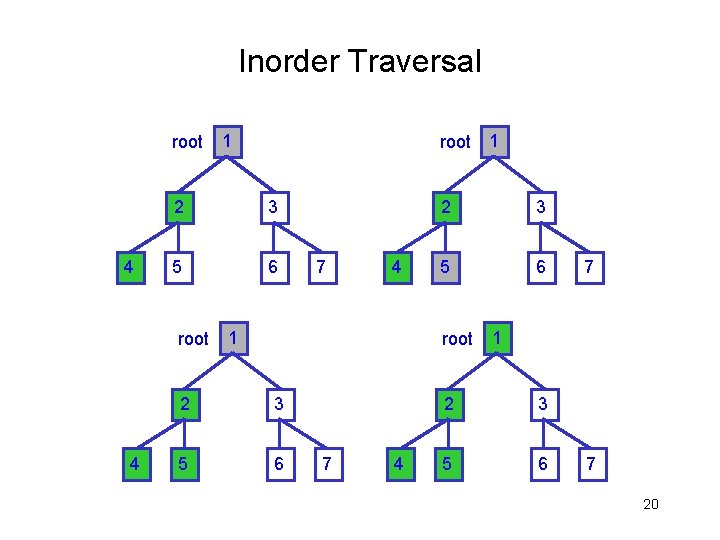
Inorder Traversal root 4 root 2 3 5 6 root 4 1 7 4 1 2 3 5 6 root 2 3 5 6 7 4 1 7 1 2 3 5 6 7 20
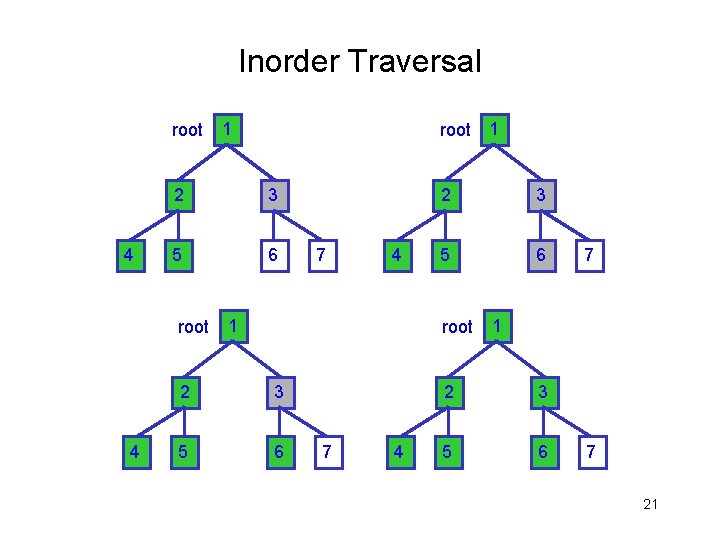
Inorder Traversal root 4 root 2 3 5 6 root 4 1 7 4 1 2 3 5 6 root 2 3 5 6 7 4 1 7 1 2 3 5 6 7 21
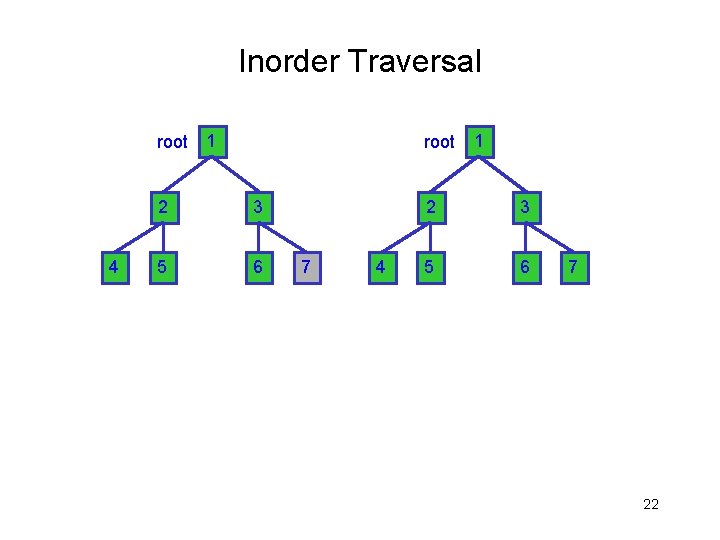
Inorder Traversal root 4 1 root 2 3 5 6 7 4 1 2 3 5 6 7 22
Binary Tree Traversals • Other traversals apply to binary case: – Preorder traversal • vertex, left subtree, right subtree – Inorder traversal • left subtree, vertex, right subtree – Postorder traversal • left subtree, right subtree, vertex – Levelorder traversal • vertex, left children, right children 23
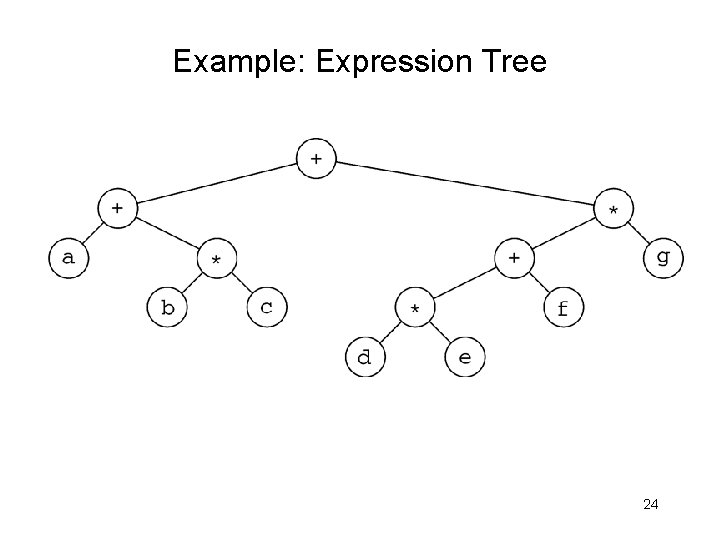
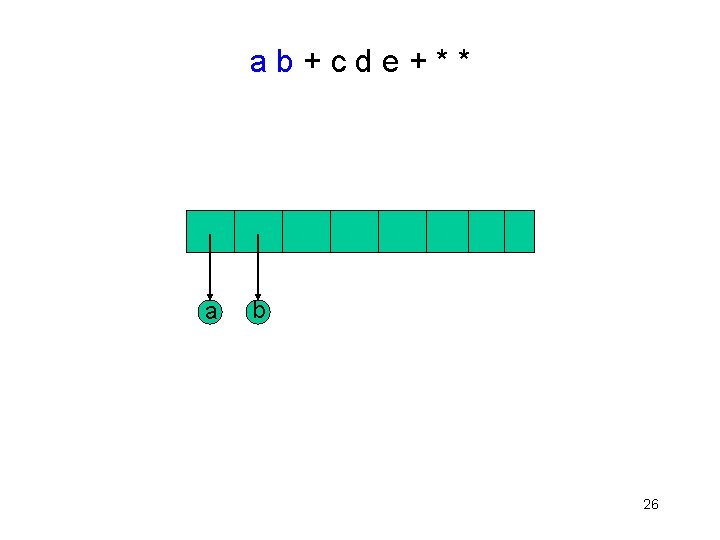
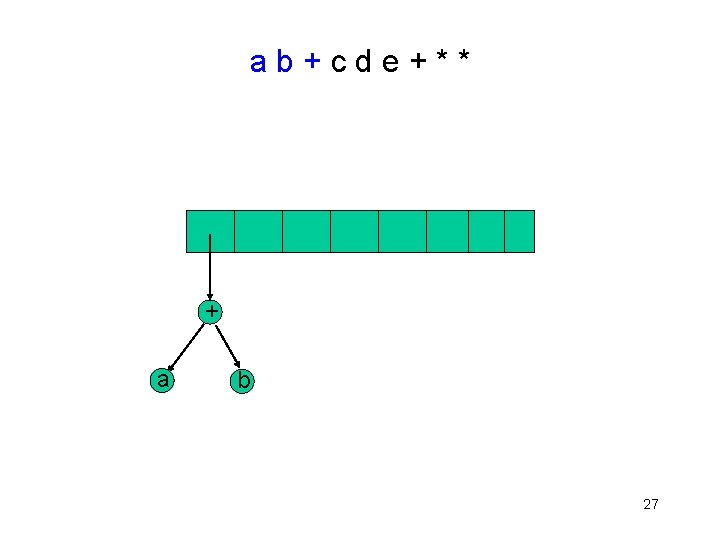
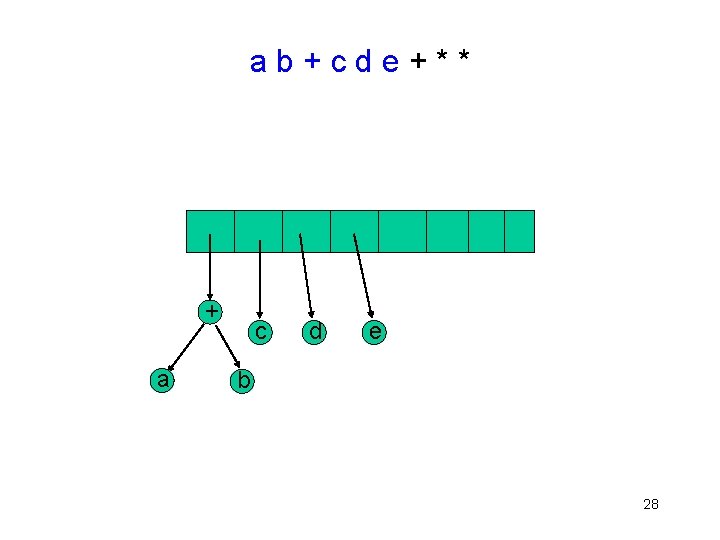
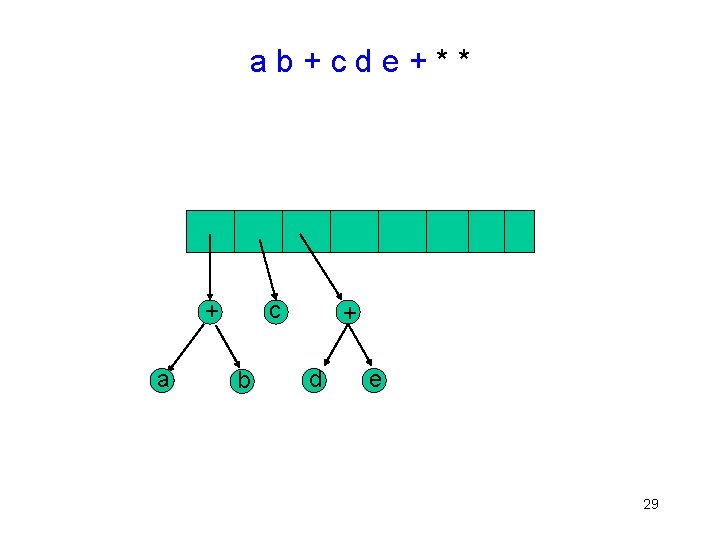
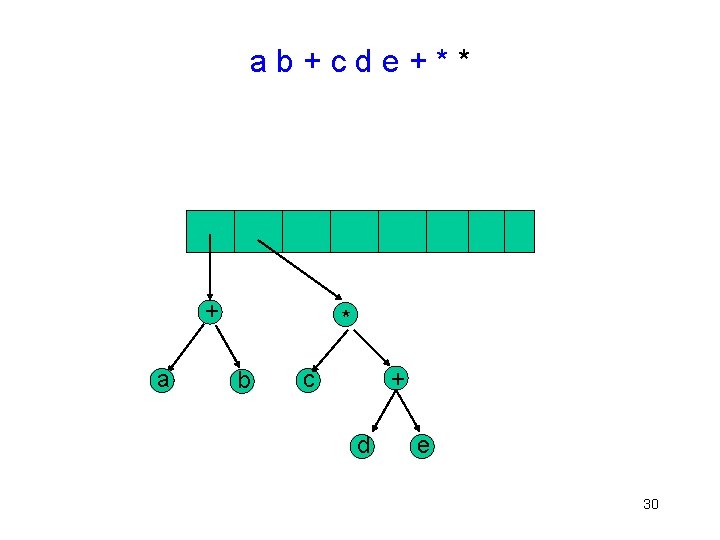
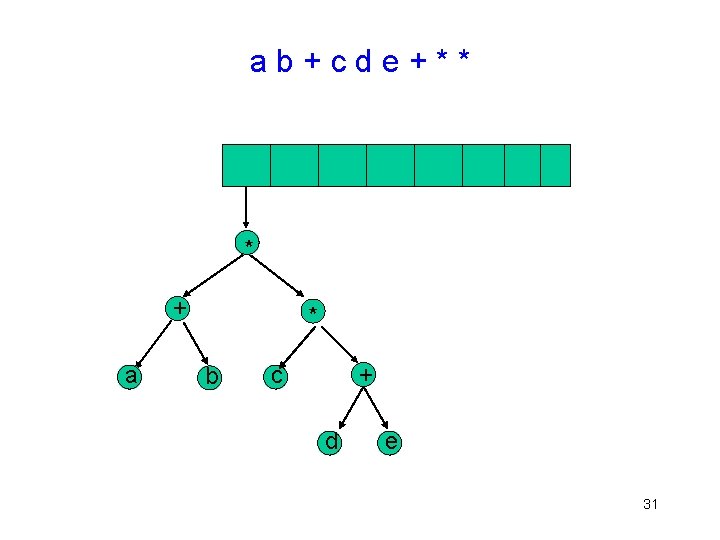
Example: Expression Tree How do you construct an expression tree from a postfix expression? E. g a b + c d e + * * 24
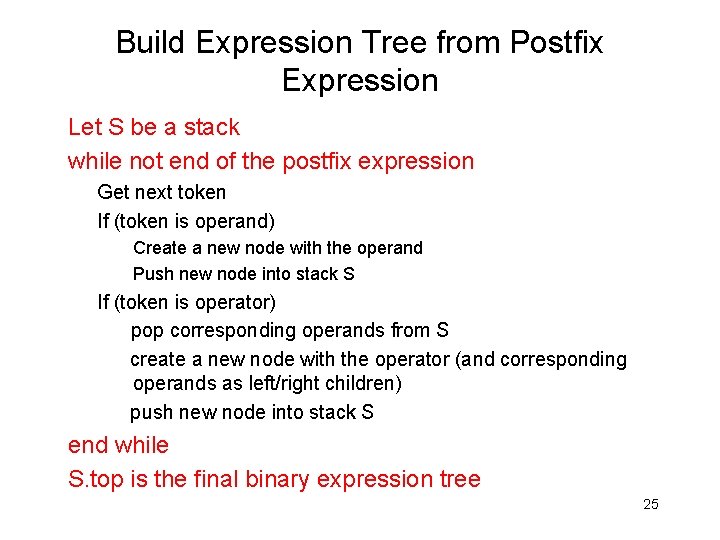
Build Expression Tree from Postfix Expression Let S be a stack while not end of the postfix expression Get next token If (token is operand) Create a new node with the operand Push new node into stack S If (token is operator) pop corresponding operands from S create a new node with the operator (and corresponding operands as left/right children) push new node into stack S end while S. top is the final binary expression tree 25
ab+cde+** a b 26
ab+cde+** + a b 27
ab+cde+** + a c d e b 28
ab+cde+** c + a b + d e 29
ab+cde+** + a * b c + d e 30
ab+cde+** * + a * b c + d e 31
Obtaining Infix Expression from Binary Expression Tree • Traversing the tree using inorder traversal • How to ensure correct precedence – Adding proper parentheses 32
Reading assignment • Section 4. 3 33
- Slides: 33