
Early Literacy Assessment Tool ELAT Project 2015 16





- Slides: 44
Early Literacy Assessment Tool (ELAT) Project 2015 -16 For New and Renewal Applicants Pursuant to: C. R. S. 22 -2 -141 January 26, 2015
Introduction to ELAT § The 2012 School Finance Act required the Colorado Department of Education to select a contractor to supply an early literacy assessment tool that teachers may use to obtain real-time assessments of the reading skill levels of students in kindergarten through third grade. The intent was to support state purchase of software that provides individualized assessments with immediate results, stores and analyzes those results, and recommends activities based on those results. Through a competitive bid process, the contract was awarded to Amplify for its DIBELS Next system and diagnostic reading assessments in January, 2013. Pending legislative approval during the 2015 session, the department will offer the project for the 2015 -16 school year. This is a non-competitive project. § By participating in the Early Literacy Assessment Tool Project, local education agencies will be supplied with the online assessment of DIBELS Next, an approved interim measure, and DIBELS Deep diagnostic reading assessments, an approved diagnostic measure. First-time participating LEAs will receive assessment kits, each school will receive one kit per grade level (renewal applicants will not receive additional kits). All LEAs will receive software to use the assessment. The tool will store and analyze the results and recommend school and home activities based on those results. Districts will be responsible for providing their own hardware. § Hardware is not included. For a list of devices that support the software, go to: http: //www. amplify. com/assessment/devices 2
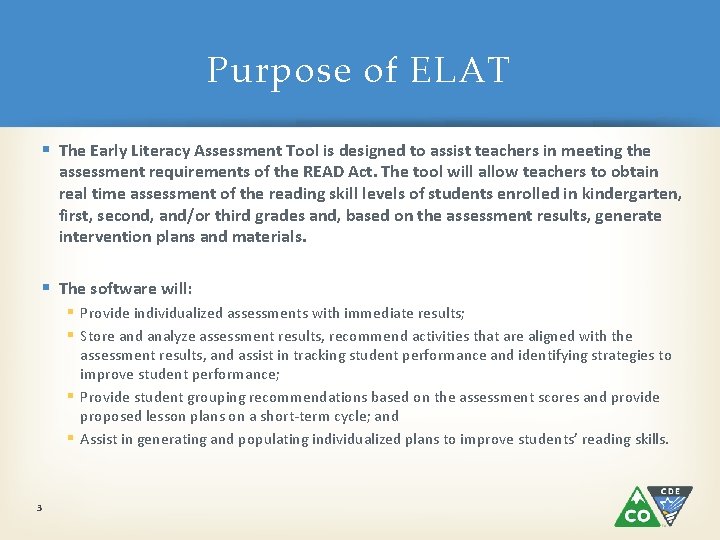
Purpose of ELAT § The Early Literacy Assessment Tool is designed to assist teachers in meeting the assessment requirements of the READ Act. The tool will allow teachers to obtain real time assessment of the reading skill levels of students enrolled in kindergarten, first, second, and/or third grades and, based on the assessment results, generate intervention plans and materials. § The software will: § Provide individualized assessments with immediate results; § Store and analyze assessment results, recommend activities that are aligned with the assessment results, and assist in tracking student performance and identifying strategies to improve student performance; § Provide student grouping recommendations based on the assessment scores and provide proposed lesson plans on a short-term cycle; and § Assist in generating and populating individualized plans to improve students’ reading skills. 3
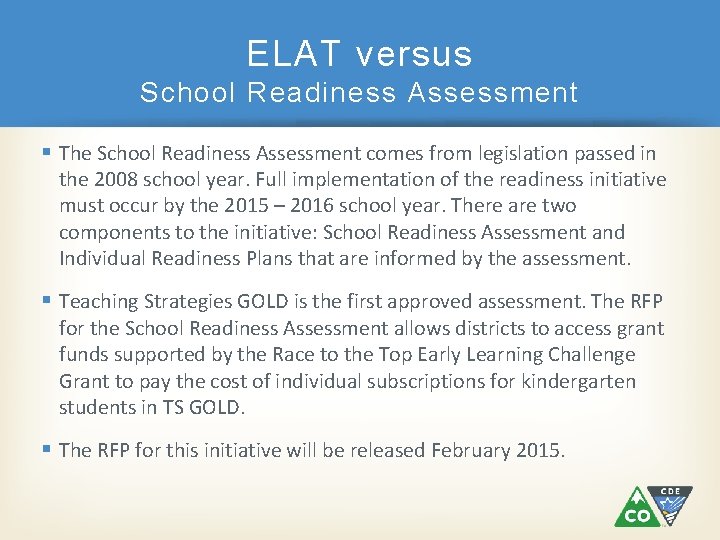
ELAT versus School Readiness Assessment § The School Readiness Assessment comes from legislation passed in the 2008 school year. Full implementation of the readiness initiative must occur by the 2015 – 2016 school year. There are two components to the initiative: School Readiness Assessment and Individual Readiness Plans that are informed by the assessment. § Teaching Strategies GOLD is the first approved assessment. The RFP for the School Readiness Assessment allows districts to access grant funds supported by the Race to the Top Early Learning Challenge Grant to pay the cost of individual subscriptions for kindergarten students in TS GOLD. § The RFP for this initiative will be released February 2015.
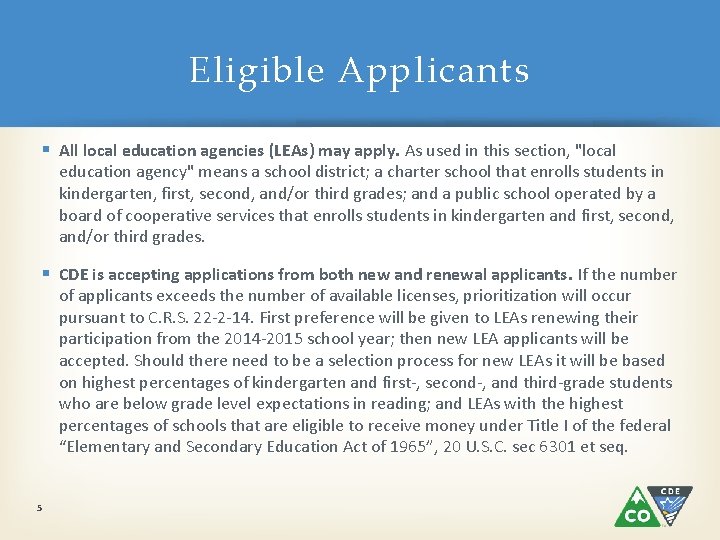
Eligible Applicants § All local education agencies (LEAs) may apply. As used in this section, "local education agency" means a school district; a charter school that enrolls students in kindergarten, first, second, and/or third grades; and a public school operated by a board of cooperative services that enrolls students in kindergarten and first, second, and/or third grades. § CDE is accepting applications from both new and renewal applicants. If the number of applicants exceeds the number of available licenses, prioritization will occur pursuant to C. R. S. 22 -2 -14. First preference will be given to LEAs renewing their participation from the 2014 -2015 school year; then new LEA applicants will be accepted. Should there need to be a selection process for new LEAs it will be based on highest percentages of kindergarten and first-, second-, and third-grade students who are below grade level expectations in reading; and LEAs with the highest percentages of schools that are eligible to receive money under Title I of the federal “Elementary and Secondary Education Act of 1965”, 20 U. S. C. sec 6301 et seq. 5
Duration of Program § Participation in the first year of the program was for the 2013 -2014 school year. § Year two participation was the 2014 -2015 school year. § The current RFP will apply to the 2015 -2016 school year. § Participation in subsequent years is dependent upon appropriations and available licenses. 6
Required Activities § School level activities required of the Early Literacy Assessment Tool Project include the following: § Obtain and utilize devices to assess kindergarten, first, second, and/or third graders on § § § 7 DIBELS Next. Note: The hardware purchase will be the district’s responsibility. Collection and submission of staff and student roster data to Amplify. Assessment of all kindergarten, first, second, and third grade students using DIBELS Next. Progress monitoring of students. Students well below benchmark will be progress monitored every 7 -10 days and students below benchmark will be progress monitored every 10 -12 days. Attendance by two Local Trainers per school at all face to face trainings and all webinar trainings. Assurance that Local Trainers will have training time with teachers at their school to implement what they have been trained on in their sessions. Attendance by principals at any scheduled instructional leader full day trainings and/or webinars as scheduled throughout the year.
Required Activities (cont. ) § For training, a timeline with specific dates and places will be available June 30, 2015. § Prior to the start of the school year, we will begin training the Local Trainers. This information will be included in the timeline that will be available June 30, 2015. 8
Evaluation & Reporting § By receiving software licenses, local education agencies agree to share all data collected using the software. § This data will be shared with Amplify and the Colorado Department of Education (CDE). § Data includes, but is not limited to, the growth and achievement of all kindergarten, first, second, and/or third grade students receiving services using the early literacy assessment tool, staff and student roster data, etc. § Data that is entered into the system will be automatically synced for uploading. Districts will still be required to submit READ Data through Data Pipeline. § The data collected is solely used by Amplify and the Colorado Department of Education for the scope of successful implementation of the project. This includes implementation fidelity, achievement and growth results, determination of site visits and professional development support. Any transference of data that includes personal identifiable information is done through secure file transfer. § See the Assurances and Authorization for Release of Personally Identifiable Information. 9
Review Process § Applications will be reviewed by CDE staff to ensure they contain all required components. § As stated above, if the number of applicants exceeds the number of available licenses, prioritization will occur pursuant to C. R. S. 22 -2 -14. Preference will be given to year 2 participants (2014 -2015); then to new LEAs with the highest percentages of kindergarten and first-, second-, and third-grade students who are below grade level expectations in reading; and to LEAs with the highest percentages of schools that are eligible to receive money under Title I of the federal “Elementary and Secondary Education Act of 1965”, 20 U. S. C. sec 6301 et seq. 10
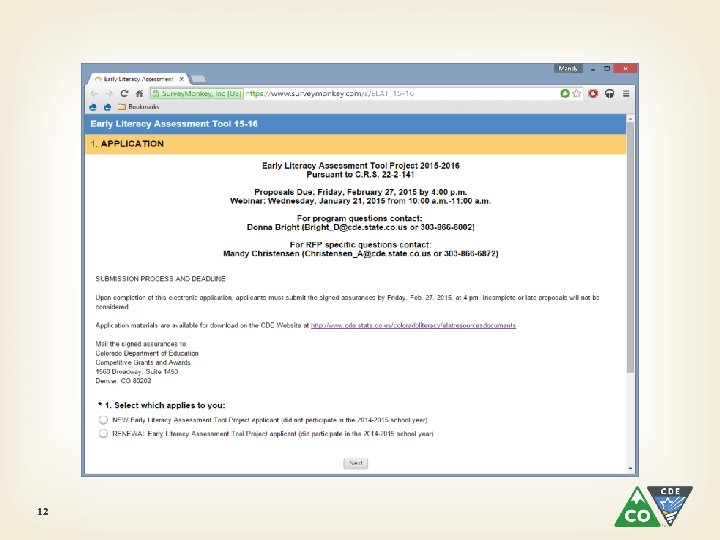
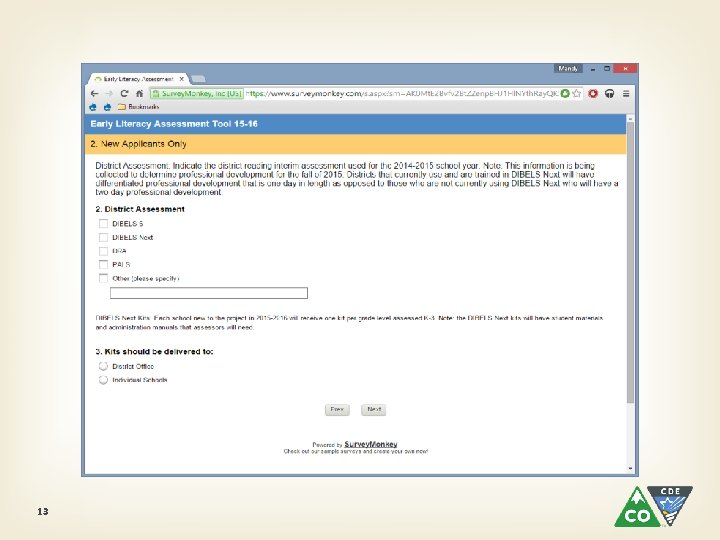
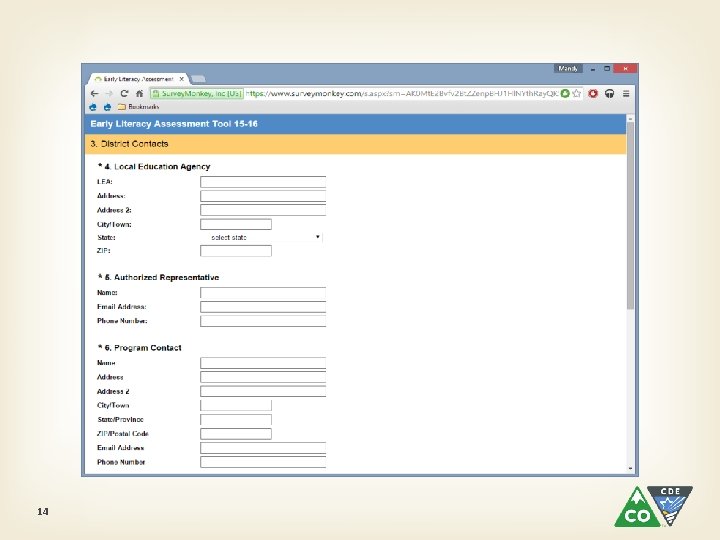
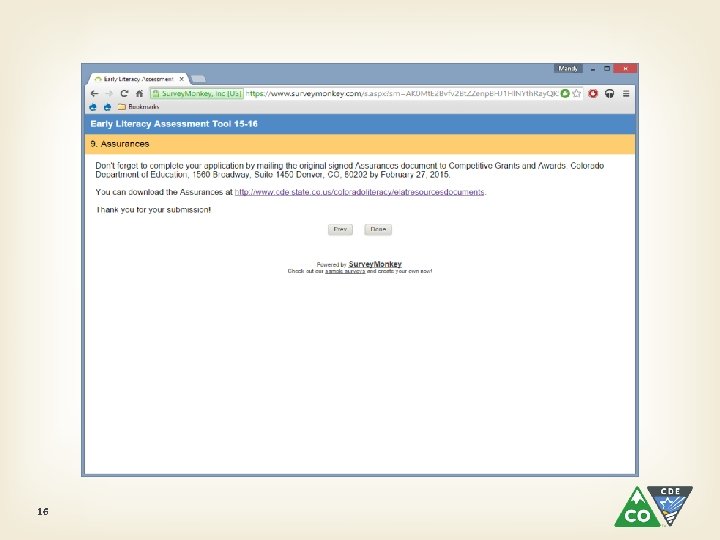
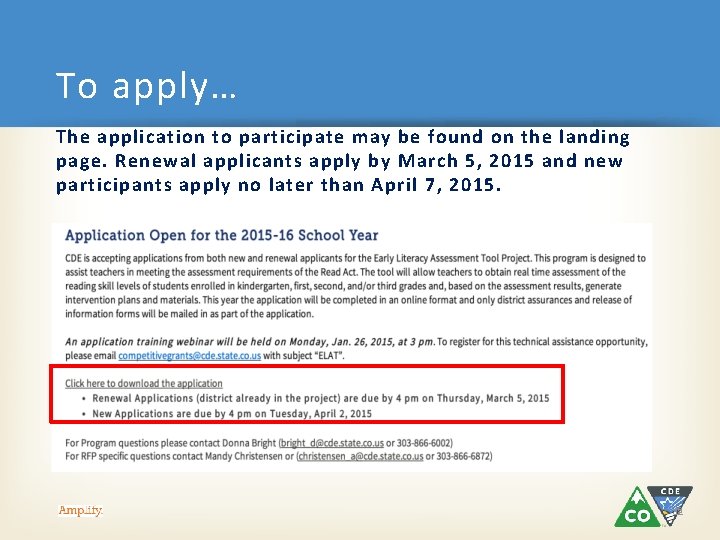
Submission Process and Deadline § The application is available online at: https: //www. surveymonkey. com/s/ELAT_1516. § Upon completion of the application, applicants must submit a hard copy of the signed Assurances and the Amplify Authorization for Release of Personally Identifiable Information to CDE by March 5, 2015, by 4 pm, for renewing applicants (districts in the project for the 2014 -15 school year), and no later than April 7, 2015, by 4 pm, for new applicants to the project. Incomplete or late applications will not be considered. § Applications will be accepted as they are received. By submitting before the deadline, districts will afford themselves the opportunity for early outreach support. § Application materials are available for download on the CDE Website at: http: //www. cde. state. co. us/coloradoliteracy/Read. Act/assessmenttool. asp 11
12
13
14
15
16
CDE Contact Information For program questions contact: Donna Bright (Bright_D@cde. state. co. us or 303 -866 -6002) For RFP specific questions contact: Mandy Christensen (Christensen_A@cde. state. co. us or 303 -866 -6872) Lynn Bamberry (Bamberry_L@cde. state. co. us or 303 -866 -6813) 17
QUESTIONS? § At this point, we will answer questions specific to the application process before the demonstration of the tool. § As we move into the demonstration of the tool, previous ELAT participants may decide to leave the webinar. 18
CDE 2015 -16 Early Literacy Assessment Tool Project
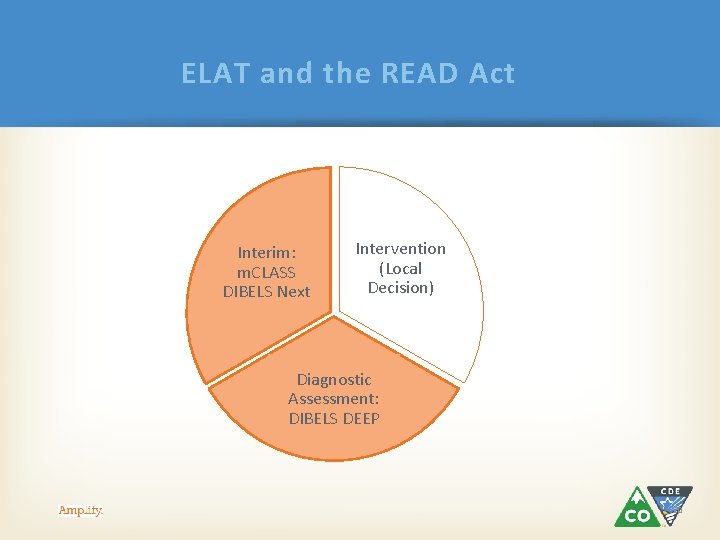
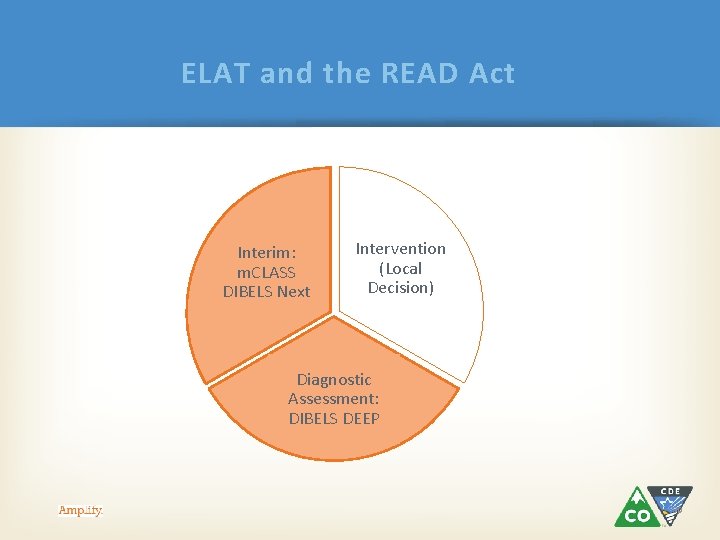
ELAT and the READ Act Interim: m. CLASS DIBELS Next Intervention (Local Decision) Diagnostic Assessment: DIBELS DEEP 20
m. CLASS: DIBELS Next Assess, Analyze, Act
Now What? Tools Assess, Analyze, Act
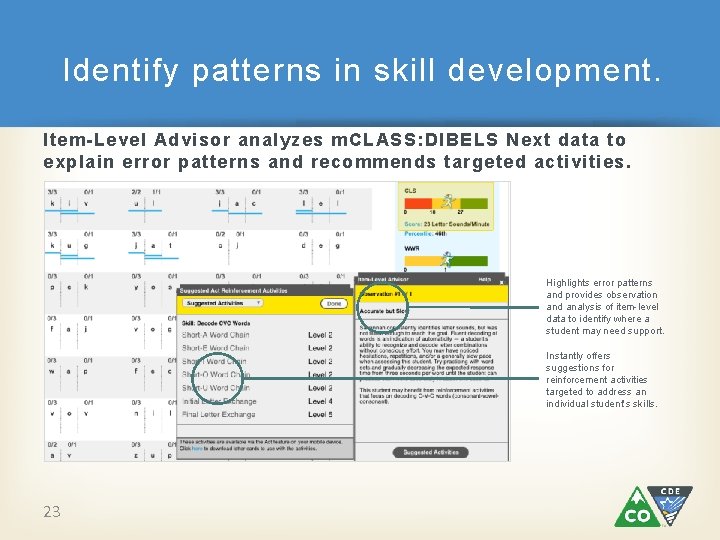
Identify patterns in skill development. Item-Level Advisor analyzes m. CLASS: DIBELS Next data to explain error patterns and recommends targeted activities. Highlights error patterns and provides observation and analysis of item-level data to identify where a student may need support. Instantly offers suggestions for reinforcement activities targeted to address an individual student’s skills. 23
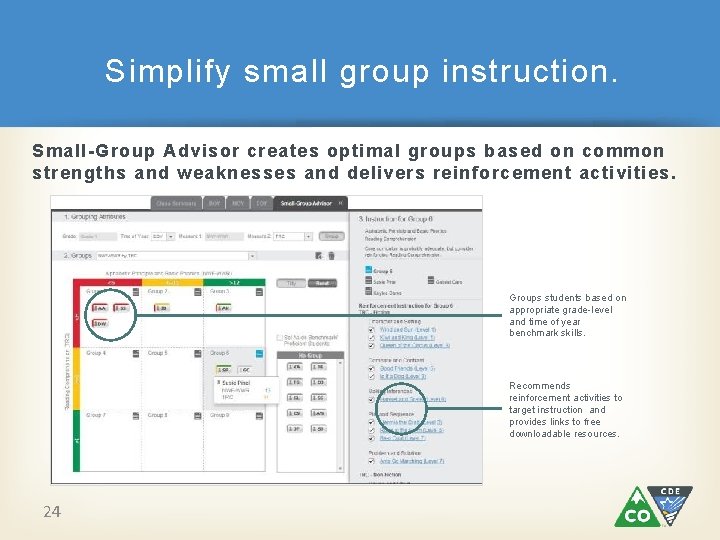
Simplify small group instruction. Small-Group Advisor creates optimal groups based on common strengths and weaknesses and delivers reinforcement activities. Groups students based on appropriate grade-level and time of year benchmark skills. Recommends reinforcement activities to target instruction and provides links to free downloadable resources. 24
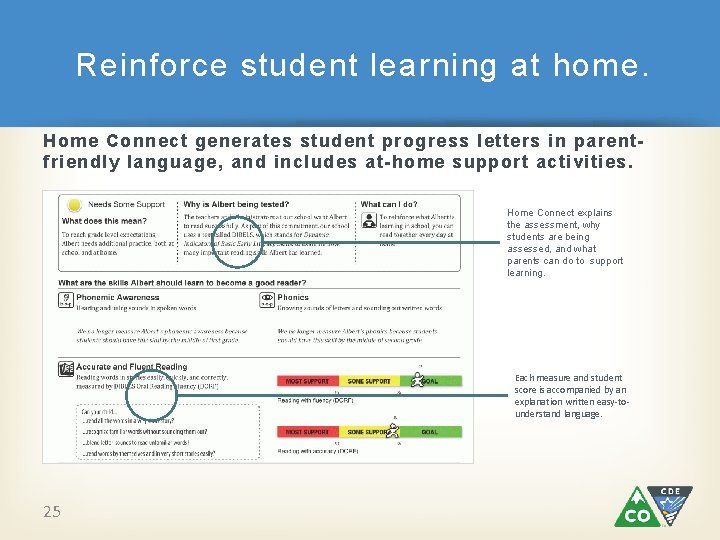
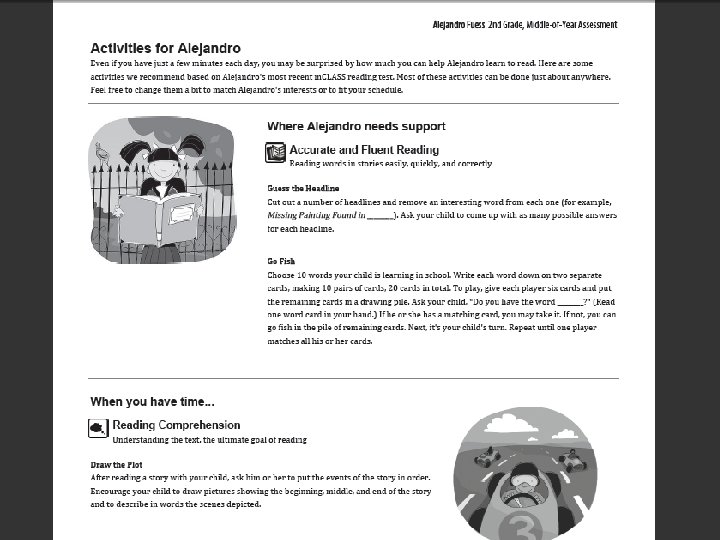
Reinforce student learning at home. Home Connect generates student progress letters in parentfriendly language, and includes at-home support activities. Home Connect explains the assessment, why students are being assessed, and what parents can do to support learning. Each measure and student score is accompanied by an explanation written easy-tounderstand language. 25
26
How can m. CLASS: DIBELS Next help educators?
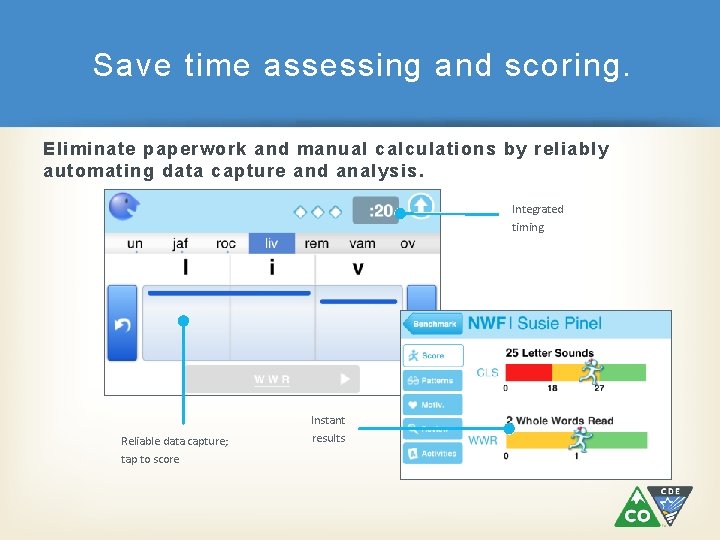
Save time assessing and scoring. Eliminate paperwork and manual calculations by reliably automating data capture and analysis. Integrated timing Instant Reliable data capture; tap to score results
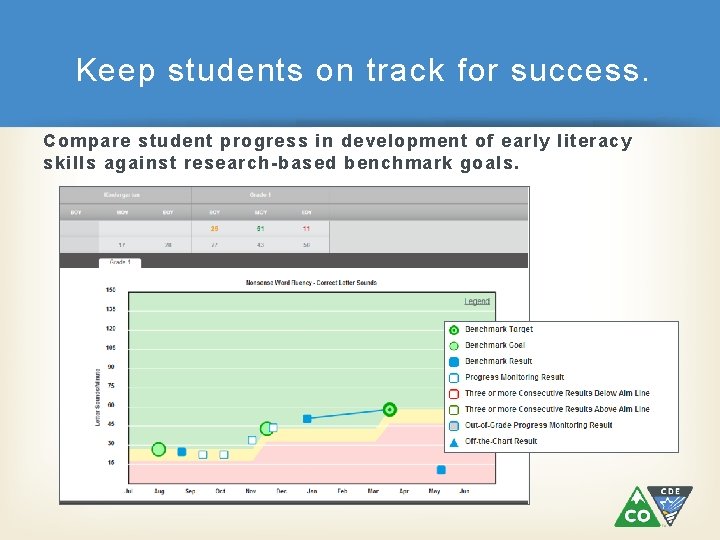
Keep students on track for success. Compare student progress in development of early literacy skills against research-based benchmark goals.
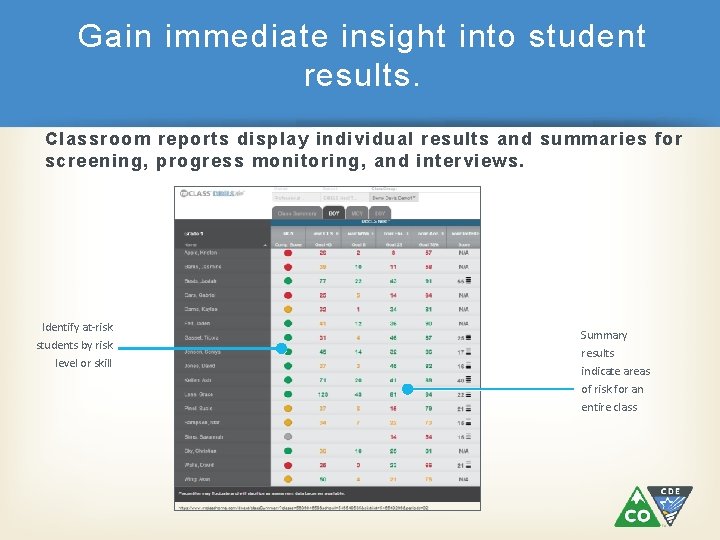
Gain immediate insight into student results. Classroom reports display individual results and summaries for screening, progress monitoring, and interviews. Identify at-risk students by risk level or skill Summary results indicate areas of risk for an entire class
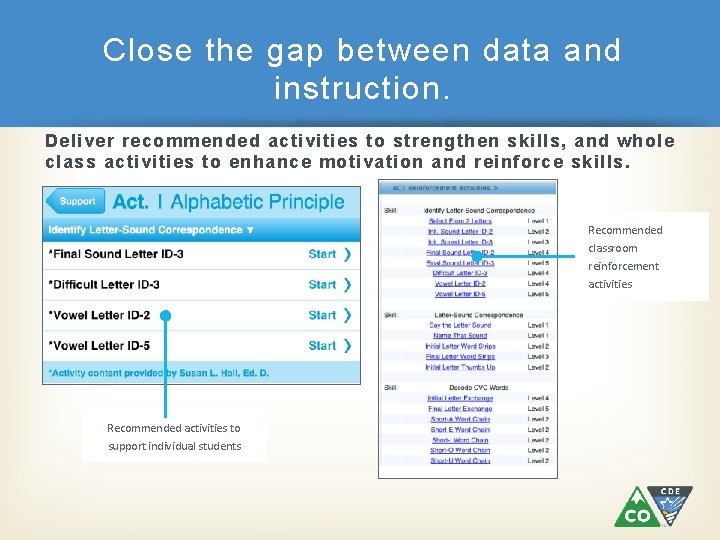
Close the gap between data and instruction. Deliver recommended activities to strengthen skills, and whole class activities to enhance motivation and reinforce skills. Recommended classroom reinforcement activities Recommended activities to support individual students
How does m. CLASS: DIBELS Next enable data-driven decisions?
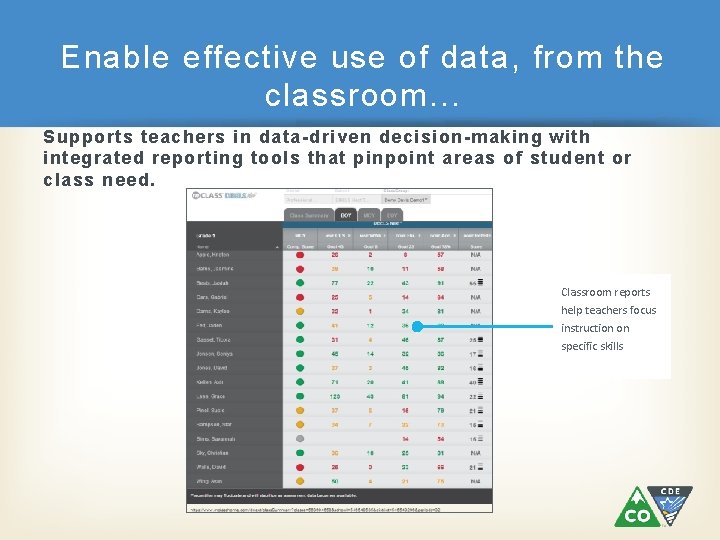
Enable effective use of data, from the classroom. . . Supports teachers in data-driven decision-making with integrated reporting tools that pinpoint areas of student or class need. Classroom reports help teachers focus instruction on specific skills
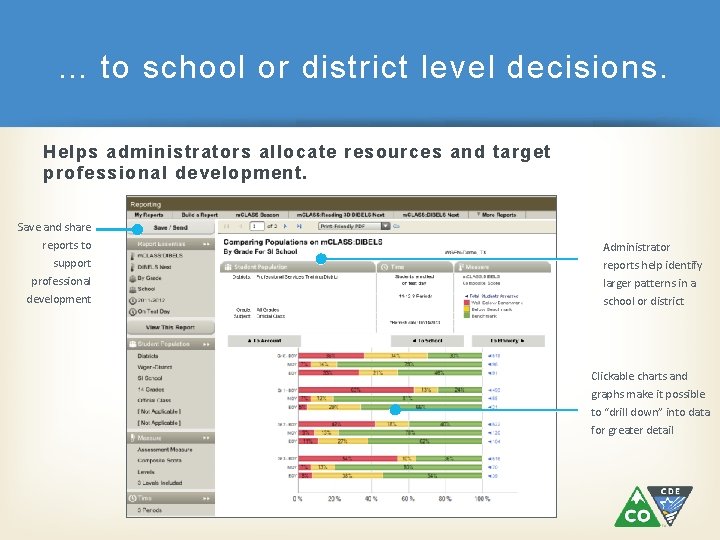
… to school or district level decisions. Helps administrators allocate resources and target professional development. Save and share reports to support professional development Administrator reports help identify larger patterns in a school or district Clickable charts and graphs make it possible to “drill down” into data for greater detail
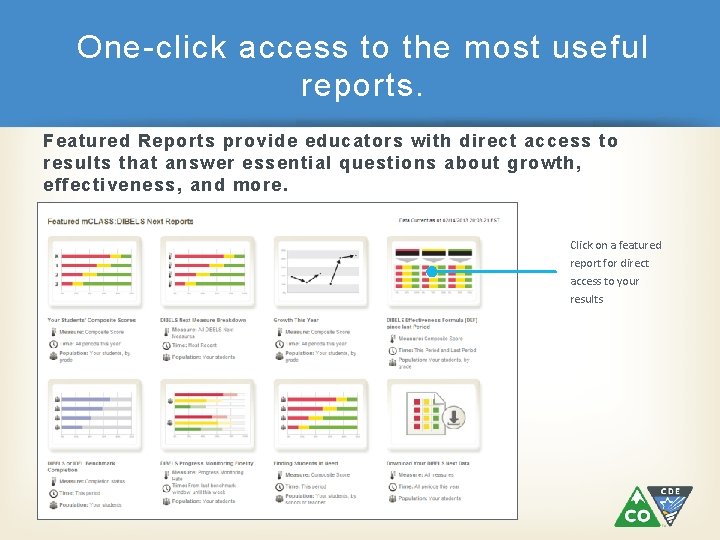
One-click access to the most useful reports. Featured Reports provide educators with direct access to results that answer essential questions about growth, effectiveness, and more. Click on a featured report for direct access to your results
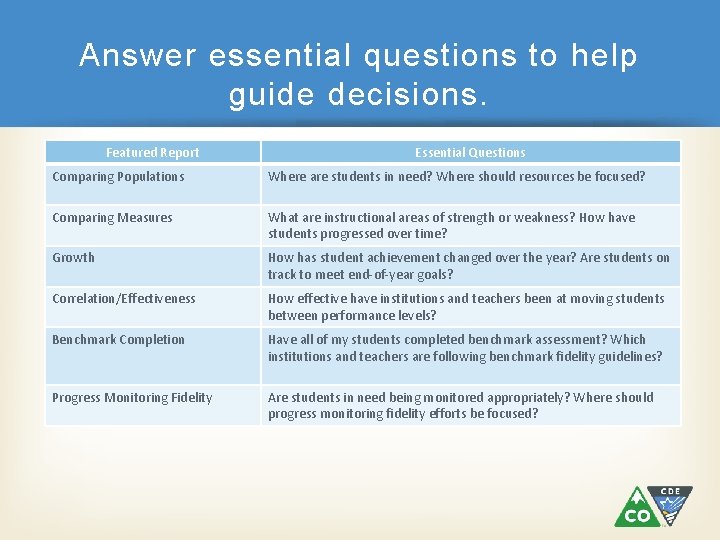
Answer essential questions to help guide decisions. Featured Report Essential Questions Comparing Populations Where are students in need? Where should resources be focused? Comparing Measures What are instructional areas of strength or weakness? How have students progressed over time? Growth How has student achievement changed over the year? Are students on track to meet end-of-year goals? Correlation/Effectiveness How effective have institutions and teachers been at moving students between performance levels? Benchmark Completion Have all of my students completed benchmark assessment? Which institutions and teachers are following benchmark fidelity guidelines? Progress Monitoring Fidelity Are students in need being monitored appropriately? Where should progress monitoring fidelity efforts be focused?
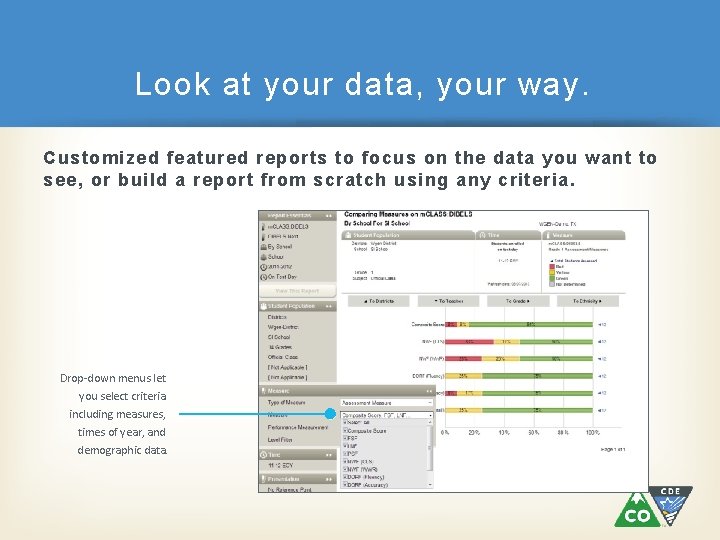
Look at your data, your way. Customized featured reports to focus on the data you want to see, or build a report from scratch using any criteria. Drop-down menus let you select criteria including measures, times of year, and demographic data.
In Summary…
ELAT and the READ Act Interim: m. CLASS DIBELS Next Intervention (Local Decision) Diagnostic Assessment: DIBELS DEEP 39
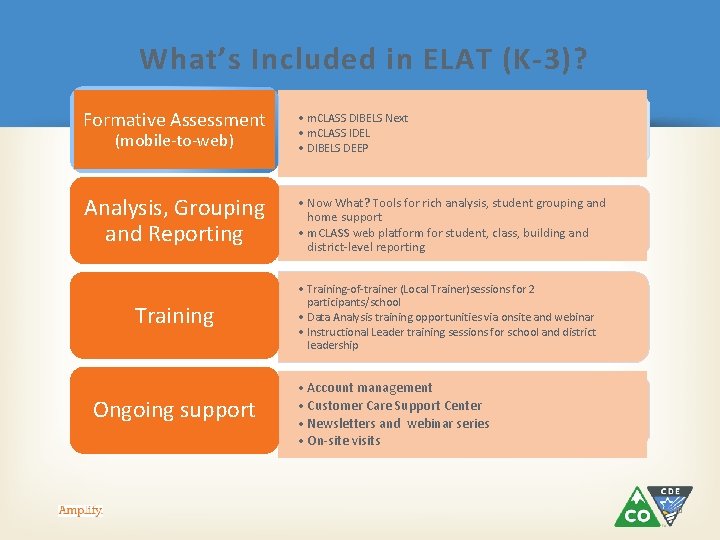
What’s Included in ELAT (K-3)? Formative Assessment • m. CLASS DIBELS Next • m. CLASS IDEL • DIBELS DEEP Analysis, Grouping and Reporting • Now What? Tools for rich analysis, student grouping and home support • m. CLASS web platform for student, class, building and district-level reporting (mobile-to-web) Training Ongoing support • Training-of-trainer (Local Trainer)sessions for 2 participants/school • Data Analysis training opportunities via onsite and webinar • Instructional Leader training sessions for school and district leadership • Account management • Customer Care Support Center • Newsletters and webinar series • On-site visits 40
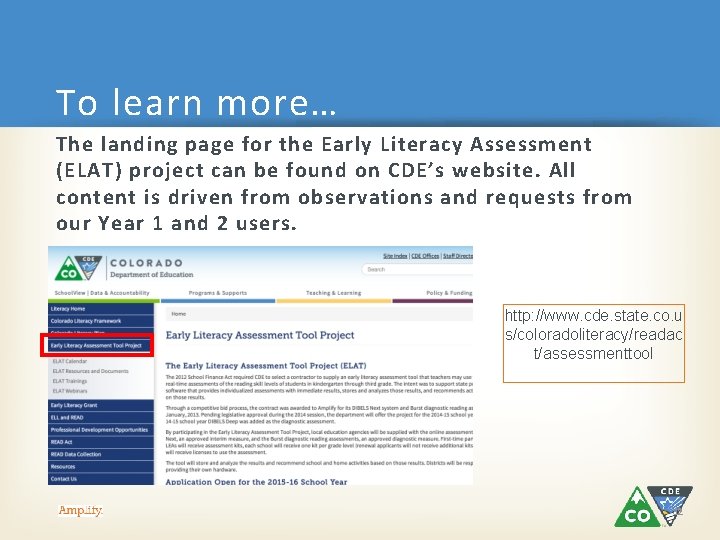
To learn more… The landing page for the Early Literacy Assessment (ELAT) project can be found on CDE’s website. All content is driven from observations and requests from our Year 1 and 2 users. http: //www. cde. state. co. u s/coloradoliteracy/readac t/assessmenttool 41 32
To apply… The application to participate may be found on the landing page. Renewal applicants apply by March 5, 2015 and new participants apply no later than April 7, 2015. 42 32
Questions Thanks for your participation! 43
CDE Contact Information For program questions contact: Donna Bright (Bright_D@cde. state. co. us or 303 -866 -6002) For RFP specific questions contact: Mandy Christensen (Christensen_A@cde. state. co. us or 303 -866 -6872) Lynn Bamberry (Bamberry_L@cde. state. co. us or 303 -866 -6813) 44