Improvement Planning for Schools Identified for Comprehensive and

- Slides: 40
Improvement Planning for Schools Identified for Comprehensive and Targeted Support October 2019 1
Welcome! 2
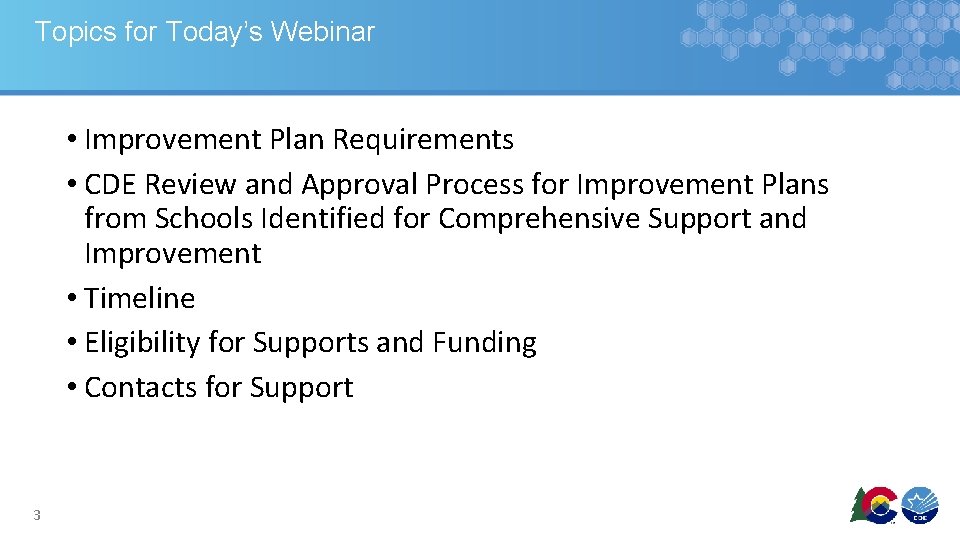
Topics for Today’s Webinar • Improvement Plan Requirements • CDE Review and Approval Process for Improvement Plans from Schools Identified for Comprehensive Support and Improvement • Timeline • Eligibility for Supports and Funding • Contacts for Support 3
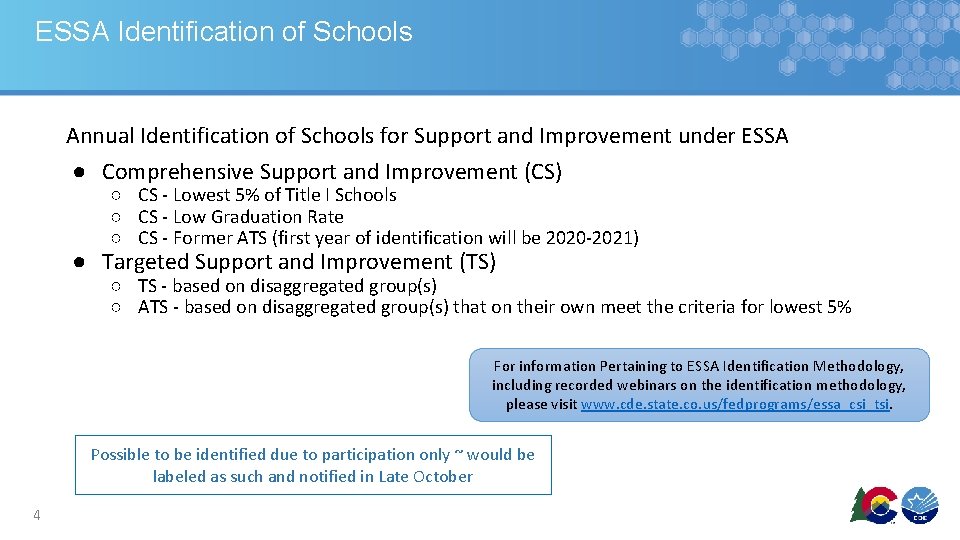
ESSA Identification of Schools Annual Identification of Schools for Support and Improvement under ESSA ● Comprehensive Support and Improvement (CS) ○ CS - Lowest 5% of Title I Schools ○ CS - Low Graduation Rate ○ CS - Former ATS (first year of identification will be 2020 -2021) ● Targeted Support and Improvement (TS) ○ TS - based on disaggregated group(s) ○ ATS - based on disaggregated group(s) that on their own meet the criteria for lowest 5% For information Pertaining to ESSA Identification Methodology, including recorded webinars on the identification methodology, please visit www. cde. state. co. us/fedprograms/essa_csi_tsi. Possible to be identified due to participation only ~ would be labeled as such and notified in Late October 4
Improvement Plan Requirements 5
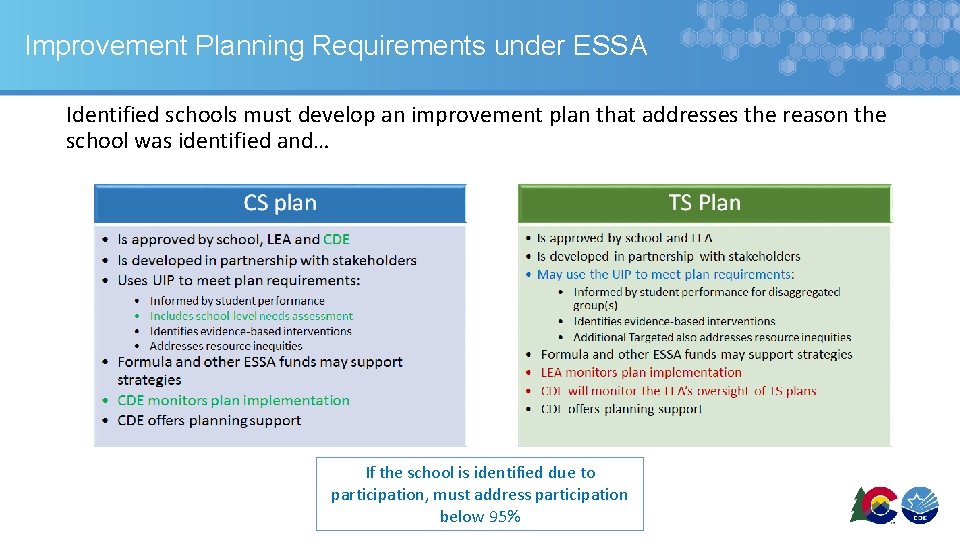
Improvement Planning Requirements under ESSA Identified schools must develop an improvement plan that addresses the reason the school was identified and… If the school is identified due to participation, must address participation below 95%
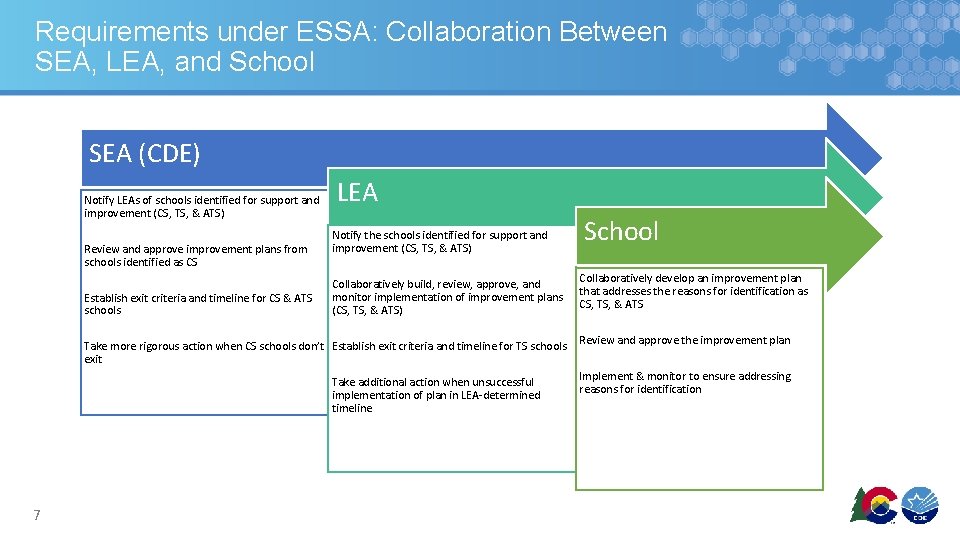
Requirements under ESSA: Collaboration Between SEA, LEA, and School SEA (CDE) Notify LEAs of schools identified for support and improvement (CS, TS, & ATS) Review and approve improvement plans from schools identified as CS Establish exit criteria and timeline for CS & ATS schools LEA Notify the schools identified for support and improvement (CS, TS, & ATS) Collaboratively build, review, approve, and monitor implementation of improvement plans (CS, TS, & ATS) Take more rigorous action when CS schools don’t Establish exit criteria and timeline for TS schools exit Take additional action when unsuccessful implementation of plan in LEA-determined timeline 7 School Collaboratively develop an improvement plan that addresses the reasons for identification as CS, TS, & ATS Review and approve the improvement plan Implement & monitor to ensure addressing reasons for identification
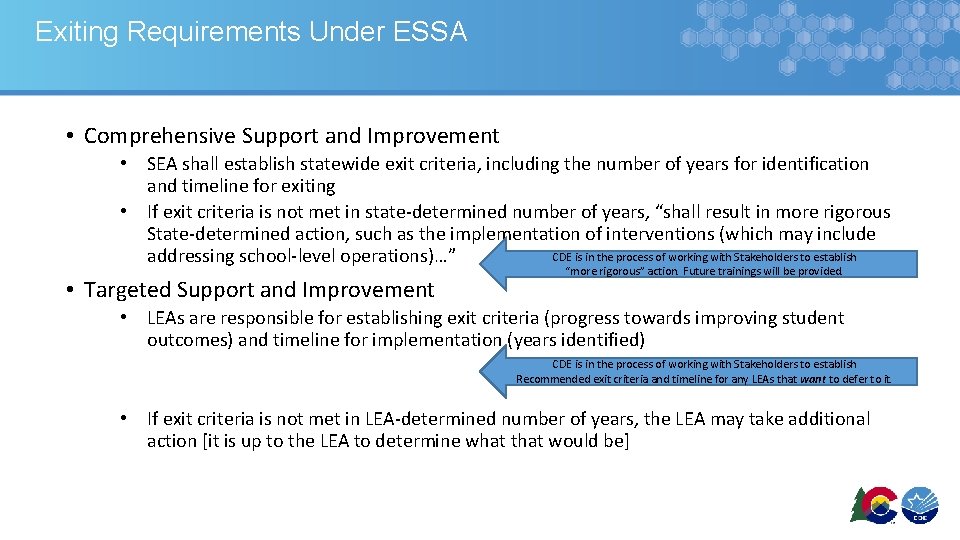
Exiting Requirements Under ESSA • Comprehensive Support and Improvement • SEA shall establish statewide exit criteria, including the number of years for identification and timeline for exiting • If exit criteria is not met in state-determined number of years, “shall result in more rigorous State-determined action, such as the implementation of interventions (which may include CDE is in the process of working with Stakeholders to establish addressing school-level operations)…” • Targeted Support and Improvement “more rigorous” action. Future trainings will be provided. • LEAs are responsible for establishing exit criteria (progress towards improving student outcomes) and timeline for implementation (years identified) CDE is in the process of working with Stakeholders to establish Recommended exit criteria and timeline for any LEAs that want to defer to it. • If exit criteria is not met in LEA-determined number of years, the LEA may take additional action [it is up to the LEA to determine what that would be]
CDE Review and Approval of CS Improvement Plans (or UIPs from Schools Identified as CS) 9
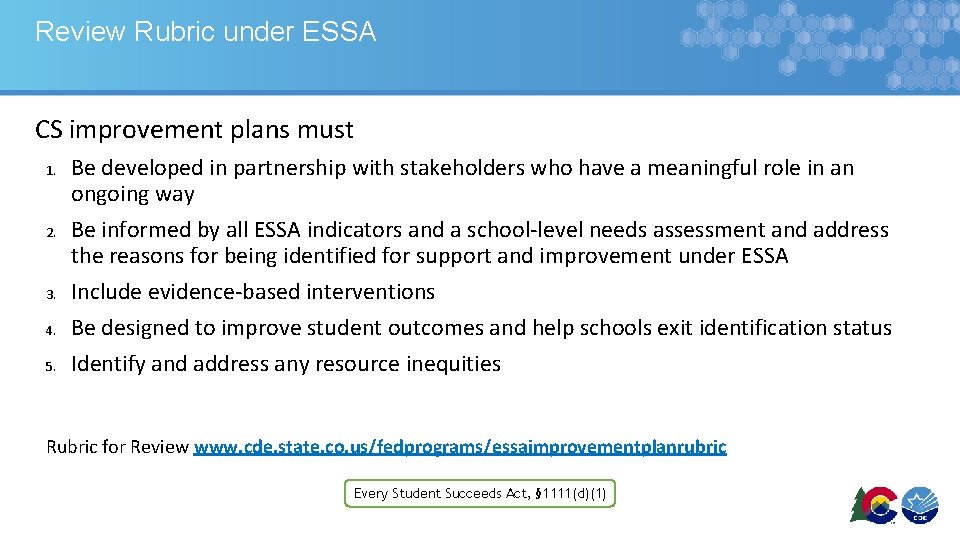
Review Rubric under ESSA CS improvement plans must 1. 2. 3. 4. 5. Be developed in partnership with stakeholders who have a meaningful role in an ongoing way Be informed by all ESSA indicators and a school-level needs assessment and address the reasons for being identified for support and improvement under ESSA Include evidence-based interventions Be designed to improve student outcomes and help schools exit identification status Identify and address any resource inequities Rubric for Review www. cde. state. co. us/fedprograms/essaimprovementplanrubric Every Student Succeeds Act, § 1111(d)(1)
Section 1: Stakeholder Engagement • Recommended Applicable Section of UIP: Data Narrative –Description of School Setting and Process for Data Analysis • ESSA section 1111(d)(1)(B) requires that “…the local education agency shall, for each school identified by the State and in partnership with stakeholders (including principals and other school leaders, teacher, and parents), locally develop and implement a comprehensive support and improvement plan…. ” • CDE interprets this requirement as the plan must be developed in partnership with stakeholders, meaning they had a significant role in the improvement plan development process, including but not limited to reviewing the reasons for the school’s identification for ESSA support and improvement, the school’s performance on each ESSA indicator, prioritization of indicators based on ESSA indicators and selection of interventions or strategies for improving identified needs. 11
Section 1: Stakeholder Engagement Guiding Questions • Which stakeholders partnered in the development of the school’s improvement plan? • At a minimum, stakeholders should include district partners, school leaders, teachers and other teaching staff, and parents. Local context should be used to identify the most appropriate stakeholder groups to invite to participate. • Outreach to engage and involve stakeholders should provide genuine opportunity for participation. • There should be evidence of district staff approval, but this should be evident through the district’s submission of the plan and can also be documented in the district level UIP. • Did stakeholders have opportunity to partner in the plan development in an ongoing manner? • Outreach to invite stakeholders to partner in plan development should be frequent and provide ongoing opportunity for partnering on development. • Stakeholders should be invited to participate from the beginning of plan development. • Multiple opportunities should be provided across the plan development period to various stakeholders, including times, modalities, methods, and venues that work for the various stakeholders. • Did stakeholders have a genuine opportunity to partner in the plan development? • Stakeholders should have a genuine opportunity to provide input on the improvement plan, including but not limited to participating in the school level needs assessment, reviewing the results of the needs analysis, reviewing student performance on all ESSA indicators, and helping identify which needs to prioritize, or giving input on the strategies to be used to address needs. 12
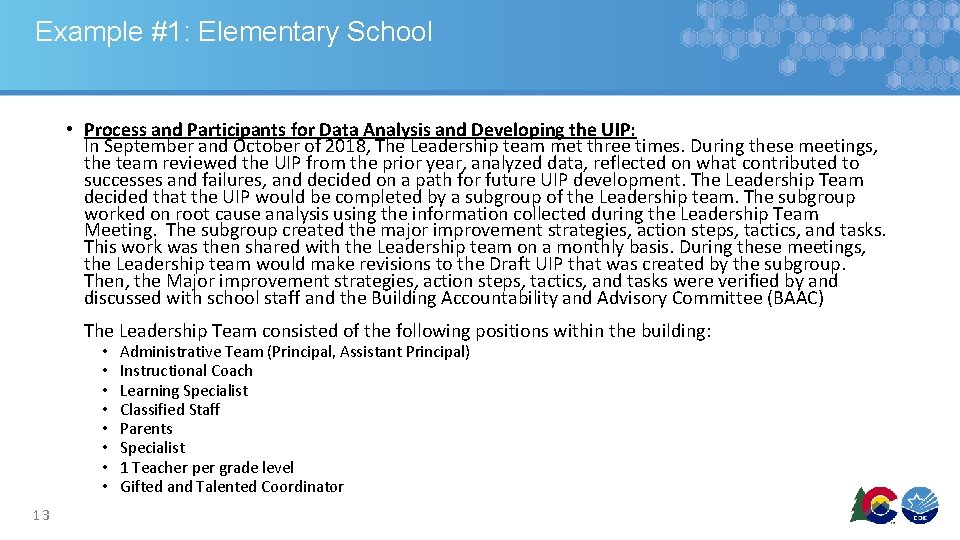
Example #1: Elementary School • Process and Participants for Data Analysis and Developing the UIP: In September and October of 2018, The Leadership team met three times. During these meetings, the team reviewed the UIP from the prior year, analyzed data, reflected on what contributed to successes and failures, and decided on a path for future UIP development. The Leadership Team decided that the UIP would be completed by a subgroup of the Leadership team. The subgroup worked on root cause analysis using the information collected during the Leadership Team Meeting. The subgroup created the major improvement strategies, action steps, tactics, and tasks. This work was then shared with the Leadership team on a monthly basis. During these meetings, the Leadership team would make revisions to the Draft UIP that was created by the subgroup. Then, the Major improvement strategies, action steps, tactics, and tasks were verified by and discussed with school staff and the Building Accountability and Advisory Committee (BAAC) The Leadership Team consisted of the following positions within the building: • • 13 Administrative Team (Principal, Assistant Principal) Instructional Coach Learning Specialist Classified Staff Parents Specialist 1 Teacher per grade level Gifted and Talented Coordinator
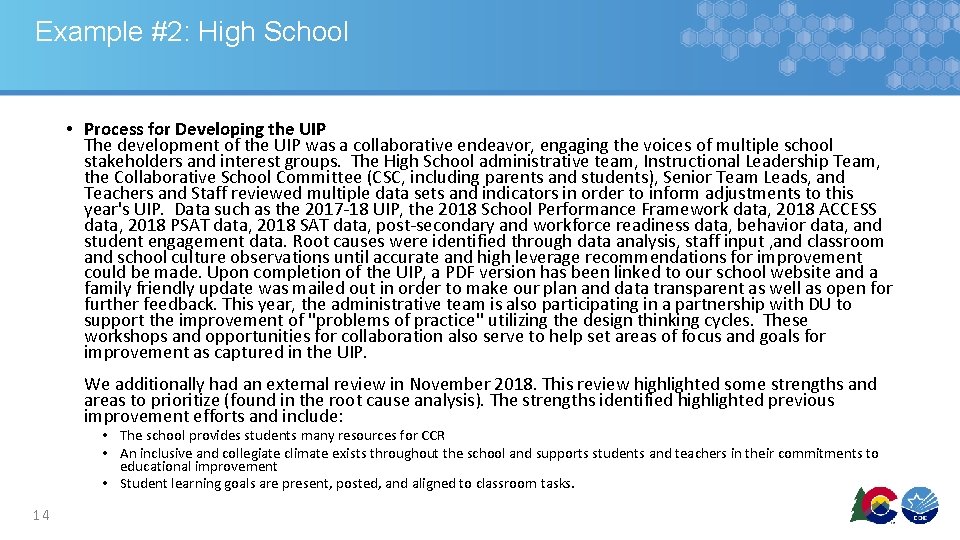
Example #2: High School • Process for Developing the UIP The development of the UIP was a collaborative endeavor, engaging the voices of multiple school stakeholders and interest groups. The High School administrative team, Instructional Leadership Team, the Collaborative School Committee (CSC, including parents and students), Senior Team Leads, and Teachers and Staff reviewed multiple data sets and indicators in order to inform adjustments to this year's UIP. Data such as the 2017 -18 UIP, the 2018 School Performance Framework data, 2018 ACCESS data, 2018 PSAT data, 2018 SAT data, post-secondary and workforce readiness data, behavior data, and student engagement data. Root causes were identified through data analysis, staff input , and classroom and school culture observations until accurate and high leverage recommendations for improvement could be made. Upon completion of the UIP, a PDF version has been linked to our school website and a family friendly update was mailed out in order to make our plan and data transparent as well as open for further feedback. This year, the administrative team is also participating in a partnership with DU to support the improvement of ''problems of practice'' utilizing the design thinking cycles. These workshops and opportunities for collaboration also serve to help set areas of focus and goals for improvement as captured in the UIP. We additionally had an external review in November 2018. This review highlighted some strengths and areas to prioritize (found in the root cause analysis). The strengths identified highlighted previous improvement efforts and include: • The school provides students many resources for CCR • An inclusive and collegiate climate exists throughout the school and supports students and teachers in their commitments to educational improvement • Student learning goals are present, posted, and aligned to classroom tasks. 14
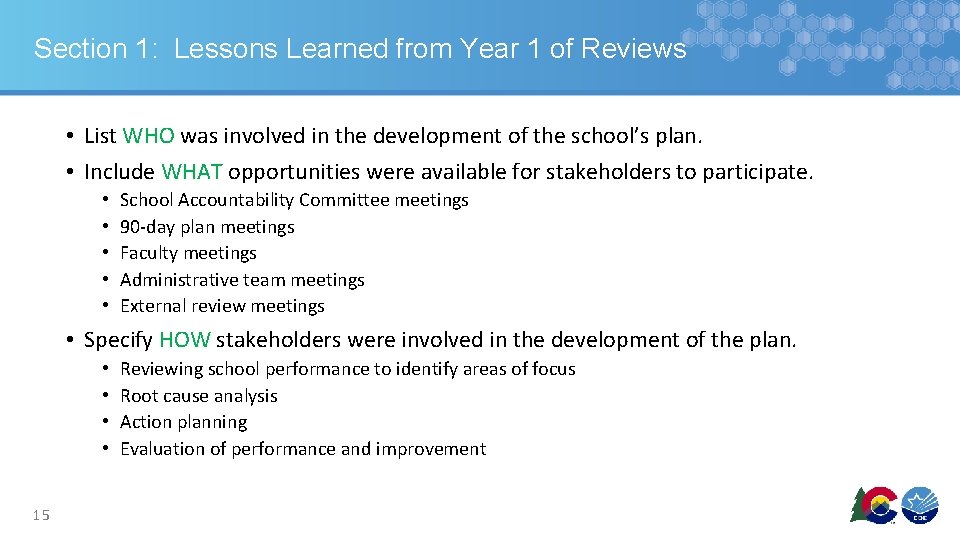
Section 1: Lessons Learned from Year 1 of Reviews • List WHO was involved in the development of the school’s plan. • Include WHAT opportunities were available for stakeholders to participate. • • • School Accountability Committee meetings 90 -day plan meetings Faculty meetings Administrative team meetings External review meetings • Specify HOW stakeholders were involved in the development of the plan. • • 15 Reviewing school performance to identify areas of focus Root cause analysis Action planning Evaluation of performance and improvement
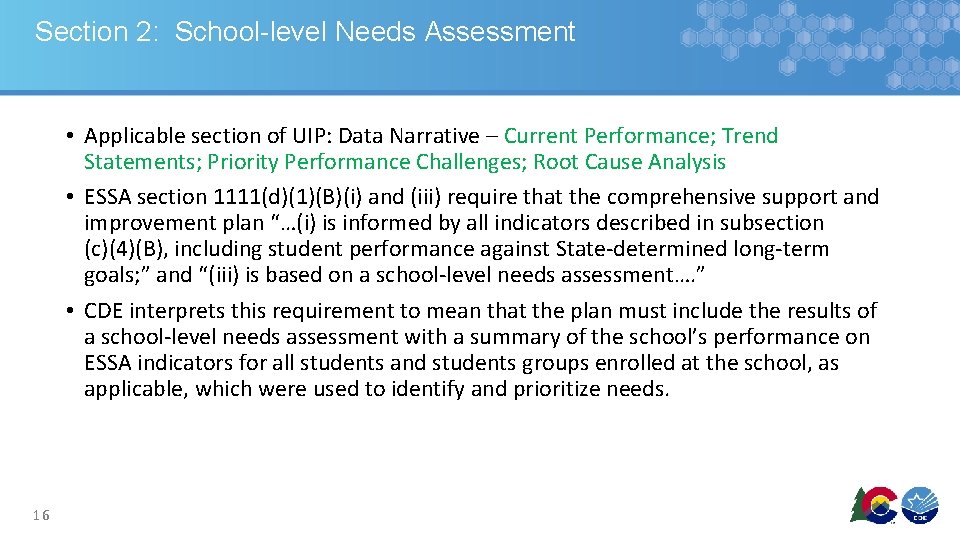
Section 2: School-level Needs Assessment • Applicable section of UIP: Data Narrative – Current Performance; Trend Statements; Priority Performance Challenges; Root Cause Analysis • ESSA section 1111(d)(1)(B)(i) and (iii) require that the comprehensive support and improvement plan “…(i) is informed by all indicators described in subsection (c)(4)(B), including student performance against State-determined long-term goals; ” and “(iii) is based on a school-level needs assessment…. ” • CDE interprets this requirement to mean that the plan must include the results of a school-level needs assessment with a summary of the school’s performance on ESSA indicators for all students and students groups enrolled at the school, as applicable, which were used to identify and prioritize needs. 16
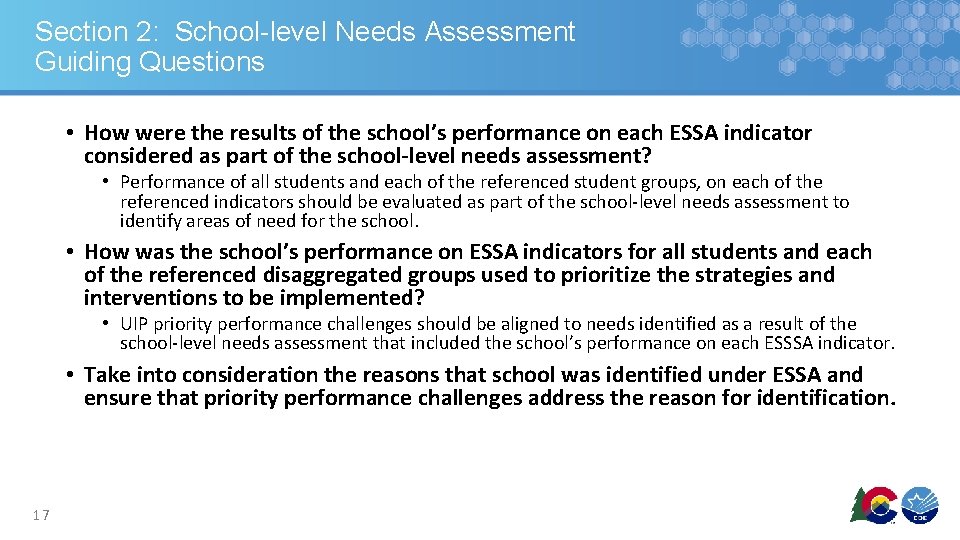
Section 2: School-level Needs Assessment Guiding Questions • How were the results of the school’s performance on each ESSA indicator considered as part of the school-level needs assessment? • Performance of all students and each of the referenced student groups, on each of the referenced indicators should be evaluated as part of the school-level needs assessment to identify areas of need for the school. • How was the school’s performance on ESSA indicators for all students and each of the referenced disaggregated groups used to prioritize the strategies and interventions to be implemented? • UIP priority performance challenges should be aligned to needs identified as a result of the school-level needs assessment that included the school’s performance on each ESSSA indicator. • Take into consideration the reasons that school was identified under ESSA and ensure that priority performance challenges address the reason for identification. 17
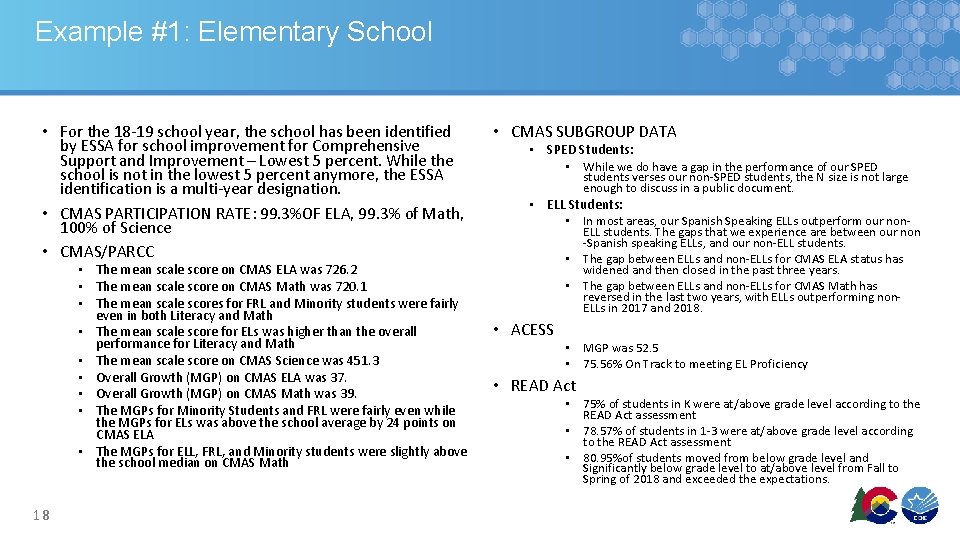
Example #1: Elementary School • For the 18 -19 school year, the school has been identified by ESSA for school improvement for Comprehensive Support and Improvement – Lowest 5 percent. While the school is not in the lowest 5 percent anymore, the ESSA identification is a multi-year designation. • CMAS PARTICIPATION RATE: 99. 3%OF ELA, 99. 3% of Math, 100% of Science • CMAS/PARCC • The mean scale score on CMAS ELA was 726. 2 • The mean scale score on CMAS Math was 720. 1 • The mean scale scores for FRL and Minority students were fairly even in both Literacy and Math • The mean scale score for ELs was higher than the overall performance for Literacy and Math • The mean scale score on CMAS Science was 451. 3 • Overall Growth (MGP) on CMAS ELA was 37. • Overall Growth (MGP) on CMAS Math was 39. • The MGPs for Minority Students and FRL were fairly even while the MGPs for ELs was above the school average by 24 points on CMAS ELA • The MGPs for ELL, FRL, and Minority students were slightly above the school median on CMAS Math 18 • CMAS SUBGROUP DATA • SPED Students: • While we do have a gap in the performance of our SPED students verses our non-SPED students, the N size is not large enough to discuss in a public document. • ELL Students: • In most areas, our Spanish Speaking ELLs outperform our non. ELL students. The gaps that we experience are between our non -Spanish speaking ELLs, and our non-ELL students. • The gap between ELLs and non-ELLs for CMAS ELA status has widened and then closed in the past three years. • The gap between ELLs and non-ELLs for CMAS Math has reversed in the last two years, with ELLs outperforming non. ELLs in 2017 and 2018. • ACESS • MGP was 52. 5 • 75. 56% On Track to meeting EL Proficiency • READ Act • 75% of students in K were at/above grade level according to the READ Act assessment • 78. 57% of students in 1 -3 were at/above grade level according to the READ Act assessment • 80. 95%of students moved from below grade level and Significantly below grade level to at/above level from Fall to Spring of 2018 and exceeded the expectations.
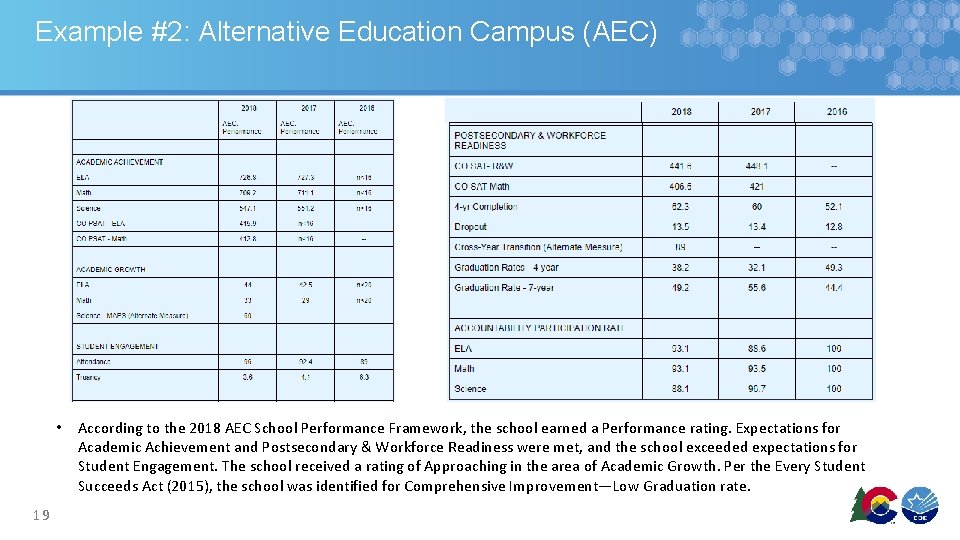
Example #2: Alternative Education Campus (AEC) • 19 According to the 2018 AEC School Performance Framework, the school earned a Performance rating. Expectations for Academic Achievement and Postsecondary & Workforce Readiness were met, and the school exceeded expectations for Student Engagement. The school received a rating of Approaching in the area of Academic Growth. Per the Every Student Succeeds Act (2015), the school was identified for Comprehensive Improvement—Low Graduation rate.
Section 2: Lessons Learned from Year 1 of Reviews • Explicitly state the reason the school was identified for Comprehensive Support. • Include data/trend statements for each relevant ESSA indicator. • • • ELA and Math achievement ELA and Math growth Science achievement English language proficiency Graduation rates Dropout rates • Include data/trend statements for each relevant student group. • • • 20 All students English Learners Free/Reduced Lunch Minority Students with Disabilities
Section 3: Evidence-based Interventions (EBI) • Applicable section of UIP: Major Improvement Strategy and Action plans, as well as Research Supporting the Use of the Strategy • ESSA section 1111(d)(1)(B)(ii) requires that the plan “…includes evidence-based interventions…. ” • CDE interprets this to mean that the research behind the selected strategies meets the definition and criteria for evidence-based interventions (EBI) under ESSA Planning Requirements (for additional information see www. cde. state. co. us/fedprograms/essaplanningrequirements) and that the strategies and interventions in the plan consider and respond to the reasons the school was identified for improvement and support under ESSA. 21
Section 3: Evidence-based Interventions Guiding Questions • Do the intervention(s) and strategies being used address the reasons for identification for ESSA support and improvement? • Descriptions should explain which and how identified needs and priority performance challenges, tied back to ESSA indicators, are being addressed with intervention(s) and strategies (should align with the ESSA indicators on which the school had low performance). • How well do the intervention(s) and strategies align with the reasons the school was identified for support and improvement? • Interventions and strategies should have a direct and clear connection to the reasons the school was identified for ESSA support and improvement. • Do intervention(s) and strategies meet the ESSA Planning Requirements definition (found under Evidence-based Interventions on www. cde. state. co. us/fedprograms/essaplanningrequirements) and criteria for EBI (Tiers I through III)? Is information included that details the research supporting the strategy? • Selected strategies and/or interventions should have a strong research-base and/or demonstrated record of effectiveness for addressing the school’s identified needs. • Do intervention(s) and strategies demonstrate a contextual fit aligned to the reasons the school was identified for support and improvement (be applicable for the population being served, fit the needs identified, have a reasonable adoption period, are sustainable, are sufficiently resourced for implementation, have cultural relevance, etc. )? 22
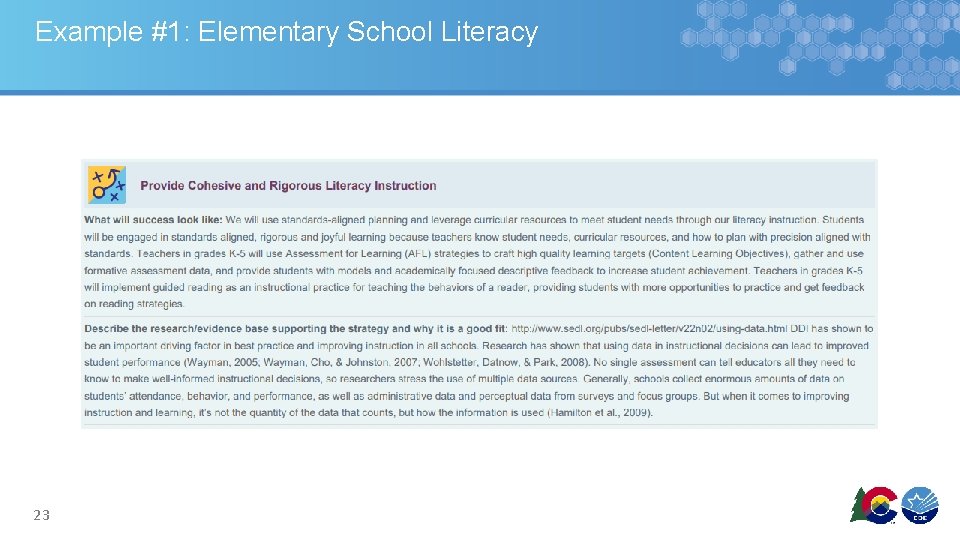
Example #1: Elementary School Literacy 23
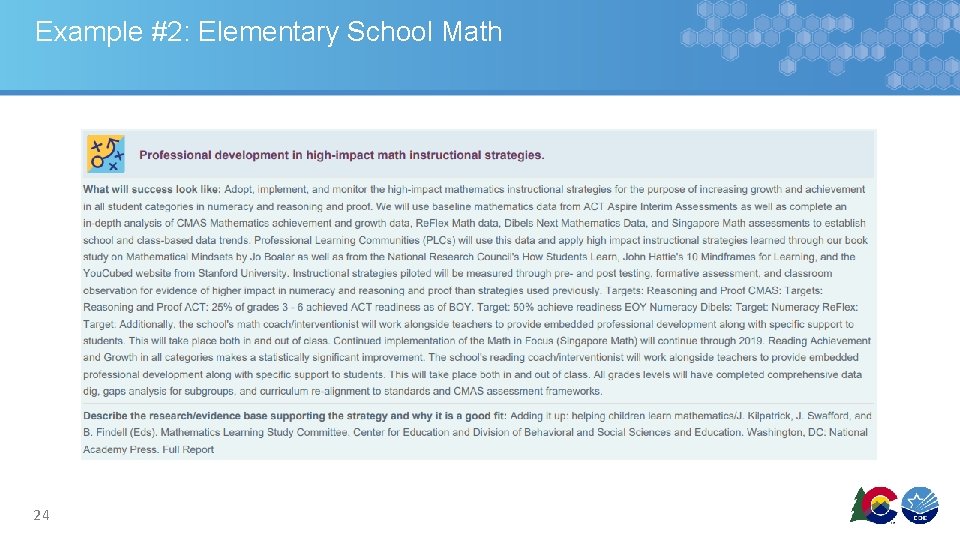
Example #2: Elementary School Math 24
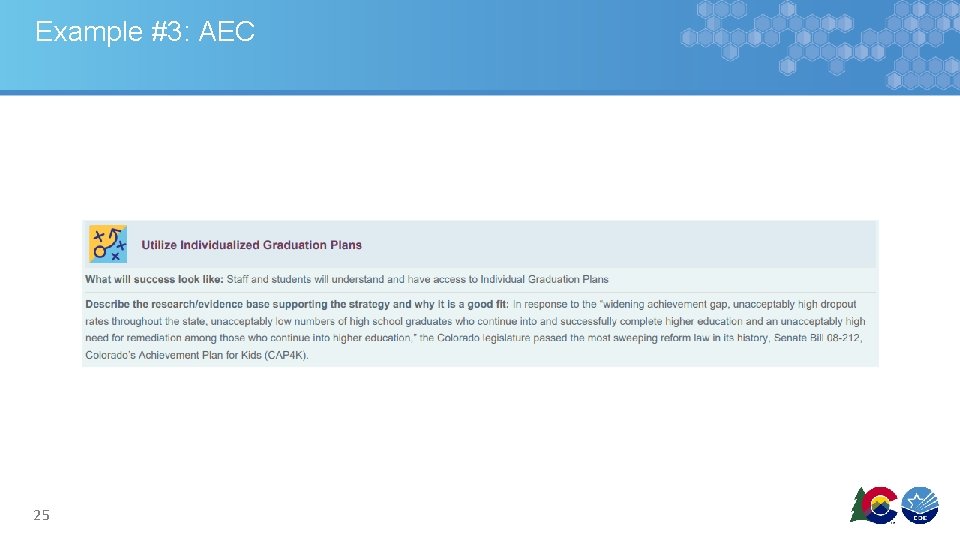
Example #3: AEC 25
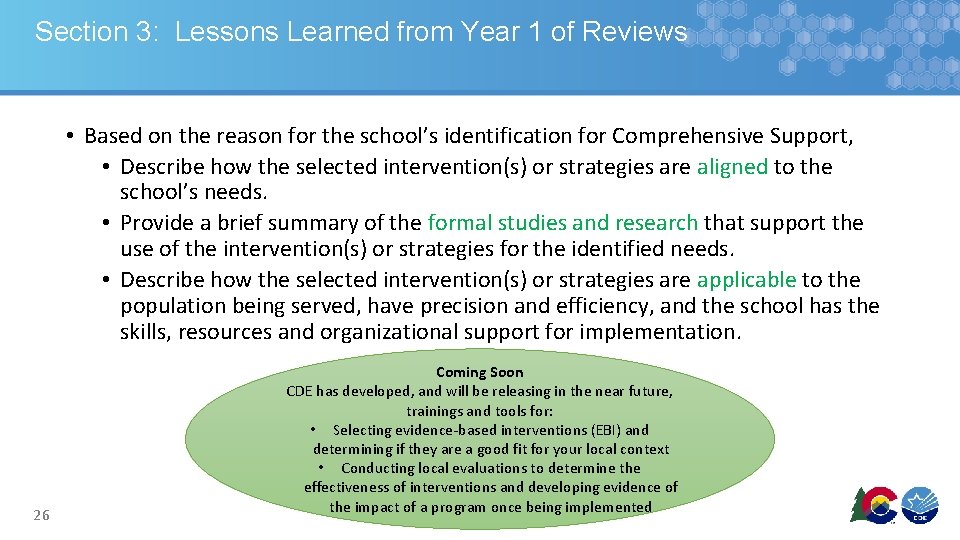
Section 3: Lessons Learned from Year 1 of Reviews • Based on the reason for the school’s identification for Comprehensive Support, • Describe how the selected intervention(s) or strategies are aligned to the school’s needs. • Provide a brief summary of the formal studies and research that support the use of the intervention(s) or strategies for the identified needs. • Describe how the selected intervention(s) or strategies are applicable to the population being served, have precision and efficiency, and the school has the skills, resources and organizational support for implementation. 26 Coming Soon CDE has developed, and will be releasing in the near future, trainings and tools for: • Selecting evidence-based interventions (EBI) and determining if they are a good fit for your local context • Conducting local evaluations to determine the effectiveness of interventions and developing evidence of the impact of a program once being implemented
Section 4: Monitoring and Evaluation • Applicable section of UIP: Implementation Benchmarks; Reflection on Prior Year Targets; and Student Performance Targets and Interim Measures • ESSA section 1111(d)(1)(B) requires that the plan be developed “…to improve student outcomes. ” Subsection (iv) of this section goes on to require that once approved and being implemented, plans are “monitored and periodically reviewed by the State educational agency. ” • CDE interprets this to mean that the implementation of plans should result in improved outcomes for students. One way to ensure the plans are resulting in intended outcomes is to include processes for monitoring and evaluating the impact of the selected EBI and adjusting or modifying any strategies or interventions that are not producing desired improvements and outcomes for students. 27
Section 4: Monitoring and Evaluation Guiding Questions • What are the plans, including timeline, for monitoring and evaluating the impact of the EBI selected to ensure that desired outcomes are being reached? • Schools and LEAs should collaborate on monitoring and evaluating the impact that selected intervention(s) and strategies are having on the reasons the school has been identified for support and improvement. The plan should include a timeline for conducting such analyses. • What are the plans, including timeline, for modifying strategies or interventions that are not improving the indicators that resulted in the school being identified for ESSA support and improvement? • The plan should include actions that the school and district will take if desired outcomes are not being reached. 28
Section 5: Resource Inequities • Applicable section of UIP: Data Narrative/Current Performance or Brief Description and Major Improvement Strategies • ESSA section 1111(d)(1)(B)(iv) requires that the plan “identifies resource inequities, which may include a review of local educational agency and school-level budgeting, to be addressed through implementation of such comprehensive support and improvement plan. ” • CDE interprets this to mean that the plan must include a process for identifying resource inequities (including consideration of any of the processes listed below), describes any inequities that have been identified and how the school and district will address any identified inequities. • Resource Inequity: In addition to the descriptions provided in the ESSA improvement plan (or UIP), CDE will be monitoring resource equity through the following processes and will notify the district of any identified gaps, which must also be addressed by the school and district in the subsequent year’s plan: • • 29 Comparability Maintenance of Effort Supplement, Not Supplant Analyses of the number of economically disadvantaged or minority students being taught by inexperienced, ineffective, or out-of-field teachers
Section 5: Resource Inequities Guiding Questions • Does the identified school have equitable access to the same funding as nonidentified schools? • Are the same percentage of effective, teaching in-field and experienced teachers teaching in identified schools, compared to non-identified schools? • Do the students in identified schools have the same access to rigorous courses, such as advanced placement courses, as students in non-identified schools? 30
Under Development • The improvement plan addresses any inequitable access to rigorous courses and/or the plan includes strategies for identifying and addressing any inequitable access to rigorous courses for students in identified schools compared to students in non-identified schools in the district, or the state if the district only has one school per level. 31
Timeline 32
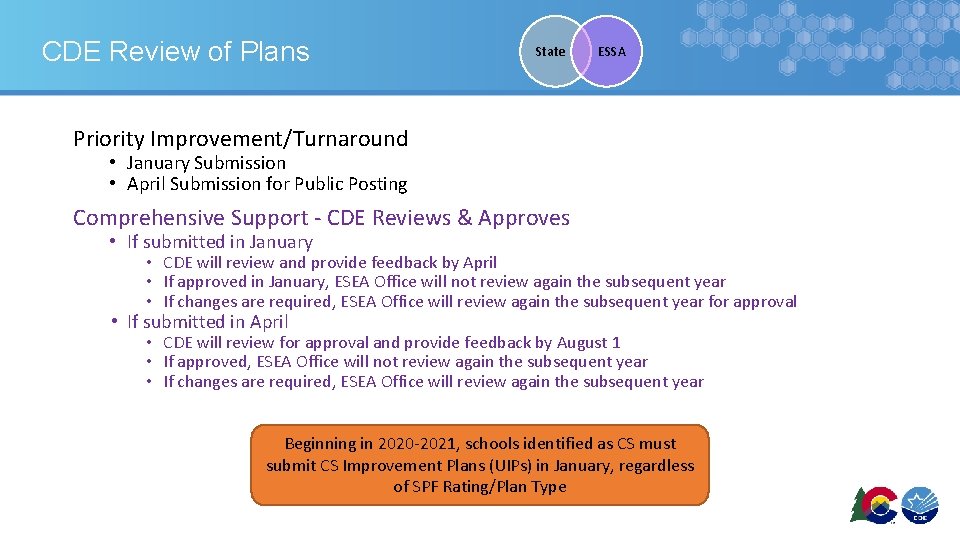
CDE Review of Plans State ESSA Priority Improvement/Turnaround • January Submission • April Submission for Public Posting Comprehensive Support - CDE Reviews & Approves • If submitted in January • CDE will review and provide feedback by April • If approved in January, ESEA Office will not review again the subsequent year • If changes are required, ESEA Office will review again the subsequent year for approval • If submitted in April • CDE will review for approval and provide feedback by August 1 • If approved, ESEA Office will not review again the subsequent year • If changes are required, ESEA Office will review again the subsequent year Beginning in 2020 -2021, schools identified as CS must submit CS Improvement Plans (UIPs) in January, regardless of SPF Rating/Plan Type
Eligibility for Supports and Funding: Title I School Improvement Funds 34
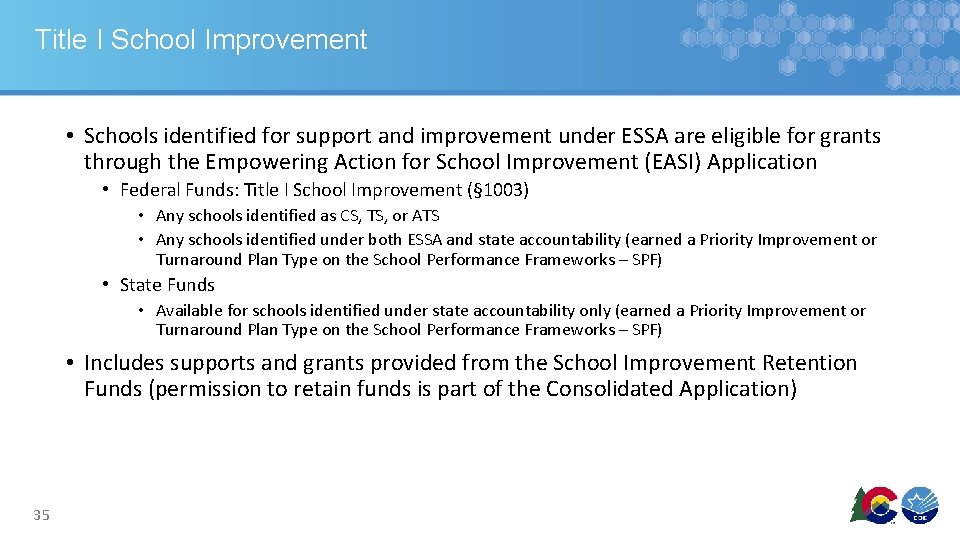
Title I School Improvement • Schools identified for support and improvement under ESSA are eligible for grants through the Empowering Action for School Improvement (EASI) Application • Federal Funds: Title I School Improvement (§ 1003) • Any schools identified as CS, TS, or ATS • Any schools identified under both ESSA and state accountability (earned a Priority Improvement or Turnaround Plan Type on the School Performance Frameworks – SPF) • State Funds • Available for schools identified under state accountability only (earned a Priority Improvement or Turnaround Plan Type on the School Performance Frameworks – SPF) • Includes supports and grants provided from the School Improvement Retention Funds (permission to retain funds is part of the Consolidated Application) 35
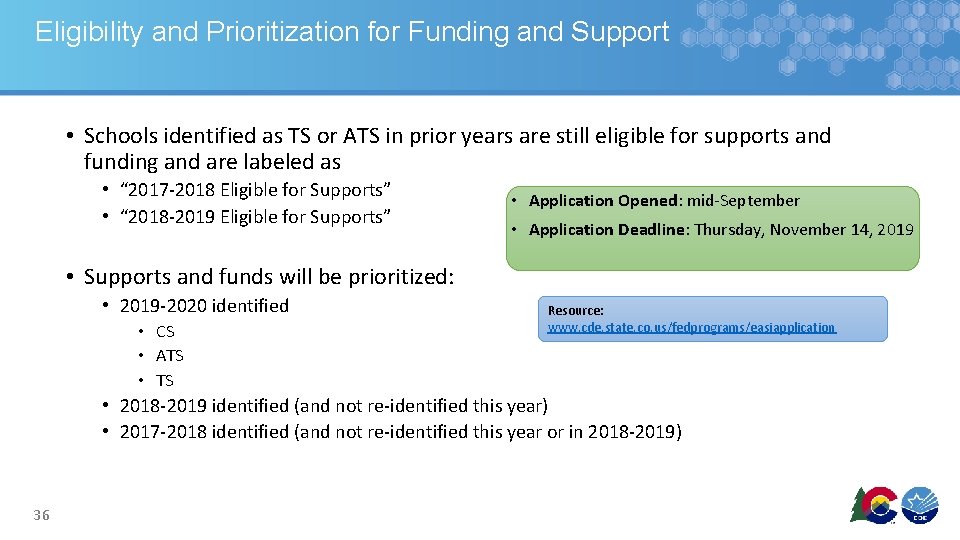
Eligibility and Prioritization for Funding and Support • Schools identified as TS or ATS in prior years are still eligible for supports and funding and are labeled as • “ 2017 -2018 Eligible for Supports” • “ 2018 -2019 Eligible for Supports” • Application Opened: mid-September • Application Deadline: Thursday, November 14, 2019 • Supports and funds will be prioritized: • 2019 -2020 identified • CS • ATS • TS Resource: www. cde. state. co. us/fedprograms/easiapplication • 2018 -2019 identified (and not re-identified this year) • 2017 -2018 identified (and not re-identified this year or in 2018 -2019) 36
Additional Support 37
Federal Programs Contacts • Tammy Giessinger • giessinger_t@cde. state. co. us • 303 -866 -6992 • Laura Meushaw • meushaw_l@cde. state. co. us • 303 -866 -6618 • Nazanin Mohajeri-Nelson • mohajeri-nelson_n@cde. state. co. us • 303 -866 -6205 38 • Regional Contacts • www. cde. state. co. us/fedprograms/regionalcontactspage
UIP Contacts • Lisa Steffen • steffen_l@cde. state. co. us • 303 -866 -6676 • Jennifer Morgan • morgan_j@cde. state. co. us • 303 -866 -5499 39
Thank You! 40