
EOCT PREP 1 In an ecosystem some plants
- Slides: 110
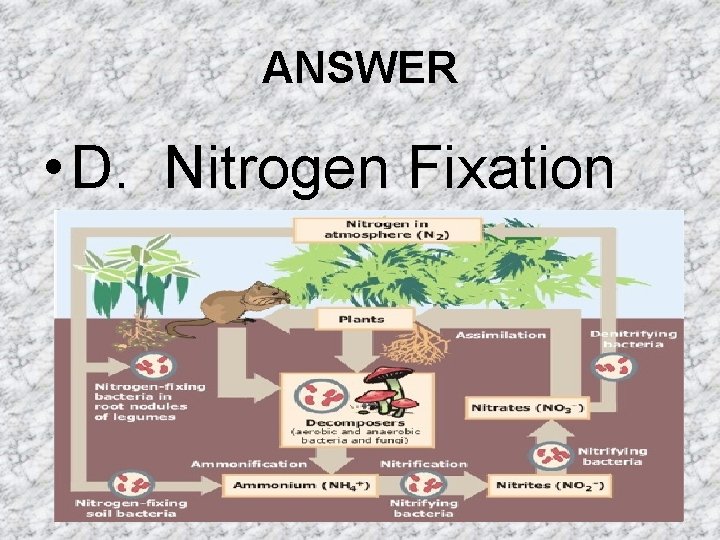
EOCT PREP • 1) In an ecosystem, some plants may convert atmospheric nitrogen gas into ammonia through a process called ____________. • A)denitrification • B)nitrogenous mutation • C)transformation • D)nitrogen fixation
ANSWER • D. Nitrogen Fixation
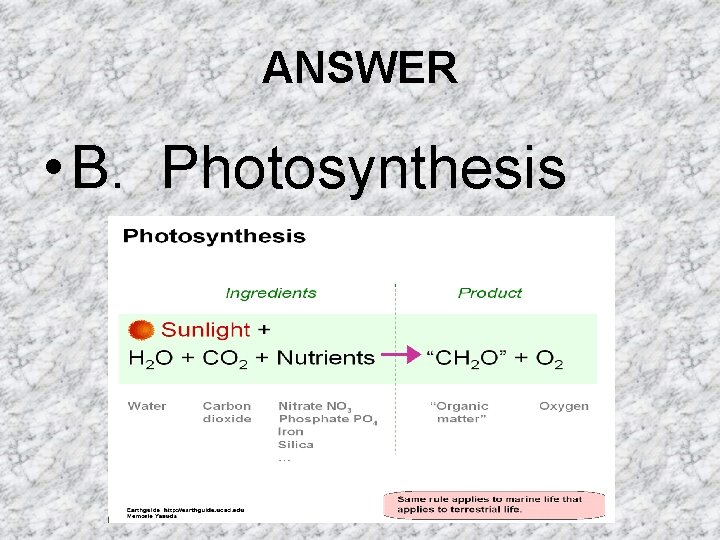
EOCT PREP • 2) Producers break down sugar and create energy in the process of _________. • A)diffusion • B)photosynthesis • C)cell respiration • D)chemosynthesis
ANSWER • B. Photosynthesis
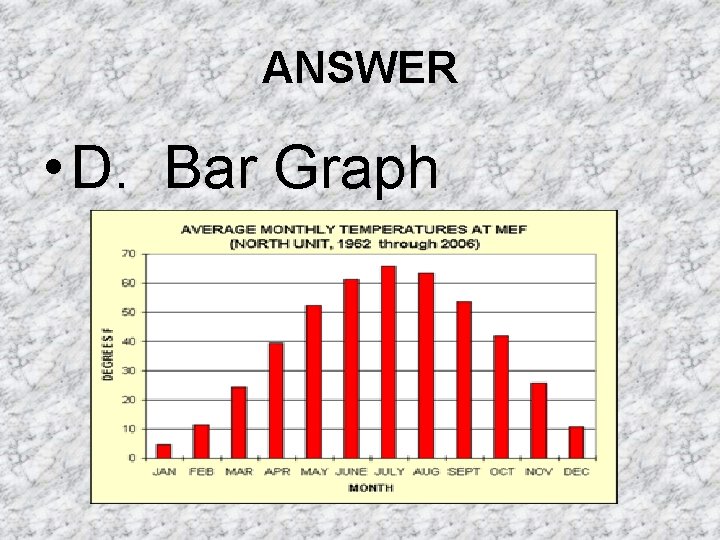
EOCT PREP • 3) You have been collecting data to determine the average monthly temperature for a particular year. You have 30 samples recorded in degrees Celsius each month. You want to show temperature trends over the entire year. What would be the best way to represent your data to illustrate the average temperature for each month? • A)In a descriptive paragraph • B)In a data table • C)On a calendar • D)on a bar graph
ANSWER • D. Bar Graph
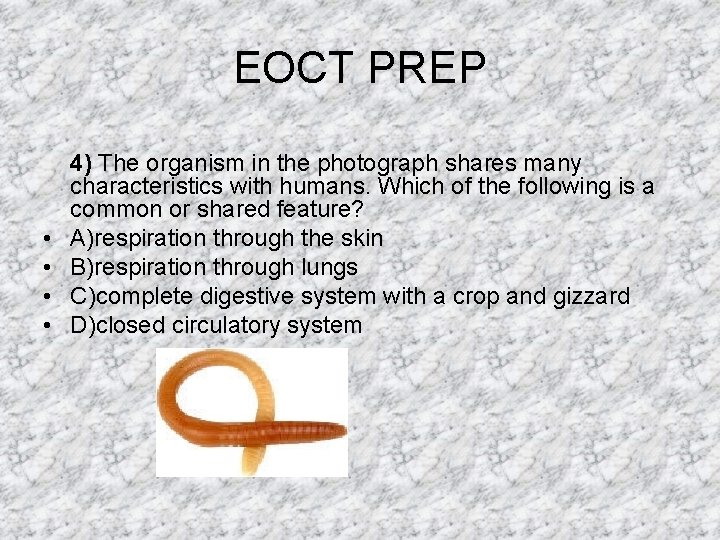
EOCT PREP • • 4) The organism in the photograph shares many characteristics with humans. Which of the following is a common or shared feature? A)respiration through the skin B)respiration through lungs C)complete digestive system with a crop and gizzard D)closed circulatory system
ANSWER • D. Closed Circulatory System
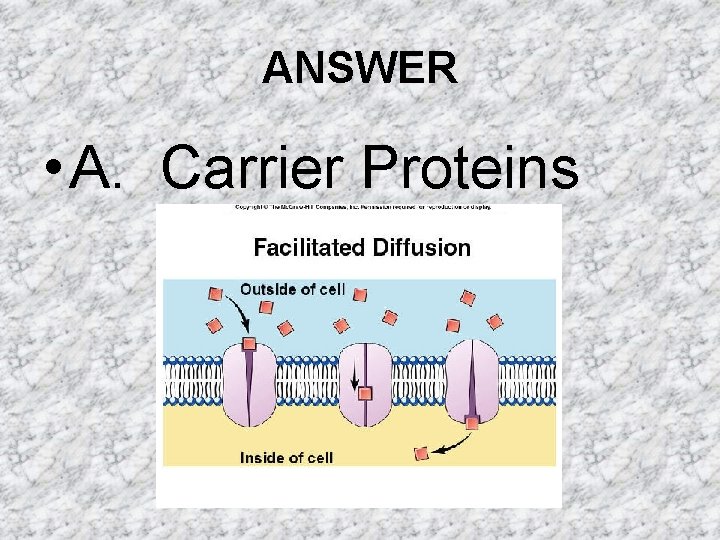
EOCT PREP • 5) _________ are responsible for the transport of substances down a concentration gradient during facilitated diffusion. • A)Carrier proteins • B)Ionic pumps • C)Ion channels • D)Protein receptors
ANSWER • A. Carrier Proteins
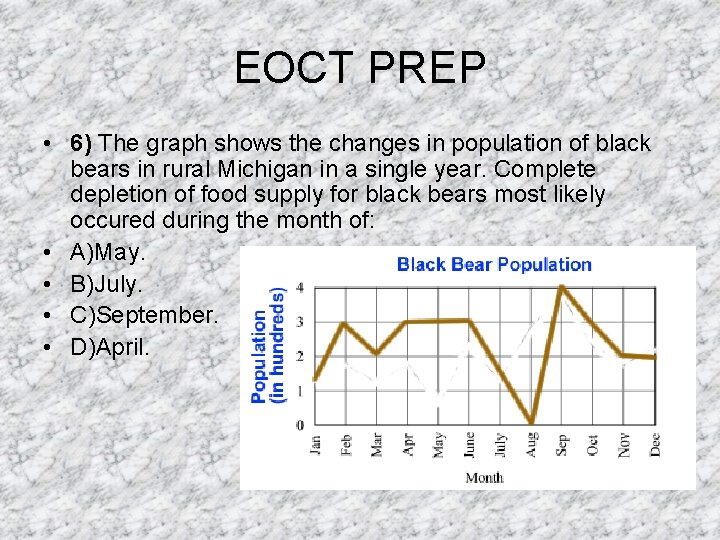
EOCT PREP • 6) The graph shows the changes in population of black bears in rural Michigan in a single year. Complete depletion of food supply for black bears most likely occured during the month of: • A)May. • B)July. • C)September. • D)April.
ANSWER • B. July
EOCT PREP • 7) Changes in the DNA sequence, or mutations, drive ____________. • A)deamination events • B)evolutionary change • C)amino acid coding • D)environmental interaction
ANSWER • B. Evolutionary Change
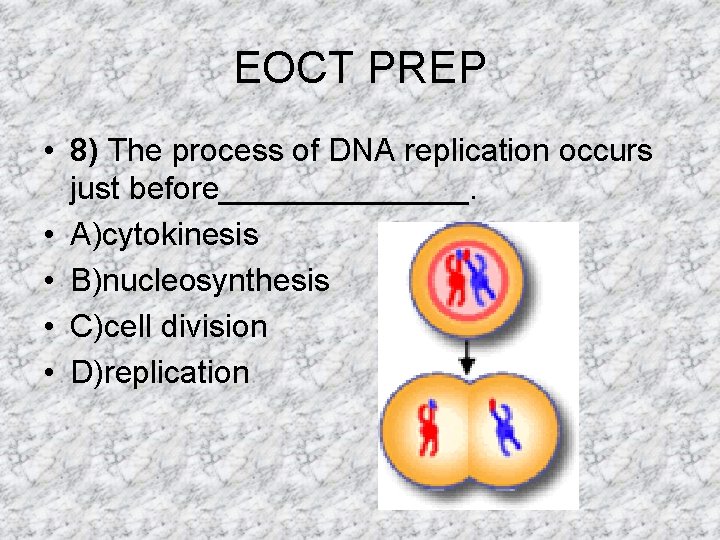
EOCT PREP • 8) The process of DNA replication occurs just before_______. • A)cytokinesis • B)nucleosynthesis • C)cell division • D)replication
ANSWER • C. Cell Division
EOCT PREP • 9) A _________ is the largest natural population of organisms that can interbreed to produce fertile offspring. • A)Class • B)Genus • C)Family • D)Species
ANSWER • D. Species
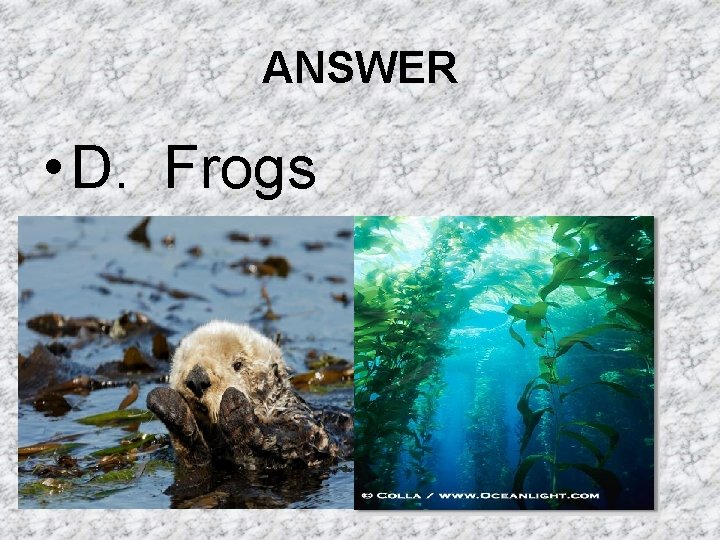
EOCT PREP • 10) Which of the following organisms does not depend upon the successful growth of kelp beds in a marine environment? • A)Sea otters • B)Crustaceans • C)Young fish • D)Frogs
ANSWER • D. Frogs
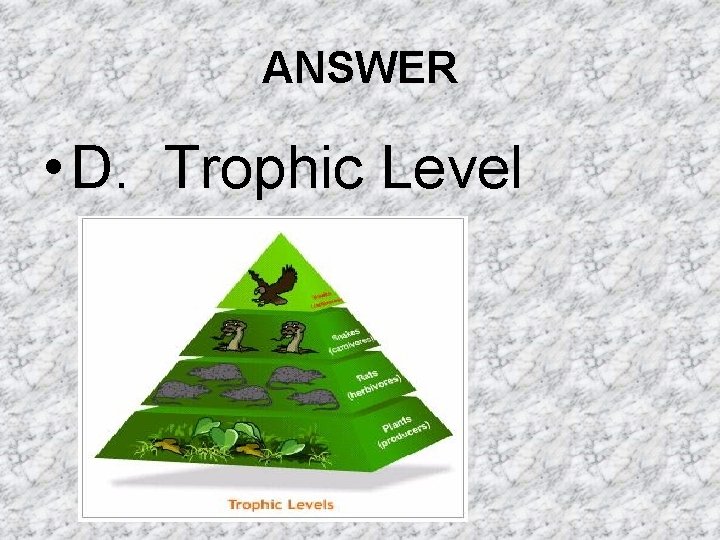
EOCT PREP • 11) Ecological pyramids can be based on the numbers of individual organisms at each ____ level. • A)consumable • B)biomass • C)resource • D)trophic
ANSWER • D. Trophic Level
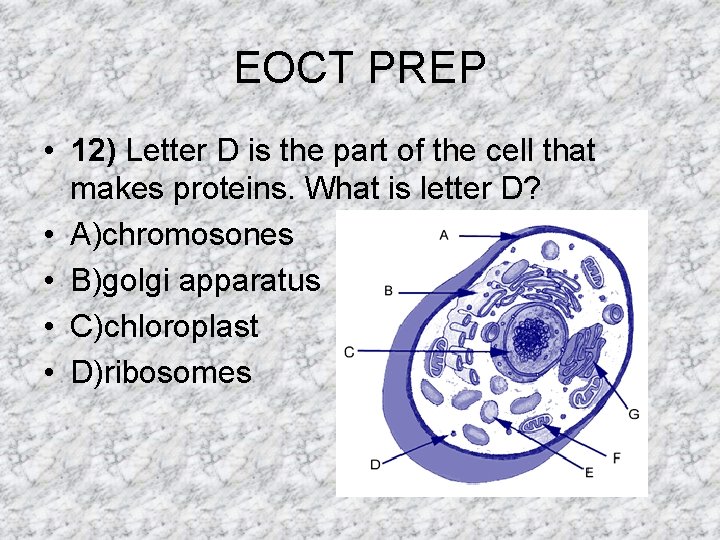
EOCT PREP • 12) Letter D is the part of the cell that makes proteins. What is letter D? • A)chromosones • B)golgi apparatus • C)chloroplast • D)ribosomes
ANSWER • D. Ribosomes
EOCT PREP • • • 13) Which of the following is a vertebrate? A)squid B)beaver C)snail D)crab
ANSWER • B. Beaver
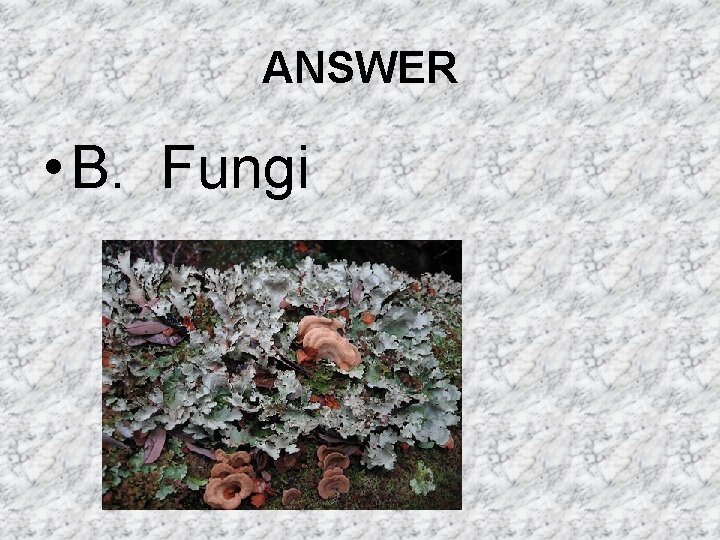
EOCT PREP • 14) Lichens are symbiotic relationships between algae and ______. • A)protists. • B)fungi. • C)microscopic animals. • D)diatoms.
ANSWER • B. Fungi
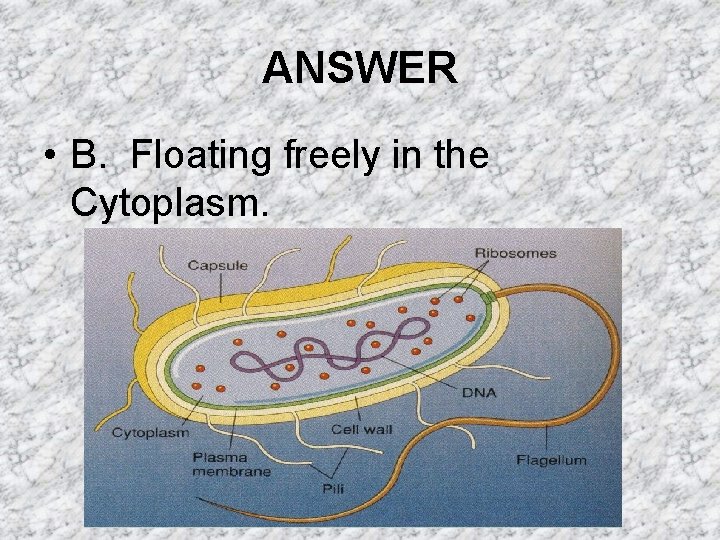
EOCT PREP • 15) In a prokaryotic cell, most ribosomes are: • A)attached to the ER. • B)floating freely in the cytoplasm. • C)in the nucleus. • D)attached to the nucleus.
ANSWER • B. Floating freely in the Cytoplasm.
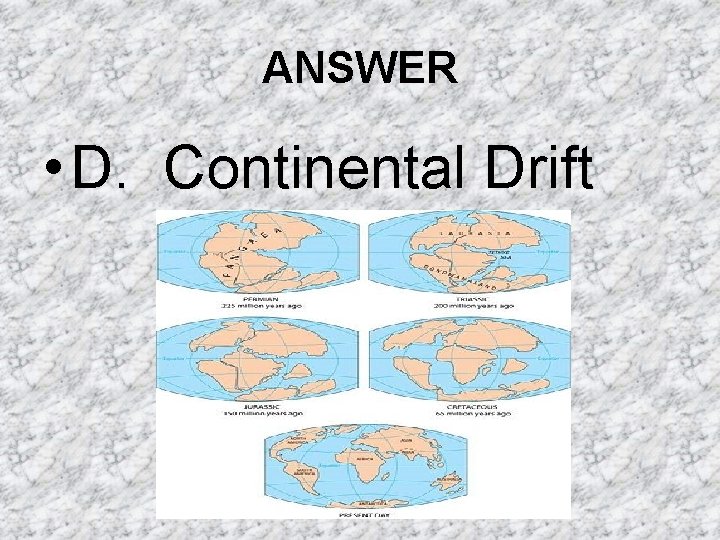
EOCT PREP • 16) __________ helps explain why there a large number of marsupial mammal species in Australia and South America, continents that were once connected. • A)Ozone production • B)The fifth mass extinction • C)The first mass extinction • D)Continental drift
ANSWER • D. Continental Drift
EOCT PREP • 17) If a student notices that frogs are all gathering at one end of the pond the student has done what? • A)experimented • B)hypothesized • C)collected data • D)observed
ANSWER • D. Observed
EOCT PREP • 18) The first step in the scientific method is to ___________. • A)gather information • B)state the problem • C)form a hypothesis • D)state the conclusion
ANSWER • B. State the Problem
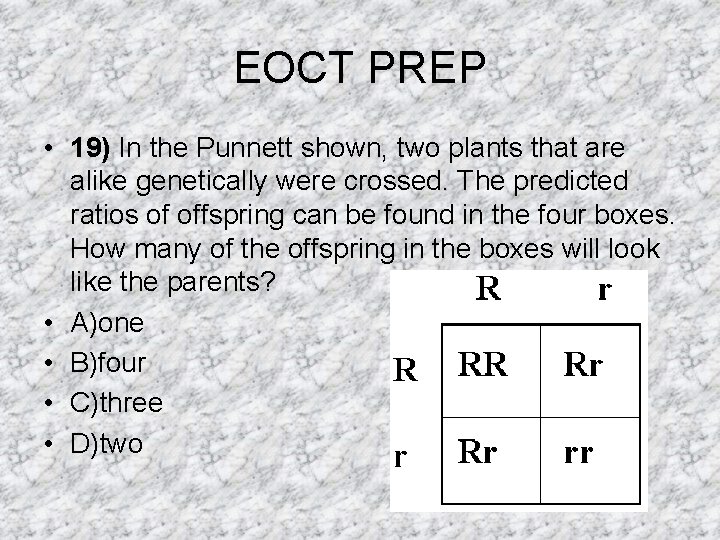
EOCT PREP • 19) In the Punnett shown, two plants that are alike genetically were crossed. The predicted ratios of offspring can be found in the four boxes. How many of the offspring in the boxes will look like the parents? • A)one • B)four • C)three • D)two
ANSWER • C. Three—R— Dominant
EOCT PREP • 20) The portion of the membrane system in eukaryotic cells that is responsible for the making lipids and breaking down toxic substances is the _______. • A)rough ER • B)smooth ER • C)ribosomal ER • D)semi-permeable ER
ANSWER • A. Rough ER
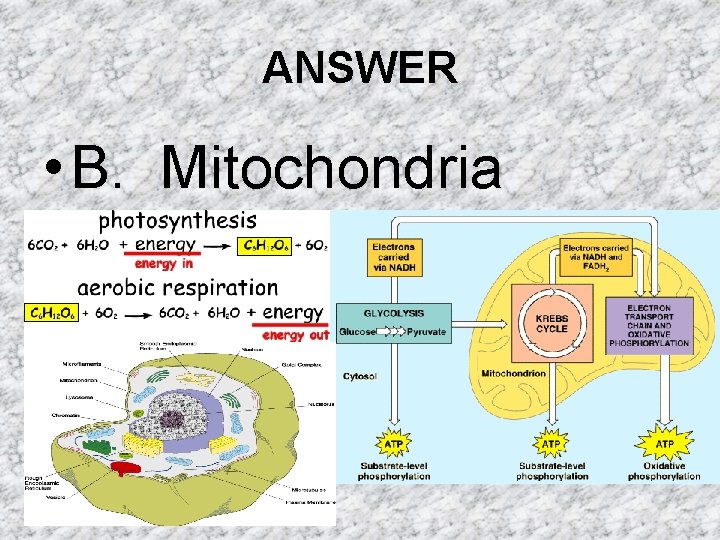
EOCT PREP • 21) Most of the ATP made during cellular respiration is produced in: • A)ribosomes • B)mitochondria • C)the Krebs cycle • D)glycolysis
ANSWER • B. Mitochondria
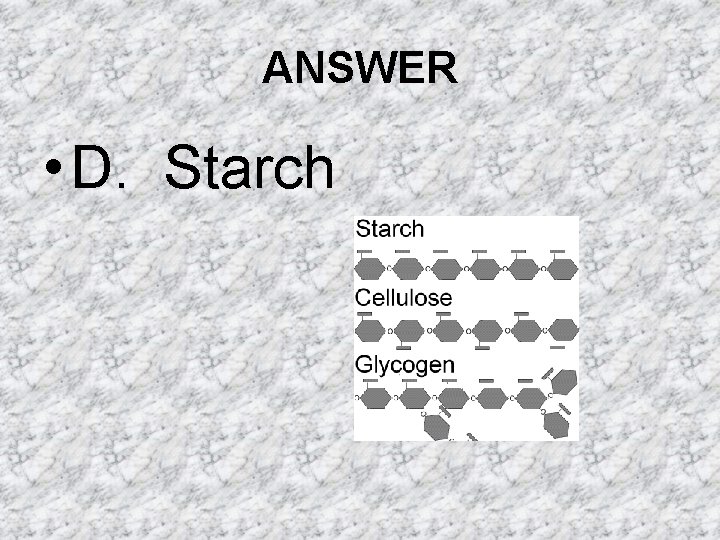
EOCT PREP • 22) Which of the following is a carbohydrate? • A)Saturated fat • B)Salt • C)Protein • D)Starch
ANSWER • D. Starch
EOCT PREP • 23) ______ are the oldest organisms and are divided into two groups, the achaebacteria and the eubacteria. • A)Viruses • B)Prokaryotes • C)Eukaryotes • D)Algae
ANSWER • B. Prokaryotes
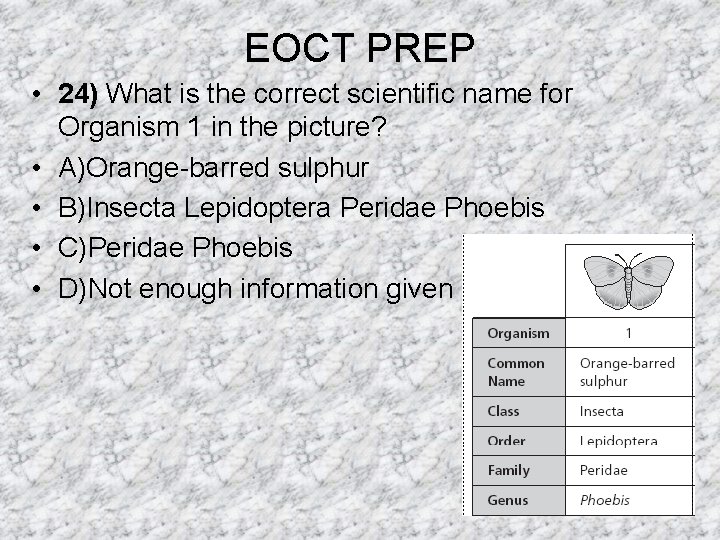
EOCT PREP • 24) What is the correct scientific name for Organism 1 in the picture? • A)Orange-barred sulphur • B)Insecta Lepidoptera Peridae Phoebis • C)Peridae Phoebis • D)Not enough information given
ANSWER • D. Not enough Information.
EOCT PREP • 25) How many variables should be manipulated in an experiment? • A)one • B)two • C)three • D)it does not matter
ANSWER • A)one
EOCT PREP • 26) When bacteria successfully undergo cell transformation, recombinant DNA: • A)undergoes mutation. • B)is treated with oncogenes. • C)clones itself. • D)is integrated into a chromosome.
ANSWER • D)is integrated into a chromosome.
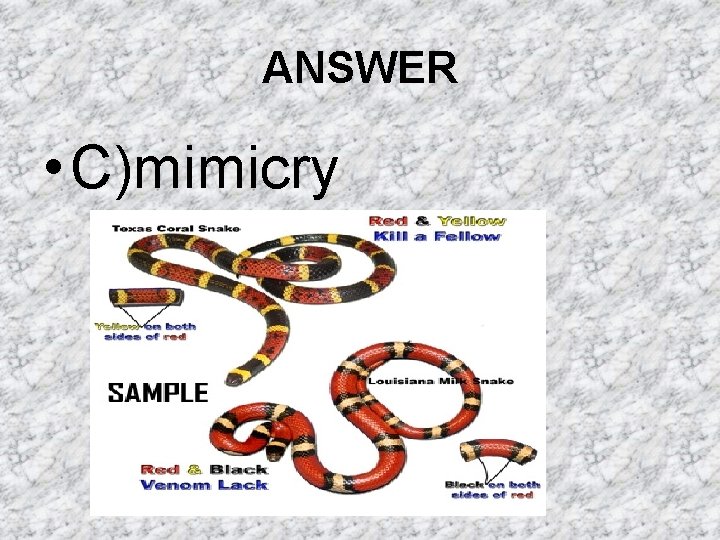
EOCT PREP • 27) A milk snake looks similar to the deadly coral snake. This is an example of: • A)warning coloration • B)cryptic coloration • C)mimicry • D)adaptive radiation
ANSWER • C)mimicry
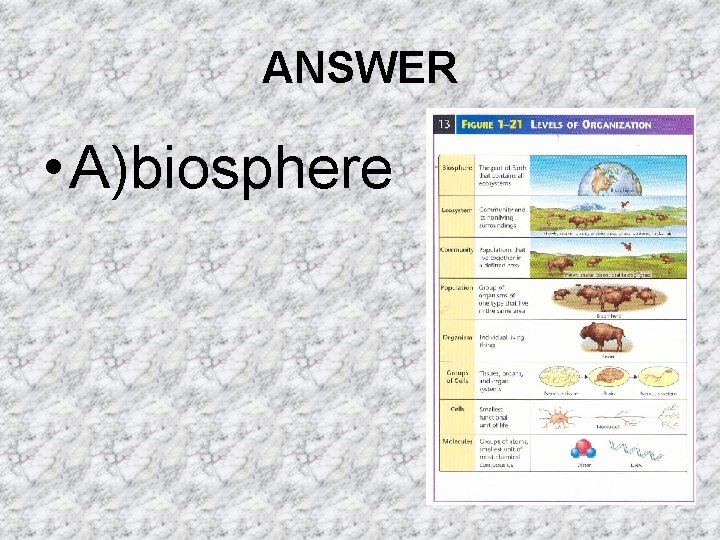
EOCT PREP • 28) The ____ includes the entire planet and all of its living and nonliving parts. • A)biosphere • B)community • C)ecosystem • D)lithosphere
ANSWER • A)biosphere
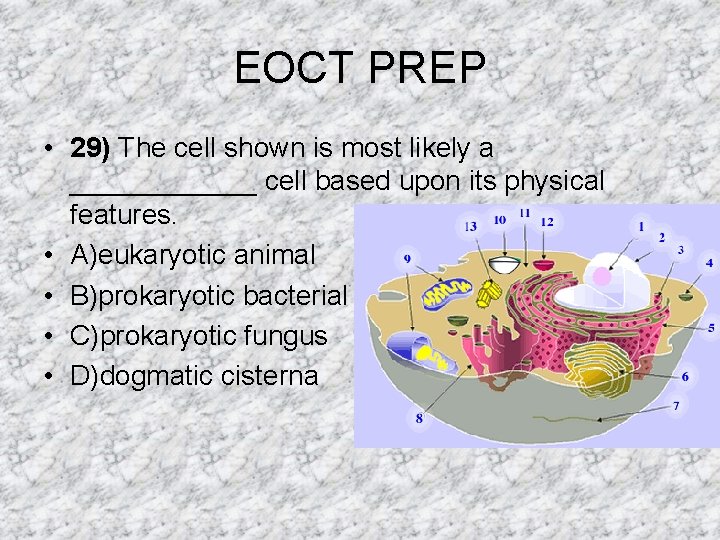
EOCT PREP • 29) The cell shown is most likely a ______ cell based upon its physical features. • A)eukaryotic animal • B)prokaryotic bacterial • C)prokaryotic fungus • D)dogmatic cisterna
ANSWER • A)eukaryotic animal
EOCT PREP • 30) Which of the following lab safety procedures is incorrect? • A)Follow instructions as given by teacher. • B)Always carry a textbook into the lab for checking accuracy. • C)Know the fire escape route from your lab. • D)No horseplay in the lab.
ANSWER • B) Always carry a textbook into the lab for checking accuracy.
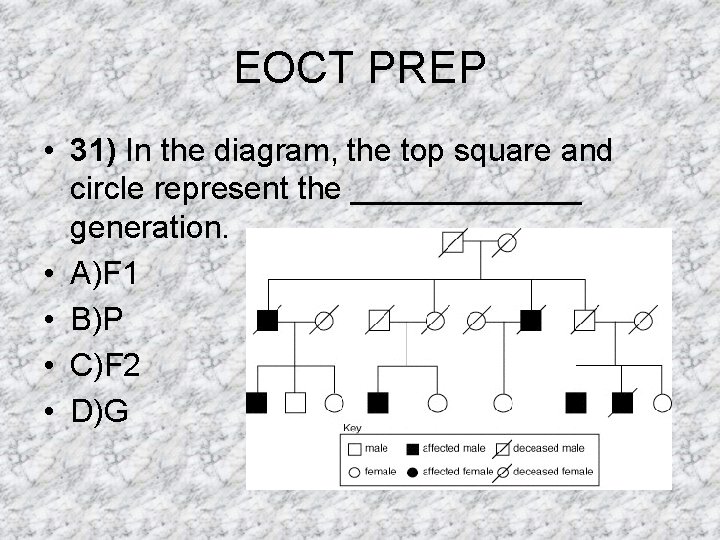
EOCT PREP • 31) In the diagram, the top square and circle represent the _______ generation. • A)F 1 • B)P • C)F 2 • D)G
ANSWER • B)P
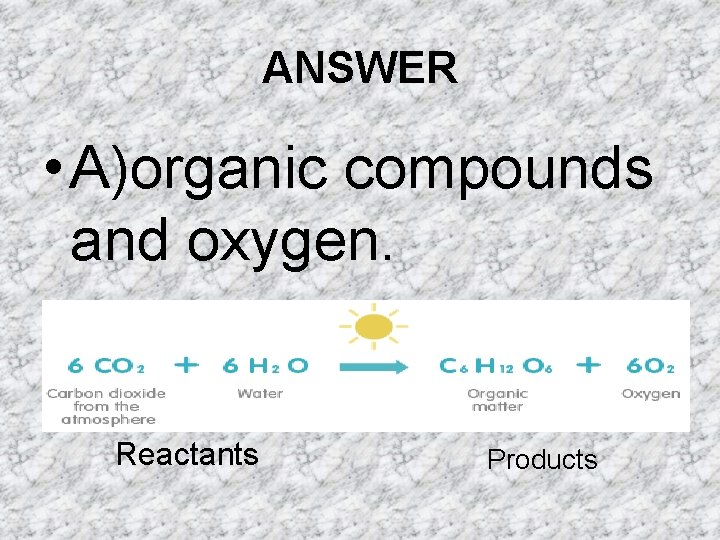
EOCT PREP • 32) The products of photosynthesis that begin cellular respiration are ____________. • A)organic compounds and oxygen. • B)carbon dioxide and water. • C)NADPH and hydrogen. • D)AARP and water.
ANSWER • A)organic compounds and oxygen. Reactants Products
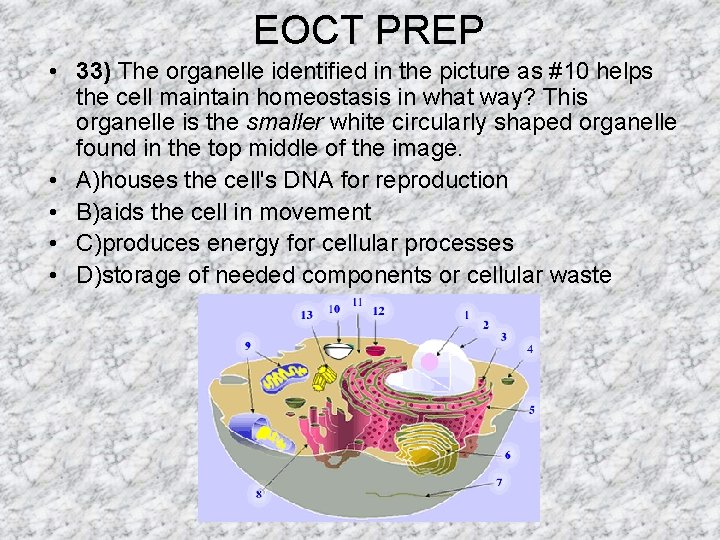
EOCT PREP • 33) The organelle identified in the picture as #10 helps the cell maintain homeostasis in what way? This organelle is the smaller white circularly shaped organelle found in the top middle of the image. • A)houses the cell's DNA for reproduction • B)aids the cell in movement • C)produces energy for cellular processes • D)storage of needed components or cellular waste
ANSWER • D)storage of needed components or cellular waste
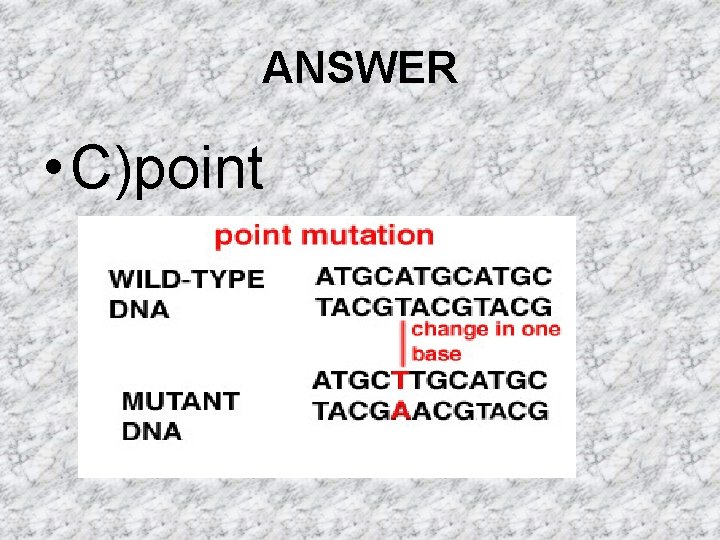
EOCT PREP • 34) The substitution, addition, or removal of a single nucleotide in DNA is called a(n) ______ mutation. • A)exorcism • B)reference • C)point • D)normal
ANSWER • C)point
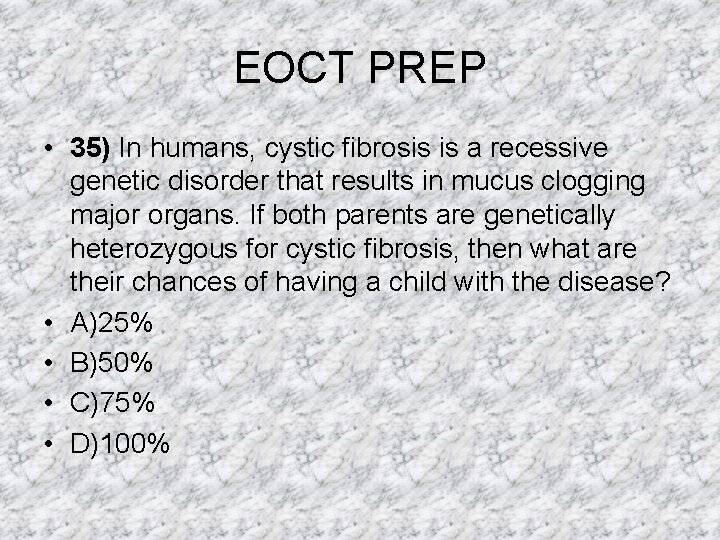
EOCT PREP • 35) In humans, cystic fibrosis is a recessive genetic disorder that results in mucus clogging major organs. If both parents are genetically heterozygous for cystic fibrosis, then what are their chances of having a child with the disease? • A)25% • B)50% • C)75% • D)100%
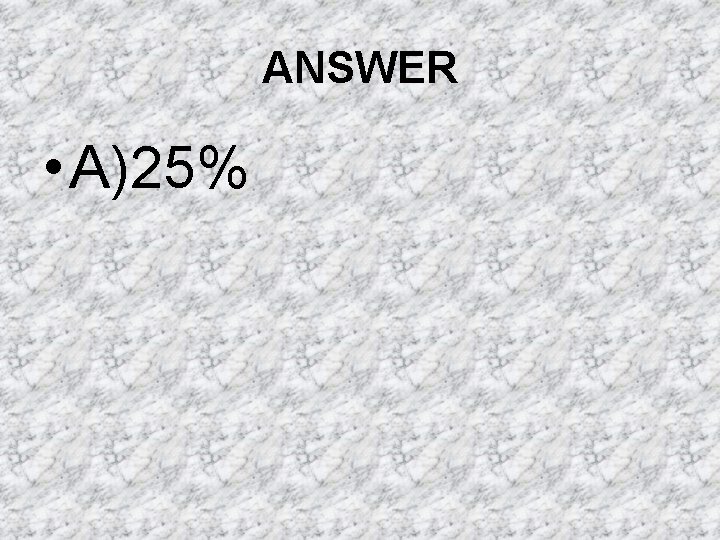
ANSWER • A)25%
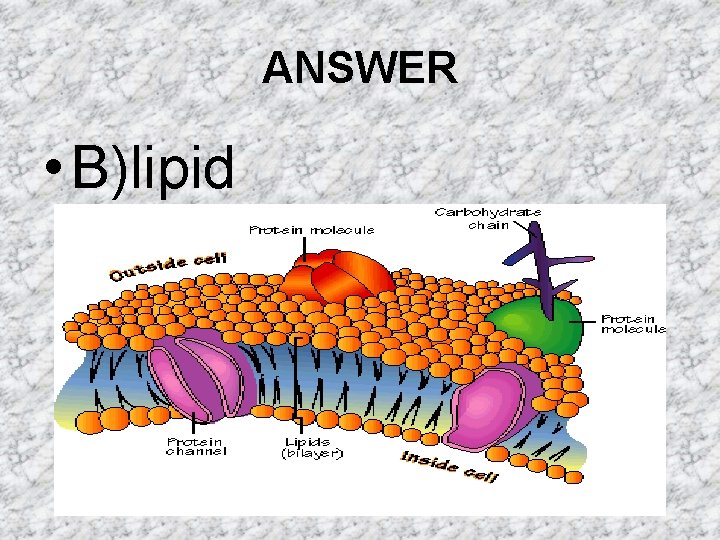
EOCT PREP • 36) Which type of molecule makes up most of a cell membrane? • A)protein • B)lipid • C)nucleic acid • D)carbohydrate
ANSWER • B)lipid
EOCT PREP • 37) In rabbits, the allele B for black fur is dominant over the allele b for brown fur. Calculate the probability of a homozygous dominant (BB) offspring resulting from a cross between two parents with the genotype Bb. • A)1/100 • B)7/10 • C)1/4 • D)1/2
ANSWER • C)1/4
EOCT PREP • 38) Bears and coyotes both consume large plant -eating mammals such as deer. When the deer are in short supply, bears and coyotes may fight over the prey. This type of biological interaction is called _________. • A)rumination • B)commensalism • C)mutualism • D)competition
ANSWER • D)competition
EOCT PREP • 39) Which of the following procedures is most important when handling acids and bases correctly in the lab? • A)Wear safety goggles and a lab apron at all times for protection • B)Be sure to take books and notes into the lab station to know what you are doing • C)Be sure to work at eye level with the experiments to better observe • D)Wear gloves and a respirator.
ANSWER • A) Wear safety goggles and a lab apron at all times for protection
EOCT PREP • 40) In the replication process of this molecule, polymerase proofreads the molecule so that few mistakes or ______ occur. • A)oppositions • B)interferons • C)vexations • D)mutations
ANSWER • D)mutations
EOCT PREP • 41) ___________ is a technology that allows strands of DNA to be transferred from the cells of one species into the cells of another species. • A)Gene splicing • B)Gene cultivation • C)Hormone growth • D)Binary fission
ANSWER • A) Gene splicing
EOCT PREP • • • 42) Which of the following is an autotroph? A)rabbit B)bear C)mushroom D)dandelion
ANSWER • D)dandelion
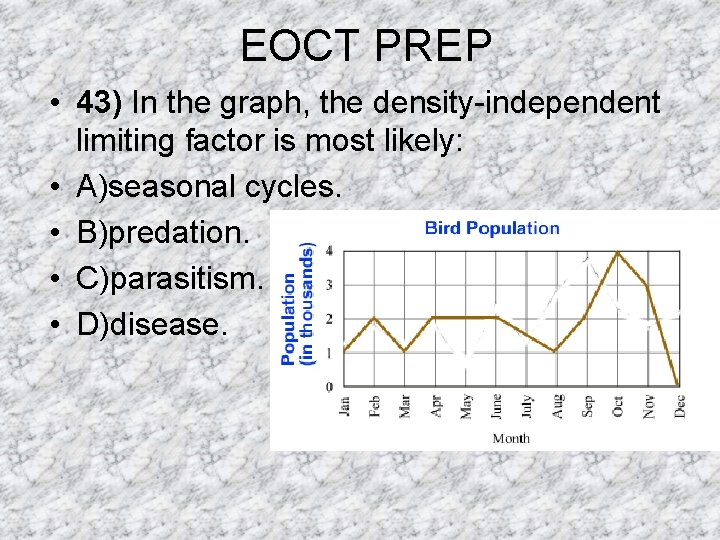
EOCT PREP • 43) In the graph, the density-independent limiting factor is most likely: • A)seasonal cycles. • B)predation. • C)parasitism. • D)disease.
ANSWER • A)seasonal cycles.
EOCT PREP • 44) Viruses are not considered to be living things, but they depend upon living cells for energy, reproduction, and protection at the expense of the cells that they invade. • • The type of relationship described above could best be classified as one of ___________. A)mutualism B)parasitism C)commensalism D)resignation
ANSWER • B)parasitism
EOCT PREP • 45) An organism with 24 chromosomes in each body cell will produce sex cells with _____ chromosomes. • A)48 • B)12 • C)10 • D)6
ANSWER • B)12
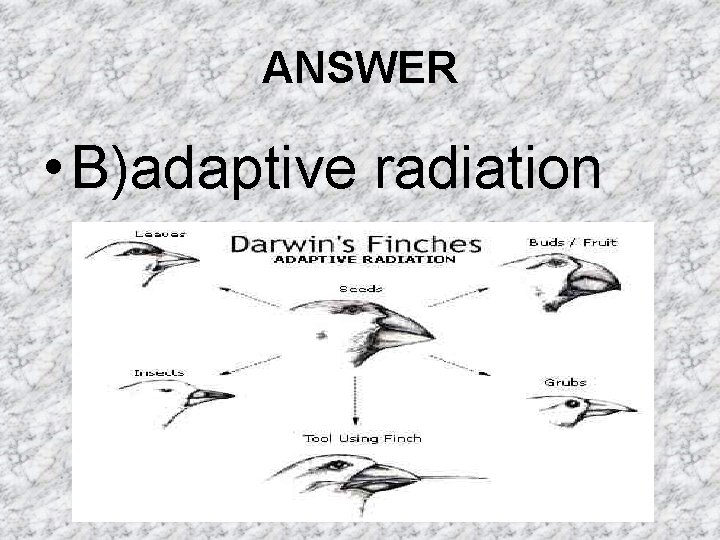
EOCT PREP • 46) The finches that Darwin studied in the Galapagos islands have evolved with different types of beaks: Drilling, cracking, tearing and fishing. This is an example of: • A)protective resemblence • B)adaptive radiation • C)warning coloration • D)predation
ANSWER • B)adaptive radiation
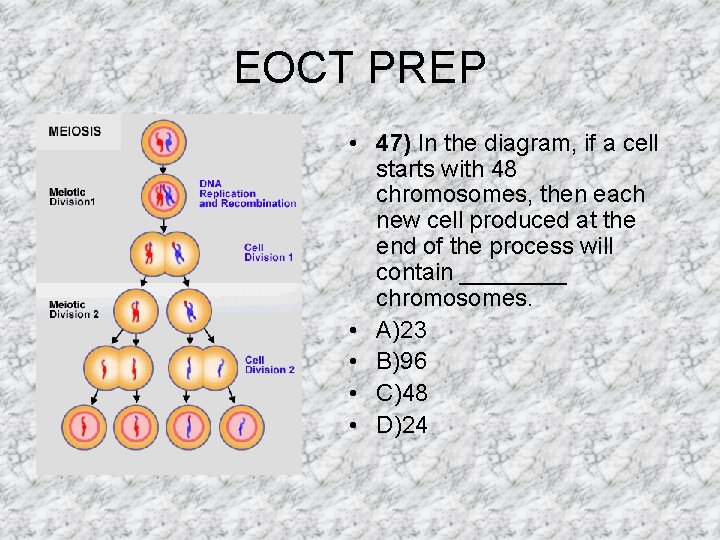
EOCT PREP • 47) In the diagram, if a cell starts with 48 chromosomes, then each new cell produced at the end of the process will contain ____ chromosomes. • A)23 • B)96 • C)48 • D)24
ANSWER • D)24
EOCT PREP • 48) Mutations can be both harmful and helpful. Indicate which of the following is NOT caused by a genetic mutation. • A)AIDS • B)Sickle cell anemia • C)Cystic fibrosis • D)Down syndrome
ANSWER • A)AIDS
EOCT PREP • 49) Which of the following is NOT a nucleic acid found within the confines of a typical cell? • A)r. RNA • B)t. RNA • C)m. RNA • D)q. RNA
ANSWER • D)q. RNA
EOCT PREP • 50) What are the products of photosynthesis? • A)carbon dioxide and oxygen • B)carbon dioxide and water • C)glucose and carbon dioxide • D)glucose and oxygen
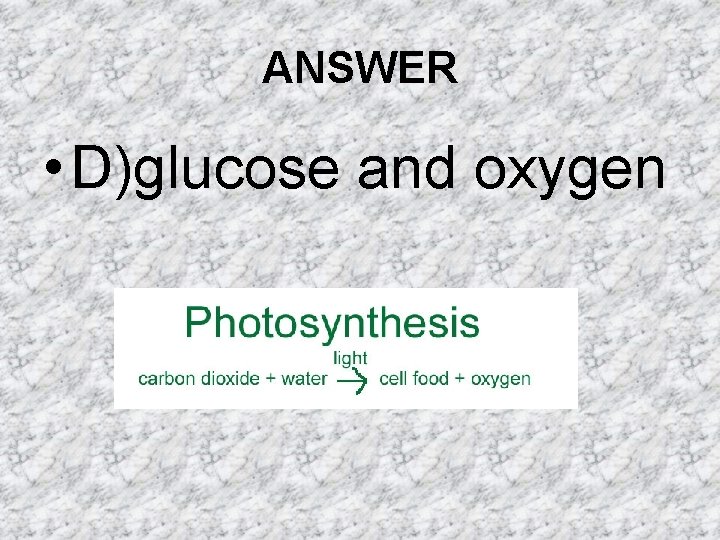
ANSWER • D)glucose and oxygen
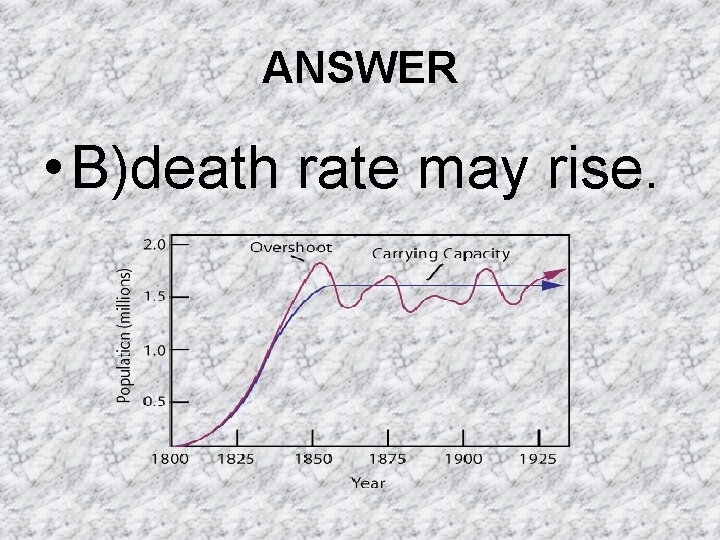
EOCT PREP • 51) If a population grows larger than its environmental carrying capacity, then: • A)birth rate may rise significantly. • B)death rate may rise. • C)death rate may fall significantly. • D)immigration rate may increase.
ANSWER • B)death rate may rise.
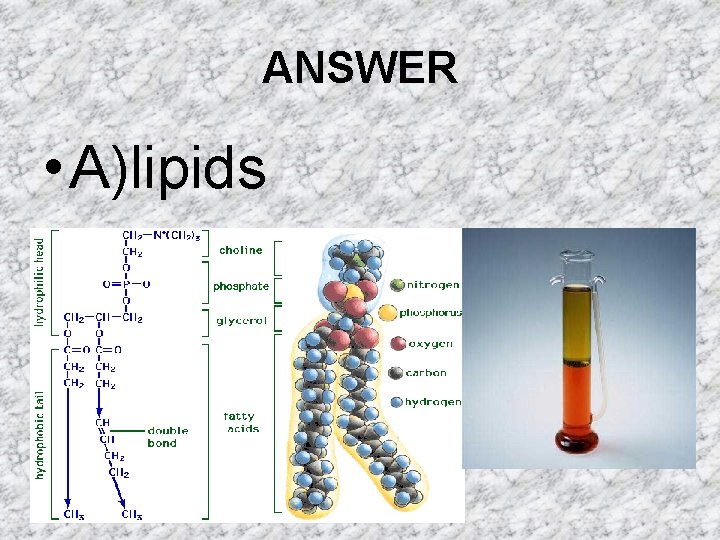
EOCT PREP • 52) ______ are a large and varied groups of molecules that are usually not soluble in water. • A)lipids • B)carbohydrates • C)proteins • D)amino acids
ANSWER • A)lipids
EOCT PREP • 53) Which of the following is NOT part of a nucleic acid? • A)ribose • B)phosphate • C)nitrogenous base • D)amino acid
ANSWER • D)amino acid
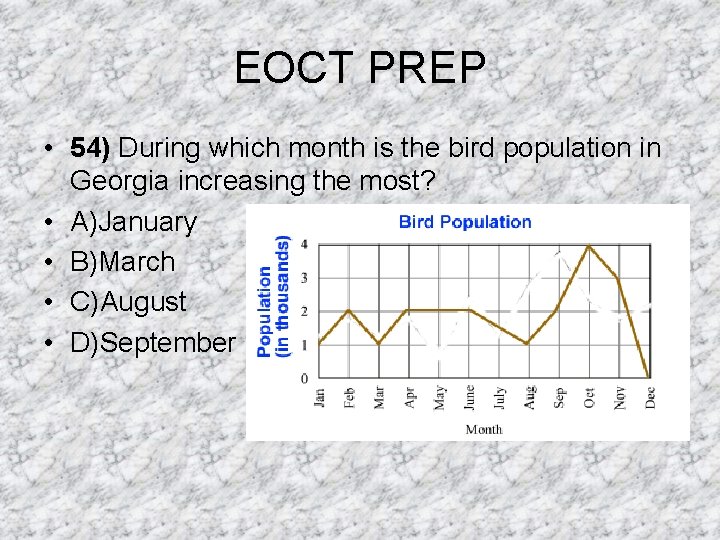
EOCT PREP • 54) During which month is the bird population in Georgia increasing the most? • A)January • B)March • C)August • D)September
ANSWER • D)September
EOCT PREP • 55) What adaptation allowed reptiles to reproduce on land? • A)amniotic eggs • B)clawed toes • C)body scales • D)warm bloodedness
ANSWER • A)amniotic eggs