CHAPTER 35 Family Interventions 1 Characteristics of Family

- Slides: 20
CHAPTER 35 Family Interventions 1
Characteristics of Family Function • Ability to provide for safety of members • Quality of resources and support systems • Underlying issues • Cultural concerns • Developmental needs • Patterns of behavior and interaction • Responses to stressors • Ability to interact with support services • Parenting skill • Relationships and interactions • Overall flexibility or resilience 2
Types of Families in the United States • Nuclear family • Single parent family • Unmarried biological or adoptive family • Blended family • Cohabitating family • Extended family • “Other” family 3
Case Study The Merchant family consists of parents Trent and Marnie and their two daughters Morgan, age 13, and Heather, age 9. Mr. and Mrs. Merchant are seeking family therapy because they are having trouble helping Morgan, who has attention deficit hyperactivity disorder (ADHD), cope with stress and social situations. Her anxiety and frustration sometimes manifest as panic attacks that can look like aggression. These attacks set off panic in the parents as well, who compound the problem, Marnie says, “because we just can’t find a consistent, right way to handle it. So we just wing it every time. ” Copyright © 2018, Elsevier Inc. All rights reserved. 4
Case Study (Cont. ) A second response to the stress in the Merchants’ household is a certain “overprotectiveness” that they describe seeing in their younger daughter, Heather. In general, they’ve noticed that Heather tries to compensate by being very well behaved: “…like, almost abnormally so, ” says Trent. “We think she’s trying to protect us from more stress. ” Marnie nods. “Sometimes, on rough evenings, she even takes control of dinnertime, ordering pizza or making hot dogs for dinner when we’re focused on Morgan. And she’s only 9 years old! It’s cool that she’s so sweet, but we also feel bad that she even thinks to do that. ” Copyright © 2018, Elsevier Inc. All rights reserved. 5
Family Functions • Management • Boundaries • Clear • Diffuse or enmeshed • Rigid or disengaged 6
Family Functions (Cont. ) • Communication • Emotional-supportive • Socialization 7
Audience Response Question The family has come to rely on 9 -year-old Heather to initiate dinner preparations when her sister is having an episode. Although this can be a positive, it does mean that they run the risk of violating ordinary family: A. B. C. D. Boundaries Socialization Communication Management Copyright © 2018, Elsevier Inc. All rights reserved. 8
Major Goals of Family Therapy • Improve the skills of the individual members • Strengthen the functioning of the family as a whole • Family systems theory • By altering family dynamics we can decrease emotional reactivity, increase each member’s sense of self, and/or improve patterns of family interaction Copyright © 2018, Elsevier Inc. All rights reserved. 9
Areas Usually Explored before Family Therapy • Cohesiveness • Communication • Appreciation • Commitment • Coping • Beliefs and values Copyright © 2018, Elsevier Inc. All rights reserved. 10
Examples of Dysfunctional Communication • Manipulating • Distracting • Generalizing • Blaming • Placating 11
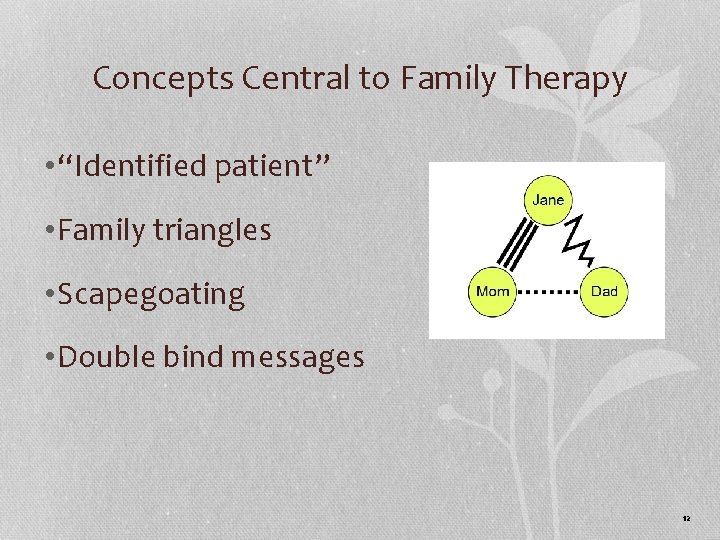
Concepts Central to Family Therapy • “Identified patient” • Family triangles • Scapegoating • Double bind messages 12
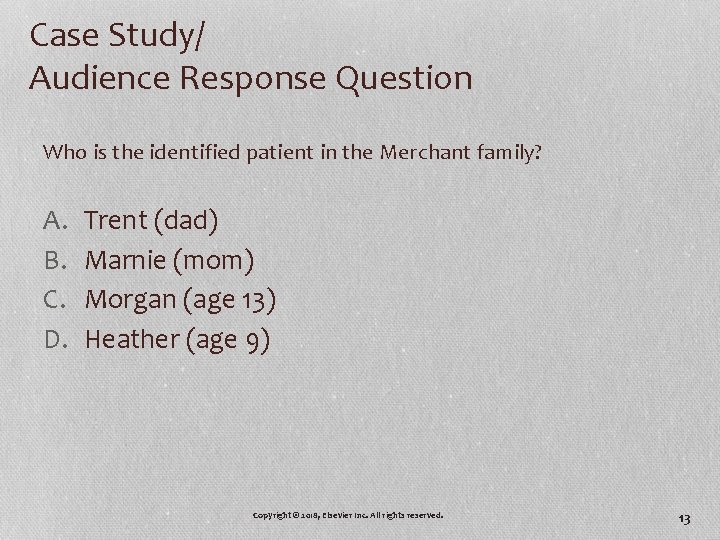
Case Study/ Audience Response Question Who is the identified patient in the Merchant family? A. B. C. D. Trent (dad) Marnie (mom) Morgan (age 13) Heather (age 9) Copyright © 2018, Elsevier Inc. All rights reserved. 13
Application of the Nursing Process • Family assessment • Assessment tools • Constructing a genogram • Other assessment tools • Self assessment 14
Nursing Process (Cont. ) • Diagnosis (Box 34 -3) • Impaired parenting • Dysfunctional family processes • Caregiver role strain • Ineffective denial • Defensive coping 15
Nursing Process (Cont. ) • Implementation • Counseling and communication techniques • Nonjudgmental manner promotes open and flexible communication • Perspective of each family member is elicited and heard 16
Outcomes Identification • Reduce dysfunctional behavior of individual family members and resolve or reduce conflicts • Mobilize family resources, encourage adaptive family problemsolving behaviors, improve family’s communication skills, heighten awareness and sensitivity to other family members’ emotional needs 17
Outcomes Identification (Cont. ) • Strengthen family’s ability to cope with major life stressors and traumatic events, including chronic physical or psychiatric illness • Improve integration of family system into societal system 18
Nursing Process (Cont. ) • Pharmacological interventions • Case management 19
Question 1 The family of a child with attention deficit hyperactivity disorder (ADHD) and behavioral problems is referred for family therapy. Select the appropriate goal for family therapy. A. B. C. D. The patient will develop stress reduction techniques. The parents will provide structure and limit setting. The patient will adhere to the medication regimen. The patient will be free of aggressive behavior. 20