
Intro Course 101 Pyramid of Interventions RTI SSTAGE
- Slides: 64
Intro Course 101: Pyramid of Interventions, RTI & SSTAGE Conference January 24, 2008 Lynn Le. Loup Pennington Education Consultant, President of SSTAGE and Frank Smith Ga. DOE, Psychological Services & SST
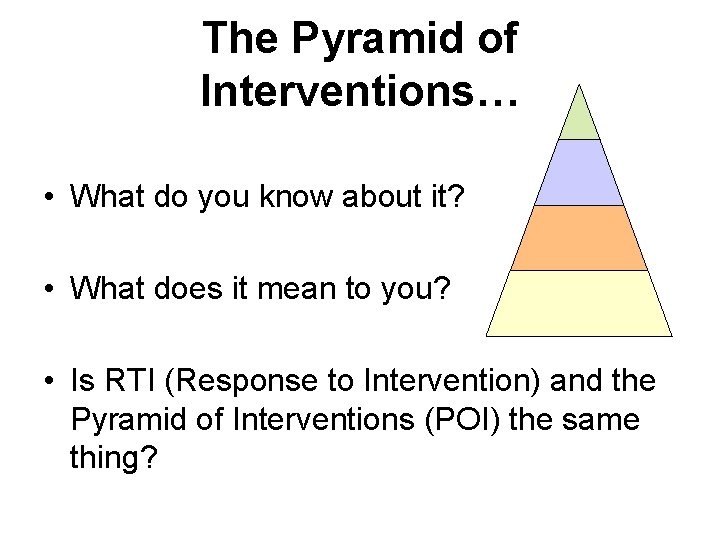
The Pyramid of Interventions… • What do you know about it? • What does it mean to you? • Is RTI (Response to Intervention) and the Pyramid of Interventions (POI) the same thing?
Essential Questions: • Are our students learning? • How do we know that they are learning? • What are we prepared to do when they do not learn? Du. Four, R. , Eaker, R. , Karhanek, G. (2004), Whatever it takes: How professional learning communities respond when kids don’t learn. Bloomington, IN, National Educational Service
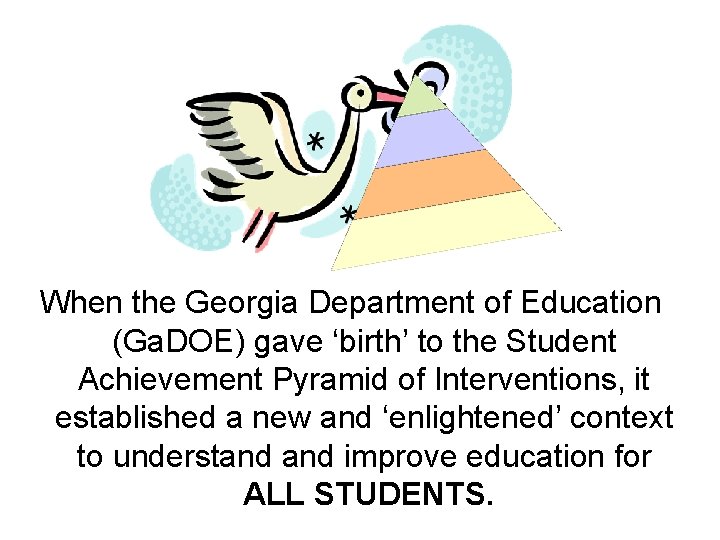
When the Georgia Department of Education (Ga. DOE) gave ‘birth’ to the Student Achievement Pyramid of Interventions, it established a new and ‘enlightened’ context to understand improve education for ALL STUDENTS.
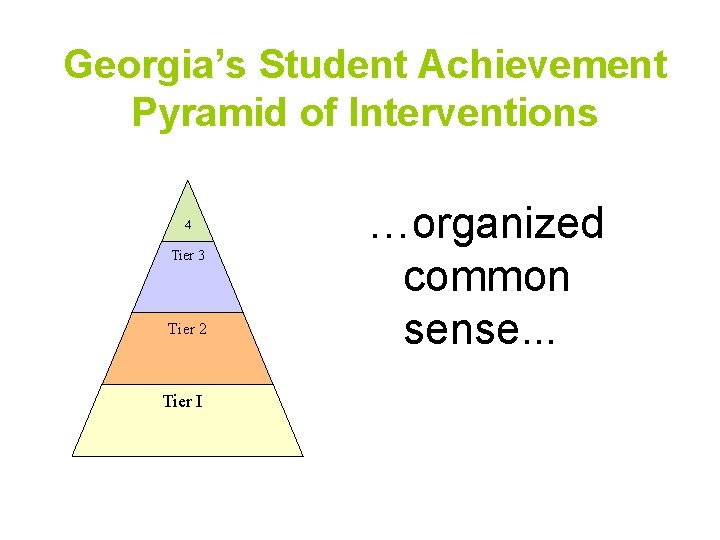
Georgia’s Student Achievement Pyramid of Interventions 4 Tier 3 Tier 2 Tier I …organized common sense. . .
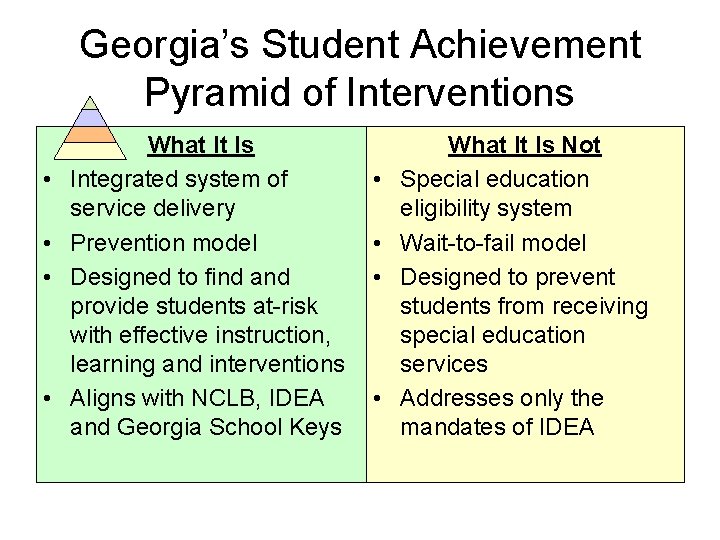
Georgia’s Student Achievement Pyramid of Interventions • • What It Is Integrated system of service delivery Prevention model Designed to find and provide students at-risk with effective instruction, learning and interventions Aligns with NCLB, IDEA and Georgia School Keys • • What It Is Not Special education eligibility system Wait-to-fail model Designed to prevent students from receiving special education services Addresses only the mandates of IDEA
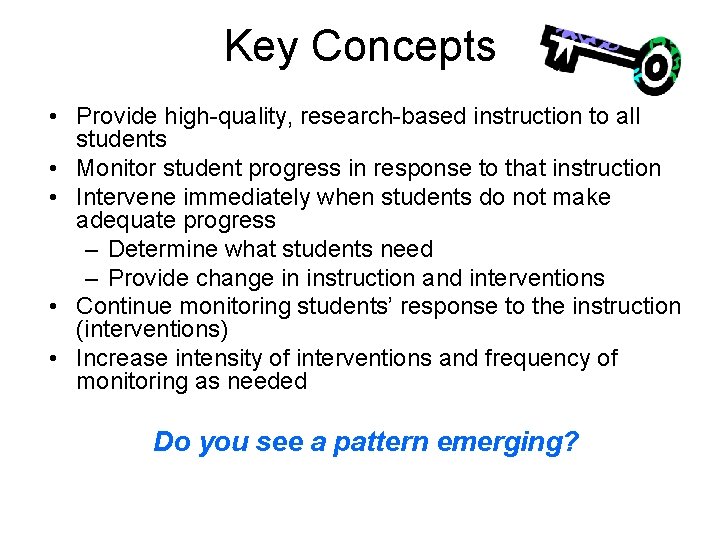
Key Concepts • Provide high-quality, research-based instruction to all students • Monitor student progress in response to that instruction • Intervene immediately when students do not make adequate progress – Determine what students need – Provide change in instruction and interventions • Continue monitoring students’ response to the instruction (interventions) • Increase intensity of interventions and frequency of monitoring as needed Do you see a pattern emerging?
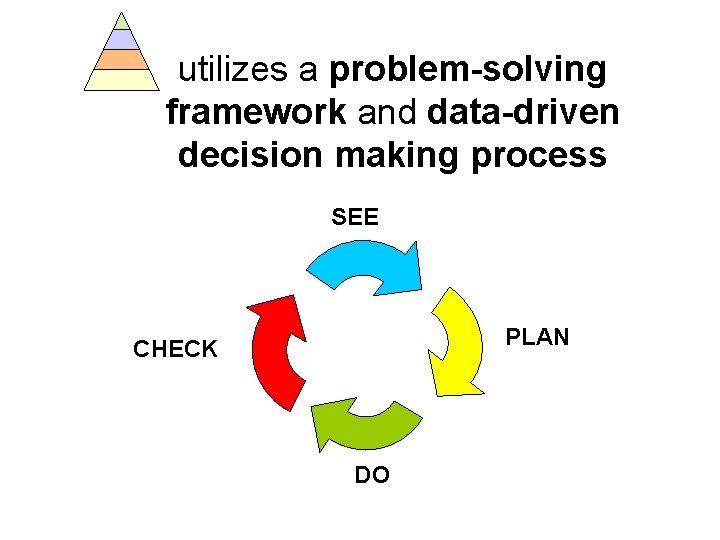
utilizes a problem-solving framework and data-driven decision making process SEE CHECK DO PLAN
Data-driven problem solving is the “engine” within the pyramid which provides educators with a systematic process to make informed decisions at each tier.
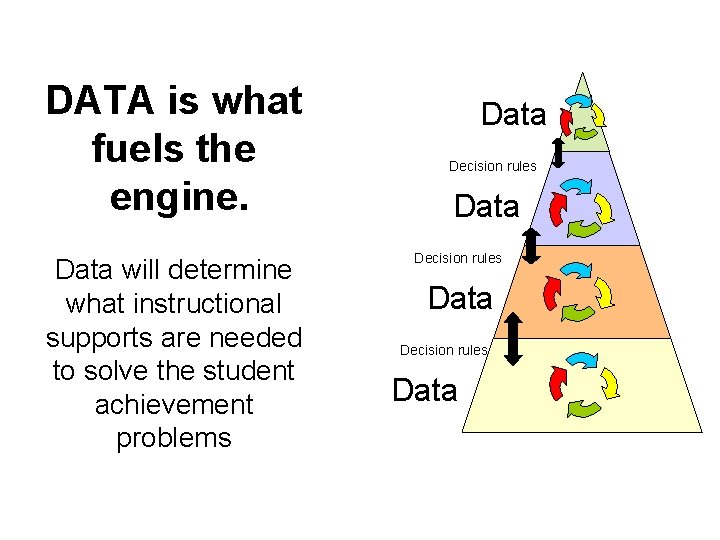
DATA is what fuels the engine. Data will determine what instructional supports are needed to solve the student achievement problems Data Decision rules Data
Data-based problem solving represents the core conceptual basis of addressing students’ academic and behavioral problems whether we are focusing on … – the entire school – a single grade level – one classroom – a small group – one student
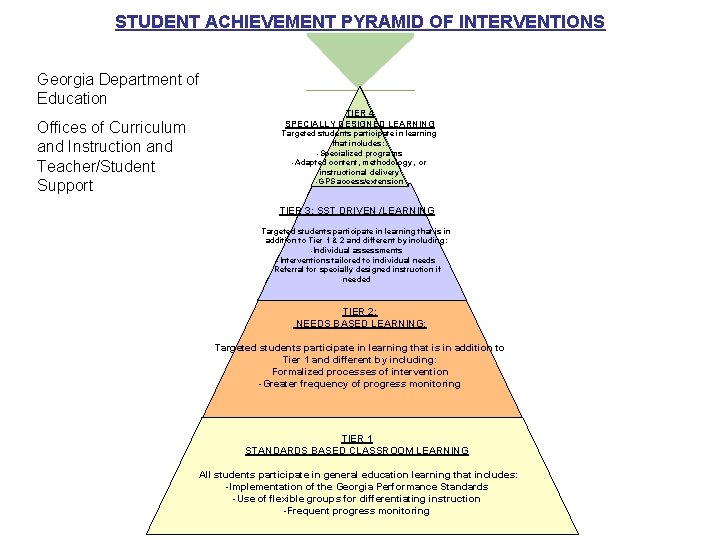
STUDENT ACHIEVEMENT PYRAMID OF INTERVENTIONS Georgia Department of Education Offices of Curriculum and Instruction and Teacher/Student Support TIER 4 SPECIALLY DESIGNED LEARNING Targeted students participate in learning that includes: : -Specialized programs -Adapted content, methodology, or instructional delivery -GPS access/extension TIER 3: SST DRIVEN /LEARNING Targeted students participate in learning that is in addition to Tier 1 & 2 and different by including: -Individual assessments -Interventions tailored to individual needs -Referral for specially designed instruction if needed TIER 2: NEEDS BASED LEARNING: Targeted students participate in learning that is in addition to Tier 1 and different by including: Formalized processes of intervention -Greater frequency of progress monitoring TIER 1 STANDARDS BASED CLASSROOM LEARNING All students participate in general education learning that includes: -Implementation of the Georgia Performance Standards -Use of flexible groups for differentiating instruction -Frequent progress monitoring
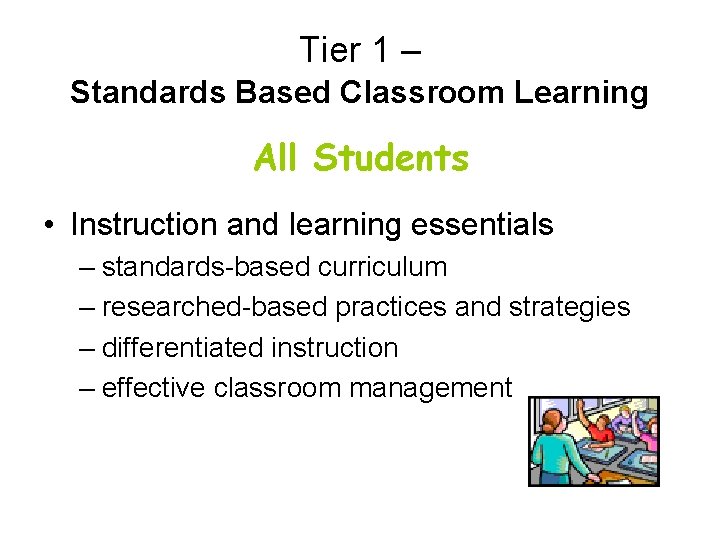
Tier 1 – Standards Based Classroom Learning All Students • Instruction and learning essentials – standards-based curriculum – researched-based practices and strategies – differentiated instruction – effective classroom management
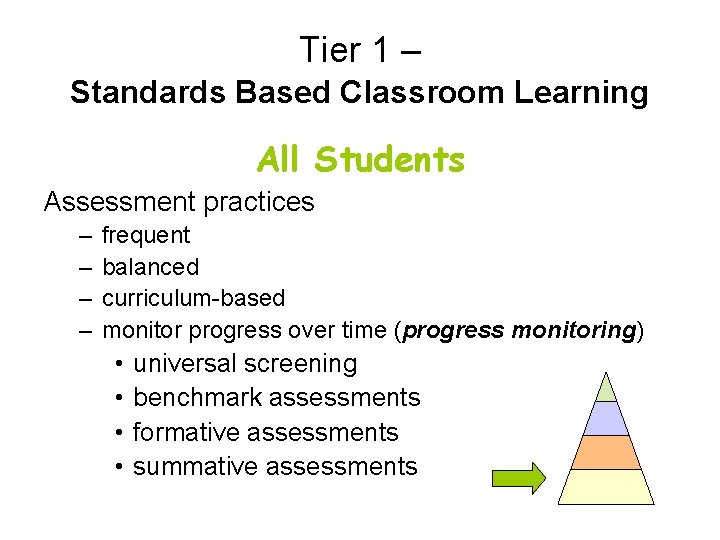
Tier 1 – Standards Based Classroom Learning All Students Assessment practices – – frequent balanced curriculum-based monitor progress over time (progress monitoring) • • universal screening benchmark assessments formative assessments summative assessments
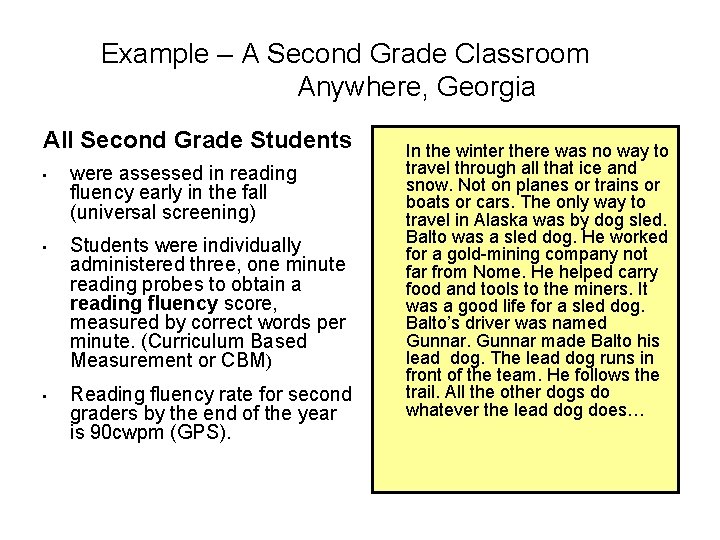
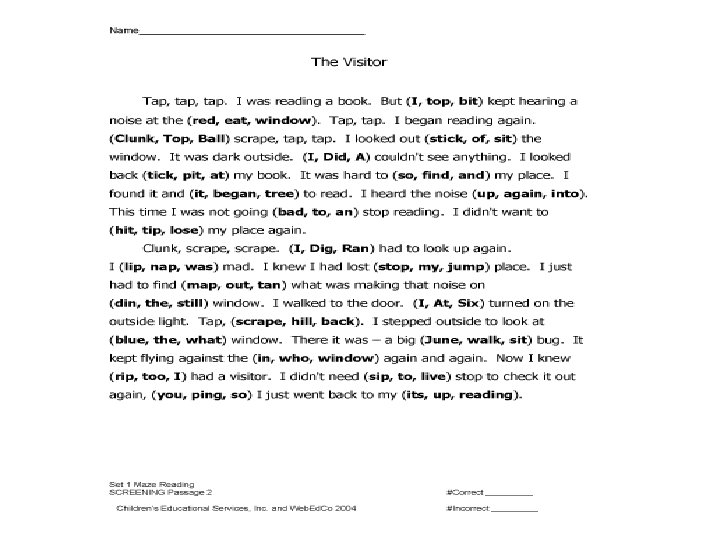
Example – A Second Grade Classroom Anywhere, Georgia All Second Grade Students • • • were assessed in reading fluency early in the fall (universal screening) Students were individually administered three, one minute reading probes to obtain a reading fluency score, measured by correct words per minute. (Curriculum Based Measurement or CBM) Reading fluency rate for second graders by the end of the year is 90 cwpm (GPS). In the winter there was no way to travel through all that ice and snow. Not on planes or trains or boats or cars. The only way to travel in Alaska was by dog sled. Balto was a sled dog. He worked for a gold-mining company not far from Nome. He helped carry food and tools to the miners. It was a good life for a sled dog. Balto’s driver was named Gunnar made Balto his lead dog. The lead dog runs in front of the team. He follows the trail. All the other dogs do whatever the lead dog does…
Mr. Price’s Classroom • • After the fall screening, eight students were identified in Mr. Price’s classroom as performing in the lowest 20%ile for second grade. Mr. Price provided differentiated and small group instruction to the eight students. He used The Six-Minute Solution: A Reading Fluency Program* as part of the instructional/learning program. *Sopris West
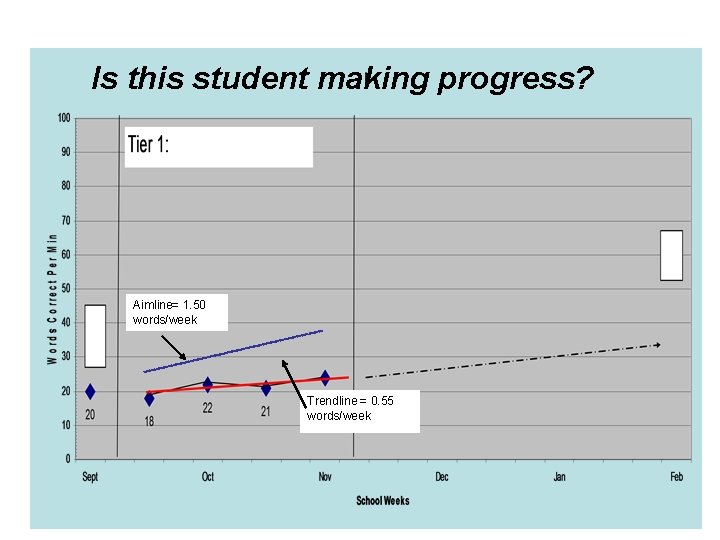
• • • The eight students were assessed each week to measure their progress. At the end of nine weeks, the students’ progress was reviewed. (9 data points) The progress made by four of the students indicated that they would reach the end of the year goal (i. e. , close the achievement gap) with continued in-class support. Four students were not on track to reach the state standard in reading fluency by year’s end. They need additional intervention. Begin a Tier 2 reading intervention for the targeted students. CBM - Reading Fluency ü The reading probes are different each week, but they are the same level of difficulty. ü As the student reads, the teacher marks the errors ü The student reads for one minute. ü Number of words read correctly is counted ü Scores are graphed
Is this student making progress?
Is this student making progress? Aimline= 1. 50 words/week Trendline = 0. 55 words/week
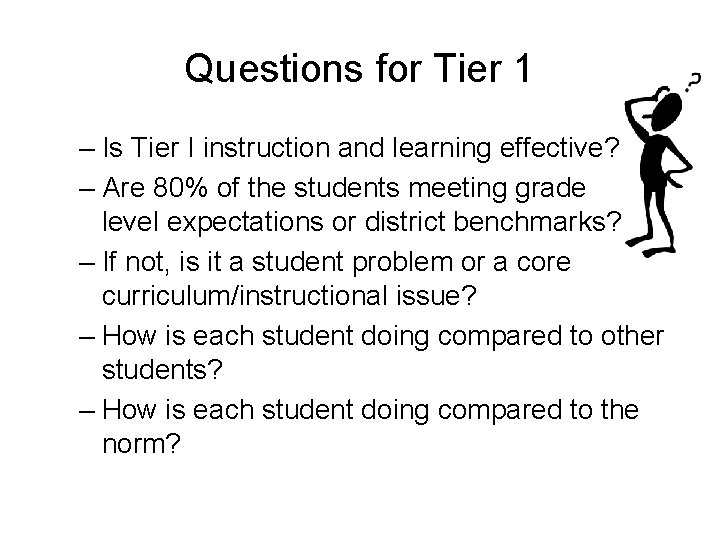
Questions for Tier 1 – Is Tier I instruction and learning effective? – Are 80% of the students meeting grade level expectations or district benchmarks? – If not, is it a student problem or a core curriculum/instructional issue? – How is each student doing compared to other students? – How is each student doing compared to the norm?
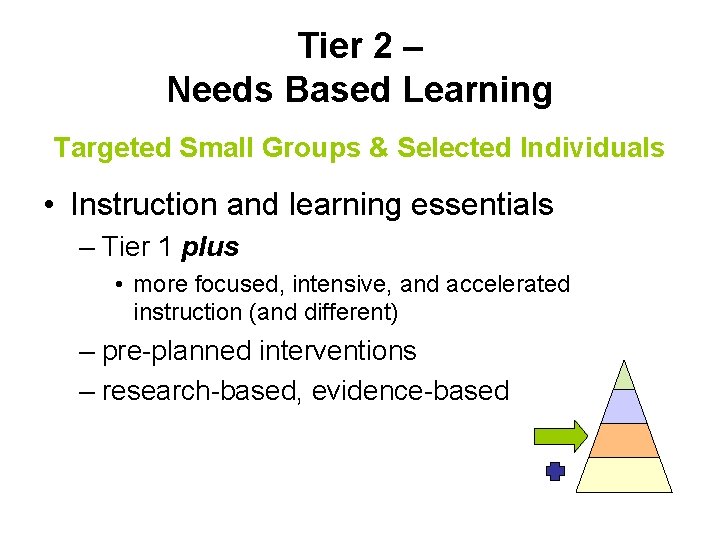
Tier 2 – Needs Based Learning Targeted Small Groups & Selected Individuals • Instruction and learning essentials – Tier 1 plus • more focused, intensive, and accelerated instruction (and different) – pre-planned interventions – research-based, evidence-based
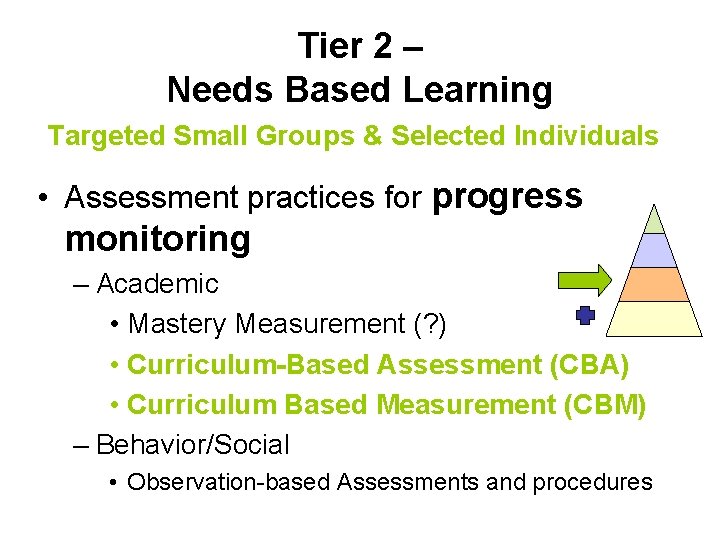
Tier 2 – Needs Based Learning Targeted Small Groups & Selected Individuals • Assessment practices for progress monitoring – Academic • Mastery Measurement (? ) • Curriculum-Based Assessment (CBA) • Curriculum Based Measurement (CBM) – Behavior/Social • Observation-based Assessments and procedures
Progress monitoring typically targets basic skills and competencies (a few examples) • Reading – – – Phonemic awareness Word Identification (correct words per minute) Fluency (correct words per minute) Vocabulary (matching words to pictures, definitions) Comprehension (maze) • Math – Computation Fluency (correct digits) • Writing – Fluency (correct word sequences) Screenings and probes are usually timed.
A service of www. interventioncentral. org What will you find there? • • • Directions to administer CBMs CBM norms (national benchmarks) Links to CBM probes (all ready made) Create your own probes (make your own) Graphing programs to display the data
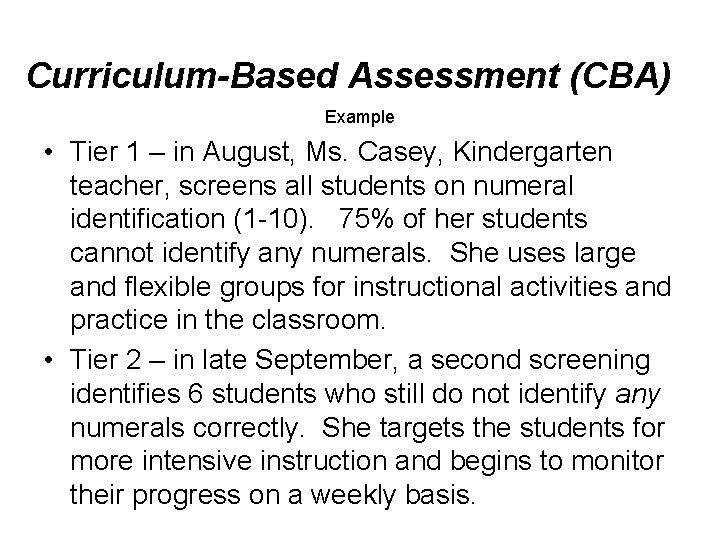
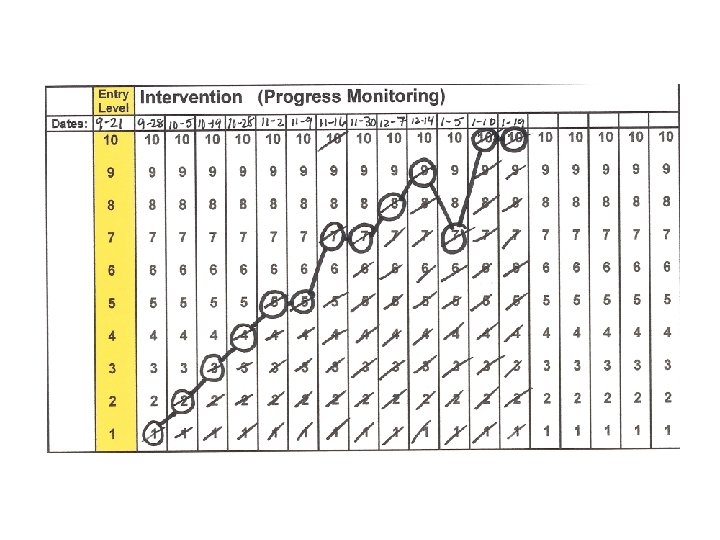
Curriculum-Based Assessment (CBA) Example • Tier 1 – in August, Ms. Casey, Kindergarten teacher, screens all students on numeral identification (1 -10). 75% of her students cannot identify any numerals. She uses large and flexible groups for instructional activities and practice in the classroom. • Tier 2 – in late September, a second screening identifies 6 students who still do not identify any numerals correctly. She targets the students for more intensive instruction and begins to monitor their progress on a weekly basis.
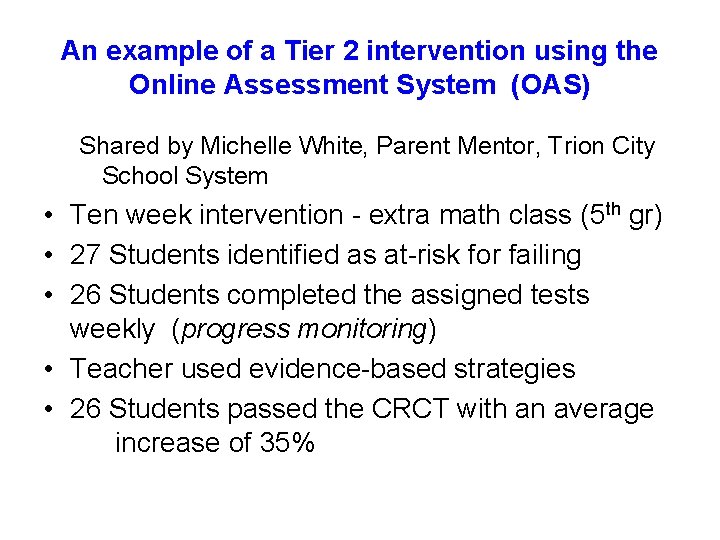
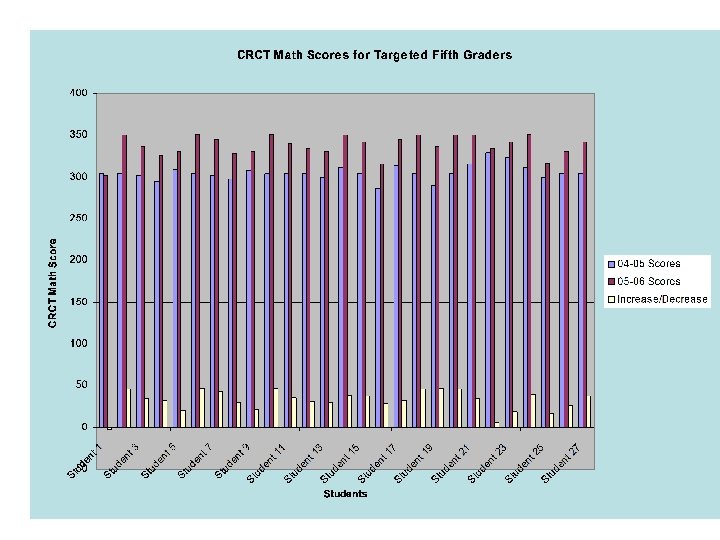
An example of a Tier 2 intervention using the Online Assessment System (OAS) Shared by Michelle White, Parent Mentor, Trion City School System • Ten week intervention - extra math class (5 th gr) • 27 Students identified as at-risk for failing • 26 Students completed the assigned tests weekly (progress monitoring) • Teacher used evidence-based strategies • 26 Students passed the CRCT with an average increase of 35%
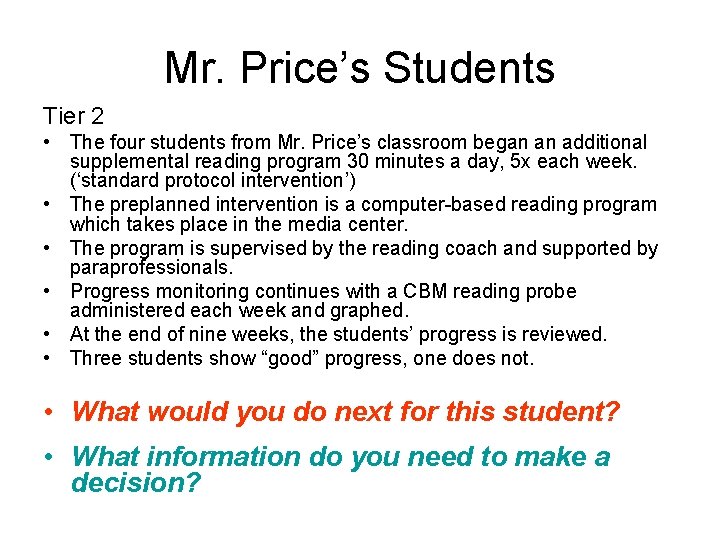
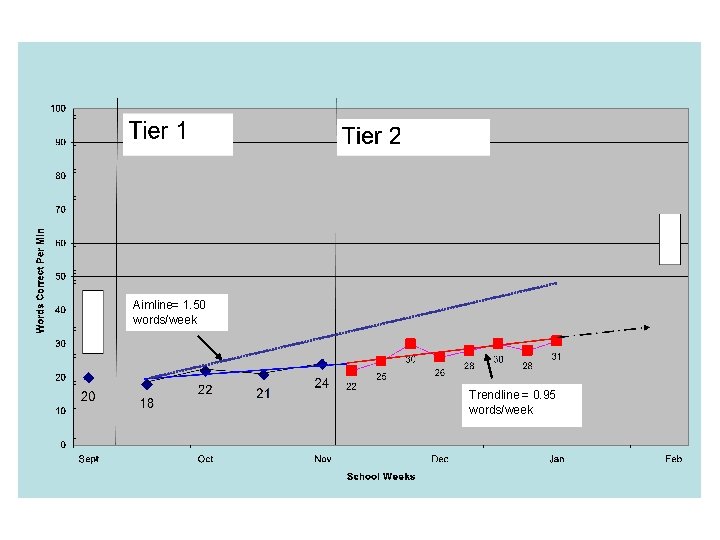
Mr. Price’s Students Tier 2 • The four students from Mr. Price’s classroom began an additional supplemental reading program 30 minutes a day, 5 x each week. (‘standard protocol intervention’) • The preplanned intervention is a computer-based reading program which takes place in the media center. • The program is supervised by the reading coach and supported by paraprofessionals. • Progress monitoring continues with a CBM reading probe administered each week and graphed. • At the end of nine weeks, the students’ progress is reviewed. • Three students show “good” progress, one does not. • What would you do next for this student? • What information do you need to make a decision?
Aimline= 1. 50 words/week Trendline = 0. 95 words/week
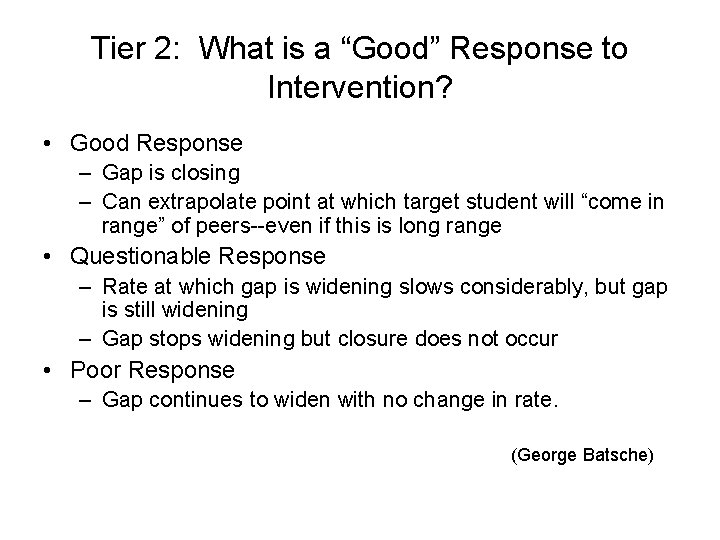
Tier 2: What is a “Good” Response to Intervention? • Good Response – Gap is closing – Can extrapolate point at which target student will “come in range” of peers--even if this is long range • Questionable Response – Rate at which gap is widening slows considerably, but gap is still widening – Gap stops widening but closure does not occur • Poor Response – Gap continues to widen with no change in rate. (George Batsche)
How does progress monitoring work? • The student’s current levels of performance are determined. • Goals are identified for learning that will take place over time. • The student’s academic performance is measured on a regular basis. • Progress toward meeting the student’s goals is measured by comparing expected and actual rates of learning. • Based on these measurements, teaching is adjusted as needed. www. studentprogress. org
Progress Monitoring at Tier 2 & 3 What is it? • Assessing students’ performance on a regular (ongoing) basis and analyzing the data to determine whether children are profiting appropriately from the instructional program. • A scientifically based practice that is used to assess students’ academic performance and evaluate the effectiveness of instruction. • This is Response to Intervention.
Assessment practices and tools for progress monitoring should be: • Relatively simple to administer and interpret results • Sensitive to student improvement • Easy to communicate with parents or other professionals about students’ progress • Frequent and specific feedback to students about their growth towards identified benchmarks • Used to drive instructional decision-making
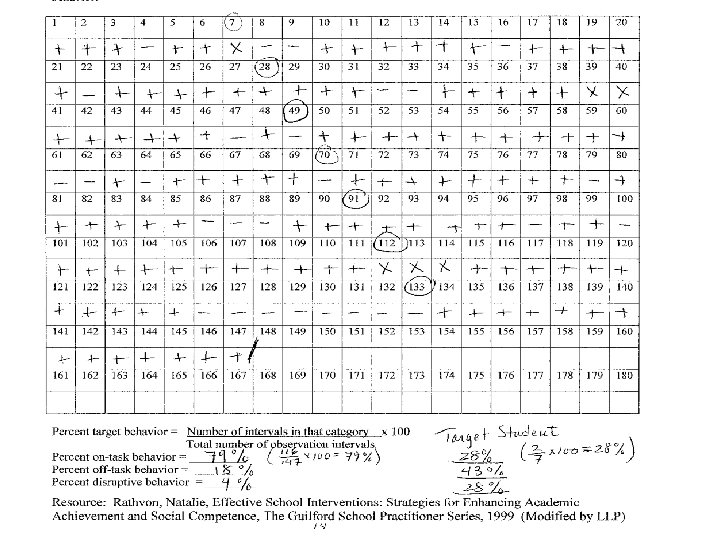
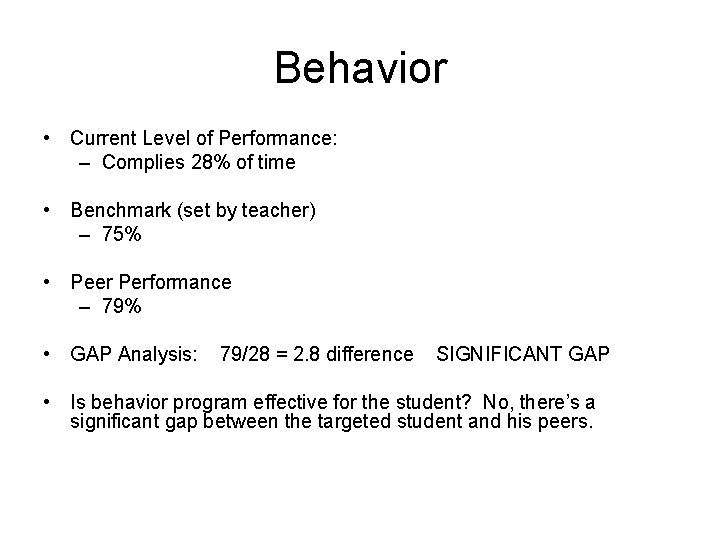
Behavior • Current Level of Performance: – Complies 28% of time • Benchmark (set by teacher) – 75% • Peer Performance – 79% • GAP Analysis: 79/28 = 2. 8 difference SIGNIFICANT GAP • Is behavior program effective for the student? No, there’s a significant gap between the targeted student and his peers.
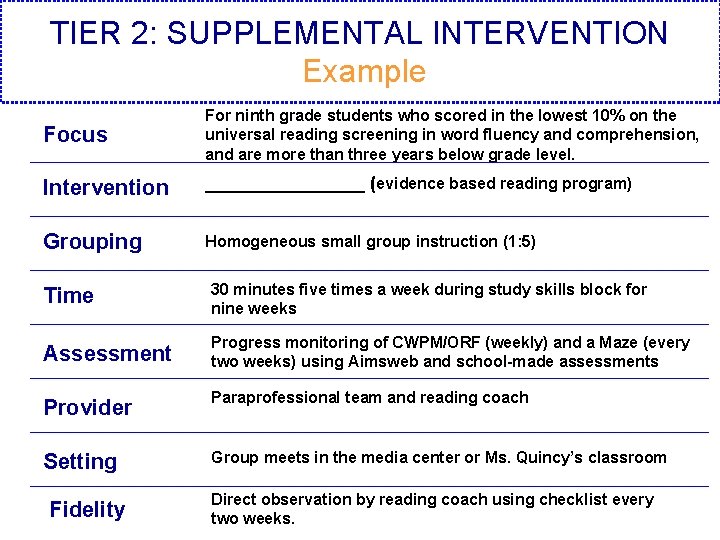
TIER 2: SUPPLEMENTAL INTERVENTION Example Focus For ninth grade students who scored in the lowest 10% on the universal reading screening in word fluency and comprehension, and are more than three years below grade level. Intervention ________ (evidence based reading program) Grouping Homogeneous small group instruction (1: 5) Time 30 minutes five times a week during study skills block for nine weeks Assessment Progress monitoring of CWPM/ORF (weekly) and a Maze (every two weeks) using Aimsweb and school-made assessments Provider Paraprofessional team and reading coach Setting Group meets in the media center or Ms. Quincy’s classroom Fidelity Direct observation by reading coach using checklist every two weeks.
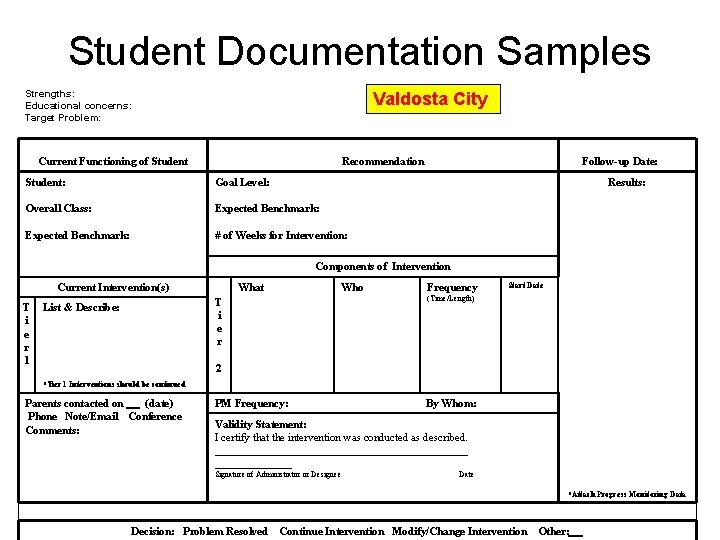
Student Documentation Samples Strengths: Educational concerns: Target Problem: Valdosta City Current Functioning of Student Recommendation Student: Goal Level: Overall Class: Expected Benchmark: # of Weeks for Intervention: Follow-up Date: Results: Components of Intervention Current Intervention(s) T i e r 1 T i e r List & Describe: What Who Frequency (Time/Length) Start Date 2 *Tier 1 Interventions should be continued Parents contacted on (date) Phone Note/Email Conference Comments: PM Frequency: By Whom: Validity Statement: I certify that the intervention was conducted as described. _______________________ Signature of Administrator or Designee Date *Attach Progress Monitoring Data Decision: Problem Resolved Continue Intervention Modify/Change Intervention Other:
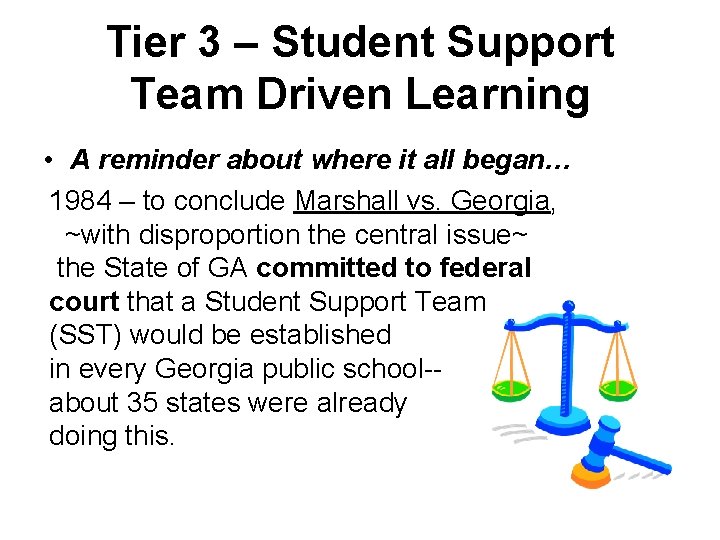
Tier 3 – Student Support Team Driven Learning • A reminder about where it all began… 1984 – to conclude Marshall vs. Georgia, ~with disproportion the central issue~ the State of GA committed to federal court that a Student Support Team (SST) would be established in every Georgia public school-about 35 states were already doing this.
Student Support Team The stage has been set for a new “production” of SST. What characteristics and features of the old SST will no longer be part of the performance?
The lights are going out and the curtain is closing on the view that… • SST is an isolated process and set of procedures • teacher judgment or frustration should be the primary criteria for entry to the SST • school policies or procedures should automatically place students in SST who fail a course or don’t pass a state-level assessment • vague descriptions of student problems and unmeasured student performance will suffice
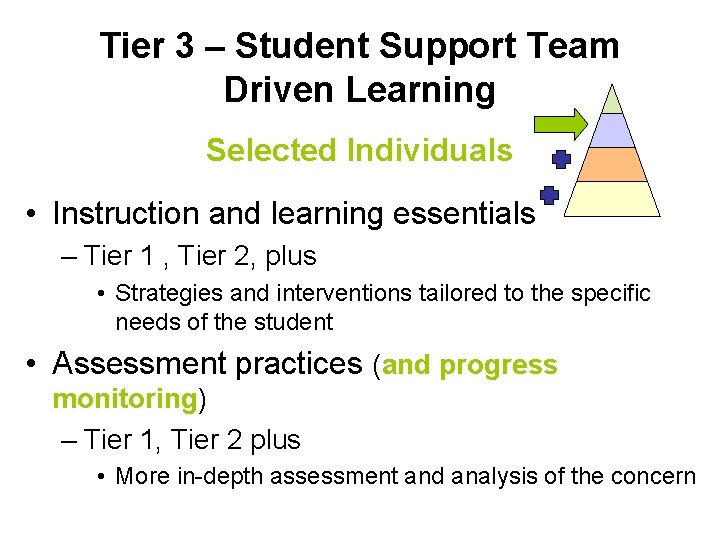
Tier 3 – Student Support Team Driven Learning Selected Individuals • Instruction and learning essentials – Tier 1 , Tier 2, plus • Strategies and interventions tailored to the specific needs of the student • Assessment practices (and progress monitoring) – Tier 1, Tier 2 plus • More in-depth assessment and analysis of the concern
If data-based problem solving is found at every tier, what’s different about it at SST?
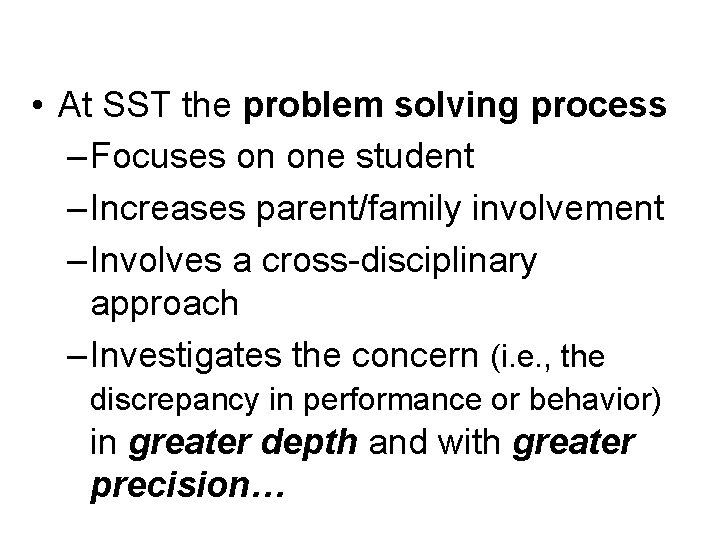
• At SST the problem solving process – Focuses on one student – Increases parent/family involvement – Involves a cross-disciplinary approach – Investigates the concern (i. e. , the discrepancy in performance or behavior) in greater depth and with greater precision…
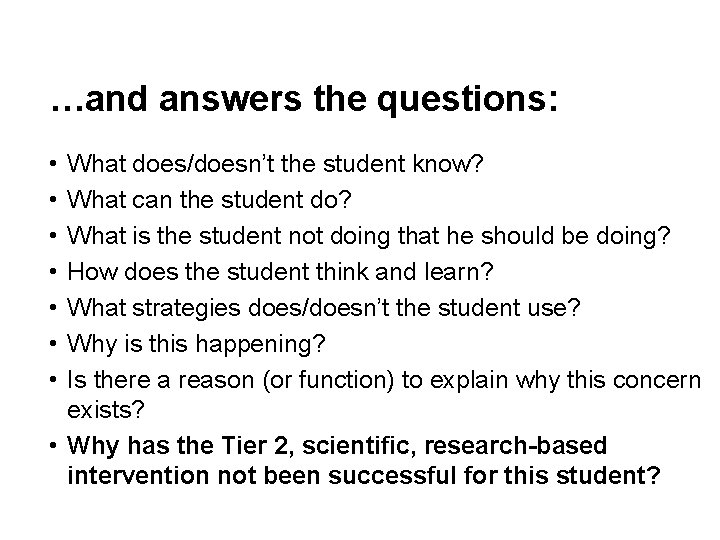
…and answers the questions: • • What does/doesn’t the student know? What can the student do? What is the student not doing that he should be doing? How does the student think and learn? What strategies does/doesn’t the student use? Why is this happening? Is there a reason (or function) to explain why this concern exists? • Why has the Tier 2, scientific, research-based intervention not been successful for this student?
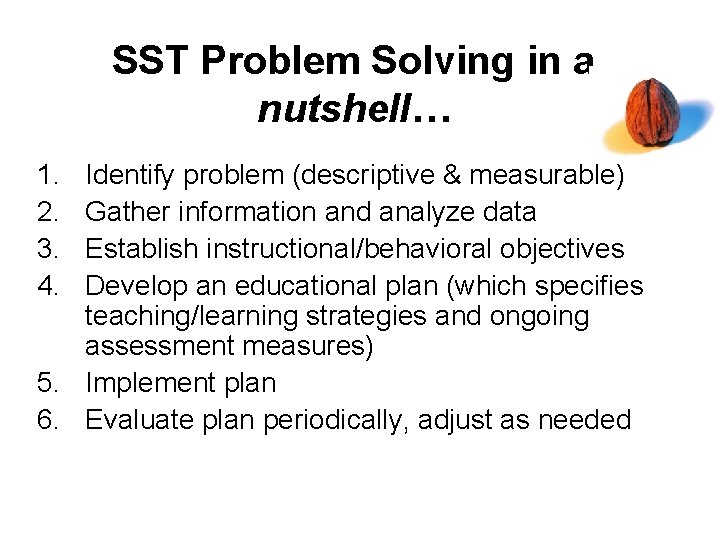
SST Problem Solving in a nutshell… 1. 2. 3. 4. Identify problem (descriptive & measurable) Gather information and analyze data Establish instructional/behavioral objectives Develop an educational plan (which specifies teaching/learning strategies and ongoing assessment measures) 5. Implement plan 6. Evaluate plan periodically, adjust as needed
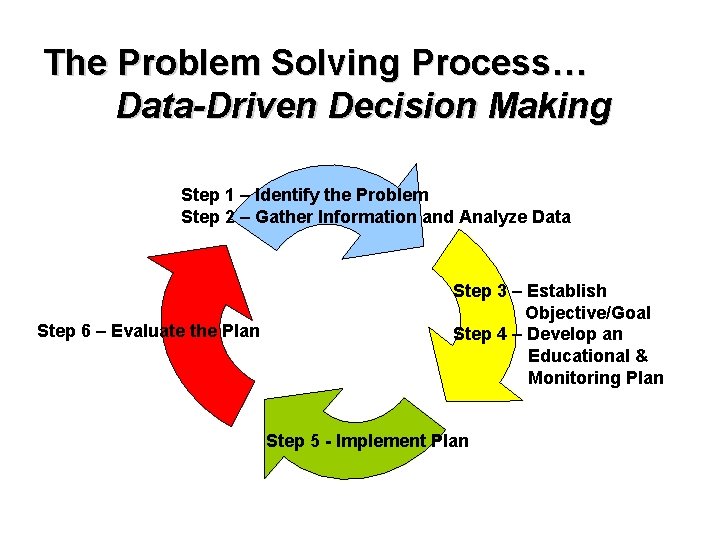
The Problem Solving Process… Data-Driven Decision Making Step 1 – Identify the Problem Step 2 – Gather Information and Analyze Data Step 6 – Evaluate the Plan Step 3 – Establish Objective/Goal Step 4 – Develop an Educational & Monitoring Plan Step 5 - Implement Plan
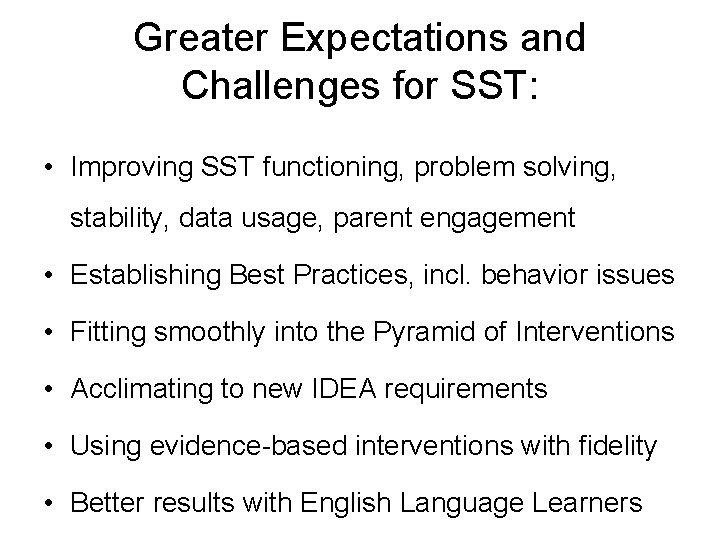
Greater Expectations and Challenges for SST: • Improving SST functioning, problem solving, stability, data usage, parent engagement • Establishing Best Practices, incl. behavior issues • Fitting smoothly into the Pyramid of Interventions • Acclimating to new IDEA requirements • Using evidence-based interventions with fidelity • Better results with English Language Learners
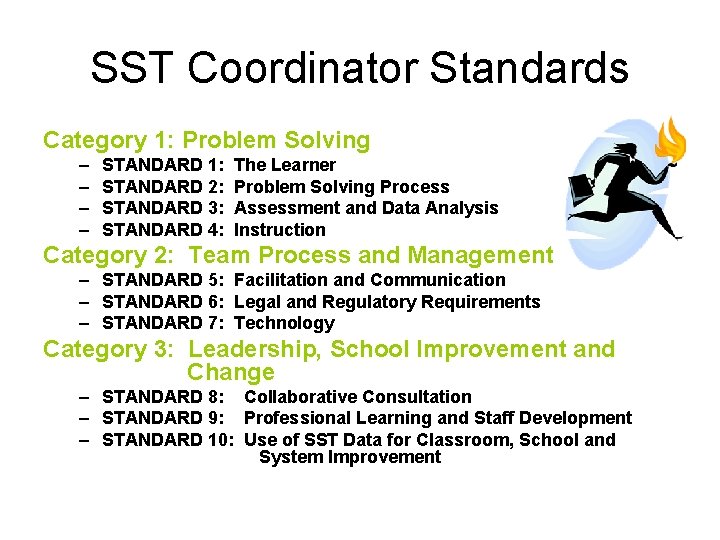
SST Coordinator Standards Category 1: Problem Solving – – STANDARD 1: The Learner STANDARD 2: Problem Solving Process STANDARD 3: Assessment and Data Analysis STANDARD 4: Instruction Category 2: Team Process and Management – STANDARD 5: Facilitation and Communication – STANDARD 6: Legal and Regulatory Requirements – STANDARD 7: Technology Category 3: Leadership, School Improvement and Change – STANDARD 8: Collaborative Consultation – STANDARD 9: Professional Learning and Staff Development – STANDARD 10: Use of SST Data for Classroom, School and System Improvement
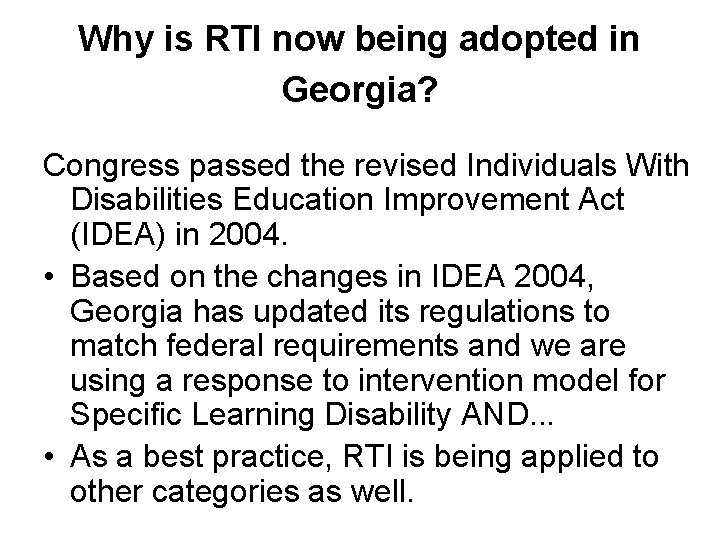
Why is RTI now being adopted in Georgia? Congress passed the revised Individuals With Disabilities Education Improvement Act (IDEA) in 2004. • Based on the changes in IDEA 2004, Georgia has updated its regulations to match federal requirements and we are using a response to intervention model for Specific Learning Disability AND. . . • As a best practice, RTI is being applied to other categories as well.
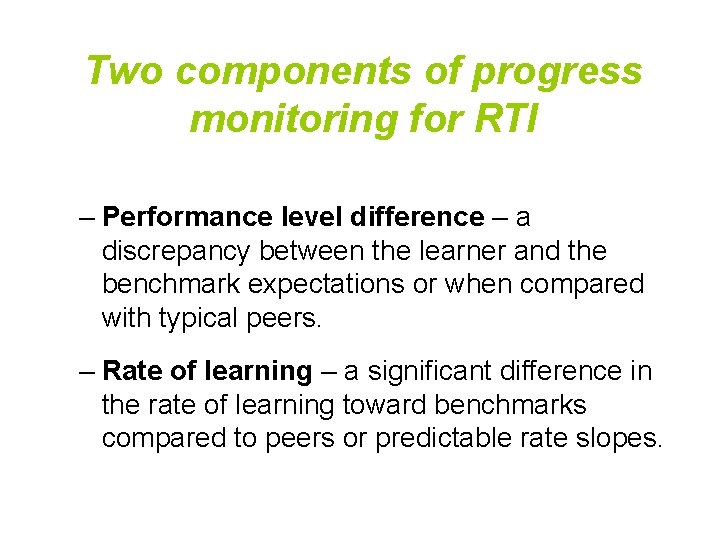
Two components of progress monitoring for RTI – Performance level difference – a discrepancy between the learner and the benchmark expectations or when compared with typical peers. – Rate of learning – a significant difference in the rate of learning toward benchmarks compared to peers or predictable rate slopes.
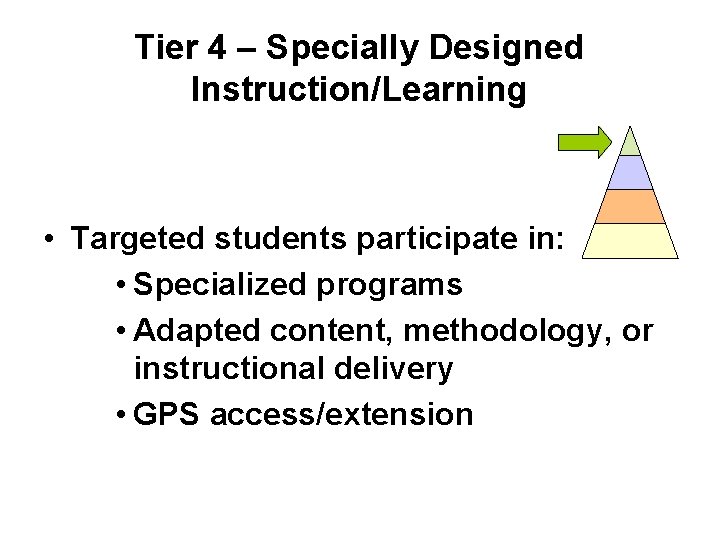
Tier 4 – Specially Designed Instruction/Learning • Targeted students participate in: • Specialized programs • Adapted content, methodology, or instructional delivery • GPS access/extension
Where do we begin? Take stock of what you already have in place. In other words, what’s your baseline or entry level in terms of… – – Perceptions, attitudes and understanding? Learning and instructional practices at Tier 1? Assessment and progress monitoring tools? Supplemental interventions (Tier 2) and which students are targeted? – Problem solving teams? – Roles and responsibilities? – Resources?
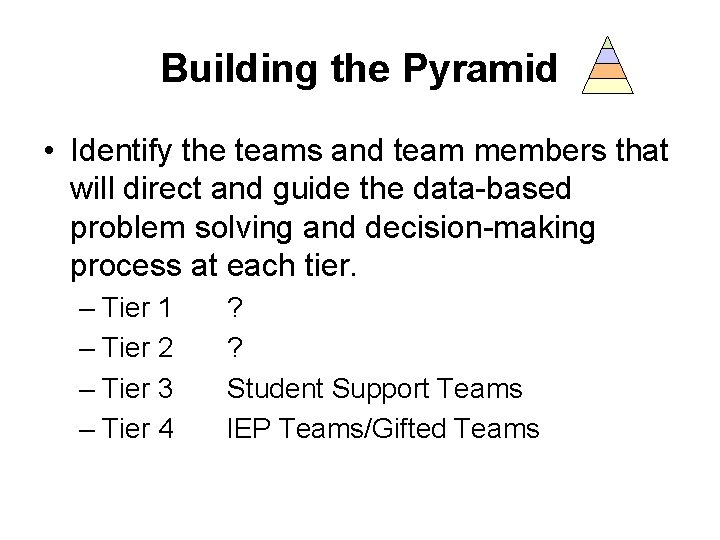
Building the Pyramid • Identify the teams and team members that will direct and guide the data-based problem solving and decision-making process at each tier. – Tier 1 – Tier 2 – Tier 3 – Tier 4 ? ? Student Support Teams IEP Teams/Gifted Teams
Building the Pyramid Standardize use of data and decision rules to determine instructional programming for Tiers 1 and 2 • What score/percentage will be used to determine need for supplemental interventions (cut-off points)? • What criteria will be considered proficient? 80% or higher? • How many data points will be required before changing the instruction or intervention? • What scores (rate, slope, percent of mastery) will determine sufficient level of responsiveness?
Building the Pyramid • Student and Family Involvement and Support – Does support for parents change when students need and receive more intensive intervention? – See “School Keys” from Ga. DOE (page 44) • • • Communication Parenting Skills Assisting in Student Learning Parents Welcome in the School Parents as Full Partners Community Resources
Avoiding Pitfalls to Full Scale Implementation • Build awareness, consensus, and understanding of the Pyramid of Interventions and the need for problem solving and RTI. – How they relate to other mandates. – How they relate to shared values in the school. • Build infrastructure before innovation is added. – On-going professional learning for all staff – Time for professionals to collaborate, problem solve – Re-examine roles and resources
The Pyramid of Interventions and RTI are… …a work in progress!
The Student Support Team Association for Georgia Educators provides leadership through collaboration, learning and advocacy to enhance student competence. www. sstage. org
References: • • • Allison, R. , & Ikeda, M. , From Theory to Practice: Critical Considerations for Response to Intervention, Iowa Department of Education, (2006) Batsche, G. , Elliot, J. , Graden, J. L. , Grimes, J. , Kovaleski, J. F. , Prasse, D. , Reschly, D. J. , Schrag, J. , & Tilly III, W. D. , (2005), Response to intervention: Policy considerations and implementation, Alexandria, VA, National Association of State Directors of Special Education, Inc. Batsche, George M. , Problem-Solving and Response to Intervention: Implications for Policy and Practice, G-Case, Savannah, GA, 2006 Bergan, J. R. (1977) Behavioral consultation. Columbus, OH, Charles E. Merrill Brown-Chidsey, Rachel & Steege, Mark W. (2005) Response to intervention: principals and strategies for effective instruction. New York, NY: The Guilford Press. Bootel, J. , Holland-Coviello. R. , Wen-Yu Lee. S. , Progress Monitoring in a Response to Intervention World: Helping Classrooms to Implement Best Practices, National Center on Student Progress Monitoring, CEC 2007 Annual Convention, April 21, 2007 Deno, S. (1985). Curriculum-based measurement: The emerging alternative. Exceptional Children, 52, 219 -232. Deojay, T. R. , & Pennington, L. L. (2004) Content: Connecting data, professional development, and student achievement. In Powerful designs for professional learning. Easton, L. (ed. ), Oxford, OH, National Staff Development Council Donaldson, Whitney (2005, November) When Assessment Isn’t Enough: Understanding Student Progress Monitoring; National Center on Student Progress Monitoring.
References: • • • Du. Four, R. , Eaker, R. , Karhanek, G. (2004), Whatever it takes: How professional learning communities respond when kids don’t learn. Bloomington, IN, National Educational Service Ed. Checkup – sample of maze www. edcheckup. com Fuchs, L. S. , LD Identification: Using CBM to Identify Students Who Are Not Responsive to Instruction, [www. studentprogress. org]. Fuchs, L. S. , & Fuchs, D. , Applying Progress Monitoring to RTI Prevention and Identification, , Vanderbilt University, [www. studentprogress. org] Fuchs, Lynn S. & Oxaal, Ingrid , PROGRESS MONITORING: What, Why, How, When, Where, Office of Special Education Programs, U. S. Department of Education, [www. studentprogress. org]. Rathvon, Natalie, (1999) Effective Interventions: Strategies for Enhancing Academic Achievement and Social Competence, The Guilford School Practitioner Series, Safer, Nancy; Donaldson, Whitney & Oxaal, Ingrid (2005, March) Using Progress Monitoring to Develop Strong IEPs, OSEP Leadership Conference, (PPT presentation). Tilly, D. (2003, December). Heartland Area Education Agency’s evolution from four to three tiers: Our journey - our results. Paper presented at the National Research Center on Learning Disabilities Responsiveness-to-Intervention Symposium, Kansas City, MO. Whitney Donaldson, W. , Kim K. , Short, S. , Choosing a Progress Monitoring Tool That Works for You, Student Progress Monitoring (PPT presentation).
Websites: Just a start… • Progress monitoring, interventions & links www. interventioncentral. org • Progress monitoring www. studentprogress. org • Interventions www. whatworks. ed. gov (What Works Clearinghouse) • Universal Design for Learning www. cast. org • Georgia’s DOE Implementation Manual – “General Education Interventions” chapter http: //www. doe. k 12. ga. us/ci_exceptional. asp x? Page. Req=CIEXCImp. Man
To contact us: Lynn L. Pennington Office: 770 -752 -9941 lynchpenn@aol. com Frank Smith Office: 404 -656 -5805 fsmith@doe. k 12. ga. us © 2008 All Rights Reserved